Introduction
Cannabis is the most widely used illicit recreational drug in the world (UNODC, 2007). Increasing evidence suggests that cannabis use may constitute a risk to psychosis in individuals with no previous history of a psychotic illness (for review, see Moore et al. Reference Moore, Zammit, Lingford-Hughes, Barnes, Jones, Burke and Lewis2007). The use of cannabis is widespread in age groups (15–30 years) at risk for the onset of schizophrenia and other psychotic disorders. However, most users of cannabis, including heavy users of the most potent varieties (collectively referred to as ‘skunk’), do not go on to develop psychosis and many diagnosed psychotics have never used cannabis. Individuals vary in their sensitivity to acute administration of THC with some developing full-blown paranoia at doses that barely affect others (Favrat et al. Reference Favrat, Ménétrey, Augsburger, Rothuizen, Appenseller, Buclin, Pin, Mangin and Giroud2005). For a minority, the psychotic symptoms experienced during cannabis use develop into a psychotic episode well beyond withdrawal from the drug. A variety of factors have been suggested to predispose an individual to experiencing the harmful effects of cannabis, including genetics, age of first use and degree of use (Di Forti et al. Reference Di Forti, Morrison, Butt and Murray2007).
Another factor which has been suggested to account determine how vulnerable an individual is to the harmful effects of cannabis is their underlying psychosis proneness or schizotypy. Higher levels of psychosis proneness have been found in cannabis-using populations as a whole (Williams et al. Reference Williams, Wellman and Rawlins1996; Skosnik et al. Reference Skosnik, Spatz-Glenn and Park2001). However, it has been further suggested that those prone to psychosis (so called highly ‘schizotypal’ individuals) may be particularly at risk during acute exposure to cannabis. To examine this link between acute cannabis use and psychosis proneness, Verdoux et al. (Reference Verdoux, Gindre, Sorbara, Tournier and Swendsen2003) conducted an interesting naturalistic study of 79 university students who were cannabis users, using an experience-sampling method. This study found that those who scored higher on a questionnaire (Community Assessment of Psychic Experiences; CAPE) measure of psychosis proneness reported more unusual perceptions, feelings of ‘thought influence’ and hostility when they had smoked cannabis; in contrast, those with lower CAPE scores reported feeling at ease with the world and enhanced pleasant atmosphere. Furthermore, when asked to retrospectively recall cannabis' effects, psychosis-like experiences are reported more commonly in highly psychosis-prone individuals (Barkus et al. Reference Barkus, Stirling, Hopkins and Lewis2006). Barkus & Lewis (Reference Barkus and Lewis2008) have recently replicated these results in a web-based questionnaire study, extending the findings to additionally include pleasurable experiences. One interpretation of these results has been to suggest a ‘causal’ relationship as opposed to merely an ‘association’ (whereby those prone to psychosis are simply drawn to cannabis use). However, few studies have been genuinely experimental, in the sense of being able to measure the psychotomimetic effects of cannabis systematically at the time of intoxication. Typically, both the nature of the intake of cannabis and its effects have relied on self-report after the event and may be conflated both with the trait measures of psychosis proneness with which they are compared, and confounded by the acute memory-impairing effects of cannabis. In Verdoux et al.'s (Reference Verdoux, Gindre, Sorbara, Tournier and Swendsen2003) study, the random experience-sampling at 3-h intervals meant there was considerable variation between when the drug was smoked and the reporting of symptoms. In addition, state measures of symptoms may also be conflated with the trait measures of psychosis proneness with which they are compared. Clear differentiation of trait and state measures is important.
Therefore the present study set out to test cannabis users when under the acute effects of the drug in a naturalistic setting and again when drug free. To explore trait/state interactions, we used both the Schizotypal Personality Questionnaire (SPQ; Raine, Reference Raine1991), a widely used trait psychosis-proneness measure, together with the recently developed Psychotomimetic States Inventory (PSI; Mason et al. Reference Mason, Morgan, Stefanovic and Curran2008). We hypothesized that highly psychosis-prone individuals would report more marked psychotic experiences under the influence of cannabis across a range of domains of the PSI.
Method
Design and participants
This study used an independent group, repeated-measures design to compare cannabis users and controls on two test days. The first was the day of acute cannabis use for the cannabis group (day 0) and the second was 3–5 days later (days 3–5) following at least 24 h of abstinence. On the first test day, cannabis users were assessed beginning 10–15 min after smoking a ‘spliff’ of their own cannabis.
Current cannabis users (n=140) were recreational smokers who used cannabis at least once a month. The control subjects (n=144) were recruited as non-users of any psychotropic drug (other than alcohol and tobacco) including cannabis for at least 6 months. All participants gave written, witnessed, informed consent on both occasions. This study was approved by the University College London Graduate School ethics committee and its aims were supported by the UK Home Office. In addition, given the ethical issues of studying active cannabis use, the volunteer information sheet stated that researchers did not condone the use of cannabis and participants were provided with a cannabis advice information leaflet (Home Office) following testing and a helpline to contact should they wish to talk to someone about their drug use.
Procedure
Following informed consent, demographic data were collected. Participants then agreed to contact the researchers when next using cannabis recreationally (day 0). Similar testing conditions and time of day were arranged for control participants who contacted the researchers to say when it would be convenient to be tested (day 0). Researchers tested each participant on each test day, either in the participant's own home or in the home of one of their friends. Researchers administered each measure and supervised its completion by each participant. Three to five days later, all participants were individually retested in the same location and a drug history was taken (Morgan et al. Reference Morgan, Rossell, Pepper, Smart, Blackburn, Brandner and Curran2006). Urine samples were taken on day 0 from cannabis users and on days 3–5 from control participants. Urine drug testing was carried out for cannabis, ketamine, opiates, cocaine, amphetamine, methamphetamines/ecstasy and benzodiazepines. The PSI was completed on both testing days: the SPQ and a brief drug history were completed on days 3–5.
Measures
PSI
The PSI is a 48-item questionnaire designed to assess psychotomimetic states or current (state) schizotypal symptomology. Participants rate statements that describe their current experience from 0 (not at all) to 3 (strongly). The PSI yields six subscales: ‘delusional thinking’ (e.g. ‘You feel that you might cause something to happen just by thinking about it’); ‘perceptual distortion’ (e.g. ‘You feel more sensitive to light or the colour or brightness of things’); ‘negative symptoms’ (e.g. ‘You feel rather indifferent about things’); ‘manic experience’ (e.g. ‘Ideas and insights come to you so fast that you can't express them all’); ‘paranoia/suspiciousness’ (e.g. ‘You feel that people have it in for you’); and ‘cognitive disorganization’ (e.g. ‘Your mind jumps a lot from one thing to another’). The scale has a test–retest reliability of 0.84 and a Cronbach's α overall of 0.94.
SPQ
The SPQ is a very widely used questionnaire assessing trait schizotypy (Raine, Reference Raine1991), that yields three subfactors: cognitive/perceptual subfactor (broadly corresponding to positive symptoms); interpersonal subfactor (broadly corresponding to negative symptoms); disorganized subfactor (odd behaviour and odd speech, broadly corresponding to cognitive symptoms).
Statistical analysis
Demographic data were analysed with t tests or Mann–Whitney U tests where data were non-parametric. The psychosis-proneness data were analysed first with a 2×2 repeated-measures ANOVA (rmANOVA) with one within-subjects factor of day (0, 3–5) and one between-subjects factor of drug group (cannabis user, control). High and low psychosis-prone individuals were selected by taking those individuals scoring above and below the top and bottom quartiles using norms of the SPQ. For the subgroup analysis, this additional between-subjects factor of SPQ group (high, low) was added to the rmANOVA. Pearson's correlations were conducted between drug-use data and schizotypy scores and between factors of the SPQ and the PSI.
Results
Demographics and drug use
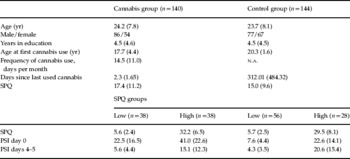
Table 1 presents demographic and drug-use data from the two groups. There were no differences in terms of age and education. The cannabis group were significantly more schizotypal (t=2.0, p=0.047), although this had a very small effect size (d'=0.12, r=0.12). Groups of high- and low-scoring schizotypal participants were created using upper and lower quartile divisions using norms for the SPQ (see Table 1 for mean scores of these groups).
Group means (standard deviations) for demographic data and cannabis use

SPQ, Schizotypal Personality Questionnaire; PSI, Psychotomimetic States Inventory.
Reports of other psychotropic drug use suggested that this was at very low levels in the control group both in terms of lifetime and recent use; of 132 successfully urine tested, none tested positive for illicit drug use. Rates of recent drug use in the cannabis users were also relatively low: five reported use of amphetamines, 30 cocaine, three ketamine and four LSD in the previous 3 weeks. Urine drug screens showed all tested positive for cannabis and 11 for stimulants on day 0. At time of day 0 testing, ten of the cannabis group (7%) and 21 of the control group (15%) reported also consuming alcohol. At days 3–4, three of the cannabis group (2%) and six of the control group (4%) reported consuming alcohol. Statistical effects remained when one or other group of drug and alcohol users was removed and so results have been reported on the sample as a whole.
Acute psychotomimetic effects
Whole sample
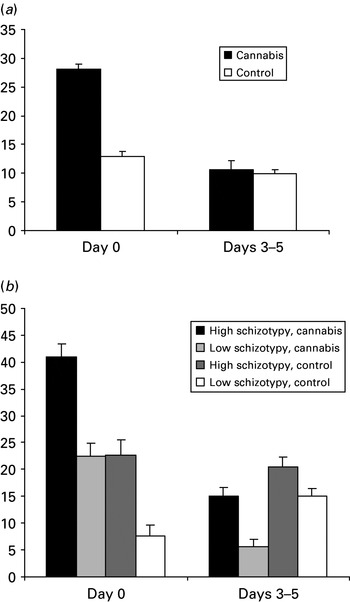
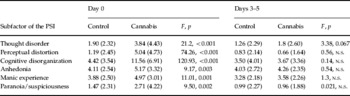
A 2×2 rmANOVA yielded a significant day×group interaction [F(1, 282)=80.88, p<0.001] and significant main effects of day [F(1, 282)=162.31, p<0.001] and group [F(1, 282)=41.33, p<0.001]. Simple effects revealed a significantly greater psychotomimetic effects on day 0 [F(1, 282)=74.49, p<0.001] in the cannabis users compared to controls but no differences on day 3 (see Fig. 1a). There were significant differences between the groups on day 0 for each subfactor of the PSI and no differences on day 3 (a trend for greater thought disorder in the cannabis users was observed but did not survive Bonferroni correction; see Table 2 for means, and F and p values).
(a) Mean Psychotomimetic States Inventory (PSI) scores across day and drug-user group. (b) Mean PSI scores across day, Schizotypal Personality Questionnaire (SPQ) group and drug-user group (bars represent standard errors).

Means (standard deviations) for the subfactors of the PSI across day and group

PSI, Psychotomimetic States Inventory.
High and low schizotypy groups
A 2×2×2 rmANOVA was conducted, adding total SPQ score as a covariate to attempt to account for the difference in SPQ between cannabis and non-cannabis using groups. This analysis yielded a significant day×drug group×SPQ group interaction [F(1, 155)=4.82, p=0.03] along with a significant day×group interaction [F(1, 155)=60.14, p<0.001] and main effects of day [F(1, 155)=13.23, p<0.001] and group [F(1, 155)=17.13, p<0.001]. To explore the significant three-way interaction difference scores between day 0 and days 3–5 PSI scores were calculated to give an index of change in psychotomimetic symptoms. Significant group differences were observed in the change in psychotomimetic symptoms between day 0 and days 3–5 in the cannabis group [F(1, 73)=6.91, p=0.01], reflecting a greater change across days in the highly psychosis-prone subjects but no differences between the high and low psychosis-prone controls were observed (see Fig. 1b).
To investigate the effects of frequency of cannabis use, the difference score was correlated with frequency of use in the cannabis-using group as a whole. A greater psychotomimetic state effect was associated with less frequent usage of cannabis (r=0.33, p<0.005). However, frequency of cannabis use did not correlate with overall SPQ score in the cannabis users.
Discussion
The main finding of this study was of elevated levels of psychotic-like symptoms following acute cannabis use in users who exhibited high levels of psychosis proneness, along with evidence of greater psychotomimetic symptoms in this group even when not acutely intoxicated. The study also demonstrated that smoked cannabis in a naturalistic setting reliably increased psychotic-like symptoms across all users, even after controlling for marginally elevated levels of psychosis proneness in this group. Increasing use of the drug was associated with decreasing scores on the PSI suggesting that increasing use may bring tolerance to the psychotomimetic effects of cannabis. However, psychosis proneness itself was not associated with frequency of use.
This study found that trait psychosis-proneness potentiated the psychotomimetic effects of cannabis and is thus consistent with several previous studies (Verdoux et al. Reference Verdoux, Gindre, Sorbara, Tournier and Swendsen2003; Barkus et al. Reference Barkus, Stirling, Hopkins and Lewis2006; Barkus & Lewis, Reference Barkus and Lewis2008). However, this study extends prior findings in cannabis users which employed experience-sampling methods or retrospective recall as we clearly demonstrated greater psychomimetic effects of cannabis being experienced by high psychosis-prone individuals during actual acute cannabis intoxication. Speculatively, as dopaminergic hyper-responsivity in schizotypal individuals has been observed (Soliman et al. Reference Soliman, O'Driscoll, Pruessner, Holahan, Boileau, Gagnon and Dagher2007), cannabis-stimulated dopamine release may be the neurochemical basis of the elevation in psychotomimetic symptoms.
Of relevance to the debate over the link between cannabis use and psychosis, this study found that highly schizotypal individuals also reported a greater resting level of psychotomimetic experiences than lower scorers, i.e. when drug free for at least 24 h. Given that the majority of the sample fall within the age of relatively high risk of onset of a psychotic disorder, this is clear evidence that psychotic symptoms are most likely to appear following cannabis use in those psychometrically most at risk of disorder. Clearly, there is considerable debate about the existence of a causal relationship between cannabis use and psychosis (e.g. Henquet et al. Reference Henquet, Krabbendam, Spauwen, Kaplan, Lieb, Wittchen and van Os2005; Hickman et al. Reference Hickman, Vickerman, Macleod, Kirkbride and Jones2007; Moore et al. Reference Moore, Zammit, Lingford-Hughes, Barnes, Jones, Burke and Lewis2007). While it is difficult to infer causality from a cross-sectional study of this kind, one may speculate that regularly experiencing psychotic-like symptoms whilst under the acute effects of a drug, might put some individuals at a greater risk of developing psychosis. The current findings also further validate a new measure of psychotomimetic states, the PSI (Mason et al. Reference Mason, Morgan, Stefanovic and Curran2008).
The present study demonstrated that the acute subjective effects of cannabis mimic a wide range of the signs and symptoms of schizophrenia in a naturalistic setting. While this has previously been demonstrated in the laboratory using pharmaceutical intravenous Δ9-THC (e.g. D'Souza et al. Reference D'Souza, Perry, MacDougall, Ammerman, Cooper, Wu, Braley, Gueorguieve and Krystal2004), rigorous psychometric measurement using ‘street’ cannabis in drug-taking contexts has not hitherto been demonstrated. Further evidence that the subjective psychotomimetic effects of acute cannabis were reliably measured comes from the finding of reduced effects in those with greater recent usage, which is consistent with other findings of blunted effects of THC in frequent users of the drug (D'Souza et al. Reference D'Souza, Ranganathan, Braley, Gueorguieva, Zimolo, Cooper, Perry and Krystal2008). It was not possible to examine dose–response relationships as little reliable information on either quantity or potency of the cannabis used was available. We also had no measure of the relative cannabinoid content of spliffs smoked which recent evidence suggests may be important in determining psychotic-like effects, especially the relative balance between THC and cannabidiol (Morgan & Curran, Reference Morgan and Curran2008). There was no evidence for a relationship between reported frequency of cannabis use and degree of psychosis proneness. This suggests that degree of cannabis use is not a confounding variable accounting for our main finding, of greater cannabis-induced psychotomimetic symptoms in the highly psychosis-prone group. Furthermore, this supports the conclusions of other studies which rejected the notion that cannabis use may be self-medication of psychotic symptoms (e.g. Henquet et al. Reference Henquet, Krabbendam, Spauwen, Kaplan, Lieb, Wittchen and van Os2005; Fergusson et al. Reference Fergusson, Horwood and Ridder2005).
Although this experiment was a naturalistic one lending it considerable ecological validity, it is possible that pre-existing levels of schizotypy or prior chronic drug use are responsible for some of the findings. However, differences in SPQ scores between the groups were small and the effect remained when statistically controlling for this. While other psychotropic drug use was more common in the cannabis group, this applied only to a small minority and did not alter the findings for the acute effects of cannabis and their relationship with schizotypy. It would be interesting to follow-up cannabis users and re-assess them after longer periods of abstinence from the drug. It would also be important to replicate these findings in a study which also employed various genetic makers, including COMT polymorphism, as Henquet et al. (Reference Henquet, Krabbendam, Spauwen, Kaplan, Lieb, Wittchen and van Os2005) showed that trait schizotypy mediated the impact of the COMT polymorphism on sensitivity to the psychosis-like effects of cannabis although this was not replicated in a subsequent study by Zammit et al. (Reference Zammit, Spurlock, Williams, Norton, Williams, O'Donovan and Owen2007).
In summary, the present study found evidence of higher levels of acute cannabis-induced psychotomimetic symptoms in users of the drug who were high in psychosis proneness. Further, there was evidence of a blunted response which may suggest tolerance to psychotomimetic symptoms across all cannabis users. However, degree of cannabis use appeared to be unrelated to existing psychosis proneness. Individuals who were high in psychosis proneness exhibited greater levels of psychotomimetic symptoms when drug free, even when trait psychosis proneness was controlled for. Taken together these findings suggest that both existing psychosis proneness and an individual's acute response to the cannabis may represent a risk factor for experiencing harmful effects of the drug.
Acknowledgements
We thank Chief Inspector Alan McFarlane of the UK Home Office for supporting the aims of this study. C.J.A.M. was supported by a grant to H.V.C. from ESRC (RES-000-23-0945).
Declaration of Interest
None.