In a January 1906 alumni banquet speech in Madison, University of Wisconsin history professor Frederick Jackson Turner observed that intercollegiate football's popularity had led some universities to conduct themselves in a manner unbecoming to institutions of higher education. “The public has pushed its influence inside the college walls,” proclaimed Turner, thus “making it impossible for faculties and for the clean and healthy masses of the students to keep athletics honest and rightly related to a sane university life.”Footnote 1 Turner was just one of many who critiqued football during the winter following the disastrous season of 1905. That fall, eighteen college and high school players died on gridirons around the country, drawing the attention of progressives such as President Theodore Roosevelt and inspiring the creation of the precursor to the National Collegiate Athletic Association (NCAA).Footnote 2 As Turner's speech indicated, critical observers did not only worry about players' health. They were also concerned about the effects on the modern university, an important progressive institution. Just two months before Turner spoke, Collier's magazine had published a series on midwestern college football, titled “Buying Football Victories.” Written by a young muckraker named Edward S. Jordan, these articles echoed Lincoln Steffens's 1902–03 Shame of the Cities series on municipal graft. A graduate of the Madison campus and a reporter for the Milwaukee Journal,Footnote 3 Jordan included in his Collier's series an article that accused the University of Wisconsin's football program of rampant corruption. He claimed that the university's athletic association had rigged elections and that the team had included “professionals”; he even charged a law professor with arranging state sinecures for the “football men.” These athletes “packed political mass meetings, cheered and hissed speakers in turn, and gained a livelihood by a perversion of the fundamental principles of the service of the State. They learned all the bad tricks of politics, came to admire chicanery, and taught its effectiveness to the undergraduates they controlled.”Footnote 4
The starters for the 1901 University of Wisconsin football team. Four years after this squad went undefeated (9–0), history Professor Frederick Jackson Turner critiqued football in an alumni banquet speech in Madison. Courtesy of the University of Wisconsin—Madison Archives.

Historian John Sayle Watterson has argued that Jordan's accusations likely possessed some truth.Footnote 5 However, even more significant than the specific claims, Jordan's articles and Turner's speech provide a lens through which one can analyze the meaning of Progressive Era football reform. At the turn of the century, state universities like Wisconsin—as well as privately endowed institutions of higher education and research like the University of Chicago—were expanding in size and developing specialized academic programs.Footnote 6 They were also striving for social utility, claiming to serve as the political, economic, and cultural leaders of American society. In Madison, the Wisconsin Idea touted university–government cooperation,Footnote 7 whereas the new university on Chicago's South Side tried to engage city dwellers and uplift urban life.Footnote 8 However, intercollegiate football, one of the most visible elements of the American university system, complicated the relationship between universities and the society they hoped to serve. The intercollegiate sport began as a soccer-style game in 1869; its popularity grew in the following decades as colleges began playing rugby and as innovators introduced the rules that turned the game into a rational, measured, and physically strenuous spectacle. By the early 1900s football held a prominent place in both university life and popular culture. Spectators flocked to intercollegiate contests by the tens of thousands, and many more consumed accounts in daily newspapers.Footnote 9 As observers during the Progressive Era began to perceive the sport as hazardous to the health and morals of colleges and college-age men, football became, like impure food and drugs, a celebrated cause for public concern and progressive reform.Footnote 10
This article uses intercollegiate football reform to explore the tense relationship between popular culture and academic institutions during the Progressive Era. Football was an important facet of many colleges and universities in the late 1800s and early 1900s.Footnote 11 Additionally, cultural scholar Michael Oriard shows that the sport, since the 1880s, has served as a lightning rod for popular discourses about race, class, gender, and work.Footnote 12 Certainly, intercollegiate football is an important element of American cultural and social history. However, it is also more than just another cultural text or one more subject of social reform to be added to the Progressive Era pantheon. Football did not just fill the sports pages. Located in between the academy and popular culture, it also occupied the time, energy, and pens of intellectuals and educators, including prominent social scientists like Turner, Edward A. Ross, Thorstein Veblen, and William I. Thomas, as well as university leaders like William Rainey Harper. Scholars from diverse disciplinary backgrounds theorized universities as spaces for training middle-class, “manly” morals and perceived football as an activity essential for imparting these traits and for maintaining American “civilization.”Footnote 13 Properly regulated football, many argued, could cultivate biological or moral characteristics seemingly necessary for white male citizens, without negatively affecting institutions of higher learning. Reform, in other words, could help retain football and its supposed lessons while preserving the Progressive Era academy as a rational, academic, and respectable space located beyond the reach of mass culture and popular influence.
Football reformers thus wrestled with the paradox at the center of progressive thought between democratic practice and popular involvement on one side and professionalism and expertise on the other. To illuminate the meaning of this apparent paradox, this study pushes the scope of analysis beyond the standard narrative of universities' involvement in Progressive Era government, culture, and society. Universities facilitated reform, but these institutions were themselves in need of care and attention. Commentators often touted football's potential benefits for students and society, but they also exhibited concern for the game's undesired effects. Like Turner, many progressives feared that sport, rather than providing a way for universities to exert positive influence upon American life, might allow untutored “public influence” to intrude within the university walls, filling them with graft and corrupting an otherwise uplifting institution. Debates about football and various attempts at reform represented ambivalence regarding the relationship between higher learning and the American people. Through universities, progressives hoped to further their goal of forming a rational, educated public that would support right-minded reform and serve as an articulate, moderate voice to anchor society. In turn, the public was supposed to treat institutions with rational deference. The popular spectacle of intercollegiate football complicated this scenario. According to critics, football allowed potentially irrational, or non-rational, crowds to pollute universities—the spaces in which progressive minds, bodies, and morals originated.Footnote 14 The same reformers who hoped to craft the socially useful university also wanted to ensure that universities would remain useful to a rational society without being transformed by irrational elements within that society. As a result, they sought reforms that would limit popular influence, while still preserving the intercollegiate game and its presumed social effects.
Football and College Men
Reformers wanted to regulate intercollegiate football because they saw it as a venue in which the pursuit of money, fame, and pleasure held the power to corrupt. This was an especial concern at a time when an increasing percentage of American youth were attending college, and universities were expanding at unprecedented rates. Harvard and Michigan enrolled around 4,000 students each in 1905, whereas Wisconsin and Chicago each had about 2,500. Thirty years earlier Harvard enrolled about 1,300 and Michigan about 1,100.Footnote 15 Within these growing, research-oriented universities, students developed a campus culture that often flouted traditional, nineteenth-century college ideals. Whereas colleges had once sought to discipline students through study and close supervision, expanding universities increasingly left students to their own devices. Soon, extracurricular activities—fraternities, choral societies, yearbooks, newspapers, and athletics—came to dominate university life. For critical observers, like Princeton's Woodrow Wilson, the “side shows” had “swallowed up the circus.”Footnote 16
Albert Shaw, editor of the American Review of Reviews, was a vocal critic of this new variety of university life. Like other social scientists and progressive intellectuals who grappled with the issue of football reform (including E.A. Ross, Frederick Jackson Turner, and Thomas Moran), Shaw had studied at John Hopkins with the German-trained scholar Richard T. Ely, a public intellectual whose critiques of laissez-faire shaped Progressive Era economics and society.Footnote 17 A well-known proponent of municipal government reform, Shaw critiqued student culture at the bloated universities. He noted in 1909 that “drunkenness, gambling, lavish expenditure, and scandalous practices of other sorts” had once been alien to American higher education. In Shaw's view, legendary college leaders like Mark Hopkins of Williams and Theodore Dwight Woolsey of Yale had taught, inspired, and disciplined students. In the early 1900s, however, “social clubs and luxurious cliques” had transformed the college youth into “an experienced club man” spending money carelessly on cocktails and fine living. College, rather than strengthening discipline, might now “spoil young men for lives of real industry, real intellectual vigor, and real moral power.”Footnote 18 More generally, Progressive Era municipal reformer Delos Wilcox warned in The American City that betting “at a foot-ball game”—like gambling at bucket shops, races, and elections—led to an unhealthy “competitive spirit” and made democracy “impossible.”Footnote 19
Concerns about wealth and lack of discipline represented an enduring motif in American life. In the antebellum period, Whig educational philosophers and sentimental moralists sought to tame students' “animal spirits” through study and gymnastics. By the early 1900s antimodernists espoused competitive athletics as a way to instill martial order and republican self-control.Footnote 20 Discipline was necessary in the era of quick money and political opportunism that supposedly characterized the late 1800s. Reformers were trying to contain the influence of bosses and business tycoons and create a democratic society based on purer political conduct and civic spirit as opposed to self-interest. However, as concern over machine politics indicated—and debates over football confirmed—progressive reform also reflected middle-class fears about the corrupting influence of popular culture. Football's commercial appeal, wagering potential,Footnote 21 and resemblance to violent modes of working-class leisure, like prizefighting,Footnote 22 might taint the ostensibly pure spaces of modern American public life. Popular intercollegiate sport, if not regulated properly, could make athletes into immoral celebrity performers and turn potentially progressive and useful universities into corrupt sponsors of entertaining spectacle. Even worse, instead of uplifting students and the public, football might transform them into unthinking consumers of that spectacle.Footnote 23
Nonetheless, some observers were optimistic about football's potential. At its best, supposedly, the sport could create a morality of self-control among students and promote genteel manliness.Footnote 24 These characteristics, in turn, would presumably help middle-class students improve American society. At a 1901 Stanford football rally, economics professor Burt Estes Howard stated that he expected Stanford to win the upcoming game against the University of California, but he implored the team to play only “clean football” and win only via honest means: “Do not come back to us with a stain on our colors. An unclean victory is the worst possible defeat …. It isn't winning the game, but being men that counts.” The theme of cleanliness and manliness was also present in Howard's 1901 volume Education and Democracy, which dismissed disputes between populists' proposed bimetallic monetary standard and conservatives' gold standard as a superficial representation of a deeper problem: “The great struggle before us is not a struggle for a kind of money, but for a kind of man.” A democratic society was more than a “political machine,” said Howard; “It is manhood sharing the burden of state.” Offices needed to be “administered by the best men in the best way to conserve the public weal.”Footnote 25 Howard's pronouncements implied that only the leadership of clean and honest men, especially those trained in colleges with pure athletic programs, could prevent corruption.
Many, though, were ambivalent about football's educational potential. Harvard economist Frank W. Taussig argued that sports were good because they could promote “loyalty and public spirit” among students, but he also feared that they led to bodily injury and damaged “the moral and intellectual ideas” of college men. In particular, the public's vast expenditure on the football spectacle prompted students to spend too much money on the games. As in politics, enthusiasm was good but it should not steal the show: “Intercollegiate contests are as surely proofs of a healthy state of body and mind among our college students as a keen party spirit, with all its excesses, is proof of a healthy activity in the political life of the country.” The public's overemphasis on athletics, though, gave a “false impression of the part which the colleges do play and must play in the community, as training-places for educated, intelligent, public-spirited, rightly guided, and rightly ambitious men and citizens.” Colleges needed to teach “discipline,” said Taussig, but an overemphasis on athletics might limit their ability to fulfill this mission. He implied that the leaders of college athletics, like organizers of political campaigns, needed to make sure that they were not pandering to the untutored masses.Footnote 26 Others made an even less favorable comparison between politics and football. Albert Shaw proclaimed in 1909 that college athletics comprised “a network of commercialism that thoroughly Tammany-izes what ought to be decorous and fine, like contests in the English universities.”Footnote 27
The comparison between football and late-nineteenth-century politics was telling. Through much of the 1800s, organizers of political campaigns emphasized spectacle over more staid exposition of the platforms and key issues.Footnote 28 In the same way that many observers were concerned about spectacle, sensation, and personality driving substance from the political process, Taussig, Shaw, and others were alarmed about football's implications for America's universities. Popular spectacle held the potential to transform colleges into debased spaces for creating dissipated men, instead of pure spaces for instilling manly discipline and public spirit. This problem, ultimately, resonated with those most interested in preserving the progressive character of American universities, and society, via higher education and football reform.
Madison and Chicago: Blueprints for the Progressive Era University
Madison and Chicago were the locations of concerted efforts to create model progressive institutions of higher learning at the turn of the century. Madison was a state capital where politicians and academics pioneered the Wisconsin Idea of government, which sought to increase participation in government and make universities useful to the public. According to Wisconsin progressives like Governor Robert M. La Follette, University of Wisconsin President Charles R. Van Hise, and State Legislative Librarian Charles McCarthy, the state university should serve as a fountainhead of reform. It would fulfill this role by producing policy experts, disseminating knowledge throughout the state, and encouraging faculty to serve on public commissions.Footnote 29 To spread university knowledge throughout Wisconsin, the institution also pioneered the university extension movement in the 1880s and helped to revive it in 1905. Based on European models, Wisconsin's extension program reached workers, farmers, and interested laymen through lecture courses, agricultural instruction, and mechanics institutes in urban centers like Milwaukee. The university in Madison also served as inspiration for other states. Ohio and Kansas sent delegations to study the extension division, and Texas consciously modeled its university on Wisconsin's.Footnote 30 Lincoln Steffens praised the institution for establishing a “new ideal for education” throughout the nation and the world. He wrote in 1909 that the university was “offering to teach anybody—anything—anywhere.” It was becoming an essential component of the state's collective “brain.”Footnote 31
Key supporters of the Wisconsin Idea included Frederick Jackson Turner, Richard T. Ely (who left Johns Hopkins for Madison in 1892), labor scholar John R. Commons, and sociologist Edward A. Ross. These were just a few of the professors who taught extension courses, staffed public commissions, and promoted Wisconsin's progressive system of government and education. Quoted in McCarthy's book on the Wisconsin Idea, Turner wrote that the university should positively affect society through “scientific” study of industry, government, and agriculture. Its expert investigators should be recruited from the “masses” and receive university training. This educational investment would protect the public against both “the passionate impulses of the mob” and unscrupulous capitalists.Footnote 32 In Turner's formulation, the state university provided a doubly important service. First, it formed a rational public by educating and polishing the state's young men and women so that they could resist the magnetic appeal of irrational crowds. Second, it groomed some of these young people to occupy key government and academic positions, in which they would serve as stewards of the public interest.
Proponents of the Wisconsin Idea presumed that universities existed to uplift some members of the working classes and to protect the middle class from both top and bottom of society. A state university crafted policies and trained future leaders; to protect its ability to fulfill both functions it had to maintain its purity. The university was an institution of the people, designed to affect the people, but it should not be unduly affected by the people. Or, at least, it should not be affected by the wrong people, the people who did not cherish the public interest and possess a reform spirit. In progressive parlance, the “public” signified the people at large in a properly functioning democracy: rational, thoughtful, orderly, and constructive. An irrational, disorderly group was a “mob,” or a “crowd.” Although fear of the mob dated to the colonial period and beyond, it was particularly relevant in an era of labor unrest and financial panics and found expression in a transatlantic discourse of suggestibility and crowd psychology shaped by Gustave Le Bon and Boris Sidis.Footnote 33 An important theorist of the mob mentality was Wisconsin sociologist Edward A. Ross, who had taught alongside other important West Coast progressive social scientists before his controversial dismissal from Stanford in 1900.Footnote 34 The author of pioneer studies on social order, Ross claimed that the “mob mind” was the product of new communications technologies like high-speed printing presses, which quickly spread volatile ideas through the supposedly unthinking masses. He warned that the mob mentality was particularly dangerous for modern society because crowds acted on emotions instead of rational faculties. Unlike a public that engaged in constructive debate, crowds muted sense in favor of sensation. According to Ross, the cultural phenomenon of the “mob mind” led to virtually uncontrollable modern social phenomena like religious revivals, economic bubbles, and land speculation.Footnote 35 Spectator sports could not be far behind.
Social scientists like Ross were participating in a Progressive Era discussion about the meaning and shape of the public sphere. Although progressives themselves were aided by communication technology, they were also wary of the popular press's ability to shape public discourse through sensationalism and marketing strategies that targeted diverse social groups.Footnote 36 According to such thinkers, those who supported the university's mission of reason and fair-minded expertise—as well as those who imbibed that mentality at the university—composed an educated and rational public. In contrast, those who sought a different kind of meaning and purpose from university activities like football comprised a crowd located outside the public. Football was a promising, yet dangerous, collegiate sport because it evoked multiple meanings among different constituencies. Progressive educators and scholars, especially in the social sciences, claimed that football's purpose, fulfilled when the sport was properly regulated, was to teach college men morality and discipline. However, for many of the individuals filling the stands and forming a crowd of questionable rationality, football might be just an entertaining spectacle, an opportunity for gambling, or an exciting chance to view physical brutality. For those possessing a progressive vision of universities as spaces for the creation of a rational, truly democratic public and an orderly society, these were hardly legitimate reasons for university sponsorship of football.
Although Wisconsin was the prototypical public university that nourished state government and culture, some institutions funded with private money also hoped to contribute to Progressive Era society by shaping urban life. Another major midwestern research institution, the University of Chicago, had its own ways of trying to affect the people located outside its gothic walls. Funded by the largesse of oil baron John D. Rockefeller in the 1890s, the new institution located on Chicago's South Side was led by academic prodigy William Rainey Harper. Under Harper's leadership the university sponsored self-consciously academic scholarship from its inception, yet it also tried to reach out to nonacademics. Harper was a leader of the Chautauqua movement, which brought learning to common people in the late 1800s.Footnote 37 Chicago's imposing campus was located alongside the Midway Plaisance, the popular culture center of the 1893 Columbian Exposition. The University of Chicago tried to fulfill the potential of its physical setting and make itself relevant to the city and its masses. Like Jane Addams and other middle-class social activists in the Windy City, men and women in the university's pioneering departments of sociology and social work studied Chicago with hopes of engaging and improving it.Footnote 38 Indeed, Harper's university was another pioneer of university extension. Chicago professors taught practical courses for community members not otherwise enrolled in the university, including working-class immigrants located near settlement houses.Footnote 39 Among the more imaginative interpretations of football, we will see, was an attempt (by a University of Chicago social scientist, no less) to portray spectator sport as a way to engage and educate modern society.
Many progressive scholars at major academic institutions like Madison and Chicago wanted to improve local society, but they also kept an eye closely trained on the extracurricular activities sponsored by their academic homes. From the turn of the century to circa 1910, several professionally trained social scientists contributed to the discourse of football reform in academic or popular venues. Although each had differing opinions and disciplinary orientations, all of these intellectuals showed concern about the ways that intercollegiate football affected universities' public roles. Whereas some feared the influence that the game might bring to bear upon colleges and college men, others relished the possibilities that popular sport held for students or the general public. Football was not just a sideshow of the modern university. It was becoming a main event, and that growing reality was harbinger of both good and ill.
Theorizing Football, Men, Universities, and the Public
Prominent turn-of-the-century social scientists who questioned the shape of the public sphere and critiqued the social utility of college football included Thorstein Veblen and William I. Thomas of Chicago, Frederick Jackson Turner and Edward A. Ross of Wisconsin, and Paul van Dyke of Princeton. These critics came from diverse methodological backgrounds, and each had a unique perspective. Common among such thinkers, though, were two implicit questions that illustrated the issues behind Progressive Era football reform. First, these critics asked in what ways could the game benefit or harm college men. Specifically, they addressed football's utility within a framework of Darwinian evolutionary development and strenuous manliness. Second, they considered how football represented, and even shaped, the relationship between universities and the non-academic population. Whereas several of these thinkers shared F.W. Taussig's fears of an unregulated athletic spectacle's effects on universities and college men, others took a less pessimistic approach. Together, their analyses reveal an underlying intellectual basis for football reform and shed light on several innovations suggested or implemented during the Progressive Era. Intercollegiate football reform was a way to ensure the creation and protection of strenuous men, but it was also a means of making sure that popular culture did not corrupt universities that claimed to prepare students for productive lives in an orderly society.
Turn-of-the-century commentators often discussed football in terms that owed a debt to Darwinian evolutionary theory and its social applications.Footnote 40 Among social scientists, the most explicit to employ Darwinian ideas was W.I. Thomas, a University of Chicago sociologist and anthropologist whose later studies of Polish Chicago established his reputation as a liberal pluralist rather than a Darwinian.Footnote 41 In 1901 Thomas argued that the modern embrace of play was actually a manifestation of a human characteristic called the “gaming instinct.” Bred for millennia, this innate trait resulted from natural selection. Thomas contended that men and women of all social classes and in all societies expressed a hereditary interest in risky or dangerous contests of “skill and chance,” including spectacles like bear-baiting, street-fights, prizefights, bullfights, cockfights, and football. He argued that “instincts developed in the struggle for food and rivalry for mates” had instilled the desire for conflict within the human psyche. These characteristics had evolved throughout millennia, but Thomas warned that modern civilization's advances had begun to negate the progress of biological evolution. (With relief, he noted that not everyone lived monotonous, counter-evolutionary lives: Chicago's gamblers, tramps, and “confidence men” eschewed the predictability of modern life, and even respectable men engaged in risky business like stock market speculation.) Although Thomas demonstrated a nascent formulation of cultural pluralism in this 1901 article, he also drew on prevailing notions of racial hierarchy. Life had become dull and “artificial,” he argued, and the quest for sustenance had lost its challenge. If modern society did not soon heed Darwin's “struggle for existence,” the “white race” would fall behind other racial and ethnic groups populating America's industrial cities. Atavistic behaviors like physically strenuous sport, in other words, could be a means of strengthening and perpetuating America's predominant biological and cultural group.Footnote 42
Essentially, Thomas argued that sports like football could serve as a ritual training ground for the primitive male traits that modern American society seemed to need so badly. Frederick Jackson Turner made a similar claim in his 1906 critique. He alluded to Theodore Roosevelt's “strenuous life” doctrine and praised sport for promoting students' health and for developing the courage necessary to build “American character.”Footnote 43 Like the notable turn-of-the-century psychologist and educational theorist G. Stanley Hall, commentators like Thomas and Turner claimed that physical games that evoked earlier stages in human evolutionary history would protect men from the rigors of modern society by inoculating them with pre-modern experience.Footnote 44 Indeed, Thomas explained that the “gaming instinct” still existed in children's games and college athletics because it possessed a distinctly modern utility: Sport fulfilled the human desire for conflict. He even claimed that football had a special advantage over working-class entertainments like prizefights because it was safer and more highly organized.Footnote 45
Other commentators likewise perceived football's biological and social utility, even if they were more critical of its potential dangers. In an influential 1905 piece in Outlook, a middle-class reform periodical, Princeton historian Paul van Dyke portrayed football as a strenuous, nationally beneficial game. A Presbyterian minister and a specialist in Renaissance history with close ties to European intellectual life, Van Dyke considered the educational value of physical exercise as a timeless truth dating back to Plato. Certainly, he did not fault robust white Americans for delighting in dangerous athletic contests, but he did lament their apparently irrational desire to watch barely skilled teams destroy each other with “brute force.” Nonetheless, he echoed the Darwinian spirit of Thomas's 1901 essay when he proclaimed, “No Saxon community will ever abandon a game simply because it is rough.”Footnote 46 Whereas Thomas saw football as one manifestation of an innate human desire for chance and risky behavior, the expression of which would bolster American society, Van Dyke saw its strenuous facets as an expression of middle-class culture and Anglo-Saxon superiority. However, as we will see, Van Dyke was less enamored of some of football's less savory characteristics, especially the way it seemed to bring corrupting cultural influences into the academy.
Of course, not all scholars influenced by Darwinism perceived football as even a potentially positive element of American higher education. In his 1899 treatise, The Theory of the Leisure Class, Thorstein Veblen, an economist and sociologist at Chicago, critiqued the intercollegiate athletic spectacle as merely another form of “conspicuous consumption” that demonstrated modern America's debauchery. Veblen complained that football was simply a way to shape players' “predatory temperament” and instill qualities of violence and trickery, not virtuous self-control. He argued that the sport was more show than physical culture, and—in one of his characteristically dry, yet colorful passages—insisted that conflating college football with physical education was like confusing a bullfight with animal husbandry: “The material used, whether brute or human, is subjected to careful selection and discipline, in order to secure and accentuate certain aptitudes and propensities which are characteristic of the ferine state.” Athletics thus reflected “an arrested development of the man's moral nature”; it taught “truculence” and “cunning” rather than developing “physique” or “manly spirit.” Football promoted a cultivated “barbarism” more useful in competitive, modern society than in nature, yet it lacked even the “redeeming features of the savage character.”Footnote 47 Veblen's critique read the game's Darwinian influence in reverse, positing it as an uncivilized activity unfit for college students. Rather than echoing evolution's beneficial lessons, the game actually negated them. Football did not promote the beneficial discipline that would save modern society. On the contrary, it promoted a corrupt variety of discipline that permeated industrial American society and culture.
Social scientists like Veblen, Van Dyke, Turner, and Thomas addressed football's consequences for modern American men and society, taking diverse approaches to interpreting the game's cultural meanings. They also considered the way that football illuminated and affected the relationship between universities and the public. Veblen, in particular, expressed concern that an essentially non-academic enterprise could corrupt the academy. Near the end of his itinerant career, Veblen argued in The Higher Learning in America, a volume based on decades spent at institutions like Chicago, that universities should comprise a pure academic sphere untainted by politics, capitalism, or popular culture. The university was an intellectual space, Veblen claimed, and prolonged exposure to the gilded ways of the leisure class could only sully it. Football was a distraction from serious academic pursuits; it brought the backslapping, unreflective culture of the businessman into the academy.Footnote 48 Such distractions diverted attention from the main purposes of America's institutions of higher education and knowledge production. Veblen had a personal stake in this ivory-tower stance. Tenure and widespread adherence to academic freedom were Progressive Era innovations,Footnote 49 and in an era before these professional safeguards, the iconoclastic sociologist—whose personal behavior could be disruptive—was compelled to leave universities bankrolled by industrial tycoons like John Rockefeller (Chicago) and Leland Stanford.Footnote 50 Veblen touted the university as a place for training scholars. He did not want the academy to become a space for producing men adept in a modern perversion of Darwinian competition, a kind of struggle mostly useful for capitalism. Football represented the academy's willingness to submit to base desires originating outside the college walls. Although Veblen was a renegade spirit in many ways, and not a typical progressive, his attitude toward the academy was fairly representative of the era's social scientists and university leaders who wanted to keep certain elements of society from influencing the shape and tenor of institutions of higher learning.
Veblen focused attention on the business class, but others cast their nets more broadly. Shortly before the major, national reforms of 1905–06, Paul van Dyke contended that any “reasonable and dispassionate” person could see that competitive, intercollegiate athletics had become debased. According to Van Dyke, whose analysis echoed the themes of F.W. Taussig's 1895 article, football's evils merely reflected the state of American society. Sometimes critics exaggerated its faults, he conceded, but they often correctly pointed out that football did not improve university life. He argued that football's “material evils” were not intrinsic. Rather, they represented unsavory elements of the modern culture located outside the university:
Gambling is no more a result of football than betting is a result of Presidential elections. And so those subtler evils which do give grounds for just protest … are not the native product of university soil. Seeds have come in from the outside, and through the carelessness of graduates and undergraduates they have grown into a noxious crop of weeds which is a disfigurement to the fields of university athletics.Footnote 51
Through his agricultural metaphor, Van Dyke attempted to place responsibility for the game's problems on the moral shortcomings of national culture. American life, which included an unhealthy fascination with chance—in the form of gambling, which was a special concern for Progressive Era reformers and social criticsFootnote 52—was corrupt, and its corrupt elements had invaded college football. As a result, the American people had sullied the supposedly pure university grounds. Football, Van Dyke claimed, was a potentially beneficial university activity that had to be rescued from the popular influence of the dissipated masses who valued monetary gain and entertainment over education and rational, measured thought.
Like Veblen, Van Dyke saw consumerism as part of the problem. He targeted the mass media as a major reason for collegiate sport's debasement, accusing the popular press of feeding the insatiable desire for brutality. He claimed that more readers wanted to consume stories about prizefights than about political orations, and he estimated that ten times the number of boxing enthusiasts wanted to read about football. The root of football's moral decline, therefore, was the popular desire for “spectacle.” No longer a skillful, educational contest, it had become a sport exhibiting “men of extraordinary weight and strength drilled to mechanical exactness in executing monotonous movements.”Footnote 53 Van Dyke used the common comparison between sport and politics to make his point that the media had caused football's downfall. The game, like so many other elements of American life, was a victim of the crowd, shrouded in “hysterical exaggeration.” To satisfy rabid spectators, football's supporters had transformed it from a game for training strenuous manliness into a corrupt and profitable business that inspired effeminate madness. The notion that a potentially educational experience had become a spectacular end rather than an enlightened means represented a public disgrace. Instead of embracing rational cooperation and responsible politics, Americans craved spectatorship and profiteering.Footnote 54
Speaking just a few months after Van Dyke's essay appeared in The Outlook, Frederick Jackson Turner posited that football needed serious reform if it were to benefit players and spectators.Footnote 55 He supported a proposal that Wisconsin and other Big Nine universities suspend playing football for two years, a stance that prompted students to hang him in effigy and threaten to toss him into Lake Mendota.Footnote 56 Although Turner, like other progressive social scientists, was concerned about football's physical dangers, he worried more about its immorality. He called players “gladiators” and “mercenaries,” complaining that athletes were specialized “experts fighting for victory on a football field,” men whom universities recruited from distant locales because of their physical prowess and skill. College football had “become a business, carried on far too often by professionals, supported by levies on the public, bringing in vast gate receipts, demoralizing student ethics, and confusing the ideals of sport, manliness, and decency.” Like Taussig and Albert Shaw, Turner invoked urban politics: “Tammany Hall methods have no legitimate place in the education of college men.” He also echoed Van Dyke by proclaiming that responsibility lay with the spectators who bought tickets and consumed newspaper accounts. The “vast crowd drawn by the love of spectacle” apparently possessed a greater desire for entertainment than for maintaining the university as a progressive educational institution. Apparently, they would rather support a “football giant” than the hardworking students who would comprise a generation of state leaders.Footnote 57 For a proponent of the Wisconsin Idea, this was untenable. By succumbing to market forces and capricious sports enthusiasts, universities were letting non-academics degrade institutions that served the state, institutions capable of aiding government and carrying out selective social uplift. Unregulated football appealed to the lowest common denominator, allowing the multitude to corrupt an otherwise healthy, educational middle-class ritual.
W.I. Thomas's view of the game's potential, in his anthropological discussion of the “gaming instinct,” was more optimistic than Turner's. He speculated that regulated athletic conflict could develop instinctive behaviors within the tens of thousands of spectators who, by attending football games, demonstrated an innate need for conflict. In this way, football helped extend academic influence to the many Americans who did not attend classes but were located in the shadow of the university. Unlike courses or academic scholarship, Thomas wrote, virtually everyone in the city could appreciate intercollegiate sport. It was “the only phase of university life which appeals directly and powerfully to the instincts, and it is consequently the only phase of university life which appeals equally to the man of culture, the artist, the business-man, the man about town, the all-around sport, and, in fact, to all the world.”Footnote 58 Essentially, Thomas envisioned football as university extension, an activity that could bring the city together and teach important lessons of biological evolution that modern society was forgetting. Sporting contests were an important part of American universities because they bridged social divisions by reaching deep into the psyche. Unlike the academic departments and disciplinary scholarship developing at increasingly large, fragmented research institutions,Footnote 59 football possessed relevance for a wide range of spectators by providing some of the conflict and danger missing in modern life. This was a likely Progressive Era interpretation of football's social utility, but in the long run, no one individual, university professor or otherwise, could dictate a single meaning for football. Its prominence in popular culture and the media assured that the game's meanings would be multiple and malleable. Football was an arena—both figurative and literal—where players, coaches, spectators, writers, and readers created and negotiated culture.
Whereas Thomas saw football as a way to reach out to urban society, E.A. Ross saw it as a pedagogical tool. He argued that sport was one “prophylactic” against the mob mind, a means of creating a proper public attitude and fostering “self-restraint” among students. Education in rational analysis would equip students with the critical tools needed to distinguish “objective truth” from popular fads, and “athletic contests” would also strengthen individual will, instill discipline, and train participants not to seek the crowd's approval. In his argument football was useful only insofar as its less-savory aspects prepared college men to resist the temptations of the mob later in life. In other words, sport trained students to resist the sway of cultural tricksters and to avoid the temptation to seek the crowd's approval. Thus educated, college graduates could avoid the confidence men who peddled faulty political or social panaceas and protect themselves from “the sweep of popular delusion.”Footnote 60 A key question that Ross avoided, though, was how exactly athletics would help students develop self-restraint. Might students, without some kind of expert guidance, become swept up in the popular spectacle and succumb to the mob mind? Ross's analysis of college sport awaited a solution that would resolve his implied paradox. That solution, for some reformers, would be the permanent, professional coach.
Progressive social scientists who contemplated football often wanted to preserve the game because of the essential lessons it could supposedly provide for American men and society. Unlike the crusty Veblen, a persistent gadfly and critic of American society and culture, scholars like Ross, Turner, Thomas, and Van Dyke saw some utility in the intercollegiate game: Played properly it could be an important element of university education. In some cases, as Thomas posited, it might even be a tool of public engagement. However, social scientists also perceived many of football's problems and hoped to reform the sport. They stressed that intercollegiate sport had to maintain distance from the irrational crowd in order to retain its utility for the rational public. Otherwise, “public influence” and the “mob mentality” could penetrate the university walls. This situation might bring the worst elements of modern American culture into the academy: a desire for entertaining spectacle, a fascination with unruly chance, and a not-always-beneficial obsession with atavistic brutality. Various proposals and attempts to reform football, when read in this context, reveal the determination of academic football reformers to protect the academy from the untutored masses, while still preserving the progressive ideal of the university's public mission and social utility.
Varieties and Meanings of Progressive Era Football Reform
After the tragic 1905 season, progressive critics suggested a number of football reforms. They wanted to protect universities and college students from contamination by popular culture while still maintaining the game as a way to develop students and advertise institutions. One prominent result of this movement was the creation of the National Collegiate Athletic Association, but the NCAA was only the tip of the iceberg. Progressive Era proposals for reform included the de-commercialization of college sport (via athletic endowments, the abolition of ticket sales, or the cessation of Thanksgiving Day contests) and the creation of a professional coaching corps. Each reform, presumably, would insulate football from the pressures and disposable income of the irrational (or non-rational) crowd. Such proposals resulted in only mixed success, but they demonstrated the desire to protect universities from popular influence. Simultaneously, they showed how football's mounting importance for the university and its visibility in popular culture was making this desire increasingly difficult to fulfill.
There was some truth to Paul van Dyke's claims that Americans wanted spectacle and that the sensational press shaped football. Daily newspapers and “sporting” literature fueled great interest in the collegiate game in the 1890s and early 1900s.Footnote 61 However, middle-class periodicals also affected football. The deaths and injuries of the 1905 season, reported in numerous newspapers, culminated in a violent November Saturday when a Union College player died in a game against New York University and a Yale player broke a Harvard player's nose on a late tackle.Footnote 62 Nevertheless, while the physical calamities were significant, articles about moral dangers had already primed readers' outrage. Edward Jordan's series in Collier's exposed recruiting practices and eligibility scandals in midwestern universities like Wisconsin, Michigan, Illinois, and Chicago.Footnote 63 Within a month of the publication of Jordan's series, true to Robert Wiebe's portrayal of a Progressive Era “search for order,” politicians and educators created an advisory agency to oversee intercollegiate football reform.Footnote 64 In December 1905 representatives from dozens of universities convened in New York City to found the Inter-Collegiate Athletic Association of the United States (IAAUS), which became the NCAA in 1910. This regulatory organization implemented drastic rules changes, such as legalization of the forward pass, to make football safer by promoting an “open” style of play.Footnote 65 The formation of the NCAA was a quintessentially progressive reform, in which institutions “banded together”Footnote 66 to create a national agency that would regulate a middle-class activity. It sought to protect universities and students by crafting policies to make football safer for players' bodies and more wholesome for everybody's morals.
The NCAA and new rules like the forward pass were not the only ways to reform football. Other proposals sought to limit the effect of popular influence. One significant, albeit largely unsuccessful, suggestion was William Rainey Harper's proposal for athletic endowments. Harper, the University of Chicago's influential founding president, wanted to maintain the university's public presence, but he also hoped to limit the institutional effects of that presence. In addition to supporting the university's social settlements and extension courses, Harper initiated and eagerly promoted Chicago's football program. The Maroons were led by former Yale football and baseball standout Amos Alonzo Stagg, who served as professor of physical culture and athletics. Stagg's team, dubbed the Monsters of the Midway long before the National Football League's Chicago Bears inherited that moniker, was one of America's most successful squads from the 1890s to the 1920s. It helped publicize Rockefeller's university virtually from its opening day.Footnote 67 Not surprisingly, contemporary critics drew attention to Harper's embrace of popular culture. As English Professor Robert Herrick's thinly disguised satire in the novel Chimes indicated, some saw Harper as a bookish version of P.T. Barnum, an ambitious prodigy running his university more like a circus than an academic institution.Footnote 68 Facets of the University of Chicago, like Maroons football, did resemble a circus. Unlike big top impresarios,Footnote 69 however, Harper embraced neither the motley crowd nor the multitude of meanings it brought to the spectacle. He wanted to ensure that football, in addition to educating students' bodies and morals, publicized and enriched the university.Footnote 70
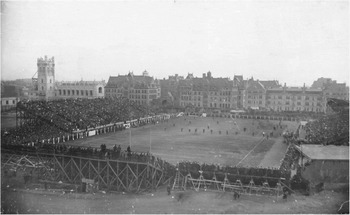
A football game on Marshall Field (later Stagg Field) at the University of Chicago, circa 1902. This view is looking south, toward the gothic quadrangles across 57th Street. After Chicago abolished football in 1939, a squash court under the Stagg Field grandstands was the site of Enrico Fermi's secret Manhattan Project laboratory during World War II; Regenstein Library is currently located on the former football field. Courtesy of Special Collections Research Center, University of Chicago Library.

In 1905 Harper wrote that football was a part of the “business side of the university” and an important public relations tool. Because the university “comes into contact with the public … in its department of physical culture and athletics,” it had to assume responsibility for maintaining fields and equipment, scheduling games, and selling tickets.Footnote 71 In a contemporaneous argument, Harper suggested that financial support for collegiate sport should not come from the public. Athletics were the only department to gain sponsorship from “the masses,” and he found it problematic that an important part of the university should receive its greatest support from a mob obsessed with spectacle, money, and chance: “Shall the university depend for the support of one of its departments upon a crowd, a large proportion of which treats the game as it would treat the race-course, and patronizes it because of the opportunity which it furnishes for gambling? Shall a higher institution of learning cater thus to the lowest passions of the multitude?”Footnote 72 Harper wanted to publicize the university—and he promoted the university's exertion of influence upon the public via social work, extension, and physical culture—yet he dreaded any influence that the non-academic public might have upon the university.
Part of the problem with the current scenario was not only that the wrong people (whom he called the “multitude”) patronized college athletics, but also that the right people were not able to do so. Harper observed with chagrin that ticket prices had climbed so high that many students and faculty members could not buy them. This needed to change: “So long as the most conspicuous work of the department of physical culture is dependent for its support upon gate receipts at public games it cannot occupy the high and dignified place which should be accorded it.” Football's increased dignity, Harper contended, would result from increased institutional support, which would prevent it from relying upon patronage by the masses.Footnote 73 Following this line of reasoning, Harper considered whether universities should provide sport with endowment funds. He broached this idea to Presidents Van Hise of Wisconsin and James B. Angell of Michigan as early as 1903 and published it in Harper's Weekly in September 1904.Footnote 74 Harper based his proposal on the logic that athletics, as an integral part of university extension and marketing efforts, should receive support equal to other university units. A “division” of the “department of physical culture,” athletics needed the same resources provided “for other subjects included in the schedule of the university.” Athletic endowments would “lift the cause of higher physical education to a plane coordinate with that of intellectual education.” Such funding, supposedly, would reduce the “illegitimate side” of athletics and reduce intense interinstitutional rivalries. In turn, football “would become in a true sense a gentleman's sport.”Footnote 75
Harper's desire to preserve football as a “gentleman's sport” was not unusual at the turn of the century, but his call for an endowment was. Many universities enjoyed the revenue that the popular sport provided and even used football's revenues to fund physical education and other college facilities or activities.Footnote 76 Most institutions would not willingly give up this source of income. Although Swarthmore de-emphasized football in the 1920s by funding it through the regular college budget,Footnote 77 in the early 1900s Harper's proposal did not gain many adherents. Contributing to the lack of converts may have been the fact that Harper was suffering from cancer in 1905 and died soon thereafter. Even though this suggestion fell on deaf ears, it is evidence that Harper understood the relationship between universities, intercollegiate athletics, and the American public better than many of his contemporaries. Some reformers hoped to purify intercollegiate football by removing the taint of popular culture and the masses but were loath to cut off the cash flow it provided. While they wanted to have their lucrative spectacle and de-commercialize it, too, Harper was more realistic. He knew that the way to preserve the sport—a strenuous, manly physical activity considered essential for modern, college-educated males and a valuable form of publicity—was to find other revenue sources besides gate receipts. Most of the universities that depended on football for publicity or for bankrolling physical education, however, did not possess benefactors as wealthy as Rockefeller or Marshall Field. Indeed, the Chicago Tribune reported the general response from Ann Arbor and Madison to Harper's plan: “Where can we get the $500,000?”Footnote 78
Harper's plan fell on deaf, or at least under-endowed, ears, and other reformers looked for more realistic and less expensive solutions. Many Progressive Era observers angled for the careful oversight and regulation of football, but where that guidance would originate was up for debate. Albert Shaw, writing in the American Review of Reviews, offered the middle-class press as a means of supervising university athletic reform. He asserted that football's reform should be a part of a “housecleaning” in America's rapidly growing and often undisciplined universities. Shaw observed that both taxpayers and private donors (“the Carnegies, the Rockefellers, the Kennedys, the Sages, and others”) were pumping millions of dollars into American education; meanwhile, ticket sales and sensational newspapers had turned college sport into a commercial, “unsportsmanlike” game, a “tumultuous public spectacle” conducted before tens of thousands of spectators. Considering the attention lavished on sport, donors and taxpayers needed assurance that money was not being thrown away on corrupt institutions that bowed to popular pressures. Athletes were being portrayed “on the sporting page of all the metropolitan newspapers” next to the “negro pugilist” Jack Johnson “and the favorites of the world of professional baseball.” College sport, he implied, should embody manly discipline and lofty collegiate ideals, not crass professionalism within a racially mixed sphere of commercial leisure. Shaw, like Van Dyke, saw the press as part of the problem, but it could also be part of the solution. Although the “academic caste” might be wary of “newspaper criticism,” it was time for university leaders to heed the critiques arising from editors' pens. Shaw did not offer specific reforms, but his message was clear. Universities were important to modern American life, and they needed appropriate attention. Any changes implemented needed to originate with the public, and progressive writers like Shaw ostensibly represented the purest embodiment of the public voice.Footnote 79
The public voice was an important part of reforming football, but the most long-lasting reforms were implemented through the structures of intercollegiate athletic regulation formed in 1905—especially the NCAA. National, middle-of-the-road reforms made sense to schools that wanted to make the best of a popular, perhaps even profitable, venture. A few universities (including Chicago) bucked this trend, ceasing intercollegiate football by the 1930s, whereas others mitigated the effects of athletic spectacle by eliminating ticket sales.Footnote 80 Most, however, adopted a less sensational, but no less sweeping, reform intended to limit sport's popular and commercial influences on colleges. Some reformers advocated a corps of professional coaches, athletic experts with permanent positions. Endorsed by the Intercollegiate Conference of Faculty Representatives (the Midwest athletic conference then known colloquially as the Big Nine) in 1906, this reform was also later embraced by the NCAA.Footnote 81 Specialist coaches, supposedly, would add a stabilizing force to intercollegiate athletics. Their presence might minimize the impact of popular influence, via money or the press, on students and athletes.
At the 1909 annual convention of the soon-to-be-renamed IAAUS, Purdue University historian and economist Thomas MoranFootnote 82 spoke on the possibilities for change in college sport. Moran noted that progressive football reform would be difficult because diverse groups were invested in the spectacle. Most spectators simply desired entertaining games, and the average “rough-neck” was uninterested in change. To make matters worse, the typical college president wanted winning teams for their advertising value. Therefore, football reform had to be carefully crafted and widely implemented—a kind of “mutual disarmament” among many colleges. To reform sport, colleges needed the right kind of coach. Moran complained that many coaches just served in season, migrated from job to job, sought only victory, and possessed “no sympathy with the scholastic ideals of the institution.” These journeymen employed dishonest means to win games so that they could either retain their jobs or move to new positions with higher salaries. Instead of embracing devious, shifty journeymen, universities should seek “a higher type of man than the temporary coach.” A coach should be a well-paid football teacher belonging to a professional class, not a rover searching perpetually for monetary compensation; he should be a leader teaching mental, physical, and moral discipline. Men of unimpeachable character usually entered stable professions, so institutions should sign respectable men to full-year contracts: “Such a man is a fixture, not a transient … He is a part of the college community and is interested in putting athletics on a sound and wholesome basis. He is usually a member of the instructional corps and as such has a feeling of responsibility.” Moran advocated a football teacher with bona fide status, envisioning an institutional niche for the professional coach. This new profession had to exist throughout the nation's network of universities because even coaches possessing high moral character competed against distant teams led by “unscrupulous men.”Footnote 83
Moran's approach to football reform was thoroughly progressive. First, it was national in scope. Football's savior class, made up of scrupulous, truly professional coaches, would be created through structural reform carried out on a broad geographical level. This process could not be left to chance—or to local or regional efforts. In a time of modern transportation and communication networks tying what Wiebe labeled “island communities” into a single nation,Footnote 84 reforms intended to circumvent corrupting influences and graft needed to be all-encompassing. A few institutions could not implement meaningful changes. Rather, all had to agree on changes that would (to employ an athletic metaphor) level the playing field. Second, this proposal negotiated a fine line between two kinds of professionalism: one that craved mere money, and a second that pursued a steady salary. Moran deplored the journeyman coach who sought profit and fame, but he exalted the resident expert who would teach football and in return only demand a respectable living. Itinerant showmen might corrupt the university by appealing to the base interests of the irrational mob, whereas expert coaches would enrich the university by serving only the best interests of the rational public. Resident athletic experts, presumably, would not be swayed by popular opinion or easy money.
Moran anticipated the eager reception of this reform. He proclaimed, with bravado, that all IAAUS members were interested in supporting “clean and manly” college athletics: “We all delight in a strenuous, manly, sportsmanlike intercollegiate contest, and for that reason we should be zealous in protecting intercollegiate athletics from all influences of a harmful character.”Footnote 85 Such optimism aside, many university leaders held mixed views of professional coaches. In 1908 Stanford University president David Starr Jordan, a noted California progressive, evolutionary biologist, and educator, sent a circular letter to hundreds of college and university administrators throughout the nation. He suggested, among other innovations (including the replacement of American-style football with rugby football as played in Australia and Canada), to eliminate paid coaches entirely. Not all recipients responded with enthusiasm. In his reply to Jordan, Wisconsin's president Charles Van Hise demurred, characterizing the emerging class of athletic experts as “a very nice set of fellows.”Footnote 86 Van Hise may have been unwilling to condemn coaches or eliminate intercollegiate football because, as historians of the University of Wisconsin note, he “knew the zeal of students and alumni” for football and helped in 1906 to mediate a compromise that maintained the sport in the Big Nine conference.Footnote 87 Other college leaders responded to President Jordan with interest but hesitated because they were skeptical that his proposed reforms would be adopted by more than a few institutions.Footnote 88
Eventually, the proposal for a national corps of professional coaches prevailed as a major reform intended to alleviate commercialism. As a result, professional coaches and athletic directors gradually became the guardians of intercollegiate athletics.Footnote 89 By the end of the twentieth century, though, coaches and athletic directors typically possessed a different kind of ethos than the one that social scientists like Moran envisioned. Out of either occupational necessity or personal ambition, many coaches embraced the popular culture marketplace and exposure in the mass media. Rather than being located in an academic space removed from popular influence, their salaries, contracts, and prestige came to depend on victory and the commercial success of the popular spectacle. Likewise, many universities depended on the publicity that sport brings and purportedly used ticket sales from “big time”Footnote 90 sports like football and basketball to subsidize their athletic departments (although not necessarily physical education, as universities often claimed at the start of the century). Critics of big-time sports sought to expose the “creative accounting” practices and budgetary legerdemain that underpinned questionable claims of athletic department self-sufficiency. As Murray Sperber notes, most late-twentieth-century intercollegiate athletic programs actually spent more than they earned.Footnote 91
Within the big business of intercollegiate athletics by the early 2000s, coaches often wove back and forth between professional sports leagues and the collegiate game, competing for salaries that typically made them the highest paid individuals in contemporary universities (and, in some cases, within the state governments that employ them). By 2007, Nick Saban, a former coach of the National Football League's Miami Dolphins, made four million dollars per year as the head coach of the University of Alabama Crimson Tide football team; in April 2009 John Calipari signed a deal for $31.65 million over eight years to coach the University of Kentucky Wildcats men's basketball squad.Footnote 92 This reality was not what Progressive Era reformers had intended, but it was the fruit of their labors.Footnote 93 Progressive Era reformers were trying to cope with the reality of intercollegiate football and craft policies that would preserve its presumed social benefits. Drawing on their intellectual orientations as well as their cultural milieu, they theorized strenuous sport as a means of developing strong, middle-class men and saw the popular spectacle as a way to help growing universities reach out to presumed constituencies. Unwilling to eliminate the spectators—or the money that those spectators paid to watch intercollegiate athletic contests—reformers crafted a national regulatory body and created a corps of professional coaches that would, presumably, mitigate the effects of money on universities and campus culture. Over the decades, however, these alterations did little to keep popular influence from entering the college walls and usually led to the reverse.
The reform of intercollegiate football illustrates the paradoxical character of progressivism long noted by historians.Footnote 94 The people who sought to use the university as a progressive tool for changing society at the turn of the century also dreaded society's impact on that institution. For them, the unregulated intrusion of an irrational crowd—the same crowd that they were trying to subdue in favor of a rational public—held the potential to ruin the university's noble aims and goals. Progressives hoped to shape modern society by extending academic influence to the public located outside the university, but they feared the impact of popular influence within it. This problem was hardly resolved by the reform of football. Over time, athletic departments staffed by expert coaches provided a bureaucratic structure through which popular influence, once the bane of those who envisioned socially useful universities, efficiently permeated the college walls. Progressive Era social scientists and university leaders attributed the promise and potential public benefits of college football to respectable middle-class values and regulated academic institutions, while attributing the sport's dangers to popular elements. By stressing moderate reforms that sought to maintain the profitability of intercollegiate sport without solving the problem of its popular appeal (and without eschewing the money that came with popularity), reformers did not eliminate outside influence from the academy. They institutionalized it via the bureaucratization of collegiate sport, in turn ensuring the permanence of a popular culture spectacle within institutions of higher education and research.