The weeks surrounding parturition are a critical time in the life cycle of a high-producing dairy cow (Mullins et al., Reference Mullins, Mamedova, Brouk, Moore, Green, Perfield, Smith, Harner and Bradford2012). During this period, cows make many metabolic adjustments to support the transition from pregnancy to lactation with a dramatic change in nutrient demands that necessitate coordination of metabolism to meet requirements for energy, glucose, amino acids (AA), and calcium by the mammary gland following calving (Bell, Reference Bell1995; Mullins et al., Reference Mullins, Mamedova, Brouk, Moore, Green, Perfield, Smith, Harner and Bradford2012). Requirements for glucose and AA by the mammary gland at 4 d post-partum are respectively 3- and 2-fold higher than those by the gravid uterus at 250 d of gestation (Bell, Reference Bell1995). Furthermore, dairy cows produce more milk in respect to their ability to consume energy, resulting in a period of negative energy balance in early lactation (Mullins et al., Reference Mullins, Mamedova, Brouk, Moore, Green, Perfield, Smith, Harner and Bradford2012). The negative energy balance can cause periparturient lipid-related disorders associated with high levels of non-esterified fatty acids (NEFA) and β-hydroxybutyrate (BHB) as fatty liver disease and ketosis (Fiore et al., Reference Fiore, Piccione, Perillo, Barberio, Manuali, Morgante and Gianesella2017).
Several strategies have been carried out in cows to treat ketosis by reducing the effect of fat mobilization during the periparturient period (Fiore et al., Reference Fiore, Perillo, Piccione, Gianesella, Bedin, Armato, Giudice and Morgante2016). Many studies on the treatment of hyperketonaemia have shown that animals treated with more than one compound or active ingredients in a drug formulation have better outcomes than animals treated with only one compound, however, these have typically used short follow-up periods (Gordon et al., Reference Gordon, Leblanc and Duffield2013). Deficiencies of compounds involved in lipoprotein synthesis and secretion, such as carnitine, choline, cyanocobalamin, inositol, lysine, and methionine, can cause fatty liver in dairy cows just as they do in non-ruminants (Bobe et al., Reference Bobe, Young and Beitz2004). The inability to prevent fatty liver indicates that cows are not usually deficient in these compounds, that compounds are quickly degraded in rumen, or that lipoprotein synthesis in ruminants cannot be easily changed (Bobe et al., Reference Bobe, Young and Beitz2004).
Both the needs of the foetus pre-partum and the mammary gland post-partum greatly increase the demand for amino acid (AA) from the circulation for glucose and protein synthesis (Zhou et al., Reference Zhou, Loor, Piccioli-Cappelli, Librandi, Lobley and Trevisi2016, Reference Zhou, Vailati-Riboni, Luchini and Loor2017). Acetylmethionine is the acetylated form of L-methionine, an essential AA associated with various key physiologic events (Fiore et al., Reference Fiore, Perillo, Piccione, Gianesella, Bedin, Armato, Giudice and Morgante2016; Zhou et al., Reference Zhou, Vailati-Riboni, Luchini and Loor2017). As a gluconeogenic AA, a portion of methionine may be taken up by liver to sustain the abrupt increase in demand for glucose at the onset of lactation. Inadequate methionine availability could potentially limit the utilization of other circulating AA (Zhou et al., Reference Zhou, Vailati-Riboni, Luchini and Loor2017). Inositol is a cyclohexitol sugar alcohol that can exist in nine possible stereoisomeric forms, although only myo-inositol has been confirmed to have multiple cellular functions in mammalian cells (Indyk et al., Reference Indyk, Saldo, White, Dole, Gill and Woollard2016). The ruminal degradation of myo-inositol is not complete and is increased by supplementation with exogenous phytase (Brask-Pedersen et al., Reference Brask-Pedersen, Glitsø, Skov, Lund and Sehested2013). Cyanocobalamin is the synthetic form of vitamin B12 (Rollin et al., Reference Rollin, Berghaus, Rapnicki, Godden and Overton2010). Serum cyanocobalamin concentrations are low in early lactation, and it has been used as an adjunct therapy in ketosis treatment because of its role in gluconeogenesis (Fürll et al., Reference Fürll, Deniz, Westphal, Illing and Constable2010; Gordon et al., Reference Gordon, Leblanc and Duffield2013). α-lipoic acid is ubiquitously present in living organisms and plays a fundamental role in energy metabolism (Akiba et al., Reference Akiba, Matsugo, Packer and Konishi1998). Clinical trials have been carried out using α-lipoic acid as a therapeutic agent in various disorders including liver diseases (Bustamante et al., Reference Bustamante, Lodge, Marcocci, Tritschler, Packer and Rihn1998). This antioxidant may be effective in preventing the development of hepatic fibrosis and hepatic steatosis (Gorąca et al., Reference Gorąca, Huk-Kolega, Piechota, Kleniewska, Ciejka and Skibska2011).
Monensin improves the availability of glucose in dairy cows by modulating the microbial populations of the rumen and the consequent production of volatile fatty acids. In particular, the final effect of monensin in the rumen is to change the microbial population with a consequent decrease in the bacteria that produce acetic acid and butyric acid, and an increase in the bacteria that produce propionate (gluconeogenic precursors) (Duffield et al., Reference Duffield, LeBlanc, Bagg, Leslie, Ten Hag and Dick2003; Melendez et al., Reference Melendez, Goff, Risco, Archbald, Littell and Donovan2006; McCarthy et al., Reference McCarthy, Yasui, Ryan, Pelton, Mechor and Overton2015; Drong et al., Reference Drong, Meyer, von Soosten, Frahm, Rehage, Breves and Dänicke2016). The impacts of monensin on transition cows include an improved energy status, feed efficiency and animal health with a lower risk of developing clinical and subclinical ketosis (Melendez et al., Reference Melendez, Goff, Risco, Archbald, Littell and Donovan2006; Drong et al., Reference Drong, Meyer, von Soosten, Frahm, Rehage, Breves and Dänicke2016).
Based on previous results and on the effect of different strategies to treat or prevent hyperketonaemia, the objective of the present study was to compare the effect of two different preventive protocols one composed of acetyl-methionine, inositol, cyanocobalamin, l-alanine, l-arginine, l-threonine, l-glutamic acid and α-lipoic acid and the other one containing only monensin, on serum BHB concentration and liver health indices in high-yielding Holstein dairy cows during pre-partum and early lactation period.
Materials and methods
All protocols of animal husbandry and experimentation were reviewed and approved in accordance with the standards recommended by the Guide for the Care and Use of Laboratory Animals and Directive 2010/63/EU for animal experiments.
Animals
A total of 100 pregnant multiparous Holstein cows (from the second lactation to the fourth lactation), from a single high producing dairy farm located in Padua, Italy (45° 41′ N; 11° 88′ E, 17 m above sea level), were enrolled in this study. The average milk production was about 10 000 kg per year and the average milk composition was 3.72% of fat and 3.34% of protein. The cows had a dry period of 60 d and a close-up period of 15 d before calving. Supplementary Table S1 shows the chemical composition of the total mixed ratio (TMR) used for all animals during pre-partum and post-partum period. The diets were sampled twice for each experimental period (dry and lactation period) and analysed for chemical composition. Feed were analysed by near infrared spectroscopy (NIRS) using NIRS 5000 (Foss NirSystem, FossItalia, Padova, Italy). Water was available ad libitum. At the moment of the enrolment (21 ± 2 d pre-partum), all animals were clinically healthy. Their health status was evaluated based on clinical examination and measurement of rectal temperature, heart rate, respiratory rate, appetite and faecal consistency.
Experimental groups
The population was homogeneous prior to assigning to treatment groups, in particular, the mean parity number and mean milk yield were similar in all cows; the subjects were then randomly divided into three groups. Control group (CTRL, n = 20) didn't receive any preventive treatment. The second group (SUPP, n = 40) was treated with two combined supplementations by intramuscular injection. Specifically, cows received 100 ml of acetyl-methionine (15 000 mg), inositol (3000 mg), cyanocobalamin (100 mg), L-alanine (1500 mg), L-arginine (1500 mg), L-threonine (1500 mg), L-glutamic acid (1500 mg) (Bograss®, Ceva Salute Animale S.p.A., Agrate Brianza, MB, Italy) at 12 ± 2 and at 9 ± 2 d pre-partum. The same group received 20 ml of acetyl-methionine (480 mg), cyanocobalamin (50 mg), α-lipoic acid (25 mg) (Erbacolina PLUS®, Ceva Salute Animale S.p.A., Agrate Brianza, MB, Italy) on the day of parturition and repeated at 2, 4, 6, 8, 10 and 12 d post-partum.
The third group (MON, n = 40) was treated with monensin (95 d of intraruminal continuous-release, with 12 sub-unit of 2700 mg of monensin included in the device, Kexxtone®, Eli Lilly Italia S.p.a., Sesto Fiorentino, FI, Italy) at 21 ± 2 d pre-partum.
Sample collection
Body condition score (BCS, 0 to 5 scale) was evaluated in each animal according to Edmondson et al. (Reference Edmondson, Lean, Weaver, Farver and Webster1989). Blood samples were collected from each animal at the same hour in the morning (9 : 00 a.m.) from jugular vein into vacuum glass tubes (VenosafeTM, Terumo Europe) without anticoagulant agent. BCS and blood samples were taken by the same operator at 6 time points: 21 ± 2 d and 7 ± 2 d pre-partum; 7 ± 2 d, 25 ± 2 d, 50 ± 2 d and 90 ± 2 d post-partum. The blood samples were allowed to clot for 30 min, thereafter, the tubes were centrifuged at 1372g for 10 min. The obtained sera were transferred into plastic tubes and transported at 4°C to the laboratory of the Department of Animal Medicine, Production and Health of the University of Padua where they were stored at −18°C until analysis. On obtained serum the concentrations of glucose, NEFA, BHB, triglycerides, total cholesterol (TC), alanine aminotransferase (ALT), aspartate aminotransferase (AST), γ-glutamyltransferase (GGT), total bilirubin (TB), total proteins (TP), albumin, globulins and urea were assessed by means of a BT1500 automated photometer analyser (Biotecnica Instruments S.p.A., Roma, Italy) using available commercial kits according to Fiore et al. (Reference Fiore, Perillo, Piccione, Gianesella, Bedin, Armato, Giudice and Morgante2016).
Statistical analysis
The data were expressed as mean ± standard deviation (sd). Data were normally distributed (Shapiro and Wilk test 1965). Two-way analysis of variance (ANOVA) for repeated measures was applied to assess differences in the studied parameters among the three experimental groups. Bonferroni's multiple comparison tests was used for post hoc comparison test. P values <0.05 were considered statistically significant. Statistical analysis was performed using the STATISTICA software package (STATISTICA 7 Stat Software Inc., Tulsa, Oklahoma).
Results
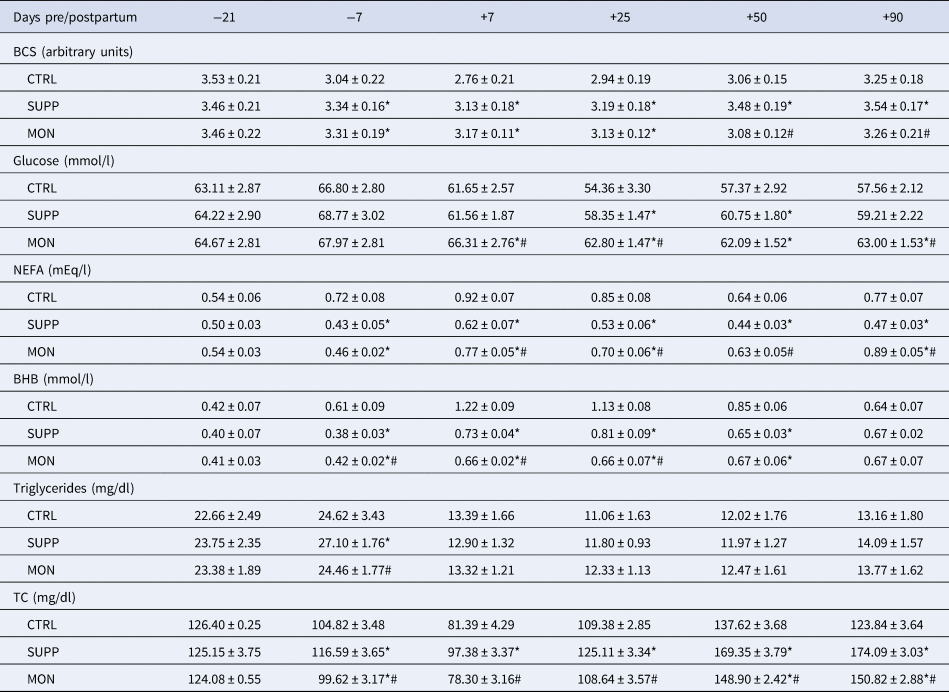
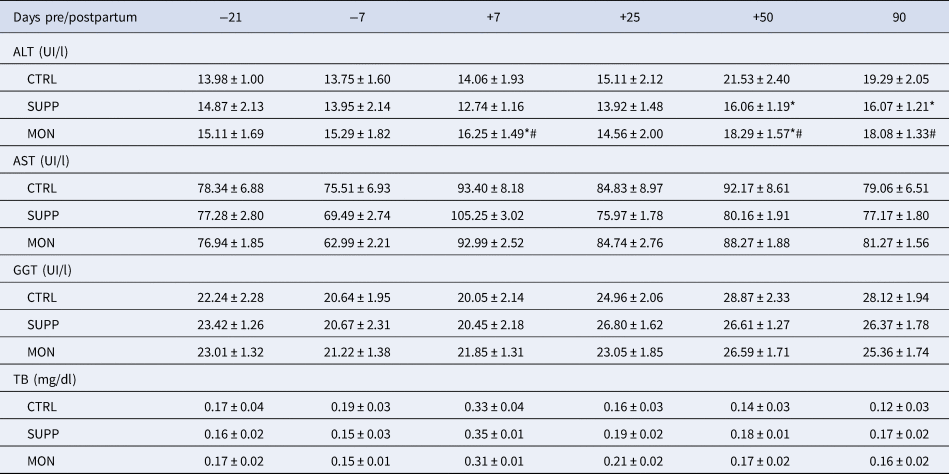
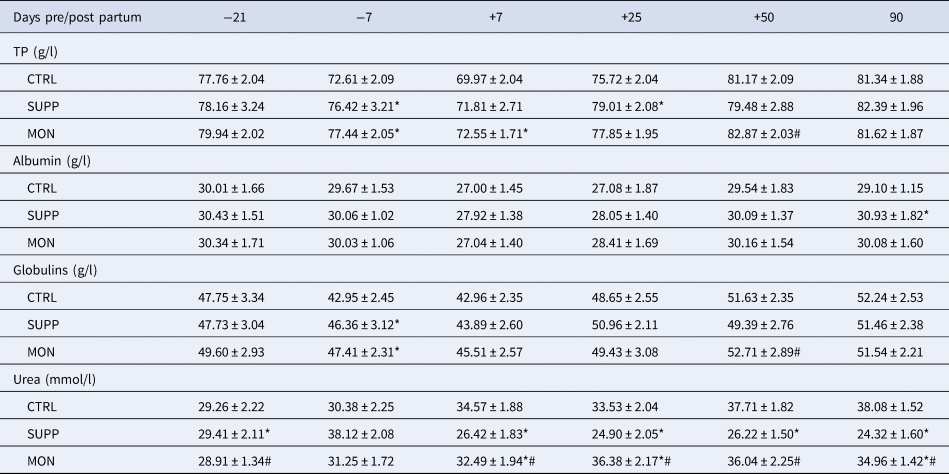
Data are presented in Tables 1–3 and the same data are available as Figures in the online Supplementary File. The application of two-way ANOVA for repeated measures showed a significant effect of time and treatment on all tested parameters.
Values of BCS and plasma glucose, NEFA, BHB, triglycerides and total cholesterol (TC) in control and treated cows

Values are mean ± sd. Days pre/postpartum are all ± 2.
CTRL: control group, SUPP: cows treated with two combined supplementations containing acetyl-methionine, inositol, cyanocobalamin, l-alanine, l-arginine, l-threonine, l-glutamic acid and α-lipoic acid, MON: cows treated with monensin.
Significant differences (P < 0.05 or greater) are shown by: * vs. CTRL and # vs. SUPP.
Values of serum alanine aminotransferase (ALT), aspartate aminotransferase (AST), γ-glutamyltransferase (GGT) and total bilirubin (TB) in control and treated cows

Values are mean ± sd. Days pre/postpartum are all ± 2.
CTRL: control group, SUPP: cows treated with two combined supplementations containing acetyl-methionine, inositol, cyanocobalamin, l-alanine, l-arginine, l-threonine, l-glutamic acid and α-lipoic acid, MON: cows treated with monensin
Significant differences (P < 0.05 or greater) are shown by: * vs. CTRL and # vs. SUPP
Values of serum total protein (TP), albumin, globulins and urea in control and treated cows

Values are mean ± sd. Days pre/postpartum are all ±2.
CTRL: control group, SUPP: cows treated with two combined supplementations containing acetyl-methionine, inositol, cyanocobalamin, l-alanine, l-arginine, l-threonine, l-glutamic acid and α-lipoic acid, MON: cows treated with monensin.
Significant differences (P < 0.05 or greater) are shown by: * vs. CTRL and # vs. SUPP.
Body condition score
The Bonferroni post-hoc comparison test showed that BCS was similar in SUPP and MON groups having higher values respect to CTRL group starting from 7 ± 2 d pre-partum to 25 ± 2 d post-partum. At 50 ± 2 and 90 ± 2 d post-partum the highest values were observed in SUPP group (Table 1).
Glucose
MON treatment induced an increase of glucose concentration at 7 ± 2, 25 ± 2 and 90 ± 2 d post-partum compared to other groups and at 50 ± 2 d post-partum compared only to CTRL group. SUPP treatment at 25 ± 2 and 50 ± 2 d post-partum and MON treatment at 50 ± 2 d post-partum showed higher values respect to CTRL group (Table 1).
Non-esterified fatty acids
SUPP and MON treatments induced a decrease of NEFA concentration from 7 ± 2 d pre-partum to 25 ± 2 d post-partum compared to CTRL group. The decrease compared to CTRL group was also observed in SUPP treatment at 50 ± 2 and 90 ± 2 d post-partum. Contrary at 90 ± 2 d post-partum an increase compared to CTRL group was observed in MON group. Also in MON group NEFA values were higher than SUPP group for all post-partum period (Table 1).
β-Hydroxybutyrate
SUPP and MON treatments induced a decrease of BHB concentration from 7 ± 2 d pre-partum to 50 ± 2 d post-partum compared to CTRL group. MON treatment induced an increase at 7 ± 2 d pre-partum and a decrease at 7 ± 2 and 25 ± 2 d post-partum compared to SUPP treatment (Table 1).
Triglycerides
In CRTL and MON groups a lower triglycerides concentration respect to SUPP group was observed at 7 ± 2 d pre-partum (Table 1).
Total cholesterol
In CRTL and MON groups a decrease of TC concentration from 7 ± 2 d pre-partum to 90 ± 2 d post-partum compared to SUPP treatment was observed. In MON treatment a decrease at 7 ± 2 d pre-partum and an increase at 50 ± 2 and 90 ± 2 d post-partum compared to CTRL group was observed (Table 1).
Alanine aminotransferase
MON treatments induced an increase of ALT concentration at 7 ± 2 d post-partum compared to other groups. SUPP and MON treatments resulted decreased at 50 ± 2 d post-partum compared to CTRL group. The decrease compared to MON treatment was also observed in SUPP treatment at 50 ± 2 and 90 ± 2 d post-partum. SUPP treatment induced a decrease at 90 ± 2 d post-partum compared to CTRL group (Table 2).
Aspartate aminotransferase
SUPP and MON treatments induced a decrease of AST concentration at 7 ± 2 d pre-partum compared to CTRL group. MON treatment induced a decrease at 7 ± 2 d pre-partum and 7 ± 2 d post-partum compared to SUPP treatment. SUPP treatment induced an increase at 7 ± 2 d post-partum compared to CTRL group. CRTL and MON groups induced an increase at 25 ± 2 and 50 ± 2 d post-partum compared to SUPP treatment. MON treatment induced an increase at 90 ± 2 d post-partum compared to SUPP treatment (Table 2).
γ-Glutamyltransferase
CRTL and MON groups showed a decrease of GGT concentration at 25 ± 2 d post-partum compared to SUPP treatment. The decrease compared to CTRL group was also observed in SUPP treatment at 25 ± 2 d post-partum. MON treatment induced a decrease from 25 ± 2 to 90 ± 2 d post-partum compared to CTRL group (Table 2).
Total bilirubin
SUPP and MON treatments induced a decrease of TB concentration at 7 ± 2 d pre-partum and an increase from 25 ± 2 to 90 ± 2 d post-partum compared to CTRL group. CRTL and MON groups showed an increase at 7 ± 2 d post-partum compared to SUPP treatment. The decrease compared to SUPP treatment was also observed in MON treatment at 25 ± 2 d post-partum (Table 2).
Total protein
SUPP and MON groups induced an increase of TP concentration at 7 ± 2 d pre-partum compared to CTRL group. SUPP group showed an increase at 7 ± 2 and 25 ± 2 d post-partum compared to CTRL group. The increase compared to SUPP treatment was also observed in MON treatment at 50 ± 2 d post-partum (Table 3).
Albumin
In CTRL group a lower albumin concentration respect to SUPP group was observed at 90 ± 2 d post-partum (Table 3).
Globulins
SUPP and MON groups induced an increase of globulins concentration at 7 ± 2 d pre-partum compared to CTRL group. The increase compared to SUPP treatment was also observed in MON treatment at 50 ± 2 d post-partum (Table 3).
Urea
In CRTL and MON groups a lower urea concentration respect to SUPP group was observed at 7 ± 2 d pre-partum. CRTL and MON groups showed an increase starting from 7 ± 2 to 90 ± 2 d post-partum compared to SUPP treatment. MON treatment induced a decrease at 7 ± 2 and 90 ± 2 d post-partum and an increase at 25 ± 2 d post-partum compared to CTRL group (Table 3).
The significant effect of time observed by the application of Bonferroni post hoc comparison is showed in online Supplementary Figures S2–S4.
Discussion
This study showed several important findings regarding the influence of the administration of two preventive protocols on hyperketonaemia and on liver enzymatic activity in pre-partum and early lactation high-yielding dairy cows. It was evident that BCS in SUPP had a better trend in respect to the other groups. SUPP showed a similar trend with MON till 25 ± 2 d post-partum with significantly higher values in respect to CTRL. A significant increase of BCS was found till the end of the experimental period, reaching the initial values and indicating a better long term response only in SUPP.
Glucose concentration initially had a similar trend in all three groups, then decreasing postpartum to a lesser extent in MON than in other groups. The primary action of monensin is that it improves the glucose supply to cows by changing ruminal fermentation and volatile fatty acid production in favour of propionate (Duffield et al., Reference Duffield, LeBlanc, Bagg, Leslie, Ten Hag and Dick2003). This could lead to better ruminal fermentation efficiency, which may increase gluconeogenesis by increased its major precursor, propionate, suggesting an anti-ketogenic effect, besides of moderate positive effect on milk production (Odongo et al., Reference Odongo, Or-Rashid, Bagg, Vessie, Dick, Kebreab, France and McBride2007). Mullins et al. (Reference Mullins, Mamedova, Brouk, Moore, Green, Perfield, Smith, Harner and Bradford2012) stated that monensin did not affect plasma glucose concentrations pre- or post-partum, while a meta-analysis indicated that monensin can increase plasma glucose concentration of transition cows, but increases were not consistently reported (Duffield et al., Reference Duffield, Rabiee and Lean2008). Fürll et al. (Reference Fürll, Deniz, Westphal, Illing and Constable2010) hypothesized that high-producing dairy cows in early lactation may have a relative or actual deficiency of cyanocobalamin. In accordance with Fiore et al. (Reference Fiore, Perillo, Piccione, Gianesella, Bedin, Armato, Giudice and Morgante2016), the trend of glucose concentration in SUPP had lower values in respect to MON, but better than CTRL, underlining the beneficial effect of the supplementation on glucose. In two previous experiments (Graulet et al. Reference Graulet, Matte, Desrochers, Doepel, Palin and Girard2007; Akins et al. Reference Akins, Bertics, Socha and Shaver2013), plasma glucose concentration was unaffected by additional vitamin B12 alone. However, Graulet et al. (Reference Graulet, Matte, Desrochers, Doepel, Palin and Girard2007) and Preynat et al. (Reference Preynat, Lapierre, Thivierge, Palin, Matte, Desrochers and Girard2009) stated that a combined supplement of folic acid and cyanocobalamin improved metabolic efficiency of dairy cows in early lactation by increasing plasma glucose or glucose irreversible loss rate. These findings are consistent with the mechanism of action of cyanocobalamin, which is a coenzyme for methylmalonyl-CoA mutase, an intermediate step for the entry of propionate into the Krebs cycle for gluconeogenesis, causing an increase of glucose concentration (Pereira et al., Reference Pereira, Fensterseifer, Barcelos, Martins, Schneider, Schmitt, Pfeifer, Del Pino and Corrêa2013).
According to Fiore et al. (Reference Fiore, Perillo, Piccione, Gianesella, Bedin, Armato, Giudice and Morgante2016), who used a therapeutic protocol similar to SUPP, the NEFA concentration maintains lower values in respect to other groups in the entire experimental period indicating that there is less mobilization of fat in these cows. That same effect was evident here in SUPP. In MON, NEFA concentration had lower values in respect to CTRL, which accords with an earlier meta-analysis including 24 studies with plasma NEFA data (Duffield et al., Reference Duffield, Rabiee and Lean2008).
BHB concentration significantly decreased at each time point except at 90 ± 2 d post-partum in SUPP and MON in respect to CTRL. The data are consistent with Fiore et al. (Reference Fiore, Perillo, Piccione, Gianesella, Bedin, Armato, Giudice and Morgante2016) who showed a tendency for lower serum BHB concentrations during the first 50 d post-partum in cows treated with Erbacolina at calving compared with placebo-treated cows. The data are also supported by Duffield et al. (Reference Duffield, LeBlanc, Bagg, Leslie, Ten Hag and Dick2003) and Mullins et al. (Reference Mullins, Mamedova, Brouk, Moore, Green, Perfield, Smith, Harner and Bradford2012), who showed the same tendency in monensin-treated cows. The effect on BHB is not surprising given that almost all relevant publications have reported similar decreases in BHB concentrations in monensin-treated cows (Duffield et al., Reference Duffield, Rabiee and Lean2008). Therefore, the significant increase in plasma glucose, as well as the reduced BHB and NEFA concentrations in CTRL and MON suggests an improved energy balance as compared with CTRL indicating a possible improvement in metabolic efficiency due to the treatments.
We have previously shown that serum triglycerides and TC concentration values are significantly influenced by the reproductive cycle (Arfuso et al., Reference Arfuso, Fazio, Levanti, Rizzo, Di Pietro, Giudice and Piccione2016). In the present study, triglyceride concentration did not show any substantial differences between the three groups except shortly pre-partum where SUPP showed a slight increase in respect to the other groups. TC concentration, on the other hand, was significantly elevated in SUPP for all apart from the first measurement, in agreement with Fiore et al. (Reference Fiore, Perillo, Piccione, Gianesella, Bedin, Armato, Giudice and Morgante2016). Moreover, TC concentration was not affected by monensin supplementation until 50 ± 2 d post-partum, where it reached higher values. These results are in contrast with other authors (Duffield et al., Reference Duffield, LeBlanc, Bagg, Leslie, Ten Hag and Dick2003). In the current study the results reflect less fat transported to the liver (lower NEFA pre-partum) combined with greater fat export from the liver (higher cholesterol) which support the hypothesis that our treatments, in particular SUPP, could decrease the accumulation of triglycerides in the liver of periparturient dairy cows.
ALT, AST and GGT are liver associated enzymes that may leak into the bloodstream as a consequence of liver damage, and serum ALT activity is considered to be a nonspecific marker for bovine liver damage (Rafia et al., Reference Rafia, Taghipour-Bazargani, Asadi, Vajhi and Bokaie2012). In agreement with Fiore et al. (Reference Fiore, Perillo, Piccione, Gianesella, Bedin, Armato, Giudice and Morgante2016), the ALT activity increased from 25 ± 2 d post-partum until the end of the experimental period, showing a long term protective response in SUPP and MON meaning lower values in respect to CTRL. Serum concentrations of AST showed considerable changes up to 25 ± 2 d post-partum, especially in SUPP, after stabilizing and showing lower values in SUPP till the end of the experiment. These findings are partially in agreement with Fiore et al. (Reference Fiore, Perillo, Piccione, Gianesella, Bedin, Armato, Giudice and Morgante2016) who showed lower AST concentration values with respect to the control group in cows treated with Erbacolina alone, although overall higher than found here. In addition, SUPP significantly reduced blood AST compared to MON. These findings partially agree with a previous study, which reported lower AST concentration values post-partum in cows administered monensin pre-partum (Duffield et al., Reference Duffield, LeBlanc, Bagg, Leslie, Ten Hag and Dick2003). In accordance with Fiore et al. (Reference Fiore, Perillo, Piccione, Gianesella, Bedin, Armato, Giudice and Morgante2016), we found significantly increasing values of GGT in all three groups, but with a slightly lower increase in SUPP and MON. When fat infiltrates the liver, as may occur after calving, a lesion appears in the hepatic tissues and the concentration values of enzymes that indicate liver injury (AST and GGT) are generally increased (González et al. Reference González, Muiño, Pereira, Campos and Benedito2011). Our findings suggest an improved liver function in treated cows.
Total bilirubin (TB) seems to be influenced by parturition, because its change is mainly due to the adaptation by the hepatic function to the new metabolic status (Fiore et al., Reference Fiore, Perillo, Piccione, Gianesella, Bedin, Armato, Giudice and Morgante2016). We found a similar trend of TB concentration in all three groups with a better response in SUPP and MON. Changes in serum proteins were observed throughout the entire lactation, in particular, the serum total protein (TP), albumin and globulins values were lower around parturition in all groups as reported by Gianesella et al. (Reference Gianesella, Perillo, Fiore, Giudice, Zumbo, Morgante and Piccione2018). At the onset of lactation, TP increased rapidly in all three groups, reaching the highest concentrations between 30 and 100 d and then decreasing slightly (Bobbo et al., Reference Bobbo, Fiore, Gianesella, Morgante, Gallo, Ruegg, Bittante and Cecchinato2017). Piccione et al. (Reference Piccione, Messina, Schembari, Casella, Giannetto and Alberghina2011) showed that stage of gestation and lactation affected serum total protein and globulins (α1, β and γ) concentration and albumin/globulin ratio of five Holstein Frisian cows, particularly during the transition from late gestation to early lactation, when cows usually have to cope with a pronounced metabolic stress. On the contrary, Cozzi et al. (Reference Cozzi, Ravarotto, Gottardo, Stefani, Contiero, Moro, Brscic and Dalvit2011) did not find any effect of stage of lactation when comparing total protein, albumin and globulin concentration of plasma from cows in early and mid-lactation.
After a significant peak shortly pre-partum (which agrees with our previous study: Fiore et al. Reference Fiore, Perillo, Piccione, Gianesella, Bedin, Armato, Giudice and Morgante2016), urea concentration values significantly decreased in SUPP till the end of the experiment. The variation of urea concentration around calving may be due to a variety of factors. Impaired liver function, as commonly occurs after calving, reduces the metabolic clearance of urea. Glucose availability may be increased by increased catabolism of amino acids stored in skeletal muscle and other tissue proteins, resulting in an increase of urea production (Fiore et al., Reference Fiore, Perillo, Piccione, Gianesella, Bedin, Armato, Giudice and Morgante2016; Gianesella et al., Reference Gianesella, Perillo, Fiore, Giudice, Zumbo, Morgante and Piccione2018). A decrease of plasma urea concentration was detected in cows receiving vitamin B12 supplement, even if vitamin B12 has no known role in ammonia metabolism (Duplessis et al., Reference Duplessis, Lapierre, Pellerin, Laforest and Girard2017).
In conclusion, results from the present study suggest that both preventive protocols, but in particular SUPP, could positively affect selected indicators of energy metabolism reducing the risk of hyperketonaemia and improving liver function in Holstein dairy cows both pre- and post-parturition. SUPP could have a hepatoprotective effect evident as a greater decrease in NEFA, AST, ALT, UREA serum concentration after calving. These improved metabolic conditions probably led to a more stable postpartum BW as BCS was also more stable. Our results confirm the beneficial effect of MON treatment seen previously. We can affirm that both supplementations may be considered as a good protocol for the amelioration or even prevention of liver disorders occurring in the post-partum period, decreasing the lipomobilization of early lactation.
Supplementary material
The supplementary material for this article can be found at https://doi.org/10.1017/S0022029921000108