INTRODUCTION
In recent years, conservative Christian groups in Britain have been involved in a number of high profile and controversial issues. Notable flashpoints have included disputes around free speech, abortion, assisted dying, same-sex marriage, the regulation of medical technologies, religious freedom, and equalities legislation. Notwithstanding a number of studies into the historical, sociological, and anthropological qualities of conservative forms of Christianity in Britain (e.g., Bebbington Reference Bebbington1989; Wolffe Reference Wolffe1995; Thompson Reference Thompson2009; Bebbington and Jones Reference Bebbington and Jones2013; Strhan Reference Strhan2015; Reference Strhan, Llewellyn and Sharma2016), scholarly research into the political activities of conservative Christian groups has been relatively limited. In addition, the small number of analyses have tended to focus on a select number of issues, typically centering on the debate around an emergent British “Christian Right” comparable to the movement that developed in the United States from the 1970s (e.g., Walton, Hatcher, and Spencer Reference Walton, Hatcher and Spencer2013), and the approach taken by conservative Christian groups to “moral issues” such as homosexuality and abortion (e.g., see Durham Reference Durham2005; Burack and Wilson Reference Burack, Wilson, Manley Scott, Graham and Baker2009; Hunt Reference Hunt2010; Reference Hunt2014).
In one respect, this lack of scholarly attention is understandable. Conservative Christian groups attempting to shape developments at a national level are relatively few in number and are usually considered to exert little cultural or political influence (Walton, Hatcher, and Spencer Reference Walton, Hatcher and Spencer2013). Yet the engagement of such groups with high-profile affairs demonstrates a significant commitment to activism, and their potential influence cannot be wholly discounted — not least given the substantial size of the conservative (or conservative-leaning) Christian population. For these reasons, the political activities of conservative Christian groups remain a worthwhile topic for analysis.
This article contributes to scholarship in this area by exploring the collective action frames that are deployed by Britain's main conservative Christian organizations. Collective action frames are an essential part of the way in which groups and movements seek to effect political, social and/or cultural change, providing a narrative designed to simplify and condense the core elements of the world in which they are operating, as well as encapsulate their shared beliefs and values in an easily understandable way. In this respect, a collective action frame has multiple, interrelated objectives: to identify key problems and adversaries, to highlight grievances and injustices, to consolidate and reaffirm group cohesion and solidarity, to propose an agenda for change, and to legitimize objectives and mobilize actors to pursue them. In short, a collective action frame seeks to advance the interests of the group while simultaneously undermining the claims and efforts of their opponents (see Benford and Snow Reference Benford and Snow2000; Polletta and Jasper Reference Polletta and Jasper2001; Rohlinger and Quadagno Reference Rohlinger and Quadagno2009; Graham Reference Graham2013). In order to be successful, a collective action frame must appeal to two distinct “internal” and “external” sets of audiences (generally breaking down into group and non-group members). Messages primarily directed toward members of the group (such as statements made in newsletters or promotional appeals) must be pitched to strengthen or sustain cohesion and mobilization, while messages principally targeted at those outside the group (such as general media interviews, the use of social media or public statements about values, goals, and policy) need to be tailored to persuade and possibly recruit others to the cause. While the division between these two orientations is not always clear-cut (media statements can also be used to signal a position to an internal audience, for instance), the bifurcation raises important strategic considerations (on these points see Gamson Reference Gamson1997).
The process by which a collective action frame is constructed and deployed is shaped by a number of factors. These include: the ability of the group to mobilize resources (such as money, manpower, and positive media coverage), its relationships to political opportunity structures (including state institutions, political parties, and relevant policy networks), as well as the impact of wider sociocultural variables (such as perceptions of legitimacy, cultural norms, and general public attitudes). The role of internal tensions and debates around goals and strategies are important here as well. Collective action frames are the outcome of negotiated processes in which disputes over goals and strategy may emerge. The possibility for intra-group conflict is all the more pressing in a context in which the aims and values of a group diverge from those of the wider society they wish to influence, with potential strains between a desire for ideological purity and pragmatism making a successful frame all the more difficult to achieve (Benford and Snow Reference Benford and Snow2000; Polletta and Jasper Reference Polletta and Jasper2001; Lichterman Reference Lichterman1999; Reference Lichterman2008).
This dilemma has been all the more pronounced in the case of conservative Christian groups by the growing pressures of secularization. With religion in Britain declining across all key measures of religiosity, conservative groups have increasingly turned to the use of collective action frames based on overtly secular norms and values rather than theological assertions. While this may be a strategic imperative for engaging with a largely secular society, the implications are potentially significant, raising the prospect of schisms as well as a loss of control over the direction of narrative structures themselves.
The empirical research for this study is primarily drawn from a series of eight semi-structured interviews with elite level representatives from conservative Christian groups seeking to effect change at the national level. Although there is no authoritative view on which conservative Christian groups might be the most important in terms of influencing national politics in Britain, a number of organizations attract consistent attention within the scholarly literature and commentary on the subject. These groups typically include: the Christian Institute, the Evangelical Alliance, Anglican Mainstream, Christian Concern, Christian Voice, Christian Action Research and Education (CARE), the Conservative Christian Fellowship, the Jubilee Centre, the Christian Medical Fellowship, Core Issues Trust, and the Christian Legal Centre.
These groups were all approached to take part in the study, and the subsequent interviews were conducted under conditions of anonymity. Five of the interviewees were directly responsible for leading their organization, and all were involved at a senior operational and decision-making level.Footnote 1 These interviews were supplemented by a qualitative analysis of media reports and public statements from conservative Christian groups, and by a series of interviews with representatives from more mainstream religious organizations. Although the number of interviewees involved in the main sample is relatively small, and while due care must therefore be taken when attempting to generalize from their responses — the composition of the main sample was also predominantly male and white as well as being largely London-centric — the primary interviews cover the majority of key national level conservative Christian groups in Britain, and provide a valuable insight into critical aspects of their worldview.
CONSERVATIVE CHRISTIANITY IN BRITAIN
The most influential conservative Christian groups in Britain derive predominantly from the evangelical wing of the Christian faith and are primarily Anglican leaning.Footnote 2 The precise denominational breakdown, however, is difficult to determine. Many organizations do not explicitly declare a denominational orientation, while others, such as the Christian Institute, describe themselves as non-denominational (www.christian.org.uk/whoweare/faq). The driving forces and motivations behind the establishment of these groups are diverse. The Evangelical Alliance was formed in 1846, and the Christian Medical Fellowship (which aims to help and support Christians in the medical profession) was set up in 1949. CARE was established in 1971 (as the direct successor to the Festival of Light), the Jubilee Centre was founded in 1983, and the Christian Institute began in the late 1980s (being formally established in 1991) as a reaction to concerns about “the moral direction of the nation and the implications for society” (Christian Institute 2011). The Conservative Christian Fellowship was established in 1990 to provide a link between the Conservative Party and the wider Christian community. More recently, Anglican Mainstream was set up in 2005, and Core Issues Trust in 2007, both emerging in response to changing social views and issues around sexuality. Christian Concern was formed in 2008 to act as a sister organization to the Christian Legal Centre, which was established to defend and support the legal rights of Christians the previous year.
Firm data on the size of these groups remains elusive. Some organizations (such as Christian Concern and Anglican Mainstream) do not have formal membership structures, while others (such as Christian Voice) do not make their membership details publicly available. The variable quality of the information on offer makes direct comparisons difficult. The Christian Medical Fellowship counts over 4,000 doctors and 800 medical students among its membership (www.cmf.org.uk/about); the Evangelical Alliance (Britain's largest evangelical organization) purports to represent evangelicals from no fewer than 79 denominations, with more than 23,000 members (www.eauk.org/connect/about-us); and Christian Concern points to a mailing list of over 43,000 individuals and churches (www.christianconcern.com/about).
In financial terms, however, these organizations are comparatively small. According to annual accounts submitted to the Charity Commission, the Christian Institute had a yearly income of £2.6 million for the year ending December 2014, the Evangelical Alliance had an income of £2.3 million (up to March 2015), CARE had an income of just under £2 million (March 2015), and the Christian Medical Fellowship had an income stream of £1.3 million (December 2014). Virtually all these earnings came from voluntary donations and the figures pale in comparison to Britain's larger charitable organizations. The National Society for the Prevention of Cruelty to Children, for example, has an annual income in excess of £134 million, while the largest (overtly) religious charity, Christian Aid, had an income of £100 million.
Measuring the wider social support for conservative Christian groups is also problematic. One issue here concerns the inadequacies of available survey data. The last (2011) national census question on religious identification in England and Wales simply directed Christian respondents to classify themselves as: “Christian (including Church of England, Catholic, Protestant and all other Christian denominations)” (www.ons.gov.uk/ons/guide-method/measuring-equality/equality/ethnic-nat-identity-religion/religion/index.html). Nevertheless, recent figures show that Conservative Christian denominations are among the fastest growing. Pentecostalism, for example, enjoyed a 21% increase in membership between 2008 and 2013, and is expected to see a 25% increase from 2013 to 2020 (Brierley Reference Brierley2014).
Another problem concerns the limited data on the views and opinions of conservative Christians themselves. The available evidence indicates that they do not subscribe to any homogenous political position. A survey of more than 2,000 evangelicals conducted by the Evangelical Alliance in 2015 found that 92% of respondents believed that Christians should be more engaged in politics, but voting intentions were split between Labour (31%), the Conservatives (28%), The UK Independence Party (12%), and the Liberal Democrats (11%).Footnote 3 At the same time, voting intentions were dominated by a set of shared moral concerns. The highest-ranking issue in this case was religious liberty and freedom, with 71% of respondents claiming that this would shape their decision on how to vote. Other key issues included policies on poverty (cited by 61%), human trafficking (59%), opposition to same-sex marriage (46%), pro-life issues around euthanasia (45%), and abortion (41%). More than half (57%) of respondents felt that the United Kingdom was “a Christian country and this should be reflected in its laws” (Evangelical Alliance 2015).
This emphasis on moral themes is strongly shaped by theological influences. The largest survey of evangelical opinion in Britain (also conducted by the Evangelical Alliance), involving a poll of over 17,000 people — more than 15,000 of whom self-identified as evangelical — found that 96% of respondents claimed to attend church at least once a week, 91% strongly believed that Jesus was the only way to God and 88% strongly agreed that their faith was the most important thing in their lives. Traditional and conservative views were also significant, with almost two-fifths (37%) of respondents professing a belief in hell and around a fifth maintaining that Christianity and evolution were incompatible (Evangelical Alliance 2011).
AIMS AND ACTIVITIES
The political activities of conservative Christian groups are primarily directed toward two kinds of audiences. The former of these (what might be termed “inward-facing”) activities are tailored toward members of the group and like-minded constituencies, and are designed to address issues and concerns that are specific to the group itself, or to its own sectional area of expertise (for example, providing legal support or advice in the case of the Christian Legal Centre). In this respect, a key aim of conservative Christian groups is to reify group boundaries and to reinforce a sense of identity, meaning, and belonging for their members or like-minded individuals. According to one interviewee, a central goal of their organization is to show “ordinary Christian people” that someone is out there making their case, and to reassure them that they are not “swivel-eyed loons” (interview #6, May 22, 2013). Another notes that the direction of their organization is “not so much campaigns, it's more drawing things to people's attention,” and that its efforts are “not so much aimed at the general public, but just to raise up a standard so that people who are listening who agree with me say ‘oh yeah, hang on a minute, somebody there's saying what I believe.’” The general aim, in this regard, is “to provide a testimony … a little flag that people can rally around” (interview #7, June 4, 2013).
Running parallel to this, the external (or “outward-facing”) activities of conservative Christian groups are aimed at securing two over-arching objectives: shaping opinions within British society and culture with a view to promoting a greater role for Christianity, and influencing matters of public policy. These goals are reflected in the public mission statements of conservative Christian groups. The stated position of Christian Concern, for example, is “to work to infuse a biblical worldview into every aspect of society … to be a strong Christian voice in the public sphere,” and to “change public opinion on issues of key importance and affect policy at the highest levels” (www.christianconcern.com/about). The declared aim of the Christian Institute is to secure “the furtherance and promotion of the Christian religion in the United Kingdom,” calling on the British state “to adopt Christian values and to implement godly laws” (Christian Institute 2008). These sentiments are echoed by Christian Voice, an organization that describes itself as promoting “Christianity with testosterone,” and as “looking to take the battle to the Lord's enemies” (www.christianvoice.org.uk/index.php/about-us). Taking a less combative stance, the Conservative Christian Fellowship claims to effect change by providing “a strong, relational bridge” between the Conservative Party and the wider Christian community (www.christian-conservatives.org.uk/we-are-ccf-0).
Group representatives are keen to stress that these objectives are not about imposing theological dictates on the rest of society but are about securing a fair hearing for members of the Christian faith. As one respondent puts it, the general aim is not “to create some kind of theocracy that over-rules the rights and views of people who differ fundamentally from ourselves,” but simply to find a way “that allows society to enable different points of view to function” (interview #8, June 6, 2013). Making a similar point, another explains that a key ambition is to see a society “in which the central position of the church in the country is still maintained, and there's a recognition and understanding that Biblical principles, the out-working of individuals and the church's position on Christian faith is recognized as being one for the public good” (interview #2, April 18, 2013). One representative maintains that politics is “a dirty old business but it's an important business, it's about running the country, why wouldn't you want men and women of faith and values being involved in it to bring their principles and their integrity, their faith and so on, into that square?” (interview #4, April 23, 2013).
Conservative Christian groups pursue their various objectives through a wide range of activities. These include the production of briefing papers, books, journals and newsletters, providing web-based resources and social media engagement, involvement in public talks, debates and media interviews, as well as lobbying activities such as meetings with Members of Parliament and related parties for campaigns and informational purposes. The Conservative Christian Fellowship, for instance, maintains direct and formal links to the Conservative Party (as well as cross-party groups, such as Christians in Parliament and Christians in Politics), and seeks to promote a Christian worldview by facilitating meetings between party officials and members of the wider Christian community on a range of policy issues. In a similar fashion, CARE supports its own lobbying activities by supplying interns directly to Members of Parliament. A former CARE official with close links to the scheme describes the aim as being to:
train-up Christian leaders who were politically savvy, knew what was what, understood the political process … and would therefore influence public life in their own right when they were established in their political public life career … It was the goal of the program to have political influence when these interns became MPs (interview #9, April 25, 2013).
Another interviewee notes that one of the core aims of their organization is to shape the “Mountains of Culture” (such as Parliament, the Courts, the Church, and the media), “and part of that is … trying to get laws which embody Judeo-Christian values on the statute books, trying to get Christian values shaping public life” (interview #1, April 16, 2013). Likewise, one representative declares that “all facets of the public sphere, law, politics, media, even the academies” are central to their mission, because “in terms of influence in the public sphere … they're intertwined” (interview #5, April 25, 2013). Another maintains that the core goals of their organization are based around “influencing the social, cultural and spiritual discourse in a number of ways … so it's a bit of lobbying, it's a bit of advocacy, it's a bit of representation” (interview #3, April 23, 2013).
In advancing these aims, conservative Christian groups do not function as a cohesive and coordinated bloc or movement. On a general day-to-day level the main organizations do not engage with each other in a systematic co-operative way, and this lack of co-ordination (bordering in some cases on mutual antipathy) was also highlighted by interviewees.Footnote 4 Alliance building is not unknown, however, and the emergence of a policy issue on which there are strong views and common ground can lead to joint endeavors. The Coalition government's decision to legalize same-sex marriage in 2013 is a classic example of this, producing concerted opposition from a range of religious groups. The main umbrella organization opposing the move, Coalition for Marriage, counted Christian Concern and the Evangelical Alliance among its founder members, and had strong connections to a range of conservative Christian groups, including CARE, Anglican Mainstream and the Christian Institute.
PROBLEMS AND CHALLENGES
While conservative Christian groups have diverse aims and structures, they face a number of common challenges linked to the growing pressures of secularization and the long-term decline of religion in Britain. According to official figures from the Office for National Statistics (2011), the proportion of the adult population in England and Wales describing themselves as “Christian” declined from 71.7% in 2001 to 59.3% in 2011, while the proportion of people identifying with “no religion” rose from 14.8% to 25.1% over the same period. According to British Attitude Surveys (2014), the proportion of the adult population describing themselves as “Christian” fell from 67% to 41.7% from 1983–2014, while the proportion self-identifying as having “no religion” rose from 31% to 48.9%. These findings are supported by a raft of additional studies and surveys suggesting that secularizing trends continue to run through every indicator of religiosity, from decline at the level of beliefs, attendance and membership, to a loss of religious authority expressed in diminishing trust and confidence in both church and clergy (see e.g., Bruce Reference Bruce2013; Field Reference Field2014; Clements Reference Clements2015).
A meta-analysis of opinion poll data (taken from 123 national and 35 local surveys) has revealed a similar picture of decline in the status of the Bible, suggesting a growing disjuncture between one the central pillars of the evangelical worldview and mainstream British society. While 82% of evangelical churchgoers professed to read or listen to the Bible at least once a week in 2010 (with 52% doing so daily), the overall proportion of British adults reading the Bible at least once a month fell from 24% in 1973 to just 8% in 2013. Literal interpretations of the Bible are also in decline. In 1973, 56% of the British public proclaimed a belief in “Bible truth,” but in 2008 just 26% agreed that the Bible represented the divinely inspired word of God. Evangelical opinion, on the other hand, was far stronger. In 2010, almost three quarters (72%) of evangelical churchgoers claimed that the Bible was without error. In 2011, 83% of evangelicals claimed that the Bible was the supreme authority guiding their beliefs, opinions and behaviors (see Field Reference Field2014).
These dynamics present conservative Christian groups with a two-pronged dilemma: imposing strategic pressures to position themselves within what is now an increasingly secularized external environment, but to fashion this appeal in such a way that it sustains a sense of internal cohesion and mobilization amongst group members. The principal response to this — which has emerged in an un-planned and un-coordinated fashion — has been the deployment of a collective action frame built upon two primary assertions: first, that secularization poses a serious threat to the social and moral probity of the nation, and second, that it represents a growing danger to religious freedoms. This approach, which draws on the salience of identity politics and a language of minority rights, contains strong similarities to (and, indeed, may well have been influenced by) the political strategy adopted by the Christian Right in the United States (on this see Jelen Reference Jelen2005; Klemp Reference Klemp2010; Thomas and Olson Reference Thomas and Olson2012).Footnote 5
The first of these themes pulls together a number of interrelated points, maintaining that the decline of Christianity in Britain has led to a loss of social cohesion, the rise of a crude individualized culture and a sense of moral relativism, all of which are considered to be at the root of many of Britain's social problems. Common assertions from group representatives here, for instance, include the claim that “there's no longer a consensus about what's right and wrong” and that “we're in a post-Christian multi-faith relativistic society where each person decides their own view” (interview #1); that “the whole system is breaking down, at every level” under the pressure of “this diversity stuff and being politically correct” (interview #7); and that many of Britain's problems are attributable to the fact that “[w]e don't love Jesus enough … We don't believe in a God that will judge, and in heaven and hell” (interview #5). Another representative, in the same way, maintains that Britain's social malaise is directly linked to a loss of Biblical principles. As they put it: “This is what happens when a society does not follow something straightforward like the 10 commandments, but says “no no no, we're free to do what we want” (interview #6).
The second core element of the collective action frame is that Christianity is now becoming increasingly marginalized in British society. The main perpetrators here are said to be vocal minority groups opposed to Christianity, most notably homosexual and Islamic organizations as well as militant secularists keen to drive religion from the public square. A central feature of this assertion is the notion that there now exists a competing hierarchy of rights in Britain, and that the rights of Christians have become subordinate to those of other social groups. Legal provisions on human rights (such as the European Convention on Human Rights and the 1998 Human Rights Act) as well as legislative measures designed to promote greater equality and fairness (such as the 2004 Civil Partnership Act, the 2007 and 2010 Equality Acts and, more recently, the legalization of same-sex marriage) have been instrumental in the adoption of this approach too (see Hunt Reference Hunt2014). Claims that measures such as these pose a direct threat to religious freedom have also been accompanied by a series of high-profile legal challenges, most of which have centered on issues of alleged employment discrimination on religious grounds. Four of these cases (involving claims brought by Nadia Eweida, Shirley Chaplin, Lillian Ladele, and Gary McFarlane) were heard, and three of them rejected, by the European Court of Human Rights in 2013.Footnote 6
Perceptions of marginalization are highly prevalent among representatives of conservative Christian groups. Describing a situation of “residual, secular antipathy toward all religion generally, but Christianity specifically,” one interviewee describes the situation in Britain as one in which:
Christians are discriminated against in the public square … you've got a hundred years of a secular experiment that's gone all wobbly all over the place and people see religion as a threat to their power, to their influence and their world view (interview #3).
Another representative, making the same point, claims that: “secularists want to drive religion out of the public sphere, to leave the field clear for them,” and are “creating a spiritual vacuum … that Islam is waiting to fill” (interview #7). From a similar vantage point is the argument that the marginalization of Christians has been driven by “an aggressive secularism that claims to be value neutral,” but in reality represents “an attempt to rid Western civilization of Judeo-Christian values … it's reminiscent, really, of the Soviet state, and it's a complete denial of an individual or groups” right to be able to express themselves freely’ (interview #8). Another interviewee asserts, just as vigorously, that “the whole equalities agenda” has led directly to “oppression and censorship” to the extent that anyone disagreeing is “cut out of the public space” (interview #5).
These views are reflected in public statements from conservative Christian groups. Christian Concern maintains that: “We are witnessing an increasing restriction of religious freedom in this country. Increasing numbers of Christians have been penalized for their faith in the public sphere, often due to equalities legislation and the promotion of homosexual rights” (www.christianconcern.com/our-concerns/religious-freedom). The Christian Institute (2009, 5) warns of a “growing sense of intolerance,” claiming that Christians in Britain “feel that a hierarchy of rights has sprung up which leaves them bottom of the pile.” In a similar vein, CARE maintains that “in recent years we have seen the Christian voice being marginalized with many concerning restrictions on Christian freedom of speech,” and that “Christian freedom … is not merely liberty to believe what we wish, but also liberty to live our lives according to our faith” (www.care.org.uk/our-causes/more/religious-liberty). Tensions around free speech have also been highlighted by Core Issues Trust, who protested about “worrying issues about the closedown on debate around homosexuality in the UK” following a ban on London Bus adverts carrying the line: “Not Gay! Ex-Gay, Post-Gay and Proud. Get over it!” (www.core-issues.org/index.php?page=bus-case). The Evangelical Alliance, responding to the employment discrimination ruling in the European Court, maintains that “a hierarchy of rights now exists in UK law,” and calls for “more common sense for Christian belief in public life,” including “the reasonable accommodation of the expressions of religious belief in all its diverse forms” (Evangelical Alliance 2013).
This emphasis on religious rights and freedoms has become increasingly prominent during the last decade. The shift in focus is illustrated by an analysis of press releases from the Christian Institute, one of the most well-known and publicly active conservative Christian groups in Britain, as well as being one of the few to make their archive publicly available. From 1996 to 2000 the issue of religious liberty featured in just 9.8% of all press releases (from a total of 61), with the primary issues of concern centering on homosexuality (featuring in 44% of all items), education (21%), and marriage (16%). From 2001 to 2004 (figures for 2005 were not available) religious liberty featured in 15% of all outputs (from a total of 63), with the key issues being education (40%), homosexuality (33%), and drugs (19%). From the mid-point of the decade, however, religious liberty was transformed into the single dominant topic of concern, featuring in 45% of press releases from 2006–2010 (from a total output of 84), and 76% of press releases from 2011–2015 (September) (the total number in this case being 50). The next set of prominent issues during this latter period were the related topics (being connected through the theme of same-sex marriage) of homosexuality (with 64%) and marriage (with 50%).Footnote 7
Assertions about the marginalization of Christianity often place the blame for this on the actions of the government as well as churches themselves. Alongside the introduction of equalities legislation under the administrations of New Labour, some of the most significant complaints in this regard are directed at the Coalition government for the legalization of same-sex marriage and a failure to follow through on promises to allow a greater public role for faith-based organizations under the Big Society agenda. As one interviewee puts it, the government's approach was “quite religiously illiterate in different ways, and even hostile” (interview #3), while another maintains that: “the problem is what the government has wanted is the benefit that the Christian organizations bring in particular — which is loads of good social work on the ground — but you try and put Jesus in or prayer in, the thing that actually changes lives,” and the real attitude was “don't give out the bibles, don't talk about Jesus” (interview #5). The restrictive impact of equality and diversity measures is also highlighted, with one interviewee claiming that this has meant that “the ability for the church to serve is then strangled” (interview #2). Another makes the point more forcefully, accusing the government of having “abused religious people.” As they complain, the government's approach is “an attempt to, on the one hand, say that religions are important, and on the other hand to completely emasculate them in terms of any effectiveness in society” (interview #8).
Criticism of the government also comes from the Conservative Christian Fellowship. The legalization of same-sex marriage — the symbolic high point of David Cameron's attempt to detoxify the Conservative Party brand by moving it in a more socially liberal direction — was opposed by a number of Fellowship MPs, including: David Burrowes (one of the group's founder members), John Glen (its Parliamentary Chairman), Stephen Crabb (then Secretary of State for Wales), Nicky Morgan (then Secretary of State for Education), Jeremy Lefroy, Fiona Bruce, David Amess, and Julian Brazier. One interviewee, an ex-senior office holder in the Fellowship, maintained that the Prime Minister's efforts to push forward on same-sex marriage had been “an astonishing decision” based on the assumption that “evangelical Christians would just get over it and it wouldn't be a big deal.” In their view, the actual result had been nothing short of “a political disaster.” As they explain:
we've upset our traditional supporters by pressing ahead with it … we've sent a terrible signal, if you like, to gay people by the majority of Conservative MPs being against it, so you've got a lose lose. It was an absolutely ridiculous thing to do (interview #4).
Alongside this, the role of the church in the marginalization of religion is said to reside in its own willful, and decades long abandonment of the public sphere. One representative claims that their organization “would not need to exist if the Church of England had spoken with a clear voice,” and laments that many of the problems associated with secularization have emerged as a result of “the church failing to take her place, others vying loud in the public space” (interview #5). Supporting this view, another interviewee notes that “a number of other organizations” (notably Muslim and homosexual rights groups) have been “very active and very strong when it comes to lobbying … there is a tide that's turning, and unless the church stands up and speaks, we won't be entitled to hold that position in the public sphere” (interview #2). Highlighting the lack of engagement from Christians themselves, one respondent expresses a desire to see “Christ's church militant here on earth” and for Christians to become more politically organized, “getting out on to the streets and being active in the public sphere, getting elected, all these sorts of things” (interview #7).
THE LIMITS OF FRAMES
A collective action frame based on the dangers of secularization and the marginalization of Christianity serves as a useful agent of cohesion for conservative Christian groups, fostering a sense of shared grievance and providing a motivational spur to action. At the same time, however, a central (and to some extent, paradoxical) feature of this narrative is its overtly secular character. While the beliefs and activities of conservative Christian groups are driven by theological concerns (e.g., Ysseldyk, Matheson, and Anisman Reference Ysseldyk, Matheson and Anisman2010), and while “inward-facing” activities directed at group members may well give prominence to these theological motivations (Klemp Reference Klemp2010), the “outward-facing” arguments that are deployed with a view to shaping wider socio-cultural attitudes and issues of public policy are overwhelmingly framed in terms of secular norms and values. Arguments around the issue of abortion, for example, are often based on improving survival rates for premature births (typically drawing on data from EPICure studies [www.epicure.ac.uk]), advances in medical technologies are frequently opposed on “slippery slope” grounds involving the unpredictable social consequences (such as the rise of an instrumentalist view of humanity, the creation of designer babies and the risks of using human/animal hybrid embryos), the case against assisted dying is founded on the implications for the most vulnerable groups in society (a common argument here being that elderly and disabled citizens will feel under pressure to turn to assisted suicide rather than live on as a “burden” on their families), while opposition to the legalization of same-sex marriage was based primarily on arguments relating to historical tradition, the lack of an electoral mandate, and the alleged social problems (such as rising levels of crime and family breakdown) that would result (for more on these issues see e.g., Kettell Reference Kettell2009; Reference Kettell2013; Hunt Reference Hunt2014).
The adoption of a collective action frame based on a language of minority rights and secular norms may appear to be somewhat unusual given that Christianity remains the single largest religion in Britain and continues to enjoy a wide range of privileges at the level of politics and law (including an established church, representatives in the legislature, an extensive (and growing) role within the education system, and numerous tax and legal exemptions). Research into the views of grassroots evangelical members is suggestive of a potential discrepancy too, with many lay evangelicals expressing a preference for identity markers based on notions of “distinctiveness” rather than “marginalization” (Strhan Reference Strhan2015; Reference Strhan, Llewellyn and Sharma2016).
One explanation for the construction and deployment of a collective action frame emphasizing minority rights and marginalization is that it reflects a pragmatic response by organizational elites to a changing legal environment (particularly the growth of equalities legislation from the middle of the previous decade) and a recognition of the fact that, in an increasingly secularized society, religious groups can only hope to influence wider opinion by avoiding narrative claims that are couched in overt theological terms and by instead utilizing discourses that are connected to secular, liberal norms (e.g., see Jelen Reference Jelen2005; Graham Reference Graham2013). Indeed, the benefits of using a form of “strategic secularism” to promote theological issues by drawing on the tactics (language, methods, and tools) of secular culture (Engelke Reference Engelke2009) are well recognized by representatives of conservative Christian groups. Explaining the reasoning behind the use of secular rather than religious arguments by their own organization, for instance, one interviewee notes that:
It's not because they don't have these convictions … it's because we live in a post-Christian society, so if I use Christian arguments most people are not going to be persuaded by them … you've got to use the language that people connect with … if I'm talking to a Christian audience, then I'll couch it in different ways (interview #1).
On the same theme, another respondent states that the choice of “when to use explicit religious arguments and language in public life” is “a big issue” for their organization, and maintains that while it is impossible to “separate the theology out from public discourse,” the danger of giving a green light to the use of theological arguments was that they “could end up with all sorts of stuff” that could be politically disadvantageous. Thus, as they put it:
There's a time and a place for it … 99% of your Christian discourse is going to be implicit rather than explicit in that context, so you've got to be sensible about this, I think, because it plays into the hands of the secularists who just want to paint us as some sort of gung-ho (interview #3).
A related assertion here is that the use of secular arguments does not contradict theologically based claims, but, rather, that the two forms are complementary modes of reasoning and that the findings of science, and social scientific research, are supportive of the underlying theological position. Thus, as one respondent observes, on the specific issue of same-sex marriage:
It's not that we're dinosaurs or, you know, stick-in-the-muds, there is a truth about this that's critically important, there's nothing to do, you know, with preserving religious beliefs, it's everything to do with the way the world is made … all the evidence is that children in a secure mother-father family do best (interview #6).
The decision to use secular, as opposed to theological arguments, then, is:
Because what we're trying to do, what Christians in this are trying to do, is persuade … the majority, the people who are not swayed by religious arguments as such, that this particular view is right … the appeal is made on arguments that are common ground arguments, common good arguments, and they should be. If God is the creator, then what is good for the creation will be in harmony with what God says (interview #6).
Another interviewee sets out the same line of argument. As they put it: “the kind of apologetics that I would offer around the position we take is not couched in a religious argument … in my view there is enough in science that would support the view that we take.” The use of an overtly secular language, then, is not thought to be inauthentic or paradoxical because “most religious groups realize that they have a particular take on reality which is not shared across the board,” and because the findings of science and religion on issues such as the dangers of homosexuality and abortion are such that “in terms of the scientific data … there's no need to appeal to the religious argument” (interview #8). Making the point too, another representative argues that a successful defense of heterosexual marriage can be made on secular grounds because “science shows and studies show that children do best when raised by a mother and a father,” and because secular arguments are fully compatible with the religious view. As they put it: “I think a lot of secular interfacing arguments were made because they can be made,” and that “I believe them from a faith perspective, from believing in the bible, but science and sociology and life backs it up, it always does … that's the truth” (interview #5).
SUCCESS OR FAILURE?
The use of a collective action frame based around secular rather than theological arguments might provide conservative Christian groups with a useful means of appealing to a wider audience, but the evidence to date — as measured by policy progress on key campaign issues — suggests that the results have been somewhat mixed. On one hand, although the intractable problem of disentangling variables of cause and effect make it virtually impossible to ascertain the extent to which any practical influence on public policy issues can be attributed to the particular actions of conservative Christian groups (Chong and Druckman Reference Chong and Druckman2007), some areas of campaign success can be highlighted. Among these include: the rejection of the Adoption and Children Bill by the House of Lords in 2002 (opposed by conservative Christian groups for its proposal to allow homosexual couples to adopt); the introduction of internet filters designed to protect children from accessing pornographic material (the Online Safety Bill was defeated in 2012, but similar measures have recently been reintroduced with the addition of adult content blocks by some of Britain's main internet service providers); and resistance to campaigns for the legalization of assisted dying (with the latest attempt being defeated in the House of Commons in September 2015).
Alongside this, one area in which conservative Christian groups can (somewhat less contentiously) be said to have achieved some measure of success concerns their ability to shape elements of public discourse around the theme of religious discrimination. A poll conducted for the BBC by ComRes in 2010, for instance, found that 44% of respondents felt that Britain was becoming less tolerant of religion.Footnote 8 Propagating claims of marginalization has been helped by the regular pursuit of high-profile court cases (such as those brought before the European Court of Human Rights) and by the cultivation of close links between certain conservative Christian groups and sections of the right-wing tabloid media. According to a study into religious claims made in the media between 2000 and 2010, the Christian Institute was found to be the fifth most prolific religious actor in Britain (making a total of 140 claims in the media during this period), being surpassed only by the Muslim Council of Britain, the Archbishop of Canterbury, the Archbishop of Westminster, and the Archbishop of York (Stuart and Ahmed Reference Stuart and Ahmed2012).
The relationship between conservative Christian groups and elements of the British media is similarly highlighted by an analysis of coverage involving these organizations. A comparative analysis of outputs from Britain's four main right-wing tabloid newspapers (the Daily Mail, the Daily Telegraph, the Daily Express, and the Sun) shows that this relationship is not uniform, and that certain groups are given greater coverage than others. The Christian Institute is the most prominent conservative Christian group mentioned — featuring (as of August 2016) in 350 and 201 reports respectively in the Daily Mail and the Daily Telegraph. The nature and content of these reports are predominantly sympathetic, and focus overwhelmingly on the marginalization of Christianity and freedom of religion issues. Examples from the Daily Mail include: “BBC accused of neglecting Christianity as it devotes air time to pagan festival” (November 2, 2010), “Christian B&B owners sued for discrimination after refusing to allow gay couple to share a double bed” (December 8, 2010), “Christian's salary cut because he criticised gay marriage on Facebook” (October 9, 2012), and “Meddling EU to probe Britain's Christian schools for discrimination … because they favour Christian teachers!” (February 21, 2015). The figures involved in this coverage are set out in Table 1.Footnote 9
Conservative Christian groups featured in news reports (all-time results)

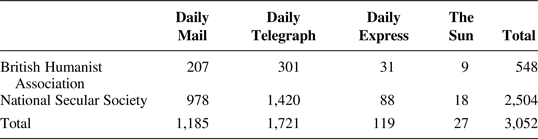
These trends are also highlighted by a comparative analysis of reporting on Britain's main campaign groups for secularism, the British Humanist Association and the National Secular Society. While the reporting statistics here are far higher than for those of conservative Christian groups (the National Secular Society was reported on 978 times by the Daily Mail and 1,420 times by the Telegraph, for example), the coverage was almost universally negative, and favorable to a religious viewpoint. Examples from the Daily Mail included: “Selfish culture is killing secular Europe, says Chief Rabbi” (November 5, 2009), “Prayers really can heal the sick, finds study” (August 5, 2010), “The secular attack on Bideford that aims to destroy our national faith” (December 2, 2011), and “David Cameron hails UK's Christian values' in Christmas message” (December 24, 2015). These figures are set out in Table 2.
Secular groups featured in news reports (all-time results)

Evidence also suggests that a collective action frame based on the marginalization of Christians may resonate well with a wider Christian constituency. A 2009 opinion poll conducted by ComRes, for example, found that 58% of Christians in Britain believed that living according to their faith was now more difficult than five years previously. This figure rose to 66% when the time period was extended to two decades (Premier Christian Media 2011). A survey by the Evangelical Alliance (2012) found that 77% of evangelicals in Britain thought that it was becoming harder to live by the Christian faith, and a 2010 poll revealed that 93% of Christians believed (60% strongly) that religion, and Christianity in particular, was being marginalized (ComRes 2010). Similar findings emerged from an inquiry into Christian experiences in Britain conducted by the cross-party group, Christians in Parliament. Almost three quarters of the organizations giving evidence to the inquiry (a total of 22 out of 30 respondents) cited “religious freedom” as a significant issue, some way ahead of the second and third placed issues of “family” (being cited by 46% of respondents), and “life issues” and “charity” (with 30% each). A majority of respondents to the inquiry (56%) also said that Christians in Britain were being marginalized, and 50% maintained that they were being “discriminated against” (figures calculated from Christians in Parliament 2012).
All the same, the potential success of conservative Christian groups is outweighed by their evident failures. One issue here has been a notable lack of campaign success in key areas such as securing a reduction in the time limit for abortion, preventing the legalization of same-sex marriage, and the repeated loss of legal challenges brought on issues of employment discrimination. Another problem is that, while the size of the conservative (evangelical) population in Britain is far from insignificant, the lack of positive engagement with a frame of “marginalization” by many grass-roots evangelicals raises the possibility of future tensions and discontent with the collective action frame being deployed by group elites (see Strhan Reference Strhan2015; Reference Strhan, Llewellyn and Sharma2016). In a similar fashion, divisions and disagreements between conservative Christian groups also threatens to undermine any sense of wider cohesion, with active co-operation between organizations being limited to specific high-profile campaigns.
A potentially more significant problem, however, derives from the use of a secularized discourse itself. One issue here is that assertions of marginalization, and related claims that supporters of conservative Christian views need to be accorded the same rights and equalities as other social interests, serve to highlight the sectional character of religious claims, undermining calls for special treatment and the justification of political and legal privileges. This is particularly so when these assertions are out-of-step with the majority of British public opinion (as is the case on critical issues such as abortion, assisted suicide and same-sex marriage) and where these privileges can themselves be seen as traducing the rights of other minority groups (e.g., see Clements Reference Clements2015).
While research from the United States indicates that the use of collective action frames based on notions of rights may have a positive rather than a negative impact — an educative and liberalizing effect that promotes ideals of universal rights and levels of tolerance towards out-groups (e.g., Djupe, Lewis, and Jelen Reference Djupe, Lewis and Jelen2016; Lewis Reference Lewis2016), others indicate that the polarizing discourse of the Christian Right has had a detrimental effect on democratic civility and deliberation (e.g., see Klemp Reference Klemp2010) and highlight the schismatic effects of promoting strong and reified religious identities (Bruce Reference Bruce1994). Importantly, the extent to which findings based on the specific context of the United States (where levels of religiosity remain unusually high compared to other advanced Western nations, and where notions of individual rights have a particularly high level of cultural symbolism) can be applied to Britain (where such notions are far less prevalent) remains an open question.
Another potential problem with using collective action frames based on secular arguments is that this can reduce the amount of control that religious groups have over the direction of their own narrative claims and structures. In contrast to the use of theological arguments, about which religious groups can claim to have particular expertise, attempting to legitimize public policy arguments on secular terms (and particularly when these are legitimized on the basis of scientific evidence) can expose groups to unexpected shifts in the evidence base that can challenge and undermine the core assertions being made. If same-sex marriage does not lead to growing social problems, for example, or if the legalization of assisted dying did not lead to a rising number of deaths among vulnerable groups in the way that conservative Christians contend, then the credibility of the arguments being deployed to oppose such policies would be severely (and perhaps fatally) compromised. At the same time, such a situation would heighten the risk of internal splits and fissures between group members committed to retaining a secular outward-facing logic — with the implication being that they would now need to support a position to which they were previously opposed (such as accepting same-sex marriage) — and those wishing to remain theologically “authentic” (on these issues see Knutson Reference Knutson2011; Thomas and Olson Reference Thomas and Olson2012; Thomas Reference Thomas2013).
CONCLUSION
Conservative Christian groups in Britain are organizationally diverse and politically engaged on a variety of issues, but are confronted by similar challenges brought about by the on-going process of secularization. This poses a strategic dilemma between balancing the need for groups to position themselves within an increasingly secularized context, while at the same time maintain a sense of distinctiveness and internal cohesion. The common response to this has been the construction of a collective action frame based on the ostensible social problems of secularization and the threat posed to religious rights and freedoms. These assertions may be useful for providing group solidarity, but significant problems remain. The most serious of these pertain to the dynamics of a collective action frame based on secular norms and values, the long-term effects of which are unlikely to provide the kind of benefits that conservative Christian groups would like to see. Further research into the political behavior of conservative Christian groups should work towards unpacking these dynamics in more detail.