THE NEGOTIABILITY OF CUSTOMARY TENURE
Issues of equity and security in the governance of land and natural resources are of growing concern to scholars and policy makers, and the suitability of customary and state tenure systems to provide rights of access to land for the poor has been debated for many years.Footnote 1 Whereas historically land tenure reforms in Africa have attempted to replace existing customary structures, a more pragmatic adaptive strategy of building on and reconfiguring customary law is now emerging (Bruce and Migot-Adholla Reference Bruce and Migot-Adholla1994; Cotula et al. 2004: 5, 7 DfID 1999: 7; Platteau Reference Platteau1996: 76; Quan Reference Quan, Toulmin and Quan2000: 38; World Bank 2003). Notions of customary tenure as a pre-colonial code of fixed rules have recently been abandoned, in recognition of the evolution and flexibility of customary systems (Juul and Lund Reference Berry, Bond and Gibson2002: 3; Shipton and Goheen Reference Shipton and Goheen1992: 308–11; 2002 Woodhouse Toulmin et al. 2003: 1712). Customary land tenure is now seen as a field where social and political relationships are diverse, overlapping and competing. Property regimes are thus often analysed in terms of processes of negotiation, in which people's social and political identities are central elements, and are also becoming contested terrain (Berry Reference Berry, Juul and Lund2002b; Juul and Lund Reference Berry, Bond and Gibson2002).
Peters (2002: 46–7) identifies three basic positions in the literature with regard to the negotiability of customary tenure. The first argues that the ambiguity and negotiability of customary tenure leads to a pervasive insecurity of rights of producers and to a lack of investment and inefficient uses. The second position identifies the negotiability and ambiguity of relations over land as a reflection of defining features of African societies, such as the hold social relations have over economic action, the dependence of individual actors on social networks to gain access to resources, and malfunctioning states. The fact that people's access to land is closely linked to membership of social networks and participation in political processes is seen to open up possibilities of access to land for the poor and not as necessarily engendering insecurity and increasing inequality (cf. Berry Reference Berry1993: 104). The third view holds that the ambiguity and negotiability of customary tenure do not necessarily inhibit investment but lead to increasing inequality because some people are in a better bargaining position than others and there are limits to negotiability and ambiguity (cf. 2002b: 219; Woodhouse Reference Woodhouse2003: 1705–6).
The first view was dominant from the 1960s to the 1980s (Acock Reference Acock1962; Feder and Noronha Reference Feder and Noronha1987; Yudelman Reference Yudelman and Robinson1964) but it has now been largely abandoned. Scholars such as Platteau Reference Platteau, Toulmin and Quan2000, Toulmin and Quan Reference Quan, Toulmin and Quan2000 and Toulmin et al. 2002 now appear to favour the second position, although ‘with sufficient unanswered questions to leave open the possibility of accepting the third’ (Woodhouse Reference Woodhouse2003: 1706). Others such as Cousins Reference Cousins, Juul and Lund2002, Daley and Hobley Reference Daley and Hobley2005, Juul and Lund Reference Berry, Bond and Gibson2002, Lund Reference Gough and Yankson2000, Peters Reference Peters, Juul and Lund2002, Shipton Reference Shipton, Juul and Lund2002 and Woodhouse Reference Woodhouse2003 support the third position based on mounting evidence of land appropriation by influential elites and increasingly restricted and insecure access to land (see, for instance, Abudulai Reference Abudulai1996; Reyna and Downs Reference Bruce, Downs and Reyna1988: 18; Simo Reference Platteau1996: 49; Swindell and Mamman Reference Swindell and Mamman1990: 177). They point to the fact that negotiators or contestants in customary land matters seldom operate on level playing fields. Some have more negotiating power, and more defining and contesting powers than others (Shipton Reference Shipton, Juul and Lund2002: 10). When competition for land intensifies, the inclusive flexibility offered by customary rights can quickly become an uncharted terrain where the less powerful are vulnerable to exclusion as a result of the manipulation of ambiguity by the more powerful (Woodhouse Reference Woodhouse2003: 1715). Ambiguity offers room for manoeuvre to small farmers and modest rural producers, but, at the same time, is exploited by the privileged in order to obtain advantage (Peters Reference Peters, Juul and Lund2002: 53). These studies also show that not everything is negotiable: ‘porous boundaries and fluid, malleable identities too have their limits. There are some groupings and roles to which humans get ascribed and from which they have no escape’ (Shipton Reference Shipton, Juul and Lund2002: 10).
This article studies the negotiability of customary tenure in peri-urban Ghana where land is at the centre of intense and unequal competition and closely tied to struggles over authority. The peri-urban village of Besease provides a grassroots view of processes of contestation of customary rights to land. The analysis of how local actors in this village deal with, negotiate and struggle for land rights confirms that these contestants always face an unequal fight. Postulating the social inequalities of local communities, the article analyses whether it is useful to place all local dealings about land under the term ‘negotiations’ – which signifies a mutual interest of the parties, as well as an opt-out option if negotiations prove unsatisfactoryFootnote 2 – or whether such a characterization extends beyond the boundaries of the term and risks undercutting the significance of local stratification and ignoring the winners and losers of uncertain rules.
LAND TENURE IN AN ASHANTI VILLAGE
Ghana
The evolution of customary tenure in Ghana has been described by scholars such as Alden Wily and Hammond Reference Alden Wily and Hammond2001, Amanor Reference Amanor1999 2001, Berry Reference Berry1993, 2001, 2002a, Boni Reference Boni, Kuba and Lentz2006, Lentz Reference Daley and Hobley2005 and Lund Reference Boni, Kuba and Lentz2006, who all differ in their terminology. While Berry, for instance, invariably stresses the flexibility and negotiability of customary tenure, Amanor (2001: 16) cautions that ‘defining the customary as flexible, adaptive, dynamic and hybrid creates problems for examining processes of change, since change has now become an intrinsic feature of institutions rather than a product of struggle between different social forces’. They do agree, however, that property relations are subject to intense contestation in cases where access to wealth and authority are undergoing rapid change. In line with this observation, the current article focuses on a peri-urban area of Ghana where such changes are salient. Owing to urbanization and population growth, peri-urban areas are witnessing a high demand for residential land, which is triggering struggles over the rights to allocate for residential purposes village land that has been cultivated by community members. In Ghana, the ‘customary’ dominates both property rights and allocational authority: 80 per cent of land is regulated by customary law,Footnote 3 with a decisive role for traditional authorities.Footnote 4 In peri-urban areas this role is described as shifting ‘from stewardship to ownership’ (Alden Wily and Hammond Reference Alden Wily and Hammond2001: 96). Although stoolFootnote 5 land administration is largely the domain of the traditional authorities, the government is to a certain extent also involved in stool land administration, for instance through the collection and distribution of stool land revenue, the requirement to provide consent and concurrence for allocations of stool land, and through land use planning.Footnote 6 However, in 2003 Ghana started a Land Administration Project, a long-term programme with multi-donor support, under which the government would pass its responsibility for the management of stool lands to customary land secretariats under the aegis of the traditional authorities (Ministry of Lands and Forestry 2003: 12; Toulmin et al. 2004). This project is expected to enhance the pivotal position of traditional leaders in Ghanaian land management. The lowest level of local government in Ghana, the Unit Committee,Footnote 7 has no formal role in land management but its members and the local representative at the District AssemblyFootnote 8 are often actively involved in development of the community and are, as such, in dialogue with the chiefs about issues of land-use planning and land revenue expenditures.
The peri-urban village this article focuses on is in the vicinity of Kumasi. Besease used to be a village of subsistence farmers but with the growth of Kumasi it has become a popular residential area where land is a valuable asset, now sellingFootnote 9 for more than Cedis 10 million (almost €1,000) per (residential) plot. Various actors – farmers, families, family heads, chiefs, the paramount chief, local government representatives and ‘foreign’ or local buyers of residential land – are all struggling for land on the outskirts, and the revenues this can bring. Sometimes actors team up, in other struggles former allies become new enemies. The story of Besease opens small but meaningful windows on local contestations for rights to land and serves to illuminate the capacity and opportunity of various local actors to negotiate their positions. It is based on fieldwork undertaken in 2003 and 2004. While the research displays narratives from only one village, it was part of a broader study in peri-urban Kumasi that has unveiled the same kinds of processes in other villages, which are also confirmed in the literature on other peri-urban areas of Ghana (Abudulai Reference Abudulai, Toulmin, Lavigne Delville and Traoré2002; Alden Wily and Hammond Reference Alden Wily and Hammond2001 Berry Reference Berry, Juul and Lund2002a; Gough and Yankson Reference Gough and Yankson2000; Kasanga and Kotey Reference Kasanga and Kotey2001 Maxwell et al. 1998).10
Besease
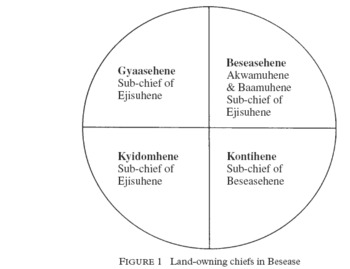
Besease – whose name literally means ‘under (ase) the cola tree (bese)’ – is situated on the outskirts of Kumasi, the capital of the Ashanti Region of Ghana. The village is about 23 kilometres from Kumasi on the main road to Accra, just after the town of Ejisu, which is home to both the District Assembly and the paramount chief, the Ejisuhene (ohene: chief). Besease is famous as the home town of Yaa Asantewaa – the queen mother of Ejisu who led the fight against the British in 1900 in what was later called the Yaa Asantewaa War – and infamous as the place with the worst rumble strips on Accra Road. The royal family of Ejisu comes from Besease, which therefore is home not only to the Beseasehene (who serves the Ejisuhene as his Akwamuhene and Baamuhene sub-chief) and his Kontihene sub-chief but also to three other sub-chiefs of the Ejisuhene: Kontihene, Kyidomhene and Gyaasehene. The term ‘chief’ can be confusing as it is used to describe various levels of traditional leaders. This article features the Asantehene, the chief or king of all Asantes; the Ejisuhene, a paramount chief; the Beseasehene, a village chief; and a range of sub-chiefs of the paramount chief or the Beseasehene. All are referred to by the term ‘chief’. The titles of sub-chiefs are not based on the names of their residence, as we saw for the Beseasehene and the Ejisuhene, but on their function. They either refer to the sub-chiefs' original position in the chief's army – for example, the Kyidomhene is the leader of the rear flank (akyi: back, behind) – or their administrative function in the locality: the Baamuhene, for instance, takes care of the royal cemetery (baamu: mausoleum). Sub-chiefs function as the chiefs' councillors. The councillors of lower chiefs are called elders. Four of the five residing chiefs ‘own’ land in Besease, with the fifthFootnote 11 ‘owning’ land in Ejisu. Ownership of land is a complicated concept since the ultimate title of stool land lies with the community, usufructuary interests with individuals or families, and the chief has been allocated the role of custodian. This multi-layered customary set-up allows considerable space for struggles to capture the new value of land in peri-urban Kumasi. At the centre of these struggles lie issues of authority about allocating village land to outsiders for residential purposes and entitlements to the proceeds from such allocations. A related issue is whether allocation papers need to be signed by a chief and, if so, by whom and for what signing fee. These debates are taking place within communities and between the various levels of chieftaincy.
The paramount chief in the area of study is infamous for a style of land management that lacks equity and pro-poor development. According to the assemblyman of Besease, ‘the Ejisuhene is a greedy man, therefore almost no one goes to him to sign the allocation papers, because he asks too much money’.Footnote 12 The area's District Chief Executive describes what he regards as the Ejisuhene's ‘autocratic way of ruling’: ‘The Ejisuhene is leasing out land in the villages, bypassing the village chief. Therefore he tries to get subservient chiefs (in the villages). Ejisu traditional area is notorious for its rampant chieftaincy disputes. The Ejisuhene is at the centre of those.’Footnote 13 The Ejisuhene has also interfered with the selection of candidates for village stools in his traditional area. ‘The omanhene (paramount chief) is no good,’ says his Kontihene, ‘most of the chiefs he has planted in these towns are not liked.’Footnote 14 He has, for example, interfered in the enstoolment of the current Beseasehene: ‘The Ejisuhene selected this person for the Besease stool. The kingmakers were not involved and the abusua panin (head of family) was even sent away at the enstoolment.’Footnote 15 Similar practices were found in Boankra, Onwe and Adadeentem, other villages in Ejisu paramountcy. The Ejisuhene also tried to destool a number of his own sub-chiefs, including the Kyidomhene, Gyaasehene and Kontihene, because they did not agree with his land management. These depositions were not accepted by the families concerned, whose consent the Ejisuhene had failed to seek before taking action. The sub-chiefs for their part are bringing charges against the Ejisuhene on account of how much land he has sold, how little he has given to the Unit Committee during his ten-year reign and his unwillingness to account for his actions. The case is now before the Asantehene.Footnote 16 ‘When this case has been settled, the local chiefs can also be dealt with,’ explains his Kontihene. ‘Most of the village chiefs gave significant amounts of their revenue to the Ejisuhene, so it is actually the same case.’Footnote 17 In the meantime, the sub-chiefs are not going to the Traditional Council in Ejisu but are still carrying on with most of their functions in Besease. The relationship between the parties seems to have been soured. At a certain point, the Ejisuhene even reported his Kyidomhene, Gyaasehene and Kontihene to the Regional Security Council for planning to assassinate him. However the council sent them home when they explained that they only wanted the Ejisuhene to account for his actions. ‘The Ejisuhene is now so afraid,’ sniggered the Kontihene sub-chief of the Beseasehene, ‘that even when he goes over the rumble strips in Besease his car goes at full speed because his Kontihene lives on the main road.’Footnote 18 The ruined relationship means that the Ejisuhene cannot ‘come here and tell all the chiefs their different roles’, as one of the villagers in Besease had hoped.Footnote 19 Although there are doubts about the usefulness of the Ejisuhene's interference for community development because of his style of land administration, this villager justifiably wonders how local disputes involving chiefs can be solved when the paramount chief – who has the exclusive jurisdiction to deal with destoolment charges – is unable or unwilling to discipline his sub-chiefs.20
Due to its unusual set-up with four land-owning chiefs and a paramount chief who frequently interferes in village affairs, Besease offers an excellent case for studying agency and resistance in land struggles at various levels and in different arenas. These struggles can be grouped in three categories: struggles over the right to sell village land for residential purposes; over the right to sign allocation papers; and over the right to cash the revenue accruing from land sales. This division has been made to structure the land struggles in Besease but should not be interpreted as meaning that these rights are unrelated. For instance, the right to sign allocation papers entails a right to a negotiated signing fee and enhances the possibility to initiate sales.
THE RIGHT TO SELL
The right to sell village land under cultivation by community members to outsiders for residential purposes is a highly contested issue in Besease. Does it belong to the farmers and families who have been cultivating the land for generations and passing it on to family members through gifts and succession? Or does it devolve to the chiefs who also have the right to allocate unused land to outsiders? According to the Beseasehene, ‘It is a law that when the town is growing and it comes to your farm, you do not have any land. Because the land is for the chief.’Footnote 21 The Kontihene of the Ejisuhene agrees: ‘When the town reaches the farm, people lose their rights.’Footnote 22 ‘Only the chief can sell,’ says the Kontihene of the Beseasehene. However he takes a more moderate point of view: ‘You must compensate the farmer for his loss of livelihood if he approaches you with respect. How much? That depends on when the farmer is satisfied. You don’t want trouble in the family. It's a process of negotiation.'Footnote 23 Other villagers' views vary widely, from acknowledging the chief's right to sell the land to a full denial of any such right. ‘The chief decides to sell land. Farmers can’t say no, but they can negotiate a price. But the bulk of the money goes to the chief, since he has full power'Footnote 24 is one view. While others feel that: ‘the chief cannot sell land without the family’s consent because someone is farming there now. The money will go to the farmer, the chief only gets some of it.'25
In accordance with the conflicting statements described above, actions by both chiefs and the people demonstrate similar disagreements regarding land rights.Footnote 26 The first case features the former Beseasehene who, at some point, demarcated a piece of farmland, which was being cultivated by a farmer from another family, into eight residential plots. The chief sold seven of these plots and gave the last one to the family concerned. The current Beseasehene recently sold the eighth and last plot and the family was first aware of this when the buyer started to develop the land. A quarrel broke out between the chief and the family but the chief refused to give the family another plot, and ‘brought macho people in’Footnote 27 to restrain them. In contrast to this, the Beseasehene did not get his own way in a different case in which he sold a plot of land belonging to yet another family. As soon as the buyer started building on this piece of land, he was restrained by the infuriated family. The buyer then went back to the chief who approached the family to plead with them to settle the conflict, but they were adamant and the chief almost got beaten up. The chief then had to compensate the buyer. These two cases suggest that the power and actions of a family – depending on its size, connections, economic capital and willingness to act and use force – can influence the outcome of a chief's attempts to appropriate rights in family land. A third case involving a former Beseasehene dates back to 1973, when Mr O. approached the Beseasehene about buying a piece of land on the other side of the road, near the station. After he had bought it, the land turned out to belong to the Kyidomhene. The two chiefs reached an understanding but Mr O. ended up with only a small part of the land he had bought, an outcome he felt unable to challenge. In this case, as well as in a number of other cases discussed below, it was the buyer who lost out.
A different chief who wanted to sell some land, which in this case belonged to his own family, is the Gyaasehene. One of his predecessors had given a large tract of land to the Catholic Church on the understanding that it would start a school on part of the land. When the Catholics failed to honour their promise, the current Gyaasehene approached the Bishop, who returned part of the land to the chief. The Gyaasehene, instead of giving it back to his family, sold the land to outsiders and pocketed the proceeds. When the chief's family discovered his action, they initially wanted to destool him but this would have involved the Ejisuhene, with whom the family was still angry for his attempt to destool the Gyaasehene without their consent. Besides, the elder leading the charges was not on speaking terms with the Ejisuhene. This elder, a lawyer, had been the Gyaasehene-elect at the last installation but the Ejisuhene had refused to enstool him, probably because in the past he had been involved in – and won – a court case against the Ejisuhene over land. After extensive deliberations, therefore, the family decided to keep the Gyaasehene on the stool but sent him away from Besease to avoid his meddling in land matters. This case demonstrates the danger a chief faces if he sells land that belongs to his own family, which has more direct power in disciplining the chief.
The next case shows that it is not only the chiefs who are selling land. A.D., a Kyidomhene elder, recently sold some plots of family land. According to him, he sold the land to raise revenue to renovate the family house, but his nephews claim that he sold more plots than was necessary for this purpose alone. When asked whether the chief's permission was required to sell land, A.D. replied that things were changing. ‘It depends on the animosity between the seller and the chief. The chief has to sign the land allocation paper and the site plan. But we first sell and then we go to the chief.’Footnote 28 He later explained that his family has three houses or ‘gates’ from which the Kyidomhene is selected, and the people from these three houses can sell their own land, whereas others cannot.Footnote 29 When the Kyidomhene heard this, he stated angrily: ‘A.D. was wrong when he said that members of the three gates can sell their own land. He said that because he has sold seven plots.’Footnote 30 A.D. does not have a bad relationship with the Kyidomhene, however, because when the Ejisuhene tried to destool the latter, A.D., who is next in line to the Kyidom stool, refused the position. A.D. is thus not just any member of the family and he fully acknowledges that it ‘depends on your importance in the family’ as to whether you can get away with selling your own land or can negotiate a fair price when the chief is selling it.31
The following cases show that commoners can also find ways to sell their land, although with some involvement by the Beseasehene. These cases centre on the interpretation of history. When the town started to expand during the reign of the former Beseasehene at the beginning of the 1990s, the chief announced that anybody could sell the land he was farming. According to some, the Beseasehene's statement only referred to land belonging to his own family; others took it to have a much wider meaning and to cover all the land in Besease. The Aduana family in Besease, who had been given farmland by the Kontihene sub-chief of the Beseasehene when they arrived in the village, seized the opportunity to sell their lands and went to the Beseasehene to sign the allocation papers, thus bypassing the Kontihene. The deal was of mutual benefit to the Aduana and the Beseasehene, since the first could sell their land without involving the Kontihene, while the latter could receive a 10 per cent signing fee on land that was not his. When the Kontihene discovered the sales, he wanted to take the Aduana to court but felt he could not do so because they were half-brothers and sisters. Besides this, ‘all the plots have been sold and the money squandered’.Footnote 32 A similar story was told by the Kyidomhene:
People with Kyidom land knew that I would not agree [to selling the land] and sign their allocation papers, so they went to the Beseasehene for a signature. When I heard about it, I could not do much about it. I called the people with a letter and sent a copy to the Beseasehene and Ejisuhene but I did not pursue it. I did not want to take my own family to court.33
These cases illustrate how, when chiefs are confronted with established sales, they do not always see the chance of reversing them to claim part of the revenue or to discipline the sellers in any other way, especially if the sale involves a larger group of people or the chief's own relatives. Both the Aduana family members collectively and a number of individual commoners with Kyidom land were able to sell their own land, with the signature of the former Beseasehene on their allocation papers.
THE RIGHT TO SIGN
Whether the chief is the one to sell the land, or merely the one who signs the allocation paper, many people think that the chief has to be involved at a certain point. If a buyer wants to obtain a building permit from the District Assembly, his allocation paper will need to be signed by the chief, who will demand a signing fee for this service. A much debated question in Besease, however, is which chief needs to be involved. The Beseasehene posits that all allocation papers in Besease need his signature, whereas the other land-owning chiefs claim they can sign their own allocation papers. ‘The king of Besease has overall power of the land,’ says the Beseasehene.
My uncle, the former chief, told the sub-chiefs they could sell their own land. But when I came, I cancelled that. I have to be consulted first. They are not happy about my decision. Some sub-chiefs sign their own allocation papers but it is risky to buy land without the chief's signature.34
The other chiefs protest this usurpation of power. ‘This chief pretends the other chiefs do not exist. He wants to own the whole town, which is not right,’ says one of them. ‘He is a small, new chief, he was only elevated to Akwamuhene in 1975. His business is to mind the cemetery.’ According to the Gyaasehene, a purchase of land by the Beseasehene, before he became chief, supports this argument. This land was bought from the Kyidomhene who provided all the transaction documents without any involvement of the then Beseasehene. This is clearly not a struggle for signatures alone but for the power to control land sales and the revenue from them. ‘If we allow the Beseasehene to sign our allocation papers,’ says a Kontihene elder, ‘he will also try to initiate sales of our land and take the revenue.’35
This dispute is tied up with the issue of authority. The Beseasehene claims that since he is the chief of Besease, he is superior to the other chiefs, at least regarding Besease lands. But according to the Kyidomhene and Gyaasehene, there is no hierarchical relationship. ‘Each chief pours libation on festive occasions,’ explains an elder of the Kyidomhene.Footnote 36 Both claims are grounded in their own versions of history. In Beseasehene's version, two brothers named Asutwuma and Acheampong migrated to Besease from Denkyira. Later Asutwuma left for Ejisu, but since he originally came from Besease, he chose his sub-chiefs from there and asked his brother, the Beseasehene, to allocate land to these sub-chiefs and their families. As the Ejisuhene wanted to be buried in Besease, he created a royal cemetery there, which comes under the responsibility of the Beseasehene. This has earned him the additional title of Baamuhene. Later, the Ejisuhene also made the Beseasehene his Akwamuhene, the divisional chief that speaks after the paramount chief. According to the other chiefs, the Ejisuhene, when he was still living in Besease as Beseasehene, divided land among his sub-chiefs as a reward for good service. The Gyaasehene, Kyidomhene and Baamuhene received land in Besease, and the Kontihene in Ejisu. Later, when the chief left for Ejisu, he made the Baamuhene caretaker of Besease, while his higher divisional chiefs served him in Ejisu. The Beseasehene thus used to be only the Baamuhene, a ‘service chief’, of the Ejisuhene, and was elevated to Akwamuhene in the 1970s, thereby gaining the same status as the Kyidomhene, Kontihene and Gyaasehene. Even the Beseasehene's own sub-chief, the Kontihene, claims the right to sign his own allocation papers, and is in fact selling his land. ‘I am also the occupant of a black stool. I am next to him, not a subject. If the Beseasehene were cooperative, I would have advised the buyers to go to the Beseasehene with some drinks, but now he is trying to use power to take it.’37
Mirroring the conflicting statements above, actual dealings with land demonstrate various struggles as to who has the right to sign allocation papers. Two examples, in which the previous Beseasehene signed the allocation papers of land that fell under the jurisdiction of the Kyidomhene and the Kontihene sub-chief of the Beseasehene respectively, have already been discussed. In both cases, the family members who were selling were reproached, but in the end the family members as well as the Beseasehene escaped unharmed. Even when the Beseasehene himself sold two plots of land belonging to his Kontihene in 2002, he did not run into trouble. ‘We, as the rulers of Besease, do not want to quarrel with him,’ explains an elder of the Kontihene, ‘but the buyer cannot come and work on it. If you come to work, you will meet the Konti family.’Footnote 38 The Kontihene later added that he hoped that the buyer would take the case to court. As seen before, in the case of Mr. O., the buyer seems to suffer as a result of the malpractices of the selling chief. One should not conclude from the previous cases that the Kontihene recognizes any Beseasehene claims over his land or the revenue accruing from land sales. When the Kontihene recently sold 32 plots of land, the Beseasehene, as self-proclaimed overlord of the land, claimed C40 million (approximately €4,000) of the revenue, but the Kontihene refused to pay, even after the Beseasehene reduced his demand to C28 million.
Another inventive attempt by the Beseasehene to capitalize on his position proved equally unsuccessful. He personally went to the homes of all the people who had bought residential land from previous Beseasehenes, claiming that he should renew the signature on their allocation papers, a service for which he demanded a substantial signing fee. He went, for instance, to the house of Mrs O., who bought a tract of land from the then Beseasehene twenty years ago. He ordered Mrs O.'s mother, who lives in the house while her daughter lives in the Brong-Ahafo Region, to come to his house to get a new signature. But after consulting Mrs O. and her husband, she decided not to go. The chief also went to the house next door, where eighty-four-year-old Mrs A. told him that the papers were with her children in South Africa and that he had no right to see or sign them. A fight developed and insults were thrown by both sides. To another lady, Mrs S., he said that at the time of the sale the land had been sold too cheaply, and that he now had to sign the papers again. It was rumoured that she had gone to the chief's house for his signature, and was made to pay C1.2 million (approximately €120), but during the interview she denied the story. ‘He is cheating us. I am not taking my papers there,’ was her firm response.Footnote 39 Tellingly, the Beseasehene took no further steps to enforce ‘his right’ in these cases.
Comparing the cases described in this section – where the house owners resisted the Beseasehene's claims for a renewed signature and his sub-chief, the Kontihene, refused to share revenue from land sales with him – with the cases in the last section shows that it is much easier to resist claims for money or a renewed signature than to fight an established sale. This demonstrates the crucial significance of the power to initiate sales. Whether this initiative is taken by commoners or chiefs, the other contestants are often unable or need a lot of force to undo any established sales or to claim part of the revenue.
THE RIGHT TO CASH
In Besease, land struggles are not only centred around the rights to sell and sign. Even when a chief has already sold land, the struggle continues for the right to cash or the obligation of the chief to set aside a certain part of the land revenue for community development. According to the Unit Committee (UC), the Beseasehene has sold many plots since his enstoolment at the beginning of 2002, but only in a few of these cases has he informed the UC of the sale and contributed C100,000 for community development. The other land-owning chiefs in Besease have neither disclosed sales nor contributed any money for community development. Since 2003, the UC and the assembly member have pressed for more transparency and funds for community development. After they had raised the issue unsuccessfully in conversations with the Beseasehene, the topic featured prominently on the agenda of the 2003 Easter Convention: ‘We are going to tell the chief point blank to give money to the community,’ said the assemblyman a few days before the event.Footnote 40 This convention is a two-day homecoming event when everyone who comes from Besease, including the chiefs, gets together for a celebration and a discussion of the town's affairs. To everyone's surprise, the Beseasehene and the queen mother did not attend this year. The general feeling was that they did not show up because the Beseasehene did not want to be questioned about his land administration policy. According to the Kontihene sub-chief of the Ejisuhene, ‘He did not come to the Easter Convention because I would bring him to account, and he has squandered all the money.’Footnote 41 The people were so angry that they wanted to destool the Beseasehene but when the queen mother apologized on his behalf they decided to give him one last chance. Their reluctance to destool him also seems to be based on fear because it is said that he uses juju and witchcraft. The other chiefs are also unable to introduce destoolment charges because of their own dispute with the paramount chief.
A few weeks after Easter, the UC and the assembly member called a village meeting at which they proposed to install a Plot Allocation Committee (PAC) that would sign all land allocation papers and secure a certain percentage of the revenue for community development. This provoked a heated debate between the Beseasehene, who denied all land sales, and the people who did not believe him and wanted him to account for his land administration. In the end, the Beseasehene reluctantly agreed to appoint two of his confidants to the PAC. The Beseasehene was the only chief present at this village meeting. The absence of the other chiefs was explained as being due to the animosity between the chiefs of Besease: ‘Every time they see the Beseasehene, they fight.’Footnote 42 ‘Last meeting, a fight nearly broke out.’Footnote 43 ‘They have not been coming to public meetings because of their litigation with the Ejisuhene.’Footnote 44 Since this meeting, the UC and the assemblyman have been trying to get all the chiefs together to agree to the PAC receiving a third of the revenue of all land allocations in Besease. According to the chairman of the UC, the Gyaasehene had already agreed but he had not yet spoken to the Kyidomhene. One of his elders did not think the Kyidomhene would agree ‘because a third is big money. But we will make him agree to a sizeable amount when we all meet. We have to convince them that the money will be used for the development of the town.’Footnote 45 Later interviews proved them right: the Gyaasehene stated that ‘The law that a percentage of land revenues should go to the town already existed, even if the chief didn’t agree.'Footnote 46 But the Kyidomhene said that: ‘It is too much because the farmer, chief, elders and stool also need money. Besides, the UC usually misuses the money. A quarter would be a better idea.’47
During the following months, the Beseasehene proved to be the most uncooperative chief and tried to thwart any discussion on the topic. He seemed enraged by the refusal of the UC chairman and the assembly member to tell the other chiefs that all allocation papers should be signed by the Beseasehene. In an encounter shortly after the village meeting, the Beseasehene told the assemblyman and the UC chairman that since the community collects a third, they also had to take care of this issue. And if they would not talk to the other chiefs, he would not comply with their laws to give a third of the revenue to the Unit Committee. But the assemblyman thought that the chief should give a third to the community because ‘the law is the law’.Footnote 48 At the end of August 2003, the PAC and all the chiefs finally met. The PAC explained that they wanted a third of all land proceeds for town development but the chiefs disagreed. ‘If your forefathers did not have land, you can’t claim it now just because you are on the committee. The chiefs already pay more on certain occasions such as at the Easter Convention. And they pay a lot of expenses for their own families, such as education and funerals,' the Kontihene of the Beseasehene later explained.Footnote 49 They promised to come up with a different proposal after discussing it amongst themselves. The PAC, however, never heard from them again. In January 2004 they sent all Besease chiefs a letter to ask them to account for their land administration but this was also ignored. By as late as September 2005, the PAC had still not started in Besease.
The configuration of Besease makes the coercion of chiefs in accountable land management and revenue sharing a complicated issue. None of the land-owning chiefs is eager to see a third of his revenue go to the community. As long as they can blame the failure on a third party, there is no incentive for them to try to reach an agreement. The Beseasehene is trying to use the installation of the PAC to initiate the practice of his signing all allocation papers in Besease. He blames the UC and the assemblyman for not cooperating with him and is therefore withholding his support for the PAC. The other chiefs are reluctant for the same reasons: they do not want to accept the Beseasehene as overall landlord, and are uncertain of the UC's position on the issue. Even farmers are taking an ambiguous stance towards the sharing of revenue from land sales. On the one hand, they would rather that revenues from land sales be used for community development than end up in the chiefs' coffers. But when they see the chance to sell their own land, they are not keen to hand over any of the purchase price to the UC. This constellation of bickering chiefs and wavering farmers makes it almost impossible for the UC and the PAC to take measures against reluctant chiefs. The situation is exacerbated by the fact that the paramount chief cannot be appealed to in a mediating role. In an attempt to break the deadlock, the PAC and UC members have turned to state law and statements by officials to underpin their claims. For instance, when the UC told the queen mother about the PAC, they said that the government had informed them that the community would get a third of any revenue from land sales.Footnote 50 And one of the PAC members claimed that ‘the sub-chiefs are all legally obliged to obey the law. It is a constitutional provision that the town receives 30 per cent of revenues. Even the MP when he came to the Easter Convention announced that.’Footnote 51 While the truth about official statements remained unclear, no such legislative provisions are to be found in the constitution or elsewhere.
Conclusion
Conclusions from the cases
This article has considered struggles for land regarding the right to sell, to sign and to receive cash payments. The first conclusion that can be drawn from these cases is that selling land – sometimes initiated by farmers but more often by chiefs – is often profitable and does not entail many risks for the seller. Even if the land did not belong to the seller, sales were rarely reversed. And if they were, usually the seller was only made to return money to the buyer, which in the worst case sent the former back to square one, but incurred no additional costs. Even in the case of the Gyaasehene, who sold land belonging to his own family, the punishment was no more severe than his relocation from the village. The sale of land for residential purposes automatically implies the loss of farmland for a local farmer, which often severely affects the person's livelihood. Such effects are difficult to cope with or turn around even if the sale of land provides good start-up capital for a new livelihood, but become almost impossible to combat when the chief is the seller and provides limited or no compensation. Whenever a sale leads to a dispute between chief and farmer, the position of the buyer is also endangered.Footnote 52 Buying land from someone whose authority was questioned, which in Besease is more often the case than not, runs a real risk for the buyer of losing part or all of the land, of being threatened or assaulted by the aggrieved party, or of having to pay an additional sum to acquire the same plot of land or as a signing fee for the allocation papers.Footnote 53 The Beseasehene has even tried to make buyers from twenty years ago pay a new fee for their papers, but due to their long-term uninterrupted possession of the land, and the homes they had built on it, they withstood his pressure. In the triangle of chief, farmer and buyer, the chief usually benefits from land sales at the cost of the latter two, which, over time, would appear to result in reduced access to land for the poor and increased socio-economic inequality, a result confirmed by other research.54
Since selling land is profitable and those wishing to undo established sales are often unable to do so, gains largely depend on the opportunity or ability to initiate sales. Although we saw cases where commoners had been able to sell their land, the prime actors in selling land were usually the chiefs. Bruce 1998: 43 explains their strong position as follows:
in many indigenous tenure systems a traditional leader who administers community land is viewed as holding a tenure in that land. This is best described as an estate of administration, held in trust, but where the land is unoccupied and rights to land are becoming increasingly individualized, the traditional leader is sometimes able to convert the administrative estate to a personal right.
In Besease, where there is no unoccupied land left, chiefs are even attempting to acquire personal rights over occupied land under cultivation by community members. The customary system of land allocation, with the chief as the administrator of land, is thus clearly dominated by the traditional elite. The chiefs' strong position is enhanced by their capacity to draw up planning schemes and demarcate village land into residential plots – actions frequently supported by local government – which provides the administrative tools to allocate land.
Even though those who want land do not have equal opportunities, this does not mean that the powerful can deal with land as they please. Three cases were described above that showed how the Beseasehene overstretched his authority and was resisted. The first case was where a family restrained a buyer from coming on to the land he had purchased from the Beseasehene and steadfastly refused to come to an agreement with the chief. The second case described how the Kontihene sub-chief refused to share land revenue with the Beseasehene. And, in the third case, the fierce resistance of various villagers against the Beseasehene's scheme to ‘renew’ the signatures on old allocation papers was discussed. The chief's room for manoeuvre and the success of resistance against his actions in cases like this depend, among other things, on the contestants' membership of social and political networks, their economic capital, the number of people they can mobilize, and the degree of physical force they are willing and able to use.
Among themselves, the chiefs of Besease constantly struggle for the spoils of land allocations. Besease, with its four land-owning chiefs, does not fit the typical model of an Ashanti village with respect to traditional leadership. The multi-chief configuration of Besease on the one hand offers opportunities for individuals and families to benefit from the animosity and rivalry between the chiefs, by playing them off against each other. On the other hand, it complicates the process of bringing about accountable land management and equitable revenue sharing, as was seen in the case of the establishment of a Plot Allocation Committee.Footnote 55 Disagreements between the various chiefs in Besease and the interference of the paramount chief furthermore show how the local and the supra-local are intertwined, and illustrate how contestations over land are intimately tied up with struggles over political power and authority. Claims by an institution to define property are also claims about the institution's legitimacy itself (cf. Berry Reference Berry, Juul and Lund2002b; Lund Reference Berry, Bond and Gibson2002). The Besease case furthermore shows that struggles for both land and political power are intimately tied up with contestations of history.
In conclusion, this account of land struggles in Besease shows how sales of residential land have disproportionately benefited the traditional elite at the expense of small-scale farmers and stranger buyers. Customary tenure in Besease does not constitute a guarantee of security for the poor. This case therefore does not support recognition of customary rights at the community level per se as a means of protecting the poor. Since local communities are themselves ‘the sites of inequalities and the instigators of exclusions’ (Moore Reference Moore1998: 42), measures to strengthen customary institutions and local control of access to land without regulating checks and balances on local power holders may actually reinforce inequality. Although this article covers only one village with its own peculiar composition and other localities could well have different power configurations, the general trends described in Besease are confirmed by mounting evidence that, due to rising land values, processes of commodification and individualization of land are restricting access to land for the poor, increasing the appropriation of land by influential elites and exacerbating socio-economic inequalities (cf. Berry Reference Maxwell, Larbi, Lamptey, Zakariah and Armah-Klemesu1998: 58–60; Peters Reference Peters2004; Reyna and Downs Reference Bruce, Downs and Reyna1988: 13–19; Woodhouse Reference Woodhouse2003: 1717).
A conclusion on the negotiability of customary tenure
The third position described in the introduction to this article imputes the increased inequality under customary tenure to the differentiated bargaining positions within a community and the limits of negotiability and ambiguity. Although the Besease case endorses both these aspects, I agree with Peters 2004 and Amanor 1999 who warn that too much emphasis on negotiability results in an overestimation of people's agency and that the image of relatively open, negotiable and adaptive customary systems of landholding and land use obscures processes of exclusion, deepening social divisions and class formation. Peters, in a critical assessment of the literature stressing the negotiable and adaptive nature of customary tenure systems, simultaneously recognizes the valuable contribution of these studies to policy debates and points to a neglect in asking who benefits and who loses or, even when social inequalities are identified, to an undercutting of their significance by insisting on social agency:
Critics who mounted successful challenges to simplistic and economistic models that posited customary landholding to lack security of title and, hence, to fail to provide incentives for investment and modernization, were able to reveal the fallacy of this conventional development thinking, and, recently, to achieve a dramatic reversal of position among World Bank researchers and some aid agencies. But in so doing, they also have over-emphasized negotiability and indeterminacy. This, in combination with a parallel shift in social theory influenced by postmodern and postcolonial writing that privileges ambiguity, multiplicity and indeterminacy, has resulted in a proliferation of studies celebrating agency and manoeuvres at the cost, I claim, of identifying winners and losers. (Peters Reference Peters2004: 271)
In her opinion, more emphasis on who benefits and who loses in instances of ‘negotiability’ in access to land requires ‘a theoretical move away from privileging contingency, flexibility and negotiability that, willy-nilly, ends by suggesting an open field, to one that is able to identify those situations and processes (including commodification, structural adjustment, market liberalization and globalization) that limit or end negotiation and flexibility for certain groups or categories’ (ibid.: 270) (emphasis added).
In line with, but perhaps going beyond, Peters's observation, I wish to caution against misuse of the term ‘negotiability’. As noted earlier, the term ‘negotiation’ denotes a mutual interest by the parties as well as a withdrawal option if negotiations prove unsatisfactory. Where neither of these characteristics are found in struggles and contestations for land because one party has the power to negate the other party's rights completely or unilaterally to impose a new constellation of rights, it is overstretching the term to continue to speak of negotiations. We cannot say that it is the result of a negotiation serving their mutual interest when a farmer finds out that a chief has sold his farmland. Nor can we speak of an opt-out for this farmer when he goes to the chief to plead for part of the revenue. The Besease case shows a range of interactions on a continuum from (1) negotiations where parties have more or less equal power, such as between chiefs, and (2) negotiations between parties with severely unbalanced power relations, such as between chiefs and poor farmers, to (3) unilateral actions where one party is presented with a fait accompli regarding an alteration in his/her rights to land but where resistance changes the outcome to a certain extent, and (4) unilateral actions where acts of resistance remain ineffective and the strongest party imposes a new constellation of rights or even negates all the rights of the other party. When Juul and Lund (2002: 6) state that ‘just as poor and disadvantaged people may sometimes negotiate improvements to their lives, these may just as swiftly be negotiated away again’, they thus present an incomplete and skewed picture that ignores a whole array of actions in which a powerful party one-sidedly abrogates or diminishes the other party's rights. An overstretching of the term negotiation – or rather a continued use of the term when in fact negotiations have ended – is not only incorrect but also dangerous as it obscures the stratification of the local communities in which these processes take place, overemphasizing the positive aspects of customary tenure, while neglecting its injustices. This also sends a wrong signal to policy makers, who have mainly shifted from favouring the abolition of customary tenure systems (USAID 1986; World Bank 1975) to a greater role for customary land tenure (De Soto Reference De Soto2001; DfID 1999; EU 2004; World Bank 2003) but often still lack an eye for issues of social differentiation and inequality (cf. Daley and Hobley Reference Daley and Hobley2005: 4, 35). Overstretching the negotiability of customary tenure will sustain this gap between empirical realities of customary land tenure and its characterization in policy debates.
This research does not conclude that the increasing economic inequalities are solely or predominantly a consequence of customary tenure and negotiable land rights. Rather, these should be attributed to Ghana's political economy, with the internalization of the market-driven inequalities of the global economy and the strengthened position of chiefs that is discernible since the overthrow of Nkrumah in 1966, but has become especially pronounced during the current reign of President Kufuor. This research also does not mean to suggest that national legislation will necessarily make land management more equitable. It recognizes customary law as a fact of contemporary political life but warns against treating it as a panacea. We should ‘engage with “customary” tenure with open eyes’ (Daley and Hobley Reference Daley and Hobley2005: 4, 35), and this warrants continued study and open debate about its functioning.
Land-owning chiefs in Besease