INTRODUCTION
The Alzheimer’s disease (AD) process begins decades before severe symptoms are observed (Aizenstein et al., Reference Aizenstein, Nebes, Saxton, Price, Mathis, Tsopelas and Klunk2008; Bateman et al., Reference Bateman, Xiong, Benzinger, Fagan, Goate and Fox2012; Bennett et al., Reference Bennett, Schneider, Arvanitakis, Kelly, Aggarwal, Shah and Wilson2006; Kremen et al., Reference Kremen, Jak, Panizzon, Spoon, Franz, Thompson and Lyons2014a). Recent efforts have highlighted the need to identify risk factors early in this process and to identify non-invasive tests that may improve identification of mild cognitive impairment (MCI) or AD, or act as screening tools for other assessments (e.g., biomarker assays) (Kremen et al., Reference Kremen, Jak, Panizzon, Spoon, Franz, Thompson and Lyons2014a; Sperling, Mormino, & Johnson, Reference Sperling, Mormino and Johnson2014; Vos & Duara, Reference Vos and Duara2019; Wang et al., Reference Wang, Coble, McDade, Hassenstab, Fagan and Benzinger2019). Genetic studies are highly relevant, as knowing which individuals are at high genetic risk for AD may allow for targeted interventions before the onset of more severe deficits. However, it is still unclear how AD genetic influences relate to cognitive performance, including cognitive changes across the critical transition period from midlife to older age. The current study sought to shed light on the cognitive correlates of AD genetic risk by examining how polygenic scores for AD predict cognitive performance – including both baseline levels and cognitive changes – across late midlife. As described below, although episodic memory is most characteristic of AD, we also examined executive function as it also associated with early AD-related declines.
In the past decade, genome-wide association studies (GWASs) have unlocked enormous potential for understanding AD biology (Bellenguez, Grenier-Boley, & Lambert, Reference Bellenguez, Grenier-Boley and Lambert2020; Kunkle et al., Reference Kunkle, Grenier-Boley, Sims, Bis, Damotte and Naj2019; Lambert et al., Reference Lambert, Ibrahim-Verbaas, Harold, Naj, Sims, Bellenguez and Amouyel2013), detecting individuals at high risk for AD, and understanding how AD genetic influences may affect cognition and health decades before the onset of AD. Researchers can leverage data from across the genome, including the 40 or more genes/loci the have already been linked to AD risk, to create polygenic risk scores that capture an individual’s relative genetic risk of AD compared to others in the sample (Choi, Mak, & O’Reilly, Reference Choi, Mak and O’Reilly2020; Logue et al., Reference Logue, Panizzon, Elman, Gillespie, Hatton, Gustavson and Kremen2019). Polygenic risk scores for AD (hereafter, AD-PRSs) have already shown promise in understanding early AD-related changes in preclinical samples, for example, by differentiating individuals with amnestic MCI in a sample of middle-aged adults (mean age 56) (Logue et al., Reference Logue, Panizzon, Elman, Gillespie, Hatton, Gustavson and Kremen2019). Beyond understanding how AD-PRSs relate to MCI diagnoses and cognitive impairments in midlife, it will also be important to quantify whether AD genetic risk can also predict cognitive changes across midlife in community-dwelling adults. Such findings would help elucidate whether and how much AD genetic influences contribute to individual differences in aging in the general population, may aid in identifying individuals at elevated risk for cognitive decline or dementia, and may highlight cognitive tests as potential screening tools for more invasive biomarker assays.
When investigating potential associations between AD-PRSs and cognitive change, it is necessary to consider the impact of the APOE gene, which is consistently the region of the genome most strongly associated with AD risk (Kunkle et al., Reference Kunkle, Grenier-Boley, Sims, Bis, Damotte and Naj2019; Lambert et al., Reference Lambert, Ibrahim-Verbaas, Harold, Naj, Sims, Bellenguez and Amouyel2013). Multiple studies have identified associations between APOE ϵ4 alleles and cognitive changes, such as change in general cognitive ability (Moray House test scores) between ages 11 and 80 years in data from the Lothian Birth Cohort (LBC) (Deary et al., Reference Deary, Whiteman, Pattie, Starr, Hayward, Wright and Whalley2002) and general cognitive ability trajectories across mid to late life in the Cognitive Ageing Genetics in England and Scotland (CAGES) cohorts and Swedish replication cohorts (Davies et al., Reference Davies, Harris, Reynolds, Payton, Knight, Liewald and Deary2014). Another study found that APOE genotype was associated with 6-year cognitive change in middle-aged to early old-aged participants for digit symbol substitution in African Americans and delayed word recall and digit symbol substitution in Caucasians (Blair et al., Reference Blair, Folsom, Knopman, Bray, Mosley and Boerwinkle2005). However, word fluency was not associated with APOE genotype in either group in this study (Blair et al., Reference Blair, Folsom, Knopman, Bray, Mosley and Boerwinkle2005), and in other work there were no associations between APOE genotype and cognitive change across short durations in midlife (e.g., 60–64 years) (Bunce et al., Reference Bunce, Bielak, Anstey, Cherbuin, Batterham and Easteal2014). Administration of multiple cognitive tests and utilization of latent variable approaches may help clarify these findings, as they can better capture cognitive ability within each timepoint and therefore improve estimates of change over time (Gustavson et al., Reference Gustavson, Elman, Sanderson-Cimino, Franz, Panizzon, Jak and Kremen2020b).
Episodic memory deficits are the most characteristic deficits in AD, and recent studies have demonstrated how individual differences in memory in cognitively normal (CN) individuals can provide strong prediction of later MCI (Rowe et al., Reference Rowe, Bourgeat, Ellis, Brown, Lim, Mulligan and Villemagne2013), even across midlife (Gustavson et al., Reference Gustavson, Elman, Panizzon, Franz, Zuber, Sanderson-Cimino and Kremen2020a, Reference Gustavson, Elman, Sanderson-Cimino, Franz, Panizzon, Jak and Kremen2020b). Episodic memory is therefore an excellent candidate to examine in relation to AD genetic risk across midlife. Beyond memory, we propose that executive functions are especially important in relation to AD-PRSs in middle age. Executive function deficits are prominent in the early stages of AD (Baudic et al., Reference Baudic, Dalla Barba, Thibaudet, Smagghe, Remy and Traykov2006; Greene, Hodges, & Baddeley, Reference Greene, Hodges and Baddeley1995; Kirova, Bays, & Lagalwar, Reference Kirova, Bays and Lagalwar2015; Lafleche & Albert, Reference Lafleche and Albert1995; Ramanan et al., Reference Ramanan, Bertoux, Flanagan, Irish, Piguet, Hodges and Hornberger2017) and in MCI (Aretouli & Brandt, Reference Aretouli and Brandt2010; Kochhann et al., Reference Kochhann, Pereira, Holz, Chaves and Fonseca2016; Nutter-Upham et al., Reference Nutter-Upham, Saykin, Rabin, Roth, Wishart, Pare and Flashman2008; Zhao, Guo, & Hong, Reference Zhao, Guo and Hong2013). Executive function abilities such as inhibition, task-set shifting, and working memory updating, are of substantial importance because they control other cognitive processes (Friedman & Miyake, Reference Friedman and Miyake2017; Miyake & Friedman, Reference Miyake and Friedman2012), and because their performance and associated brain regions are some of the first to exhibit decline in middle age (Bakkour, Morris, Wolk, & Dickerson, Reference Bakkour, Morris, Wolk and Dickerson2013; Buckner, Reference Buckner2004; Fjell et al., Reference Fjell, Westlye, Amlien, Espeseth, Reinvang, Raz and Walhovd2009). Indeed, classification of MCI based primarily on executive function deficits may predict progression from MCI to dementia even better than traditional memory-based MCI classifications (Junquera et al., Reference Junquera, Garcia-Zamora, Olazaran, Parra and Fernandez-Guinea2020). In summary, executive functions are sensitive to both normal aging and AD, and their changes across midlife may in part be driven by AD genetic risk factors that are influencing cognition when (or possibly even before) AD biomarkers such as amyloid and tau reach thresholds for positivity (Elman et al., Reference Elman, Panizzon, Gustavson, Franz, Sanderson-Cimino and Lyons2020).
In the current study, we evaluated the hypothesis that higher genetic risk for AD will be associated with cognitive changes in episodic memory and executive function from midlife to early old age. We tested this hypothesis in a well-characterized community sample of male twins from the Vietnam Era Twin Study of Aging (VETSA) who participated in extensive cognitive assessments, including seven memory and six executive function tests/subtests, at mean age of 56, 62, and/or 68 years and were CN at their first assessment. Importantly, all individuals were cognitively unimpaired at baseline. Using age-based longitudinal latent growth models, we evaluated how AD-PRSs were associated with (i) baseline episodic memory and executive function abilities and (ii) change in memory and executive function abilities across the 12-year assessment window. AD-PRSs were examined both including and excluding the APOE region.
MATERIAL AND METHODS
Participants
Data analyses were based on 1,168 individuals from VETSA who participated in at least one of three longitudinal VETSA assessments, were diagnosed as CN at their first assessment, and were of European descent (as PRS performance suffers when there is a discrepancy between the GWAS population ancestry and the cohort being scored) (Duncan et al., Reference Duncan, Shen, Gelaye, Meijsen, Ressler, Feldman and Domingue2019; Martin et al., Reference Martin, Gignoux, Walters, Wojcik, Neale, Gravel and Kenny2017). VETSA participants are male twins who served in the United States military at some point between 1965 and 1975 who were randomly recruited from a previous study of Vietnam Era Twin Registry participants (Tsuang, Bar, Harley, & Lyons, Reference Tsuang, Bar, Harley and Lyons2001). VETSA participants are generally representative of American males of their age group with respect to health and lifestyle (Schoenborn & Heyman, Reference Schoenborn and Heyman2009). Nearly 80% of individuals did not serve in combat or in Vietnam (Kremen et al., Reference Kremen, Panizzon, Xian, Barch, Franz, Grant and Lyons2011; Kremen et al., Reference Kremen, Thompson-Brenner, Leung, Grant, Franz, Eisen and Lyons2006) and rates of post-traumatic stress disorder and other psychiatric diagnoses are not elevated compared to other population studies (Gustavson et al., Reference Gustavson, Franz, Panizzon, Lyons and Kremen2019). All participants provided informed consent at each wave, all research was completed in accordance with the Helsinki Declaration, and the study was approved by local Institutional Review Boards at the University of California, San Diego, and Boston University.
Individuals with MCI at their first wave of assessment were excluded because we were primarily interested in whether AD-PRSs would be associated with cognitive change in individuals who were not already showing signs of impairment. VETSA MCI diagnoses use the Jak–Bondi approach requiring impairment on at least two tests within a given domain (>1.5 SD below the age- and education-adjusted normative means) (Bondi et al., Reference Bondi, Edmonds, Jak, Clark, Delano-Wood, McDonald and Salmon2014; Jak et al., Reference Jak, Bondi, Delano-Wood, Wierenga, Corey-Bloom, Salmon and Delis2009; Kremen et al., Reference Kremen, Jak, Panizzon, Spoon, Franz, Thompson and Lyons2014a) and also adjust for performance on a test of general cognitive ability that was taken at mean age 20 years. This adjustment ensures that MCI diagnoses capture a decline in function rather than long-standing low ability.
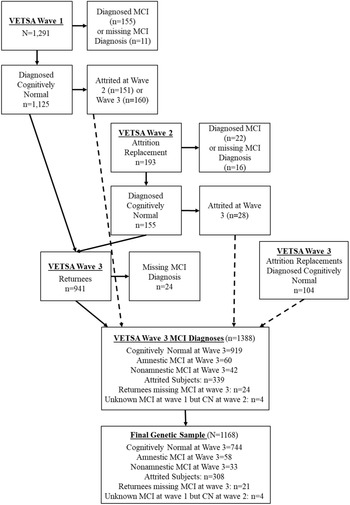
Figure 1 displays a flowchart of the subjects included in this analysis. Of the 1,291 individuals who completed the VETSA protocol at the first wave, 155 (12.0%) were diagnosed with MCI at wave 1 and 11 were missing MCI diagnosis (e.g., due to lack of covariates). At VETSA 2, an additional 193 attrition replacement subjects were recruited, 38 of which were excluded because they were diagnosed as MCI (i.e., at their first assessment) or were missing MCI diagnoses. 941 individuals returned at VETSA 3, who were combined with 339 subjects who were CN at their first assessment but did not return at VETSA 3, 104 attrition replacement subjects new to VETSA 3 and diagnosed CN, and 4 individuals who were missing MCI diagnoses from their first assessment in VETSA 1 but were diagnosed CN at VETSA 2. Finally, of these 1,388 individuals, our analyses focused on the subset of 1,168 individuals who were of European descent and were not missing genotype data (final N = 1,168) because PRSs must be evaluated in a subset of individuals from the same ancestral background as the reference GWAS (Duncan et al., Reference Duncan, Shen, Gelaye, Meijsen, Ressler, Feldman and Domingue2019; Martin et al., Reference Martin, Gignoux, Walters, Wojcik, Neale, Gravel and Kenny2017).
Flowchart describing the sample. All subjects included in the final genetic sample were diagnosed cognitively normal at their first assessment and were of European ancestry (necessary for associations with AD-PRS). VETSA 2 was completed M = 5.70 years (SD = .69) after VETSA 1. VETSA 3 was completed M = 5.93 years after VETSA 2. VETSA = Vietnam Era Twin Study of Aging; CN = cognitively normal; MCI = mild cognitive impairment.

Episodic Memory Measures
Episodic memory was measured with the logical memory and visual reproductions subtests of the Wechsler Memory Scale–Third Edition (WMS-III) (Wechsler, Reference Wechsler1997) and the California Verbal Learning Test–Second Edition (CVLT-II) (Delis, Kramer, Kaplan, & Ober, Reference Delis, Kramer, Kaplan and Ober2000). For logical memory and visual reproductions, we examined both immediate recall and delayed recall measures. For the CVLT, we examined short delay free recall, long delay free recall, and the total number of words recalled across the five learning trials (i.e., the sum of all correct responses across learning trials 1 through 5). The hierarchical latent variable model of episodic memory employed in this study was based on earlier confirmatory factor analyses of VETSA 1 and 2 (Gustavson et al., Reference Gustavson, Elman, Sanderson-Cimino, Franz, Panizzon, Jak and Kremen2020b; Kremen et al., Reference Kremen, Panizzon, Franz, Spoon, Vuoksimaa, Jacobson and Lyons2014b; Panizzon et al., Reference Panizzon, Neale, Docherty, Franz, Jacobson, Toomey and Kremen2015) and includes three test-level latent factors (logical memory, visual reproductions, CVLT) and one higher-order episodic memory factory (which we focus on here).
Executive Function Measures
Executive function was measured with six tasks spanning prepotent response inhibition, task-set switching, and working memory span. Inhibition was assessed with the Stroop task (Golden & Freshwater, Reference Golden and Freshwater2002; Stroop, Reference Stroop1935). Shifting was assessed using two tasks from the Delis–Kaplan Executive Function System (D-KEFS) (D-KEFS; Delis, Kaplan, & Kramer, Reference Delis, Kaplan and Kramer2001): the Trail Making Test switching trial and the category-switching subtest for verbal fluency (both measures were adjusted for appropriate baseline conditions). Working memory span was assessed with the letter number sequencing and digit span subtests of the WMS-III (Wechsler, Reference Wechsler1997) and the reading span test (Daneman & Carpenter, Reference Daneman and Carpenter1980).
Our confirmatory model of executive function was also validated in waves 1 and 2 of VETSA (Gustavson et al., Reference Gustavson, Panizzon, Elman, Franz, Reynolds, Jacobson and Kremen2018a; Gustavson et al., Reference Gustavson, Panizzon, Franz, Friedman, Reynolds, Jacobson and Kremen2018b) and includes two latent factors: a common executive function latent factor (based on performance across all six tests) and a working memory-specific factor (based on additional variance in the three working memory span tests not already captured by the latent factor). The present analyses focus on the association between AD-PRSs and the common executive function factor. Latent growth models included the working memory-specific factor to avoid introducing bias in the estimation of common executive function; however only baseline levels of the working memory-specific factor were fit (i.e., intercept-only), as there was essentially no evidence for change variance in this factor in our earlier work (Gustavson et al., Reference Gustavson, Panizzon, Elman, Franz, Reynolds, Jacobson and Kremen2018a) or in preliminary analyses.
Alzheimer’s Disease Polygenic Scores
Genotyping
Genome-wide genotyping was conducted on individual dizygotic twin pairs and unpaired twins, and one randomly selected twin from each monozygotic twin pair (who are genetically identical to their co-twin). Samples were whole-genome amplified, fragmented, precipitated and resuspended prior to hybridization on Illumina HumanOmniExpress−24 v1.0A beadchips (Logue et al., Reference Logue, Panizzon, Elman, Gillespie, Hatton, Gustavson and Kremen2019). Beadchips were imaged using the Illumina iScan System and analyzed with Illumina GenomeStudio v2011.1 software containing Genotyping v1.9.4 module.
Cleaning and imputation
Cleaning and quality control were conducted using PLINK v1.9 (Chang et al., Reference Chang, Chow, Tellier, Vattikuti, Purcell and Lee2015). Single-nucleotide polymorphisms (SNPs) with >5% missing data or with Hardy–Weinberg equilibrium p-values < 10−6 were excluded prior to imputation. Relationships and zygosity were concordant with previously determined relationships derived from microsatellite markers and self-reported ancestry was confirmed using both SNPweights (Chen et al., Reference Chen, Pollack, Hunter, Hirschhorn, Kraft and Price2013) and principal components (PCs) analysis in PLINK in conjunction with 1000 Genomes Phase 3 reference data (1000 Genomes Project Consortium et al., Reference Auton, Brooks, Durbin, Garrison, Kang and Abecasis2015) (see Logue et al. (Reference Logue, Panizzon, Elman, Gillespie, Hatton, Gustavson and Kremen2019) for details). PCs used to adjust for any cryptic population substructure were calculated for the European-descent subjects using 100,000 randomly chosen common SNPs (minor allele frequency > .05) using PLINK. PCs were fit using only 1 twin per pair and then applied to the co-twins (Logue et al., Reference Logue, Panizzon, Elman, Gillespie, Hatton, Gustavson and Kremen2019). Imputation was performed using MiniMac (Fuchsberger, Abecasis, & Hinds, Reference Fuchsberger, Abecasis and Hinds2015; Howie et al., Reference Howie, Fuchsberger, Stephens, Marchini and Abecasis2012) computed at the Michigan Imputation Server. The 1000 genomes phase 3 European data were used as a haplotype reference panel. Imputation was performed using one randomly chosen participant per monozygotic (i.e., identical) twin pair, which was applied to their co-twin. In total, 1,329 European ancestry VETSA participants had genetic data, 1,168 of which are included here for passing the other inclusion criteria.
AD-PRS calculation
AD-PRSs were computed based on the Kunkle et al. (Reference Kunkle, Grenier-Boley, Sims, Bis, Damotte and Naj2019) scores using PLINK (Chang et al., Reference Chang, Chow, Tellier, Vattikuti, Purcell and Lee2015). Scores for each individual reflect a weighted average of the additive imputed SNP dosages with log-odds ratios (ORs) for each SNP estimated in the GWAS used as the weights. We excluded SNPs with minor allele frequency < 1%, SNPs with poor imputation quality (R 2 < .80), and strand ambiguous SNPs from AD-PRS. Remaining SNPs were trimmed for linkage disequilibrium using PLINK’s clumping procedure (r2 threshold of .1 in a 1000 kb window; 1000 Genomes Phase 3 European reference panel). AD-PRS were computed using the p < 5×10⁻⁸ threshold, as it has been recently argued that AD-PRS are most accurate when focusing on only the most significant SNPs (Zhang et al., Reference Zhang, Sidorenko, Couvy-Duchesne, Marioni, Wright, Goate and Visscher2020). The optimal threshold varied by sample in that study, but remained close to the typical genome-wide significance threshold of 5×10⁻⁸ for all samples, so we elected to use this cutoff. We calculated two versions of the AD-PRS, one with and one without APOE region variants (44,400,000 to 46,500,000 according to GRch37p13) to quantify the effect of the APOE isoform on our findings. AD-PRSs including the APOE region were based on 51 SNPs and AD-PRSs excluding the APOE region were based on 17 SNPs.
Additional AD-PRS calculations
We repeated our primary analyses with two additional methods of computing AD-PRSs. First, we recomputed AD-PRSs based on a p < .1 threshold. This threshold was recommended by Leonenko et al. (Reference Leonenko, Baker, Stevenson-Hoare, Sierksma, Fiers, Williams and Escott-Price2021) when AD-PRS are examined in combination with the APOE genotype. It also allows us to compare whether associations with cognitive decline may be stronger at more liberal thresholds, as others have observed (Kauppi et al., Reference Kauppi, Ronnlund, Nordin Adolfsson, Pudas and Adolfsson2020). These AD-PRSs were based on 50,608 SNPs (including APOE region SNPs) or 50,499 SNPs (excluding APOE region SNPs). Second, we recomputed AD-PRS (both with and without the APOE region) using SbayesR (GCTB v2.03; Lloyd-Jones et al., Reference Lloyd-Jones, Zeng, Sidorenko, Yengo, Moser, Kemper and Visscher2019), with the robust parameterization option. SbayesR is comparable with, or outperforms, other packages (e.g., LDpred2) that compute PRSs without a user-determined p-value threshold.
APOE genotyping
APOE genotyping was conducted earlier at the Puget Sound VA Healthcare System (see Lyons et al., Reference Lyons, Genderson, Grant, Logue, Zink, McKenzie and Kremen2013; Panizzon et al., Reference Panizzon, Hauger, Xian, Vuoksimaa, Spoon, Mendoza and Franz2014). The genotype was independently determined twice, and lab personnel were blind to the zygosity of the participant and genotype of their co-twin. As recommended by Leonenko et al. (Reference Leonenko, Baker, Stevenson-Hoare, Sierksma, Fiers, Williams and Escott-Price2021), analyses involving AD-PRSs without the APOE region included an APOE genotype covariate based on weighted effect sizes from the Kunkle et al. (Reference Kunkle, Grenier-Boley, Sims, Bis, Damotte and Naj2019) GWAS where each ϵ2 allele was scored −.47, each ϵ3 allele was scored .00, and each ϵ4 was scored 1.12.
DATA ANALYSIS
Prior to analyses, all cognitive scores at waves 2 and 3 were adjusted for practice effects, leveraging data from attrition replacement participants who completed the task battery for the first time at wave 2 or wave 3 to estimate the increase in performance expected in returnees who completed the tests two or more times (Elman et al., Reference Elman, Jak, Panizzon, Tu, Chen, Reynolds and Kremen2018).
Statistical analyses were conducted using Mplus version 8.3 (Muthén & Muthén, 1998-Reference Muthén and Muthén2017), which accounts for missing observations using full information maximum likelihood. Model fit was evaluated based on −2 log-likelihood (−2LL), Akaike’s Information Criteria, and Bayesian Information Criteria. Significance of individual parameter estimates were established with standard error-based 95% confidence intervals (CIs) and confirmed with χ2 difference tests by fixing that parameter to zero. Standard errors were adjusted for clustering within families (i.e., using a sandwich estimator), and the χ2 difference tests were appropriately scaled (Satorra & Bentler, Reference Satorra and Bentler2001).
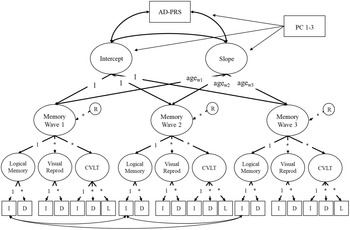
The latent growth curve models of episodic memory and executive function were estimated using “type=complex random” and “algorithm=integration” in Mplus using maximum likelihood estimates and while accounting for the nested structure of twins within families. An example of the final model of episodic memory and AD-PRSs (without parameter estimates) is displayed in Figure 2 (see supplement Figures S1 and S2). Factor loadings on the intercept factors from individual cognitive latent variables were fixed to 1.0 at all waves. Factor loadings on the slope factor were based on the age of each participants at that wave of assessment (scaled in decades). Factor loadings of individual tasks on latent executive function and memory variables were equated across waves and means for individual tasks were also fixed across wave (i.e., assuming scalar invariance). This assumption was evaluated using a set of confirmatory factor models for which we could obtain objective fit statistics, such as the Comparative Fit Index (CFI), Tucker-Lewis Index (TLI), and Root Mean Square Error of Approximation (RMSEA) (e.g., a latent variable model of Common Executive Function at wave 1, wave 2, and wave 3 with correlations between latent factors instead of latent growth intercept/slope factors). Scalar invariance models had good overall model fit (CFI = .977, TLI= .972, RMSEA = .040 for memory; CFI = .975, TLI = .969, RMSEA = .029 for executive function) despite fitting significantly worse than the metric invariance models (χ 2(12) = 222.57, p < .001 for memory; χ 2(12) = 222.57, p < .001 for executive function). Additionally, we equated residual variances on latent memory and executive function factors across waves (to identify the model).
Path model of the latent growth model of episodic memory with Alzheimer’s disease polygenic risk scores (AD-PRSs). Factor loadings with a “1” indicate loadings were fixed to 1. Loadings with a “*” indicates they were equated across time (e.g., the path from CVLT to Memory Wave 1 was the same as the corresponding path on Memory Wave 2 and Wave 3). Factor loadings on the slope factor represent each individual’s age at that assessment (centered on the mean age at wave 1 and scaled based in decades). At the top of the model, AD-PRS and the intercept and (linear) slope factors are regressed on the first 3 ancestry-based principal components (PCs). Intercept and slope factors were also regressed on APOE ϵ4 status (i.e., a dichotomous variable capturing the presence of an ϵ4 allele) only when AD-PRSs excluded the APOE region. At the bottom of the model, residual correlations between memory tests across waves were included for all tests, but these are displayed for Logical Memory (immediate recall) only for simplicity. Means for each test were also equated across wave and means for intercept and slope factors were estimated but not displayed here. CVLT = California Verbal Learning Task; I = immediate recall; D = delayed recall; L = learning trials.

Based on our earlier confirmatory factor analyses and preliminary analyses, latent growth models needed to include residual correlations among all individual tasks (e.g., wave 1 Stroop with wave 2 Stroop, etc.) to capture the fact that these measures are correlated across time over-and-above the variance captured by the latent variables. Moreover, preliminary analyses in the model of executive function indicated that there was essentially no change variance in the working memory-specific factor (e.g., separate correlated latent factor models revealed correlations near 1.0 between working memory-specific factors across wave), justifying our intercept-only model for working memory-specific variance. This also greatly reduced the number of integration points in the latent growth curve model.
AD-PRSs were included in cognitive latent growth curve models by correlating these scores with both intercept and slope factors (see Figure 2). Two models were run for each cognitive domain: one where AD-PRSs include loci in the APOE region and another where AD-PRSs exclude loci in the APOE region. In all models, we controlled for ancestry by regressing the first 3 ancestry PCs on AD-PRSs and cognitive intercept and slope latent factors. In the model where AD-PRSs excluded APOE loci, we also regressed the APOE genotype score on the cognitive intercept and slope factors.
RESULTS
Descriptive Statistics
Demographic characteristics of the sample are displayed in Table 1. Descriptive statistics for individual cognitive tasks are displayed in the supplement (Table S1).
Demographic characteristics of the study

Note: All individuals were of European ancestry.
Latent Growth Models of Executive Function and Episodic Memory
Unstandardized results from latent growth models of episodic memory and executive function (including their association with AD-PRSs) are displayed in the supplement (Figures S1 and S2). Variances of the intercept (i.e., baseline memory performance) and slope (i.e., memory change) factors indicate that change variance in memory across 1 decade (.05) was about 19% as large as the variance in baseline memory ability (.24). Change variance in executive function across 1 decade (.07) was 43% as large as the variance in baseline ability (.17). Intercept and slope variables were not correlated for either ability, suggesting that individuals with relatively poorer cognition at baseline were not more likely to improve or decline in that respective ability compared to those who performed better at baseline, or vice versa. Factor loadings on all latent factors were similar to estimates from our earlier work on this sample at waves 1 and 2 (Gustavson et al., Reference Gustavson, Panizzon, Elman, Franz, Reynolds, Jacobson and Kremen2018a; Gustavson et al., Reference Gustavson, Panizzon, Franz, Friedman, Reynolds, Jacobson and Kremen2018b).
Associations Between Cognition and Alzheimer’s Disease Polygenic Scores
Our primary study hypothesis concerning associations between cognitive change and AD genetic risk were conducted by examining correlations between AD-PRSs and the intercept and slope factors from the cognitive latent growth models. Standardized results are displayed in Table 2, which depict correlations between AD-PRSs and cognitive intercept and slope factors (after adjusting for ancestry-based PCs). All model estimates (and standard errors) are displayed in the supplement (Tables S2 and S3).
Associations between Alzheimer’s disease polygenic scores (AD-PRS) and cognitive change across midlife

Note: Associations between AD-PRSs with (A) episodic memory and (B) executive function intercept (baseline) and change (slope) latent factors. AD-PRSs were based on Kunkle et al. (Reference Kunkle, Grenier-Boley, Sims, Bis, Damotte and Naj2019), p < 5×10⁸ threshold. Models were run separately for executive function and memory, and separately for AD-PRS including the APOE region (Model 1) or excluding the APOE region (Model 2). All models adusted for the ancestry by regressing the first 3 ancestry-based principal components on AD-PRS and cognitive intercept/slope latent factors. Model 2 also regressed cognitive intercept and slope factors on APOE genotype (i.e., a score of −.47 per ϵ2 allele, .00 per ϵ3 allele, and 1.12 per ϵ4 allele; rightmost columns). Significant associations are displayed in bold (95% CIs do not overlap 0 and p < .05).
AD-PRSs were associated with change in episodic memory such that high genetic risk for AD was associated with a steeper rate of decline in memory, r = −.19, 95% CI [−.35, −.03]. A similar association was observed for executive function, r = −.27, 95% CI [−.49, −.05]. AD-PRSs were also weakly associated with the intercept factor for executive function, r = .11, 95% CI [.00, .21], such that individuals with better executive function at baseline had slightly higher AD-PRS.
After removing the APOE region variants from AD-PRSs, the associations with memory and executive function slopes were smaller and nonsignificant, yet were within the 95% CIs of the original estimates. The APOE genotype was associated with executive function slopes, β = −.22, 95% CI [.00, .21], suggesting the previous association with AD-PRS was driven by APOE. The association between AD-PRSs and cognitive intercept factors were all nonsignificant after excluding APOE.
Comparison of Alternate AD-PRS Calculations
Analyses were repeated using AD-PRS recomputed from (a) the p < .1 threshold and (b) using SbayesR. Results are displayed in Table 3. Results were similar to our primary results, with two small differences. First, the weak positive correlation between AD-PRS and executive function intercept (in the model including APOE) was nonsignificant with both approaches. This correlation was unexpected to begin with, so we do not discuss it further.
Sensitivity analyses using different methods for computing Alzheimer’s Disease polygenic scores (AD-PRS)

Note: Associations between AD-PRSs with episodic memory and executive function intercept (baseline) and change (slope) latent factors using different methods for computing AD-PRS: (A) p < .1 threshold and (B) using SbayesR software (with the robost option), instead of the p < 5×10⁸ threshold from Table 2. Models were run separately for executive function and memory, and separately for AD-PRS including the APOE region (Model 1) or excluding the APOE region (Model 2). All models adusted for the ancestry by regressing the first 3 ancestry-based principal components on AD-PRS and cognitive intercept/slope latent factors. Model 2 also regressed cognitive intercept and slope factors on APOE genotype. Significant associations are displayed in bold (95% CIs do not overlap 0 and p < .05).
Second, using SbayesR only, AD-PRSs excluding APOE were now significantly associated with memory slopes, r = −.14, 95% CI [−.28, .00], providing some evidence that non-APOE loci are related to memory slopes. AD-PRS generated with SbayesR correlated strongly with our original scores based on the p < 5×10⁻⁸ threshold (r = .77 including APOE, r = .48 excluding APOE) and moderately with the p < .1 threshold (r = .30 including APOE, r = .46 excluding APOE).
DISCUSSION
This study provides evidence that AD genetic risk predicts changes in episodic memory and executive function across midlife into early old age (between age 56 and 68 years). Although episodic memory is the most characteristic AD cognitive impairment, executive functions may be especially relevant to early AD pathology as they are some of the first cognitive abilities to exhibit age-related changes in midlife. Although there was relatively modest variability in cognitive change across this 12-year interval in late midlife to early old age (especially for memory), individuals at higher genetic risk were more likely to decline in both domains.
When APOE loci were removed, the AD-PRSs were no longer associated with cognitive slope factors in memory or executive function, though there was some evidence for an association with memory using the SbayesR method only. For memory, these findings suggest our results for the full AD-PRS were driven by both APOE and non-APOE loci that generally did not reach significance alone (but were significant when combined into the full AD-PRS). These findings align with an earlier study of Health and Retirement Study participants which included midlife (and older) adults and demonstrated that AD-PRSs were associated with memory decline only when including APOE loci (Marden et al., Reference Marden, Mayeda, Walter, Vivot, Tchetgen Tchetgen, Kawachi and Glymour2016). In contrast, executive function slopes were significantly correlated with APOE genotype (β = −.22), suggesting their association with AD-PRS were generally driven by APOE. Of course, some non-APOE loci may still be relevant to executive function change (e.g., as evidenced by the weak r = −.06 association with AD-PRS excluding APOE), but these effects appear smaller than the contribution of APOE genotype.
Compared to our primary results using the p < 5×10⁻⁸ threshold recommended by Zhang et al. (Reference Zhang, Sidorenko, Couvy-Duchesne, Marioni, Wright, Goate and Visscher2020), results using the more liberal threshold of p < .1, and using SbayesR, revealed similar associations. Recent work has suggested that AD-PRS are more strongly predictive of cognitive decline with more liberal thresholds (Kauppi et al., Reference Kauppi, Ronnlund, Nordin Adolfsson, Pudas and Adolfsson2020), but the choice of threshold did not appear to have a strong effect in our sample. However, this earlier study focused on individuals who were subsequently healthy whereas our study included individuals who were CN or MCI at the final timepoint (all individuals were CN at baseline). We did not re-analyze data excluding MCI cases at the final timepoint because we already observed little variance in cognitive change (especially memory change), but it will be interesting to examine how MCI status and p-value thresholds impact associations between AD-PRS and cognition in larger studies (that can more precisely estimate change).
It will be important for future work to examine how AD biomarkers such as amyloid beta are relevant to these findings. On one hand, biomarkers may mediate the associations observed here if genetic risk for AD is associated with pathological biomarker accumulation across middle age, which in turn affects cognitive change. Alternatively (or additionally), there is evidence that cognitive performance changes can also predict later amyloid beta accumulation (Elman et al., Reference Elman, Panizzon, Gustavson, Franz, Sanderson-Cimino and Lyons2020). Although we cannot be certain, it is likely that few participants were biomarker positive at baseline in the current study (age 51–60). AD genetic influences may therefore somewhat independently affect cognition and AD biomarkers (i.e., pleiotropic genetic effects) (Bellou, Stevenson-Hoare, & Escott-Price, Reference Bellou, Stevenson-Hoare and Escott-Price2020), and the time course of observable changes in both cognition and biomarker load may vary in different individuals. Better understanding how AD genetic risk factors relate to cognitive and biomarker phenotypes across midlife will help us understand how these factors influence each other early in the AD trajectory.
Strengths and Limitations
We leveraged data from 3 longitudinal assessments across the critical transition period from middle age to older age to examine how baseline and change variance in episodic memory and executive function relate to AD genetic influences. Latent growth curve models were based on 7 memory tests and 6 executive function tests to more accurately quantify cognitive changes leading into old age. Latent variable approaches are advantageous in this work, especially for executive function, as executive function tasks do not load strongly on their respective latent factors and the common variance across multiple executive function subdomains (inhibition, shifting, updating) appears most relevant to clinical traits (Miyake & Friedman, Reference Miyake and Friedman2012). However, even utilizing this approach, we were not able to estimate both linear and quadratic components of cognitive change in our latent growth models as this requires additional timepoints of data.
Relatedly, it will be important to quantify the extent to which associations between AD genetic risk and memory and executive function are explained by variance shared across both domains versus domain-specific cognitive change. Meta-analytic estimates suggests that an average of 60% of the variance in cognitive change is shared across cognitive abilities (Tucker-Drob, Brandmaier, & Lindenberger, Reference Tucker-Drob, Brandmaier and Lindenberger2019), with even stronger ratios in older adults. Therefore, the associations with AD-PRS described here likely reflect at least some shared variance in change across both domains. Again, however, given the relatively small variance in change observed at the latent variable level here (especially for memory), it will require a large sample to estimate domain-general vs. domain-specific components and their association with AD genetic influences. More broadly, it is necessary to examine PRS only in individuals whose ancestry matches the original GWAS (Martin et al., Reference Martin, Gignoux, Walters, Wojcik, Neale, Gravel and Kenny2017). Therefore, we restricted our attention to the European-descent subset of VETSA, which make up the majority of the cohort. Additionally, our sample only includes men, so it will be important to examine whether these findings generalize to other populations and to women.
This study extends our previous investigation that demonstrated AD-PRSs differentiated individuals with amnestic MCI from CN individuals at the first wave (mean age 56) (Logue et al., Reference Logue, Panizzon, Elman, Gillespie, Hatton, Gustavson and Kremen2019). In the present study, all individuals with MCI at their baseline assessment were excluded from analyses, so it is not surprising that AD-PRSs were not associated with baseline memory ability (i.e., intercept). Executive function intercept was associated with slightly higher AD-PRS scores in some but not all analyses. This association may have been spurious, or perhaps driven by the excluding of impaired individuals at baseline. The present study complements the earlier studies by demonstrating that AD-PRSs also predict changes in cognitive ability in a group of CN individuals from a community-dwelling sample.
CONCLUDING REMARKS
GWAS data allow researchers to examine the impacts of genetic influences on disease decades before onset. We used data from a large longitudinal dataset with comprehensive measures of cognition to demonstrate that AD genetic influences are moderately associated with cognitive changes between middle age to early old age in individuals who were all CN at their first assessment. Considerable correlations between AD-PRSs and executive functions highlight their importance in understanding early AD-related cognitive changes. Executive function abilities control other cognitive processes and they are some of the first to exhibit age-related decline in middle age. These findings are some of the first to link these cognitive changes in executive function to AD genetic risk factors and suggest they should be examined more systematically in predictive studies of early AD pathology.
Supplementary material
For supplementary material accompanying this paper visit https://doi.org/10.1017/S1355617722000108
Acknowledgments
Numerous organizations have provided invaluable assistance in the conduct of the VET Registry, including: Department of Defense; National Personnel Records Center, National Archives and Records Administration; Internal Revenue Service; National Opinion Research Center; National Research Council, National Academy of Sciences; the Institute for Survey Research, Temple University. This material was, in part, the result of work supported with resources of the VA San Diego Center of Excellence for Stress and Mental Health Healthcare System. Most importantly, the authors gratefully acknowledge the continued cooperation and participation of the members of the VET Registry and their families as well as the contributions of many staff members and students.
Financial Support
This research was supported by Grants R03 AG065643, R01 AG050595, and R01 AG022381, K01 AG063805, R01 AG060470, R01 AG059329, and K24 AG046373 from the National Institutes of Health. The content of this manuscript is solely the responsibility of the authors and does not necessarily represent the official views of the National Institute on Aging/National Institute of Health, or the VA. The U.S. Department of Veterans Affairs has provided financial support for the development and maintenance of the Vietnam Era Twin (VET) Registry.
Conflicts of Interest
The authors have nothing to disclose.