Implications
This study clarifies the positive effects of n-3 polyunsaturated fatty acid (n-3PUFA) diets on immunity, antioxidative status and bone quality characteristics in old laying hens housed in battery cages, which might be used as a useful tool to enhance the laying performance. Enrichment of n-3PUFA in eggs is a successful and cheaper strategy to ensure an adequate supply of n-3PUFA for the greater population, especially in countries of the Middle East and North Africa whose consumption of marine products is relatively low, and to reduce the incidence of cardiovascular diseases, diabetes, arthritis and cancer.
Introduction
The recent researches have focused on dietary changes to modify the fatty acids composition of foods instead of centering on reducing the cholesterol content. This strategy has proved to be viable and is currently applied to market eggs in several countries to improve the health image of eggs. Consumption of n-3 polyunsaturated fatty acids (n-3PUFA) has positive effects on health, including potential in prevention and treatment of cardiovascular diseases, diabetes, arthritis and certain types of cancer (Simopoulos, Reference Simopoulos2000). The balance between the two major types, n-6 and n-3PUFA, may also be crucial. According to the health point of view, Simopoulos (Reference Simopoulos2000) stated that foodstuffs with an n-6/n-3 PUFA ratio of less than 4:1 are considered beneficial to human health. Lewis et al. (Reference Lewis, Seburg and Flanagan2000) and Kralik et al. (Reference Kralik, Škrtić, Suchý, Straková and Gajčević2008) indicated a desirable ratio of n-6/n-3 PUFA of less than 4:1 in egg yolk lipids. Enrichment of n-3PUFA in eggs of laying hens is a successful strategy to ensure an adequate supply of n-3PUFA for the greater population, especially where their consumption of marine products is relatively low. Production of such eggs is feasible and could be realized by adding common sources of n-3PUFA (i.e. fish oil (FO), marine algae, linseed oil (LO), etc.) to the layer's diet (Baucells et al., Reference Baucells, Crespo, Barroeta, López-Ferrer and Grashorn2000; Ebeid et al., Reference Ebeid, Eid, Saleh and Abd El-Hamid2008; Garcia-Rebollar et al., Reference Garcia-Rebollar, Cachaldora, Alvarez, De Blas and Méndez2008). FO is rich in long-chain n-3PUFA (i.e. eicosapentaenoic acid (EPA; C20:5 n-3) and docosahexaenoic acid (DHA; C22:6 n-3)) and LO contains only α-linolenic acid (ALA; 18:3n-3), in greater amounts, which is the precursor of EPA and DHA. The ALA is converted into EPA and DHA by the hen's liver and the synthesized fatty acids are subsequently excreted with the egg yolk (Simopoulos, Reference Simopoulos2000).
Contradictory results have been reported concerning the possible effects of such n-3-enriched diets on layer performance and egg quality characteristics. Several reports have revealed that supplementing n-3PUFA into the diet had no significant effects on egg production, egg weight and egg quality characteristics (Liu et al., Reference Liu, Veit, Wilson and Denbow2003; Garcia-Rebollar et al., Reference Garcia-Rebollar, Cachaldora, Alvarez, De Blas and Méndez2008; Da Silva et al., Reference Da Silva, Elias, Aricetti, Sakamoto, Murakami, Gomes, Visentainer, de Souza and Matsushita2009). By contrast, Cortinas et al. (Reference Cortinas, Galobart, Barroeta, Baucells and Grashorn2003) summarized that egg production was significantly higher when laying hens were fed diets containing 4% FO or flaxseed oil. Cachaldora et al. (Reference Cachaldora, Garcia-Rebollar, Alvarez, Méndez and De Blas2008) indicated that yolk color increased in the diets supplemented with n-3 oils with respect to the control diets. Samman et al. (Reference Samman, Piu Kung, Carter, Foster, Ahmad, Phuyal and Petocz2009) stated that eggshell weight, expressed as a percentage of total egg weight, was highest in n-3 eggs (P < 0.05).
Dietary n-3PUFA are incorporated into cellular lipids where they exert essential effects on many biological systems, such as immune reactions, blood platelet aggregation and growth regulation of some cell types (De Pablo et al., Reference De Pablo, Puertollano and de Alvarez de Cienfuegos2002). In fact, in poultry, there are conflicting results on the effects of dietary lipids on immune functions (Wang et al., Reference Wang, Field and Sim2000). Recently, Ebeid et al. (Reference Ebeid, Eid, Saleh and Abd El-Hamid2008) indicated that dietary FO levels below 3.5% increased the antibody titer in laying hens. This response is similar to observations by Yuming et al. (Reference Yuming, Chen, Xia and Yuan2004) who proved that the antibody levels were higher in hens fed oils rich in n-3PUFA (FO or LO) than in hens fed maize oil rich in n-6PUFA. In addition, studies have elucidated that a moderate intake of n-3PUFA can enhance antioxidative properties, including the activity of glutathione peroxidase (GSH-Px) in experimental animals (Marja et al., Reference Marja, Mutanen and Mykkãnen1984; Ebeid et al., Reference Ebeid, Eid, Saleh and Abd El-Hamid2008) and reduced serum lipid peroxidation (Yuan and Kitts, Reference Yuan and Kitts2002; Ebeid et al., Reference Ebeid, Eid, Saleh and Abd El-Hamid2008).
The n-6 and n-3 fatty acids are currently being studied to understand their effects on bone. Numerous animal studies have shown that a higher ratio of n-6 to n-3 fatty acids is associated with detrimental effects on bone health, and a lower ratio is associated with healthy bone properties (Watkins et al., Reference Watkins, Shen, McMurtry, Xu and Bain1997; Liu et al., Reference Liu, Veit, Wilson and Denbow2003). Liu et al. (Reference Liu, Veit, Wilson and Denbow2003) demonstrated that, in Japanese quail, long-term supplementation of n-3PUFA was beneficial to bone biomechanical properties that are involved in bone strength. In fact, among the studies dealing with the enrichment of eggs with n-3PUFA, to our knowledge, limited data have been published on ovarian follicular development and bone characteristics of older laying hens. Therefore, the objective of this study was to determine the effects of supplemented different dietary sources of n-3PUFA (LO, FO or mixture of LO + FO) to produce n-3-enriched eggs on laying performance, egg quality characteristics, yolk lipid profile, antioxidative properties, immune response, ovarian follicular development and tibial bone characteristics in aged laying hens.
Material and methods
Birds and diets
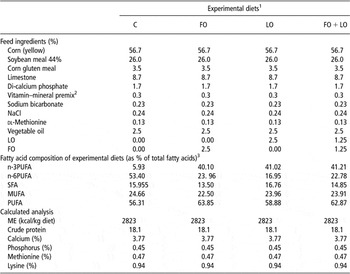
A total of 100 Hisex Brown hens at 56 weeks of age were housed individually in laying cages in an open-sided building under a 16 h light:8 h dark lighting schedule. Hens were randomly divided into four experimental treatments (n = 25 each). Birds were fed ad libitum diets containing 2.5% vegetable oil (C, control), 2.5% FO, 2.5% LO and a mixture of 1.25% LO +1.25% FO (LO + FO) from 56 to 68 weeks of age. In order to avoid a fishy taste in eggs, the level of n-3 oils used in the diets of this study did not exceed 2.5%. The lipid profile of the experimental diets is shown in Table 1. Experimental diets were formulated to have the same metabolizable energy (ME). The birds were fed a standard layer diet (17% crude protein; 2850 kcal ME/kg diet, Table 1). The diets were calculated to meet the recommendations of the National Research Council for laying hens. During the experimental period, the average daily temperature and relative humidity inside the house ranged from 23°C to 25°C and from 50% to 60%, respectively. All experiments conformed with institutional guidelines concerning animal use.
Composition of experimental diets

C = control; FO = fish oil; LO =linseed oil; PUFA = polyunsaturated fatty acids; SFA = saturated fatty acids; MUFA = monounsaturated fatty acids; ME = metabolizable energy.
1Experimental diets include control (C, 2.5% vegetable oil), 2.5% FO, 2.5% LO and (1.25% LO + 1.25% FO) of diet.
2Vitamin and mineral premix provided per kilogram of diet: vitamin A, 12 000 IU; cholecalciferol, 2000 IU; vitamin E, 70 mg; vitamin K3, 5 mg; vitamin B1, 1.5 mg; vitamin B2, 6 mg; vitamin B6, 5 mg; vitamin B12, 30 μg; pantothenate, 10 mg; folic acid, 0.75 mg; biotin, 0.08 mg; Mn, 40 mg; Zn, 60 mg; Fe, 50 mg; Cu, 5 mg; Se, 0.15 mg; Co, 0.1 mg; I, 0.4 mg.
3n-3 = Omega-3 fatty acids, n-6 = omega-6 fatty acids, SFA, MUFA, PUFA, fatty acid composition expressed as percentage of total fatty acids.
Laying performance and egg quality characteristics
Feed intake was measured weekly, whereas egg production and weight were recorded daily throughout the experimental period. During the last week of the experimental period (68 weeks of age), 30 eggs were taken at random from each treatment to determine the egg quality characteristics. The eggs were individually weighed, and the external and internal qualities were determined. Egg length and width were measured with a sliding caliper (0.01 mm, CD-15B; Mitutoyo Ltd, Kawasaki, Japan), and the egg shape index was calculated as length/width in all the eggs. All the eggs were then broken and their contents were removed. The shell with the membranes and the yolk was separated from the albumen and weighed, and the relative proportions were determined. Albumen weight was calculated by subtracting the yolk and shell weight from the total egg weight. Shell thickness was measured at three locations on the egg (air cell, equator and sharp end) by using a micrometer caliper (0.01 to 20 mm; Mitutoyo, Tokyo, Japan) after removing the eggshell membranes. Yolk color was determined by using the Roche Color Fan (DSM Yolk Color Fan, Basel, Switzerland). Shell percentage, albumen percentage and yolk percentage were calculated as a ratio of egg weight. Haugh units were calculated on the basis of egg weight and albumen height.
Fatty acid composition
Fatty acid profiles of experimental diets and egg yolks were determined. During the last week of the experimental period (68 weeks of age), 15 eggs were taken at random from each treatment and divided into five replicate groups of three eggs each to determine the yolk lipid profile and cholesterol content. Yolks were carefully separated without albumen and pooled for colorimetric cholesterol assay according to Watson (Reference Watson1960) and yolk fatty acids were quantified using the method of Radwan (Reference Radwan1978). Briefly, total lipids were extracted with chloroform:methanol (2:1 vol/vol) from 0.8 g of the yolk. Total lipids were converted into fatty acid methyl esters and yolk fatty acids were quantified by gas liquid chromatography using Shimadzu gas chromatograph GC-4 CM (PFE) equipped with a flame ionization detector. An analytical glass column (3 m × 33 mm internal diameter) was packed with 5% diethylene glycol succinct on 80/100. The chromatography conditions were as follows: 180°C column temperature, 270°C injector temperature and 270°C detector temperature. Gas flow rates were as follows: nitrogen 30 ml/min, hydrogen 1 ml/min, air 0.5 ml/min and chart speed was 0.5 mm/min. A standard mixture of methyl esters was analyzed under identical conditions prior to running the samples. The retention times of the unknown sample of methyl esters were compared with those of the standard. The concentration of methyl esters were calculated using the triangulation method (Radwan, Reference Radwan1978).
Humoral immunity
Total antibody titers against sheep red blood cells (SRBC) were measured by the 12th week of dietary treatment (n = 10 each). Humoral immunity is an organism's antibody response to pathogens. Antibody response to a T-dependent (both T- and B-cells must recognize antigens) antigen was assessed by measuring serum antibody titer following a primary intramuscular injection of 0.5 ml of 40% SRBC suspension (in phosphate-buffered saline) in the right pectoral muscle. Antiserum to SRBC was collected 7 days after challenge. Antibody titers to SRBC were measured using a microhemagglutination assay by the method of Wegmann and Smithies (Reference Wegmann and Smithies1966).
Ovary morphology
At the end of the experimental period (68 weeks of age), 10 females from each treatment were randomly chosen, weighed, anesthetized and killed by decapitation. Blood plasma samples were taken and stored at −40°C for subsequent analysis. The abdominal cavity was opened and the ovary and oviduct were removed and weighed. The number and weight of normal large yellow follicles (LYF; >10 mm diameter), and the number of small yellow follicles (SYF; 5 to 10 mm diameter), large white follicles (LWF; 3 to 5 mm diameter) and medium white follicles (MWF; 1 to 3 mm diameter) were recorded. Follicle size classifications were based on Renema et al. (Reference Renema, Robinson, Melnychuk, Hardin, Bagley, Emmerson and Blackman1995). The stroma weight comprising the ovarian tissue remaining after the LYF were counted and removed.
Antioxidative properties
Lipid peroxidation in blood plasma was measured in the form of thiobarbituric acid reactive substance (TBARS) as described by Richard et al. (Reference Richard, Portal, Meo, Coudray, Hadjian and Favier1992). TBARS, in particular malondialdehyde, is a product of the oxidative degradation of PUFA, and is thus used as an index of oxidative stress. The activity of the antioxidative enzyme GSH-Px and total antioxidant capacity of blood plasma were measured according to Paglia and Valentine (Reference Paglia and Valentine1967) and Koracevic et al. (Reference Koracevic, Koracevic, Djordjevic, Andrejevic and Cosic2001), respectively, using kits produced by Bio-Diagnostic, Egypt.
Bone measurements
At 68 weeks of age, after killing the birds, the left tibia bones were excised from each hen. The bones were freed of the surrounding soft tissue and cartilage and weighed in grams. Bone length (from the longitudinal epicondyle to the distal end) and diameter at the mid-diaphysis were measured with dial calipers in centimeters. After the measurements were obtained, the left tibias were wrapped in saline-soaked towels, sealed in plastic bags and frozen (−40°C) until the day of determination of breaking strength and ashing. Bone breaking strength (kg) was determined using the Instron Universal Testing Machine (Model Ioll, Instron, Canton, MA, USA) according to Wilson and Ruszler (Reference Wilson and Ruszler1998). Following bone breaking, the bone wall thickness was measured at the midpoint mark using the micrometer. To determine tibial ash content, bones were oven-dried at 105°C for 24 h and ashed in a muffle furnace at 600°C for 14 h following the procedure of Liu et al. (Reference Liu, Veit, Wilson and Denbow2003). The percentage ash was determined relative to the dry weight of the tibia.
Statistical analysis
The differences among treatments were statistically analyzed by one-way ANOVA in a completely randomized design using Statistical Packages for the Social Sciences (SPSS®, 2001) with the type of diet as the main source of variation. Significant differences among means of treatments were compared by Duncan's new multiple range test. P < 0.05 was set as the limit of significance.
Results
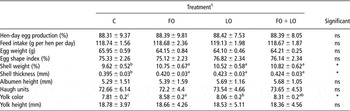
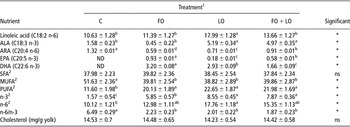
Results concerning the effects of n-3-enriched diets on laying performance and egg quality characteristics are presented in Table 2. There were no significant effects of treatments on hen-day egg production, feed intake, egg weight, egg shape index, albumen height, Haugh units and yolk height. However, dietary FO and/or LO supplementation had a significantly positive effect on eggshell percentage, eggshell thickness and yolk color. The greatest shell percentages and shell thicknesses were obtained from eggs laid by hens fed LO + FO-supplemented diets (10.82% and 0.424 mm, respectively). Yolk color increased in the diets supplemented with n-3 oils compared with the control diets (Table 2). Data in this study showed that incorporation of n-3PUFA into the egg yolks has been successful by using dietary FO and/or LO. As shown in Table 3, feeding 2.5% FO, 2.5% LO or a mixture of 1.25% FO + 1.25% LO to birds resulted in an increment of the total n-3PUFA concentrations (P ⩽ 0.05) in egg yolk lipids, as compared with control. The highest n-3PUFA concentration in the egg yolk is observed in 2.5% LO and a mixture of 1.25% FO + 1.25% LO treatments (8.55% and 7.87%, respectively). The ratios of n-6/n-3 of experimental groups FO, LO and FO + LO were similar, being 2.23, 2.01 and 1.87, respectively, whereas in control eggs the n-6/n-3 ratio was 6.49. Dietary n-3PUFA decreased monounsaturated fatty acids (MUFA) significantly, whereas no significant differences were observed in saturated fatty acids (SFA) and egg yolk cholesterol content (Table 3).
Effect of feeding FO and/or LO on laying performance and egg quality characteristics in laying hens

FO = fish oil; LO = linseed oil; C = control.
a,b,cMeans followed by different letters in the same row are significantly different: *P ⩽ 0.05.
1Experimental treatments include control (C, 2.5% vegetable oil), 2.5% FO, 2.5% LO and (1.25% LO + 1.25% FO) of diet.
Effect of feeding FO and/or LO on yolk fatty acid composition

FO = fish oil; LO = linseed oil; C = control; ALA = α-linolenic acid; ARA = arachidonic acid; EPA = eicosapentaenoic acid; DHA = docosahexaenoic acid; SFA = saturated fatty acids; MUFA = monounsaturated fatty acids; PUFA = polyunsaturated fatty acids; ND = not detected.
a,b,cMeans followed by different letters in the same row are significantly different: *P ⩽ 0.05.
1Experimental treatments include control (C, 2.5% vegetable oil), 2.5% FO, 2.5% LO and (1.25% LO + 1.25% FO) of diet.
2n-3 = Omega-3 fatty acids, n-6 = omega-6 fatty acids, SFA, MUFA, PUFA, fatty acid composition expressed as percentage of total fatty acids.
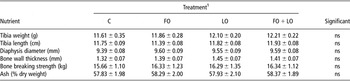
At 68 weeks of age, there was no significant difference among dietary treatments for tibial bone morphology measurements (tibia weight, tibia length, diaphysis diameter, bone wall thickness, bone breaking strength and ash); however, dietary n-3PUFA offered improvements of some sort in tibial bone characteristics when compared with the control diet (P > 0.05; Table 4) in late-phase laying hens.
Tibial bone measurements at 42 days of age of Japanese quail supplemented with different sources of n-3PUFA oils

PUFA = polyunsaturated fatty acids; C = control; FO = fish oil; LO = linseed oil.
1Experimental treatments include control (C, 2.5% vegetable oil), 2.5% FO, 2.5% LO and (1.25% LO + 1.25% FO) of diet.
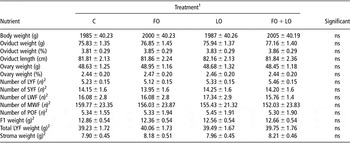
Ovarian morphological parameters were not significantly affected by dietary n-3PUFA. Results presented in Table 5 indicated that ovary and oviduct weights, expressed in either absolute terms or relative to body weight, were not significantly affected by dietary FO and/or LO. The numbers of LYF, SYF, LWF, MWF and postovulatory follicle (POF) were not significantly changed by FO and/or LO supplementation. The weights of F1, total LYF and ovarian stroma did not differ among the different dietary treatments (Table 5). It is noteworthy in the results of this study that dietary n-3PUFA did not have a negative influence on the different reproductive morphology parameters in aged laying hens.
Effect of feeding FO and/or LO on different reproductive morphology parameters in laying hens

FO = fish oil; LO = linseed oil; C = control; LYF = large yellow follicle; SYF = small yellow follicle; LWF = large white follicle; MWF = medium white follicle; POF = postovulatory follicle.
1Experimental treatments include control (C, 2.5% vegetable oil), 2.5% FO, 2.5% LO and (1.25% LO + 1.25% FO) of diet.
2LYF (>10 mm diameter), SYF (5 to 10 mm diameter), LWF (3 to 5 mm diameter), MWF (1 to 3 mm diameter), POF, F1 = the largest yellow follicle, LYF weight without F1 follicle, the stroma weight comprised the ovarian tissue remaining after the LYF were counted and removed.
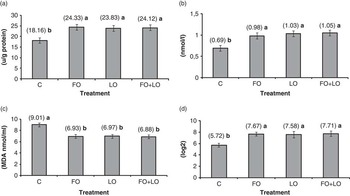
With respect to the effect of dietary n-3PUFA oils on antioxidative properties including GSH-Px activity and total antioxidant capacity as well as lipid peroxidation index in blood plasma (Figure 1a, b and c), it could be observed that dietary 2.5% LO, 2.5% FO and a mixture of 1.25% FO + 1.25% LO significantly enhanced both GSH-Px activity and total antioxidant capacity in comparison with control. Moreover, using TBARS as an index of lipid peroxidation, it could be observed that moderate levels of n-3PUFA oils (2.5%) decreased serum TBARS of older laying hens. Results of immune response, presented graphically in Figure 1d, show that different sources of dietary n-3PUFA had a positive effect on humoral immunity as measured by antibody titers against SRBC when compared with the control diet (P ⩽ 0.05). The highest scores were attained by laying hens fed n-3PUFA oils (2.5% LO, 2.5% FO and a mixture of 1.25% FO + 1.25% LO) treatments.
Effect of different sources of n-3 polyunsaturated fatty acids {control (C, 2.5% vegetable oil), 2.5% linseed oil (LO), 2.5% fish oil (FO) and a mixture of 1.25% LO +1.25% FO (LO + FO)} on (a) blood plasma glutathione peroxidase, (b) blood plasma total antioxidant capacity, (c) blood plasma thiobarbituric acid reactive substance and (d) antibody titer at 68 weeks of age in laying hens to produce n-3-enriched egg. Values are expressed as means ± s.e.; means with different letters differ from each other (P ⩽ 0.05).

Discussion
There were no significant effects of treatments on hen-day egg production, feed intake, egg weight, egg shape index, albumen height, Haugh units and yolk height (Table 2). These results agree with previous works using similar levels of inclusion of various n-3PUFA sources (Cachaldora et al., Reference Cachaldora, Garcia-Rebollar, Alvarez, Méndez and De Blas2008; Garcia-Rebollar et al., Reference Garcia-Rebollar, Cachaldora, Alvarez, De Blas and Méndez2008; Da Silva et al. Reference Da Silva, Elias, Aricetti, Sakamoto, Murakami, Gomes, Visentainer, de Souza and Matsushita2009). Garcia-Rebollar et al. (Reference Garcia-Rebollar, Cachaldora, Alvarez, De Blas and Méndez2008) reported that dietary supplementation with n-3PUFA either from FO or LO did not affect laying rate, feed intake, egg weight, yolk weight and Haugh units. By contrast, Cortinas et al. (Reference Cortinas, Galobart, Barroeta, Baucells and Grashorn2003) summarized that egg production was significantly higher when laying hens were fed diets containing 4% FO or LO. As shown in Table 2, the greatest shell percentages and shell thicknesses were obtained from eggs laid by hens fed a mixture of 1.25% LO + 1.25% FO-supplemented diets. Similarly, Samman et al. (Reference Samman, Piu Kung, Carter, Foster, Ahmad, Phuyal and Petocz2009) observed that the eggshell weight, expressed as a percentage of total egg weight, was higher in n-3 eggs than conventional eggs (P < 0.05). It is possible that Ca+2 absorption was increased due to dietary supplementation of n-3PUFA (Kruger and Schollum, Reference Kruger and Schollum2005), which might play a vital role in improving eggshell quality characteristics. By contrast, several studies revealed that dietary supplementation with n-3PUFA either from FO or LO did not affect shell thickness (Cachaldora et al., Reference Cachaldora, Garcia-Rebollar, Alvarez, Méndez and De Blas2008; Garcia-Rebollar et al., Reference Garcia-Rebollar, Cachaldora, Alvarez, De Blas and Méndez2008; Da Silva et al. Reference Da Silva, Elias, Aricetti, Sakamoto, Murakami, Gomes, Visentainer, de Souza and Matsushita2009). In fact, yolk color is an important quality trait in influencing consumer acceptance. In this study, yolk color intensity was postulated to be increased significantly by dietary FO and/or LO (Table 2). Similar results were documented by Cachaldora et al. (Reference Cachaldora, Garcia-Rebollar, Alvarez, Méndez and De Blas2008) who revealed that yolk color increased in the diets supplemented with n-3 oils with respect to the control diets. Also, Grobas et al. (Reference Grobas, Méndez, Lázaro, de Blas and Mateos2001) noted that yolk color benefited from n-3 oils. The oxycarotenoids contained in the diet are lipid soluble, and therefore their absorption from the intestine are likely to be improved when fed in parallel with the lipids (Grobas et al., Reference Grobas, Méndez, Lázaro, de Blas and Mateos2001).
Virtually, commercial table eggs contain a high proportion of n-6 PUFA but are a poor source of n-3 PUFA. Several studies revealed that the ratio of n-6/n-3 PUFA in standard eggs was 20:1, whereas n-3PUFA-enriched eggs had a ratio of less than 4:1 in laying hens (Lewis et al., Reference Lewis, Seburg and Flanagan2000; Kralik et al., Reference Kralik, Škrtić, Suchý, Straková and Gajčević2008) and Japanese quail (Da Silva et al., Reference Da Silva, Elias, Aricetti, Sakamoto, Murakami, Gomes, Visentainer, de Souza and Matsushita2009). Dietary n-3PUFA are directly incorporated into the yolk to modify the level of fatty acids in eggs in favor of n-3 (Ebeid et al., Reference Ebeid, Eid, Saleh and Abd El-Hamid2008; Garcia-Rebollar et al., Reference Garcia-Rebollar, Cachaldora, Alvarez, De Blas and Méndez2008; Kralik et al., Reference Kralik, Škrtić, Suchý, Straková and Gajčević2008). Similar findings were detected in this study (Table 3). Generally, the concentrations of n-3PUFA increased, whereas the n-6/n-3 ratio tended to decrease in yolk lipids in response to dietary n-3PUFA. The changes in yolk n-3PUFA shown here due to feeding of FO and/or LO (Table 3) are in agreement with previous reports (Garcia-Rebollar et al., Reference Garcia-Rebollar, Cachaldora, Alvarez, De Blas and Méndez2008; Kralik et al., Reference Kralik, Škrtić, Suchý, Straková and Gajčević2008) and these studies have clearly established that n-3PUFA-rich diets increased the deposition of these fatty acids in the yolk. Kralik et al. (Reference Kralik, Škrtić, Suchý, Straková and Gajčević2008) reported that different combinations of FO and LO in the diets had a significant effect on the fatty acid profile of the egg yolk, especially on n-3PUFA. The desirable ratio of n-6/n-3 PUFA less than 4:1 was determined in egg yolk lipids of all groups except the control group (Table 3). This is in line with current nutritional trends (Lewis et al., Reference Lewis, Seburg and Flanagan2000). Likewise, Kralik et al. (Reference Kralik, Škrtić, Suchý, Straková and Gajčević2008) indicated that the healthy beneficial ratio of n-6/n-3 PUFA is less than 4:1 in egg yolk lipids. Considering the possibilities of enrichment of egg yolks with n-3PUFA, our results showed that the combination of 1.25% LO + 1.25% FO in the hen diet was efficient. Therefore, the inclusion of low dietary levels of FO together with another source of ALA (i.e. LO) might be suggested to obtain an acceptable product with decreased ratio between n-6/n-3 fatty acids, which are considered beneficial for human health.
As shown in Table 4, no significant difference in dietary FO and/or LO was found in tibial bone morphology measurements (tibia weight, tibia length, diaphysis diameter, bone wall thickness, bone breaking strength and ash). These results are in agreement with those of Baird et al. (Reference Baird, Eggett and Fullmer2008) who stated that there was no significant effect of dietary LO on bone morphology characteristics (weight, length or outer diameter). A study by Johnston et al. (Reference Johnston, Nash, Maceda, Davidson and Armstrong2006) demonstrated similar findings in turkeys. However, in young birds, several studies have shown that dietary n-3PUFA has a positive effect on the development, growth and modeling of long bones in growing chicks (Watkins et al., Reference Watkins, Shen, McMurtry, Xu and Bain1997) and growing Japanese quail (Liu et al., Reference Liu, Veit, Wilson and Denbow2003), which have a direct and important role in facilitating the mineralization of bone tissues and strength of bone (Liu et al. Reference Liu, Veit, Wilson and Denbow2003). Also, it is well established that dietary lipids can modulate the fatty acid profile in cartilage and bone tissues (Watkins et al., Reference Watkins, Shen, McMurtry, Xu and Bain1997). By contrast, this study began dietary treatments at 56 weeks of age until hens were 68 weeks of age. It is possible that dietary lipids did not have as pronounced an effect on mature bone as on growing, forming bone. Although bone is constantly being resorbed and renewed, dietary ratios of n-6:n-3 may modulate this process slightly in mature bone. Moreover, this study has several limitations (e.g. the number of birds used in this study was relatively low and the microstructure of bone or the organic collagen matrices was not analyzed). It is important to mention that, in spite of the fact that improvements in bone morphology characteristics were not significant (Table 4), getting such benefits in aged laying hens is a vital necessity especially at the end of the egg-laying cycle of caged hens.
No significant effects were detected in the ovary, oviduct, LYF and stroma weights when laying hens were fed different sources of n-3PUFA. Also, the numbers of LYF, LWF, MWF and POF were not significantly affected by FO and/or LO supplementation (Table 5). Therefore, the data of this study indicated that dietary n-3PUFA did not have any negative influences on the different reproductive morphology parameters. These results are in accordance with Ebeid et al. (Reference Ebeid, Eid, Saleh and Abd El-Hamid2008) who postulated that, in laying hens, different levels of dietary FO did not affect ovary morphology characteristics. By contrast, in mammals, several studies documented that feeding different types of fat with varying PUFA content to females can alter the number and size of ovarian follicles, the ovulation rate and progesterone production by the corpus luteum (Thomas et al., Reference Thomas, Bao and Williams1997; Robinson et al., Reference Robinson, Pushpakumara, Cheng, Peters, Abayasekara and Wathes2002). Robinson et al. (Reference Robinson, Pushpakumara, Cheng, Peters, Abayasekara and Wathes2002) indicated that the number and diameter of follicles were increased in the PUFA-fed cows. This finding is consistent with other reports in which various types of fat supplementation consistently increased both the number and size of ovarian follicles (Thomas et al., Reference Thomas, Bao and Williams1997).
Dietary moderate levels of n-3PUFA oils (2.5% LO, 2.5% FO and a mixture of 1.25% FO + 1.25% LO) significantly enhanced both GSH-Px activity and total antioxidant capacity as well as decreased lipid peroxidation (TBARS values) in serum of laying hens (Figure 1a, b and c). These results confirmed our previous results (Ebeid et al., Reference Ebeid, Eid, Saleh and Abd El-Hamid2008) which elucidated that using FO not more than 2.5% may enhance the antioxidative status in laying hens. In addition, Marja et al. (Reference Marja, Mutanen and Mykkãnen1984) indicated that the plasma GSH-Px levels were higher in chicks receiving 4% PUFA in their diet as compared to those fed the same amount of butter fat or olive oil. This may refer to the hypolipidemic effects of dietary n-3PUFA, which are fairly consistent in lowering plasma triacylglycerols, with variable effects on total and low-density lipoprotein cholesterol concentrations (Yuan and Kitts, Reference Yuan and Kitts2002). In addition, n-3PUFA produces lower abdominal fat deposition than SFA or MUFA (Crespo and Esteve-Garcia, Reference Crespo and Esteve-Garcia2001). This, in turn, will reduce the free radical attacks on these lipids, and consequently reduce lipid peroxidation, which consequently might be involved in reducing the incidence of fatty liver hemorrhagic syndrome. From another point of view, taking into account the involvement of GSH-Px in the immune function, it is important to note that the antioxidative enzyme GSH-Px is likely to protect neutrophils from oxygen-derived radicals that are produced to kill ingested foreign organisms (Arthur, Reference Arthur2000). Furthermore, GSH-Px plays an important role in regulation of the biosynthesis of prostaglandins from their precursor, arachidonic acid (ARA, 20:4; n-6); however, the precise nature of GSH-Px involvement in eicosanoid metabolism is not fully understood (Wang et al., Reference Wang, Field and Sim2000). Interestingly, it is important to mention that n-3PUFA can decrease the oxidation products generated by the inflammatory cells that accompany ischemic reperfusion. Therefore, it could be mentioned that enriching eggs with n-3PUFA using a mixture of 1.25% FO + 1.25% LO may enhance the antioxidative status and reduce lipid peroxidation, which probably resulted in improving the immune responsiveness in late-phase laying hens in this study.
This study demonstrated that different sources of dietary n-3PUFA positively affected the immune response (P ⩽ 0.05) in aged laying hens (Figure 1d) and this result supports those concerning the antioxidative parameters discussed above. This response is similar to observations by Ebeid et al. (Reference Ebeid, Eid, Saleh and Abd El-Hamid2008) who postulated that inclusion of 2.5% FO in laying hen diets enhanced the antibody response in laying hens. Similarly, Yuming et al. (Reference Yuming, Chen, Xia and Yuan2004) proved that the antibody levels were higher in hens fed oils rich in n-3PUFA (FO or LO) than in hens fed maize oil rich in n-6PUFA. In this respect, several studies have demonstrated that dietary n-3PUFA can modulate a wide range of immune response in poultry. Apparently, diets enriched with n-3PUFA rich in long-chain n-3PUFA (EPA and DHA) have anti-inflammatory properties (Wang et al., Reference Wang, Field and Sim2000), increase delayed-type hypersensitivity (Korver and Klasing, Reference Korver and Klasing1997), increase antibody responses (Ebeid et al., Reference Ebeid, Eid, Saleh and Abd El-Hamid2008) and decrease lymphocyte proliferation (Fritsche et al., Reference Fritsche, Cassity and Huang1991). Further experiments by Wang et al. (Reference Wang, Field and Sim2000) demonstrated that diets enriched with FO suppress prostaglandin E2 production derived from ARA. Therefore, it could be assumed that the addition of anti-inflammatory lipids, such as FO and/or LO, has also been shown to be beneficial to birds’ health. Furthermore, by taking into account our results in lipid peroxidation and antioxidative properties, it could be concluded that mixed sources of dietary n-3PUFA may enhance the immune responsiveness in moderate levels (2.5%).
On the basis of the data presented above, it could be concluded that inclusion of mixed sources of n-3PUFA in diets at moderate levels (2.5%) increased the n-3PUFA content and decreased the n-6/n-3 ratio content in the yolk, improved antioxidative status, reduced lipid peroxidation, enhanced the antibody response and did not have any negative influence on ovarian follicular development and tibial bone characteristics in aged laying hens.
Acknowledgements
The author wishes to acknowledge the helpful suggestions of Professor Mohamed El-Habbak, Dr Ibrahim El-Khaiat, Department of Poultry Production, Faculty of Agriculture, Kafrelsheikh University, Egypt and Dr Wael Awad, Animal Production Research Institute, Sakha, Kafr El-Sheikh, Egypt for their help and support.