





1. Introduction
 $\omega$
Centauri (NGC 5139, herafter
 $\omega$
Cen) is the most massive globular cluster in the Milky Way (Baumgardt and Hilker Reference Baumgardt and Hilker2018) and hosts several distinct stellar populations (Bellini et al. Reference Bellini, Milone, Anderson, Marino, Piotto, van der Marel, Bedin and King2017, e.g.). Due to this complexity and
 $\omega$
Cen’s characteristic prograde orbit, it is believed to be the remnant core of a dwarf galaxy accreted primarily during the Gaia-Enceladus merger event (Limberg et al. Reference Limberg, Souza, Pérez-Villegas, Rossi, Perottoni and Santucci2022).
Recent spectroscopic studies of the binary population in
 $\omega$
Cen have identified an excess of long-period binaries (
 $\gt10$
days) relative to model predictions (Wragg et al. Reference Wragg, Kamann, Saracino, Latour, Dreizler, Martens, Seth, Vaz and van de Ven2024; Saracino et al. Reference Saracino, Kamann, Wragg, Dreizler, Kremer, Latour, Müller-Horn, Neumayer, Seth, van de Ven and Häberle2025). However, due to data limitations, these studies were not very sensitive to binaries with orbital periods
 $\gt10^3$
days, and so it was unclear whether this excess continues to these longer orbital periods. Being able to detect and characterize such long-period binaries will be critical to informing improved models of the formation and evolution of dense star clusters. Platais et al. (Reference Platais, Sahlmann, Girardi, Kozhurina-Platais, Kamann, Pourbaix, Wragg, Lemson and Mitschang2024) performed an astrometric search for binaries in
 $\omega$
Cen and discovered four long-period binaries, including one star orbiting a potential neutron star. They did not perform any sort of completeness analysis, so from this study alone, we can’t say much about the long-period binary population.
 $\omega$
Centauri is expected to contain
 $\sim10^4$
stellar-mass black holes (Baumgardt et al. Reference Baumgardt, He, Sweet, Drinkwater, Sollima, Hurley, Usher, Kamann, Dalgleish, Dreizler and Husser2019; Zocchi et al. Reference Zocchi, Gieles and Hénault-Brunet2019), but to this point none have been detected. The detection of an IMBH from bound fast stars (Häberle et al. Reference Häberle, Neumayer, Seth, Bellini, Libralato, Baumgardt, Whitaker, Dumont, Alfaro-Cuello, Anderson, Clontz, Kacharov, Kamann, Feldmeier-Krause, Milone, Nitschai, Pechetti and van de Ven2024b) suggests that the dynamical evidence for dark mass in this cluster may be primarily due to a single black hole rather than a cluster of stellar-mass black holes.
Astrometric measurements are most sensitive to binaries with massive companions, especially those with longer orbital periods. Since existing studies have not identified any stellar-mass black holes, we hope that our deeper astrometric study will reveal this elusive population.
The Hubble Space Telescope has observed the central regions of
 $\omega$
Cen over 500 times over the past 20+ years. These observations were recently compiled by Häberle et al. (Reference Häberle, Neumayer, Bellini, Libralato, Clontz, Seth, Nitschai, Kamann, Alfaro-Cuello, Anderson, Dreizler, Feldmeier-Krause, Kacharov, Latour, Milone, Pechetti, van de Ven and Voggel2024a) into a new astrophotometric catalog. The individual time-series astrometric measurements that were used to create this catalog give us the ability to search for binaries (including potential compact-object companions) in
 $\omega$
Cen astrometrically.
In this work we describe our search for binaries using a generalized Lomb-Scargle periodogram (Section 2). Then we describe the creation of synthetic observations of simulated binaries that allow us to test the completeness of our astrometric binary search (Section 3). We conclude by describing ongoing work to characterize the detected binaries (Section 4).
2. Periodogram Analysis to Detect Binaries
At the distance of
 $\omega$
Cen, binary members can’t be resolved individually, but we can detect a measurable periodic wobble in the photocenter of bright stars orbiting a fainter (or dark) companion. After fitting for the proper motion of each star, we aim to detect this periodic motion and distinguish it from observational noise in the astrometry.
The periodogram is often used in astronomy to detect periodic signals in noisy, unevenly spaced time-series data. For example, Platais et al. (Reference Platais, Sahlmann, Girardi, Kozhurina-Platais, Kamann, Pourbaix, Wragg, Lemson and Mitschang2024) used a periodogram in their search for astrometric binaries. A similar approach is utilized here using the Lomb-Scargle periodogram (Lomb Reference Lomb1976; Scargle Reference Scargle1982). The power of a periodogram at a given period essentially measures the goodness of fit (in a least-squares sense) of a sinusoid of that period to the data. The largest peak of the periodogram typically corresponds to the true period of a time-series signal, although spurious peaks can appear due to the observational cadence, a signal that isn’t sinusoidal in shape, or correlated noise (VanderPlas Reference VanderPlas2018). To measure the significance of a given peak, the “false-alarm probability” (FAP) is estimated using a bootstrap method. The FAP can be thought of as the probability that a peak with a given power could have arisen due to random noise in the data.
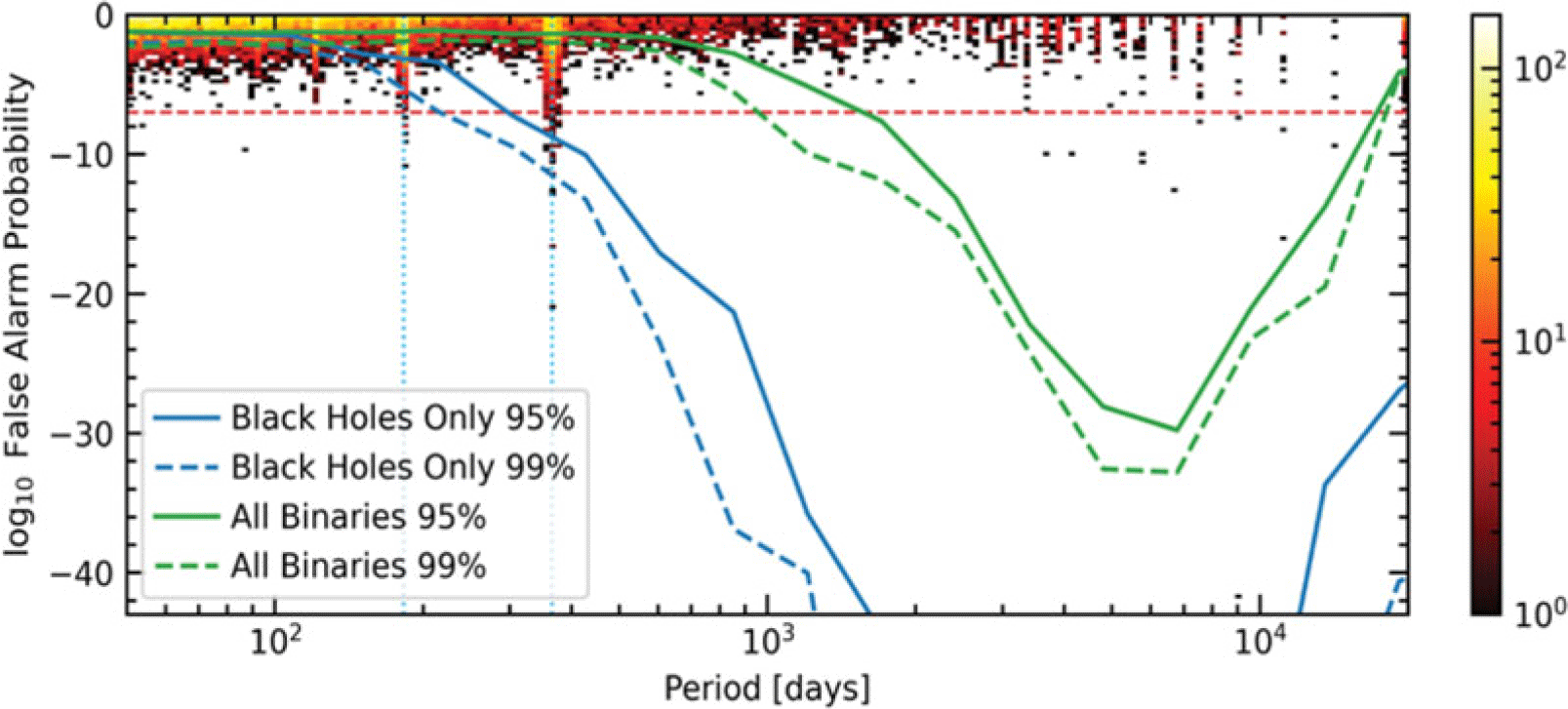
The results of our periodogram analysis on a high-quality subset of our data are shown in Figure 1.
A 2D histogram showing the period and false alarm probability (FAP) of a high-quality subset of our dataset. The synthetic binary datasets are described in Section 3. Note the pileup of significant detections at 1 year and 0.5 years, which are marked. As in Platais et al. (Reference Platais, Sahlmann, Girardi, Kozhurina-Platais, Kamann, Pourbaix, Wragg, Lemson and Mitschang2024), these 1 year signals arise due to observational and instrumental effects rather than a true binary signal.

Figure 1 Long description
A line graph showing the relationship between period and false alarm probability for different binary types. The horizontal axis represents the period in days, ranging from 10^2 to 10^4 days. The vertical axis represents the false alarm probability on a logarithmic scale from 0 to -40. The graph includes four lines: solid blue for Black Holes Only 95%, dashed blue for Black Holes Only 99%, solid green for All Binaries 95%, and dashed green for All Binaries 99%. The lines show varying trends, with the blue lines generally decreasing and the green lines showing a dip around 10^3 days before rising again.
3. A Synthetic Binary Population
To quantify the completeness of our periodogram detection method and determine an appropriate FAP threshold to constitute a detection, we generated datasets with synthetic observations of simulated binaries. The synthetic data we generated included a set of binaries with only black hole companions and a set of binaries with a realistic population of companion masses. For both sets, we followed a similar procedure to that used by Wragg et al. (Reference Wragg, Kamann, Saracino, Latour, Dreizler, Martens, Seth, Vaz and van de Ven2024) to determine the orbital parameters for each binary. To preserve realistic noise in our synthetic data, we inject the simulated orbital motion into the existing data for stars in the cluster. Given the small fraction of expected binaries in
 $\omega$
Cen, we don’t expect many of the original stars to have an existing orbital signal, but to ensure that any such signal is removed, we shuffle the proper motion residuals before injecting the orbital motion.
After creating the synthetic datasets, we run them through our periodogram analysis. We find that a relatively strict FAP threshold
 $\log_{10}(\text{FAP}) \lt -7$
yields no false positives for orbital periods
 $\gt1$
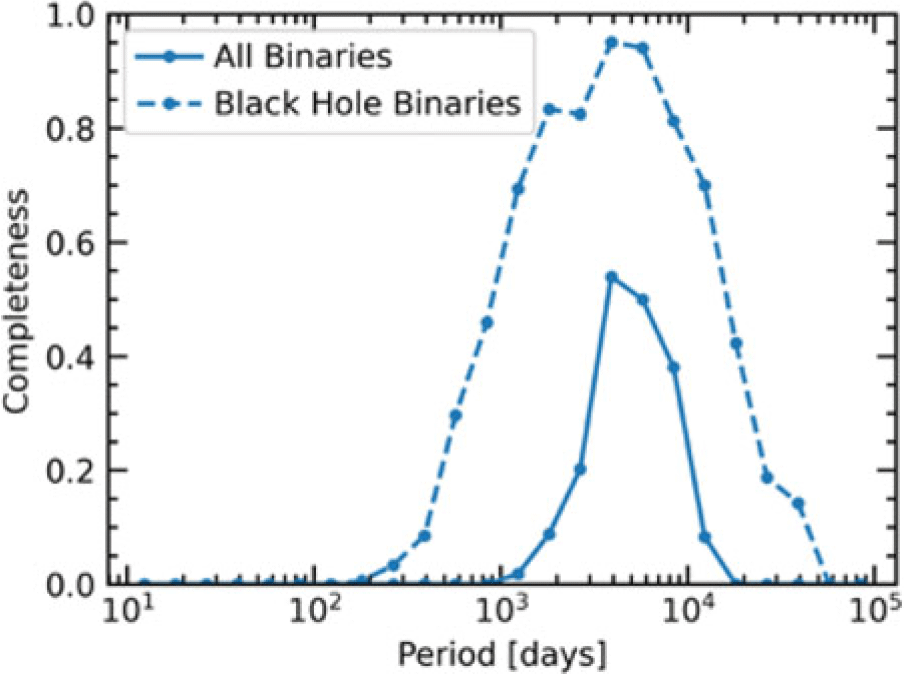
year. With this threshold, we get the completeness shown in Figure 2. We can consistently detect binaries with periods between
 $2\times10^3$
and
 $10^4$
days, with greater completeness and a wider range of periods for black hole binaries.
Detection completeness as a function of period for the same high-quality subset of our synthetic dataset.

4. Conclusion and Future Work
Applying the
 $\log_{10}(\text{FAP}) \lt -7$
threshold we determined from our synthetic data, we find
 $\sim30$
candidate binaries with an orbital period
 $\gt1$
year. This is a
 $\sim7$
x increase over the number of binaries found astrometrically by Platais et al. (Reference Platais, Sahlmann, Girardi, Kozhurina-Platais, Kamann, Pourbaix, Wragg, Lemson and Mitschang2024). An example of two new candidate binaries and their periodogram fit are shown in Figure 3.
Examples of newly discovered candidate binaries and their best periodogram fit.

Work is ongoing to characterize these binaries to determine their mass and other orbital parameters using Markov-Chain Monte Carlo fitting. We also report the tentative detection of a binary with a
 $\sim5\,\text{M}_\odot$
black hole companion. We are also working to make our quality cuts less strict so that we achieve greater overall completeness. As in Saracino et al. (Reference Saracino, Kamann, Wragg, Dreizler, Kremer, Latour, Müller-Horn, Neumayer, Seth, van de Ven and Häberle2025), we don’t expect to be able to characterize all the binaries in our list of detections due to the many degeneracies that arise when fitting orbits using noisy low-amplitude data, but we expect that the characterizability depends strongly on the strength of the signal, so black hole candidates with quality data should be characterizable.
Acknowledgements
Also contributing: Anil C. Seth, Maximilian Häberle, Evan Kerr, Andrea Bellini, Callie Clontz, Zack Freeman, Sebastian Kamann, Mattia Libralato, Nadine Neumayer, Carl Rodriguez, Jay Strader, Doga Veske, John Zaris. This project was funded in part by Hubble Space Telescope archival grant AR 17033 and the University of Utah Physics & Astronomy Summer Undergraduate Research Fellowship (SURF).




 Open access

