


1 Introduction
In this note we establish an effective analytic formula (Theorem 2) for the number of distinct irreducible factors of a polynomial
 $f \in \mathbb {Z}[x]$
. Our error bounds are unconditional and explicit in terms of their dependence upon f. To this end, we first introduce Theorem 1 that is of independent interest, since it relates a Mertens-type sum over number fields to a weighted sum over rational primes in an explicit manner that does not involve the residue of a Dedekind zeta function.
1.1 A Mertens-type sum
Let
 $\mathbb {K}$
be a number field of degree d with ring of integers
 $\mathcal {O}_{\mathbb {K}}$
. Let
 $N(\mathfrak {p})$
denote the norm of a prime ideal
 $\mathfrak {p}\subset \mathcal {O}_{\mathbb {K}}$
and p a rational prime. The primitive element theorem says that
 $\mathbb {K} = \mathbb {Q}(\alpha )$
for some
 $\alpha \in \mathcal {O}_{\mathbb {K}}$
[Reference Stewart and Tall17, Corollary 2.12]. Let
 $g \in \mathbb {Z}[x]$
be irreducible with root
 $\alpha $
and leading coefficient c. The degree of g is d [Reference Stewart and Tall17, p. 47] and the discriminant
 $D_g$
of g is nonzero (Lemma 4).
Theorem 1. Let
 $\mathbb {K} = \mathbb {Q}(\alpha )$
, in which
 $g \in \mathbb {Z}[x]$
is irreducible with root
 $\alpha $
, leading coefficient c, and degree d. Define
 $\mathbf {D}_g = |c|^{ (d-1)(d-2) } |D_g|$
. For
 $x> \max \{2,\sqrt {\mathbf {D}_g}\}$
,
 $$ \begin{align*} \sum_{p\leq x} \frac{\omega_g(p)}{p} = \underbrace{\sum_{N(\mathfrak{p})\leq x} \frac{1}{N(\mathfrak{p})} }_{\mathbf{M}_{\mathbb{K}}(x)}+ A_g, \end{align*} $$
in which
 $\omega _g(p)$
is the number of solutions to
 $g(x) \equiv 0 \,\,(\operatorname {mod}p)$
,
 $$ \begin{align} |A_g| \leq d\,\bigg( \mathbf{M}_{\mathbb{Q}}(|c|) + \mathbf{M}_{\mathbb{Q}}\bigg(\sqrt{\mathbf{D}_g}\bigg) + 0.64\bigg),\quad\text{and}\quad \mathbf{M}_{\mathbb{Q}}(x) = \sum_{p\leq x}\frac{1}{p}. \end{align} $$
Rosser and Schoenfeld bounded
 $\mathbf {M}_{\mathbb {Q}}(x)$
explicitly [Reference Rosser and Schoenfeld14, formula (3.20)]; see (2-10) below. It is known that
 $\mathbf {M}_{\mathbb {K}}(x) = \log \log x + O(1)$
, where the
 $O(1)$
term depends upon the residue of the corresponding Dedekind zeta function at
 $s=1$
[Reference Garcia and Lee7, Reference Rosen13]. Theorem 1 avoids this inconvenience and reduces the computation of a Mertens-type sum over number fields to a sum over rational primes, with an explicit error bound.
1.2 An effective analytic formula
Recall that
 $f \in \mathbb {Z}[x]$
is primitive if the greatest common divisor of its coefficients is
 $1$
. A nonconstant polynomial in
 $\mathbb {Z}[x]$
is irreducible in
 $\mathbb {Z}[x]$
if and only if it is primitive and irreducible in
 $\mathbb {Q}[x]$
. Gauss’ primitivity lemma ensures that the product of primitive polynomials is primitive, so we may assume that each irreducible factor of a given
 $f\in \mathbb {Z}[x]$
is primitive.
Suppose that
 $f = f_1 f_2 \cdots f_k \in \mathbb {Z}[x]$
, in which
 $f_1,f_2,\ldots ,f_k \in \mathbb {Z}[x]$
are irreducible; they are uniquely determined up to ordering. Since the Euclidean algorithm reveals any common factors of
 $g,g'\in \mathbb {Z}[x]$
, we may assume that the
 $f_i$
are distinct without loss of generality. Equivalently, the discriminant
 $D_f$
of f is nonzero. Under these circumstances, we provide an analytic formula for k. Our result is unconditional and explicit. The error term depends only upon the degree and discriminant of f.
Theorem 2. Suppose that
 $f =f_1 f_2 \cdots f_k \in \mathbb {Z}[x]$
is a product of distinct, irreducible nonconstant polynomials
 $f_1, f_2, \ldots , f_k \in \mathbb {Z}[x]$
. Let f have degree
 $d \geq 1$
and leading coefficient c. Write
 $\mathbf {D}_f = |c|^{(d-1)(d-2)} |D_f|$
, in which
 $D_f$
is the discriminant of f. For
 $x\geq \max \{2, |D_f|, \sqrt {\mathbf {D}_f}\}$
,
 $$ \begin{align} \bigg| \frac{1}{\log\log x}\sum_{p \leq x} \frac{\omega_f(p)}{p} - k \bigg| \, \leq \, \frac{d\,\mathbf{M}_{\mathbb{Q}}( |D_f| ) + \mathbf{A} + \mathbf{B}(x) + \mathbf{C}}{\log\log{x}}, \end{align} $$
in which
 $$ \begin{align*} \mathbf{A} &\leq d\,\bigg( \mathbf{M}_{\mathbb{Q}}(|c|) + \mathbf{M}_{\mathbb{Q}}\bigg( \sqrt{\mathbf{D}_f}\bigg) + 0.64 \bigg),\\[3pt] \mathbf{B}(x) &\leq \frac{2 }{\log x} \bigg( \bigg[ \frac{\Lambda \sqrt{\mathbf{D}_f}}{0.362\,32}( 0.55 d^2 + 44.86 d ) \bigg] + 2 d \bigg) , \quad \text{and}\\[3pt] \mathbf{C} &\leq d\,\,\bigg(\gamma + 1.02\,d - 0.02 + \frac{d-1}{2}\log \mathbf{D}_f\bigg). \end{align*} $$
Here
 $\gamma =0.57721\ldots $
is the Euler–Mascheroni constant,
 $\mathbf {M}_{\mathbb {Q}}$
is given by (1-1), and
 $$ \begin{align*} \Lambda = e^{28.2 d+5}(d+1)^{({5d+5})/{2}}|D_f|(\log |D_f| )^d. \end{align*} $$
Since the right-hand side of (1-2) tends to zero as
 $x\to \infty $
, the value of k on the left-hand side of (1-2) can (in principle) be determined from the weighted sum.
Theorem 2 produces a finite list of primes that certifies that
 $f \in \mathbb {Z}[x]$
has exactly k distinct irreducible factors: take
 $x\geq \max \{2, |D_f|, \sqrt {\mathbf {D}_f}\}$
such that the right-hand side of (1-2) is less than
 $0.5$
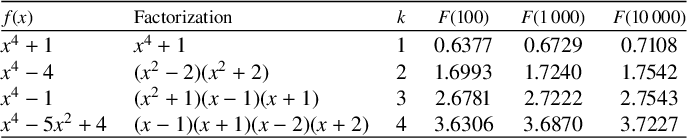
. Although this method is not yet practical, Theorem 2 is a valuable proof of concept and several avenues for improvement are discussed in Section 5. Table 1 exhibits the behavior of the main term in Theorem 2.
 $F(x) = ({1}/{\log \log {x}}) \sum _{p\leq x} ({\omega _f(p)}/{p})$
, the main term in Theorem 2.

The proof of Theorem 2 relies upon Theorem 1 and its proof requires recent work on explicit Mertens’ theorems for number fields and residue bounds for Dedekind zeta functions [Reference Garcia and Lee7]. We must consider the fields
 $\mathbb {K}_i$
generated by the roots of
 $f_i$
and quantify the resulting error in terms of the degree, discriminant, and leading coefficient of f. Moreover, each step must be uniform and explicit.
2 Preliminaries
In this section, we review results needed for the proof of Theorem 2. Section 2.1 concerns several important notions from elimination theory, while Section 2.2 presents explicit unconditional bounds on Dedekind zeta residues. We explore Mertens-type sums for algebraic number fields in Section 2.3. Finally, Section 2.4 contains a few remarks about a function related to the prime zeta function.
2.1 Resultants and discriminants
Although the material in this subsection is classical, it is surprisingly difficult to find it all stated in one convenient reference. Let
 $f(x) = a_n x^n + a_{n-1} x^{n-1} + \cdots + a_0$
and
 $g(x) = b_m x^m + b_{m-1} x^{m-1} + \cdots + b_0$
be complex polynomials of positive degrees n and m, respectively. Their resultant
 $R(f(x),g(x);x)$
is the determinant of the
 $(m+n)\times (m+n)$
Sylvester matrix
 $$ \begin{align} {\begin{bmatrix} a_{n}&0&\cdots &0&b_{m}&0&\cdots &0\\ a_{n-1}&a_{n}&\cdots &0&b_{m-1}&b_{m}&\cdots &0\\[-3pt] a_{n-2}&a_{n-1}&\ddots &0&b_{m-2}&b_{m-1}&\ddots &0\\ \vdots &\vdots &\ddots &a_{n}&\vdots &\vdots &\ddots &b_{m}\\[-3pt] a_{0}&a_{1}&\cdots &\vdots &b_{0}&b_{1}&\cdots &\vdots \\[-3pt] 0&a_{0}&\ddots &\vdots &0&b_{0}&\ddots &\vdots \\ \vdots &\vdots &\ddots &a_{1}&\vdots &\vdots &\ddots &b_{1}\\ 0&0&\cdots &a_{0}&0&0&\cdots &b_{0} \end{bmatrix}. } \end{align} $$
We often suppress the variable x and write
 $R(f,g)$
instead of
 $R(f(x),g(x);x)$
. Since (2-1) has m columns with the coefficients of f and n columns with the coefficients of g, it follows that
 $R( \alpha f, \beta g) = \alpha ^m \beta ^n R(f,g)$
for
 $\alpha , \beta \in \mathbb {C}$
. The definition ensures that
 $R(f,g) \in \mathbb {Z}$
whenever
 $f,g \in \mathbb {Z}[x]$
.
We now need an important fact about polynomials. Suppose that
 $f\in \mathbb {Z}[x]$
and
 $f = AB$
, in which
 $A,B\in \mathbb {Q}[x]$
. Gauss’ lemma ensures that
 $f = ab$
, where
 $a,b \in \mathbb {Z}[x]$
are of the form
 $a = \mu A$
and
 $b = \mu ^{-1} B$
for some
 $\mu \in \mathbb {Q}$
[Reference Dummit and Foote5, Proposition 5, p. 303].
Lemma 3. Let
 $f,g \in \mathbb {Z}[x]$
have positive degree. Then
 $R(f,g) = 0$
if and only if f and g have a common divisor in
 $\mathbb {Z}[x]$
of positive degree.
Proof. Let
 $\mathcal {P}_i$
denote the
 $\mathbb {C}$
-vector space of polynomials of degree at most
 $i-1$
. Then the matrix in (2-1) represents the linear map
 $(u,v) \mapsto uf+vg$
from
 $\mathcal {P}_{m} \times \mathcal {P}_{n}$
to
 $\mathcal {P}_{m+n}$
with respect to the corresponding monomial bases (listed in order of descending degree). Thus,
 $R(f,g) = 0$
if and only if
 $f,g$
have a common divisor in
 $\mathbb {C}[x]$
of positive degree, that is, if and only if
 $f,g$
share a common root
 $\alpha \in \mathbb {C}$
. Since
 $\alpha $
is algebraic and
 $f,g \in \mathbb {Z}[x]$
, the preceding is equivalent to asserting that
 $f = m_{\alpha } F$
and
 $g = m_{\alpha } G$
, in which
 $m_{\alpha } \in \mathbb {Q}[x]$
denotes the minimal polynomial of
 $\alpha $
over
 $\mathbb {Q}$
and
 $F,G \in \mathbb {Q}[x]$
. The remarks from the preceding paragraph imply that
 $R(f,g) = 0$
if and only if
 $f,g$
have a common divisor in
 $\mathbb {Z}[x]$
of positive degree.
For
 $f,g \in \mathbb {C}[x]$
with leading coefficients
 $a_n$
and
 $b_m$
, respectively,
 $$ \begin{align} R(f,g) = a_n^m b_m^n \prod_{ \substack{1 \leq i \leq m \\ 1 \leq j \leq n}} (\lambda_i - \mu_j), \end{align} $$
in which
 $\lambda _1,\lambda _2,\ldots ,\lambda _n$
and
 $\mu _1,\mu _2,\ldots ,\mu _m$
are the roots of f and g in
 $\mathbb {C}$
, counted by multiplicity [Reference Dummit and Foote5, Example 31c, p. 621]. For
 $c \in \mathbb {C}$
and
 $h \in \mathbb {C}[x]$
, (2-2) implies that
 $$ \begin{align} R(fg,h) = R(f,h) R(g,h) \quad \text{and}\quad R(f(cx),g(cx)) = c^{mn} R(f,g). \end{align} $$
The discriminant
 $$ \begin{align*} D(f;x) = \frac{(-1)^{n(n-1)/2}}{a_n} R(f(x),f'(x);x) \end{align*} $$
of
 $f \in \mathbb {C}[x]$
with degree n and leading coefficient
 $a_n$
is a homogeneous polynomial of degree
 $2n-2$
in the coefficients of f. The choice of sign ensures that
 $D(f;x) \geq 0$
if the roots of f are real. We often write
 $D_f$
or
 $D_{f(x)}$
instead of
 $D(f;x)$
.
If
 $\deg f = 1$
, then
 $D_f = 1$
. If
 $f \in \mathbb {Z}[x]$
and
 $\deg f \geq 2$
, then
 $D_f \in \mathbb {Z}$
. Lemma 3 ensures that
 $D_f = 0$
if and only if f and
 $f'$
share a common divisor in
 $\mathbb {Z}[x]$
of positive degree; that is, if and only if f has a repeated root in
 $\mathbb {C}$
. This yields the following.
Lemma 4. If
 $f \in \mathbb {Z}[x]$
is irreducible and has positive degree, then
 $D_f \neq 0$
.
The definition and (2-2) yield
 $$ \begin{align*} D_f = a_n^{2n-2} \prod_{1 \leq i < j\leq n} (\lambda_i - \lambda_j)^2, \end{align*} $$
in which
 $\lambda _1,\lambda _2,\ldots ,\lambda _n$
are the roots of f, repeated according to multiplicity. For
 $\alpha \in \mathbb {C}$
, (2-3) implies that
 $$ \begin{align} D_{f(\alpha x)} = \alpha^{n(n-1)} D_{f(x)} \quad \text{and} \quad D_{gh} = D_g D_h R_{g,h}^2. \end{align} $$
If
 $f,g \in \mathbb {Z}[x]$
and
 $g|f$
, then
 $D_g | D_f$
. If, in addition,
 $D_f \neq 0$
, then
 $|D_g| \leq |D_f|$
.
Lemma 5. If
 $f =f_1 f_2 \cdots f_k \in \mathbb {Z}[x]$
is a product of distinct irreducible polynomials
 $f_1, f_2, \ldots , f_k \in \mathbb {Z}[x]$
of positive degree, then
 $R(f_i,f_j) | D_f$
for
 $i\neq j$
.
Proof. Since
 $f_1,f_2,\ldots ,f_k \in \mathbb {Z}[x]$
are distinct, irreducible, and have positive degree, Lemma 3 ensures that
 $R(f_i,f_j) \neq 0$
for
 $i\neq j$
. Moreover,
 $D_f \neq 0$
since f has no repeated factors. Induction and (2-4) imply that
 $R(f_i,f_j) | D_f$
for
 $i\neq j$
.
The final lemma of this subsection (an easy consequence of Lagrange’s theorem) concerns the number of solutions
 $\omega _f(p)$
to
 $f(x) \equiv 0 \,\,(\operatorname {mod}p)$
for a rational prime p. Note that if
 $f\in \mathbb {Z}[x]$
is reducible, then
 $\omega _f(p)> \deg f$
is possible. For example, consider
 $3x-6$
modulo
 $3$
.
Lemma 6. If
 $f \in \mathbb {Z}[x]$
is irreducible and
 $\deg f \geq 1$
, then
 $\omega _f(p) \leq \deg f$
for all p.
2.2 Dedekind zeta residues
Let
 $\mathbb {K}$
be a number field of degree
 $n_{\mathbb {K}}$
with ring of algebraic integers
 $\mathcal {O}_{\mathbb {K}}$
and let
 $\Delta _{\mathbb {K}} $
denote the discriminant of
 $\mathbb {K}$
. In what follows,
 $\mathfrak {p}\subset \mathcal {O}_{\mathbb {K}}$
denotes a prime ideal,
 $\mathfrak {a}\subset \mathcal {O}_{\mathbb {K}}$
an ideal (not necessarily prime), and
 $N(\mathfrak {a})$
the norm of
 $\mathfrak {a}$
. The Dedekind zeta function
 $\zeta _{\mathbb {K}}(s) = \sum _{\mathfrak {a}}N(\mathfrak {a})^{-s}$
of
 $\mathbb {K}$
is analytic on
 $\operatorname {Re}{s}> 1$
and extends meromorphically to
 $\mathbb {C}$
, except for a simple pole at
 $s=1$
. The analytic class number formula asserts that the residue of
 $\zeta _{\mathbb {K}}(s)$
at
 $s=1$
is
 $$ \begin{align*} \kappa_{\mathbb{K}} = \frac{2^{r_1}(2\pi)^{r_2}h_{\mathbb{K}}R_{\mathbb{K}}}{w_{\mathbb{K}}\sqrt{| \Delta_{\mathbb{K}} |}}, \end{align*} $$
in which
 $r_1$
is the number of real places of
 $\mathbb {K}$
,
 $r_2$
is the number of complex places of
 $\mathbb {K}$
,
 $w_{\mathbb {K}}$
is the number of roots of unity in
 $\mathbb {K}$
,
 $h_{\mathbb {K}}$
is the class number of
 $\mathbb {K}$
, and
 $R_{\mathbb {K}}$
is the regulator of
 $\mathbb {K}$
[Reference Lang9]. The nontrivial zeros of
 $\zeta _{\mathbb {K}}(s)$
lie in the critical strip
 $0 < \operatorname {Re} s < 1$
, in which there might also exist an exceptional, real zero
 $0 < \beta < 1$
. The generalized Riemann hypothesis, which remains unproven, asserts that the nontrivial zeros of
 $\zeta _{\mathbb {K}}(s)$
satisfy
 $\operatorname {Re} s = \tfrac 12$
and that no exceptional zero exists.
We require unconditional bounds for the residue
 $\kappa _{\mathbb {K}}$
of
 $\zeta _{\mathbb {K}}(s)$
at
 $s=1$
. If
 $d=1$
, then
 $\mathbb {K} = \mathbb {Q}$
and hence
 $\zeta _{\mathbb {Q}}(s)$
is the Riemann zeta function, for which
 $\kappa _{\mathbb {Q}} = 1$
. Consequently, we restrict our attention to the case
 $d \geq 2$
.
Lemma 7. Let
 $g \in \mathbb {Z}[x]$
be irreducible with degree
 $d \geq 2$
and leading coefficient c. If
 $g(\alpha ) = 0$
and
 $\mathbb {K} = \mathbb {Q}(\alpha )$
, then
 $$ \begin{align} \frac{0.362\,32}{\sqrt{\mathbf{D}_g}} \,\leq\, \kappa_{\mathbb{K}} \,\leq\, \bigg(\frac{e\log \mathbf{D}_g}{2(d-1)} \bigg)^{d - 1}, \end{align} $$
in which
 $\mathbf {D}_g = |c|^{(d-1)(d-2)}|D_g|$
.
Proof. Let
 $g \in \mathbb {Z}[x]$
be irreducible with degree
 $d \geq 2$
and leading coefficient c. Then
 $c^{d - 1} g(x) = h(cx)$
, in which
 $h \in \mathbb {Z}[x]$
is monic, irreducible, and has degree d. Let
 $\alpha ~\in ~\mathbb {C}$
be such that
 $g(\alpha ) = 0$
. Then
 $h(c\alpha ) = 0$
and
 $\mathbb {K} = \mathbb {Q}(\alpha ) = \mathbb {Q}(c\alpha )$
; the degree
 $n_{\mathbb {K}}$
of the number field
 $\mathbb {K}$
is d. Since the discriminant of
 $c^{d - 1} g(x)$
is
 $(c^{(d-1)})^{2d-2} D_g$
and the discriminant of
 $h(cx)$
is
 $c^{d(d-1)} D_h$
,
 $$ \begin{align*} D_h = c^{(d-1)(d-2)} D_g. \end{align*} $$
From [Reference Neukirch12, Proposition I.2.12], observe that
 $$ \begin{align*} 1 \leq [\mathcal{O}_{\mathbb{K}} : \mathbb{Z}[c\alpha]]^2 = \bigg( \frac{ \det \mathbb{Z}[c\alpha] }{ \det \mathcal{O}_{\mathbb{K}} } \bigg)^2 = \frac{|D_h| }{ | \Delta_{\mathbb{K}} |} \end{align*} $$
and hence
 $$ \begin{align} | \Delta_{\mathbb{K}} | \leq |D_h| = \mathbf{D}_g. \end{align} $$
Since
 $n_{\mathbb {K}} = d \geq 2$
, Louboutin [Reference Louboutin10, Theorem 1] provided the first inequality in
 $$ \begin{align} \kappa_{\mathbb{K}} \leq \bigg(\frac{e\log{| \Delta_{\mathbb{K}} |}}{2(n_{\mathbb{K}} - 1)}\bigg)^{n_{\mathbb{K}} - 1} \leq \bigg(\frac{e \log \mathbf{D}_g}{2(d-1)} \bigg)^{d - 1}. \end{align} $$
The lower bound follows from [Reference Garcia and Lee7]; the argument is short and reproduced here. Since
 $n_{\mathbb {K}} = r_1 + 2r_2\geq 2$
, we have
 $2^{r_1}(2\pi )^{r_2} \geq 2^{2}(2\pi )^{0} = 4$
. Friedman [Reference Friedman6, Theorem B] proved that
 $R_{\mathbb {K}}/w_{\mathbb {K}} \geq 0.090\,58$
, improving on Zimmert [Reference Zimmert20] (see [Reference Lang9, Theorem 7, p. 273]). Thus,
 $$ \begin{align} \kappa_{\mathbb{K}} \geq \frac{2^{r_1}(2\pi)^{r_2}R_{\mathbb{K}}}{w_{\mathbb{K}}\sqrt{ | \Delta_{\mathbb{K}}|}}> \frac{4\times 0.090\,58}{\sqrt{\Delta_{\mathbb{K}}}} = \frac{0.362\,32}{\sqrt{|\Delta_{\mathbb{K}}|}} \geq \frac{0.362\,32}{\sqrt{\mathbf{D}_g}}. \end{align} $$
This concludes the proof.
Remark 8. With respect to
 $\mathbf {D}_g$
, there are asymptotically superior lower bounds available (with explicit constants). For example, one can obtain
 $$ \begin{align} \kappa_{\mathbb{K}}> \frac{0.015\,744\,605}{d\,d! \,\mathbf{D}_g^{1/d}} \end{align} $$
from Stark [Reference Stark16] by tracking the constants involved [Reference Garcia and Lee7]. However, the dependence upon
 $d = n_{\mathbb {K}}$
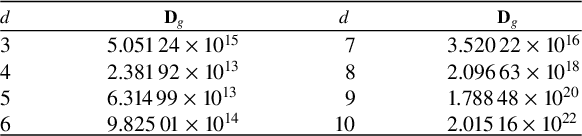
is poor, so we use the degree-independent lower bound in (2-5) instead. The bound (2-9) is superior to (2-5) only for astronomically large
 $\mathbf {D}_g$
; see Table 2.


2.3 The function
 $\mathbf {M}_{\mathbb {K}}(x)$

For a number field
 $\mathbb {K}$
, define the Mertens-type sum
 $$ \begin{align*} \mathbf{M}_{\mathbb{K}}(x) = \sum_{ N(\mathfrak{p})\leq x} \frac{1}{N(\mathfrak{p})}, \end{align*} $$
where the sum runs over the prime ideals
 $\mathfrak {p}$
of
 $\mathcal {O}_{\mathbb {K}}$
. If
 $\mathbb {K} = \mathbb {Q}$
, then the sum reduces to the classical Mertens sum
 $$ \begin{align} \mathbf{M}_{\mathbb{Q}}(x) = \sum_{p\leq x} \frac{1}{p} \leq \log \log x + C_{\mathbb{Q}} + \dfrac{1}{(\log x)^2}, \end{align} $$
in which
 $C_{\mathbb {Q}} = 0.261\,49\cdots $
is the Meissel–Mertens constant and (2-10) holds unconditionally for
 ${x> 1}$
[Reference Rosser and Schoenfeld14, formula (3.20)]. For
 $\mathbb {K} \neq \mathbb {Q}$
, the first two authors [Reference Garcia and Lee7] used an ideal-counting estimate of Sunley [Reference Sunley18, Reference Sunley19] to prove unconditionally for
 $x \geq 2$
that
 $$ \begin{align} \mathbf{M}_{\mathbb{K}}(x) = \log \log x + C_{\mathbb{K}} + B_{\mathbb{K}}(x), \end{align} $$
in which
 $$ \begin{align} \gamma + \log \kappa_{\mathbb{K}} - d_{\mathbb{K}} \,\leq\, C_{\mathbb{K}} \,\leq\, \gamma + \log \kappa_{\mathbb{K}} \end{align} $$
and
 $$ \begin{align} |B_{\mathbb{K}}(x)| \leq \frac{2 \Upsilon_{\mathbb{K}}}{\log x}, \end{align} $$
where
 $$ \begin{align} \Upsilon_{\mathbb{K}}= \bigg( \frac{(n_{\mathbb{K}}+1)^2}{2\kappa_{\mathbb{K}}(n_{\mathbb{K}}-1)}\Lambda_{\mathbb{K}} + 1\bigg) + \frac{0.55\, \Lambda_{\mathbb{K}}n_{\mathbb{K}}(n_{\mathbb{K}}+1)}{\kappa_{\mathbb{K}}} + n_{\mathbb{K}} + 40.31 \dfrac{\Lambda_{\mathbb{K}}n_{\mathbb{K}}}{\kappa_{\mathbb{K}}} \end{align} $$
and
 $$ \begin{align} \Lambda_{\mathbb{K}} = e^{28.2n_{\mathbb{K}}+5} (n_{\mathbb{K}}+1)^{ {5(n_{\mathbb{K}}+1)}/{2}} | \Delta_{\mathbb{K}} |^{{1}/({n_{\mathbb{K}}+1})} (\log | \Delta_{\mathbb{K}} |)^{n_{\mathbb{K}}}. \end{align} $$
The Dedekind zeta residue
 $\kappa _{\mathbb {K}}$
in (2-14) can be explicitly bounded by Lemma 7.
2.4 The function
$\mathbf {P}(x)$

For
 $x\geq 1$
, define
 $$ \begin{align*} \mathbf{P}(x) = \sum_{2\leq k\leq x} \frac{P(k)}{k}, \end{align*} $$
in which
 $P(s) = \sum _p p^{-s}$
is the prime zeta function. Then
 $\mathbf {P}(1) = 0$
and
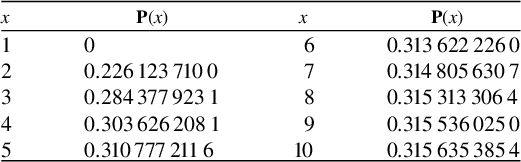
 $\mathbf {P}(n)$
tends monotonically to
 $0.315\,718\,45\ldots $
as
 $n \to \infty $
; see Table 3. That
 $\lim _{x\to \infty }\mathbf {P}(x)$
exists follows from an old result of Euler (1781) [Reference Srivastava15, formula (2.12), p. 133]:
 $$ \begin{align*} \mathbf{P}(x) < \sum_{k \geq 2} \frac{1}{k} \sum_p \frac{1}{p^k} < \sum_{k = 2}^{\infty} \frac{1}{k}\sum_{n= 2}^{\infty} \frac{1}{n^k} = \sum_{k = 2}^{\infty} \frac{\zeta(k)-1}{k} = 1-\gamma. \end{align*} $$
A convenient upper bound is
 $\mathbf {P}(x) \leq 0.32$
for all
 $x \geq 2$
.
Approximate values of
 $\mathbf {P}(x)$
.

3 Proof of Theorem 1
The proof of Theorem 1 requires the next lemma, which handles the monic case.
Lemma 9. Let
 $h(x) \in \mathbb {Z}[x]$
be monic and irreducible with degree
 $d \geq 1$
. Let
 $\alpha \in \mathbb {C}$
be such that
 $h(\alpha )=0$
and let
 $\mathbb {K} = \mathbb {Q}(\alpha )$
. For
 $x> \sqrt {|D_h|}$
,
 $$ \begin{align*} \bigg| \mathbf{M}_{\mathbb{K}}(x) - \sum_{p\leq x} \frac{\omega_h(p)}{p} \bigg| < \bigg( \mathbf{M}_{\mathbb{Q}}\bigg(\sqrt{|D_h|}\bigg) + 0.64\bigg)\, d. \end{align*} $$
Proof. Suppose that
 $h(x) \in \mathbb {Z}[x]$
is monic and irreducible with degree
 $d \geq 1$
. Let
 $\alpha \in \mathbb {C}$
be such that
 $h(\alpha ) = 0$
(that is, h is the minimal polynomial of
 $\alpha $
over
 $\mathbb {Q}$
) and consider the number field
 $\mathbb {K} = \mathbb {Q}(\alpha )$
, which has degree d [Reference Stewart and Tall17, p. 47]. Let
 $\mathcal {O}_{\mathbb {K}}$
denote the ring of algebraic integers in
 $\mathbb {K}$
; by construction, it contains
 $\alpha $
. For each rational prime p, the ideal
 $p\mathcal {O}_{\mathbb {K}}$
factors uniquely (up to reordering the factors) as
 $$ \begin{align*} p\mathcal{O}_{\mathbb{K}} = \mathfrak{p}_1^{e_1} \mathfrak{p}_2^{e_2}\cdots \mathfrak{p}_r^{e_r}, \end{align*} $$
in which
 $\mathfrak {p}_1,\mathfrak {p}_2,\ldots ,\mathfrak {p}_r \subset \mathcal {O}_{\mathbb {K}}$
are distinct prime ideals [Reference Stewart and Tall17, Theorem 5.6]. Then
 $N(\mathfrak {p}_i) = | \mathcal {O}_{\mathbb {K}}/\mathfrak {p}_i | = p^{f_i}$
, in which
 $f_i$
is the inertia degree of p at
 $\mathfrak {p}_i$
and
 $$ \begin{align*} e_1 f_1 + e_2 f_2 + \cdots + e_r f_r = d; \end{align*} $$
see [Reference Neukirch12, Proposition 8.2, p. 46]. Since each prime ideal
 $\mathfrak {p}\subset \mathcal {O}_{\mathbb {K}}$
can occur in the factorization for only one rational prime p and, moreover,
 $p \leq N(\mathfrak {p}) \leq p^d$
[Reference Stewart and Tall17, Theorem 5.14c], the number of prime ideals of norm
 $p^k$
is at most
 $d/k$
.
The Dedekind factorization criterion relates the factorization of
 $p\mathcal {O}_{\mathbb {K}}$
to the factorization of h over
 $\mathbb {F}_p$
[Reference Lang9, Proposition 25, p. 27]. If
 $p \nmid [\mathcal {O}_{\mathbb {K}} : \mathbb {Z}[\alpha ]]$
, then
 $$ \begin{align*} h(x) = h_1(x)^{e_1} h_2(x)^{e_2} \cdots h_r(x)^{e_r} \end{align*} $$
in
 $\mathbb {F}_p[x]$
, where
 $h_1,h_2,\ldots ,h_r \in \mathbb {F}_p[x]$
are distinct and irreducible with
 $\deg h_i = f_i$
. If
 $a \in \mathbb {F}_p$
and
 $h(a) = 0$
, then there is a unique index i such that
 $h_i(x) = x-a$
. Hence,
 $f_i = \deg h_i = 1$
and
 $N(\mathfrak {p}_i) = p$
. Conversely,
 $N(\mathfrak {p}_i) = p$
implies that
 $\deg h_i =f_i = 1$
and hence
 $h_i(x) = x-a$
for some unique
 $a \in \mathbb {F}_p$
. We conclude that
 $\omega _h(p)$
equals the number of prime ideals of norm p in the prime ideal factorization of
 $p\mathcal {O}_{\mathbb {K}}$
.
If
 $p> \sqrt {|D_h|}$
, then
 $p \nmid [\mathcal {O}_{\mathbb {K}} : \mathbb {Z}[\alpha ]]$
since
 $$ \begin{align*} [\mathcal{O}_{\mathbb{K}} : \mathbb{Z}[\alpha]] = \frac{ \det \mathbb{Z}[\alpha] }{ \det \mathcal{O}_{\mathbb{K}} } =\sqrt{ \frac{|D_h| }{ | \Delta_{\mathbb{K}} |}} \leq \sqrt{|D_h|} \end{align*} $$
by [Reference Neukirch12, Section 1.2]. Consequently,
 $x \geq \sqrt {|D_h|}$
implies that
 $$ \begin{align*} \sum_{p\leq x} \frac{\omega_h(p)}{p} &=\sum_{p\leq \sqrt{|D_h|}} \frac{\omega_h(p)}{p} + \sum_{\sqrt{|D_h|} < p\leq x} \frac{\omega_h(p)}{p} \\ &=\sum_{p\leq \sqrt{|D_h|}} \frac{\omega_h(p)}{p} + \sum_{\substack{\sqrt{|D_h|} < p \leq x\\N(\mathfrak{p})=p}} \frac{1}{N(\mathfrak{p})}\\ &=\mathbf{M}_{\mathbb{K}}(x) + \underbrace{\sum_{p\leq \sqrt{|D_h|}} \frac{\omega_h(p)}{p} - \sum_{N(\mathfrak{p}) \leq \sqrt{|D_h|}} \frac{1}{N(\mathfrak{p})}}_{\bigstar} - \underbrace{\sum_{\substack{\sqrt{|D_h|} < p^\ell \leq x\\N(\mathfrak{p}) = p^\ell\\ 2\leq \ell \leq d}} \frac{1}{N(\mathfrak{p})}}_{\clubsuit}. \end{align*} $$
First, note that
 $$ \begin{align} |\bigstar | \leq \max \bigg\{ \sum_{N(\mathfrak{p}) \leq \sqrt{|D_h|}} \frac{1}{N(\mathfrak{p})}, \,\, \sum_{p\leq \sqrt{|D_h|}} \frac{\omega_h(p)}{p} \bigg\} \end{align} $$
because the two sums in (3-1) are both nonnegative. Since
 $\mathbf {P}(y) \leq 0.32$
for
 $y \geq 2$
,
 $$ \begin{align*} \sum_{N(\mathfrak{p}) \leq \sqrt{|D_h|}} \frac{1}{N(\mathfrak{p})} \leq \sum_{p^\ell \leq \sqrt{|D_h|}} \frac{d/\ell}{p^\ell} &= d\sum_{p \leq \sqrt{|D_h|}} \frac{1}{p} \,\,+\,\, d\!\!\!\! \sum_{\substack{p^\ell \leq \sqrt{|D_h|}\\2 \leq \ell \leq d}} \frac{1}{\ell\,p^\ell} \\ &\leq d\,\mathbf{M}_{\mathbb{Q}}\bigg(\sqrt{|D_h|}\bigg) + d\, \mathbf{P}\bigg(\sqrt{|D_h|}\bigg) \\ &\leq d \bigg(\, \mathbf{M}_{\mathbb{Q}}\bigg(\sqrt{|D_h|}\bigg) + 0.32\bigg). \end{align*} $$
Lemma 6 ensures that
 $\omega _h(p) \leq d$
for all p. Thus,
 $$ \begin{align*} \sum_{p\leq \sqrt{|D_h|}} \frac{\omega_h(p)}{p} \leq d \sum_{p\leq \sqrt{|D_h|}}\frac{1}{p} = d\, \mathbf{M}_{\mathbb{Q}}\bigg(\sqrt{|D_h| }\bigg). \end{align*} $$
To bound (3-1), we take the greater of the two estimates above.
Since the number of prime ideals of norm
 $p^\ell $
is at most
 $d/\ell $
,
 $$ \begin{align*} |\clubsuit | = \sum_{\substack{\sqrt{|D_h|} < p^\ell \leq x\\N(\mathfrak{p}) = p^\ell\\ 2\leq \ell \leq d}} \frac{1}{N(\mathfrak{p})} \leq d \sum_{\ell = 2}^{d} \frac{1}{\ell}\sum_{p\leq x} \frac{1}{p^\ell} = d\,\mathbf{P}(x) \leq 0.32\,d. \end{align*} $$
Combining these observations and using the triangle inequality yields the result.
We are now ready for the proof of Theorem 1.
Proof of Theorem 1. Let
 $g \in \mathbb {Z}[x]$
be irreducible with degree
 $d \geq 1$
and leading coefficient c. Then
 $$ \begin{align} c^{d - 1} g(x) = h(cx), \end{align} $$
in which
 $h \in \mathbb {Z}[x]$
is monic, irreducible, and has degree d. Let
 $\alpha \in \mathbb {C}$
be such that
 $g(\alpha ) = 0$
. Then
 $h(c\alpha ) = 0$
and
 $\mathbb {K} = \mathbb {Q}(\alpha ) = \mathbb {Q}(c\alpha )$
.
For
 $p \nmid c$
, (3-2) gives
 $\omega _g(p) = \omega _h(p)$
. For
 $p \mid c$
, Lemma 6 yields
 $\omega _g(p), \omega _h(p) \leq d$
. Thus,
 $$ \begin{align} \bigg|\sum_{p\leq x} \frac{\omega_g(p)}{p} - \sum_{p\leq x} \frac{\omega_h(p)}{p}\bigg| \leq \sum_{p\leq x} \frac{| \omega_g(p) - \omega_h(p)|}{p} &\leq \sum_{p\mid c} \frac{\max\{ \omega_g(p) , \omega_h(p) \}}{p} \nonumber \\ &\leq d\sum_{p\mid c} \frac{1}{p} \nonumber\\ &\leq d\, \mathbf{M}_{\mathbb{Q}}(|c|). \end{align} $$
Since the discriminant of
 $c^{d - 1} g(x)$
is
 $(c^{(d-1)})^{2d-2} D_g$
and the discriminant of
 $h(cx)$
is
 $c^{d(d-1)} D_h$
, it follows from (3-2) that
 $$ \begin{align} |D_h| = |c|^{(d-1)(d-2)} |D_g| = \mathbf{D}_g. \end{align} $$
For
 $x \geq \sqrt {|D_h|}$
, Lemma 9 provides
 $$ \begin{align*} \bigg| \mathbf{M}_{\mathbb{K}}(x) - \sum_{p\leq x} \frac{\omega_g(p)}{p} \bigg| &= \bigg| \mathbf{M}_{\mathbb{K}}(x) - \sum_{p\leq x} \frac{\omega_h(p)}{p} \bigg| +\bigg| \sum_{p\leq x} \frac{\omega_h(p)}{p} - \sum_{p\leq x} \frac{\omega_g(p)}{p} \bigg| \\ &< d\bigg( \mathbf{M}_{\mathbb{Q}}(|c|) + \mathbf{M}_{\mathbb{Q}}\bigg(\sqrt{|D_h|}\bigg) + 0.64 \bigg). \end{align*} $$
To complete the proof, use (3-4) and rewrite the preceding in terms of
 $\mathbf {D}_g$
.
Remark 10. The term
 $\mathbf {M}_{\mathbb {Q}}(|c|)$
in (1-1) can be improved. Return to (3-3) and observe that the maximal order of
 $\sum _{p|c}1/p$
is
 $\log \log \log |c|$
since, if
 $c=\prod _{p\leq y} p$
, then
 $c=e^{(1+o(1))y}$
and hence
 $y=(1+o(1))\log c$
. Consequently,
 $\sum _{p|c} 1/p=\sum _{p\leq y} 1/p \sim \log \log y \sim \log \log \log c$
. This can even be made explicit with [Reference Broadbent, Kadiri, Lumley, Ng and Wilk2, Corollary 2.1]:
 $$ \begin{align*} \log c = \sum_{p \leq y} \log p = \theta(y) \leq (1 + 1.933\,78 \times 10^{-8})y. \end{align*} $$
On the other hand,
 $\mathbf {M}_{\mathbb {Q}}(|c|) \sim \log \log |c|$
, so the dependence upon c is weak already and the improvement is not worth pursuing.
4 Proof of Theorem 2
The proof of Theorem 2 requires two additional lemmas (Section 4.1). After that, we estimate three quantities that arise:
 $\mathbf {A}$
in Section 4.2,
 $\mathbf {B}(x)$
in Section 4.3, and
 $\mathbf {C}$
in Section 4.4. Finally, we wrap things up in Section 4.5.
4.1 Preliminary lemmas
The next two lemmas set up the final estimates needed for the proof of Theorem 2. Recall that
 $\omega _f(p)$
denotes the number of solutions to
 $f(x) \equiv 0 \,\,(\operatorname {mod}p)$
. The first lemma concerns the additive structure of
 $\omega _f(p)$
.
Lemma 11. Suppose that
 $f =f_1 f_2 \cdots f_k \in \mathbb {Z}[x]$
is a product of distinct, irreducible nonconstant polynomials
 $f_1, f_2,\ldots ,f_k \in \mathbb {Z}[x]$
. If
 $p> |D_f|$
, then
 $$ \begin{align*} \omega_f(p) = \omega_{f_1}(p) + \cdots + \omega_{f_k}(p). \end{align*} $$
Proof. Each zero of f in
 $\mathbb {F}_p$
is a zero of some
 $f_i$
. Thus,
 $$ \begin{align} \omega_f(p) \leq \omega_{f_1}(p) + \cdots + \omega_{f_k}(p) \end{align} $$
holds for any p. Since every zero of
 $f_i$
in
 $\mathbb {F}_p$
is a zero of f, it suffices to show that
 $f_i$
and
 $f_j$
have no common zeros in
 $\mathbb {F}_p$
if
 $i \neq j$
and
 $p> |D_f|$
. If
 $i \neq j$
, then there are
 $u_{ij}, v_{ij} \in \mathbb {Z}[x]$
such that
 $$ \begin{align} u_{ij} f_i + v_{ij} f_j = R(f_i,f_j), \end{align} $$
in which
 $R(f_i,f_j) \in \mathbb {Z}$
is the resultant of
 $f_i$
and
 $f_j$
[Reference Cox, Little and O’Shea3, Proposition 5, Section 3.6]. Since
 $f_i,f_j \in \mathbb {Z}[x]$
are distinct and irreducible, they share no common factors over
 $\mathbb {C}$
, so
 $R(f_i,f_j) \neq 0$
[Reference Cox, Little and O’Shea3, Corollary 4, Section 3.6]. If
 $f_i,f_j$
have a common zero in
 $\mathbb {F}_p$
, then (4-2) ensures that
 $p \mid R(f_i,f_j)$
. Consequently,
 $p \mid D_f$
(Lemma 5) and hence
 $p \leq |D_f|$
since
 $D_f \neq 0$
(Lemma 4). Thus,
 $p> |D_f|$
implies that (4-1) is an equality.
The second lemma is an asymptotic estimate for a special sum over
 $\omega _f(p)$
.
Lemma 12. Suppose that
 $f =f_1 f_2 \cdots f_k \in \mathbb {Z}[x]$
is a product of distinct, irreducible, nonconstant polynomials
 $f_1, f_2, \ldots , f_k \in \mathbb {Z}[x]$
of degrees
 $d_1, d_2, \ldots , d_k \geq 1$
, respectively. For
 $x \geq \sqrt { \mathbf {D}_f}$
,
 $$ \begin{align} \bigg|\sum_{p \leq x} \frac{\omega_f(p)}{p} - k \log \log x \bigg| \leq d\, \mathbf{M}_{\mathbb{Q}}( | D_f| ) + \mathbf{A} + \mathbf{B}(x) + \mathbf{C}, \end{align} $$
in which
 $$ \begin{align} d = d_1+d_2+\cdots+d_k \end{align} $$
and
 $$ \begin{align*} \mathbf{A} = \sum_{i=1}^k |A_{f_i}| ,\quad \mathbf{B}(x) = \sum_{i=1}^k |B_{\mathbb{K}_i}(x)| ,\quad \text{and}\quad \mathbf{C} = \sum_{i=1}^k |C_{\mathbb{K}_i}|. \end{align*} $$
Here
 $A_{f_i}$
,
 $B_{\mathbb {K}_i}(x)$
, and
 $C_{\mathbb {K}_i}$
are given by (1-1), (2-13), and (2-11), respectively.
Proof. For each
 $i=1,2,\ldots ,k$
, let
 $\alpha _i$
be a root of
 $f_i$
and define
 $\mathbb {K}_i =\mathbb {Q}(\alpha _i)$
, which has degree
 $d_i$
since each
 $f_i$
is irreducible. Observe that
 $D_f \neq 0$
(since f has no repeated roots in
 $\mathbb {C}$
),
 $$ \begin{align*} k \leq d, \quad\text{and}\quad 1\leq |D_{f_1}|, |D_{f_2}|,\ldots, |D_{f_k}| \leq |D_f|. \end{align*} $$
Without loss of generality, let
 $c\geq 1$
denote the leading coefficient of f and let
 $c_1,c_2,\ldots ,c_k \geq 1$
denote the leading coefficients of
 $f_1,f_2,\ldots ,f_k$
, respectively. Then
 $c = c_1 c_2 \cdots c_k$
and
 $c_1,c_2,\ldots ,c_k \leq c$
.
If
 $x> |D_f|$
, then Lemma 11 implies that
 $$ \begin{align*} \sum_{p \leq x} \frac{\omega_f(p)}{p} &= \sum_{p \leq |D_f|} \frac{\omega_f(p)}{p} + \sum_{|D_f| < p \leq x} \frac{ \omega_f(p)}{p} \\ &= \sum_{p \leq |D_f|} \frac{\omega_f(p)}{p} + \sum_{|D_f| < p \leq x}\sum_{i=1}^k \frac{ \omega_{f_i}(p)}{p} \\ &= \sum_{p \leq |D_f|} \frac{\omega_f(p)}{p} + \sum_{i=1}^k \bigg(\sum_{p \leq x} \frac{ \omega_{f_i}(p)}{p} - \sum_{p \leq |D_f|} \frac{ \omega_{f_i}(p)}{p}\bigg)\\ &= \underbrace{\sum_{p \leq |D_f|} \frac{\omega_f(p)- \sum_{j=1}^{k}\omega_{f_j}(p)}{p} }_{I} + \underbrace{\sum_{i=1}^k \sum_{p \leq x} \frac{ \omega_{f_i}(p)}{p} }_{II}. \end{align*} $$
Term I. Observe that
 $$ \begin{align*}\quad |I| &= \bigg|\sum_{p \leq |D_f|} \frac{\omega_f(p)-( \omega_{f_1}(p)+\omega_{f_2}(p) +\cdots + \omega_{f_k}(p))}{p} \bigg| \\ &\leq \sum_{p \leq |D_f|} \frac{ \omega_{f_1}(p)+\omega_{f_2}(p)+\cdots + \omega_{f_k}(p)}{p} && \text{by (4-1)} \\[-12pt] \\ &\leq \sum_{p \leq |D_f|} \frac{d_1+d_2+\cdots + d_k }{p} && \text{by Lemma 6} \\ &\leq \sum_{p \leq |D_f|} \frac{d}{p} && \text{by (4-4)}\\ &\leq d\,\mathbf{M}_{\mathbb{Q}}(|D_f|). \end{align*} $$
Term II. Since
 $|c_i| \leq |c|$
and
 $d_i \leq d$
,
 $$ \begin{align} \mathbf{D}_{f_i} \leq \mathbf{D}_f \end{align} $$
for
 $i=1,2,\ldots ,k$
. For
 $x \geq \sqrt {\mathbf {D}_f} \geq \max _{1\leq i \leq k} \sqrt {\mathbf {D}_{f_i}}$
, Theorem 1 ensures that
 $$ \begin{align*} II &= \sum_{i=1}^k \sum_{p \leq x} \frac{ \omega_{f_i}(p)}{p} \\ &= \sum_{i=1}^k ( \mathbf{M}_{\mathbb{K}_i}(x) + A_{f_i} ) && \text{by Theorem 1}\\ &= k \log \log x + \sum_{i=1}^k (A_{f_i} +B_{\mathbb{K}_i}(x) + C_{\mathbb{K}_i} ) && \text{by (2-11)}\\ &= k \log \log x + \mathbf{A} + \mathbf{B}(x) + \mathbf{C}. \end{align*} $$
Putting this all together, we obtain (4-3).
To complete the proof of Theorem 2, we must estimate
 $\mathbf {A}$
,
 $\mathbf {B}(x)$
, and
 $\mathbf {C}$
.
4.2 Estimating
$\mathbf {A}$

Since
 $\mathbf {M}_{\mathbb {Q}}$
and
 $\mathbf {P}$
are increasing, Theorem 1 and (4-4) provide
 $$ \begin{align*} \mathbf{A} = \sum_{i=1}^k |A_{f_i}| &\leq \sum_{i=1}^k d_i\bigg(\mathbf{M}_{\mathbb{Q}}(|c_i|) + \mathbf{M}_{\mathbb{Q}}\bigg(\sqrt{\mathbf{D}_{f_i}}\bigg) + 0.64\bigg)\\ &\leq \bigg(\sum_{i=1}^k d_i\bigg)\bigg(\mathbf{M}_{\mathbb{Q}}(|c|) + \mathbf{M}_{\mathbb{Q}}\bigg(\sqrt{\mathbf{D}_{f}}\bigg) + 0.64\bigg) \\ &\leq d\,\bigg( \mathbf{M}_{\mathbb{Q}}(|c|) + \mathbf{M}_{\mathbb{Q}}\bigg( \sqrt{\mathbf{D}_f}\bigg) + 0.64 \bigg). \end{align*} $$
4.3 Estimating
$\mathbf {B}(x)$

The degree
 $d_i$
of each irreducible factor
 $f_i$
of f equals the degree
 $n_{\mathbb {K}_i}$
of the number field
 $\mathbb {K}_i$
generated by a root of
 $f_i$
; that is,
 $n_{\mathbb {K}_i} = d_i$
for
 $i=1,2,\ldots ,k$
. Suppose for now that each
 $d_i \geq 2$
. Then (2-6) and (2-15) imply that
 $$ \begin{align*} \Lambda_{\mathbb{K}_i} &= e^{28.2 n_{\mathbb{K}_i}+5}(n_{\mathbb{K}_i}+1)^{({5n_{\mathbb{K}_i}+5})/{2}} | \Delta_{\mathbb{K}_i}|^{{1}/({n_{\mathbb{K}_i}+1})}(\log |\Delta_{\mathbb{K}_i} | )^{n_{\mathbb{K}_i}} \\ &\leq e^{28.2 d_i+5}(d_i+1)^{({5d_i+5})/{2}}|D_{f_i}|^{{1}/({d_i+1})}(\log |D_{f_i}|)^{d_i} \\ &\leq e^{28.2 d+5}(d+1)^{({5d+5})/{2}}|D_f|(\log |D_f|)^d \end{align*} $$
since
 $D_{f_i} | D_f$
and
 $D_f \neq 0$
(see Lemma 4 and the discussion below (2-4)). Define
 $$ \begin{align*} \Lambda = e^{28.2 d+5}(d+1)^{({5d+5})/{2}}|D_f|(\log |D_f| )^d, \end{align*} $$
which satisfies
 $0 \leq \Lambda _{\mathbb {K}_i} \leq \Lambda $
for
 $i=1,2,\ldots ,k$
and vanishes if
 $D_f=1$
.
From (2-8), (2-13), and (2-14),
 $$ \begin{align} |B_{\mathbb{K}_i}| &\leq \frac{2}{\log x} \bigg[ \bigg( \frac{(n_{\mathbb{K}_i}+1)^2}{2\kappa_{\mathbb{K}}(n_{\mathbb{K}_i}-1)}\Lambda_{\mathbb{K}_i} + 1\bigg) + \frac{0.55\, \Lambda_{\mathbb{K}_i}n_{\mathbb{K}_i}(n_{\mathbb{K}_i}+1)}{\kappa_{\mathbb{K}_i}} + n_{\mathbb{K}_i} + 40.31 \dfrac{\Lambda_{\mathbb{K}_i}n_{\mathbb{K}_i}}{\kappa_{\mathbb{K}_i}} \bigg] \nonumber \\ &\leq \frac{2 }{\log x} \bigg[ \frac{\Lambda}{\kappa_{\mathbb{K}_i}} \bigg( \frac{(n_{\mathbb{K}_i}+1)^2}{2(n_{\mathbb{K}_i}-1)} + 0.55\, n_{\mathbb{K}_i}(n_{\mathbb{K}_i}+1) + 40.31 n_{\mathbb{K}_i} \bigg) + 1 + n_{\mathbb{K}_i} \bigg] \nonumber \\ &= \frac{2 }{\log x} \bigg[ \frac{\Lambda \sqrt{\mathbf{D}_f}}{0.362\,32}\bigg( \frac{(d_i+1)^2}{2(d_i-1)} + 0.55\, d_i(d_i+1) + 40.31 d_i \bigg) + 1 + d_i \bigg] \nonumber \\ &\leq \frac{2 }{\log x} \bigg[ \frac{\Lambda \sqrt{\mathbf{D}_f}}{0.362\,32}( 0.5(d_i+7) + 0.55\, d_i(d +1) + 40.31 d_i ) + 1 + d_i \bigg] \end{align} $$
for
 $d_i \geq 2$
and
 $x \geq 2$
. In the final inequality, we use the fact that
 $$ \begin{align*} \frac{(x+1)^2}{2(x-1)} \leq \frac{x+7}{2} \quad \text{for}\ x \geq 2. \end{align*} $$
This inequality is equivalent to
 $2-2(x-1)^{-1} \geq 0$
, which holds for
 $x \geq 2$
. We use this argument to ensure that the choice
 $d_i=1$
is permissible below.
If
 $d_i = 1$
, then
 $\mathbb {K}_i = \mathbb {Q}$
and
 $D_{f_i} = 1$
(the discriminant of a nonconstant linear polynomial is
 $1$
). Recall from (2-10) that
 $M_{\mathbb {Q}}(x) = \log \log x + C_{\mathbb {Q}} + B_{\mathbb {Q}}(x)$
, in which
 $C_{\mathbb {Q}} = 0.261\,497\,2\ldots $
is the Meissel–Mertens constant and
 $|B_{\mathbb {Q}}(x)| \leq 2(\log x)^{-2}$
for
 ${x>1}$
[Reference Rosser and Schoenfeld14, formulas (3.17) and (3.20)]. Since
 $$ \begin{align*} \frac{2}{(\log x)^2} \leq \frac{4 }{\log x} \quad \text{for}\ x \geq 2, \end{align*} $$
it follows that (4-6) holds if
 $d_i = 1$
(even if
 $|D_f |=1$
, so
 $\Lambda = 0$
). Thus, (4-4) yields
 $$ \begin{align*} \mathbf{B}(x) &= \sum_{i=1}^k |B_{\mathbb{K}_i}(x)|\\ &\leq \sum_{i=1}^k \frac{2 }{\log x} \bigg[ \frac{\Lambda \sqrt{\mathbf{D}_f}}{0.362\,32}( 0.5(d_i+7)+ 0.55\, d_i(d +1) + 40.31 d_i ) + 1 + d_i \bigg] \\ &\leq\frac{2 }{\log x} \bigg(\sum_{i=1}^k \bigg[ \frac{\Lambda \sqrt{\mathbf{D}_f}}{0.362\,32}( 0.5d_i+3.5+ 0.55\, d_i(d +1) + 40.31 d_i ) \bigg] + k + d \bigg)\\ &\leq\frac{2 }{\log x} \bigg( \bigg[ \frac{\Lambda \sqrt{\mathbf{D}_f}}{0.362\,32}( 0.5d+3.5k+ 0.55\, d(d +1) + 40.31 d ) \bigg] + 2 d \bigg)\\ &=\frac{2 }{\log x} \bigg( \bigg[ \frac{\Lambda \sqrt{\mathbf{D}_f}}{0.362\,32}( 0.55 d^2 + 44.86 d ) \bigg] + 2 d \bigg). \end{align*} $$
4.4 Estimating
$\mathbf {C}$

Recall from (2-12) that
 $$ \begin{align*} \gamma -d_i +\log \kappa_{\mathbb{K}_i} \leq C_{\mathbb{K}_i} \leq \gamma +\log \kappa_{\mathbb{K}_i} \end{align*} $$
for
 $i=1,2,\ldots ,k$
. Therefore,
 $$ \begin{align*} |C_{\mathbb{K}_i}| \leq \gamma + d_i + | \log \kappa_{\mathbb{K}_i} |. \end{align*} $$
For
 $d_i \geq 2$
, the residue bounds (2-7), (2-8), and the inequality (4-5) provide
 $$ \begin{align*} \frac{0.362\,32}{\sqrt{\mathbf{D}_f}} \,\leq\, \frac{0.362\,32}{\sqrt{\mathbf{D}_{f_i}}} \ \,\leq\, \kappa_{\mathbb{K}_i} \,\leq\, \bigg(\frac{e \log \mathbf{D}_{f_i}}{2(d_i-1)}\bigg)^{d_i-1} \,\leq\, \bigg(\frac{e \log \mathbf{D}_{f}}{2}\bigg)^{d-1}. \end{align*} $$
If
 $d_i = 1$
, then
 $\mathbb {K}_i = \mathbb {Q}$
,
 $\kappa _{\mathbb {K}_i} = 1$
,
 $D_{f_i}=1$
, and
 $\mathbf {D}_f \geq \mathbf {D}_{f_i} \geq 1$
. Thus,
 $$ \begin{align} \quad \frac{0.362\,32}{\sqrt{\mathbf{D}_f}} \, \leq \, \kappa_{\mathbb{K}_i}\, \leq\, \max\bigg\{1,\frac{e \log \mathbf{D}_{f}}{2}\bigg\}^{d-1}\quad\text{for}\ d_i \geq 1, \end{align} $$
where the maximum in (4-7) is
 $1$
for
 $\mathbf {D}_f =1,2$
only. Using (4-7) for
 $i=1,2,\ldots ,k$
and
 $d_i\geq 1$
,
 $$ \begin{align*} | \log \kappa_{\mathbb{K}_i}| &\leq \max\! \bigg\{ \log \frac{\sqrt{\mathbf{D}_f}}{0.362\,32},\, (d-1)\log\max\bigg\{1,\frac{e \log \mathbf{D}_{f}}{2}\bigg\} \bigg\} \nonumber \\[5pt] &\leq \begin{cases} \max\! \big\{ 1.015\,23 + \frac{1}{2}\log \mathbf{D}_f,\, 0 \big\} &\ \text{if}\ \mathbf{D}_f =1,2,\\[6pt] \max\! \bigg\{ 1.015\,23 + \dfrac{1}{2}\log \mathbf{D}_f,\, (d-1)\bigg(\log{\dfrac{e}{2}} + \log\log \mathbf{D}_{f}\bigg) \bigg\} &\ \text{if}\ \mathbf{D}_f \geq 3, \end{cases}\nonumber\\[5pt] &\leq (d-1) \begin{cases} 1.015\,23 + \frac{1}{2}\log \mathbf{D}_f &\ \text{if}\ \mathbf{D}_f =1,2,\\ \max\! \big\{ 1.015\,23 + \frac{1}{2}\log \mathbf{D}_f,\, \big(0.306\,86 + \frac{1}{2}\log \mathbf{D}_f\big) \big\} &\ \text{if}\ \mathbf{D}_f \geq 3, \end{cases}\nonumber\\ &\leq (d-1)\big(1.02 + \tfrac{1}{2} \log\mathbf{D}_f\big) \nonumber \end{align*} $$
since
 $\log {\mathbf {D}_f} < \sqrt {\mathbf {D}_f}$
because
 $\mathbf {D}_f \geq 1$
.
Since
 $k \leq d$
and because of (4-4),
 $$ \begin{align*} \mathbf{C} = \sum_{i=1}^k |C_{\mathbb{K}_i}| \leq \sum_{i=1}^k (\gamma + d_i + | \log \kappa_{\mathbb{K}_i} | ) &\leq d\, \gamma + d + (d-1) \sum_{i=1}^k\bigg(1.02 + \frac{1}{2}\log \mathbf{D}_f\bigg) \\ &\leq d\, \bigg(\gamma + 1 + (d-1) 1.02 + \frac{d-1}{2}\log \mathbf{D}_f\bigg) \\ &=d\, \bigg(\gamma + 1.02\,d - 0.02 + \frac{d-1}{2}\log \mathbf{D}_f\bigg). \end{align*} $$


5 Conclusion
A natural number can be proven composite without factoring it. In a similar manner, Theorem 2 permits us to certify the number of distinct irreducible factors of
 $f \in \mathbb {Z}[x]$
: we compute how large x must be so that the error in (1-2) is less than
 $\tfrac 12$
.
We have not made a concerted effort to obtain the best possible error bounds. Our main point is that recent advances on explicit Mertens’ theorems for number fields [Reference Garcia and Lee7] finally permit completely explicit results such as our Theorems 1 and 2. Some improvements are required to make this approach computationally feasible.
5.1 The generalized Riemann hypothesis
The generalized Riemann hypothesis leads to much stronger error terms in the number-field analogues of Mertens’ theorems. In particular, Theorem 2 might be brought into the realm of computational feasibility, especially if done in conjunction with the following idea.
5.2 Alternate for Theorem 2
One might use a more rapidly divergent series in place of
 $\sum _{N(\mathfrak {p}) \leq x} N(\mathfrak {p})^{-1} \sim \log \log x$
. For
 $x\geq 2$
, the first two authors [Reference Garcia and Lee7] proved that
 $$ \begin{align} \bigg|\sum_{N(\mathfrak{p})\leq x} \frac{\log N(\mathfrak{p})}{N(\mathfrak{p})} - \log x \bigg| \leq \Upsilon_{\mathbb{K}}, \end{align} $$
with
 $\Upsilon _{\mathbb {K}}$
as in (2-14). One hopes for an effective version of Theorem 2 of the form
 $$ \begin{align} k = \frac{1}{\log{x}}\sum_{p\leq x}\frac{\omega_f(p)\log{p}}{p} + O\bigg(\frac{1}{\log{x}}\bigg). \end{align} $$
This possibility is suggested by an inexplicit result of Nagell [Reference Nagell11], whose error term was improved by Bantle [Reference Bantle1]:
 $$ \begin{align} \sum_{p\leq x}\frac{\omega_f(p)\log{p}}{p} = \log{x} + O(1). \end{align} $$
Diamond and Halberstam provided an alternate proof [Reference Diamond and Halberstam4, Proposition 10.1] and they used this result in their sieve methods. Moreover, Halberstam and Richert used a generalized version (see [Reference Halberstam and Richert8,
 $(\Omega(\kappa,L))$
, p. 142]) of (5-3) throughout their treatise on sieve methods [Reference Halberstam and Richert8]. Therefore, results like Theorem 1 are of independent interest, for example in the development of explicit sieve methods.
Acknowledgments
The authors thank Lenny Fukshansky, Florian Luca, Valeriia Starichkova, and Tim Trudgian for helpful comments and suggestions.