Introduction
Morphologically and genetically, selection of the embryo before the uterine transfer is a major aim of assisted reproductive techniques (ART) (Liu et al., Reference Liu, Liu, Du, Ling, Sun and Chen2017). The first report on children born post-preimplantation genetic testing was published in 1990, in which the detection of repetitive Y-sequences using PCR amplification for gender determination in families with X-linked diseases was described (Handyside et al., Reference Handyside, Kontogianni, Hardy and Winston1990). Preimplantation genetic diagnosis and screening for aneuploidy and monogenic/single-gene disorders (PGT-M/PGT-A) are widely used to detect embryo aneuploidy and hereditary single-gene disorders as well as gender identification (Brouillet et al., Reference Brouillet, Martinez, Coutton and Hamamah2020). However, there are some concerns regarding the safety and accuracy of this approach following aggressive embryo biopsy (Huang et al., Reference Huang, Bogale, Tang, Lu, Xie and Racowsky2019). To overcome the limitations of invasive embryo biopsy for diagnostic testing of single-gene disorders and gender determination, a non-invasive alternative to PGT-A/PGT-M such as the detection of CF-DNA in biological fluids has been recently introduced (Brouillet et al., Reference Brouillet, Martinez, Coutton and Hamamah2020; Huang et al., Reference Huang, Bogale, Tang, Lu, Xie and Racowsky2019). The prenatal testing based on fetal DNA in maternal blood has been recently developed that allows non-invasive (NI) fetal sexing in pregnancies that are at risk of a sex-linked disorder, therefore avoiding the risks associated with conventional invasive procedures such as chorionic villus biopsy or amniocentesis with their likely risk of fetal loss (Breveglieri et al., Reference Breveglieri, D’Aversa, Finotti and Borgatti2019). Non-invasive prenatal testing through the analysis of fetal CF-DNA has dramatically changed clinical practice in prenatal care (Rafi et al., Reference Rafi, Hill, Hayward and Chitty2017). Analyzing the embryo-released CF-DNA to the culture medium throughout the latest stages of in vitro development (blastocyst stage) can detect any aneuploidy in the embryo (Shamonki et al., Reference Shamonki, Jin, Haimowitz and Liu2016). The identification of embryonic CF-DNA in spent blastocyst medium has recently opened a new approach for NI embryo genetic and gender testing in ART (Rubio et al., Reference Rubio, Navarro-Sánchez, García-Pascual, Ocali, Cimadomo, Venier, Barroso, Kopcow, Bahçeci, Kulmann, López, De la Fuente, Navarro, Valbuena, Sakkas, Rienzi and Simón2020). Sex determination should produce highly reliable and precise results. Amelogenin is the most common sex determination marker used in most commercially available multiplex short tandem repeat (STR) kits and forensic casework that is accepted into the United States National DNA Index System (Investigation, 2017). Sex-determining region Y (SRY) is the most accurate available marker for the prediction of male appearance and is often used as a confirmatory test when an amelogenin test produces unexpected results (Steinlechner et al., Reference Steinlechner, Berger, Niederstätter and Parson2002; Drobnič, Reference Drobnič2006; Tozzo et al., Reference Tozzo, Giuliodori, Corato, Ponzano, Rodriguez and Caenazzo2013). The multiplex method involving the SRY marker, the mini X-STR loci along with the amelogenin, is the best proposed method for reliable sex determination to avoid any possible anomalies (Esteve Codina et al., Reference Esteve Codina, Niederstätter and Parson2009).
As NI prenatal testing has received increasing attention in the potential for use in prenatal diagnosis, this study aimed to investigate the sensitivity and specificity of CF-DNA in spent cleavage and blastocyst medium (on days 3 and 5 post-fertilization, respectively) versus blastomere DNA obtained from the same human’s embryo for sex identification.
Materials and methods
Study design and patients
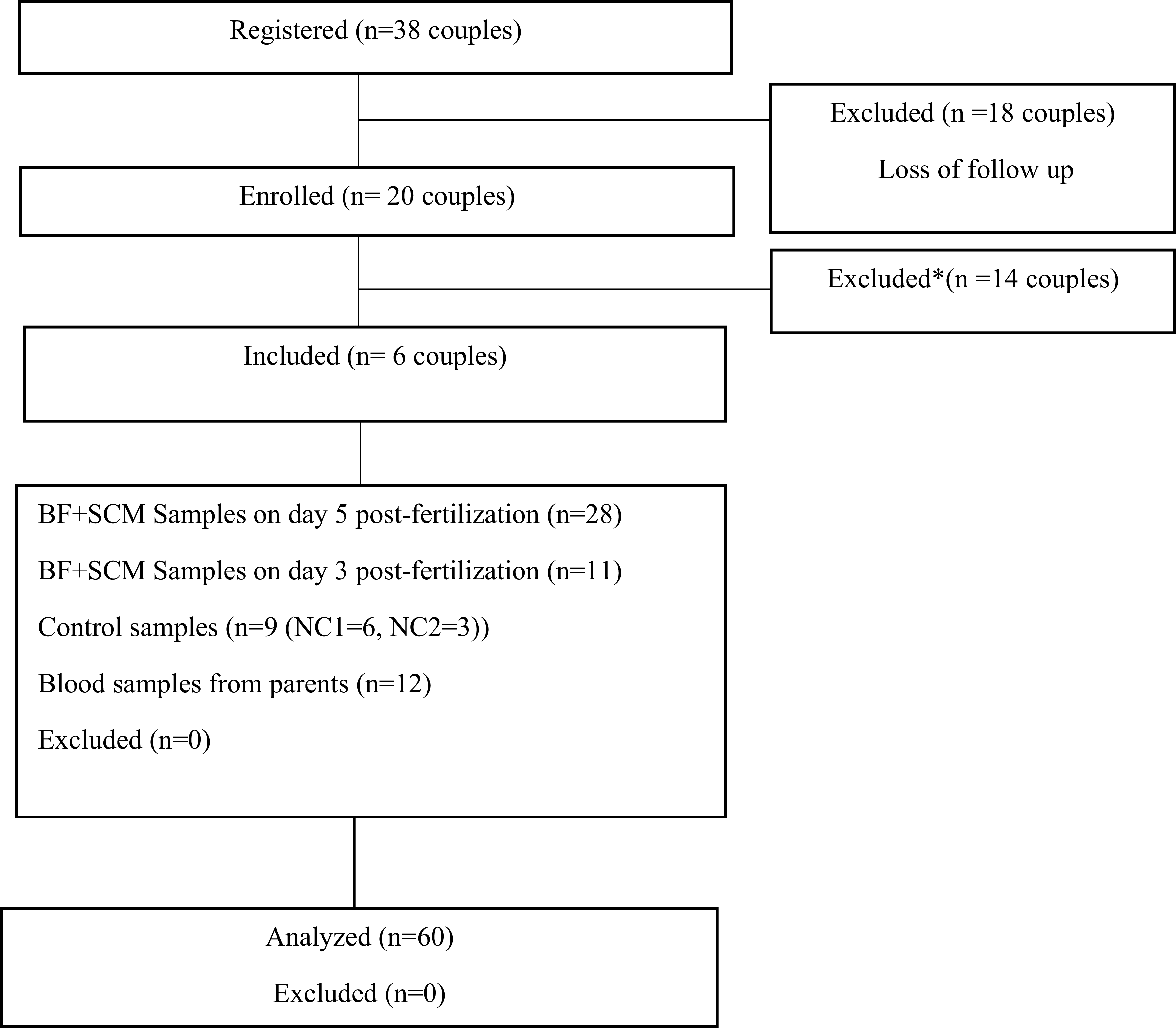
This double-blinded cross-sectional study was performed from June 2020 to February 2021 following the rules on assisted reproduction of the Iran Medical Board. All embryos included in this study were selected from sex selection cycles with blastomere biopsy. This study was approved by the Ethics Committee of Infertility Clinic & Reproductive Biomedicine Research Center, at Royan Institute, Tehran, Iran (Ethics Committee Approval Number: IR.ACECR.ROYAN.REC.1399.041). Written informed consent was obtained from all the participants. After transferring and freezing healthy embryos, the embryo culture medium and blastocoel fluid (BF) were collected for genetic analysis. The fertile and infertile couples without any chromosomal karyotype abnormalities who presented to determine the sex of the embryos prior to implantation to prevent the transmission of sex chromosome-related diseases and family balancing were included in this study (Figure 1). The samples were selected from the patient’s culture medium and BF that was presented for sex selection preimplantation genetic diagnosis (PGD). In total, 39 samples of spent culture medium (SCM) from six couples were collected of which 28 samples were from BF+SCM and 11 samples from SCM alone on days 5 and 3 post-fertilization, respectively. In addition, six medium drops without contact with embryos were kept in parallel under the same conditions as well as three unused culture media (Sage1-Step medium with a serum protein supplement, Origio, Denmark) were used as negative controls 1 and 2, respectively (NC1 and NC2).
Study flowchart. *Fear of giving blood samples on embryo transfer day; or Dissatisfaction with the collection of spent culture medium (SCM) and blastocoel fluid (BF); or Lack of embryos of the desired sex for transfer on the embryo transfer day; or Lack of embryo with proper quality and sufficient number embryo to enter the study; or problems in FISH results such as lack or loss of the nucleus, small or fragmented nucleus and suspicious signals; or Technical problems in testing and numerical sex chromosome abnormality.

Blood sample collection and DNA extraction
Peripheral blood samples (n = 12) from all couples were collected on embryo transfer day. Blood was collected in 3-ml EDTA anticoagulant tubes. The samples were stored at 0–2°C until molecular assay. DNA was extracted from 2 ml of maternal and paternal plasma using the salting-out method (Gaaib et al., Reference Gaaib and Nassief2011) and stored at −20°C for subsequent processing.
Fertilization and embryo culture
Protocols for controlled ovarian stimulation were personalized and depended on each patient’s medical history and gynaecologists’ recommendations. Oocyte maturation was performed using either 6500 IU recombinant human chorionic gonadotropin (hCG) or a bolus of GnRH agonist, depending on the type of protocol used when the dominant follicle reached a diameter of more than 17 mm, as measured using transvaginal ultrasonography. Oocyte pick-up was performed according to ESHRE recommendations for good clinical practice (ESHRE PGT Consortium Steering Committee et al., Reference Carvalho, Coonen, Goossens, Kokkali, Rubio, Meijer-Hoogeveen, Moutou, Vermeulen and De Rycke2020).
After 1 h of retrieval, cumulus cells were removed from oocytes with hyaluronidase (Origio, Denmark). The corona cells were completely removed using a 150-μm stripper to minimize contamination. After denudation, all mature oocytes were given at least 1 h in culture and were then classified according to their level of maturity.
Mature (metaphase II) oocytes were fertilized using intracytoplasmic sperm injection (ICSI). After ICSI, the fertilized oocytes were cultured individually until embryo biopsy on day 3 post-fertilization (PF) in Sage1-Step medium with serum protein supplement (Origio, Denmark) under liquid paraffin (Origio, Denmark), in 25-μl droplets and Cook incubators (Cook Medical) at 37°C in a humidified atmosphere of 5% O2 and 6.5% CO2 balanced with N2. All embryo culture drops were placed in sterile DNase/RNase Free Pipette Tips.
Embryo biopsy and preimplantation sex selection diagnosis
On the morning of day 3 PF, each embryo was re-evaluated for the complete removal of cumulus cells by washing individually three times using a 170-μm pipette (Origio, Denmark) to remove any still attached granulosa cells surrounding the embryos. On day 3 PF, the morphologic scoring of the embryo was done based on ESHRE that investigated the cell number, symmetry, fragmentation, and multinucleation. The embryos were then scored into three groups including the good, fair, and poor (ALPHA Scientists In Reproductive Medicine and ESHRE Special Interest Group Embryology, 2011).
Blastomere biopsy was performed at ∼72 h post-ICSI in regularly developing embryos at the 6- to 8-cell stage according to the Boada protocol in 20 μl of Ca2+- and Mg2+-free medium (Biopsy Media, Origio, Denmark) under liquid paraffin (Boada et al., Reference Boada, Carrera, De La Iglesia, Sandalinas, Barri and Veiga1998).
FISH is a standard operating procedure for embryos intended for sex selection in our laboratory. For blastomere biopsy, the embryos were perforated using an inverted microscope (Nikon, TE300, Japan) equipped with a zona infrared laser optical system (ZILOS; Hamilton-Thorn, Beverg, MA, USA) with a 1.48-mm infrared diode laser beam. One blastomere was gently aspirated with an aspiration pipette (±35 μm outer diameters) and checked for the presence of the nucleus.
The biopsied cells, after 5 min remaining in a hypotonic solution, were transferred onto a slide; using a fixative solution consisting of a 3:1 ration of methanol:acetic acid, the cytoplasm was removed and nucleus spread and fixed. Sex chromosomes were assessed by FISH using X and Y DNA probes (Vysis, Abbott Mol, USA) according to the manufacturer’s instructions.
Blastocyst culture
Following blastomere biopsy, each embryo was washed in four drops of the fresh one-step SAGE medium culture (Origio, Denmark) using separate tips and then the embryo was cultured individually in 25 μl of one-step SAGE culture medium (Origio, Denmark) overlain with liquid paraffin in Cook incubators (Cook Medical) at 37°C in a humidified atmosphere of 5% O2, 6–7% CO2 balanced with N2 until day 5 PF.
Embryo culture medium and blastocoel fluid collection
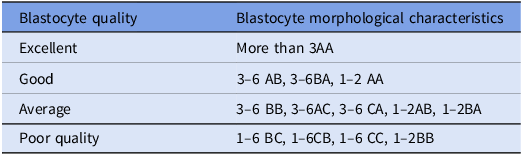
On day 5PF, the quality and development of blastocytes based on the quality of inner cell mass and trophectoderm were determined as previously described by Gardner et al. (Reference Gardner, Lane, Stevens, Schlenker and Schoolcraft2000). The embryos were then scored at four classifications as shown in Table 1 (Timofeeva et al., Reference Timofeeva, Kalinina, Drapkina, Chagovets, Makarova and Sukhikh2019). The SCM + BF was collected from all samples except the transferred embryos. After embryo transfer on day 5 PF, the untransferred embryos that had inclusion criteria were collapsed using a clinical laser (Hamilton, Biosciences, USA) according to the Mukaida method (Darwish and Magdi, Reference Darwish and Magdi2016), and BF was released into the culture medium and mixed with each other. Briefly, to prevent damage to the embryo, it was transferred to another medium droplet using the smallest size of the pipette. To avoid contamination with oil and cross-sample contamination, the oil was collected from the surface of the medium and the pipette tips were changed between each collection of each sample, respectively. Finally, 20 µl SCM and BF from 25 µl culture medium were collected using sterile pipette filter tips and were transferred to 0.2 ml RNase–DNase-free PCR tubes and immediately stored at −80°C for future analysis (Li et al., Reference Li, Song, Yao, Huang, Mao, Huang, Ma, Dong, Huang, Huang, Chen, Qu, Li, Zhong and Gu2018). All procedures were performed in a class II laminar flow hood (Table 1).
Classification of blastocyte quality (Timofeeva et al., Reference Timofeeva, Kalinina, Drapkina, Chagovets, Makarova and Sukhikh2019)

Cell-free DNA chromosomal analysis
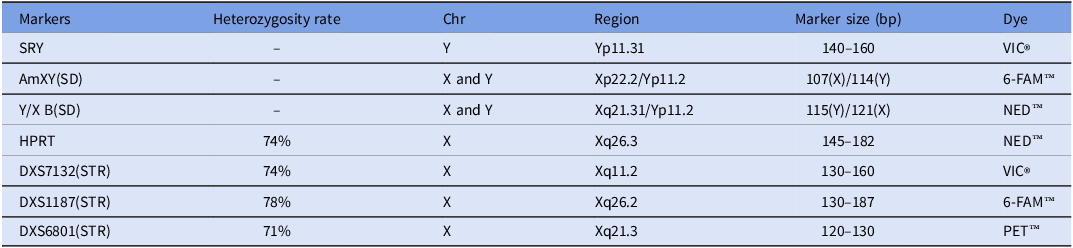
The frozen SCM samples were thawed and gently mixed and processed for NI sex selection assay using multiplexed nested PCR without whole genome amplification (WGA). Two rounds of nested PCR were performed to amplify the Y chromosome primer (SRY), two segmental duplications (SD) markers including XYB and AMXY, also one X-linked polymorphic marker (HPRT) and three STR markers (including DXS7132, DXS1187, and DXS6801) in the both parental gDNA (maternal and paternal plasma samples) and cell-free DNA from BF (day 5) and culture medium (day 3). All primers were designed using Gene Runner software v.3.05 and synthesized and labelled commercially with four fluorescent dyes: 6-FAM™, VIC®, NED™, and PET™. The primers were designed to obtain PCR products less than 200 bp in length. The sequences of these primers are held by Genetek Biopharma company. These markers have been previously described by other researchers (Bahrami Zadegan et al., Reference Bahrami Zadegan, Dabbagh Bagheri, Joudaki, Samiee Aref, Saeidian, Abiri and Zeinali2018). SCM and BF+SCM without WGA were according to the following protocol for inner primers: primary denaturation at 95°C for 5 min followed by 35 cycles of denaturation at 95°C for 1 min, annealing at 62°C for 90 s and extension at 72°C for 2 min, and final extension at 72°C for 15 min, and primary denaturation at 95°C for 5 min as well as the same protocol for outer primers with 30 cycles. PCR products were analyzed on 2% (w/v) agarose gels (KBC) before running on a Genetic Analyzer 3130 XL system (Thermo Fisher Scientific, USA) to check the quality of the PCR products. Each PCR I mix contained 20 μl of BF and culture medium, 49.2 μl of multiplex PCR buffer and outer primers (Kawsar Biotech Co., KBC, Tehran, Iran), and 0.8 μl KBC Taq DNA polymerase. PCR II mix contained 2 μl of PCR I product, 49.4 μl of multiplex PCR buffer and inner primers (Kawsar Biotech Co, KBC, Tehran, Iran) and 0.6 μl KBC Taq DNA polymerase. All runs were interpreted blindly by two operators. All assays that were carried out on CF-DNA from SCM alone and SCM+BF were also performed on the parental gDNA (maternal and paternal plasma samples). Although the design of amplicons with limited size was difficult, here we developed a unique fluorescent multiplex PCR involving one specific Y chromosome primer (SY14 or SRY), two SD markers including XYB and AMXY, and three STR markers including DXS7132, DXS1187, DXS6801, as well as one X-linked polymorphic marker (HPRT). All details of primers are shown in Table 2.
Short tandem repeats (STR) and segmental duplications (SD) markers, regions and the used dyes to label PCR products, and heterozygosity rate (Saberzadeh et al., Reference Saberzadeh, Miri, Tabei, Dianatpour and Fardaei2016)

All STRs were trinucleotide or tetranucleotide repeats to increase the accuracy of diagnosis and reduce the stutter artefacts. The SD markers were DNA sequences that had nearly identical sequences and, as a result of duplication events, exist in multiple locations.
The XYB and AMXY SD markers amplify the locations that are common between the X and Y chromosomes. Therefore, in a normal male, there should be a 1:1 height ratio between the peaks of these markers that show the same number of the X and Y chromosomes. The HPRT is a polymorphic marker with 72% heterozygosity, and maps onto the X chromosome, and accordingly two alleles will be present in normal females, while only one allele will be present in normal males. The DXS7132, XYB, and AMXY markers also are useful for screening for Klinefelter’s syndrome.
The informativity of the STR markers was evaluated according to the gDNA (maternal and paternal plasma samples). The markers were categorized based on their size as full informative (healthy and affected parental alleles are completely different), semi-informative (one of the healthy or affected parental alleles are similar), and non-informative (healthy and affected parental alleles are completely similar to each other).
For the SD markers, the expectation is to have two peaks. Also, for the STR markers, there should be one or two peaks in the range listed in Table 2.
Statistical analysis
Finally, the results of PCR-based sexing of embryos on culture medium were compared with those achieved using FISH. Concordance rates between blastomere biopsy and SCM were calculated for sex determination. Data were analyzed using MedCalc software based on its ability to correctly diagnose male, female, and both genders as specificity sensitivity, positive predictive value (PPV), and negative predictive value (NPV). The concordance rate was measured with Agreement Kappa (AK). Other statistical analysis was carried out using SPSS version 22 (SPSS Inc., Chicago, IL, USA) and McNemar’s and chi-squared tests. A P-value of < 0.05 was considered to be statistically significant.
Results
Six women with the age range 33–40 completed the study.
Electrophoresis
The specific fragments obtained from parental and embryonal samples were successfully amplified; capillary electrophoresis using multiplex PCR for seven markers was carried using the ABI 3130 XL system (Thermo Fisher Scientific, USA). Data were analyzed using Genemapper software (TF).
The results of markers achieved by capillary electrophoresis were evaluated by haplotype drawing for the following reasons: authenticity of a sample, ruling out sample mix-up, and ruling out maternal cell contamination.
Each marker was identified by a different colour and size. The size range of alleles is shown in Table 2. The markers with same size were separated by different colours. The AMXY and YXB markers are located on the X and Y chromosomes. In these markers, the sizes 107 and 121 are related to the X chromosome and the size 114 is related to the Y chromosome. The presence of two and one peaks in males and females, respectively, is mandatory. The HPRT marker has one peak for a normal male and two peaks for a normal female that are located on the X chromosome. The SRY marker has a peak size of ∼150 in males and no peak in females. The DXS1187, DXS6801 and DXS7132 markers were also used to confirm gender. The sample belonged to a woman in which two peaks, of relatively the same size, were seen. As a homozygous woman can show a single peak of the marker, the single peak detected in a sample resulted in no confirmation of male. An embryo with failure for the DXS1187 STR marker is shown in Figure 2.
Capillary electrophoresis using multiplex PCR for seven markers, the name of each marker has been written above the peaks, and size (s) and height (ht) of each marker have been written under the peaks. DXS1187 STR marker in female embryos failed. (A) mother, (B) father, (C) female embryo.

The electrophoresis results from a male embryo with paternal allele dropout (ADO) in AMXY marker and a female embryo with paternal ADO in HPRT, DXS1187, and DXS7132 markers are shown in Figures 3 and 4, respectively. Except for two cases, all ADOs were detected in paternal alleles and are shown in Figure 3.
Capillary electrophoresis using multiplex PCR from a male embryo with paternal allele dropout in AMXY marker. (A) mother, (B) father, (C) male embryo.

Capillary electrophoresis using multiplex PCR result from a female embryo with paternal allele dropout in HPRT, DXS1187, and DXS7132 markers. (A) mother, (B) father, (C) male embryo.

Frequency of ADO and fail rate of the markers in CF-DNA
The highest and lowest frequency of ADO rate in CF-DNA belonged to DXS6801 (27.6%) and DXS7132 (10.3%), respectively. In addition, the highest and lowest failure rate in CF-DNA belonged to DXS6801 (41.4%) and SRY (10.3%), respectively. There was no significant difference between all markers in terms of frequency of ADO and failure rate (P > 0.05). The frequency of ADO and failure rate of all markers in CF-DNA are shown in Table 3.
The frequency of ADO and fail rate of all markers in CF-DNA

P < 0.05.
Frequency of the informativity of markers
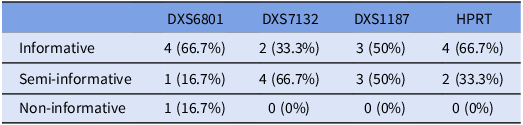
The frequencies of informativity of the STR and HPRT markers were evaluated according to the gDNA (parent plasma samples) and are shown in Table 4. The highest frequency of informative markers belonged to DXS6801 and HPRT, followed by DXS1187 and DXS7132. The highest frequency of semi-informative markers belonged to DXS7132, followed by DXS1187, HPRT, and DXS6801. The frequency of the non-informative marker of DXS6801 was 16.7%. The frequency of non-informativity of other markers was zero.
The frequencies of informativity of the STR and HPRT markers

The number of ADO and fail on days 3 and 5 PF in CF-DNA
The numbers of ADO and failure between all markers on days 3 and 5 PF were compared using the McNemar test and are shown in Table 5. There was no significant difference between all the markers on day 3 PF, compared with day 5 PF in terms of the number of ADO (P > 0.05).
Statistical analysis of ADO and fail number between all markers on days 3 and 5 post-fertilization

* Day 5 PF (d5); Day 3 PF (d3). P < 0.05.
Amongst all markers, only the DXS1187 marker showed a significant difference in the number of failures between days 5 and 3PF (P = 0.016) (Table 5).
Frequency of the embryo’s morphology on days 3 and 5 PF
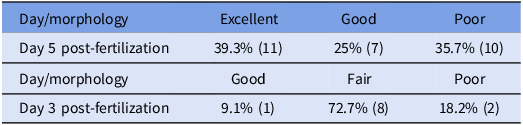
The embryos were scored according to morphology into three groups including good, fair, and poor on days 3 and 5 PF, and the frequency of the results on embryo’s morphology are shown in Table. 6.
Embryo’s morphology scoring

The study data showed that 81.8% of embryos had good and fair quality on day 3 and that 64.3% of embryos showed excellent and good quality on day 5, therefore most embryos participating in this study were of good quality.
Relationship between the morphology of embryos and ADO and failure number in all markers on day 5 PF
The relationship between the morphology of embryos and ADO and the failure number of all markers was investigated using the chi-squared test. No significant relationship between the ADO number of all markers and the morphology of embryos was seen (P > 0.05). A significant difference was seen between the morphology of embryos and failure number (P = 0.017). The relationship between the ADO and failure number in all markers with embryos morphology is presented in Table 7.
The relationship between the ADO and fail number in all markers with embryo’s morphology on day 5 PF

P < 0.05.
Comparison of sex determination rate between CF-DNA and FISH
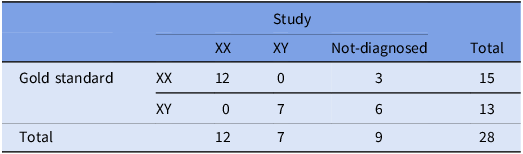
The sex determination rate between CF-DNA isolated from culture medium and FISH was compared with the measurement of AK and is presented in Table 8. The AK value was 0.516, which is moderate (Table 8).
Comparison of sex determination rate between CF-DNA isolated from culture medium and FISH using measurement of Agreement Kappa

MedCalc analysis findings
The ability of CF-DNA to detect the correct diagnosis of male and female embryos showed that all values of specificity, sensitivity, PPV, and NPV were 100%.
Discussion
The present study investigated the sensitivity and specificity of CF-DNA in spent cleavage and blastocyst medium (on days 3 and 5 PF, respectively) as a NI approach versus blastomere DNA obtained from the same human embryo used for sex identification and STR-based fluorescent multiplex PCR for the first time. Mature (metaphase II) oocytes were fertilized using intracytoplasmic sperm injection (ICSI) that is specifically recommended for PGT treatment, to avoid paternal contamination from sperm attached to the zona pellucida, as in conventional IVF (ESHRE PGT Consortium Steering Committee et al., Reference Carvalho, Coonen, Goossens, Kokkali, Rubio, Meijer-Hoogeveen, Moutou, Vermeulen and De Rycke2020). Maternal DNA contamination originating from cumulus cells can also be reduced by careful denudation of the oocytes before ICSI (Wilton et al., Reference Wilton, Thornhill, Traeger-Synodinos, Sermon and Harper2009). It has been shown that genome amplification of human embryos biopsies taken on day 3 PF or single blastomeres and on day 5 PF or trophoblastic cells provided a suitable DNA template for PCR-based methods for genotyping and preimplantation genetic testing (Schaeffer et al., Reference Schaeffer, López-Bayghen, Neumann, Porchia, Camacho, Garrido, Gómez, Camargo and López-Bayghen2017). It has been reported that more than 99% of day-2 and day-3 embryos were found to have DNA in their culture medium that could be appropriate for molecular studies (Feichtinger et al., Reference Feichtinger, Vaccari, Carli, Wallner, Mädel, Figl, Palini and Feichtinger2017).
It has been reported recently that NI preimplantation genetic testing for aneuploidy in the spent medium may be more reliable than that of trophectoderm biopsy (Huang et al., Reference Huang, Bogale, Tang, Lu, Xie and Racowsky2019). Early prenatal sex determination through NI diagnosis using PCR amplification of sex-specific markers is becoming an interest worldwide (Rubio et al., Reference Rubio, Navarro-Sánchez, García-Pascual, Ocali, Cimadomo, Venier, Barroso, Kopcow, Bahçeci, Kulmann, López, De la Fuente, Navarro, Valbuena, Sakkas, Rienzi and Simón2020). An efficient NI approach such as examination of CF-DNA in spent blastocyst medium can offer the benefits of invasive PGT-A without the limitations of embryo manipulation and biopsy for sex determination and fetal aneuploidy screening (Rubio et al., Reference Rubio, Navarro-Sánchez, García-Pascual, Ocali, Cimadomo, Venier, Barroso, Kopcow, Bahçeci, Kulmann, López, De la Fuente, Navarro, Valbuena, Sakkas, Rienzi and Simón2020). We compared the results of medium-based sexing with FISH results. There are other NI approaches for embryo selection such as proteomic technologies and mass spectrometry for chromosomal constitution analysis in preimplantation embryos (Kokkali et al., Reference Kokkali, Vrettou, Traeger-Synodinos, Jones, Cram, Stavrou, Trounson, Kanavakis and Pantos2005). Despite these methods having potential for use for sex determination, they are currently time consuming and expensive (Palini et al., Reference Palini, Galluzzi, De Stefani, Bianchi, Wells, Magnani and Bulletti2013).
The fundamental principle for sex determination was based on the detection of Y-specific markers (SRY) and X-specific markers (DXS6801, DXS7132, DXS1187, and HPRT) as well as common X- and Y-specific markers with different sizes (YXB, and AMXY) using PCR-based genotyping. ADO is a chance phenomenon that occurs in all PCR-based methods, even when a standardized PCR protocol is used. Therefore, it should be detected in all PCR-based methods (Wilton et al., Reference Wilton, Thornhill, Traeger-Synodinos, Sermon and Harper2009). As PCR-based amplification leads to ADO, and bias in particular when starting with small amounts of DNA due to unequal amplification of chromosomal regions and alleles (Karlsson et al., Reference Karlsson, Sahlin, Iwarsson, Westgren, Nordenskjöld and Linnarsson2015), the frequency of ADO rate was also considered in the current study. In the current study, the highest and lowest frequencies of ADO rate were detected in DXS6801 (27.6%) and DXS7132 (10.3%) markers, respectively. ADO is the main inherent pitfall of PCR-based methods that potentially leads to an adverse misdiagnosis. ADO may arise either when the biopsied cell is haploid for the target locus or during PCR amplification, so that PCR primers anneal to one of the two target alleles with lower efficiency. However, the latter can be minimized with optimization of the cell lysis and PCR reaction conditions, especially if PCR amplicon labelling and detection systems with high sensitivity are used (Wilton et al., Reference Wilton, Thornhill, Traeger-Synodinos, Sermon and Harper2009). Finally, in our study, the ADO frequency rate in the biased PCR method to detect CF-DNA markers has been reported to range from 10.3% to 27.6% for DXS7132 and DXS6801 markers, respectively. In addition, we found that the average frequency rate of ADO in blastomere biopsy was 16.72%. This finding indicated that adverse misdiagnosis induced by ADO was low in spent blastocyst medium. Moreover, more ADO belonged to the paternal alleles than the maternal alleles, which may be due to the faster fragmentation of the Y chromosome than the X chromosome, as shown in Figure 4. Chen et al. (Reference Chen, Fu, Shen, Huang and Zhou2019) reported that the average ADO rates were 13.3% in embryos biopsied at the cleavage stage (Chen et al., Reference Chen, Fu, Shen, Huang and Zhou2019). We did not use the WGA for DNA amplification as the ADO rates for WGA plus multiplex PCR at the single-cell level were higher (20–30%) than that of single-cell multiplex PCR (ESHRE PGT Consortium Steering Committee et al., Reference Carvalho, Coonen, Goossens, Kokkali, Rubio, Meijer-Hoogeveen, Moutou, Vermeulen and De Rycke2020). We found no significant difference in the numbers of ADO between all markers on day 3 PF compared with day 5 PF.
Another limitation of low DNA quantity was related to the increased risk of DNA amplification failure (AF) (ESHRE PGT Consortium Steering Committee et al., Reference Carvalho, Coonen, Goossens, Kokkali, Rubio, Meijer-Hoogeveen, Moutou, Vermeulen and De Rycke2020) that was considered in this study. The highest and lowest failure rates were detected in DXS6801 (41.4%) and SRY (10.3%), respectively. In PGT-A tests, BF analysis showed high AF rates (65.2%) and an overall concordance rate of 37.5% among amplified samples (Capalbo et al., Reference Capalbo, Romanelli, Patassini, Poli, Girardi, Giancani, Stoppa, Cimadomo, Ubaldi and Rienzi2018). We found only the DXS1187 marker showed a significant difference in the failure number between days 5 and 3 PF. None of the control samples was amplified.
The recognition of ADO resulted in the development of multiplex PCR protocols using informative, family-specific STRs to further increase the accuracy of the technique and prevent potential misdiagnosis (Hardy, Reference Hardy2020). For informativity/segregation analysis and identification of informative markers, STR or SNP marker genotyping was performed on DNA samples isolated from the parents and related family member(s) as well as to establish that the combination of marker alleles (haplotype) segregates with the pathogenic variant. The informativity of STR markers and their heterozygosity have been previously reported (Hardy, Reference Hardy2020). The frequencies of informativity of the STR and HPRT markers were evaluated according to the gDNA (parent plasma samples). The highest frequency of informative markers belonged to DXS6801 and HPRT, followed by DXS1187 and DXS7132. STR markers are short tandemly repeated DNA sequences, the most common are dinucleotides, which are not only highly polymorphic but also quite abundant in the human genome (ESHRE PGT Consortium Steering Committee et al., Reference Carvalho, Coonen, Goossens, Kokkali, Rubio, Meijer-Hoogeveen, Moutou, Vermeulen and De Rycke2020). As a fully informative STR marker contains the different amplicon sizes for each of the four parental alleles, it allows detection of the problems of contamination, ADO, the determinate of all possible embryo genotypes, and copy number aberrations. A semi-informative STR marker showed that not all genotypes of embryos can be distinguished and has less potential in detecting additional problems. The highest frequency of semi-informative markers in our study belonged to DXS7132. In addition, as the non-informative STR marker cannot distinguish between an unaffected and affected embryo, the frequency of non-informative other markers was zero.
To determine whether the morphologic grade of the embryos may influence the accuracy of CF-DNA, the frequencies of the embryo’s morphology on days 3 and 5 PF were investigated. The obtained data from the frequency of the embryo’s morphology on day 5 PF showed that more than 40% and 25% of embryos had excellent and good morphology, respectively. In contrast, 9.1% and 72.7% of embryos showed good and fair morphology, respectively. Unlike the failure rate, we have found no significant difference between ADO and embryo morphology. The embryos with poor quality showed a higher rate of failure. Poor morphological grade has been shown to be associated with higher DNA shedding and higher accuracy of CF-DNA for aneuploidy screening (Ho et al., Reference Ho, Arrach, Rhodes-Long, Ahmady, Ingles, Chung, Bendikson, Paulson and McGinnis2018). Ho et al. (Reference Ho, Arrach, Rhodes-Long, Ahmady, Ingles, Chung, Bendikson, Paulson and McGinnis2018) found no poor quality embryos yielding CF-DNA on day 3. They also reported that there was no significant difference between good/fair versus poor morphology embryos with the use of days 3 (3/5: 60% vs. 6/11: 54.5%) and 5 CF-DNA (19/28: 67.9% versus 7/12:58.3%). Finally, they suggested that morphology did not influence CF-DNA concentration or accuracy (Ho et al., Reference Ho, Arrach, Rhodes-Long, Ahmady, Ingles, Chung, Bendikson, Paulson and McGinnis2018).
The AK was used to compare the sex determination rate obtained by CF-DNA isolated from culture medium with a FISH assay using X and Y DNA probes that were 0.516 or intermediate (McHugh, Reference McHugh2012). Agreement (Kappa) and closely related measures can be used with great difficulty in quality assurance in clinical trials (Reeve and Gottlieb, Reference Reeve and Gottlieb2020). Various methods such as FISH have been applied for PGT and sex determination, each having their own pros and cons. For example, the FISH technique requires more time and comes with high procedural costs (Munné et al., Reference Munné, Cohen and Simpson2007). Analysis of blastomere biopsy using FISH is a standard operating procedure in our laboratory for embryos intended for sex selection. FISH can be used for social sexing or for detecting X-linked genetic diseases and aneuploidy screening. We reported the ability of CF-DNA to detect the correct diagnosis of males and females with high values of specificity, sensitivity, PPV, and NPV. Based on our knowledge, no study has evaluated the values of specificity, sensitivity, PPV, and NPV for CF-DNA and sex determination based on STR markers. However, it has been recently shown that the CF-DNA in the SCM effectively reflected the chromosomal status of embryos following culture beyond implantation compared with trophectoderm biopsy (Shitara et al., Reference Shitara, Takahashi, Goto, Takahashi, Iwasawa, Onodera, Makino, Miura, Shirasawa, Sato, Kumazawa and Terada2021). Conversely, the concordance rate between NI-PGT-A and PGT-A with outgrowth samples (long-term culture up to day 10) was 56.3% and 43.8%, respectively (Shitara et al., Reference Shitara, Takahashi, Goto, Takahashi, Iwasawa, Onodera, Makino, Miura, Shirasawa, Sato, Kumazawa and Terada2021). They showed that NI-PGT-A exhibited 87.5% specificity, 100% sensitivity, 88.9% PPV, and 100% NPV. Whereas, PGT-A exhibited 77.8% specificity, 87.5% sensitivity, 87.5% PPV, and 75% NPV. They reported that NI-PGT-A may be more accurate than PGT-A in terms of ploidy diagnostic accuracy in outgrowths.
The presence of embryonic CF-DNA in the SCM on day 3 PF, as well as blastocyst medium on day 5 PF, using STR-based multiplex PCR was approximately consistent when using FISH for sex determination. Advances in DNA extraction, amplification techniques, and testing may decrease ADO and failure rate allowing for preimplantation genetic screening as an NI approach without biopsy in the future, either in sex determination or chromosomal abnormality. The disruptive contamination in the detection of embryo profile can be prevented by some procedures such as the use of a separate pipette for each embryo, complete elimination of granulosa cells, culture in separate drops PF, use of ICSI technique, and full observance of protocols concerned in sampling in PGD.
Author contribution
Study conception and design: Poopak Eftekhari-Yazdi, Mehdi Totonchi, Maryam Zare. Data collection: Poopak Eftekhari-Yazdi, Mohammadreza Zamanian, Maryam Zare, Sirous Zeinali. Data analysis and interpretation: Maryam Mohammadi, Maryam Zare, Reza Mohammadi. Drafting of the article: all authors. Critical revision of the article: all authors.
Funding
This study was supported by a research grant from the Faculty of Basic Sciences and Advanced Medical Technologies, Royan Institute (98000064), Iran.
Declaration of interest
The authors report no financial or commercial conflicts of interest.