


Introduction
Interest in the notion of pointless or gratuitous evil stems from its role in the evidential argument from evil:
(1) Gratuitous evils occur.
(2) If God exists then no gratuitous evils occur.
Therefore,
(3) God does not exist.
As an instance of modus tollens, the inference from (1) and (2) to (3) is valid. The argument's soundness therefore hinges on the truth of the premises, and thus on the notion of gratuitous evil. (1) is the evidential premise, giving the argument its name. It is usually claimed by proponents that support for (1) is to be had simply by looking around. When we do, we allegedly find instances of evil, or a distribution of evils, which God would not be justified in permitting. (2) is the theological premise. It is supposed to follow a priori from God's perfect goodness that HeFootnote 1 wouldn't do anything without adequate justifying reasons and so wouldn't permit gratuitous evil.
To a first approximation, then, we can say that gratuitous evils are evils that God would have no adequate justifying reason for permitting. But if we are properly to assess the theist's prospects for rebutting the evidential argument, we need to be more explicit about the conditions under which there would be no adequate God-justifying reasons. What we want, I suggest, is a definition of ‘gratuitous evil’ that makes the theological premise uncontroversial for theists and, subject to that constraint, renders the evidential premise as initially plausible as possible. By securing (2), we force theists to focus their fire on (1). This both simplifies the task of evaluating theistic responses and provides a baseline against which different models of divine providence may be compared.
As we'll see, some models have an easier time of it vis-à-vis the evidential argument. Provided they don't thereby incur unacceptable costs elsewhere, this is a significant selling point in their favour. To render the evidential premise maximally plausible we should define gratuitous evil broadly, so that it applies to as many putative evils as possible, provided that we don't define it in a way that undermines the theological premise. Clearly, we don't want unnecessary restrictions on the class of gratuitous evils. Nor do we want to downplay God's involvement in evils that occur by, for example, speaking of His merely ‘permitting’ them when stronger terms like ‘ordaining’ are admissible. In short, we want to make the explanatory burden on theists as high as their commitments allow, so that we can see as clearly as possible what pressure the evidential argument places on those commitments.
I begin in the next section with sketches of four models of providence: theological determinism, Molinism, open theism, and process theism. I then reflect on theistic strategies for responding to the evidential argument. In the following sections I develop and defend a definition of gratuitous evil intended to render the theological premise acceptable to representatives of all four models. Finally, I consider how proponents of each model might best resist the evidential premise.
Four models of providence
The models of providence I discussFootnote 2 are held by proponents to be versions of theism understood broadly as follows:
(4) Theism=def. There is a unique, personal being (God) who exemplifies a maximal set of compossible great-making properties and upon whom all other concrete beings depend.Footnote 3
Nevertheless, there are fundamental differences between the models, which can be understood in terms of two distinctions. The first concerns the exercise of divine power. Let us say that God acts ‘efficaciously’ in bringing about event E, just in case God is an ultimate sufficient cause of E. And let us say that God acts ‘persuasively’ in bringing about E, just in case God's influence raises the objective probability of E, but not in a way that is causally sufficient for E. In these terms, theological determinists hold that God's activity vis-à-vis creation is always efficacious; process theists, that it is always persuasive; Molinists and open theists, that it is sometimes efficacious and sometimes persuasive.
The second distinction concerns the specificity of divine providence. Let us say that God's providence is ‘meticulous’ just in case God ordains all events. By ‘ordaining’ an event, I mean that God either strongly or weakly actualizes it. To ‘strongly actualize’ an event is to be an ultimate sufficient cause of it. To ‘weakly actualize’ an event is to strongly actualize conditions knowing for certain that they will lead to the event, despite the fact that those conditions are not causally sufficient for it.Footnote 4 In contrast, let us say that God's providence is ‘general’ just in case it is not meticulous, that is, just in case God does not ordain all events. In these terms, theological determinists and Molinists affirm meticulous providence, whereas open and process theists affirm general providence.
Here's a summary table of the above distinctions:
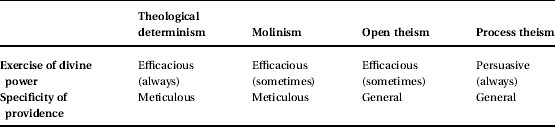
Other relevant differences between the four models follow from the preceding. Thus, since process theists believe that divine power is always persuasive and never efficacious, they deny creation ex nihilo and the occurrence of miracles (understood as efficacious divine interventions in creation over and above God's work of creating and sustaining). The other models, in contrast, allow for both miracles and creation ex nihilo. Similarly, because theological determinists believe that God is the ultimate sufficient cause of all events, they cannot hold that creatures are free in a libertarian sense. In contrast, most proponents of the other models are libertarians. Finally, because open and process theists deny meticulous providence; they believe that there occur events that God has neither strongly nor weakly actualized. God neither caused them to occur nor knew for certain in advance that they were going to occur. The future, we might say, is ‘epistemically open’ for God with respect to future contingents. In contrast, theological determinists and Molinists believe there is a unique and complete sequence of future events that God infallibly knows is going to occur.
We have, then, a spectrum of positions, ranging from theological determinism at one end to process theism at the other. A few additional comments about the intermediate positions, Molinism and open theism, may be helpful.
Molinism raises the question of how God can exercise meticulous providence without being the ultimate sufficient cause of all events. The Molinist's answer lies in God's prevolitional knowledge of all ‘counterfactuals of creaturely freedom’ (CCFs), that is, of what every possible free creature (or abstract creaturely essence – to avoid commitment to concrete possibilia) would freely do in any possible circumstance in which it might find itself. Because this knowledge is prevolitional, God has no control over which CCFs are true. And because it concerns what creatures would freely do, it is contingent. CCFs provide, then, a contingent, a priori constraint on God's providence. God cannot actualize just any possible world containing free creatures. He can only select from among the ‘feasible’ worlds, the ones which are compatible with the set of true CCFs. By virtue of His prevolitional knowledge of CCF's, then, God knows with certainty exactly how the feasible world He selects will turn out without being the ultimate sufficient cause of everything in it.
Open theism raises the question of how God can refrain from exercising meticulous providence if He creates ex nihilo. In so creating, doesn't He thereby actualize a specific possible world? If so, doesn't He know which possible world He's actualizing? These questions, however, assume that possible worlds must include a unique and complete history. On that assumption, open theists would deny that God actualizes any possible world.Footnote 5 Instead, God creates an initial concrete world-state, one with inherent propensities (some non-deterministic) for development into successor world-states. In so doing, God leaves some of the details of future history unspecified. He actualizes, we might say, an actual world type without specifying any token of that type as ‘the’ actual world.Footnote 6 Alternatively, open (and process) theists can argue that nothing in the definition of possible worlds as maximal, internally consistent states of affairs implies that they must include a unique and complete history. Uniqueness follows only if (a) all possible worlds can be fully described in tenseless terms (i.e. if there can be no irreducibly tensed facts).Footnote 7 Completeness follows only if (b) there can't be truth-value gaps and (c) temporally indexed pairs of ‘does’/‘does not’ propositions (e.g. ‘x does obtain at t’, ‘x does not obtain at t’) are contradictories and not contraries – otherwise, both could be false.Footnote 8 These are not safe assumptions in the present context, however, since many openFootnote 9 and process theistsFootnote 10 explicitly reject one or more of them.
The foregoing sketches in place, I return to the evidential argument, beginning with some methodological reflections on possible theistic responses.
Methodological reflections
I undertake below to develop and defend a definition of gratuitous evil designed to render the theological premise (2) of the evidential argument uncontroversial for proponents of all four models. Given (2) and the validity of the argument, theists can only resist it by attacking (1), the claim that gratuitous evils occur. Three strategies are available to this end. First, theists can offer independent arguments for theism to counterbalance (1). The downside of this approach is its failure to say what, if anything, is wrong with (1). This leaves the evidential argument intact as a standing challenge to theism, one that threatens to turn the tide in the atheologian's favour, should the case for theism falter under scrutiny.
Second, theists can offer a rebutting defeater for (1) by giving a comprehensive theodicy, that is, an account that reconciles the evils we witness with the existence of God by explaining how the former cohere with plausible accounts of God's nature, purposes, and involvement in the world, and by explaining how those cohere with objective goodness (hereafter ‘the Good’). To date, many theodicies have been proposed to account for various classes of evils.Footnote 11 It is doubtful, however, whether any of them, even in combination, provides the comprehensive theodicy needed to fully rebut (1). As it stands, then, this type of response is probably not sufficient for the theist's needs.
Third, theists can offer an undercutting defeater for (1). According to this ‘sceptical-theist’ approach, the epistemic distance between us and God means that a truly comprehensive theodicy is too much to expect. No-one should be surprised if there are evils for which we lack plausible God-justifying reasons. As a supplement to theodicy, this is clearly helpful. But if employed as the theist's primary or sole response to (1), sceptical theism raises some concerns. For if it is maintained that theists should only expect to be able to give plausible theodicies for at most very few evils, then sceptical theism may lead to a much more sweeping scepticism about God and the Good than theists ought to be comfortable with.Footnote 12 This last point deserves some elaboration.
Consider the essential components of a theodicy. It is an attempt to reconcile the evils we witness with the existence of God by explaining how: (a) those evils cohere with plausible accounts of God's (b) purposes and (c) involvement in the world, and by explaining how (b) and (c) cohere with (d) the Good. Since sceptical theists doubt the adequacy of our epistemic position for giving a comprehensive theodicy, they must doubt the adequacy of our epistemic position vis-à-vis some of (a)–(d). Which ones?
Well, targeting the adequacy of our understanding of either (a) or (d) seems like a bad idea. Theists shouldn't deny that we can often judge reliably whether something is objectively bad or good, at least when enough of the non-axiological facts are on the table, for that would not only lead to a general moral scepticism but also undermine the theist's ability to say meaningfully that God is good.Footnote 13 A theist's scepticism, then, ought to focus on (b) and (c), where it is more likely to be innocuous. It is not, after all, very surprising that we don't know much about God's purposes or how He is working to fulfil them.
Even so, theists shouldn't entertain complete or near-complete scepticism regarding (b) and (c). For one thing, that would leave them in no position seriously to entertain any theory of divine providence. Further, there's no reason to think we aren't able to make several good guesses about God's overall purposes and methods. Finally, if we aren't sceptics about (a) and (d), then we must suppose that God's purposes and methods cohere for the most part with what we (theists or otherwise) understand of the Good. Hence, theists shouldn't impute purposes or methods to God that strike us on reflection as pretty clearly incompatible with the Good.
The theist's best response to the evidential argument probably consists in a combination of strategies. It makes sense to begin by saying as much as possible by way of theodicy. After all, in the absence of theodicy, every evil is a candidate for ‘gratuitous’ status and so a potential defeater for theism. By offering a plausible theodicy, even one limited in scope, the theist provides a God-justifying reason for some evils and thereby nullifies their force as potential theistic defeaters. Once the prospects for theodicy have been explored it then makes sense for the theist to enter a plea for epistemic modesty concerning the remaining evils, the now prima facie gratuitous ones that have resisted our best efforts to come up with adequate God-justifying reasons. But the theist shouldn't play this ‘sceptic card’ as though it read ‘Get out of jail free’. That is, the theist shouldn't think it allows her to simply shrug off the challenge that prima facie gratuitous evils pose for her theology.Footnote 14 Rather, it merely buys her theoretical breathing room by weakening (not nullifying) the inference from ‘these evils are prima facie gratuitous’ to ‘these evils are gratuitous’.
Relating the above observations to divine providence, I note that theodicies, like models of providence, describe God's involvement in creation. Hence, a theist's model of providence constrains the sorts of theodicies available to her. Moreover, a model may have implications for what sorts of theodicies are needed for rebutting the evidential premise. For example, theological determinists and Molinists believe that God exercises meticulous providence. God, on their view, does not merely permit moral evil; rather, He knowingly actualizes a possible world containing it. Consequently, proponents of those models need there to be justifying reasons, not just for God's permitting moral evil, but for His ordaining it as well. Open and process theists, in contrast, can maintain that moral evil is merely permitted by God. In general, the less a model allows the theist to say by way of theodicy, and the more it requires by way of God-justifying reasons, the more it pushes her to rely on either the counterbalancing or sceptical-theist strategies, each of which has its limitations. I submit, therefore, that some preference should be given models of providence that enlarge the prospects for theodicy and that allow God to play a merely permissive role toward evils. To see how this plays out, we must now define gratuitous evil.
Defining gratuitous evil
In order to assess theistic prospects for responding to the evidential argument, we need a clear definition of gratuitous evil. Above I argued that a good general definition should render the theological premise uncontroversially true and, subject to that constraint, broad enough to render the evidential premise as initially plausible as possible. In this section and the next I will propose and defend such a definition.
Rowe's original definition is a good place to start:
(5) A gratuitous evil=def. An instance of intense suffering which an omnipotent, omniscient being could have prevented without thereby losing some greater good or permitting some evil equally bad or worse.Footnote 15
Unfortunately, (5) doesn't make the theological premise uncontroversially true, as indicated by attempts to argue that it would be OK for God to permit gratuitous evils so defined.Footnote 16 I'll look at those arguments later. Right now, some polishing of (5) is in order.
First, restriction to instances of ‘intense suffering’ is counterproductive if we want the evidential premise to be as plausible as possible. I see no reason to think that a short-lived dull pain couldn't be a gratuitous evil.Footnote 17 Nor do I see any reason to think gratuitous evils must involve suffering. Suppose a delusional psychopath delights in carving up his victims and, believing that pumpkins are persons, carves up several while enjoying their imagined screams. Arguably, there is evil, perhaps even gratuitous evil, in the disordered soul of the psychopath. But there is no obvious suffering. Emphasizing intense suffering may serve a rhetorical purpose, namely, that of focusing attention on the sorts of emotionally heartrending cases often thought to be especially problematic for theists,Footnote 18 but the restriction sets aside a potentially large class of evils which, individually or collectively, might also be problematic for theists, even if not so viscerally disturbing.
Instead of instances of intense suffering, let's simply speak of instances of ‘evil’. How these should be characterized is a delicate question, but I tentatively propose the following:
(6) An evil=def. An event-token which is such that, in relation to the Good, it is objectively better that it not occur, than that it occur.
This is an attempt to capture the idea that the class of evils includes, as Marilyn Adams puts it, ‘all the minuses of life’.Footnote 19 Given plausible assumptions about objective value, it is better not to be in pain than to be in pain, not to be ugly than to be ugly, not to be selfish than to be selfish, and so on. (6) licenses us to call such things ‘evil’. It is important to observe, however, that an evil event may be included in larger event which is, on the whole, not evil. If this weren't so there could be no non-gratuitous evils. For such to be possible, something has to be evil considered in itself, but appropriate, fitting, or justified within a larger context. Being in pain is bad, but there are circumstances in which it is, on balance, better than the alternatives. For example, pain may necessary for developing virtues like courage or for alerting us to dangers that threaten more serious harms.
In addition to replacing ‘instances of intense suffering’ in (5) with ‘instances of evil’, we can simplify the phrase ‘without thereby losing some greater good or permitting some evil equally bad or worse’. First, the last part, ‘or worse’, is redundant. If an evil may be permitted to prevent something worse, then not to permit it is, in effect, to forego a greater good, namely, a world lacking that worse evil. Thus, to forego a greater good is to be left with something overall worse than what one could have had. And to permit something equally bad is to settle for what is overall no better. So the whole phrase boils down to the idea that the evil in question could have been prevented in a way that would have made the world overall better. Hence,
(7) A gratuitous evil=def. An instance of evil which an omnipotent, omniscient being could have prevented in a way that would have made the world overall better.
While an improvement on (5), this doesn't yet give us what we need. There remain loopholes theists might wish to exploit that could make resistance to the evidential argument understood in terms of (7) all too easy. Suppose we think of omniscience as the property of knowing all that can be known.Footnote 20 And suppose God could have prevented a certain evil E by doing A but that there was no antecedently knowable factFootnote 21 that God's preventing E by doing A would make the world overall better. Under those conditions, a theist could admit E as gratuitous on the grounds that while God could have prevented E by doing A, and while such prevention would have made the world overall better, God couldn't have known that His preventing E in that way would make the world overall better and so was not obligated to do A. We close this loophole with:
(8) A gratuitous evil=def. An instance of evil which an omnipotent, omniscient being antecedently knew He could have prevented in a way that would have made the world overall better.
We can now simplify (8) by dropping ‘omnipotent’ and ‘omniscient’ and replacing them with ‘God’, for the relevance of those divine attributes for the evidential argument is unpacked in the phrase ‘antecedently knew that He could have prevented’.
Here's another loophole. It has been argued by some philosophersFootnote 22 that there are no singular propositions about particulars that have not yet existed on account of reference failure. This thesis (sometimes called ‘existentialism’) is controversial but, if it is correct, then there are no propositions about instances of evil for God to know in advance. Given this, it becomes trivially easy to argue against the evidential premise, since (8) is couched in terms of instances. To block this manoeuvre without entering into debate about whether existentialism is correct, we can revise (8) to cover not only tokens of evil but also types. So, to use Rowe's example, even if there was no prior fact about whether the fawn's suffering could have been prevented by God, there could still have been a fact about whether God could have prevented the suffering of a fawn under relevantly similar circumstances.
It may be that still further refinements are needed. Nevertheless, I'm reasonably confident that I've addressed the major issues, and so, to get on with the rest of this paper, I'm going to assume that our job of refinement is completeFootnote 23 and propose, without further ado, the following working definition of ‘gratuitous evil’:
(9) A gratuitous evil=def. A token or type of evil which God antecedently knew He could have prevented in a way that would have made the world overall better.
In the light of (9), the theological premise becomes:
(2*) If God exists then there occur no tokens or types of evil which God antecedently knew He could have prevented in a way that would have made the world overall better.
I submit that (2*) should be uncontroversially true for theists on account of God's perfect goodness. If God can prevent evils (tokens or types) in a way that would make the world overall better, and if God knows He can prevent those evils in such a manner, then it is hard to see what could justify God's permitting them.
If this is right, then it is incumbent upon theists to resist the evidential premise by denying that we have any good reason to affirm
(1*) There occur tokens or types of evil which God antecedently knew He could have prevented in a way that would have made the world overall better.
I noted above, however, that some have argued that theism is compatible with gratuitous evil, so before we examine what different models of providence can say with respect to (1*), we need to check whether (2*) can stand up to challenges.
Defending the definition
It is easy to show that theism is compatible with gratuitous evil if one defines that notion in a ways that are significantly weaker than (9). This is what Peterson does. In a recent discussion, he unwittingly (it seems) replaces Rowe's definition with one in which gratuitous evils are simply instances of suffering which are not necessary for greater goods.Footnote 24 He thereby omits both the requirement of preventability by God as well as the qualification that prevention not result in something equally bad or worse.
One can argue that theism is compatible with gratuitous evils in Peterson's sense via the soul-making theodicy:
Soul-making theodicy: It is good that God creates a world in which creatures are confronted with trying circumstances so that in response they might develop virtues needed for full participation in God's kingdom.
If this is right then, plausibly, the best worlds God could create involve considerable natural evil. It may not matter much which instances of natural evil occur or when they occur, but only that they be varied in kind and widely-distributed. Thus, it may not be necessary for a greater good that lightning strikes and kills this person at this time, yet God may be justified in permitting it because it is necessary for the best sorts of worlds that natural evils of similar magnitude strike some people at some times. That is, an evil may be token gratuitous without its being, in some appropriate classification, type gratuitous.
One can also argue that theism is compatible with gratuitous evils in Peterson's sense via the free-will theodicy:
Free will theodicy: It is good that God creates a world containing free creatures, and it is impossible for God to create such a world and to ensure that creatures never misuse their freedom by sinning.
If this is right, then it may be necessary for the best worlds that sinning be possible even if it is not necessary for the best worlds that any sinning be actual. If so, then it is not necessary for a greater good that any sinning occur. Individually, sins are token gratuitous and, collectively, they are type gratuitous, yet God is justified in permitting sins because not to do so would be inconsistent with realizing a world of the best sort.
But these considerations do not defeat (2*). Granting that God could have prevented all natural evils, it is not clear that He could have done so in a way that would have made the world overall better. Indeed, the point of the soul-making theodicy is that a hedonistic paradise would have been overall worse, or at least not better, than how things are. Similarly, the point of the free-will theodicy is that even if God could have limited creaturely freedom and thereby prevented all moral evil, He could not have done so in a way that would have made the world overall better. Thus, what Peterson takes as reasons for rejecting the theological premise are not reasons for rejecting (2*). Rather, they are reasons for thinking that much natural and moral evil is non-gratuitous on the grounds that there are adequate God-justifying reasons for permitting it.Footnote 25
Another argument for the compatibility of God and gratuitous evil has been offered by Hasker. He contends that the theological premise undermines moral motivation and so should be rejected by theists. Thus, if God prevents all gratuitous evil, then every evil that occurs is either necessary for a greater good or such that the world would be overall worse unless something comparably bad occurs in its stead. But if so, then all successful efforts to prevent evil are counterbalanced by additional evils (or loss of goods) elsewhere. Hence, we can't do anything to make the world overall better.Footnote 26 If we believe this, contends Hasker, it will undermine our moral motivation.Footnote 27 So if God wants us to take the demands of morality seriously, He must not encourage us to think that He prevents all gratuitous evil. Either He must systematically conceal from us the fact that He prevents all gratuitous evil or He must permit some. Hasker rejects the first option on the grounds that it thwarts one of God's most important purposes, which is to ‘bring us to an understanding of his own goodness’.Footnote 28 That leaves the second option. Hence, God must permit gratuitous evils.
While I appreciate Hasker's concerns about the perils of undermining moral motivation, he argument isn't successful against (2*). Distinguish evils that are preventable by God in a way that would make the world overall better from evils that are preventable simpliciter (i.e. by someone or other) in a way that would make the world overall better. Moral motivation requires that it be possible for the latter sort of evils to exist, but it does not require the former. And it is only the former that qualify as gratuitous in terms of (9). Clearly, if God were to prevent all evils that are preventable simpliciter, there would no evils left for us to prevent by which we could improve the overall quality of the world. That would undermine our moral motivation. But if God wants us to take seriously the duties of loving our neighbours and such, then He shouldn't ensure that no harms befall them that aren't necessary for achieving a greater good, or for avoiding a worse or equal evil. Instead, He should leave much of the work of preventing evils to us. In so doing, God teaches us to take the demands of morality seriously. In sum, what Hasker gives us is a useful theodicy:
Moral motivation theodicy: It is good that God places responsibility for the overall welfare of the world in our hands, and it is impossible for God to do this without leaving evils for us to prevent.
Like any theodicy, this can be used to rebut the evidential premise. Nevertheless, it's compatible with (2*).
A final attempt to refute the theological premise comes from van Inwagen. He imagines someone charging God with injustice for not eliminating much of the evil in the world and making do instead with the minimum required for God's plan to succeed.Footnote 29 In response, van Inwagen questions the coherence of the notion of a minimum of non-gratuitous evil:
But if there is no minimum of evil that would have served God's purposes, then one cannot argue that God is unjust or cruel for not ‘getting by with less evil’ – any more than one can argue that a law that fines motorists $25.00 for illegal parking is unjust or cruel owing to the fact that a fine of $24.99 would have had identical deterrent effect. … [I]f, for any amount of evil that would have served God's purposes, slightly less evil would have served His purposes just as well … then the principle that God should have got by with less evil, if less would have served, entails the (ex hypothesi false) conclusion that God should have got by with no evil at all.Footnote 30
In essence, his contention is that if the theological premise is correct then there must be a sharply defined minimum of non-gratuitous evil. Sorites reasoning is then used to argue that there is no such minimum, and it is concluded that the theological premise is false.
The Howard-Snyders have recently endorsed van Inwagen's argument, helpfully elaborating on the inference from the theological premise to there being a minimum of non-gratuitous evil.
Imagine an enormous pool of possible instances of intense suffering each of which God has it within His power to permit or to prevent. Suppose that He must permit some, but not all, in order to secure the goods involved in His purposes. So He must select some from the pool. As He selects, He asks of each one: ‘Do the greater goods require the permission of it or something … comparably bad, given the amount of suffering I'm already permitting?’ If the answer is ‘yes,’ then He puts it on His right; if the answer is ‘no,’ He puts it on his left. When this selection process is complete … on His right will be a set of instances of suffering the collective badness of which is such that God must permit no more or no less in order to secure the goods involved in His purposes.Footnote 31
I contend that this argument is unsound. Either the implications God's attributes have for the permissible amount of evil are vague or they are not. If the latter, then there is a precise minimum of evil God can justifiably permit, but then the sorites argument fails. If the former, then there is no precise minimum, but neither does the theological premise imply otherwise. Here again, an attempt to resist the theological premise is better understood as a challenge to the evidential premise. If the implications God's attributes have for the permissible amount of evil are vague, then there is a range of evils for which not even God can give a definitive answer to the question ‘Would permitting this evil, in addition to the ones I'm already permitting, be gratuitous?’. Moreover, evils that fall into that range don't qualify as gratuitous according to (9), for a gratuitous evil has to be clearly gratuitous from God's own perspective. If God knows He can prevent an evil in a way that would make the world overall better, we are not dealing with an evil the gratuitousness of which God has any uncertainty about. Hence we are not dealing with one of the vague cases. Vagueness in the implications of God's attributes regarding the permissible amount of evil only serves to weaken the force of the evidential premise, not (2*).
I've now looked at three attempts to refute (2*) and found all wanting. In each case, when ‘gratuitous evil’ is understood in terms of (9), the reasons offered for doubting (2*) turn out to be, if anything, reasons for doubting (1*) instead. I take it then that (2*) is secure and that theists should focus on (1*). I now consider the prospects in this regard for the four above-sketched models of providence. Given length considerations, my discussion focuses only on what I take to be the distinctive options and challenges for each of the models.
Models of providence and the evidential argument
Theological determinism
This model affirms that God is the ultimate sufficient cause of all events and that God exercises meticulous providence in virtue of His strongly actualizing a particular possible world, one which includes a unique and complete history. These commitments give theological determinists an especially hard time with (1*), for on their view we would expect God to create either the best of all possible worlds (if there is a unique best), one of the best (if several are equal-best), or (if worlds have no intrinsic maximum) a ‘pretty darn good’ world – one in which the balance of good over evil tilts heavily in favour of the former. Prima facie, however, it doesn't seem plausible that this is such a world given the prevalence of serious moral and natural evils. God, it seems, could have actualized a much better possible world.
In response, theological determinist must resist (1*) and maintain that we have no good reason for believing that God knowingly could have prevented any of the evils we witness in a way that would have made the world overall better. Unlike open and process theists, however, theological determinists can't rebut (1*) by appealing to intrinsic constraints on divine knowledge or power. And unlike free-will theists generally, they cannot even partially deflect responsibility for moral evil away from God. This is widely seen as a significant defect of theological determinism. The popularity of the free-will theodicy, after all, lies in its ability to deflect much of the responsibility for moral evil away from God. But theological determinists can't use that theodicy very effectively. For starters, their model seems to violate what is arguably a necessary condition for creaturely free will in any sense of that term, namely,
An agent S is free with respect to an action A only if A is not an intentional causal consequence of another agent's actions over which S has no influence.Footnote 32
And even if divine determined creatures can somehow have free will and moral responsibility, this does nothing to get God ‘off the hook’ for strongly actualizing moral evil. At most it gets creatures ‘on the hook’ along with God, which merely spreads the responsibility around without diminishing God's role. In light of this point, Helm concedes God's responsibility for moral evil, but denies that it undermines God's goodness since God is not responsible for doing moral evil.Footnote 33 It's not clear, however, that this defence is coherent. Hasker asks:
What can we make of this? God is not responsible for ordering the Holocaust, because God did not order the Holocaust. But God is responsible for Hitler's having ordered the Holocaust, and also for the Holocaust's having occurred, since each of these is the outcome of a deterministic process freely and knowingly set up by God. Just how Helm's answer clears God from the taint of moral evil is nowhere explained by Helm. But in any case, my argument is not that, given Calvinism, God is morally guilty for the world's sins, but rather that, given Calvinism, it is unintelligible to suppose God to be so utterly, implacably opposed to moral evil as the Scriptures represent him as being.Footnote 34
Moreover, it's not clear how, on this model, God can justly hold people responsible for sins when, in a fairly obvious sense, they've been providentially ‘set up’.
Of course, theological determinists don't believe God actualizes evils for their own sakes, but rather for the sake of goods to which those evils contribute. The difficulty is that, for pretty much any goods the theological determinist might propose, it's hard to see why God couldn't have obtained them (or something comparably wonderful) in a way which would have made the world overall better. Consider moral evils. God could have strongly actualized a world without any moral evil. So why didn't He? What goods require moral evils, and on the massive scale that we observe?
One of the few suggestions offered by theological determinists at this point is that moral evil is a felix culpa (a fortunate fault) because it is the necessary occasion for divine atonement and forgiveness.Footnote 35 It's doubtful, however, that this is consistent with divine goodness. Scripture condemns those who ‘do evil that good may result’,Footnote 36 and even though God isn't the one doing evil, one might think that knowingly causing the doing of evil should fall under similar condemnation. Indeed, God's redemptive activity on this theodicy seems like that of an arsonist who starts a building on fire so he can get glory for ‘heroically’ saving those trapped inside.Footnote 37
In response it might be proposed that it's not only God who gains from moral evil; we do so as well. The state of saved sinners, it may be suggested, is much better than the state of those who never sin at all. But to my mind this is quite implausible.Footnote 38 Even if the goods of divine atonement and forgiveness couldn't have been realized in the absence of moral evil, surely other goods, ones at least as impressive (unbroken fellowship with God, love, joy, peace, etc.), would have been available in a world without moral evil. Moreover, it's part of our moral sense that evil, especially horrendous moral evil, is deeply tragic – something preventable that should not have happened. In suggesting otherwise, the felix culpa theodicy objectionably downplays the gravity of moral evil.
Given their limited options for theodicy, we might expect theological determinists to rely heavily on the sceptical response to the evidential argument. But this can't be their primary strategy. The apparent plausibility of (1*) on theological determinism arises not from what we don't know about God and the Good – such that if we only knew more we'd see God as fully justified in ordaining all the evils we witness. It arises rather from what we think we do understand about those things. And what we do understand gives us a strong prima facie reason for thinking that a perfectly good God would not strongly actualize the kind of world theological determinists think He has – a world in which God causes the creaturely doing of moral evil (for whatever reasons). Under these conditions to play the sceptic card in the absence of a persuasive theodicy is to call into question the reliability of our moral intuitions.
Comparatively, then, theological determinism fares poorly in the face of the evidential argument. Given its commitments, it has less resources for theodicy than the other models. Moreover, the available theodicies don't significantly undermine the plausibility of (1*). Nor is the sceptical manoeuvre particularly useful because of theological determinism's clash with our moral intuitions. The evidential argument thus remains a standing defeater for theological determinism, one that, in the eyes of many, is not adequately counterbalanced by positive arguments for the model.
Molinism
Like theological determinists, Molinists affirm meticulous providence, but they deny that God is the ultimate sufficient cause of all events and affirm creaturely libertarian freedom. This puts more options for theodicy at their disposal. They can, for example, use the free-will theodicy to deflect responsibility for moral evil away from God. Nevertheless, Molinism ‘is no boon to the theodicist’.Footnote 39 Because the model has God weakly actualizing a specific feasible world, one with a unique and complete history, it implies that God intends – not for their own sakes, but as part of a ‘complete package’ – all evils that occur. This makes it difficult to rebut (1*), for on Molinism we would expect God to create either the best of all feasible worlds (if there is a unique best), one of the best (if several are equal-best), or (if worlds have no intrinsic maximum) a ‘pretty darn good’ world – one in which the balance of good over evil tilts heavily in favour of the former. Prima facie, however, it doesn't seem that this is such a world given the prevalence of serious moral and natural evils. God, it seems, could have actualized a much better feasible world, perhaps even one in which creatures always freely refrained from moral evil.
Molinists have two lines of response. The first uses theodicies to argue that feasible worlds without large amounts of moral and natural evil are not, ceteris paribus, better than the actual world. For natural evil an obvious candidate is the soul-making theodicy. Unfortunately, the theodicy is not as useful for Molinists as one might expect. The problem is that while some people respond to trials in ways conducive to soul-making, many others are crushed by them. Yet if God has middle knowledge then He knows how each individual would respond to any possible trial. It follows that God frequently allows people to suffer trials knowing they won't respond in ways conducive to soul-making.Footnote 40
As for moral evil, the felix culpa theodicy may be the Molinist's best bet,Footnote 41 but for reasons given above, I doubt it helps much, if at all. It is doubtful, then, that Molinists can deflect the ‘Why didn't God actualize a better feasible world?’ charge with theodicies. They do, however, have another response, namely, that no worlds significantly better overall than the actual world were feasible. Recall that the class of feasible worlds is defined by the set of true CCFs, over which God has no control. True CCFs may fall out in such a way that no ‘pretty darn good’ worlds are feasible for God. On this response the Molinist exonerates God by blaming the CCFs. But this is surely implausible. It requires a colossal stroke of ‘bad luck’ on God's part. There are, presumably, an infinite number of possible free creatures God could have actualized. With so many available, it's surprising that God wouldn't have available a feasible world populated by beings that (nearly) always refrain from moral evil.
What about the sceptical strategy? Molinism raises fewer concerns here than theological determinism because their model doesn't clash as much with our moral intuitions. Molinism doesn't depict God as the ultimate sufficient cause of moral evil, nor does God hold creatures accountable for sins when they had no unconditional power to refrain. Nevertheless, Molinists do have God actualizing creatures knowing they are going to commit heinous sins, and that does raise worries. Instrumental justifications of moral evil are condemned in scripture, and while Molinism doesn't have God doing or causing moral evil for the sake of greater goods that will result, it does have God ordaining moral evil for the sake of greater goods that will result. This renders God a deliberate accessory to moral evil, and one might think that should fall under similar condemnation.
If that's right, then the sceptical strategy can't rescue Molinism from the evidential argument, for what we do understand about God and the Good suggests that He would not have actualized the sort of world Molinists say He has. If so, then in the absence of better theodicies, Molinists lack a convincing rebuttal to (1*) and have to rely on positive arguments for their model to counterbalance the evidential argument.
Open theism
Theological determinists and Molinists have difficulty with the evidential argument largely because of meticulous providence. Open (and process) theists hope to secure comparative advantage by rejecting meticulous providence. On their view, meticulous providence and infallible knowledge of a unique, complete future are incompatible with future contingency, and thus with creaturely libertarian freedom. So if it is good, as the free-will theodicy claims, that there be creatures with moral freedom, then it may also be good that God not exercise meticulous providence, even if He can. Open theists believe God exercises general providence – He sets the parameters but leaves many of the details of history to be filled in by creatures. From the outset, God knew all ways history might unfold, but He did not know exactly how it would unfold because there was no such (knowable) fact. For open theists, therefore, manyFootnote 42 of God's goals for creation must be cultivated without advance guarantee of success. Things may turn out better or worse than God expects, but regardless, God's overall project is a good one, open theists would maintain.
As a result, open theists have definite advantages over theological determinists and Molinists vis-à-vis the evidential argument. First, God neither strongly nor weakly actualizes moral evil; He merely permits it. Hence, open theists don't face the question of why God ordains sin and the suffering it causes. With Peterson, they can say that only the possibility of moral evil is necessary for the best sorts of world, not its actuality. The occurrence of moral evil is, thus, genuinely tragic, and is not part of God's grand design. Second, open theists can utilize the soul-making theodicy to greater effect. Whereas Molinists can only use it for evils that actually have positive soul-making results, open theists can use it whenever the expected value of soul-making results is positive, even if the actual results aren't. Third, open theists have a straightforward rebuttal to (1*): They can say that for many evils there was no (knowable) fact as to whether God's preventing them would have made the world overall better.
The foregoing observations don't, however, put open theists ‘in the clear’ vis-à-vis the evidential argument. Critics may still charge that God permits too much evil. And there's Ivan Karamazov's complaint that some evils aren't worth whatever goods could possibly come of them. Moreover, we can modify (1*) to yield a version of the evidential argument tailored to open theism:
(1*o) There occur tokens or types of evil which God antecedently knew He could have prevented in a way that would probably have made the world overall better.Footnote 43
Even without infallible foreknowledge of future contingents, surely God knows in advance that the occurrence of certain horrendous evils is highly probable. So why doesn't He prevent them? Open theists can offer various theodicies in response, but the status of (1*o) is likely to remain uncertain at best. One wonders how God should balance His chances of making the world overall better (how much better?) against the risks of inadvertently making it worse (how much worse?).
Open theists will therefore probably have to play the sceptic card at some point. They do so, however, with comparatively less risk of promoting general moral scepticism. Theological determinists and Molinists run a greater risk because it is prima facie plausible on those models that a perfectly good God could have and would have actualized a better possible or feasible world, especially one with much less moral evil. Thus, on either model, the prevalence of moral evil calls our ability to assess the implications of divine goodness (and God's goodness itself) into question. What open theists propose, in contrast, is that God has chosen the best means to the best kind of possible world (if there is a unique best), or one of the best means to one of the best kinds of possible worlds (if several are equal-best), or a ‘pretty darn good’ means to a ‘pretty darn good’ kind of world (if ‘best’ is ill-defined in this context). After making due allowance for epistemic modesty regarding God's purposes and methods, it is, I think, not implausible that our world is of the sort one would expect given open theism.Footnote 44 Open theists, therefore, seem to have a defensible position vis-à-vis the evidential argument, one that may not require them to fall back on positive arguments for the model to counterbalance the plausibility of the evidential premise.
Process theism
Many of the foregoing remarks on open theism carry over to process theism since both models advocate general providence, creaturely libertarian freedom, and the incompatibility of infallible foreknowledge with future contingency. I limit my comments, therefore, to issues on which the models differ.
The distinctive commitment of process theism is that God's power over the world process is merely persuasive and never efficacious. More specifically,
… [t]he mode of God's activity is formally the same in each and every event that takes place. God provides the ‘initial aim’ for each momentary ‘occasion of experience’; this initial aim represents, one might say, God's ‘ideal will’ for that particular occasion. But the occasion then exercises its inherent power of self-determination in selecting its ‘subjective aim’; in so doing, it may follow closely the initial aim provided by God but it also may deviate widely from that initial aim.Footnote 45
For process theism, God cannot remove an occasion's ‘inherent power of self-determination’. Consequently, God cannot ensure that anything goes the way He wants. Hence, God cannot, strictly speaking, prevent evils from occurring. He can ‘lure’ occasions toward the good, thereby increasing the objective probability that good results, but He can't raise the probability to one. Thus, if process theists are right about the nature of divine power, then there can't be gratuitous evils as I've defined them, for (9) includes preventability by God as a necessary condition. It follows immediately that (1*) is false. Process theists thus have no need for theodicies or other strategies. The constraint on God's power does all the needed work. No matter what evils one points to, process theists can say that God has done all He can to lure events in the right direction, and so is not accountable for those evils occurring.
The evidential argument is not yet vanquished, however, for with a modification of (1*) we can tailor a version of the argument for process theism:
(1*p) There occur tokens or types of evil which God should have been able been able to avert in a way He antecedently knew would probably have made the world overall better.Footnote 46
With respect to (1*p) process theists face a dilemma: God's persuasive power vis-à-vis the world process is either high or it is not. If it is high, then God's influence should make a big difference in the long run, with God getting His way much more often than not. But then it might be charged that there is far more evil in the world than we should expect given an all-good God with high persuasive power. Process theists will then need to offer theodicies and/or play the sceptic card to explain why we shouldn't expect so much. If, however, God's persuasive power is often low, then we have less reason to expect the long-run distribution of evils in the world to reflect God's influence, but we then have more reason to wonder whether a God with so little influence really qualifies for the divine title. Does such a being really exemplify a maximal set of compossible great-making properties? To the extent that is doubtful, the process model will seem to be an abandonment of theism in the face of the evidential argument.
Conclusion
When ‘gratuitous evil’ is defined as in (9), the theological premise of the evidential argument from evil – the claim that if God exists then no gratuitous evils occur – becomes uncontroversial for theists. Attempts to resist that premise turn out, upon examination, to be disguised challenges to the evidential premise, the claim that gratuitous evils occur.
With the theological premise secured, the evidential premise provides a baseline against which competing models of providence may be compared. Other things equal, models that make it easier for the theist to resist the evidential premise should be preferred. In this respect, I have argued that models that endorse meticulous providence are decidedly worse off than models which endorse general providence. The former cannot fully deflect the prima facie plausibility of the evidential premise merely by combining theodicy and epistemic modesty. Theological determinists and Molinists ultimately need positive arguments for their models to counterbalance the plausibility of the evidential premise. In contrast, open and process theists have little problem resisting the evidential premise as articulated by (1*). And while the evidential argument can reformulated in ways tailored to those models, the corresponding versions of the evidential premise, (1*o) and (1*p), can arguably be adequately deflected by a theodicy/modesty combo.
Of course, how well a model fares against the evidential argument is only one criterion theists must consider. Those who place a premium on certain readings of scripture, continuity with the mainstream theological tradition, or certain philosophical arguments may conclude that the comparative disadvantages of some model vis-à-vis the evidential argument are sufficiently compensated by advantages elsewhere. Still, how well a model holds up against the evidential argument is a relevant and important criterion. Providence has to do with God's management of the world, whereas the evidential argument charges God with mismanagement. Since theists can't let that charge slide, they must come to terms with putative gratuitous evils as best they can.Footnote 47


