



Non-technical Summary
Paleontological data from the late Paleozoic strata of western Yunnan, southwestern China, have played significant roles in understanding the history of the Cimmerian continental blocks and the Paleotethys Ocean. In this paper, we describe and illustrate brachiopod fossils from the early to middle Permian strata of western Yunnan, China. These brachiopods were collected from three beds of the Shanmutang section, and composed of three assemblages, which in ascending order include the Elivina-Etherilosia Assemblage from the top of the Kongshuhe Formation, the Spiriferella-Spiriferellina Assemblage from the base of the Dadongchang Formation, and the Waagenites-Costiferina Assemblage from the lower part of the Dadongchang Formation. The first assemblage is considered to be most likely late Sakmarian to early Artinskian, the second assemblage probably late Artinskian, and the third assemblage late Roadian to early Wordian in age. It is noticed that there is a transition from cool-water brachiopod faunas with Gondwanan affinities to mixed warm-temperate (transitional) faunas with Cathaysian elements during the Artinskian and through the Guadalupian. We consider that this phenomenon probably resulted from the Gondwana deglaciation and the northward drift of the peri-Gondwanan blocks (including the Tengchong Block) during the Cisuralian and Guadalupian.
Introduction
Paleontological data from the late Paleozoic strata of western Yunnan, southwestern China, have played significant roles in understanding the history of the Cimmerian continental blocks and the Paleotethys Ocean (Shi et al., Reference Shi, Fang and Archbold1996; Shen et al., Reference Shen, Shi and Zhu2000, Reference Shen, Shi and Fang2002; Shi and Shen, Reference Shi and Shen2001; Shi et al., Reference Shi, Jin, Huang and Yang2008, Reference Shi, Huang, Jin and Yang2011, Reference Shi, Huang and Jin2017; Huang et al., Reference Huang, Jin, Shi and Yang2009, Reference Huang, Shi and Jin2015, Reference Huang, Jin, Shi, Wang, Zheng and Zong2020). The area west of the Lancangjiang (Mekong) River in Yunnan has been divided into three tectonic units (e.g., Jin, Reference Jin1994, Reference Jin1996), namely, from west to east, the Tengchong Block, the Baoshan Block, and the Changning-Menglian Belt (Fig. 1). The Tengchong and Baoshan blocks are thought to have been derived from Gondwana as components of the eastern segment of the Cimmerian continental blocks (e.g., Sengör, Reference Sengör1984; Ueno, Reference Ueno2003; Huang et al., Reference Huang, Jin, Shi, Wang, Zheng and Zong2020), whereas the Changning-Menglian Belt is considered to be remnants of the Paleotethys (e.g., Liu et al., Reference Liu, Feng and Fang1991; Fang et al., Reference Fang, Feng, Liu, Fang and Feng1996; Metcalfe, Reference Metcalfe2013; Wang et al., Reference Wang, Qian, Cawood, Liu and Feng2018; Zheng et al., Reference Zheng, Jin, Huang, Yan, Wang and Bai2021). Permian marine sequences are well exposed in the Baoshan and Tengchong blocks. Permian brachiopod fossils from the Baoshan Block and their paleobiogeographic aspects have been relatively well studied (Fang, Reference Fang1983, Reference Fang1994; Fang and Fan, Reference Fang and Fan1994; Shi et al., Reference Shi, Fang and Archbold1996; Shen et al., Reference Shen, Shi and Zhu2000, Reference Shen, Shi and Fang2002; Shi and Shen, Reference Shi and Shen2001), whereas those of the Tengchong Block have so far only received limited attention.
(1) Geographic location of the study area in western Yunnan, China, with rectangle indicating (2). (2) Tectonic subdivision of western Yunnan, with section localities indicated. (3) Probable location of the Tengchong Block (Tch in red) in the early Permian (280 Ma); paleogeographic map slightly simplified from Torsvik and Cocks (Reference Torsvik and Cocks2013).

In an article describing the Permian lithostratigraphic succession of Gondwanan affinities in southwest China, Jin et al. (Reference Jin, Huang, Shi and Zhan2011) reported three brachiopod assemblages from the Shanmutang section located in the northern part of the Tengchong Block (Fig. 1.2), and they were named as, in ascending order, the Notospirifer transversa-Elivina yunnanensis Assemblage from the top of the Kongshuhe Formation, the Spiriferella qubuensis-Spiriferellina yunnanensis Assemblage from the base of the Dadongchang Formation, and the Derbyia grandis-Waagenites mediplicata Assemblage from a higher level of the Dadongchang Formation. The ages of these three assemblages were inferred to be the Sakmarian–Artinskian, early Kungurian–early Roadian, and Wordian, respectively. However, no detailed taxonomic description of the brachiopods has been provided.
In this paper, we present the systematic descriptions and illustrations of these brachiopod assemblages. We also refine the ages of the assemblages, based on correlations with coeval brachiopod assemblages from other Cimmerian blocks, as well as ages indicated by associated fusulinids. In addition, the paleogeographic implications of these brachiopod assemblages are addressed for a better understanding of the tectonic evolution of the Tengchong Block (and other Cimmerian blocks) during the Permian.
Stratigraphy
The Carboniferous–Permian successions in the northern Tengchong Block include, in ascending order, the Zizhi, Kongshuhe, and Dadongchang formations (Jin, Reference Jin1994; Fig. 2). The Zizhi Formation consists of >700 m thick monotonous quartz sandstones. The overlying Kongshuhe Formation, 700–900 m thick, consists mainly of diamictites and pebbly mudstones, with relatively minor amounts of dark shales, siltstones, and lenticular limestone beds. The latter lithology (limestone) becomes more evident and common toward the upper part of the formation, especially in its top 100 m where it contains abundant brachiopods, bryozoans, and crinoids (Shi et al., Reference Shi, Jin, Huang and Yang2008; Jin et al., Reference Jin, Huang, Shi and Zhan2011; Figs. 2, 3). The Dadongchang Formation is 600 m thick and mostly composed of limestones and dolomitic limestones. The lower part of this formation (~150 m thick) is composed of limestones and bioclastic limestones, containing fusulinids and brachiopods; the middle part (~50 m thick) is characterized by thin-bedded micritic limestones, yielding brachiopods. Upward, it is overlain by thick-bedded, fusulinid-bearing limestones (~100 m thick). The upper part of the formation (~300 m thick) is dominated by dolomitic limestones (Shi et al., Reference Shi, Jin, Huang and Yang2008; Jin et al., Reference Jin, Huang, Shi and Zhan2011; Fig. 3).
History of the subdivision of Carboniferous-Permian successions in the northern part of the Tengchong Block. A lithological column is presented to help clarify the confusion caused by Geological Survey of Yunnan (1985), who handled the fossiliferous lower part of the carbonate succession as the second member of the Kongshuhe Formation that is otherwise a fining-up clastic succession, for the purpose of giving the Kongshuhe Formation a relatively reliable age. Fang and Fan (Reference Fang and Fan1994) named the carbonate second member of the former Kongshuhe Formation as the Guanyinshan Formation, but its upper boundary with the overlying Dadongchang Formation remained a problem, being hardly determinable in the field. Jin (Reference Jin1994) restored the basic meaning of a formation, i.e., a mappable lithological unit, and thus placed the carbonate succession in the Dadongchang Formation. His plan is followed in this paper. Fm. = Formation.

Stratigraphic column of the upper part of the Kongshuhe Formation and the lower part of the Dadongchang Formation in the northern Tengchong Block (modified from Jin et al., Reference Jin, Huang, Shi and Zhan2011). Data are from the Shanmutang section, except as indicated. Taxonomic lists of fusulinids are based on Shi et al. (Reference Shi, Jin, Huang and Yang2008, Reference Shi, Huang and Jin2017) and Huang et al. (Reference Huang, Jin, Shi, Wang, Zheng and Zong2020). Species not otherwise mentioned in the text are: Chusenella cf. Chusenella minuta Skinner, Reference Skinner1969; Chusenella riagouensis Chen in Zhang, Chen, and Yu, Reference Zhang, Chen and Yu1985; Eoparafusulina aff. Eoparafusulina laudoni (Skinner and Wilde, Reference Skinner and Wilde1966); Eoparafusulina malayensis Igo, Rajah, and Kobayashi, Reference Igo, Rajah and Kobayashi1979; Eoparafusulina tibetica Nie and Song, Reference Nie and Song1983; Eoparafusulina tschernyschewi oblonga (Grozdilova and Lebedeva, Reference Grozdilova and Lebedeva1961); Eoparafusulina tschernyschewi tschernyschewi (Grozdilova and Lebedeva, Reference Grozdilova and Lebedeva1961); Monodiexodina wanneri Schubert, Reference Schubert and Wanner1915; Nankinella cf. Nankinella mingshanensis Sheng and Rui, Reference Sheng and Rui1984; Nankinella orientalis Miklukho-Maklay, Reference Miklukho-Maklay1954. Fm. = Formation.

Brachiopod specimens of this study were collected from three levels of the Shanmutang section: the top of the Kongshuhe Formation, base of the Dadongchang Formation (~5–7 m above the base of this formation), and lower part of the Dadongchang Formation (~120 m above the base of the formation) (Fig. 3). The brachiopod specimens from the Kongshuhe Formation are preserved mainly as molds in mudstones, commonly co-occurring with bryozoans and crinoids. On the other hand, the specimens from the Dadongchang Formation mostly retain their calcareous shells with better preservation conditions than those from the Kongshuhe Formation.
Previous studies on Permian brachiopods from the Tengchong Block
Permian brachiopods have been known from the Kongshuhe and Dadongchang formations (or in their equivalent beds) in the Tengchong Block since the 1980s. Wang (Reference Wang1983) first reported nine genera from the upper part of the Menghong Group (= the upper part of the Kongshuhe Formation). In a subsequent regional geological survey report, the Geological Survey of Yunnan (1985) listed 90 brachiopod species in 47 genera from the Kongshuhe Formation (approximately the Kongshuhe Formation and the lower part of the Dadongchang Formation of this study) (Fig. 2). Then, Nie et al. (Reference Nie, Song, Jiang and Liang1993) also listed some brachiopods from the Tengchong Block. However, all of these reports lacked systematic descriptions and illustrations, and no specimens from the studies are available for reinvestigation.
The first systematic paleontological study with illustrations of Permian brachiopods from the Tengchong Block was given by Fang and Fan (Reference Fang and Fan1994). The taxa described include three indeterminate species (Chonetinella sp. indet., Echinaria sp. indet., and ‘Martinia’ sp. indet.) from the Menghong Group near Lianghe in the southern Tengchong Block (Fang and Fan, Reference Fang and Fan1994), and a much more diverse brachiopod assemblage consisting of 25 species in 16 genera from the Guanyinshan Formation (= the lower part of the Dadongchang Formation) (Fig. 2) in the Dadongchang in the northern Tengchong Block (Fang and Fan, Reference Fang and Fan1994; see also Fang, Reference Fang1995). Fang (Reference Fang1995) noted particular similarities between the Guanyinshan brachiopod assemblage, and the Waagenites-Costiferina Assemblage reported from the Xiaoxinzhai Formation (corresponding to the Yongde Formation) in Gengma of the Baoshan Block by Fang (Reference Fang1983).
Materials and methods
Approximately 120 brachiopod specimens collected from three levels of the Shanmutang section were first mechanically prepared using steel needles, scalpels, chisels, and brushes to get better exposure of the samples, and then examined with a hand lens and microscope. The photographed samples were first coated with smoked ammonium chloride, and then photographed using a Nikon SMZ18 stereo microscope equipped with a Nikon D800 digital SLR camera.
The systematic study adopted here follows classifications proposed by Brunton et al. (Reference Brunton, Lazarev, Grant and Kaesler2000a, Reference Brunton, Lazarev, Grant, Jin and Kaeslerb) for Productida, Williams et al. (Reference Williams, Brunton, Wright and Kaesler2000) for Orthotetida, Savage et al. (Reference Savage, Mancenido, Owen, Carlson, Grant, Dagys, Sun and Kaesler2002) for Rhynchonellida, Alvarez and Rong (Reference Alvarez, Rong and Kaesler2002) for Athyridida, Carter et al. (Reference Carter, Johnson, Gourvennec, Hou and Kaesler2006) for Spiriferida, Carter and Johnson (Reference Carter, Johnson and Kaesler2006) for Spiriferinida, and Lee et al. (Reference Lee, Mackinnon, Smirnova, Baker, Jin, Sun and Kaesler2006) for Terebratulida.
Repositories and institutional abbreviations
All of the described specimens in this study are deposited at the Institute of Geology, Chinese Academy of Geological Sciences, Beijing, China (IGCAGS). Other cited repositories are: NIGP, Nanjing Institute of Geology and Palaeontology, Nanjing, China; USNM, National Museum of Natural History, Washington, D.C.
Brachiopod assemblages: composition, age, and paleobiogeographical implications
The brachiopod specimens described in the present study were originally referred by Jin et al. (Reference Jin, Huang, Shi and Zhan2011, fig. 3), but without description or illustration. Detailed systematic study of these specimens herein undertaken (see Systematic paleontology section below) has allowed us to revise and update their taxonomic identifications and species composition list (Table 1). Consequently, based on this study, as well as taking into account the previously reported taxa from the Tengchong Block (e.g., Fang and Fan, Reference Fang and Fan1994; Fang, Reference Fang1995), we recognize three brachiopod assemblages from the Permian strata in the northern Tengchong Block, in ascending order: the Elivina-Etherilosia Assemblage, the Spiriferella-Spiriferellina Assemblage, and the Waagenites-Costiferina Assemblage.
Taxonomic composition of three Permian brachiopod assemblages in northern Tengchong Block, showing the original species listed by Jin et al. (Reference Jin, Huang, Shi and Zhan2011) and the corresponding emendation in this paper. -= not present; * = new addition; § = we consider that the specimens of Jin et al. (Reference Jin, Huang, Shi and Zhan2011) from the lower part of the Dadongchang Formation can be assigned to the Waagenites-Costiferina Assemblage previously recognized by Fang (Reference Fang1995), and thus we adopt Fang's assemblage name here; R = taxonomic treatment revised. Note that the assemblages are now named after representative genera.

The Elivina-Etherilosia Assemblage
This assemblage occurs in the top of the Kongshuhe Formation at the Shanmutang section (Fig. 3), composed of: three productides—Neochonetes (Sommeriella) cymatilis (Grant, Reference Grant1976), Costatumulus? sp. indet., and Etherilosia sp. indet.; an orthotetide—Orthotetidae gen. indet. sp. indet.; a rhynchonellide—Stenoscismatidae gen. indet. sp. indet.; two athyridides—Cleiothyridina sp. A and Hustedia sp.; six spiriferides—Ambikella? sp. indet., Neospirifer sp. indet., Trigonotreta cf. Trigonotreta semicircularis Shen, Shi, and Zhu, Reference Shen, Shi and Zhu2000, Aperispirifer sp. indet., Elivina yunnanensis Shi, Fang, and Archbold, Reference Shi, Fang and Archbold1996, and Spirelytha sp. indet.; three spiriferinides (Cyrtella? sp. indet., Callispirina ornata (Waagen, Reference Waagen1883), and Spiriferellina? sp. indet.; and a terebratulide—Notothyris? sp. indet. In the assemblage, the spiriferides show the highest generic diversity with six genera, followed by productides and spiriferinides with three genera each (Fig. 4.1). The athyridides are minor, represented by two genera. Both orthotetide and rhynchonellide brachiopods are uncommon, each represented by only a single indeterminate genus. Terebratulides are represented by one genus (Fig. 4.1). Regarding species abundance, spiriferides are the most abundant, followed in turn by productides and spiriferinides (Fig. 4.2).
(1) Faunal compositions of three brachiopod assemblages in the northern Tengchong Block. (2) Diagram showing the number of specimens of each taxon in Ass.1. Naming genera of the assemblage are in bold. A similar diagram is neither drawn for Ass. 2 nor for Ass. 3, because Ass. 2 is represented only by 17 specimens in total, and Ass. 3 comprises our data from the Shanmutang section (22 specimens) and previous data from the Dadongchang section (Fang, Reference Fang1995), and the latter did not provide numbers of specimens. Ass.1 = Elivina-Etherilosia Assemblage; Ass. 2 = Spiriferella-Spiriferellina Assemblage; Ass. 3 = Waagenites-Costiferina Assemblage.

Jin et al. (Reference Jin, Huang, Shi and Zhan2011, p. 379) suggested that the Elivina-Etherilosia Assemblage (equivalent to their Notospirifer transversa-Elivina yunnanensis Assemblage) is late Sakmarian to early Artinskian in age, based on the supposed temporal ranges of the genera Trigonotreta Koenig, Reference Koenig1825, Spirelytha Fredericks, Reference Fredericks1924, and the species Elivina yunnanensis. Although these taxa have been partially revised in this study, this age assignment remains valid and is followed here. It is also supported by the occurrence of Neochonetes (Sommeriella) cymatilis, which was reported from the Ko Yao Noi Formation, southern Thailand of late Sakmarian age (Waterhouse, Reference Waterhouse1981).
The Elivina-Etherilosia Assemblage appears most correlative with the Callytharrella dongshanpoensis Assemblage from the Dingjiazhai Formation of the Baoshan Block (Nie et al., Reference Nie, Song, Jiang and Liang1993; Shen et al., Reference Shen, Shi and Fang2002), evidenced by a number of shared genera in both assemblages including Trigonotreta and Elivina Fredericks, Reference Fredericks1924 (Fig. 5). The Elivina-Etherilosia Assemblage also shows strong affinities with the brachiopod fauna from the Callytharra Formation (late Sakmarian), Western Australia (Archbold, Reference Archbold, Findlay, Unrug, Banks and Veevers1993b, p. 315), with which it shares such genera as Trigonotreta, Elivina, and Spirelytha. The Spinomartinia prolifica Assemblage from the Ko Yao Noi Formation, southern Thailand (Waterhouse, Reference Waterhouse1981) seems to resemble the Elivina-Etherilosia Assemblage: for instance, Neochonetes (Sommeriella) Archbold, Reference Archbold1982 is in common in these assemblages; Costatumulus? sp. indet. in the latter is close to Costatumulus cancriniformis (Chernyshev, Reference Chernyshev1889) in the former; Stenoscismatidae gen. indet. sp. indet. is similar to Stenoscisma quasimutabilis Waterhouse, Reference Waterhouse1981; and Notothyris? sp. indet. resembles the juvenile of Notothyris hexeris Waterhouse, Reference Waterhouse1981. In addition, the Elivina-Etherilosia Assemblage is comparable to the Bandoproductus monticulus-Spirelytha petaliformis Assemblage (named by Xu et al., Reference Xu, Aung, Zhang, Shi, Cai, Than, Ding, Sein and Shen2021) of the Sibumasu Block (of Sakmarian–early Artinskian) in the age, including brachiopod faunas from the Nam Loong No. 1 Mine beds of western Malaysia (Shi and Waterhouse, Reference Shi and Waterhouse1991) and from the Khao Phra Formation, southern Thailand (Shi et al., Reference Shi, Raksaskulwong and Campbell2002). The brachiopod assemblage from the Maubisse Formation near the Bisnain village, western Timor (Archbold and Barkham, Reference Archbold and Barkham1989), also shows some similarity with the Elivina-Etherilosia Assemblage, particularly in that both share the genus Elivina.
Brachiopod assemblages in the northern Tengchong Block and their correlation with other faunas in the Baoshan, Lhasa, and Irrawaddy blocks. Species not otherwise mentioned in the text are: Aulosteges ingens (Hosking, Reference Hosking1931); Bandoproductus monticulus Waterhouse, Reference Waterhouse1982; Bandoproductus qingshuigouensis Shen, Shi, and Zhu, Reference Shen, Shi and Zhu2000; Callytharrella dongshanpoensis Shen, Shi, and Zhu, Reference Shen, Shi and Zhu2000; Comuquia xainzaensis Zhan et al., Reference Zhan, Yao, Ji and Wu2007; Cryptospirifer omeishanensis Huang, Reference Huang1933; Liosotella subcylindrica Jin and Fang, Reference Jin and Fang1985; Marginifera semigratiosa (Reed, Reference Reed1927); Nantanella elegantula Grabau, Reference Grabau1936; Neoplicatifera pusilla Zhan and Wu, Reference Zhan and Wu1982; Pseudoantiquatonia mutabilis Zhan and Wu, Reference Zhan and Wu1982; Punctospirifer afghanus Termier et al., Reference Termier, Termier, de Lapparent and Marin1974; Punctocyrtella australis (Thomas, Reference Thomas1971); Punctocyrtella nagmargensis (Bion, Reference Bion1928); Retimarginifera alata Waterhouse, Reference Waterhouse1981; Spinomartinia prolifica Waterhouse, Reference Waterhouse1981; Stenoscisma gigantea (Diener, Reference Diener1897); Tenuichonetes tengchongensis (Fang, Reference Fang1994); Vediproductus punctatiformis (Chao, Reference Chao1927).

The Spiriferella-Spiriferellina Assemblage
This assemblage occurs in the base of the Dadongchang Formation in the Shanmutang section (Fig. 3), possessing Chonetoidea gen. indet. sp. indet., Schizophoria sp. indet., Cyrolexis sp. indet., Composita sp. indet., Spiriferella sp. indet., and Spiriferellina yunnanensis Fang, Reference Fang1983. In this assemblage, each order contains one genus (Fig. 4.1). Notably, spiriferinides and rhynchonellides are the most abundant in terms of specimens recovered. The Spiriferella-Spiriferellina Assemblage is found to share one genus (Spiriferella Chernyshev, Reference Chernyshev1902) with the Costiferina-Stenoscisma gigantea Assemblage from the Ri'a Formation, Xainza, Tibet (Zhan and Wu, Reference Zhan and Wu1982).
Jin et al. (Reference Jin, Huang, Shi and Zhan2011) inferred a probable early Kungurian–early Roadian age for the Spiriferella-Spiriferellina Assemblage, based on the supposed age of Spiriferella qubuensis Zhang in Zhang and Jin, Reference Zhang (= Chang) and Jin (= ‘Ching’)1976 (synonymized as Spiriferella nepalensis Legrand-Blain, Reference Legrand-Blain1976 by Shen and Jin, Reference Shen and Jin1999, p. 557) and Spiriferella salteri (Chernyshev, Reference Chernyshev1902). However, the present study cannot confirm the occurrences of these two species in the assemblage (see Systematic paleontology section), necessitating a reconsideration of its age. The lower part of the Dadongchang Formation has been known to yield a fusulinid assemblage dominated by Eoparafusulina Coogan, Reference Coogan1960 (Fig. 3), indicative of a late Sakmarian–Artinskian age (Shi et al., Reference Shi, Jin, Huang and Yang2008; Jin et al., Reference Jin, Huang, Shi and Zhan2011; see also Fig. 5), as documented in the Kongshuhe section (~50 km north of the Shanmutang section; see Fig. 1.2). In another section (~4 km east of the Kongshuhe Village), Eoparafusulina also occurs in the lower part of the Dadongchang Formation (Huang et al., Reference Huang, Jin, Shi, Wang, Zheng and Zong2020). Judging from their positions in the basal carbonate bed of the formation, these fusulinid-bearing horizons might be stratigraphically somewhat higher than the bed of the Spiriferella-Spiriferellina Assemblage in the Shanmutang section (Fig. 3). Recently, Xu et al. (Reference Xu, Zhang, Yuan and Shen2022) thought that the Eoparafusulina fauna might come from the upper Kongshuhe Formation, because they guessed that the rock samples containing the Eoparafusulina fauna might represent fallen loose stones from the Kongshuhe Formation. However, this assumption is not supported by our field observations, because not only is the Kongshuhe Formation in a lower position, but also the stratigraphic level of the samples bearing well-preserved Eoparafusulina is characterized by oolitic limestones, purplish bioclastic limestones, and grayish bioclastic limestones, and these lithologies representatively occur only in the lower part of the lower Dadongchang Formation (Huang et al., Reference Huang, Jin, Shi, Wang, Zheng and Zong2020, p. 3). Some notable differences in biofacies between the Shanmutang and the Kongshuhe sections, e.g., the underdevelopment of the above-mentioned oolitic limestones in the Shanmutang area and the better development of a dark gray, thin-bedded limestone member in the Shanmutang area, might indicate that the depositional environments of the two areas are somewhat different. Nevertheless, considering the ages of the underlying Elivina-Etherilosia Assemblage, which was assigned an age of late Sakmarian–early Artinskian, and the overlying Eoparafusulina fusulinid fauna, which has an age of a late Sakmarian–Artinskian, the age of the Spiriferella-Spiriferellina Assemblage is more likely to be late Artinskian.
The Waagenites-Costiferina Assemblage
The Waagenites-Costiferina Fauna was proposed as a representative brachiopod fauna from the Guanyinshan Formation in the Dadongchang by Fang (Reference Fang1995), comprising 25 species in 16 genera. In the present study, we recovered a brachiopod assemblage from the lower part of the Dadongchang Formation in the Shanmutang section, which includes: three productides—Waagenites mediplicata Fang, Reference Fang1983, Waagenites sp. indet., and Linoproductus lineatus (Waagen, Reference Waagen1884); an orthotetide—Derbyia grandis Waagen, Reference Waagen1884; and a rare athyridide—Cleiothyridina sp. B. Except for Linoproductus lineatus, other two named species were also found in the Waagenites-Costiferina fauna previously reported from the Dadongchang section by Fang (Reference Fang1995). Despite the diversity difference between the two sections, all of these brachiopods are regarded as members of the same assemblage, due to the lithologic similarity in the fossil-bearing beds as well as their taxonomic resemblance.
In the Waagenites-Costiferina Assemblage (combining the data of both the Dadongchang and Shanmutang sections; Table 2), productides show the highest generic diversity, followed by orthotetides, athyridides, spiriferides, and spiriferinides, whereas orthides, rhynchonellides, and terebratulides each include only one genus (Fig. 4.1). The Waagenites-Costiferina Assemblage has also been recognized in the Baoshan Block (Fang, Reference Fang1983), sharing 15 species in 10 genera with the Tengchong Block. In Tibet, the Pseudoantiquatonia mutabilis-Neoplicatifera pusilla Assemblage from the Xiala Formation of the Lhasa Block (Zhan and Wu, Reference Zhan and Wu1982) is also comparable with the Waagenites-Costiferina Assemblage, as evidenced by their common genera Chonetinella Ramsbottom, Reference Ramsbottom1952, Waagenites Paeckelmann, Reference Paeckelmann1930, Leptodus Kayser, Reference Kayser and Richthofen1883, Spirigerella Waagen, Reference Waagen1883, and Neospirifer (Quadrospira Archbold, Reference Archbold1997).
Taxonomic composition of the Waagenites-Costiferina Assemblage in northern Tengchong Block. Two species of the Dadongchang section need to be revised concerning their taxonomy (indicated in bold). * = genus absent in the Dadongchang section; S = species shared in the Shanmutang and Dadongchang sections.

Shi and Archbold (Reference Shi and Archbold1995) suggested a Kazanian–Midian age (Roadian–Capitanian) for the Waagenites-Costiferina Assemblage from the Yongde Formation in the Baoshan Block. Later, Shi and Archbold (Reference Shi, Archbold, Hall and Holloway1998) reassigned a Kubergandian age (late Kungurian–early Roadian) for the brachiopod assemblage, according to fusulinids occurring in the Dadongchang Formation in the Tengchong Block. Studies on fusulinids associated with the Waagenites-Costiferina Assemblage in the Shanmutang section also provided its age information; Chusenella mingguangensis Shi et al., Reference Shi, Jin, Huang and Yang2008 and Monodiexodina gigas Shi et al., Reference Shi, Jin, Huang and Yang2008, which occurred on the horizon above the Waagenites-Costiferina Assemblage bed (Fig. 3), indicate a Wordian–Capitanian age (Shi et al., Reference Shi, Jin, Huang and Yang2008). Further upward, another fusulinid-bearing bed dominated by Chusenella Hsu, Reference Hsu1942 and Nankinella Lee, Reference Lee1934 (Fig. 3) was also reported in the same section (Shi et al., Reference Shi, Huang and Jin2017). These two fusulinid faunas have been considered either Roadian–Capitanian or Wordian–Capitanian in age (Shi et al., Reference Shi, Jin, Huang and Yang2008, Reference Shi, Huang and Jin2017; Fig. 5). The age of the Waagenites-Costiferina Assemblage can also be confined by the Eopolydiexodina-bearing strata of Wordian age (Huang et al., Reference Huang, Jin, Shi and Yang2009), which overlies the assemblage bed in the Baoshan Block (see also Shi and Shen, Reference Shi and Shen2001). Therefore, the Waagenites-Costiferina Assemblage is most probably late Roadian–early Wordian in age, but its lower boundary in the Kungurian cannot be excluded.
Paleobiogeographical implications
The Elivina-Etherilosia Assemblage is represented by several typical Gondwanan elements, e.g., Trigonotreta, Aperispirifer Waterhouse, Reference Waterhouse1968, and Elivina (Waterhouse, Reference Waterhouse1964, Reference Waterhouse1968; Shi et al., Reference Shi, Archbold and Zhan1995; Shi and Archbold, Reference Shi, Archbold, Hall and Holloway1998; Li et al., Reference Li, Shi, Yarinpil, He and Shen2012; Xu et al., Reference Xu, Aung, Zhang, Shi, Cai, Than, Ding, Sein and Shen2021). Etherilosia Archbold, Reference Archbold1993a was previously reported from the Cundlego and Callytharra formations, Carnarvon Basin, Western Australia (Prendergast, Reference Prendergast1943; Coleman, Reference Coleman1957; Archbold, Reference Archbold1993a), and can be regarded as a Gondwanan genus. Neochonetes (Sommeriella) occurs in Western Australia and southern Thailand (Grant, Reference Grant1976; Archbold, Reference Archbold1981). Spirelytha and Neospirifer Fredericks, Reference Fredericks1924 are known to be antitropical genera (Shi et al., Reference Shi, Archbold and Zhan1995; Shi and Grunt, Reference Shi and Grunt2000; see also Xu et al., Reference Xu, Aung, Zhang, Shi, Cai, Than, Ding, Sein and Shen2021). Callispirina Cooper and Muir-Wood, Reference Cooper and Muir-Wood1951 occurs mainly in the peri-Gondwanan blocks, including: the middle–late Permian of the Salt Range in Pakistan (Waagen, Reference Waagen1883; Reed, Reference Reed1944), the Ko Noi Formation, southern Thailand (Waterhouse, Reference Waterhouse1981), and the Pija Member of the Senja Formation, Nepal (Waterhouse, Reference Waterhouse1983). No typical Tethyan (warm-water) elements have been detected in the assemblage (Table 3). Thus, the Elivina-Etherilosia Assemblage represents a cool-water fauna with a relatively strong Gondwanan affinity.
The biogeographically significant genera in the three Permian brachiopod assemblages in northern Tengchong Block, combining the data of both the Shanmutang and Dadongchang (Fang, Reference Fang1995) sections.

The Spiriferella-Spiriferellina Assemblage appears to be dominated by genera with wider distributions. Spiriferella is a genus showing an antitropical distribution (Shi et al., Reference Shi, Archbold and Zhan1995; Shi and Grunt, Reference Shi and Grunt2000). Spiriferellina Fredericks, Reference Fredericks1924 is known to be cosmopolitan (Carter and Johnson, Reference Carter, Johnson and Kaesler2006). Cyrolexis Grant, Reference Grant1965 was reported from the lower Productus Limestone of Pakistan, lower Permian of Russia (Grant, Reference Grant1965), and upper Permian of southern China (Xu and Grant, Reference Xu and Grant1994; Shen et al., Reference Shen, He, Zhu and Guo1992). Thus, the Spiriferella-Callispirina Assemblage overall represents a biogeographically mixed fauna.
Shi and Archbold (Reference Shi, Archbold, Hall and Holloway1998) considered that the Waagenites-Costiferina Assemblage from the Tengchong and Baoshan blocks, as reported by Fang (Reference Fang1983, Reference Fang1995) and Fang and Fan (Reference Fang and Fan1994), represents a mixed fauna, containing Gondwanan, Cathaysian, and cosmopolitan genera. Among the 18 genera in this assemblage in the Tengchong Block (see Table 3), Costiferina Muir-Wood and Cooper, Reference Muir-Wood and Cooper1960 is a typical Gondwanan genus (Shi et al., Reference Shi, Archbold and Zhan1995; Shi and Archbold, Reference Shi, Archbold, Hall and Holloway1998), whose occurrence in the assemblage indicates the Gondwanan affinity of the tectonic block (although the genus has not been detected in our collection). Neospirifer (Quadrospira) occurs in Western Australia and in the early–late Permian of the Cimmerian blocks (Archbold, Reference Archbold1997). The existence of three antitropical genera, i.e., Chonetinella, Waagenites, and Wyndhamia Booker, Reference Booker1929 (Shi et al., Reference Shi, Archbold and Zhan1995; Shi and Grunt, Reference Shi and Grunt2000), also supports that there were cool-water components, probably linked to the high-latitude Gondwana Realm. On the other hand, the occurrence of three genera with Cathaysian affinities, i.e., Leptodus, Spirigerella, and Squamularia Gemmellaro, Reference Gemmellaro1899 (Change into (Shi and Archbold, Reference Shi, Archbold and Zhan1995, Reference Shi, Archbold, Hall and Holloway1998; Shi et al., Reference Shi and Archbold1995), explains that the Tengchong Block was also strongly influenced by warm-water currents from the Paleotethys Ocean. Nine genera—Lissochonetes Dunbar and Condra, Reference Dunbar and Condra1932, Linoproductus Chao, Reference Chao1927, Orthotetes Fischer de Waldheim, Reference Fischer de Waldheim1829, Derbyia Waagen, Reference Waagen1884, Orthotichia Hall and Clarke, Reference Hall and Clarke1892, Stenoscisma Conrad, Reference Conrad1839, Cleiothyridina Buckman, Reference Buckman1906, Spiriferellina, and Dielasma King, Reference King1859—are known to be cosmopolitan.
To sum up, during the late Sakmarian–early Artinskian, the northern Tengchong Block was dominated by a cool-water fauna represented by the Elivina-Etherilosia Assemblage, carrying strong similarities to coeval brachiopod faunas from other Cimmerian continental blocks, including the Baoshan Block (Shi and Archbold, Reference Shi, Archbold, Hall and Holloway1998), the Lhasa Block (Zhan et al., Reference Zhan, Yao, Ji and Wu2007), and the Sibumasu Block (Xu et al., Reference Xu, Aung, Zhang, Shi, Cai, Than, Ding, Sein and Shen2021). The brachiopods of the late Artinskian age in northern Tengchong are represented by the Spiriferella-Spiriferellina Assemblage, indicative of a biogeographically mixed fauna. The overlying Waagenites-Costiferina Assemblage of late Roadian–early Wordian age contains more warm-water Cathaysian elements. Thus, it is evident that the brachiopod fauna of the northern Tengchong Block evolved from a cool-water Gondwana-type fauna in the early early Permian to a mixed fauna with warm-water Cathaysia-type species through the late early Permian–middle Permian. Such an unambiguous paleobiogeographic evolutionary pattern of the Tengchong Block through the early–middle Permian is in accord with a similar temporal biogeographic succession of the Irrawaddy Block in eastern Myanmar (Xu et al., Reference Xu, Aung, Zhang, Shi, Cai, Than, Ding, Sein and Shen2021).
The transition of Permian brachiopod assemblages in the northern Tengchong Block, like in the Irrawaddy and Sibuma blocks, has been interpreted as a result of the combined effect of deglaciation and the northward drift of the peri-Gondwanan blocks (Shi and Archbold, Reference Shi, Archbold, Hall and Holloway1998; Shi, Reference Shi2001; Xu et al., Reference Xu, Aung, Zhang, Shi, Cai, Than, Ding, Sein and Shen2021). The deglaciation of Gondwana commenced in the middle Sakmarian (Montañez and Paulsen, Reference Montañez and Paulsen2013), as evidenced by facies changes from glaciogenic diamictites to fine-grained siliciclastics across all peri-Gondwana blocks (Wopfner and Jin, Reference Wopfner and Jin2009). Up sequence, as demonstrated by the Shanmutang section (Fig. 3), siltstones and shales of the Kongshuhe Formation are replaced by limestones bearing increasingly more diverse faunas including brachiopods, corals characterized by mixed Gondwanan and Cathaysian elements, bryzoans dominated by wide-ranging genera and a proportion of Gondwanan or peri-Gondwanan elements (Fang and Fan, Reference Fang and Fan1994; Shi and Archbold, Reference Shi, Archbold, Hall and Holloway1998), crinoids, and fusulinids, and also some oolites (Huang et al., Reference Huang, Jin, Shi, Wang, Zheng and Zong2020), suggesting continued and enhanced warming in the northern Tengchong Block.
Systematic paleontology
The specimens with certain identification are described and discussed below. Other specimens are only figured here, under the names that were tentatively suggested by Jin et al. (Reference Jin, Huang, Shi and Zhan2011, fig. 3), because it is not possible to reveal additional characters for a more accurate identification based on insufficient or not well-preserved materials.
Order Productida Sarytcheva and Sokolskaya, Reference Sarytcheva and Sokolskaya1959
Family Rugosochonetidae Muir-Wood, Reference Muir-Wood1962
Genus Neochonetes Muir-Wood, Reference Muir-Wood1962
Subgenus Neochonetes (Sommeriella) Archbold, Reference Archbold1982
Type species
Chonetes prattii Davidson, Reference Davidson1859, probably from the Sakmarian–early Aktinskian of Western Australia.
Remarks
Neochonetes (Sommeriella) was first proposed by Archbold (Reference Archbold1981) under the name Neochonetes (Sommeria) to define the Neochonetes Muir-Wood, Reference Muir-Wood1962 with a conspicuously developed ventral sulcus, gentle dorsal fold, and hinge spines at ~40–45°. Neochonetes (Sommeriella) differs from Chonetinella mainly in developing distinct growth lines (Archbold, Reference Archbold1981).
Neochonetes (Sommeriella) cymatilis (Grant, Reference Grant1976)
Figure 6.1–6.9
- Reference Grant1976
Chonetinella cymatilis Grant, p. 77, pl. 16, figs. 1–58.
- Reference Waterhouse1981
Chonetinella andamanensis, Waterhouse, p. 65, pl. 2, figs. 18, 19, pl. 3, figs. 1–18.
- Reference Archbold1983a
Neochonetes (Sommeriella)? cymatilis, Archbold, p. 70.
- Reference Wu, He, Zhang, Yang, Xiao, Chen and Weldon2016
Neochonetes (Sommeriella) cymatilis, Wu et al., p. 510.
- Reference Xu, Aung, Zhang, Shi, Cai, Than, Ding, Sein and Shen2021
Chonetinella cymatilis, Xu et al., p. 1169, fig. 6.5–6.9.
Brachiopods from the top part of the Kongshuhe Formation in the northern Tengchong Block. (1–9) Neochonetes (Sommeriella) cymatilis (Grant, Reference Grant1976): (1) 0036, ventral internal mold, IGCAGS 20001; (2) 220708-3-a, ventral valve, IGCAGS 20002; (3) 0218-5-a, ventral internal mold, IGCAGS 20003; (4) 0813-1-a, ventral external mold, IGCAGS 20004; (5) 0806-6-a, dorsal external mold, IGCAGS 20005; (6, 7) 0813-4-a, ventral internal mold and enlargement showing the median myophragm and muscle scars, IGCAGS 20006; (8, 9) 0813-2-a, dorsal internal mold and enlargement showing short median septum and endospines, IGCAGS 20007. (10–24) Etherilosia sp. indet.: (10) 0810-2-a, ventral valve, IGCAGS 20016; (11) 0810-1-a, ventral external mold, IGCAGS 20017; (12) 0811-1-a, ventral external mold, IGCAGS 20018; (13) 0811-10-a, ventral valve, IGCAGS 20019; (14) 0810-6-a, ventral external mold, IGCAGS 20020; (15) 0079, ventral valve, IGCAGS 20021; (16) 0807-3-b, ventral valve, IGCAGS 20022; (17) 0807-4-c, ventral external mold, IGCAGS 20023; (18, 19) 0807-5, two ventral views of a ventral valve, IGCAGS 20024; (20) 0810-3-a, dorsal external mold, IGCAGS 20025; (21) 0811-11-a, dorsal external mold, IGCAGS 20026; (22) 0807-1-d, dorsal external mold, IGCAGS 20027; (23, 24) 0810-4, dorsal internal mold and enlargement showing the bilobed cardinal process, muscle scars, and thin median ridge, IGCAGS 20028. (25, 26) Costatumulus? sp. indet., 0219-4-b, ventral external mold and enlargement showing the ribs and spines, IGCAGS 20035. (27, 28) Orthotetidae gen. et sp. indet., 0210-4-b, dorsal external mold and enlargement showing the costellae, IGCAGS 20114. (29–31) Stenoscismatidae gen. indet. sp. indet.: (29) 0812-4-a, ventral internal cast, IGCAGS 20043; (30) 0811-12-a, ventral internal cast, IGCAGS 20044; (31) 0062, ventral internal cast, IGCAGS 20045. (32) Cleiothyridina sp. A, 0209-3-b, ventral external mold, IGCAGS 20115. (33) Hustedia sp. indet., 0210-5-a, ventral external mold, IGCAGS 20116. Scale bars = 5 mm, unless otherwise labeled.

Holotype
USNM 211993 from the Rat Buri Limestone, Ko Muk, southern Thailand (Grant, Reference Grant1976, pl. 16, figs. 26–30).
Occurrence
Top of the Kongshuhe Formation; Ko Yao Noi Formation, Ko Yao Noi, southern Thailand; Rat Buri Group, Ko Muk, southern Thailand; Taungnyo Group, Zwekabin Range, Myanmar.
Description
Shell small, ~7–9 mm long in most specimens, and 15 mm wide in largest specimen; outline transversely subquadrate; lateral profile concavoconvex; cardinal extremities rounded; ears small and flat.
Ventral valve moderately convex; sulcus prominent, relatively narrow in general, starting from beak and becoming deeper and wider anteriorly (Fig. 6.3), but sometimes much widely developed near beak with swollen umbo (Fig. 6.1). Dorsal valve slightly concave; fold distinctly developed, originating from beak and gradually widening anteriorly (Fig. 6.5). Surface of both valves fully covered by fine costellae; growth lines mostly occurring on anterior part.
Ventral interior with elongate muscle scars bisected by 3.6 mm long median ridge (Fig. 6.7). Dorsal interior strongly endospinose, with cardinal process pit; inner socket ridges long, parallel to hinge; median septum anteriorly elevated; accessory septa lacking (Fig. 6.9).
Materials
Seven specimens including three ventral internal molds (IGCAGS 20001, 20003, 20006); one ventral external mold (IGCAGS 20004); one broken ventral valve (IGCAGS 20002); one dorsal external mold (IGCAGS 20005); one dorsal internal mold (IGCAGS 20007).
Remarks
These specimens are assignable to Neochonetes (Sommeriella) cymatilis based on the similarities in shell size and profile, having a deep ventral sulcus, fine costellae, and growth lines, as well as the low median septum and socket ridges in the dorsal interior, and a median ridge and muscle areas in the ventral interior.
Chonetinella cymatilis Grant, Reference Grant1976 was reassigned to Neochonetes (Sommeriella) in doubt by Archbold (Reference Archbold1983a), but without any explanation. Later, this species was revised as Neochonetes (Sommeriella) cymatilis by Wu et al. (Reference Wu, He, Zhang, Yang, Xiao, Chen and Weldon2016, p. 510).
Chonetinella andamanensis Waterhouse, Reference Waterhouse1981, from the Ko Yao Noi Formation, southern Thailand, was originally supposed to be distinguishable from Neochonetes (Sommeriella) cymatilis in having a less transverse shell outline. However, the morphological difference was regarded as intraspecific variation by Xu et al. (Reference Xu, Aung, Zhang, Shi, Cai, Than, Ding, Sein and Shen2021), which is also followed here.
Chonetinella tengchongensis Fang, Reference Fang1995, from the Guanyinshan Formation, Tengchong, which is probably more attributable to Neochonetes (Sommeriella) in the presence of growth lines, develops a very weak ventral sulcus and, therefore, is clearly distinguished from Neochonetes (Sommeriella) cymatilis. The present specimens resemble Chonetinella unisulcata Chang (Zhang) in Zhang and Jin, Reference Zhang (= Chang) and Jin (= ‘Ching’)1976, reported from the Selong Group (Zhang and Jin, Reference Zhang (= Chang) and Jin (= ‘Ching’)1976) and the Qubuerga Formation (Shen et al., Reference Shen, Shi and Archbold2003) in the Mt. Qomolangma region, southern Tibet, in having a transversely subquadrate outline. However, the former differs in its smaller shell size.
Genus Waagenites Paeckelmann, Reference Paeckelmann1930
Type species
Chonetes grandicostus Waagen, Reference Waagen1884 from upper Productus Limestone in Salt Range, Pakistan.
Remarks
Waagenites resembles the genus Tethyochonetes Chen et al., Reference Chen, Shi, Shen and Archbold2000 in internal structures, however, the latter has finer costae, a transversely rectangular outline, less strongly concavoconvex shells, and less distinct sulcus and fold. Subsequently, Tethyochonetes was treated as a subjective junior synonym of Fusichonetes Liao in Zhao et al., Reference Zhao, Sheng, Yao, Liang, Chen, Rui and Liao1981 by Wu et al. (Reference Wu, He, Zhang, Yang, Xiao, Chen and Weldon2016), who doubted that the differences between the two type specimens represent intraspecific variation.
Waagenites mediplicata Fang, Reference Fang1983
Figure 7.6, 7.7
- Reference Fang1983
Waagenites mediplicata Fang, p. 97, pl. 2, figs. 4–6.
- Reference Fang and Fan1994
Waagenites mediplicata, Fang and Fan, p. 76, pl. 19, figs. 1–3, pl. 29, figs. 1–3.
- Reference Fang1995
Waagenites mediplicata, Fang, p. 137, pl. 3, figs. 1–3.
Brachiopods from the lower part of the Dadongchang Formation in the northern Tengchong Block. (1–5) Waagenites sp. indet.: (1) 0819-1-c, ventral vlave, IGCAGS 20013; (2) 0819-2-a, ventral valve, IGCAGS 20014; (3–5) 0819-3-a, ventral valve and enlargement showing fine capillae, plus costal diagram, IGCAGS 20015. (6, 7) Waagenites mediplicata Fang, Reference Fang1983: (6) 0368, ventral valve, IGCAGS 20008; (7) 0363, slab with Waagenites mediplicata, IGCAGS 20009–20012. (8–17) Derbyia grandis Waagen, Reference Waagen1884: (8, 9) 0533, dorsal valve and enlargement of dorsal valve, IGCAGS 20036; (10, 11) 0546, ventral external mold and enlargement showing the costae increase pattern, IGCAGS 20037; (12, 13) 0554, dorsal valve and enlargement showing the costae increase pattern, IGCAGS 20038; (14) 0121, dorsal valve, IGCAGS 20039; (15) 0563, ventral valve, IGCAGS 20040; (16) 0180, ventral valve, IGCAGS 20041; (17) 0197, ventral valve, IGCAGS 20042. (18) Cleiothyridina sp. B, 0235, ventral valve, IGCAGS 20117. Scale bars = 5 mm.
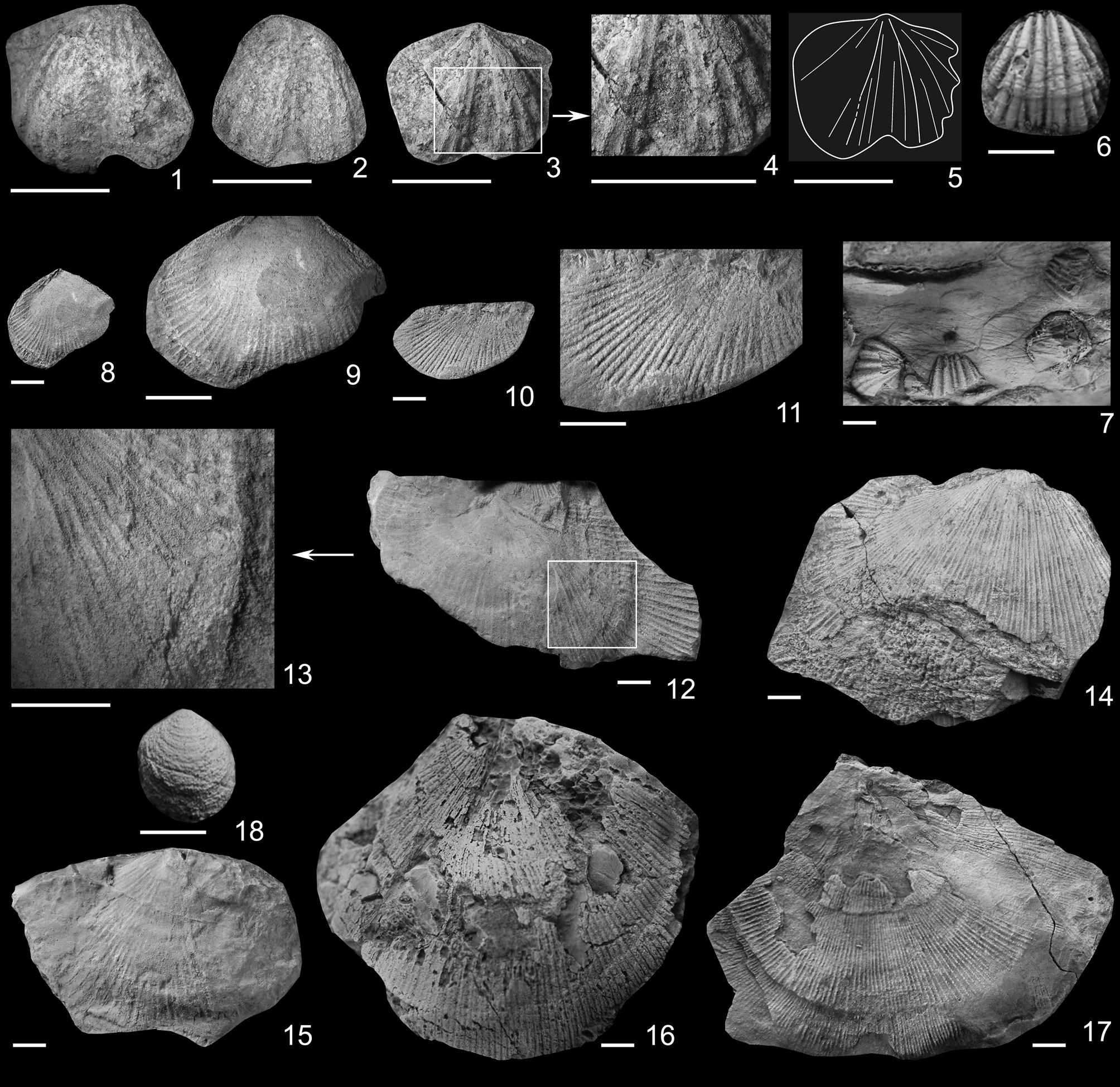
Holotype
Specimen 81112 from the Yongde Formation, Xiaoxinzhai section, Gengma, southwestern Yunnan, China (Fang, Reference Fang1983, pl. 2, fig. 4a–e). The specimen is deposited at Yunnan Institute of Geological Sciences.
Occurrence
Lower part of the Dadongchang Formation; Yongde Formation, Gengma, China; Guanyinshan Formation, Tengchong, China.
Description
Shell small, ~9 mm wide in largest specimen; outline quadrate, with maximum width at hinge line. Ventral sulcus broad, containing thin, low median costa and two lateral costae. Each flank of ventral valve relatively steep, with three primary costae. Costae strong and rounded in general, and those adjacent to sulcus bifurcating two or three times on anterior part (Fig. 7.6); growth lines irregularly spaced.
Materials
Five ventral valves (IGCAGS 20008–20012).
Remarks
Six species of Waagenites have been reported so far from Yunnan (Fang, Reference Fang1983, Reference Fang1995; Fang and Fan, Reference Fang and Fan1994), among which, Waagenites fasciata Fang, Reference Fang1983 and Waagenites gengmaensis Fang, Reference Fang1983 are from the Yongde Formation, Gengma of southwestern Yunnan; Waagenites guanyinshanensis Fang, Reference Fang1995 from the Guanyinshan Formation, Tengchong; and Waagenites yunnanensis Fang, Reference Fang1983, Waagenites mediplicata, and Waagenites simplex Fang, Reference Fang1983 from the Yongde and Guanyinshan formations. All of these species are small in shell size, with a quadrate outline and coarse costae. They can be further subdivided into two groups: one is with fasciculate costae, especially adjacent to the sulcus, including the species Waagenites yunnanensis, Waagenites mediplicata, Waagenites fasciata, and Waagenites guanyinshanensis; and the other is with simple costae, including the species Waagenites simplex and Waagenites gengmaensis. Later, Waagenites yunnanensis from the Xiaoxinzhai Formation, was also illustrated and described by Chen et al. (Reference Chen, Shi, Shen and Archbold2000, p. 5, figs. 2D, E, 3).
The present specimens are most similar to Waagenites mediplicata, one of the three Waagenites species occurring in both the Yongde and Guanyinshan formations, in having a quadrate shell outline, the sulcal plications, and distinct bifurcating costae on and near the ventral sulcus.
Waagenites sp. indet.
Figure 7.1–7.5
Occurrence
Lower part of the Dadongchang Formation.
Description
Shell small, ~10 mm wide in largest valve; outline subquadrate, with length/width ratio ~1.12. Ventral valve moderately convex; ventral sulcus deep, originating from beak, generally bearing two pairs of costae (Fig. 7.5); each ventral flank ornamented in general with three coarse costae; micro-ornament composed of fine capillae (Fig. 7.4).
Materials
Three ventral valves, with abrasion to some degree (IGCAGS 20013–20015).
Remarks
These specimens are characterized by the quadrate outline, deep sulcus, and coarse costae, which suggests their assignment to the genus Waagenites. It is worth noting that the sulcus of the present specimens is not as deep as that in the type species Waagenites grandicosta (Waagen, Reference Waagen1884). However, Waagenites also includes species with a moderately developed sulcus, e.g., Waagenites dichotoma (Waagen, Reference Waagen1884), Waagenites squamulifera (Waagen, Reference Waagen1884), Waagenites deplanata (Waagen, Reference Waagen1884), and Waagenites aequicosta (Waagen, Reference Waagen1884), all from the Productus Limestone (Waagen, Reference Waagen1884, pls. 60, 61). Hence, the varieties of development of the sulcus probably represents interspecific variation within Waagenites, whereas the quadrate shell outline and coarse costae could be more important to identify the genus.
The present specimens are not matched with the Waagenites species previously reported from the Tengchong Block. They differ from Waagenites mediplicata co-occurring in the Dadongchang Formation in the lack of a median costa on the ventral sulcus. These specimens are also distinguished from Waagenites yunnanensis both from the Yongde and Guanyinshan formations in having a slightly convex valve.
The present specimens are more similar to Waagenites dichotoma (see Waagen, Reference Waagen1884, p. 633, pl. 61, fig. 4) from the middle Productus Limestone in Salt Range, Pakistan, in a sulcus that is deepest and widest anteriorly, the bundle costae adjacent to the sulcus, and weak convexity of ventral valve, but our specimens differ in fewer costae on the sulcus and lateral flanks.
Waagenites speciosus Waterhouse and Piyasin, Reference Waterhouse and Piyasin1970 from limestones at Khao Phrik in southern Thailand, later assigned to Waterhouseiella Archbold, Reference Archbold1983a by Archbold (Reference Archbold1983a), is comparable in the weak convexity of the ventral valve; however, the Thai species is more transverse in outline, having more and finer costae (see also Grant, Reference Grant1976, p. 81, pl. 17, fig. 21).
Family Linoproductidae Stehli, Reference Stehli1954
Genus Linoproductus Chao, Reference Chao1927
Type species
Productus cora d'Orbigny, Reference d'Orbigny1842 from the lower Permian of Bolivia.
Remarks
Linoproductus is similar to the genera Coolkilella Archbold, Reference Archbold1993a and Kasetia Waterhouse, Reference Waterhouse1981 in having fine costae and lacking dorsal spines. However, these genera can be easily differentiated: Linoprodutus is medium to large, having a gently concave dorsal corpus and a posteriorly inflated ventral profile. Coolkilella has a dorsal valve showing a flat or very gently concave visceral disc and strong geniculation anteriorly. Kasetia is small and has concentric narrow rugae.
Linoproductus lineatus (Waagen, Reference Waagen1884)
Figure 8
- Reference Waagen1884
Productus lineatus Waagen, p. 673, pl. 66, figs. 1, 2, pl. 67, fig. 3.
- Reference Diener1897
Productus lineatus, Diener, p. 14, pl. 4, figs. 2–5.
- Reference Chao1927
Linoproductus lineatus, Chao, p. 129, pl. 15, figs. 27, 28.
- Reference Wang, Jin and Fang1964
Linoproductus lineatus, Wang et al., p. 323, pl. 52, figs. 18, 19.
- Reference Feng and Jiang1978
Linoproductus lineatus, Feng and Jiang, p. 260, pl. 92, fig. 4a–c.
- Reference Tong1978
Linoproductus lineatus, Tong, p. 231, pl. 81, fig. 7a, b.
- Reference Yang, Feng, Xu, Lin and Yang1984
Linoproductus lineatus, Yang, p. 222, pl. 34, fig. 14.
- Reference Zeng, He and Zhu1996
Linoproductus lineatus, Zeng et al., pl. 6, fig. 12a–c.
- Reference Chen and Shi2000
Linoproductus lineatus, Chen and Shi, p. 551, fig. 4.20.
- Reference Shi and Shen2001
Linoproductus lineatus, Shi and Shen, p. 248, pl. 1, figs. 5, 6.
Brachiopods from the lower part of the Dadongchang Formation in the northern Tengchong Block. (1–18) Linoproductus lineatus (Waagen, Reference Waagen1884): (1–4) 0582, ventral, ventral, posterior, and lateral views, respectively, of ventral valve, IGCAGS 20029; (5) 0565, ventral valve, IGCAGS 20030; (6, 7) 0614, two ventral views of ventral valve, IGCAGS 20031; (8–10) 0646, ventral, lateral (white arrow = a spine base), and posterior views, respectively, of ventral valve, IGCAGS 20032; (11–15) 0726, ventral, dorsal, lateral, ventral, and posterior views, respectively, of a conjoined shell, IGCAGS 20033; (16–18) 0113, three ventral views of ventral valve, IGCAGS 20034.
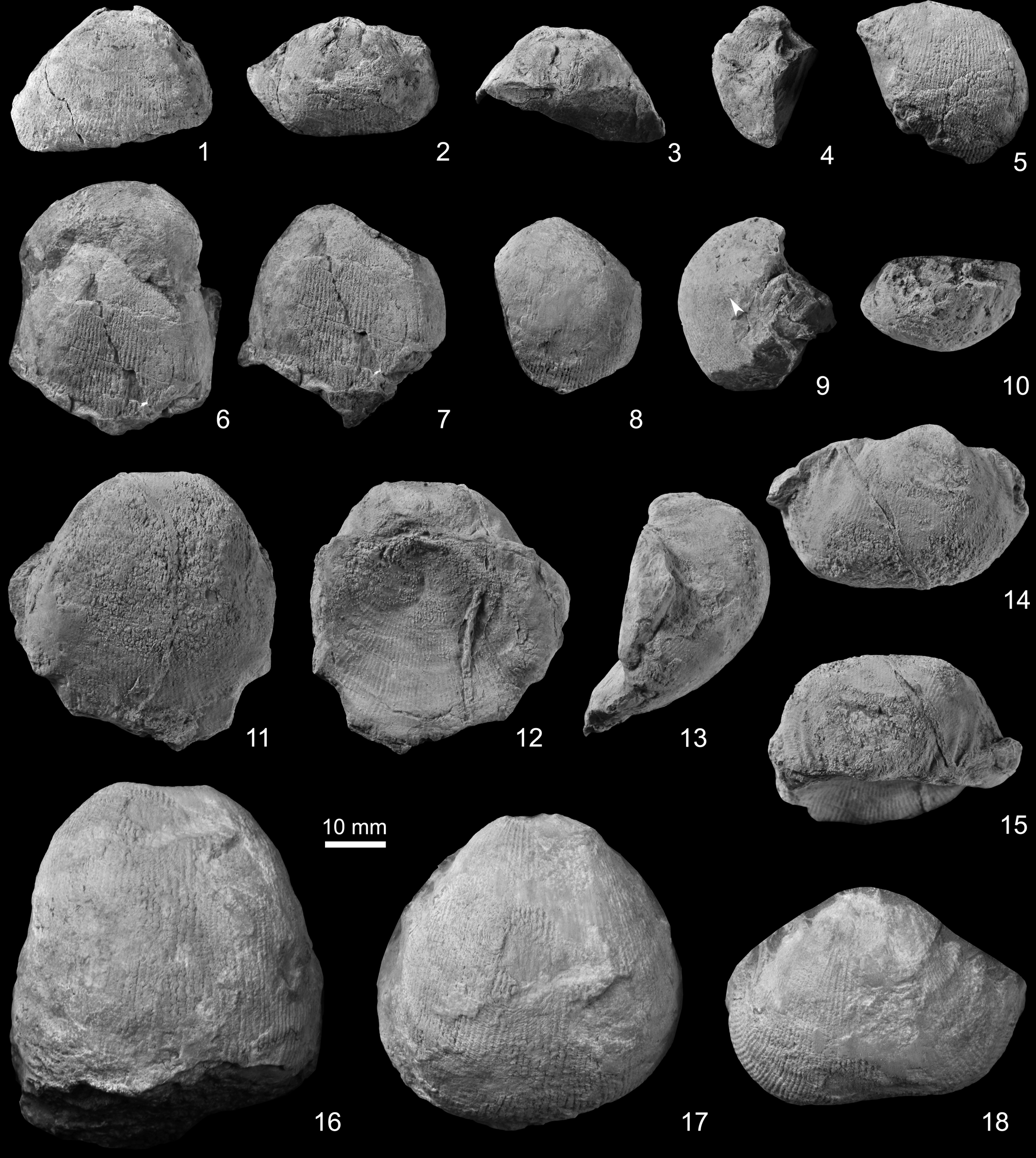
Holotype
Several specimens (but without formal specimen number) from the Productus Limestone, Salt Range, Pakistan (Waagen, Reference Waagen1884, pl. 66, figs. 1, 2, pl. 67, fig. 3).
Occurrence
Lower part of the Dadongchang Formation; Wargal Formation of the Salt Range, Pakistan, northwestern Himalaya; Maokou Formation or equivalents of South China; Shazipo Formation, Baoshan, China.
Description
Shell large, with width of 50 mm in the largest valve, elongate subrectangular in outline; cardinal extremities rounded. Ventral valve moderately convex but inflated on posterior part; lateral slopes sharply inclined; sulcus absent. Dorsal valve slightly concave, without median fold.
Shell surface covered by numerous costae; costae fine, separated by narrower interspaces, approximately eight costae per 10 mm at anterior part; concentric rugae (or wrinkles) on ventral ears, ventral flanks (Fig. 8.15), and dorsal corpus (Fig. 8.12); spine bases rarely remaining on ventral valve but fully absent on dorsal valve.
Materials
Six specimens, including five ventral valves (IGCAGS 20029–20032, 20034) and one conjoined shell (IGCAGS 20033).
Remarks
The present specimens are similar to Linoproductus lineatus from the Wargal Formation of the Salt Range, Pakistan (Waagen, Reference Waagen1884) in the shell outline and sparse ventral spines on the ventral valve.
Several different views have been expressed regarding the differences between Linoproductus lineatus and Linoproductus cora (d'Orbigny, Reference d'Orbigny1842). First, Waagen (Reference Waagen1884) stated that Linoproductus cora develops no sulcus on the ventral valve, whereas Linoproductus lineatus has a distinct broad impression on the median part of the ventral vale. Then, Diener (Reference Diener1897) reported that the majority of Linoproductus lineatus from the Himalayan also develop the ventral median sulcus, which is not distinctly marked. However, Chao (Reference Chao1927) more strongly emphasized the different shell shapes of Linoproductus lineatus and Linoproductus cora: Linoproductus lineatus from the Permian Productus Limestone is more rectangular with the sides nearly parallel (Chao, Reference Chao1927, p.131), whereas Linoproductus cora from Bolivia is essentially triangular with the sides of the umbonal region diverging. Later, Wang et al. (Reference Wang, Jin and Fang1964) followed this opinion, and mentioned that Linoproductus lineatus is commonly rectangular in outline, whereas Linoproductus cora shows a triangular to oval outline with more ventral spines. In addition, Linoproductus lineatus is generally characterized by a relatively small shell and weakly defined rugae across the visceral discs (Shi and Shen, Reference Shi and Shen2001). In summary, the shell shape and spine number on the ventral valve appear to have a high discriminating value to distinguish Linoproductus lineatus and Linoproductus cora, which is followed here.
The present specimens differ from Linoproductus tingriensis Ching (= Jin) in Zhang and Jin, Reference Zhang (= Chang) and Jin (= ‘Ching’)1976 from the Qubuerga Formation, southern Tibet (Zhang and Jin, Reference Zhang (= Chang) and Jin (= ‘Ching’)1976, pl. 7, figs. 11–13, pl. 9, figs. 3–5) in being larger with fewer spines on the ventral valve.
Family Monticuliferidae Muir-Wood and Cooper, Reference Muir-Wood and Cooper1960
Genus Costatumulus Waterhouse in Waterhouse and Briggs, Reference Waterhouse and Briggs1986
Type species
Auriculispina tumidus Waterhouse in Waterhouse et al., Reference Waterhouse, Briggs, Parfrey and Foster1983 from the lower Permian Tiverton Formation, Queensland, Australia.
Remarks
The major differences between Cancrinella Fredericks, Reference Fredericks1928 and Costatumulus lie in that the former develops dorsal spines (Archbold, Reference Archbold1993a), whereas the latter lacks spines but bears dimples or pits on the dorsal valve (He et al., Reference He, Shen, Feng and Gu2005, Reference He, Shi, Zhang, Yang, Shen and Zhang2019; Li et al., Reference Li, Shi, Yarinpil, He and Shen2012; Shen et al., Reference Shen, Sun, Zhang and Yuan2016). In addition, Costatumulus has a gently convex ventral valve, with the corpus cavity becoming moderate until the adult stage, and developed rugae. On the other hand, Cancrinella has a deep corpus cavity (Brunton et al., Reference Brunton, Lazarev, Grant, Jin and Kaesler2000b, p. 533–538).
Costatumulus? sp. indet.
Figure 6.25, 6.26
Occurrence
Top of the Kongshuhe Formation.
Description
Ventral external surface covered with costae, spines, and wrinkles; costae fine and dense, numbering seven in 3 mm at the anterior part of valve; spines arranged in quincunx, having elongate swollen bases; wrinkles strongly developed but discontinuous.
Materials
One incomplete specimen (ventral external mold; IGCAGS 20035).
Remarks
The present specimen is similar to both Cancrinella and Costatumulus in the shell ornaments including fine and dense costae, wrinkles, and prominent spines arranged in quincunx. Due to the lack of dorsal valves, it is hard to determinate whether our specimen develops dorsal spines or not, which is regarded as the major differences between Cancrinella and Costatumulus. Thus, the present specimen is tentatively assigned to Costatumulus in doubt, based on the relatively weak convexity of the ventral valve.
The specimens previously assigned to Cancrinella cancriniformis (Chernyshev, Reference Chernyshev1889) from the Ko Yao Noi Formation, southern Thailand (Waterhouse, Reference Waterhouse1981, pl. 18, fig. 4) were reassigned to Costatumulus due to lacking dorsal spines (Li et al., Reference Li, Shi, Yarinpil, He and Shen2012, p. 300). The present specimen is close to these Thailand specimens in its fine and dense costae, ventral spines, and wrinkles. Our specimen resembles Costatumulus irwensis (Archbold, Reference Archbold1983b) and Costatumulus occidentalis Archbold, Reference Archbold1993a from the late Sakmarian and early Artinskian of Western Australia in having rugae across the ventral valve. However, without the dorsal valve, the differences between the Tengchong specimen and those from Western Australia are not inferred.
Family Strophalosiidae Schuchert, Reference Schuchert and von Zittel1913
Genus Etherilosia Archbold, Reference Archbold1993
Type species
Strophalosia etheridgei Prendergast, Reference Prendergast1943 from the late Sakmarian of Western Australia.
Etherilosia sp. indet.
Figure 6.10–6.24
Occurrence
Top of the Kongshuhe Formation.
Description
Shell small, ovate in outline, with both width and length commonly <10 mm. Ventral valve evenly convex, without sulcus. Dorsal valve slightly concave; fold absent.
Ventral spines relatively coarse, hollow, at least on posterior part (Fig. 6.14). Surface of dorsal valve ornamented by concentric rugae and dimples (Fig. 6.21, 6.22); concentric rugae distinctly developed, irregularly spaced, especially on posterior part, sometimes discontinuous; dimples coarse, regularly spaced along concentric rugae; no spines on dorsal valve.
Sockets distinctly developed, deep and divergent; dorsal muscle scars bisected by long, thin median ridge (Fig. 6.24).
Materials
Thirteen specimens, including five ventral valves (IGCAGS 20016, 20019, 20021, 20022, 20024), four external ventral molds (IGCAGS 20017, 20018, 20020, 20023), three dorsal external molds (IGCAGS 20025–20027), and one dorsal internal mold (IGCAGS 20028).
Remarks
The present specimens are assignable to Etherilosia, based on the small shell size, oval outline, relatively coarse ventral spines, concentric rugae on the dorsal valve, prominent sockets, and a median ridge in the dorsal interior.
The Tengchong specimens are very similar to Etherilosia etheridgei (Prendergast, Reference Prendergast1943) from the Callytharra Formation, Carnarvon Basin, Western Australia (Coleman, Reference Coleman1957), in shell size and outline, ventral spines, dorsal ornamentation, dorsal deep sockets, and median ridge. However, the poorly preserved ventral valves, from which it is unknown whether the concentric lamellae and interarea are present, prevent further comparison. Etherilosia prendergastae (Coleman, Reference Coleman1957), from the Cundlego and Callytharra formations in the Carnarvon Basin, is different from our specimens in its relatively larger shell size and more spines on ventral valve (Archbold, Reference Archbold1993a). However, adequate comparison is difficult in view of the paucity of specimens and the limited preservation.
Order Orthotetida Waagen, Reference Waagen1884
Family Derbyllidae Stehli, Reference Stehli1954
Genus Derbyia Waagen, Reference Waagen1884
Type species
Derbyia regularis Waagen, Reference Waagen1884 from the Guadalupian of the Salt Range in Pakistan.
Remarks
Magniderbyia Ting, Reference Ting (= Ding)1965 was proposed to replace the genus Licharewiella Sokolskaya, Reference Sokolskaya, Sarycheva and Orlov1960; Sokolskaya (Reference Sokolskaya, Sarycheva and Orlov1960, December) was not aware of that this genus name had been utilized for a productide from the Permian of the western of Kunlun Mountain by Ustritsky (Reference Ustritsky1960, March). Therefore, the genus Licharewiella established by Sokolskaya should be abandoned. Later, Licharewiella was treated as a junior synonym of Derbyia by Cooper and Grant (Reference Cooper and Grant1974), which was adopted by Williams et al. (Reference Williams, Brunton, Wright and Kaesler2000).
Derbyia grandis Waagen, Reference Waagen1884
Figure 7.8–7.17
- Reference Waagen1884
Derbyia grandis Waagen, p. 597, pl. 51, fig. 1a–d, pl. 52, figs. 1, 3, pl. 53, figs. 3, 5.
- Reference Broili and Wanner1916
Derbyia grandis, Broili, p. 7, pl. 115, fig. 9.
- Reference Ting (= Ding)1962
Schellwienella acutangula (Huang, Reference Huang1933), Ting, p. 457, pl. 4, fig. 3a.
- Reference Grunt and Dmitriev1973
Derbyia grandis, Grunt and Dmitriev, p. 84, pl. 3, figs. 1–4.
- Reference Termier, Termier, de Lapparent and Marin1974
Wardakia grandis Termier et al., p. 94, pl. 9, figs. 2–5, pl. 10, figs. 1–3.
- Reference Zhang (= Chang) and Jin (= ‘Ching’)1976
Orthotetes cf. Orthotetes gyppyi (Thomas, Reference Thomas1958), Zhang and Jin, p. 160, pl. 1, fig. 3.
- Reference Li, Gu and Su1980
Derbyia grandis, Li et al., p. 336, pl. 159, fig. 13.
- Reference Angiolini1996
Derbyia grandis, Angiolini, p. 9, pl. 1, figs. 7–9.
- Reference Shen, Shi and Archbold2003
Derbyia grandis, Shen et al., p. 60, text-fig. 4, pl. 1, figs. 1–3.
Holotype
Several specimens listed (but no formal specimen numbers) from the middle to upper Productus Limestone, Salt Range, Pakistan (Waagen, Reference Waagen1884, pl. 51, fig. 1a–d, pl. 52, figs. 1, 3, pl. 53, figs. 3, 5).
Occurrence
Lower part of the Dadongchang Formation; Productus Limestone, Salt Range, Pakistan; Nifokoko River, Mollo Region, Timor; Qubuerga Formation, Mt. Qomolangma region, southern Tibet; Wardak, central Afghanistan; Panishah Formation, central Karakorum.
Description
Shell large, >75 mm wide in largest specimen. Ventral valve weakly convex and nearly flat at anterior part. Dorsal valve moderately and evenly convex. Shell surface fully covered by costae; costae fine, increased by intercalation and bifurcation, six to eight per 5 mm at anterior margin, intersected by fine growth lines (Fig. 7.9); secondary costae as thick as primary ones at anterior part; interspaces wider than costae. Internal structures unknown.
Materials
Seven specimens: three incomplete dorsal valves (IGCAGS 20036, 20038, 20039) and four ventral valves (IGCAGS 20037, 20040–20042).
Remarks
The present specimens resemble Derbyia grandis in the large shell, evenly convex dorsal valve, nearly flat anterior part of the ventral valve, and costae increasing both by intercalation and bifurcation. Our specimens are also similar to Derbyia profunda Cooper and Grant, Reference Cooper and Grant1974 from western Texas, in the large shell and fine costae, but the latter develops more crowded costae, numbering 15 or 16 in 5 mm. Derbyia nigpi Chen and Liao, Reference Chen and Liao2007 from the upper Changhsing Formation, South China can be distinguished from Derbyia grandis by its smaller size and highly conical umbo of the ventral valve.
Order Rhynchonellida Kuhn, Reference Kuhn1949
Family Stenoscismatidae Oehlert, Reference Oehlert and Fischer1887
Stenoscismatidae gen. indet. sp. indet.
Figure 6.29–6.31
Occurrence
Top of the Kongshuhe Formation.
Materials
Three ventral internal casts (IGCAGS 20043–20045).
Remarks
All of these small specimens preserved as ventral internal casts are simply characterized by the development of a spondylium in the ventral interior, which suggests that they might belong to the Stenoscismatidae. The elongate spondylium supported by the relatively low median septum in the Tengchong specimens is comparable with the spondylium of Stenoscisma quasimutabilis (see Waterhouse, Reference Waterhouse1981, pl. 19, fig. 9) from the Ko Yao Noi Formation, southern Thailand, but detailed comparison is difficult in view of the limited preservation of our specimens.
Family Psilocamaridae Grant, Reference Grant1965
Genus Cyrolexis Grant, Reference Grant1965
Type species
Cyrolexis haquei Grant, Reference Grant1965 from lower Productus Limestone, Salt Range, Pakistan.
Cyrolexis sp. indet.
Figure 9.7–9.13
Occurrence
Base of the Dadongchang Formation.
Brachiopods from the base of the Dadongchang Formation in the northern Tengchong Block. (1, 2) Chonetoidea gen. indet. sp. indet., 0819-5, ventral and dorsal views of ventral valve, IGCAGS 20118. (3–6) Schizophoria sp. indet., 0061, ventral, dorsal, posterior, and lateral views, respectively, of an incomplete shell, IGCAGS 20119. (7–13) Cyrolexis sp. indet.: (7–9) 20220708-1, lateral, ventral, and dorsal views, respectively, of dorsal valve, IGCAGS 20046; (10) 0218-8, ventral valve showing the spondylium in the ventral interior, IGCAGS 20047; (11) 0200, dorsal valve, IGCAGS 20048; (12) 0205, ventral valve, IGCAGS 20049; (13) 0209, ventral valve, IGCAGS 20050. (14–18) Composita sp. indet.: (14–16) 0819-6, ventral, dorsal, and posterior views, respectively, of an incomplete shell, IGCAGS 20051; (17, 18) 0921-5, ventral and dorsal views of ventral valve, IGCAGS 20052. (19–27) Spiriferellina yunnanensis Fang, Reference Fang1983: (19) 0921-3, ventral valve, IGCAGS 20098; (20, 21) 0917-2, ventral and dorsal views of ventral valve, IGCAGS 20099; (22, 23) 0921-2, ventral and dorsal views of ventral valve, IGCAGS 20100; (24, 25) 0917-1, ventral and dorsal views of ventral valve, IGCAGS 20101; (26, 27) 0917-3, ventral and dorsal views of ventral valve, IGCAGS 20102. (28–31) Spiriferella sp. indet.: (28, 29) 1608, ventral and posterior views of ventral valve, IGCAGS 20070; (30) 1631, ventral valve, IGCAGS 20071; (31) 0819-4, dorsal view of ventral valve showing ventral apical thickening, IGCAGS 20072. Scale bars = 5 mm.

Description
Shell elongate globose in outline, with narrow hinge line. Ventral valve evenly convex; umbonal region slightly swollen. Dorsal umbonal region strongly swollen; dorsal beak incurved. Sulcus and fold not prominent. Costae low and simple, occurring only at anterior region of both valves. Ventral interior with spondylium elevated by very low septum anteriorly.
Materials
Five specimens, including two dorsal valves (IGCAGS 20046, 20048), one ventral valve (IGCAGS 20049), and two ventral valves showing internal structures (IGCAGS 20047, 20050).
Remarks
The present specimens are assignable to the genus Cyrolexis in the elongate globose outline with the narrow hinge line, strongly swollen umbonal area of dorsal valve, and a spondylium in the ventral interior, as well as the simple and rounded costae developed on the anterior part of valve.
They resemble Cyrolexis haquei from the lower Productus Limestone, Salt Range, Pakistan, in the low costae. However, the Tengchong specimens differ from the latter by a slightly wider outline. Stenoscisma purdoni (Davidson, Reference Davidson1862), reported from the Guanyinshan Formation, Dadongchang, Tengchong by Fang and Fan (Reference Fang and Fan1994, p. 84, pl. 30, figs. 9, 10; see also Fang, Reference Fang1995, p. 139, pl. 4, figs. 9, 10), is distinguished from our specimens by its transverse and pentagonal shell outline.
Order Athyridida Boucot, Johnson, and Staton, Reference Boucot, Johnson and Staton1964
Family Athyrididae Davidson, Reference Davidson1881
Genus Composita Brown, Reference Brown1845
Type species
Spirifer ambiguus Sowerby, 1822 in Reference Sowerby1821–1822, from the Viséan of England.
Composita sp. indet.
Figure 9.14–9.18
Occurrence
Base of the Dadongchang Formation.
Description
Shell moderate in size, subovate in outline, widest near midlength, bioconvex in lateral profile. Fold and sulcus absent on both valves. Ventral beak moderately incurved to suberect; foramen ovate in outline, 1 mm in diameter, with permesothyridid to epithyridid position; delthyrium narrowly triangular. Dorsal valve evenly convex. Three growth lamellae distinctly developed at middle and anterior parts (Fig. 9.17). Internal structures unknown.
Materials
Two specimens, including one incomplete conjoined shell (IGCAGS 20051) and one ventral valve (IGCAGS 20052).
Remarks
The present specimens can be assigned to Composita in terms of the subovate outline, rounded ventral foramen, the absence of sulcus or fold.
The specimens figured by Fang and Fan (Reference Fang and Fan1994, p. 86, pl. 31, figs. 4, 6) as Spirigerella minuta Waagen, Reference Waagen1883 from the Guanyinshan Formation, Dadongchang section, Tengchong has an ovate permesothyrid ventral foramen, which is a character of Composita (Alvarez and Rong, Reference Alvarez, Rong and Kaesler2002). Our specimens resemble these in developing a less convex dorsal valve and growth lamellae at middle and anterior parts. Composita sp. indet. from the Selong Group in southern Tibet (Shen et al., Reference Shen, Archbold, Shi and Chen2001, p. 178, fig. 14.9) is also similar in its small size, subovate outline, the absence of a sulcus, and the permesothyrid foramen, but further comparison is hampered due to lack of sufficient materials and the limited preservation of internal structures.
Order Spiriferida Waagen, Reference Waagen1883
Family Ingelarellidae Campbell, Reference Campbell1959
Genus Ambikella Sahni and Srivastava, Reference Sahni and Srivastava1956
Type species
Ambikella fructiformis Sahni and Srivastava, Reference Sahni and Srivastava1956 from Eurydesma beds in Sikkim, eastern Himalaya.
Ambikella? sp. indet.
Figure 10.1–10.9
Occurrence
Top of the Kongshuhe Formation.
Brachiopods from the top of the Kongshuhe Formation in the northern Tengchong Block. (1–9) Ambikella? sp. indet.: (1) 0209-5-a, ventral internal mold, IGCAGS 20053; (2, 3) 0812-5-a, fragment and enlargement, IGCAGS 20054; (4, 5) 0209-4, broken ventral internal mold and enlargement showing the narrow grooves arranged in quincunx, IGCAGS 20055; (6, 7) 0492, ventral internal mold and enlargement showing the fine and elongated grooves, IGCAGS 20056; (8, 9) 0501, ventral external mold and enlargement showing the micro-ornament, IGCAGS 20057. (10–12) Neospirifer sp. indet.: (10, 11) 0509, ventral and posterior views of ventral internal mold, IGCAGS 20058; (12) 0527, dorsal external mold, IGCAGS 20059. (13–21) Aperispirifer sp. indet.: (13) 1567, dorsal internal mold, IGCAGS 20064; (14, 15) 1577, dorsal external mold and enlargement showing lamellate valve, IGCAGS 20065; (16) 1394, ventral internal mold, IGCAGS 20066; (17) 1401, ventral external mold, IGCAGS 20067; (18, 19) 0806-4, ventral external mold and enlargement showing the micro-ornaments composed of imbricated growth lamellae and radial capillae, IGCAGS 20068; (20, 21) 0811-6, ventral internal mold and enlargement showing the micro-ornaments, IGCAGS 20069. (22–26) Trigonotreta cf. Trigonotreta semicircularis Shen et al., Reference Shen, Shi and Zhu2000: (22) 0218-3-a, dorsal valve, IGCAGS 20060; (23) 1547, broken ventral external mold, IGCAGS 20061; (24) 0209-6-b, fragment, IGCAGS 20062; (25, 26) 0812-3, dorsal external mold and enlargement showing the capillate micro-ornament, IGCAGS 20063. Scale bars = 5 mm, unless otherwise labeled.

Description
Shell small, ~15 mm wide in largest specimen, oval in outline, with rounded cardinal extremities. Ventral valve without sulcus, micro-ornamented by fine, elongated, narrow grooves arranged in quincunx (Fig. 10.3). Ventral interior with slightly divergent to parallel, long dental plates and very shallow, short median ridge (Fig. 10.1); pustules and pits elongated, developed on entire ventral internal floor (Fig. 10.5–10.7).
Materials
Five specimens, including three ventral internal molds (IGCAGS 20053, 20055, 20056), one ventral external mold (IGCAGS 20057), and one shell fragment (IGCAGS 20054).
Remarks
The present specimens are provisionally assigned here to Ambikella, based on the oval shell outline with obtuse cardinal extremities, micro-ornament composed of elongated grooves, and closely spaced, subparallel dental plates. The development of the elongated pustules and pits on the ventral interiors is similar to the ‘ovarian markings’ of Ambikella ovata (Campbell, Reference Campbell1961) from the Tiverton Formation, Queensland, Australia (see Waterhouse, Reference Waterhouse2015, p. 150 for more details on the taxonomic assignment of this species). Ambikella confusa Waterhouse, Reference Waterhouse1968 from the Letham Formation, New Zealand is similar to our specimens in the small shell, short grooves, and ventral dental plates, but differs in having a narrow median groove on the sulcus. Our specimens resemble Ambikella undulosina Waterhouse and Chen, Reference Waterhouse and Chen2007 from the Galte and Ngawal Members of the Senja Formation, north-central Nepal, in the rounded cardinal extremities and micro-ornaments of fine surface grooves, however, further comparison is hampered due to the limited preservation of external structures.
Family Trigonotretidae Schuchert, Reference Schuchert1893
Genus Neospirifer Fredericks, Reference Fredericks1924
Type species
Spirifer fasciger Keyserling, Reference Keyserling1846 from the Cisuralian of Timan Peninsula, Arctic (Russia).
Neospirifer sp. indet.
Figure 10.10–10.12
Occurrence
Top of the Kongshuhe Formation.
Description
Shell large, transverse in outline, with largest width at hinge line; cardinal extremities rounded. Shell surface covered by numerous costae; costae fine, nearly equidimensional on anterior part, increased by bifurcation; fascicles prominent at umbonal region (Fig. 10.12); fascicle near fold composed of approximately four costae at umbonal area; growth lamellae distinct on middle and anterior parts of dorsal valve.
Ventral interior with strongly developed and divergent dental plates, delimiting posterior boundary of diductor scars; muscle areas flabellate with longitudinal striates; adductor scars bisected by long median ridge.
Materials
Two specimens, including one dorsal external mold (IGCAGS 20059) and one ventral internal mold (IGCAGS 20058).
Remarks
The present specimens are assignable to Neospirifer because their shell shape, costal features, and growth lamellae are well matched with the diagnosis of the genus suggested by Archbold and Thomas (Reference Archbold and Thomas1984a, Reference Archbold and Thomas1986). Our specimens bear a median ridge in the ventral interior, whereas both Neosprifier hardmani (Foord, Reference Foord1890) from Callytharra Formation, Western Australia (Archbold and Thomas, Reference Archbold and Thomas1986, fig. 3C, G) and Neospirifer aff. Neospirifer hardmani from southeastern Oman (Angiolini et al., Reference Angiolini, Bucher, Pillevuit, Platel, Roger, Broutin, Baud, Marcoux and Alhashmi1997) do not bear any median ridge on their ventral floor.
Neospirifer kubeiensis Ting, Reference Ting (= Ding)1962 (emend. Zhang in Zhang and Jin, Reference Zhang (= Chang) and Jin (= ‘Ching’)1976) = Neospirifer (Quadrospira) tibetensis Ting, Reference Ting (= Ding)1962, based on Shen et al. (Reference Shen, Archbold, Shi and Chen2001, p. 162) from the Guanyinshan Formation in the Dadongchang section, Tengchong (Fang and Fan, Reference Fang and Fan1994) resembles our specimens in the large size, prominent dental plates, and muscle scars, but the former has more strongly developed fascicles. Two species of Neospirifer were previously reported from the upper part of the Dingjiazhai Formation, Yunnan—Neospirifer kimsari (Bion, Reference Bion1928) and Neospirifer amphigyus Cooper and Grant, Reference Cooper and Grant1976a, by Fang (Reference Fang1994) and Nie et al. (Reference Nie, Song, Jiang and Liang1993)—but both are morphologically separated from the Tengchong specimens; Neospirifer kimsari is distinguished in having acute cardinal extremities, and Neospirifer amphigys is different in possessing fine costae forming fascicles from the umbonal region extending to the anterior margin.
Genus Trigonotreta Koenig, Reference Koenig1825
Type species
Trigonotreta stokesi Koenig, Reference Koenig1825 from the Permian of Australia.
Trigonotreta cf. Trigonotreta semicircularis Shen, Shi, and Zhu, Reference Shen, Shi and Zhu2000
Figure 10.22–10.26
- cf. Reference Shen, Shi and Zhu2000
Trigonotreta semicircularis Shen et al., p. 273, pl. 3, figs. 5–8.
Holotype
NIGP 130936 from Member B of the Dingjiazhai Formation, at Dingjiazhai, Shidian, western Yunnan, China (Shen et al., Reference Shen, Shi and Zhu2000, pl. 3, fig. 5).
Occurrence
Top of the Kongshuhe Formation.
Description
Shell moderate in size, ~30 mm wide in dorsal valve (Fig. 10.24). Ventral sulcus moderately developed; dorsal fold prominent; both costate. Lateral flanks on both valves covered by strong plicae; each plica composed of fascicles containing unequal costae, usually with coarse median costa and two or more thin lateral costae (Fig. 10.22, 10.24); capillae present (Fig. 10.26). Shell interiors unknown.
Materials
Four specimens, including one broken ventral external mold (IGCAGS 20061), one dorsal external mold (IGCAGS 20063), one dorsal valve (IGCAGS 20060), and one fragment (IGCAGS 20062).
Remarks
The present specimens are generally well matched with Trigonotreta semicircularis from the Baoshan Block, in the prominent sulcus and fold, and fascicles with a coarse median costa and thin lateral costae. However, the latter develops distinct growth lamellae on both valves, which were not observed on our specimens. Trigonotreta orientalis Singh and Archbold, Reference Singh and Archbold1993 from the Sakamarian of the eastern Himalaya is also similar to Trigonotreta cf. Trigonotreta semicircularis in the unequal costae in the fascicles with median costae coarser than the lateral costae, but differs from the latter by the prominent concentric lamellae.
Trigonotreta victoriae (Archbold, Reference Archbold1991) from the late Asselian to early Sakmarian of Victoria is similar to our specimens in the poorly developed growth lamellae, but differs in denser fascicles. The Tengchong specimens are similar to Trigonotreta lightjacki Archbold and Thomas, Reference Archbold and Thomas1986 from the Lightjack Formation, Canning Basin, Western Australia in the coarse plicae and distinct dorsal fold, but differ from the latter in the coarser median costae of the fascicles. Trigonotreta sp. indet. from the Rat Buri, Thailand (Archbold, Reference Archbold1999) is similar to the Tengchong specimens in the coarse plicae, but differs in the very transverse shell outline.
Genus Aperispirifer Waterhouse, Reference Waterhouse1968
Type species
Neospirifer wairakiensis Waterhouse, Reference Waterhouse1964 from the Letham Formation, New Zealand.
Aperispirifer sp. indet.
Figure 10.13–10.21
Occurrence
Top of the Kongshuhe Formation.
Description
Shell moderate in size, ~32 mm wide in most complete dorsal valve (Fig. 10.13), transverse in outline, with angular cardinal extremities. Ventral sulcus narrow, distinctly developed, bearing median costa and two lateral costae (Fig. 10.16). Dorsal fold posteriorly narrow, but gradually widening anteriorly. Each flank covered by seven plicae in the large specimen (Fig. 10.16) and by four plicae in the small specimen (Fig. 10.18); plicae coarse, subangular, separated by deep and wide interspaces; plicae toward lateral margin simple, two or three plicae near sulcus/fold forming fascicles from nearly middle part to anterior (Fig. 10.17), occasionally with fascicles composed of strong median costa and two finer accretional costae (Fig. 10.13). Micro-ornaments composed of imbricated growth lamellae and fine radial capillae, distributed on the plicae and interspaces (Fig. 10.15, 10.19).
Materials
Six specimens, including one dorsal external mold (IGCAGS 20065), one dorsal internal mold (IGCAGS 20064), two ventral external molds (IGCAGS 20067, 20068), and two ventral internal molds (IGCAGS 20066, 20069).
Remarks
The present specimens appear to bear the characteristics of typical Aperispirifer, e.g., a transverse outline, weakly developed lateral plicae, acute cardinal extremities, unequal costae, and concentric and radial capillae on both valves.
Aperispirifer wairakiensis Waterhouse, Reference Waterhouse1964 from the Letham Formation, New Zealand and Aperispirifer lethamensis Waterhouse, Reference Waterhouse1968 from the Mangarewa Formation, New Zealand is similar to our specimens in transverse shell shape, narrow sulcus, and narrow fold, but the former two develop four to six pairs of plicae. Due to lack of complete valves in the Tengchong, further comparison including the costal pattern of each plica cannot be carried out.
The present specimens are close to Neospirifer sterlitamakensis (Gerassimov, Reference Gerassimov1929) from the Ko Yao Noi Formation, southern Thailand (Waterhouse, Reference Waterhouse1981, p. 101, pl. 25, figs. 3–5, pl. 26, figs. 1–5), in a transverse shell with acute cardinal extremities, narrow sulcus, and micro-ornaments consisting of imbricated concentric growth lamellae and fine radial capillae. However, Neospirifer sterlitamakensis from Thailand is distinguished in having three to five pairs of plicae composed of strong costae. It is worth noting that Archbold (Reference Archbold1999) considered that some materials of Neospirifer sterlitamakensis illustrated by Waterhouse (Reference Waterhouse1981) probably represent a group of Trigonotreta species, according to the fascicles of three unequal costae and prominent growth lines.
Family Spiriferellidae Waterhouse, Reference Waterhouse1968
Genus Spiriferella Chernyshev, Reference Chernyshev1902
Type species
Spirifer saranae de Verneuil, Reference Verneuil, Murchison, Verneuil and Keyserling1845 from the Cisuralian, Ural Mountains, Russia.
Spiriferella sp. indet.
Figure 9.28–9.31
Occurrence
Base of the Dadongchang Formation.
Description
Shell medium to large, > ~34 mm in width, with longitudinally oval outline. Ventral umbonal region inflated; ventral interarea moderately high. Sulcus shallow, narrow, subplicate, with fine median costa, starting nearly from umbo and extending to anterior margin (Fig. 9.30); lateral flanks covered by four or more pairs of plicae; lateral plicae broad, rounded on crest, separated by narrow interspaces, fasciculate, commonly with three costae (Fig. 9.28). Ventral interior posteriorly filled with callus (Fig. 9.31).
Materials
Three ventral valves (IGCAGS 20070–20072).
Remarks
The present specimens are assigned to Spiriferella based on the elongate outline, strongly plicate lateral flanks, and thick ventral callus (Waterhouse and Waddington, Reference Waterhouse and Waddington1982; Lee et al., Reference Lee, Shi, Woo, Park, Oh, Kim, Nakrem and Tazawa2019). These specimens resemble Spiriferella sinica Zhang in Zhang and Jin, Reference Zhang (= Chang) and Jin (= ‘Ching’)1976 and Spiriferella qubuensis from the Selong Group in Himalaya (Zhang and Jin, Reference Zhang (= Chang) and Jin (= ‘Ching’)1976), in the elongate outline, narrow and shallow sulcus, and the existence of a median costa and two lateral costae on the sulcus. However, the Tengchong specimens differ from the two Himalayan species in the pattern of lateral plication; Spiriferella sinica has four pairs of plicae on the lateral flanks, among which, the first and second plicae are trifurcated on anterior part of valve, and Spiriferella qubuensis bears six pairs of simple plicae on the lateral slopes. The present specimens are also similar to Spiriferella saranae (de Verneuil, Reference Verneuil, Murchison, Verneuil and Keyserling1845) from the Jungle Creek Formation, northern Yukon Territory in the elongate shell outline, inflated ventral umbo, and one median costa in the sulcus, but differ in the six to eight weak costae in the sulcus and radial capillae on the ventral valve of the latter (Waterhouse and Waddington, Reference Waterhouse and Waddington1982).
Genus Elivina Fredericks, Reference Fredericks1924
Type species
Spirifer tibetanus Diener, Reference Diener1897 from the Permian of Chitichun Limestone, Tibet.
Elivina yunnanensis Shi, Fang, and Archbold, Reference Shi, Fang and Archbold1996
Figure 11.1–11.14
- Reference Fang1994
Spiriferella unicosta Chang (= Zhang) in Zhang and Jin, Reference Zhang (= Chang) and Jin (= ‘Ching’)1976, Fang, p. 269, pl. 2, figs. 10–12.
- Reference Fang1994
Spiriferella qubuensis ‘Chang,’ Fang, p. 269, pl. 2, figs. 13, 14.
- Reference Shi, Fang and Archbold1996
Elivina yunnanensis Shi, Fang, and Archbold, p. 98, fig. 5D–M.
- Reference Shen, Shi and Zhu2000
Elivina yunnanensis, Shen et al., p. 273, pl. 2, figs. 21–25, pl. 3, figs.1–4.
Brachiopods from the top of the Kongshuhe Formation in the northern Tengchong Block. (1–14) Elivina yunnanensis Shi, Fang, and Archbold, Reference Shi, Fang and Archbold1996: (1, 2) 0817-3, two ventral views of ventral internal mold, IGCAGS 20073; (3–5) 1541, ventral internal mold and enlargement showing the muscle fields and median ridge, and enlargement showing the sulcus, IGCAGS 20074; (6, 7) 0812-2, posterior and ventral views of ventral internal mold, IGCAGS 20075; (8, 9) 1519, ventral internal mold and enlargement showing the muscle fields and a median ridge, IGCAGS 20076; (10) 1555, ventral external mold, IGCAGS 20077; (11, 12) 0209-7, ventral internal mold and enlargement showing the muscle fields and a median ridge, IGCAGS 20078; (13, 14) 0484, ventral internal mold and enlargement, IGCAGS 20079. (15–24) Spirelytha sp. indet.: (15) 0218-6, dorsal internal mold, IGCAGS 20080; (16–18) 0812-7, fragment and enlargement showing growth lamellae, and enlargement showing biramous spines, IGCAGS 20081; (19, 20) 0218-7, dorsal external mold and enlargement, IGCAGS 20082; (21) 0210-1, dorsal internal mold, IGCAGS 20083; (22) 1590, dorsal internal mold, IGCAGS 20084; (23, 24) 1599, dorsal external mold and enlargement showing spine-bearing growth lamellae, IGCAGS 20085. Scale bars = 5 mm, unless otherwise labeled.

Holotype
NIGP 124753 from the Dingjiazhai Formation, Dingjiazhai, Shidian, western Yunnan, China (Shi et al., Reference Shi, Fang and Archbold1996, fig. 5F).
Occurrence
Top of the Kongshuhe Formation; Dingjiazhai Formation, Baoshan, Shidian, Yongde, China.
Description
Shell small to medium, circular in outline, with rounded cardinal extremities. Ventral sulcus narrow, distinctly developed; delthyrium triangular (Fig. 11.4); ventral lateral slope possessing approximately five pairs of rounded plicae (Fig. 11.10); plicae bounding sulcus bifurcating.
Ventral interior with short divergent dental plates and median ridge extending to nearly two-thirds of the muscle field (Fig. 11.7); muscle field deeply impressed, longitudinally striated, with variable outline from rounded (Fig. 11.2, 11.4) to elongated oval (Fig. 11.7, 11.8, 11.12).
Materials
One ventral external mold (IGCAGS 20077), and six ventral internal molds (IGCAGS 20073–20076, 20078, 20079).
Remarks
The morphology of the present specimens is consistent with that of Elivina yunnanensis, particularly in the rounded outline and strongly depressed muscle field that was demonstrated in the specimens from the Dingjiazhai Formation in the Baoshan Block by Shen et al. (Reference Shen, Shi and Zhu2000; see Fig. 5).
Two species of Spiriferella were described from the upper part of Dingjiazhai Formation in the Baoshan Block by Fang (Reference Fang1994), which were later renamed Elivina yunnanensis by Shi et al. (Reference Shi, Fang and Archbold1996), based on the smaller size, more rounded outline, and simpler costae of the specimens. Elivina hoskingae Archbold and Thomas, Reference Archbold and Thomas1985 from Western Australia is also similar in shell outline, size, the delthyrium partly filled by callus, and deeply impressed muscle scars, but Elivina yunnanensis is different in having simple plicae. Elivina tibetana (Diener, Reference Diener1897) from the Permian of Chitchun Limestone, southern Tibet, is larger and elongate in outline compared with the present species (Diener, Reference Diener1897, pl. 6, figs. 1–7).
Family Elythidae Fredericks, Reference Fredericks1924
Genus Spirelytha Fredericks, Reference Fredericks1924
Type species
Spirelytha pavlovae Archbold and Thomas, Reference Archbold and Thomas1984b from the Permian of Siberia.
Spirelytha sp. indet.
Figure 11.15–11.24
Occurrence
Top of the Kongshuhe Formation.
Description
Shell small, ~13 mm wide in the largest specimen; outline nearly circular. Dorsal valve slightly convex, without plication on surface. Concentric growth lamellae very prominent, each bearing row of biramous spines (Fig. 11.18). Dorsal interior with short median ridge.
Materials
Six specimens, including one fragment showing micro-ornament (IGCAGS 20081), one distorted dorsal internal mold (IGCAGS 20080) and external mold (IGCAGS 20082), one dorsal external mold (IGCAGS 20085) and internal mold (IGCAGS 20084), and one distorted dorsal internal mold (IGCAGS 20083).
Remarks
The present specimens seem compatible with Spirelytha, in the ornaments composed of concentric lamellae and biramous spines and the delicate dorsal median ridge (Archbold and Thomas, Reference Archbold and Thomas1984b).
Our specimens are close to Spirelytha stepanoviana Archbold and Thomas, Reference Archbold and Thomas1984b from the middle Kungurian of the Carnarvon Basin, Western Australia, in the small shell and thin median ridge in the dorsal interior. However, the latter has a broad and low fold (Archbold and Thomas, Reference Archbold and Thomas1984b, p. 320, fig. 4F–R). Our specimens differ from Spirelytha petaliforms (Pavlova, in Grunt and Dmitriev, Reference Grunt and Dmitriev1973) from the Nam Loong No. 1 Mine of Perak, West Malaysia by Shi and Waterhouse (Reference Shi and Waterhouse1991), from the Gircha Formation, Karakorum by Angiolini (Reference Angiolini1995), and from the Dingjiazhai Formation in the Baoshan Block by Shen et al. (Reference Shen, Shi and Zhu2000), in having a broad sulcus and fold of the latter.
Order Spiriferinida Ivanova, Reference Ivanova1972
Family Syringothyrididae Fredericks, Reference Fredericks1926
Genus Cyrtella Fredericks, Reference Fredericks1924
Type species
Cyrtia kulikiana Fredericks, Reference Fredericks1916 from the Permian of Russia.
Cyrtella? sp. indet.
Figure 12.1–12.8
Occurrence
Top of the Kongshuhe Formation.
Brachiopods from the top of the Kongshuhe Formation in the northern Tengchong Block. (1–8) Cyrtella? sp. indet.: (1) 1412, dorsal internal mold, IGCAGS 20086; (2, 3) 1459, dorsal external mold and enlargement showing the micro-ornaments, IGCAGS 20087; (4, 5) 1428, ventral external mold and enlargement, IGCAGS 20088; (6–8) 1448, ventral internal mold and enlargement showing the divergent dental plates, and view of ventral interarea with delthyrium, IGCAGS 20089. (9–20) Callispirina ornata (Waagen, Reference Waagen1883): (9, 10) 0811-3, dorsal internal mold and enlargement, IGCAGS 20090; (11, 12) 0209-1, dorsal internal mold and enlargement showing the small sockets, IGCAGS 20091; (13) 0209-2, dorsal external mold, IGCAGS 20092; (14) 0811-5, dorsal external mold, IGCAGS 20093; (15, 16) 0218-2, ventral external mold and enlargement showing the micro-ornament, IGCAGS 20094; (17) 0218-1, ventral internal mold, IGCAGS 20095; (18, 19) 0811-2, ventral external mold and enlargement showing imbricated growth lamellae and dense elongated spinules, IGCAGS 20096; (20) 0811-7, ventral internal mold, IGCAGS 20097. Scale bars = 5 mm, unless otherwise labeled.

Description
Shell medium in size, ~36 mm wide in largest specimen, transversely subtriangular outline with acute cardinal extremities, with width/length ratio of 3.0. Ventral sulcus broad, moderately deep, with rounded bottom; no costae developed in sulcus. Ventral interarea moderately high, weakly concave, with delthyrium of narrow triangular form (Fig. 12.8). Dorsal fold well delimited, narrow but broadening anteriorly, moderately high, with rounded crest. Lateral slopes with seven or more pairs of plicae; plicae distinct, simple, rounded, with wider interspaces. Shell surface ornamented with quincuncially arranged elongate pustules, and discontinuous capillae (Fig. 12.3, 12.5); growth lamellae irregularly spaced.
Ventral interior with short, divergent dental plates, extending anteriorly across outer edges of sulcus-bounding plicae (Fig. 12.7). Adductor muscle scars very narrow; median ridge weakly developed only on posterior part of ventral floor.
Materials
Four specimens, including one dorsal external mold (IGCAGS 20087), one dorsal internal mold (IGCAGS 20086), one ventral external mold (IGCAGS 20088), and one ventral internal mold (IGCAGS 20089).
Remarks
The present specimens resemble Cyrtella in the punctate shell, strongly transverse outline, and simple lateral plicae. However, they are assigned to Cyrtella in doubt, due to the relatively lower ventral interarea and the presence of a groove in the dorsal fold not established.
It is worth noting that Punctocyrtella Plodowski, Reference Plodowski1968 was regarded as a synonym of Cyrtella by Archbold (Reference Archbold1990) and Archbold and Gaetani (Reference Archbold and Gaetani1993). However, Angiolini et al. (Reference Angiolini, Bucher, Pillevuit, Platel, Roger, Broutin, Baud, Marcoux and Alhashmi1997) considered that Punctocyrtella spinosa Plodowski, Reference Plodowski1968 from Afghanistan should not be synonymized with Cyrtella, because Punctocyrtella spinosa has a more transverse outline, lower ventral interarea, a higher number of plicae on lateral flanks, spinose micro-ornament, shorter ventral plates, and a smaller delthyrial plate. However, the above differences were more reasonably regarded as the interspecific variations in one genus due to the preservation status and ontogenic stages of specimens (Chen, Reference Chen2004). The present specimens are similar to Punctocyrtella spinosa from the lower Permian of Afghanistan, in having a similar width/length ratio, lower ventral interarea, and deep ventral sulcus, but they differ from the latter by the micro-ornament and fewer plicae on the lateral flanks.
Cyrtella australis Thomas, Reference Thomas1971 from the Callytharra Formation of the Carnarvon Basin, Western Australia has more numerous plicae than our specimens. Cyrtella noblis Armstrong, Reference Armstrong1970 from the Oxtrack and Flat Top formations of the southwest Bowen Basin, Australia (Waterhouse, Reference Waterhouse1987) is similar to our specimens in the transverse outline, low ventral interarea, and sharply defined ventral sulcus, but differs in having more pairs of plicae on the lateral flanks and small spines of micro-ornaments.
Family Paraspiriferinidae Cooper and Grant, Reference Cooper and Grant1976
Genus Callispirina Cooper and Muir-Wood, Reference Cooper and Muir-Wood1951
Type species
Spiriferina ornata Waagen, Reference Waagen1883 from the upper Productus Limestone in the Salt Range, Pakistan.
Callispirina ornata (Waagen, Reference Waagen1883)
Figure 12.9–12.20
- Reference Waagen1883
Spiriferina ornata Waagen, p. 505, pl. 50, figs. 1, 2.
- Reference Reed1944
Spiriferina (Mansuyella) ornata, Reed, p. 249.
- Reference Cooper and Muir-Wood1951
Callispirina ornata, Cooper and Muir-Wood, p. 195.
- Reference Grant1976
Callispirina ornata, Grant, p. 227, pl. 63, figs. 38–46.
- Reference Fang and Fan1994
Spiriferina ornata, Fang and Fan, p. 88, pl. 32, figs. 3–6.
- Reference Fang1995
Spiriferina ornata, Fang, p. 140, pl. 6, figs. 3–6.
Holotype
Several specimens listed (but no formal specimen number) from upper Productus Limestone in the Salt Range, Pakistan (Waagen, Reference Waagen1883, pl. 50, figs. 1, 2).
Occurrence
Top of the Kongshuhe Formation; upper Productus Limestone, Salt Range, Pakistan; Guanyinshan Formation, Tengchong, China.
Description
Shell small, subovate in outline, with maximum width near midshell; cardinal extremities rounded. Ventral sulcus smooth, deep, well delineated. Dorsal fold smooth, largely broadening anteriorly. Each lateral flank commonly bearing three simple, strong, angular plicae, separated by angular interspaces.
Growth lamellae imbricate, regularly and closely spaced, three or four per millimeter, almost covering whole shell surface; a single row of elongate spinules densely arranged along edge of each growth lamella (Fig. 12.16, 12.19).
Ventral interior with long median septum extending anteriorly to near midvalve floor. Dorsal interior with cardinal process composed of parallel platelets; sockets widely divergent; inner socket ridges strong; outer hinge plates short and broad; median ridge thin, anteriorly reaching two-thirds of dorsal floor (Fig. 12.9, 12.10).
Materials
Eight specimens, including two ventral external molds (IGCAGS 20094, 20096), two ventral internal molds (IGCAGS 20095, 20097), two dorsal external molds (IGCAGS 20092, 20093), and two dorsal internal molds (IGCAGS 20090, 20091).
Remarks
The micro-ornaments of Callispirina have been inconsistently observed. Waagen (Reference Waagen1883, p. 505) described that Spiriferina ornata, as the type species of Callispirina, develops closely arranged lamellae. Later, Cooper and Grant (Reference Cooper and Grant1976b) showed the micro-ornaments of Callispirina, including: punctae in concentric rows along growth lines; fine, numerous, regularly or irregularly spaced growth lines; and occasional short, thin, hair-like spinosities. On the other hand, Grant (Reference Grant1976) considered that Callispirina develops closely and regularly spaced growth lamellae and concentric rows of punctae but did not mention the occurrence of spines. Waterhouse (Reference Waterhouse1983) re-examined the type material of Callispirina, and concluded that the micro-ornaments were composed of closely spaced growth lamellae, a single row of small spines near anterior edge, and two or three rows of punctae, which is followed here. The Tengchong specimens show regularly and closely spaced growth lamellae, and with a single row of small spines near anterior edge, in accord with the characteristic micro-ornament features of Callispirina.
The present specimens are most assignable to Callispirina ornata (Waagen, Reference Waagen1883) from the upper Productus Limestone, Salt Range and from the Guanyinshan Formation, Tengchong (Waagen, Reference Waagen1883; Fang and Fan, Reference Fang and Fan1994, p. 88, pl. 32, figs. 3–6; Fang, Reference Fang1995, pl. 6, figs. 3–6), based on their shell outline, angular plicae and interspaces, micro-ornament, and ventral internal structures.
Callispirina aff. Callispirina ornata from the Nakakubo Formation, west-central Japan, resembles the Tengchong specimens in the small shell, strong fold, and three or four subangular simple plicae on each flank, but differs in the shallow sulcus and being ornamented only by growth lines (Yanagida and Hirata, Reference Yanagida and Hirata1969). Callispirina ornata from the Lugu Formation, South Qiangtang Block (Shen et al., Reference Shen, Sun, Zhang and Yuan2016) is similar to the Tengchong specimens in the deep sulcus and simple angular plicae, however, the former has five costae on each flank, which is different from that of the Tengchong specimens.
Callispirina transversa Waterhouse, Reference Waterhouse1983 from the Ko Yao Noi Formation, southern Thailand is nearly identical to the Tengchong specimens in bearing fine, closely and regularly spaced growth lamellae, with one row of spines along edges, but the Thai species is different in its transverse outline and four pair of plicae on the lateral flanks (Waterhouse, Reference Waterhouse1981, p. 114, pl. 32, fig. 2, pl. 33, figs. 8, 9, pl. 34, fig. 1). The present specimens are very similar to Yaonoiella mantajiti Waterhouse, Reference Waterhouse1983 from the Ko Yao Noi Formation, southern Thailand in the rounded cardinal extremities and dense growth lamellae, but the latter has a narrower sulcus and micro-ornament composed of growth lamellae with two to four rows of spinules arranged between lamellae (Waterhouse, Reference Waterhouse1981, p.114, pl. 32, fig. 1, pl. 33, figs. 5–7). Callispirina austrina Grant, Reference Grant1976 from Ko Muk, southern Thailand differs from the present specimens in the more transverse outline, and lower and more plicae (Grant, Reference Grant1976, p. 230, pl. 63, figs. 1–37).
Family Spiriferellinidae Ivanova, Reference Ivanova1972
Genus Spiriferellina Fredericks, Reference Fredericks1924
Type species
Terebratulites cristatus von Schlotheim, Reference Schlotheim1816 from the Lopingian of Thuringia, Germany.
Spiriferellina yunnanensis Fang, Reference Fang1983
Figure 9.19–9.27
- Reference Fang1983
Spiriferellina yunnanensis Fang, p. 102, pl. 5, figs. 8, 9, pl. 6, figs. 1–4.
- Reference Fang and Fan1994
Spiriferellina yunnanensis, Fang and Fan, p. 88, pl. 24, figs. 3–7, pl. 25, fig. 1.
Occurrence
Base of the Dadongchang Formation; Yongde Formation, Gengma, Yunnan, China.
Description
Shell small, 8.7–10.6 mm in width, semielliptical to transverse in outline with rounded cardinal extremities. Ventral sulcus narrow, smooth; ventral interarea moderately high; delthyrium narrowly triangular. Each ventral flank with three strong rounded plicae separated by narrower interspaces. Growth lamellae imbricate, distinct mainly on middle and anterior parts of ventral valve; pustules along the anterior of each growth lamellae (Fig. 9.22). Ventral interior strongly thickened posteriorly; dental plates divergent; diductor scars reniform; ventral median ridge strong.
Materials
Five ventral valves (IGCAGS 20098–20102).
Remarks
The present specimens are attributable to Spiriferellina yunnanensis from the Yongde Formation, Gengma, based on the small shell, transverse outline with rounded cardinal extremities, few strong plicae on lateral slopes, and micro-ornament including lamellose growth lamellae and pustules (Fang, Reference Fang1983; Fang and Fan, Reference Fang and Fan1994).
The present specimens are also similar to Spiriferellina cristata (von Schlotheim, Reference Schlotheim1816) from Pössneck, Germany, in the small shell, micro-ornaments including pustules on the surface, and growth lamellae becoming numerous and imbricate toward the anterior margin; however, Spiriferellina cristata has five plicae on each side and a deep sulcus that appears to slightly protrude toward the front (Campbell, Reference Campbell1959b). Spiriferellina yunnanensis also resembles Spiriferellina tricosa Cooper and Grant, Reference Cooper and Grant1976b from the Cathedral Mountain Formation, western Texas in the transverse outline, but differs from the latter by more crowded growth lamellae.
Also transverse in outline are Spiriferellina adunctata Waterhouse and Piyasin, Reference Waterhouse and Piyasin1970 from Khao Phrik and Spiriferellina yanagidai Grant, Reference Grant1976 from Ko Muk, the former was considered to be conspecific with Spiriferellina yunnanensis by Shen et al. (Reference Shen, Shi and Fang2002, p. 679). However, Spiriferellina adunctata has 8–12 plicae and thorn-like spinules on the shell surface, whereas Spiriferellina yanagidai has angular cardinal extremities, fewer growth lamellae, and tube-like spinules, both of which are different from Spiriferellina yunnanensis with 6–8 plicae and pustules. Spiriferellina adunctata from the Yongde Formation is similar to our specimens in having three coarse, simple plicae on each flank, but further comparison is hampered due to the lack of micro-ornaments in the former (Shen et al., Reference Shen, Shi and Fang2002). Spiriferellina adunctata reported from the Baliqliq Formation in the Tarim Basin by Chen and Shi (Reference Chen and Shi2006) obviously differs from the type specimens from Khao Phrik, Thailand (Waterhouse and Piyasin, Reference Waterhouse and Piyasin1970) as well as our Tengchong specimens, in having a more rounded outline and prominent ventral umbo.
Spiriferellina? sp. indet.
Figure 13.1–13.15
Occurrence
Top of the Kongshuhe Formation.
Brachiopods from the top of the Kongshuhe Formation in the northern Tengchong Block. (1–15) Spiriferellina? sp. indet.: (1, 2) 0806-2, two dorsal views of dorsal internal mold, IGCAGS 20103; (3–5) 0806-3, dorsal external mold with enlargement, and enlargement showing traces of punctation, IGCAGS 20104; (6) 0807-2, dorsal external mold, IGCAGS 20105; (7–9) 0806-8, dorsal and posterior views of dorsal internal mold and enlargement showing the ctenophoridium cardinal process and a fine median ridge, IGCAGS 20106; (10, 11) 1491, dorsal internal mold and enlargement showing cardinal process and sockets, IGCAGS 20107; (12–14) 1474, dorsal external mold and enlargement showing trace of punctation, and enlargement, IGCAGS 20108; (15) 0065, dorsal internal mold, IGCAGS 20109. (16–21) Notothyris? sp. indet.: (16) 0210-6b, ventral valve, IGCAGS 20110; (17–19) 0812-6, lateral and two ventral views of ventral valve, IGCAGS 20111; (20) 0811-8-a, ventral valve, IGCAGS 20112; (21) 0811-9-a, ventral valve, IGCAGS 20113. Scale bars = 5 mm, unless otherwise labeled.

Description
Shell small, 11.5–20 mm in width; shell outline transverse, with subangular to slightly mucronate cardinal extremities. Dorsal median fold originating from near beak, becoming high and wide on anterior part, with nearly flat folded crest. Each dorsal flank with three to six simple, moderately strong, subangular plicae with rounded crests, separated by wider, rounded interspaces. Growth lamellae sparsely spaced; punctae densely arranged in quincunx (Fig. 13.4, 13.5, 13.13, 13.14).
Dorsal interior with long, fine median ridge, narrow sockets, and divergent inner socket ridges (Fig. 13.11); ctenophoridium small (Fig. 13.9); dorsal adminicula short.
Materials
Seven specimens: including four dorsal internal molds (IGCAGS 20103, 20106, 20107, 20109) and three external molds (IGCAGS 20104, 20105, 20108).
Remarks
The present specimens are similar to Spiriferellina in the strongly punctate, transverse shell outline, and the lamellose, plicate shell.
Our specimens most resemble Spiriferellina sp. indet. from the Taungnyo Group, Myanmar in shell size and outline, a relatively wide anterior fold, six plicae separated by wider interspaces, close and numerous punctae, divergent socket ridges, and cardinal process (Xu et al., Reference Xu, Aung, Zhang, Shi, Cai, Than, Ding, Sein and Shen2021). However, adequate comparison is difficult, due to the absence of a ventral valve, and, therefore, they are tentatively assigned to Spiriferellina in doubt.
The present specimens are different from Spiriferellina yunnanensis, previously reported from the Tengchong Block, in the relatively larger shell and more plicae. The relatively numerous plicae on the flanks of our species (three to six on each flank) allow us to distinguish it from the species Spiriferellina from western Texas bearing two to five plicae (Cooper and Grant, Reference Cooper and Grant1976b). The Tengchong species appears closer to Spiriferellina sp. indet. from the Dingjiazhai Formation (Fang, Reference Fang1994, pl. 3, fig. 8), owing to the existence of seven to nine plicae on each flank and the development of pustules on the external surface.
Order Terebratulida Waagen, Reference Waagen1883
Family Notothyrididae Licharew in Licharew et al., Reference Licharew, Makridin, Rzhonsnitskaya, Sarycheva and Orlov1960
Genus Notothyris Waagen, Reference Waagen1882
Type species
Terebratula subvesicularis Davidson, Reference Davidson1862 (p. 378, 379, pl. 28, figs. 3, 4) from the middle Productus Limestone in the Salt Range, Pakistan.
Notothyris? sp. indet.
Figure 13.16–13.21
Occurrence
Top of the Kongshuhe Formation.
Description
Shell small, ~3 mm wide and 3.6 mm long in most well-preserved specimen (Fig. 13.18); outline longitudinally elongate. Ventral valve slightly and evenly convex; umbonal region strongly swollen; beak incurved; sulcus absent; ventral flanks nearly smooth but with few growth lamellae on middle and anterior parts. Ventral interiors and dorsal valves unknown.
Materials
Four ventral valves (IGCAGS 20110–20113).
Remarks
The present specimens should be assigned to the family Notothyrididae based on the small and smooth shell (Smirnova, Reference Smirnova2007). The present specimens are very similar to the juvenile of Notothyris hexeris from the Ko Yao Noi Formation, southern Thailand (Waterhouse, Reference Waterhouse1981, pl. 34, fig. 12). However, it is impossible to make further comparison between our specimens and Notothyris hexeris, because there are no adult specimens obtained from Tengchong. Hence, the present specimens are temporarily named Notothyris in doubt.
Acknowledgments
We thank W.H. He, Z.Q. Chen, two anonymous reviewers, and the journal editor and associate editor for their constructive comments, which significantly improved the presentation of the manuscript. We thank Y.K. Shi (Nanjing University, Nanjing) and Y.Z. Wang (Regional Geological Survey Brigade, Geological Bureau of Yunnan, Yuxi) for participating in the field work. We also thank H.P. Xu (Nanjing University, Nanjing) and Z. Guo (China University of Geosciences (Wuhan)) for providing important references. This study was financially supported by National Natural Science Foundation of China (grant nos. 92155202 and 41630104) and China Geological Survey (no. DD20230221).
Declaration of competing interests
The authors declare none.



