INTRODUCTION
It is well known that infants are able to discriminate phoneme contrasts along various phonetic dimensions within the first few months of life and extract segmental patterns from fluent speech input in their ambient language (Saffran, Aslin & Newport, Reference Saffran, Aslin and Newport1996). In contrast to infants' highly developed perceptual abilities, vocal output repertoires during babbling and first-word period are limited. Previous studies (e.g. Davis & MacNeilage, Reference Davis and MacNeilage1995; Locke, Reference Locke1983; Stoel-Gammon, Reference Stoel-Gammon1985) have commonly reported that stop and nasal consonants are frequent while fricative and affricate consonant manner of articulation is rare in infants' early output repertoires. Moreover, glides are frequent while liquid consonants are infrequent. In terms of vowels, predominant vowels are mid to low central and front vowels whereas high, back and rounded vowels are infrequent (Davis & MacNeilage, Reference Davis and MacNeilage1995; Kent & Bauer, Reference Kent and Bauer1985; Stoel-Gammon & Harrington, Reference Stoel-Gammon and Harrington1990).
Some studies indicate that infant perceptual abilities relative to ambient language regularities may be reflected in sound properties within their limited babbling repertoires. For example, Boysson-Bardies & Vihman (Reference Boysson-Bardies and Vihman1991) found that French-learning infants produced more labial consonants compared to infants in English, Swedish and Japanese language environments, reflecting frequency of labials in the ambient languages. These findings suggest that segmental distributions in speech input available to infants should be investigated in order to fully understand the relationship of ambient phonological patterns to characteristics of infants' vocalization.
Regarding ambient phonological input, infant-directed speech (IDS), a speech style directed to infants, may be the register that is most frequently used by adults in formative stages of speech acquisition. Weijer (Reference Weijer2002) reported, however, that other types of speech registers in addition to IDS are also available to infants such as adult-directed speech (ADS), child-directed speech (CDS), and child–child conversational speech (CCS). Since CDS or CCS varies depending on communication patterns among family members, IDS and ADS should be the major phonological patterns consistently available to infants in most families. Thus, in order to obtain valid insight into the role of linguistic input, it is important to examine consonant and vowel distribution patterns in IDS as well as in ADS to gain information about sound patterns available as input to infants in a natural communication environment. Most previous investigations comparing IDS to ADS have analyzed semantic and syntactic domains as well as acoustic characteristics in order to characterize the nature of these registers (see Pine, Reference Pine, Gallaway and Richards1994, for more information). However, only a few studies of segmental distributions in IDS are currently available.
Ferguson (Reference Ferguson, Snow and Ferguson1977) qualitatively described the phonological properties of baby talk in several languages. He noted that baby talk contains phonological simplifications, referring to a tendency toward simple consonant and vowel forms and omissions of complex and difficult sounds (e.g. liquid substitution), and reduplication of sounds within words. Stoel-Gammon (Reference Stoel-Gammon1984) also qualitatively described phonological variability in two types of mother–child speech: termed ‘careful’ and ‘casual’ speech. Vihman, Kay, Boysson-Bardies, Durand & Sundberg (Reference Vihman, Kay, Boysson-Bardies, Durand and Sundberg1994) attempted to characterize mothers' speech quantitatively across several languages with respect to phonetic input characteristics. They analyzed consonant repertoires and phonotactic structures. These studies examined only IDS; however, they did not compare consonantal and vowel segmental characteristics of IDS with ADS within the same language.
Shockey & Bond (Reference Shockey and Bond1980) and Bernstein Ratner (Reference Bernstein Ratner1984) compared phonological characteristics of ADS and IDS. Shockey and Bond reported that phonological processes such as palatalization, dental deletion, inter-dental deletion, and the conversion of ts/s appeared more frequently in IDS than ADS. In contrast, Bernstein Ratner (Reference Bernstein Ratner1984) did not find any differences between ADS and IDS in phonological process patterns except for palatalization. According to Bernstein Ratner, ‘their mothers seem to have had input strategies which “clean up” phonological strings to make them much more canonical or citation-like in nature’ (p. 251). These two studies still did not provide information on how such phonological processes affected overall segmental distributions of consonants and vowels in ADS and IDS. Finally, Zamuner (Reference Zamuner2003) reported the number and percentage of coda consonants by using dictionaries, words in the MacArthur Communicative Development Inventory (CDI), and CDS. She did not include comparative analysis of ADS or report overall characteristics of consonants and vowels in CDS. Thus, previous studies have not provided complete characterizations of segmental distribution patterns between ADS and IDS.
As in other language domains, if segmental patterns of IDS are different from ADS, what is the role of IDS in infants' speech development? The role of caregivers' speech in language development can be understood within Vygotsky's (Reference Vygotsky, Cole, John-Steiner, Scribner and Souberman1978) sociolinguistic learning theory. Vygotsky asserted that children's learning is accomplished by scaffolding, which comes about as an adult engages the child in ways that build on and move beyond the skills the child already possesses. A question raised here is how scaffolding is constructed in the teaching and learning processes for ambient language phonemes, given the highly developed nature of speech sound perception capacities in infants. Several researchers have proposed that IDS is tailored to children's output capacities (Cross, Reference Cross, Snow and Ferguson1977; Sachs, Reference Sachs, Snow and Ferguson1977). Cross (Reference Cross, Snow and Ferguson1977) noted that ‘In general, the input to rapidly developing children is graded continuously in tune with their linguistic and communicative abilities’ (p. 163).
In her Mother–Infant Phonetic Interaction Model (MIPhI), Sundberg (Reference Sundberg1998) described IDS as a two-way interactive process. According to Sundberg, infants' sensitivity to language-specific characteristics of IDS is increased as they are exposed to IDS. At the same time, IDS speakers use the infants' vocalizations to tune to the infants' phonological ability and adjust their IDS to infants' level of phonological development. In spite of the important function of caregivers' speech, there is a lack of precise information on the role of segmental input patterns in this speech register. One step toward understanding the role of naturally occurring speech input as a support for infants' mastery of ambient language patterns is to investigate frequencies of consonant and vowel categories in IDS compared to ADS.
Recently, Lee et al. (Reference Lee, Davis and MacNeilage2008) compared Korean IDS and ADS segmental distribution patterns. One of the observations that inspired that study was that Korean IDS speakers often used nonsense sounds and onomatopoeia when talking to their infants (Lee & Nakayama, Reference Lee and Nakayama2000). Repeated syllables and stop and nasal consonants commonly appear in nonsense sounds and onomatopoeia in Korean. These natural speech tendencies mediated by cultural practices for input to young children might lead to different segmental distributions between IDS and ADS in Korean.
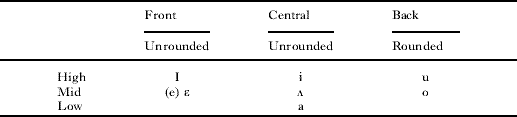
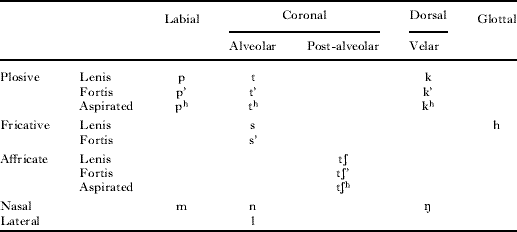
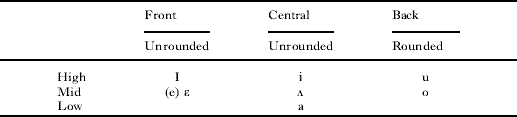
As a member of the Altaic language family, Korean has 19 phonemic consonants and 8 monophthong vowels. The Korean consonant and vowel systems are shown in Appendices A and B. One distinctive aspect of the Korean consonant system is that stops and affricates at each place of articulation include three-way distinctions: lenis, fortis and aspirated. Compared with English, Korean has only two fricatives. Glides /w, j/ are combined with a monophthong vowel to form a diphthong. Finally, the same sound in Korean is allowed at the coda of the first syllable and at the onset of the second syllable, resulting in geminates. In terms of vowels, Korean has no tense–lax distinction, unlike English. Korean has no low-front vowel /æ/, but the high-central vowel /ɨ/. The vowel /a/ is categorized as a low-central vowel.
Lee et al. (Reference Lee, Davis and MacNeilage2008) found that Korean IDS speakers produced fewer fricative consonants, and more language-specific Korean phones such as fortis and geminate consonants than ADS speakers. Korean IDS speakers also produced more mid and low central vowels, but fewer mid-front and high-central vowels than ADS speakers. These segmental distribution patterns in Korean IDS were similar to the infants' speech patterns, suggesting that segmental distribution patterns in Korean IDS tended to match their infants' production repertoire.
Lee et al. (Reference Lee, Davis and MacNeilage2008) compared IDS and ADS segmental distributions in the Korean language. It is not certain, however, whether such differences in ADS and IDS patterns also exist in languages other than Korean. Thus, an important step to making general assertions about the role of IDS in early learning of ambient phonological regularities is to examine segmental distribution patterns in other languages. English is different from Korean in terms of both phonological patterns for consonants and vowels and cultural characteristics related to word types frequently used by caregivers. Thus, a comparison of segmental distributions in English IDS with ADS will indicate whether differences found between ADS and IDS in the Korean language exist in English.
Segmental distributions could be mediated by lexical and morphosyntactic factors. Lee et al. (Reference Lee, Davis and MacNeilage2008) found that different segmental patterns in ADS and IDS could be attributed to different use of lexical and grammatical morphemes. For example, Korean IDS speakers produced words containing fricatives less frequently than did ADS speakers. In addition, Korean IDS speakers less frequently produced grammatical morphemes containing fricatives such as perfect/past tense ess, past past/past perfect ass-ess or ess-ess, honorific si, and conjunctor enders such as se, kose, and myen-se than ADS speakers. Similarly, IDS speakers less frequently used case particles containing high-central and mid-front vowels than ADS speakers. Thus, the use of lexical and grammatical morphemes in IDS leads to differing frequency of consonant and vowel distributions than in ADS.
As segments are mediated by lexical and morphological characteristics, lexical and morphosyntactic aspects are also influenced by cultural styles of communicating with infants. Fernald & Morikawa (Reference Fernald and Morikawa1993) proposed that cultural norms underlying IDS have been reflected in syntactic as well as semantic aspects of language input. Toda, Fogel & Kawai (Reference Toda, Fogel and Kawai1990) and Fernald & Morikawa (Reference Fernald and Morikawa1993) observed that American mothers often use more direct sentence types such as questions and imperatives than Japanese mothers. They also observed that American mothers produce fewer nonsense sounds and onomatopoeia than Japanese mothers. Consistent with previous studies, Lee & Nakayama (Reference Lee and Nakayama2000) reported different maternal speech characteristics among Korean, American and Japanese mothers. The authors proposed that Korean mothers tend to focus on teaching actions using frequent verbs, but American mothers are more likely to teach nouns by describing and asking object names, while Japanese mothers emphasize teaching social skills by producing frequent socially related words to infants such as ‘hi’ and ‘thank you’. Consequently, the types of words mothers frequently spoke to their infants were different among the three groups. These studies concluded that semantic and syntactic characteristics of IDS differed cross-linguistically due to different cultural norms. As previous studies have indicated, if the lexicon is influenced by culture, segmental distribution may be also affected because the frequency of occurrence of segments could be mediated by the frequency of the specific characteristics of the lexicon.
The purpose of this study was to characterize segmental consonant and vowel distribution patterns in English IDS and ADS and to identify potential roles of IDS in infant speech development. Frequency of certain semantic properties was analyzed as well to examine whether these properties affect segmental distributions in ADS and IDS. For comparison with Korean, the same methodology used in Lee et al. (Reference Lee, Davis and MacNeilage2008) was adopted. Results will provide not only comparison of segmental characteristics of English IDS and ADS, but enable cross-linguistic and cross-cultural comparisons of English and Korean input to young children.
METHOD
Participants
To avoid any potential influence of IDS on ADS conversational speech, two groups of female speakers were recruited for collecting IDS and ADS samples separately. For the IDS samples, ten native-English-speaking mothers living in a large Midwestern city in the US participated. Mothers were selected if they had children who were aged approximately 1 ; 0 (range from 0 ; 11 to 1 ; 1), spoke only English to their infant and had limited exposure to other cultures and languages. For the ADS samples, ten native-English-speaking female students enrolled at a large university in a Midwestern city participated. All female speakers for the ADS samples were single and did not have children.
Data collection
IDS speech samples were recorded at the Speech Acoustics Laboratory at a Midwestern university. Only one mother's data were collected at her home. Mothers wore a small traveling bag on their waist, with a Sony Minidisc Recorder MZ-N10 inside. An MM-Lapel-1 microphone connected to the recorder was clipped to their clothing. During the initial 2–3 minutes, mothers were asked to play with their infants using several toys in the way they usually interacted. Subsequently, four specific types of target toys were provided to obtain the IDS samples analyzed. The types of toys included a pair of stuffed animals (e.g. a dog and a pig), a pair of cars (e.g. truck and car), toy foods (e.g. fruits and vegetables) and a miniature house with family members (e.g. Daddy, Mommy, baby). These toys were the same toys used in the previous study (Lee et al., Reference Lee, Davis and MacNeilage2008). Toys were selected because they are commonly used in mother–child interaction in various cultures (Fernald & Morikawa, Reference Fernald and Morikawa1993) and reflect daily activities at home for infants in this age range. With each set of toys, mothers were asked to play with their infants for approximately 5 minutes.
For the ADS samples, English-speaking female speakers were interviewed by the primary investigator for 20–30 minutes at the Speech Acoustics Lab. The investigator initiated a 5-minute introduction period to explain procedures. Subsequently, toys used for the IDS samples were provided. Each speaker was asked to talk about any idea that came to mind when she saw the materials. Conversations for each toy lasted for approximately 5 minutes. All speech samples were collected with the same microphone and recorder used for the IDS samples.
Data analysis
As in the study of Korean (Lee et al., Reference Lee, Davis and MacNeilage2008), after excluding interjections and people's names, the first 250 syllables produced with each set of test materials in the ADS and IDS samples were selected for analysis. In total, 1000 syllables were obtained from each participant (i.e. 250 syllables×4 types of test materials per participant).
Segmental analysis
The data were transcribed by native English speakers using IPA conventions at the level of broad phonemic transcription. First, consonants were analyzed in terms of manner of articulation. Manner of articulation categories included stops /b p d t g k/, nasals /n m ŋ/, fricatives /f v θ ð s z ʃ ʒ h/, affricates /dʒ tʃ/, glides /w j/ and liquids /r l/. Then, each consonant manner, if the manner was composed of more than one place, was analyzed further in terms of each place. For example, stop and nasal manners were analyzed into bilabial /b, p, m/, alveolar /d, t, n/ and velar /g, k, ŋ/ places. Glide manner was categorized into bilabial /w/ and palatal /j/ places. Fricative manner was further divided into labio-dental /f v/, inter-dental /θ ð/, alveolar /s z/, palatal /ʃ ʒ/ and glottal /h/ places. Instead of broader place categories such as labial, coronal, dorsal and glottal used in the previous study (Lee et al., Reference Lee, Davis and MacNeilage2008), more finite place categories were used in the current study to provide more detailed place information on differences between ADS and IDS in English. Such detailed place analysis is necessary in English because certain English consonants are produced at more places of articulation than in Korean. For example, three English fricatives are produced within the coronal place category (i.e. inter-dental, alveolar and palatal) while Korean fricatives are produced at one place (i.e. alveolar). Without investigating place at a more finely grained level, it is difficult to identify which place may contribute to differences in segmental distributions between ADS and IDS. Vowel data were analyzed in terms of ten vowel categories. The ten categories include seven monophthongs (high-front /i I/, mid-front /e ɛ/, low-front /æ/, mid-central /ə ʌ/, high-back /u Ʊ/, mid-back/o ɔ/, and low-back /ɑ/, and three phonemic diphthongs /aI/, /aƱ/ and /ɔI/).
Overall frequency of each consonant and vowel category was calculated using the Logical International Phonetic Program (LIPP) computer software. Multivariate analyses of variance (MANOVA) were conducted for consonant and vowel categories to compare ADS and IDS at α=0·05. Using Bonferroni correction, a new alpha level was set at α=0·008 by dividing 0·05 by 6 (the total numbers of planned statistical analysis).
To calculate reliability for phonetic transcriptions of vowel and consonant categories, a native English speaker, blind to study hypotheses, re-transcribed 20% of randomly selected utterances from the sample. Consonant reliability was calculated categorically in terms of each consonant manner and place of articulation. Also, vowel reliability for ten categories was obtained. Voiced and voiceless distinctions for consonants and tense–lax distinction for vowels were not considered. Consonants and vowels showed 98% and 97% reliability in both samples.
Lexical analysis
The data were also transcribed using orthographic conventions by native English speakers. The orthographic data were entered into the Systematic Analysis of Language Transcripts (SALT) program (version 7). The SALT program was used for analyzing target lexical items used in ADS and IDS samples.
RESULTS
Overall characteristics
A sample of 1000 syllables per participant was analyzed. Means for the total number of utterances in ADS and IDS were 88 (SD=14) and 210 (SD=47). Means of the total number of words in ADS and IDS were 799 (SD=16) and 814 (SD=128), respectively. Thus, on average, each utterance contained 9 words in ADS and 4 words in IDS. In addition, the mean number of word types in ADS and IDS was 297 (SD=12) and 209 (SD=36), respectively. t-tests revealed that ADS contained significantly fewer utterances (t(18)=−7·83, p<0·001) and more word types (t(18)=7·331, p<0·001) than IDS. However, the total number of words was not significantly different between ADS and IDS (t(18)=−0·377, p=0·711).
Consonants
Overall, a total of 14 990 consonants and 14 450 consonants were produced in ADS and IDS, respectively. The mean frequencies for consonants were significantly different between the two groups (t(18)=2·37, p=0·03). IDS speakers used fewer consonants than ADS speakers.
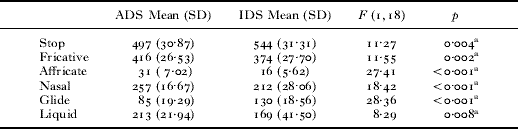
Figure 1 shows the percentages of six consonant manners in IDS and ADS. The frequency order of each manner category was the same in both IDS and ADS. The stop manner (37% for IDS and 33% for ADS) was most frequent, followed by fricative (26% for IDS and 28% for ADS), nasal (15% for IDS and 17% for ADS), liquid (12% for IDS and 14% for ADS) and glide (9% for IDS and 6% for ADS). The affricate manner was produced least frequently in both ADS and IDS (1% for IDS and 2% for ADS). Although the order of frequency of occurrence was similar between ADS and IDS, the mean frequency of each consonant manner was different between the two groups. More stops and glides were produced in IDS than in ADS, while the other manners (fricative, affricate, nasal and liquid) were more frequent in ADS.
The percentages of consonant manner of articulation in ADS and IDS.

A two-way MANOVA was conducted to determine the effect of ADS and IDS groups on the six consonant manners. A significant difference was found between the two groups, Wilks' lambda=0·212 (F(6, 13)=8·06, p<0·001, η2=0·78). Means, standard deviations and F, and p values of univariate ANOVA for each consonant manner in ADS and IDS are presented in Table 1. All consonant manner categories were significantly different between ADS and IDS. ADS speakers used fricative, affricate nasal and liquid manners significantly more than IDS speakers, while IDS speakers produced significantly more stops and glides than ADS speakers.
Means, standard deviations (SD) and ANOVA statistics of consonants in ADS and IDS
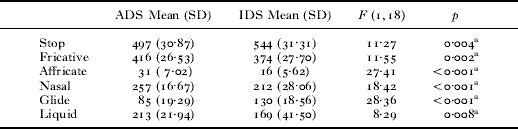
note: a Statistically significant at α=0·008 using Bonferroni correction.
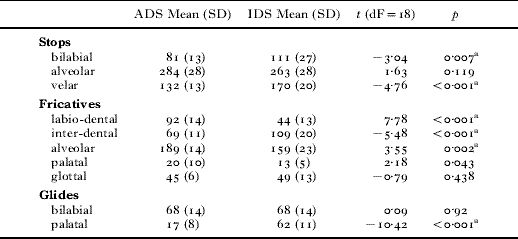
Since stop, fricative, nasal and glide manners have more than one place, follow-up analysis of variance (ANOVA) was conducted between ADS and IDS for each manner separately. For stops, a two-way mixed ANOVA with group as a between-subject factor (i.e. ADS and IDS) and three places (i.e. bilabial, alveolar and velar) as a within-subject factor was conducted. There were significant main effects for group (F(1, 18)=11·27, p<0·004, η2=0·38) and for place (F(2, 36)=260·78, p<0·001, η2=0·93) as well as a significant interaction (F(2, 36)=7·92, p<0·001, η2=0·31). Because of the significant interaction effect, three independent t-tests for each stop place were conducted comparing ADS and IDS (see Table 2). There were significant differences for bilabial and velar places between ADS and IDS. IDS speakers produced significantly more bilabial (20%) and velar (31%) places than ADS speakers (16% for bilabial and 26% for velar). However, there was no significant difference for alveolar place between ADS (58%) and IDS (49%).
Means, standard deviations (SD), t and p values of each place of articulation for stops, fricatives and glides
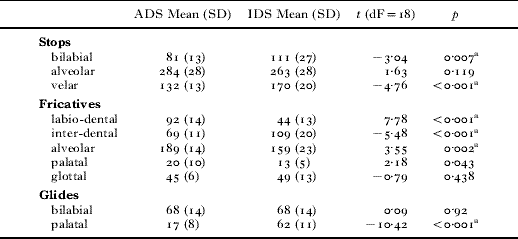
note: a Statistically significant at α=0·008 using Bonferroni correction.
For fricatives, a two-way mixed ANOVA was also conducted with group as a between-subjects factor (i.e. ADS and IDS) and five places (i.e. labio-dental, inter-dental, alveolar, palatal and glottal) as a within-subject factor. There were significant main effects for group (F(1, 18)=12·33, p<0·002, η2=0·41) and for place (F(4, 72)=332·33, p<0·001, η2=0·95) as well as a significant interaction (F(4, 72)=26·79, p<0·001, η2=0·59). Because of the significant interaction effect, five independent t-tests for each fricative place were conducted comparing ADS and IDS (see Table 2). There were significant differences for labio-dental, inter-dental and alveolar places. ADS speakers produced significantly more labio-dental (21%) and alveolar (46%) fricatives than IDS speakers (17% for labio-dental and 43% for alveolar). In contrast, IDS speakers used more inter-dental (29%) fricatives than ADS speakers (17%). Palatal and glottal places were not significantly different between ADS and IDS.
In terms of nasal consonants, an ANOVA indicated significant main effects for group (F(1, 18)=18·42, p<0·001, η2=0·51) and for place (F(2, 36)=469·72, p<0·001, η2=0·96). However, no interaction effect was found (F(2, 36)=1·95, p<0·001, η2=0·09). ADS speakers produced more nasals for all three places (M=78, SD=8 for bilabial; M=157, SD=13 for alveolar; M=20, SD=5 for velar) than IDS speakers (M=57, SD=13 for bilabial; M=139, SD=25 for alveolar; M=15, SD=8 for velar).
With respect to glides, there were significant main effects for group (F(1, 18)=28·36, p<0·001, η2=0·61) and for place (F(1, 18)=61·45, p<0·001, η2=0·77) as well as a significant interaction effect (F(1, 18)=41·29, p<0·001, η2=0·69). Follow-up t-tests (see Table 2) indicated that frequency of palatal glides was significantly different between ADS and IDS. IDS speakers (48%) used palatal glides significantly more than ADS speakers (20%). However, there was no difference for bilabial glides between the two speech registers.
Vowels
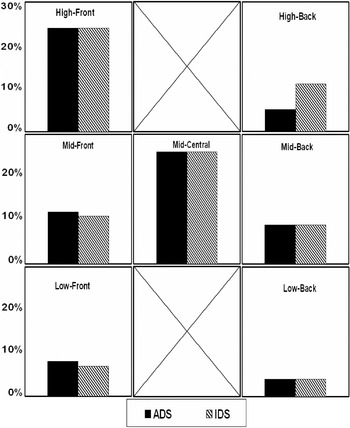
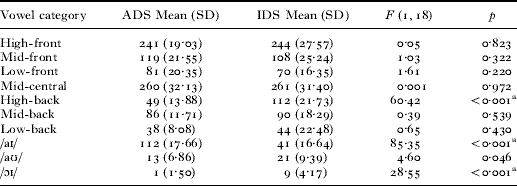
Figure 2 shows the percentages of each monophthong vowel category in IDS and ADS. Considering both monophthongs and diphthongs, the order of frequency of each category in the two groups was similar to some extent except for the high-back vowels and the diphthong /aI/ category. In both IDS and ADS registers, mid-central vowels were most frequent and high-front vowels were second-most frequent. After the mid-central and high-front vowel categories, the order of frequent vowel categories in ADS was mid-front→diphthong/aI/→mid-back→low-front→high-back→low-back. In IDS, the order was high-back→mid-front→mid-back→low-front→low-back. Diphthongs /aƱ/ and /ɔI/ were the least and the second-least frequent in ADS while the three diphthongs /aI/, /aƱ/ and /ɔI/ were the least frequent in that order in IDS.
The percentages of monophthong vowels in ADS and IDS.

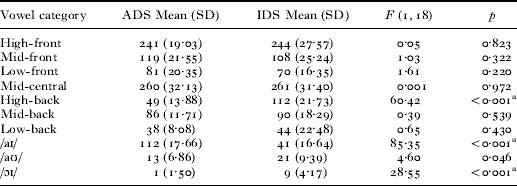
A two-way MANOVA was conducted to determine the effect of ADS and IDS groups on the ten vowel categories. A significant difference was found between the two groups, Wilks' lambda=0·028 (F(9, 10)=37·98, p<0·001, η2=0·97). Means, standard deviations, and F and p values of univariate ANOVA for each vowel category in ADS and IDS are presented in Table 3. Three out of ten vowel categories (high-back and two diphthongs) were significantly different between ADS and IDS. IDS speakers produced significantly more high-back vowels and diphthong /ɔI/, but fewer diphthong /aI/ than ADS speakers.
Means, standard deviations (SD) and ANOVA statistics of vowels in ADS and IDS
note: a Statistically significant at α=0·008 using Bonferroni correction.
Lexical analyses
Some aspects of segmental distributions were different between ADS and IDS. In particular, IDS speakers produced higher frequencies of bilabial and velar stops, palatal glides, high-back vowels and the diphthong /ɔI/ than ADS speakers. Although fricative consonants were more frequent in ADS overall, inter-dental fricatives were significantly higher in IDS. To investigate whether frequent bilabial and velar stops, palatal glide, high-vowels, the diphthong /ɔI/ and inter-dental fricatives in IDS were influenced by lexical characteristics, the frequencies of words containing these sounds were analyzed. In addition, two further analyses were conducted. First, frequencies of occurrence of baby-talk words in English IDS were examined in order to evaluate whether sounds frequently occurring in baby-talk words affected segmental distribution differences between ADS and IDS. Second, words containing bilabial glides were also analyzed in order to confirm previous finding that questions were used more frequently in IDS.
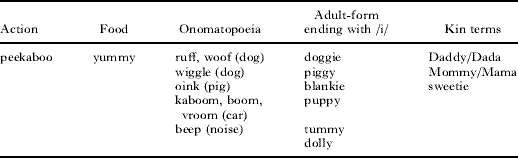
Baby-talk words
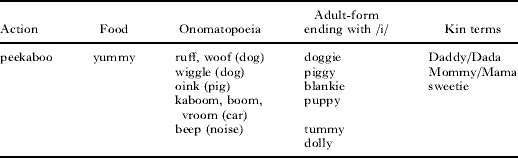
Table 4 shows baby-talk words spoken in IDS. These baby-talk words were defined as action, food, onomatopoeia, adult-form ending with /i/ and kin terms. On average, 40 baby-talk words and 9 different types of baby-talk words were produced by each mother. These words comprised 5% of the total number of words in the IDS samples. In contrast, only 4 tokens, which were limited to two types of words, Mom and Dad, were counted in ADS samples.
Baby-talk words in English IDS
Lexical items containing stops
Table 5 shows the frequencies and percentages of words containing bilabial and velar stops in ADS and IDS. Words containing stops were categorized as target toy related words and non-target toy related words. The target toy related words containing bilabial stops included words such as apple, baby, banana, pineapple, strawberry, boy, bark, bed, pig, piggy, puppy, push, pull, kaboom, boom, peekaboo, etc. The target toy related words containing velar stops included words such as car, truck, dog, doggy, pig, piggy, leg, corn, wiggle, bark, come, go, knock, oink, peekaboo. etc. In general, English IDS speakers used the target toy related words frequently when they interacted with their infants while ADS speakers did not use the target toy related words as much. IDS speakers used more bilabial stops for the target toy related words than the non-target toy related words. In contrast, ADS speakers produced bilabial stops more for the non-target toy related words than the target toy related words. IDS speakers produced more velars for the target related words, but both IDS and ADS speakers produced similar number of words containing velar stops for the non-target toy related words.
Frequencies and percentages of words containing bilabial and velar stops in ADS and IDS

note: TTRW indicates the target toy related words while NTTRW indicates non-target toy related words.
Lexical items containing glides
Table 6 shows the frequencies and percentages of words containing bilabial and palatal glides in ADS and IDS. Words containing bilabial glides were divided into questions such as what, where and when and other words such as wheel, well and want. Words containing palatal glides were categorized into pronoun you and possessive your and other words such as yes and yummy. English IDS speakers produced more question forms than ADS speakers. Alternatively, ADS speakers produced more diverse word types containing bilabial glides than question words used in IDS. IDS speakers produced words such as you and your more than ADS speakers while ADS speakers used these words only three times on average.
Frequencies and percentages of word containing bilabial and palatal glides in ADS and IDS

Lexical items containing inter-dental fricatives
Table 7 shows the frequencies and percentages of lexical items containing inter-dental fricatives in ADS and IDS. Lexical items containing inter-dental fricatives were categorized as: (1) the article the; (2) demonstrative pronouns such as this, that, those and these; (3) the adverb and pronoun there; (4) the pronouns they and them; and (5) other words containing inter-dental fricatives such as think, thank, throw, etc. IDS speakers produced more articles and demonstrative pronouns as well as the words and phrases there or there is than ADS speakers. The frequency of the pronoun they was similar between ADS and IDS, but other words containing inter-dental fricatives were more frequent in ADS than in IDS.
Frequencies and percentages of words containing inter-dental fricatives in ADS and IDS

Lexical items containing high-back vowels and diphthongs
High-back vowels and diphthongs /ɔI/ were more frequent in IDS than in ADS in this English data. As a result, word types containing these vowels were analyzed. Although IDS speakers produced high-back vowels more frequently than ADS speakers, both groups produced similar types of words containing high-back vowels. ADS speakers produced more varied (M=21) word types than IDS speakers (M=17). Words containing high-back vowels produced in ADS and IDS were could, choose, do, look, loose, new, school, screw, shoes, took, used, would, you, food, fruit, cook, put, etc. Similarly, the types of words containing /ɔI/ were not different between the two groups. On average, IDS speakers produced three different words, while ADS speakers produced only one word containing the /ɔI/ vowel. Examples of words containing the /ɔI/ vowel were boyfriend, noise and toy in ADS, and boy, toy, oink and noise in IDS.
DISCUSSION
Young children have demonstrated sophisticated perception based learning capacities for segmental regularities in laboratory environments (Saffran et al., Reference Saffran, Aslin and Newport1996). Translation of these perceptual capacities to learning of ambient language regularities reflected in infant production output requires understanding of the nature of input speech to infants in natural communication environments. IDS is a prominent speech style directed at young infants in addition to ADS that is also available in an infant's communication environment. An earlier study of Korean (Lee et al., Reference Lee, Davis and MacNeilage2008) found that IDS speakers showed significant differences in consonant and vowel patterns compared to ADS speakers, consistent with patterns described for early infant output. Consonants and vowels in English IDS and ADS were compared to examine whether differences between IDS and ADS appear in another language environment.
Segmental distribution patterns
English IDS speakers produced fewer fricatives, affricates, liquids and nasals and more stops, glides, high-back vowels and the /ɔI/ diphthong than ADS speakers. Use of fewer fricatives, affricates and liquids, but more stops and glides in IDS may be related to the relative production system complexity demands associated with production of these consonant manner categories. Dinnsen, Chin, Elbert & Powell (Reference Dinnsen, Chin, Elbert and Powell1990) identified five categories of sound inventories based on forty functionally disordered children's speech. Among the five categories, the simplest type of inventory included stops, nasals and glides, which require ballistic movements incorporating regulation of velo-pharyngeal valving and rate of articulation movement. Fricative and affricate sounds were categorized as more difficult than stop, nasal and glide consonants to produce. According to Kent (Reference Kent, Ferguson, Menn and Stoel-Gammon1992), ‘Fricative and affricate production requires regulation of lingual configuration and fine force control to generate frication’ (p. 75).
Previous studies of infant babbling (Boysson-Bardies & Vihman, Reference Boysson-Bardies and Vihman1991; Davis & MacNeilage, Reference Davis and MacNeilage1995; Locke, Reference Locke1983) have reported that across languages stop, nasal and glide consonants are far more frequently produced by infants than are fricatives, affricates and liquids. At the onset of word use, however, 50% of English-learning children have been described as producing word-initial fricative /f/ and /s/ at age 2 ; 0 (Stoel-Gammon, Reference Stoel-Gammon1985; Dyson, Reference Dyson1988). Based on Dinnsen et al.'s (Reference Dinnsen, Chin, Elbert and Powell1990) sound complexity analysis, infant speech can be characterized as containing simpler sounds with relatively less articulatory complexity required for production. Thus, the finding that English IDS speakers produced fewer fricatives, affricates and liquids and more stops and glides suggests that mothers tend to match phonetic properties that infants produce while they interact with their infants, although mothers can certainly produce words with more complex articulatory requirements as they use these sound patterns in ADS.
These results for English support the fine-tuning argument that IDS is tailored to children's capacities in this formative period of language acquisition (Cross, Reference Cross, Snow and Ferguson1977; Sachs, Reference Sachs, Snow and Ferguson1977). These findings are also consistent with Sundberg's hypothesis (1998) that mothers provide segmental input appropriate to their infants' production capacities. This result with English speakers showing fewer fricatives in IDS than in ADS was consistent with previous results for Korean ADS and IDS (Lee et al., Reference Lee, Davis and MacNeilage2008). In these two diverse languages, consonant manner, in particular fricative distribution, between ADS and IDS is similar.
Not every aspect of IDS was consistent with infant speech patterns. English IDS speakers produced fewer nasal consonants than ADS speakers, although nasal consonants are produced with relatively simple articulatory positioning (Dinnsen et al., Reference Dinnsen, Chin, Elbert and Powell1990). This result was not consistent with the previous results on Korean IDS (Lee et al., Reference Lee, Davis and MacNeilage2008). Korean IDS speakers produced significantly more nasals than ADS speakers. Why were relative nasal consonant frequencies in IDS and ADS different between English and Korean? Lee et al. (Reference Lee, Davis and MacNeilage2008) found that Korean IDS speakers frequently used baby-talk words compared to ADS speakers. Those frequent baby-talk words in Korean IDS often included nasal consonants, in particular geminate nasal consonants such as mungmung ‘woofwoof’, mamma ‘meal’, nenne ‘sleep’ and amma ‘Mommy’. Since Korean IDS speakers produced onomatopoeia more frequently compared to Korean ADS speakers, the result was a difference in frequency of nasal consonants between ADS and IDS based on the frequency of geminate consonants in onomatopoeia (i.e. two nasal sounds). In English, although IDS speakers used more baby-talk words than ADS speakers, baby-talk words did not contain the nasal consonants found in Korean baby-talk words. Thus, unlike obstruents, nasal consonant frequencies in IDS are different across languages and show language-specific characteristics related to specific lexical–phonological connections in Korean that are not present in English.
While consonant manner in IDS showed a strong tendency to match phonetic properties in infant speech, vowel distributions in IDS did not seem to match vowel characteristics described as typical of infants' canonical babbling output. Previous studies of infants' babbling have reported dominant mid, low, front and central vowels and less frequent high, back and rounded vowels in infants' canonical babbling (Davis & MacNeilage, Reference Davis and MacNeilage1995; Kent & Bauer, Reference Kent and Bauer1985). Similar patterns were found in a French-learning infant (Levitt & Aydelott Utman, Reference Levitt and Aydelott Utman1992). For example, the French-learning infant produced a few front and back rounded vowels such as /ø ɔ u/ at age 0 ; 11. According to the Frame dominance theory (Davis & MacNeilage, Reference Davis and MacNeilage1995), sound repertoires in babbling result from a dominant role of jaw movement with relative lack of lingual independence in vocal output sequences. The recent variable linear articulatory model of Ménard, Schwartz & Boë (Reference Ménard, Schwartz and Boë2004) supported the hypothesis that incomplete vowel inventories in infants can be attributed to immature motor control capabilities, not to vocal tract length or configuration. Given the fact that infant vowel output repertoires are incomplete, this analysis of adult input frequencies did not find equivalent patterns in English IDS. Rather, English IDS speakers produced more high-back vowels than ADS speakers. Why did English IDS speakers not show the phonetic matching behavior in vowel production that was evident for consonants?
English-learning infants have been reported to establish vowel system inventories and accuracy earlier than consonants (Hare, Reference Hare, Irwin and Wong1983; Paschall, Reference Paschall, Irwin and Wong1983; Stoel-Gammon & Harrington, Reference Stoel-Gammon and Harrington1990). Based on analysis of 20 children aged 1 ; 4–1 ; 6, Paschall (Reference Paschall, Irwin and Wong1983) reported that high and low vowels including rounded vowels were produced with relatively high accuracy (range from 75% to 81%). Hare (Reference Hare, Irwin and Wong1983) found that children aged 2 ; 0 showed more than 84% accuracy for all English vowels except for r-colored vowels. Although it is still debated whether infants' vowel production is accurate by age 2 ; 0, it is commonly agreed that while English-learning infants produce mid, low, front and central unrounded vowels more frequently than high, back and rounded vowels in babbling, by age 2 ; 0 they produce most vowels, including rounded vowels. If vowel acquisition is accomplished earlier than consonants, in particular fricatives, affricates and liquids, which are acquired after age 2 ; 0, vowel input in IDS may differ from consonant input. In other words, unlike with consonants, English IDS speakers, whose children are aged 1 ; 0, may produce frequent high-back vowel input to support their infants in mastery of the entire ambient language vowel repertoire. The results found for frequency of IDS vowels were consistent with Vygotsky's scaffolding hypothesis that adults engage their child to build on and move beyond the skills the child already possesses.
These results for consonants and vowels in IDS and ADS suggest that caregivers are sensitive to their infants' developmental stage of segmental production mastery and adjust their IDS to the level of infant production capacities. This study also supports the hypothesis that IDS input may play an active scaffolding role in assisting infants to develop their repertoire of ambient language phonemes. Longitudinal studies are needed to investigate developmental changes in IDS segmental patterns in order to verify this hypothesis. If IDS and ADS speakers produce similar frequencies of fricatives when infants start to produce fricatives (e.g. age 2 ; 0), the finding can provide further supportive evidence that IDS speakers play an active and changing role tuned to infant developmental level. Relative to the Vygotsky hypothesis, caregivers could be viewed as providing scaffolding for their infants' development of ambient language sound patterns in output.
Two studies have indicated that English-learning infants produced more frequent high-back vowels than infants in other language environments (Lee, Davis & MacNeilage, Reference Lee, Davis and MacNeilagein press; Rvachew, Alhaidary, Mattock & Polka, Reference Rvachew, Alhaidary, Mattock and Polka2008). Rvachew et al. reported that English-learning infants produced more frequent high-back vowel [u] than French-learning infants through the age range of 0 ; 8 to 1 ; 6, supporting the hypothesis that infant vowel production may begin to reflect the ambient language in this early period of prelinguistic and early language based vocal output. Similarly, English-learning infants produced more high-back vowels than Korean-learning infants who were aged 0 ; 9 to 1 ; 0 (Lee et al., in press). These studies suggest that English IDS speakers may be providing input containing more high-back vowels. English-learning infants' vowel output, in turn, is influenced by the greater frequency of high-back vowels in IDS input.
In Korean, the frequent use of fortis consonants in IDS may also function to assist infants in perceptual access to less frequent phonemes in their production repertoires. English-learning infants initially produce voiceless and unaspirated stops (e.g. stops with short lag) and tend to produce stops with long lag and distinguish voice and voiceless sounds at around age 2 ; 0 (Macken & Barton, Reference MacKen and Barton1980). Similarly, Korean infants do not produce fortis consonants at age 0 ; 7 to 0 ; 9, but start to produce them around age 0 ; 10 to 1 ; 0 (Lee, Reference Lee2003). Thus, Korean IDS speakers may produce fortis sounds more often in IDS to provide early perceptual scaffolding supporting infants' awareness of the presence of such phonemes, even while they cannot yet produce them.
Influences of lexical choice on segmental distribution patterns
In part, the segmental distributions in English ADS and IDS are mediated by lexical choices. Previous studies have indicated that IDS contains ‘here and now’ vocabulary and words are often repeated (Phillips, Reference Phillips1973; Snow, Reference Snow1972). Thus, if the name of a salient target toy contains a sound, the sound such as bilabial or velar stops may be produced more frequently in IDS than in ADS. Lexical choices still influence segmental frequency, although they are not frequently shown in infant's speech repertoire. For example, in this study, some of the target toys contained velar stops in either initial or final position of words such as pig, dog, car and truck. Frequent verbs used with these toys also included velar stops such as come and go. When IDS speakers interacted with their infants using these toys as the focus, the frequency of velar stops consequently increased. Thus, the frequent velar stops, which were inconsistent with their infant's production output, are based on the target toys used in this study that contained velar stops. The frequency of velar stops might be reduced if target toys did not contain velars. Further studies should examine whether IDS speakers frequently produce velar stops when target toys do not contain velar consonants.
The frequent palatal glides in IDS were influenced by the word you. As can be seen in Table 6, the average frequency of you and your in IDS (M=45) was more than ten times the frequency in ADS (M=3). English IDS speakers often call their infant you. The word you has been reported as the most frequent word in English IDS in one other study (Gerometta & Shafer, Reference Gerometta and Shafer2008). The frequent use of pronoun you may be also attributed to linguistic characteristics of English. In other languages, such as Korean and Japanese, pronouns can be omitted without being considered a grammatical error. The phenomenon is called ‘empty pronoun’ (Suh, Reference Suh1991). For example, when a mother asks her infant to drink milk, she says ‘Do you want to drink some milk?’ In this sentence, the pronoun you is grammatically necessary. However, in Korean, the same question can be asked without a pronoun, for example ‘wuyu (milk) mekko (eat) siphe (want)?’ Thus, lexical choice for pronouns is also mediated by grammatical characteristics of the ambient language.
Previous studies (Bernstein Ratner, Reference Bernstein Ratner1984; Shockey & Bond, Reference Shockey and Bond1980) report that English IDS speakers often used palatalization because, in part, the word you appears after the past tense verb did. An alveolar /d/ and palatal glide /j/ sequence results in a palatal affricate /dʒ/. However, the current results did not show frequent use of palatal affricates in IDS, although English IDS speakers frequently used the word you to their infants. As mentioned, because IDS speakers use most likely ‘here and now’ vocabulary (Phillips, Reference Phillips1973; Snow, Reference Snow1972), the past tense verb did would not appear frequently in IDS, especially when interaction between caregivers and infants used novel toys in a new environment such as the laboratory setting of the current study. Gerometta & Shafer (Reference Gerometta and Shafer2008) also reported that the most frequent element that preceded you was a pause (58%). The word did only occurred 3·3% before you in the home environment. Analysis of phonological processes in IDS was not within the scope of the current study. Further studies should examine how both phonological processes and frequent items in the input lexicon influence segmental distribution patterns in IDS compared to ADS.
Although the frequency of fricatives was higher in ADS than in IDS overall, the frequency of inter-dental fricative (M=109) in IDS was higher than ADS (M=69). As can be seen in Table 7, English IDS speakers produced words containing initial inter-dental fricatives such as article the, demonstrative pronouns this, that, these and those, and pronoun there more frequently than ADS speakers. The frequency of inter-dental fricatives may be related to English IDS speakers' frequent use of interrogative forms in their speech to infants. As shown in Table 6, when English-speaking mothers interacted with their infants, they used frequent question forms such as ‘What is this?’ and ‘Where do you go?’ When they used question forms, demonstrative pronouns were often spoken together. In addition, frequent use of the may result from English IDS speakers' use of more nouns in their speech to infants (Fernald & Morikawa, Reference Fernald and Morikawa1993; Lee & Nakayama, Reference Lee and Nakayama2000). As a result, frequent use of these lexical forms accounts for the frequency of inter-dental fricatives in English IDS compared to ADS.
Finally, the frequency of diphthongs is also mediated by lexical choice. English IDS speakers frequently produced words such as boy, toy and oink containing the diphthong /ɔI/. In particular, frequent onomatopoeic oink in English IDS attributed to the higher frequency of the /ɔI/ diphthong. Thus, similarly to velar stops, the frequency of the diphthong /ɔI/ may be due to the target toy used. It may not necessarily be representative of IDS and ADS differences.
Cultural influences on lexical choice
These results for English allowed the conclusion that several characteristics of IDS may reveal general trends across languages. For example, IDS contained simpler utterances (i.e. few words per utterance) and few word types but more baby-talk words than ADS in English. These characteristics have been documented in previous cross-linguistic studies of IDS (Fernald & Morikawa, Reference Fernald and Morikawa1993; Lee & Nakayama, Reference Lee and Nakayama2000).
Regardless of these similarities, English IDS speakers showed different cultural characteristics from Korean IDS speakers (Lee et al., Reference Lee, Davis and MacNeilage2008), although this study did not compare them directly. Frequent question forms and use of the article the accounting for frequent glides and inter-dental fricatives in English IDS, may be attributed to cultural characteristics of talk to infants. Previous studies (Fernald & Morikawa, Reference Fernald and Morikawa1993; Bornstein et al., Reference Bornstein, Tal, Rahn, Galperin, Pecheux, Lamour, Toda, Azuma, Orino and Tamis-LeMonda1992; Toda et al., Reference Toda, Fogel and Kawai1990) report that English IDS speakers produced more question forms than IDS speakers in other languages such as Japanese, French and Spanish. Moreover, Lee & Nakayama (Reference Lee and Nakayama2000) found that the frequency of nouns in English IDS was higher than in Korean and Japanese IDS because American mothers tend to teach nouns to their infants by asking questions. These results enabling comparison of English ADS and IDS suggest that segmental distribution patterns result from both linguistic and cultural characteristics. Further studies should compare English and Korean IDS directly in order to investigate complicated interaction among segmental distribution, lexical choice and cultural aspects in IDS.
Implication and future directions
These results for English provide important implications for infant speech acquisition. Previous studies investigating the effect of ambient language input on infant speech acquisition output patterns have primarily examined infant speech patterns compared with phonological structures in ADS or dictionary counts (e.g. Levitt & Aydelott Utman, Reference Levitt and Aydelott Utman1992; Teixeira & Davis, Reference Teixeira and Davis2002). These analyses carried the assumption that spontaneous speech samples of ADS or dictionary samples might be representative of an infant's daily language environment. While infants may receive speech input from ADS, caregivers across language communities frequently use IDS when they interact with their infants. Thus, it is important to characterize phonological properties of connected speech samples in both ADS and IDS. This comparison can support a more complete understanding of the nature of perceptually available natural speech input to infants who are learning to reproduce ambient language regularities. This study revealed that English ADS and IDS show different consonant and vowel distribution frequencies. Differences in segmental input distributions are based partially on differences in lexical choices between ADS and IDS. Further studies should consider both ADS and IDS in understanding perceptual influences on early learning of ambient language regularities from naturally occurring connected speech.
Consideration of segmental distribution patterns between ADS and IDS beyond age 1 ; 0 is also important to developing a full picture of the role of naturally occurring ambient language input. Previous research (e.g. Cross, Reference Cross, Snow and Ferguson1977) showed that mothers' input to infants changes depending on an infant's developmental age, although developmentally sensitive modifications in input speech and language properties are debated. Segmental modifications in input may be different if IDS is analyzed for infants at age 0 ; 6 or at 2 ; 0. When infants are aged 0 ; 6, English-speaking caregivers may produce more stops, nasals and mid- and low-central vowels to perceptually scaffold infants who are acquiring production capacities for the earliest developed sounds. On the other hand, when infants are aged 2 ; 0, English-speaking caregivers may produce higher frequencies of fricatives and affricates to assist infants who are in the process of acquiring later developing sound types.
English-speaking mothers in this study were mid level socio-economic status (SES). It is not certain whether segmental distribution patterns are similar in caregivers from low SES families or in caregivers using different dialects (e.g. African American dialect). Since English-speaking caregivers in low SES families use fewer question forms or different vocabulary from caregivers in mid SES, segmental distributions may not be the same. Finally, investigation of segmental distribution patterns in languages other than English and Korean should be conducted in order to obtain a more comprehensive understanding of the nature of speech input for infants that is affected by both linguistic and cultural influences.
APPENDIX A: INVENTORY OF KOREAN CONSONANTS
APPENDIX B: INVENTORY OF KOREAN MONOPHTHONG VOWELS
note: (e) only exists in orthography in contemporary Korean.