INTRODUCTION
The 13.5 m ha of rice (Oriza sativa)-wheat (Triticum aestivum) cropping systems in South Asia provide the region's cereal bowl and underpin rural livelihoods (Timsina and Connor, Reference Timsina and Connor2001). The rice-wheat system is primarily irrigated, with 85% concentrated in the Indo-Gangetic Plains (IGP) (Timsina and Connor, Reference Timsina and Connor2001). The system showed significant productivity increases during the Green Revolution, but recent studies indicate a slowdown in productivity growth (Byerlee et al., Reference Byerlee, Ali, Siddiq, Ladha, Hill, Duxbury, Gupta and Buresh2003; Kumar et al., Reference Kumar, Jha, Kumar, Chaudhary, Grover, Singh, Singh, Mitra, Joshi, Singh, Badal, Mittal and Ali2002). Agricultural technologies that can save resources, reduce production costs and improve production while sustaining environmental quality are therefore becoming increasingly important (Gupta and Sayre, Reference Gupta and Sayre2007; Hobbs and Gupta, Reference Hobbs, Gupta, Ladha, Hill, Duxbury, Gupta and Buresh2003).
To date, the resource-conserving technology that has been most successful in the IGP is zero-tillage (ZT) planting of wheat after rice (Erenstein and Laxmi, Reference Erenstein and Laxmi2008; Laxmi et al., Reference Laxmi, Erenstein and Gupta2007), particularly by using a tractor-drawn ZT seed drill. This specialized seeding implement allows wheat seed to be planted directly into unploughed fields with a single pass of the tractor, often with simultaneous basal fertilizer application. In contrast, conventional tillage practices for wheat in these systems involve multiple passes of the tractor to accomplish ploughing, harrowing, planking and seeding operations.
On-station and on-farm trials with ZT wheat in the rice-wheat systems of the IGP have shown primarily positive impacts on wheat crop management, particularly through reduced input needs combined with potential yield increases (Erenstein and Laxmi, Reference Erenstein and Laxmi2008; Hobbs and Gupta, Reference Hobbs, Gupta, Ladha, Hill, Duxbury, Gupta and Buresh2003; Laxmi et al., Reference Laxmi, Erenstein and Gupta2007; Malik et al., Reference Malik, Gupta, Singh, Yadav, Brar, Thakur, Singh, Singh, Singh and Sinha2005). The use of ZT significantly reduces energy costs, mainly by reducing tractor costs associated with conventional methods. The use of ZT also allows the wheat crop to be planted sooner than would be possible using conventional methods, which significantly reduces turnaround time. This is an important consideration in many parts of the rice-wheat belt, where late planting of wheat is a major cause of reduced yields (Hobbs and Gupta, Reference Hobbs, Gupta, Ladha, Hill, Duxbury, Gupta and Buresh2003; Ortiz-Monasterio et al., Reference Ortiz-Monasterio, Dhillon and Fischer1994).
Field observations and knowledgeable experts estimate that the area under ZT in the IGP is significant and is rapidly increasing (Laxmi et al., Reference Laxmi, Erenstein and Gupta2007). Our study areas are located in the rice-wheat zone of the northwest IGP (see next section), and findings from the same study areas reported elsewhere (Erenstein et al., Reference Erenstein, Farooq, Malik and Sharif2007a) confirm widespread adoption in India's Haryana State (34.5% of surveyed households and 26% of surveyed wheat area) and Pakistan's Punjab province (19% households and 18% area). Companion studies also show that ZT's ‘cost-saving effect’ makes adoption worthwhile and this effect is the main driver for adoption in both study areas, further aided by a significant ‘yield effect’ in Haryana, India (Erenstein et al., Reference Erenstein, Farooq, Malik and Sharif2007a; Reference Erenstein, Farooq, Malik and Sharif2008). Yet despite ZT's profitability, its adoption is still far from universal and some recent discontinuation has been reported (10–14% of surveyed households did not use ZT in the survey year but had used ZT before, Erenstein et al., Reference Erenstein, Farooq, Malik and Sharif2007a).
Franke et al. (Reference Franke, McRoberts, Marshall, Malik, Singh and Nehra2003) expected that ‘the structures of the farming community and the extension system are likely to encourage unequal adoption of [zero tillage] among farmers from different socioeconomic classes.’ However, their study in Haryana State included too few ZT adopters to examine the extent to which this was the case. The same study also postulated that failure to adopt new technologies ‘cannot be attributed solely to ignorance or conservatism. . . It is likely related to a range of factors such as poor access to capital and information, and differences in psychological characteristics’ (Franke et al., Reference Franke, McRoberts, Marshall, Malik, Singh and Nehra2003). In turn, such factors are intricately linked to the socioeconomic position (Franke et al., Reference Franke, McRoberts, Marshall, Malik, Singh and Nehra2003).
A better understanding of the factors that influence the adoption of ZT in the IGP will be instrumental in furthering its effective promotion and accelerating its equitable uptake. Experience suggests that successful adoption depends on a favourable confluence of technical, economic, institutional and policy factors (CIMMYT, 1993; Feder et al., Reference Feder, Just and Zilberman1985). It is only by understanding these factors that researchers, extension specialists, machinery manufacturers and policymakers will be able to modify the technology, delivery mechanisms and policy environment to stimulate successful adoption and diffusion.
The present paper analyses differences at the farm household level that may help explain observed ZT adoption decisions in the northwestern IGP. The subsequent methodology section introduces the two study areas and the empirical surveys used as primary data sources. The contrasts of household characteristics across adopter classes are presented and discussed in the subsequent section, which is followed by a conclusion.
METHODOLOGY
Study area
The study focuses on two irrigated rice-wheat areas in the northwest IGP of South Asia. The first is the rice-wheat zone in Haryana State, located in the northwest of India (hereafter referred to as ‘Haryana’). The second is the rice-wheat zone in Punjab Province, located in the northeast of Pakistan close to the Indian border (hereafter referred to as ‘Punjab’). The two study areas show a number of commonalities and selected contrasts (Erenstein et al., Reference Erenstein, Farooq, Malik and Sharif2007a; Erenstein and Farooq, Reference Erenstein and Farooq2008).
The areas have in common a semi-arid climate that is continental monsoonal, with some 80% of the total precipitation during the monsoon season from June to September. Wheat is grown in the cool and dry weather from November to March, whereas rice is grown during the warm humid/semi-humid season from June to October (Timsina and Connor, Reference Timsina and Connor2001). Rice and wheat are dependent on irrigation, which includes the conjunctive use of surface water and groundwater. The soils in the study areas are predominantly alluvial, calcareous, very low in organic carbon and weakly structured, with light to medium texture (sandy loam to clay loam) (Erenstein et al., Reference Erenstein, Farooq, Malik and Sharif2007a).
Wheat has traditionally been, and continues to be, the mainstay of food security in the northwest IGP, and the introduction and widespread cultivation of rice have only occurred in recent decades (Erenstein et al., Reference Erenstein, Thorpe, Singh and Varma2007c). The introduction of rice has, thereby, put increasing pressure on the ability to plant wheat at the appropriate time to avoid yield losses. Another distinguishing feature of both study areas within the IGP is the popularity of basmati rice (Timsina and Connor, Reference Timsina and Connor2001), an aromatic fine-quality rice which takes longer to mature.
Land preparation for rice and wheat in the study areas is mechanized using four-wheel tractors and combine harvesting is widespread. Irrigation and chemical fertilizer use for rice and wheat is universal. Rice and wheat are primarily produced for the market, and rice-wheat alone provides over two-thirds of overall household income in both study areas. Except for the larger land-holdings in Pakistan Punjab, rice-wheat farms tend to be better endowed in Haryana (Erenstein et al., Reference Erenstein, Farooq, Malik and Sharif2007a; Erenstein and Farooq, Reference Erenstein and Farooq2008). Particularly when compared to the eastern IGP, the rice-wheat systems in the two study areas are highly mechanized, input intensive, commercial and with relatively large farm holdings (Erenstein et al., Reference Erenstein, Thorpe, Singh and Varma2007c). The wealth of rural households in each area is closely associated with their access to land, with the poorest typically being landless and deriving their income mainly from labour services. In the northwest IGP farm households are typically male headed with women having limited participation in field-based crop activities and primarily engaged in livestock and homestead-based activities (Erenstein et al., Reference Erenstein, Thorpe, Singh and Varma2007c).
Data sources
This study interprets ZT as the planting of wheat with a tractor-drawn ZT seed drill directly into unploughed fields with a single pass of the tractor. Although prototype ZT seed drills were first introduced into South Asia during the mid- to late 1980s, significant adoption of ZT by farmers began only in the late 1990s. The two study areas in Haryana and Punjab were chosen for this study as they comprise the locations where ZT promotion was initiated and adoption was most significant (Erenstein et al., Reference Erenstein, Farooq, Malik and Sharif2007a).
The main primary data source for this study was a formal survey of rice-wheat growers from the rice-wheat zones of Haryana and Punjab during 2003/04. The adoption survey used a stratified sampling frame. In both country studies, the districts (and sub-districts) with predominantly rice-wheat systems were chosen, comprising at least four (sub)districts where ZT has been widely promoted and at least two where promotion of ZT has been less extensive. The two country studies varied somewhat in the exact sampling approach (for details see Erenstein et al., Reference Erenstein, Malik and Singh2007b; Farooq et al., Reference Farooq, Sharif and Erenstein2007). In the case of Haryana, altogether five villages per district were randomly chosen from 10 districts. Within each selected village, eight farm households were chosen randomly. This gave a total of 50 villages and 400 farm households in Haryana. In the case of Punjab, 51 villages were selected with typically some 8–10 farmers each giving a total of 458 farmers in Punjab. In both study areas, all surveyed households were engaged in crop cultivation (typically in combination with livestock production) and were male headed. The information was primarily compiled from the household head, usually the oldest person in the family.
Analytical methods
The surveyed farm households were classified based on their use of ZT in wheat. ZT adopters are defined here as farmers who have used the ZT drill for wheat in untilled fields during the 2003/04 winter season. Those who never used ZT for wheat on their farm were classified as non-adopters. Dis-adopters are defined here as farmers who had used ZT in preceding seasons, but did not do so in the 2003/04 winter season for whatever reason. We hypothesize that there are a number of differences between the three types of adopters, and that these may help explain the observed adoption decision.
The present paper primarily focuses on the bivariate analysis of household level indicators from the empirical surveys. Bivariate analysis has the advantage over multivariate analysis in allowing a more comprehensive coverage of the variables measured, not being bound by endogeneity or auto-correlation constraints. The significance of all bivariate contrasts with the adopter categories was calculated using the relevant statistical tests (primarily ANOVA with Duncan post-hoc test). In the results section only a selection of the most relevant variables is presented. The comprehensive results including a multivariate analysis and further methodological details including questionnaires are given in the respective country case studies (Erenstein et al., Reference Erenstein, Malik and Singh2007b; Farooq et al., Reference Farooq, Sharif and Erenstein2007) and synthesized in Erenstein et al. (Reference Erenstein, Farooq, Malik and Sharif2007a).
RESULTS AND DISCUSSION
Bivariate analysis
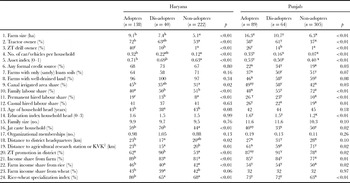
Table 1 contrasts a number of farm level indicators with the three adopter categories in each site. With the exception of a few variables (family size and organizational memberships), most variables are significantly associated with the adopter categories either in both study sites (e.g. distance indicators) or in one study site (e.g. light soil type and well drained only in Punjab). Often each indicator highlights two distinct groups in each site, but occasionally all three adoption categories differ significantly from each other within the site (e.g. ZT drill ownership).
Selected indicators by adoption category in Haryana and Punjab study sites.

p: significance within row comparison per site (ANOVA). Data followed by different letters differ significantly (a,b,c in Haryana, x,y,z in Punjab); Duncan (0.10), within row comparison per site.
†KVK: Krishi Vigyan Kendra, outreach stations for Indian agricultural research.
Source: adapted from Erenstein et al., Reference Erenstein, Malik and Singh2007b; Farooq et al., Reference Farooq, Sharif and Erenstein2007.
Farm size and asset base. Average operational landholding of surveyed households amounted to 6.7 ha in Haryana and 8.8 ha in Punjab, well above the average farm size in Haryana state (2.3 ha) and Punjab province (2.9 ha) according to government statistics (Erenstein et al., Reference Erenstein, Malik and Singh2007b; Farooq et al., Reference Farooq, Sharif and Erenstein2007), but consistent with the average reported for rice-wheat systems in the northwest IGP (Erenstein and Farooq, Reference Erenstein and Farooq2008). In both study sites owner-operators prevail (58–60%), followed by owner-cum-tenants, with pure tenancy uncommon (2–7%). Most of the operational land holding is thereby owned, i.e. self-cultivated (76–81%).
In both study areas, ZT adoption is strongly associated with the size of operational holding, with dis-adopters having intermediate farm sizes (Table 1: line 1). Land ownership shows a similar strong association with adoption categories (Erenstein et al., Reference Erenstein, Malik and Singh2007b; Farooq et al., Reference Farooq, Sharif and Erenstein2007). In both study areas the net land rented and/or shared is positive, i.e. average operational farm size exceeds the land owned. Only in Haryana is this associated with ZT adoption: adopters having the highest net area rented, suggesting these farmers are less resource-constrained and more commercial (Erenstein et al., Reference Erenstein, Malik and Singh2007b).
Particularly land owned is a structural asset that would have shown limited change for the sample as a whole since ZT started to diffuse. Its association with adoption categories can thus not be interpreted as an effect of ZT adoption. Instead, this association can be interpreted as farm size facilitating ZT adoption, likely a reflection of access to resources and information, returns to scale and risk-bearing capacity. ZT also potentially alleviates serious timeliness constraints on wheat establishment on larger farms. The smaller land holdings of non-adopters may reduce the willingness to risk experimenting with it on part of their holding.
In both Haryana and Punjab, adoption of ZT was positively associated with the possession of farming assets (particularly a tractor and farm equipment) and household assets (particularly a car/vehicle and household appliances). Individual asset categories and the overall asset index thus convey a similar message (Table 1: lines 2, 4 and 5) adopters typically being endowed with a higher asset base than non-adopters, with dis-adopters taking an intermediate or similar position. This likely again reflects access to resources and information and an enhanced investment and risk-bearing capacity.
Credit can alleviate financial constraints and thereby be an influential determinant of adoption decisions, but inventoried credit access indicators provided no clear association with adoption classes (Table 1: line 6; Erenstein et al., Reference Erenstein, Malik and Singh2007b; Farooq et al., Reference Farooq, Sharif and Erenstein2007). In part this may be associated with the prevailing reliance of ZT adopters on ZT drill services (see below), thus postponing the need for investment capital, whereas the cost-saving nature of ZT reduces operational capital needs.
Access to ZT drills. ZT drill ownership was significantly higher for adopters, less common for dis-adopters and virtually absent for non-adopters in each site (Table 1: line 3). The majority of ZT adopters thereby relied on contracted ZT drill services at the time of the survey (60% in Haryana and 74% in Punjab). This is in line with the common tillage practices in these areas where many farmers do not own a tractor but rely on tillage contract services to get their fields prepared.
Contracted ZT drill services allow tractor owners to put off the ZT drill investment decision. ZT drills are manufactured locally and their cost does not seem prohibitive for an average ZT adopter already owning a tractor, whereby they can typically recover the investment in one to two wheat seasons (Erenstein et al., Reference Erenstein, Farooq, Malik and Sharif2007a). Contracted ZT drill services also have made the technology accessible to smallholders without a tractor. Rental markets do imply increased dependence on timely and effective service delivery. The lack or untimely availability of drills and the high drill cost, particularly in Punjab, have been raised as issues limiting ZT diffusion (Jehangir et al., Reference Jehangir, Masih, Ahmed, Gill, Ahmad, Mann, Chaudhary and Turral2007; Tahir and Younas, Reference Tahir and Younas2004).
Irrigation, land quality and land use intensity. The surveyed rice-wheat cropping system primarily relies on tubewell irrigation, sometimes with the conjunctive use of canal irrigation sources. Adoption of ZT was positively associated with the conjunctive use of canal and tube-well irrigation (Table 1: line 9), whereas non-adopters tended to rely more heavily on tubewells only in both sites. The association between irrigation source and ZT may reflect a number of underlying irrigation characteristics. For one, conjunctive use implies a more developed irrigation infrastructure (i.e. a more favourable asset base). Canal irrigated areas typically also have a much longer irrigation history, whereas groundwater use showed a rapid increase over recent decades (Ahmad et al., Reference Ahmad, Turral, Masih, Giordano and Masood2007). The two irrigation sources also differ in terms of public support (for initial investment and operation and maintenance), and reliance on tubewells typically implies higher private irrigation costs, particularly in Pakistan where diesel tubewells prevail.
Soils in Haryana tend to be lighter and better-drained than in Punjab (farms with only [sandy] loam soils 67% and 48%, respectively; farms with well-drained land 97% and 57%, respectively). In Haryana there was no significant association between soil type or drainage and ZT adoption, but in Punjab heavy soils and drainage problems are associated with continued ZT use (Table 1 – lines 7 and 8). These soils would be more difficult to plough and so ZT would have more potential in reducing turnaround time. A separate study in the Punjab area indeed revealed that ZT users generally perceive heavier soils to be more suitable for ZT (Tahir and Younas, Reference Tahir and Younas2004).
The prevalence of irrigation implies high land use intensities: 199% in Haryana and 192% in Punjab (95% in the monsoon season and 97% in winter). Seasonal fallow is uncommon in Haryana (reported by 2% of households) but more widespread in Punjab: 18% of households reported some winter fallow, averaging 0.35 ha per household. Winter fallow is often associated with problem soils (e.g. poor drainage and water logging). Winter fallow was found to be positively associated with ZT adoption in Punjab (Farooq et al., Reference Farooq, Sharif and Erenstein2007). Part of the incentive to adopt ZT in Punjab may have been the potential of ZT to increase the area cultivated in winter. Another study in the Punjab rice-wheat area reported that adoption of zero tillage and laser levelling led to an expansion in cropped area on medium- and large-scale farms (Ahmad et al., Reference Ahmad, Turral, Masih, Giordano and Masood2007). They attributed this to water and to a lesser extent labour limiting the wheat area sown. Our study cannot unambiguously link ZT to an increased wheat area, lacking baseline or retrospective data, whereas adopters did not report any significant change in farm activities or area cultivated in both sites. In any case, the eventual increase in area due to ZT would be curtailed by the overall limited fallow area even in Punjab.
Farm labour. The surveyed rice-wheat households rely on a combination of family, casual and permanent labour sources. Casual labour is particularly hired to address labour peaks such as rice transplanting and cereal harvesting. Permanent labour is positively associated with farm size, particularly in Pakistan. Family labour is variously engaged in farm and other activities, with primarily males engaged in field-based crop activities. Reliance on mechanized service providers (e.g. for tractor operations or combine harvesting) is common, whereas on machine-owning farms adult family and/or permanent labour typically possess the machinery handling skills.
In both Haryana and Punjab, adoption of ZT was negatively associated with reliance on family labour and positively associated with reliance on permanent labour (Table 1: lines 10 and 11). In Punjab only, adoption of ZT was also positively associated with reliance on casual labour (Table 1: line 12). These variations in labour use patterns are unlikely to be the result of ZT adoption, although we lack baseline or retrospective data to assert this unambiguously. ZT is primarily a tractor-saving technology with relatively limited implications for labour use in wheat cultivation (Erenstein et al., Reference Erenstein, Farooq, Malik and Sharif2008). These labour use variations likely reflect underlying characteristics of the farm household (particularly wealth, farm size, commercial orientation and possibly human capital) that influence the adoption decision. They are associated with family labour availability relative to land, particularly in view of the significant differences in the size of holding whereas there was no significant difference in terms of household size or composition between adoption classes (Erenstein et al., Reference Erenstein, Malik and Singh2007b; Farooq et al., Reference Farooq, Sharif and Erenstein2007). The adopters also are economically better off and thereby can more easily opt for hiring in labour to substitute for family labour. Indeed, reliance on family labour is negatively associated with the household assets. It also highlights that adopters are likely to be more commercially oriented.
Social characteristics. The farmer and household social characteristics comprise elements of the household's human and social capital base and can in turn modify access to other assets. In both study areas the Jat caste prevails numerically (46% of surveyed households in Punjab, mainly Muslim by faith, and 52% in Haryana, mainly Sikh or Hindu by faith). The Jats are a peasant caste, typically comprising peasant proprietors in the northwest IGP. Particularly in Haryana, the Jats have benefited from land reforms and now form the backbone of its agricultural economy (Britannica, 2008; Wikipedia, 2008).
In both Haryana and Punjab, adoption of ZT was associated with the household belonging to the Jat caste – albeit in opposite ways. In Haryana non-adopters are more diverse and less likely to be Jat (Table 1: line 16), possibly reflecting less social capital and more constrained access to resources and information. In Punjab the reverse was true with non-adopters more likely to be Jat (Table 1: line 16), and this was probably associated with the less extensive land reforms and with landlords still dominating the rural scene (Erenstein and Farooq, Reference Erenstein and Farooq2008).
Age of the household head was only significantly associated with the adoption categories in Haryana, dis-adopters being relatively younger (Table 1: line 13). This may be associated with younger farmers being more confident and willing to experiment with new technological options yet also less willing to persevere. Educational status of the household head was only significantly associated with the adoption categories in Punjab, with non-adopters having a low literacy ratio and education index (Table 1: line 14). Family size and organizational membership indicators provided no clear association with adoption classes (Table 1: lines 15 and 17).
Location. Location of the farm is linked to the exposure to various factors that drive and modify farm dynamics, including technology adoption. Distance is associated with adoption and dis-adoption in each site, but no clear pattern emerges across the two sites. In Haryana, various proximity indicators were associated with dis-adoption, the latter likely reflecting the combined effect of exposure to ZT and diversification incentives (Table 1: lines 18 and 19).
The ZT technology has been promoted in both study areas and one would expect the assumed intensity of ZT promotion at the district level to be significantly associated with the adoption categories. Contrary to expectations, promotion was primarily associated with dis-adoption (Table 1: line 20). ZT promotion thus played an important role in the introduction of the technology, but less so in its continued use. This could reflect promotion being supply driven and that for whatever reason the ZT technology performed less well in dis-adopters’ fields than implied by the ZT promoters. However, it also is associated with the technology primarily spreading from farmer to farmer with other farmers as the main source of information in both study areas (Erenstein et al., Reference Erenstein, Malik and Singh2007b; Farooq et al., Reference Farooq, Sharif and Erenstein2007).
Income sources and rice-wheat specialization. In both Haryana and Punjab, farming was the main income source across households, contributing 80 % or more of overall household income. The income share from farming is associated with ZT adoption categories, being highest for adopters in Haryana and adopters and dis-adopters in Punjab (Table 1: line 21). This highlights a positive association of ZT adoption and penetration, respectively, with the farm households’ reliance on agriculture for income. This agricultural specialization reflects their larger landholding and more commercial orientation.
In Haryana, rice and wheat contributed about equal shares to household income (43% and 42%, respectively). In Punjab, the relative income share favours rice over wheat (51% and 32%, respectively), associated with the more widespread cultivation of high-value basmati rice. In our Haryana sample, adopters have taken the rice-wheat specialization furthest (Table 1: lines 22–24). In Punjab, adopters and dis-adopters were relatively similar in terms of having the highest relative contribution of rice to farm income and having taken the rice-wheat specialization furthest. The combination of these factors likely enhances the incentives for adopters in Haryana and adopters and dis-adopters in Punjab to innovate and cut production costs in rice-wheat systems.
In Haryana, dis-adoption of ZT was positively associated with income from sugarcane cultivation, which is often grown in a 2-year rotation with wheat. This reduced their reliance on rice-wheat systems whereas the prevailing tine-type ZT drills will not work well without prior tillage in former sugarcane fields owing to the persistent rootstocks. To use ZT in such fields, heavier double-disc drills are needed that can cut through the rootstocks, and these only started becoming available in 2002/03 (Erenstein et al., Reference Erenstein, Thorpe, Singh and Varma2007c).
Overall the bivariate analysis of farm level indicators thus highlights several contrasts and similarities between ZT adopters, dis-adopters and non-adopters in each site. Compared to multivariate analysis, the bivariate analysis has the advantage of allowing a more comprehensive coverage of variables measured (Erenstein et al., Reference Erenstein, Farooq, Malik and Sharif2007a). Some contrasts are robust and similar across sites. Most noteworthy are the significant divergences in terms of their resource base in both study areas. For most of the indicators compiled, adopters typically have the most favourable values and the non-adopters the least favourable, with dis-adopters often taking an intermediate position. This has two important implications. First, it highlights that ZT adoption in the initial diffusion stage is strongly associated with the wealth of the farm household, likely reflecting better access to innovations, their risk-bearing capacity and ability to innovate. Second, it highlights that ZT dis-adopters combine characteristics of both adopters and non-adopters. The favourable characteristics may thereby facilitate the initial adoption of ZT, whereas the unfavourable characteristics undermine its continued use.
Farm-level impacts of ZT
Whereas differences at the farm household level help explain observed ZT adoption decisions, there was no substantive evidence of ZT adoption contributing to such differences. The impact of ZT primarily reflected immediate positive effects on the wheat crop budget through significant cost savings, and in the case of Haryana, additional yield effects (Erenstein et al., Reference Erenstein, Farooq, Malik and Sharif2007a; Erenstein et al., Reference Erenstein, Farooq, Malik and Sharif2008). ZT adopters have the largest farms and wheat areas and therefore potentially benefit most on an aggregate-household basis from a cost-saving technology such as ZT (Erenstein et al., Reference Erenstein, Farooq, Malik and Sharif2007a).
In both Haryana and Punjab, farmers reported that the ZT technology implied time savings for wheat cultivation. The time thus saved was primarily used for other agricultural activities, and to a lesser extent for more leisure time and other non-agricultural activities. Adopters and dis-adopters generally agreed that the adoption of ZT did not reduce the time for cultivating rice. In both study areas, adopters and dis-adopters differed significantly in terms of whether ZT had increased the family's income, with the majority of adopters and only a minority of dis-adopters reporting an increase. It was only in Punjab that the adoption of ZT reportedly increased the family's food consumption, with nearly half the adopters reporting an increase. As there was no significant yield increase linked to the adoption of ZT in Punjab, this may reflect the ZT-induced cost savings and correspondingly higher disposable income being used to enhance family food consumption.
In terms of changes in farming activities, adopters and dis-adopters in both sites reported primarily productivity effects of ZT proper, with most farmers reporting time and cost savings. In the case of Haryana, it is interesting to note that the reporting of the various ZT-related benefits was markedly less pronounced for dis-adopters, which suggests that they typically had less successful experiences with ZT, leading to their discontinuation with the technology. In the case of Punjab, adopters and dis-adopters largely concurred in terms of the ZT-related benefits. This suggests that in Punjab, ZT dis-adoption reflected a complex of factors (Erenstein et al., Reference Erenstein, Farooq, Malik and Sharif2007a). For some dis-adopters, yield considerations were paramount and thereby nullified time- and cost-saving considerations. Other dis-adopters may have had such favourable perceptions, but unable to act upon them in view of problematic access to the ZT drill in the survey year.
ZT wheat also seems to have had no discernible effects on other farm activities of the household, including other crops, livestock and non-farm activities. Livestock are dependent on the wheat and rice residues, but ZT wheat has so far had limited implications for crop-residue management. This reflects the prevailing harvesting, residue-collection and residue-burning practices for the preceding rice crop with generally still limited consideration for the retention of crop residues as mulch – a necessary component of conservation agriculture.
Equity implications
The study indicates some equity concerns as ZT uptake and the corresponding benefits are positively associated with farm size in each study area. Although ZT is potentially scale neutral and in principle accessible to smallholders through service providers, various constraints have limited its uptake amongst smallholders. Our study findings thereby confirm the expectation of Franke et al. (Reference Franke, McRoberts, Marshall, Malik, Singh and Nehra2003) that ZT adoption differs between farmer socioeconomic classes.
In the present context, the tractor and cost-saving nature of ZT wheat have relatively limited implications for labour use. Consequently, although ZT adoption has bypassed the poor landless class, it also seems to have had limited adverse effects on their employment. The bulk of their employment opportunities as agricultural labour in the rice-wheat system are linked to the major labour peaks of rice transplanting and cereal harvesting. Monitoring and better understanding the equity implications of extending resource-conserving technologies like ZT to rice establishment will be imperative.
Innovations that are primarily adopted by resource-rich farmers widen the technology and income gap between resource-rich and resource-poor farmers (Franke et al., Reference Franke, McRoberts, Marshall, Malik, Singh and Nehra2003). This might contribute to further farm consolidation in the northwest IGP with potentially grave social consequences of disappearing rural livelihoods (Franke et al., Reference Franke, McRoberts, Marshall, Malik, Singh and Nehra2003). This calls for enhancing the human capital base and skills of the rural poor and stimulating the economic growth of the secondary and tertiary sectors to absorb surplus labour from the primary sector (Erenstein et al., Reference Erenstein, Thorpe, Singh and Varma2007c). At the same time more equitable access to ZT is called for.
Penetration of ZT is still uneven both geographically and within communities (Erenstein et al., Reference Erenstein, Farooq, Malik and Sharif2007a). This suggests there is a need to enhance the accessibility to ZT knowledge, particularly for smallholders. Alleviating knowledge blockages can further an equitable access to this promising technology. Such efforts should complement and build on farmer to farmer exchanges, for instance, through more field days and a more participatory and farmer-field school approach.
There also seems a need to enhance the accessibility of smallholders to ZT drill service providers. Such services have much merit, but only when they are timely, reliable and widely accessible. Much of the potential benefits from ZT are easily thwarted by a late or uncertain arrival of the ZT drill or its improper use – calling for well-trained operators and properly maintained ZT drills. Resource constraints, ZT drill cost and limited tractor ownership naturally limit the potential for self-owned ZT drills for smallholders.
The companion studies show ZT adoption is worthwhile in both study areas (Erenstein et al., Reference Erenstein, Farooq, Malik and Sharif2007a; Erenstein et al., Reference Erenstein, Farooq, Malik and Sharif2008). However, that assessment primarily relies on the ZT performance on adopter and thus better-endowed farms. This calls for a further assessment of the performance of ZT on less-endowed farms in the same areas. Similarly, the study focused on the northwest IGP which is better endowed and has more intensive rice-wheat systems than the eastern plains (Erenstein et al., Reference Erenstein, Thorpe, Singh and Varma2007c). This calls for a closer scrutiny of the adoption, impacts and implications of ZT now that the uptake of ZT in the eastern plains has started to pick up.
Study limitations and implications for further research
Empirical household surveys such as used for the present study provide a useful tool to assess who is actually benefitting from new technologies like ZT. They also allow us to quantify and test for significance of observed differences. At the same time such surveys have their shortcomings, including their time-consuming nature, the reliance on farmer responses and inability to control for all underlying sources of variation.
There is scope for combining such quantitative methods with more qualitative approaches. The studies would have benefited from complementary informal surveys to shed more light on understanding some of the conjectural areas to do with farmers’ perceptions of incentives and risks and how these influenced decisions. For instance, what were the main reasons for adoption (e.g. potential to increase the winter area cultivated in Punjab) and particularly dis-adoption (e.g. problematic access to the ZT drill in the survey year)? Do smaller land holdings of non-adopters reduce their willingness to risk experimenting with ZT? How did the ZT-related cost savings in Punjab lead to an increase in family food consumption? Such surveys could also provide more intensive, participatory and timely monitoring of the uptake, adaptation and eventual dis-adoption of new technologies like ZT. The two approaches are complementary and can enrich the interpretation and validity of findings. In this respect, a livelihood system and value chain perspective will be useful and should enhance the relevance and equity of research and development interventions.
The present study primarily limited itself to comparing ZT adopters, dis-adopters and non-adopters in terms of farm household characteristics. Considerable differences were found at the farm household level and these help explain observed ZT adoption decisions. The various indicators analysed are associated with, and therefore proxies for, other factors such as access to capital and information and psychological characteristics. Further disentangling the underlying associations and linkages merits follow-up research.
The association between resource endowment and ZT adoption also has important implications for impact assessment. Indeed, the farmers’ socioeconomic position typically correlates strongly with farm profitability (Erenstein et al., Reference Erenstein, Malik and Singh2007b; Farooq et al., Reference Farooq, Sharif and Erenstein2007; Franke et al., Reference Franke, McRoberts, Marshall, Malik, Singh and Nehra2003). Structural differences between adopter classes were thus found to translate into significant management and productivity differences between wheat plots of adopters (irrespective of whether ZT or conventional wheat) and non-adopters and dis-adopters (Erenstein et al., Reference Erenstein, Malik and Singh2007b; Farooq et al., Reference Farooq, Sharif and Erenstein2007). Comparisons of ZT performance can thus be easily confounded with underlying structural differences (Erenstein et al., Reference Erenstein, Farooq, Malik and Sharif2008), calling for the need to control for such differences which influence production outcomes. One option would be to stratify technology comparisons by resource endowment, thus providing a more realistic assessment of the benefits of its adoption for poorer farmers.
CONCLUSIONS
ZT has been primarily adopted by the better endowed farmers in the rice-wheat systems of India's Haryana State and Pakistan's Punjab province. ZT adopters typically have the most favourable values for most of the farm household indicators compiled and the non-adopters the least favourable, with dis-adopters often taking an intermediate position.
The study highlights that ZT adoption is strongly linked to the wealth of the farm household in the initial diffusion stage. This calls for closer consideration of equity implications in future research and development. It particularly indicates the need to extent ZT to less endowed farmers by facilitating access to ZT knowledge and ZT drills. The structural differences between the adopters and non-adopters/dis-adopters also easily confound the assessment of ZT impact across adoption categories. Finally, there is a need to complement surveys of structural variables with more informal approaches to enhance our understanding and monitor the uptake of ZT in rice-wheat systems.
Acknowledgements
The paper draws from two detailed country studies (Erenstein et al., Reference Erenstein, Malik and Singh2007b; Farooq et al., Reference Farooq, Sharif and Erenstein2007) and a synthesis (Erenstein et al., Reference Erenstein, Farooq, Malik and Sharif2007a). The original studies were funded through the Comprehensive Assessment of Water Management in Agriculture. The views expressed in this paper are those of individual scientists and do not necessarily reflect the views of the donor or the authors’ institutions. The present study benefited from the assistance of numerous individuals and institutions that have been acknowledged in the corresponding country reports to the extent possible. The paper benefited from reviewers’ comments.