INTRODUCTION
Angiostrongylus vasorum is a metastrongylid nematode known to infect dogs and wild canids using gastropod molluscs as intermediate hosts. Dogs are highly susceptible to infection and the subsequent disease can be life-threatening. A wide range of clinical presentations have been recognized including coagulopathies, respiratory, neurological, locomotor and cardiovascular signs, with some dogs being asymptomatic (Morgan et al. Reference Morgan, Jeffries, van Otterdijk, McEniry, Allen, Bakewell and Shaw2010). Angiostrongylus vasorum infection has been reported in several areas of Europe, Africa, Canada, and North and South America (Helm et al. Reference Helm, Jackson and Bell2010). New reports of its occurrence in several countries, in which it has previously been unreported, have sparked interest in its current distribution and the apparent expansion in its geographical range. Canine infection in the UK was initially reported to have occurred in Cornwall (Martin and Neal, Reference Martin and Neal1992) and South Wales (Patteson et al. Reference Patteson, Gibbs, Wotton and Day1993), then to have spread across into Southeast England and later, into Northern England (Yamakawa et al. Reference Yamakawa, McGarry, Denk, Dukes-McEwan, Macdonald, Mas, McConnell, Tatton, Valentine, Williams and Hetzel2009) and Scotland (Helm et al. Reference Helm, Gilleard, Jackson, Redman and Bell2009).
The first UK report of A. vasorum infection in red foxes (Vulpes vulpes) was made in Cornwall, with five cases reported close to the location of the first canine cases reported in that country (Simpson, Reference Simpson1996). Two of these cases were clinically symptomatic for the infection and had severe lung lesions closely resembling those observed in dogs dying from angiostrongylosis. Studies of foxes in Denmark, close to Copenhagen, showed a high incidence of infection; however, in contrast, these foxes were not known to be clinically ill and showed minimal pathology (Bolt et al. Reference Bolt, Monrad, Henriksen, Dietz, Koch, Bindseil and Jensen1992). This group proposed that there is a good degree of host–parasite adaptation and it is now known that red foxes are the major wildlife reservoir for dogs in Europe (Tolnai et al. Reference Tolnai, Szell and Sreter2015). Hence, knowledge about infection rates in foxes is of relevance to canine health. Surveys of foxes carried out in Great Britain between 2005 and 2006 found an overall infection rate of 7·3% (Morgan et al. Reference Morgan, Tomlinson, Hunter, Nichols, Roberts, Fox and Taylor2008) increasing to 18·3% in 2013–2014 (Taylor et al. Reference Taylor, Gato, Learmount, Aziz, Montgomery, Rose, Coulthwaite, McGarry, Forman, Allen, Wall and Morgan2015). It is of interest, that this apparent increase in fox infection rate mirrors the increase in canine angiostrongylosis cases in the UK.
The first canine case reported in Ireland was in a greyhound in 1968 (Roche and Kelliher, Reference Roche and KellIher1968). Further Irish cases have been reported sporadically over the years (Dodd, Reference Dodd1973; Brennan et al. Reference Brennan, McCarthy, McAllister, Basset and Jones2004; O'Neill et al. Reference O'Neill, Acke, Tobin and McCarthy2010; Gallagher et al. Reference Gallagher, Brennan, Zarelli and Mooney2012; Zarelli et al. Reference Zarelli, Shiel, Gallagher, Skelly, Calahan and McAllister2012). However, while A. vasorum has been identified previously in Irish foxes around the Dublin region (Wolfe et al. Reference Wolfe, Hogan, Maguire, Fitzpatrick, Vaughan, Wall, Hayden and Mulcahy2001), it was reported to be of low prevalence and no indication of the number of infected animals was provided. The distribution and rate of infection in foxes, or indeed in dogs, in Ireland has never been formally examined. This is important to facilitate evidence-based decision-making with regard to risk management and the need for preventative healthcare for dogs with respect to their potential exposure to A. vasorum.
The aims of this study were to confirm the presence and the geographical distribution of A. vasorum in red foxes throughout Ireland, providing an estimate of the countrywide wildlife reservoir of infection. This information will, in turn, serve as a baseline to monitor any future spread of the parasite in the fox population.
MATERIALS AND METHODS
Acquisition of foxes
Samples examined in this study were obtained from the Department of Agriculture, Food and the Marine and from the Irish Equine Centre. Foxes were sourced through the Irish governmental screening programme for Echinococcus multilocularis status under EU Regulation 1152/2011. The sampling strategy included the objective to obtain foxes from all regions and counties in Ireland. The foxes were culled, by shooting, for pest and predator control and some were inadvertently captured in traps set for other wildlife as part of wildlife disease control measures. The fox population in Ireland has been estimated between 150 000 and 200·000 (Hayden and Harrington, Reference Hayden and Harrington2000; Marnell et al. Reference Marnell, Kingston and Looney2009). In terms of sampling size to estimate infection prevalence for A. vasorum, assuming an expected 30% prevalence with 95% confidence interval (CI) and 5% precision, 323 fox samples needed to be examined (Thrusfield, Reference Thrusfield1986). However, as 550 samples were available, all were examined. Plucks (trachea, heart and lungs) from these foxes, killed between July 2014 and May 2015, were collected and examined as described below. Precise information (within 0·5 km) about the location of where each fox was found was available for all but two animals included in the survey. All plucks obtained were frozen and maintained at −20 °C until thawed for examination.
Parasitological investigation
To examine for A. vasorum, the heart was removed from the pericardium, an incision made through the right atrium and ventricle, the pulmonary arterial trunk opened by cutting along its length towards the lungs and the arterial supply to each of the seven lung lobes opened in turn. This dissection necessitated cutting through some small airways and pulmonary tissues. The cardiac chambers and arteries were inspected visually for the presence of parasites. The pluck was then immersed in a white, shallow bowl of water and washed thoroughly and the process was repeated twice. Parasites were identified visually and removed. All blood clots were manually disrupted and examined for the presence of worms. Recovered parasites were collected and stored in 10% buffered formalin for microscopic confirmation of identity. Parasites for microscopic identification were cleared in lactophenol for 48 h prior to examination at 40× magnification. Confirmation of identification was carried out by a European College Board certified parasitologist (TdW).
RESULTS
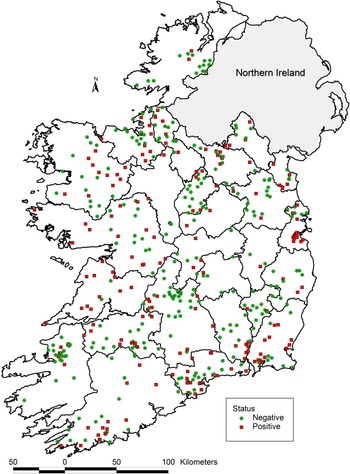
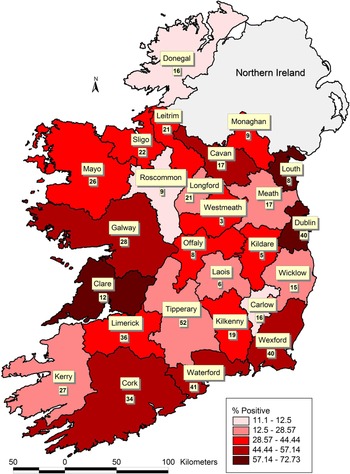
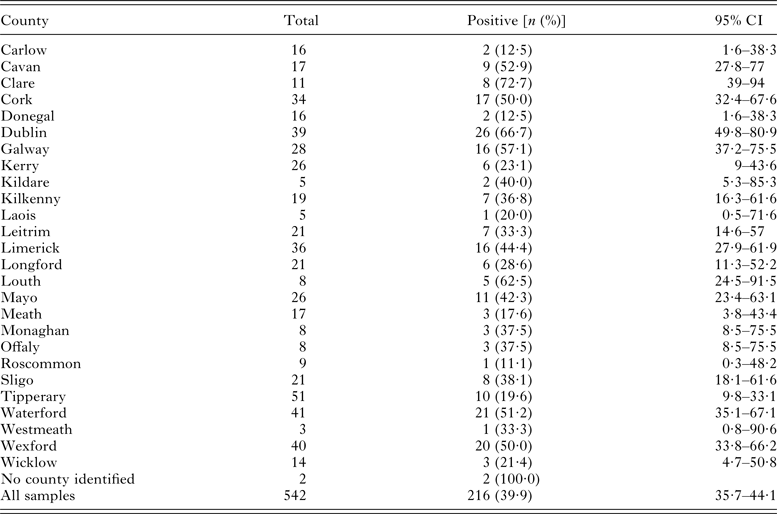
Overall, 550 fox plucks were examined; 394 were obtained from the Department of Agriculture, Food and the Marine and a further 156 plucks from the Irish Equine Centre. Eight samples were severely damaged by shooting and were excluded from the study. Of the remaining 542 plucks, 216 (39·9%) were positive for A. vasorum based on visual inspection and later confirmed by microscopy of collected parasites. Crenosoma vulpis adult parasites were coincidently identified in seven of these foxes (1·3%), four foxes showing dual infection. The geographical distribution of A. vasorum positive and negative foxes is shown in Fig. 1. Positive samples were obtained from each of the 26 counties in the Republic of Ireland (Table 1). The prevalence of infection ranged from 11·1 to 72·7%, with one county having the prevalence in excess of 70%, seven in excess of 50%, and three counties with a low prevalence of less than 13% (Fig. 2).
Geographical distribution of fox samples screened for Angiostrongylus vasorum. Red squares represent positive samples. Green circles represent negative samples.

Percentages of foxes positive for Angiostrongylus vasorum per county in the Republic of Ireland. Numbers in each county represent the total number of foxes screened in that county.

Total numbers of samples examined and prevalence per county

Confidence Intervals (95% CI) were calculated using GraphPad Prism version.6, GraphPad Software, California, USA.
DISCUSSION
Angiostrongylus vasorum is found in Europe, Africa, North and South America (Taylor et al. Reference Taylor, Gato, Learmount, Aziz, Montgomery, Rose, Coulthwaite, McGarry, Forman, Allen, Wall and Morgan2015). Dogs and wild canids such as foxes, wolves, coyotes and jackals are known to be definitive hosts (Morgan and Shaw, Reference Morgan and Shaw2010; Elsheikha et al. Reference Elsheikha, Holmes, Wright, Morgan and Lacher2014). The parasite primarily uses gastropods (slugs and snails) as its intermediate hosts and as many as 25 species have been identified as being suitable (Tonsberg, Reference Tonsberg2006). Overall the best documented wildlife reservoir of A. vasorum is the red fox (Otranto et al. Reference Otranto, Cantacessi, Dantas-Torres, Brianti, Pfeffer, Genchi, Guberti, Capelli and Deplazes2015).
In affected countries, angiostrongylosis had previously occurred in well-defined, endemic areas, with only sporadic cases reported outside these locations (Bolt et al. Reference Bolt, Monrad, Koch and Jensen1994). However, recent reports of disease prevalence suggest an apparent expansion in the parasite's range to areas outside known endemic areas. For instance, A. vasorum has been newly identified in dogs in Slovakia (Hurnikova et al. Reference Hurnikova, Miterpakova and Mandelik2013), Serbia (Simin et al. Reference Simin, Kosic, Kuruca, Pavlovic, Savovic and Lalosevic2014) and Belgium (Jolly et al. Reference Jolly, Poncelot, Lempereur, Caron, Bayrou, Cassart, Grimm and Losson2015) and in foxes in Poland (Demiaszkiewicz et al. Reference Demiaszkiewicz, Pyziel, Kuligowska and Lachowicz2014) and USA (Kistler et al. Reference Kistler, Brown, Allison, Nameth and Yabsley2014). Such an expansion pattern was predicted by a model of potential global distribution of A. vasorum presented by Morgan et al. (Reference Morgan, Jefferies, Krajewski, Ward and Shaw2009).
Interestingly, the first reported cases in the UK, and in the USA, were in greyhounds that had been imported from the Irish Republic (Jacobs and Prole, Reference Jacobs and Prole1975; Williams et al. Reference Williams, Lindemann, Padgett and Smith1985). In Ireland, A. vasorum is considered endemic.
In 2009 in Europe, the reported prevalence of A. vasorum infection in the fox ranged from 5 to 49% and was reported to be higher than that in dogs (range 0·3–9·8%) from the same geographical area (Koch and Willesen, Reference Koch and Willesen2009). This suggests that foxes may serve as reservoir hosts for infection in dogs. This hypothesis is supported by studies showing that the parasite can be transmitted between fox and dog (Guilhon, Reference Guilhon1965; Bolt et al. Reference Bolt, Monrad, Henriksen, Dietz, Koch, Bindseil and Jensen1992). In addition, Jefferies and colleagues found no evidence of genetic disparity between A. vasorum isolates from foxes and dogs (Jefferies et al. Reference Jefferies, Shaw, Viney and Morgan2009).
In 2014/2015, the reported prevalence of A. vasorum infection in foxes in various European countries ranged from 4·2 to 51·8% [51·8% (n = 329) in Italy, 17·9% (n = 937) in Hungary, 5·2% (n = 76) in Poland and 4·2% (n = 96) in the Netherlands (Demiaszkiewicz et al. Reference Demiaszkiewicz, Pyziel, Kuligowska and Lachowicz2014; Eleni et al. Reference Eleni, Grifoni, Di Egidio, Meoli and De Liberato2014; Franssen et al. Reference Franssen, Nijsse, Cremers, Dam, Takumi and van der Giessen2014; Magi et al. Reference Magi, Guardone, Prati, Mignone and Macchioni2015; Santoro et al. Reference Santoro, D'Alessio, Di Prisco, Neola, Restucci, Pagano and Veneziano2015; Tolnai et al. Reference Tolnai, Szell and Sreter2015)]. A survey of 546 UK foxes, carried out between 2005 and 2006, found an overall prevalence of infection of 7·3% (Morgan et al. Reference Morgan, Tomlinson, Hunter, Nichols, Roberts, Fox and Taylor2008). This was followed by a survey of 442 foxes carried out in 2013–2014 which found an overall prevalence of 18·3% with an infection rate of 7·4% occurring in Northern UK; an area that had previously had zero prevalence (Taylor et al. Reference Taylor, Gato, Learmount, Aziz, Montgomery, Rose, Coulthwaite, McGarry, Forman, Allen, Wall and Morgan2015).
This study represents the first comprehensive survey of A. vasorum in foxes in the Republic of Ireland. Red foxes have been observed in all parts of Ireland (National Biodiversity Data Centre, 2015) and the survey sampling strategy included the objective to obtain samples from all regions and counties. Additionally, from the point of view of coverage of the country, a large number of foxes were examined compared with the geographical area (Republic of Ireland 70 273 km2) with an average of 21 foxes collected from each of the country's 26 counties (range 3–52). In view of this, and the total number of samples examined, the report provides robust evidence of widespread distribution of A. vasorum infection in the Irish fox population.
This report confirms that the parasite is endemic in the Republic of Ireland and that, based on these current figures, the overall prevalence in Irish foxes is second highest in Europe. Prevalence rates varied throughout the 26 counties ranging from 72·7% (Co Clare) to 11·1% (Co Roscommon) indicating that the infected fox reservoir spans the country with an overall prevalence rate of 39·9%.
In a previous study, 79 faecal samples were collected from Irish foxes on the east coast of Ireland (‘Dublin and the surrounding counties’ sic) and A. vasorum larvae were recorded to be of ‘low prevalence’ in these samples (Wolfe et al. Reference Wolfe, Hogan, Maguire, Fitzpatrick, Vaughan, Wall, Hayden and Mulcahy2001). However, fecal samples were only examined by saturated sugar flotation and not by modified Baermann flotation technique. In Dublin and the surrounding counties (Meath, Kildare and Wicklow) in this study, the overall prevalence rate was 36·4% which is close to the national average. This may suggest that the prevalence of infection is increasing in this part of the country.
C. vulpis, another metastrongylid parasite which uses gastropods as intermediate hosts, has a worldwide distribution in dogs and foxes (Levine, Reference Levine1980) where it inhabits the trachea, bronchi and bronchioles. The only clinical case reported to date in Ireland was from a 1-year-old Cavalier King Charles Spaniel from Northern Ireland (Reilly et al. Reference Reilly, McGarry, Martin and Belford2000). To our knowledge, it has not been previously reported on the island of Ireland in the fox but its presence was presumed (Conboy et al. Reference Conboy, Hare, Charles, Steeje and Heine2009). Its coincidental discovery in seven foxes in this study, confirms its presence in foxes in Ireland. However, our dissection method was not designed to investigate airway parasites. Therefore, our findings most likely underestimate the true prevalence of infection. Further work needs to be carried out to investigate its actual prevalence.
This high prevalence and wide distribution of A. vasorum in foxes in Ireland has implications for the diagnosis and treatment of infections in dogs. Case management decisions and prophylactic regimes should take into consideration the local risk and regional variation and prevalence in infected foxes. Routine screening of dogs using the commercially available canine A. vasorum antigen detection tests or faecal parasitology should be considered in areas which have high prevalence of infection in foxes and in any animals with suggestive clinical signs.
Much still remains to be determined about the ecology of A. vasorum. In particular, knowledge about intermediate and reservoir hosts and how this information relates to disease transmission and expression in dogs is of significant clinical relevance. The dynamics of infection in wild populations and factors underpinning the spill-over to domestic dogs is highly relevant and requires considerable further investigation (Elsheikha et al. Reference Elsheikha, Holmes, Wright, Morgan and Lacher2014).
In conclusion, this is the first national survey of A. vasorum infection in the Irish fox population. It identifies a high prevalence of parasite infection in this species and highlights the exposure of the Irish dog population to serious risk of cross-infection. In addition, it confirms the presence of C. vulpis in Irish foxes for the first time.
ACKNOWLEDGEMENTS
The authors would like to thank the Veterinary research Officers at the Regional Veterinary Laboratories and Ursula Fogarty at the Irish Equine centre for their assistance in the collection of the fox samples.
FINANCIAL SUPPORT
This research received no specific grant from any funding agency, commercial or not-for-profit sectors.