1 Introduction
In Present-day English the principal ways of forming new adverbs are suffixation by means of -ly and -wise, and zero derivation (conversion). Diachronic studies show that the -ly suffix has become increasingly productive over time: it is now capable of forming degree modifiers and sentence adverbs, and can even be applied to present participles and stative adjectives (Kjellmer Reference Kjellmer1984; Nevalainen Reference Nevalainen, Rissanen, Kytö and Heikkonen1997; Swan Reference Swan1997; Killie Reference Killie2000). Developments such as these can be viewed as indicators that the -ly suffix is becoming fully productive and is close to qualifying as an inflectional suffix; in fact, some researchers argue that this is already the case (Marchand Reference Marchand1969; Quirk, Greenbaum, Leech & Svartvik Reference Quirk, Greenbaum, Leech and Svartvik1985: 1556; Baayen & Renouf Reference Baayen and Renouf1996). In this sense, we can talk about -lyadverbialization as a process of grammaticalization.
Despite its high productivity, however, -ly suffixation has not been implemented to the same extent in all adverb categories. Intensifiers continue to be a particularly heterogeneous class, containing a number of suffixless deadjectival adverbs such as bloody, pretty, real and very. Previous research shows that in Present-day English the choice between -ly and zero-derived intensifiers such as real and really varies regionally (Kortmann & Schneider Reference Kortmann and Schneider2006), and can be affected by social and stylistic factors (Macaulay Reference Macaulay1995, Reference Macaulay2002; Biber, Johansson, Leech, Conrad & Finegan Reference Biber, Johansson, Leech, Conrad and Finegan1999: 564; Tagliamonte & Ito Reference Tagliamonte and Ito2002; Ito & Tagliamonte Reference Ito and Tagliamonte2003). In this article I will discuss the extent to which the spread of -ly to intensifiers was socially determined rather than regulated solely by linguistic constraints in the past. It is noteworthy that what looks like free variation is also commonly attested with the choice of intensifier form in earlier English (Peters Reference Peters and Kastovsky1994: 284).
The terminology I use mostly follows that of Quirk et al. (Reference Quirk, Greenbaum, Leech and Svartvik1985). The term modifier refers to the basic syntactic function of adverbs that modify adjectives and other adverbs, and thus operate at the level of constituents rather than at the clause level. When intensifiers assume a Verb(-Phrase) modifying role they are classified as subjuncts (Quirk et al. Reference Quirk, Greenbaum, Leech and Svartvik1985: 583). Subjuncts have a syntactically subordinate role compared with other sentence elements, including adjuncts, which fulfil clause-level functions as adverbials. On this adverbial cline, subjuncts fall between modifiers and adjuncts. We may assume that -ly suffixation spread from its typical context of adjunct formation via subjuncts to modifiers (Nevalainen Reference Nevalainen and Kastovsky1994; Nevalainen & Rissanen Reference Nevalainen and Rissanen2002).
This study sheds light on the process of -ly adverbialization and its social embedding in a set of intensifiers drawn from a socially stratified corpus, the Corpus of Early English Correspondence (CEEC; Nevalainen & Raumolin-Brunberg Reference Nevalainen and Raumolin-Brunberg2003; Raumolin-Brunberg & Nevalainen Reference Raumolin-Brunberg, Nevalainen, Beal, Corrigan and Moisl2007). I will focus on the period from the fifteenth to the late seventeenth century tracing the history of a set of dual-form intensifiers the zero forms of which were condemned by eighteenth-century normative grammarians. The pairs to be analysed consist of exceeding/exceedingly, excellent/excellently, extraordinary/extraordinarily, extreme/extremely, full/fully and marvellous/marvellously. They all function as amplifiers, and scale the meaning of the modified element upwards from an assumed norm (Quirk et al. Reference Quirk, Greenbaum, Leech and Svartvik1985: 445). The study includes the -ly and zero-form instances of these intensifiers in both subjunct and modifier functions.
In the eighteenth century, suffixless adverbs in general, and intensifiers in particular, were condemned by prescriptive grammarians. Robert Lowth (Reference Lowth1764: 94), one of the household names of eighteenth-century prescriptive grammar, denounced collocations such as excellent well, extreme elaborate and marvellous graceful.Footnote 2 As Sundby, Bjørge & Haugland (Reference Sundby, Bjørge and Haugland1991: 200–3) illustrate, eighteenth-century grammars branded suffixless intensifiers as ‘improper’, ‘inelegant’, ‘absurd’, ‘unidiomatic’ and ‘ungrammatical’ or simply ‘bad’. The fact that such proscriptions arose suggests not only linguistic variation but also social differentiation. Appeals to notions such as ‘improper’ and ‘inelegant’ imply second-order indexicality, attaching to the use of these forms a social evaluation of their users (Milroy Reference Milroy, Bex and Watts1999).
Analysing extralinguistic factors, such as writers' socio-economic status and regional background, may provide evidence of the degree to which -ly suffixation has been implemented across the social spectrum over time. If a grammaticalization process fails to apply to some significant sections of the language community, extralinguistic determinants can lead to dialect differentiation, and give rise to variety grammars with grammaticalization histories of their own. Some such variety grammars will be addressed in section 3, after a more comprehensive discussion of processes of adverbialization from the perspective of grammaticalization in section 2. I will present my material in section 4 and, in section 5, the results I obtained, both quantitative and qualitative. Section 6 will relate them to present-day variation within a wider framework, referring to notions such as social layering in grammaticalization and comparative sociolinguistics (Tagliamonte Reference Tagliamonte, Chambers, Trudgill and Schilling-Estes2001).
2 Adverbialization as grammaticalization
Before tackling -ly adverbialization in its syntactic and social contexts, we need to specify the extent to which this process of adverb formation qualifies as a process of grammaticalization, indexing a lexical item for a particular syntactic function. In Nevalainen (Reference Nevalainen, Rissanen, Kytö and Heikkonen1997) I presented diachronic evidence to argue that English now has a more grammaticalized adverb category than it had in the past, basing my argument on the view that grammatical categories are inherently scalar. It is traditionally held that adverbs constitute an open class and can therefore be considered content words. However, if we position adjectives and adverbs on a continuum between form and content words, -ly adverbs are the more grammaticalized category of the two precisely because they are derived from adjectives. Moreover, -ly adverbs are atypical content words in that few of them can be inflected for comparison.
Bringing the issue down to the morphological level, we may ask whether -ly adverbialization is a word-formation process in English. After all, it meets several criteria usually set for inflectional systems. The suffix itself has minimal semantic content, and so fulfils the requirement of generality associated with inflectional elements. It is highly productive: in Modern English, it is possible to form adverbs from practically all adjectives by means of the -ly suffix. Killie (Reference Killie2000) shows how -ly adverbs have begun to be formed from stative adjectives such as colour terms in the last two centuries (cf. Kjellmer Reference Kjellmer1984). There is also a good deal of evidence showing how the suffix has become more productive over time, capable of forming sentence adverbs and intensifiers, for instance (Nevalainen Reference Nevalainen, Rissanen, Kytö and Heikkonen1997; Swan Reference Swan1997; for a summary, see Brinton & Traugott Reference Brinton and Traugott2005: 132–6). As Swan (Reference Swan1997) demonstrates, in this respect English differs from other Germanic languages such as German and Norwegian, whose adverb marking and functional range are considerably more limited.
Moreover, the complex ways in which the multiple functions of English adverbs are described by grammars such as Quirk et al. (Reference Quirk, Greenbaum, Leech and Svartvik1985) suggests that there are item-specific processes of grammaticalization of -ly adverbs (Nevalainen & Rissanen Reference Nevalainen and Rissanen2002). This means that adverbialization does not constitute a simple inflectional process in English, but that -ly suffixation and zero derivation can also be diachronic processes: not all adverbial functions are available to all adverbs at all times. The adverb category resembles pronouns and prepositions in that it contains subcategories such as focusing subjuncts and intensifiers whose membership cannot be augmented at will (Nevalainen Reference Nevalainen1991; Peters Reference Peters and Kastovsky1994; Macaulay Reference Macaulay2006). Although these adverbial subcategories may be less stable over time than those of pronouns, for instance, their members may be interpreted as grammatical elements which have become more grammatical; as such they are not the typical products of inflectional processes.
One way to settle the apparent conflict between the productivity of the -ly suffix and these closed-class adverbs is to consider adverbialization as a staggered process. I suggested in Nevalainen (Reference Nevalainen, Lindquist and Mair2004: 25–6) that the inflectional analysis gives an adequate description of the productivity of -ly adverbialization with regard to the adverbial function of adjuncts, and of manner adjuncts in particular. Considering -ly suffixation from this angle, adverbialization is not only adverb formation, but also adverbial formation in terms of clause-level functions. This process, presented in Pattern I, applies to the vast majority of adjectives at any given time. However, as it is still gaining ground in the mainstream varieties of Present-day English, it falls into the transitional area between derivation and inflection. Brinton & Traugott (Reference Brinton and Traugott2005: 93) place it towards the productive end (G3) of their cline of grammaticality (G1–G3).

Pattern I maximizes the productivity of -ly, suggesting that adverbs in their typical adverbial functions are formed from adjectives and continue to have regular correspondences with their adjectival bases. This pattern is of course not restricted to -ly suffixation, but is also followed by suffixless or zero forms in those varieties in which they are productive (on the spread of zero forms, see section 3).
Pattern II suggests two more complex scenarios, both of them attested with intensifiers, and with -ly and zero adverbs alike. The first, IIa, depicts adjectival polysemy giving rise to an adverbial function (adv 1b). It can be illustrated by the adjective pretty, whose sense ‘fair’ gives rise to senses such as ‘fair-sized’ and ‘considerable’, which are the likely source of the modifier pretty (pretty good) (Nevalainen Reference Nevalainen, Lindquist and Mair2004: 23).
In the second scenario, IIb, the connection between a derived adverb (adv 2b) and its adjectival base (adj 2a) is obliterated after the first adverb (adv 2a) acquires new senses and functions. The modifiers fair and fairly (fairly soon) illustrate this pattern: the highly polysemous adjective fair was the source of the Old and Middle English adverb fair, which also developed intensifying senses (‘completely’, ‘fully’, ‘quite’), which it did not share with the adjective. Sense developments like this, typical of intensifiers, produce adverbial homonymy (Peters Reference Peters and Kastovsky1994: 269; Nevalainen & Rissanen Reference Nevalainen and Rissanen2002: 378). They are also attested for fairly, which coexisted with fair for centuries (Nevalainen Reference Nevalainen, Lindquist and Mair2004: 21–2). I will assume a similar synonymous relationship for the suffixless and suffixed amplifiers that I will analyse in this study.
Adverbs which assume grammatical specializations as degree modifiers, for example, may be accounted for in terms of grammaticalization. Brinton & Traugott (Reference Brinton and Traugott2005: 136) position them midway along their cline of grammaticality (G1–G3), in the semi-productive closed-class category G2. However, diachronic processes that involve the replacement of a suffixless adverb by the corresponding -ly form may simply count as evidence for the further grammaticalization of the -ly suffix, as in Pattern III:
I suggested above that -ly adverbs are a more grammaticalized category than adjectives because they are formed from adjectives. This is also the case with zero adverbs, which in Middle English succeeded the Old English (OE) adverbs ending in -e. The concomitant rise of the -lich(e) suffix created a dual-form system, discussed in 3.2, below, which may be described in terms of what Hopper (Reference Hopper, Traugott and Heine1991: 22) calls layering in grammaticalization. The more recent layer was periphrastic: the adverbial suffix goes back to OE lice ‘body’, ‘likeness’, and its reduced form -ly has retained its morphological distinctiveness. The older layer now consists of morphologically opaque zero adverbs. These demonstrate what Hopper (Reference Hopper, Traugott and Heine1991: 22) calls persistence: despite the overwhelming productivity of the more recent layer, the older one need not disappear. Parallel resources may also give rise to alternative grammars, as to some extent appears to be the case in English adverb formation.
3 Evidence for variety grammars in adverb formation
3.1 Present-day variation
Kortmann & Schneider's general survey of varieties of English (Reference Kortmann and Schneider2006) gives an overall picture of the spread of suffixless adverbs, both degree modifiers (that's real good) and other deadjectival adverbs (he treated her wrong), in 46 regional varieties of English around the world. In 29 of these varieties, suffixless deadjectival adverbs are pervasive, and in 10 others they are very frequent. As for degree modifiers, the overall proportion of zero forms is similarly high: they predominate in 27 out of the 46 varieties and are very frequent in another 8.
According to this survey the varieties that favour zero forms in both cases include colloquial American English, urban African American Vernacular English (AAVE), Newfoundland English, East Anglian English, Northern British English, Irish English, Welsh English, New Zealand English and a number of other regional (first- and second-language) varieties, including English-based creoles. By contrast, those with the lowest scores of zero adverbs of both kinds include South-Eastern and South-Western British English, Australian English, white South African English and Singapore English; in none of them are zero forms pervasive.
This survey appears to reflect the different histories of the varieties, both in demographic terms and in terms of prescription. Tagliamonte & Ito (Reference Tagliamonte and Ito2002: 259) refer to the founder principle, noting that ‘American English was undoubtedly predisposed by its founders to develop from a stage of frequent use of the zero adverb.’ They also suggest that the influence of linguistic prescriptivism on adverb form was not so strong in the United States as it was in England. Both demographic factors and social sanction no doubt contribute to the variety differences reported in the Kortmann & Schneider survey.
Evidence for social differentiation in adverb use also emerges in research on regional varieties. Macaulay's Scottish data (Reference Macaulay1995, Reference Macaulay2002), collected from Ayr and Glasgow, indicate that -ly adverbs are not characteristic of lower-class speech to the same extent as they are of middle-class speech. Middle-class speakers used suffixed forms in the adverb classes studied, including intensifiers, twice as frequently as working-class speakers. A similar pattern was found even for single-form intensifiers such as very, which Macaulay (Reference Macaulay2002: 404) observes is almost categorically a middle-class word in his data. He attributes these findings to a stable difference in speech styles between these social classes (a notion also discussed by Cheshire Reference Cheshire2005).
Ito & Tagliamonte (Reference Ito and Tagliamonte2003) similarly find that educated informants use intensifiers more than the uneducated in their Northern English data from York. However, they also note the rapid rise of really at the expense of very among young and middle-aged informants, while the suffixless intensifier real is found to mark less-educated male speech (Tagliamonte & Ito Reference Tagliamonte and Ito2002). Using corpora of standard English, Lorenz (Reference Lorenz, Wischer and Diewald2002) similarly argues for an increase in the use of really as an adjective modifier in British English over the last few decades, a tendency also found in Canadian English (see Tagliamonte this issue).
Genre sensitivity in intensifier use is amply in evidence in Present-day English. Biber et al. (Reference Biber, Johansson, Leech, Conrad and Finegan1999: 564) find that ‘conversation uses a wider range of common intensifiers than academic prose’, and that American and British English conversation ‘have a similar profile of frequency except that so, totally, really and real are more common in AmE’, and that ‘bloody and absolutely are more common in BrE’. The material they analysed comes from a corpus that represents the standard varieties of American and British English.
However, relatively rapid turnover is documented in popular intensifiers. Tagliamonte & Roberts (Reference Tagliamonte and Roberts2005) report that in the long-running TV series Friends, the typical North American intensifier, really, was taken over by so, especially in the speech of female speakers, between 1994 and 2002. However, as suggested by the Scottish adolescent data reported by Macaulay (Reference Macaulay2006), popular trends do not necessarily override local usages. The top three intensifiers used by the Glasgow working-class adolescents Macaulay recorded in 1997 were, in this order, pure, dead and so. In his 2004 data, the group identity marker pure had retained its position, but so had surpassed dead in popularity. However, Macaulay found a gender difference in the use of pure: it was much more frequent in girls' speech than in boys'.
3.2 Dual-form adverbs in the history of English
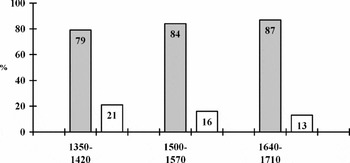
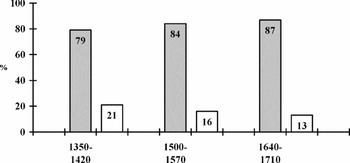
The status of English suffixless adverbs has changed over the centuries. Some of them, such as hard and soft, go back to Old English, where they were formed by means of the adverbial suffix -e. After the levelling of word-final morphology in the course of Middle English, which obliterated the adverbial suffix -e, many adverbs were formed by means of zero derivation. However, by this time suffixation by -li(che)/-ly(che) had already become the main means of adverb formation. My study of the multigenre Helsinki Corpus (Nevalainen Reference Nevalainen, Rissanen, Kytö and Heikkonen1997) indicates that the overall number of suffixless adverb types was reduced even further in the course of the Late Middle and Early Modern English periods. This trend is shown in figure 1.
Relative frequencies of suffixed (grey) and suffixless (white) adverb types in Late Middle and Early Modern English in the Helsinki Corpus (based on Nevalainen Reference Nevalainen, Rissanen, Kytö and Heikkonen1997: 162)

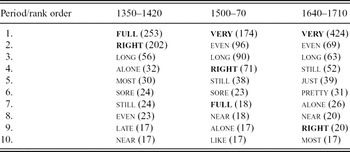
Table 1 gives a ranked list of the ten most frequent suffixless adverbs in three subperiods of the Helsinki Corpus (Nevalainen Reference Nevalainen, Rissanen, Kytö and Heikkonen1997: 174). Only items with attested dual morphology are listed. The table shows that full heads the list in the period from 1350 to 1420, but comes only seventh in the first Early Modern English subperiod, 1500–1570, and drops out of the list altogether in the third, 1640–1710.
The ten most frequent suffixless adverbs in three periods in the Helsinki Corpus of English Texts (Nevalainen Reference Nevalainen, Rissanen, Kytö and Heikkonen1997; absolute frequencies)

Table 1 suggests that very replaced full as the most popular intensifying word modifier in Early Modern English, just as full had taken over from swiþe in Middle English (Méndez-Naya Reference Méndez-Naya2003: 386). The other frequent Middle English intensifier and focusing subjunct, right, remained in the Early Modern English top ten throughout the period. As table 1 shows, a new suffixless intensifier, pretty, surfaced in the last subperiod, 1640–1710. The popular Present-day English intensifier real(ly) only started to spread in Late Modern English, however.
A large number of less frequent intensifiers, both suffixed and suffixless, were introduced in the Early Modern period. In his corpus-based study, Peters (Reference Peters and Kastovsky1994: 286) finds that letters with private or emotional content show the highest frequencies of amplifiers, and boosters in particular, which denote a high point on a scale. Although he observes that new boosters are common in the letters of accomplished writers, he comes to the general conclusion that personal letters are not setting fashionable trends in creating boosters.
Peters (Reference Peters and Kastovsky1994: 272) also studied the OED record from the Late Middle English period on, and found that the first attestations of boosters often occurred in dramatic dialogue, political and religious polemics, handbooks and instructive prose (especially for Latinate, ‘hard-word’ boosters), travel literature, and from the early eighteenth century onwards, in magazines and newspapers. Generic trends in intensifier use have also been traced back to Middle English in medical texts (Pahta Reference Pahta, Dossena and Taavitsainen2006).
Little research is available on the social embedding of intensifier use in earlier English. The generic trends referred to above say something about the first dating, and therefore potential actuation of new boosters, but little about their diffusion in the language community. My exploratory study sets out to analyse the use of a set of dual-form intensifiers by different social groups before the era of normative grammar. As noted in section 1, prescriptive grammarians condemned the use of zero adverbs in the eighteenth century. Normative grammars proscribed the intensifier use of items such as exceeding, excellent, extraordinary, extreme, full and marvellous. These proscriptions suggest not only linguistic variation, i.e. the actual use of suffixless forms, but also social stratification of this use. ‘Improper’, ‘inelegant’ and similar judgements listed by Sundby et al. (Reference Sundby, Bjørge and Haugland1991: 200–3) imply second-order indexing, attaching to linguistic forms a social evaluation of their users. I therefore also expect to find social variation in their use in the previous centuries.
4 Material and method
The set of intensifiers I analysed for this study consists of six of the dual-form adverbs whose short forms are cited in A Dictionary of English Normative Grammar 1700–1800 (Sundby et al. Reference Sundby, Bjørge and Haugland1991) as having caught the critical attention of eighteenth-century normative grammarians: exceeding(ly), excellent(ly), extraordinary(ly), extreme(ly), full(y) and marvellous(ly). These particular adverbs were selected because of their overall frequency in the data studied.
My material comes from the Corpus of Early English Correspondence (CEEC), compiled by the Historical Sociolinguistics team in Helsinki. It covers the period from c.1400 to 1800. The focus of this study is on the prenormative period, Late Middle and Early Modern English before 1680, which is covered by the 1998 version of CEEC. With its Supplement, this part of the corpus consists of some three million words produced by nearly 800 writers representing mostly upper and middling social ranks, but also containing original material from the social lower ranks of the period. The number of women writers is about 20 per cent of the total in each subperiod.Footnote 3 A search of the corpus returned a total of 1,020 instances of the six dual-form adverbs (including all the spelling variants of the lexemes).
The linguistic variable I constructed for this study makes a distinction, using the terminology of Quirk et al. (Reference Quirk, Greenbaum, Leech and Svartvik1985), between the modifier and subjunct functions of adverbs. It is based on previous research, which suggests that there is a basic syntactic difference in the use of suffixed and suffixless intensifiers in earlier English (Ungerer Reference Ungerer1988: 261–3; Nevalainen Reference Nevalainen and Kastovsky1994: 245–6; Peters Reference Peters and Kastovsky1994: 284–5). Zero intensifiers favour adverb and adjective heads, and so typically function as word modifiers. By contrast, intensifying -ly adverbs tend to occur with verbal and participial heads, and thus function as subjuncts. This form–function specialization is illustrated by the six pairs of adverbs in (1) to (6).
(1)
(a) The bride was maried in her haire that hung downe long, with an exceding rich coronet on her head (which the King valued the next day at a million of crownes).
(1613, John Chamberlain; I, 424, CEEC)(b) . . . the Palsgrave mounted upon a high bounding horse, which he managed so like a horsman, that he was excedingly commended and had many showts and acclamations of the beholders,
(1613, John Chamberlain; I, 424, CEEC)(2)
(a) He hath a daughter, a civill well-disposed and discreete young mayde: who works very well and playes excellent well of the virgenols;
(1647, Unton Dering; II, 129, CEEC)(b) . . . I beleeve none of them; unlesse it bee that of my Lady Newport which I must confesse is soe like her, that if it bee not true twas at least Excellently fancyed.
(1654, Dorothy Osborne; 142, CEEC)(3)
(a) I have good content here in all things, but I find it extraordinarye chargeable for one who would live in good fashions (you told me so much before I came).
(1627, Thomas Coppin; I, 32, CEEC)(b) . . . but in mine I yett amongst many others observe this one passage, that hee that doth nott extraordinarily love Venus will never prove a good soldier under mars.
(1642, Henry Oxinden; I, 286, CEEC)(4)
(a) I came the later, the way beeing hard for a stranger to hitt, the myles long, and a cuntry so extreame foule, that I think winter is to be found heer at Midsummer.
(1615, John Holles; I, 61, CEEC)(b) . . . I confesse I disdaine extreamly to thinke, such a thing as the Chamberlaine should indanger to putt the Marshall to the worse.
(1632, Thomas Wentworth; 307, CEEC)(5)
(a) My Sister and her Family were well last night, and full glad I am that you are so, hoping that one post or two more will put an end to your absence from home.
(1679, Samuel Pepys; 79, CEEC)(b) But of this, you shall not need to take notice to his family, for I have not yet fully acquainted him with my intentions herein.
(1679, Samuel Pepys; 143, CEEC)(6)
(a) . . . the newes and every materiall point, which vppon the reding his Grace well noted vn to the Quenys Grace and all other abowt hym who were mervelouse glad to here it.
(1524, Thomas More; 312, CEEC)(b) Mr Howard meruelusly incendyth the Kyng ayenst the Scottis: by whos wantone meanys hys grace spendyth mych money, and ys more dyssposyd to ware than paxe.
(1511, Thomas Wolsey; 54, CEEC)
5 Findings
5.1 Overall trends
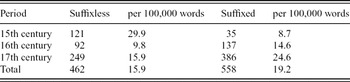
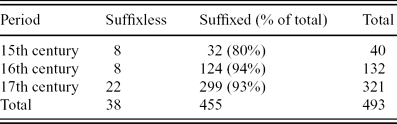
A number of empirical generalizations can be made on the basis of the corpus data. First, the spread of the -ly suffix over time is evidenced in the normalized frequencies of the adverbs. Table 2 gives the frequencies of the six suffixed and suffixless adverbs in three centuries (in this and subsequent tables, the seventeenth century extends until 1680). We can see that in the fifteenth century the suffixless forms were on average much more frequent per 100,000 words than in the next two centuries. Suffixed forms pick up in the course of time, but do not reach the fifteenth-century average of the suffixless ones.
Absolute numbers and frequency/100,000 words of the dual-form adverbs, by century

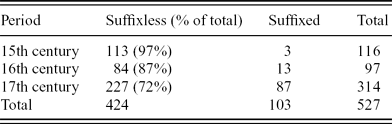
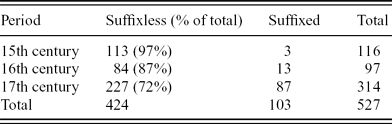
The most interesting general result is that head type continues to correlate with the form of dual-form adverbs throughout the Late Middle and Early Modern period. Table 3 presents the distribution of suffixed and suffixless intensifiers in the modifier function, that is, with adjectival and adverbial heads. Although the relative proportion of suffixed adverbs increases during the three centuries studied, the basic system remains in place throughout the period: the modifier function is clearly associated with zero-forms, and these occur in 72 per cent of the cases even as late as the seventeenth century. These figures imply that the vast majority of the writers in the corpus use zero intensifiers in the modifier function.
Modifier function (all data); percentage of suffixless forms
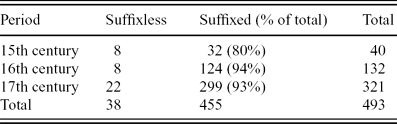
To complete the overall picture, let us compare the information in table 3 with that in table 4. Table 4 summarizes the frequencies of suffixed and suffixless forms in the subjunct function, that is, with verbal and participial heads. In this function, the use of the suffixless form is greatly reduced between the fifteenth and sixteenth centuries, from 20 per cent to a mere 6 per cent of the cases, as the suffixed form becomes increasingly predominant. Not unexpectedly, the -ly suffix continues to spread in its preferred verbal contexts. The answer to my research question would thus appear to be that grammatical rather than social conditioning was the primary factor in deciding the choice of adverb form at the time.
Subjunct function (all data); percentage of suffixed forms
We shall see, however, that the diachronic changes suggested by tables 3 and 4 are partly adverb-specific, in that the use of some intensifiers picks up while that of others recedes. But, significantly, the overall trend of increased use of -ly with modifiers can be also traced to the individual adverbs. This finally gives us a handle on linguistic innovators – people and groups of people who promoted the use of -ly intensifiers – making it possible to assess the role played by social factors in this process of change over time.
5.2 Lexical developments
For some writers, a search of the corpus returns minimal pairs of amplifiers, such as exceeding(ly) in (7), excellent(ly) in (8) and full(y) in (9). Cases like this suggest relatively free variation between the two morphosyntactic options at a given point in time, or at least for certain individual informants. However, I would argue that these overlapping cases may also be indicative of changes in progress in a given dual-form adverb.Footnote 4
(7)
(a) I am exceeding sorry the strangurie is become soe afflictive unto you.
(1653, Thomas Browne; 285, CEEC)(b) Butt I am exceedingly sorry for the death of that worthy honest gentleman Dr Jaspar Needhame, and the colledge will have a great losse of him.
(1679, Thomas Browne; 136, CEEC)(8)
(a) I blese god we be all very well in health and thy father most exelent well even every way: god howld him so for ever . . .
(1626, Katherine Paston; 96, CEEC)(b) I doe like this striffe (if I maye so cal it) excelently well. for in this kinde the more we striue the. better we agree.
(1626?, Katherine Paston; 90, CEEC)(9)
(a) And many thynges haue there syns in this greate matter growne in questyon wherin I neyther am suffycyently learned in the law nor full enfurmed of the facte . . .
(1534, Thomas More; 536, CEEC)(b) . . . that it may lyke yow at such oportune tyme or tymys as your wisedom may fynde, to helpe that his Highnes may by your goodnes be fully enformed of my true faithfull mynde . . .
(1534, Thomas More; 500, CEEC)
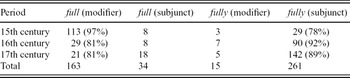
Let us turn to the profiles of the individual adverbs and, proceeding in chronological order, begin with full(y). Table 5 indicates that full was typically used as a modifier in the fifteenth century, occurring in 97 per cent of the modifier instances of this dual-form adverb, whereas fully was the form associated with the subjunct function (occurring in 78 per cent of the subjunct cases). As in earlier periods, the subjunct function was a good deal less common than the modifier in the fifteenth century (Méndez-Naya Reference Méndez-Naya2004). The situation changed quite rapidly as the subjunct fully gained momentum in the following century, and became the principal form–function combination for this dual adverb in terms of frequency of occurrence.
Full/fully (percentages of the modifier and subjunct functions, respectively)

We know from previous studies that this process coincided with the rapid expansion of very in the modifier function in the sixteenth century (see table 1, above). A functional division obviously took place, promoting the subjunct and demoting the modifier function of this dual-form adverb. In the seventeenth-century data, nearly half of the instances of full (18 out of 39) also assumed the subjunct function.
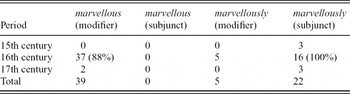
A more extreme case of an intensifier losing its popularity is that of the modifier marvellous, shown in table 6. Peaking in the sixteenth century (and popular in Shakespeare), the use of the modifier plummets in the seventeenth century, the less popular subjunct marvellously following suit. This arrest of development may be connected with the gain in currency of other Latinate items at the time, in particular exceeding(ly) and extreme(ly).
Marvellous/marvellously (percentages of the modifier and subjunct functions)

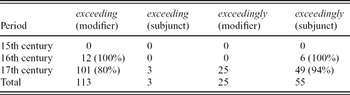
Table 7 shows how the use of the modifier exceeding, in particular, picks up in the seventeenth century, and the modifier use of the -ly form exceedingly follows the same pattern. I will return to these processes below.
Exceeding/exceedingly (percentages of the modifier and subjunct functions)

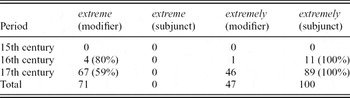
Table 8 indicates a very similar trend for the dual adverb pair extreme and extremely. The main difference between exceeding(ly) and extreme(ly) is the higher frequency of the suffixed form extremely in both modifier and subjunct functions. The modifier use of the -ly form in this dual adverb is in fact proportionately the highest of all the items investigated.
Extreme/extremely (percentages of the modifier and subjunct functions)

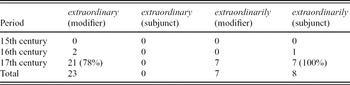
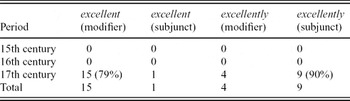
Tables 9 and 10 show the frequency of occurrence of the dual adverb pairs extraordinary/extraordinarily and excellent/excellently, both recent and relatively infrequent in the seventeenth century. However, both have the -ly modifier alternative, thus lending support to my argument concerning the generalization of the -ly suffix in this function.
Extraordinary/extraordinarily (percentages of the modifier and subjunct functions)

Excellent/excellently (percentages of the modifier and subjunct functions)

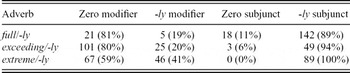
If we examine the three most frequent amplifier pairs in the seventeenth century, we find varying degrees of morphological overlap in modifier use, but much less in the subjunct function. Table 11 shows that full/fully and exceeding/exceedingly have the least overlap as modifiers, while extreme/extremely has the most. It is noteworthy that full/fully is the least frequent of the three as a modifier.
Functional distribution of three common dual-form amplifiers in the seventeenth century

5.3 Sociolinguistic correlations
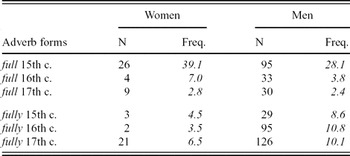
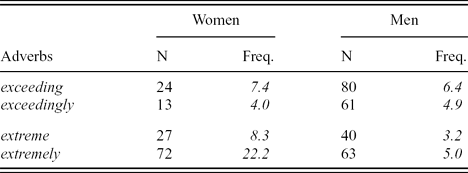
As we saw in section 3.1, above, studies on Present-day English suggest that lower- social-status groups use intensifiers, and suffixed intensifiers in particular, less than higher-status groups, and that there are gender differences in intensifier use. I will test whether these arguments hold for the most frequent dual-form intensifiers in my data, full/fully, exceeding/exceedingly and extreme/extremely, and begin with their distribution by gender, shown in tables 12 and 13. To make it possible to estimate the degree of social embedding of the -ly suffix, both the modifier and subjunct functions of the adverbs are included in these analyses, which are based on adverb form.
Table 12 summarizes the gender distribution of full and fully over the three centuries. It documents the declining frequency of full, and the increase in that of fully over time. However, despite the systematic variation in the normalized frequencies –proportionally, women more often use full and men fully in each period – there is no statistically significant difference between male and female writers in the use of either form in any of the periods.Footnote 5
Use of full and fully according to gender in the fifteenth–seventeenth centuries; number of occurrences (N) normalized to 100,000 words (Freq.)

Only the seventeenth century allows an adequate comparison between male and female usage of the two other adverb pairs, exceeding/exceedingly and extreme/extremely. Table 13 presents both the absolute and normalized frequencies (per 100,000 words). Differences in the use of exceeding and exceedingly are too small to be statistically significant. By contrast, those in the use of extreme and extremely prove to be highly significant: women use both adverbs, but especially the suffixed one, much more than men. The figures in table 13 include one particularly heavy user of extremely, Dorothy Osborne (see section 5.4, below). Excluding her from the total lowers women's normalized frequency of extremely to 13.5, but does not alter the statistical significance of the gender difference. To summarize so far: only one of the three adverb pairs shows a statistically significant gender difference.
Use of exceeding(ly) and extreme(ly) according to gender in the seventeenth century; number of occurrences (N) normalized to 100,000 words (Freq.)
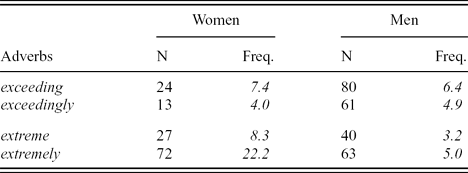
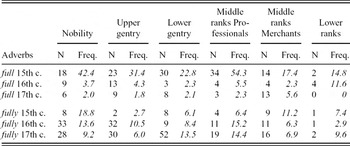
Table 14 presents the break-downs by social status and century of the frequencies of full and fully. The social status hierarchy in Late Medieval and Early Modern England is discussed in Nevalainen & Raumolin-Brunberg (Reference Nevalainen and Raumolin-Brunberg2003: 136–8). In this analysis, I separate out the nobility (including royalty), the upper gentry (including the upper clergy) and the lower gentry (including the lower clergy), which make up the upper ranks, as opposed to professional people and wealthy merchants (middle ranks) and the lower ranks (other ranks below the gentry).Footnote 6
Use of full and fully according to social rank; number of occurrences (N) normalized to 100,000 words (Freq.)

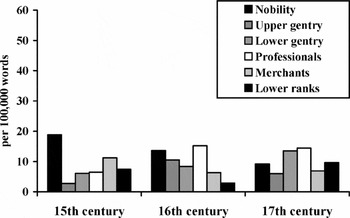
With both full and fully, the distributional differences between the social ranks are statistically significant in the fifteenth century but not in the sixteenth, and only those of fully are significant in the seventeenth century (see also figures 2 and 3). The fifteenth-century data suggest clear social stratification, with the highest ranks using full proportionally more than the rest, and the lowest literate ranks using it the least. However, as the absolutely most frequent users of full are professional men, who occupied a middling position in the English social hierarchy at the time, these results imply that there is no one-to-one correspondence between high social rank and the frequency of intensifier use. The correlation may be stylistically motivated: professional men commanded the legal and other special registers typical of the written communication of the nobility and the upper gentry in the fifteenth century. Professional clerks and secretaries were often also responsible for composing their employers' personal letters.Footnote 7
Use of full according to social rank per 100,000 words

Use of fully according to social rank per 100,000 words

Moving on to fully, the notion of hierarchical social embedding is only partially supported, as merchants come second after the nobility in the use of fully in the fifteenth century. The comparison is, however, biased by the low overall frequency of this form in the Late Middle English data.
According to table 14, these social status differences realign in the sixteenth and seventeenth centuries, when the intensifier fully is generalized. Table 14 and figure 3 show the popularity of the suffixed form fully among the nobility in the fifteenth century, but suggest a social crossing-over in the sixteenth century, with the professionals and lower gentry as the most frequent users of the suffixed form in the seventeenth century.
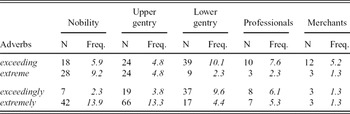
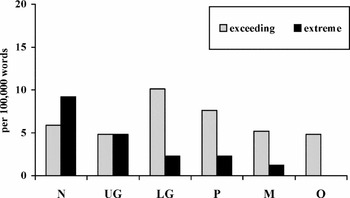
In order to be able to assess the degree of social embedding of relatively more innovative forms, I analysed the use of exceeding/exceedingly and extreme/extremely in the seventeenth century. As with full and fully, I based this analysis on the form of the adverb, including both modifier and subjunct functions. It is worth noting that the data in table 15 come from precisely the same set of people as in table 14. The lower ranks only contribute to exceeding (a single instance, equivalent to 4.8/100,000 words); this is not shown in table 15, but is included in figure 4.
Use of exceedingly and extremely according to social rank in the seventeenth century; number of occurrences (N) normalized to 100,000 words (Freq.)

Seventeenth-century use of exceeding and extreme according to social rank per 100,000 words (N = nobility, UG = upper gentry, LG = lower gentry, P = professionals, M = merchants, O = other ranks below the gentry)

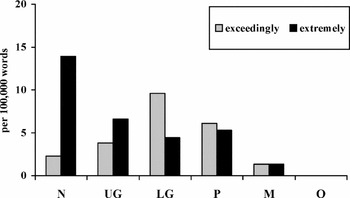
The social differences in the distribution of exceeding are not statistically significant, but those of extreme, exceedingly and extremely are. These findings remain significant even if the single most frequent individual user of extremely, Dorothy Osborne, is excluded from the upper-gentry figures, which reduces the normalized frequency of that rank to 6.6 per 100,000 words (figure 5).
Seventeenth-century use of exceedingly and extremely according to social rank per 100,000 words (N = nobility, UG = upper gentry, LG = lower gentry, P = professionals, M = merchants, O = other ranks below the gentry)

The overall distributions of the four adverbs show that the literate social ranks used all of them in the seventeenth century. However, the figures suggest different preferences depending both on social status and the adverb. Except for extreme, professional people are among the frequent users of all these intensifiers but, in contrast to the situation with full, they do not make up the group of most frequent users for any of them. Extreme and extremely are promoted by the highest social ranks, women in particular (table 13); the suffixed form extremely is more popular than the suffixless one. By contrast, exceeding is used quite evenly across the social spectrum, whereas exceedingly is favoured by the lower gentry and professional men. It is much less frequent among the merchants and other ranks below the gentry than the suffixless form.
With some minor modifications, the same pattern is repeated with the modifier use of the two adverbs. As table 11 shows, exceedingly is not in general particularly frequent as a modifier; this new function is quite evenly spread across the social scale (c. 2.2/100,000 words) except for the nobility, who do not use the adverb much in either of its functions. The contrast between the uppermost ranks and the lower gentry, in particular, is repeated for the modifier function of extremely: representatives of the nobility promote it (5.6/100,000 words), while those of the lower gentry use it rarely, and merchants or the other ranks below the gentry show no attestations of this use at all in the corpus.
5.4 Diffusion of -ly modifiers
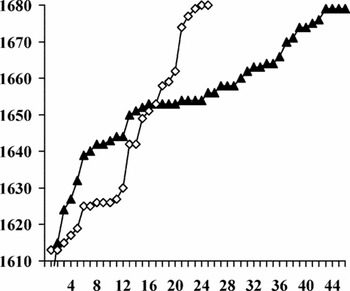
A closer analysis of the diffusion of the incoming -ly modifiers reveals major adverb-specific differences. As shown by table 5, fully does not gain ground as a modifier in the seventeenth century (five modifier instances).Footnote 8Exceedingly is more frequent (25 modifier instances), and its diffusion takes place at a slow pace throughout the eighty years of the seventeenth century studied. Extremely is the most frequent of the three adverbs in the modifier function (46 instances); it also advances throughout the century but gains momentum in the second forty-year period, from 1640 to 1680. Figure 6 plots the two suffixed modifiers, exceedingly and extremely, with the number of instances per year indicated on the x-axis.
Incidence of exceedingly (white) and extremely (black) as modifiers in the seventeenth century

As shown by table 13, the modifier extremely was promoted by women, who ranged from Lady Arabella Stuart, Queen Elizabeth of Bohemia and Lady Anne Conway to Winifred Thimelby, an English nun in Louvain, and Dorothy Osborne, the daughter of the royalist lieutenant-governor of Guernsey. Dorothy Osborne (1627–95), later Lady Temple, particularly favoured the incoming form. Two instances of her use of extremely are illustrated in (10). In our past research on the CEEC, Dorothy Osborne has emerged as the uncontested leader of several ongoing processes of change (Nevalainen & Raumolin-Brunberg Reference Nevalainen and Raumolin-Brunberg2003: 217). In sociolinguistic terms, she can be identified as an outlier; she even demonstrates a degree of social nonconformity, which is associated with the leaders of linguistic change in the modern world (cf. Labov Reference Labov2001: 516–18).
(10)
(a) Sr
if there were any thing in my Letter that pleased you I am extreamly glad on't, 'twas all due to you, and made it but an equall retourne for the sattisfaction yours gave mee;
(1653, Dorothy Osborne; 3, CEEC)(b) I am extreamly sorry that your letter miscaryed but I am confident my B: has it not; as cunning as hee is, hee could not hide it soe from mee, but that I should discover it some way or other;
(1653, Dorothy Osborne; 117, CEEC)
As Dorothy Osborne wrote her letters to her future husband, Sir William Temple, they were more colloquial than the average personal letter in the CEEC. However, most -ly modifiers in the corpus also come from letters written to family members and close friends. There is therefore no direct evidence to suggest that the use of the suffixed form would have been a conscious change from above in terms of social awareness. As we saw in examples (7)–(9), a preference for the -ly form in one modifier does not predict innovative use of suffixed modifiers in general. In (11), Queen Elizabeth of Bohemia places her amplifiers on a strength scale: extremely (here used as a subjunct) is obviously less strong to her than the zero modifier monstrous.
(11)
Amongst my Neeces maides Culpeper is a great woman with her, my Lo: Culpepers daughter as madd as she, I can assure you I loue her extremelie, as well as her Aunt doth but not so fonde, for she is monstrous fonde of her;
(1659, Elizabeth of Bohemia; 122, CEEC)
It is, however, worth pointing out that suffixed modifiers are notably absent from the correspondence of the lower ranks in the seventeenth century. One of the reasons for this may be the relative scarcity of material from these largely illiterate ranks in the CEEC. By contrast, there is a fair amount of data produced by wealthy merchants engaged in foreign trade. Suffixless modifiers occur in their letters, as do suffixed subjuncts, but suffixed modifiers do not. Taken together with what we know from later periods, this negative evidence could be indicative of a wider pattern of use: differences in social status are revealed by the maintenance of the traditional system based on functional differentiation in adverb form.Footnote 9
6 Discussion
The material analysed in this article clearly shows that the form of amplifiers was functionally determined in Late Middle and Early Modern English: -ly was preferred in the subjunct function, zero in the modifier function. There was, however, also a marked increase in -ly forms in the modifier function over time. The diffusion of -ly to modifiers may in part have been facilitated by contexts in which the verb or, more commonly, the past participle was premodified by another adverb, typically well. Some examples from the corpus are listed in (12).
- (12)
(a) exceedingly much recreated, exceedingely well pleased, exceedingly well stated, excedingly well trapped and furnished
(b) so extreamely cunningly and partially handled, extreamely well pleased, extreamely well-bred
Cases like these are ambiguous, with two possible syntactic interpretations: (a) the amplifier in -ly is modifying the participle, which is itself premodified by an adverb functioning as an adjunct; or (b) the -ly amplifier is modifying the premodifying adjunct. In cases like well-bred, the participle can also be analysed as a compound adjective, and (a) is therefore the more likely interpretation. Constructions such as those in (12) may be added to contexts paving the way for the generalization of the -ly suffix.
As emerges from the data discussed above, the rate at which the change progressed was to a certain extent adverb-specific. A comparison of the three seventeenth-century amplifiers analysed in this study reveals a cline of morphological overlap: extremely leads the change towards -ly suffixation in modifier use, with 41 per cent of the cases in -ly, while the corresponding figure for fully is only 19 per cent. Appearing in 20 per cent of the modifier instances of the dual-form adverb, exceedingly is hardly more advanced than fully. The cline is shown in figure 7.
Degree of morphological overlap in modifier use

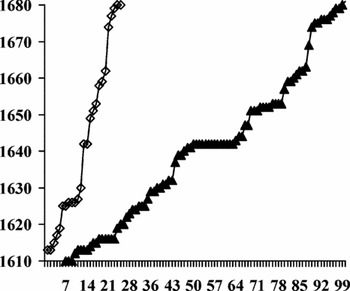
The rates at which the change progresses also vary over time. The two amplifier pairs exceeding/exceedingly and extreme/extremely reveal similar overall frequencies in the sixteenth and seventeenth centuries, but their preferred functional domains are differently weighted: exceeding(ly) is typically a modifier, extremely common as a subjunct (see tables 7 and 8). The preferred form–function combinations of these adverbs may partly account for their different rates of -ly adoption; this is also the case with fully, which was specialized in the subjunct function. On the other hand, as indicated by the comparison in figure 6, the modifier exceedingly was more common than extremely in the first few decades of the seventeenth century.
Frequency of occurrence appears to play a role in the maintenance of the zero form (cf. the conserving effect in Bybee & Thompson Reference Bybee and Thompson1997). Figure 8 contrasts the popular suffixless modifier exceeding with the rather infrequent suffixed one in the seventeenth century (the number of instances per year marked on the x-axis).
Incidence of exceeding (black) and exceedingly (white) as modifiers in the seventeenth century

Having a firm position in the grammar of a wide section of the population in the seventeenth century, the modifier exceeding persisted well into the eighteenth century. In the Corpus of Early English Correspondence Extension (CEECE), which continues into the eighteenth century, exceeding continues to be used as a common modifier, while extremely by far outnumbers extreme, providing further evidence for lexical diffusion as a means by which the -ly suffix generalized to modifiers, and thus became more grammaticalized.Footnote 10
The data I have investigated reveal varying degrees of social focusing in -ly adverbialization. None of the items is restricted to any one social rank, and the zero modifier exceeding shows a fairly even spread across the social spectrum in the seventeenth century. However, exceedingly is preferred by the ranks in the middle of the social scale we have access to, the lower gentry and professionals. Extreme and extremely, by contrast, illustrate form–function combinations associated with the usage of the uppermost social ranks, women in particular, in the seventeenth century. The suffixed form extremely appears to be a fashionable innovation which originates in the sixteenth century and rapidly picks up both as a subjunct and as a modifier in the seventeenth century. Finally, social alignment is also subject to change over time, as with full and fully.
Overall, these findings support the generalization made by Tagliamonte (Reference Tagliamonte, Chambers, Trudgill and Schilling-Estes2001) that language changes across varieties are not progressing at the same rate in terms of social embedding, although they follow the same internal linguistic constraints. The generalization of the -ly suffix to intensifiers follows Pattern III outlined in section 2, above. However, this pattern simplifies the process in that it does not take account of the grammatical specialization of the two forms – zero forms functioning as modifiers and -ly forms as subjuncts – the systematicity of which is clearly borne out by the data I have discussed. This division of labour ultimately accounts for the persistence of such zero modifiers as very and pretty until the present day: their suffixed forms failed to generalize in the subjunct function, hence ruling out Pattern III.
7 Concluding remarks
The answer to the question posed in the title of this article is a qualified yes. The data I have analysed, however, also indicate that functional differentiation between zero and suffixed forms is the majority pattern with dual-form intensifiers in Late Middle and Early Modern English before 1700. The generalization of the suffixed forms to the modifier function proceeds gradually across the lexical spread of dual-form items, including the six pairs of amplifiers examined here.
In sociolinguistic terms, the model of diffusion that emerges from the data I have discussed suggests varying input from different social groups. While there are some items, such as the modifier exceeding, which are shared by all the literate social ranks and the two genders alike, there are others, notably the subjunct and modifier extremely, that are preferred by the uppermost social ranks, and by women rather than men. This variation suggests social layering in adverbialization at any given point in time. However, real-time data, as exemplified by full and fully, show that social differences in the distribution of an intensifier can also even out. The rapid turnover of intensifiers discussed in the earlier literature, on the other hand, could of course be taken as evidence for cases in which no such levelling took place.
The evidence I have presented paints a variable scenario of social focusing in -ly adverbialization. Despite this variability, the data suggest that the spread of -ly to the modifier function was not promoted by the lower end of the literate section of the language community. Although this evidence should be interpreted with caution – because of their high rate of illiteracy, the lower ranks were underrepresented in the data – these findings do not contradict the results of modern sociolinguistic studies. They also agree with surveys of regional variation in adverb form, and hence provide some backgound for the modern variety grammars discussed in section 3.1.
It should be noted that the developments I have discussed largely took place in the prenormative era. The social embedding apparent in -ly adverbialization may therefore go part of the way towards explaining where the normative models in eighteenth- and nineteenth-century prescriptive grammars came from: the suffixed forms associated with the higher status groups were taken as the norm, while the traditional usage of the lower ranks, which retained suffixless modifiers, was stigmatized. Overall, these results on -ly adverbialization suggest that social embedding in grammaticalization need not differ in principle from social embedding in other linguistic changes in progress.