Introduction
The pig placenta is responsible for nutrient transport from the sow to the fetus during pregnancy. In the placenta, maternal blood must be brought into direct contact with the villous trophoblast of the fetal placenta, where sow and fetal nutrient and substrate supply occur within folds of the two epithelial cell layers (Vallet and Freking, Reference Vallet and Freking2007). Therefore, the capability of placenta nutrient transport depends on the density and permeability of blood vessels on the placental surface besides placenta size. The placental surface area of Meishan was similar between day 70 and day 110 of gestation, but their vascular density significantly increased during this interval (Biensen et al., Reference Biensen, Wilson and Ford1998). Whereas the placental surface area of Yorkshire placentae was markedly larger on day 110 than on day 90, placental vascular density was similar during this interval. A large number of potentially important growth factors may directly or indirectly regulate angiogenesis at the maternal–fetal interface. Angiogenesis can occur by sprouting, intussusception and recruitment of endothelial progenitor cells (Bates and Harper, Reference Bates and Harper2002). There is substantial evidence that permeability increases are associated with sprouting. Placental vascularization as well as its permeability reflects a complex interaction of many regulatory factors.
Vascular endothelial growth factor (VEGF) is a potent angiogenic, vasoactive and permeability-increasing molecule (Michel, Reference Michel1984; Taylor and Granger, Reference Taylor and Granger1984; Bates et al., Reference Bates, Lodwick and Williams1999). VEGF-binding sites were identified in vascular endothelial cells corresponding to VEGF-R1 (Flt-1) (Shibuya et al., Reference Shibuya, Yamaguchi, Yamane, Ikeda, Tojo, Matsushime and Sato1990) and VEGF-R2 (Flk-1/KDR) (Matthews et al., Reference Matthews, Jordan, Gavin, Jenkins, Copeland and Lemischka1991). VEGF up-regulation and VEGF-R activation promote numerous downstream targets of receptor tyrosine kinases of signal transduction pathways such as endothelial nitric oxide synthase (eNOS) and vascular endothelial cadherin (CDH5), which lead to vascular endothelia cells proliferation and vascular permeability (Wang et al., Reference Wang, Pennock, Chen, Kazlauskas and Wang2004).
Nitric oxide (NO) is the endothelium-derived relaxing factor, which regulates blood flow and vascular permeability. Endothelial NO synthase is the primary physiological source of NO in the vascular system. VEGF increases eNOS expression via activation of the VEGF-R2 receptor tyrosine kinase and a downstream protein kinase C signaling pathway (Shen et al., Reference Shen, Lee and Zioncheck1999). NO and prostacyclin were produced by the interaction of VEGF with its VEGF-R2 receptor as mediators of VEGF/VPF-induced vascular permeability (Murohara et al., Reference Murohara, Horowitz, Silver, Tsurumi, Chen, Sullivan and Isner1998).
Down-regulation of vascular endothelial cadherin in endothelial tumors may have important consequences for tumor growth and bleeding complications (Zanetta et al., Reference Zanetta, Corada, Grazia Lampugnani, Zanetti, Breviario, Moons, Carmeliet, Pepper and Dejana2005). CDH5 is located strictly at endothelial junctions and appears to be a major adhesive component of cell-to-cell contacts (Huber et al., Reference Huber, Dalmon, Engiles, Breviario, Gory, Siracusa, Buchberg and Dejana1996). Activation of VEGF-R results in the dissolution of endothelial cell-specific adhesion through the β-arrestin2-dependent endocytosis of CDH5, thereby promoting cell migration and vascular permeability (Gavard and Gutkind, Reference Gavard and Gutkind2006). β-arrestins are mainly associated with receptor desensitization and endocytosis by means of binding to the phosphorylated receptors or interacting with proteins of the endocytic machinery (Goodman et al., Reference Goodman, Krupnick, Santini, Gurevich, Penn, Gagnon, Keen and Benovic1996; Kohout and Lefkowitz, Reference Kohout and Lefkowitz2003). β-arrestin2 (Arrb2) is involved in G-protein-coupled receptors (GPCRs) signal transduction pathway, and GPCRs is the best example of phospho-serine-threonine-targeted endocytosis.
Pig placental VEGF mRNA level is positively correlated with placental and adjacent endometrial vascularity (Vonnahme et al., Reference Vonnahme, Wilson and Ford2001); moreover, placental growth and vascular development have been shown to be markedly different in the prolific Chinese Meishan pig v. the less-prolific Yorkshire breed (Biensen et al., Reference Biensen, Wilson and Ford1998). In this study, we cloned and characterized the partial mRNA sequences of porcine VEGF, VEGF-R1, VEGF-R2, eNOS, CDH5 and Arrb2 from porcine placenta, and further investigated their tissue expression profile. Real-time quantitative polymerase chain reaction (RT-Q-PCR) was used to measure the relative expression levels of the six genes in placentas on days 33, 60 and 90 of gestation in Landrace pigs. We also compared placental mRNA expression of the six genes on day 90 of gestation in the most prolific Chinese Erhualian pig v. the Landrace breed.
Material and methods
Animals and tissue collection
Landrace and Chinese indigenous Erhualian pigs were used in this study. Landrace (n = 9) and Erhualian (n = 3) sows were mated with boars of the same breed, respectively. Landrace pig placentas were collected on day 33 (n = 3), day 65 (n = 3) and day 90 (n = 3) of gestation. Erhualian pig placentas were collected on day 90 (n = 3) of gestation. The placentas were snap frozen in liquid nitrogen for future RNA isolation. The heart, liver, spleen, lung, kidney, skeletal muscle and placenta from Landrace fetus on day 90 of gestation were also harvested.
RNA preparation
Total RNAs were isolated from approximately 200 mg of frozen tissue by using Trizol reagent (Gibco-BRL, Rockville, USA) according to the manufacturer’s protocol, and treated with DNaseI by a TURBO DNA-free kit (Ambion, Austin, TX, USA). RNA integrity was checked using denaturing gel electrophoresis and the concentration was estimated with a Beckman DU®640 spectrophotometer. Two micrograms of total RNA was reverse-transcribed into cDNA with 300 U M-MLV reverse transcriptase (Promega Corporation, USA) using random and oligo-dT primers as described previously (Feng et al., Reference Feng, Tang, Li, Liu, Yu and Zhao2007).
Cloning of porcine VEGF, VEGF-R1, VEGF-R2, eNOS, CDH5 and Arrb2 genes
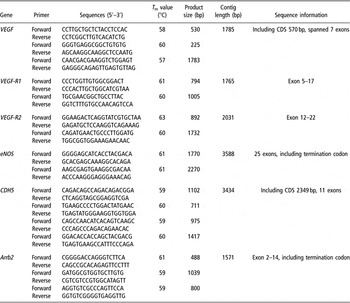
The cDNA of the six genes were cloned by RT-PCR. cDNA fragments were amplified from the single-stranded cDNAs prepared from Landrace placenta on day 90 of gestation. Sixteen primer pairs were designed based on the sequences of cDNA or EST of these porcine genes (Table 1). The polymerase chain reaction amplification was performed using 1 μl cDNA template, 2 μl 10 × PCR buffer (containing 100 mM Tris–HCl (pH 8.0), 500 mM KCl, 10 mM of MgCl2 and 0.1% glutin), 2.0 μl 10 mM dNTPsMix, 0.5 μl forward and reverse primers (10 pmol/ml), 0.2 μl AmpliTaq DNA polymerase (5 U/ml) and 14.3 μl double-distilled water. The PCR profile was 3 min at 94°C followed by 35 cycles of 30 s at 94°C, 30 s at annealing temperature, 30 s at 72°C and a final extension of 5 min at 72°C. The PCR products were separated on 2% agarose gels, visualized by ethidium bromide staining and analyzed using an Alpha Innotech (San Leandro, CA, USA) imaging system. The amplified fragments were sequenced to verify the correct amplification.
Primers used for cloning of vascular endothelial growth factor (VEGF), VEGF-R1, VEGF-R2, endothelial nitric oxide synthase (eNOS), vascular endothelial cadherin (CDH5) and β-arrestin2 (Arrb2) genes in this study

CDS = coding sequence.
mRNA expression of porcine VEGF, VEGF-R1, VEGF-R2, eNOS, CDH5 and Arrb2 genes in different tissues
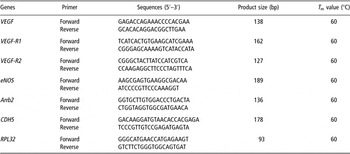
Total RNAs isolated from heart, liver, spleen, lung, kidney, skeletal muscle and placenta of Landrace fetus on day 90 gestation were reverse-transcribed into cDNA. The tissue expression patterns of these genes were investigated by RT-PCR. Primers used for expression pattern analysis were designed across introns (Table 2). Ribosomal protein L32 (RPL32) gene was used as an internal control.
Primers used for semi-quantitative reverse transcription (RT)-polymerase chain reaction (PCR) and quantitative (Q)-RT-PCR

VEGF = vascular endothelial growth factor; eNOS= endothelial nitric oxide synthase; Arrb2= β-arrestin2; CDH5= vascular endothelial cadherin; RPL32= ribosomal protein L32.
SYBR Green RT-PCR analysis of VEGF, VEGF-R1, VEGF-R2, eNOS, CDH5 and Arrb2 gene expression patterns
Expression differences of the six genes in different developmental stages of placenta in Landrace pigs, and on day 90 gestation between two breeds were detected using SYBR Green I-based quantitative real-time polymerase chain reaction (Q-RT-PCR). RPL32 gene was used as a control gene. Each RT-PCR reaction (in 20 μl) contained 1 × RT-PCR SYBR Green master buffer (Toyobo, Osaka, Japan), 0.25 μM primers (Table 2) and 1 μl template cDNA. The cycling conditions consisted of an initial cycle of 3 min at 95°C followed by 35 cycles of cycling consisting of 15 s at 94°C, 20 s at 61°C, 20 s at 72°C and fluorescence acquisition at 82°C for 1 s. The specific PCR products were confirmed by melting curve analysis. cDNAs from three fetus placenta samples in each stage were used to detect the expression changes of the target gene, and all PCRs were performed in triplicate and gene expression levels were quantified relative to the expression of RPL32 using Gene Expression Macro software (Bio-Rad, Richmond, CA, USA) employing an optimized comparative Ct (ΔΔCt) value method. Expression levels were considered undetectable when the Ct value of the targeted gene exceeded 35 in the sample tissues. The t-test was conducted to identify genes differing in expression; P < 0.05 was considered significant.
Results
Molecular cloning and sequence analysis of porcine VEGF, VEGF-R1, VEGF-R2, eNOS, CDH5 and Arrb2 gene
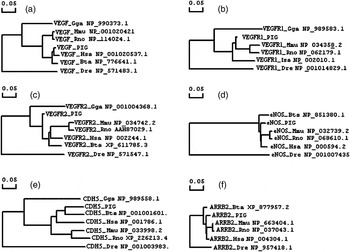
A 1875 bp (GenBank: EU714324) porcine VEGF fragment was identified from the sequencing of PCR products, which contains an open-reading frame of 576 nucleotides (nt). We also cloned the partial mRNA sequences of porcine VEGF-R1, VEGF-R2, eNOS, CDH5 and Arrb2 (Table 1), and submitted to the NCBI database (GenBank accession nos.: EU714325, EU714326, EU714327, EU714329 and EU714330). Basic local alignment search tool analysis revealed 88–100% sequence homology with the published porcine ESTs or human cDNA sequences for these genes. A GenBank database search using BLAST revealed that the predicted porcine VEGF, VEGF-R1, VEGF-R2, eNOS, CDH5 and Arrb2 gene coding sequence (CDS) has high similarity with other mammalian counterparts (Table 1). We compared the amino acid sequences of VEGF, VEGF-R1, VEGF-R2, eNOS, CDH5 and Arrb2 with those of these genes from other species retrieved from the EMBL and GenBank databases. Multiple sequence alignments were generated using Clustal W. Phylogenic trees (Figure 1) of VEGF, VEGF-R1, VEGF-R2, eNOS, CDH5 and Arrb2 based on the amino acid sequences generated using the DNAMAN program.
Phylogenetic relationship of vascular endothelial growth factor (VEGF) (a), VEGF-R1 (b), VEGF-R2 (c), endothelial nitric oxide synthase (eNOS) (d), vascular endothelial cadherin (CDH5) (e) and β-arrestin2 (Arrb2) (f) in different species. Amino acid sequences of the six porcine genes were predicted by our study.

mRNA expression of six genes in different tissues
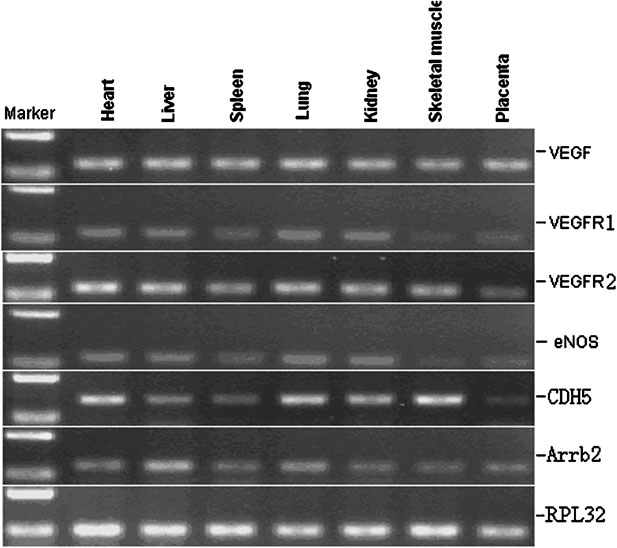
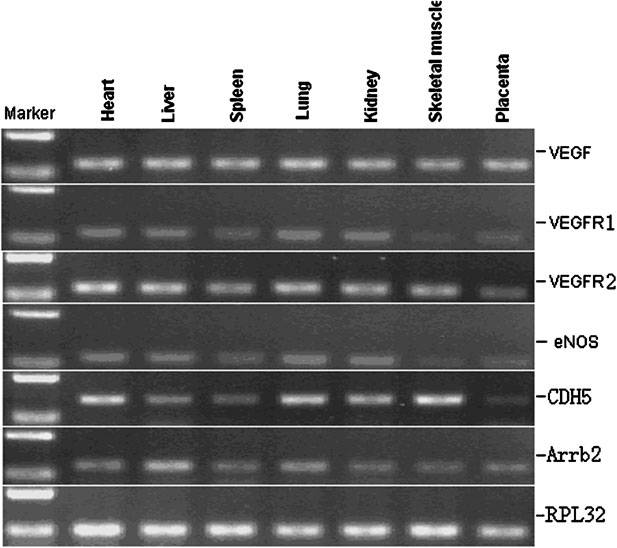
Porcine VEGF, VEGF-R1, VEGF-R2, eNOS, CDH5 and Arrb2 genes showed expression in all seven tissues: heart, liver, spleen, lung, kidney, skeletal muscle and placenta (Figure 2).
Tissue distribution analysis of porcine VEGF, VEGF-R2, eNOS, Arrb2 and CDH5 genes.
Temporal expression of VEGF, VEGF-R1, VEGF-R2, eNOS, CDH5 and Arrb2 gene during placenta development
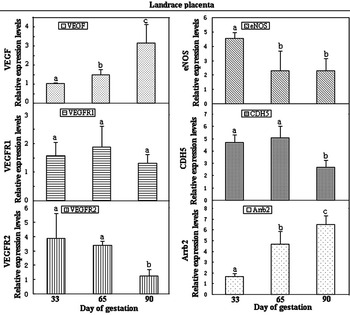
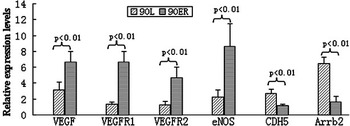
Q-RT-PCR results are shown in Figures 3 and 4. The results showed several different patterns for the six genes. VEGF and Arrb2 gene expressions were increased (P < 0.05) from 33-day and 65-day to 90-day gestation in Landrace pigs, whereas VEGF-R1 did not show different expression in the same stages. Placental eNOS mRNA expression exhibited significant increase (P < 0.05) from 33- to 65-day gestation in Landrace placenta, which remained the same through 90-day gestation. VEGF-R2 and CDH5 expressions have no expression difference between 33- and 65-day gestation placenta; however, their expression was significantly decreased (P < 0.05) from 65 day to 90 day. Comparison of expression levels in placenta on day 90 of gestation was also analyzed between Landrace and Erhualian breeds. The results showed that VEGF, VEGF-R1, VEGF-R2 and eNOS genes had significantly higher (P < 0.01) expression levels in Erhualian than those in Landrace. However, CDH5 and Arrb2 showed contrary tendency, their expression levels were significantly lower (P < 0.01) in Erhualian than in Landrace.
Expression differences in Landrace placenta of 33-, 65- and 90-day gestation of VEGF, VEGF-R1, VEGF-R2, eNOS, CDH5 and Arrb2 genes. Different letters indicate significant differences (ΔCt ± s.d.) (P < 0.05).

Expression differences between Landrace and Erhualian placentas of the 90-day gestation of VEGF, VEGF-R1, VEGF-R2, eNOS, CDH5 and Arrb2 genes. 90L represents Landrace pigs, 90ER represents Erhualian pigs.

Discussion
In this study, we obtained the porcine VEGF, VEGF-R1, VEGF-R2, eNOS, CDH5 and Arrb2 partial cDNA sequences. The porcine sequences of these genes showed high similarity with their counterparts in human and mouse, indicating the conserved function of these genes in the pig. We assume that the proteins are produced in close correlation to the total RNA levels we measured. Expression analysis showed that these six genes were expressed in various porcine tissues (heart, liver, spleen, lung, kidney, skeletal muscle and placenta). The high level of VEGF expression in different tissues showed that this gene plays important roles in maintaining normal function of these organs. The CDH5 gene showed a lower level of expression in placenta compared to other tissues. CDH5 is a major adhesive component of cell-to-cell contacts (Huber et al., Reference Huber, Dalmon, Engiles, Breviario, Gory, Siracusa, Buchberg and Dejana1996); its low-level expression may help to promote placenta permeability.
Our study demonstrated that during porcine placenta development, the expression of VEGF was up-regulated, which is generally in agreement with the previous research results (Vonnahme and Ford, Reference Vonnahme and Ford2004). VEGFs are crucial regulators of vascular development (Olsson et al., Reference Olsson, Dimberg, Kreuger and Claesson-Welsh2006) and also directly stimulate increased vascular permeability to water and large molecular weight proteins and vasodilatation (Bates and Harper, Reference Bates and Harper2002). Thus, up-regulation in placental VEGF mRNA expression will promote placenta growth and placenta permeability. According to a previous study, VEGF increases permeability acutely by activating VEGF-R2, then phospholipase C was stimulated, which results in diacylglycerol (DAG) production (Wu et al., Reference Wu, Huang, Yuan and Granger1996). DAG directly stimulates calcium influx, to increase intracellular calcium, which stimulates eNOS to produce NO (Hatakeyama et al., Reference Hatakeyama, Pappas, Hobson, Boric, Sessa and Durán2006). Unexpectedly, significantly lower VEGF-R2 and eNOS expressions were detected in Landrace placenta of 90-day gestation comparing to the two earlier stages, which showed a tendency in contrary to VEGF. Biensen et al. (Reference Biensen, Wilson and Ford1998) reported that less-prolific Yorkshire pig placenta size increased markedly compared to prolific Meishan pig throughout gestation. Here, we found significantly increased expression of VEGF but decreased expression of VEGF-R2 and eNOS, which may weaken the function per unit placenta (placenta efficiency) during Landrace pig gestation, and may be one reason of the enlarged placenta in late gestation stages in Landrace.
In the study of Youngs et al. (Reference Youngs, Ford, McGinnis and Anderson1993), the Meishan pig can farrow three to five more live pigs per litter than Western breeds (Ford and Youngs, Reference Ford and Youngs1993; Youngs et al., Reference Youngs, Ford, McGinnis and Anderson1993). Wilson found that the Meishan placenta exhibits a marked and progressive increase in the density of blood vessels on the placental surface (Wilson et al., Reference Wilson, Biensen, Youngs and Ford1998). Our study showed significantly high levels of VEGF, VEGF-R1, VEGF-R2 and eNOS expression in 90-day gestation Erhulian placenta compared to that in Landrace, indicating that VEGF, VEGF-R1 and VEGF-R2 may promote vascular growth and eNOS increases vascular permeability, thereby strengthening placenta function/efficiency in the Erhualian pig breed, which is a breed considered to have higher litter size than Meishan pig in China.
Gavard and Gutkind (Reference Gavard and Gutkind2006) proposed that the effects of VEGF on endothelial-cell permeability may result from the transient disruption of the CDH5 cell–cell adhesion, and Arrb2 may aid CDH5 endocytosis. Therefore, down-regulation of CDH5 and up-regulation of Arrb2 in Landrace placenta found in our study will increase placenta vascular permeability in late gestation stages, thereby promoting placenta function. Significant low expression of CDH5 detected in Erhualian than in Landrace placenta on 90-day gestation indicated high endothelial-cell permeability in Erhualian placenta. The low expression of both CDH5 and Arrb2 in Erhualian pig might suggest that Arrb2 is a cofactor of CDH5 endocytosis and help in promoting placenta permeability.
Conclusion
In summary, the results of our study showed that high expression of VEGF and its receptors and low expression of CDH5 and Arrb2 may be related to high placental efficiency in the Erhuanlian pig, and may explain in one aspect why Erhualian pig is more prolific than the Landrace breed. The differential expression of VEGF, VEGF-R1, VEGF-R2, eNOS, CDH5 and Arrb2 genes during placenta development and between different breeds indicates these genes have important relationship with reproduction traits in the pig. Understanding the regulation of vascular growth and permeability in porcine placenta will provide much-needed insight into placentation and the mechanism of litter size difference between pig breeds. This result also contributes new data of the VEGF signal transduction pathway in porcine placenta development.
Acknowledgments
We thank Zhou Quanyong for helping with collecting samples and technical help to this paper. This research was supported by the Program for New Century Excellent Talents in University of Chinese Education Ministry (NCET-05-0669), the National Natural Science Foundation of China (30571328), the Key Project of National Basic Research and Developmental Plan (2006CB102105) of China, National High Technology Research and Development Program (2007AA10Z148) of China.