In the early decades of the eighth/fourteenth century, a period that coincided with the reigns of the later Mongol Ilkhans Öljeytü (r. 703–16/1304–16) and Abu Saʿid (r. 716–36/1316–35), northwestern and west-central Iran witnessed a burgeoning of intellectual and cultural production, in science and philosophy, theology and metaphysics, historiography, architecture, the visual arts and literary expression. A constitutive dimension to this prodigious creativity was Arabic and Persian bilingualism. This bilingualism comprised a distinct area of intellectual interest, and translation between the two languages formed a significant and quite substantial sub-set of the period’s literary productivity. Among the period’s many manifestations of Arabic and Persian bilingualism, one division of literary expression—namely, elaborations of the literary legacy of ʿAli b. Abi Tālib (d. 40/661)—provided a particularly attractive site for the bilingual artistry of a network of translators, poets and calligraphers. A distinctive genre, involving translations of the Imam’s words from Arabic into Persian and elaborations of these meanings in one or both languages, emerged and flourished, especially within the geographical area of west-central Iran that included the locations Isfahan, Kashan, Saveh and Aveh.
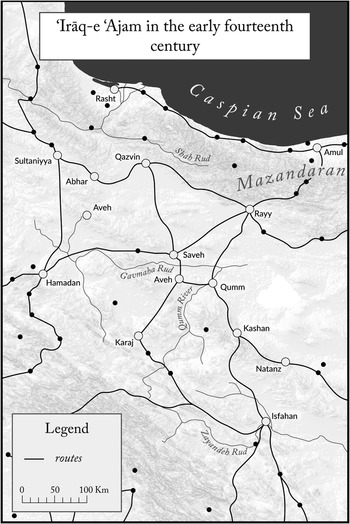
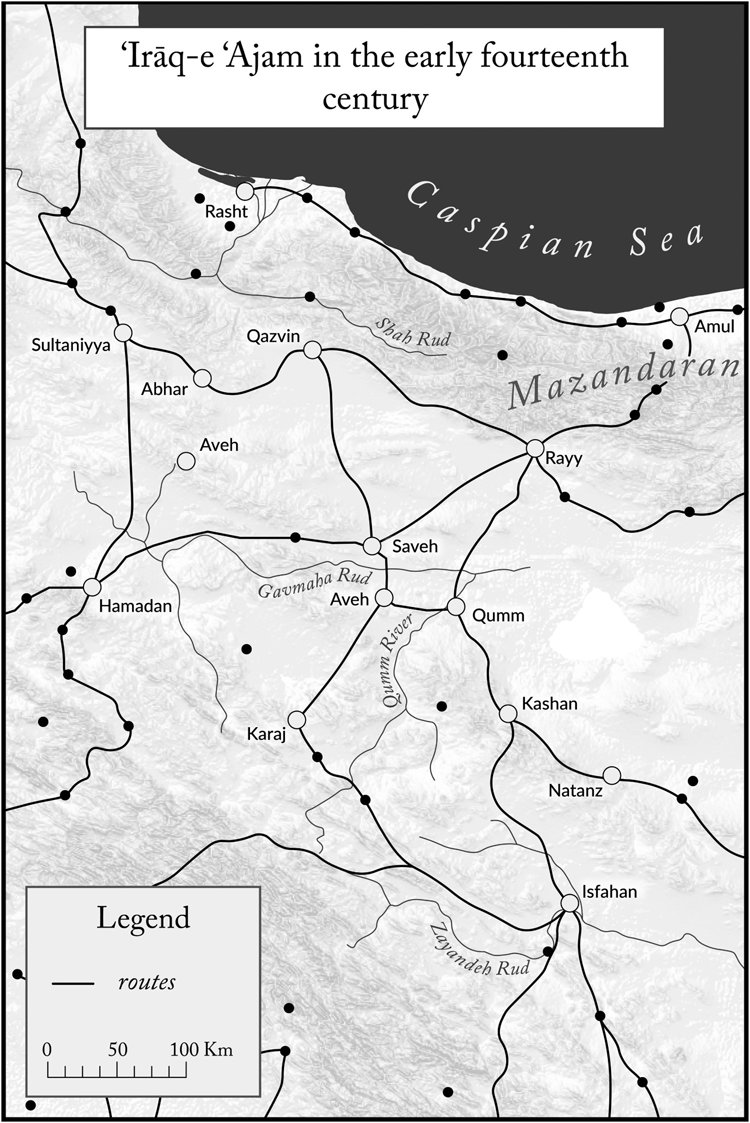
This article examines the nature and functions of this early fourteenth-century literary initiative within its particular regional environment. Isfahan, Kashan, Saveh and Aveh lay in the region identified in contemporaneous sources as ʿIrāq-e ʿAjam (see Figure 1).Footnote 1 The principal source for the present study is a miscellany (a collection or majmuʿeh), MS CBL Per 308, preserved in the Chester Beatty Library in Dublin.Footnote 2 MS CBL Per 308 contains five texts, all copied in the year 729–30/1329–30. These five texts, I suggest, linked together a network of individuals in or hailing from (or whose forebears hailed from) the previously mentioned locations. This network of littérateurs intersected with a much larger network, made up of individuals and family members connected to the powerful vizier Ghiyāth al-Din Muhammad (d. 736/1336). Ghiyāth al-Din, son of the historian-vizier Rashid al-Din Fazl Allāh (d. 718/1318), had been appointed to office by the Ilkhan Abu Saʿid (r. 716–36/1316–35) in 727/1327, and, like his father, he presided over an extremely extensive system of patronage.Footnote 3 The first part of this article treats the historical and literary context of early fourteenth-century ʿIrāq-e ʿAjam; the second part explores the Chester Beatty Miscellany; the third part offers an attempt to situate this MS in the distinctive local context described in the first part.
ʿIrāq-e ʿAjam in the early fourteenth century.
Credit: Dani Henry.
ʿIrāq-e ʿAjam in the Early Eighth/Fourteenth Century
The focal point of the sub-network involved in this bilingual literary activity lay in the city of Isfahan. Conquered by the Mongol armies in 638/1240–41, Isfahan had suffered severely over the following decades, when the city’s continuing resistance to Mongol control incurred harsh suppression. By the early fourteenth century, however, Isfahan appears to have returned to a state of considerable prosperity.Footnote 4 The contemporary financial officer Hamd Allāh Mustawfi Qazvini (b. ca. 680/1281–82, d. ca. 750/1349), who visited the city in this period, describes its fertility and abundance. Any seed brought to Isfahan and planted there, he asserted, would grow better and more abundantly than in its place of origin, and in any event (with very few exceptions) its yield would not be any less;Footnote 5 its fruits, he reported, were of exceptionally fine quality, and in demand for export as far afield as India and Greece; the city also possessed abundant pasturage.Footnote 6 Despite a steep decrease in the revenues of ʿIrāq-e ʿAjam since the Seljuk period, when his great-grandfather Amin al-Din Nasir Mustawfi had served in the fiscal administration—a decrease that Hamd Allāh Mustawfi ascribes to the region’s state of ruination (takhrib-e vilāyāt)—Isfahan itself, in his time, yielded substantial annual revenues.Footnote 7 It seems likely that, as Mustawfi asserts, the land and tax reforms initiated by Rashid al-Din and implemented under Ghazan Khan (r. 694–703/1295–1304) and his successor Öljeytü (r. 703–16/1304–16) had, by this time, produced significant improvements for Isfahan and its environs.Footnote 8 Mustawfi reported large numbers of madrasas, khānaqāhs and charitable endowments (abvāb-e khayr),Footnote 9 and Ghazan had founded a dār al-siyāda (a “house for sayyids,” descendants of the Prophet) in the city.Footnote 10 Ibn Battuta (703–70 or 779; 1304–68/69 or 1377), who visited Isfahan in 727/1327, benefited from the hospitality afforded him at the zāwiya (khānaqāh) of the Shaykh ʿAli b. Sahl.Footnote 11 A year or so after Ibn Battuta’s visit, the city’s prosperity and hospitality found further affirmation in the Tarjameh-ye Mahāsin-e Isfahān (729/1328–29) of Husayn b. Muhammad b. Abi l-Rizā Husayni ʿAlavi Āvi, who dedicated this translation to the vizier Ghiyāth al-Din Muhammad and who, as will become apparent in what follows, contributed significantly to the bilingualism associated with this Isfahan-based network.Footnote 12
For all its prosperity, Isfahan suffered from recurrent sectarian strife. Parts of the city and more particularly its surrounding area possessed significant Shiʿi populations,Footnote 13 while the majority of the city’s inhabitants were Sunni and Shāfiʿi.Footnote 14 Outbreaks of intra-urban sectarian conflict were, reportedly, quite frequent; according to Mustawfi, the townspeople were well known for their susceptibility to internal strife and disagreement (muhārabeh va-nizāʿ).Footnote 15 A significant occasion for manifestations of sectarian tension arose when the Ilkhan Öljeytü attempted to declare Twelver (Imami) Shiʿism the official religion of parts of the Ilkhanid state. In Isfahan, the Friday Mosque reflects Öljeytü’s efforts to impose Shiʿi formulations in its mihrāb, which bears inscriptions restored, in the Ilkhan’s name, by his vizier Saʿd al-Din Muhammad Sāvaji (d. 711/1312) in 710/1310.Footnote 16 The citizens of Isfahan mounted vigorous resistance to Öljeytü’s initiative; Ibn Battuta, echoing a point of common emphasis in the Mamluk sources, attributed the ruination of much of the city to sectarian strife (fitna) between the Sunni (ahl al-sunna) and Shiʿi (rawāfid) communities, a strife which, he observed, remained active.Footnote 17
Similar reports of sectarian conflict encompass the two locations to the north, Saveh and Aveh, which, I suggest, were linked with Isfahan in the production of an ʿAlid-focused bilingual literature. Saveh, a strategically sited town, lay at an important crossroads, between Hamadan and Rayy on the northerly route to Khurasan (also the pilgrimage route to Tus and Mashhad, site of the tomb-shrine of the eighth Imam, ʿAli al-Ridā [d. 203/818]), and between Qazvin and Isfahan on the north–south route.Footnote 18 Like Isfahan, Saveh possessed a largely Sunni and Shāfiʿi population, while the inhabitants of most of its surrounding villages belonged to the Twelver Shiʿa. Among Saveh’s principal districts was Aveh, which lay four farsangs from Saveh and ten farsangs to the west of Qumm, on the route between Kashan and Qazvin (see Figure 1).Footnote 19 In general terms, the advent of Ilkhanid rule created a favorable environment for Twelver Shiʿi communities, for the development of the Shiʿi religious sciences, especially in the fields of theology, philosophy and law, and for Shiʿi individuals, several of whom rose to high rank in the Ilkhanid administration.Footnote 20 Aveh, a notable center for Twelver Shiʿi learning and culture throughout the Ilkhanid period,Footnote 21 possessed several prominent ʿAlid families, some of whom held the important position of naqib;Footnote 22 a number of the town’s naqibs, moreover, contributed substantially to the region’s literary as well as its scholarly and administrative cultures.Footnote 23 Mustawfi described Aveh’s population as exceedingly fervent in their religious allegiance (bi-ghāyat mutaʿassib), and he reported frequent outbreaks of strife between the communities of Aveh and Saveh.Footnote 24 Ibn Battuta commented in somewhat similar terms on the local inhabitants’ forceful assertions of their religious commitments.Footnote 25 These contemporary accounts evoke a recurrent pattern of local sectarian conflict in continuity with the observations of Yāqut (574 or 575–626/1179–1229) in the previous century.Footnote 26
These reports of recurrent sectarian tensions, whether inter- or intra-urban, create an impression of sharply delineated communal boundaries and, in certain times and under certain conditions, perceptions of clearly defined sectarian identities.Footnote 27 Yet it is a marked sectarian fluidity, or, in John Woods’ felicitous phrase, “confessional ambiguity,” that constitutes one of the most distinctive features of the region’s fourteenth-century religious culture.Footnote 28 The ascription of definitive Sunni or Shiʿi labels to phenomena or individuals is in many instances far from straightforward. If there were cases and situations that highlighted elements of sectarian polarization, numerous individuals and initiatives contributed to a capacious middle ground that accommodated—and brought together—a diversity of religious sensibilities and dispositions. Manifestations of the period’s “de-confessionalisation” range from, for example, the substantial holdings in Sunni-affiliated libraries of writings associated directly or indirectly (if not exclusively) with Twelver Shiʿi religiousness,Footnote 29 to the practice in the region’s Persian historiography of explicitly including ʿAli’s son Hasan (3–49/624 or 625–69 or 670), the Second Imam among Shiʿis, as the fifth of the first, original (asli) category of caliphs.Footnote 30
The coincidence of porous and intersecting religious demarcations on the one hand with explicit espousals of religious identities on the other finds expression also in the shifting religious allegiances of the Ilkhans and their varying policies towards the religious constituencies of their subjects. Conversions among the Mongol forces preceded by several years the first conversions among the royal family. The first of the Ilkhans to become a Muslim was Ahmad Tegüder (r. 681–83/1282–84), who converted before his accession; more conspicuously, Ghazan adopted Islam in 694/1295, immediately prior to his accession.Footnote 31 In approximately 709/1309, Öljeytü, having already moved through a succession of religious affiliations, adopted Shiʿi Islam, a development followed by a mass conversion among his amirs.Footnote 32 During the minority of Öljeytü’s son Abu Saʿid, who succeeded his father at the age of twelve, the Mongol Amir Chupan (d. 728/1327) effectively ruled the empire; Chupan, exceptionally among Öljeytü’s amirs, had not converted to Shiʿism but had remained Sunni, and Abu Saʿid also identified with Sunni Islam.Footnote 33 The Ilkhans’ varying religious identities and their changing policies towards the religious communities in their territories contributed, in part, to periodic hardenings of perceived religious boundaries and local eruptions of sectarian violence.Footnote 34
Since the Seljuk period, the leading families of Saveh and Aveh had participated significantly, at the local, provincial and imperial levels, in the region’s administrative life and literary culture. Saʿd al-Din Sāvaji, for example, had, until his dismissal and execution in 711/1312, served as joint vizier with Rashid al-Din; in Saʿd al-Din’s employ was the sayyid and naqib, the Twelver Shiʿi scholar Tāj al-Din Āvaji, executed (on the alleged grounds of genealogical forgery) in the same year as the vizier.Footnote 35 The close alliance of these two individuals illustrates the forging of associations between Shiʿi or Shiʿi-inclined members of Saveh’s notable families and the sayyids of Aveh.Footnote 36 The production of MS CBL Per 308, as the discussion to follow in the second part of this article will show, provides further evidence of such Sāvaji-Āvaji associations.
Persian and Arabic in Ilkhanid Iran. Part of the context for the early eighth/fourteenth-century engagement with translation lies in the new predominance of Persian in the Ilkhanid period. Persian consolidated its importance as the leading language, in administrative and scholarly as well as literary contexts, from Anatolia to India and Central Asia. In the linguistically diverse regions that made up the Ilkhanid state, it was Persian that provided the lingua franca, and among Muslims, Persian, more than any other language, facilitated communication between Iran and China.Footnote 37 At the same time, Arabic remained an indispensable linguistic medium in many settings. Although Persian constituted the primary language of administration under the Ilkhanids, Arabic retained its importance in several branches of imperial and regional governance, including diplomatic and other types of official correspondence.Footnote 38 Furthermore, notwithstanding the appearance of numerous original compositions in Persian in the period, several Persian-literate writers continued to prefer the medium of Arabic, especially but not exclusively for religious and scientific subjects.Footnote 39 Consequently, in different contexts, both languages provided essential means of communication among individuals for whom, often enough, neither language was their mother tongue. This position obtained in the case of, among other groupings, the Ilkhans, many of whom were multi-lingual, if not multi-literate. Ghazan spoke Mongolian and Turkish; with Rashid al-Din “and those like him among the close associates of his court (akhissāʾ hadratihi),” he spoke Persian; he understood Arabic, and he may have possessed some familiarity with a number of other languages as well.Footnote 40 Abu Saʿid was skilled in the writing of Persian and Mongolian, and he was noted for his composition of poetry in Persian.Footnote 41 Arabic and Persian facilitated communication across ethnic and religious, as well as linguistic, boundaries. Bilingual and even trilingual proficiency signaled a distinct intellectual status and socio-cultural position, and a fitness for administrative office.Footnote 42
In the early decades of the eighth/fourteenth century, an interest in Arabic and Persian bilingualism manifested itself in several intellectual arenas. The period saw, for example, the compilation of a number of dictionaries, including Arabic–Persian and Persian–Persian glossaries, and the composition of various comparative linguistic studies.Footnote 43 The purpose of these compositions was not to supplant Arabic, which remained essential for administrative purposes and retained a privileged position in religious and scientific discourse, but to join it, and to this end, writer-scholars formulated for Persian a parallel linguistic and lexicographical apparatus.Footnote 44 Shams-e Fakhri (Shams al-Din Muhammad b. Fakhr al-Din Saʿid Fakhri Isfahāni) (ca. 674–749/1275–1348), in his Miʿyār-e Jamāli va-miftāh-e Abi Ishāqi (ca. 745/1344), produced, in Isfahan, a treatise that covered, in consecutive sections, ʿilm-e ʿuruz (the discipline of prosody), ʿilm-e qavāfi (the discipline of rhyme), ʿilm-e badāyiʿ al-sanāyiʿ (the discipline of rhetorical devices) and ʿilm-e lughat-e Furs (a lexicon of the Persian language).Footnote 45 Shams-e Fakhri’s work recalled the earlier treatise dedicated to Persian rhetoric, al-Muʿjam fi maʿāyir ashʿār al-ʿajam (629/1232), of Shams’ predecessor Shams-e Qays (Shams al-Din Muhammad b. Qays Rāzi, fl. first half of the seventh/thirteenth century). Shams-e Qays’ treatise had in turn reflected the pre-eminent study of the Arabic linguistic disciplines, Miftāh al-ʿulum, of his contemporary al-Sakkāki (d. 626/1228), who, incidentally, was probably quadrilingual (in Khvarazmian, Khvarazmian Turkic, Persian and Arabic).Footnote 46 Muhammad b. Hindushāh Nakhjavāni (ca. 679–768/1280–1366), compiler of the widely used Persian–Persian glossary Sihāh al-furs (728/1327–28) and, like al-Sakkāki, a native speaker of neither Arabic nor Persian, affirmed the necessity of bilingual fluency in his administrative manual and collection of model correspondence Dastur al-kātib fi taʿyin al-marātib.Footnote 47 These examples illustrate the initiative in this period to invest Persian with a new status, and to equip the language with a growing and increasingly wide-ranging scholarly literature.
A component in this expansion of the Persian language, and in the period’s marked interest in bilingualism, involved translation. The period’s translations from Arabic into Persian encompassed works of historiography and statecraft,Footnote 48 biography,Footnote 49 hagiography,Footnote 50 the virtues of place,Footnote 51 lexicography,Footnote 52 and adab or belles lettres.Footnote 53 Rashid al-Din devoted considerable portions of his (Persian) Jāmiʿ al-tavārikh to materials translated from an array of languages, and he stipulated the preparation each year of two copies, one in Arabic and one in Persian, of his magnum opus, to be distributed widely, and repeatedly, among speakers of both languages.Footnote 54 Despite the frequent declaration in such translations that the translator sought through his activity to expand the circulation of his Arabic source text—so that khāss and ʿāmm, turk and tājik should have access to it—the content and presentation of several of the period’s Persian renderings belie or at least demand qualifications of this stated purpose.Footnote 55 The large amount of Arabic often retained in the Persian versions implies at the very least that their intended readership possessed some knowledge of Arabic, and in some cases it seems to presuppose the audience’s complete bilingualism. In such instances, the meaning and significance of the production of translations must be deemed to have lain less in the desire to reach an exclusively Persian-literate public than in less obvious, perhaps unacknowledged purposes, to which I shall return in the third part of this article.
The Literary Legacy of ʿAli b. Abi Tālib and Bilingualism: Chester Beatty Library MS CBL Per 308
The literary legacy of ʿAli b. Abi Tālib (d. 40/661), fourth caliph in the Sunni tradition and for Shiʿi Muslims the first Imam, occupies a highly elevated position in Arabic literary culture. ʿAli was, in the words of Tahera Qutbuddin, “arguably the most famous orator in Islam”; across a variety of topics, he combined in his orations, testaments and sayings perfection of form with clarity of expression and depth of substance.Footnote 56 His speech epitomized the Arabic literary virtues of concision, wit and eloquence, and provided a particularly rich and appealing arena for bilingual display. The source texts for ʿAli’s literary legacy had been passed down in various Arabic collections, such as the Miʾa kalima, which recorded, as its title indicates, a hundred of ʿAli’s maxims; the Nahj al-balāgha (400/1010), which assembled a diverse group of ʿAli’s orations, written communications and letters; and the Nathr al-laʾāli, an alphabetically arranged collection of ʿAli’s maxims.Footnote 57 The “translation” entailed in the creation of a bilingual corpus dedicated to the words of ʿAli ranged from word-for-word paraphrase in the target language to effectively new composition that owed its inspiration more than its form to ʿAli’s Arabic texts. ʿAli’s speech inspired not only translation, versification and meditative elaboration, but also visual and aesthetic expression; calligraphers, designers and craftsmen trained in the arts of the book collaborated to produce exquisite manuscripts to record the Imam’s words.Footnote 58 On the eve of the period under study, the master calligrapher Yāqut al-Mustaʿsimi (ca. 618–98/1221–98) had produced (monolingual) copies of Nathr al-laʾāli (691/1292) and other collections of ʿAli’s writings.Footnote 59 Bilingual editions of selected dicta of ʿAli would abound in the Timurid period, when the target languages included Turkish, and in the Safavid period, when Twelver Shiʿism became the official religion of the Safavid state in Iran.Footnote 60 Yet the bilingual genre elicited a striking investment of cultural interest at this earlier historical moment, notably in the specific portion of ʿIrāq-e ʿAjam that comprised Isfahan, Kashan, Saveh and Aveh.
I shall explore this confluence of bilingualism and devotion to ʿAli’s literary legacy with primary reference to the five texts that make up MS CBL Per 308, kept in the Chester Beatty Library, Dublin.Footnote 61 I shall refer briefly to a second, partially contemporaneous miscellany that would seem to resemble MS CBL Per 308 in its attention to the literary legacy of ʿAli and the Twelver Imams, and in the prominence in its formation of figures whose nisbas indicate their ties with the locations of Aveh (Āvi and Āvaji) and Saveh (Sāvi or Sāvaji).
The Miscellany contained in the Chester Beatty Library’s MS CBL Per 308 consists of five works, all of them copied in Isfahan within the space of a year (between Rabiʿ II 729 and Rabiʿ II 730/February 1329 and January 1330). Each item offers a translation and interpretation of a part of ʿAli’s literary legacy. The five texts are the work of a single copyist, Abu l-Mahāsin Muhammad b. Saʿd Nakhjavāni, known as Ibn al-Sāvaji.Footnote 62 Two of the five pieces bear dedications to the vizier, Sāhib-e Aʿzam Sharaf al-Dawla wa-l-Din ʿAli al-Fāminini, who resided in Isfahan.Footnote 63 The carefully designed manuscript, which contains autograph copies of Ibn al-Sāvaji’s original translations, provides a suitably fine formal presentation for the eloquence and insight of ʿAli’s speech.
Ibn al-Sāvaji was a notable littérateur, copyist, calligrapher and translator. In the period under consideration, interest and skill in calligraphy extended beyond the circles of professional calligraphers to broader sections among the educated elites; the vizier Ghiyāth al-Din Muhammad, for example, had some training in calligraphy, and the calligraphic aptitude of his sovereign Abu Saʿid has already been mentioned.Footnote 64 Ibn al-Sāvaji acquired and cultivated multiple competences, literary and artistic alike; this wide-ranging accomplishment appears to have been a hallmark of the period’s literary-secretarial culture.Footnote 65
In his copying career, it seems that Ibn al-Sāvaji made copies of various kinds, at varying levels of opulence, for a range of purposes: in response to commissions; for presentation; and for his personal or familial use. Earlier in his life, he had produced copies in the northwestern cities of Sultaniyya (Safar and Rabiʿ I 711/June and July 1311), Tabriz (Rabiʿ I 711/July 1311) and, further north still, in Nakhjavan (713–14/1313–15).Footnote 66 At least two of these manuscripts reflect his particular concentration in bilingual subjects. A MS containing two items, the first completed in Safar 711/June 1311 at Sultaniyya and the second finished in Rabiʿ I 711/July 1311 at Tabriz, comprises, in its first section, the Arabic–Persian glossary Kitāb al-Masādir of Husayn al-Zawzani (d. 486/1093), and in its second section, a glossary of Arabic synonyms explained in Persian, a work ascribed to the grammarian and lexicographer Abu ʿAli Muhammad Qutrub (d. 206/821).Footnote 67 In the same year, at Sultaniyya, Ibn al-Sāvaji produced a copy of the Arabic–Persian al-Sāmi fi l-asāmi (497/1104) of Abu l-Fadl Ahmad al-Maydāni (d. 518/1124). Since Ibn al-Sāvaji prepared this last item for the use of his son, Abu Tāhir Muhammad, the MS perhaps suggests a familial engagement with Arabic–Persian proficiency.Footnote 68
The manuscript record suggests that in the early years of the second decade of the eighth/fourteenth century, during the reign of Öljeytü, Ibn al-Sāvaji moved in a northwesterly direction, and resided for periods of time in the major cities of the epoch, including, in the far northwest, Nakhjavan, a location with which his nisba Nakhjavāni suggests an ancestral or perhaps a more recent connection. It seems likely that the high importance of Sultaniyya and Tabriz during the early eighth/fourteenth century, and during the reign of Öljeytü in particular, and the vast resources expended in the expansion and development of both cities, notably by the vizier-historian and great patron Rashid al-Din, account in significant part for Ibn al-Sāvaji’s northerly migration.Footnote 69 The second decade of the century, however, finds Ibn al-Sāvaji in Isfahan, where, during the reign of Abu Saʿid, he perhaps spent the remainder of his itinerant life. It was in this last city, in Muharram 726/December 1325, that he produced a notable copy, in his signature naskh, of the Tarjameh-ye Masālik va-mamālik, a translation into Persian of the fourth/tenth-century Arabic geography of Abu Ishāq al-Istakhri.Footnote 70 His reputation as a translator would seem to have been sufficiently established that certain manuscripts attribute not only the transcription of this geographical work but also its translation to Ibn al-Sāvaji.Footnote 71 It is perhaps suggestive that among the other figures occasionally credited with the Tarjameh-ye Masālik va-mamālik is the Twelver Shiʿi scientist and philosopher (and vizier to Hülegü [r. 654–63/1256–65]) Nasir al-Din Tusi (597–674/1201–74), who had indeed translated certain works from Arabic into Persian.Footnote 72 The appearance of the names of Ibn al-Sāvaji and Tusi in close proximity and similar contexts perhaps suggests a link by association between the two figures.Footnote 73
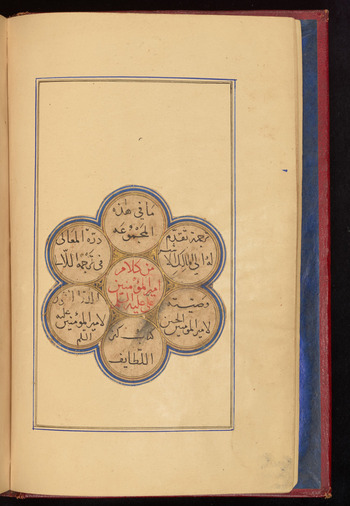
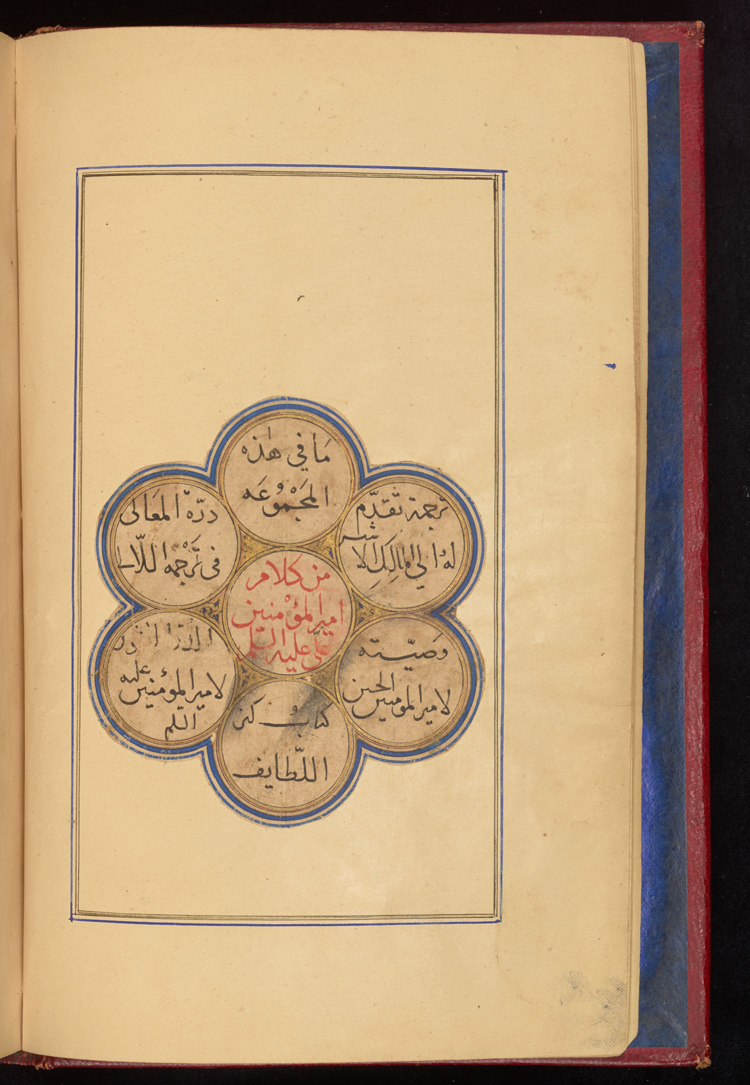
The contents of MS CBL Per 308, listed according to the titles that appear in the MS’s shamseh (see Figure 2),Footnote 74 are as follows:
The Words of the Commander of the Faithful ʿAli, may peace be upon him, that are contained in this miscellany:
i: Durrat al-maʿāli fi tarjamat al-laʾāli. “The Pearl of Noble Things: A Translation of [Scattered] Pearls.” Translation by Abu l-Mahāsin Muhammad b. Saʿd b. Muhammad al-Nakhjavāni al-maʿruf bi-Ibn al-Sāvaji of Nathr al-laʾali.
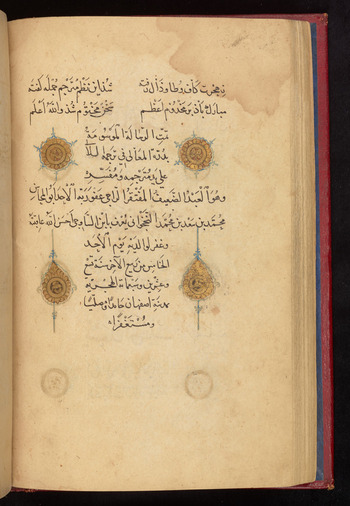
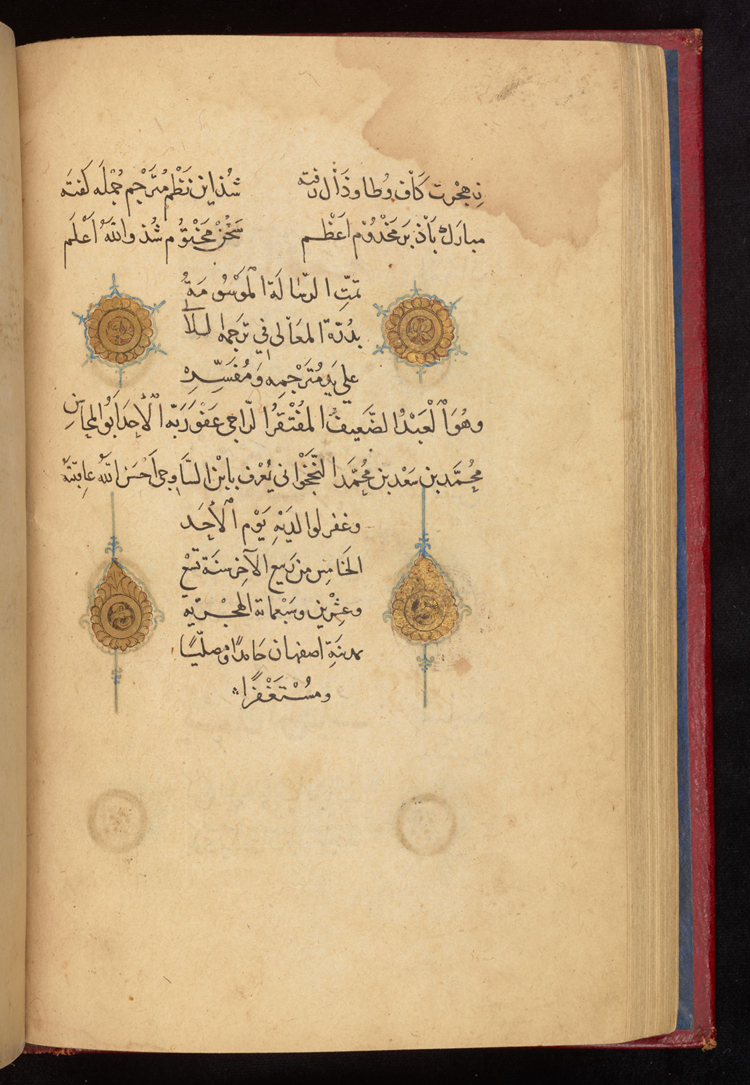
The colophon (Figure 3) reads tammat al-risāla al-mawsuma bi-Durrat al-maʿāli fi tarjamat al-laʾāli ʿalā yad mutarjimihi wa-mufassirihi (dated Rabiʿ II 729/February 1329).Footnote 75
Shamseh. CBL Per 308 fol. 1v.
Source: © The Trustees of the Chester Beatty Library, Dublin.
Colophon to Durrat al-maʿālī fī tarjamat al-laʾālī. CBL Per 308 fol. 47v.
Source: © The Trustees of the Chester Beatty Library, Dublin.
This first item in MS CBL Per 308 is Ibn al-Sāvaji’s bilingual version of Nathr al-laʾāli. Nathr al-laʾāli (and variants thereof) is the name given to a widely circulated collection, compiled by Abu ʿAli al-Tabrisi (al-Tabarsi) (d. 548/1153), of ʿAli’s (Arabic) maxims.Footnote 76 It is this collection that formed the source text for Ibn al-Sāvaji’s composition.Footnote 77 The contents of the Arabic Nathr al-laʾāli and their arrangement differ slightly from one manuscript to another, but the collection, which proceeds in alphabetical order, from alif to yāʾ, remains easily recognizable. Unlike its Arabic source, and unlike other (later) translations into Persian, Ibn al-Sāvaji’s translation lacks a section for the letter dāl, presumably because it is a feature of Ibn al-Sāvaji’s orthography that, when writing in Persian, he usually employs the dotted form, that is, the letter dhāl, including in many words (āmad, shinidam, guyad) where the modern reader would expect the (undotted) letter dāl.
Copies of al-Tabrisi’s Arabic collection of ʿAli’s maxims usually begin immediately after the basmala. Ibn al-Sāvaji preceded his bilingual version with a preface, composed in Persian couplets. In this preface, Ibn al-Sāvaji praises the vizier ʿAli Fāminini, alludes to his sharing of his name with the imam, and places much emphasis on his justice and equity (ʿadl va-dād, a pairing of Arabic and Persian synonyms). In presenting the reasons for his decision to translate Nathr al-laʾāli, Ibn al-Sāvaji declares his intention to prepare a tarjameh chun durr-e manthur, “a translation like scattered pearls,”Footnote 78 a reference to the metaphor contained in the source text’s title (Nathr al-laʾāli, “The Scattering of Pearls”), and to the title under which Ibn al-Sāvaji knew an earlier bilingual work of Rashid al-Din Vatvāt (d. ca. 578/1182–83)—the work, in fact, that constitutes the second item in the collection.Footnote 79 In a reflection of the mingling of Sufistic discourse with ʿAlid piety in the period’s religious culture, and at a time when almost all Sufi communities traced their spiritual lineages to ʿAli, Ibn al-Sāvaji refers to ʿAli as shāh-e tariqat (King of the Spiritual Path) and he describes his source text Nathr al-laʾāli as a book of haqiqat (the highest truth).Footnote 80
Immediately before the colophon, Ibn al-Sāvaji added a pair of Persian couplets:
zi-hijrat-e kāf va-tāʾ va-dhāl rafteh shud in nazm-e mutarjam jumleh
mubārak bād bar makhdūm-e aʿzam sukhan makhtūm shud va-Allāhu aʿlam Footnote 81
[At a date] past the hijra by [the value of the letters] kāf, tāʾ and dhāl
This versified translation has reached its completion.
May the Great Patron be ever blessed
The word is sealed; and God knows best.
The letters kāf, tāʾ and dhāl contain a chronogram indicating the year 729, date of the manuscript’s completion, and the second line invokes blessings on the vizier to whom it is dedicated.
ii: al-Durr al-manthur li-Amir al-Muʾminin ʿalayhi al-salām. “Scattered Pearls: By the Commander of the Faithful [ʿAli], peace be upon him” = Matlub kull tālib min kalām Amir al-Muʾminin ʿAli b. Abi Tālib, by Rashid al-Din Vatvāt (d. ca. 578/1182–83). Dated Ramadan 729/June 1329.Footnote 82
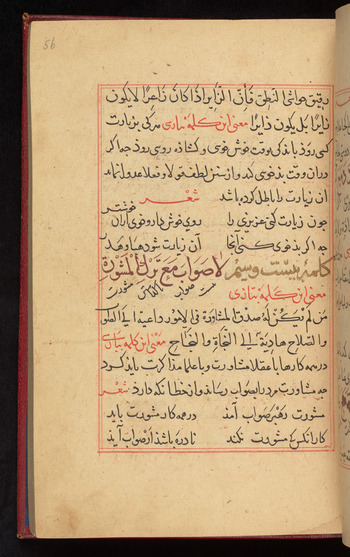
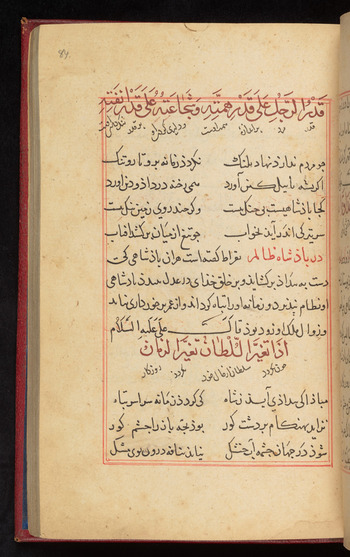
The second item, presented under the title al-Durr al-manthur, is Vatvāt’s bilingual version of the Miʾa kalima (Persian Sad kalimeh), the compilation of which is traditionally attributed to ʿAmr b. Bahr al-Jāhiz (d. 255/868–69).Footnote 83 Vatvāt, the sixth/twelfth-century secretary, poet and author of an important treatise, in Persian, devoted to rhetorical figures (ʿilm al-badiʿ), was widely renowned for his virtuosity in Arabic and Persian alike.Footnote 84 He composed bilingual collections of the pronouncements of the caliphs Abu Bakr, ʿUmar and ʿUthmān, but his most celebrated composition of this type was the present collection, usually recorded under the title Matlub kull tālib min kalām Amir al-Muʾminin ʿAli b. Abi Tālib. This text constitutes the prototypical bilingual treatment of ʿAli’s sayings and probably served as a model for Ibn al-Sāvaji’s Durrat al-maʿāli. Vatvāt employs an invariable format for each entry in the text. First, he cites the Arabic maxim to which the entry is dedicated, and next, he transcribes the maxim in Persian; in MS CBL Per 308, Ibn al-Sāvaji wrote each Persian word or phrase directly under its Arabic counterpart (see Figure 4). After this bilingual opening section of his text, Vatvāt provides two sections of commentary, first an explication in Arabic (maʿnā-ye in kalimeh bi-tāzi), and then an explication in Persian (maʿnā-ye in kalimeh bi-pārsi). He concludes each entry with a fitting couplet, du-bayt-e shiʿr (in Persian) of his own origination. In each entry, then, Vatvāt combined literal, word-by-word translation, exemplified in the opening section, with, in the second section, translation as interpretation, which he described as a bilingual tafsir.Footnote 85 In adopting this approach, in which he fully integrated the two languages, Vatvāt went well beyond the limited scope for bilingual expression deemed permissible in the use of mulammaʿ, an established but constrained technique that allowed for the alternation of Arabic and Persian segments in poetic compositions.Footnote 86
iii: Kitāb Kanz al-latāʾif. “Treasury of Fine Sayings” = Daftar-e Khiradnamā-ye jān-afruz or Khiradnāmeh, the work of Abu l-Fazl Yusuf b. ʿAli Mustawfi. Dated Dhu l-Qaʿda 729/August 1329.Footnote 87
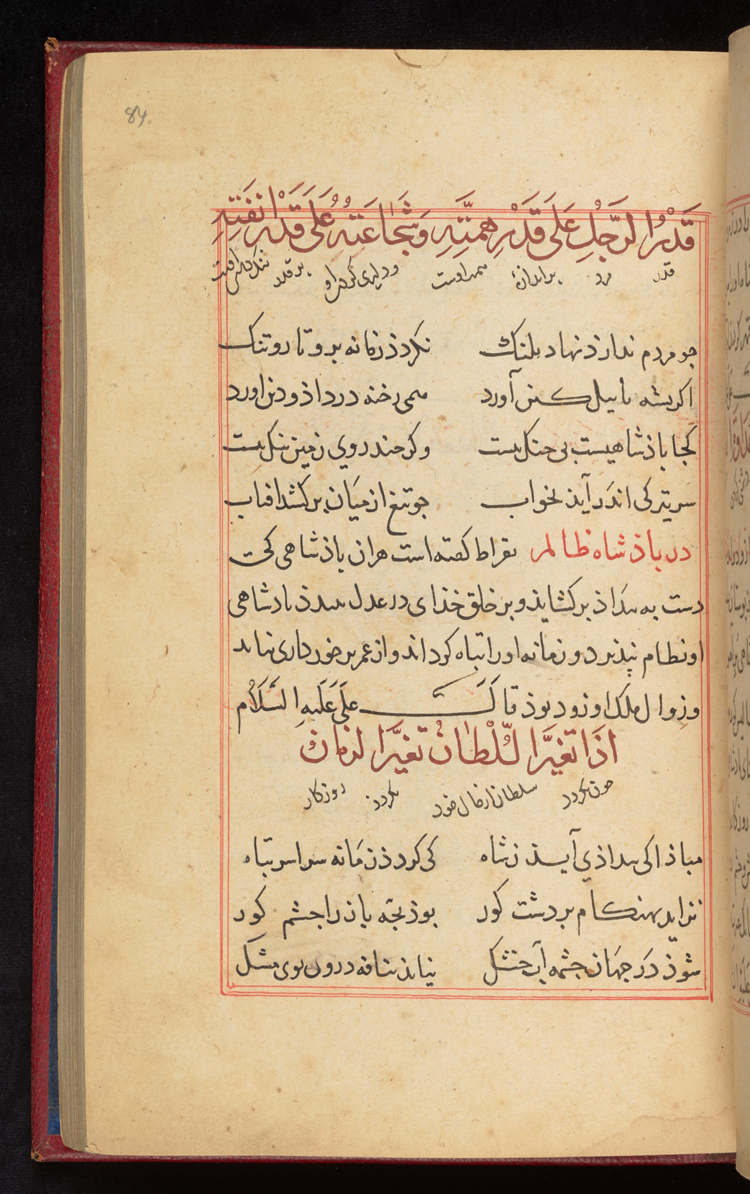
The third item, here labelled Kanz al-latāʾif, is the collection known elsewhere under the title Daftar-e Khiradnamā-ye jān-afruz or Khiradnāmeh.Footnote 88 The work of Abu l-Fazl Yusuf b. ʿAli Mustawfi, this text, probably compiled in the twelfth or thirteenth century, comprises a compilation of one hundred thematically distinguished entries. Each entry consists of three elements (see Figure 5): first, a text in prose ascribed to a (usually named) wise person (khiradmand), whether a figure of antiquity or a personage of the early Islamic period (in thirty cases the texts appear as anonymous citations); secondly, a proverbial utterance (mathal, pl. amthāl) of ʿAli, in Arabic; thirdly, a selection of verse (nazm), in Persian, from the Shāhnāmeh of Firdawsi.Footnote 89 MS CBL Per 308, in the hand of Ibn al-Sāvaji, appears to be the earliest extant copy of Mustawfi’s compilation. Several later copies of Khiradnamā-ye jān-afruz also survive in miscellanies, where, not infrequently, they appear in proximity to compositions by or ascribed to Nasir al-Din Tusi, and in particular his Maqāleh fi fazāʾil Amir al-Muʾminin ʿAli.Footnote 90
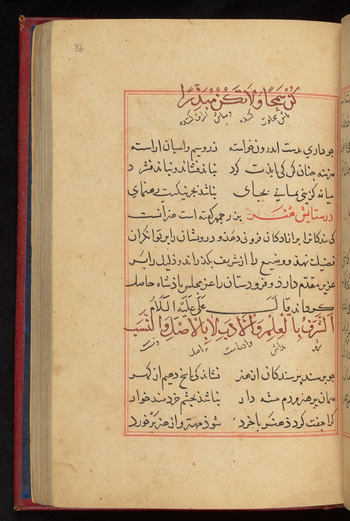
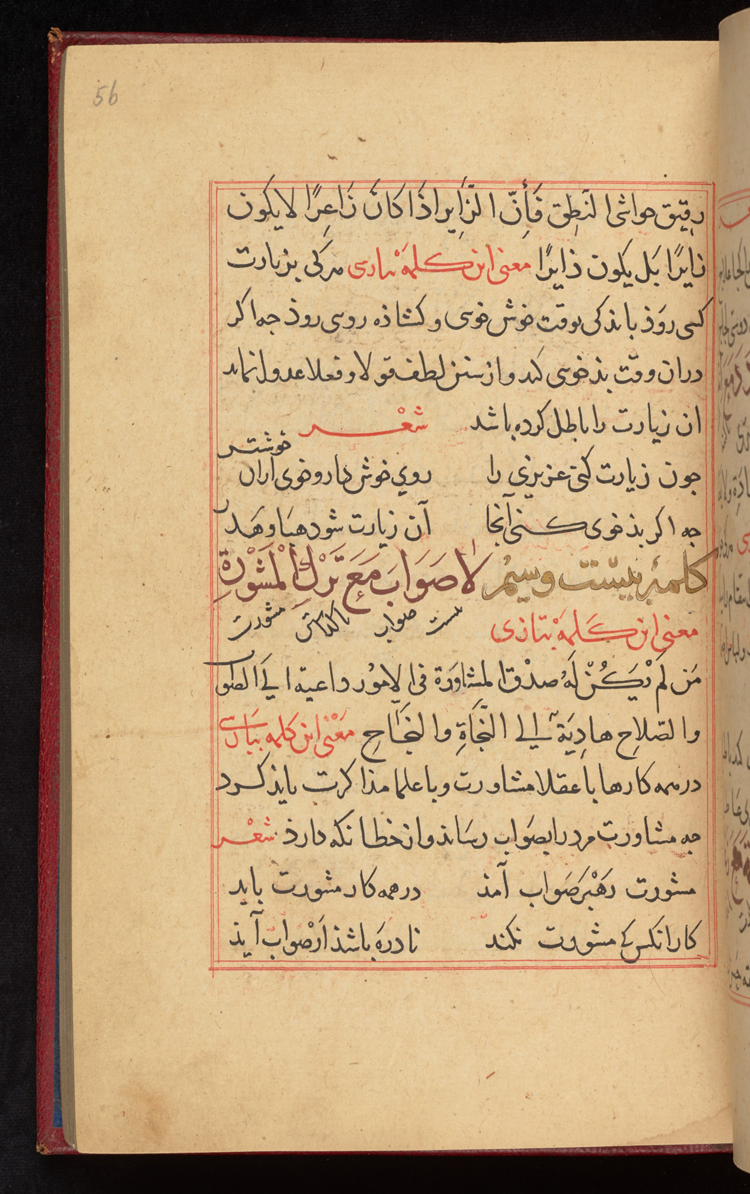
The text contained in MS CBL Per 308 seems to be the only copy of Mustawfi’s compilation that adds Persian translations for the Arabic maxims of ʿAli that comprise the middle section of each entry. These Persian translations are the work of Ibn al-Sāvaji, who in this instance, as in his Durrat al-maʿāli, combined his bilingual dexterity with his skills as a copyist and calligrapher.Footnote 91 Like Vatvāt, Ibn al-Sāvaji follows each of ʿAli’s maxims with an interlinear Persian translation (see Figure 6) that, proceeding one lexical unit at a time, accommodates Arabic rather than Persian syntax:
kathrat al-āmāl taqtaʿu aʿnāq al-rijāl
bisyāri-ye umid-hā—biburad—gardān-hā-ye—mardumān
idhā taghayyara al-sultān taghayyara al-zamān
chun bigardad—sultān az hāl-e khud—bigardad—ruzgār
al-sharaf bi-l-ʿilm wa-l-adab lā bi-l-asl wa-l-nasab
sharaf—bi-dānish—va-adab ast—nah bi-asl—va-nasab ast. Footnote 92
Twenty-third kalimeh, in al-Durr al-manthūr. CBL Per 308 fol. 56r.
Source: The Trustees of the Chester Beatty Library, Dublin.
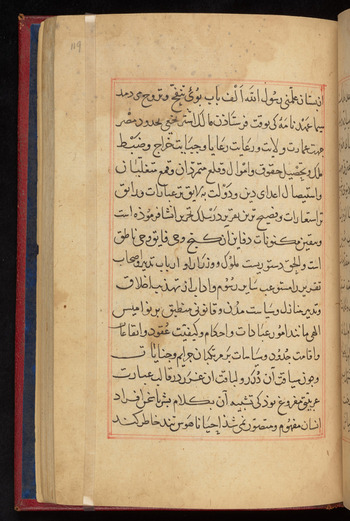
Page from Kitāb Kanz al-laṭāʾif. CBL Per 308 fol. 84r.
Source: © The Trustees of the Chester Beatty Library, Dublin.
Page from Kitāb Kanz al-latāʾif. CBL Per 308 fol. 86r.
Source: © The Trustees of the Chester Beatty Library, Dublin.
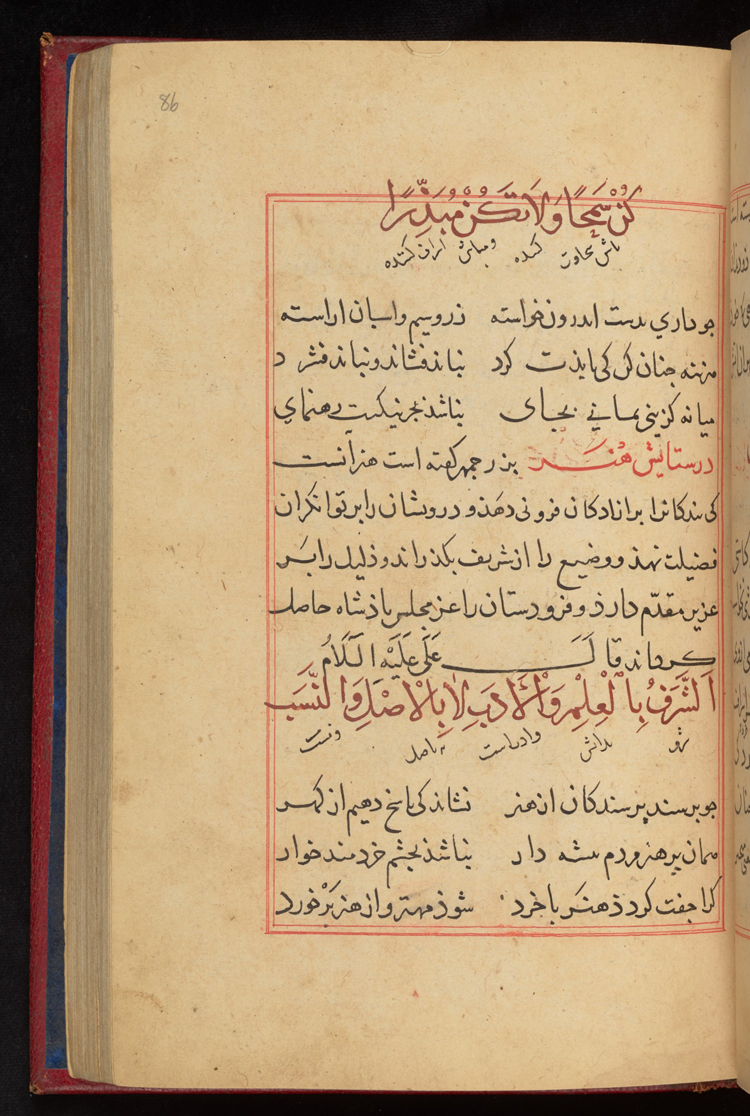
In this context, as these examples illustrate, Ibn al-Sāvaji adopts a spare, literal approach in his translations; this approach contrasts with the freer mode of translation evident in his versifications. The device of the interlinear translation, which Ibn al-Sāvaji uses for ʿAli’s speech in many parts of the Miscellany, recapitulates the practice established for producing bilingual copies of the Qurʾan.Footnote 93
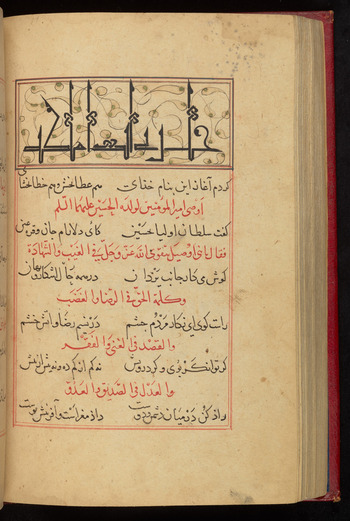
iv: Vasiyyatuhu li-Amir al-Muʾminin al-Hasan. “His [ʿAli’s] Testament to the Commander of the Faithful Hasan.” Arabic text, properly of Vasiyyatuhu li-waladihi Husayn (“His Testament to His Son Husayn”) with interlinear versified translation by Ibn al-Sāvaji (see Figure 7). Dated 729/1328–29.Footnote 94
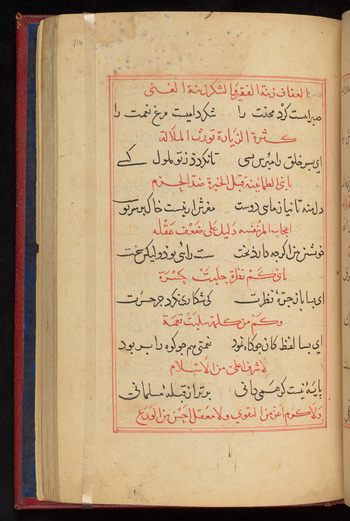
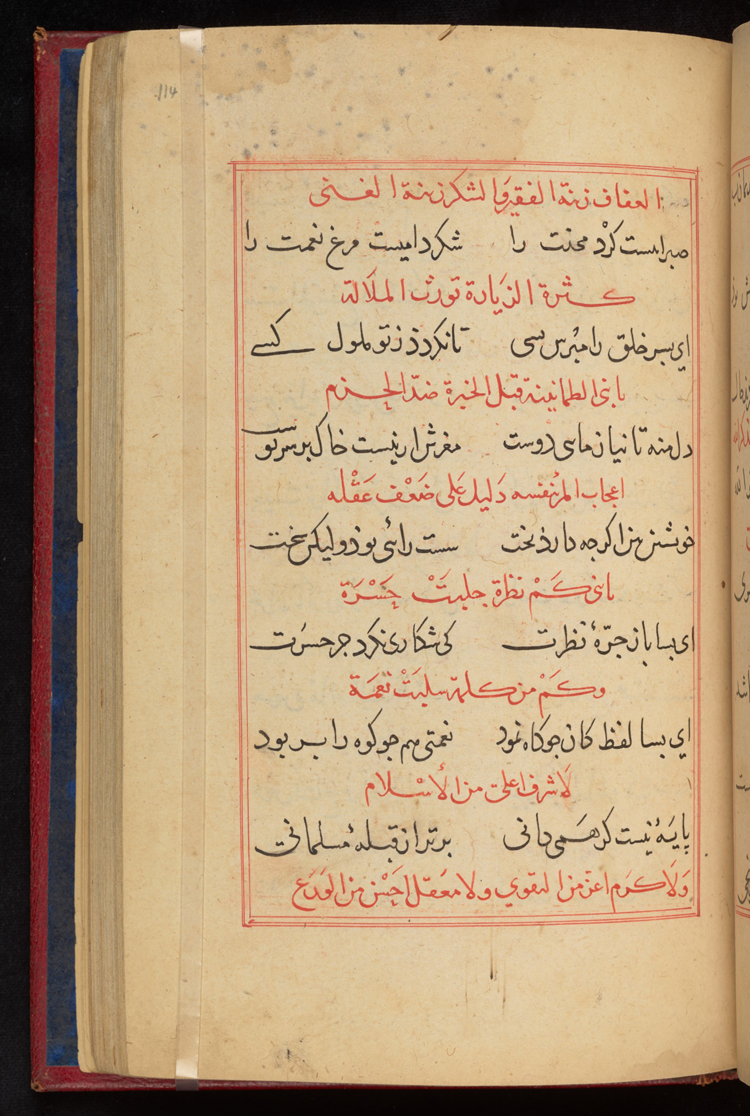
Despite the apparent naming of Hasan as the addressee of this item in the shamseh that appears at the front of the Miscellany, the source text for this fourth piece is a “Testament of ʿAli to His Son Husayn.”Footnote 95 A number of ʿAli’s testaments to his sons Hasan and Husayn, the second and third imams of the Twelver tradition respectively, have been preserved; some are addressed to one son or the other; a lengthy text addressed to Hasan is especially celebrated; and at least one wasiyya is jointly addressed to Hasan and Husayn.Footnote 96 ʿAli’s several testaments, like other examples of the genre, encompass moral and religious instruction as well as, in some cases, practical and political counsels.Footnote 97 Recorded in some of the Arabic historiographical sources and various collections of edificatory and devotional writings, several of ʿAli’s testaments appear in the Nahj al-balāgha.Footnote 98 In the case of the testament included in MS CBL Per 308, the source text consists of brief ethical counsels, introduced with the formula yā bunayya usika bi-taqwā Allāh ʿazza wa-jalla fi l-ghayb wa-l-shahāda, “O my son, I commend you to mindfulness of God, may He be exalted and glorified, in what is hidden and what is manifest.”Footnote 99 The versified translation in the Chester Beatty Miscellany is, once again, the work of Ibn al-Sāvaji. The copyist-translator describes the work in his colophon as al-wasiyya maʿa tarjamatihi, “the testament with its translation,” a phrasing that suggests two closely interrelated and interdependent texts. In this text, Ibn al-Sāvaji follows each phrase of the Arabic with a rhyming Persian couplet that provides its translation. The relationship of source text and target text is reflected in the calligrapher-translator’s use of an interlinear format, in which he inscribes the Arabic texts in red ink and the Persian in black (Figure 8).
v: Tarjamat taqaddum lahu li-Mālik al-Ashtar. “Translation of a Commission that He [ʿAli] Addressed to Mālik al-Ashtar.” By Husayn b. Muhammad b. Abi l-Rizā Husayni ʿAlavi Āvi. Translation and commentary on ʿAli’s letter of instruction to Mālik-e Ashtar. Comprising an introduction with two discourses and a khātimeh, dedicated to Sharaf al-Dawla Tāj al-Islām ʿAli Fāminini. Dated Rabiʿ II 730/January 1330.Footnote 100
The source text for this concluding item in MS CBL Per 308 appears in the Nahj al-balāgha.Footnote 101 Āvi describes his source text as the ʿAhdnāmeh that ʿAli composed on the occasion of his dispatch of Mālik b. al-Hārith al-Nakhaʾi al-Ashtar (d. 37 or 38/657–58) to the governorship of Egypt (a post that Mālik, who died en route, never reached) (see Figure 9). Unlike the self-contained proverbial utterances of the previous pieces, the Arabic source text in this case takes the form of a substantial address, in prose, comprised of instructions and counsels related to specific areas of governance. Unlike Ibn al-Sāvaji’s translations, and his transcription of Vatvāt’s translation, contained in the preceding texts, Āvi’s translation is not interlinear. Instead, according to Āvi’s announced plan, it consists of a preface, the Arabic source text, two discourses in Persian prose, and an epilogue (khātimeh). Āvi refers to himself in his preface as the text’s muharrir (redactor, adapter) and muqarrir (arranger, determiner), terms that highlight the freedom to interpret, and expand, that “translation” (tarjameh) made possible. His two discourses offer paraphrase and an interpretative commentary for the benefit of Āvi’s contemporary reader rather than a thorough, closely worded translation.
Opening page of Vasiyyat ʿAli li-waladihi al-Husayn. CBL Per 308 fol. 110v.
Source: © The Trustees of the Chester Beatty Library, Dublin.
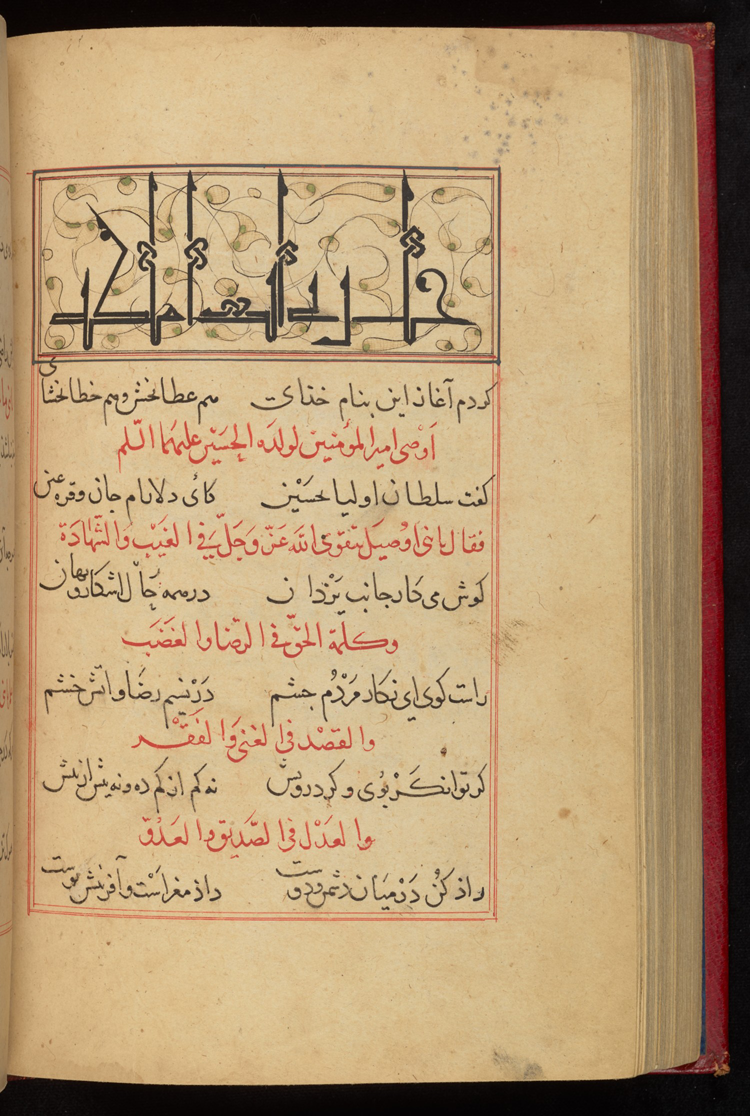
Page from Vasiyyat ʿAli li-waladihi al-Husayn. CBL Per 308 fol. 114r.
Source: © The Trustees of the Chester Beatty Library, Dublin.
Page from ʿAli's ʿAhdnāmeh to Mālik-e Ashtar (so identified in line 2). CBL Per 308 fol. 119r.
Source: © The Trustees of the Chester Beatty Library, Dublin.

In the previous year, 729/1328–29, Husayn-e Āvi had produced, also in Isfahan, another notably free translation: an updated and rearranged adaptation that moves far beyond its eleventh-century Arabic source text, yet at the same time places considerable emphasis on its connection to the earlier composition.Footnote 102 Shortly after his arrival in Isfahan, Āvi had dedicated his Tarjameh-ye Mahāsin-e Isfahān to the Ilkhan Abu Saʿid’s vizier Ghiyāth al-Din Muhammad, who through his extensive and multifaceted network controlled a vast system of patronage.
Translation and bilingual display in the ʿAlid corpus. The joint work of Ibn al-Sāvaji and Husayn-e Āvi, MS CBL Per 308 evokes a collaboration between two individuals whose roots lay in Saveh and Aveh, and who now sought favor in the circle of the vizier ʿAli Fāminini in Isfahan. Although it is possible that the vizier commissioned one or some of the pieces that comprise the collection, the writers’ silence regarding such a commission suggests that they offered their works unprompted. Three of the first four texts included in the Miscellany, composed at various points in 729, represent autograph copies of Ibn al-Sāvaji’s own translations. Although the date at which the five items were joined together to create the Miscellany is uncertain, it seems likely that this combination occurred soon after the completion of the individual pieces. The ornamental hors de texte ʿunvāns which appear at the head of all five of the texts vary in style and script: the first two, like the main text, are written in naskh; the third, fourth and fifth ʿunvāns employ a highly stylized kufic; on the other hand, the first and fifth, and the third and fourth, are identical in their wording.Footnote 103 Perhaps suggesting a pre-existing design for the creation of the Miscellany, its five constituent items were assembled in order of their completion. It is possible that Ibn al-Sāvaji planned to produce, one by one, copies of the first three or four texts; he finished these copies every few months throughout 729 (it should be noted that the colophon of the fourth piece states only the year, and not the month, of completion). It is conceivable that having completed these items, Ibn al-Sāvaji, in the following year (730), added to them his copy of Āvi’s translation of ʿAli’s ʿAhdnāmeh, in preparation for presentation of the Miscellany to the vizier. Āvi’s dedication of his earlier translation, the Tarjameh-ye Mahāsin-e Isfahān, to the imperial vizier Ghiyāth al-Din, and of his later translation, the ʿAhdnāmeh, to the local vizier ʿAli Fāminini, whom the translator had praised in lavish terms in his earlier translation as well, suggest an intersection of the local Isfahan-based network with the much larger network over which the Ilkhan’s vizier presided.Footnote 104
The major criteria for the selection of the five items contained in MS CBL Per 308 were, it seems evident, firstly, an admired position in ʿAli’s prestigious literary legacy, especially its edificatory and homiletic sector, and, secondly, opportunity for bilingual display. The interplay of source and target languages throughout the pieces assembled in the Miscellany suggests that its function was hardly limited to, and perhaps barely encompassed, the rendering of the Arabic texts into Persian for the benefit of a Persian-speaking audience unfamiliar with Arabic. On the contrary, much of the MS seems designed to please and win the admiration of a fully bilingual readership. The conceptual and practical framework for the Miscellany’s bilingualism involves not only translation but also discursive and rhetorical appeal.Footnote 105 Several of the Miscellany’s pieces combine literal, word-for-word renderings of ʿAli’s pronouncements with demonstrations of bilingual artistry, in which the Arabic source text provides an inspiration for elaborations, often in poetic form, in one or both languages.Footnote 106 In several instances, the translators embraced and foregrounded the interpretative dimension of their activities.
In alternating between literal renderings and associative literary developments of ʿAli’s words, the translators followed the example of Rashid al-Din Vatvāt, who, in his Matlub kull tālib min kalām Amir al-Muʾminin ʿAli b. Abi Tālib (or, as it is labeled in this collection, al-Durr al-manthur), set out to produce a tafsir in two languages (bi-du zabān-e tāzi va-pārsi tafsir kardan). Vatvāt’s stated purpose, in accordance with his audience’s expectation, was to extend the benefits and profits of ʿAli’s sayings to a broad audience (tā fāʾideh-ye ān ʿāmm-tar va-manfaʿat-e ān tāmm-tar bāshad), and to appeal to connoisseurs of prose and poetry alike (har du fariq ham arbāb-e nazm va-ham ashāb-e nathr dar mutālaʿeh-ye ān raghbat nimāyand).Footnote 107 Very probably, Vatvāt’s work provided a model for Ibn al-Sāvaji, who, in the colophon to his Durrat al-maʿāli fi tarjamat al-laʾāli, refers to himself as the text’s mutarjim and mufassir (Figure 3). Notwithstanding Vatvāt’s perhaps conventional invocation of a general audience for his bilingual production, it seems highly likely that he, and his later imitator Ibn al-Sāvaji, envisaged a bilingual readership. Not only did both writers include quantities of Arabic vocabulary in their Persian renderings; they also assumed a certain familiarity with Arabic grammar and usage. The Appendix to this article presents examples to illustrate Ibn al-Sāvaji’s techniques of translation and inter-lingual elaboration.
It appears from the detailed descriptions of M. T. Dānishpazhuh that MS CBL Per 308 bears comparison with a second miscellany, which involved numerous individuals associated with Saveh and Aveh and contained a substantial number of texts devoted to ʿAli.Footnote 108 According to Dānishpazhuh, this bilingual miscellany, which I have not seen, contains items copied by perhaps three different copyists.Footnote 109 The copyist responsible for the largest number of items is a Muhammad b. Abi Tālib Āvi, who produced the miscellany’s copy of Usul ʿilm al-balāgha of Kamāl al-Din Mitham b. ʿAli b. Mitham Bahrāni (d. after 681/1282) in Dhu l-Qaʿda 735/June 1335, as well as, in all likelihood, the Maqāleh fi fazāʾil Amir al-Muʾminin ʿAli by or ascribed to Nasir al-Din Tusi.Footnote 110 Explicit notices of Muhammad Āvi’s transcriptions in this MS are dated 735/1334–35 and 738/1337–38, and located, in the latter case, in Kashan. Dānishpazhuh surmises that this Muhammad b. Abi Tālib Āvi produced most of the texts contained in the Miscellany, and that he completed them in these two years. The second copyist likely to have been involved in the production of the pieces assembled in this collection, according to Dānishpazhuh’s account, is ʿAli b. al-Hasan b. al-Rizā Husayni Hāfiz, who, in Safar 738/August 1337, transcribed a prayer for the complete recitation of the Qurʾan for the vizier (dastur) Shams al-Din Āvi.Footnote 111 The collection also includes the verses of a Zayn al-Din Āvi.Footnote 112
Contexts and Functions
As I hope to have demonstrated in the preceding section, a striking number of the individuals involved in the creation of this ʿAlid-focused bilingual literary corpus had roots in the localities of Saveh and Aveh. They had, however, left these localities for Isfahan, and it was in this city that they produced many of their bilingual compositions.Footnote 113 In the preface to his Tarjameh-ye Mahāsin-e Isfahān, Husayn-e Āvi, the translator of ʿAli’s ʿAhdnāmeh, states that he had reluctantly left his native Aveh and traveled, by way of Kashan, to Isfahan, where he took up residence in a madrasa and sought refuge with the vizier.Footnote 114 Since Āvi had composed his Tarjameh-ye Mahāsin-e Isfahān in 729, it is possible to speculate that, following his presentation of that composition to the vizier, he joined the circle which also included Ibn al-Sāvaji, and in the following year, in collaboration with Ibn al-Sāvaji, he produced his translation of ʿAli’s ʿAhdnāmeh. In all likelihood the attraction of the migrants to Isfahan lay principally in the thriving status that the city had attained in the early decades of the fourteenth century. Isfahan’s several levels of political authority—imperial, regional, municipal and local—as well as its numerous sites of economic and social importance—mosques, madrasas, khānaqāhs, shrines—provided a variety of opportunities for the forging of new associations. It is also possible that the recurrent inter-urban conflict of Saveh and Aveh contributed to this pattern of migration to Isfahan. Although Isfahan itself was far from untouched by sectarian strife, the manuscript record suggests that the Shiʿi vizier Sharaf al-Din ʿAli Fāminini supported a circle of Sāvaji and Āvaji littérateurs, many of them likely also to have been Twelver Shiʿis.
The period’s joining of Arabic and Persian bilingualism to the utterances and wisdom of the Imam ʿAli finds another important context, I suggest, in the region’s landscape of indeterminate and intersecting sectarian identities and episodic religiously articulated conflict. The ʿAlid-focused literary production under consideration occupies an ambiguous, potentially inclusive space in the prevailing religious culture. The region’s many shrines—including the tombs of Shaykh ʿUthmān of Saveh; Ishāq, son of Imam Musā al-Kāzim; and the prophet Samuel—suggest aspects of the religious culture that transcended confessional divisions.Footnote 115 The period also saw the continued development of specific channels of common interest, such as the extensive collaboration in the legal sphere between Twelver Shiʿi and Shāfiʿi Sunni scholars.Footnote 116 In an example of the intellectual engagement between scholars affiliated with these two schools, Nasir al-Din Tusi composed a commentary, Talkhis al-muhassal (669/1271), on the Muhassal al-afkār (Muhassal afkār al-mutaqaddimin wa-l-mutaʾakhkhirin min al-ʿulamāʾ wa-l-hukamāʾ wa-l-mutakallimin) of the Shāfiʿi Fakhr al-Din al-Rāzi (543–606/1149–1209).Footnote 117 But the figure of ʿAli offered an especially ample and compelling opportunity for cross-communal contact. As cousin and son-in-law of the Prophet and progenitor of the Prophet’s descendants, ʿAli was a revered figure in all branches of Islamic tradition. Devotion to the Prophet’s family, and to ʿAli in particular, bridged sectarian divisions, and attachment to the living descendants of ʿAli and his family, the sayyids or sādāt, was deeply rooted in the regional culture, as Ghazan’s construction of “houses for sayyids” (sg. dār al-siyāda) in Isfahan and Kashan, as well as several other locations, suggests.Footnote 118
The functions of the distinctive ʿAlid-focused literary production of this group of Sāvaji and Āvaji individuals might be considered in terms of three levels: personal and proximate; literary and cultural; social and historical.
On a personal and proximate level, the corpus demonstrated the bilingual fluency and literary as well as calligraphic artistry of the Sāvaji and Āv(aj)i migrants to Isfahan. As the alliance between the vizier Saʿd al-Din Sāvaji and the sayyid Tāj al-Din Āvaji had demonstrated, the Shiʿi or Shiʿi-friendly families of Sunni-majority Saveh sometimes developed associative relationships with the sayyids, many of them Shiʿi notables, of Aveh.Footnote 119 The collaborative relationship of Ibn al-Sāvaji and Husayn-e Āvi in Isfahan suggests a comparable association, which, I propose, formed part of a local, self-replicating network from one generation to the next. The bilingual accomplishment of these individuals in their adopted environment proved their fitness for administrative and secretarial employment. Their compositions also carried a certain ceremonial value. Given as presents, collections of ʿAli’s sayings, inscribed in manuscripts designed to add visual and aesthetic enhancement to the perfect eloquence of ʿAli’s speech, gestured towards virtue on the part of the giver and the recipient. The first and last items contained in the Miscellany bear explicit dedications to ʿAli Fāminini, and it seems likely that all five of the pieces, whether commissioned or, more probably, offered in the expectation of recompense and favor, were prepared for presentation to the vizier.
On a literary and cultural level, the creation of this distinctive bilingual corpus contributes to the continuing and contemporaneous process of establishing parity between the Arabic and Persian languages.Footnote 120 This literature, composed of interlinear translations and Persian or bilingual elaborations of ʿAli’s speech, supported the intellectual activity also manifest in the composition of dictionaries and the development of a scholarly literature devoted to Persian linguistics and literary studies. The most celebrated figure in the formative development of this kind of bilingualism—both as a medium of expression and as a scholarly discipline—was Rashid al-Din Vatvāt, who was also greatly renowned for his translation and bilingual elaboration of the Miʾa kalima. Ibn al-Sāvaji, who placed his versified translation of the Nathr al-laʾāli directly before his copy of Vatvāt’s al-Durr al-manthur (= Matlub kull tālib min kalām ʿAli b. Abi Tālib), employed his predecessor’s work as a multifaceted example: it established a prototype in, first, its choice of source text, the maxims of ʿAli; secondly, its provision of Persian translations for ʿAli’s words; and thirdly, its meditations on ʿAli’s wisdom in composed Persian couplets. In an era in which Persian had acquired new currency and status as an imperial lingua franca, the genre demonstrated the language’s elevation to a level fit to convey the eloquence of its prestigious Arabic source. Unlike the acknowledged multi- and interlingual literary device termed mulammaʿ, “translation” imposed few formal constraints on its practitioners; it allowed for the extension of meanings and associations from the source text to the target text in a continuous process of bilingual intertextuality.Footnote 121
On a social and cultural level, these texts, produced in a time of recurrent sectarian tension, seem intended to avoid controversy and to facilitate social cohesion. It was ʿAli’s eloquence, rather than his status as Imam—source of theological, legal and exegetical authority—that provided the focus of this body of literature. In a setting in which devotion to the Prophet and his family was virtually universal, these texts, which promoted the literary and ethical parts of ʿAli’s heritage, possessed an appeal that crossed confessional boundaries. Rendering ʿAli’s impeccable utterances into Persian was, in this environment, an undertaking that required neither explanation nor justification. At the same time, the generation of a bilingual literature centered on ʿAli’s wisdom held a special and additional significance in intra-Shiʿi contexts. Among Twelver Shiʿis, the devotion of artistic, literary and intellectual expertise to the display, dissemination and elaboration of ʿAli’s speech constituted not only a meritorious but also a pietistic and devotional exercise. These texts, I suggest, operated on various, implicit levels: usually devoid of overt sectarian indicators, they occasionally skirted the boundaries of the mixed middle ground discussed in the first part of this article, and in so doing they signaled, fleetingly and sporadically, a distinctively Shiʿi devotion to the Imams.Footnote 122
In sum, the texts under consideration responded to, on the one hand, the porousness of the region’s sectarian divisions and the scope for inclusivity that accompanied its confessional ambiguity and, on the other hand, its sometimes firmly perceived sectarian demarcations. The “translators” of ʿAli’s sayings not only displayed their knowledge and their skills, but also their aspiration, in a period of sectarian tensions, to build associations and bridge constituencies. In this regard, their bilingual and intertextual activities mirror contemporaneous creations and reconfigurations which offered, among other functions, potential ground for various kinds of integration. These simultaneously developing and interrelated reconfigurations include the renewal of the idea of “Iran”;Footnote 123 the location of points of intersection between Mongol and Islamic models of legitimation;Footnote 124 and the forging of fresh, broadly encompassing political concepts.Footnote 125 The activities of the ʿAlid-focused bilingual littérateurs of Saveh and Aveh contributed to the expansion of a supra-confessional middle ground in which sectarian allegiances receded and lost much for their significance.
It is a pleasure to acknowledge with gratitude the helpful comments made by the anonymous reviewer for Iranian Studies. I also wish to thank Dani Henry for her assistance in the preparation of Figure 1, and the Trustees of the Chester Beatty Library, Dublin, for their kind permission to publish the images that accompany this article.
In composing the rhyming couplets that convey, amplify and complement each Arabic maxim in Nathr al-laʾāli, Ibn al-Sāvaji, in his translation Durrat al-maʿāli fi tarjamat al-laʾāli, employs several techniques to extend the meaning and the associations of the source text. These techniques include the introduction of variant meanings of or words related to a lexical item that appears in the Arabic; the introduction of pairings of terms, sometimes both terms in Arabic, and sometimes one in Arabic and another in Persian; and shifts in register and the mode of address, often from declarative statement to direct admonition. A few examples from Ibn al-Sāvaji’s translation of Nathr al-laʾāli will illustrate some of these techniques.
Arabic:
birr al-wālidayn salaf
Reverence for parents is an advance payment (for the afterlife).
Persian:
salaf guyad keh birr-e vālidayn ast
khalaf-rā dar maʿād in fakhr va-zayn ast Footnote 126
He has said that reverence for parents is an advance payment;
For the successors, in the hereafter, this brings esteem and adornment.
By introducing the Arabic term khalaf, the Persian couplet develops the meanings and associations of the Arabic term salaf, here used (in the source text) in the sense of an advance payment towards the reckoning that awaits each person at the Day of Judgement. In Arabic contexts, the two (rhyming) terms salaf and khalaf frequently appear together, evoking “predecessors” and “successors” respectively; and Ibn al-Sāvaji’s couplet assumes his audience’s familiarity with the pairing and the terms’ associations.
Arabic:
thulthu l-imān hayāʾ wa-thulthuhu ʿaql wa-thulthuhu jud
A third of faith is modesty, a third is reason, and a third generosity.
Persian:
seh thulth āmad daru-ye ʿaql imān
hayā va-ʿaql va-digar jud va-ihsān Footnote 127
There are, as reason dictates, three thirds in faith:
Modesty and reason, and also, generosity and kindness.
By reproducing the Arabic nouns of the source text and adding, for purposes of rhyme and meter, the noun ihsān, this couplet presupposes an audience fluent in Arabic’s vocabulary of virtues. Introducing a new rhyme by the addition of a suitable Arabic term, as the previous example also demonstrates, is a frequent technique in Ibn al-Sāvaji’s versified translations.
Arabic:
kamāl al-ʿilm fi l-hilm
The perfection of knowledge lies in forbearance.
Persian:
kamāl-e martabat dar ʿilm bāshad
kamāl-e ʿilm va-ʿālim hilm bāshad Footnote 128
The perfection of rank lies in knowledge;
The perfection of knowledge—and the perfection of the scholar—lie in forbearance.
In this case, by adding the Arabic word ʿālim, Ibn al-Sāvaji introduces a meaning and an effect dependent on a familiarity with an Arabic grammatical form; he also repeats and highlights the Arabic rhyme of ʿilm and ʿhilm.
Arabic:
thulmat al-din mawt al-ʿulamāʾ
The death of scholars entails calamity for religion.
Persian:
bi-marg-e ʿālimān rakhneh shavad din
keh din az ʿilm dārad nur va-āyin Footnote 129
With the death of scholars, religion suffers a breach;
For from knowledge, religion attains light and order.
In this example, the second line links to the term ʿulamāʾ (= Pers. ʿālimān) of the source text the related Arabic word ʿilm, to which it adds a pairing of one Arabic and one Persian term (nur and āyin respectively).
Arabic:
thabāt al-nafs bi-l-ghadhāʾ
The endurance of the carnal self stems from nourishment.
Persian:
baqā-ye nafs-e insān dar ghadhā dān
baqā-ye ruh dar āvāz va-alhān Footnote 130
Know that the continuance of the carnal self stems from nourishment;
The continuance of the spirit stems from sound and from melodies.
In this case, the Persian couplet adds a second maxim to the first, and in it, Ibn al-Sāvaji draws a parallel between the corporeal or carnal self (nafs) and the spirit (ruh), assuming his audience’s familiarity with these somewhat technical terms. In the second line, where he prescribes the requirements for the longevity of the spirit, Ibn al-Sāvaji introduces a new pairing of terms—one in Persian (āvāz), “voice,” and one in Arabic (alhān), “melodies.” Certain copies of Nathr al-laʾāli include the very similar Arabic maxim thabāt al-nafs bi-l-ghadāʾ wa-thabāt al-ruh bi-l-ghināʾ; it is highly likely that Ibn al-Sāvaji presumed his readers’ familiarity with this variant in composing his accompanying couplet.Footnote 131
Arabic:
salāh al-insān fi hifz lisānihi
The human being’s welfare lies in guarding his tongue.
Persian:
salāh-e mardumān az mard va-az zan
hameh hifz al-lisān āmad muʿayyan Footnote 132
The wellbeing of the people, men and women alike—
For everyone, guarding the tongue is duly stipulated.
In this case, Ibn al-Sāvaji imports the most significant phrase, hifz al-lisān, intact into his Persian couplet, and adds a new Arabic term muʿayyan to rhyme with the Persian zan.
Arabic:
tawāduʿ al-marʾ yukrimuhu
A man’s humility ennobles him.
Persian:
tavāzuʿ mard-rā dārad kirāmi
tavāzuʿ kun chu khvāhi nik-nāmi Footnote 133
Humility brings a man nobility;
Be humble, if you desire a fine reputation.
The Persian couplet transposes the source text’s verb to a related Arabic noun, and it moves from the declarative tone of the first line to a cautionary invocation in the second line.
Arabic:
talab al-adab awlā min talab al-dhahab
The quest for education is worthier than the quest for gold.
Persian:
adab justan beh az zar justan āy dust
adab mar ādami-rā māl-e nikust Footnote 134
Seeking education is better than seeking gold, O Friend;
Education, for the human being, is the finest wealth.
In this case, as in the preceding example, Ibn al-Sāvaji shifts from the declarative voice of the Arabic source maxim, retained in the first line of the couplet, to an intimate, didactic mode of direct address in the second line.
These examples suggest Ibn al-Sāvaji’s continuation of the approach of Rashid al-Din Vatvāt, whose seventeenth kalima, in al-Durr al-manthur (= Matlub kull tālib min kalām Amir al-Muʾminin ʿAli b. Abi Tālib), illustrates the affinity:
[Opening]
lā sharaf maʿa suʾ al-adab There can be no nobility where there are bad manners.Footnote 135
nist buzurgi bā badi-ye adab There is no greatness with bad manners.
maʿnā-ye in kalimeh bi-tāzi:
ʿuluʾ l-rutab lā yunālu illā bi-husn al-adab
High ranks are attained only by good manners.
maʿnā-ye in kalimeh bi-pārsi:
har keh bi adab bāshad az buzurgi mahrum mānad va-bi-darajeh-ye ashrāf va-akābir va-aʿyān va-amāthil narasad
Whoever lacks manners remains deprived of greatness, and will never reach the degree of the noble, the great, the eminent and the exemplary.
shiʿr:
bi adab mard kay shavad mihtar gar-cheh u-rā jalālat az nasab ast
bā adab bāsh tā buzurg shavi keh buzurgi natijeh-ye adab ast Footnote 136
How can the man devoid of manners ever become great—even if he possesses a noble lineage?
Be well mannered, if you wish to become great; for greatness is the consequence of manners.
In this example, Vatvāt began his entry with the statement of the Arabic maxim and a word-for-word Persian version that retained even the syntax of the Arabic source. He adopts a freer approach in the two following sections, in which he explicates the meaning of the maxim, first in Arabic and then in Persian. In his Arabic explication, Vatvāt opts for brevity, concision and clarity; in his Persian explication, he expatiates, and, using a string of Arabic nouns, all in the plural form, he extends the inferences inherent in the maxim. In his final Persian couplet, Vatvāt ventures well beyond the text of the maxim; he concludes his entry with a direct admonition to his audience to move from comprehension of the maxim’s meaning to incorporation of its implications into their conduct.