Introduction
In a paper recently published by Kia et al. (Reference Kia, Meamer, Zahabiun and Mirhendi2009), Trichinella larvae detected in a wild boar (Sus scrofa) of Iran were identified as Trichinella murrelli, through molecular analysis of the 5S rRNA intergenic spacer region. This species is a taxon of the genus Trichinella that circulates in North America (Pozio & La Rosa, Reference Pozio and La Rosa2000; Pozio et al., Reference Pozio, Hoberg, La Rosa and Zarlenga2009), and it has only been detected once outside of this continent, in particular, in a horse slaughtered in France yet imported from the USA (Pozio, Reference Pozio2001). Additional studies were therefore performed at the International Trichinella Reference Centre (ITRC, Rome, Italy, www.iss.it/site/Trichinella/index.asp) to check this first identification.
Materials and methods
The larvae, which Dr Kia kindly provided and which had been preserved in ethyl alcohol, were investigated by analysing the following loci: the 5S rDNA intergenic spacer region, the LSU rDNA expansion segment five (ESV), and the internal transcribed spacers 1 and 2 (ITS1 and ITS2). Some of these loci, specified below, were amplified by polymerase chain reaction (PCR), in accordance with previously published protocols (Rombout et al., Reference Rombout, Bosch and Van Der Giessen2001; Pozio & La Rosa, Reference Pozio and La Rosa2003; Zarlenga et al., Reference Zarlenga, Rosenthal, La Rosa, Pozio and Hoberg2006). Moreover, the primer set ITS2Gf (5′-CCGGTGAGCGTAATAAAG-3′) and ITS2Hr (5′-AATCACTCAACATTAACCG-3′) was designed to amplify the ITS2 sequence, and the amplification was carried out for 35 cycles, as follows: 94°C for 40 s, 50°C for 1 min, and 72°C for 1 min. The ITS2 primer pair amplifies a fragment of 398 bp in length for Trichinella britovi and a fragment of 402 bp for T. murrelli. Reference larvae from four European T. britovi isolates (codes ISS002, ISS320, ISS351 and ISS955) and from three T. murrelli isolates from the USA (codes ISS035, ISS246 and ISS346) were tested in parallel. The 5S rDNA intergenic spacer region and ITS2 amplicons were sequenced, and the sequence alignments were constructed and compared to each other and to those present in GenBank using the Clustal W algorithm from Accelrys Gene 2.5 (Accelrys Inc., San Diego, California, USA) to define the genetic correspondence.
Results and discussion
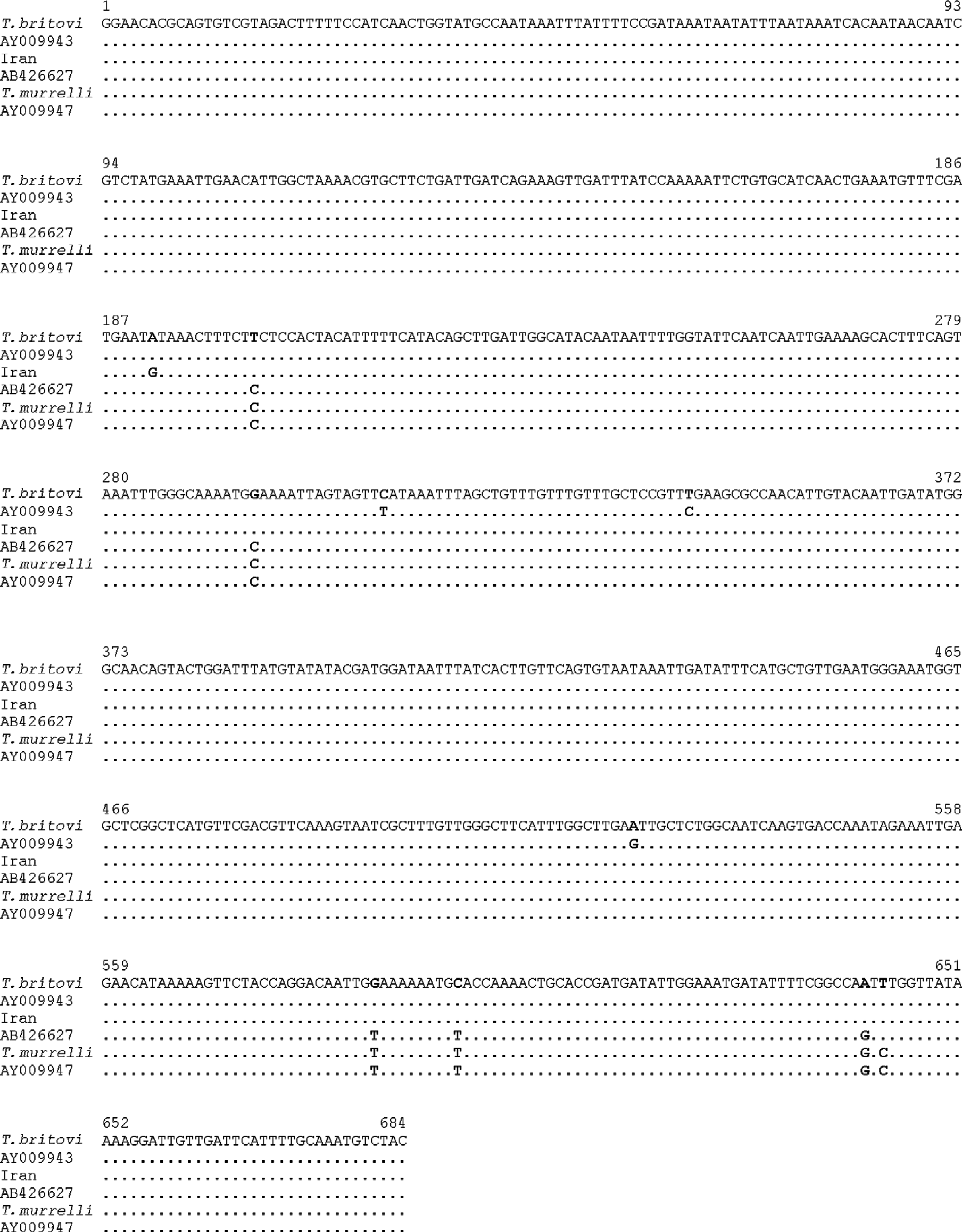
The multiplex PCR pattern of the Iranian isolate (ISS2754) and of all of the T. britovi reference larvae displayed two bands, one of 127 bp (related to ESV) and another of 253 bp (related to ITS1), whereas the T. murrelli reference larvae showed a band of 127 bp (related to ESV) and a band of 316 bp (related to ITS2) (data not shown). The results of the multiplex PCR show that the Iranian isolate can be assigned to T. britovi. To further support the identification of the Iranian isolate, the 5S rDNA intergenic spacer region and ITS2 amplicons were sequenced. The 5S rDNA intergenic spacer region multi-alignment of the Iranian isolate (ISS2754) was very similar to that of the four European T. britovi reference isolates (except for a substitution of the nucleotide G, instead of A, at position 192), yet it differed for six substitutions from the AB426627 sequence deposited by Kia et al. (Reference Kia, Meamer, Zahabiun and Mirhendi2009) in GenBank, for four substitutions from the AY009943 sequence of T. britovi deposited by Rombout et al. (Reference Rombout, Bosch and Van Der Giessen2001) in GenBank, and for seven substitutions from both the AY009947 sequence of T. murrelli deposited by Rombout et al. (Reference Rombout, Bosch and Van Der Giessen2001) in GenBank, and the three T. murrelli reference isolates (fig. 1).
Sequence alignment of 5S rDNA. T. britovi, consensus of the four Trichinella britovi reference isolates (present work); AY009943, T. britovi sequence deposited in GenBank by Rombout et al. (Reference Rombout, Bosch and Van Der Giessen2001); Iran, Iranian isolate (ISS2754) from the wild boar (present work); AB426627, Iranian isolate from the wild boar deposited in GenBank by Kia et al. (Reference Kia, Meamer, Zahabiun and Mirhendi2009); T. murrelli, consensus of the three Trichinella murrelli reference isolates (present work); AY009947, T. murrelli sequence deposited in GenBank by Rombout et al. (Reference Rombout, Bosch and Van Der Giessen2001). Conserved bases are represented by dots; different bases are in boldface; and gaps are represented by dashes.
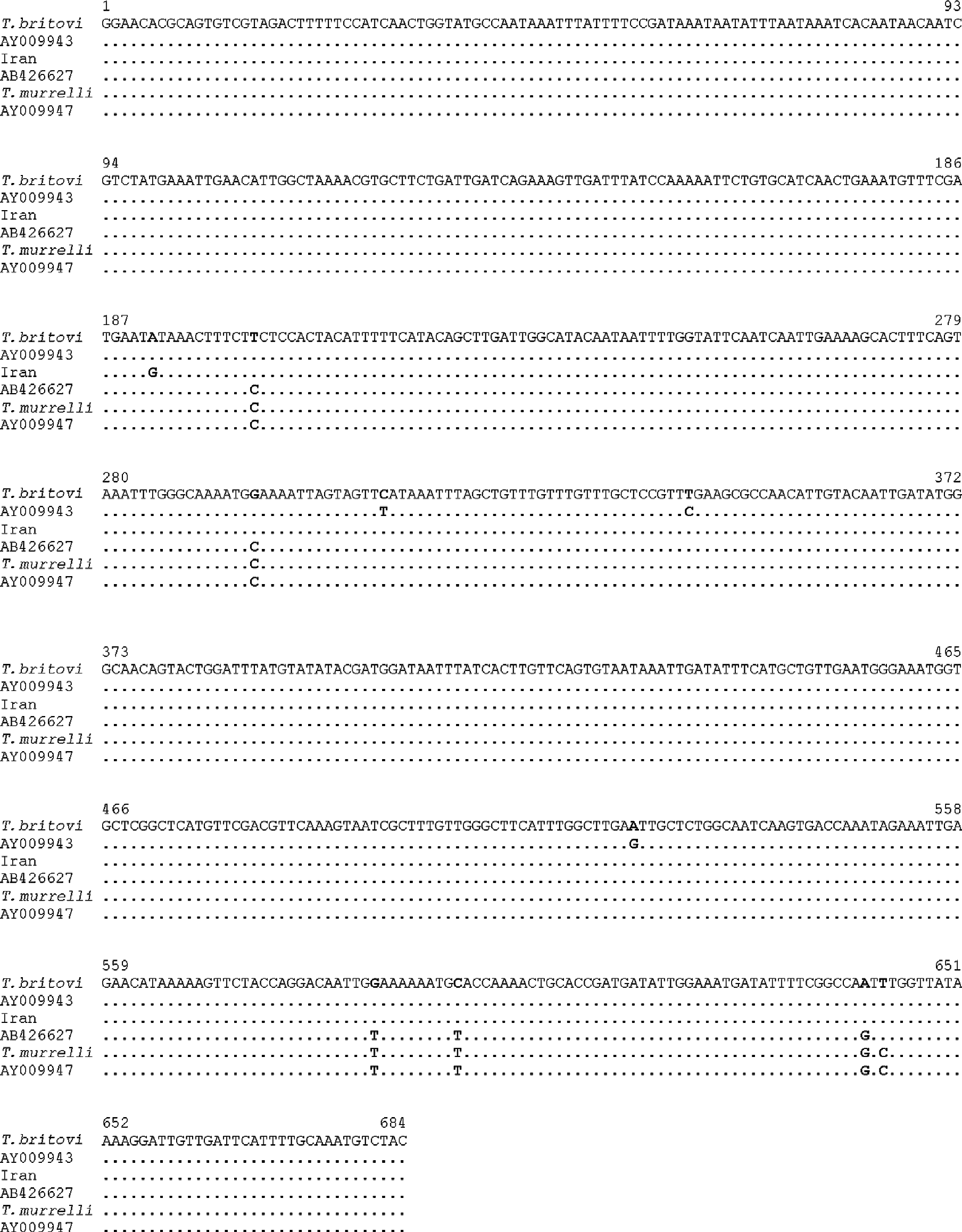
The comparison of the ITS2 sequence of the Iranian isolate with the ITS2 sequences of T. britovi and T. murrelli reference isolates showed that the sequence of the Iranian isolate was very similar to that of the four T. britovi reference isolates and to the T. britovi sequence deposited in GenBank (AY851268) by Zarlenga et al. (Reference Zarlenga, Rosenthal, La Rosa, Pozio and Hoberg2006) (except for the presence of an additional T nucleotide at position 254), but it was quite different from that of the three T. murrelli reference isolates and the T. murrelli sequence deposited in GenBank (AY851270) by Zarlenga et al. (Reference Zarlenga, Rosenthal, La Rosa, Pozio and Hoberg2006) (fig. 2). These results are consistent with those of the multiplex PCR identification, and they further support the belief that the Iranian isolate from a wild boar belongs to T. britovi.
Sequence alignment of partial ITS2 region of rDNA. T. britovi, consensus of the four Trichinella britovi reference isolates (present work); AY851268, T. britovi sequence deposited in GenBank by Zarlenga et al. (Reference Zarlenga, Rosenthal, La Rosa, Pozio and Hoberg2006); Iran, Iranian isolate (ISS2754) from the wild boar (present work); T. murrelli, consensus of the three Trichinella murrelli reference isolates (present work); AY851270, T. murrelli sequence deposited in GenBank by Zarlenga et al. (Reference Zarlenga, Rosenthal, La Rosa, Pozio and Hoberg2006). The primer sequences are underlined; the conserved bases are represented by dots; different bases are in boldface; and gaps are represented by dashes.

The observed discrepancy between the 5S rDNA intergenic spacer region sequence of the same Iranian isolate suggests that the sequence AB426627 deposited by Kia et al. (Reference Kia, Meamer, Zahabiun and Mirhendi2009) is incorrect. The species reassignment presented in this work is consistent with epidemiological data, which show that T. britovi circulates in the Palaearctic region, whereas T. murrelli is confined to the Nearctic region (Pozio et al., Reference Pozio, Hoberg, La Rosa and Zarlenga2009). Furthermore, the presence of T. britovi in Iran is not surprising, in that this species has already been detected in this country (Mowlavi et al., Reference Mowlavi, Marucci, Mobedi, Zahabiioon, Mirjalali and Pozio2009).
Of note is the finding that the 5S rDNA intergenic spacer region (AY009943) sequence of T. britovi deposited by Rombout et al. (Reference Rombout, Bosch and Van Der Giessen2001) in GenBank differs for three nucleotides from the four European T. britovi sequences shown in fig. 1. Unfortunately, Rombout et al. (Reference Rombout, Bosch and Van Der Giessen2001) do not report from which T. britovi isolate the sequence that they deposited originated.
The selection of molecular markers for taxon identification should be evaluated carefully. Sometimes the selected target DNA shows a low variability between two or more taxa and does not constitute a suitable choice for this purpose. In the work of Kia et al. (Reference Kia, Meamer, Zahabiun and Mirhendi2009), the choice of a single molecular marker with a low level of interspecies variation and the occurrence of sequencing mistakes led to an incorrect identification of a Trichinella isolate.
Acknowledgements
We are very grateful to J. Dupouy Camet for help with this work and for his criticism and helpful suggestions. We are also very grateful to E.B. Kia who kindly provided us with Trichinella larvae from the Iranian wild boar, preserved in ethyl alcohol.