In recent years the number of studies related to well-being has grown exponentially. There is consensus among researchers that well-being is not necessarily the absence of ill-being, and the two constructs have been shown to be independent and compatible (Keyes, Shmotkin, & Ryff, Reference Keyes, Shmotkin and Ryff2002). Happiness is considered to be a life goal for most if not all individuals and is a key component of well-being. Two types of well-being have been described: hedonic or subjective well-being (SWB) based on maximizing pleasure and minimizing pain (Diener, Emmons, Larsen, & Griffin, Reference Diener, Emmons, Larsen and Griffin1985), and eudaimonic or psychological well-being (PWB) based on the concept of a meaningful life and full realization of human potential (Ryff, Reference Ryff1989). SWB has been defined in terms of a cognitive and an affective component: Life satisfaction is the global cognitive appraisal of one’s life as a whole (Diener et al., Reference Diener, Emmons, Larsen and Griffin1985), and the balance between positive and negative affect reflects individual happiness (Watson, Clark, & Tellegen, Reference Watson, Clark and Tellegen1988). PWB is based on Aristotelian philosophical assumptions about “a meaningful life” or a life worth living. PWB reflects the full development of capabilities and self-actualization. Ryff’s (Reference Ryff1989) conceptualization of PWB, comprising six dimensions which were used in the present study: self-acceptance involves a positive attitude towards oneself and acceptance of one’s limitations; positive relations with others refers to the ability of individuals to love and trust each other; autonomy refers to independence and self-regulation of behavior, ceasing to be influenced by external pressure; environmental mastery consists of the ability to choose or create environments most suitable for one’s conditions; purpose in life is the need to set goals or objectives that give meaning to life; and personal growth is based on striving to develop one’s potential, to grow and expand as a person, only possible by optimizing the above-mentioned dimensions.
Although related, both types of well-being have been shown to be different (Keyes et al., Reference Keyes, Shmotkin and Ryff2002). Adults who reported higher levels of PWB also showed greater life satisfaction, more positive affect and less negative affect (Keyes et al., Reference Keyes, Shmotkin and Ryff2002) but the correlation between the summed measure of PWB and the summed measure of SWB was only .59. Chen, Jing, Hayes, and Lee (Reference Chen, Jing, Hayes and Lee2013) have found that components of both PWB and SWB have unique explanatory power, over and beyond overall well-being. Besides, these authors note that each component of well-being can be differentially related to other well-being measures, personality, goals, locus of control or quality of social relations.
In this article, we examine empirical links between personality and both types of well-being. Personality traits are central to the understanding of the individual. The Five-Factor Model (FFM), often referred to as the “Big Five”, is the most widely used integrative model of characteristics of personality (McCrae & Costa, Reference McCrae and Costa1997; McCrae & Terracciano, Reference McCrae and Terracciano2005). Extraversion, conceived as activity and sensation seeking, comprises warmth, gregariousness, assertiveness, activity, excitement-seeking and positive emotions; Neuroticism, focusing on emotional stability and adjustment, is composed by the facets: anxiety, hostility, depression, self-consciousness, impulsiveness and vulnerability; Agreeableness, referring to interest in interpersonal interactions, comprising the facets trust, straight forwardness, altruism, compliance, modesty and tender-mindedness; Conscientiousness, including goal-directed behaviours and impulse control, whose facets are competence, order, dutifulness, achievement striving, self-discipline and deliberation; and to Openness to Experience, involving intelligence, creativity or interests and cultural level, comprising openness to fantasy, aesthetics, feelings, actions, ideas and values. Previous research has found substantial associations between Big Five broad dimensions and SWB but few empirical works have jointly analyzed the relationships between constitutive Big Five facets, SWB and PWB (Anglim & Grant, Reference Anglim and Grant2014; Chen et al., Reference Chen, Jing, Hayes and Lee2013; Keyes et al., Reference Keyes, Shmotkin and Ryff2002). Facets within these broad domains could provide further information about the connection with the two types of well-being. Costa and McCrae (Reference Costa and McCrae1999) suggested that each facet captures unique personality information.
Most previous research has demonstrated that Neuroticism is one of the most prominent predictors of PWB and SWB (Marrero & Carballeira, Reference Marrero and Carballeira2011; Schmutte & Ryff, Reference Schmutte and Ryff1997; Steel, Schmidt, & Shultz, Reference Steel, Schmidt and Shultz2008). Neurotic individuals generally report more negative affect than emotionally stable individuals (Watson et al., Reference Watson, Clark and Tellegen1988). Also, Extraversion shows a close association with high levels of positive affect (Watson et al., Reference Watson, Clark and Tellegen1988). In addition, Conscientiousness has also been linked to SWB and PWB (Marrero & Carballeira, Reference Marrero and Carballeira2011; Marrero & Carballeira, Reference Marrero, Carballeira and Nguyem2012; Schmutte & Ryff, Reference Schmutte and Ryff1997). However, Agreeableness and Openness to experience do not seem to be related with SWB but have an association with certain dimensions of PWB. Agreeableness is linked to positive relations with others and Openness to experience is associated with personal growth (Marrero & Carballeira, Reference Marrero, Carballeira and Nguyem2012; Schmutte & Ryff, Reference Schmutte and Ryff1997). Empirical evidence suggests a greater relationship between Big Five broad dimensions and PWB than between these traits and SWB, explaining 40–62% of the variance of PWB (Anglim & Grant, Reference Anglim and Grant2014; Hounkpatin, Wood, Boyce, & Dunn, Reference Hounkpatin, Wood, Boyce and Dunn2015). However, we have not found studies analyzing the relationship between the Big Five facets and the two types of well-being in the same work.
Some scholars have analyzed the associations between Big Five facets and SWB. In this regard, positive emotions and assertiveness, both facets of Extraversion, have been identified as determinants of happiness and life satisfaction (Marrero & Carballeira, Reference Marrero and Carballeira2011; Schimmack, Oishi, Furr, & Funder, Reference Schimmack, Oishi, Furr and Funder2004). On the other hand, facets of Neuroticism, such as depression, appear to be among the most powerful predictors of happiness and life satisfaction, while vulnerability is related to positive and negative affect (Marrero & Carballeira, Reference Marrero and Carballeira2011). Thus, there is some support for the claim that Big Five facets show substantially greater predictive utility than the Big Five broad dimensions. Although, Schmutte and Ryff (Reference Schmutte and Ryff1997) suggested that the facets would provide additional information to the understanding of PWB, only one study has examined Big Five facets in relation to PWB (Siegler & Brummett, Reference Siegler and Brummett2000). These authors used four measures equivalent to Ryff’s dimensions (self-acceptance, environmental mastery, positive relations with others and purpose in life) and examined the associations between facets and PWB at the bivariate level. The results showed that not all Big Five facets were equally associated to PWB. Although these findings suggest the relevance of Big Five facets for PWB, bivariate statistics are not able to capture the complexity of relationships between personality facets and well-being. Thus, further research is needed to clarify the relative power of lower-order Big Five levels for predicting PWB and SWB.
Certain sociodemographic characteristics have showed be associated with some dimensions of PWB, but consistent relationships between SWB and sociodemographic factors were not found. Some authors have found gender differences in PWB with women having more positive relations with others (Ryff, Reference Ryff2014) and greater personal growth (Marrero & Carballeira, Reference Marrero, Carballeira and Nguyem2012) than men. Purpose in life and personal growth decrease with age, whereas environmental mastery and autonomy increase with age (Ryff, Reference Ryff2014).
Therefore, the current study addresses whether Big Five facets provide a sufficiently detailed description of both types of well-being. We sought to identify those Big Five facets that are common to both types of well-being and which make a unique contribution to each of them. Some Big Five facets, mainly from Neuroticism, Extraversion and Conscientiousness, were expected to be closely related with SWB and PWB, although not all would have equal weight for the prediction of each type of well-being (Schmutte & Ryff, Reference Schmutte and Ryff1997; Siegler & Brummett, Reference Siegler and Brummett2000; Soto, Reference Soto2015). Gender differences are also expected in the facets that explain PWB but no are expected for SWB (Marrero & Carballeira, Reference Marrero, Carballeira and Nguyem2012). This study explores a new direction in understanding and measuring the relative contribution of each facet to the explanation of well-being by means of dominance analysis. The merit of dominance analysis is that it allows statistically decomposing the total predicted variance of the regression model according to the importance of each predictor.
Method
Participants
The study sample consisted of 1,403 Spanish adults ranging in age from 17 to 78 years (M = 37.2, SD = 13.9) and 47.11% were women. Regarding educational level, 55% had a secondary school education, 21% university and 18% primary school.
Participants were contacted through psychology students. The researchers requested them to locate people of different ages and professions who were willing to participate in the study. All participants were informed about the aim of the study, anonymity and confidentiality regarding the information gathered. The questionnaires were administered individually at home. Completion of these involved consent for them to be used exclusively for the purposes of research.
Instruments
Ryff’s Psychological Well-being Scales were used (PWBS; Ryff, Reference Ryff1989). The original version consists of six dimensions of 14 items per scale. In this study, the Spanish version of 39 items proposed by Díaz et al. (Reference Díaz, Rodríguez-Carvajal, Blanco, Moreno-Jiménez, Gallardo, Valle and van Dierendonck2006) was used. The six dimensions were assessed on a six-point answering scale, ranging from 1 (totally disagree) to 6 (totally agree). Well-being measures were constructed by summing the scores on the individual items. The individuals with higher scores on each scale were considered to have higher well-being. In this study, Cronbach’s alpha was acceptable: autonomy (α = .74), environmental mastery (α = .64), personal growth (α = .66), positive relations (α = .79), purpose in life (α = .76) and self-acceptance (α = .77).
The Satisfaction with Life Scale (SWLS; Diener et al., Reference Diener, Emmons, Larsen and Griffin1985) was used as a cognitive measure of whole life satisfaction. A total of 5 items were answered using a 7-point scale, ranging from 1 (not satisfied at all) to 7 (totally satisfied). The final score in the scale was obtained by summing the scores on the individual items. The Spanish version has showed adequate psychometric properties (Vázquez, Duque, & Hervás, Reference Vázquez, Duque and Hervás2013). Cronbach´s alpha in this study was .85.
The Positive and Negative Affect Schedule (PANAS, Watson et al., Reference Watson, Clark and Tellegen1988) assessed positive and negative affect referring to the present, using 10 descriptors each. PANAS uses a 5-point scale, from 1 (strongly disagree) to 5 (strongly agree). Also, the score for each scale was obtained by summing the scores for the constituent items. In this study, Cronbach´s alpha for positive affect was .87, and for negative affect it was .86.
The Revised NEO Personality Inventory (NEO-PI-R, Costa & McCrae, Reference Costa and McCrae1999) was employed to measure the five broad traits of personality and 30 facets. The questionnaire uses a 5-point Likert scale; from strongly disagree to strongly agree, for 240 items. Big Five facets were constructed by summing the scores on the individual items. In this study Cronbach’s alpha for each dimension was adequate: Extraversion (α = .84), Neuroticism (α = .89), Agreeableness (α = .82), Conscientiousness (α = .87) and Openness to Experience (α = .85). For all 30 facets, Cronbach’s alpha ranged between .37 for tender-mindedness and .80 for depression.
A check-list in the form of a questionnaire was designed to record socio-demographic characteristics of participants, such as age, gender and educational level.
Data analysis
To analyze the relative contribution of Big Five facets to PWB and SWB, dominance analysis (Azen & Budescu, Reference Azen and Budescu2003) was used through R statistical package. This technique has been developed to order individual predictors’ contributions to an overall regression effect or R 2. Traditional multiple regression analyses consider variables in isolation from one another by calculating the squared zero-order correlations or in the presence of one another by calculating the beta weights, i.e., the expected change in criterion variable for a one-unit change in predictor variable when the other covariates are held constant (Nathans, Oswald, & Nimon, Reference Nathans, Oswald and Nimon2012). When variables are correlated, then β values can result in different rank orders of the variables. Any explanatory variance depends on the variable that was entered first in the regression model, potentially leading to misunderstanding of a variable’s true contribution. It is recommended that after obtaining beta weights, researchers should use additional measures to more accurately capture the relative contribution of independent variables to the regression equation (Nathans et al., Reference Nathans, Oswald and Nimon2012). A dominance analysis examines R 2 changes resulting from adding a predictor to all possible subsets of regression models. So, dominance analysis is used to identify both the unique contribution of each variable and the contribution in the presence of the other predictors to the regression effect.
Results
Dominance analyses
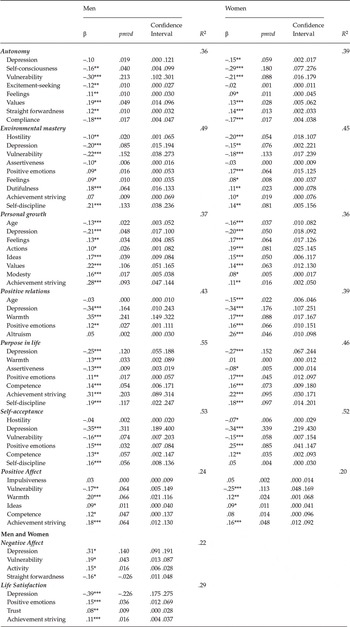
To determine the relative importance of Big Five facets for PWB and SWB, a series of dominance analyses were conducted. Because the inclusion of each additional variable exponentially increases the number of calculations, it was important to select a set of predictor variables from among 30 NEO-PI-R facets. To further reduce the number of predictor variables, generalized linear models (GLM) were constructed first (McLeod & Xu, Reference McLeod and Xu2010). This technique yields the best subset of inputs using a variety of information criteria as well as cross-validation. A best GLM analysis was used to select the 30 Big Five facets, gender, age, and educational level as predictor variables and each measure of SWB and PWB as criterion variables. The results showed a set of different predictors for each measure of well-being. Educational level was not a significant predictor for any of the regression models. Age was a significant predictor of personal growth and purpose in life. Gender was a significant predictor for the majority of measures of well-being. So the dominance analyses were repeated for men and women separately for all the measures of PWB and positive affect of SWB. We included only those facets that had proved to be significant predictors in GLM analyses for each dimension of well-being, and age was included for the analyses of personal growth and purpose in life. To test for multicollinearity between the predictors, the tolerance criterion and variance inflate factor (VIF) were applied in all the analyses. The results revealed no multicollinearity between the predictor variables. Table 1 summarizes the results of the dominance analysis for each of the well-being measures for men and women separately. The beta weight of all the independent variables included in the analysis appears in column 1 of the table. The second column shows the proportional marginal variance decomposition (pmvd), reflecting the relative importance of each regressor (Grömping, Reference Grömping2006). This value multiplied by 100 indicates the average proportion of the predictor’s explained variance with respect to each dependent variable. The third column shows the confidence interval obtained by bootstrapping procedure. This procedure provides a measure of confidence and reproducibility that indicates the chance of reproducing the sample result over 1000 bootstrap samples (Azen & Budescu, Reference Azen and Budescu2003). The fourth column presents the full model’s R 2 for each of the well-being measures, obtained by averaging each predictor’s contribution across all possible models. The full model’s R 2 can be decomposed into components that reflect the relative importance of each predictor (pmvd).
Dominance analysis of personality facets as predictors of PWB and SWB

Note: pmvd = proportional marginal variance decomposition.
*p < .05, **p < .01, ***p < .001.
In predicting the autonomy of men, 21% of the predicted variance can be attributed to vulnerability. The average contributions of openness to values (4.9%), self-consciousness (4%), depression (1.9%), compliance (1.7%), excitement seeking (1%), straight forwardness (1%) and openness to feelings (1%) only explained an additional 15.5% of variance F(8, 469) = 34.28, p < .001, R 2 adjusted = .36. In the case of women, the contribution of the predictors was mainly shared between self-consciousness (18%), vulnerability (8.8%) and depression (5.9%), while the remaining predictors only contributed around 6% F(8, 501) = 41.12, p < .001, R 2 adjusted = .39.
For environmental mastery in men, vulnerability (15.2%) and self-discipline (13.3%) jointly explained over half the variance F(9, 454) = 49.72, p < .001, R 2 adjusted = .49. Other variables that contributed to explain environmental mastery were depression (8.5%) and dutifulness (6.4%). For environmental mastery in women, vulnerability (13.3%), self-discipline (8.1%), depression (7.6%), positive emotions (6.4%) and hostility (5.4%) contributed similarly F(9, 495) = 48.88, p < .001, R 2 adjusted = .45.
Personal growth in men was mainly explained by openness to values and achievement striving, explaining a variance of 9–11% each F(8, 505) = 39.48, p < .001, R 2 adjusted = .37. Personal growth in women was explained by openness to actions (8.1%), feelings (6.4%), values (6.3%) and ideas (5%) F(8, 543) = 39.20, p < .001, R 2 adjusted = .36. Age was a predictor of personal growth in both men and women, with greater relative importance for women (3.7% of explained variance).
The results for positive relations with others showed that warmth alone explained 24.1% of the variance for men, depression explained 16.4% and positive emotions explained 2.7% F(5, 508) = 78.58, p < .001, R 2 adjusted = .43. Similar results were observed for women, although depression had greater weight in the equation than warmth (17.6% and 8.8%, respectively). Altruism and age were significant for women but not for men. The average contribution of all the predictors that entered in the equation was 39% F(5, 571) = 75.66, p < .001, R 2 adjusted = .39.
Purpose in life for men was mainly explained by achievement striving (20.3% of explained variance) and depression (12% of explained variance), although self-discipline (11.7% of explained variance) made important relative contribution F(7, 487) = 85.96, p < .001, R 2 adjusted = .55. For women, depression was the most important predictor (15.2% of explained variance) followed by self-discipline (9.7% of explained variance), achievement striving (9.5% of explained variance) and competence (7.3% of explained variance). The facets that entered the equation explained 46% of the variance of purpose in life F(7, 521) = 65.35, p < .001, R 2 adjusted = .46.
Self-acceptance was explained mainly by depression for both men and women (31.1% and 33.9%, respectively). The remaining predictors - vulnerability, positive emotions, competence, self-discipline and hostility - explained an additional 20% of variance F(6, 469) = 113.58, p < .001, R 2 adjusted = .59 for men; F(6, 522) = 126.59, p < .001, R 2 adjusted = .59 for women. Self-discipline was better predictor of self-acceptance for men than women (5.6% and .4%, respectively).
The results of dominance analyses for the different SWB measures are presented in Table 1. Because gender was a significant predictor in the previous best GLM regression model for positive affect along, the dominance analyses were conducted separately for women and men. In women, vulnerability was far more important in the equation than for men (11.3% vs 6.4%, respectively). In men, warmth explained almost three times the variance compared to women (6.6% vs 2.4%, respectively). Achievement striving was a significant predictor for positive affect with similar importance for both genders. However, all the facets that entered the equation explained no more than 25% of the variance in positive affect F(6, 500) = 28.22, p < .001, R 2 adjusted = .24 for men; F(6, 540) = 24.10, p < .001, R 2 adjusted = .20 for women.
Of the 30 facets, only four explained negative affect and life satisfaction in both men and women. Negative affect was explained by depression, vulnerability, straight forwardness and activity F(4, 1146) = 83.71, p < .001, R 2 adjusted = .22. In addition, life satisfaction was explained by depression (23%) and the remaining predictors – positive emotions, achievement striving and trust – only accounted for an increase in variance of 6% F(4, 1152) = 116.54, p < .001, R 2 adjusted = .29.
Discussion
This study analyzes the relative importance of Big Five facets on PWB and SWB through the dominance analyses. Most previous research assumes that Neuroticism, Extraversion and Conscientiousness broad dimensions are the best predictors of SWB and PWB (Ryff, Reference Ryff2014; Schmutte & Ryff, Reference Schmutte and Ryff1997; Steel et al., Reference Steel, Schmidt and Shultz2008). However, there is little research on which Big Five facets have greatest explanatory power for well-being (Marrero & Carballeira, Reference Marrero and Carballeira2011; Siegler & Brummett, Reference Siegler and Brummett2000). Big Five facets allow operationalizing the broad traits and identifying individual differences in these traits (Costa & McCrae, Reference Costa and McCrae1999), so they can provide more useful information that explains and promotes well-being.
The four main findings of the current work were: First, Big Five facets captured a substantial proportion of the variance in PWB and SWB. Second, facets were better predictors of PWB than SWB, explaining twice as much variance in the different measures of well-being. Third, each facet had a relative importance for each measure of well-being, although some facets proved to be common to both types of well-being. Depression, vulnerability, positive emotions and achievement striving were more closely related to most measures of well-being for women and men. Fourth, Big Five facets that predicted both types of well-being had a different relative importance for men and women.
Environmental mastery was predicted by self-discipline and vulnerability for men and women. However, self-discipline which implies motivation and constancy to complete tasks despite difficulties (Costa & McCrae, Reference Costa and McCrae1999) was more relevant for men than women. Positive emotions and achievement striving contributed to explain the variance of environmental mastery for women but they were not particularly important for men. Achievement striving presupposes high levels of aspiration, and positive emotions implies greater enthusiasm (Costa & McCrae, Reference Costa and McCrae1999).
Positive relations with others was linked mainly to warmth and depression for men and women. However, much of the variance of positive relations with others was explained by warmth for men but not so much for women. Altruism had more weight for women than men. A possible explanation is that men require greater warmth to counteract the effect of differential socialization which they are subjected to greater emotional control (Wood & Eagly, Reference Wood and Eagly2002). Age was a significant predictor of positive relations in women, but not in men. Women reported less positive relationships with age. The protective effects of positive relationships seem have greater importance for women than men (Eisenlohr-Moul & Segerstrom, Reference Eisenlohr-Moul and Segerstrom2013; Ryff, Reference Ryff1989).
Purpose in life was related to depression and the majority of the facets of Conscientiousness for women and men. Achievement striving was the most important predictor of purpose in life for men, whereas depression was for women. Somehow these results reflect the gender stereotype where women are perceived as more emotional than men, and men are perceived as more capable of managing the environment than women (Ebert, Steffens, & Kroth, Reference Ebert, Steffens and Kroth2014).
Self-acceptance was explained mainly by depression for both, men and women. Some studies have found that people with slightly impaired levels of self-acceptance, autonomy, purpose in life and positive relationships were at a higher risk of depression (Wood & Joseph, Reference Wood and Joseph2010). However, positive emotions made a greater contribution to self-acceptance in women and self-discipline were more important predictors of self-acceptance for men. Gender role stereotypes also had an impact on self-acceptance.
Personal growth was predicted by most of the facets of Openness to experience, such as openness to values, actions, feelings and ideas for both genders. Openness to action was more important for personal growth of women, whereas achievement striving had greater weight for men. Personal growth in men seems be related with gender stereotype, so that men who fulfill the stereotype of facing stressors in a more proactive manner (McLean & Anderson, Reference McLean and Anderson2009) showed greater personal growth. However, women’s personal growth was linked to new ideas beyond fit into the gender stereotype.
Our results suggest that autonomy of men depends on the management of situational demands –low vulnerability-; whereas for women social interaction –low self-consciousness was more important to gain autonomy. The more individualistic and independent role of men against the tendency to relatedness, interdependence and connectedness of women have been documented (Wood & Eagly, Reference Wood and Eagly2002).
Negative affect and life satisfaction were explained mainly by depression for men and women. The link between depression and negative affect has been extensively demonstrated. Depressed people show greater reactivity to negative emotions, attenuation of positive emotions as well as emotional insensitivity (Bylsma, Morris, & Rottenberg, Reference Bylsma, Morris and Rottenberg2008) and have a negative attributional style (Korn, Sharot, Walter, Heekeren, & Dolan, Reference Korn, Sharot, Walter, Heekeren and Dolan2014).
Vulnerability was the most important predictor of positive affect for women while this facet together with warmth had similar weight in explaining the variance of positive affect for men. These results could be explained in two ways: inability to handle stress decreases positive affect or the presence of positive affect may offset distress (Garland et al., Reference Garland, Fredrickson, Kring, Johnson, Meyer and Penn2010). On the other hand, the results of our study indicated that a more caring attitude seem to be needed to promote positive affect in men.
The results of the current study provide further support for FFM as an integrative model of the relationships between lower-order Big Five levels, PWB and SWB, although further research to identify what other factors cause well-being is required (Keyes, Kendler, Myers, & Martin, Reference Keyes, Kendler, Myers and Martin2015). Big Five facets contributed to explain 36–55% of the variance of PWB and around 25% of the variance of SWB. The use of dominance analyses allowed us to identify which facets were common and which differed between SWB and PWB. Consistent with previous research, the results indicated a certain overlapping between the two types of well-being since both require a certain emotional stability. However, hedonic pursuits were more related with carefreeness, positive emotions and absence of depression, while eudaimonic pursuits were related to meaning, i.e., competence, achievement striving or self-discipline (Huta & Ryan, Reference Huta and Ryan2010). In addition, the analysis revealed facets that were common to both genders and which facets explained the well-being of men and women separately.
Despite the relevance of the results found in the current study, there are several limitations that need be resolved in the future. First, this study was cross-sectional, so causal inferences about the determinants of PWB and SWB cannot be drawn on the basis of personal traits. There may be a bidirectional linkage between personality and well-being (Soto, Reference Soto2015). Presumably, the congruence between personality and environment favors well-being. Second, the sample comprised mainly young adults, although the age range was large, so this limits the generalizability of the results. It would be useful to examine the relationships between personality and well-being in different developmental periods. In addition, longitudinal research would allow us to identify which facets remain stable and which could change according to individual development. Cross-sectional and longitudinal studies have demonstrated changes in personality traits and well-being with age (Soto, John, Gosling, & Potter, Reference Soto, John, Gosling and Potter2011), but the majority of reliable variance in personality traits have been attributable to stable influences and changing factors have had a greater influence on SWB (Anusic & Schimmack, Reference Anusic and Schimmack2015). Third, individual differences by gender for some measures of PWB were found. Some of these differences can be attributed to different personality profiles between men and women. Lehmann, Denissen, Allemand, and Penke (Reference Lehmann, Denissen, Allemand and Penke2013) have found that women have higher levels of Neuroticism, Extraversion, and Agreeableness, while men have greater Openness to experience, albeit with small effect size (Hyde, Reference Hyde2014). Finally, some Big Five facets showed low internal consistency which could have influenced the effect size estimates.
Despite the limitations, the current study reveals that Big Five facets should be employed to explain commonalities and differences between PWB and SWB. Of the sociodemographic variables analyzed, only gender distinguished between the two types of well-being. The differences between men and women highlight the existence of certain gender stereotypes which affect well-being in positive and negative ways. Future interventions focused on promoting the personal traits identified may contribute to the happiness of individuals.