

1. Introduction
1.1 Goals
Causative adjuncts provide information about the motivation or explanation behind the event expressed by the matrix sentence. In traditional grammar, adjuncts are typically discussed under the term adverbial as a loosely defined group of modifiers of verbs, adjectives and adverbs indicating different semantic relations, such as place, manner, time, reason, purpose, contrast, comparison, condition, etc. Notably, some of the semantic relations listed as functions of adverbials – for instance reason, purpose and condition – can be understood as causative.
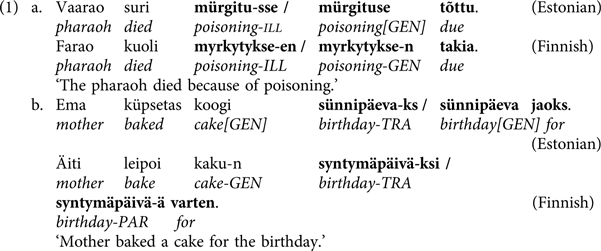
The adjuncts with a causative relationship to the matrix sentences are subordinate structures expressing either the reason for or the result of the situation conveyed by the matrix sentence. In this study, we will examine the semantics and morphosyntax of subordinate causative structures in Estonian and Finnish, the languages genetically affiliated to the Finnic language subgroup of the Uralic language family. Regarding their linguistic form, the subordinate causative structures can both in Estonian and Finnish be expressed (i) morphologically, via nominal phrases marked with (mainly) the locative cases, for instance illative; and (ii) using words that function as adpositions. The examples in (1) reflect the morphological and adpositional variants of a reason adjunct and a purpose adjunct both in Estonian and Finnish, respectively:Footnote 1
The aim of the analysis in this article is to clarify the role and nature of causation in purpose phrases. We focus particularly on the purpose adjuncts expressing the desired result of intentional action.Footnote 2 Causation is traditionally analyzed as a chain of events (see e.g. Croft Reference Croft1991, Reference Croft and Gathercole2009; Langacker Reference Langacker1991), and the causing event always temporally precedes the caused event. We will show that this kind of linear analysis is problematic when it comes to purpose expressions and we suggest a non-linear analysis of causation. In addition to an analysis of the purpose adjuncts and a contribution to the general theory of causative expressions, the third goal of our paper is to compare the analytic and synthetic expressions the cognate languages Estonian and Finnish make use of in the selected purpose constructions.
1.2 The types of purpose adjuncts studied in this article
The adjuncts we are interested in are exemplified in (2) and (3) below. We use the terms reason-purpose adjunct and avoidance adjunct for two main purpose-adjunct types, both expressing causation.
(2) Reason-purpose adjuncts
I am training for making the Olympic team.
(making the Olympic team is the reason of training; training precedes the desired Olympic team membership)
The patient was anesthetized for the appendix removal.
(the removal of the appendix is the cause for anesthetizing; anesthetizing precedes the appendix removal)
(3) Avoidance adjuncts
a. Removal adjuncts
I took a pill for seasickness.
(the experienced seasickness is the reason for taking a pill; taking a pill precedes the expected removal of seasickness)
b. Prevent adjuncts
I took a pill for seasickness.
(the expected seasickness is the reason for taking a pill and at the same time, taking a pill prevents – causes the avoidance – of the seasickness; seasickness has not occurred yet)
Reason-purpose adjuncts (exemplified in (2) above) are adjuncts in which
(i) the causing situation is expressed in the matrix structure and the caused situation in the adjunct structure,
(ii) the caused situation follows temporally the causing situation, and
(iii) the causing situation is a reason for the caused situation.
Avoidance adjuncts are adjuncts in which
(i) the causing situation is expressed in the matrix structure and the caused event in the adjunct structure,
(ii) the caused situation either precedes or follows the causing situation, and
(iii) the caused situation is avoided by the occurrence of the causing situation.
Avoidance adjuncts can be divided into two types on the basis of their temporal structure:
If the caused situation follows the causing situation, we use the term removal adjunct (e.g. the example in (3a) above).
If the caused situation precedes the causing situation, we use the term prevent adjunct (e.g. the examples in (3b) above).
Often only the context reveals whether the avoidance adjunct should be interpreted as a removal or a prevent adjunct. Another context-dependent property of purpose adjuncts is the realization of the purpose; for instance, in the proposition Nurses struck over better pay, the outcome (the nurses getting a pay raise) is not indicated, but must be inferred from the context.
1.3 Problems with a linear analysis of causation
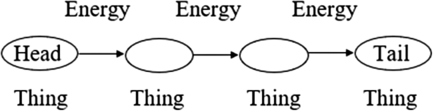
The theoretical aim of this study is to account for the complexity of causative relationships by examining intentional purpose adjuncts. The present approach can be seen as an alternative to the linguistic theories that are based on a linear view of cause and effect.Footnote 3 For instance, Langacker (Reference Langacker1991:283) analyzes causation using the notion of ‘action chain’, which, essentially, constitutes a relation between things. The ‘force’ that relates the things in the action chain is in this model called ‘energy’; the initial cause is termed ‘head’ and the final result ‘tail’. In Figure 1, the arrows stand for energy and the direction of the arrows indicates the course of applying the energy.
The linear causal chain.

Another example of linear approaches to causation, analogous to Langacker’s action chain, is the theory of the linear causal chain proposed by Croft. Croft (Reference Croft1991, Reference Croft and Pustejovsky1993, Reference Croft, Butt and Geuder1998a, b, Reference Croft and Gathercole2009, Reference Croft2012) argues for ‘a simple theory of argument linking’ derived from the event structure and in particular from the properties of the causal sequence involving also subordinate structures. This model of argument linking has been influenced by Talmy’s (Reference Talmy and Shibatani1976, Reference Talmy1988) force dynamics account of causation, which is based on the idea that the relative position of participants in a single event is determined by the transmission of force. The causal chain of Croft (Reference Croft2012; see also e.g. Croft Reference Croft1991, Reference Croft and Gathercole2009) represents the sequences of participants acting on other participants, which determines argument linking, seen in (4).
(4) Sue broke the coconut for Greg with a hammer.
Sue → hammer → coconut → Greg
The chain of events is, according to Croft, an example of volitional causation: a person (Sue) acts physically on an instrument, which acts physically on an object undergoing a change of state as a result of the action and affecting the mental state of the benefactive participant (Greg). The arrow indicates the relation ‘act on’ (A → B means ‘A acts on B’).
The problem with the linear analyses is that this model assumes a default correlation between the causal chain and the temporal time span of the event. Also, the major emphasis of the theory is placed on the energy or the force, which is an unknown factor, as the properties of the energy are not defined in any way. For instance, in the analysis in (4), the relation ‘act on’ actually refers to different types of relations. Our goal is to specify theoretically what ‘acting on’ means when Sue is ‘acting on’ the hammer, the hammer is ‘acting on’ the coconut and the coconut is ‘acting on’ Greg. Regarding the relationship between the coconut and Greg in particular, it is difficult to see any meaningful interpretation in which the coconut is acting on Greg.
If analyzing the oblique for Greg as beneficiary, an interpretation of (4) is that it was Sue’s intention to break the coconut to make it easier for Greg to eat it (or something of that sort). The sentence does not say anything about the spatial location of the coconut (i.e. whether Sue passed the coconut to Greg) or the ownership of the coconut. However, if the sentence in (4) is interpreted so that it was Sue’s intention to make Greg’s life better by breaking the coconut, the whole process would not have started without Greg and the conscious intention to benefit him. According to the above definition of causer and caused situation, the ‘for’ adjunct for Greg can be seen as the trigger of the whole process manifesting at the same time the purpose and the intentional (mental) reason of the causer at the beginning of the chain. Thus, the linear analysis in (4) of the causal chain would be replaced with the one given in (5):
(5) Greg → Sue → hammer → coconut
In this way, we avoid the problem with the causative relation between the coconut and Greg as discussed above. However, we will show that the linear analysis in (5) is still problematic, and we will suggest a non-linear model that gives a more elaborate analysis of causation in purpose expressions (about the application of the non-linear Conceptual Semantics methodology on causative structures, see Nikanne Reference Nikanne1990, Reference Nikanne1997b, Reference Nikanne, Östman, Verschueren and Versluys2008, Reference Nikanne2018; causative emotion constructions are examined in Pörn Reference Pörn2004, Reference Pörn2008; an elaboration of causative structures in variants of phraseological units is Petrova Reference Petrova2011; Paulsen Reference Paulsen2011a, Reference Paulsen2011b offers an approach to social causation).
1.4 The properties of the non-linear analysis of causation
The definition of causation in this study distinguishes two poles, cause and result: causation occurs between two situations (events or states) or between a causer and a situation if the occurrence of one situation – the cause – leads to the occurrence of another situation – the result. The existence of the resulting situation thus depends on the appearance of the cause. Causation in the linguistic sense is dependent on, but does not directly correspond to, causation in ‘the real world’, being a product of conceptualization. As Tomasello (Reference Tomasello1999) emphasizes, the understanding of causal processes however precedes language, and linguistic structuring depends on the physical, social, psychological and cultural explanation of causation. Keeping this in mind, we define causation as follows:
(6) Causation
In the meaning of linguistic expression E, A causes Situation B iff, according to the meaning of E, B would not occur without A.
The definition of causation in (6) is a very common one as such. Causation may be expressed linguistically as a relation between two situations, as in (7a), or a thematic participant and a situation, as in (7b).
(7) a. Batman fainted because the Joker gave him knock-out gas.
b. Batman had the Joker go behind bars.
Thus, the situation ‘The Joker gave Batman knock-out gas’ in (7a) causes the situation ‘Batman fainted’. Batman is the causer of the situation ‘The Joker goes behind bars’ in (7b); the meaning of the sentence does not specify in any way what Batman did for making the Joker go behind bars but merely states that without Batman it would not have happened.
The aim of this study is to work out an analysis of purpose adjuncts, displaying particularly complex patterns of causative and temporal relationships. In the present approach, the Tiernet model of Conceptual Semantics, there are several semantic levels that are (in parallel) involved in the formation of the causative meaning. To mention some of them:
the type of causation (the semantic field of the event)
the correspondence between causation and temporal structure
the aspects related to activity and dominance (agent–patient relations)
agentive features related to animate participants (volitionality, consciousness, responsibility)
In the analyses that follow, we will argue for a non-linear model of causation and propose theoretical tools for describing causative relations, intentionality, temporal structure, and the instrument. In the non-linear approach we do not assume a one-to-one correspondence between causative and temporal relationships; our goal is an analysis that separates causation from the temporal flow. A causative subordinate structure may temporally precede the situation expressed by the matrix sentence (as in (2, 3a) above) or come after it (as in (3b)). It is thus important to keep causative and temporal relationships as separate relations in the semantic analysis, even when they co-occur.
1.5 An outline of the article
The structure of the article is as follows. In Section 2, we present the theoretical and methodological basis to the analysis, the Tiernet model of Conceptual Semantics. The semantic feature central to purpose adjuncts, intentionality, will be given an explicit formal analysis in Section 2.2. In Section 3, we address the reason-purpose and avoidance adjuncts, based on the different combinations of causative and temporal relations. The reason-purpose adjuncts are addressed in Section 3.1; here, two kinds of patterns are distinguished: the goal-purpose construction, the translative-purpose construction. Section 3.2 concentrates on avoidance adjuncts with two subtypes: the removal construction and the prevention construction. In order to capture the intentional mental causation and the temporal structure of a sentence involving several causative structures, the ‘coconut sentence’ presented in (4) above will be reanalyzed within the Conceptual Semantics framework in Section 4. We call this type of pattern the beneficiary-purpose construction. The analysis in Section 4 also involves a treatment of instrumentality.
2. Causation in the Tiernet model of Conceptual Semantics
2.1 The basic conceptual structure
In this study, the causative relationships are approached within the theoretical framework of Conceptual Semantics, a theory based on the work of Ray Jackendoff (Reference Jackendoff1983, Reference Jackendoff1990, Reference Jackendoff1997, Reference Jackendoff2002, Reference Jackendoff2007) and Nikanne (Reference Nikanne1990, Reference Nikanne1995, Reference Nikanne1997a, Reference Nikanne1997b, Reference Nikanne, Östman and Fried2005, Reference Nikanne2006, Reference Nikanne, Östman, Verschueren and Versluys2008, Reference Nikanne2018), developed in Pörn (Reference Pörn2004, Reference Pörn2008), Paulsen (Reference Paulsen2011a, Reference Paulsen2011b) and Petrova (Reference Petrova2011). The goal of Conceptual Semantics is to establish the optimal means of describing the human cognitive system with emphasis on the interface between different cognitive systems related to language. Conceptual representation of a word, lexical conceptual structure (LCS), is the level of understanding linguistic information, functioning as structural correspondence between the linguistic representations such as phonology, syntax and other cognitive domains (spatial, social, haptic knowledge, etc.; see Nikanne Reference Nikanne1997b, Reference Nikanne2006, Reference Nikanne, Östman, Verschueren and Versluys2008).
Conceptual Semantics strives for an explicit and strict account of the smallest autonomous structures with their primitive units and the combination principles between them. Semantic phenomena are in Conceptual Semantics addressed on the level of conceptual structure. The conceptual structure is understood as the representation in which linguistic information is organized and compiled with cognitive faculties such as dimensionality, spatial information, body representation and social reasoning (e.g. Jackendoff Reference Jackendoff1983:16–18; Nikanne Reference Nikanne, Östman, Verschueren and Versluys2008). The conceptual structure is decomposed to semantic roles and functions as parts of a multi-tiered structure. The ontological categories Situation, Path, Time, Direction, etc. are realized on the function–argument level and every conceptual argument is a conceptual constituent of a basic category. The central levels of description are the thematic tier (expressing causation, change, direction and location), the action tier (describing dominance relations between the participants, activity and passivity), the temporal tier (dealing with the internal time flow of a situation), the semantic field tier (spatial, possessive, circumstantial, social, etc.) and the modal tier (negation, possibility, necessity) (Jackendoff Reference Jackendoff1990; Nikanne Reference Nikanne1990, Reference Nikanne, Östman, Verschueren and Versluys2008, Reference Nikanne2018).
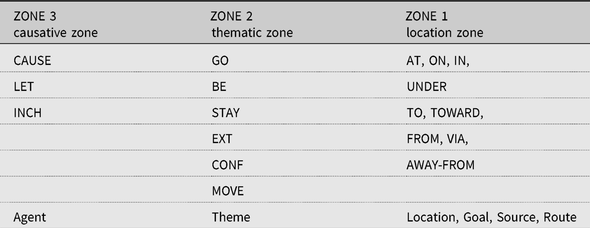
In a Jackendovian approach, the intrinsic structure of the categories and the well-formedness rules determining the relations between the categories are analyzed via the rules of inference or the rewriting rules of the thematic tier architecture. For instance, causation is described via the semantic function CAUSE; this function selects two arguments, the causer and the caused situation: CAUSE (causer, SITUATION)). In Nikanne (Reference Nikanne1990 and later), the organization of LCS is claimed to be non-linear, meaning that the order of the semantic functions (CAUSE, GO, TO, FROM, etc.) is determined by three ‘positional groups’ or zones. Organization of the zones and the division of the thematic tier functions and the thematic roles within the zones is illustrated in Table 1, taken from Nikanne (Reference Nikanne1997b:83).
Zones and semantic functions.
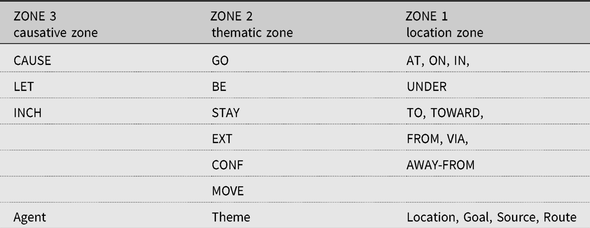
The Tiernet model approach or the micro-modular network (Nikanne Reference Nikanne, Östman and Fried2005, Reference Nikanne2018) thus captures the Jackendovian rewriting rules into a more general rule of a well-formed function-chain (f-chain). Direction of the f-chain (the chain of functions) is always from the causative zone toward the locative zone, from left to right. The essential properties behind the combination principles of the f-chain are manifested in the f-chain schema:
 $${\rm{The}}\,{\rm{f\hbox{-}chain}}\,{\rm{schema:}}\,{\rm{f3^*}}\, \to \,{\rm{f2}}\, \to \,{\rm{f1^*}}$$
The number after the f indicates the zone (one, two or three), the arrow indicates selection and the asterisk (*) indicates that there can be none, one or several occurrences of the function in the f-chain. The f-chain schema postulates that the number of f1s and f3s can vary from none to several, but there must always be one and only one f2 in a well-formed f-chain. Thus, zone 2 can be stated as the core zone of the conceptual structure (Nikanne Reference Nikanne1990 and later).
In the analysis of the thematic structure of a sentence, a thematic function is inserted into the f-chain. Each function selects an argument carrying a thematic role. In the Tiernet model, the thematic role hierarchy does not instantiate a list of roles but follows directly from the principle of the f-chain (Nikanne Reference Nikanne1997b). In addition, the action tier functions AC (actor) and UN (undergoer) form a separate chain, the act-chain. An argument that carries a semantic role in the thematic tier can thus be assigned another role in the action tier. Actor is defined as the active participant and undergoer as the passive participant in the event. If the event has both an actor and an undergoer, the actor dominates the undergoer. The role undergoer is further divided into subroles malefactive (UN−) and beneficiary (UN+), which will be relevant in this study (Nikanne Reference Nikanne1995).
To illustrate the Tiernet formalism, consider the analyses of the thematic tier, action tier and semantic fields of two sentences in (8). The structure of following examples is a two-part one, first presenting a sentence and then the conceptual structure analysis of it; the formalism used in the analysis will be explained after the example.
(8)
a. Sherlock2 shot1 Moriarty3 [with a silver bullet]4

b. Sherlock2 convinced1 Moriarty3 to get5 into6 the room7
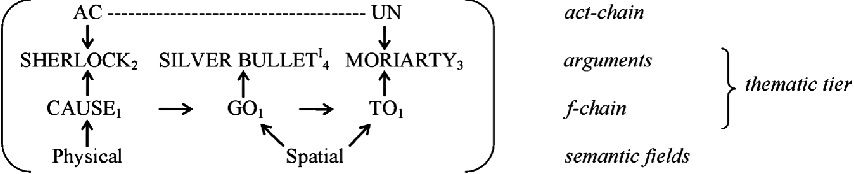

The causer, the argument selected by the function CAUSE is in both sentences SHERLOCK, also assigning the role actor in the action tier. In (8a), the theme argument (SILVER BULLET) is characterized by a transition (assigned by the function GO) and the goal (MORIARTY) is the endpoint of the transition. Note that the ‘with’ adjunct (with a silver bullet) is fused with the implicit theme argument of the verb shoot in (8a); in the accompanying analysis of conceptual structure, the implicitness of the theme argument is marked with the superscript index I. The argument MORIARTY as the passive participant to whom the activity of the actor is directed on assigns the role undergoer in the action tier. In (8b), the theme argument is MORIARTY and the goal argument is ROOM. The cognitive backgrounds in which the events take place are described by semantic fields. Both in (8a) and (8b), the transition of the theme (the implicit argument SILVER BULLET in (8a) and MORIARTY in (8b)) is described by the spatial semantic field. In Conceptual Semantics, the notion of semantic field indicates the cognitive background of the situation, e.g. the type of influence (physical, social, etc.) that the causation is based on. For instance, in (8a), the semantic field of the causation is physical and in (8b) social.
When describing the correspondence of the lexical conceptual structure and the syntactic structure, we apply the linking convention suggested by Nikanne (Reference Nikanne, van der Zee and Nikanne2000). The numeral subscript indices point to the linking between the syntactic and the conceptual structure. The basic idea is that all parts of the syntactic structure that are marked with an index correspond to the parts of the lexical conceptual structure of the word that are marked with the same index. Hence, the parts of the conceptual structure that are marked with the index 1 in (8a) correspond to the LCS of the predicate shot. The subject argument is marked with the index 2 and the object argument with 3.
2.2 Temporal and causative relations in complex sentences. Intention
It is a largely acknowledged assumption concerning the causative situations that causative and temporal relationships are tightly bound together – the reason (the causing situation) must precede the effect (the caused situation). To investigate this phenomenon closer, exact methodological tools are necessary. In this section, we introduce the Conceptual Semantics approach to temporal and causative relationships in complex sentences.
Jackendoff (Reference Jackendoff1987, Reference Jackendoff1990) analyses the internal time flow of events and proposes that aktionsart, the internal time span of a lexical conceptual structure is described in the temporal tier (T-tier). The T-tier operates with two primitives: point of time (P) and region of time (R). A T-tier may consist of a point of time or a region of time alone; a region of time may be bounded in its beginning (PR) or in the end (RP), and there may be a point of time in the middle of the region of time (RPR) (Jackendoff Reference Jackendoff1990; Nikanne Reference Nikanne1990, Reference Nikanne1997a). Pörn (Reference Pörn2004) takes into account the starting points and end points of (sub)events as well as the chronological order of the points in the internal time line of the complex situation by marking the starting point (Ps) and final point (Pf) of a situation using subscripts s and f; Petrova (Reference Petrova2011) distinguishes additionally the intermediate point of time (Pi) and marks it with the subscript i. Petrova (Reference Petrova2011) separates the T-tier further into two subtiers: (i) the chronological temporal division that is arranged into the feature system using the features [s], [i], and [f] as the primitives; (ii) the time region level containing also the points of time. Nikanne (Reference Nikanne2018), adopting Petrova’s terminology, identifies the chronological division as the order tier and the region–point system as the RP-tier and introduces the notion of temp-root that represents the temporal structure as a whole. The RP-tier formation is specified by the means of the primitives R, P and temp-root. The combination principles of the RP-tier and the role of the notion of temp-root are defined in (9):
(9) The definition of the RP-tier (Nikanne Reference Nikanne2018)
a. The primitives of the RP-tier are organized as a constituent structure: The ‘maximal projection’ of the RP tier is the ‘temp-root’ node, which represents the whole temporal tier. The RP-tier must include one R and none, one, or more Ps (the linear order is not relevant). This can be illustrated as follows:
b. If R is not present, no more than one P is allowed in the RP-tier.
c. Temp-roots may share the same P but they cannot share the same R.

The T-tier of the sentence Sam gives Tom a book can thus be analyzed as in (10). The sentence implies a time line that is bounded both in the beginning, in zone 3 and in the end, zone 1. This means that the causation is connected to a P-node in its temp-root and the caused situation involves a temp-root with an R- and a P-node.
(10) Sam2 gives1 Tom4 a book3

To describe the temporal relationships of a complex sentence, Nikanne (Reference Nikanne1997a:344) proposes a separate temporal tier, the CT-tier (constructional or complex T-tier) that relates the situations expressed in a complex sentence to a linear time flow. This is based on the idea that a complex sentence forms a ‘micro universe of discourse’ (compare the notion of universe of discourse in Givón Reference Givón1984:338–339) and the temporal structures of the sub-situations of this ‘universe’ must be related to each other. The T-tier of the matrix sentence and the T-tier of the adjunct are thus mapped to the CT-tier separately; the individual situations are analyzed as wholes without an analysis of the internal temporal structure. An individual T-tier can be equal to (=), included in (∈) or not included in (ϵ) the CT-tier. It can be undivided or divided pursuant to a linear time course: the beginning part of the shared T-tier describes the chronologically earlier time sequence and the final part the latter time sequence (11a, b). In the divided CT-tier, the abbreviation CT1 stands for the chronologically earlier part of CT and CT2 stands for the chronologically latter part of CT (Nikanne Reference Nikanne1997a:344–345). The brackets are used to indicate the sub-situations that are linked to the CT-tier.

In Nikanne (Reference Nikanne2018) the CT-tier is analyzed as a constituent structure where CT is (possibly) divided into two parts as in (12).
(12) The formation of the CT-tier

If CT is divided, then CT1 precedes CT2 in the internal timeline of the micro universe of discourse. This relation is abbreviated with the symbol ‘is larger than’, i.e. CT1 > CT2. The CT-function must select one temp-root which links the CT-tier to the rest of the conceptual structure. If CT is divided, then its parts CT1 and CT2 must select one temp-root each.
The discussion so far has concentrated on the temporal relations. How do temporal relations of a complex sentence comprising a subordinate causative structure correlate with causation? In Paulsen’s (Reference Paulsen2011a:212–223) study of constructional complexes of the (causative or non-causative) matrix sentence and an adjunct connected to it, it is observed that the temporal and causative structures are interweaving but do not necessarily correlate with each other chronologically. To separate causation from the temporal structure, Paulsen (Reference Paulsen2011a:214) proposes two causative subordinate operators:

The causative operators reflect the two possible directions of subordinate causation and the characteristics of causative subordination: CS↑ describes a situation where the subordinate structure is the reason for the situation expressed by the matrix structure; CS↓ stands for the situation where the subordinate structure is a result of the situation expressed in the matrix sentence. Basically, we regard reason as one basic type of causative subordination and result another; the adjuncts of these types can be referred to by the terms reason adjuncts and result adjuncts, respectively.
Two reason adjuncts are analyzed in (14a, c) and a result adjunct in (14b) below, where the parts of the CT-tier are related to the whole construction and the temporal type of the subordinate causation is identified. The abbreviation MX represents the matrix structure and AD stands for the adjunct; the indices refer to the matrix structure (2), adjunct structure (3) and the causative subordination marker (1). The reason adjunct in (14a) precedes the matrix structure temporally, coinciding with the direction of causation.
(14) a. (MX [Moriarty broke into the Tower of London]2) (AD [because of1 (his obsession)]3)

An example of the result-adjunct type is the sentence Moriarty pushed Sherlock off the roof, analyzed in (14b). In this example, the adjunct structure is the result of the matrix sentence. Also temporally, the adjunct structure follows the matrix sentence.
(14) b. (MX[Moriarty pushed Sherlock]2) (AD [(off1) the roof]3)

The example in (14c) involves a purpose adjunct. The temporal relationships show an opposite direction – the adjunct structure causes the matrix structure (as in the previous example), but temporally, the matrix structure precedes the adjunct structure.
(14) c. (MX[Moriarty broke into the Tower of London]2) (AD [(to1) try on the crown]3)

Characteristically of purpose constructions, it remains open if the intention (to try on the crown) will be realized. Note also that, in (14c), breaking into the tower makes it possible for Moriarty to try on the crown. The matrix sentence expresses thus a necessary condition for the situation expressed by the adjunct. Therefore, an additional CS↓ could be added to the analysis. In this article, we focus on the purpose adjuncts and leave the analysis of condition interpretation to future research.
Now we need to formalize the essence of intention, a crucial semantic component related to (causative) purpose adjuncts. Intention is here addressed as a relation between (i) the intended situation (e.g. to try on the crown in (14c)), and (ii) the one having the intention (e.g. Moriarty in (14c)). It is hence a two-place relation restricting the conceptual category of the argument: one argument is a Thing and the other argument is a Situation;Footnote 4 see (15).
(15) Intention

The relation INTENTION expresses that the Thing argument has the intention to make the Situation argument real. A property of the operator INTENTION is that the situation in its scope is interpreted not factive: it is a desired goal that may or may not be achieved.
3. Purpose adjuncts and causation
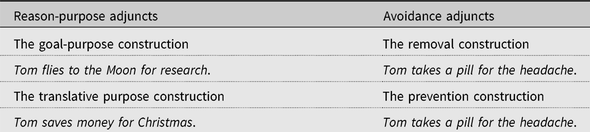
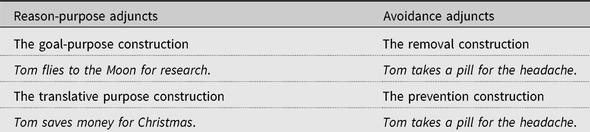
The semantically complex purpose adjuncts can be seen as a special case regarding causative and temporal relationships.Footnote 5 These adjuncts express the reason and the intended situation, indicating why the activity in the matrix sentence is taking place. The purpose adjuncts analyzed in this study are approached as a subtype of causative adjuncts. We argue that a temporally and causally bidirectional relationship gives rise to two types of purpose adjuncts. In the first type, the matrix sentence leads to the adjunct temporally, but causally, the adjunct structure is the reason of the situation encoded in the matrix sentence. This type belongs to the reason-type causative adjuncts that we call reason-purpose adjuncts and discuss it in Section 3.1. The second type of purpose structures, avoidance adjuncts, are causally like the reason-purpose adjuncts, as the adjunct structure causes the matrix situation, but temporally it may either follow or precede the matrix sentence. In addition, the adjunct involves modal features in form of negation. This phenomenon is discussed in Section 3.2. As pointed out in Sections 1 and 2.2 above, even the notion of intention is an important part of purpose adjuncts; the analysis below aims to a specification of this semantic property. The two types of adjuncts and the respective constructions that will be discussed in connection with these structures in Sections 3.1 and 3.2 are presented in Table 2 (on next page).
Examples of the reason-purpose adjuncts and avoidance adjuncts.
3.1 The reason-purpose adjuncts
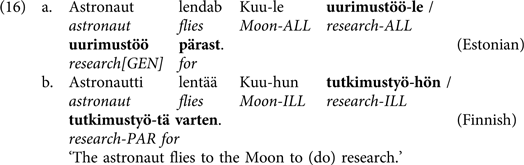
The sentences involving a reason-purpose adjunct convey a situation where the adjunct structure is temporally latter but causally earlier than the matrix situation. Purpose adjuncts express the ultimate goal of the action, meaning roughly ‘for the reason that’. In Estonian and Finnish, the reason-purpose adjuncts occur in connection with both transitive and intransitive matrix predicates with some restrictions on the distribution of case markers and adpositions. The morphological purpose adjuncts can generally be expressed by illative case in Finnish and allative case in Estonian (see examples (16) and (17)) if the matrix sentence is intransitive.
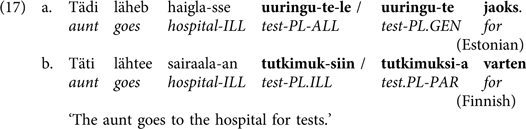
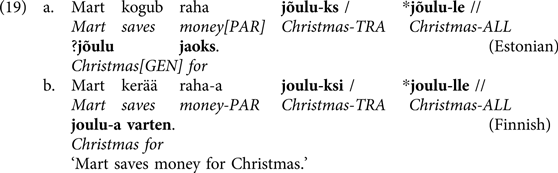
In both languages, there seems to be a tendency that the purpose adjunct in the translative case combines with transitive verbsFootnote 6 (as in examples (19a, b) below); in connection with action nominalizations or converbal formsFootnote 7 both intransitive and transitive verbs govern translative purpose adjuncts. Note that illative, allative and translative are all directional cases encoding the end-point of a trajectory; translative expresses in addition an (abstract) change of state. The morphological purpose-adjunct construction in connection with an intransitive verb corresponds to the structure [NPsubj Vintr NP-all/ill] (consider examples (16)–(17)). In addition to locative and translative case forms, purpose adjuncts can be expressed by postpositions, e.g. pärast, jaoks, heaks, ees, eest, eesmärgil, nimel, in Estonian and takia, varten, hyväksi, tähden, edessä, eteen, edestä, puolesta in Finnish, all meaning roughly ‘for, because of, for the sake of’.
An intransitive construction encoding reason-purpose incorporates two adjunct structures: a location phrase and a purpose phrase. In examples (16)–(17), the purpose is marked with the goal-marking cases illative in Finnish and allative in Estonian and with the postpositions pärast and jaoks in Estonian and varten Footnote 8 in Finnish. The locative goal can be expressed by the same morphological marker as the purpose, as seen in (16a–b) below, but does not have to, as seen in (17a). The goal-purpose construction apparently favors intransitive motion verbs. In this construction, either of the adjuncts (locative or causative) can be omitted without any grammatical consequences, but the causative purpose reading is clearest if the locative adjunct is there – when the spatial position is specified, the second oblique phrase identifies the reason for the subject argument being in that place.
The conceptual structure of the goal-purpose construction (18) is analyzed by example (16) above.


The situation expressed by the matrix structure, the theme argument (ASTRONAUT), mapped to the action tier function AC (actor), undergoes a spatial transfer to the goal argument (MOON); the spatial adjunct is combined with the argument structure of the predicate verb (for details on the combination, see e.g. Nikanne Reference Nikanne1990, Reference Nikanne2018). The purpose adjunct expresses a dynamic state (reflecting a static but temporally bounded situation) analyzed by the function STAY and the cognitive background of this situation is described by the circumstantial semantic field. To mark the multiple thematic roles within a conceptual structure, we use the binding system of Jackendoff (Reference Jackendoff1990): the theme argument of the adjunct structure is a bindee of the theme argument of the matrix structure (ASTRONAUT), marked with an α. This example is a case of overlapping semantic fields; the purpose phrase can have both circumstantial and temporal reading. Following Nikanne (Reference Nikanne2018), we assume that the f2 (i.e. zone 2 function, see Table 1 in Section 2.1) can be mapped to more than one semantic field. The type of the causative relationship between the subordinate and matrix structures is BECAUSE OF, marked with the operator CS↑ (the adjunct structure causes the situation in the matrix sentence, see Section 2.2 above). The matrix structure and adjunct structure are connected by the INTENTION-operator that selects the actor argument (ASTRONAUT) of the matrix sentence as the intender and the adjunct structure as the intended situation. Note that INTENTION belongs to the scope of the causative operator CS↑ (the intention causes the matrix situation). The CT-tier analysis shows that the matrix structure (indexed with 2) precedes the adjunct structure (indexed with 3).
The analysis of the goal-purpose construction in (18) demonstrates what we mean by a non-linear model of causation. The causative relations, when it comes to the purpose reading, are not following the temporal order and the different relations relevant for understanding causation are analyzed in separate layers, with explicated linking relations between the temporal nodes and thematic arguments.
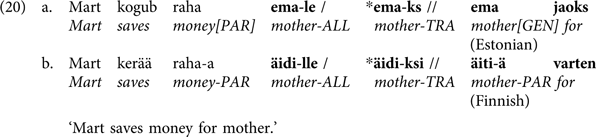
As mentioned above, in transitive sentences expressing purpose,Footnote 9 the purpose adjunct can be expressed in translative case both in Estonian and Finnish adopting the sentential form [NPsubj + Vtr + NPobj + NP-tra]. This pattern can be termed as the translative purpose construction. Analogically to the spatial destination argument of the goal-purpose constructions, the theme linked to the object argument in this construction functions as a ‘fixing point’. Translative case can be used with adjuncts that refer to dynamic entities, situations or happenings; hence, the semantic field of the purpose phrase is circumstantial. There seems to be a distributional segregation regarding the encoding of circumstantial and recipient-purpose adjuncts: the allative case is not used in the circumstantial field (see (19) below); in possessive field, allative is used if the referent is animate to encode recipient (Est. emale Fin. äidille [mother-all] ‘for the mother’) (see (20)). The postpositions jaoks (Est.) and varten (Fin.) ‘for’ replace the morphologically encoded recipient in both languages and these adpositions encode also circumstantial adjuncts (recall examples (16) and (17) above), even if jaoks is not always the most natural choice (as in (19a)).
An analysis of the translative purpose construction is given in (21) on the basis of example (19).


The conceptual structure of the matrix structure includes causation, expressed by the thematic function CAUSE; the semantic field of the causation is physical. The theme argument (MONEY) undergoes a transfer in the semantic field Characterizing, describing the transformation in shape which the theme referent is undergoing, typically appearing as a source or goal (see Jackendoff Reference Jackendoff1990:116–122). The semantic field of the purpose adjunct is circumstantial/temporal (for Christmas in (21)). The purpose adjunct expresses a state analyzed by the function BE. This function selects a whole situation as its argument, the possessive state of money (coindexed with the theme argument of the matrix structure by the Greek β) being in the possession of Mart (coindexed with the causer argument of the matrix structure by the letter α). The causative relationship between the subordinate and matrix structures is BECAUSE OF. As in the intransitive goal-purpose construction (18), the adjunct structure precedes the matrix structure causally and follows the matrix structure temporally.
To summarize the properties of reason-purpose adjuncts, following generalizations can be drawn:
(i) It encodes the target of a directional (dynamic) matrix sentence and a desired state of affairs.
(ii) It is an example of opposite causative–temporal relationships – temporally, it indicates a subsequent situation and causally, a preceding situation.
(iii) The reason-purpose adjuncts are marked with the allative case in Estonian and illative in Finnish (in the goal-purpose construction) or with the translative case (in the translative purpose construction) in both languages. As an alternative to case marking, both languages use postpositions (Est. jaoks, pärast; Fin. varten, takia). The relations and the division of labor between the postpositional constructions and the locative case constructions is an interesting field of further research, but it must be left for the future.
(iv) The cognitive background of a purpose adjunct is typically described by the circumstantial semantic field; additional semantic fields are possible (e.g. temporal, possessive). The prototypical purpose marked with the directional cases is dynamic/processual (research, tests; Christmas, graduation).
3.2 The avoidance adjuncts
As was the case with the reason-purpose adjuncts discussed in the previous section, in a sentence involving an avoidance adjunct the adjunct structure causes the matrix situation, but the temporal relationships are more complicated. The avoidance-purpose expressions have an antonymous relationship in respect to the reason-purpose adjuncts. Instead of a desired achievement, the avoidance adjuncts denote ‘against something’ or ‘to prevent something’, basically encoding the concepts REMOVE and PREVENT. Note that in English, the preposition expressing reason-purpose, for, can be used also in avoidance adjuncts, but the Estonian and Finnish postpositions used to convey the reason-purpose (e.g. Est. jaoks, tarbeks, heaks and Fin. varten, tähden, hyväksi, all meaning ‘for the sake of’) do not express removal- or prevent-relations. In addition, there is a linguistic distinction in Finnish, separating the removal and prevent adjuncts – the illative case expresses both removal and prevent relations whereas the postposition vastaan ‘against’ only conveys the prevention reading. In Estonian, no morphological means are used to encode avoidance-purpose and the postposition vastu ‘against’ covers both removal and prevent adjuncts.Footnote 10 Examples of removal adjuncts in Estonian and Finnish are given in (22).
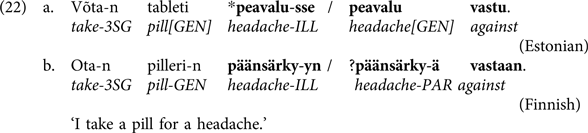
The factual and non-factual readings involve two different types of causative situations. The removal situation (a) can be paraphrased as I have a headache → I take a pill → headache disappears. The preventing situation (b) implies I do not have a headache → I take a pill → no headache emerges. In both cases, the last paraphrase is the intended situation. We analyze the basic conceptual structure of the removal construction and the prevention construction in (23). In both factual and non-factual readings, the basic structure is similar: the situation expressed by the adjunct situation causes the matrix sentence, i.e. the intention of not having the headache causes the taking of pill in both cases. Note that negation belongs inherently to the avoidance-purpose, hence, the modal operator Neg (negation) selects the function BE as its scope, expressing that the situation of ‘Tom having a headache’ is not there.


For the analysis of the CT-tier of removal and prevent adjuncts, we suggest a division of the CT1 and CT2 further into two parts. If the dominating CT is divided into CT1 and CT2 and the CT1 is divided into two, we use the markings CT1:1 and CT1:2, and if the CT2 is divided, we use the markings CT2:1 and CT2:2, as is shown in Figure 14. This gives us a CT-tier that is a recursive constituent structure based on simple binary constituents.
(24) The recursive CT-tier

Next, we analyze, in turn, the CT-tiers of removal-purpose construction (25) and prevent-purpose construction (26).
(25) CT-tier of the removal-purpose construction;
removal interpretation: HEADACHE4 ∈ CT1

The temporal structure of the prevent-purpose construction (25) differs from the removal-purpose construction (24): since the adjunct situation is not an actual but a hypothetical situation that the agent argument intends to avoid, the matrix sentence precedes the adjunct sentence. Thus, factuality plays a role in this construction: the temporal structure of the prevention construction requires that the causer of the event expressed in the matrix sentence (i.e. the purpose) is non-factual.
(26) CT-tier of the prevent-purpose construction;
prevention interpretation: HEADACHE4 ε CT2

To summarize the properties of avoidance adjuncts, five generalizations can be drawn:
(i) The avoidance adjunct encodes a non-desired state of affairs, hence, the adjunct structure includes negation.
(ii) Causally, the avoidance adjunct indicates a preceding situation in respect to the event expressed in the matrix sentence.
(iii) Temporally, the result-purpose adjunct indicates either a subsequent situation (the removal-purpose construction) or a preceding situation (the prevention construction) to the event expressed in the matrix sentence.
(iv) The removal-purpose adjunct is marked with the postposition vastu ‘against’ in Estonian and with the illative case in Finnish. The prevent adjunct is marked with vastu in Estonian; in Finnish, the postposition vastaan ‘against’ and the illative case encode prevent adjuncts.Footnote 11
(v) The removal adjunct must be factual whereas the prevent adjunct and the reason-purpose adjunct are non-factual.
4. Reanalysis of the ‘coconut sentence’: Beneficiary and instrument
After a discussion of the Tiernet model and its methodological approach to causative and temporal relationships, we now return to the example illustrating the causal chain notion of Croft presented in Section 1.3, Sue broke the coconut for Greg with a hammer. This sentence includes two adjunct structures, the purpose phrase for Greg and the instrumental adjunct with a hammer. In contrast to the linear causal chain hypothesis (recall example (4) in Section 1 above), we suggested that the order of the linear causal sequence is not straightforward, since the last segment of the chain, the phrase for Greg, has an effect on the whole as well. One could even say that without Greg, the whole sequence of events would not happen, and Greg can be understood as the reason for this causal chain by initiating Sue to action. We interpret this phrase as a purpose adjunct implying that the actor (SUE) acts intentionally and volitionally (particularly in case it is interpreted as a benefactive, as in e.g. Croft Reference Croft2012:198). We do not consider a purpose adjunct with properties of recipient, often expressed by for in English, automatically getting the role beneficiary, but we assume here that Sue’s activity is benefitting Greg.
How does the instrument phrase with a hammer fit into the whole situation? We suggest that instrument is described via the subordinate operator BY (27). The instrument phrase is connected with the actor argument of the matrix structure (bonded with the actor argument through the superscript α); the instrument argument itself is selected by the action tier subrole undergoer (UN). Note that the thematic functions as well as the semantic field are left unspecified.
(27) Instrument

Let us now analyze of the ‘coconut sentence’; this pattern can be generalized as the beneficiary-purpose construction (28).
(28) The beneficiary-purpose construction
(MX[Sue broke the coconut]) (AD[for4 Greg]2) (ADwith5 a hammer]3)

Note that the function INCH in the matrix structure of (28), marking inchoativity, indicates that the situation in its immediate scope starts. The triggering property of the beneficiary purpose adjunct for Greg is described by the INTENTION-operator that selects the actor argument (SUE) as the intender and the purpose-adjunct structure as the intended situation. In addition, the actor argument (SUE) of the matrix structure is selected by the AC-function of the beneficiary purpose-adjunct structure; also, the actor of the instrumental adjunct selects the argument coindexed with SUE. The argument GREG is selected by the beneficiary-marking function UN+. The purpose adjunct encodes reason-purpose causation, marked by the causative operator CS↑. Following the underspecified instrument analysis, we do not specify the thematic functions or the semantic field of the instrument adjunct. Note that unlike the linear description (see (4)), in our account, there is no causative or ‘act on’ relationship between the coconut and Greg.
The temporal structure of the beneficiary-purpose construction is described separately in (29). The temp-roots of the matrix structure and the instrumental adjunct are included in the CT1 and the purpose adjunct is included in CT2.
(29) Temporal structure of the beneficiary-purpose construction

5. Conclusions
In this paper, we have discussed the concept of causativity in the theory of grammar. Our description is a non-linear one and, thus, differs from the model that is based on a linear causal chain (Croft Reference Croft1991, Reference Croft and Pustejovsky1993, Reference Croft, Butt and Geuder1998a, Reference Croft and Tomasello1998b, Reference Croft and Gathercole2009, Reference Croft2012; Langacker Reference Langacker1991). The non-linear model of causative matrix sentences and adjuncts is based on the idea that the meaning of a complex sentence is compiled by separate sub-situations which may have causative relations to each other but not necessarily in a linear temporal order. In the theoretical framework used in this study, the Tiernet model, causation is part of a semantic network of subsystems such as thematic tier, action tier, temporal tier and semantic field tier. This enables us to identify the connections between semantic levels and to specify explicitly the direction of causative and temporal relations.
A complex area related to causation involves expressions that we have called purpose adjuncts. These adjuncts, e.g. the English in order to adjuncts, or translative purpose adjuncts in Estonian and Finnish, express that the driving force for some action is an intention of reaching some state of affairs that follows from the action. This is a complex causative-temporal configuration as the desired situation chronologically follows the action: the intention causes the action and the action is a way to achieve the intended situation. We have introduced a new theoretical tool, the operator INTENTION, for describing the intention, and the temporal relations between the situations using the temporal structure model developed by Jackendoff (Reference Jackendoff1990), Nikanne (Reference Nikanne1997a, Reference Nikanne2018), Pörn (Reference Pörn2004), Paulsen (Reference Paulsen2011a) and Petrova (Reference Petrova2011). In addition, we suggest a universal description of instrument adjuncts, which is based on underspecification.
Common to the purpose expressions analyzed in this study is that the matrix sentence expresses an action that is taken for achieving or preventing a desired or dreaded future situation encoded by the adjunct structure. All the different purpose-adjunct types involve the relation INTENTION, and the purpose in its scope causes the matrix situation. The two main types of purpose adjuncts focused on in this article are the reason-purpose and avoidance adjuncts, identified on the basis of the direction of time flow between the matrix and adjunct structures. The reason-purpose adjuncts represent adjuncts that causally precede the matrix structure but temporally follow it; the subtypes of this relation are the goal-purpose construction, the translative-purpose construction and the beneficiary-purpose construction (based on the sentence exemplifying the linear causal chain; see Croft Reference Croft1991, Reference Croft and Gathercole2009, Reference Croft2012). The avoidance adjuncts express complex causative-temporal and modal relations – a situation where the adjunct structure causes the matrix structure and temporally it either follows (the removal-purpose) or precedes (the prevent-purpose) the matrix situation. The analyses of avoidance adjuncts have shown that their common property in addition to the result-causation is the inclusion of negation; hence, even the modal tier has an influence on the types of purpose expressions.
A comparison of Estonian and Finnish analytic and synthetic expressions of the reason-purpose construction has shown that as the morphological means, both languages use translative case in addition to the allative case in Estonian and the illative in Finnish; in addition, the reason-purpose is expressed by postpositions (Est. jaoks, pärast; Fin. varten, takia). The avoidance purpose construction is encoded by the postpositions vastu in Estonian and vastaan in Finnish, both meaning ‘against’; Estonian does not use morphological means in this relation, while Finnish expresses avoidance purpose by the illative case. Note that in English, all these constructions can be expressed by the preposition for.
There are still many topics left for future research regarding causative purpose expressions, and a cross linguistic approach to ascertain the morpho-syntactic and semantic properties of causative adjunct constructions is needed. The analysis of Estonian and Finnish case-marked nominals and postpositional phrases in the present study indicates that there is a complex functional distribution of synthetic and analytic means of expression and even closely related languages do not necessarily encode causative purpose relationships in the same way. This study concentrates on the purpose adjuncts involving causation in locative cases and translative case, and some adpositional purpose adjuncts in Estonian and Finnish, but this is only a part of the variety of purpose expressions.
Acknowledgements
Earlier versions of this article were presented at the concluding conference of the Language and Infrastructure research network Language and Perception in Trondheim, May 2015, and at The Fifth Conference of the Scandinavian Association for Language and Cognition in Trondheim, August 2015. We would like to thank the audiences of these conferences for constructive discussions. We would also like to thank the anonymous NJL reviewers for their useful comments. Research for this work has been supported by the Estonian Research Council grant PSG227 to Paulsen.
Abbreviations
3 = third person; ABE = abessive case; AD = adjunct structure; ALL = allative case; CS↑ = the adjunct structure causes the situation in the matrix sentence (BECAUSE OF); CS↓ = the matrix sentence causes the adjunct’s situation (LEAD TO); CT = constructional T-tier; GEN = genitive case; ILL = illative case; LCS = lexical conceptual structure; MX = matrix structure; PAR = partitive case; PL = plural; SG = singular; TRA = translative.
Corpora
Estonian Reference Corpus. https://www.sketchengine.co.uk/estonian-reference-corpus/ (accessed 3 May 2019).
KLK-fi = The Newspaper and Periodical Corpus of the National Library of Finland, Kielipankki Version. Kielipankki. Available at: http://urn.fi/urn:nbn:fi:lb-201405275 (accessed 3 May 2019).