Dis/composure
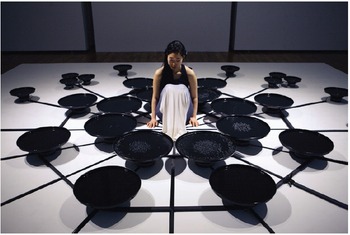
Lisa Park appears at first glance to be a cyborg, yet ethereal. With eyes closed Park calmly enters the room, a device wrapped around the back of her head. Sounds inundate the gallery with a blend of hums and chimes. The performance space has blank white walls with track lighting that illuminates Park at the center; pools of water surround her. The noise is initially discombobulating; it is not readily apparent why such sounds emanate throughout the room, unless the noise is intended to create the tension that fills the room. As the intensity of the sound increases, the water in the pools is animated, forming concentric circles, or if further perturbed, rapidly jumping water droplets. Park stares at the pools intensely, implying control over the vibrating water, perhaps by sight or some other force — telekinesis. But the invisible force is not telekinesis; it’s the vibrational frequency of the noise.
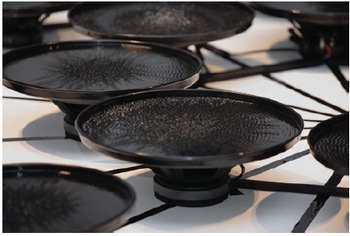
This 2014 piece by Korean artist Lisa Park was Eunoia II, the second part of the Eunoia series, performed at Mana Contemporary in Jersey City, New Jersey. Park surrounded herself with 48 pools — aluminum vibration plates filled with a thin layer of water, each placed upon 15-inch speakers. The 48 vibration plates represented the 48 different affects as philosophized by Baruch Spinoza in Ethics ([1677] 2020). On her head, Park wore an Emotiv, a commercial biosensor device embedded with electroencephalography (EEG) technology to track her brain’s electrical activity. This technology monitored five electrical waves (alpha, beta, delta, gamma, and theta) and each speaker vibrated according to Park’s brain wave signals. Through the orchestration of several software programs using interpretive algorithms, Park’s brain waves were translated into sound waves, the megahertz producing a deep and eerie monastic noise. The sound vibrations animated the pools of water, creating gentle waves or jumping water droplets depending on the intensity of her transduced brain waves, capturing a live composite of Park’s affective state. “Eunoia,” which in Greek means a beautiful mind, denotes for Park the material exposition of emotional processing that goes largely unseen.
Lisa Park performing Eunoia II. Mana Contemporary, Jersey City, NJ, 27 May 2014. (Photo courtesy of Lisa Park)

Speaker set-up from Lisa Park’s Eunoia II in 2014. (Photo courtesy of Lisa Park)

Park shares her experience of performing Eunoia II: “It’s a very overwhelming feeling to be surrounded by sounds; 48 speakers are noisy” (2020). Park’s experiments with biofeedback began with the intent to achieve “inner calmness” or a meditative composure. In Eunoia I (2013), the goal was discipline, to calm her mind “so that no sound could be heard, and no vibrations could be seen on the water” (Park Reference Park2013). Whereas the first series focused on composure, or generating alpha waves, thereby making less noise, the progression of the series expanded the number of affects and speakers. Eunoia II produced a noisy and loud composition tracking all five brain waves, a result of dis/composure, or the artist’s inability to maintain a “quiet” mind. Alpha brain wave sonification, a method of sounding brain waves, is best induced through a disciplined composure or meditative state. Inevitably this led to a comparison with Park’s predecessor, experimental composer Alvin Lucier, a pioneer in this method. However, during her creative process, Park was unaware of Lucier’s work; she only heard of him afterward through audience members and critics. For Park, the shared use of the EEG sensor as a tool for artistic expression is coincidental (Park Reference Park2020). I bring Park’s work in conversation with Lucier to explicate how identity and perceptions of control or self-control — composure — necessarily situate the techniques of noise, amplification, and cognition through brain wave signaling in the racial biopolitics of sonic discipline. I posit the alpha wave as a performative racial marker going beyond brain signal data. Considering Park’s work in her own terms deviates from the art historical comparative approach that often imputes Asian avantgarde/Buddhist philosophy as derived from or in hierarchal relation to Western white, masculine experimentation. Footnote 1 I examine the sonification of alpha waves to question how this immaterial labor is reconstituted through race and gender.
Amplifying Alpha
Lisa Park and Alvin Lucier
Artists and musicians have experimented with EEG signal and brain wave sonification since the 1960s. Pioneer composers such as Alvin Lucier and David Rosenboom as well as performers Mariko Mori and Claudia Robles-Angel have experimented with “brain computer interfaces” or BCIs to convert brain waves into sound and imaging (Chapman et al. Reference Chapman, Ma, Earl Pollick, Zioga, Sá, Carvalhais and McLean2014). First coined by UCLA computer scientist Jacques Vidal in the 1970s, a BCI is an artificial system that gathers neurological data and translates it into artificial output that can transform the capacity or expressivity of a natural bodily system. The first interface between brains and computers comprised noninvasive electrodes placed on the scalp measuring brain waves. In recent years, BCIs have become available for consumers, advertised as user-friendly biosensors: portable devices that can track physical and mental health data or enhance the virtual experience by linking to the user’s range of emotions and facial expressions in real time. In 2007, NeuroSky introduced the first wireless BCI device that did not require conductive gels or skin preparation. Park’s first performance of Eunoia in 2013 utilized NeuroSky’s MindWave wireless headset. For Eunoia II, she used an Emotiv headset launched in 2009.
Park is not the only artist to use commercial BCI devices as artistic tools. New media artist Shu Lea Cheang and collaborators on her durational Sleep 79 project held an overnight art event in January 2019 where sleeping audience members’ brain waves were recorded. Similar to Park’s piece, brain wave coding translated electroencephalograms into amplified sound to create a “sound sanitorium” that was supposed to improve the sleep of audience members. Footnote 2
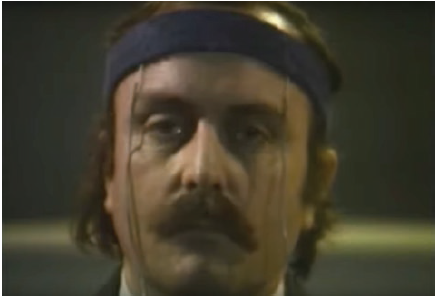
BCI live performance began as a medium less determined by accurate signal processing than by intriguing optics and theatrics (Straebel and Thoben Reference Straebel and Thoben2014). This was apparent early on in Lucier’s 1965 Music for Solo Performer, first performed at Brandeis University’s Rose Art Museum. Collaborating with physicist Edmond Dewan, Lucier used a headband to attach three wet electrodes to his forehead. The brain wave amplifier tracked Lucier’s alpha waves that “played” an array of percussion instruments coupled with amplifiers and loudspeakers.
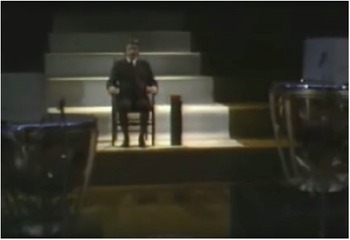
In a video recording of Lucier’s 1976 performance of Solo Performer, he sits center stage, upright and still, his face inscrutable with eyes softly focused or closed. An assistant prepares him by applying gel to the headband of electrodes and attaching it to his forehead. The audience waits as Lucier focuses on producing alpha waves. Alpha waves are the most easily detectable wave of the human brain; they are produced most in a state of wakeful relaxation with eyes closed, which Lucier practiced leading up to the performance. In his 1980 description, Lucier writes:
The alpha rhythm of the brain has a range from 8 to 12 Hz, and, if amplified enormously and channeled through an appropriate transducer, can be made audible. It can be blocked by visual attention with the eyes open or mental activity with the eyes closed. No part of the motor system is involved in any way. Control of the alpha consists simply of alteration of thought content — for example, a shifting back and forth from a state of visual imagery to one of relaxed resting. (1995:300)
Lucier describes a performance of alpha waves induced by self-control, recalling images, and resting. There is no bodily movement. Amplification increases the signal strength of the EEG, which is transduced and made audible through a system that “plays” percussive instruments, like bass drums, triangles, or a small gong. The quiet that predominates is disturbed by tremors of cymbals or the kick of a snare. One crescendo culminates in a cascade of various percussive sounds. However, what looks like a mastery of one’s brain waves to “play” the musical instruments relies on “illusion, [or] an intended theatrical effect” of Lucier’s performance of alpha wave discipline (Straebel and Thoben Reference Straebel and Thoben2014:17). Footnote 3 This performative illusion belies the fact of the inconsistencies produced by the imperfect technology as well as the labor of production assistants during the performance; as Volker Straebel and Wilm Thoben point out, not every sound is a result of alpha activity, but rather, also a live capture of extraneous feedback, noise, and interference (23).
Close-up of Alvin Lucier from the 1976 video of Alvin Lucier’s Music for Solo Performer, from Robert Ashley’s Music with Roots in the Aether. (Photo courtesy of Performing Artservices, Inc.)

Conceptually, in Solo Performer Lucier sought to compose and perform live music without intention or subjective feeling, achieving a “blank” mind (in Dewar Reference Dewar2012:2). Lucier was significantly influenced by John Cage’s “non-action” and chance operations as put forward in Cage’s seminal Silence: Lectures and Writings (1961). Footnote 4 In fact, Cage was Lucier’s assistant in the first performance of Solo Performer. Footnote 5 Cage’s turn to chance operations is often attributed to his well-known encounter with Zen Buddhism in the 1940s–’50s. During this time, Eastern traditions like Zen Buddhism and yoga were becoming established in the American consciousness. In Silence, Cage cites the influence of D.T. Suzuki, a Zen Buddhist teacher and scholar:
In the course of a lecture last winter, Suzuki said that there was a difference between Oriental and European thinking, that in European thinking things are seen as causing one another and having effects, whereas in Oriental thinking this seeking of cause and effect is not emphasized but instead one makes an identification with what is here and now. ([1961] 2010:46)
The “here and now” of Eastern thought in contradistinction to the causal logics of Western discourse is commonly cited as the source of the spontaneity and indeterminacy so central to Cage. However, Benjamin Piekut critiques this familiar association of “Cagean self-abnegation” with Asian philosophy as an “all-too-familiar” dynamics of power in the West” (2012:15). For Piekut, the “modesty” Cage cultivates is less shaped by Eastern philosophy and more by a deeply modernist scientism. Furthermore, Piekut considers Cage’s seemingly modest style of ventriloquizing the objective world of nature a reification of white, male subjectivity and listening (15). Similarly, sound studies scholar Marie Thompson symptomizes this kind of listening as “white aurality” where it “amplifies dualisms” and erases its “own constitutive presence in hearing the ontological conditions of sound-itself” (2017:274).
The philosophical approaches of Cage’s colleague Lucier are more transparent: his primary influence is sound physics and the natural sciences. And although the compelling theatrics of Music for Solo Performer that entail this early brain wave sonification are in essence an illusion for what was a highly mediated and produced sound, the reception of Lucier, like John Cage, is one that has also afforded him the position of sound’s “modest witness.” Piekut’s Cage critique is applicable to Lucier’s claim of having no emotion or intent in this pursuit of pure, objective composition by way of alpha wave activity. Further, Lucier’s performative composure shares in Piekut’s definition of Cagean modesty through the presentation of a public self that conceals more than it reveals. And of course, what makes Lucier’s Solo Performer especially enchanting is how the technology of the EEG sensors enables the artist to appear to not actually “do” the physical work required of a musician. As Alfred Gell argues on the metrics of “enchanting” technology, its success is calibrated according to its convergence with a “magic standard of zero work” (1994:58). Lucier’s rejection of intent and emotion in his sound composition speaks to a white masculinist composure or control projected as willed individual strength and discipline. This “rugged” cognitive labor reformulates the concept of immaterial labor argued by Michael Hardt and Antonio Negri as a formal feature of postindustrial economies (2000). Rather than the social, communicative, and affective labor that make up the features of immaterial labor, Lucier’s cognitive labor relies completely on an illusion of nonsubjectivity and inscrutable will. In this illusion, alpha waves become a kind of raw material for Lucier to extract and perform in a practiced cognitive discipline; and such gestures of centralized labor extraction illuminate how his performative composure entails the messy political ontologies of the scientism of alpha waves, Eastern philosophy, Orientalism, and cognitive cybernetics.Footnote 6
From the 1976 video of Lucier’s Music for Solo Performer, from Robert Ashley’s Music with Roots in the Aether. (Photo courtesy of Performing Artservices, Inc.)

G. Douglas Barrett identifies Lucier as a “brain worker” whose experiments directly intervene in the shifts to postindustrial capitalism (2017:2). “Brain worker” is a helpful term to contradict the erasure of material labor that is often associated with this “enchanting” performance: Lucier’s illusion of playing instruments with his mind is still a form of embodied labor. Following Barrett, I also position Lisa Park as a brain worker who shares some formal and stylistic elements with Lucier, yet for the most part diverges from his approach. For Park, Buddhist philosophy and meditation practice are significant conceptual and formal structures of the performance:
The main reason I started Eunoia is because I wanted to meditate on myself and understand my feelings through biofeedback. It’s a very overwhelming feeling to be surrounded by sounds — 48 speakers are noisy — related to my current emotions and brain wave measurements. Also, the movements I could perform are limited due to the Eunoia installation’s structure. The layout of the installation’s structure was inspired by the East Asian Buddhism symbol “Gan gyil.” I tried to trace my memories and amplify my feelings so that my invisible state could be manifested as sound and causing water ripples. (Park Reference Park2020)
The “gan gyil” or “wheel of joy” is a Buddhist symbol that is composed of three sections in yellow, blue, and red, swirling into a circular unity denoting knowledge of interconnectedness. In figure 1, the gan gyil–inspired installation can be seen in the repetition of the concentric arrangements of speakers and vibration plates. When Park first conceptualized Eunoia, she focused primarily on the production of alpha waves as a meditation practitioner. However, she soon realized her initial intent failed when performed for the public: “It is very challenging to keep yourself calm for a certain amount of time, more than five minutes” (Park Reference Park2020). Her inquiry into the unpredictability of meditating in public shaped her next brain wave projects.Footnote 7 Whereas Lucier’s performance enacted an illusion of mastery, Park’s performances evolved into an exploration of brain wave signaling. Park describes a moment when a participant was asked a private question by her friend; a quiet ring suddenly increased in volume before she could respond, startling the participant. This private moment enacted an unconscious physiological response made known to others first by noise. In another experience, Park had her friend, a ten-year veteran meditator, wear the EEG headset to test her work. His “attention” values were low and “meditation” values were high, resulting in low audio output and small vibrations on the water pool. For Park, the sound of meditation became a failed experiment on controlling alpha waves.
The modulated noise is a significant aspect of the performance, and yet this has received little critical attention. Reviews of Park’s performances are characterized by cultural references, from Kung-Fu films or Quentin Tarantino’s Kill Bill (2003) to remarks on a mysterious beauty that shrouds Park’s brain wave performances. In his PAJ essay about Eunoia, Daniel Rothbart did not describe the sound work, instead focusing on the aesthetics of the aluminum vibration plates (2015:7). What Park’s performance brought to Rothbart’s mind were the “early Korean ceramics that I recently reviewed at the Musée Guimet in Paris. […] They were fashioned and fired for the Korean tea ceremony and shared a graceful demi-spherical form with Park’s vibrating vessels” (7). Park’s performative composure reminded him of the tranquil tea ceremony; the active noise was objectified as a cultural and ethnic identifier. Rothbart’s reimagining of Park’s water tray set up as a Korean tea ceremony diminished the intricate, technical components of her sound art, transforming Park into the hostess of an ethnic custom. The “vessels’” property of amplification by the speakers were overlooked. Park’s performance intends to signal and sound emotion and relationality, but Rothbart’s tea ceremony fantasy projected a fantasy of passive East Asian femininity, both ornamental and inscrutable. Anne Cheng theorizes ornamentalism as a “style” of Asiatic femininity, “a human figure that emerges as and through ornament” (2018:419). Cheng notes the ease with which cool ceramics and Asian femininity are conflated in art criticism (428). Inscrutability, the well-rehearsed Orientalist trope of emotional inaccessibility and opacity, is part of the patronizing Western “feminization” of silence and thereby, the East (see Cheung Reference Cheung1993). In his review, despite the fact that water ripples according to noise vibrational disturbance and Park’s 48 affective states, Rothbart apparently did not hear the performance’s sonic materiality, nor did he acknowledge the artist’s techniques.
Reading Lucier’s Solo Performer and Park’s Eunoia together reveals an embedded assumption concerning the sonic arts of neural feedback using alpha wave data. Their methods and performances of alpha wave amplification illuminate how central their racial and gender subjectivities are in mediating the illusion of composure or self-control. What began for Park as a project of alpha wave control to manage strong emotional reactions through rehearsals and memory training unraveled into a performance with discomposure and admittedly little self-control, thereby amplifying the atonal and clashing sounds modulated by five brain waves. For Lucier, alpha waves were the ink, so to speak, of a percussive musical score generated by his restrained, composed state. And in the traditional concert setting of his 1976 performance, the quiet audience waited in the dark as the musician sat downstage focused on generating as many alpha waves as possible, further heightening the theatrical effect of his performative composure. Enabling the unpredictability of neurofeedback in the “live wire” of Park’s EEG resulted in a noisy and loud experience. As Park remarked, it was overwhelming to sit in the middle of 48 speakers in front of an audience sounding her neural feedback. Eunoia’s Buddhist gan gyil concentric setup of speakers and vibration plates that limited Park’s movements was another conceit of what was perceived as racial composure. Perhaps, also, the gan gyil structure can be indexed as an ambivalent attachment to the aesthetics of the kind of Eastern Buddhist philosophy revered by white, male avantgarde composers of the extended 1960s.
My readings of Lucier’s and Park’s brain wave performances reveal the ontological politics of sound. Juxtaposing the two works demonstrates how EEG-based sound art cannot be decontextualized; that is, considered apart from its producers/subjects. Park’s affective states amplify dis/composure, and Lucier performs self-control in the extractive labor of generating alpha waves. Inasmuch as Park’s performance is not about a composed state of mind and body but rather a cacophony of brain waves, there is the question of why the work was perceived as the “quiet mind” of alpha waves. These perceptions are both intentionally constructed by the artist and projected by the listeners. Park aestheticizes this composure and negotiates through the installation’s environment; she also disrupts this conceit of composure with loud noise. I see Park’s experience of performing live as being “overwhelmingly loud,” an extension of another “burden of liveness,” drawing from José Esteban Muñoz’s theory of disidentification. Muñoz argues the burden of liveness is a demand especially made of racial subjects who must perform a “crude materiality” in order to signify in the dominant culture (1999:188). But how can alpha waves signify a racial “crude materiality”? What Park’s performance enables is a deeper understanding of alpha waves, or composure, as both a feminized alterity of experimental musical composition and a conceit of Asian femininity. I further contextualize the alpha wave as an idealized state, a racial marker, an “Alpha Orient,” so to speak, by turning to the performance works of Yoko Ono.
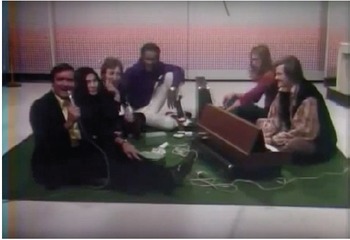
From left: Mike Douglas, Yoko Ono, John Lennon, Chuck Berry, Kurt Munkacsi, and David Rosenboom on The Mike Douglas Show in 1972. (Screenshot by Peggy Kyoungwon Lee)

The Alpha Orient
Revisiting Yoko Ono’s Cut Piece and Sky Piece to Jesus Christ
From 14 to 18 February 1972, Yoko Ono and John Lennon cohosted The Mike Douglas Show, a popular American daytime talk show. In one episode, they invite experimental composer and musician David Rosenboom to introduce biofeedback technology to the broader national audience. Sitting on a green carpet of AstroTurf TM in a segment Douglas jokingly refers to as the “floor show,” Rosenboom and Kurt Munkacsi on synthesizer are joined by Douglas, Ono, and Lennon, as well as Chuck Berry. Rosenboom introduces biofeedback as a new technology that can broaden an individual’s sense of self and/or artistic practice by listening to their internal physiology. He emphasizes how biofeedback has the potential to become a useful practice that would enable an individual to “begin to learn to control some of [his own internal biological processes] that he may not be in control of.”Footnote 8 Rosenboom cites raising or lowering one’s blood pressure or heartbeat as a practical example of how biofeedback can transform one’s relationship to one’s own body. John Lennon enthusiastically adds, “Anybody can do it.” He recalls a television program he and Ono watched on a sailor who learned in a half hour to lower his blood pressure using biofeedback. “I used to think only the yogis and people of the East could do those things,” Lennon says. Douglas follows up by asking Rosenboom, “Can forms of meditation like John pointed out, the Zen and the yoga, be used to produce alpha brain waves?” Rosenboom affirmed the close link and explained how some may find it harder than others; for instance, there will be a learning curve for those who are “high-strung” and “nervous” compared to those who are instinctively “detached,” “calm and very cool.” On how biofeedback benefits society, Rosenboom suggests:
It seems like every time you see somebody being wired up and everything you think, oh boy, is this the last straw for Western culture? It’s about time for me to go to India or China and live or something. But this is a new kind of thing, which requires a certain attitude, a certain orientation that just hasn’t been around. You have to learn in order to do this, how to do things without trying to do them. You have to learn how to let things happen and how not to try. It’s like you have to learn how to be a person by not trying to be a person. What would it be like if this stone had to try to be a stone, you know?
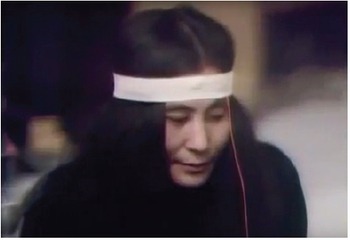
Yoko Ono wears an alpha wave neurosensor on The Mike Douglas Show televised in 1972. (Screenshot by Peggy Kyoungwon Lee)

Chuck Berry breaks Rosenboom’s chain of thought by asking, “But is the resulting factor music?” Lennon jumps in to reassure Berry that there are musical possibilities for creating rock and roll. Berry grabs Lennon’s arm and with a breath of relief says, “Thank you, John!” Clearly, Berry was not yet convinced of the musical possibilities of alpha waves. Douglas is first to try the biofeedback sensor and while Rosenboom sets him up asks, “If a person is tired, and fatigued, does it work as well?” Berry jokes, “It’s blues then.”
Douglas’s amplified alpha waves sound in loud, repeating beeps in varied speeds. Douglas equates the sound to flatulence from eating too many onions at lunch. After Douglas, Ono and Lennon place the electrodes on their heads for an improvised musical performance. With Rosenboom on keys and Munkacsi on a synthesizer, they jam with the couple’s alpha brain waves. Ono sits still with her eyes looking down. Lennon does the same but pivots his head away from Ono. First, Lennon’s alpha waves begin the song with fast clicks, then a synthesized gentle, slow wobble sound can be heard. Rosenboom points to how the artists have control over the wobbling with their alpha. He announces Ono’s alpha with, “Here goes Yoko.” There are clicks, then an introduction of a faster wobble with a brighter tone, presumably Ono’s alpha state. Shortly after, Rosenboom follows Ono and Lennon’s alpha wave collaboration on the keys, creating an otherworldly, echoey synth atmosphere. Munkacsi modulates the synthesized wobbling, at times changing its pitch to create more texture in the alpha amplifications. Douglas calls it “eerie” while Berry remains silent.
In this fascinating television moment, alpha waves are given a popular national spotlight by a set of significant musical artists of the 20th century. In this early moment of brain sonification art, only seven years after Alvin Lucier’s Solo Performer, Rosenboom pitches the potential of alpha waves, passionately describing their broad impacts in health, art, and self-perception. Rosenbloom espouses biofeedback as first and foremost a practice of self-control, a point he reiterates. To demonstrate, viewers see Ono and Lennon maintaining a meditative composure as they improvise a “song” based on their alpha waves. And although it is not clearly audible who exactly is who during the performance, Rosenbloom’s treatment of alpha waves parallels what I wrote earlier about Lucier: alpha waves are extracted as a new form of musical labor.
More notably, for Rosenboom and Lennon, alpha waves are explicitly racialized. Unique and “new” to the West, the biofeedback of alpha waves relates specifically to the “East” as it is central to Zen Buddhism and yoga. In Rosenbloom’s explanation for mainstream viewers, controlling alpha waves evidences an ontological difference between West and East: the anxious and high-strung West in its ceaseless noise of capitalist striving versus the contemplative, composed, and quiet spiritualities of the East. Alpha waves offer a new sonic and physical reorientation to help the Westerner train to embody composure. I find it telling that Berry chose not to apply the electrodes. At the moment when Douglas asked Rosenboom what happened to alpha waves in states of suffering like fatigue, Berry invoked the black musical tradition of the blues. Perhaps, Berry was just not buying it. In my reading, Berry listens, but suspiciously, to another white musical appropriation, not dissimilar to the racial history of rock and roll and the blues when the likes of Elvis Presley extracted black music in a “crossover.”
The viewer only hears Ono after she applies the electrodes, and then just the clicks and wobbles composed by her alpha wave activity. She engages in the conversation with nods that indicate she is listening, perhaps to limit stimulation before her live performance with Lennon. As the only Asian in the group, or as Lennon fantastically put it earlier in the broadcast, one of the “people of the East,” her performative composure and alpha waves sound ambivalently between authority and ambiguity. I view this televised moment on The Mike Douglas Show as a sounding of the Alpha Orient: my term for the racial world-building of Rosenboom and Lennon, their audio alpha wave biofeedback fantasy. To reiterate, alpha brain waves make up the “crude materiality” equating the labor of their production with Asian racial and cultural formations. The Alpha Orient signals a preoccupation with the alpha wave as a site of radical distinction between the East and West, a material of untapped potential that the West has discovered, amplified, and made audible. By now, more than a half century after Ono, Lennon, Rosenboom, and Berry’s appearance on the show, Eastern philosophies and practices have become engrained in the US American consciousness and popular culture. The Alpha Orient is an aural revision of Edward Said’s “Orientalism” ([1978] 2014).
The Alpha Orient is not only a spatial sonic destination but also an “allochronic technology.” Based on a concept enunciated by anthropologist Johannes Fabian to describe how non-Western and Western people are in different times culturally (1983), African American studies scholar Alexander G. Weheliye applied the idea to “race, orientalism, and popular music”:
[A]nthropological discourse works primarily by creating a dual structure that places non-western people in a radically different temporal space than western subjects. In this scenario the non-West must be both prior to and radically incommensurate with the imagined civilizational superiority of the West: the West and the Global South cannot exist on a coeval plane. […A]llochronic technologies […] combine apparatuses, images, knowledges, sounds, and bodies to imagine a radically different temporal dimension for non-western and non-white people. (in Recke Reference Recke2014)
As an artistic conceit, the Alpha Orient reverberates as both a risk and a strategy for the composed, female Asian performer. In Lisa Park’s Eunoia, the Alpha Orient surfaces in the conflict between her feminized, performative composure/Buddhist-inspired installation, and the noise that betrays her inability to generate alpha waves. Put differently, the performance refuses to deliver the calm-sounding alpha waves expected of an Asian female. This refusal sounds the conceit of this Alpha Orient, manipulated and sutured into the environment by Park. More importantly, the Alpha Orient illuminates a lacuna in cultural and performance criticism that not only conveniently erases or mutes Park, but also calls into question how she listens.
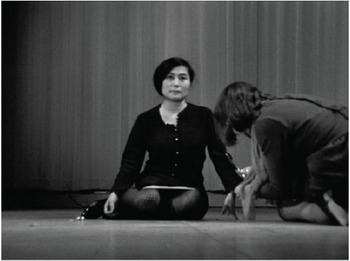
Yoko Ono in Cut Piece (1965) at Carnegie Hall. Image still from 1966 film by Albert and David Maysles, 8 minutes. (Screenshot by Peggy Kyoungwon Lee)

On the AstroTurf, while the men talk, Ono is quiet, not engaging anyone. Where is Ono going? Is she focused on generating alpha waves? With the electrodes on her head, she is producing an “eerie,” psychedelic sound with Lennon; hearing this we might interpret Ono as endemic to this Alpha Orient or techno fantasy Rosenboom assigns to the embodied awareness of alpha waves. I reject this reading; I interpret Ono’s composure not as Eastern self-discipline, but as a test. This testing composure by means of stillness recalls an earlier iconic Ono work, Cut Piece, which she first performed in 1964 at the Yamaichi Concert Hall in Kyoto, Japan. In Cut Piece, Ono invites spectators to take scissors and cut the clothing off her body. Cut Piece has generated a significant body of feminist art historical scholarship on the meanings of the feminine Asian body, gender-based violence, and risk. The possible visual outcome of Cut Piece, a naked and/or violated Ono, creates a tension in the performance that has been widely discussed and that for some is problematic. It is read as inaugurating politicized feminist body art and is popularly reenacted by new generations of artists and musicians as an explicitly feminist act. Jack Halberstam situates Ono’s oft-characterized passivity as a radical act; by trafficking in the aesthetics of submission, masochism, or giving, she disturbs the frameworks of liberal feminist subjectivity (2011:138). Julia Bryan-Wilson refuses to regard Ono as victim and the audience as menace; instead, she makes “space for Cut Piece to be a gift, a gesture of reparation, or a ritual of remembrance” (2003:103). Vivian Huang resituates Ono’s gift as a trope of hospitality, retrieving Asian inscrutability as an artistic method that invites curiosity and experimentation through affective ambiguity (2018:197). Jieun Rhee argues Ono made strategic use of her dual identity as a Japanese artist in the West and a New York avantgardist in Japan by playing the exotic body in both contexts (2005:98). Rhee frames Ono’s stillness as willingly submitting to the gaze, an encounter she can stop at her own discretion, cultivating a distinct pleasure of being watched.
I read Ono’s composure as similarly agential within the directed, indeterminate encounter. The long-lasting and wide-ranging interest in Cut Piece speaks to a pleasure in social constraint that the piece engenders for many viewers. Ono’s signature composure both enacts and challenges archetypes of the feminized Asian body: cognitive efficiency, durability, calculative emotionality, docility, passivity. I am not interested in signifying Ono’s composure as a pathologized, racial surface of ambiguity or inscrutability, nor as some unique psychic interiority. Rather, composure is an ephemeral act, something lost, regained, or never had to begin with. Footnote 9 Composure by definition is an encounter that relies on a relation without which it cannot emerge, however uneven the scale. This uneven scale was obvious in the uncomfortable, sexualized encounter depicted in the Albert and David Maysles film of Ono’s 1965 Carnegie Hall performance of Cut Piece. One man in a white shirt disrobes Ono aggressively, adding, “I’ll make a piece for Playboy with it.” Ono’s gaze searches the man’s in what may have been an effort to redirect the encounter. It fails. As the man leaves the stage, one can imagine the relief for both Ono and some spectators. In this encounter, Ono’s composure enacts a heightened self-consciousness riskiest for racial women subjects. In the film, the soundtrack aurally projects Cut Piece’s tensions and risks — footsteps, cutting, the clanging of the metal shears, audience murmurs. Footnote 10 Ono’s composure in Cut Piece was labor, a particularly compelling relational construct at the start of the post-1964 Civil Rights era. But also, for Ono, Cut Piece was pleasurable. In an interview, she reflects: “There was a long silence between one person coming up and the next person coming up. And I said it’s fantastic, beautiful music, you know? Ba-ba-ba-ba, cut! Ba-ba-ba-ba, cut! Beautiful poetry, actually” (MoMALearning n.d.). Ono regards Cut Piece first and foremost as a musical composition, an event score. Footnote 11
Ono performed Cut Piece at Carnegie Hall the same year Lucier first performed Music for Solo Performer. Both Lucier and Ono experimented with performative composure, music, and the indeterminacy of the live encounter. Yet in art historical narratives Lucier’s work is called a sound and musical innovation, while Ono’s piece is not. Exploring the erasure of women’s labor in the history of sound art, Judy Dunaway asks why Laurie Anderson and Ono are given short shrift. Citing Alan Licht’s Sound Art: Beyond Music, Between Categories (2007), Dunaway notes how Licht relegates them as a “crossover signifier” and “the prototypical crossover pop artist” (2020:40). Dunaway asks, “How do opportunities denied to women and practitioners of diversity affect the trajectory of the form?” (40). Ono repeatedly encountered misogyny and anti-Asian racism. For instance, when her Plastic Ono Band released their debut album in December of 1970, Charles McCarry, writing in Esquire, sexualized Ono and mocked her Japanese accent with the title “John Rennon’s Excrusive Gloupie: On the load to briss with the Yoko nobody Onos.” The interview was accompanied with a full-page illustration by David Levine of a wild-haired giant, Ono, controlling her famous musician husband, who was depicted as a beetle on a leash (McCarry Reference McCarry1970:204).
Comparing the scores of Lucier and Ono, both express an aesthetics of composure: Lucier uses amplified alpha signals and Ono embodied stillness. They seem opposites: Ono seemingly gives everything, while Lucier offers nothing. Lucier, Cage, Rosenboom, and their contemporaries desired to destabilize the hierarchy of noise and exploit what was made possible by chance. However, my concept of the Alpha Orient questions how such Western sound-making methods rely on the thingness of Asian bodies. In the politics of the Alpha Orient, the production of noise by the female Asian performer can only be recognized as inert or passive, a container rendered unintelligent by her immigrant English. In spite of the racist and sexist attacks Ono regularly endured as a young artist, early on in her career she critiqued and deconstructed these projections of the Alpha Orient expressed by some of her Fluxus collaborators.
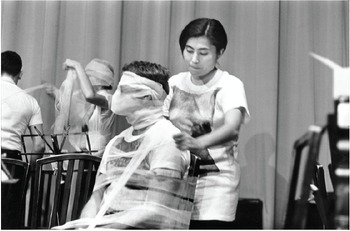
In 1965, just six months after Cut Piece, Ono returned to Carnegie Hall and performed Sky Piece to Jesus Christ during Fluxorchestra, a Fluxus event conducted by La Monte Young featuring 16 performances by artists and composers, including George Brecht and Mieko Shiomi. Footnote 12 In Sky Piece, members of the Fluxorchestra are wrapped in white medical gauze as they perform Antonín Dvor ˇák’s Serenade for Wind Instruments (1878). Ono and her coperformers begin wrapping the musicians’ bodies and their instruments with the bandages. The musicians stay composed in spite of the increasing impediments. In the 2013 staging of Sky Piece, Ono watches from the audience as a group of young women bind players’ limbs to their instruments, limiting their abilities to press, blow, or bow. Footnote 13 Laughter ensues when the music stumbles. As players become more restricted in their movements, the wind ensemble dissolves into absurdity. Faces are blotted out by the wraps, affecting the flutist’s and French hornist’s ability to blow. Or, a violinist, now completely cocooned with her instrument, makes chuffing sounds as she moves her bow across strings wrapped in gauze. The bandaged oboist slowly degrades from a forceful timbre to a pathetic noise closer to flatulence. More laughter follows. By the end of Sky Piece, the musicians are so impaired by the gauze wrappings that the ensemble concludes in silence. The musicians are bound to their instruments but are also conjoined to one another. After the audience applauds, the musicians, their visions obstructed by bandages, their feet slowly shuffling, are guided offstage in awkward coordination by those who wrapped them.
Sky Piece to Jesus Christ, performed by Yoko Ono, Carnegie Hall, 1965. (Photo by Peter Moore. Peter Moore Photography Archive, Charles Deering McCormick Library of Special Collections, Northwestern University Libraries. © Northwestern University)

Sky Piece to Jesus Christ referred not to the Christian god, but to the god-like status of John Cage whose “JC” initials are the same. Cage was in attendance at this comical tribute. In Sky Piece Ono explicitly cites Cage’s 1952 4´33˝ — a piece consisting of three periods of silence over the duration of 4 minutes and 33 seconds. Famously, Cage’s collaborator David Tudor sat at his piano in silence in front of an audience of musicians in Woodstock, New York. At this first performance, Cage was deeply affected by noises of the wind, raindrops, and the audience’s rustling. The audience reacted with mixed responses, some calling it Cage’s genius, and others, a gimmick. Regardless, Cage’s “silent” composition remains a landmark performance in the history of experimental music, sound art, and indeterminacy. Why then has so little been written about Sky Piece? What writing exists situates Ono’s piece as either humorously derived from Cage’s aesthetics of silence or a formulaic example of Fluxus “ready-made” art (Lushetich Reference Lushetich2011:25).
I interpret Sky Piece as a jab at Cage made palatable by means of sardonic Fluxus art. In the program to Ono’s 2013 Sky Piece staging in Frankfurt, Germany, “Sky” is “the epitome of freedom in contrast to the inner and outer bonds visualized during the performance” (Walter Reference Walter2013). Through the languages of restraint, debility, and disability — the visual poetics of the medical gauze — Ono retrieves what is lost by worshipping Cage: her own unbound self. During the performance, Ono is free; she binds others. She is far from being Piekut’s “modest witness,” Cage’s modernist creation of a universal, listening subjectivity.Footnote 14 Rather, the binding she leads is a bold takeover. Binding the musicians to their instruments and to each other is aggressive, signaling simultaneously wounds and wars. In Sky Piece, Ono is the intruder, literally restraining and silencing Western classical music. Sky Piece to Jesus Christ is an early critique of the Alpha Orient and the Cagean practice of the white male–dominant avantgarde. Ono’s piece was received by the audience as a prank, but for Ono the joke’s on them.
My examination of the work by Park and Ono concludes not with the aesthetics of composure, but rather, discomposure. The Alpha Orient illuminates for the female Asian performer the conflicted, tense subjection and subjectivity of composure, interfacing between all the haunting manifestations of “unreal” Asian femininity and the lived/performed material embodiments iterative of the “feminine” Asian subject. We need to revisit old scores (musical and otherwise), challenging how we listen.