Introduction
On 30 November 1999, the World Trade Organization (WTO) Third Ministerial was met with an estimated 50,000 protesters, representing ‘broad and diverse opposition to the recent expansion of neo-liberal globalization’ (Smith, Reference Smith2002). Trade unionists, anti-debt campaigners, environmentalists, church and community groups, indigenous peoples, migrants, farmers, students, anarchists, anti-corporate campaigners, and more, had allegedly become united by ‘political generalization’ (Calinicos, Reference Calinicos2009). This diverse movement against corporate globalization grew rapidly in the early days of the new millennium, reaching its pinnacle at the 2001 G8 Summit in Genoa, at which some 300,000 activists rallied and a small minority rioted.
Quite rightly, impressive transnational mobilizations like these and the networks supporting them have attracted considerable academic attention. A range of names have been deployed to refer to the sum of their parts: the movement of movements (Della Porta and Mosca, Reference Della Porta and Mosca2005), the anti-capitalist movement (Desai et al., Reference Desai2001), the anti-globalization movement (Buttel, Reference Buttel2003; Escobar, Reference Escobar2004), the movement against anti-corporate globalization (Crossley, Reference Crossley2003), the alter-globalization movement (Pleyers, 2010) and, arguably most frequently, the global justice movement (GJM) (cf. Graeber, Reference Graeber2004: 205–215; Della Porta, Reference Della Porta2007a). Despite the diversity of labels, these approaches are common in at least two respects, allowing us to make some (albeit limited) progress in understanding transnational contention. First, each recognizes that recent transnational expressions of resistance reflect opposition to neo-liberal globalization, often in tandem with support for social justice and more participatory forms of democracy (see, e.g. Chin and Mittleman, Reference Chin and Mittleman2000; Gills, Reference Gills2000; Della Porta et al., Reference Della Porta, Andretta, Mosca and Reiter2006; McDonald, Reference McDonald2006; Della Porta, Reference Della Porta2007a, Reference Della Porta2009; Pianta and Marchetti, Reference Pianta and Marchetti2007). Second, despite studies having looked at different sets of organizations or protests, these are often lumped together under the rubric of a movement, without systematically measuring the extent to which movement dynamics are present or absent among differentiated organizations.
The first supposition, that transnational contention reflects resistance to neo-liberal globalization, has been critiqued by Tarrow (Reference Tarrow2002), who warns against ‘lumping’ distinct manifestations of protest and campaigning under the same banner. For Tarrow (Reference Tarrow2005a) individuals and organizations involved in transnational campaigns and protests on justice issues are ‘rooted cosmopolitans’ rather than global justice actors. In other words, they are territorially rooted actors who bring their parochial concerns to transnational mobilizations (Della Porta and Tarrow, Reference Della Porta and Tarrow2005).
It is unfortunate that the second assumption – that a diverse range of organizations share the characteristics of a movement – overlooks the fact that organizations that make up this so-called movement might be involved in different modes of coordination. Modes of coordination, which I explore in more detail later in the article, are a sum of a particular set mechanisms which govern how groups and networks organize, represent, decide, and foster belonging (see Reference DianiDiani, forthcoming, and 2012, explained in more detail later). Organizations that are commonly thought to be part of the GJM are likely to have different characteristics which may, or may not, manifest in social movement modes of coordination. It is these differences to which I turn my attention in this article.
Rigorous checks for social movement modes of coordination are rare in the social movement literature (except for Diani and Bison, Reference Diani and Bison2004) and thus far are entirely missing from accounts of what has become known as the GJM. It is important to address these because, as Routledge and Cumbers (Reference Routledge and Cumbers2008: 2) suggest, ‘there has been a lack of detailed scrutiny about its [the GJM's] component parts, its operational networks and their dynamics, strategies and practices’. Even Diani and Bison (Reference Diani and Bison2004: 282), who have done more than anyone else to systematically search for social movement dynamics in their study of civic networks in Bristol and Glasgow, ‘deliberately avoid any reference to organizations’ substantive properties’.
In this article, I seek to address this gap in the literature. I conduct analysis on a broad range of global justice organizations in order to better understand which of the organizations that work on global justice issues most fully become involved in social movement modes of coordination. Uniquely, I explore networking positions of actors that work inside and/or outside of official political institutions within global justice networks. Instead of simply assuming that insiders are isolated pressure groups and that outsiders are networked movement actors, I consider it more useful actually to measure their behaviour and analyse the resultant network patterns. Taking this approach allows me to pay a degree of attention to the substantive properties of the organizations in the sample.
I adopt the term ‘global justice networks’ (Routledge and Cumbers, Reference Routledge and Cumbers2008) for three main reasons. First, as many activists and scholars have previously noted, ‘global justice’ is a more positive framing of the aims of actors engaged with transnational mobilizations than is implied by the term ‘anti-globalization’. Second, the emphasis on networks allows for a plurality of organizational forms to be analysed. As Routledge and Cumbers (Reference Routledge and Cumbers2008: 37) argue, global justice networks are diverse, incorporating a host of organizations with potentially conflicting goals, ideologies, and strategies. Third, and arguably most importantly, I use the term global justice networks to avoid making the a priori assumption that the organizations that constitute global justice networks necessarily become involved in social movement modes of coordination. Given their plurality, organizations that work on global justice issues might not necessarily be involved in social movement modes of coordination: not all will have resources and/or ideological postions conducive to networking with other global justice organizations.
Prevailing approaches to the study of global justice networks
Two prevailing approaches to the study of global justice networks might be called the ‘tolerant identity’ approach and the ‘horizontal vs. vertical’ approach. Although useful heuristic tools, both do some degree of injustice to the range of characteristics of diverse actors within global justice networks. The first approach states that a GJM has evolved on the basis of tolerant or weak identities (see, e.g. Della Porta, Reference Della Porta2005; Flesher Fominaya, Reference Flesher Fominaya2010), perhaps best expressed by the slogan ‘one no, many yeses’ (Kingsnorth, Reference Kingsnorth2003; St John, Reference St John2004). According to Della Porta (Reference Della Porta2005: 177), frame bridging has allowed diverse cultures to rally under the umbrella of social justice, ‘while leaving broad margins for autonomous developments’. While this supposition has much credibility, not least because it allows for both formal and informal organizations to be included in empirical analysis of the phenomenon, there are limits to its usefulness. The ‘tolerant identity’ approach can be problematic if paired with an assumption that weak and informal network links constitute a social movement (and, by implication, that such networks are involved in social movement modes of coordination. See, e.g. Della Porta et al., Reference Della Porta, Andretta, Mosca and Reiter2006; Della Porta, Reference Della Porta2009). Diani and Bison (Reference Diani and Bison2004) have suggested that the networks constituting a social movement should be relatively dense, although it remains a moot point exactly how dense they should be. Even if weak and informal links are enough to bind actors together into a broad movement, emphasis on weak links is a problem to the extent that it precludes exploration of the heterogeneity of network positions. There are good reasons for exploring the idea that some actors occupy more peripheral network positions than others. For instance, in practice we might quite realistically expect insiders – organizations with close ties to national or transnational policy-making institutions (Grant, Reference Grant1995) – to occupy more peripheral network positions than outsiders, who lack a relationship with policy-making institutions. This is because organizations working in close collaboration with the state will have a reputation to protect and will likely be unwilling to tarnish their reputations by being associated with radical anarchistic organizations that would rather the state be abolished.
The ‘horizontal vs. vertical’ approach goes some way towards addressing these issues, by distinguishing two different organizational logics within global justice networks: the horizontal and the vertical. Horizontal networks are open, participatory and lack formal organizational structures. They emphasize the importance of spaces for deliberation and dialogue. In contrast, vertical organizations are formally organized and make decisions on the basis of votes, or within a small cadre (Tormey, 2005, cited in Routledge and Cumbers, Reference Routledge and Cumbers2008). Most organizations that become insiders are vertically/bureaucratically organized. But this distinction imposes an artificial dichotomy between formal organizations and networks that often, in practice, mix and match strategies. Some horizontal networks, for example, fall prey to inadvertent verticality, as the most experienced activists unwittingly emerge as de-facto leaders (Freeman, Reference Freeman1970; Saunders, Reference Saunders2009a). In some scholarly work on the GJM, the emphasis has been purely on horizontal or autonomous actors (e.g. Graeber, Reference Graeber2009; Flesher Fominaya, Reference Flesher Fominaya2010). While it is not a problem to focus on horizontal actors, particularly if the theoretical approach merits it, the approach precludes systematic examination of the interrelationships between horizontal actors and their more vertical counterparts. For Tarrow (Reference Tarrow2005a), such exclusion of formal organizations is problematic, not least because trade unionists have played a central role in the protests against the WTO in Seattle and in other significant transnational protests. Similarly, in Italy, while horizontal groups are deemed to have been the initiators of transnational protests they are considered to have won the sympathy of more vertical organizations, with which they now collaborate (Della Porta et al., Reference Della Porta, Andretta, Mosca and Reiter2006). However, Tarrow (Reference Tarrow2005b: 66) still sees more formal organizations as an ‘other’ form of contentious politics:
Consider the absence of NGOs and unions from the purview of most social movement research on transnational contention: rather than ignore these entities, dismiss them as ‘insiders,’ or place them under the social movement umbrella, we should see them as other forms of contentious politics and examine their relationship to movements, states, and international institutions.
The manner in which I deploy the term global justice networks resonates with Keck and Sikkink's (Reference Keck and Sikkink1998) concept of a transnational advocacy network, which incorporates a multiplicity of organizational forms, including international and national non-governmental organizations (NGOs), local social movements, foundations, churches, the media, trade unions, and consumer organizations. Yet their emphasis on advocating for policy-change prioritizes vertical actors and marginalizes the more anarchistic actors in global justice networks, leading them to a preliminary conclusion that ‘international and domestic NGOs play a central role in all advocacy networks’ (Keck and Sikkink, Reference Keck and Sikkink1998: 9). Those scholars who side with the horizontal approach would be alarmed at this preliminary conclusion. I purposefully avoid prioritizing either horizontal or vertical actors, instead including both.
I refrain from making the assumption sometimes associated with the ‘tolerant identity’ approach that NGOs, unions, and myriad other organizations are necessarily part of the same movement by virtue of sharing only a tolerant collective identity and weak network links. Instead, I examine networking among and between insiders, outsiders and, to include the significant group of actors that mediates between the two extremes, thresholders. Although insiders and outsiders are frequently juxtaposed against one another by both scholars and activists, this analytical dimension is important in the study of social movements, not least for four reasons given by Tarrow (Reference Tarrow2005b: 56): (1) outsiders’ critiques of insiders help movements to develop; (2) insiders are rarely as toothless as outsiders might imply; (3) insiders and outsiders ‘can work together fruitfully’; and (4) the radical flank effect allows joint progress to be made.
Given the need to study insiders, ‘thresholders’ and outsiders, a broad range of west European global justice organizations – even including opposition political parties – is selected for analysis. As a variety of organizations with different degrees of capacity or willingness to cooperate exists within global justice networks, I adopt a method proposed by Diani and Bison (Reference Diani and Bison2004) to assess the modes of coordination of these diverse actors. Modes of coordination are ‘mechanisms through which resources are allocated within a certain collectivity, decisions taken, collective representations elaborated, [and] feelings of solidarity and mutual obligation forged’ (Reference DianiDiani, forthcoming: 7; see also, Diani, Reference Diani2012). Diani's typology of modes of coordination, which I introduce below, allows us to differentiate social movement dynamics from organizational, coalitional, and sub-cultural ones.
I proceed by hypothesizing the anticipated network positions of insiders, thresholders and outsiders within global justice networks. Next, I unpack Diani's different modes of coordination. I then introduce the methodology, which approximates the approach of Diani and Bison (Reference Diani and Bison2004). However, I deploy deductive rather than inductive blockmodeling (Saunders, Reference Saunders2011; Reference Saunders, Buechs, Papafragkou, Wallbridge and SmithSaunders et al., forthcoming), first testing hypothesized network positions of insiders, thresholders and outsiders against actual networking patterns. I explain this procedure in the methods section of the article before presenting the results and discussing the findings. In my discussion of the findings, I raise some important challenges that should be taken into consideration in future attempts to uncover different modes of coordination among politically contentious actors. I intentionally side-step two key debates that are both already extensively addressed by Tarrow (Reference Tarrow2005a) and not measurable using Diani and Bison's (Reference Diani and Bison2004) method. These are, first, whether the different issues that are thought to have been bridged by the GJM have been lumped together inappropriately; and second whether the alleged GJM has any truly global characteristics. Neither of these is crucial for understanding how social movement dynamics are distributed among a broad range of organizations.
Insiders, thresholders, and outsiders in global justice networks
One of the key functions of Keck and Sikkink's (Reference Keck and Sikkink1998) transnational advocacy networks is ‘leverage politics’, which involves pressurizing and persuading powerful actors such as governments, transnational corporations, and international financial institutions, to change their policies. Leveraging the resources to do this effectively can potentially involve gaining votes within international institutions or prestigious offices. Put differently, it can involve becoming an insider. Thus, insider organizations that have favourable status with national and/or international institutions and consequently avoid contentious relations, feasibly exist within global justice networks. Generally speaking, insiders are considered the most susceptible to ‘protest business’ tendencies: that is, they are hierarchically and bureaucratically organized, and involve volunteers only in ‘the “depoliticized” mundane work of sending in the funds, selling raffle tickets, or buying goods from catalogues’ (Jordan and Maloney, Reference Jordan and Maloney1997: 190). The nature of this work is thought to stifle interaction among volunteers. Network links that insiders extend or accept are therefore, in theory, tightly controlled: allies are strategically selected only after weighing up whether they can help them win campaigns without jeopardizing insiders’ reputations.
At the opposite extreme, ideological outsiders are fundamentally opposed to formal political institutions (Grant, Reference Grant1995). The anarchistic bent of many horizontal global justice organizations makes them a text book example (Graeber, Reference Graeber2004). Such organizations are thought to be concerned with broad-ranging issues incompatible with bureaucratic politics. Outsider groups can often muster few monetary, material, and professional resources for various reasons – such as being newly formed or radical in outlook. In consequence, they are thought to generate more extensive network links ‘as an essential replacement for the scarcity of organizational resources’ (Della Porta and Diani, Reference Della Porta and Diani1999: 88). They rely more heavily on social capital, pre-existing networks or community relations, what Jenkins (Reference Jenkins1985) terms ‘indigenous organization’. According to this perspective, outsiders would be expected to be embedded in dense networks with other outsiders as they strive to use limited resources to best effect (Edwards and McCarthy, Reference Edwards and McCarthy2004: 141).
In practice, not all organizations that are part of global justice networks can be easily pigeon holed as insiders or outsiders. Baggott (Reference Baggott1995) usefully appends the intermediate category of ‘thresholder’ for those organizations that mix and match insider and outsider strategies. Given their intermediate political positions and strategies, we might expect thresholders to have network links not only with other thresholders, but also to act as brokers between insiders and outsiders (Saunders, Reference Saunders2009b).
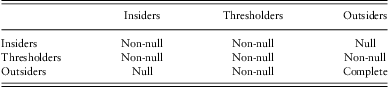
Overall, these expectations lead to the hypothetical set of network positions shown in Table 1. Here, insiders have some links (non-null) with other insiders and with thresholders, but none with outsiders. Thresholders have many links with themselves (complete) and also act as bridges between insiders and outsiders. Outsiders have close links with others like themselves but are otherwise linked only with thresholders. The question now begging to be asked is whether organizations across the insider–outsider spectrum can be considered to be part of a broader social movement. To help answer this question, I first turn to the work of Mario Diani on the ‘concept of social movement’.
Hypothetical network positions of insiders, thresholders and outsiders

Social movements and modes of coordination
Diani was motivated to clearly formulate the concept of a social movement after noting that ‘social and political phenomena as heterogeneous as revolutions, religious sects, political organisations, [and] single-issue campaigns are all, on occasion, defined as social movements’ (Diani, Reference Diani1992: 2). In particular, he had noted that formal organizations without network links were sometimes mistakenly deemed to be social movement actors. Confusing movements with almost anything that moves in social and political circles is problematic insofar as it makes comparisons between movements, or even of the same movement over time, unreliable. As I have already alluded, the term ‘movement’ has been used particularly loosely with reference to what has become known as the GJM. Hadden and Tarrow (Reference Hadden and Tarrow2007), for example, define the GJM as:
consisting of campaigns of mobilization against global or transnational neoliberalism or its agents, taking place against the policies of international financial institutions or their meetings; against regional economic compacts and summits; and global or regional forums directed against global neo-liberalism like the World Social Forum and the European Social Forum.
Boykoff (Reference Boykoff2006: 206) defines it very differently as ‘a diverse collection of groups that focus on a wide range of social issues, from poverty, the environment, sexual politics, and corporate greed to human rights, the AIDS epidemic, labor rights, and the periods of capitalism’. The first example conflates a movement with a series of campaigns (see also Best, Reference Best2005), the second takes the ‘tolerant identity’ approach, assuming that there is sufficient frame-bridging. Does working on a series of campaigns or sharing a tolerant identity make a movement? We could argue that, while both approaches are invaluable for understanding the nature and scope of transnational contention, they fail to explore which actors within these so-called movements actually possess social movement modes of coordination.
Looking at the four main branches of social movement theory, Diani was able to tease out points of consensus. Common to the theories of collective behaviour (Turner and Killian, Reference Turner and Killian1957), resource mobilization (McCarthy and Zald, Reference McCarthy and Zald1977), political process (Tilly, Reference Tilly1978), and new social movements (Melucci, Reference Melucci1989) is emphasis on: networks of informal interactions between individuals and organizations; solidarity, shared beliefs or identity; political or cultural challenges to the social order; and action that ‘primarily occurs outside of the institutional sphere and the routine procedures of social life’ (Diani, Reference Diani1992: 11). Thus, for Diani, the consensual definition of a social movement becomes: ‘a network of informal interactions between a plurality of individuals, groups and/or organizations, engaged in a political or cultural conflict, on the basis of a shared collective identity’ (Diani, Reference Diani1992: 13).
Drawing on this definition, social movement modes of coordination are apparent when network links are dense and actors consider themselves to be part of a broader collectivity. Movements are ‘consensual’ when there is a lack of conflict, but are ‘social’ when there is conflict. Movement modes of coordination are distinct from coalitions’ in two regards: first, the network links are more enduring, and second, there is a stronger sense of identification with a broader collectivity. Organizational modes of coordination are in motion when network links are few and identification is lacking. Where there are few network ties, but a strong sense of identity, sub-cultural modes of coordination are at play (Diani and Bison, Reference Diani and Bison2004; Reference DianiDiani, forthcoming) (see Table 2 for a summary). I would expect insiders to engage in organizational or coalition modes of coordination, and thresholders and outsiders to, together, be involved in social movement modes of coordination.
The modes of coordination of movements, coalitions, organizations and sub-cultures

Based on Diani and Bison (Reference Diani and Bison2004), Diani, forthcoming.
Methodological notes
The empirical section of this article uses data from a survey of 208 western European (British, Italian, French, Swiss, and Spanish) and transnational social movement organizations, conducted by a European team of social movement scholars as part of the Democracy in Europe and Mobilization of Society Project (see acknowledgements). It should be stressed that the sampling frame here differs considerably from many other studies of networking in social movements. Usually, scholars focus on local networks (Diani and Bison, Reference Diani and Bison2004; Saunders, Reference Saunders2007). In this article, the data are derived from several different organizations that campaign at the national and transnational level. Given that data are drawn from different countries, we might expect the networking to be considerably less dense compared with local social movement networks. In the ‘reflections’ section of the article, I return to discuss the implications of the cross-national sample for tie-density.
The organizations in the sample were selected because they represent the range of movements that are commonly considered to have coalesced to form a GJM, including, most prominently: labour, environmental, human rights, development/aid/humanitarian, and religious organizations; social forums, networks campaigning against the neo-liberal economy, women's rights groups, lesbian/gay and bisexual groups; associated information, communication support and outreach groups; and green and left-wing political parties (see Ekins, Reference Ekins1992; Della Porta, Reference Della Porta2007b). For each sector we included in our sample only those that had been the most active in the global days of action and parallel summits associated with global justice activism (see Pianta, Reference Pianta2001). In this way, we hoped to have included those social movement organizations across Europe and beyond that are the most likely to be involved in social movement modes of coordination; certainly they could be said to share a tolerant identity (Della Porta, Reference Della Porta2009). This sampling frame is justified in the context of this study, which, as a starting point, hypothesizes that insiders, thresholders, and outsiders will occupy different network positions.
The questionnaire – administered as a structured interview with organizational elites – asked a host of questions, including those that allow measurement of modes of coordination. Networking is measured through the question: ‘Please list up to five groups, networks or campaigns dealing with global justice issues with which your group interacts most intensively’. While data derived from this question do not make it possible to produce a complete matrix, this approach nonetheless gives us an indication of strong ties shared between organizations in the sample. This is similar to the approach taken by Diani and Bison (Reference Diani and Bison2004), in their search for social movement dynamics in civic networks in Glasgow and Bristol.Footnote 1
Identification with the movement is measured by asking ‘does your group as a whole consider itself to be part of the global justice movement?’ In order to sharpen the distinction between coalitional and organizational dynamics, I also use a measure of continuity, which comes from attendance at more than three global days of action and/or parallel summits. The use of this last measure has at least two caveats that must be mentioned. First, transnational events like parallel summits and global days of action are most likely to be attended by resource-rich organizations that can afford the travel expenses, and this may therefore bias against smaller organizations. Second, many protest networks associated with global justice activism are degradable: they exist for the lifespan of a particular protest event and then evaporate. This is not to say that the activists associated with such networks also disappear; they may simply reappear under a different guise. Caveats withstanding, these measures approximate Diani and Bison's (Reference Diani and Bison2004) measurement of identity processes.Footnote 2 They use overlapping memberships and participation in public events. They record an identity link between two organizations if the organizations had participated in at least three common events. I would therefore argue that my two measures are proxies at least as effective as Diani and Bison's for measurement of ‘broader and long-term mutual commitments’ (Diani and Bison, Reference Diani and Bison2004: 298).
I operationalize the presence or absence of conflict by cross-tabulating two variables, which distinguish between insiders, thresholders, and outsiders. The first variable measures the regular use of contentious actions (demonstrations, strikes, blockades, occupations, civil disobedience), drawn from a survey question which asked ‘in the last five years, which of the following forms of action has your group engaged in repeatedly?’. The second measures the presence or absence of collaboration with international and national political institutions (how does your group relate to public institutions at different territorial levels?). Those actors engaging in conflict and refusing collaboration with national and/or international public institutions are operationalized as outsiders. In contrast, thresholders use at least some contentious action, but also collaborate with national and/or international institutions at times; and insiders do not use any form of contentious action but routinely collaborate with national and/or international institutions. Diani and Bison (Reference Diani and Bison2004) measured contention (which they term ‘conflict’) by asking their respondents whether they identified particular public authorities and/or specific social groups as opponents in their main initiatives. It could be argued that their approach overlooks that many organizations may be thresholders, mixing and matching conflict with collaboration.
In a first step in the analysis, following Diani and Bison (Reference Diani and Bison2004), I identify blocks of structurally equivalent actors on the basis of their network links. However, I deploy a deductive approach, which contrasts with their inductive approach. I do this because inductive blockmodels might be interpreted as little more than ‘highly idealized patterns of interaction from the complex interweaving of thousands of paired relationships’ (Breiger, Reference Breiger1976: 134). Indeed, social network analyst experts Wasserman and Faust suggest that the inductive approach using CONCOR (used by Diani, Reference Diani1995; Diani and Bison, Reference Diani and Bison2004), should only be used ‘with a great deal of caution’ (Wasserman and Faust, Reference Wasserman and Faust1994: 381). This is partly because of the ‘fuzzy’ way it converts actors into approximately structurally equivalent actors (Scott, Reference Scott2000: 154).
Instead, I use the ‘optimize’ routine from the software package Pajek (Batagelj and Mrvar, Reference Batagelj and Mrvar1998). This involves creating a hypothetical block model based on theoretical assumptions, loading it as an existing partition and asking the software to optimize that partition. The software provides an error score, which indicates how many of the cells in each block of the measured network matrix do not fit the hypothesized pattern. The optimize routine then moves as few actors around as possible to find a matrix with the minimal number of errors. During the optimize routine, the number of actors in each block changes, but the hypothetical structure remains intact. To enable the article to tell us something concrete about the interactions between insiders, thresholders, and outsiders, I optimize the hypothetical block model shown in Table 1. For the first stage of the analysis, I analyse only actors that are part of the main component. In other words, disconnected actors are excluded. It is desirable to conduct block modelling only on the main component of any network. I proceed to show how the other variables used to distinguish different modes of coordination are distributed across the blocks of structurally equivalent actors identified, including, in this second stage of the analysis, disconnected actors as a separate structurally equivalent block. The actors that are disconnected from the network are purely structurally equivalent by their having no links at all with others.
Results
In the overall sample, there are five insiders, 91 thresholders, and 111 outsiders.Footnote 3 The proportion of insiders in the sample is relatively low despite the inclusion of trade unions and political parties of green and extreme left persuasions from each of the five countries in which the survey was administered. This suggests that it may be a mistake to exclude radical parties and trade unions on the grounds that they are institutionalized: most of the organizations in the sample engage in at least some contentious action. The main component of the network consists of four insiders, 34 thresholders, and 43 outsiders. In total, 122 of the 208 actors are not a part of the main component of the network. I henceforth refer to these disconnected actors as Block 0. Looking only at connected actors (those in Blocks 1, 2, and 3), there are very few errors in the hypothetical blockmodel – only 1.72% of cells across the whole matrix.Footnote 4 The errors that do exist are confined almost entirely to outsiders, who lack the anticipated intense network relations with one another, but otherwise network as hypothesized (Table 3).
Errors in the hypothesized blockmodel

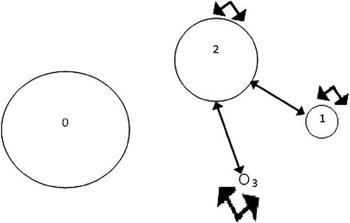
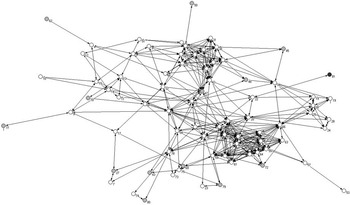
Thus, it seems true to say that insiders network intensely with other insiders, less intensely with thresholders, but lack ties with outsiders; and thresholders act as brokers between insiders and outsiders. The 110 cells with errors are re-distributed across the matrix by the software program. In the final error-free block model, 60.1% of respondent organizations are in Block 0 (i.e. they are isolated), 8.2% are in Block 1, the position hypothesized for insiders; 30.3% in Block 2, the anticipated thresholder position; and only 0.5% in Block 3, the structural location expected for outsiders. The final error-free blockmodel is visualized in Figure 1, and the complete network for the main component is shown in Figure 2. Given the small number of organizations in Block 3, it will be excluded from the analysis, aside from the visual representations of the network.
Final error-free blockmodel. Note: the size of nodes is scaled to approximate the number of actors in each block.

Sociogram of the main component. Note: Block 0 is excluded, but the actors would have appeared on the periphery as isolated nodes scattered around the edge of the diagram. Actors in Block 1 are shown white, Block 2 in grey and Block 3 black.

The identified Blocks have distinct characteristics. Block 2 has the highest density (0.144), with 14% of all possible links activated. This means that each actor in Block 2 is linked to an average of nine others. The density of Block 1 is considerably lower at 0.011 which means that only around 1% of the cells in the network matrix have a tie. In contrast to Block 2, the average degree score for actors in Block 1 is only 0.143: each actor in the network has on average on 0.14 links with others in the network. Diani and Bison (Reference Diani and Bison2004) suggested that their blocks of actors with densities of 0.071 (7% of ties activated) for Glasgow and 0.083 (8% of ties activated) for Bristol consisted of incumbents that identified most frequently with social movements and therefore constituted a social movement dynamic. Block 2 of the network, which is occupied largely by thresholders, is not only relatively dense. It also has the most extensive ties across the whole network, with links to others in Blocks 1 and 2. While this might represent a networking dynamic illustrative of a social movement mode of coordination, do the organizations in Block 2 also have a shared sense of identity that pervades beyond temporary coalitions and do they engage in conflict?
Blocks and social movement dynamics
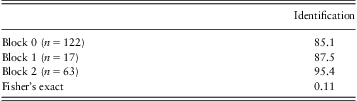
Now including Block 0 in the analysis, I look to see how my measures of identity (identification and continuity) and conflict (insiders, thresholders, and outsiders) are distributed across the three blocks (Blocks 0, 1 and 2). Twenty-eight of the sampled organizations (13.5%) did not consider themselves to be a part of the GJM. Identification with the GJM was highest in Block 2 (95.4%) and lowest in Block 0 (85.1%). There is no statistically significant relationship between network position and identification with the GJM (Table 4).
Identification across structurally equivalent blocks

Notes: Percentages are for rows, which may not total to 100.0% due to rounding. Fisher's exact calculated on a single 2 × 3 contingency table, hence only one P-value.
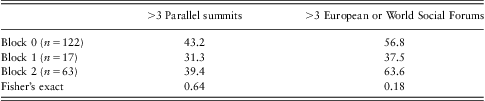
Overall, the majority of organizations that have continuity in their networking are isolated in the network (around 60% for both measures of continuity). But different patterns prevail for parallel summits than for social forums. Around 40% of the organizations in Blocks 0 and 2 had been to at least three parallel summits, but less than a third of those in Block 1. Organizations in Block 2 have a greater proclivity to attend three or more social forums than those in the other Blocks, with nearly two-thirds having done so. There is no statistically significant association between these two measures of continuity and network position (Table 5).
Continuity across structurally equivalent blocks

Notes: Fisher's exact calculated for two separate 3 × 2 contingency tables. Percentages are by rows, which may not total to 100.0% due to rounding. These two variables were set up as two independent dummies where 1 = yes and 0 = no.
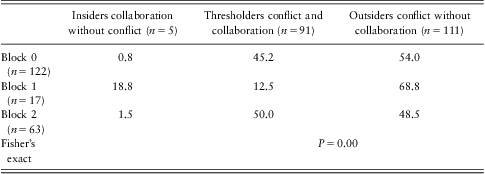
Thresholders and outsiders together make up the majority of actors in Blocks 0 and 2, and Block 3 is occupied by just one outsider out of a possible 111. Nearly all of the insiders are in Block 1, but a number of outsiders also occupy this structural position (Table 6). Over 98% of the organizations in Blocks 0 and 2 engage in at least some conflict with national and/or international public institutions. There is a statistically significant association between network position and this measure of conflict, which suggests that the hypothetical blockmodel (Table 1) cannot be rejected. This is hardly surprising, given the relatively few errors in the hypothetical blockmodel (see Tables 3 and 6).
Distribution of insiders, thresholders and outsiders across structurally equivalent blocks

Notes: Percentages are for rows, which may not total to 100.0% due to rounding. Fisher's exact calculated on a single 3 × 3 contingency table, hence only one P-value.
In summary, I find evidence for three of Diani and Bison's (Reference Diani and Bison2004) modes of coordination in the global justice networks that I analysed (see Table 7):
Modes of coordination across structurally equivalent blocks

Notes: Low, moderate and high are rankings where low reflects the lowest percentage for that data; with percentages given for rows. The continuity score is based on a new variable, which reflects participation in at least three parallel summits and/or global days of action. Conflict here is based on the proportion of thresholders and outsiders. For example, of the actors in Block 0, 99.2% are thresholders or outsiders (rank = 1, high); in Block 1, 81.2% are outsiders or thresholders (rank = 3, low) and in Block 2, 98.5% are outsiders (rank = 2, moderate).
-
• Social movement modes of coordination are most apparent in Block 2. In this Block, networks are the densest and also broker Blocks 1 and 3. Almost all of the organizations in this Block self-identify with the GJM; and around two-thirds have participated in at least three European or World Social Forums. Only 1.5% of the actors in this Block are non-confrontational. Together, the relatively high network density (and brokerage position, I would argue), a sense of collective identity beyond short-term coalitions and the presence of conflict suggest a social movement mode of coordination.
-
• Coalitional modes of coordination appear at play in Block 1. The network of actors in Block 1 is sparse, there is little continuity over time (over two-thirds of organizations in this Block have not participated in more than three parallel summits or social forums), and many of the organizations do not have contentious relations with national or international public institutions.
-
• Organizational modes of coordination are most prevalent in Block 0. In this Block, the organizations are disconnected from one another when a strong measure of network linkage (i.e. the top five approach) is deployed. Nearly 15% of the organizations in Block 0 do not identify with the GJM, despite a relatively high proportion of them attending more than three parallel summits or European/World Social Forums. This Block is the most contentious of all, containing only one insider.
Although comprised mostly of thresholders and outsiders, Block 0 contains a mix of single-issue NGOs and more radical groups. There are a number of reasons why the actors in this Block may be unwilling or unable to engage in collaborations. The smaller and more informal organizations may be relatively resource poor, thus rendering it difficult if not impossible for them to engage in networking with their domestic counterparts, let alone with organizations from farther afield in Europe. Second, some of the organizations in this sample may be embedded in local or domestic politics, which is arguably an artefact of the sampling. Third, the more radical organizations may be displaying sectarianism, unwilling to compromise their own positions by mingling with organizations with more reformist policy positions. Fourth, the more formal organizations may work alone in order to protect their organizational reputations in the face of competition, a well-known response to professionalization of the field. In practice, it is probable that all four of these explanations can explain the isolation of organizations in this block.
Discussion
Only a minority of organizations are allocated to a block of approximately structurally equivalent actors that is involved in social movement modes of coordination. This block consists of only 63 organizations of the 208 surveyed – less than one-third of the total sample. The majority of organizations in the sample surveyed are involved in organizational or coalitional modes of coordination. Although the organizations included in the sample could be said to have multiple/tolerant identities and to share opposition to neo-liberalism (Della Porta, Reference Della Porta2007a, Reference Della Portab, Reference Della Porta2009), the network is not homogenously weakly and informally connected. While some organizations are embedded in relatively dense networks, others are only tangentially connected and others still are entirely isolated. All of the insiders, for example, occupy a block that has very sparse network links, and which has connections only to actors occupying the structural position hypothesized for thresholders.
Does the marginal network position of insiders justify exclusion of formal organizations in explorations of the GJM? On the basis of the evidence I present in this article, I would argue that it is no more appropriate to routinely dismiss formal or insider organizations than to dismiss outsiders. Insiders are, overall, better networked than outsiders. Many outsiders were in Block 0, the disconnected block, and others were assigned to Block 1, a position they shared with insiders. Only one of the insider organizations does not consider itself to be part of the GJM, compared with nine outsiders. In addition, the vast majority of political parties and trade unions surveyed engage in at least some contentious action that is often associated with (what Reference DianiDiani, forthcoming, calls) ‘conflictual’ social movements. And even though insiders do not engage in contentious action, they could still be said to be part of a consensual social movement. Thus, the analysis presented stresses the importance of carefully assessing the modes of coordination of insiders, thresholders, and outsiders, rather than assuming either (a) that they equally share the same modes of coordination, or (b) that they represent different forms of contention. This part of the argument holds not withstanding some of the possible limitations of the study.
Arguably, these findings could be said to be skewed by the limitations of the data, analysis, and sample. Unfortunately, the data does not allow for a ‘complete’ network matrix to be drawn upon given that the survey asked respondents only for their top five most important collaborative links. Thus, the network measurement used here can only capture strong links between organizations, not links per se. The overall density of the network may have been higher had the survey asked all 208 organizations whether they had any contact with each of the other 207, reducing the number of actors in Block 0. This potential problem also exists within Diani and Bison's (Reference Diani and Bison2004) piece on social movement, organizational and coalitional dynamics. They asked a similar question in their survey (i.e. the top five), but also asked respondents to identify whether there were any additional important collaborators. As they state, ‘the resulting data on alliances should not be treated as a list of the groups with which our respondents exchanged most frequently or most intensely in objective terms, but of those they perceive as their most important allies at the time of interview’ (Diani and Bison, Reference Diani and Bison2004: 2009). However, perception of the importance of networking and actual networking are two different things. Future attempts to search for social movement modes of coordination may improve on the current state of the art by drawing on complete rather than partial networks. In other words, the survey instrument used should provide each respondent the opportunity to tick off their collaborative partners from a list of all other respondents. This is not to entirely discount the analysis presented in this article, or in Diani and Bison's (Reference Diani and Bison2004), but rather to highlight a survey design that may be better equipped to capture the networking element.
Empirically, is there evidence that recently established outsiders are discriminated against in the measures of continuity? The short answer is ‘yes’. Only around one-third of the outsiders that lack continuity were established before 1999 and over 6% were formed in 2005. Given that many parallel summits are annual events, recently established organizations will have been presented with fewer opportunities for attending parallel summits or social forums than their counterparts. In contrast, all of the insiders that had continuity in their protesting were established before 1999. These measures of continuity cannot assert that some of the same individuals may have remained involved in direct action networks, despite particular organizations folding. This, therefore, is an artefact of drawing an organizational sample and excluding significant individuals. In so doing, it inevitably ignores those thousands, if not millions, of activists worldwide that protest and campaign inside and outside of organizations. A combined sample of organizations and individuals may be preferable in future research, especially given that social movements are conceived as networks of both (Diani, Reference Diani1992). It seems likely that we may find more extensive deployment of social movement modes of coordination through a large-scale in-depth study focused on individual activists and organizations.
Unfortunately, the project from which the analysed data were drawn was also limited to sampling organizations mostly from countries in western Europe due to its scope. But such restricted geographical scope would logically make it more likely that the findings exaggerate rather than underplay global movement dynamics – European activists are, after all, given their relative geographical proximity, more likely to share network links, identify with one another and attend the same parallel summits/global days of action than they are with activists from farther afield. On the other hand, given that most studies of social movement networks have looked at networking among local actors, we might have expected network densities to be relatively low; it is much more difficult to extend network links across countries than across a town or city. However, Block 2, which most closely displayed a social movement mode of coordination, had a relatively high density of 14%, which is higher than the density in Diani and Bison's (Reference Diani and Bison2004) civic networks in Glasgow (7%) and Bristol (8%). The networking in Block 2 is therefore quite remarkable, and has probably been facilitated by transnational protest events.
Reflections
In addition to asserting the network positions of insiders, thresholders, and outsiders, this article raises some important challenges associated with attempts to empirically measure social movement modes of coordination. These questions centre around sampling frames and the measurement of continuity and network density.
First, I address sampling issues. Because movements are networks of individuals and organizations, future studies would do well to include both dimensions, qualitatively, and quantitatively. A challenge here is to draw boundaries around the network. In most cases, it is impossible to identify a social movement population in advance of an empirical study, particularly if this is complicated further by moving beyond the organizational level to incorporate individuals and to do this transnationally. This means that a set of criteria must be established in order to work out which individuals and organizations to interview. In the empirical work I present in this article, the research team made a necessary compromise by drawing on a sample of significant social movement organizations. But in so doing, we missed out many other organizations and networks across Europe and entirely ignored individuals. How might we ensure that we have identified a complete network, so as to not distort our blockmodeling results? And how, for example, ought we react if our respondents identify organizations or individuals we had not considered could be part of the network? Do we then use snowball sampling, and where does this process end? I suggest below, where I discuss how to distinguish emergent movement dynamics from coalitions, that a good starting point for sampling might be to identify organizations and individuals participating in a particular protest or campaign. But this is not to conflate movement modes of coordination with a series of campaigns.
With regards to measures of continuity, an open question is how we might discern coalitional modes of coordination from the modes of coordination in an emergent movement. By restricting our focus to just one point in time, it would be easy to confuse the two. This suggests that we should study how coalitional modes of coordination vary over time. Moreover, insisting on engagement in at least approximately three annual events to distinguish social movement modes of coordination is clearly a compromise not least because, as mentioned earlier, degradable networks within global justice networks have little trace of continuity aside from the continued participation of key individuals. It is also a problem because the organizations attending these events may not even meet, preventing them from developing an enduring collective identity (Saunders, Reference Saunders2007); at the European Social Forums, for example, it is likely that distinct clusters of organizations will likely spend their whole time in entirely different thematic workshops.
In Reference DianiDiani's (forthcoming) more recent work, he drops the measure of continuity (participation in at least three common events) and suggests instead that joint membership is a characteristic of a social movement mode of coordination as it ‘accounts for links between collectivities in which the basis of interpersonal linkages is clearly not kin or friendship, such as epistemic communities of communities of practice’ (Saunders, Reference Saunders2007: 8). While social movement modes of coordination witness shared memberships, coalitional ones have only ‘temporary, means oriented alliances’ (Gamson, Reference Gamson1961: 374). Yet it is possible for organizations and individuals in global justice networks to both share memberships and engage only in temporary strategic alliances. This stresses the need for a more discriminatory means of identifying continuity or commitment beyond coalitions, which can perhaps only be revealed through in-depth interviews with organizational representatives that co-jointly organize protests or campaigns. A sensible sampling frame to begin with could be active coalitions/protest networks, like the Put People First coalition, which emerged in Britain in 2009 to challenge the G20, and its radical counterpart, the G20 Meltdown. Have the organizations and individuals who engaged with these coalitions/networks continued to work together on similar campaigns and protests over time?
On the question of density, how dense should movement networks be? And what does ‘relatively dense’ actually mean? In some of my previous work, I have suggested that a density of around 0.25 might be a sensible benchmark (Saunders, Reference Saunders2011). However, a problem with relative density is that it can mean different things depending on the size of a network. Friedkin showed how comparing the density between networks of different sizes was problematic because it ‘belies the degree of connectivity’ (Friedkin, Reference Friedkin1981: 45). For instance, a network with 20 actors and a density of 0.004 has an average of 0.05 pairs joined, compared with a network of 60 actors with the same density and an average of 0.77 pairs joined. In other words, small increases in low densities are more significant than much larger increases in higher densities. This suggests that perhaps we should consider a different networking benchmark than density. One possibility to which Diani and Bison's (Reference Diani and Bison2004) work lends itself, is an approach based on network positions. Organizations that broker other network positions (such as those in Block 2 in my study) might better display a form of networking we would expect to confirm a social movement mode of coordination.
Conclusion
This article has found evidence of three distinct modes of coordination in west European global justice networks: social movement, coalitional, and organizational. Formal and informal organizations are found in each of the three types, stressing the importance of measuring rather than assuming that particular kinds of organizations share modes of coordination. It has also raised the need to carefully think through a number of questions, which I have only begun to address here. In empirical tests for modes of coordination, scholars should think through clear answers to the following: How might we determine a useful sampling frame for organizations and individuals in which we anticipate to find social movement modes of coordination? How can we measure continuity without discriminating against resource-poor, newly formed organizations or emergent movements? And does brokerage work as a better indicator of social movement networking than density? In addition to raising these important questions, I have stressed the need to include insiders, thresholders, and outsiders in any empirical study that searches for modes of coordination in collective action.
Acknowledgement
The author would like to thank Democracy in Europe and Mobilization of Society Project (EC-FP6 Framework 506026) coordinator Donatella Della Porta and principal investigators of the country teams (Chris Rootes, Marco Guigni, Isabelle Sommier, Mario Pianta, Manuel Jiménez and Dieter Rucht) for allowing her to use data collected on that project. She also thanks all the researchers who helped to collect the data. The author is very grateful to Mario Diani for his support and guidance, to Graham Smith for reading and commenting on a number of versions of this article and to Maria Grasso for her research assistance. The comments from reviewers of EPSR were invaluable in helping shape the article.