Introduction
Most species of twig beetles, Pityophthorus Eichhoff (Coleoptera: Curculionidae: Scolytinae), are considered polygamous (Bright Reference Bright1981; Wood Reference Wood1982), but there is evidence of monogamy in a few species (Pfeffer Reference Pfeffer1976; Bright Reference Bright1981; Dallara et al. Reference Dallara, Seybold, Meyer, Tolasch, Francke and Wood2000). In polygamous species, a male selects the host, starts constructing an egg gallery with a nuptial chamber, and attracts females, which extend the egg gallery (Bright Reference Bright1981; Kirkendall Reference Kirkendall1983).
Little is known about pheromone-based aggregation in the genus Pityophthorus. Vité (Reference Vité1965); however, Chararas (Reference Chararas1966, Reference Chararas1975) observed that males of P. confertus Swaine, P. annectans LeConte, and P. pityographus (Ratzeburg) attract conspecific females. Francke et al. (Reference Francke, Pan, König, Mori, Puapoomchareon, Heuer and Vité1987) identified (2R,5S)-2-(1-hydroxy-1-methylethyl)-5-methyltetrahydrofuran (E-(+)-pityol) and cis-1-(2-hydroxyethyl)-1-methyl-2-(1-methylethenyl) cyclobutane ((±)-grandisol) from males of P. pityographus, and showed that both compounds were active in the field. (E)-(+)-Pityol was also found in males of P. carmeli Swaine and females of P. nitidulus Mannerheim and P. setosus (Blackman) (Dallara et al. Reference Dallara, Seybold, Meyer, Tolasch, Francke and Wood2000), and has been reported as the female-produced sex pheromone of the cone beetles Conophthorus resinosae Hopkins, C. coniperda (Schwarz), and C. ponderosae Hopkins (Coleoptera: Curculionidae: Scolytinae) (Birgersson et al. Reference Birgersson, DeBarr, de Groot, Dalusky, Pierce and Borden1995; Pierce et al. Reference Birgersson, DeBarr, de Groot, Dalusky, Pierce and Borden1995; Miller et al. Reference Miller, Pierce, de Groot, Jean-Williams, Bennett and Borden2000). In addition to pityol, the spiroacetal (5S,7S)-(–)-7-methyl-1,6-dioxaspiro[4.5]decane (conophthorin) has been identified as a semiochemical in species of Pityophthorus. Conopthorin is a component of the aggregation pheromone emitted by males of P. carmeli (Dallara et al. Reference Dallara, Seybold, Meyer, Tolasch, Francke and Wood2000) and is a male-produced repellent in some other scolytines (Kohnle et al. Reference Kohnle, Densborn, Kölsch, Meyer and Francke1992; Birgersson et al. Reference Birgersson, DeBarr, de Groot, Dalusky, Pierce and Borden1995; Pierce et al. Reference Birgersson, DeBarr, de Groot, Dalusky, Pierce and Borden1995; de Groot and DeBarr Reference de Groot and DeBarr2000). (E)-(–)-Conophthorin, by itself, is not attractive to Pityophthorus species, and significantly reduces catches of P. setosus (predominantly males) to (E)-pityol (Dallara et al. Reference Dallara, Seybold, Meyer, Tolasch, Francke and Wood2000), suggesting that it acts as a synomone to reduce intraspecific competition between P. setosus, P. nitidulus, and P. carmeli, three species that cohabit in Pinus radiata D. Don (Pinaceae) stands in central coastal California (Dallara et al. Reference Dallara, Seybold, Meyer, Tolasch, Francke and Wood2000).
Pityophthorus pubescens (Marsham) is the only Pityophthorus species known from P. radiata stands in the Basque Country (northern Spain) (López et al. Reference López, Romón, Iturrondobeitia and Goldarazena2007). It is associated with Fusarium circinatum (Niremberg and O'Donnell) (Hypocreales: Nectriaceae), the pathogen causing pitch canker disease (Romón et al. Reference López, Romón, Iturrondobeitia and Goldarazena2007). Pityophthorus setosus and P. carmeli have been associated with pitch canker-infected Monterey pines in California (Storer et al. Reference Storer, Wood and Gordon2004; Sakamoto et al. Reference Sakamoto, Gordon, Storer and Wood2007). Our objectives were to identify the aggregation pheromone of P. pubescens and evaluate its biological activity in electroantennographic (EAG) and behavioral tests in the laboratory.
Materials and methods
Beetles
Specimens of P. pubescens were collected from infested branches of P. radiata from a stand located at Gorosika (43°15′N, 02°42′W), Basque Country. Infested branches were maintained in an incubator at 25°C and 65% RH under a 10L:14D photoperiod, and beetles were collected by dissecting the branches with a microscalpel under a binocular microscope.
Chemicals
Racemic (E)-pityol (93.4% chemical purity) was purchased from Contech Inc. (Delta British Columbia, Canada) and (E)-(+)-pityol (99%) (Mori and Puapoomchareon Reference Francke, Pan, König, Mori, Puapoomchareon, Heuer and Vité1987) was provided by Prof. W. Francke (Institute of Organic Chemistry, University of Hamburg, Hamburg, Germany).
Collection of volatiles
Volatiles of P. pubescens were adsorbed on a Porapak Q column (50/80 mesh, Supelco, Bellefonte, Pennsylvania) using 200 beetles of each sex caged in a glass flask and exposed to a stream of charcoal-filtered air at a flow rate of 1L/min for 40h. Three independent sets of this system containing males, females, or no beetles (control) were operated simultaneously and two volatile collections and blanks (control) were made for each sex. Each column was extracted with 300μL of dichloromethane and the extract was stored at –40°C until used.
Additional volatile collections were obtained using a polydimethylsiloxane fiber (100μm) for solid-phase microextraction (SPME) (Supelco) (Belardi and Pawliszyn Reference Belardi and Pawliszyn1989; Matich et al. Reference Matich, Rowan and Banks1996). Two hundred individuals of each sex were placed in separate 40mL vials (29 mm×81mm) with a SPME fiber for 36h under laboratory conditions (mean temperature 23°C, 65% RH, 14L:10D). The fiber had been conditioned prior to use by inserting it into the injection port of a gas chromatograph (GC) for 15min. Two replicates were done for each sex, using 200 different beetles each time.
Volatiles from both collection methods were analyzed on a Thermo Finnigan Trace 2000 GC system coupled to a Trace MS quadrupole mass spectrometer (ThermoFisher Scientific, Madrid, Spain) using helium (1mL/min) as the carrier gas. The samples were introduced in splitless mode at 250°C. The column used for analysis was a 30m×0.25mm i.d.×0.25μm HP-5MS fused silica capillary (Agilent Technologies, Madrid, Spain). The following chromatographic conditions were used: injection at 60°C for 5 min, increasing by 5°C/min to 280°C, and then maintained at this temperature for 10 min. Mass spectra were obtained under electron impact ionization mode at 70 eV in the 40–400m/z range.
EAG assays
The EAG instrument was obtained from Syntech (Kirchzarten, Germany). EAG recordings were performed using Ag-AgCl glass microcapillaries filled with Ringer solution. Each beetle was fixed upside down on a piece of double-sided sticky tape, and the head was excised using a microscalpel. The recording electrode was connected to the tip of an antenna and the reference electrode was inserted into the occipital foramen using MP15 micromanipulators (Syntech). Humidified pure air (1000 mL/min) was continuously directed over the antenna. The signals were amplified (100×) and filtered (DC to 1kHz) with a IDAC-2 interface (Syntech), digitized on a PC, and analyzed with the EAG Pro program. The EAG system was set up in a Faraday cage (70 cm × 65 cm× 60 cm) to preclude external electric signals. A log dilution series of (E)-(+)-pityol in hexane was prepared at doses of 0.1, 1, 10, and 100ng/μL. Odor stimuli consisted of applying 10μL of a given concentration to a filter-paper strip (2.5cm i.d.) that was then placed inside a Pasteur pipette. After evaporation of the solvent, puffs of 400ms duration through the Pasteur pipette placed 2cm from the antennal setup were pulsed with a stimulus controller, CS-01 (Syntech). The recovery time for the antenna between two consecutive stimuli was established at 1–1.5min. Eight individuals of each sex were used with each dose of (E)-(+)-pityol and only one antenna was used per beetle. Three puffs of each dose of (E)-(+)-pityol were applied and the mean amplitude of depolarization was subtracted from that in response to puffs of the hexane control, before and after each stimulus. Stimuli were delivered in order of increasing dose.
Behavioral response
The behavioral responses of male and female P. pubescens to three different doses of (E)-(+)-pityol and (E)-(±)-pityol were evaluated using a Y-tube olfactometer designed for small beetles (5mm i.d., main arm 5cm long, short arms 4cm long, 90° angle between short arms). Each short arm of the olfactometer was connected to a glass chamber containing the odor source. One of the arms contained 10μL of hexane on a circle of filter paper (2.5cm diameter) as a control, while the other contained a piece of filter paper of similar size treated with the test chemical. Different doses of the semiochemical were obtained from 10μL of decadic dilutions in hexane containing 0.1, 1, and 10ng/μL. Filter papers were replaced in each arm for every second beetle. Incoming air was filtered through activated charcoal and the airflow was maintained at 820mL/min.
All tests were conducted at 23 ± 1°C, 50 ± 9% RH, and beetles were acclimatized to conditions for 15min before the assays. Each beetle was observed for a maximum of 5min and was used only once. A response was considered positive when the beetle walked at least 3cm into one of the arms. The arms were reversed after five beetles were tested, to avoid directional bias. After 10 individuals were tested, the olfactometer was cleaned first with soap and water and then with absolute ethanol, and left to dry until the solvent had completely evaporated. In total, 35–40 different beetles were used for each sex and dose.
Statistical analysis
Data on the EAG response to (E)-(+)-pityol concentrations and sex were subjected to two-way ANOVA, followed by Tukey's post-hoc tests at a significance level of α = 0.05. In olfactometer trials, the null hypothesis that P. pubescens showed no preference for either olfactometer arm (a response equal to 50:50) was analyzed by a χ2 test.
Results
Volatile collections
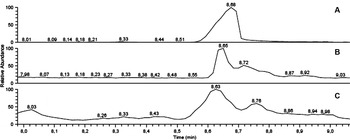
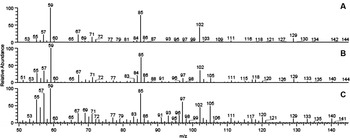
GC-mass spectrometry analyses of volatile collections trapped on Porapak Q or by SPME revealed the presence of (E)-pityol in both sexes of P. pubescens by comparing its retention time and mass spectra with those of an authentic standard (Francke et al. Reference Francke, Pan, König, Mori, Puapoomchareon, Heuer and Vité1987) (Figs. 1, 2). All spectra exhibited a base peak at m/z 59, suggesting a tertiary alcohol, and prominent peaks at 85, 102, and 129m/z. The intense fragment ion of m/z 85 in the mass spectrum reflects the presence of a tetrahydropyran or methyl-substituted tetrahydrofuran ring as a partial structure. The amount of (E)-(+)-pityol emitted was not compared between the sexes. As expected, no traces of (E)-pityol were found when the controls of both sexes were analyzed.
Amplified region of the gas chromatogram of a standard sample of (E)-(+)-pityol (A) and a dichloromethane extract of headspace volatiles of male (B) and female (C) Pityophthorus pubescens trapped on Porapak Q. The numeral above each peak represents the retention time (minutes). See Materials and methods for gas chromatographic conditions.

Mass spectra of a standard sample of (E)-(+)-pityol (A), male Pityophthorus pubescens (B), and female P. pubescens (C). Note the presence of fragment ions of m/z 59, 85, 102, and 129 in all three spectra.

EAG response of P. pubescens to (E)-(+)-pityol
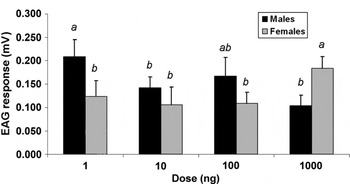
(E)-(+)-Pityol elicited electrophysiological responses from the antennae of both sexes (0.1–0.2mV, on average) (Fig. 3). The mean amplitude of depolarization was not significantly affected by sex (F 1,56 = 1.050, P = 0.310) or dose (F 3,56 = 0.700, P = 0.476), but the interaction between sex and dose was nearly significant (F 3,56 = 2.356, P = 0.083). Therefore, we compared responses among all eight sex-dose combinations using Tukey's post-hoc test. From this analysis it was clear that male antennae responded most strongly to the lowest dose of (E)-(+)-pityol (1ng), whereas female antennae responded most strongly to the highest dose (1000 ng) (Fig. 3).
Absolute EAG responses (mean ± SE) of Pityophthorus pubescens males (dark shading) and females (light shading) to serial dilutions containing 1, 10, 100, and 1000ng of (E)-(+)-pityol. A different letter above the bar indicates a significant difference (two-way ANOVA followed by Tukey's multiple range test (P ≤ 0.05), n = 8).

Behavioral response
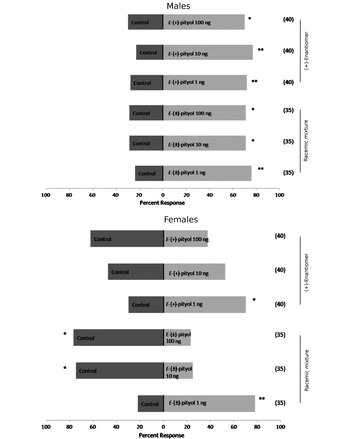
Male P. pubescens significantly preferred the olfactometer arm containing either racemic (E)-pityol or (E)-(+)-pityol at all three doses tested (Fig. 4A). The lowest doses (1ng for the racemic material and 1–10ng for the chiral material) proved to be the most attractive. However, females were attracted only to the lowest dose (1ng) of racemic (E)-pityol and (E)-(+)-pityol (Fig. 4B). Moreover, they significantly avoided racemic (E)-pityol at doses of 10 and 100ng.
Responses of Pityophthorus pubescens males and females to different doses of (E)-(+)-pityol and racemic (E)-pityol in Y-tube olfactometer trials (*, P < 0.05; **, P < 0.01). Numbers in parentheses denote the number of beetles that responded.

Discussion
We isolated and identified (E)-pityol in volatiles of male and female P. pubescens, and demonstrated an electrophysiological response to (E)-(+)-pityol in the antennae of both sexes, as well as a dose-dependant behavioral response of both sexes to racemic (E)-pityol and (E)-(+)-pityol in olfactometer bioassays. These results suggest that (E)-(+)-pityol may be a key compound in the chemical ecology of P. pubescens. Prior to our study, (E)-(+)-pityol had been detected in several Pityophthorus species but always in one sex only, e.g., males of P. carmeli and P. pityographus and females of P. setosus and P. nitidulus. In field tests, males of P. setosus, a monogamous species, responded strongly to (E)-(+)-pityol alone (Dallara et al. Reference Dallara, Seybold, Meyer, Tolasch, Francke and Wood2000), whereas P. pityographus, a polygamous species, was attracted by the combination of grandisol and (E)-(+)-pityol (Francke et al. Reference Francke, Pan, König, Mori, Puapoomchareon, Heuer and Vité1987). Another polygamous species, P. carmeli, was attracted only by the combination of (E)-(+)-pityol and (E)-(−)-conophthorin (Dallara et al. Reference Dallara, Seybold, Meyer, Tolasch, Francke and Wood2000). Similarly, in species of Conophthorus Hopkins (a genus considered to be phylogenetically closely related to Pityophthorus) (Cognato et al. Reference Cognato, Gillette, Bolaños and Sperling2005), (E)-(+)-pityol is known to be the major compound of its sex pheromone and has been found only in females (Birgersson et al. Reference Birgersson, DeBarr, de Groot, Dalusky, Pierce and Borden1995; Pierce et al. Reference Birgersson, DeBarr, de Groot, Dalusky, Pierce and Borden1995; Miller et al. Reference Miller, Pierce, de Groot, Jean-Williams, Bennett and Borden2000).
During dissection of naturally infested branches to collect beetles, we observed that all galleries contained a single mating pair of P. pubescens, and had a longitudinal pattern without a nuptial chamber, which is consistent with monogamy. However, it would be necessary to carry out a more extensive study of the gallery patterns from more naturally collected branches to allow us to draw accurate conclusions.
Although we found (E)-pityol in both sexes, the enantiomeric composition of the natural material has not been elucidated. Chirality plays an important role in determining pheromone specificity. In 60% of species and sex/aggregation systems studied to date, only a single enantiomer is bioactive, and its opposite enantiomer does not inhibit the response to the active stereoisomer in racemic blends (Mori Reference Mori2007), but in some species the antipode can significantly reduce the attractive response to the active enantiomer (Birch et al. Reference Birch, Light, Wood, Browne, Silverstein and Bergot1980; Leal Reference Leal1996; Lacey et al. Reference Lacey, Moreira, Millar, Ray and Hanks2004). Owing to the lack of the (−)-enantiomer in our behavioral assays, its biological activity cannot be inferred. However, the racemic mixture was attractive, as was the pure (+)-enantiomer, to male P. pubescens when tested in the olfactometer, suggesting that (E)-(−)-pityol could be behaviorally inactive for males. This is consistent with the lack of response of other Pityophthorus species to (E)-(−)-pityol (Francke et al. Reference Francke, Pan, König, Mori, Puapoomchareon, Heuer and Vité1987; Dallara et al. Reference Dallara, Seybold, Meyer, Tolasch, Francke and Wood2000; W. Francke, personal communication). In contrast, females were only attracted to the lowest dose in both cases, showing a significant preference for the blank arm when the racemic mixture was tested (and it is evident that increasing the (E)-(+)-pityol dose leads to an apparent and progressive decrease of the positive response, although this is not statistically significant). In light of our results we cannot assert that this behavior is caused by the presence of (E)-(−)-pityol; further studies would be needed to determine the biological influence of each enantiomer on P. pubescens.
We report the first electroantennographic assays performed on a species of Pityophthorus and show that the antennae of both sexes of P. pubescens respond to (E)-(+)-pityol. Interestingly, whereas female antennae showed the greatest response to the highest dose, the reverse was true for male antennae, i.e., they showed the greatest response to the lowest dose.
In summary, for the first time we detected the presence of (E)-pityol as a possible aggregation pheromone in male and female volatiles of P. pubescens, and demonstrated the biological activity of the (+)-enantiomer and the racemate in electrophysiological and behavioral studies. Studies should be carried out to confirm the attraction of both sexes of P. pubescens in the field for these chemicals.
Acknowledgements
Thanks are extended to the Department of Education, Universities and Research of the Basque Country for awarding a Ph.D. fellowship to S.L., and to the Department of Agriculture and Fisheries of the Basque Country and the Ministerio de Ciencia e Innovación (project AGL2009-13452-C02-01) for financial support. Thanks are also extended to Prof. Rafael Jordana (Department of Zoology and Ecology, University of Navarra, Spain) and Prof. Wittko Francke (Institute of Organic Chemistry, University of Hamburg, Hamburg, Germany) for comments and suggestions on earlier versions of the manuscript, and to Pedro Romón for his assistance and suggestions for the experimental design. We are indebted to members of Neiker-Tecnalia, Biscay Government, and of the Chemical Ecology Unit, Institut de Quimica Avançada de Catalunya, for technical assistance. Prof. Francke kindly provided pure (E)-(+)-pityol.