Introduction
Until very recently, the history of mental health policy in Ontario, Canada, has been marked by frustrated attempts to move from a policy development path rooted in a hospital and physician-based tradition to one with significantly greater emphasis placed on community-based mental health care.Footnote 1 Other countries have faced similar challenges in moving away from institution-based mental health care (Goldberg, Reference Goldberg1999; Grob, Reference Grob2005; Haug and Rossler, Reference Haug and Rossler1999; Monk-Jorgensen, Reference Monk-Jorgensen1999; The President's New Freedom Commission on Mental Health, 2003; Thornicroft and Tansella, Reference Thornicroft and Tansella2003; Turner, Reference Turner2004; Vazquez-Barquero and Garcia, Reference Vazquez-Barquero and Garcia1999; WHO Europe, 2005) but have approached mental health reform in various ways, with differing results (McDaid and Thornicroft, Reference McDaid and Thornicroft2005).
Some countries such as the UK and New Zealand have established national bodies to oversee long-term planning and to promote mental health reform (Kirby, Reference Kirby2004a, Reference Kirby2005b), with comprehensive national mental health polices and legislation as part of the solution (WHO Europe, 2004b). A Canadian Senate Standing CommitteeFootnote 2(the Kirby Committee) recommended the creation of a National Mental Health Commission following its review of the Canadian mental health system (Kirby, Reference Kirby2005b) and the commission is now being established (Government of Canada, 2007). This could have a profound impact on the mental health reform agenda, but to be successful, the dampening effect that past policies have had on mental health reform efforts must be considered (Altenstetter and Busse, Reference Altenstetter and Busse2005; Hacker, Reference Hacker1998; Pierson, Reference Pierson1993).
In the case of Ontario, the meaning of mental health reform has been reflected in numerous government study recommendations: (Health Services Restructuring Commission, 1999: 174–175; Ministry of Health and Long-Term Care, 1993, 1999a, 1999b, 2000a; Provincial Forum, 2002):
move care from psychiatric hospitals to community mental health services;
reduce the ratio of mental health spending for institutional vs. community-based services; and
create a seamless transition among the various services and settings (Canadian Mental Health Association, 2004; Ministry of Health and Long-Term Care, 1993).
Some change has been achieved since the mid-1960s. Seven of ten provincially owned psychiatric hospitals (PPHs) have been divested, spending on a number of community-based programs (Ministry of Health and Long-Term Care, 2004b) has increased substantially, and Assertive Community TreatmentFootnote 3(ACT) teams (Ministry of Health and Long-Term Care, 2004a) and Community Treatment OrdersFootnote 4(CTOs) (Government of Ontario Press Releases, 2000) have been introduced. However, the proportion of spending on institutional vs. community-based mental health care has not reached the policy target of 40:60 set in 1993 despite recent increases to community-based spending (Ministry of Health and Long Term Care, 2004b) and the system remains highly fragmented and difficult for consumers to navigate (Dewa, Rogers, Kates, and Goering, Reference Dewa Rogers, Kates and Goering2000; Health Services Restructuring Commission, 1999; Kirby, Reference Kirby2004b; Ministry of Health and Long-Term Care, 1993, 1999b). Moreover, the comprehensive recommendations of nine regional mental health implementation task forces have not been implemented.
The historical institutionalism literature suggests that during critical junctures, where there is significant policy change (such as the establishment of a publicly financed health care system), decisions will be taken the effects of which will result in policy legacies that impact on subsequent political development (Pierson, Reference Pierson1993). It is important, therefore, to examine the policy-making process within its historical context because the sequence of events can influence political outcomes (Hacker, Reference Hacker1998).
In this article, we examine how the legacies of two prior policies – (i) the introduction of provincial psychiatric hospitals (PPHs) (then asylums) in the mid 1800s, and (ii) the introduction of medicare to the province in the late 1950s and 1960s – have influenced repeated efforts to develop a coordinated, consumer-centred mental health system and achieve a significant rebalancing of spending from institutional to community-based care in Ontario through until at least the 1990s (Health Services Restructuring Commission, 1999; Ministry of Health and Long-Term Care, 1993, 1999a, 1999b, 2000a; Provincial Forum, 2002). We then assess current prospects for achieving stated mental health reform objectives in Ontario in light of these legacies and comment on the implications for other countries facing similar mental health reform challenges.
Methodology
Case study approach
We use a qualitative case study approach (Yin, Reference Yin2003) which features the use of a conceptual framework to guide data gathering and analysis. Our case is defined as ‘the legacies of psychiatric hospital and medicare policy and their implications for mental health reform in Ontario’. We focus on Ontario because of its history of largely failed attempts to achieve widespread mental health reform and because of new opportunities as part of general health system reform. We examine how well the theory explains the case and what it tells us about current reform prospects.
Conceptual framework
The prior conceptual framework is used as a theoretical lens through which the data are analysed. This is particularly helpful for studies that have a strong historical component. The framework also promotes analytical rigor (Harrison, Reference Harrison, N. Fulop, P. Allen, A. Clarke and N. Black2001), and can be refined as new themes emerge from the analysis.
We adopt Pierson’s (Reference Pierson1993) analytic framework where prior policy is seen as capturing two categories of effects – resource/incentive and interpretive effects – on three groups of policy actors: government elites (senior politicians and bureaucrats), interest groups (professional associations, lobbyists), and mass publics (the voting public) (Pierson, Reference Pierson1993). Pierson suggests these effects can become self-reinforcing and become ‘policy legacies’ that affect subsequent policy-making.
The first category of resource/incentive effects refers to how policies influence the financial resources and political influence of each group of policy actors. For government elites, policy decisions determine the funds allocated to different administrative departments and the areas of expertise developed by bureaucrats, which in turn affect their capacity to promote various reform initiatives. Policies can strengthen particular interests through initial privileges such as financial benefits and access to authority, or by encouraging like-minded interests to come together through an ‘organizing niche’ (e.g. through a medical association for fee negotiations in a publicly financed system). Stronger interests will lobby to defend their position when reform initiatives are considered. For the public, some policies influence major life decisions such as where to live, or what kind of job to take. Attempts to reverse such policies are likely to arouse substantial protest from the public.
Interpretive effects include the ways that policies can shape the worldview of political actors and their responses to subsequent policy development. Government elites and interest groups often respond to emerging policy issues with solutions that were successful in the past. Mass publics may consistently vote for particular parties whose ideologies support policies they have come to depend on.
Data sources
We use multiple data sources (academic literature, policy documents, and key informant interviews) to identify the convergence of themes, and to assess the continuing relevance of policy legacies described in historical accounts with more recent sources (Hodder, Reference Hodder, Denzin and Lincoln2000). The academic literature provided insight into the history of psychiatry as a profession, the asylum experience in Ontario and mental health policy-making over the period 1850 to 1988.Footnote 5 Policy documents provided more recent data on mental health policy-making in the province, especially since the release of the Graham reportFootnote 6(Graham, Reference Graham1988), which set the tone for subsequent mental health reform in Ontario.Footnote 7
Key informant interviews were conducted with representatives of each group of policy actors identified in the Pierson model: government elites (3 informants), interests (11 informants), and the public (3 informants). Participants were selected through purposive sampling; some were identified through the document review and the remainder through snowball sampling during the interviews. Key informants are coded as ‘GOV n’, ‘INT n’ and ‘PUB n’ for the categories government, interest, and public, respectively, where ‘n’ identifies the respondent within the category.
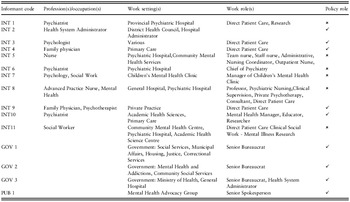
The government informants had collective experience with mental health reform in the Ministries of Health and Long-Term Care, Housing, Labour, Child and Youth Services and Corrections. The provider interest key informantsFootnote 8(psychiatry, family medicine, nursing, psychology, and social work) had worked in five settings of service delivery (psychiatric hospital inpatient and outpatient, general hospital, primary care, and community mental health agency) in numerous roles (e.g. provider, manager, or policy advocate). Other key interests were consumers and family members. Several key informants identified a specific informant as someone who could provide excellent insights to represent the public’s view more broadly (mass publics). This informant could also speak to the interests of mental health consumers and their family members, based on an extensive knowledge of the history of mental health policy in Ontario. Additional insight for mass public, as well as for the family member and consumer interests was obtained from two government key informants who had experience working for mental health consumer organizations and from written documents, including Hansard, the record of legislative debates for Ontario. For further detail about the professional disciplines, work roles, and settings of the key informants and their role in policy advocacy or development, please see Table A-1 in the Appendix.
The interviews were carried out between July 2004 and November 2005. Participants were contacted by phone or email to inform them of the project and to invite participation. One semi-structured interview guide was developed for each group of policy actors. Each guide asked about policy effects and probed responses to determine whether or not these effects became policy legacies over time. Disconfirming evidence was sought during the interviews. The interviews lasted from 45 minutes to one and a half hours. Interviews were confidential, audio-tape recorded, and transcribed by a professional transcriber who signed a confidentiality agreement. Ethics approval was obtained from the McMaster Research Ethics Board.
Data analytic procedures
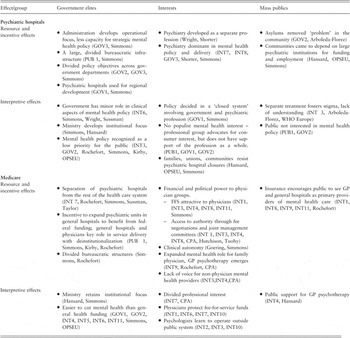
The transcripts were read through in their entirety by the primary author for an overall impression of the findings, then reread and searched for common themes. Some themes were directly related to the interview questions and others emerged from the interviews. The 53 themes that emerged were grouped into broader categories and compared against the key elements of the Pierson framework. Evidence for or against findings identified by a single source was then sought in the literature, policy documents, Hansard, or press releases. We included data as an effect if they were discussed in at least two different sources. Table A-2in the Appendix provides the summary of themes and the various sources in which each theme was identified. Relevant sections and quotes were checked by the key informants for accuracy.
Findings
The first legacy effects: early mental health policy and the effects of psychiatric hospitals
Mental health policy in Ontario can be traced back to 1850 when Upper Canada’s first insane asylum was built in Toronto (Wright, Reference Wright2004). This marked the beginning of Ontario’s institutionalization era, which continued until the early 1960s (Kirby, Reference Kirby2004b). Prior to this, individuals with mental illness may have received custodial care from families or religious institutions, but otherwise were left untreated and frequently ended up in jail or a poorhouse (Wright, Moran, and Gouglas, Reference Wright, Moran, Gouglas, Porter and Wright2003). The asylums were intended as a place of respite and ‘moral treatment’ (Kirby, Reference Kirby2004b), which included occupational therapy, recreation, and social activities in self-contained settings often removed from large busy centres. The British North America Act of 1867 gave jurisdiction over health care to the provinces. By 1891, there were four principal asylums in Ontario, located in Toronto, Kingston, London, and Hamilton (Wright, Moran, and Gouglas, Reference Wright, Moran, Gouglas, Porter and Wright2003).
Effects on government elites
The introduction of insane asylums had resource/incentive and interpretive effects on government elites. First, the sheer size of the investment in psychiatric hospitals required a large bureaucracy to support them. Across the country, more was spent on asylums over the period 1845–1902 than on prisons and other hospitals (Wright, Moran, and Gouglas, Reference Wright, Moran, Gouglas, Porter and Wright2003).
At the beginning of the twentieth century … 75% of provincial government expenditures in Ontario were on the asylums – this was a huge amount. [PUB 1].
Governments focused on managing the construction and operation of very large facilities to house the mentally ill over the long-term rather than on clinical aspects of policy-making, which was left to the local asylum superintendents (Simmons, 1989). A resulting legacy was limited government capacity for internal strategic mental health policy-making and for many years the government relied heavily on external advice from the psychiatric profession.
I think psychiatrists have always had a strong role in mental health policy … there were times they had a direct influence because the Ministry operated the 10 psychiatric hospitals. Inside the hospital and the branch level there were always psychiatrists working full-time. [GOV 3]
Asylum policy also meant mental health policy decisions were divided across government departments, such as health and public works, with often competing objectives. Two legacies were (i) clinical mental health policy was a relatively low priority and (ii) an institutional focus for mental health policy became entrenched in government.
Until the late 1950s, the mental health bureaucracy had little influence over the location, size or design of the mental institutions. Thus they took over institutions which many of them felt were unsuited to the needs of mentally ill people or to the objectives of the mental health system. Yet, because the system had functioned this way since the middle of the nineteenth century, the mental health authorities had to accept the institutions as they were and to try to tailor their policies to fit the structures. (Simmons, Reference Simmons1989: 109)
Over time, the psychiatric hospitals were used as a tool for regional development, often located in underdeveloped areas, which would benefit from the injection of funds and jobs. Politicians learned that asylum location decisions could be a powerful tool for generating votes (Simmons, Reference Simmons1989). The public did not develop meaningful involvement with local psychiatric hospitals in the same way as they did for general hospitals (Abelson, Reference Abelson2001: 787), so it was easy to choose politically expedient locations.
Nobody wanted them … The psychiatric hospitals were like prisons … they weren’t located to be ‘the community’s institution’. [Instead,] they were put where it was politically attractive for any particular government usually. [GOV 1]
Effects on interests
The asylums had important resource/incentive effects on professional interests. First, they lead to the development of psychiatry as a profession, which did not exist before the end of the eighteenth century (Shorter, Reference Shorter1997). As Wright (Reference Wright2004) stated in a speech on the history of mental health policy in Ontario: ‘The asylum created the profession.’
Psychiatry claimed guild status on the grounds that running an asylum in a therapeutic manner was as intricate a science as chemistry or anatomy. (Shorter, Reference Shorter1997)
Second, public ownership gave substantial power and authority to psychiatrists in policy-making in Ontario. The superintendent was in charge of each asylum and reported directly to the Ontario Department of Health (Simmons, Reference Simmons1989). Further, the geographic remoteness of many asylums meant the public was generally not familiar with their workings:
what happened in the mental hospitals and in the psychiatric profession in general was determined almost exclusively by a small circle of decision-makers: psychiatrists, the superintendents of the asylums, and those few government officials concerned with mental health policy. … on the whole the daily life of mental patients in asylums passed in isolation from the media and certainly in isolation from the political realm. (Simmons, Reference Simmons1989: 218)
For consumers and family members, the asylums contributed to the stigma of mental illness by removing individuals with mental illness from the community (Arboleda-Florez, Reference Arboleda-Florez2003; WHO Europe, 2005). Patients residing in an often distant asylum, away from the support of family and friends were unable to come together to develop an effective lobby, and the stigma of a mentally ill family member kept families from forming a lobby on behalf of patients [PUB 1]. This meant that from the early days, no consumer- or family-based mental health interest group developed:
that doesn’t mean that families weren’t concerned about the level of care at these places, but the situation was such that it was difficult for them … there was no citizen’s movement for them to be part of. [PUB 1]
The Canadian National Committee for Mental HygieneFootnote 9 was a professionally based interest group that lobbied on behalf of the rights of the mentally ill. Founded by a progressive psychiatrist (Dr. Clarence Hinks), it was comprised of a small number of psychiatrists, physicians and a few nurses (Canadian Mental Health Association) (CMHA), but did not have the support of the majority of the profession:
the CMHA up until the 1960s was not a citizens’ movement. It was a voluntary organization, but professionally led with a corporate board … even Clare Hincks had difficulty getting the attention of psychiatrists and the medical profession on a lot of issues, including prevention. [PUB 1]
Other interests emerged over time, and were vocal whenever there was discussion of closing psychiatric hospitals. These included the affected communities, which would lobby to keep the institutions and associated jobs; and the Ontario Public Service Employees Union (OPSEU), which lobbied on behalf of its members (Simmons, 1989) (National Union of Public and General Employees, 2002; Ontario Public Service Employees Union, 1998a, 1998b, 2002).
Many of those interviewed mentioned that one of the principal reasons for the government’s reluctance to contemplate closing the psychiatric hospitals was fear of the political backlash that would result from the damage inflicted on local economies and of resistance from the more than 7,000 staff members who belonged to the Ontario Public Service Employee’s Union. (Simmons, Reference Simmons1989: 249)
Effects on mass publics
The asylums ‘took the problem away’ from citizens in the community and relieved a major burden for family members who had struggled with caring for someone with mental illness.
The public were so fearful and rejecting of the fact that mental illness was a common illness that to the general public getting people out of the community was quite acceptable … It was all part of the era, if you can’t figure it out and you think it’s a bit dangerous – remove it and send it someplace else. [PUB 1]
The needs of the mentally ill in far-away asylums were much less visible to the public than other local needs.
The public other than the public that are immediately concerned, the family members and so on are likely going to say well we’ve got better things to do with our money, let’s fix the road … these people, nobody seems to know how to fix them anyway. [GOV 2]
There were also important interpretive effects. Since only those with more severe disorders were sent to asylums, the public came to recognize mental illness only at its most extreme. Although those with more moderate illness remained in the community, they were not necessarily recognized as having a mental illness.
People didn’t think they had the mentally ill around them – one out of five of them. They would have imagined, I’m sure, that the relative who was around them and slightly depressed wasn’t even slightly like the person who was wild and wooly and out of their mind and in the psychiatric hospital. [PUB 1].
Lack of familiarity meant the public became less comfortable around people with mental illness (Arboleda-Florez, Reference Arboleda-Florez2003). This prevented mental health from developing ‘the same sort of base of public consumer support’ [INT 3] needed for community-based mental health reform.
Failed reform efforts and psychiatric hospital legacies
Over time the PPHs became increasingly overcrowded and the original intent of providing moral treatment was lost (Kirby, Reference Kirby2004b; Simmons, Reference Simmons1989). Several attempts were made to adopt a community-based public health approach to preventing and treating mental illness, but these had limited success (Simmons, Reference Simmons1989). For example, in 1930, mobile mental health units in the community were introduced, but they were under-funded and soon overwhelmed by the demand and discontinued. Again, in 1946, the Deputy Minister of Health (McGhee) tried unsuccessfully to put forward a comprehensive community care plan that would create ambulatory mental health care in community public health units.
The difficulty of moving to community-based care can be understood in light of the policy legacies of PPHs. First, government elites had developed considerable bureaucratic capacity and expertise in running large institutions and had far less experience in community-based programming. The Ministry became dependent on the psychiatric community in policy-making and without a consumer- or family-based mental health interest group, the psychiatric profession was the dominant interest. Most psychiatrists were reluctant to switch to an unproven, less prestigious and potentially less-lucrative community-based system (Simmons, Reference Simmons1989). Further, there was more to be gained politically by building large institutions in disadvantaged areas, than by smaller investments in community-based programs across many municipalities. There was also a risk of public backlash if the community-based programs did not perform. In light of these legacies, it was not surprising that attempts at community-based reforms had limited success.
A second legacy and its effects: the introduction of medicare
Soon after McGhee’s attempt at widespread reform, the federal government introduced a series of incentives to support a public health insurance system (commonly referred to as medicare). In 1948, the federal government introduced the Dominion Health Grants to assist the provinces in developing and extending health facilities in specific areas. For mental health, $5 million of federal funding could be matched with provincial funds to support the development of general hospital psychiatric units (Hastings, Reference Hastings1999). This was followed by the Hospital Insurance and Diagnostic Services (HIDS) Act in 1957 and the Medical Care Act in 1966 (Health Canada, 2004) which offered federal cost-sharing for provinces and territories that operated a universal insurance program for hospital and physician services respectively. In Ontario, public hospital insurance came into effect in 1959 and medical care insurance for physician services in 1969. The combined health insurance program in the province was called the Ontario Health Insurance Program (OHIP).
During the federal-provincial negotiations which preceded the introduction of HIDS, the Ontario government pushed ‘to remove, as far as possible, any artificial financial or administrative distinctions between acute, convalescent, or chronic care, or care for mental illness and tuberculosis’ (Taylor, Reference Taylor1978: 135). However, the federal government indicated that its ‘contribution would not be made in respect of care in mental hospitals or tuberculosis sanatoria’ because PPH patients were already covered by provincial general revenues (Kirby, Reference Kirby2004b; Simmons, Reference Simmons1989). The discovery in the late 1950s of new medications that showed promise in the treatment of mental illness increased acceptance of community-based care (Kirby, Reference Kirby2004b), but also reinforced physicians and general hospitals in its delivery, rather than community support programs.
Effects on government elites
The matched federal funding for general hospital psychiatric units under the Dominion Mental Health Grants and OHIP encouraged provincial governments to move care from psychiatric hospitals to general hospital psychiatric units (Simmons, Reference Simmons1989).
The Dominion mental health grants started the shift away from the old asylums, but it wasn’t done for therapeutic reasons, as much as for fiscal reasons … these were 50 cent dollars. If you set up a psychiatric unit in a general hospital, you could get up to 50% of your cost paid. [PUB 1]
Inpatient units expanded, and many community-based services were developed in general hospital psychiatric outpatient clinics, instead of local public health units or community agencies:
This policy led to rapid expansion of general hospital psychiatric units, as well as the promotion of community-based services under the organizational umbrella of general hospitals…In Ontario the decision was made to give general hospital psychiatric units a pivotal role in the deinstitutionalization process by making them the center of both short-term inpatient care and outpatient services. (Rochefort and Portz, Reference Rochefort and Portz1993: 68–69)
Since provincial psychiatric hospitals were excluded from OHIP, there was split responsibility within the Ministry of Health for policies pertaining to psychiatric and general hospitals. Separate bureaucratic structures posed a challenge to coherent policy-making (Rochefort and Portz, Reference Rochefort and Portz1993; Simmons, Reference Simmons1989).
This administrative intricacy can be explained, at least in part, by the long history of public mental health care in Canada, which had already developed a distinct array of provincial services and facilities before Medicare arrived. (Rochefort and Portz: 75)
Today there remains a marked split between child/youth and adult mental health services which are the responsibility of different government Ministries:
there’s supposed to be some overlap. In fact in practice there’s virtually none… The systems are dramatically different … It’s really much more of a historic piece that one was funded by the Ministry of Health. The Ministry of Health has had much more of an institutional focus. [INT 11]
Separate funding streams meant publicly owned psychiatric hospitals were subject to government cost control measures during periods of fiscal restraint that did not apply to the general hospitals. Without a public mental health lobby, governments gave lower priority and reduced funding to mental health care spending.
Because they were part of the government system, the government would put constraints on itself, in terms of employment spending freezes, etc. that would apply to the PPHs because they were part of the Ministry … so … the [general] hospitals were always better funded, better staffed, in terms of equipment, and in terms of physician upgrades because they weren’t under the Ministry. [GOV 2]
Even within hospitals, funds intended for psychiatric units would frequently end up being allocated to acute care services because:
the hospitals didn’t get a lot of reward out of dealing with seriously mentally ill people ... they may have been in for the 14th time and not doing so well… money targeted for mental health … would end up being deployed for more surgeries or something. [GOV 1]
Effects on interests
OHIP covered hospital services regardless of provider type, and physician services regardless of delivery setting. This divided the mental health professional interest and privileged physicians over other mental health providers. For psychiatrists, OHIP offered the prospect of open-ended fee-for-service billing and professional autonomy in private practice rather than salaried employment in a government-run institution or community-based mental health organization. It placed few restrictions on the type or amount of mental health care that could be provided (Goering, Wasylenki, and Durbin, Reference Goering, Wasylenki and Durbin2000).
Unlike the psychiatric hospitals where they were employed exclusively on a salaried basis, individual psychiatrists in general hospitals could combine private practice with hospital work, as well as work in a more congenial, prestigious and professionally exciting atmosphere than in the psychiatric institutions. (Simmons, 1989: 130)
Physicians became a powerful force in health policy-making through the Ontario Medical Association’s interaction with government during the OHIP fee negotiation process (Hutchison, Abelson, and Lavis, Reference Hutchison, Abelson and Lavis2001; Tuohy, Reference Tuohy1999). Physicians became direct participants in health policy-making through joint management committees (Hutchison, Abelson, and Lavis, Reference Hutchison, Abelson and Lavis2001).
The majority of physician services are covered under Medicare, and because the government has a huge financial investment in those services, to a large extent the role that the medical profession might play in the development of public policy is … in proportion to the government’s investment … so without a doubt physicians are typically at most forums. [INT 3]
Other mental health providers did not have the same access to policy-makers, which was a major problem during times of fiscal restraint.
Mental health professions such as psychology, social work and occupational therapy, unlike nursing and medicine, do not have equal and effective access to the highest levels of decision making…This lack of voice results in policy decisions being taken at the highest levels that ignore or do not effectively take into consideration psychological health, mental health, mental illness and addictions. The consequences can be severe in terms of inclusion or exclusion in short- and long-term planning, resource allocation, and so on. (Canadian Psychological Association, 2003: 16)
Psychologists were hit particularly hard during periods of hospital budget cuts. Unlike physicians, whose services were paid for by OHIP, psychologists’ salaries were paid from the hospital budget [INT 3, INT 4, INT 8, INT 11]. They were typically the first group to be let go from hospitals.
Other health care providers working within hospitals are typically employees of a hospital … They receive a salary from the institution … because they have no direct relationship with the primary payer which is government … they’re usually not at the table when major decisions are made. [INT 3]
Medicare produced powerful interpretive effects for the various mental health provider interests. Physicians learned to protect the OHIP funds from encroachment by other provider groups [INT 1] and to lobby against any reforms that might reduce existing privileges.
Physicians, the OMA, Ontario Medical Association, as a union for the physicians is extremely powerful as a group – anything that encroaches on the fee-for-service pot … they’re very much against. And any other profession that may want to go fee-for-service, they’re very much against because … they see that they’ll end up … encroaching on their own pot ... I think that’s in part why you don’t have these other professions being able to bill OHIP. [INT1]
Psychologists learned to operate in private practice [INT 2, INT 3] outside the public system. Some focused on private patients, and patients covered under private insurance through worker’s compensation or automobile accident insurance.
So for example in the private sector, um, you know, people used to joke that the easiest way to get to see a psychologist was to be injured on the job or injured in a car accident … a lot of psychologists have gravitated to providing services in those areas. And a lot of people have almost focused their practice entirely on auto insurance cases to the exclusion of other things. [KI 3]
OHIP coverage for psychotherapy delivered by family physicians, but not by psychologists (who typically had more extensive training in these techniques) was a point of conflict between the mental health professions [INT 3].
Without a unified interest across professions, the mental health system became more fragmented. Although there were enlightened community psychiatrists who lead the development of new programs, for the most part, physicians focused on hospital and primary mental health care in private practice and had less interaction with public health units or community-based services.
Effects on mass publics
First dollar coverage under medicare gave the public a strong financial incentive to see their family physician for mental health problems rather than pay out of pocket to see a psychologist or social worker in the private setting. Family physicians found a growing demand for provision of psychotherapy. In fiscal year 2001/2 psychotherapy was the fourth most commonly billed OHIP fee code (Cree, Reference Cree2004). With their clinical autonomy, some family physicians chose to specialize in psychotherapy and became known as ‘GP psychotherapists’:
there was a greater demand for what I was doing in psychotherapy than there was for what I was doing in family practice … There are so few [psychiatrists] that do psychotherapy. But there’s a huge gaping hole in the system for patients who can’t pay … And I realized that there was going to be no treatment for some of these people so I had to do it. [INT 9]
The public came to rely on family physicians for mental health care. OHIP billing data suggest that 84–93% of mental health services are provided by family physicians (Lin and Goering, Reference Lin and Goering1999). Self-reported survey data indicate that 68% of Ontarians see a family physician for a mental health problem, compared with 27% a psychiatrist, 28% a social worker or other counsellor, 14% a psychologist and 6% a nurse (Rhodes, Bethell, and Schultz, Reference Rhodes, Bethell and Schultz2007). Politicians have learned that the public will strongly resist any attempts to de-list family physician psychotherapy (Rochefort and Portz, Reference Rochefort and Portz1993).
People come and talk to their doctor about what to do about anything … When they [the government] tried to limit GP psychotherapy, they were personally attacked. [INT 4]
Medicare also led to a two-tier system of psychiatry, as the public found general hospital care to be less stigmatizing than care in a psychiatric hospital.
The number of psychiatric units increased rapidly from seven in 1944 to 42 by 1970 (Simmons, Reference Simmons1989). Instead of providing alternatives to the psychiatric hospitals, the psychiatric units were meeting new and different categories of psychiatric need, including patients with less serious mental illness (Simmons, Reference Simmons1989).
General hospital psychiatric units tended to be used on a voluntary basis by middle and upper income individuals who were referred to them by private psychiatrists, while psychiatric institutions continued to provide services to poorer individuals and to those who had been admitted involuntarily. This, in effect, created a two-tiered system of mental health care: the general hospitals and psychiatric institutions served groups of patients that rarely overlapped. (Kirby, Reference Kirby2004b: 141)
Later, with downsizing of psychiatric hospitals and shortages of psychiatrists, those with the most serious mental illness primarily used those community-based services that were available (Kirby, Reference Kirby2004b; Simmons, Reference Simmons1989).
Community care since the introduction of medicare
The introduction of medicare meant a shifting of services to the general hospital setting and to physicians in primary care. During the 1960s and early 1970s, many chronic patients were also shifted from psychiatric hospitals to other long-term care facilities. Without community support services, many were discharged to the community and suffered frequent relapse and readmission to psychiatric units in the general hospitals, and some ended up homeless or in jail. By the late 1980s there were increasing calls for greater spending on community services and some incremental change was achieved. By the early 1980s a mixture of about 400 community-based small non-profit agencies and others organized under the Canadian Mental Health Association (CMHA) had developed (Graham, Reference Graham1988) that offered residential services, vocational rehabilitation, income support, and case management programs (Kirby, Reference Kirby2004b). However, only 3% of provincial mental health budgets in Canada were allocated to community support by 1990 (Goering, Wasylenki, and Durbin, Reference Goering, Wasylenki and Durbin2000).
System fragmentation and the Graham Report
The release of the Graham Report (Graham, Reference Graham1988) marked a new phase in mental health policy development in Ontario. The report was unique because of its widespread consultation with mental health interests throughout the province, which for the first time included consumers and family members. Like earlier reports, it called for a rebalancing of services with much greater emphasis on community support, but also focused on the need to develop an integrated, coordinated mental health system. It pointed to the fact that community- and hospital-based programs and primary mental health care services were uncoordinated, served different patient groups and involved different providers; physicians working largely in private practice or hospital, psychologists largely in private practice, and social workers and nurses in hospital and community settings. The report urged psychiatrists to become involved in the community sector to help bridge the gap between the two systems. For patients and their families, navigating the system is an important barrier to access (Kirby, Reference Kirby2005a).
In 1991, the Ontario government made ‘a significant funding commitment to consumer groups’ (Goering, Wasylenki, and Durbin, Reference Goering, Wasylenki and Durbin2000: 354) by allocating over $3 million to the Consumer Survivor Development Initiative. A consumer-based interest developed, and spending on community mental health programs increased. At the same time, the family interest gained strength, lobbying for more treatment. Families have protested hospital bed closures and pushed for community treatment orders and community support services.
Until recently, however, spending on community mental health has not kept pace with overall mental health spending (Goering, Wasylenki, and Durbin, Reference Goering, Wasylenki and Durbin2000; Kirby, Reference Kirby2004b; Rochefort and Portz, Reference Rochefort and Portz1993; Simmons, Reference Simmons1989). The bulk of care is still hospital-rather than community-based and the system remains highly fragmented (Swenson and Bradwejn, 2002).
A subsequent report, entitled ‘Putting people first’ stressed the need to overcome system fragmentation:
The mental health system in Ontario is not really a ‘system’. It is a collection of different services, developed at different times and managed in different ways. Although this is gradually changing, there is little coordination among the different services: the provincial psychiatric hospitals, the general and specialty hospital, the community mental health programs and OHIP-funded services. In fact, these services have been described as the four solitudes of mental health. (Ministry of Health and Long Term Care, 1993: 5).
Despite subsequent policy documents calling for a pressing need to act, including nine regional mental health implementation task forces (Ministry of Health and Long-Term Care, 1998, 1999a, 1999b, 2000b) and with general agreement on what actions to take, the challenge, as reflected in the title of one government report, remains one of ‘making it happen’ (Ministry of Health and Long-Term Care, 1999a).
Discussion
Our analysis suggests that psychiatric hospital policy resulted in four legacies that have prohibited widespread mental health reform: (i) it set the treatment of mental illness ‘apart’ from the treatment of physical illness and gave it a generally lower priority in policy-making; (ii) it entrenched a hospital-based focus for mental health treatment, which (iii) led to the development of psychiatry as a profession and gave psychiatrists a privileged position in mental health policy; and (iv) it inhibited public interest in reform.
Medicare reinforced separate treatment and lower priority for mental health policy by excluding PPHs. It split decision-making across administrative units within governments, which weakened the capacity of mental health administrators to press for sweeping reform (Rochefort and Portz, Reference Rochefort and Portz1993). Medicare also emphasized hospital rather than community care, with coverage for hospital and physician services only. Finally, medicare divided the provider interest and continued to privilege psychiatrists and physicians over other mental health providers, through clinical autonomy, guaranteed public payment for services and access to government during fee negotiations (Simmons, 1989), and encouraged public support for physician-based mental health care. With some notable exceptions, physicians were unlikely to support community-based services that could threaten their existing privileges. Without a broadly based consumer or family lobby until the 1980s, community and union protests over hospital closures prevailed over community care advocates. These effects have sustained the fragmented mental health care system in the province.
Incremental changes below the surface and recent developments
The Pierson framework helps to explain the enduring nature of mental health care policy in the province and the failure to achieve a widespread shift toward community-based care; however, it does not account for the incremental movement toward community-based care within a system that continues to be dominated by hospital and physician services. Historical institutionalism frameworks have been praised for their usefulness in explaining the enduring nature of policies, but criticized for ignoring incremental change during the path-dependent periods, when there can be ‘drift’ away from existing policies (Oliver and Mossialos, Reference Oliver and Mossialos2005; Peters, Pierre, and King, Reference Peters, Pierre and King2005; Schlesinger, Reference Schlesinger2005) and for masking the ‘dissensus that may exist beneath the surface of a program … that may act as a force for change’ (Peters, Pierre, and King, Reference Peters, Pierre and King2005: 1275).
There have been important changes that may set the stage for new efforts at reform. These include stronger public support for mental health reform and the introduction of intensive community treatment approaches, such as ACT teams and CTOs since 2000. In their critique of historical institutionalism, Peters and colleagues suggest that institutions embody prevailing ideas and that changes in ideas may be sufficient motivation for incremental change to occur. A theme which arose in the interviews was that there has been a fundamental shift in ideas about the mentally ill over the last ten years, which has lessened stigma and promoted public acceptance of mental illness [PUB 1, GOV 1, GOV 3]. This is attributed to the willingness of a number of key public figures to speak out about personal experience of mental illness. This growing public acceptance may have been a key enabler of the incremental reforms that have been achieved.
Policy implications in light of current opportunities
There are signs of an emerging opportunity for comprehensive mental health reform in Ontario. Recent commitments to increase community mental health funding were a prerequisite for further bed transfers or reductions from the psychiatric hospitals (Ministry of Health and Long Term Care, 1999). Federal Accord dollars have been channeled into community mental health program expansion, and service enhancement payments are targeted for those with mental illness and legal involvement (Health Canada, 2003). Further, the province’s ongoing health system reform includes the introduction of Local Health Integration Networks (LHINs) and Family Health Teams (FHTs) (Ministry of Health and Long-Term Care, 2006; Ministry of Health and Long Term Care, 2004a). LHINs will mean regionalized service delivery and local coordination of care, which is an important theme in mental health reform recommendations (Ministry of Health and Long-Term Care, 1993, 1999a, 1999b, 2000a; Provincial Forum, 2002). FHTs offer opportunities to develop multidisciplinary teams of primary health care providers which integrate non-physician mental health specialists. What do policy legacies tell us about the opportunity to advance more widespread mental health reform in light of these initiatives?
First, LHINs may overcome the legacy of fragmented mental health policy-making across different central government departments that weakened reform capacity. Moving operational policy decisions to the local level may allow for greater coordination of mental and physical health policy in each LHIN.
Second, a regionalized approach may engage the public in local decision-making and help to overcome the legacy of limited public interest in mental health policy. With greater public interest and a regionalized approach, local decision-makers may be successful in reallocating resources from institutional to community-based care in a manner that is politically acceptable to the public.
Third, FHTs respect the traditional clinical autonomy and the dominant role of physicians, while simultaneously offering a way to include non-physician providers within a publicly financed primary care system with different remuneration approaches. Moving some physicians away from fee-for-service remuneration may reduce concerns about protecting these funds, promote willingness to work with other providers, reunite the provider interest and promote overall system integration.
Despite these positive attributes, policy legacies also suggest several challenges to developing a coordinated mental health system through current reforms. First, the legacy of separate treatment and lower priority for mental health care may continue within the LHINs. Community-based mental health programs are diverse and traditionally have had low priority in mental health policy-making. Their success will depend critically on the ability to engage local public interest. Without this, it may be necessary to institute separate authorities to ensure mental health issues remain on the agenda and to find ways to ‘ring-fence’ funding for community-based programs to ensure it is not lost within overall local health care system spending (Kirby, Reference Kirby2004a; WHO, 2003).
Second, LHIN and primary care policies have been developing quite separately with little administrative coordination within government for planning, funding flows and service delivery. This may be a legacy of and reinforce the separation of primary care from the rest of the health care system and impede efforts to break down the four solitudes – PPHs, general hospitals, community mental health programs, and OHIP services. At best, three of the four traditional settings of mental health service delivery will be integrated within the LHINs – PPHs, general hospital, and community services –and there may be greater collaboration across providers in primary care through the FHTs. However, the division between primary care and community/hospital care will likely remain in the transformed system, with moderate mental illness treated in primary care and more serious mental illness in institutions and/or community-based careFootnote 10. It remains unclear how physicians will be attracted to work in conjunction with community-based services.
Past experience suggests that separate administrative structures in government may be reflected in separate silos of health care delivery. This would be a major impediment to developing a coordinated system that can be easily navigated by the patient and may result in funding for one service delivery area outstripping another over time. Integrating the FHT and LHIN reform initiatives is a pressing priority for policy development and service delivery. A primary care/LHIN coordination function within the Ministry is needed as well as coordination and balancing of funding flows in LHINS and primary care. Each delivery site should be linked into a coordination unit in each LHIN that can manage the inventory of diverse mental health services and direct patients to available services, if a consumer-centred coordinated mental health care system is to be achieved.
Conclusion
Policy legacies can prevent widespread change from occurring when policy windows open. Nonetheless, changing ideas can lead to incremental change, which can support reform at a later critical juncture. Our examination of policy legacies suggests four important legacies of psychiatric and medicare policy: (i) the separation of mental and physical health policy-making in government and the lower priority given to mental health; (ii) the entrenched emphasis placed on hospital- and physician-based mental health care; (iii) the strength of physicians in policy-making compared with other mental health providers; and (iv) the limited public interest in mental health policy. Together these have resulted in the current fragmented delivery system and the difficulty in shifting the proportions of spending from hospitals and physicians toward more community-based care.
While widespread reform has proved elusive, below-the-surface changes have occurred that may support mental health reform as part of ongoing general health system transformation. It will be important to monitor whether a regionalized system promotes public interest in mental health policy, and, if not, to find ways to protect mental health funding in each region. Coordinating funding for LHINs and primary care is critical to achieve a coordinated, balanced mix of mental health services across settings. This calls for integrated LHIN/FHT planning at the provincial level, and a mental health system liaison function within each LHIN and delivery site. Paying attention to these issues now will promote long-sought mental health reform objectives. Failure to do so will reinforce policy legacies dating back to the 1850s and 1950s that have kept mental health reform ‘beneath the radar screen’ of policy-makers (Rochefort, Reference Rochefort1999) and once again thwart the development of a coordinated, consumer-centred and rebalanced mental health system in Ontario.
While the analysis presented here is specific to the case of Ontario, there are lessons to be learned from applying the Pierson framework to the mental health reform experience in other countries with a psychiatric hospital-based tradition. For example, similar legacies such as the weak and fragmented government capacity for mental health policy-making, the division of mental and physical health policy, the relative strength of physician interests compared to a weaker consumer interest and lack of public support for mental health policy may have resulted from caring for the mentally ill in large, geographically remote asylums. However, the subsequent path of policy development in each country during deinstitutionalization may differ from Ontario’s because of the unique legacies associated with the introduction of Canadian medicare. Differences in the deinstitutionalization experience of European countries include the degree of reliance on general hospitals, transinistitutionalisation, and in some countries, recent signs of reinstitutionalisation (Goldberg, Reference Goldberg1999; Haug and Rossler, Reference Haug and Rossler1999; Monk-Jorgensen, Reference Monk-Jorgensen1999; Turner, Reference Turner2004; Vazquez-Barquero and Garcia, Reference Vazquez-Barquero and Garcia1999). Applying the Pierson framework through comparative analysis in future work will help to explain these observed differences. It may also identify opportunities to promote mental health reform in different countries.
Appendix
Characteristics and background of key informants

Legacies of psychiatric hospitals and medicare policy on mental health policy development