Resilience and social exclusion are both slippery concepts. Attempting to explore the relationship between them – the challenge set for contributors to this themed section – might therefore be considered a rash undertaking. Nevertheless, there is much to be learned – theoretically, empirically and in terms of policy implications – from bringing together these two areas of investigation which have developed hitherto largely in isolation from each other.
The contributions to this themed section arise from work in the Centre for Analysis of Social Exclusion, which received core funding from the Economic and Social Research Council Research over the period 1997–2007. Much of this programme of work concentrated on understanding the risk factors for social exclusion, investigating the depth and duration of its consequences and exploring the effectiveness of a range of different kinds of intervention (see, for example, Hills and Stewart, Reference Hills and Stewart2005). In the course of these investigations, it became clear that there were individuals and families who ‘bucked the trend’, flourishing despite extraordinarily tough experiences and environments, and this led naturally to the exploration of the concept of resilience.
The development and meaning of the term resilience is explored in detail in the Review Article by Sarah Mohaupt. Broadly speaking, someone who exhibits resilience has positive outcomes, or avoids negative ones, despite being exposed to adverse circumstances. The concept of social exclusion has been discussed extensively elsewhere (for example, Room, Reference Room1995; Levitas, Reference Levitas1998; Byrne, Reference Byrne1999; Hills et al., Reference Hills, Le Grand and Piachaud2002), from a range of different ideological and theoretical perspectives, but there is broad agreement that someone who is socially excluded is experiencing a set of inter-connected social and economic disadvantages. Social exclusion looks to qualify, then, as the kind of ‘adverse circumstances’ in which someone might or might not exhibit resilience.
A number of similarities in the debates surrounding the terms ‘resilience’ and ‘social exclusion’ can be identified. Firstly, opinions are divided as to whether the phenomenon is distinct from the absence of its opposite: is resilience merely the absence of some other, perhaps unobserved, risk factor? Is social exclusion simply the failure of social inclusion? The Scottish Executive, for example, was adamant that its social inclusion strategy, initiated in 1999, was not equivalent to preventing or ameliorating social exclusion.
Secondly, there is uncertainty about whether ‘resilience’ is a single quality or whether forms of resilience in different contexts and with respect to different outcomes are quite distinct. If it is a single quality, is it more than the sum of protective factors? A parallel concern has been expressed with respect to social exclusion: is social exclusion one or many states or processes? Is there something over and above exclusion on the separate dimensions (access to goods and services, employment, health, participation in social activities and so on) which constitutes ‘social exclusion’?
Thirdly, to what extent are resilience and social exclusion attributes of individuals and to what extent should they be understood as the product of an interaction between the individual and his or her environment? In some interpretations, resilience is primarily an inherent psychological attribute, whilst in others it is considered to be generated by a broader range of characteristics and circumstances. Similarly, the ‘underclass’ perspective on social exclusion (for example, Murray, Reference Murray1990) tends to emphasise individuals’ lack of moral responsibility, while a rights-based or liberal egalitarian concept emphasises lack of entitlement and structural barriers (Burchardt et al., Reference Burchardt, Le Grand and Piachaud2002).
Finally, the charge of being un-measurable has been levied at both resilience and social exclusion. Of course, a response to this charge depends partly on the resolution of the preceding questions. Resilience may turn out to be a residual – that part of the positive outcome, in a context of adversity, which cannot be explained by any other means. Social exclusion may be the product of the interaction between various forms of disadvantage, producing a degree of disadvantage which is indeed more than the sum of the parts. Or, if resilience and social exclusion are interpreted as genuinely multi-dimensional, each dimension may be measurable in its own right.
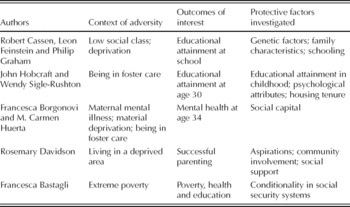
The contributions to this themed section shed interesting light on all of these controversies, using a wide range of methodologies: from literature review (Cassen and colleagues), analysis of case studies from a qualitative longitudinal study (Davidson), and international comparison of welfare reform evaluation data (Bastagli), through to econometric analysis of birth cohort studies (Hobcraft and Sigle-Rushton, and Borgonovi and Huerta). Table 1 summarises the particular context of adversity explored in each article, the outcomes of interest and the protective factors investigated.
Summary of contexts, outcomes and protective factors

A wide range of aspects of social exclusion are considered, as indicated by the descriptions of the contexts of adversity which provide the setting for each of the articles. Poverty and material deprivation are a common theme but their manifestation varies from malnutrition in the case of Bastagli's study, which is concerned with extreme poverty in Latin American countries, to enduring high levels of crime, rapid population turnover, and crumbling infrastructure in Davidson's study, set in inner-city London.
The successful outcomes which are achieved despite these adverse circumstances are also varied, ranging across health, education and parenting – all outcomes which are subject to considerable policy interest and intervention in the UK and elsewhere at the present time. Finding the key to resilience in these areas would be valuable indeed.
The protective factors investigated – which may or may not be considered to add up to resilience itself – can be placed in a hierarchy from the micro to the macro level. The articles are arranged roughly in this order, starting with the most inherently individual factors, your genes, moving up through psychological attributes, family characteristics, immediate environment (housing, schooling), wider social environment (social networks and community activity) and finally to the design and operation of national institutions (in this case, social security).
The importance of all of these levels, and the interactions between them, is well established in the social exclusion literature and the strong theme that emerges from this investigation of resilience is that they can also play an important role as protective factors, within contexts of adversity. The interplay between individuals and the structures they occupy is brought out with respect to education by Cassen and colleagues: different children thrive in different kinds of learning environment. In deprived areas, Davidson argues there is a need to support the personal development of individuals, who may have lost confidence as a result of repeated disappointments and frustrations, as well as providing high-quality facilities through area regeneration. For children in care to avoid bad outcomes in adulthood, Hobcraft and Sigle-Rushton show, a complex combination of individual and contextual characteristics is required, including psychological attributes (like locus of control) and good schooling, and again it is the interaction between them which is important in explaining outcomes. Borgonovi and Huerta demonstrate that social integration is necessary but not sufficient to avoid mental illness in adulthood for those at high risk; interventions at the intermediate ‘community’ level would not be sufficient to overturn the risk to mental health posed by a deeply disadvantaged childhood. Finally, Bastagli argues that for welfare interventions to successfully promote resilience, the accessibility and quality of services must be considered as well as individual incentives: neither individual-level interventions nor structural change are sufficient by themselves.