




No CrossRef data available.
The Regime Complex for Plant Genetic Resources
Published online by Cambridge University Press: 19 May 2004
Abstract
This article examines the implications of the rising density of international institutions. Despite the rapid proliferation of institutions, scholars continue to embrace the assumption that individual regimes are decomposable from others. We contend that an increasingly common phenomenon is the “regime complex:” a collective of partially overlapping and nonhierarchical regimes. The evolution of regime complexes reflects the influence of legalization on world politics. Regime complexes are laden with legal inconsistencies because the rules in one regime are rarely coordinated closely with overlapping rules in related regimes. Negotiators often attempt to avoid glaring inconsistencies by adopting broad rules that allow for multiple interpretations. In turn, solutions refined through implementation of these rules focus later rounds of negotiation and legalization. We explore these processes using the issue of plant genetic resources (PGR). Over the last century, states have created property rights in these resources in a Demsetzian process: as new technologies and ideas have made PGR far more valuable, actors have mobilized and clashed over the creation of property rights that allow the appropriation of that value.We are grateful for comments on early drafts presented at Stanford Law School, New York University Law School, Duke Law School, Harvard Law School, and the American Society for International Law. Thanks especially to Larry Helfer, Tom Heller, Robert Keohane, Benedict Kingsbury, Peter Lallas, Lisa Martin, Ron Mitchell, Sabrina Safrin, Gene Skolnikoff, Richard Stewart, Chris Stone, Buzz Thompson, Jonathan Wiener, Katrina Wyman, Oran Young, and two anonymous reviewers for their feedback. Kal Raustiala thanks the Program on Law and Public Affairs at Princeton for support. We also thank our research assistants, Lindsay Carlson, Lesley Coben and Joshua House.
Information
- Type
- Research Article
- Information
- Copyright
- © 2004 The IO Foundation and Cambridge University Press
International institutions have proliferated rapidly in the postwar period. As new problems have risen on the international agenda, the demand for international regimes has followed.1
See Keohane 1983; Krasner 1983; and Hasenclever et al. 1997.
These trends—in particular the rising density of international institutions—make it increasingly difficult to isolate and “decompose” individual international institutions for study.4
Yet efforts to build and test theories about the origins, operation, and influence of international regimes have typically been conducted as though such decomposition was feasible. Most empirical studies focus on the development of a single regime, usually centered on a core international agreement and administered by a discrete organization.5For example, in the field of international environmental cooperation the archetype is the Montreal Protocol on ozone depletion—the subject of analysis from multiple perspectives such as the role of state power (Benedick 1991), scientific expertise (Parson 2003), side payments (DeSombre and Kaufman 1996), and ideas (Litfin 1994).
The few exceptions, using the term “interplay,” include Young 2002; and Stokke 2001. See also Leebron 2002 for discussion of “conglomerate” regimes; and Weiss 1993 for a warning about “treaty congestion.”
Aggarwal 1985. A similar concept of hierarchy applies in environment, human rights, labor and other areas—with umbrella agreements (for example, “framework conventions”) as well as topic-specific agreements (for example, “protocols”) tailored to specific subject matters.
Exceptions include Young 2002; Wendt 1999; and Sebenius 1983.
In this article we address this gap in theory by advancing several arguments about regime interactions under conditions of rising institutional density. We develop and explore these arguments through the lens of an understudied issue in international relations: the control of plant genetic resources (PGR). The PGR case is important because it lies at the nexus of critical areas of world politics—intellectual property (IP), environmental protection, agriculture, and trade.
For most of history, PGR—such as genetic codes, seed varieties, and plant extracts—were treated as the “common heritage of all mankind.” They were understood to be freely available to all and owned by none.9
During the twentieth century, those rules changed radically; today, international and domestic rules declare PGR to be sovereign property and subject to private ownership through IP rights such as patents. We explain that transformation by examining the rules that govern PGR in their natural state—“raw” genetic resources—as well as the “worked” resources that humans improve through breeding and other improvements to plant genomes. Raw PGR are those found in the wild, such as a flower in the rain forest that contains a yet-undiscovered gene that could cure cancer. Worked genetic resources, by contrast, are the products derived from that flower—such as the marketed cancer-fighting drug.10We also examine the rules that define the boundary between “raw” and “worked,” which are important in borderline cases such as the improvements to seed varieties that have accrued over centuries of traditional farming yet are not recognized by many modern intellectual property rules.
See Demsetz 1967; Libecap 1989 and 2003; and Merrill 2002.
While new technologies and ideas created pressures for enclosure, the composition and configuration of international institutions created a highly uneven process of change. Rather than a single, discrete regime governing PGR, the relevant rules are found in at least five clusters of international legal agreements—what we call elemental regimes—as well as in national rules within key states, especially the United States and the European Union (EU). These elemental regimes overlap in scope, subject, and time; events in one affect those in others. We term the collective of these elements a regime complex: an array of partially overlapping and nonhierarchical institutions governing a particular issue-area. Regime complexes are marked by the existence of several legal agreements that are created and maintained in distinct fora with participation of different sets of actors. The rules in these elemental regimes functionally overlap, yet there is no agreed upon hierarchy for resolving conflicts between rules. Disaggregated decision making in the international legal system means that agreements reached in one forum do not automatically extend to, or clearly trump, agreements developed in other forums. We contend that regime complexes evolve in ways that are distinct from decomposable single regimes.
In this article we do not attempt a full derivation of a theory of regime complexes. Rather, our aim is to demonstrate, through our discussion of the PGR case, that there is utility in analyzing regime interactions systematically and guided by the concept of regime complexes. We explore four conjectures.
First, we expect that regime complexes will demonstrate path dependence: extant arrangements in the various elemental regimes will constrain and channel the process of creating new rules. The existing literature on regimes implicitly presumes that regimes are negotiated on a largely clean institutional slate. Organized interests arrive at the proverbial bargaining table and vie for control over the outcomes; deliberations are not much affected by the institutions already in place. In regime complexes, by contrast, the array rules already in force channel and constrain the content of new elemental regimes
Second, we expect that the existence of distinct negotiating fora will spur actors to seek out the forum most favorable to their interests. We explore not only the factors that we expect will affect the degree of forum shopping—such as barriers to entry, membership, and linkages among issues—but also the practical impact that forum-shopping has on the evolution of rules within regime complexes.
Third, we expect that a dense array of international institutions will lead to legal inconsistencies. Scholars have noted the move to law in world politics.12
One implication is that much diplomatic effort will be focused on consistency—treating like situations alike—because consistency is a core element of the legal paradigm. In standard theories of regimes, regime development is driven by political contestation over core rules. In regime complexes, we argue, that evolution is mediated by a process focused on inconsistencies at the “joints” between elemental regimes. We expect that negotiators will deploy devices such as “savings clauses” that help to demarcate boundaries between regimes and disentangle events in one forum from another. Nonetheless, governments cannot collectively negotiate detailed and demanding rules in each elemental regime that are synchronized with all other elements. There is no single, omnibus negotiation—rather, there are multiple negotiations on different timetables and dominated by different actors. The move to cooperation on issues that were previously the sole domain of domestic policy only exacerbates this harmonization problem, because it is no longer foreign ministries that dominate international diplomacy: instead, a raft of domestic agencies, often with distinct agendas, increasingly play active roles.13Fourth, we explore how states contend with inconsistencies through the process of implementation and interpretation. The literature on domestic policy implementation has demonstrated that when the legislative agenda is complex and contested, lawmakers often adopt broad, aspirational rules—delegating to the process of implementation exactly how these rules will be interpreted and applied in practice.14
See Ingram 1977; Bardach and Kagan 1982; and Stewart 1975.
We begin by summarizing the PGR case and theorizing about the dramatic change in property right norms during the past century. We introduce each element of the regime complex and show how the interactions between elemental regimes have become more numerous as the international rules have become more expansive, intrusive, and demanding. We then explore the significance of the concept of a regime complex for the theories of international institutions, focusing on the four conjectures introduced above, in light of the PGR story. Finally, in the conclusion, we suggest that while the PGR regime complex is unusual in its intricacy it is unlikely to be unique. Rather, regime complexes may exist and proliferate in many other areas of world politics as the greater depth and broader scope of international rules makes it increasingly difficult to decompose individual regimes.
Explaining Norm Change: The Rise of Property Rights in Plant Genetic Resources
PGR have been a central part of human civilization since its inception, though genes were not well understood until recently.16
There is a growing literature on PGR, but little of it seeks to explain change in international rules. See, for example, Kloppenburg 1988; Evenson 2002; Marin 2002; and Helfer 2002. The comprehensive Cambridge World History of Food gives hardly any attention to international rules; its index offers no entries for the WTO, TRIPs, or UPOV; see Kiple and Ornelas 2000. Scholarship on environmental protection has touched on PGR as it relates to biodiversity; scholarship on trade has also touched on this subject because PGR is part of TRIPs. There is an extensive literature on most of the agreements that we discuss, but few studies examine the interactions between treaties—as we do. An exception is Helfer 2002. Those that do examine such interactions focus mainly on conflicts between the CBD and TRIPs because that was the political hotbed in the 1990s, but as we show, the conflicts and synergies extend over many other agreements and began long before the 1990s.
Common heritage as a legal principle can be found in other arenas; for example, it was applied to ownership of seabed resources in the UN Law of the Sea Convention.
In the twentieth century, this structure of property rights changed markedly. By the 1990s, governments viewed raw PGR as a sovereign resource rather than as common heritage; increasingly governments also afforded individuals a wider range of varied IP rights for worked PGR, including patents, and governments negotiated treaties that required other governments to do the same. Yet not all international agreements embraced this approach, and for some time there was considerable conflict among the various regime rules. (In some areas, the conflicts persist.) Ultimately, however, a broad consensus emerged, most fully in the late 1990s. We call this new system the “property rights” approach. Some states kept those property rights for the state itself, often with the state asserting not just control over these rights but direct ownership. Many other states, however, permitted the creation of individual property rights and increasingly this is the norm.
To describe and explain this fundamental normative shift toward enclosure we look to the theory of property rights famously developed by Demsetz and elaborated by Libecap and others.18
See Demsetz 1967; and Libecap 1989.
Demsetz 1967, 350.
See, in particular, the many examples in Libecap 1989. Levmore argues that there are two basic stories of property rights emergence, one based on transactions costs and the other on interest groups and distributional concerns. We do not stress this distinction in our brief treatment, though we focus on distribution primarily. Our story is consistent with Levmore's claim that reversals of property rights tend to be associated with transaction cost considerations whereas the development of rights is associated with interest group struggle. Levmore 2002.
This evolution of property rights took decades. The rise of for-profit seed companies in the 1920s, based on expensive research and development efforts, began to eclipse publicly funded agricultural research as a source of new value in crops and also created the first pressures to provide IP protections for worked PGR. The United States took small steps toward propertization in the 1930s. But it was dramatic technological changes in the 1970s and 1980s—in particular, the development of biotechnology and genetic engineering—that created a strong push for IP protection. The pharmaceutical industry increasingly focused on “blockbuster” drugs that required strong IP rights to yield windfall profits.22
Increasingly, crop firms believed technology would similarly transform agricultural breeding; they, too, agitated for stronger IP rights that would allow them to capture innovation rents for themselves. The biotechnology revolution also created the impression that valuable genetic resources were abundant and, once discovered, could generate huge revenues. Southern states rich in these raw biological resources now saw them as new sources of wealth and sought to ensure that they would be well compensated for harboring these important resources. The result was overwhelming pressure to replace the common heritage system with the current property rights system. Rather than treating these resources as held in common, this shift in legal rules meant that raw PGR would be treated as sovereign resources just like oil or timber. Moreover, worked PGR, rather than being unprotected innovations, would be protected by a wide range of IP rights.One dimension of this unfolding debate concerned the rules for ownership of PGR—common heritage versus some form of property right. The other dimension was the mechanism for allocating benefits from raw and worked PGR. Even as states, in a Demsetzian dynamic, converged on a property rights approach there remained strong disagreements over the allocation of benefits. Developing countries desired state-controlled mechanisms that would force PGR innovators to share the benefits with those states that provided the raw PGR; industrialized states preferred a more free-market approach.
The transformation of property and allocative rules over PGR did not occur smoothly or according to a single plan or initiative. Nor did this transformation occur through a single, omnibus negotiation aimed at the creation of a new international regime. Rather, as we describe, there were six distinct strands of activity, each of which addressed some important, but partial, aspect of the PGR issue. Five of these strands are what we call an elemental regime—an international institution, based on an explicit agreement, that reflects agreed principles and norms and codifies specific rules and decision-making procedures. Three of these elemental regimes are focused on agriculture, and two extend far beyond agriculture to broader issues:
- The 1961 International Convention for the Protection of New Varieties of Plants (UPOV), as amended in 1978 and 1991, governs property rights over intentionally bred plant varieties. These treaties require members to recognize “plant breeders' rights,” a form of IP protection widely implemented in industrialized countries.
- The United Nations (UN) Food and Agriculture Organization (FAO) is the locus for negotiation of two key accords: the 1983 International Undertaking on Plant Genetic Resources and the 2002 International Treaty on Plant Genetic Resources. The FAO is also the main site for international negotiations on agricultural matters.
- The Consultative Group on International Agriculture Research (CGIAR) is an international network of crop research centers. Efforts to breed improved crops have been aided enormously by the tremendous wealth of samples in CGIAR's “gene banks.”
- The World Trade Organization (WTO)'s Agreement on Trade-Related Aspects of Intellectual Property Rights (TRIPS) sets minimum international standards for the protection of IP rights.
- The 1992 UN Convention on Biological Diversity (CBD), which originated in efforts to protect global biodiversity as a natural resource, simultaneously promotes the sharing of the economic benefits that arise from the use of genetic resources.
In addition to these five international institutions, the PGR regime complex has been influenced by activities at the domestic level, notably in the United States, and, to a lesser degree, in the EU. The United States has been a key driver of change in the IP field. Innovations that began in the United States, such as the patenting of life-forms, have subsequently been enshrined, partly as a result of U.S. insistence, in agreements such as TRIPs. U.S. firms are also the dominant innovators in both the pharmaceutical and agricultural industries.
Figure 1 illustrates these two dimensions of rules—ownership and allocative mechanisms—and summarizes the complicated story that we present below about the transformation from the common heritage system to sovereign and private property rights.

Two dimensions of debate.
The Common Heritage System
For most of human history, the rule of common heritage governed PGR. Though genes themselves were not fully understood until recently, the economic importance of genetic resources had been long recognized. Nonetheless, under the original system there were no property rights in PGR, nor did states bar access to genetic resources per se. As a result there was much international diffusion of PGR, particularly as long-distance trade expanded and imperial nations established central collections, such as Kew Gardens outside London, stocked with plants from around the globe.23
To be sure, nations tried but often failed to maintain control over certain genetic resources; for example, China went to great lengths to preserve the silkworm monopoly, but ultimately lost it to two enterprising Nestorian monks.24 Silkworms, rubber trees, and a few other special resources of obvious high value were the exception, however—otherwise, genetic resources were free for anyone who bothered to take them.Under the common heritage system there was little difference in treatment between what we term “raw” and “worked” PGR. In agriculture, the dividing line between raw and worked was (and often remains) indistinct because worked materials, as well as new raw materials collected in the field, are the source of new worked materials.25
Indeed, one of the major continuing areas of contestation has been the treatment of traditional crop varieties that have been improved incrementally and informally by generations of farmers. This is the so-called “farmers' rights” issue; we discuss it briefly below.
The first moves toward propertizing PGR addressed worked resources. Through the early twentieth century, most agricultural innovation was funded by states and performed in public research centers and universities—there was little pressure to employ IP as an incentive for innovation.26
By the 1920s, a limited, industrial business of breeding had emerged, and with it political pressure for protection arose. The most prominent innovative activity involved hybrid plants, which had their own built-in mechanism for protecting IP—hybrids lose their vigor after one generation, and thus farmers must purchase new seed every season.27 But many other innovations were more difficult to protect, such as cuttings from fruit trees that propagate asexually. Governments responded by tailoring special rules to plant innovators. In 1930, the United States passed the Plant Patent Act, allowing innovators to claim patents for plants that reproduce asexually.28 Most countries, however, stopped short of granting patents; if they granted IP protection at all they did so through a limited mechanism known today as “plant breeders' rights.” These property rights barred plant breeders from outright copying of innovations, but the rights did not prevent a breeder from using a competitor's improved variety as an input to their own new variety. This was an important step toward property rights in PGR. Nonetheless, the primary focus of agricultural policy was on subsidization and training programs for farmers rather than IP rules as mechanisms for fostering innovation. Farmers in the United States, for instance, were given free seed until the 1920s.29JEM Ag Supply v. Pioneer Hi-Bred (2001).
Internationally, property rights for worked PGR were first introduced through the 1961 UPOV agreement, which enshrined the concept of plant breeders' rights into international law.30
Barton 1982. The United States also passed the Plant Variety Protection Act in 1970, which extended the 1930 Act to sexually reproducing plants.
All but two of which were parties to the 1978 UPOV (twenty-nine states) or the 1991 (nineteen states), see Helfer 2002.
The Demise of the Common Heritage System
While change was already afoot by the early 1960s, the major shock to the common heritage system was the invention of recombinant DNA technology in the 1970s.32
By allowing innovators to work directly at the genetic level, the scope for innovation in plant resources increased dramatically. This technological change stimulated interest in creating stronger protection for worked PGR and ultimately in creating property rights for raw PGR as well. In Demsetzian fashion, actors demanded property rights in response to the possibility of increasing the value of plant genetic resources and the desire to appropriate that value for themselves. Most of the early changes in property rights occurred in the United States, but this domestic activity created pressure for changes in international rules.The biotechnology revolution that began in the 1970s led to the creation of many new firms engaged in genetic engineering. These firms' business models required secure property rights to reap the benefits of their costly investments in research and development. A critical breakpoint in this story was the U.S. Supreme Court's 1980 decision, in the landmark case of Diamond v. Chakrabarty, extending patent protection to living modified organisms—in that particular case, genetically engineered bacteria.33
Diamond v. Chakrabarty (1980). Some doctrinal uncertainties remained that are not germane to our argument; see Ex Parte Hibberd (1985), and JEM Ag Supply v. Pioneer Hi-Bred (2001).
The increasing protection of worked PGR under the domestic laws of industrialized nations as well as the UPOV agreement led developing countries to organize a counteroffensive: the 1983 FAO Undertaking on Plant Genetic Resources. The FAO Undertaking, which is not legally binding, was placed on the FAO agenda by a coalition of developing countries, mainly from Latin America, and a small number of sympathetic industrialized countries. Often rich in biodiversity, developing countries have been the source of many commercially valuable genetic samples. Yet the open access regime gave them little compensation, even as arrangements such as UPOV forced them to pay for innovations built (in part) on their own genetic heritage. These concerns resonated with the then-recent effort to establish a New International Economic Order, aimed at redistributing global wealth through new international institutions and reining in the powers of multinational corporations.36
Gilpin 1987, 298–301.
The FAO Undertaking attempted to counter the emergence of property rights in worked PGR—such as in the UPOV agreements—by defining all genetic resources (raw and worked) as “common heritage.” In its most controversial wording, the Undertaking propounded the “universally accepted principle that plant genetic resources are a heritage of mankind and consequently should be available without restriction;” PGR should be available “free of charge … or on the most favorable terms.” In practice, the Undertaking's common heritage approach to all PGR was largely a symbolic victory. The industrialized countries continued to rely on the principle of open access to raw PGR yet refused to accept the Undertaking's demand for open access to worked PGR. Eight industrialized countries issued formal reservations to the Undertaking. In 1989, FAO adopted an Annex to the Undertaking to provide a general “agreed interpretation” that papered over this conflict and allowed these hesitant countries to join.37
Most did, though the United States, Canada, and Japan stayed out.Biodiversity and Bioprospecting
The uneven but accelerating dissolution of the common heritage system in the 1980s dovetailed with a new change afoot in an unlikely source: international environmental cooperation. Protection of special habitats (such as wetlands) and animals (such as whales) were politically expedient choices for the first efforts at global environmental cooperation in the 1960s and 1970s. By the 1980s, however, conventional wisdom was that a broader approach was needed. This conceptual shift was rooted in ideas from conservation biologists that stressed the need to protect entire ecosystems and was consummated in the CBD, adopted at the 1992 UN Rio Summit.38
On the intellectual shift toward the “ecosystem” concept see Golley 1993; on the history of wildlife protection, which until the late 1980s focused on specific activities, regions and ecosystems, see Lyster 1985.
Thus, in the late 1980s, developing countries began to see property rights in PGR as a mechanism for securing sovereignty and wealth, rather than solely as a device that “biopirates” from the North had rigged against them. Enclosure, rather than commons, became attractive to several key stakeholders—notably the developing countries and many powerful environmental groups newly enchanted by market mechanisms. The conceptual touchstone for this new political coalition in favor of property rules was the notion of “bioprospecting.” Firms could prospect for valuable genetic resources just as miners had prospected for gold in centuries past. A famous 1991 deal, in which a U.S.-based pharmaceutical giant (Merck) contracted with a Costa Rican conservation institute (INbio) for bioprospecting rights in the Costa Rican rain forest, signaled to many the dawn of a new era of bioprospecting.40
See ibid.; and Blum 1993.
In the same period, the increasing sophistication of genetic manipulation meant that a raft of new plant innovations were nearing commercialization; examples included crops that contained a gene that conferred resistance to a powerful herbicide, as well as cotton and potatoes that produced a natural insecticide— allowing plants to kill some pests themselves, boosting yields and reducing requirements for pesticides.42
Lurquin 2001; see also Pardey 2001.
See Peters et al. 1989; and Godoy et al. 1993.
See Raustiala and Victor 1996; and Brenton 1994.
As the convoluted agenda for the CBD took shape, the realization by developing countries that they could benefit from asserting sovereign ownership over raw PGR was reflected much more rapidly in the FAO's Commission on Plant Genetic Resources. Unlike the omnibus CBD, the FAO commission was focused solely on the issue of PGR and thus could change course more nimbly as interests of key states changed. In 1991, the FAO adopted a new Annex that signaled how radically developing countries' interests had changed. The Annex stated that “the concept of mankind's heritage, as applied in the [1983 Undertaking], is subject to the sovereignty of states over their plant genetic resources.” It also flatly asserted that “nations have sovereign rights over their plant genetic resources”—a complete reversal of the 1983 Undertaking that sought to establish that no nation owned PGR. This reference to sovereign rights as the governing international rule, rather than common heritage, was almost the exact language in the draft texts, then circulating, of the CBD.46
The only difference being that the CBD language referred to all biological resources, not just genetic resources.
The Legalization of Property Rights
The early 1990s represented a watershed in the development of the PGR regime complex—the final break from the primacy of common heritage. Negotiations in the CBD and the FAO underscored the apparent value of PGR to the industrialized world and also revealed that the developing countries would seek to control access to their raw PGR as a new form of leverage. Yet the CBD was a broad agreement that had been crafted through a process dominated by relatively weak environment ministries; likewise, the FAO was dominated by agriculture ministries who also had limited influence. Although abundant in symbolism, the CBD and FAO had only minimal impact on the rules and practices that actually affected the flow of genetic resources.
At the same time that the new FAO Annex and CBD were finalized, nearly all the same states—represented by their more powerful trade ministers—were also in the final stages of negotiating a new round of international trade rules. These negotiations included a novel set of rules on IP, which were placed on the trade agenda because firms in entertainment, pharmaceuticals, and other “knowledge industries” insisted on stronger international protection of IP. By itself, the seed industry would not have been able to advance this agenda, but with powerful allies their concepts arrived at the center of the WTO negotiations. Backed by the power of the United States, these rules were codified into TRIPs. TRIPs sets minimum standards for IP protection; in practice these standards were closely modeled on U.S. or EU law.47
See Maskus 2000; Ryan 1998; and Sell 1995.
“Developing countries maintained that WIPO [the World Intellectual Property Organization], not the GATT, was the appropriate forum for discussions of intellectual property rights.” Ryan 1998, 107.
TRIPs contains specific language on genetic resources, which mandates that countries must grant patents for microorganisms and, in Article 27.3b, expressly requires either patents or a “sui generis” system for worked PGR.49
A “sui generis” system simply means a unique system tailored, in this case, to the needs of PGR.
Thus from the mid-1980s, the number of international institutions within the regime complex grew, and the boundaries between the elemental regimes blurred. This expansion was driven by the large number of new issues that touched on PGR—such as protection of biological diversity and the expanding agenda of international trade policy—as well as the desire by key stakeholders to codify the emerging consensus in favor of property rights. Patent protection for PGR continued to be extended incrementally in the United States (and to a lesser extent the EU) during the 1990s. To be sure, the regime complex saw continued conflict over exactly how far and fast the shift to propertization should occur. In all these fora, developing countries, occasionally joined by the EU, sought to limit the scope of property rights for worked PGR, whereas the United States generally sought the widest possible ambit for IP protection to allow innovators to seize for themselves the benefits of their innovations.
The seismic change in property rules rippled through the rest of the regime complex, affecting how key stakeholders saw their interests served in many other rules. The main front line was now the allocation of benefits from PGR—the second dimension in Figure 1. Should the market be left to itself to allocate the benefits of PGR, or should governments regulate the allocation of benefits? Distributional issues often confound efforts to secure property rights. As Libecap argues, “all things equal, skewed rights arrangements lead to pressure for redistribution through further negotiations.”50
The history of PGR exemplifies this pattern. Wary of market mechanisms, developing countries sought to create special mechanisms that would force innovators to share the benefit stream with the states that provided the raw PGR. Property rights alone, these countries argued, would not be enough to force biopirates to disgorge a fair share of profits.These efforts to elaborate an international benefit-sharing scheme arose mainly in the CBD and are still the subject of active negotiations. The widest in scope of all the elemental regimes, the CBD was a convenient forum for actors who wanted to expand the debate. At the same time, powerful states that wanted to insulate the normative structure of other (in their view, more important) elemental regimes—notably the WTO—often found it convenient to allow the CBD to become a holding pen for these new concerns. But at times these concerns surged beyond the boundaries of the CBD. The CBD addressed the benefit-allocation issue through several controversial provisions. Most notably, it obligated each party to enact measures aimed at “sharing in a fair and equitable way … the benefits arising from the commercial and other utilization of genetic resources with the [state] providing such resources.”51
Article 16. Similar language appears in Article 8(J) of the CBD. On the use of CBD as a holding pen and the incentives to shift between regimes see Helfer 2004.
States also focused on the many fine-grained differences over the precise scope and nature of PGR protection. Real and perceived conflicts across the different elemental regimes animated searches for solutions that would reconcile the varied strands of the regime complex. Governments were fragmented in their representation within each of these regimes, and thus solutions that emerged in one forum often were not accepted by the interests represented in other fora. Agriculture ministries dominated the FAO, plant breeders ruled in UPOV, environment ministries controlled the CBD, and IP lawyers and trade negotiators concentrated on TRIPs. Depending on how one counts, by the 1990s more than a dozen intergovernmental committees worked on the PGR issue, spread across all the elemental regimes—the CBD, TRIPs, FAO, and, most recently, the World Intellectual Property Organization. Nonetheless, the core elements of the new global consensus were relatively clear. The common heritage principle, which had persisted for so long, had been replaced by a system of sovereign control over genetic resources. While states owned and controlled access to PGR, private entities could and increasingly did obtain IP rights in PGR.
In sum, by the end of the 1990s the international rules governing PGR were radically different from those that existed seventy-five years earlier. Figure 2 summarizes this shift—for raw PGR (top panel) as well as “worked” PGR (bottom panel). We argue that the development of a property rights system is best understood as a Demsetzian transition. As new plant breeding techniques and recombinant DNA technology markedly transformed the scope of plant innovation, the economic value of PGR, both raw and worked, rose dramatically. As Demsetz suggested, this rise in value significantly increased the incentives to create property rights to capture this new wealth. Firms and other innovators first pushed for change at the domestic level. Domestic decisions such as the U.S. Supreme Court's in Chakrabarty paved the way for international rule change, as these decisions recognized and substantially reinforced the rise in value associated with PGR. Critical to this process, however, were several conceptual and empirical shifts. Most notable was the concept of bioprospecting, which aligned the interests of several key sets of actors and provided a new framework for thinking about property in genetic resources.

Changes in property norms for raw and worked PGR
Yet even this alignment did not erase existing political controversies, such as over the patentability of living things and, especially, over the proper allocation of the benefits from PGR. Thus international norms were cast broadly to allow some diversity in local circumstances. The EU, for example, permitted plant breeder's rights but expressly disallowed patents for plant innovations.52
Article 53 of the European Patent Convention states that “European patents shall not be granted in respect of … (b) plant or animal varieties.” The case law shows that this prohibition is not clear-cut, however.
See Libecap 1989; Merrill, 2002; and Levmore 2002.
Benkler 2002, 402.
See the list in the 2002 FAO Treaty on Plant Genetic Resources. As Libecap notes, the physical nature of an asset affects the cost of calculating and assigning value, in turn affecting the costs of marking and enforcing property rights. Libecap 2003, 150.
Regime Complexes and the Study of Regimes
Many studies of international cooperation have noted the tremendous rise in the number of international treaties and organizations, particularly since 1945.56
Shanks et al. 1996. In-depth studies of particular areas of international cooperation—such as trade, arms control, or human rights—all point to the same general pattern of rising numbers of institutions.
Partial exceptions include Young 2002; Stokke 2001; and Leebron 2002.
We thank one of the anonymous reviewers for highlighting this point.
As the PGR case illustrates, one result of rising density in this context is the development of overlapping but discrete regimes, often with conflicting rules during periods of transition to new interests and rules. Consequently, rather than a single regime governing PGR, we argue the multifaceted PGR issue-area is best conceptualized as a regime complex comprised of several interconnected elemental regimes. Moreover, we suggest that regime complexes are increasingly common in world politics. Hence the insights developed in this article ought to extend well beyond the area of genetic resources.
In the remainder of this article we use the PGR case to illustrate and probe the conjectures about regime complexes described in the introduction. Our argument is not that existing regime theory is fatally flawed, but rather that it is oriented around a model of regime development that fails to reflect the growing concentration and interconnection of institutions in the international system.
No Clean Slate
Existing scholarship on international regimes has generally, if implicitly, assumed that the process of regime formation begins with an institutional clean slate. In most empirical studies of regime formation negotiators arrive at the task of creating a regime without any explicit international rules in place; previous arrangements—if they exist at all—are readily discarded or adjusted. In these accounts, states with different interests vie to shape the outcomes, and institutions are crafted to serve the political agreement. Where negotiations occur within an already existing institutional framework, most studies emphasize the extension or adjustment of existing arrangements. Thus the trade regime evolved through eight rounds of GATT negotiations—and as GATT proved inadequate, the parties created a new institution (the WTO) that subsumed all previous arrangements. Environmental regimes often involve the creation of new institutional arrangements in the context of existing institutions, but typically the particular institutional form (the “framework-protocol” system) has clearly specified and hierarchical boundaries. In these examples, the architects of regimes could indeed largely operate against an institutional clean slate, creating rules and organizations as needed within the political confines set by the structures of interests, power, and ideas.
In a regime complex, by contrast, negotiations over most substantive rules commence with an elaborate and dispersed institutional framework already in place. The institutional slate is not clean. Ideas, interests, and expectations frequently are already aligned around some set of existing rules and concepts, though these rules and concepts can and often do contradict one another—especially when underlying interests are contested and in flux. Consequently, power, interests, and ideas do not directly map onto the norms that become enshrined in the agreements at the core of the regime; the content and evolution of rules does not trace neatly back to changes in the underlying driving forces. We expected that the lack of a clean slate would affect the development of the rules in the elemental regimes in a path-dependent manner—and, consequently, the evolution of regime complex as a whole. Despite the history of PGR being one of dramatic change—a normative shift, over many years, from common heritage to propertization—in many respects this expectation was borne out. We found path dependence at the meso scale, in that particular rules affected and constrained the architecture of subsequent rules. Yet at the macro scale the regime complex exhibited marked change.
One example of how previous expectations and institutional accretion affect outcomes in a regime complex is the creation of strong property rights for worked PGR. When negotiators in TRIPs began crafting rules for PGR in the late 1980s, there were several sets of rules already firmly in place. For decades, the community of plant breeders had built up the concept of plant breeders' rights and enshrined it in both international and domestic law. Some who opposed even this weak form of IP, predominantly concentrated in the developing world, had already established a marker in the 1983 FAO Undertaking. Yet opponents to propertization were increasingly fragmented: at the very time that TRIPs was taking shape many of the governments in developing countries were shifting positions on property rights, at least for raw PGR. Newly aware of the rising value of PGR, these countries sought to assert sovereign rights and to reverse the long-standing principle of common heritage.
With conflicting interests as well as divergent rules already on the books, it was impossible to gain consensus on a single approach to property rights. Yet the TRIPs negotiation, part of the omnibus Uruguay Round, could not be halted, so the negotiators adopted a broad umbrella approach. TRIPs decreed that plant varieties must be protected either by patents or by an “effective sui generis system,” and this compromise would be reviewed after four years. This approach contrasts sharply with more familiar cases of regime formation such as that of the Montreal Protocol on ozone depletion, where negotiators had diverging interests but the negotiation process was unconstrained by existing rules on ozone depleting chemicals.59
See Benedick 1991; and Parson 2003.
This effort to carve the Montreal Protocol from the trade regime was aided by the fact that the Protocol's trade restrictions were invented before the GATT tuna-dolphin case catapulted the trade-environment linkage to the front of the international agenda.
The lack of a clean slate has at least two implications for the evolution of rules in a regime complex. First, when wary of conflicts between rules, the architects of new rules will attempt to avoid conflicts by demarcating clear boundaries. They will negotiate devices such as “savings clauses” and other mechanisms for disentangling one regime from another—a subject we address in more detail below when we discuss the issue of legal (in)consistency. Disentangling and demarcation appear to be viewed as a first best solution—permitting each regime to proceed in its own universe allows minimization of conflicts between regimes. (In a few cases, however, we observe explicit efforts to create conflicts to force change in another regime—what we term “strategic inconsistency”—which we also discuss further below.)
Second, the sheer complexity of the interactions at high institutional density suggest that it will often prove difficult to demarcate boundaries clearly. In this context, the PGR case suggests that rules may evolve by a special pattern. When PGR-related matters have been linked to a much larger array of issues, the negotiating processes usually arrived at some agreement even when views were diverse and conflicting. In the WTO, for example, PGR issues were linked to the wider trade and IP regime in TRIPs; in the CBD, these issues were linked to the broader effort (with a deadline of the 1992 conference in Rio de Janeiro) to craft an overarching agreement on biodiversity. Analysts often assume that broader negotiations allow for “negotiation arithmetic” that explores tradeoffs and seeks Pareto-superior deals.61
See Sebenius 1983; and Tollison and Willett 1979.
A quite different pattern appeared in elemental regimes that were specialized for PGR purposes—such as the FAO Undertaking. Unsurprisingly, serious negotiations yielded rapid agreement when key stakeholders shared core interests. For example, in the late 1980s the FAO was the first elemental regime to shift from the principle of common heritage to rules that allowed states to assert sovereign ownership of raw PGR. Indeed, the FAO employed exactly the language that was under negotiation in the CBD before it had been adopted in the CBD. The substantive narrowness of the FAO process made this rapid shift possible. But when interests clash, these specialized fora are less likely to be under pressure to yield an agreement than the broader fora such as the CBD. In the 1990s when a conflict emerged between the CBD and the international system of agricultural gene banks, the FAO sat largely idle until key stakeholders worked out a new system, eventually codified in a FAO treaty adopted in 2002.
This pattern of evolution may help to explain why some interactions between elemental regimes are supportive and others yield rules that clash. The narrow, specialized elemental regimes that were under less political pressure to reach agreement tended to codify rules that reflected an emerging consensus. But agreements reached under pressure of a credible political deadline—such as the CBD and WTO—tended to yield more conflict. The CBD, for example, contained language on the scope of IP rights and requirements that governments adopt schemes to share the benefits of worked PGR—language that the U.S. government and many firms saw as aimed at undermining TRIPs.62
The PGR case suggests a propensity for negotiators in highly complex areas to adopt broad and general agreements, if only because some of the complexity and conflict may resolve itself autonomously—in the sense that exogenous events or new political shifts may in time render the underlying conflict moot. Thus the 1989 Annex to the FAO Undertaking was a general effort to paper over different interpretations of the concept of “common heritage,” which just two years later was made obsolete by new interests that favored sovereign property rights.Forum Shopping
The defining characteristic of a regime complex is the existence of multiple, overlapping elemental regimes. Given the availability of multiple fora for developing or elaborating international rules, we expected actors would attempt to select the forum that best suited their interests. The PGR case is consistent with this expectation.
The FAO, for example, served as the forum for the 1983 Undertaking that declared both raw and worked PGR to be the common heritage of all mankind. As part of the UN system and open to all states, the FAO was dominated by developing countries and thus became a favorable forum for asserting demands for wealth redistribution. By contrast, the United States and (to a lesser extent) the EU sought a different forum—the trade negotiations leading to the WTO—to push for new IP rules. The omnibus nature of WTO commitments and the exclusive membership criteria created high barriers to entry and made it easier for the United States to link IP issues—important to U.S. firms but viewed by most developing countries as detrimental—to broader market access, a key interest of developing countries.63
See Helfer 2004; Steinberg 2001; Sell 1995; and Ryan 1998.
Created under the auspices of the UN Environment Programme, the negotiations that lead to the CBD originally centered on conservation—a key issue for many industrialized countries and a logical focus for the environment ministries that dominated the UN Environment Programme. The UN Environment Programme (like FAO) was an open forum with low barriers to entry. Thus developing countries found it relatively easy to graft their IP agenda onto the CBD negotiations. What they were unable to achieve in other fora—notably TRIPs—developing countries tried to gain through linkages to biodiversity. The result was two diverging and distinct sets of rules, with the CBD rules on IP—mostly related to benefit-sharing—partly undercutting those in TRIPs. This divergence in substantive rules occurred despite the fact that the CBD and the WTO have broadly the same membership. The two institutions offered two distinct fora, with different bureaucratic representation, leading to different expressions of state interests and issue linkages. One institution, dominated by environment ministries and also open to participation by nongovernmental organizations, was attractive to those who wanted sovereign property rights and mandated redistribution of the benefits of PGR: hence the adoption of the language and discourse of “protecting” raw PGR and preserving biodiversity. The other institution, populated by finance and trade ministers and largely inaccessible to nongovernmental organizations, has focused much more narrowly on property rights as an economic spur to innovation. Environmental ministries have launched a free-wheeling discussion on redistribution of wealth and property rights within the CBD. Yet in the TRIPs context trade ministers from the same governments have barely begun to review the very IP rules that the environment ministries have claimed create the need for property redistribution.
Legal Consistency
Noting the general trend toward legalization in world politics, we expected that regime complexes would evolve in ways that reflect the increased role of legal arguments and legal concepts in international cooperation.64
One of the signal attributes of this shift to law is pressure for legal consistency. We expected that it might be extremely difficult to maintain legal consistency within a regime complex because of the complexity of issues and interests in the far-flung elemental regimes. Ensuring legal consistency, by which we mean a lack of overt legal conflict among overlapping rules, is a recurring and difficult challenge for regime architects operating in the legal paradigm because the international legal system has no formal hierarchy of treaty rules. Nor does it possess well-established mechanisms or principles for resolving the most difficult conflicts across the various elemental regimes.65There are several doctrines in international law that aim to resolve inconsistencies, such as temporality (later in time principle) and the concept of lex specialis. However, these rules are often vague in application and as a result in practice substantial controversy exists over the result when international treaties conflict.
We found that the drive for consistency—a hallmark of legalization—has had a strong impact on the evolution of the PGR regime complex. The extremely large number of issues and complex interactions made it difficult for negotiators to ensure legal consistency; areas of persistent inconsistency became focal points for efforts at reconciliation and further bargaining. States responded to legal inconsistency in two linked ways. They first attempted to implement or interpret international norms such that inconsistencies evaporated. If those efforts failed then the inconsistencies set the agenda for subsequent negotiations. We find that these inconsistencies rarely persist within each elemental regime; rather, they arise at the “joints” between the elemental regimes.
This mode of development—driven by concern about achieving legal consistency—is illustrated in several conflicts surrounding PGR. One is the evolution of the FAO Undertaking. The original 1983 Undertaking declared all PGR to be common heritage. Yet conflicts over interpretation of that principle animated an active effort (culminating in the 1989 Annex) to reinterpret and resolve the inconsistencies. When international preferences shifted again, diplomats within the FAO responded with a second broad Annex (1991) that attempted yet another interpretation that would lay the incompatibilities to rest. When the CBD (1992) and TRIPs (1994) were finally adopted, the legal inconsistencies became so glaring that a whole new accord was required. In 2002, the FAO delivered with a new Treaty on Plant Genetic Resources, which afforded the opportunity to work through many other legal inconsistencies that had accumulated in the regime complex as technologies, interests, and rules in the various elemental regimes changed. Inconsistencies that were contained entirely within the FAO elemental regime were addressed swiftly; those that arose at the joints between the FAO and CBD required more complex and difficult negotiation across legal institutions and, ultimately, the creation of a whole new legal instrument.
Likewise, when states in the late 1990s took up the task of negotiating the first protocol to the CBD—the Biosafety Protocol, intended to regulate trade in bioengineered goods—they did so against the backdrop of provisions in the WTO that prohibited discriminatory barriers to trade.66
Notably the Agreement on Technical Barriers to Trade and the Agreement on the Application of Sanitary and Phytosanitary Measures—both part of the Uruguay Round negotiations.
While efforts at achieving consistency drive much of the action within a regime complex, the PGR case illustrates that states may also attempt to create what we term strategic inconsistency. Cognizant that the growing legalization of world politics means that legal conflicts focus efforts at solutions, states at times attempt to force change by explicitly crafting rules in one elemental regime that are incompatible with those in another. For example, developing countries led the establishment of the original FAO Undertaking in a radical attempt to refocus the agenda toward a broad and controversial common heritage principle for all PGR. The CBD's rules on IP rights are another example—the CBD purposefully included language that could be construed to make IP rights subservient to environmental protection and development objectives, including benefit-sharing, all of which appeared to contravene the content of TRIPs. For diplomats operating in a legalized setting, the existence of a glaring inconsistency across regimes sets the agenda for future efforts, which in the legal paradigm typically focus on ways to restore rule alignment.
Regime Development Through Implementation
In the traditional model of regime development, parties that seek a change in regime rules press their cause through formal negotiations leading to new rules; the implementation process follows thereafter in a “top down” fashion. Rules beget changes in behavior and compliance. The actual practice of regime implementation, however, is not linear or neat. Earlier studies have shown that when international rules are demanding and intrusive, they are more likely to conflict with other national commitments—making it difficult to plan and anticipate the process of implementation.68
Governments can avert some of these problems by building greater flexibility into agreements, but the efficacy of this strategy is limited, especially as cooperation deepens and each member of a regime seeks assurance that others undertake corresponding actions.We hypothesize that the existence of a regime complex resolves this tension in favor of a “bottom up” style of evolution. Negotiators adopt broad rules because it is extremely difficult to work out the fine detail for all contingencies ex ante. Where that is not possible, they adopt specific rules that often yield conflicts in other elemental regimes. This approach, amply evident in the PGR case, in effect relies on the implementation process for experimentation with different solutions to the ambiguities and inconsistencies that arise from divergent rules and interests. The parties used their implementation experiences as guides for subsequent changes in the formal rules. This process certainly occurs in the domestic context.69
See Ingram 1977; Bardach and Kagan 1982; and Stewart 1975.
First, the evolution of access rules for the international gene banks shows how incompatible interests led states to adopt broad rules with the hope that conflicts could be resolved ex post as implementation progressed. The CGIAR system was built on the principle of common heritage. The system's gene banks were open to all, a core principle challenged when developing countries shifted preferences in the late 1980s toward sovereign rights over raw PGR. This change was reflected in both the FAO Undertaking and, especially, the CBD. At first, CGIAR attempted the easiest solution to this inconsistency: ignore the CBD's rules or segregate gene collections into pre-1992 (open access) and post-1992 (regulated access). Segregation proved expensive, contrary to the open-access culture that pervaded CGIAR, and extremely complicated in practice. Modern crop varieties are the product of breeding dozens of strains; allocating the improvements based on the national origin and date of each original sample would be nearly impossible. But simply ignoring these property rules infuriated the developing countries that sought to regulate access to raw PGR as a way to halt “biopiracy” and channel some of the benefits of raw PGR back to the countries of origin. Yet plant breeders who worked with poor farmers, and many others concerned with food security, considered this effort at benefit-sharing foolhardy. For core staple crops the profits from improved varieties were few, lack of investment (rather than biopiracy) was the main problem, and the main beneficiaries were poor communities. Revenue-sharing schemes based on assertions of sovereign rights would merely slow crop innovation and harm those who needed it most.
The solution, crafted over a decade in light of the experience and policy debates at international gene banks and crop breeding programs, was codified in the 2002 Treaty on Plant Genetic Resources. The treaty's principal purpose was to resolve some of the inconsistencies that had arisen in the regime complex. It created a special “multilateral system” for core crop resources, including the collections of raw PGR in the gene banks. In a sea of sovereign and private property, it carves out a special collective property right for a limited number of staple food and feed crops:
In essence, the multilateral system is a communal seed treasury composed of 35 food and 29 feed crops … in exchange for access to this common seed pool, those who commercialize products that incorporate plant genetic resources received from the multilateral system must pay a percentage of their profits into a fund to be administered by the Treaty's Governing Body. That fund will be used to promote conservation and sustainable use of plant genetic resources, particularly by farmers and indigenous communities, whose rights and contributions to genetic diversity the [2002 Treaty] expressly recognizes.70
For these key crops, the economic gains from property rights were outweighed by the costs of creating and policing those rights, and thus actors sought a reversal of propertization. This solution was the culmination of a process that, we suggest, is a generic feature of regime complexes. The parties started with broad and conflicting rules. They tried to work out the problems, attempting first those solutions that were easiest to implement—actions “on the ground” that sought to interpret and adjust legal commitments in favorable ways. As those failed they sought remedies that required progressively greater legal coordination—creating a new legal agreement as the last resort.
A second example of evolution through implementation is the ongoing attempt at reconciliation of the various weak forms of IP for improved plant varieties, such as the plant breeder rights embodied in the UPOV agreements, with the strong patents that many countries now grant. TRIPs accepts all of these systems because it was impossible to gain agreement on a precise rule ex ante—especially as the negotiating schedule for TRIPs was tied to the tight timetable for completing the omnibus Uruguay Round. The TRIPs architects hoped that the implementation process would reveal which systems were most compatible with the diverse interests involved, and they built in a planned review of those experiences as a result. This review is proceeding slowly—much more slowly than envisioned—which underscores an earlier point about the dynamics of a regime complex: the codification of international norms is driven by credible deadlines, but the implementation process often drags on because politically the easiest solution in the face of conflict is to keep the rules broad and then defer the details until later.
The third example, still ongoing, involves two recent concepts in IP: “farmers' rights” and “traditional knowledge.” Modern systems for protecting IP are largely organized to protect discrete innovations that occur at a moment in time by identifiable persons; they are generally unable to protect innovations that reflect the slow accumulation of novel concepts by many (unknown) members of a community.71
Farmers' rights are “rights arising from the past, present and future contribution of farmers in conserving, improving, and making available plant genetic resources.”72 The underlying idea is to compensate farmers for the incremental, collective innovations they create through their normal agricultural practices—as a counter to the plant breeder rights that commercial innovators enjoy under UPOV. From the 1970s, the farmers' rights movement called into question the dividing line between raw and worked resources, asserting that much of what is taken to be raw is in fact worked. This debate has continued in various UN fora and through efforts to challenge the expansion of patents in industrialized states. The farmer's rights movement has gained momentum as a broader group of indigenous communities—not just farmers—have realized that they could be victims of the same dividing line between “raw” and “worked” knowledge. As this broader coalition organized, it adopted a more general term: “traditional knowledge.”Many indigenous peoples fear that their traditional knowledge about plants and their properties, often accumulated over many generations, will be incorporated into discrete innovations and patented—with the stewards of such knowledge not rewarded for their long efforts and, perhaps, even forced to pay for the innovation constructed on their work. Thus far efforts to protect traditional knowledge and to mandate the sharing of benefits that arise from its commercial use have not yielded much practical change, mainly because key states are opposed but also because proponents have failed to advance politically viable rules.73
CBD Article 8(J).
Conclusion
Genetic resources, while seemingly esoteric, are increasingly an arena of global conflict in world politics. The struggle over the control of plant genetic resources is at the core of this battle. During the past century, the international rules for PGR protection shifted quite dramatically from a common heritage, open access system to a system of sovereign resource rights and private intellectual property rights. We have argued that this transition was driven by the perception—and the reality—of the rising value of PGR, in particular as new techniques of genetic manipulation permitted innovators to add substantial value to plants. Propertization, initially resisted by the plant-rich developing world, decisively triumphed over common heritage.
This transition to an international property rights system did not occur smoothly. Rule evolution in the PGR case involved several distinct but overlapping international regimes interacting with each other as well as the domestic practices of key states. Whereas existing studies of international regimes have generally focused on regimes as single, self-contained entities, often built around a single treaty, the hallmark of the PGR story is the lack of any central, hierarchical international institution. The principles, norms, rules, and decision-making procedures that govern PGR have arisen and evolved in ways that are distinct from the existing body of theory about international regimes. Consequently, the PGR case is best characterized as a regime complex rather than a regime. The horizontal, overlapping structure and the presence of divergent rules and norms are the defining characteristics of a regime complex.
The regime complex for plant genetic resources is unlikely to be the first or the last such institution in world politics. Indeed, there are good reasons to believe that regime complexes will become much more common in coming decades as international institutions proliferate and inevitably bump against one another. Examples include the many elemental regimes related to the production, control, and release of chemicals into the environment—such as on organic pollutants, trade in chemicals, and chemical safety. Looser regime complexes may be found in other areas, such as energy, where a myriad of elemental regimes addresses various forms of air pollution caused by consumption of energy as well as oil spills, investment and tax treatment, technology licensing, and hydrocarbon production sharing agreements. Indeed, regime complexes may already be abundant—looking through this new conceptual lens, regime complexes may appear where previously analysts saw only individual decomposable regimes. It might be useful to develop a typology of regime complexes that spans from tightly bound arrangements (for example, chemicals) to the very loose (for example, energy).
Despite a clear rise in institutional density in the international system, there has been surprisingly little research into the implications of density for the evolution of international cooperation. In this article, we have advanced several hypotheses about the dynamics of a regime complex to highlight how the process of rule evolution in a regime complex differs from the processes identified by mainstream regime theory. In a regime complex rules evolve against a thick backdrop of existing rules: there is no clean institutional slate on which actors pursue interests or wield power. This backdrop defines the regime complex but also generates its distinctive dynamics. In an international system characterized by increasing legalization, the lack of legal consistency that flows from differing and overlapping rules pushes states to seek resolutions and to negotiate broad rules. At times, states also create strategic inconsistency as they seek to jolt rules in one or another direction.
Our work on regime complexes suggests not only some extensions for the theories of regimes but also advances the study of legalization in world politics. A hallmark of the regime complex is a shift in the locus of action—away from elemental regimes and toward legal inconsistencies that tend to arise at the joints between regimes, and away from formal negotiations and toward the more complicated processes of implementation and interpretation. As the scope of the regime complex grows and rules become more demanding and intrusive, the style of rule change shifts ever more to this more messy and complicated “bottom-up” system and away from the top-down mechanisms that are implicitly assumed in the dominant approach to the study of regimes. More research that uses regime complexes as the unit of analysis will reflect a growing empirical reality. This type of research will also extend one of the most productive research programs in international relations—the study of international regimes—by integrating insights from studies on law and legalization, policy implementation and the role of institutions.
References
REFERENCES
Aggarwal, Vinod K.
1985.
Liberal Protectionism: The International Politics of Organized
Textile Trade.
Berkeley:
University of California Press.
Bardach, Eugene, and
Robert Kagan.
1982.
Going by the Book: The Problem of Regulatory Unreasonableness.
Philadelphia:
Temple University Press.
Barton, John H.
1982.
The International Breeder's Rights System and Crop Plant
Innovation.
Science
216 (4550):1071–75.Google Scholar
Benedick, Richard E.
1991.
Ozone Diplomacy: New Directions in Safeguarding the Planet.
Cambridge, Mass.:
Harvard University Press.
Benkler, Yochai.
2002.
Coase's Penguin, or Linux and the Nature of the Firm.
Yale Law Journal
112:369–446.Google Scholar
Blum, E.
1993.
Making Biodiversity Conservation Profitable: A Case Study of the
Merck/INBio Agreement.
Environment
35 (4):16–20,
38–45.Google Scholar
Boyle, James.
1996.
Shamans, Software and Spleens: Law and the Construction of the
Information Society.
Cambridge, Mass.:
Harvard University Press.
Brenton, Tony.
1994.
The Greening of Machiavelli: The Greening of International
Environmental Politics.
London:
Earthscan and the Royal Institute of International Affairs.
Chayes, Abram, and
Antonia Chayes.
1995.
The New Sovereignty: Compliance with International Regulatory
Agreements.
Cambridge, Mass.:
Harvard University Press.
Demsetz, Harold.
1967.
Toward a Theory of Property Rights.
American Economic Review
57 (2):347–59.Google Scholar
DeSombre, Elizabeth R., and
Joanne Kaufman.
1996.
The Montreal Protocol Multilateral Fund: Partial Success Story. In
Institutions for Environmental Aid: Pitfalls and Promise, edited by
Robert O. Keohane and
Marc A. Levy,
89–126.
Cambridge, Mass.:
MIT Press.
Diamond v. Chakrabarty, 447 U.S. 303
(1980).
Evans, Peter,
Harold Jacobson, and
Robert Putnam, eds.
1993.
Double-Edged Diplomacy: International Bargaining and Domestic
Politics.
Berkeley:
University of California Press.
Evenson, Robert E.
2002.
Agricultural Biotechnology. In
Technological Innovation and Economic Performance, edited by
Benn Steil,
David G. Victor, and
Richard R. Nelson,
367–84.
Princeton, N.J.:
Princeton University Press.
Ex Parte Hibberd, 227 U.S.P.Q. 443
(1985).
FAO.
1989.
Resolution 4/89: Annex 1: Agreed Interpretation of the International
Undertaking. Rome: Extract of the Twenty-Fifth Session of the FAO Conference,
11–29 November.
Available at
〈ftp://ext-ftp.fao.org/ag/cgrfa/Res/C4-89E.pdf〉.
Accessed on 31 December 2003.
FAO.
1995.
CPGR 6/95/8: Revision of the International Undertaking on Plant
Genetic Resources. Issues for Consideration in Stage II: Access to Plant
Genetic Resources and Farmers' Rights. Rome: First Extraordinary Session
of the Commission on Plant Genetic Resources, 7–11 November 1994.
Available at
〈ftp://ext-ftp.fao.org/ag/cgrfa/cgrfa6/R6W8E.pdf〉.
Accessed on 31 December 2003.
Gilpin, Robert.
1987.
The Political Economy of International Relations.
Princeton, N.J.:
Princeton University Press.
Godoy, Ricardo,
R. Lubrowski, and
Anil Markandya.
1993.
A Method for Economic Valuation of Non-Timber Tropical Forest
Products.
Economic Botany
47 (3):220–33.Google Scholar
Goldstein, Judith,
et al.
2001.
Legalization and World Politics.
Cambridge, Mass.:
MIT Press.
Golley, Frank.
1993.
A History of the Ecosystem Concept in Ecology: More than the Sum of
the Parts.
New Haven, Conn.:
Yale University Press.
Griliches, Zvi.
1957.
Hybrid Corn: An Exploration in the Economics of Technological
Change.
Econometrica
25 (4):501–22.Google Scholar
Haas, Peter M., ed.
1992.
Knowledge, Power, and International Policy Coordination,
special issue of
International Organization
46 (1).Google Scholar
Hasenclever, Andreas,
Peter Mayer, and
Volker Rittberger, eds.
1997.
Theories of International Regimes.
Cambridge:
Cambridge University Press.
Helfer, Laurence.
2002.
Intellectual Property Rights in Plant Varieties. FAO Legal Papers
Online 31.
Available at
〈http://www.fao.org/Legal/prs-ol/paper-e.htm〉.
Accessed on 31 December 2003.
Helfer, Laurence.
Forthcoming.
Regime Shifting: The TRIPs Agreement and New Dynamics of International
Intellectual Property Lawmaking,
Yale International Law Journal
29.
Howse, Robert.
2002.
From Politics to Technocracy—And Back Again: The Fate of the
Multilateral Trading Regime.
American Journal of International Law
96 (1):94–117.Google Scholar
Ingram, Helen.
1977.
Policy Implementation Through Bargaining: The Case of Federal
Grants-in-Aid.
Public Policy
25 (4):499–526.Google Scholar
JEM Ag. Supply v. Pioneer Hi-Bred, 534 U.S. 124
(2001).
Keck, Margaret, and
Kathryn Sikkink.
1998.
Activists Beyond Borders: Advocacy Networks in International
Politics.
Ithaca, N.Y.:
Cornell University Press.
Keohane, Robert O.
1983.
The Demand for International Regimes. In
International Regimes, edited by
Stephan D. Krasner,
141–72.
Ithaca, N.Y.:
Cornell University Press.
Keohane, Robert O., and
Joseph S. Nye, Jr.
2001.
The Club Model of Multilateral Cooperation and Problems of
Democratic Legitimacy. In
Efficiency, Equity and Legitimacy: the Multilateral Trading System
at the Millennium, edited by
Roger B. Porter et al.,
264–94.
Washington, D.C.:
Brookings Institution Press.
Kiple, Kenneth F., and
Kriemhild Conee Ornelas, eds.
2000.
The Cambridge World History of Food.
Cambridge:
Cambridge University Press.
Kloppenburg, Jack R., ed.
1988.
Seeds and Sovereignty: The Use and Control of Plant Genetic
Resources.
Durham, N.C.:
Duke University Press.
Krasner, Stephen D., ed.
1983.
International Regimes.
Ithaca, N.Y.:
Cornell University Press.
Lawrence, Robert,
Albert Bressand, and
Takatoshi Ito.
1996.
A Vision for the World Economy: Openness, Diversity and Cohesion.
Washington, D.C.:
Brookings Institution.
Levmore, Saul.
2002.
Two Stories About the Evolution of Property Rights.
Journal of Legal Studies
31 (2):5421–51.Google Scholar
Libecap, Gary D.
1989.
Contracting for Property Rights.
Cambridge:
Cambridge University Press.
Libecap, Gary D.
2003.
Contracting for Property Rights. In
Property Rights: Cooperation, Conflict, and Law, edited by
Terry L. Anderson and
Fred S. McChesney.
Princeton, N.J.:
Princeton University Press.
Litfin, Karen.
1994.
Ozone Discourses: Science and Politics in Global Environmental
Cooperation.
New York:
Columbia University Press.
Lurquin, Paul F.
2001.
The Green Phoenix: A History of Genetically Modified Plants.
New York:
Columbia University Press.
Lyster, Simon.
1985.
International Wildlife Law: An Analysis of International Treaties
Concerned with the Conservation of Wildlife.
Cambridge:
Grotius Publishers.
Marin, Patricia Cantuária.
2002.
Providing Protection for Plant Genetic Resources: Patents, Sui
Generis Systems and Biopartnerships.
New York:
Kluwer Law International.
Maskus, Keith.
2000.
Intellectual Property Rights in the Global Economy.
Washington, D.C.:
Institute for International Economics.
Merrill, Thomas.
2002.
The Demsetz Thesis and the Evolution of Property Rights.
Journal of Legal Studies
31 (2):331–38.Google Scholar
Mowery, David C.,
et al.
2001.
The Growth of Patenting and Licensing by U.S. Universities: An
Assessment of the Effects of the Bayh-Dole Act of 1980.
Research Policy
30 (1):99–119.Google Scholar
Paarlberg, Robert L.
2001.
The Politics of Precaution: Genetically Modified Crops in
Developing Countries.
Baltimore, Md.:
Johns Hopkins University Press.
Pardey, Philip G., ed.
2001.
The Future of Food: Biotechnology Markets and Policies in an
International Setting.
Washington, D.C.:
International Food Policy Research Institute.
Parson, Edward.
2003.
Protecting the Ozone Layer: Science and Strategy.
New York:
Oxford University Press.
Peters, Charles,
Alwyn Gentry, and
Robert Mendelsohn.
1989.
Valuation of an Amazonian Rain Forest.
Nature
339 (6227):655–56.Google Scholar
Pisano, Gary P.
2002.
Pharmaceutical Biotechnology. In
Technological Innovation and Economic Performance, edited by
Benn Steil,
David G. Victor, and
Richard R. Nelson,
347–66.
Princeton, N.J.:
Princeton University Press.
Raustiala, Kal.
1997.
Domestic Institutions and International Regulatory Cooperation:
Comparative Responses to the Convention on Biological Diversity.
World Politics
49 (4):482–509.Google Scholar
Raustiala, Kal, and
David G. Victor.
1996.
Biodiversity Since Rio: The Future of the Convention on Biological
Diversity.
Environment
38 (4):16–29.Google Scholar
Reid, Walter, ed.
1993.
Biodiversity Prospecting: Using Genetic Resources for Sustainable
Development.
Washington, D.C.:
World Resources Institute.
Rories, Charles.
2001.
Does the U.S. PTO Have Authority to Grant Patents for Novel
Varieties of Sexually Reproducing Plants?
Journal of the Patent and Trademark Office Society
83:737–58.Google Scholar
Ryan, Michael.
1998.
Knowledge Diplomacy: Global Competition and the Politics of
Intellectual Property.
Washington, D.C.:
Brookings Institution Press.
Safrin, Sabrina.
2002.
Treaties in Collision?: The Biosafety Protocol and the World Trade
Organization Agreements.
American Journal of International Law
96 (3):606–28.Google Scholar
Sebenius, James K.
1983.
Negotiation Arithmetic: Adding and Subtracting Issues and Parties.
International Organization
37 (2):281–316.Google Scholar
Sell, Susan K.
1995.
Intellectual Property Protection and Antitrust in the Developing
World: Crisis, Coercion, and Choice.
International Organization
49 (2):315–49.Google Scholar
Shanks, Cheryl,
Harold K. Jacobson, and
Jeffrey H. Kaplan.
1996.
Inertia and Change in the Constellation of International
Governmental Organizations, 1981–1992.
International Organization
50 (4):593–627.Google Scholar
Skolnikoff, Eugene.
1993.
The Elusive Transformation: Science, Technology, and the Evolution
of International Politics.
Princeton, N.J.:
Princeton University Press.
Steinberg, Richard H.
2001.
In the Shadow of Law or Power? Consensus-Based Bargaining and
Outcomes in the GATT/WTO.
International Organization
56 (2):339–74.Google Scholar
Stewart, Richard B.
1975.
The Reformation of American Administrative Law.
Harvard Law Review
88 (8):1667–1813.Google Scholar
Stokke, Olav Schram, ed.
2001.
Governing High Seas Fisheries: The Interplay of Global and Regional
Regimes.
Oxford:
Oxford University Press.
Stone, Christopher D.
1994.
What to Do About Biodiversity: Property Rights, Public Goods, and
the Earth's Biological Riches.
Southern California Law Review
68 (3):577–620.Google Scholar
Tilford, David S.
1998.
Saving the Blueprints: The International Legal Regime for Plant
Resources.
Case Western Reserve Journal of International Law
30 (2/3):373–446.Google Scholar
Tollison, Robert, and
Thomas Willett.
1979.
An Economic Theory of Mutually Advantageous Issue Linkages in
International Negotiations.
International Organization
33 (4):425–49.Google Scholar
United Nations.
1997.
Kyoto Protocol to the United Nations Framework Convention on Climate
Change (UNFCCC).
Available at 〈http://www.unfccc.int〉. Accessed
on 31 December 2003.
Victor, David G.,
Kal Raustiala, and
Eugene B. Skolnikoff, eds.
1998.
The Implementation and Effectiveness of International Environmental
Commitments: Theory and Practice.
Cambridge, Mass.:
MIT Press.
Weiss, Edith Brown.
1993.
International Environmental Law: Contemporary Issues and the
Emergence of a New World Order.
Georgetown Law Journal
81 (3):675–710.Google Scholar
Weiss, Edith Brown, and
Harold K. Jacobson, eds.
1998.
Engaging Countries: Strengthening Compliance with International
Accords.
Cambridge, Mass.:
MIT Press.
Wendt, Alexander.
1999.
Social Theory of International Politics.
New York:
Cambridge University Press.
Young, Oran R.
2002.
The Institutional Dimensions of Environmental Change: Fit,
Interplay, and Scale.
Cambridge, Mass.:
MIT Press.
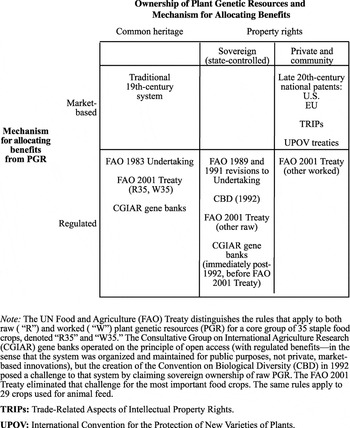
Two dimensions of debate.

Changes in property norms for raw and worked PGR
 You have
Access
- 699
- Cited by