Travel guides of the mid-nineteenth century were almost certain to encourage visitors to Rome to see Raphael's fresco of The Meeting between Leo the Great and Attila (1514) in the Vatican's Stanza di Eliodoro.Footnote 1 They were also likely to point out that Raphael's depiction of Leo the Great was in fact a flattering reference to his patron, Leo X, and to suggest appropriate analogues for Attila – usually Louis XII, but in at least one instance, Martin Luther.Footnote 2 To view the confrontation of Leo and Attila as an allegory for the politics of another historical moment, then, was not an uncommon exercise when Verdi's Attila took to the stage of the Teatro Apollo in Rome in December 1847, mere weeks before Europe was seized by revolution. The interplay of politics and opera at this critical juncture deserves a closer examination, not least because the long-supposed ‘political uses’ of Verdi's ‘Risorgimento’ operas have recently come under much critical scrutiny.Footnote 3 The Roman performances of Attila provide us with an ideal case study.
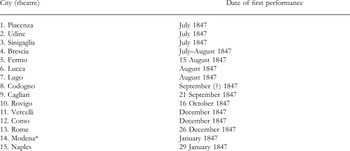
Few operas could boast as many productions in the months preceding the revolutions as Attila, which had premiered in Venice in March 1846. No fewer than fifteen Italian productions of the opera, many of them in small theatres all too frequently overlooked in reception histories, were staged (or at least attempted) from the summer of 1847 to the following Carnival season (see Table 1).Footnote 4 These performances invite further study, but it is already fairly clear, revisionist doubts notwithstanding, that the opera tended to cause a patriotic stir wherever it played during these months. The production in Modena was, according to L'Italia musicale, the house journal of the publisher Lucca (who had secured the rights to Attila), ‘suspended by superior order at the dress rehearsal’.Footnote 5 And the Lombard writer Ignazio Cantù reported:
In Como there was no longer restraint, when Attila was sung at the theatre, at these verses:
[Dear homeland, once mother and queen of valiant, bighearted sons.]
Italian productions of Verdi's Attila, July 1847–January 1848

* Production suspended by the authorities
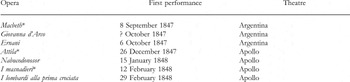
For its part, the Roman production was significant not only in the context of this array of Italian performances, but as part of an operatic season in Rome dominated almost entirely by Verdi, including every opera (up to that point) traditionally ascribed political meaning (see Table 2). Each of these productions played in counterpoint to rapidly unfolding political events in complex and fascinating ways, but here I will focus exclusively on Attila.
Verdi operas performed in Rome, autumn and winter, 1847–8

* Rome premiere
The opera opened in Rome to stormy conditions, literally and figuratively. In one of her many dispatches to Horace Greeley's New York Tribune, Margaret Fuller, the American critic, feminist and member of Emerson's transcendentalist circle,Footnote 7 complained on 30 December that ‘we have had a fortnight of rain falling incessantly … Everything was spoiled by the weather.’Footnote 8 Amid such gloom, the Carnival season at the Teatro Apollo opened, as usual, on 26 December 1847. The opening coincided with the beginning of another round of public demonstrations that would lengthen ‘the shadow that [had] fallen on [the pope's] popularity’.Footnote 9 Ever since his first major act, a general amnesty for political prisoners and exiles (16 July 1846), Pius IX had nervously watched the gap between his moderate inclinations and the expectations of his subjects grow ever wider. Events in the second half of 1847 had done little to ease the restlessness of the people. In July, Austrian forces moved into the border city of Ferrara, where the Congress of Vienna had set up a complicated and fragile relationship between the empire and the Papal States. Pius had no choice but to resist the incursion, and his protests against Austria were cheered throughout the peninsula. Seizing the moment, Giuseppe Mazzini wrote his famous open letter inviting the pope to take lead of the unification movement.Footnote 10 This Pius could not do, and even though he was able to secure the Austrians' withdrawal from Ferrara on 20 December, doubts about his commitment to liberal ideals continued to grow. As Fuller observed, Pius had revealed himself ‘a man less strong against domestic than foreign foes, instigated by a generous humane heart to advance, but fettered by the prejudices of education, and terribly afraid to be or seem to be less than the Pope of Rome, in becoming a Reform Prince, and father to the fatherless’.Footnote 11
Though the details are somewhat murky, the public celebration of Pius's name day (27 December) was darkened not only by the weather but also by a palpable spirit of revolution. According to one account, a crowd determined on 26 December to march to the Quirinal Palace, where the pope then resided, carrying signs inscribed with a list of desired reforms – including full freedom of the press, public education, emancipation of the Jews and the formation of an Italian league. Cooler heads prevailed, however, and they decided instead to write up the list of desired reforms and send it on to the palace. Naturally, this list was also printed and distributed through the city. On the evening of 27 December, a crowd, undeterred by the weather, trudged through the mud and rain to the palace to receive the pope's blessing, which Pius, under the shelter of an umbrella, hastily granted.Footnote 12
More uneasy days followed. Fuller reported that ‘rumour[s] of tumult’ and ‘inflammatory handbills’ fostered an atmosphere of suspicion on every side. On New Year's Day, ‘the people, as usual, asked permission … to go to the Quirinal and receive the benediction of the Pope’, but this request was brusquely denied by the papal authorities who, to add insult to injury, doubled the guard at the palace to prevent anything of the sort from happening. Deeply troubled by this response, the people dispatched the newly appointed Senator of Rome (a sort of mayor), Prince Tommaso Corsini, to plead their case directly to the pope:
He went to the Pope, found him ill, entirely ignorant of what was going on and much distressed when he heard it. He assured the people they should be satisfied, that since they had not been allowed to come to him, he would go to them. Accordingly the next day, though rainy and of a searching, miserable cold like that of a Scotch mist, we had all our windows thrown open and the red and yellow tapestries hung out. He passed through the principal parts of the city, the people throwing themselves on their knees and crying out ‘O Holy Father, don't desert us; don't forget us; don't listen to our enemies’. The Pope wept often and replied, ‘Fear nothing my people, my heart is yours’.Footnote 13
Coming scarcely a week after the Austrians' withdrawal from the Papal States, and amid a moment of patriotic fervour that threatened continually to spin out of control, it is quite simply unimaginable that Attila's depiction of Romans (under papal leadership) valiantly repelling the Huns would not have had timely relevance for its audience at the Apollo. Such metaphorical uses of Attila (or his Swabian twin Frederick Barbarossa, who served an identical rhetorical function) were, in fact, a Risorgimento commonplace, especially in 1848–9. For example, Leone Tettoni, flush with the exhilaration of revolution, opened his Cronaca della rivoluzione di Milano (1848) with a none-too-subtle jibe at his once and future masters:
The epochs in which our Lombardy remembers the names of Attila, Uraia, Frederick Barbarossa, and the barbarian armies of the Scythians, Huns, Goths, Visigoths, Ostrogoths and Burgundians are epochs all too happy when compared to the thirty-four years of the late Austrian domination of this beautiful part of Italy; and historians who with horror have handed down to us the facts of those times, would certainly be of a different opinion, calling the Germans of the nineteenth century barbaric hordes and those Nordic legions of beautiful Milan's early days heroes!Footnote 14
The anonymous tract Del potere politico (Venice, 1849) yearned for ‘a clergy truly learned and independent of despotic power’ from which ‘could easily arise a St Leo, a St Gregory VII, or an Alexander III to cause to tremble on their bloody thrones the Attilas, Henry [IV]s and Fredericks of our days’.Footnote 15 It was widely hoped that Pius IX himself would fulfil such a role:
Then he [Pius] recalled that Attila, the scourge of God, the conqueror of the West, was halted before a pope who unfurled the banner of the cross; then he recalled that Italy repelled the seven armies of Frederick with the sword of friendship and union; then at last he realised that the fire of love alone could fell and destroy the colossus of tyranny. And with love Pius IX turned: and with love he triumphed over the sword and the mind.Footnote 16
After war broke out with Austria, Francesco Domenico Guerrazzi implored the ‘volontarii di Vienna’: ‘Attila, the fierce king of the Huns, at the word of Pope Leo, turned back his steps, saluting immortal Rome. Young German sons of Schiller's thought, do you yearn for the fame of Genseric and Bourbon, the devastators of Rome?’Footnote 17
References like these are so plentiful that it is hard to see how any Italian – and especially any Roman – audience in the 1840s would not have understood Verdi's Attila in patriotic terms. Certainly Margaret Fuller, an intelligent and sensitive observer who attended a performance of the opera during the first week of its Roman run, recognised the political resonances the opera had with its audience:Footnote 18
The Romans begin now to talk of the mad gayeties of Carnival, and the Opera is open. They have begun with ‘Attila’, as, indeed, there is little hope of hearing in Italy any other music than Verdi's. Great applause waited on the following air. (The music is in itself very pleasing, but that was not the reason.)
[My lot is fixed and I stand ready for every conflict. If I must fall, I shall fall as a brave man, and my fame will survive. I shall not see my beloved country fall to pieces and slowly perish, and over the last Roman all Italy will weep.Footnote 19]
And at these words:
Increasingly during Attila's run there was at least as much drama and spectacle in the house as on the stage. According to L'Italia musicale, the performance of the opera on 2 January was ‘an evening of grand solemnity … Certainly Attila at the Apollo has never seen and perhaps will never again see such choice and numerous spectators. The hall and the boxes were seen crowded with soldiers of every insignia and every rank in their dress uniforms, made more striking and shining by the lights of many double-branched candlesticks.’ The outward reason for the pomp was to commemorate the installation of a new Deputation of Public Spectacles, now under municipal rather than ecclesiastical control and chaired by none other than Prince Tommaso Corsini, whose appearance at the theatre was greeted with deafening applause and shouts of ‘Evviva Corsini, evviva il Senatore, evviva il Senato Romano!’Footnote 21 To be sure, Romans welcomed the easing of censorship that came under Pius and were delighted now to have a nobleman of liberal sympathies, rather than a reactionary cleric, in charge of public spectacles.Footnote 22 But there can be little doubt that the real reason for Corsini's rapturous reception was his heroic mediation on behalf of the people the day before. And the presence of uniformed soldiers in the theatre may have been for more than festive display; Giuseppe Spada, who lived through the events of 1848–9, insists in his history that, as early as 26 December, ‘in … the Apollo, it was prearranged preventatively to have appearing in civic uniform all those who were officers of that corps’.Footnote 23 Such caution corresponds to measures taken at the performance of another Verdi opera in Piacenza, reported in the Roman journal Pallade in February 1848: ‘At the theatre Verdi's opera I lombardi is sung, and the boxes and the pit burst out in indescribable applause. The gendarmes, the police, the bailiffs run among the boxes [and] in the aisles, but to no avail.’ Footnote 24 The theatres had come to rival the streets as a venue for political demonstrations. It is entirely possible, then, that the soldiers' principal function in the Apollo was to keep outbursts like that experienced by Fuller from getting out of hand.
The remainder of the Carnival season in Rome played out against the backdrop of the Palermo uprising of 12 January and the rapid chain of events in the Two Sicilies that culminated in Ferdinand II's granting of a new constitution. The Roman papers during these months were filled with detailed accounts of political and military manoeuvres in Naples and Sicily, and these events highlighted all the more the political relevance of Attila, which was still playing at the Apollo and which would open at the San Carlo, Naples on 29 January. On 31 January Pallade, describing the Neapolitan celebrations that accompanied the ratifying of the new constitution, reported: ‘That evening at the Teatro San Carlo was performed for the first time Attila, which was not lacking in allusions to the occasion, and all were prepared to open their hearts to freer expressions’.Footnote 25 Such expressions may have been offered despite censorial expurgation of the opera's more inflammatory lines. L'Italia musicale complained, even before the production opened, that the libretto had been ‘mutilated and modified’,Footnote 26 and a review in the Augsburg Allgemeine Zeitung reported that ‘every passage in the pruned libretto [beschnittenen Operntextes] that smacked of freedom was applauded’.Footnote 27 If the censors did intervene, it was obviously to no avail.
On 4 and 5 March, as the whole of Europe hurtled towards revolution and after Verdi's Attila had yielded the Apollo stage to other operas, Romans crowded into the theatre to hear a new hymn by the Bolognese composer Gaetano Magazzari.Footnote 28 The text by Filippo Meucci called for the return of Italian heroism to combat the barbarians at the gate:
[Rally round the shadow of your standards, for the sons of Attila do not tremble far in the distance. May God awaken and renew the honour of Legnano, the boldness of Balilla, the heart of Procida.]
When war finally came with the uprising in Milan (the Cinque giornate, 18–22 March 1848), the new Milanese Committee of Public Safety echoed the sentiment of Meucci's verses when it declared ‘the need to pluck out the last roots of the ferocious sons of Attila from Italy’.Footnote 30 For the Italians of 1848 such imagery could not have seemed more apt – or more familiar.