Vocabulary learning is a necessary component of second language acquisition. However, the cognitive processes used to learn new words are myriad (Majerus, Reference Majerus2013). Cognitive processes including executive control and memory for serial order are required to recall spoken words in a native and a non-native language (Leclercq & Majerus, Reference Leclercq and Majerus2010; Majerus, Poncelet, Van der Linden & Weekes, Reference Majerus, Poncelet, Van der Linden and Weekes2008; Majerus, Heiligenstein, Gautherot, Poncelet & Van der Linden, Reference Majerus, Heiligenstein, Gautherot, Poncelet and Van der Linden2009; Majerus, Reference Majerus2013; Mikan, Reference Mikan2013). Studies have focussed on the immediate recall of spoken foreign vocabulary, low frequency words and nonwords. By contrast, the processes used to learn written words are relatively understudied (Andrews, Reference Andrews, Pollatsek and Treiman2015; Weekes, Reference Weekes1991; Reference Weekes1993; Reference Weekes1994).
We know there is a significant correlation between verbal short term memory (STM) tasks and spoken word learning in first (L1) and second (L2) languages (Gathercole, Service, Hitch & Martins, Reference Gathercole, Service, Hitch, Adams and Martin1999; Massoura & Gathercole, Reference Masoura and Gathercole2005; Mikan, Reference Mikan2013). STM processes such as serial order memory capacity and measures of executive control predict vocabulary learning (Majerus et al., Reference Majerus, Poncelet, Van der Linden and Weekes2008; Reference Majerus, Heiligenstein, Gautherot, Poncelet and Van der Linden2009). Studies of spoken vocabulary learning in a non-native language are mostly performed in laboratory settings. However, vocabulary learning typically involves study of written texts, often printed in a non-native language. This is a growing phenomenon particularly when English is the medium of instruction (Dearden, Reference Dearden2015). Although we might expect the processes used to learn spoken words in a second language are also necessary for the acquisition of written words, no study has tested this hypothesis directly. The goal of this study is to investigate vocabulary learning in a natural learning environment (tertiary studies) when the medium of instruction is English as in Hong Kong). To identify the significance of correlated processes that contribute to new vocabulary learning, multiple regression methods are useful. However, if multi-colinearity between variables is large, alternative designs can be used. The approach adopted here is to test hypotheses using a longitudinal design over a one year period in a naturalistic rather than a laboratory setting. The advantage of this approach is that effects of correlated variables might be revealed at different time points during learning.
Many theories of new vocabulary learning assume a causal role for STM and moreover some posit that executive control and serial order memory capacity have independent effects on spoken word learning (Gupta, Reference Gupta2003). Although the latter claim is not contested, no theory explicitly assumes differential effects of correlated cognitive processes on learning of written words. STM models that assume related mechanisms for executive control and serial order memory capacity (e.g., Botvinick & Plaut, Reference Botvinick and Plaut2006; Burgess & Hitch, Reference Burgess and Hitch2006), generate predictions about how serial order memory capacity constrains vocabulary learning. There is mounting evidence that serial order memory capacity – estimated by spoken recall of digits, words and nonwords – predicts vocabulary learning in native and non-native languages (Majerus, Reference Majerus2013) including Cantonese speakers learning in English (Cheung, Kemper & Leung, Reference Cheung, Kemper and Leung2000). Serial order memory capacity predicts acquisition of spoken French words in native French speakers and English and native German speakers (Majerus et al., Reference Majerus, Poncelet, Greffe and Van der Linden2006: Majerus et al., Reference Majerus, Poncelet, Van der Linden and Weekes2008a, Reference Majerus, Belayachi, De Smedt, Leclercq, Martinez, Schmidt, Weekes and Maquet2008b; Mikan, Reference Mikan2013). However, we do not yet know if tests of serial order memory capacity and theoretically related cognitive processes predict written word acquisition in a second language. We do know that phonological skills predict the acquisition of literacy (reading and writing) in languages that use an alphabet. However, this is not true in languages that use a nonalphabetic script such as Chinese (Barrett, Reference Barrett2011; Tong & McBride-Chang, Reference Tong and McBride-Chang2010). The consolidation of written words into long term memory, i.e., lexicalisation, takes time for adult English speakers and undergraduates often do not attain spelling proficiency for words taught in the curriculum (Andrews, Reference Andrews, Pollatsek and Treiman2015; Holmes, Malone & Redenbach, Reference Holmes, Malone and Redenbach2008; Weekes, Reference Weekes1991, Reference Weekes1994, Reference Weekes1996). The question posed here is do the STM processes that we know contribute to spoken word learning in a second language also predict written word acquisition in a second language? The answer to this question has implications for models of second language learning and pedagogy when the medium of instruction is not the native language. This is a growing trend with the use of English globally (Dearden, Reference Dearden2015).
Stadthagen-Gonzalez, Bowers and Damian (Reference Stadthagen-Gonzalez, Bowers and Damian2004) investigated the lexicalisation of written words by adult monolingual English speaking undergraduates learning new expert words. Expert words were extracted from the written texts used in academic disciplines and presented according to whether they were known before study and how often they were exposed to students during tertiary studies. Stadthagen-Gonzalez et al. (Reference Stadthagen-Gonzalez, Bowers and Damian2004) assessed written expert word recognition using a lexical decision task and found that expert word recognition became faster and more accurate after one year of exposure. Although they assumed lexicalisation of expert words was achieved, it is not certain that expert words were fully lexicalised. A more reliable and valid test of expert word lexicalisation can be achieved using a writing to dictation task. One goal of the present study, therefore, is to test expert word lexicalisation using a spelling task.
Stadthagen-Gonzalez et al. (Reference Stadthagen-Gonzalez, Bowers and Damian2004) did not offer a theoretical account of the cognitive processes used to lexicalise written expert words and therefore no predictions can be derived about how these processes contribute to learning of expert written expert words in a second language. However, given written words are typically presented simultaneously with spoken words in tertiary curricula, it might be assumed that the mechanisms used to lexicalise expert written words rely in part on STM. Therefore, one testable hypothesis is that performance on verbal STM tasks will be associated with expert word lexicalisation. To test this hypothesis, the present study recruited Cantonese speakers who are learning written expert words in their second language – English (L2). The study had three phases. In Phase One, participants were given a battery of tasks to measure cognitive abilities and a lexical decision task with expert written words and nonwords derived as minimal pairs e.g., presbycusis and bresbycusis to assess expert word knowledge. In Phase Two, expert word knowledge was reassessed to distil a metric of written expert word learning (Phase 2 – Phase 1 lexical decision performance). In Phase Three, expert word lexicalisation was assessed after one year via writing to dictation. The expectation was that STM measures would predict lexicalisation of written expert words.
The specific hypothesis was that measures of executive control and serial order memory capacity would be correlated with written word lexicalisation. To assess serial order memory capacity, verbal and nonverbal STM tasks were used including the serial order reconstruction paradigm developed by Majerus et al. (Reference Majerus, Poncelet, Van der Linden and Weekes2008). In this paradigm, participants listen to familiar digits ranging from 3–7 items and then reconstruct the same order of presentation by pointing to index cards, i.e., nonverbally. Two main predictions were derived: (1) performance on tests of executive control and serial order memory capacity will predict the lexicalisation of expert words, and (2) these effects would be equivalent across tests of lexicalisation, i.e., recognition and recall of written expert words. An alternative outcome is that cognitive processes impact on lexicalisation at different stages in the learning trajectory with written expert words. One reason to expect this outcome is that STM could be less significant for acquisition of words if extant lexical networks, i.e., comprising words established in long term memory, already contain similar words (Lanfranci & Swanson, Reference Lanfranchi and Swanson2005). Cognates and synonyms allow lexical and semantic bootstrapping thus reducing the demands on STM processes. To minimise extant vocabulary, Cantonese–English speakers in Hong Kong were specifically recruited because Chinese uses a non-alphabetic writing system (Leck, Weekes & Chen, Reference Leck, Weekes and Chen1995) making direct translations of written expert words unlikely. Although extant vocabulary cannot be controlled completely in this sample – as undergraduates in Hong Kong must attain a level of English literacy to enter tertiary studies – this sample does allow a relatively strong test of the predictions. Hong Kong undergraduates are highly literate according to standardised testing (Program for International Student Assessment, 2012). Therefore, sampling Cantonese–English bilingual speakers who are learning written expert words when the medium of instruction is a non-native language (English), provides reasonable control over possible effects of extant vocabulary on written expert word lexicalisation in a second language. However, to control for the potential effects of extant vocabulary on new word learning, measures of English proficiency were also taken.
Method
Participants
Twenty-eight participants (7 males, mean age = 19.11, SD=0.57) were recruited from the first-year cohort of a four-year tertiary programme. All participants were native Cantonese (L1) speakers with age of English acquisition ranging from 3 to 9 years with normal auditory and visual acuity and language development. The method of teaching was Problem Based Learning (PBL) for all students (Albanese & Mitchell, Reference Albanese and Mitchell1993). 1st-year students were recruited to minimise pre-instruction knowledge of written expert words. However, formal testing did not begin until the course had commenced. Testing of expert word recognition and recall was performed 12 months after Phase One with 25 participants (89%) of the sample recruited.
Preparatory study
Pilot testing established the validity of targets in the following way: twenty-one participants (five male, sixteen female) were recruited from an earlier first year undergraduate cohort. All were native Cantonese-speaking students aged between 18 and 19 years. Inclusion criteria were: (1) Cantonese first language; (2) no history of neurological disorders or developmental delays; (3) normal auditory and visual acuity; and (4) normal language development with no learning difficulties. All participants had learned English from six years of age and all had at least 12 years experience using English as a second language including sufficient mastery in spoken and written English to enter tertiary studies, i.e., all were in the top 5% of their cohort.
A total of 14 tasks were administered. In order to reduce demands on oral production, a majority of tasks chosen were nonverbal, i.e., required no spoken word response. Nonverbal is not equivalent to non-linguistic since all tasks reported could be performed with linguistic operations. To assess knowledge of English target words, a written lexical decision task with expert words and nonword minimal pairs was devised. Prior testing with a comparable group of participants from a previous year cohort had identified 500 expert words (e.g., echolalia) in the readings and course notes in the same curriculum. A sample of 72 English expert words were selected according to the criterion that were identified as words no better than chance (50%) in the first month of the course and were defined as targets (shown in Appendix One).
Executive control was assessed using the Flanker (Fan, McCandliss, Sommer, Raz & Posner, Reference Fan, McCandliss, Sommer, Raz and Posner2002) and Stroop tasks (Stroop, Reference Stroop1935). Serial order memory capacity was measured via the serial reconstruction task devised by Majerus et al. (Reference Majerus, Poncelet, Van der Linden and Weekes2008a) consisting of digits presented auditorily to a participant individually and in a random order by a pre-recorded female voice. Each block had 3 to 7 digit sequences presented of increasing length and six trials were presented for each sequence length until criterion was attained (defined as the sequence in which a participant could not produce the correct order in more than half the trials). Each participant was presented with stimulus cards (5cm x 5cm) with a digit printed on a card and asked to arrange them linearly in the same sequence after a brief delay according to the horizontally arranged configuration. The longest sequence recalled was a measure of serial order capacity. Performance was close to ceiling. This may be due to larger digit span reported for Chinese–English undergraduates in Hong Kong (Chincotta & Hoosain, Reference Chincotta and Hoosain1995). Verbal measures of STM including digit span, nonword span and word span in Cantonese and in English were tested. Measures of extant English vocabulary knowledge were also collected from each participant (see details below).
Items were chosen as targets if 90% of participants did not recognise a word in lexical decision performance (at least 10% error rate). To test the sensitivity of experimental tasks, target recognition was correlated with cognitive and language test performance. Regression analyses identified four variables predicting expert word acquisition: Digit-Symbol matching (β=0.824), English vocabulary production (β=−0.668), nonword recall (β=0.353) and target recognition from words translated into Cantonese (β=−0.320). Additional analysis found that serial order reconstruction (in English) was significantly correlated with performance on the same task conducted in Cantonese r=0.45, p=0.04 and a measure of Cantonese vocabulary production r=−0.51, p=0.02 confirming the sensitivity and validity of experimental tasks both in Cantonese and English. Serial order reconstruction was significantly correlated with (1) delayed memory for Cantonese words r=−0.51, p=0.02 and (2) English words r=0.53, p=0.01 and performance on Corsi Blocks r=0.56, p<.05. A test of writing to dictation found fewer than 20% of targets were correctly spelled suggesting targets had not been lexicalised. Serial order reconstruction did not predict target recognition or recall. This is due to a ceiling effect.
Experimental procedure
Twenty-eight participants were tested on an individual basis in a quiet location. Each session lasted for 1.5 hours maximum. In Phase 1, participants performed tasks assessing expert word knowledge, serial order reconstruction, verbal and nonverbal executive control, verbal STM, intellectual ability, self-rating of Cantonese and English exposure and number of hours per week studying in English. In Phase 2, expert word knowledge was reassessed with a lexical decision task. In Phase 3, expert word knowledge was reassessed with a lexical decision task and writing to dictation task. Phase 3 was conducted 12 months after the end of Phase 2.
Materials
Expert word recognition
A lexical decision task was devised using E-prime software. A total of 72 word and 72 nonword trials were presented visually on a computer screen one at a time in random order. Participants were instructed to press a mouse button (counterbalanced) as quickly and accurately as possible to indicate whether the stimulus was a word or a nonword. Decision accuracy (percentage correct) and decision latencies (in msec) were recorded for subsequent analyses. Mean accuracy of 50% correct represents chance level of performance. Therefore, acquisition was defined as better than chance performance. Successful acquisition of expert words was further defined according to the correct rejection of nonwords above a criterion of 80%. Subsequent analyses of expert word lexicalisation refer to word trials only.
Serial order reconstruction task
As described in the pilot study – however the range of digits was increased from 3–7 to 5–9 due to ceiling effects with 3–7 digits found in previous testing.
Flanker task
The arrow version of the Flanker task was administered via the Presentation Software (Ridderinkhof, van der Molen, Band & Bashore, Reference Ridderinkhof, van der Molen, Band and Bashore1997). Target stimuli were arrows presented in the centre of the computer screen. The target was surrounded by distractors on both sides (right and left) either arrows or straight lines. In the neutral condition (32 trials) the target was flanked by straight lines; in the congruent condition (32 trials), flankers were arrows pointing the same direction as targets; in the incongruent condition (32 trials), flankers were arrows pointing the opposite direction. Participants decided if the arrow direction was congruent by pressing a right or left mouse button (counterbalanced). Accuracy and reaction time (RTs) were recorded.
Stroop Colour-Word task (English)
A computerised version of the Stroop Colour-Word task (Stroop, Reference Stroop1935) was administered. Stimuli were presented on a computer screen one at a time. Participants pressed a key to indicate ink colour of the stimulus target. Response accuracy (% correct) and reaction times were recorded and computed collapsing across the neutral and incongruent trials. The task consisted of colour word trials presented in a different colour (i.e., “BLUE” in red colour) and trials in the same colour. A word was presented one at a time on the computer screen in a random order. Participants identified word colour by pressing the corresponding button on a keyboard (e.g., ‘red’ by pressing ‘R’) as quickly and accurately as possible (counterbalanced). Response accuracy and reaction times (RTs) were recorded. Note that no oral response was required.
Digit span (English)
Software program ‘D-Span’ with pre-recorded voice audio of digits was used (native male English speaker). Lists with 3 to 11 digits were presented to participants with increasing length and inter-stimuli interval of 1000 msec. Participants were instructed to type digits recalled on a keyboard. No oral response was required. Familiar sequences were excluded (e.g., 911). Each set of digits consisted of five trials. The point at which a participant made 3 errors on 5 trials was treated as their maximum digit (nonverbal) recall capacity. The total number of digits correctly recalled was recorded as a participant's maximum digit span.
Word span (English)
Word lists contained 4 to 15 syllables with 3 trials for each syllable span. Stimuli were presented auditorily using a pre-recorded female voice. Each participant recalled (orally) the auditorily presented stimuli with increasing length starting from four syllables. The condition in which a participant made two errors out of three trials was treated as the maximum score and the largest number of syllables recalled was the participant's span.
Nonword span
Nonword stimuli were pseudo-syllables derived by eliminating gaps in the phonemes of English words according to phonotactic rules. Nonword sets consisted of 5 to 12 syllables. Stimuli were presented auditorily in a pre-recorded female (English speaker) voice. Participants recalled auditorily presented stimuli (orally) with increasing length beginning at 5 syllables. The condition in which a participant made 2 errors out of 3 trials was defined as the maximum score and greatest number of syllables recollected the total nonword span.
Corsi-block tapping
Nine plastic blocks (5 x 5 x 5 cm) were used. The participants were asked to observe a sequence of blocks tapped by a confederate and repeat the sequence tapping each block in the correct order. The task began with 2 blocks and increased to a maximum number of 9 blocks. Each sequence length contained 3 trials. The condition in which a participant made errors on 2 out of 3 trials was treated as a maximum level non-verbal span. The longest sequence recalled was computed and served as the participant's visuo-spatial nonverbal span.
Raven's Progressive Matrices
The test included Set A and Set B of the Standard Progressive Matrices (Raven, Reference Raven1984). Participants saw 24 sequentially presented visual patterns with one pattern piece missing. They were asked to choose a target from among 6 choices to complete each pattern. A total score out of 24 trials was calculated and the raw scores were computed.
Controlled Oral Word Association Test (COWAT)
Participants were asked to name words from a semantic category (animals) in one minute (Benton, Varney & Hamsher, Reference Benton, Varney and Hamsher1978). Total number of correct English animal names retrieved was defined as a measure of English word fluency.
British Picture Vocabulary Scale (BPVS)
A Short Form of the BPVS (Dunn, Dunn, Whetton & Pintilie, Reference Dunn, Dunn, Whetton and Pintilie1982) was administered. A computerised version was used consisting of 32 trials presented in increasing difficulty (according to word frequency). On each trial, participants heard a spoken word and were asked to match the word with one of four pictures. Number of correct responses was recorded and used as a measure of vocabulary. No oral response was required.
Cantonese Naming
Stimuli were taken from the set of colorized Snodgrass and Vanderwart (Roisson & Pourtois, Reference Rossion and Pourtois2004). A stimulus was presented on a computer screen. There were 30 trials. Each participant was asked to name pictures in Cantonese within 2 seconds. Naming accuracy was calculated. Total number named correctly was used to estimate word fluency.
English Naming
The procedure was identical to the Cantonese Naming task but alternative items were presented. Items were matched to the Cantonese task for relevant variables. There were 30 trials. Each participant was asked to name pictures in English within 2 seconds. Naming accuracy was calculated. Total number named correctly was the estimate of fluency.
Cantonese translation
Words with variable low, medium and high frequency in Cantonese were presented auditorily to each participant who was asked to translate a target into English orally. A total of 90 trials were given. Translation accuracy was a measure of L2 vocabulary.
English translation
Identical to the Cantonese translation task except an English word was translated into Cantonese. There were 90 trials in total. Translation accuracy was calculated.
Self-rated language questionnaire
Participants were asked to rate L1 and L2 proficiency using a 7-point scale (1 represents least fluent and 7 represents most fluent); number of hours exposed to Cantonese and English, respectively per day; age of onset and duration of English vocabulary learning; and exposure (in number of hours) to academic materials in English.
Results
Learning words in a second language probably draws on knowledge of phonological forms in the language network (Majerus et al., Reference Majerus, Poncelet, Greffe and Van der Linden2006; Masoura & Gathercole, Reference Masoura and Gathercole2005; Thorn & Gathercole, Reference Thorn and Gathercole2001) as well as cognitive skills that vary across individuals (Bartolotti, Marian, Schroeder & Shook, Reference Bartolotti, Marian, Schroeder and Shook2011; Cowan, Reference Cowan1995; Kaushanskaya & Marian, Reference Kaushanskaya and Marian2009). Therefore, the contribution of correlated variables was partialled out using regression analyses to determine the significance of STM measures on written expert word learning. Given a small sample size (n=28), a maximum of three variables were introduced into analyses. It is important to note, however, that predictor variables were highly correlated with written expert word learning.
Mean expert word recognition accuracy in Phase One was 80.9% (SD=6.5), which was significantly above chance level of 50% p<0.001. This shows participants had lexicalised some target words before testing commenced. Nevertheless, when re-tested six months later (Phase Two) mean accuracy was 87.3% (SD=5.1) a significant increase t(27)=8.88, p<0.001. For analysis of latencies, only correct trials were included. Participants averaged 976 msec (SD=246) in Phase One and 859 msec (SD=166) in Phase Two, a significant decrease in reaction time p<0.001. On tests of executive function, accuracy was at ceiling on the Stroop task (mean=97.7 and 98.4% on incongruent and neutral trials respectively) and the Flanker task (mean=95.8 % and 99.7% on incongruent and neutral trials, respectively). Executive control was determined by subtracting RTs in the congruent condition from the incongruent conditions in each task. On the Flanker Task, average RT was 471 msec (SD=57) for the congruent trials and 562 msec (SD=66) for the incongruent trials. A paired t-test confirmed a Flanker effect i.e., a significant RT difference t(27)=-17.03, p<0.001. On the Stroop Task, average RT was 1039 msec (SD=192) for the congruent trials and 1266 msec (SD =242) for the incongruent trials. Paired t-test confirmed a Stroop effect i.e., a significant RT difference t(27)=9.15, p<0.001. Performance on other experimental tasks refers to the number of trials correct or else as stated.
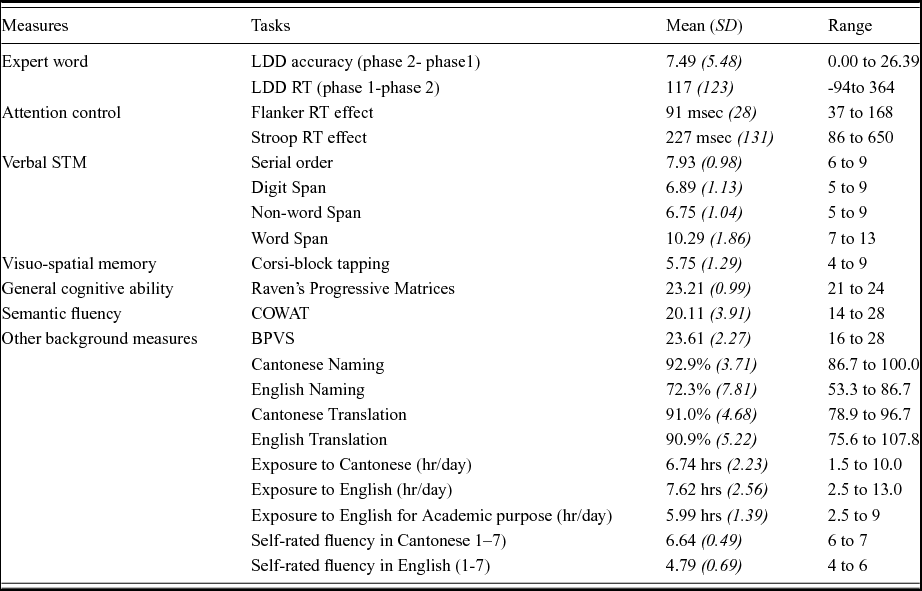
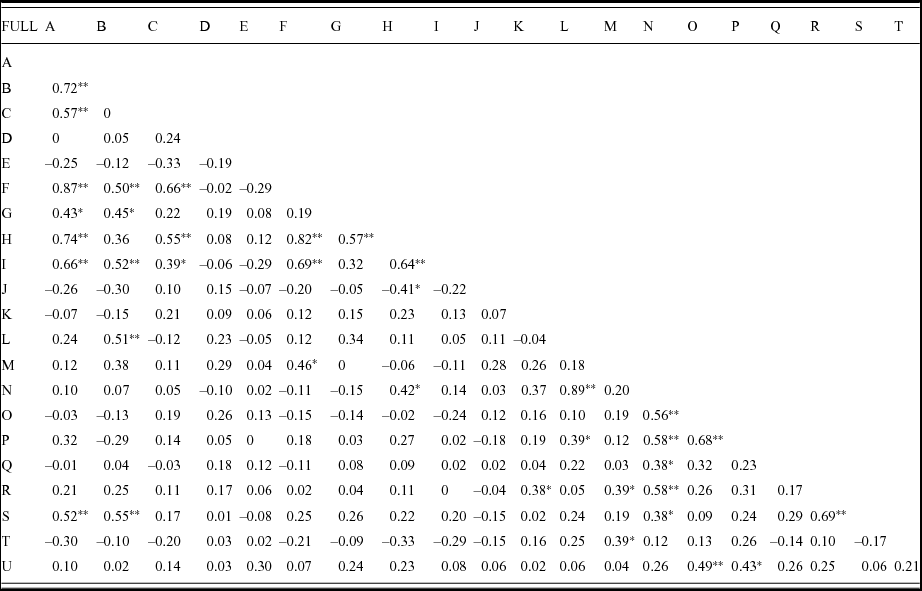
A summary of the descriptive statistics from all experimental tasks is shown in Table 1 and a summary of correlation coefficients between experimental tasks is shown in Table 2. The difference in lexical decision time between Phase Two and Phase One was used to form the index of expert word learning for analyses (accuracy was significantly correlated with the index r=−0.42, p=0.03). Ceiling effects were noted for performance on Raven's Progressive Matrices and self-rated fluency of Cantonese (oral and written vocabulary) but no other task.
Descriptive Statistics for the main measures (N=28)

Correlation matrix for all variables

A Overall accuracy in lexical decision task
B Accuracy in word trials in lexical decision task
C Accuracy in nonword trials in lexical decision task
D Flanker (Reaction time measures)
E Stroop (Reaction time measures)
F Digit Span
G Word Span
H Nonword Span
I Serial order memory
J Corsi-blocking tapping task
K Raven's Progressive Matrices
L British Vocabulary Picture Scale
M Cantonese Naming
N English Naming
O Cantonese Translation
P English Translation
Q Cantonese Exposure
R English Exposure
S Exposure to academic materials
T Self-rated proficiency in Cantonese
U Self-rated proficiency in English
*p < .05, **p < .01
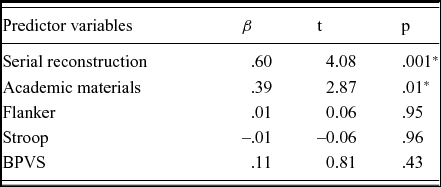
Significant positive correlations were observed between expert word learning scores and STM measures, including serial order reconstruction r=0.52, p<0.01, digit span r=0.50, p<0.01, word span r=0.44, p<0.02, and number of hours of exposure to academic materials in English r=0.52, p<0.01. Significant positive correlations were also observed between serial order reconstruction and digit span r=0.69, p<0.01 and with nonword span r=0.64, p<0.01 and nonword span with word span r=0.82, p<0.01 showing that recall performance on verbal and nonverbal tasks was correlated. Regression analyses tested significant predictors. Results are summarized in Table 3. Only performance on serial order reconstruction and exposure to academic materials independently predicted expert word learning performance in Phase Two.
Multiple regression results predicting L2 written expert word learning (Phase 2-Phase 1)

*p<0.05
Re-testing of expert word knowledge was performed twelve months after completion of Phase One with 25 participants (89%) of the original sample recruited. Three tasks were presented: a nonword delayed repetition task requiring verbal production, expert word lexical decision, and writing to dictation. Non-word delayed repetition was adapted from Majerus et al. (Reference Majerus, Poncelet, Greffe and Van der Linden2006) to test verbal STM. Materials were 30 monosyllabic nonwords taken from Gupta, Lipinski, Abbs, Lin, Aktunc, Ludden, Martin and Newman (Reference Gupta, Lipinski, Abbs, Lin, Aktunc, Ludden, Martin and Newman2004). Participants heard spoken nonwords presented one at a time and were asked to repeated each item after a 6 second delay during which they continuously repeated blah, blah (articulatory suppression). Responses were recorded with a digital recorder and were scored via offline transcription. The number of correct responses (nonwords recalled) was calculated for each participant. Mean expert word lexical decision accuracy was 89% (SD=7.1), which was not significantly improved from performance in Phase Two. The writing to dictation task comprised of seventy expert words (Appendix One), recorded by a female English speaker. Participants heard expert words presented one at a time, and wrote the word using a computer keyboard. The writing to dictation task was presented after completion of the lexical decision task for all participants. Mean writing-to-dictation accuracy was 61% correct (SD=15, range 45–79%), which is a significant increase from performance in Phase One t(22)=4.48, p<0.01.
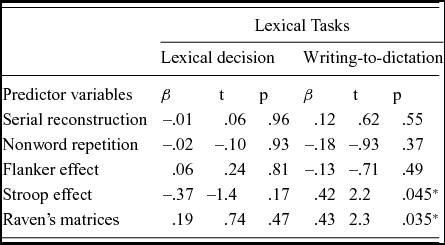
In regression analyses, performance on lexical decision and writing to dictation tasks were dependent measures and predictors were serial order reconstruction, Flanker, Stroop and Ravens scores (measured in Phase One) and delayed nonword repetition (measured in Phase Three). Due to the significant correlations between delayed nonword repetition (verbal) and serial order reconstruction (nonverbal) r=0.64, p<0.01, variables were analysed separately. Results showed significant effects of Ravens score β=0.48, p<0.05 and Stroop score β=0.42, p<0.05 only on writing to dictation. No other variable had a significant effect (see Table 4).
Multiple regression results predicting L2 written expert word lexicalisation (Phase 3)

*p<0.05
Discussion
Results show that executive control and serial order memory capacity both predict the lexicalisation of L2 written words. However, these effects varied across task: lexical decision (written expert word recognition) and writing to dictation (written expert word recall). Serial order memory capacity (nonverbal digit reconstruction) significantly predicted written word learning but was not significant after one year – whereas nonverbal executive control (Stroop performance) did not predict written word recognition but did predict written word recall. Exposure to academic materials (assessed in Phase One) predicted written word recognition but did not predict written word recall and nonverbal reasoning predicted written word recall. The results support the hypothesis that cognitive processes used to acquire spoken words in a second language predict the learning of written words. It is of interest to note that almost all tasks predicting expert written word learning were non-verbal, i.e., required no oral production in English – except for the correlation between word learning and word span (see Table 2). If it is assumed that writing to dictation draws on phonological representations, the results are surprising since nonverbal tasks predict written word recall after one year of exposure. Verbal STM could predict spoken word learning using an auditory expert word lexical decision task.
The results can be understood with reference to Gupta's (Reference Gupta2003) model of vocabulary acquisition, with the caveat that the model was not proposed to explain written word learning. This model assumes that serial order STM predicts spoken language acquisition. STM allows for the activation and rehearsal of phoneme sequences and strengthens formation of lexical and phonological representations. Burgess and Hitch (Reference Burgess and Hitch2006) proposed a similar account based on a Hebbian adjustment of long term connection weights between serial order STM and extant language representations, including lexical and sublexical language networks. When a word is presented for learning, phonemes are activated in the sublexical system and a node is formed in the lexical system. Serial order memory encodes and temporarily stores phonemes allowing transfer of sound patterns to the language network subsequently building up long-term phonological representations. The lexical system stores the phonological representations whereas the sublexical system stores subword phonological information. Both systems may be relevant to expert word learning in a second language, but this is not considered in models.
Majerus et al. (Reference Majerus, Poncelet, Van der Linden and Weekes2008a) report data from English speaking undergraduates and Majerus et al. (Reference Majerus, Belayachi, De Smedt, Leclercq, Martinez, Schmidt, Weekes and Maquet2008b) and data from German speakers showing serial order memory capacity predicts learning of spoken French words (L2) in bilingual speakers. The present results show that serial order memory capacity predicts learning of written words learning of written English words in bilingual speakers. Surprisingly, nonverbal processes appear to be sufficient to learn written words in a second language, i.e., verbal mediation may not be necessary. The effects of serial order memory capacity and nonverbal executive control on written word lexicalisation in a second language is therefore relevant to theoretical models of word learning, i.e., oral production may not be necessary for written word learning. This suggests that strategies such as rote repetition might have a minimal impact on learning written words. Of course it is not possible to exclude verbal processes as significant predictors of written word lexicalisation in a second language based on the present results, e.g., verbal word span was also correlated with written word recognition. However, the results suggest that verbal STM may not be necessary or at least not may not be significant for teaching new written words in second language. This assertion may be qualified by the unique type of written words learned here, i.e., expert words.
The results suggest that serial order memory capacity has greatest impact in the early stages of written word lexicalisation whereas executive control impacts on lexicalisation over the longer term. This is also of interest theoretically since written word recognition and recall are universally assumed to depend on the quality of phonological knowledge (both lexical and sublexical) in languages that use an alphabetic script such as English. Another way to interpret the differences across task however is to assume that word recall is a more difficult task than word recognition. Both tasks require lexical retrieval (Weekes, Reference Weekes and Brunswick2010), which in turn requires the inhibition of competitor responses within the language network. Inhibition of competitors may be more demanding in written word recall, particularly when a word cannot be spelled correctly via sub-lexical (phoneme to grapheme) procedures alone. As the correct spelling of expert words in English requires a degree of lexical knowledge (e.g., presbycusis), inhibition of competing representations for written word output must be necessary. Deep dysgraphia is an extreme consequence of damage to such a mechanism, resulting in tendency to produce semantic errors in writing to dictation (Weekes, Reference Weekes2006). The finding that Stroop performance predicts writing to dictation supports the claim that inhibition is necessary. On the other hand, lexical decision could be performed based on multiple criteria (orthographic, phonological, semantic) that reflect recollection rather than recall, perhaps making it an easier task. Lexical decision performance was therefore (not surprisingly) close to ceiling here. Prior studies have used lexical decision as a measure of expert word lexicalisation (Stathagen-Gonzalez et al., Reference Stadthagen-Gonzalez, Bowers and Damian2004) rather than written word learning. The results suggest that written word recall may be a more demanding and thus more reliable test of lexicalisation that written word recognition. It is important to note that the present findings might be different if spoken word learning were the measure of lexicalisation, since verbal STM processing may also be a significant constraint.
The results suggest that the process of lexicalisation for written words in English as a second language is incremental and furthermore that lexicalisation is not complete after one year of study (spelling is little better than 60% correct). Written word recall is a demanding test (Andrews, Reference Andrews, Pollatsek and Treiman2015; Burt, Reference Burt2006; Holmes et al., Reference Holmes, Malone and Redenbach2008; Weekes, Reference Weekes1994; Weekes, Castles & Davies, Reference Weekes, Castles and Davies2006) and is vulnerable to brain damage (Weekes, Davies, Parris & Robinson, Reference Weekes, Davies, Parris and Robinson2003; Weekes, Reference Weekes2005; Reference Weekes2012). Less is known about the written word recall in a second language although some studies have looked at Cantonese speaking children learning both alphabetic and non-alphabetic scripts (Tong & McBride-Chang, Reference Tong and McBride-Chang2010). The evidence shows that phonological knowledge is one significant predictor of literacy in English for native Cantonese speaking children but does not generalise to literacy in Chinese readily (Barrett, Reference Barrett2011; McBride-Chang, Tong, Shu, Wong, Leung & Tardif, Reference McBride-Chang, Tong, Shu, Wong, Leung and Tardif2008; Tong & McBride-Chang, Reference Tong and McBride-Chang2010). The present results suggest that verbal STM processes tested in English and in Cantonese do not predict written recall of English words in Cantonese–English adults. This may be specific to native Cantonese speakers. However, one possibility is that acquisition of literacy in Cantonese–English speakers depends in part on nonverbal STM processes. These are not often assessed in studies of reading and writing in this population. There is evidence that such processes predict spoken word learning in young Cantonese speakers (Ooi, Reference Ooi2016). Given the relationship between spoken and written language, this is an interesting hypothesis.
As noted by Majerus and others (Lanfranci & Swanson, Reference Lanfranchi and Swanson2005; Majerus, Reference Majerus2013), verbal STM may be most critical for the acquisition of new words when the lexical network contains few similar sounding words. Cantonese and English share very few cognates, etymology and no direct translations of written words. The results therefore allow inferences about relative contributions of correlated cognitive processes on lexicalisation of new words without extant knowledge. The present results show that proficiency in English (naming, rated exposure, translation) did not significantly predict lexicalisation of written words. The sample tested is therefore a suitable one for testing theories of vocabulary learning in a second language with maximum control over the influence of known words on lexicalisation. Hong Kong samples are therefore well suited for laboratory based studies of cognitive processes in word learning.
The results suggest the mechanisms for inhibitory control and memory are dissociable (Hamilton & Martin, Reference Hamilton and Martin2005; Majerus, Reference Majerus2013). To learn a foreign vocabulary, semantic features (meanings) must be linked to novel orthographic and phonological representation. Concepts are assumed learned via L1 and then linked to L2 (Tian & Macaro, Reference Tian and Macaro2012). Expert words are unique because extant concepts are rarely available before study (in L1 or L2). Expert word learning in an undergraduate sample therefore likely builds on new vocabulary incrementally. In the immediate stage of learning, conceptual mediation is probably necessary. This would explain why Stroop performance (conceptually mediated) predicts expert word lexicalisation whereas Flanker performance (not conceptually mediated) does not. An additional conjecture in the case of second language learning is that greater executive control inhibits the activation of L1 when learning new words. For example, when learning the word “drooling”, students might inhibit competing Cantonese words such as /lau4/ /hau2/ /seoi2/ relying instead on their conceptual knowledge, e.g., saliva running from the mouth – that is also language independent. Learning via conceptual mediation alone might be an exceptional case, however, when rarely used expert words are studied for lexicalisation and English (L2) is a medium of instruction.
Other cognitive processes may be critical to expert word learning in another language. Mental shifting, which includes the ability to switch between languages (Yim & Bialystok, Reference Yim and Bialystok2012) is necessary to code-switch between two different languages. Tian and Macaro (Reference Tian and Macaro2012) reported that vocabulary learning is better when instructors code-switch during lessons. To the extent that Stroop performance here reflects switching, relationships between Stroop and writing to dictation performance is consistent with such reports. Code switching might also predict expert word lexicalisation. Results from pilot testing showed that lexical decision was significantly correlated with performance on Digit Symbol Matching, which is a nonverbal test of code-switching ability. Further studies could test relationships between code switching and written word learning by manipulating code switching explicitly in the learning context.
Regression analysis found that measures of nonverbal problem solving (Ravens score) predicted lexicalisation after one year. This is notable given a restricted range of scores on the task (observed range=20–24 possible range=0–24). Pishghadam and Khajavy (Reference Pishghadam and Khajavy2013) reported that Raven scores accounted for 12% of variance in foreign language proficiency. Nonverbal problem solving can be defined as mental operations including inferences, concept formation and hypothesizing to identify novel relations to solve problems (McGrew, Reference McGrew2009). Participants with better nonverbal problem solving abilities may form relations within expert vocabulary by relating new words with extant concepts more readily reflecting a wider use of strategies. The relationship between exposure to academic materials and word learning here suggests that students who memorise expert words may lexicalise new written words more efficiently. An alternative is that students who use a wide variety of nonverbal problem solving strategies learn better than students who do not use such learning strategies. These strategies might be more efficient than memorising and reciting new words when learning L2 expert vocabulary. If this assertion is correct, the results suggest that second language teachers could distinguish between conceptually mediated and domain general inhibitory control when planning lessons.
There are limitations to the study. Despite extensive pilot testing, it was quite difficult to titrate expert word learning using a recognition task. Participants were learning new expert words between Phase One and Two but had not learned more words months later at Phase 3. Although writing to dictation improved over a year, this task should have been administered in Phase Two. Unsupervised learning also presented problems with experimental control. It is better that experiments ensure that the targets are not known before training. Using rare, low frequency words and nonwords is one possibility but the learning context then becomes more constrained and less ecologically valid. Presenting written words from a different language family as done here offers some opportunities, e.g., English speakers learning Chinese (Ehrich & Meuter, Reference Ehrich and Meuter2009; Shen, Reference Shen2013; Shen & Xu, Reference Shen and Xu2015; Wang, Ying &Perfetti, Reference Wang, Ying and Perfetti2004; Xu, Chang & Perfetti, Reference Xu, Chang and Perfetti2014; Yao, Reference Yao2005). The paradigm developed here also requires further refinement in terms of the time course of lexicalisation with repeated tests of writing to dictation over time.
Executive control had no impact on written word recognition (lexical decision). This may be due to lack of sensitivity in the lexical decision task given that performance was close to ceiling in all phases. It is more surprising however that serial order memory capacity had no impact on writing to dictation given sublexical processes are engaged in English (Weekes, Reference Weekes2006). This may reflect under-reliance on phonological processes to spell words in a second language. That is not to say that serial order memory capacity has no impact on writing to dictation in a second language. Spelling nonwords, for example, will draw on such processes.
Extant vocabulary in L1 and L2 had no impact on written word lexicalisation as was expected for expert words presented in English. Research on spoken vocabulary distinguishes vocabulary size and depth, i.e., how well people know word meanings before learning words (Cobb, Reference Cobb1999) and only vocabulary size was measured here. Nassaji (Reference Nassaji2006) reports that depth of vocabulary allows metalinguistic inferences that could enhance second language learning. Depth of vocabulary in Cantonese and English could be assessed more fully in future studies.
Hong Kong students are among the most literate in the world (PISA, 2012). Concepts are regularly taught using English technical vocabulary in Hong Kong classrooms. However, all variables tested here explain less than 30% variance in expert written word lexicalisation. There is therefore scope for more research. One issue is gender differences. Girls outperform boys on tests of literacy and this difference is persistent according to PISA (2012) yet also report more foreign language anxiety (FLA) than boys (Liu, Liu & Su, Reference Liu, Liu and Su2010). Future studies could test theoretically motivated hypotheses about interactions between STM processes and a wider range of outcome measures (Kim et al., 2016; Xu & Padilla, Reference Xu and Padilla2013; Jubera, Reference Jubera2016).
In sum, STM measures predict learning of written expert words in a second language. However, component processes have differential effects on recognition and recall of words, suggesting written word lexicalisation is an incremental process. Hong Kong undergraduates are sophisticated and regular users of second (and often more languages), reading and writing English on a daily basis. The present results have implications for second language learning and pedagogy in environments where English is the medium of instruction but implications may be limited to Chinese speaking students. However, when multiple languages are spoken and written, a variety of cognitive processes might be used to lexicalise written expert words.
Appendix
The list of words used in the writing to dictation task