Spoken language is the first form of language that children acquire, but modern children start learning about written language just a few years after they have begun learning about spoken language. Before formal literacy instruction begins, many children are already familiar with some of the visual aspects of writing, such as the fact that it tends to be laid out on lines, that the same written element tends not to appear multiple times in a row, and that writings tend to be smaller than drawings (e.g., Mortensen & Burnham, Reference Mortensen and Burnham2012; Puranik & Lonigan, Reference Puranik and Lonigan2011; Treiman & Yin, Reference Treiman and Yin2011). Many US preschoolers are also familiar with the shapes and names of some alphabet letters (e.g., Bowles, Pentimonti, Gerde, & Montroy, Reference Bowles, Pentimonti, Gerde and Montroy2013; Phillips, Piasta, Anthony, Lonigan, & Francis, Reference Phillips, Piasta, Anthony, Lonigan and Francis2012; Puranik, Petscher, & Lonigan, Reference Puranik, Petscher and Lonigan2014). Preschoolers may know a good deal about what writing looks like, but what do they know about how writing works as a symbol? This issue has been less well studied, and we addressed it in the present study.
The most fundamental aspect of writing's symbolic function is that it stands for language. In alphabetic writing systems, letters or letter groups symbolize phonemes. Consequently, phonologically longer messages are written with more letters than phonologically shorter messages. In one task testing children's knowledge of this fundamental concept, children are shown two letter strings, such as ‹MOW› and ‹MOTORCYCLE›, told that one says mow and the other motorcycle, and asked to guess which is which (Rozin, Bressman, & Taft, Reference Rozin, Bressman and Taft1974). No knowledge of specific letter-to-sound correspondences is required for success, only knowledge that a written word with more letters should symbolize a spoken word with more sounds. This seemingly simple task is difficult for many children who have not begun formal literacy instruction (Kontos, Reference Kontos1988; Lundberg & Tornéus, Reference Lundberg and Tornéus1978).
The results just described suggest that many young children do not link units of writing to phonological units of language. The results reported by Byrne (Reference Byrne1996) suggest that young children instead take letters and letter groups to symbolize morphemes (the smallest meaningful units of language). Support for this morphological hypothesis comes from experiments in which Australian 4-year-olds were shown a small set of written words and told what each word said. For example, children were told the identities of ‹small› and ‹smaller› and practiced until they could reliably read the words and pair them with pictures. Children were then shown novel pairs of written words, told the identities of the words, and asked which written word corresponded to which spoken word. For example, children were asked which of ‹green› and ‹greener› was greener and which was green. Preschoolers performed above the level of chance when the added element was a morpheme (e.g., green/greener), but they performed poorly when the added element was not a morpheme (e.g., ham/hammer). This result is consistent with the hypothesis that young children treat writing as symbolizing language at the level of morphemes.
The morphological hypothesis, if correct, would have a number of implications. Practically, it would support instructional programs that use morphemes as a bridge to learning about links between print and speech at the level of phonemes. Theoretically, it would suggest that children's difficulties in grasping these links reflect the need to overcome a tendency to attend to units of meaning and to treat these as what writing represents. Although Byrne (Reference Byrne1996) entertained other explanations for his results, the morphological explanation has garnered most attention (e.g., Liberman, Reference Liberman1999). Evidence for the morphological hypothesis is mixed, however. In one study, Levin and Korat (Reference Levin and Korat1993) showed Israeli preschoolers pairs of words such as xatula “female cat” (stem plus feminine morpheme; we transliterate Hebrew words into Latin script for ease of understanding) and xatul “cat,” told children the identities of the words, and asked them which word was which. Children who could treat a as symbolizing a meaningful unit, the feminine suffix, could have performed well even if they had no knowledge of letter–sound correspondences. However, the 5-year-olds in the study performed at chance levels. Levin and Korat also examined the number of marks that children used when asked to write the words. Children who treated writing as symbolizing morphemes should use more marks to write a two-morpheme word such as xatula than a one-morpheme word such as xatul, even if they did not use letters that made phonological sense. There was a trend in this direction for 5-year-olds, but it was not statistically significant. In another study, Treiman, Kessler, Decker, and Pollo (Reference Treiman, Kessler, Decker and Pollo2016) compared US preschoolers’ spellings of two-morpheme words such as buying and one-morpheme verbs such as buy. The participants were prephonological spellers, namely, children who use letters that are plausible renditions of the phonemes in the spoken word no more often than expected by chance. Such children do not use more elements to write phonologically longer words than phonologically shorter words (Pollo, Kessler, & Treiman, Reference Pollo, Kessler and Treiman2009; Treiman, Pollo, Cardoso-Martins, & Kessler, Reference Treiman, Pollo, Cardoso-Martins and Kessler2013; Zhang & Treiman, Reference Zhang and Treiman2015), and the results of Treiman et al. (Reference Treiman, Kessler, Decker and Pollo2016) did not show even a trend toward an influence of morphological length.
Although the results just described raise questions for the morphological hypothesis, they may not provide an ideal test of this hypothesis. This is because the studies compared words with a single content morpheme, such as buy, and words with a content morpheme and a function morpheme, such as buying. Function morphemes have little meaning on their own, and a number of investigators have suggested that young children think that function morphemes should not be represented in writing (Ferreiro, Reference Ferreiro1978; Ferreiro & Teberosky, Reference Ferreiro and Teberosky1982; Kato, Ueda, Ozaki, & Mukaigawa, Reference Kato, Ueda, Ozaki and Mukaigawa1999; Manning, Manning, Long, & Kamii, Reference Manning, Manning, Long and Kamii1993). A better test of whether children link writing and language at the level of morphemes would use compound words such as teacup and cowboy, which contain two content morphemes. By around 4 years, children perform well at segmenting orally presented compound words into morphemes, better than at segmenting single-morpheme words into syllables (Lonigan, Burgess, Anthony, & Barker, Reference Lonigan, Burgess, Anthony and Barker1998). Knowing that a spoken word such as teacup contains two units of meaning, even prephonological spellers may use more elements to write it than to write a one-morpheme word. Such a result would support the influential idea that young children link writing and language at the level of morphemes (Byrne, Reference Byrne1996), and it could help to explain why previous tests of this hypothesis have reported mixed findings.
In the present study, therefore, we asked US 4- and 5-year-olds who had not begun formal literacy instruction to write three types of words. Some words, such as fish and hand, contained one syllable and one content morpheme. Others, such as napkin and mustache, contained two syllables and one content morpheme. Words of the third type, including teacup and shoebox, contained two syllables and two content morphemes. Our main question was whether the length of prephonological spellers’ productions was influenced by number of morphemes. For example, would children use more letters to write teacup than napkin?
METHOD
Participants
We tested 119 children (48 girls) who ranged from 4 years, 1 month (4;1) to 5;8, with a mean age of 4;10. The children attended preschool programs in the St. Louis, Missouri, area that served middle-class populations and that used English as the medium of communication and teaching.
Stimuli
The spelling task used 24 nouns that were considered likely to be familiar to young children, half monosyllabic and half disyllabic. Half of the disyllabic words had one morpheme, and the other half were compounds. The single-morpheme and two-morpheme disyllabic words had similar stress patterns, and the compounds were as semantically transparent as possible. Because young children tend to make larger productions when writing words that signify larger objects than words that signify smaller objects (Zhang & Treiman, Reference Zhang and Treiman2015), we ensured that the objects corresponding to the words of the three types were similar in average size, measuring size as in the study of Zhang and Treiman. The words, which appear in Appendix A, were divided into two lists. One list included six monosyllabic words and the six disyllabic words with a single morpheme. The other list included the other six monosyllabic words and the six disyllabic compound words. Each child spelled both lists, in most cases one list in the first session of the study and the other in a second session. The order of the words within a list was randomized for each child with the constraints that one monosyllabic item and one disyllabic item occurred in the first two positions and that no more than two items with the same number of syllables occurred consecutively. For approximately half of the children, the list that included single-morpheme disyllabic words was assigned to the first session and the list that included compound words was assigned to the second session. The order was reversed for the other children.
Procedure
Children were tested individually in a quiet location in their preschool. Each child was introduced to a puppet that was said to have some difficulty with spelling. The experimenter asked the child to help the puppet by spelling some words. The experimenter pronounced each word, used it in a short sentence, and asked the child to repeat the word. The experimenter then said the word again and asked the child to write it. The child was told not to worry if he or she could not spell the word like a grown-up. After the child finished spelling each word, the experimenter asked the child to identify the letters that he or she had used. We counted the letters reported by the child as the child's response, adopting this procedure because letters produced by preschool children are not always well formed. The child spelled each word on a separate page of a booklet, such that previous spellings were not visible. The spelling task was normally divided over two sessions, with a third session devoted to other tasks that are not reported here. In some cases, when children were becoming tired or bored, the spelling list for a day was not completed and the remaining items were presented in the next session.
RESULTS
Identification of prephonological and phonological spellers
We identified prephonological spellers as in a number of previous studies (e.g., Treiman, Decker, Kessler, & Pollo, Reference Treiman, Decker, Kessler and Pollo2015; Treiman, Kessler, et al., Reference Treiman, Kessler, Decker and Pollo2016; Zhang & Treiman, Reference Zhang and Treiman2015). The first step in this procedure was to determine the extent to which each spelling represented the phonemes in the target word. We used the scheme of Treiman and Kessler (Reference Treiman and Kessler2004), counting one unit of distance for each letter that would need to be added to make a child's spelling phonologically plausible. We used the computer program Ponto (Kessler, Reference Kessler2009) to calculate the distance between the child's spelling and each of the phonologically plausible spellings of the target word, and we used the lowest possible score. For example, a child who spelled bowl as ‹bol› received an error score of 0 because no letters must be added to make a phonologically plausible spelling. An error score of 1 was given to ‹bo› because one addition would be needed to make the spelling plausible, and ‹b› and ‹aevy› received scores of 2 and 3, respectively. We summed the error scores across a child's spellings to obtain the aggregate error score for the child. Next, we randomly matched the child's spellings to the target words and rescored the spellings as if they were attempts to spell those words. For example, a child might have produced ‹aevy› for bowl, but ‹aevy› might be treated as an attempt to spell hand when spellings and target words were randomly rearranged. We performed this rearranged scoring 10,000 times using Ponto, computing the proportion of rearranged spellings for which the aggregate error score was at least as good as the original score. We repeated these analyses using the first letter of children's spellings and the first phoneme of the words’ pronunciations, and we classified a child as a prephonological speller if the p value of the hypothesis that spellings reflected phonemes was greater than .20 according to both the whole-word and first-letter analyses. We identified 50 prephonological spellers (21 girls) with an average age of 4;9.
Although prephonological spellers were the main group of interest, we also examined the productions of phonological spellers. We classified a child as a phonological speller if the p value of the hypothesis that spellings reflected phonemes was less than .05 according to both the whole-word and first-letter analyses. We identified 40 phonological spellers (12 girls) with a mean age of 5;0. Data from 29 children who could not confidently be classified as either prephonological or phonological spellers were not analyzed further.
Number of letters in spellings as a function of phonological and morphological length
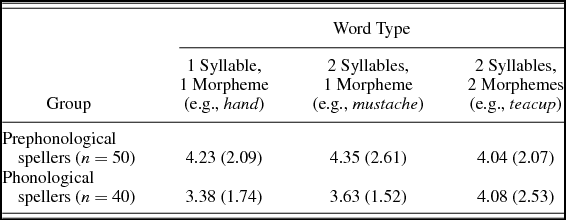
Table 1 shows the mean number of letters in prephonological and phonological spellers’ productions of each type of word. For prephonological spellers, the group of primary interest, spelling length did not appear to increase with increases in phonological or morphological length. Phonological spellers, as expected, produced longer spellings for two-syllable than one-syllable words.
Mean (standard deviation) number of letters in spellings for prephonological and phonological spellers as a function of word type

We conducted mixed-model analyses using the R software package lme4 (Bates, Mächler, Bolker, & Walker, Reference Bates, Mächler, Bolker and Walker2015). The dependent variable, number of letters, was log transformed to make the distribution more normal. Our first model included random effects for words and participants and the fixed effects of number of syllables, number of morphemes, and group (phonological, coded as 0, vs. prephonological, coded as 1). Because a previous study showed a tendency for children's spellings to decrease in size across the course of an experiment (Zhang & Treiman, Reference Zhang and Treiman2015), the linear and quadratic effects of order of the item in the experiment were also included. The log transformed number of letters that the child used to spell the item on the previous trial (trial N – 1) was included as well in light of previous reports that children's spellings are influenced by spellings produced on preceding trials, especially the immediately preceding trial (Treiman et al., Reference Treiman, Decker, Kessler and Pollo2015; Zhang & Treiman, Reference Zhang and Treiman2015). Because previous trial information is not available for the first trial of a session, these trials were excluded from the analyses. The model included the interactions of group with number of syllables, number of morphemes, linear order, quadratic order, and length of spelling on trial N − 1. Continuous predictor variables were centered. The main effect of number of morphemes and the interactions between group and number of morphemes, linear order, quadratic order, and previous trial spelling length were not significant, and removing these effects did not significantly weaken the fit of the model according to a log-likelihood test (p = .84). Therefore, we interpret the results of a simplified model that did not include these effects.
The simplified model showed significant negative linear (β = –0.003, SE = 0.001, p = .010) and quadratic (β = –0.0004, SE = 0.0002, p = .043) effects of order. These effects reflected the fact that spelling length increased from the first third of the experiment (M = 3.93 letters) to the second third (M = 4.27) and was lowest in the last third (M = 3.74). The effect of spelling length on trial N – 1 was also significant, with longer spellings on the current trial if more letters had been used on the preceding trial (β = 0.42, SE = 0.02, p < .001). Of most importance was the significant effect of number of syllables (β = 0.13, SE = 0.02, p < .001), which was qualified by an interaction with group (β = –0.14, SE = 0.03, p < .001). To interpret this interaction, we conducted separate analyses for prephonological and phonological spellers. The model for each group included number of syllables, linear and quadratic effects of order, and length of previous trial spelling. The effect of number of syllables was not significant for prephonological spellers (p = .80) but was significant for phonological spellers (β = 0.13, SE = 0.02, p < .001).
To explore the effect of spelling length on trials before the immediately preceding trial, we built a version of the above-described model that included, in addition to spelling length on trial N − 1, spelling lengths on trials N −2, N − 3, and N − 4. Data from the first four trials of each session were removed. (An analysis that also included spelling length on trial N – 5 found that it did not have a significant effect.) There was a significant effect of spelling length on trial N − 1 (β = 0.34, SE = 0.03, p < .001) and significant effects, successively decreasing in size, for trials N − 2 (β = 0.19, SE = 0.03, p < .001), N − 3 (β = 0.18, SE = 0.03, p < .001), and N − 4 (β = 0.10, SE = 0.03, p < .001). The main effects of linear order of the item in the experiment (β = –0.004, SE = 0.002, p = .043) and number of syllables (β = 0.13, SE = 0.03, p < .001) were significant in this analysis; the quadratic effect of order was not significant. Most important, the interaction between number of syllables and group (β = –0.13, SE = 0.04, p < .001) was again significant. As before, this reflected a nonsignificant effect of syllable number for prephonological spellers (p = .71) and a significant effect for phonological spellers (p < .001).
We repeated the analyses using number of phonemes rather than number of syllables as a measure of phonological length. As expected given the close association between these measures in our set of items, the results were very similar.
DISCUSSION
The present study was designed to test the influential hypothesis (Byrne, Reference Byrne1996) that children take units of writing to symbolize morphemes at a time when they do not yet take it to symbolize phonemes. The results do not support this hypothesis, for prephonological spellers did not use more letters to write compound words, which have two units of meaning, than to write one-morpheme words. The lack of support for the morphological hypothesis is noteworthy given that our study provided a stronger test of the hypothesis than past studies. Previous studies used two-morpheme words such as buying and smaller (Byrne, Reference Byrne1996; Treiman, Kessler, et al., Reference Treiman, Kessler, Decker and Pollo2016), but this is problematic because the second morpheme of such words is a function morpheme, one that has little meaning on its own and one that young children may not expect to see represented in writing (Ferreiro, Reference Ferreiro1978; Ferreiro & Teberosky, Reference Ferreiro and Teberosky1982; Kato et al.,Reference Kato, Ueda, Ozaki and Mukaigawa1999; Manning et al.,Reference Manning, Manning, Long and Kamii1993).
Although the length of prephonological spellers’ productions did not vary with the morphological or phonological length of the target, there were systematic variations as a function of other factors. Children tended to produce spellings of similar length to those that they had produced on preceding trials: a carryover effect. Spelling length tended to increase during the early trials of the experiment, a warm-up effect, and then decrease. These effects, some of which have been documented previously (Zhang & Treiman, Reference Zhang and Treiman2015), show that prephonological spellers varied the lengths of their spellings and that our study was sensitive to some factors that were associated with these variations. That children who had begun to spell phonologically showed a strong effect of phonological length also speaks to the sensitivity of the study.
Null results must be interpreted with caution, but our findings support the emerging view that, early in the course of writing development, children's productions do not reflect the length of a linguistic message in phonemes, syllables, or morphemes (Cardoso-Martins, Corrêa, Lemos, & Napoleão, Reference Cardoso-Martins, Corrêa, Lemos and Napoleão2006; Pollo et al., Reference Pollo, Kessler and Treiman2009; Treiman et al., Reference Treiman, Pollo, Cardoso-Martins and Kessler2013; Treiman, Kessler, et al., Reference Treiman, Kessler, Decker and Pollo2016; Zhang & Treiman, Reference Zhang and Treiman2015). This outcome is surprising given the ubiquity of writing in modern societies. Toddlers and preschoolers are exposed to writing every day on T-shirts, signs, food packages, books, and so on, and adults sometimes tell them what the writing says. By 2 or 3 years, children have learned about a number of writing's visual characteristics, including that it is arranged on lines and that it tends to be small, and children's productions reflect these characteristics (Mortensen & Burnham, Reference Mortensen and Burnham2012; Puranik & Lonigan, Reference Puranik and Lonigan2011; Treiman & Yin, Reference Treiman and Yin2011). The present results demonstrate that, even though young children reproduce some of the salient outer features of writing, they do not produce writing whose length reflects the length of a linguistic message. Children may show more knowledge about the symbolic function of language in tasks that do not require them to produce writing (Treiman, Hompluem, Gordon, Decker, & Markson, Reference Treiman, Hompluem, Gordon, Decker and Markson2016). When they write, however, preschoolers tend to focus on the visual appearance of the output rather than on symbolizing linguistic units.
Parents and preschool teachers help prepare children for formal literacy instruction when they teach them to write and identify alphabet letters. Although such skills are important (e.g., Piasta, Petscher, & Justice, Reference Piasta, Petscher and Justice2012), there is a danger of overemphasizing the mechanical skills that are involved in literacy learning and underestimating the conceptual skills. Our results show that the idea that longer linguistic messages correspond to longer stretches of writing, which is so obvious to literate adults, is surprisingly difficult for children. More attention should be paid to helping young children gain a conceptual understanding of writing, for example, by incorporating writing activities into preschool classrooms and demonstrating that writing communicates linguistic messages (Gerde, Bingham, & Wasik, Reference Gerde, Bingham and Wasik2012).
APPENDIX A
Words with one syllable and one morpheme: boot, bowl, bug, chin, doll, fish, hand, hen, lamp, nose, plate, sock
Words with two syllables and one morpheme: chipmunk, mustache, napkin, pumpkin, sandwich, tadpole
Words with two syllables and two morphemes: earplug, lipstick, necktie, shoebox, teacup, toothpick
ACKNOWLEDGMENTS
This research was supported by National Science Foundation Grant BCS-1421279.