Why do people participate in mass politics, despite the obvious fact that any individual’s actions have roughly zero chance of being decisive in any meaningful political context? Theories that emphasize the social and psychological benefits of political participation have received greater attention in recent years.Footnote 1 In these accounts, political participation is motivated by social pressure, norm compliance and other concerns apart from the potential policy benefits for the individual that are associated with participating. The turn to social and psychological accounts follows from the extreme difficulty that theories based on private instrumental returns have in explaining why individuals undertake costly action for collective goals despite the absence of substantial private benefits.
Although the contention that social pressure and norms may partly explain mass participation is intuitively plausible, the empirical foundation of this perspective remains largely unexplored. Recent research suggests that social dynamics – perhaps most notably the anticipation of social sanctions – can substantially affect behaviors including political participation.Footnote 2 Two key unanswered questions include whether information about people’s political participation affects how others evaluate them and whether variation in participation can be attributed to anticipating these social consequences. In this article, we document the existence of social rewards and sanctions associated with voting behavior and link these social forces to differences in observed participation.
First, we measure and calibrate the degree to which political participation affects people’s opinions of others. We present a series of survey experiments that provides causal evidence that people respond directly to information about voting behavior when forming social evaluations of others. We place the magnitude of these effects into context by comparing the social consequences of voting behavior to those associated with other pro-social activities for which the expected private benefits of action are low, including the decisions to recycle, volunteer and return one’s library books on time. We find that the social implications of the decision to vote tend to be similar in magnitude to those associated with these other decisions. This suggests that, although turnout decisions are associated with social consequences, these consequences are neither uniquely powerful, nor confined to the political realm.
Secondly, we show that individuals are willing to sanction and reward voting behavior even when doing so is personally costly. In an experimental dictator game, participants give more money to an individual who is randomly assigned to be described as having voted than to one randomly assigned to be described as not voting. This provides behavioral validation of the differences in social evaluations expressed in surveys. Of note, this willingness to undertake costly action to support a norm implies that norms may be sustained despite the fact that expressing praise or disapprobation of others is not always in an observer’s immediate self-interest. While our experimental evidence does not directly show that concern for social evaluations has a material effect on voting or other political participation, we take a tentative step toward examining this linkage below. We present evidence from a national survey that included an item that measures social norms about voting. In that analysis, we find that county-level (validated) turnout is correlated with average norms in the county. Turnout is higher in places where the belief that failing to participate will generate social sanctions is more prevalent. This finding is consistent with a prominent role for social evaluations in turnout, and is the first we are aware of to document a correlation between survey measures of norms and validated (rather than self-reported) turnout.
Our findings also have several general implications for understanding political behavior. First, we add to the growing literature documenting the important influence of social concerns on political choices. Classical writers often suggest that the psychological influence of perceptions of social standards is rooted in individuals’ sensitivity to how others assess their behavior, a characteristic that is sometimes considered a basic element of human nature. For example, in The Theory of Moral Sentiments, Adam Smith observes that:
Nature, when she formed man for society, endowed him with an original desire to please, and an original aversion to offend his brethren. She taught him to feel pleasure in their favourable, and pain in their unfavourable regard. She rendered their approbation most flattering and most agreeable to him for its own sake; and their disapprobation most mortifying and most offensive.Footnote 3
Whether sensitivity to social opinion is intrinsic or formed by social forces, we contribute to the project of documenting how social influences can shape behavior.
Our second contribution is that we provide a mechanism for continued compliance with apparent social norms. Prior field experiments have found that raising the visibility of the decision to vote increases participation.Footnote 4 We provide evidence suggesting that the effects may be driven by the accurate anticipation of social sanctions or rewards. Individuals do distinguish between those who vote and those who do not, even at a personal cost. In light of this evidence, it is not surprising that making one’s voting behavior more public increases turnout. Such publicity increases the likelihood that these social sanctions will be realized.
A final and related contribution is that the provision of social rewards and sanctions for political choices provides an explanation of the development and persistence of norms regarding political participation.Footnote 5 Although some empirical evidence shows that psychological factors such as a sense of civic duty predict political participation independently of social pressures,Footnote 6 this analysis leaves open the possibility that a sense of duty itself stems from an inference that it is one’s duty to avoid behavior that one associates with social scorn (such as failing to vote). Indeed, as the broader literature on norm enforcement suggests, selective rewards for norm compliance are the means by which norms become engrained.Footnote 7 We come to recognize behaviors that are rewarded as desirable, so we behave that way even when those means of immediate norm enforcement are withdrawn.Footnote 8
THE SOCIAL CONSEQUENCES OF TURNOUT
Early rational choice models of voting behavior focused on the instrumental benefits derived from voting (for example, the policy benefits associated with one’s preferred candidate winning) as explanations for why people do or do not vote.Footnote 9 Given the extremely small chance that one’s vote will be pivotal in deciding an election outcome, however, standard rational choice models cannot explain the fact that many people do, in fact, vote.Footnote 10 Consequently, other benefits – such as the utility derived from performing one’s civic duty and turning out on election day – became a central component of the ‘calculus of voting.’Footnote 11
Recently, Gerber, Green and Larimer found evidence that promising to reveal whether a voter participated to others in the voter’s community increased turnout; this effect was distinct from the increase in turnout associated with simply reminding voters that participating is a civic duty.Footnote 12 This finding supports the argument that the anticipation of social consequences can affect participation, and has since been replicated in other field experimental contexts.Footnote 13
Importantly, the effects of anticipating social sanctions are not likely to be confined to situations in which individuals are experimentally treated with a message that threatens to divulge their voting behavior. Researchers find that individuals believe that others monitor their behavior, and are able to discern their thoughts and feelings at much higher rates than actually occur. For example, people vastly overestimate the number of people who notice when their behavior deviates from social norms, as well as other people’s ability to detect when they are lying.Footnote 14 Thus many people may believe that others either explicitly monitor (or are at least aware of) their actions or can learn of their feelings and beliefs from observing their behavior – for example, by observing their failure to share the fact that they voted or demurring when the topic of voting is raised in conversation.
We fielded a survey in December 2010 focused on the act of voting. Approximately 65 per cent of respondents reported that one or more of their family, friends, neighbors, co-workers or boss would probably or almost certainly ask whether or not they plan to vote in the upcoming 2012 election. Fully 27 per cent reported that one or more of those individuals would almost certainly ask if they had voted.Footnote 15 For a large proportion of the population, it therefore appears that individuals anticipate that others with whom they regularly interact will ask about their participation. Overall, if people assume that their voting behavior can be observed or inferred by others, their decision to vote is open to influences associated with how others (most likely those they regularly interact with – that is, those with whom they have personal or other forms of social/network ties) will evaluate those choices, the topic of our inquiry here.
Indeed, prior work finds that voting behavior is, in part, a product of a pattern of conforming to the expectations of others in one’s social network,Footnote 16 which supports the claim that the decision to vote is shaped by the prospect of social consequences.Footnote 17 Similarly, there is evidence that individuals inflate their rates of participation for reasons of social desirability.Footnote 18 However, little work has directly demonstrated that these social consequences are real, rather than imagined.Footnote 19 Further, no research has examined whether the social consequences associated with voting behavior are uniquely large or if, instead, they are comparable to those associated with other behavioral decisions.
EXPERIMENTAL INVESTIGATIONS OF THE SOCIAL CONSEQUENCES OF VOTING
The central question we wish to address is whether the perception that abstention from voting results in social sanctions is accurate. Are people correct to expect others to evaluate them less favorably if they fail to vote? We also benchmark the social rewards/sanctions associated with voting to other behaviors. We do this using a series of experiments. The first set of experiments was included on the 2009 CCES.Footnote 20 The second set of experiments uses a convenience sample of US residents recruited using Amazon.com’s Mechanical Turk (MTurk) interface. These different recruitment and experiment delivery methods offer distinct advantages.
The CCES, which is administered by YouGov/Polimetrix, is an internet-based survey that uses a combination of sampling and matching techniques to account for the fact that opt-in internet survey respondents may differ from the general population on factors such as political interest. This process is designed to approximate a random digit-dialing sample.Footnote 21 The CCES therefore both proxies a relatively representative sample and offers a rich set of measures of demographics and other characteristics that we can use in our analysis.
The MTurk population, by contrast, is a convenience sample that appears to be more representative of the larger US population than student samples, but is still not wholly representative of the US population (for example, it is younger, fewer respondents are homeowners and a greater share of respondents report no religious affiliation).Footnote 22 However, because participants in the MTurk sample have not taken an extensive political survey prior to participating in our experiments, there is less concern about priming political considerations with prior survey content.Footnote 23 The MTurk interface also makes it feasible to allocate monetary bonuses to participants, a feature we use to gather behavioral measures of costly decision making in one set of experiments. Demographics for both samples are presented in online appendix Table A1.
Vignette Experiments
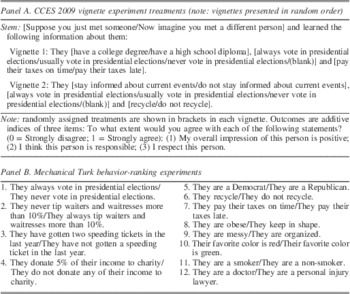
Our first evidence comes from a pair of Vignette Experiments (n=731) described in Panel A of Table 1. We presented CCES respondents with descriptions of different individuals; each description included either two or three pieces of information about the individual.Footnote 24 Each vignette was of the form: ‘Suppose you just met someone and learned the following information about them: they [treatment].’Footnote 25 Vignette order was randomly assigned for each respondent. Immediately after each vignette, respondents were asked to rate their level of agreement with three statements about the hypothetical individual on a seven-point scale ranging from strongly agree to strongly disagree: (1) ‘My overall impression of this person is positive,’ (2) ‘I think this person is responsible’ and (3) ‘I respect this person.’ These items were taken from a larger social distance questionnaire used by social psychologists to measure respondents’ broad social evaluations of an individual.Footnote 26 For each vignette, responses to these items were combined into an additive index and rescaled to range from 0 to 1; higher values correspond to more socially favorable evaluations of the hypothetical individual.Footnote 27
Experimental Designs and Question Wording

Note: participants were randomly assigned to one behavior from each of the twelve pairs. These behaviors were randomly assigned to two blocks of six behaviors, which participants were asked to rank. Question wording: ‘[Imagine someone new was moving into your neighborhood/Now imagine a different person was moving into your neighborhood.] Please rank these six pieces of information about the person moving in from 1 to 6 by dragging them into the box on the right. Ranking an item at the top (1) means the piece of information would make your neighbors most look forward to having the person live in the neighborhood. Ranking an item at the bottom (6) means the piece of information would make your neighbors least look forward to having this person live in the neighborhood.’
In each vignette, the respondent was told with equal probability either (a) no information about the individual’s turnout behavior or that the individual (b) always, (c) usually or (d) never voted in presidential elections. The two other pieces of information presented in each vignette are listed in Table 1. Each characteristic was assigned independently of the others (that is, simple random assignment was employed). The vignette design offers two benefits. First, by simultaneously providing people with multiple pieces of information about the individual, we are able to ascertain whether information about turnout matters when the evaluator has other information about the individual. Secondly, information about turnout was sometimes not provided, which allows us to identify asymmetries in the social consequences of this behavior being revealed, relative to knowing nothing about it. For example, relative to knowing nothing about someone’s voting behavior, learning that the person always votes might improve social evaluations substantially, whereas learning that they never vote might not worsen them much.
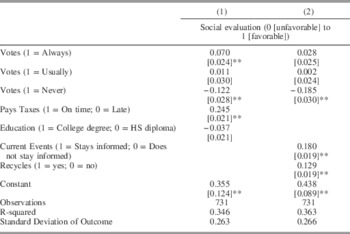
To analyze the results of the Vignette Experiments we present a series of regression results in Table 2. We specify the social evaluation index described above as the dependent variable and include indicators for the treatments as independent variables.Footnote 28 The omitted (reference) category for the turnout treatment is the condition in which the respondent was not provided with any information about the individual’s turnout behavior. Thus the statistically significant coefficient of −0.122 on ‘Vote (1=Never)’ in Column 1 means that an individual described as never voting is evaluated 0.122 units less favorably than an individual for whom turnout information was not provided. Learning that an individual always votes resulted in a 0.07 unit more favorable evaluation. Thus the net effect of finding out that someone always, rather than never, votes is about 0.192 units (0.73 standard deviations; p<0.01, all p-values are two-tailed unless otherwise noted) on the social evaluation scale. We obtain a similar result in Column 2, where the difference between the coefficients for always voting and never voting is 0.213 units (0.80 standard deviations; p<0.01).
Social Evaluations Analysis, Vignette Experiments

Note: experiment is described in Table 1, Panel A. Results from OLS regression models (weighted). Robust standard errors in brackets. For voting behavior indicators, the excluded category is no mention of this behavior. Coefficients for demographic controls (age, age-squared, race, sex, education, income, income missing, religious attendance, political interest, trust in government, indicators for ideology and party identification) are suppressed. *significant at 5 per cent; **significant at 1 per cent (two-tailed tests). Source: 2009 CCES.
Before comparing the effects of information about turnout behavior with those associated with other behaviors, we note two interesting points about how participants responded to the turnout information. First, the differences between the ‘usually’ and ‘always’ votes coefficients in Columns 1 and 2 are modest (tests of significance of difference in coefficients are p=0.056 and 0.284, respectively). This suggests that voting in every presidential election has small social benefits relative to voting in most presidential elections. Secondly, relative to knowing nothing about one’s turnout behavior, the positive social benefits of always voting appear to be somewhat smaller than the negative consequences of never voting.Footnote 29 This difference may arise because, absent learning that someone does not vote, people may, on average, presume that the person does vote.
Comparing the effects of finding out that an individual always rather than never votes in presidential elections to the effects of information about other behaviors provides some context. In Column 1, we find that the 0.192 unit positive effect of always rather than never voting is somewhat smaller than the 0.245 (p<0.01) unit effect of finding out a person pays their taxes on time rather than late (p>0.10 for test of difference in differences, DID), but substantially larger than the slightly negative −0.037 unit (p>0.10) effect of finding out that an individual has a college, rather than a high school, diploma (p<0.01 for test of DID). In Column 2, we find that the 0.213 (p<0.01) positive effect of always rather than never voting is substantially larger than the 0.129 (p<0.01) effect of finding out that someone recycles rather than does not (p=0.013 for test of DID). We also find that the social consequences of turnout are similar in size to (and statistically indistinguishable from) the 0.180 (p<0.01) unit effect of keeping informed about current events (p=0.37 for test of DID).
One question is whether this difference in evaluations is confined to only those who are already active in politics. (In the conclusion, we also separately examine geographic differences in social evaluations.) In additional analysis (available upon request) we estimate separate models for respondents with high levels of interest in politics (those who say they follow what is going on in government and public affairs ‘most of the time’ – 55 per cent of the weighted sample) and those with lower levels of political interest. We also estimate models separately for those who reported voting in 2008 (83 per cent of the weighted sample) and those who did not. We find that the hypothetical individual’s voting behavior more strongly affects evaluations among those who are more engaged with politics. However, even those who report lower levels of interest or did not vote in 2008 evaluate those who never vote less favorably than those who always vote.
For example, in models that restrict the sample to those who report high levels of interest in politics, we find that the effects of describing an individual as always, rather than never, voting are 0.211 and 0.234 in the first and second vignettes, respectively. The comparable estimates restricting the sample to respondents who did not report high levels of political interest are 0.134 and 0.180, respectively (p<0.01 for all effects). In models restricting the sample to 2008 voters, the difference between the always and never voting conditions is 0.191 and 0.240 in the first and second vignettes, respectively (p<0.01 for both), while for non-voters (17 per cent of the weighted sample) the comparable estimates are 0.142 (p=0.07) and 0.079 (p=0.35). Thus even individuals with low levels of political interest who did not vote in 2008 are inclined to sanction an individual for not voting, albeit not to the same degree as individuals who are more politically interested and who did vote in 2008.
We also consider the possibility that the effects of the voting behavior treatments were moderated by the other treatments by adding interactions between the voting treatments and each of the other treatments to the models reported in Table 2. In the first experiment, the p-value associated with a test of the joint significance of the interactions between the voting behaviors and the education treatment is 0.283; for the tax return interactions this value is 0.257. In the second experiment, the joint significance of the interactions between the voting treatments and the current events treatment is 0.198; for the recycling interactions the p-value is 0.076. The social penalties associated with never – rather than always or usually – voting were weaker when the target was described as always, rather than never, recycling. This implies that in some cases, people may be more willing to forgive a failure to vote if the target is described as conforming to social norms in other ways. However, it is important to note that this dynamic was not consistent across the experiments.
Behavior-ranking Experiments
The second set of experiments we conducted for this analysis is the behavior-ranking experiments (n=198), described in Panel B of Table 1. One half of the subjects we recruited using the MTurk interface were randomly assigned to participate in these experiments. Respondents were asked to rank characteristics that a hypothetical neighbor might have. Specifically, in each experiment they were asked to rank six items in terms of how appealing they thought their neighbors would find them: ‘Ranking an item at the top (1) means the piece of information would make your neighbors most look forward to having the person live in the neighborhood. Ranking an item at the bottom (6) means the piece of information would make your neighbors least look forward to having this person live in the neighborhood.’Footnote 30
Each subject completed two of these ranking experiments. The six items used in each experiment were randomly drawn, without replacement, from a larger list of twelve trait domains with two response options in each domain. For example, one of the domains was the hypothetical neighbor’s job, which could be either doctor or personal injury lawyer. The political domain of most interest to us is voting behavior (always votes in presidential elections or never votes in presidential elections). Other traits (for example, recycling, paying taxes on time, tipping behavior, donating to charity) were included to allow a comparison to the effect of finding out someone’s voting behavior.
Items were randomly ordered in each ranking experiment, and domains were not reused across the two experiments completed by a given respondent (for example, doctor or personal injury lawyer would appear in one experiment, but not the other). The purpose of this experiment was to provide respondents with the opportunity to evaluate the indirect importance (because respondents were asked to rank how others would view these characteristics) of political traits relative to a broad range of non-political characteristics. The ranking set-up also requires individuals to choose the relative importance of different items, because no two items could be given the same ranking. As with the outcome measure in the Vignette Experiments, we view these rankings as a proxy for the relative social desirability of different characteristics and actions.
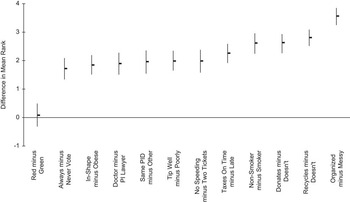
We focus on differences in evaluations of behaviors in each of the twelve behavioral domains. These differences in mean rankings are shown in Figure 1.Footnote 31 (Mean rankings for each of the twenty-four behaviors are presented in online appendix Figure A1.)
Differences in mean rankings of behaviors for each domain, Mechanical Turk behavior-ranking experiments
Note: bars are bootstrapped 95 per cent confidence intervals.

The difference in mean ranking for turnout (always minus never) is 1.72. This difference is substantially larger than the mean difference in the ranking of the two ‘favorite color’ descriptors – characteristics we included because we posited that they should not systematically alter evaluations. The turnout difference is similar in size to (and statistically indistinguishable from; p>0.10 for tests of DID) those associated with physique (1.85), occupation (1.90), tipping behavior (1.99) and whether the individual obeys speed limits (1.99). The difference in rankings for turnout is significantly smaller than (p<0.01 for tests of DID) differences in the domains of smoking (2.62), donating to charity (2.63), recycling (2.81) and being organized or messy (3.57). The difference in mean ranking for turnout is also modestly smaller than that of paying taxes on time rather than late (2.26; p=0.036 for test of DID). This supports the claim that people believe that information about turnout behavior – in this case, finding out that someone always or never votes in presidential elections – shapes how their neighbors are likely to evaluate them. Importantly, these ranking experiments also indicate that the expected rewards and sanctions associated with this dimension of behavior are similar to those associated with other behaviors and characteristics, but that people expect their neighbors to view some behaviors (for example, smoking) as more important.
The vignette and behavior-ranking experiments each provide a way to compare the social consequences of voting behavior to the social consequences of other non-political behaviors and characteristics. Taken together, the findings lead to two important conclusions. First, decisions about whether to vote appear to have social consequences – people who vote are evaluated more favorably than those who do not. Secondly, although the relative effect of the decision to vote compared to other behaviors varies somewhat across the experimental designs and samples, it is not anomalously large.Footnote 32 Instead, consonant with moderate observed turnout rates, the effect of voting is similar in size to the effects of non-political behaviors like returning library books on time and keeping in shape. Although failing to turn out may lead to negative social consequences that are large enough to affect decisions about whether to vote, our findings suggest that this is one of many behaviors that can affect one’s social standing (rather than an exceptional violation of a sacrosanct social duty). By contrast, failing to pay one’s taxes on time, which is a violation of the law, garners more substantial social sanctions, and individuals appear to believe their neighbors care more about a potential neighbor’s neatness than whether the potential neighbor votes.
BEHAVIORAL VALIDATION OF THE EFFECT OF DIFFERENCES IN SOCIAL EVALUATIONS DUE TO VOTING
The analysis discussed thus far suggests that individuals evaluate others on the basis of their voting behavior. However, one concern about our measures of the differences in social evaluations of those who do and do not vote is that they are costless to express. Thus it is unclear whether the less-positive evaluations that individuals make when evaluating those who vote infrequently would carry over to environments in which making such distinctions is costly to the individual. For this reason, we also conducted an additional set of experiments to obtain behavioral verification of these patterns of survey responses.
Those MTurk subjects not randomly assigned to the previously discussed ranking experiment were instead assigned to the allocation experiments (n=195), in which respondents were given three $0.50 bonuses. They were then offered the opportunity to anonymously share none, part or all of each of the three bonuses with another MTurk worker with one of three types of traits.Footnote 33 This is analogous to a standard dictator game, which has been used in other contexts to measure the preferences of actors toward others.Footnote 34 Specifically, the respondent was presented with (in random order) the opportunity to give away some portion of each of three $0.50 bonuses to another MTurk user. In one case the other worker’s color preference was described (randomly assigned as Red or Green); in another, their recycling behavior was presented (Yes or No), and in another the other worker’s voting behavior was described (Always or Never).Footnote 35 Any money the respondent chose to keep was paid to them directly through the MTurk payment interface; any portion they shared was given to another MTurk user with the trait described.Footnote 36 Because choosing to differentiate among individuals in these experiments requires the participant to give up money, any differences in evaluations we find in this context are less likely to be ephemeral. As in the behavior-ranking experiments, we use the difference in color preference manipulation because, ex ante, we believe it should not generate systematic differences in evaluations.
We note that this setting introduces a particularly high bar for discerning behavioral differences: individuals in the allocation experiments were anonymous and their behavior was kept private from all other MTurk users. Thus, unlike in other circumstances where the failure to enforce a social norm might itself risk social sanction, here individuals were anonymous members of a crowd whose behavior was unobservable to anyone other than the researcher, and even the researcher does not know the person’s (non MTurk) identity.Footnote 37
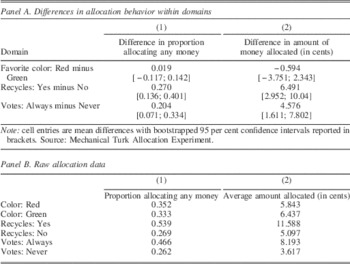
Results from these experiments appear in Table 3. Column 1 of Panel A displays the difference in the proportion of respondents allocating any of their $0.50 reward to another MTurk user for the two available descriptions for each trait domain (Red v. Green; Recycle v. Not Recycle; Always Vote v. Never Vote). Column 2 of Panel A then reports the difference in the average amount respondents shared across each of the two treatments. For both quantities of interest, we also display 95 per cent confidence intervals, which we calculate using a bootstrap technique because of the relatively small sample sizes in these experiments. Panel B provides the raw allocation data for each of the six treatment conditions: proportion allocating in Column 1 and the average amount allocated in Column 2.
Results of Allocation Experiments

Note: cell entries are raw averages by condition. Source: Mechanical Turk Allocation Experiment.
The results show that individuals are no more likely to allocate money to an individual who prefers Red to Green – the difference in the probability of allocating (Column 1) is a paltry 1.9 percentage points (p=0.78) and the difference in average contributions (Column 2) is less than 1 cent (p=0.71). By contrast, those who are described as recycling are 27.0 percentage points (95 per cent confidence interval is 13.6 to 40.1; p<0.01) more likely to garner a monetary contribution than those who are not, which is associated with an average difference in contributions of a little more than 6 cents (2.95 to 10.04; p<0.01). Finally, those who are described as always rather than never voting are 20.4 percentage points (7.1 to 33.4; p<0.01) more likely to receive an award, and the difference in the average amount given is a little less than 5 cents (1.61 to 7.80; p<0.01).
These data add support to the findings from the survey experiments presented above. First, individuals distinguish between those who vote and those who do not (and those who recycle and those who do not), even when doing so requires the experimental participant to do so at some (monetary) cost to herself and her actions are not observed by anyone other than the researcher.Footnote 38 Secondly, the relative differences across the domains of turnout and recycling are similar to those we found in the survey context using the MTurk sample (as are the null results for color preference). This suggests that the behavior-ranking experiments do not inflate the apparent social desirability of political choices relative to non-political ones.
SUPPLEMENTARY ANALYSIS: AGGREGATE EVIDENCE LINKING NORMS AND TURNOUT
The experimental work presented above supports the claim that social sanctions associated with voting increase political participation. This is the assumed mechanism in previous field experimental work that promises to reveal citizens’ turnout behavior to others. Our survey and behavioral experimental work provides direct support for the notion that the anticipation of social sanctions from not voting is warranted. However, we do not directly show that concern for social evaluations has an important effect on actual political participation.
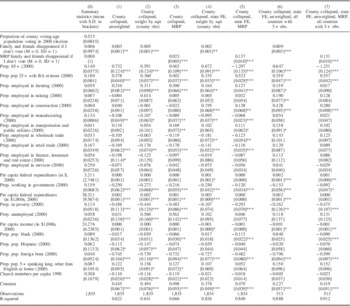
We therefore take a complementary step by examining the association between beliefs about norm violation and county-level turnout. To conduct this analysis we combine data on county-level turnout in the 2000 presidential election with survey data about norms culled from the 2000 National Annenberg Election Survey (NAES).Footnote 39 The norms item asked the respondent whether ‘you strongly agree, somewhat agree, somewhat disagree or strongly disagree’ with the statement ‘If I do not vote, my family and friends are disappointed in me.’ We use responses to this item, with greater agreement scored as more positive, to measure whether individuals expect others to sanction (reward) them for failing to adhere (adhering) to norms of appropriate behavior concerning voting.
To assess whether variation in this attitude is correlated with observed differences in turnout across counties, we calculate average responses to the survey item for each county covered by the NAES sample. Once merged with information about population, turnout in the 2000 presidential election and other county-population characteristics, we have observations from 1,835 unique counties. Our measure of turnout is the county-level proportion of the voting-age population (VAP) that cast a ballot in 2000 (mean=0.53). In addition to the survey measure of norms and the turnout measure, we collected a wide range of measures of other factors that might reasonably explain turnout. The first column of Table 4 (Column 0) provides summary statistics for all model variables. Column 1 of Table 4 then presents the results of an ordinary least squares (OLS) regression analysis in which we simply take the county-level average of the voting norms question and use it to predict VAP turnout at the county level, with a set of control variables. We use this measure of norms at the broader community level, rather than individual respondents’ subjective assessments of community norms, because we view it as more plausibly exogenous to the respondent’s voting behavior, and because our outcome of interest is county-level validated turnout.Footnote 40 In this analysis, the coefficient on the norms variable is statistically significant (p=0.011).
Observational Analysis: NAES Data Matched to County-Level Voting-Age Population Turnout Records

Note: Column 0: means with standard deviations in brackets. Variables prefixed with MRP are county estimates from multi-level model with post-stratification; see text and online appendix for details. Columns 1–7: OLS regression coefficients with robust standard errors in brackets, clustered at the state level. * significant at 10 per cent; ** significant at 5 per cent; *** significant at 1 per cent (two-tailed tests). Source: 2000 NAES.
A key issue with this analysis, however, is measurement error. In counties with few survey respondents (at the extreme, only one), our measures of average citizen attitudes will necessarily be less reliable than in counties where we have more survey observations. To account for the greater imprecision of estimates from counties with fewer observations, we take three different approaches. First, we conduct weighted analysis where greater weight is given to counties with more respondents. Secondly, we employ multilevel regression with post-stratification (MRP)Footnote 41 to generate estimates of county-level norms that account for sampling variability across counties. The details of the MRP procedure are described in the online appendix, but the key insight is that by combining information about the average responses of different demographic groups to the survey questions with census data on the distribution of those different groups across counties, we can generate a county-level norm estimate that is less affected by sampling variability. Thirdly, we partition our analysis by the number of observations in the county by presenting analysis separately for the 513 counties that have five or more survey observations.
The results of these analyses, all of which were estimated using OLS regression, appear in Columns 2–7 of Table 4. To make comparisons of magnitudes easier across specifications, we standardize both norms measures (the simple county mean and the MRP) to have a mean of 0 and a standard deviation of 1. Additionally, to account for the correlation among observations at the state level, we cluster standard errors within states. In Column 2, the estimates are weighted by the square root of the number of observations in each county (that is, a county with four survey observations receives twice the weight of a county with only a single observation). Using this specification, a two-standard-deviation increase in the social norm measure is correlated with a statistically significant 1.0 percentage point increase in turnout, or about 1.9 per cent relative to average county turnout. In Column 3, we use the MRP-derived estimates of county-level norms (that more efficiently account for sampling variability), and the correlation is larger: a two-standard-deviation increase in responses to the social sanction measure is associated with an increase in turnout of 4.6 percentage points, or about 8.7 per cent relative to average county turnout.
Columns 4 through 7 assess the robustness of this relationship. In Columns 4 and 5 we add state fixed effects, which diminishes the magnitude and statistical significance of the county-weighted analysis (Column 4), but substantially increases the size of the MRP coefficient.Footnote 42 In Columns 6 and 7 we continue to employ state fixed effects, but also restrict our analysis to the 513 counties for which we have five or more survey observations in an effort to attenuate measurement error in the survey measure. Doing so noticeably increases the estimated size of the social sanction measure coefficient in the weighted analysis (Column 6), but has a small effect on the MRP-based estimated coefficient (Column 7).Footnote 43 Per the Column 6 specification, a two-standard-deviation increase in the family and friends item is associated with a 1.8 percentage point increase in turnout.
Overall, these findings are consistent with the claim that social norms (and the potential costs of deviating from them) are important explanations of differences in participatory behavior.Footnote 44 At the same time, these results should be viewed with caution. They are based on observational data and are vulnerable to many threats to inference, including concerns about aggregation bias, omitted variables and reverse causality. Nevertheless, with the experimental work presented above and the field experimental evidence presented in prior work, there is growing evidence that social norms influence participatory decisions.
DISCUSSION
The present study is an important step toward improving our understanding of the role of social evaluations in shaping political behavior. In particular, we make two main contributions to identifying the social determinants of political participation.
First, we show that decisions about whether to vote have demonstrable social consequences. Using experimental designs that isolate other confounding factors, we find that people evaluate individuals who never vote less favorably than those who always vote. Notably, these effects are not confined to respondents who report particularly high levels of interest in politics, although they are more pronounced for those who are more interested. Secondly, the results of the behavioral dictator game experiments provide important corroborating evidence by showing that these differences in evaluations persist, and are acted upon when making such distinctions is personally costly. Overall, these results suggest that individuals do exercise judgments that will tend to reinforce the social pressure to vote in many places.
We also compare the social consequences of voting behavior to those associated with non-political behaviors. This explicitly situates turnout behavior, and the individuals who are being evaluated, in the broader context of social behavior. Our analysis shows that the social consequences of turnout behavior are similar in size to the effects of non-political behaviors such as volunteering in the community and returning library books on time.Footnote 45 Scholars have increasingly looked to social consequences as a way to explain decisions to participate in political activities where instrumental benefits are likely to be substantially outweighed by instrumental costs. Although our findings validate the claim that these social consequences are likely to play a role in political decisions, they also suggest that these social consequences are not disproportionately large in the political arena. Indeed, just as researchers have shown that increasing the social visibility of voting can increase turnout, experimental interventions that rely on social pressure by emphasizing the compliance of others with a norm have been shown to increase recycling rates and reduce energy consumption.Footnote 46 This experimental literature therefore suggests that social scorn and esteem are powerful motivators across a range of behavioral domains in which instrumental benefits are unlikely to explain individuals’ willingness to undertake costly action. Heretofore, however, the social importance of political choices relative to other choices has not been documented. The relative size of the social rewards of voting and other pro-social behavior is also consistent with the intuition that social factors explain why some (but not all) people vote, as well as the fact that rates of voting vary considerably across electoral contexts that may have different social expectations about participation (for example, presidential versus off year races).Footnote 47 It may also be useful in future work to examine the possibility that other powerful predictors of participation in the survey context (for example, age, income, education) may operate in part by affecting the social expectations about participation among one’s peers. Thus social norms may be a mediator of some other canonical predictors of participation, although this article does not fully explore this potential mechanism.
Our experimental analysis has its shortcomings. Although we provide evidence that learning whether or not someone is a voter affects how the individual is assessed and treated, our experiments do not provide any direct evidence of precisely how such information is disclosed to others or direct evidence that concerns about such disclosure affect actual patterns of turnout. That said, it is easy to list ways in which information about political participation is made known to others, and survey evidence shows that people believe others will learn about their voting activities. People often divulge that they vote or engage in other public political activities. This is to be expected if they believe, as the evidence presented here suggests, that it may boost their social standing, even if only minimally.Footnote 48 However, a serious investigation of these understudied segments of the pathway from social norms to behavioral effects is a sensible next step in solidifying our understanding of how social opinion affects voting and other political choices.
It is important to consider, for example, whether the same social consequences exist outside of this setting. Although we cannot say definitively that the same results would be found outside the survey context, the findings from our allocation experiments, and the results from field experiments that attempt to increase social pressure, suggest that the specter of social consequences affects political decisions.
We also do not know what broader inferences people may have made based on the information provided in the experiments. For example, it is possible that voting behavior is treated as a heuristic or proxy for other desirable qualities. Similarly, people may assume that an individual who is informed about current events or volunteers is also socially engaged in other ways (for example, that they vote). Despite this ambiguity, our findings suggest that information about these behaviors serves as a social cue and matters even when multiple pieces of information are provided about a given individual (as in the vignette experiments). Future work could expand the vignettes to include more informationFootnote 49 or directly examine how cues about political behavior affect other beliefs about a person by, for example, asking people how likely they think it is that a person who always votes also recycles. Most importantly, if people use voting as a proxy for other desirable behaviors, it does not mitigate against the argument that people are inclined to vote for social reasons. Our evidence suggests that individuals may be motivated to vote because they anticipate that the failure to do so will be viewed as undesirable – either because others value the specific act of voting or because they see a failure to vote as a signal of broader personal deficiencies.
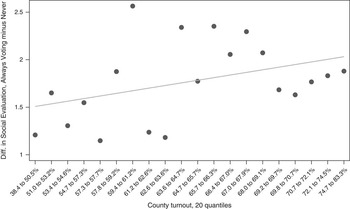
The present study can be extended and improved in a number of other ways. For example, as Campbell has argued, it is important to understand the origins of differences in the social consequences of political decisions.Footnote 50 Failing to turn out may have particularly substantial consequences in communities with high levels of ‘political capital’, but next to none in others.Footnote 51 The small sample size of our dictator game participants (n=195) makes it difficult to assess whether these findings were moderated by individual characteristics such as ‘political capital’. Thus fully exploring such variation is an important avenue for subsequent research. We do, however, have suggestive evidence that the social rewards of voting are more pronounced in places where turnout is higher.Footnote 52 In particular, the data presented in Figure 2 show that differences in the evaluations of individuals described as voting rather than not are larger in counties where turnout is higher.Footnote 53 Relative to an average difference in evaluations across all counties of around 1.7, being in the highest turnout counties rather than the lowest turnout counties increases the magnitude of differences in social evaluations by about 0.5 (p<0.05 in OLS regression), or about 30 per cent of the mean difference in evaluations. Thus, not only is turnout higher in counties where individuals believe others are more likely to evaluate them negatively if they do not vote (Table 4), but the data displayed in Figure 2 also show that individuals in high turnout counties view participating as more important when forming evaluations of others.Footnote 54 Cumulatively, our analysis also suggests a mechanism for the over-time persistence of differences in norms about appropriate behavior. We find that individuals evaluate those who fail to comply with their ideals of appropriate behavior less favorably. When such social sanctioning methods are present, norms of appropriate behavior are far more likely to be replicated in subsequent generations, thereby explaining persistent over-time differences in patterns of political and social interactions.Footnote 55
Effect of county turnout on differences in evaluations of voters and non-voters, CCES single-item experiments
Note: in OLS regression (n=20) predicting the difference in social evaluations across county turnout quantiles (1 to 20), coefficient=0.028 and SE=0.011. Average number of observations per county turnout quantiles is 25.3.

The larger point made in this article is that social forces are likely to play a role in many political choices, and that these forces deserve a place in models predicting how individuals confront those choices. Apart from the political consequences of political choices, forming accurate models of behavior may require researchers to understand the social consequences of political decisions for the individual. These consequences may be much more significant than many of the more familiar and instrumental reasons used to explain how people choose. More generally, incorporating social concerns into models of political choice provides a way to integrate explanations of political behavior with more general models of human decision making. Doing so ultimately provides a means to better address normative questions such as understanding democratic choice in the face of strong social pressure.