Introduction
Sugarcane is a multi-usage crop that serves as raw material for food and energy production along with other usages. The crop is grown on more than 20 million hectares in approximately 110 countries worldwide, ensuring income to millions of growers (Goebel & Sallan, Reference Goebel and Sallam2011). Brazil is the world's largest sugarcane producer, and the sugarcane industry is of great importance to Brazilian agribusiness. The area planted with sugarcane in this country covers an area of nearly 8.7 million hectares; sugar yield may reach up to 39.96 million tons, whereas ethanol production may reach 27.5 billion liters in the 2016/2017 crop (Conab, 2016).
The sugarcane borer, Diatraea saccharalis Fabr. (Lepidoptera: Crambidae), is a major pest of sugarcane in the American continent (Long & Hensley, Reference Long and Hensley1972; Posey et al., Reference Posey, White, Reay-Jones, Gravois, Salassi, Leonard and Reagan2006; Dinardo-Miranda, Reference Dinardo-Miranda, Dinardo-Miranda, Vasconselos and Landell2008; Vargas et al., Reference Vargas, Gómez and Michaud2015). Early-instar larvae feed on the leaf parenchyma and leaf sheaths, whereas older larvae bore into the stalks, disrupting the physiological integrity of the plant by reducing the movement of sucrose down the stalk and inhibiting the movement of nutrients and water, as well as causing stalk lodging. Larval tunnels also facilitate colonization by fungi associated with the red rot disease complex, which indirectly reduces the yield and quality of sugar and ethanol (Long & Hensley, Reference Long and Hensley1972; Macedo & Botelho, Reference Macedo and Botelho1988).
Sugarcane borer populations in Brazil are mainly controlled using mass releases of parasitoids, especially Cotesia flavipes (Hymenoptera: Braconidae) (Botelho & Macedo, Reference Botelho, Macedo, Parra, Botelho, Correa-Ferreira and Bento2002). However, fluctuations in biological control occur as a result of geographical and growing season peculiarities, the large number of parasitoids required for field release, the need to monitor borer populations, and the occurrence of a hyperparasitoid of C. flavipes cocoons in several Brazilian cane crops, which hinders this strategy (Gitahy et al., Reference Gitahy, Souza, Monnerat, Arrigoni and Baldani2007). The use of synthetic pesticides has been increasing, but pesticides are inappropriate because of poor penetration into the stalk tissue and environmental damage (Gitahy et al., Reference Gitahy, Souza, Monnerat, Arrigoni and Baldani2007). Hence, host–plant resistance to D. saccharalis emerges as an economically and environmentally effective control measure, which if available, would provide substantial benefits to sugarcane production (Milligan et al., Reference Milligan, Balzarini and White2003; Posey et al., Reference Posey, White, Reay-Jones, Gravois, Salassi, Leonard and Reagan2006; Dinardo-Miranda, Reference Dinardo-Miranda, Dinardo-Miranda, Vasconselos and Landell2008; Vargas et al., Reference Vargas, Gómez and Michaud2015).
Host–plant resistance to arthropods essentially involves traits that limit injury to the plant or reduce the amount of yield loss per unit injury (Stout, Reference Stout2013), although three modalities are often recognized, based on those originally proposed: non-preference (i.e. antixenosis), antibiosis, and tolerance (Painter, Reference Painter1951; Smith, Reference Smith2005). Previous studies indicated that sugarcane resistance traits against stem borers can be present in either leaves or stalks, because resistance has been identified in sugarcane cultivars that resulted in higher mortality of early-stage larvae feeding on leaves or leaf sheaths (Coburn & Hensley, Reference Coburn and Hensley1972; White, Reference White1993b), prevention or delay of larval entrance into stalks (White, Reference White1993b; Kvedaras et al., Reference Kvedaras, Keeping, Goebel and Byrne2007), and the presence of low stalk damage, and low adult emergence and larval weight (Keeping, Reference Keeping2006; Dinardo-Miranda et al., Reference Dinardo-Miranda, Anjos, Costa and Fracasso2012).
Based on these resistance traits, host–plant resistance to stalk borers has been measured in sugarcane clones in the field by assessing the percentage of bored internodes or exit holes, pupation viability, estimates of adults produced per area/year/variety, and damage ratings (Bessin et al., Reference Bessin, Reagan and Martin1990; White et al., Reference White1993a, Reference White, Hale, Veremis, Tew and Richard2011; Milligan et al., Reference Milligan, Balzarini and White2003). Clones with a lower percentage of bored internodes indicate the presence of traits that inhibit successful penetration of larvae, such as high fiber and a hard internode rind (White et al., Reference White, Hale, Veremis, Tew and Richard2011). A low number of emergence holes is an indirect measure of possible resistance factors within the stalk. In addition, the lack of correlation between bored internodes and damage rating is indicative that these two damage measures assess different resistance traits (White et al., Reference White1993a). Other traits, such as length of stalk bored, number of bored internodes, and number and weight of surviving larvae and pupae have also been used in greenhouses to assess sugarcane resistance to the African sugarcane borer Eldana saccharina (Lepidoptera: Pyralidae) (Keeping, Reference Keeping2006; Kvedaras et al., Reference Kvedaras, Keeping, Goebel and Byrne2007).
Plant resistance to insect feeding may depend on the number of insects per plant, plant vigor, plant age, and environmental factors. When insect populations are too high, cultivars with low and moderate resistance may appear susceptible, whereas too few insects may prevent separation of resistant and susceptible cultivars (Smith, Reference Smith2005). In addition, the expression of insect resistance in different plant tissues varies during plant development. Some plant species are less resistant to insects in early stages of development. Resistance to the southwestern corn borer Diatraea grandiosella (Dyar) and European corn borer Ostrinia nubilalis (Hubner) (Lepidoptera: Pyralidae) in resistant corn hybrids is greater in the vegetative than the reproductive stages (Klun & Robinson, Reference Klun and Robinson1969; Videla et al., Reference Videla, Davis and Willians1992). Conversely, resistance to the rice leaffolder Cnaphalocrocis medinalis (Guené) (Lepidoptera: Pyralidae) is more pronounced in older foliage of resistant varieties than in young foliage (Ramanchandran & Khan, Reference Ramanchandran and Khan1991). Therefore, the study of parameters, such as plant age and number of insects, is necessary in the study of plant resistance to insects.
In Brazil, the Inter-University Network for the Development of Sugarcane Industry (RIDESA) has a major sugarcane breeding program accounting for most of the varieties grown in the country (Barbosa et al., Reference Barbosa, Resende, Dias, Barbosa, Oliveira, Peternelli and Daros2012). The program has focused mainly on yield, agronomic quality, adaptability to different soil and climate conditions, adequacy of crop management, and disease resistance, among other traits. Despite the economic importance of the sugarcane borer, the program has not focused on selection for borer resistance because of the labor-intensive assessment of sugarcane borer damage required (Milligan et al., Reference Milligan, Balzarini and White2003). A recurrent selection strategy could be a viable alternative to the development of a resistant germplasm for use in the breeding program, and for this, studies are needed on resistance traits in the sugarcane cultivars currently grown.
It this study, we conducted a series of greenhouse and laboratory assays, first to study potential factors that could affect the assessment of sugarcane resistance to the sugarcane borer (such as plant age and number of larvae per plant). Next, we assessed resistance traits in six sugarcane cultivars that are widely grown in Brazil, and demonstrated various levels of resistance to sugarcane borers in the field. In addition, we used cluster analysis to assess genetic divergence of these cultivars and to group them in such a way that the distinct groups could be used to drive the choice of genotypes, which could be combined in breeding populations to increase borer resistance.
Material and methods
Insects and plants
Diatraea saccharalis larvae were obtained from a stock colony reared on artificial diet (Hensley & Hammond, Reference Hensley and Hammond1968) with slight modifications (Araújo et al., Reference Araújo, Botelho, Araújo, Almeida and Degaspari1985). The colony originated from a pool of field-collected and laboratory-reared larvae (Girón-Pérez et al., Reference Girón-Pérez, Oliveira, Teixeira, Guedes and Pereira2014), and care was taken to minimize an inbreeding depression by maintaining large population sizes and periodically introducing field-collected sugarcane borers.
The six cultivars used (i.e. SP803280, SP813250, RB928064, RB835486, RB867515, and SP891115) were obtained from the sugarcane germplasm unit of the Brazilian Inter-University Network for the Development of Sugarcane Industry (RIDESA, Brazil). These cultivars are widely grown in the country (Barbosa et al., Reference Barbosa, Resende, Dias, Barbosa, Oliveira, Peternelli and Daros2012) and supposedly show different levels of resistance to natural infestations by D. saccharalis (personal communication, growers and crop consultants).
To obtain experimental sugarcane plants, single-node stem cuttings containing one lateral bud were placed in plastic trays with the appropriate substrate (Tropstrato, Vida Verde Indústria e Comércio de Insumos Orgânicos Ltda, Mogi Mirim, SP, Brazil). After 45–60 days, the seedlings were transplanted to 12 liter plastic pots containing soil. Each cutting was transplanted to an individual pot maintained in a greenhouse [26 ± 10 °C; 75 ± 20% relative humidity (RH); 12 ± 2 h photoperiod] to avoid natural insect infestation at spacing 1 × 0.8 m. Limestone and fertilizer were applied to adjust soil pH and achieve suitable growth conditions (Korndorfer et al., Reference Korndorfer, Ribeiro, Andrade, Ribeiro, Guimarães and Alvarez1999). Plants were irrigated using drippers at 0.5–2.0 liters pot day−1.
Determining plant factors and rates of infestation to assess stalk damage among cultivars
As plant age, growth conditions, and infestation levels often affect comparison of host–plant resistance to insects (Smith, Reference Smith2005). Thus, we first conducted three experiments using a randomized block design to determine suitable sugarcane age, growth condition (single plants or stools), and number of larvae per plant to compare D. saccharalis stalk damage among varieties.
In the first experiment, pots containing 7-month-old single plants (no tillers or secondary stalks) of all cultivars were infested with 5, 10, 20, and 40 larvae per plant. Fifteen-day-old larvae (fourth instar) were transferred to 50 ml plastic cups, which were placed in the middle portion of the stalk with the cups’ opening toward the stalks. Then, 15 days after infestation, the plants were dissected, and the number of bored internodes, as well as tunnel length were recorded. The experiment was conducted in a randomized block design with a 6 × 4 factorial (cultivars × infestation levels). Three replicates per treatment were used. The experimental unit was one pot containing a single plant.
In the second experiment, 10-month-old single plants were infested. However, as we had a greater availability of plants, the plants were infested with 5, 10, 15, 20, 30, and 40 larvae per plant to obtain more points to increase precision of regression analysis. The infestation and damage assessment was performed as described above for the 7-month-old plant experiment. The experiment was conducted in a randomized block design with a 6 × 6 factorial (cultivars × infestation levels). Three replicates per treatment were used. The experimental unit was the single plant per plot.
In the third experiment, 5-month-old cane stools (i.e. groups of sugarcane plants derived from one lateral bud) were infested with 5, 10, 20, and 40 larvae per cane stool. Some cane stools were not infested as a check for natural infestation by D. saccharalis. We used a randomized block design with a 6 × 4 factorial (cultivars × infestation levels) with three replicates per treatment combination. The experimental unit was one 12 liter pot containing one sugarcane stool. For infestation, 15-day-old larvae (fourth instar) were transferred into 50 ml plastic cups and cups were placed in the basal portion of a plant in the center of a stool. Then, 15 days after infestation, the plants were dissected, and the number of tillers with ‘dead heart’ symptoms, bored internodes per stool, and cumulative tunnel length were recorded. Plants with less than one developed internode were considered tillers.
In an additional experiment, we compared the optimum larvae age to infest the plants by infesting 7-month-old plants of the six genotypes with 1, 3, 6, 9, 12, or 15-day-old larvae. Each plant was infested with 20 larvae. However, in the plants infested with 1-, 3-, or 6-day-old larvae, the stalk damage was null or very low, probably because the young larvae were very sensitive to greenhouse conditions or were predated by ants. Because of the lack of results, these data were not assessed. However, no differences among 9-, 12-, and 15-day-olds were observed, indicating that 9-old-larvae are already able to enter the stalks (data not shown).
Determining components of resistance
Stalk damage in the greenhouse
Based on the results obtained in the previous experiments, we assessed stalk damage caused by D. saccharalis larvae in the same six sugarcane cultivars by infesting 7-month-old single plants with 20 larvae per plant. Third-instar (9-day-old) larvae were transferred to 50 ml centrifuge tubes, which were placed in the leaf sheaths of the upper internode of the plants. Twenty days after infestation, the plants were dissected and tunnel length was recorded. The experiment was conducted in a completely randomized design with five replicates.
Larval penetration in the stalks
Seven-month-old plants of each genotype were infested with third-instar larvae (9-day-old). Each larva was transferred to a 5 ml centrifuge tube, which was taped to the stalk with the opening toward the stalk surface. Four plants of each genotype were infested with five larvae, totaling 20 larvae per genotype (n = 20). The centrifuge tubes were placed along the stalk length, spaced 10 cm from each other. Larval entrance into the stalks was assessed at 24, 48, 72, and 96 h after infestation.
Larval performance in stalk sections
In the laboratory, we conducted a completely randomized experiment with five replicates using stalk sections of 7-month-old plants grown as previously described. The plants were harvested, their leaf sheaths removed, and a 40 cm section of the upper stalk was placed in a 2 liter cylindrical cage made of polyethylene terephthalate bottles. The cage had a side opening covered with organdie cloth for ventilation. Twenty 15-day-old larvae (fourth instar) were weighed, transferred to each cage, and maintained in a growth chamber at 26 ± 2 °C, 70 ± 10% RH, and having a 12 h photoperiod. After 10 days, we dissected the stalk sections, and recorded survival, larval weight, and percentage of pupation. We calculated the weight gain of larvae for each replicate (i.e. cage) using the formula: [(final total weight)/(final number of insects)] − [(initial total weight)/(initial number of insects)].
Resistance on the leaves
In the laboratory, 5 liter pots each containing a 4-month-old single plant were placed in trays that were arranged on a water film to avoid predation on larvae by ants. For infestation, 40 neonates of D. saccharalis were transferred to the youngest leaf using a fine-hair brush. After 5 days, larval survival and leaf damage were assessed using a damage scale ranging from 1 to 5, with score 1 representing the lowest level (i.e. few small holes on young leaves) and 5 the highest one (i.e. youngest leaf dead). The experiment was conducted in a completely randomized design with four replicates (26 ± 2 °C, 70 ± 10% RH, and 12 h photoperiod). The experimental unit was a pot containing a single plant.
Statistical analysis
The data on cultivar damage at different rates of infestation (i.e. tunneling, percent borer internodes) were analyzed using a two-way analysis of variance (ANOVA), and the means were separated by using Fisher's least significant difference (LSD) protected procedure (P < 0.05) (PROC MIXED, SAS Institute Inc., 2013). When needed, the square root transformation was used to meet the assumptions of normality and homogeneity of variance. In addition, the relationship between the rate of infestation and tunnel length was investigated using regression analysis (SigmaPlot 12.0, Systat Software, San Jose, CA, USA), and the correlations between stalk damage and plant age or between the types of growth conditions studied were explored using Pearson correlation analyses (PROC CORR, SAS Institute Inc., 2013).
The data on resistance traits present in sugarcane stalks and leaves were subjected to one-way ANOVA, and the means were separated using the Fisher's LSD protected procedure (P < 0.05) (PROC MIXED, SAS Institute Inc., 2013). Pearson correlation analyses between pairs of variables were also performed to investigate their association. The data on the time spent by the larvae to enter the cane stalks were analyzed using the non-parametric procedure PROC LIFETEST (SAS Institute Inc., 2013), which uses Kaplan–Meyer estimators and provides χ2 tests, as well as mean and median entrance times for insects of each group and Tukey's adjustment for multiple comparisons. The larvae that did not enter the stalk up to 96 h after infestation were considered censored observations.
Multivariate procedures using cluster and principal component analyses were conducted for the group of cultivars based on their overall resistance to larvae of the sugarcane borer (White, Reference White1993a). Using the mean of the resistance variables related to leaf and stalk resistance recorded in the experiments, we calculated standardized mean Euclidean distances as a measure of dissimilarity between cultivar pairs and constructed a cluster dendrogram using the methods of Ward (Reference Ward1963). Likewise, we grouped the cultivars using the Tocher optimization method and principal component analysis (Cruz et al., Reference Cruz, Carneiro and Regazzi2014). The Genes software (Cruz et al., Reference Cruz2013) was used for all of these procedures.
Results
Plant factors and infestation levels affecting stalk damage among cultivars
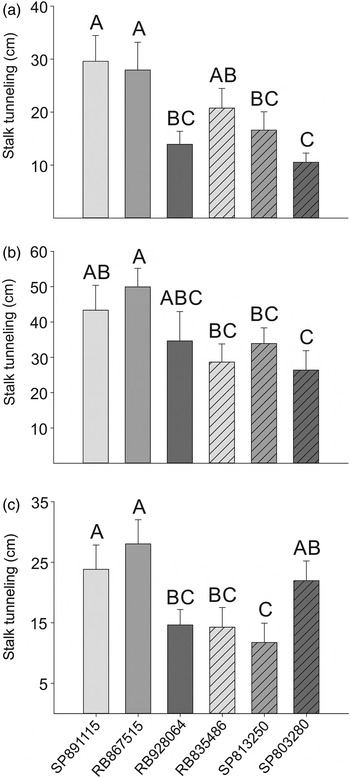
There were no differences among cultivars, levels of infestation, nor interactions between cultivars and levels of infestation for the percentage of bored internodes in any experiment. There was no significant interaction between sugarcane cultivar and level of infestation for tunnel length in the experiment with 7-month-old plants (F 15,47 = 0.91; P > 0.05), but there was a significant difference among cultivars (F 5,47 = 2.69; P = 0.040) (fig. 1a). There was also no significant interaction between sugarcane cultivar and the level of infestation for tunnel length in the experiment with 10-month-old plants (F 25,71 = 0.78; P > 0.05), but there was a significant difference among cultivars (F 5,71 = 5.00; P = 0.001) (fig. 1b). In addition, there was a significant and positive correlation between 7- and 10-month-old single plants (r = 0.82; P = 0.0445). In both experiments, the SP803280 variety had lower tunnel length than did RB867515 and SP891115 (fig. 1a, b).
Stalk tunneling by Diatraea saccharalis larvae for six sugarcane cultivars in the greenhouse. (a) Ten-month-old single plants, (b) 7-month-old single plants, and (c) 5-month-old plants in cane stools. Means ± standard errors with the same letters are not significantly different (P > 0.05) by Fisher's least significant difference protected procedure following ANOVA.

In 5-month-old cane stools, the percentage of dead heart tillers and bored internodes did not differ among cultivars (P > 0.05). There was also no significant interaction between genotype and infestation level (F 15,47 = 0.98; P > 0.05) for tunnel length, but there was a difference among sugarcane genotypes (F 5,47 = 5.62; P = 0.001). Similar to the results of single-plant experiments, varieties SP891115 and RB867515 had the longest tunnel length; however, here SP813250 had the shortest tunnel length, instead of SP803280 as previously observed (fig. 1c vs. a and b), and the tunnel length correlation of the cultivars grown as single plants and cane stools was not significant (r = 0.56; P = 0.251).
The regression model that best described the relationship between infestation level by sugarcane borer larvae and stalk tunneling was sigmoid (fig. 2). Infestation levels higher than 20 larvae per plant led to little or no increase in tunnel length, and therefore this rate of infestation was used to challenge the cultivars as discussed below.
Relationship between rate of infestation by Diatraea saccharalis (i.e. number of larvae per plant) and stalk tunneling for six sugarcane cultivars in the greenhouse.

Tunneling, penetration in the stalk, and larval performance in the stalks
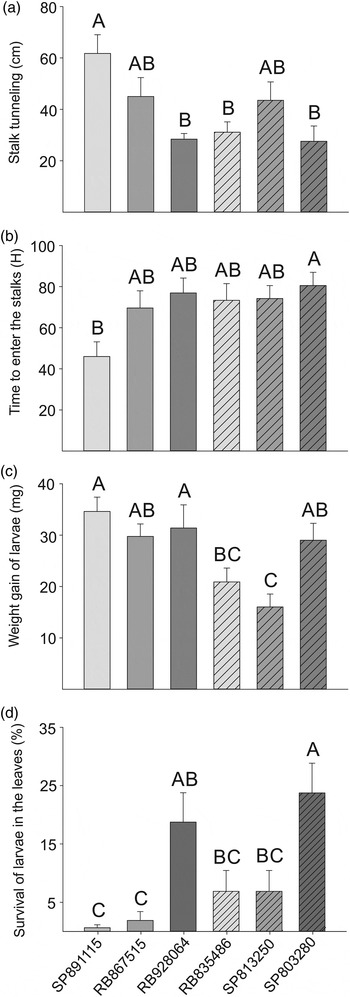
Stalk tunneling in 7-month-old plants varied among the cultivars when infested with 20 larvae/plant (F 5,24 = 4.90, P = 0.003); again, the SP891115 variety showed the longest tunneling (61.8 cm), whereas SP803280, RB928064, and RB835486 had the shortest ones (mean 27.6 cm) (fig. 3a).
Cultivar resistance to Diatraea saccharalis. (a) Stalk tunneling in 7-month-old plants, (b) mean time spent by larvae to enter stalks of 7-month-old plants in the greenhouse, (c) survival of early-stage larvae on leaves of 4-month-old plants, (d) weight gain of late-stage larvae in stalks of 7-month-old plants in the laboratory. Means ± standard errors with the same letters are not different (P > 0.05) by Fisher's LSD protected procedure following ANOVA.

The mean time spent by the larvae to bore into the sugarcane stalk varied among the cultivars (χ2 = 15.61, df = 5, and P = 0.008). For the SP891115 variety, the larvae took 57% of the time to bore into the stalk relative to that required for the SP803280 variety (P = 0.035) (fig. 3b). For the other varieties, the time spent by larvae to bore in the stalk ranged from 70 to 77 h. Only 15% of the larvae did not bore into the stalks of the genotype SP891115, whereas for the other cultivars, more than 50% of larvae failed to do so during the experiment (data not shown).
Regarding larval survival, percentage of pupation, and weight gain of larvae in stalks of 7-month-old plants, only the latter varied among the sugarcane cultivars (F 5,24 = 5.07, P = 0.003). The larvae feeding on SP891115 and RB928064 stalk sections gained more weight (35 ± 2.78 and 31 ± 4.5 mg, respectively) than those feeding on SP813250 stalks, which exhibited the least weight gain (16 ± 3.29 mg) (fig. 3c).
Leaf resistance and correlation with other traits
Leaf damage by D. saccharalis neonates did not vary among cultivars (P > 0.05) in contrast to larval survival rates (F 5,18 = 4.84; P = 0.006) in 4-month-old plants in the laboratory, which was lower for SP891115 and RB867515 cultivars and higher for SP803280 (fig. 3d). Larval survival rates on leaves and in stalks were negatively correlated (r = −0.89, P = 0.019), as were tunneling length and larval entrance time (r = −0.92, P = 0.010). Larval survival correlated with leaf damage (r = 0.87, P = 0.025), but other pairs of variables were not significantly correlated (P > 0.05).
Cluster analysis
A dendrogram for the six varieties is shown in fig. 4. The variables used to cluster the varieties were tunnel length, larval survival in both leaves and stalks, foliar damage rating, percentage of pupation, and weight gain of larvae fed on stalks. Using Ward's method standardized with the mean Euclidean distance was appropriate (cophenetic correlation coefficient = 0.93), indicating a good fit between the dissimilarity matrix and the cluster dendrogram (Cruz et al., Reference Cruz, Carneiro and Regazzi2014). Using the criterion of 55% dissimilarity to separate groups among the sugarcane varieties, three groups were clustered. Clustering was also obtained using Tocher's method, in which group 1 consisted of the SP891115 variety, group 2 of RB867515, SP813250, and RB835486, and group 3 of SP803280 and RB928064 (fig. 4, Table 1). Consistent with this clustering, principal component analysis recognized four divergent groups, as shown in the two-dimensional graph, in which the first and second axis explained 58.6% and 83.5% of the total cumulative variance, respectively (Cruz, Reference Cruz, Carneiro and Regazzi2014) (fig. 5).
Cluster dendrogram obtained by the Ward method using the standardized mean Euclidean distance as the dissimilarity measure among cultivar pairs. Cophenetic correlation coefficient (r) = 0.93.

Cluster of six sugarcane varieties using principal components analysis. The first and the second principal components represent 58.63 and 83.48% of the total accumulate variance, respectively.

Cluster of six sugarcane varieties by Tocher's optimization method based on standardized mean Euclidean distance, estimated by six traits measured for leaves and stalks of seven sugarcane varieties.

Group mean for each variable.
1 Experiments carried out in the laboratory with 4-month-old plants, infested with Diatraea saccharalis neonates.
2 Experiment conducted in the laboratory with stalks of 7-month-old plants infested with 15-day-old larvae of D. saccharalis.
3 Experiment conducted in the greenhouse with 7-month-old plants infested with 9-day-old larvae of D. saccharalis.
Discussion
After determining the appropriate plant age, growth conditions, and rate of infestation, the sugarcane cultivars were assessed for resistance to D. saccharalis. Results of these assays were consistent, and the SP803280 cultivar remained the least damaged genotype, followed by SP813250, RB928064, and RB835486; conversely, SP891115 as the most injured genotype. In addition, the SP891115 cultivar had nearly twofold the damage present in SP803280 (61.8 and 27.6 cm, respectively), indicating the presence of resistance against D. saccharalis in the stalk of the SP803280 cultivar.
To enter the stalks of the SP891115 variety, the sugarcane borer larvae took 34.5 h less than they did to bore into SP803280 stalks; likewise, 96 h after infestation, the number of larvae that entered SP891115 stalks was nearly twice as many as those that entered SP803280 stalks. Other studies have also found differences in the time spent by D. saccharalis and E. saccharina larvae to enter stalks of sugarcane (White, Reference White1993a; Kvedaras et al., Reference Kvedaras, Keeping, Goebel and Byrne2007) and rice (Sidhu et al., Reference Sidhu, Stout and Blouin2013). The time spent by larvae to enter the stalks was more correlated to tunnel length than larval feeding and development within the stalk. It provided further evidence that the difference in tunnel length among genotypes was more relevant to traits on the stalk surface, such as rind hardness, than traits affecting the development of larvae within the stalks, such as fiber content (White et al., Reference White, Tew and Richard2006).
Larvae feeding on stalks of varieties SP891115 and RB928064 gained nearly twice as much weight as the larvae feeding on stalks of the SP813250 variety. Thus, there appears to be some antibiotic factors in the SP813250 stalks, as previously observed for other cultivars (White et al., Reference White, Hale, Veremis, Tew and Richard2011; Dinardo-Miranda et al., Reference Dinardo-Miranda, Anjos, Costa and Fracasso2012). However, it is difficult to distinguish how much of this effect is caused by deterrence, low plant quality for the insect, or antibiosis (Dinardo-Miranda et al., Reference Gitahy, Souza, Monnerat, Arrigoni and Baldani2012; Stout, Reference Stout2013). The lack of correlation between tunnel length and larval development within the stalks indicates that once the larvae are established within the stalks, other resistance factors affect their development, as reported by Bessin et al. (Reference Bessin, Reagan and Martin1990) and Wilson et al. (Reference Wilson, VanWeelden, Beuzelin, Reagan, Way, White, Wilson and Showler2015).
Neonate survival on leaf tissues varied among the tested cultivars, as previously observed in other sugarcane genotypes (Coburn & Hensley, Reference Coburn and Hensley1972; White, Reference White1993b); SP891115 and RB867515 had the lowest survival rate, whereas SP803280 had the highest survival rate, indicating the presence of antibiotic factors on the leaves of the former cultivars. Additionally, there was a high correlation between foliar damage and neonate survival despite the lack of a significant difference for foliar damage.
In our study, cluster analysis was useful in splitting the sugarcane cultivars into non-overlapping homogeneous groups regarding their overall resistance traits to D. saccharalis, indicating genetic divergence (White, Reference White1993a). Tocher's methods recognized three divergent groups of cultivars and they were somewhat in agreement with the principal component analysis, which split the cultivars into four groups. In fact, these groups are in agreement with the resistance of these genotypes in the field. Group 1, composed of SP891115 is characterized by high mortality of young larvae feeding on the leaves, but exhibits high stalk damage and greater development of larvae within the stalks. Although this genotype caused high mortality of young larvae, the few surviving larvae can easily penetrate the stalk and cause severe damage in stalks of this variety. This may explain the high susceptibility observed in this genotype in the field, which is often accompanied by stalk breakage (RIDESA, personal communication). Group 3, composed of SP803280 and RB928064, is characterized by lower mortality of young larvae feeding on leaves but low stalk damage. Despite these genotypes presenting low stalk damage, more young larvae survive on the leaves, so more larvae can penetrate stalks of these genotypes, which accumulate more damage. This explains the susceptibility of these genotypes in the field (RIDESA, personal communication). Group 2, composed by RB867515, RB835486, and SP813250, is characterized by relatively low survival of young larvae on the leaves, relatively low stalk damage, and low development of larvae feeding within the stalks. In fact, the genotypes in group 2 are known to be more resistant in the field (RIDESA, personal communication) probably because of the combination of these resistance traits.
Our results are in agreement with those of previous studies highlighting the importance of selecting sugarcane for borer resistance by assessing several resistance traits (i.e. percentage bored internodes, internodes with moth exit holes, damage rating, larval recovery) (White et al., Reference White1993b, Reference White, Hale, Veremis, Tew and Richard2011; Milligan et al., Reference Milligan, Balzarini and White2003; Keeping, Reference Keeping2006). Moreover, studies considering selection for borer resistance by using a combination of damage measures through methods such as cluster analysis (White, Reference White1993a) and selection indices (Milligan et al., Reference Milligan, Balzarini and White2003) have been reported. In addition, Wilson et al. (Reference Wilson, VanWeelden, Beuzelin, Reagan, Way, White, Wilson and Showler2015) developed a resistance ratio to select sugarcane for resistance to Mexican rice borer Eoreuma loftini by using the percentage of bored internodes and relative larval survival within the stalk. Keeping (Reference Keeping2006) also developed a rating for sugarcane resistance to E. saccharina based on the length of stalk bored, number of internodes bored, and both number and weight of surviving larvae and pupae.
In a breeding program with the goal of improving host–plant resistance to D. saccharalis, one should cross varieties from different groups, those that diverge in resistance traits against D. saccharalis (e.g. genotypes causing high mortality of young larvae × genotypes presenting low stalk damage). The selection of parents is of great importance for developing resistant sugarcane populations. Some studies have shown the efficiency of selecting resistant genitors by using other methods, such as family selection (Zhou, Reference Zhou2015, Reference Zhou2016).
In summary, the results of this study showed that sugarcane cultivars have different resistance traits against the sugarcane borer, thus having important practical implications for breeding programs. Our study showed that diverse methods can be used to screen sugarcane genotypes for stem borer resistance and that several resistance-related traits need to be considered. In addition, the presence of resistance factors and dissimilarity among the tested sugarcane cultivars will aid in the choice of parents and appropriate crosses in sugarcane breeding programs. Further experiments are under way to screen resistance in large sugarcane populations by combining data obtained in the field, greenhouse, and laboratory to select clones carrying resistance traits to D. saccharalis.
Acknowledgements
The authors thank the technical assistance provided by the Inter-University Network for the Development of the Sugarcane Industry in Brazil (RIDESA). The financial support provided by the National Council of Scientific and Technological Development (CNPq), CAPES Foundation (Brazilian Ministry of Education), the Minas Gerais State Foundation for Research Aid (FAPEMIG), and the RIDESA-UFV Sugarcane Breeding Program was greatly appreciated and acknowledged here.