After four decades of unrelenting growth in Federal spending and taxes, most members of Congress came to realize that the desire to spend would always exceed the political ability to tax. From this realization, it was a short step to concluding that Congress, lacking this discipline and will, had to figure out some device by which it could automatically control its urge to spend.
—Representative Bill Archer (R-Tex.), 1991Footnote 1
Circumstances do change and you don’t like to tie the hands of either the administration or the Congress to, you know, to change our attitude as to where spending should be increased or decreased as the years go by.
—Representative Anthony C. Beilenson (D-Calif.), 1991Footnote 2
The federal budget deficit dominated the legislative agenda during the 112th Congress. The House of Representatives and the Senate had difficulty passing any legislation that did not address this issue in some way. Of the measures considered, the debate over the debt ceiling was by far the most polarizing and contentious. Congress ultimately passed the Budget Control Act (BCA; Public Law 112-25) on the eve of breaching the debt ceiling in August 2011. The BCA reduced government spending by $2.1 trillion over ten years (2012–21) in exchange for raising the debt ceiling by an equivalent amount.Footnote 3 This ten-year score was decisive in securing the votes necessary for final passage because President Obama and congressional Democrats opposed any debt ceiling increase that was not sufficient to get past the 2012 elections and congressional Republicans would not raise the debt ceiling without, at a minimum, dollar-for-dollar reductions in government spending.
Congress continues to grapple with the BCA’s consequences today. House and Senate appropriators are required to comply with the new law when writing their annual spending bills and the word sequester has become a prominent part of our political discourse over the past year. Democrats point to the ten-year score as evidence that spending has already been cut and argue that Congress should now raise more revenue as part of a balanced deficit-reduction package. In contrast, Republicans largely hail the BCA as an important step in the right direction while arguing that much more needs to be done to cut spending.
Both perspectives rely on the savings achieved by the BCA over a ten-year period. Yet most of the spending cuts in the new law have not yet occurred. To be fair, approximately half of the $2.1 trillion in savings will occur automatically each year if Congress does not repeal the sequester without offsetting the increased spending with additional reductions elsewhere. However, the remaining savings are entirely dependent on future congresses passing appropriations bills that comply with the BCA’s spending limits. In other words, these savings are contingent on future congresses passing new laws that affirmatively comply with the BCA year after year for the next eight years. In either case, Congress may change its mind and choose not to comply with the BCA.
Given these concerns, it is appropriate to question the extent to which assumed reductions in government spending will stick over the life of the BCA. Is it realistic to count on these savings in the future simply because the law technically mandates them? Answering this question now, after only a few years under the BCA, is difficult. When viewed from our current perspective, the answer appears to be a qualified yes. On one hand, Congress has largely adhered to the new law’s annual spending limits and the sequester took effect in the spring of 2013 amid much fanfare without any real effort to repeal or replace it. However, support for deficit reduction is strong and many of the members of Congress who originally voted for the BCA remain in office. Indeed, in the 2012 elections voters returned the same partisan balance of power to Washington that existed in 2011 when the BCA was first negotiated.
On the other hand, Congress passed legislation in the closing days of 2013 raising the BCA’s annual spending caps for fiscal years 2014 and 2015. Specifically, the Bipartisan Budget Act of 2013 (Public Law 113-67) increased discretionary spending by $63.4 billion. While this increase was offset by approximately $85 billion in additional savings, some of these savings appear to violate the original spirit of the BCA, at least as presented by congressional Republicans, that any increase in the debt ceiling be offset with dollar-for-dollar reductions in government spending. For example, approximately $27.3 billion of the savings in the legislation are achieved by increasing the amount of revenue the government collects. In addition, the utilization of various accounting gimmicks and delaying savings until the ninth and tenth year of the ten-year budget window further call into question the agreement’s overall savings. Notwithstanding these concerns, the bipartisan budget agreement averted a looming second sequester mandated to occur in January 2014 by the BCA. The agreement also paved the way for Congress to pass the Consolidated Appropriations Act for Fiscal Year 2014 (Public Law 113-76), which funded the government through the remainder of the fiscal year.
But what happens when the political environment changes and the consensus underlying the BCA dissipates, if it hasn’t already? This question cannot be answered sufficiently by only analyzing the BCA’s track record to date. Fortunately, the Budget Enforcement Act of 1990 (BEA; Public Law 101-508) offers an analogous case of a nearly identical budgetary regime operating under similar circumstances. Thus, we can use the BEA’s performance to make predictions for how the BCA will perform over the next eight years.Footnote 4 These predictions are based on a new corrosion theory that can be used to develop expectations for how process-centric budget agreements like the BEA and BCA perform over the long term. This approach illustrates the applicability of organization theory and the problem of credible commitment to the congressional budget process more generally. This theory suggests that procedural solutions to our fiscal problems will not be successful in the absence of the political will to actually cut spending and reduce the deficit.Footnote 5
Credible Commitment and Corrosion
Rules necessarily restrict the behavior of governments in a constitutional democracy. Yet not all rules are equally effective in restricting that behavior. According to North and Weingast (1989, 803),Footnote 6 rules that can be easily revised “differ significantly in their implications for performance from exactly the same rules when not subject to revision.” This suggests that the existence of a rules-based regime is itself not the most salient factor in assessing its future effectiveness. Rather, the degree to which the government can make a credible commitment to follow those rules in the future is a much more important consideration when assessing future performance. While North and Weingast were writing about property rights in seventeenth-century England, their observations are applicable to the congressional budget process today. Viewed from this perspective, it is not sufficient for Congress to merely set deficit-reduction targets and create special rules to achieve them. The House and Senate must also demonstrate a credible commitment to enforcing those rules in the future if voters are to have faith that the deficit-reduction targets will actually be achieved.
The problem of credible commitment here can be solved in one of two ways: reputational or procedural.Footnote 7 First, Congress may establish a precedent of “responsible behavior.” This would negate the problem of credible commitment in the first place because such behavior would, by definition, obviate the need for special deficit-reduction rules. Congress may also restrict its future behavior by making it more difficult to evade budgetary controls, thereby making it more likely that their deficit-reduction target will be achieved.
The procedural nature of the latter approach is designed to insulate lawmakers and their desired policy outcome (i.e., deficit reduction) from the inevitable political pressure to circumvent the budgetary controls in the future. Public opinion will naturally be shaped by the implementation of budgetary controls. When these conditions change, members of Congress must be relatively constrained from intervening in the automatic functioning of the budgetary controls.
The willingness of Congress to evade budgetary controls may result from an influx of new members, a new external environment, or unanticipated events that challenge the very legitimacy of those controls. But tossing out the entire procedural structure of those controls is not cost-free. Any deviation from the original agreement will be difficult to the extent that the original conditions that gave rise to the budget-process agreement in the first place persist. Thus, lawmakers will insert procedural mechanisms into the agreement that can be used to circumvent the budgetary controls in a less costly manner.
The most basic reason Congress cannot make credible commitments regarding fiscal policy is that no current Congress can dictate the decisions, and thus bind future congresses. When previously enacted laws present obstacles to what Congress wants to accomplish, those laws are typically altered. This is neither new nor novel. In contrast, what makes these process-centric budget agreements unique is that they include provisions at the time of passage that are explicitly designed to undermine the commitment Congress is trying to make credible at that particular point time. This suggests that we should be even more skeptical of credible commitments regarding multiyear budgetary and fiscal agreements if they include procedural mechanisms designed to circumvent the commitment being made at the time. This is a controversial and interesting issue given the centrality of such budgetary and fiscal agreements to congressional decision-making in recent years.
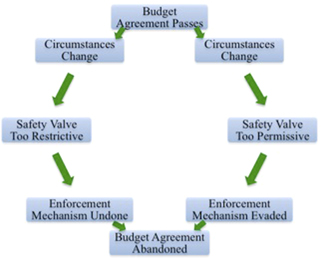
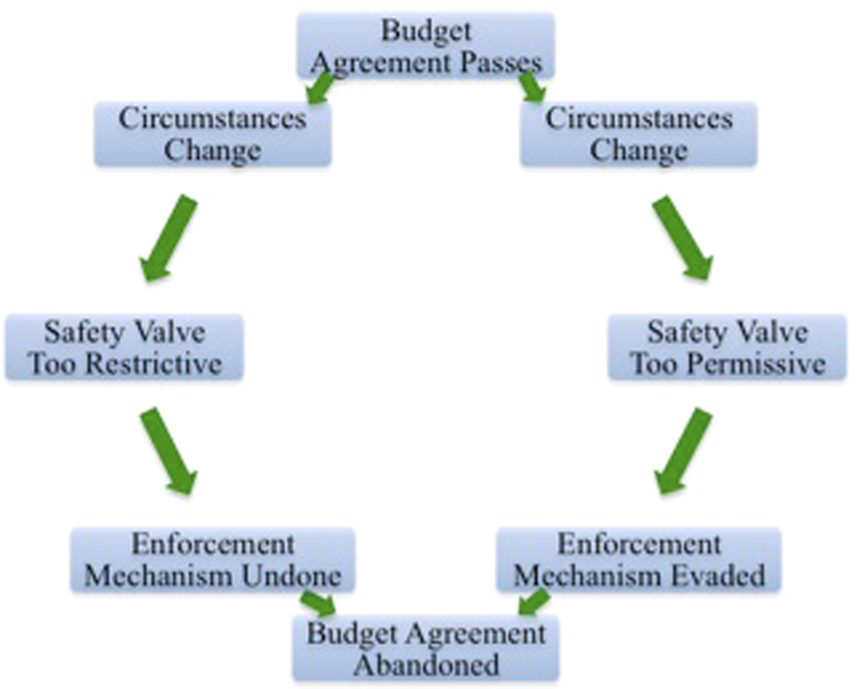
These procedural mechanisms, or safety valves, are necessitated by the multiyear nature of budget process reforms and present Congress with a budgetary Catch-22 (Fig. 1). Such multiyear accords are unable to adapt to changing circumstances in the future if their enforcement mechanisms are too restrictive. However, lawmakers will be more likely to jettison the budgetary controls in the future if the enforcement mechanism cannot adapt to changing circumstances. Yet by overcompensating for this concern and making the enforcement mechanisms more permissive, lawmakers risk destroying the agreements’ effectiveness in the first place.
Budgetary Catch-22.
Including a safety valve in such budget agreements is necessitated by their inherent forward-looking nature and their reliance on budget process reforms to secure future spending cuts. Faced with a predetermined budgetary course over several years, Congress includes a safety valve to accommodate unanticipated emergencies. Doing so allows for new spending beyond the levels called for in the agreements should the circumstances that gave rise to them change.
The theoretical explanation for this is simple: lawmakers value flexibility in the face of uncertainty. Put simply, circumstances may change in the future, thereby making the budget agreement unacceptable. Circumstances may change in one of two ways. First, legitimate emergencies, such as natural disasters or terrorist attacks, may occur unexpectedly. Second, and more consequential for the integrity of the budget agreement, the political environment may change as a result of a shift in public opinion away from austerity. Including an exception for emergency spending in the agreement therefore reduces uncertainty for lawmakers. This enables them to support a budget agreement that they might otherwise view as too restrictive. For example, an emergency exception was included in the BEA primarily to secure the support of congressional Democrats for overall limits on discretionary spending.Footnote 8
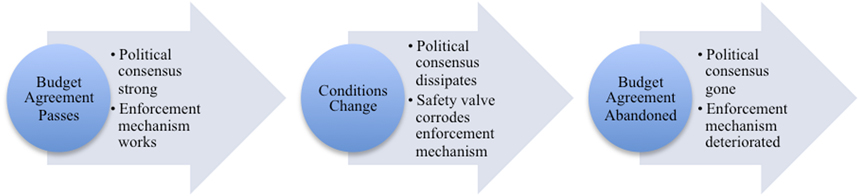
The corrosion theory predicts that this safety valve will gradually undermine process-centric budget agreements over time. Changing circumstances, particularly those that result from mid- and long-term shifts in public opinion and congressional attitudes, will corrode the enforcement mechanisms on which such agreements depend. Without an effective enforcement mechanism, the agreement will ultimately fail as increasing amounts of spending evade its limits through the safety valve. When this spending becomes too large to ignore, it causes an irrevocable deterioration of the budget agreement’s enforcement mechanism and it is abandoned (Fig. 2).
Corrosion Theory: Process.

For which reason are lawmakers more likely to utilize the emergency exception in order to evade a budget agreement’s enforcement mechanism over time? Does the relative weight of the two reasons remain stable over the life of the agreement? Or does it fluctuate with time? These questions are critical to understanding the implications of the corrosion theory and thus predicting the future success of the BCA. Fortunately, they can be answered by observing the level and nature of emergency spending over the life of the BEA.
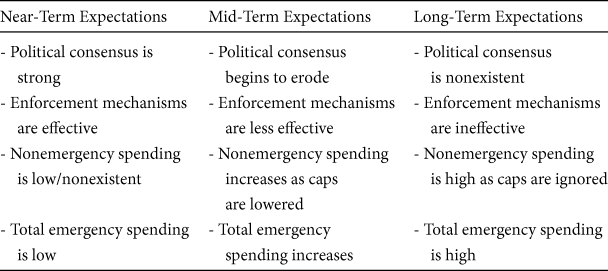
Three expectations about the level and nature of emergency spending over the course of a budget agreement can be inferred from the theory. These expectations are based on the nature of the political consensus supporting the budget agreement, the effectiveness of its enforcement mechanisms, the extent to which the agreement’s emergency exception is used for nonemergency spending, and the overall level of emergency spending (Table 1).
Corrosion Theory: Expectations

First, lawmakers will adhere to a budget agreement’s goals and its enforcement mechanism will work in the near term because the agreement itself rests on a broader political consensus on fiscal policy. As such, the emergency exception will be utilized for largely legitimate reasons and the overall amount of spending so designated will be small. Any deviation from the legitimate use of the safety valve will be contested.
Second, this consensus will dissipate over the mid- and long-term life of the agreement as circumstances change and the enforcement mechanism is corroded. Exacerbating this trend is the fact that the savings are typically back-loaded in the ten-year budget window. The political consensus supporting the agreement would be destroyed if the savings were front-loaded. However, back-loading the savings increases the probability that they will never be realized due to the dynamics of the corrosion theory over time.
Circumstances may change as a result of economic growth and prosperity, which reduces public support for austerity in tandem with an increase in tax revenue and a reduction in the deficit. Changed circumstances may also result from new members being elected to Congress who had no involvement in passing the original agreement. These two precipitating factors may also occur concurrently. In this context, the emergency exception will increasingly be used for nonemergency purposes and the overall amount of emergency spending will be greater than it was immediately after the budget agreement originally passed. This shift in the utilization of the safety valve is necessary to preserve support for the broader agreement, thereby avoiding the more controversial debate over fundamental policy differences between, and within, the two political parties. However, the shift also begins to corrode the agreement’s enforcement mechanism, thereby hastening the point at which it will be abandoned.
Finally, we can expect the budget agreement to be abandoned when the enforcement mechanism on which it depends is completely corroded and has deteriorated. At this point, the emergency exception is no longer an effective mechanism by which members of Congress may adjust the agreement to present-day circumstances while preserving its original spending levels. The amount of budgetary evasion demanded by some members is simply too large to allow them to maintain any credible pretension to fiscal responsibility. Moreover, public attachment to the agreement, never great due to the esoteric nature of the budgetary process in the first place, has waned. As a result, letting the agreement expire poses fewer costs for members than continuing to evade it through the use of the emergency exception.
A Tale of Two Budget Agreements
The period of the late 1980s and early 1990s has many similarities with the current political environment. Fiscal issues dominated public discourse and concern over the budget deficit permeated nearly all of the debates in Congress. Indeed, budgetary issues were the primary point of contention between Democrats and Republicans in the House and Senate. Then, as now, periodic budget agreements punctuated the legislative agenda and helped to unclog the policy process more generally.
The BEA was the most important budget agreement passed during this period. It structured our budgetary politics for the next ten years. The BEA’s provisions were very similar to the BCA in that they emphasized budget process reforms to keep overall spending levels under predetermined limits in the future. This approach alleviates conflict over the budget while temporarily avoiding larger and more controversial issues associated with the specific policies needed to actually cut spending and reduce the deficit.
In order to keep future spending below their statutory levels, the BEA and BCA included nearly identical enforcement mechanisms that were designed to limit Congress’s ability to increase the deficit by spending more money than what was permitted in the agreements. This kind of enforcement mechanism is defensive in nature. That is, it is designed to preserve deficit reduction agreed to as part of the original agreement instead of serving as a catalyst to spur future policy change.Footnote 9
The BEA’s enforcement mechanism adopted a two-pronged approach. First, it established annual limits on discretionary spending. Second, it limited mandatory spending and revenue legislation through a Pay-As-You-Go (PAYGO) mechanism by which any increase in mandatory spending (or decrease in revenues) would automatically be offset. Both the spending caps and PAYGO provisions were enforced through an annual sequestration procedure. Any amounts by which the caps were exceeded and any excess balance on the PAYGO scorecard would be reduced via an across-the-board sequester. The BEA was extended in 1993 and 1997. It expired in 2002.
Like the BEA, the BCA was designed to lock in the deficit reduction agreed to in the August 2011 deal. Its enforcement mechanism also adopted a two-pronged approach that was partially modeled on the BEA. First, the BCA reestablished annual caps on discretionary spending for fiscal years 2012 to 2021. Spending in excess of the discretionary caps is automatically reduced via an across-the-board sequestration process. Second, the BCA created a Joint Select Committee on Deficit Reduction (the so-called Super Committee) and tasked it with identifying an additional $1.2 trillion in deficit reduction by December 2011. However, discretionary spending levels will now be further reduced each year by an amount sufficient to achieve the $1.2 trillion target because the Super Committee was unable to reach an agreement.
The BEA and BCA are both multiyear accords because they rely on specified spending cuts in the out-years to achieve their savings. Both agreements attempt to address the problems inherent in such accords by including an emergency exception to cover legitimate needs that are unanticipated. This exception serves as a safety valve designed to protect the budget agreements because it allows Congress to adapt to changed circumstances in the future without jettisoning their enforcement mechanisms completely.
The BEA exempted spending designated as emergency appropriations from its discretionary caps.Footnote 10 In other words, spending so designated that exceeded the caps would not trigger the across-the-board sequester. The BEA defined Emergency Appropriations as the following:
Emergency Appropriations:
(i) If, for fiscal year 1991, 1992, 1993, 1994, or 1995, appropriations for discretionary accounts are enacted that the President designates as emergency requirements and that the Congress so designates in statute, the adjustment shall be the total of such appropriations in discretionary accounts designated as emergency requirements and the outlays flowing in all years from such appropriations.
(ii) The costs for operation Desert Shield are to be treated as emergency funding requirements not subject to the defense spending limits. Funding for Desert Shield will be provided through the normal legislative process. Desert Shield costs should be accommodated through Allied burden-sharing, subsequent appropriation Acts, and if the President so chooses, through offsets within other defense accounts. Emergency Desert Shield costs mean those incremental costs associated with the increase in operations in the Middle East and do not include costs that would be experienced by the Department of Defense as part of its normal operations absent Operation Desert Shield.
Notably, the BEA placed no restriction on the kind of spending that could be designated as an emergency, nor did the agreement limit the total amount of spending that could be so designated.
The BCA also exempted emergency spending from its discretionary spending caps.Footnote 11 Spending so designated would not be offset via the sequestration process, even if it caused overall spending levels to exceed the statute’s limits. Yet, unlike the BEA, the BCA defined Emergency Appropriations more precisely, in part because of increased concern among lawmakers about the use of the emergency exception as a large loophole to evade the BCA’s spending limits.
The term “emergency” means a situation that requires new budget authority and outlays (or new budget authority and the outlays flowing therefrom) for the prevention or mitigation of, or response to, loss of life or property, or a threat to national security; and is unanticipated. The term “unanticipated” means that the underlying situation is sudden, which means quickly coming into being or not building up over time; urgent, which means a pressing and compelling need requiring immediate action; unforeseen, which means not predicted or anticipated as an emerging need; and temporary, which means not of a permanent duration.
Notwithstanding the inclusion of this definition, the BCA continued the BEA’s practice of not placing any limit on the total amount of spending that could be so designated. Furthermore, the definition itself offered little specific guidance to members of Congress on what was actually considered an emergency. Finally, the definition had no real binding effect on what Congress could designate as an emergency. As a result, the safety-valve provisions of the BEA and BCA did not include any meaningful protections against abuse.
The lack of internal safeguards against abuse is significant because both of these agreements purport to effectively bind future congresses. Yet as illustrated by the budgetary Catch-22 inherent in such approaches, members will eventually recoil at these spending limits as circumstances change if their safety valves are too restrictive. In contrast, if the safety valve is considered too permissive, it will gradually corrode the agreements’ effectiveness. Put simply, a safety valve ultimately renders the spending limits meaningless, thereby negating the spending cuts originally agreed to in the BEA and BCA.
An examination of the BEA and BCA thus provides an opportunity to assess the effectiveness of deficit-reduction measures that emphasize budget process controls to reduce government spending in lieu of spelling out specific long-term policy changes. Analyzing the extent to which the BEA’s emergency exception was abused in order to evade its budgetary controls enables us to make predictions as to the BCA’s likelihood for success in the years ahead.
Evaluating Expectations: The BEA
How well do the expectations of the corrosion theory fit the evolution of process-centric, multiyear budget agreements? Does the theory allow us to make realistic predictions for the course of budgetary politics under the BCA over the next decade? Because the BCA is only in its second year, the data are insufficient to assess these claims directly. Fortunately, the BCA was modeled on the BEA. Thus, evaluating the BEA’s track record in meeting its goals allows us to test the theory and, if it is affirmed, make predictions about how the BCA is likely to perform in the years ahead. More specifically, observing the manner in which Congress utilized the BEA’s emergency exception provides an idea of what we can expect from Congress over the next eight years with regard to the BCA’s nearly identical safety valve.
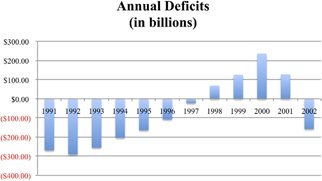
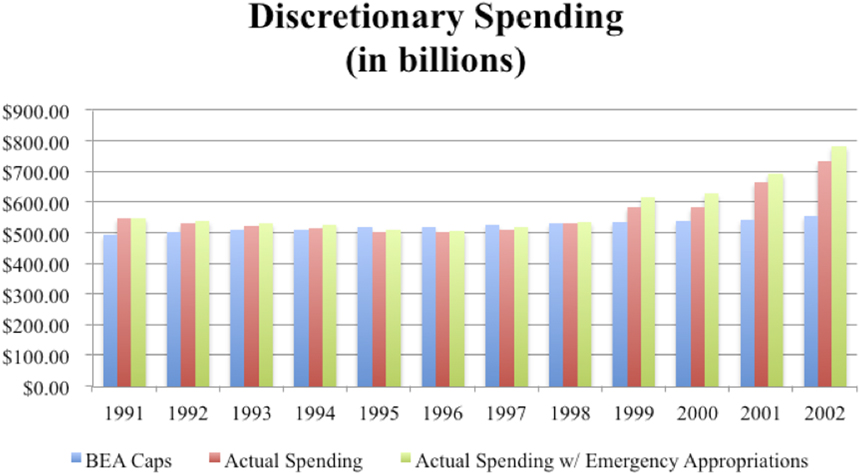
Was the BEA successful in achieving its goals of reducing the deficit by limiting spending? Viewed broadly, it appears that the answer is yes. Deficits declined after 1992 and the budget was in surplus during the BEA’s final years (1998–2002) (Fig. 3). However, a closer look suggests that the answer is no. While deficits declined over the life of the BEA, spending exceeded its caps in all but four of the years the agreement was in effect (Fig. 4).
Deficits Under the BEA.

BEA Spending Caps.

The amounts by which the caps were exceeded remained relatively small during the BEA’s first four years ($9.25 billion on average) and the trend was positive. This trend was reversed during the BEA’s last four years when the amount by which the caps were exceeded each year increased significantly ($100 billion on average). This suggests that the budget surplus of the late 1990s undermined the political consensus and corroded the enforcement mechanism on which the BEA depended.Footnote 12 The budget remained in surplus despite the excess spending as a result of surging tax revenue driven by dramatic economic expansion during this period. Thus, it can be concluded that the BEA was not successful in limiting government spending. The improvement in the deficit seems to have been in spite of, rather than due to, the agreement’s enforcement mechanisms. Deficits would quickly return as soon as the economy cooled because the underlying amount of government spending had increased, not decreased, over the life of the BEA and changing circumstances undermined its enforcement mechanism.
Why was the BEA unsuccessful in achieving its goal? Was it because the emergency exception was utilized in ways largely consistent with the corrosion theory? Accurately answering these questions allows us to assess whether or not we are headed in the same direction under the BCA.
The near-term expectation of the theory is that lawmakers will adhere to the BEA’s spending limits in the early years because they are reflective of a broader political consensus on fiscal policy in the electorate and/or among members of Congress. The BEA was part of a bipartisan compromise negotiated by President George H. W. Bush and the congressional leadership of both parties. It passed the House 228 to 200: 47 Republicans and 181 Democrats supported it; 126 Republicans and 74 Democrats opposed it. In the Senate, the BEA prevailed by a vote of 54 to 45: 19 Republicans and 35 Democrats supported it. As in the House, Senate opposition was bipartisan: 25 Republicans and 20 Democrats voted against the measure. These votes came from the conservative and liberal wings of the Republican and Democratic parties, respectively.
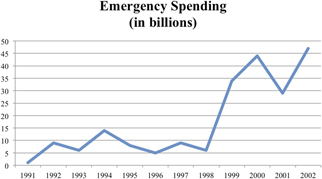
The overall amount of emergency spending was small during the first two years of the BEA. The total amount of emergency spending in 1991 and 1992 was $1 billion and $9 billion, respectively.Footnote 13 Despite the low levels of emergency spending, the discretionary caps were still exceeded in 1991 and 1992 by $10 billion and $14 billion, respectively.
The emergency exception was utilized for largely legitimate reasons during this period. The overwhelming majority of spending so designated was directly related to the Persian Gulf War, which was specifically exempted from the caps in the BEA. Most of the remaining nonemergency spending was arguably related to the war effort. Questionable uses of the exception included funding for the Coast Guard and federal assistance for a telecommunications infrastructure project in Norfolk, Virginia, at the Navy’s Tidewater Family Services Center. Nonemergency spending not directly related to the war effort included student financial assistance for military personnel and veterans and increased funding for the Export Enhancement Program to benefit farmers. Notwithstanding these questionable uses of the emergency exception, the nexus of these programs to either the military or American foreign policy in general was sufficient to pass muster in Congress at the time.
In contrast, the attempted designation of strictly domestic spending as an emergency not related to the Department of Defense or American foreign policy more generally was contested. The consideration of legislation to provide federal assistance for extended unemployment insurance was particularly heated. President Bush ultimately vetoed the bill because his administration did not consider such use of the emergency exception as legitimate. Congressional Republicans largely sided with the president, while Democrats united in support of the expanded utilization.
This debate is particularly illustrative of the dynamics governing the corrosion theory in Congress. Referring to the uses of the emergency exception up to that point, Senator Max Baucus (D-Mont.) argued, “We shouldn’t have one threshold for foreign emergencies—which says you don’t have to offset the cost—and another standard for the unemployed in this country—which says you don’t get benefits unless some other program is cut.”Footnote 14 In the House, the chairman of the Ways and Means Committee, Dan Rostenkowski (D-Ill.), observed, “Many members are frustrated with the apparent willingness to declare emergencies to help citizens of foreign countries, while ignoring equally compelling emergencies at home.”Footnote 15
Republican opponents of using the emergency exception in this manner accused the Democrats of undermining the BEA as originally negotiated just a few years earlier. Senator Pete Domenici (R-N.M.), the ranking Republican member of the Senate Budget Committee and a leading negotiator in the talks leading up to the BEA, stated, “I submit that there really is no budget agreement left, because Congress can decide every time they want something new; that they will send it to the president and say, we think it is an emergency, if you agree, there is no budget limitation.”Footnote 16 Representative Bill Archer (R-Tex.) echoed this sentiment in the House, observing that the emergency exception was a “potential seed of self-destruction.”Footnote 17
The midterm expectation of the corrosion theory is that the political consensus on fiscal policy supporting the BEA will dissipate with time as its enforcement mechanism is corroded by its impact on lawmakers and their constituents. In accordance with this trend, most of the budgetary savings achieved in the BEA occurred in the agreement’s out-years. Put simply, the cuts were delayed in order to avoid near-term pain. As a consequence, the caps became much more restrictive over the course of the agreement. In light of this, we should observe an increase in the utilization of the emergency exception for nonemergency spending as the BEA nears middle age and its enforcement mechanisms become more restrictive.Footnote 18 Emergency spending during the middle years of the BEA was in the middle and high range of annual emergency spending for the years 1991 to 2002. During the first half of the BEA era (1991–97), emergency spending totaled $52 billion. This amount increased by more than 200 percent during the second half of the BEA era (1998–2002) to $160 billion (Fig. 5). These numbers contradict the conventional wisdom that the late 1990s was a period of retrenchment in government spending and fiscal responsibility more generally.
Emergency Spending: 1991–2002.

Over the life of the BEA, emergency spending increased primarily because Congress used the safety valve to exempt nonemergency spending from the BEA’s spending limits. In response to a veto threat by President Clinton over the 1999 appropriations bills, Congress increased funding for environmental protection, highway construction, subsidized housing, and to hire one hundred thousand elementary school teachers. Congress also increased military spending beyond that called for in the BEA. In order to stay below the BEA’s caps, Congress designated all of this increased funding as emergency spending. At the time, Clinton remarked that Congress was “basically bringing money to us in a wheel-barrow.”Footnote 19
Reflecting these increases, more and more government agencies received emergency spending to use for nonemergency programs. The number of government agencies receiving emergency spending increased dramatically after the first two years of the BEA, when emergency spending was limited primarily to the departments of Defense and State and to international assistance programs. During the latter years, however, virtually all agencies received emergency spending on a regular basis. The departments of Health and Human Services, Housing and Urban Development (HUD), and Transportation, and the Small Business Administration were among the biggest recipients.
The utilization of the emergency exception for nonemergency uses is reflected in the regular designation of certain programs as an emergency on an annual basis. For example, the Community Development Block Grant program and housing assistance programs in HUD received emergency spending every year the BEA was in effect. Similarly, funding for the Low-Income Home Energy Assistance Program (LIHEAP) to subsidize residential energy costs and assistance for the Forest Service and the Department of the Interior to combat wildfires was exempted from the BEA’s caps on an annual basis over much of the life of the BEA.Footnote 20
The long-term expectation of the theory is that Congress will let the BEA expire when the political consensus on which it was built is gone. At this point, the agreement’s enforcement mechanism is thoroughly undermined and the total amount of emergency spending increases dramatically. Affirming this expectation, total emergency spending under the BEA was greatest during its final years from 1999 to 2002. In each of these years, Congress designated more spending as an emergency than in all of the previous years combined. It is difficult to credibly claim that ever-increasing levels of spending are needed to respond to unanticipated emergencies year after year. From 1997 to the end of the Clinton administration, the president’s nonemergency priorities for domestic spending were the primary beneficiary of the increase in emergency spending.Footnote 21 As a result, letting the BEA expire in its entirety presents fewer political costs for members, particularly when the budget is in surplus.
Predicting Performance: The BCA
The BCA has been in effect for two years. Thus, we are able to assess the extent to which its performance to date aligns with the near-term expectations of the corrosion theory. We will have greater confidence in the predictions of the theory’s mid- and long-term expectations for the BCA if the near-term expectations have been affirmed over the past two years.
Was the BCA successful in achieving its goal of reducing the deficit by limiting spending over the past two years? Thus far, it appears that the answer is a qualified yes. Under the agreement, discretionary spending subject to the caps was lower in 2013 than it was in 2005. This spending will not return to its pre-BCA levels until 2018. If adjusted for inflation, discretionary spending will not return to its pre-BCA levels before the BCA expires in 2021.
However, the structure of the BCA suggests that the answer will ultimately be no. Like the BEA, the BCA depends on the continued adherence of future congresses to its spending limits. Yet as the theory predicts, and the case of the BEA demonstrates, Congress will likely utilize the BCA’s safety valve in order to spend more money than the agreement allows. This will occur if the political consensus supporting the BCA dissipates and circumstances change, particularly as the result of shifts in public opinion and in attitudes of members of Congress.
The BCA conforms to the near-term expectations of the theory. Like the BEA, it depends on a consensus within the electorate and among members of Congress that the budget deficit was too high and that spending needed to be reduced. The bipartisan agreement was the result of negotiation between President Obama and the congressional leadership in the House and Senate. The measure passed the House by a vote of 269 to 161, with 174 Republicans and 95 Democrats supporting the BCA. The opposition was also bipartisan, with 66 Republicans and 95 Democrats opposing it. In the Senate, the BCA passed on a 74 to 26 vote; 28 Republicans and 46 Democrats supported it. As in the House, Senate opposition was bipartisan: 19 Republicans and 7 Democrats from the conservative and liberal wings of their respective parties voted against the agreement.
The BCA permits adjustments to its spending caps for several reasons. The three primary cap adjustments during the first two years of the BCA were for OCO, emergency appropriations, and disaster relief. However, OCO funding for the wars in Iraq and Afghanistan is excluded from the totals below in order to arrive at a BEA-equivalent amount of emergency spending for this period. Spending designated as disaster relief is included, along with spending designated as an emergency, because it must be spent on disaster relief activities associated with the Stafford Act. With this definition, the total amount of spending exempted from the BCA’s budgetary controls via the emergency exception was $11 billion in 2012 (all of which was designated as disaster relief) and $61 billion in 2013 ($12 billion of which was designated as disaster relief and $42 billion of which was designated as an emergency).
The BCA also included an automatic sequester procedure separate from the annual caps on discretionary spending. The sequester was designed to save $1.2 trillion over ten years primarily by further reducing annual discretionary spending, including the spending exempted from the BCA’s discretionary caps through the emergency and disaster relief designations. The sequester took effect in 2013 for the first time and reduced spending designated as emergency and disaster relief by $3 billion. Thus, the final BEA-equivalent number for emergency spending in 2013 was $58 billion.
Taking into account all of these modifications, the BCA caps were technically not exceeded in either 2012 or 2013. However, total spending, including exempted spending, exceeded the total amount permitted by the caps in both years ($1.043 trillion). In 2012, total discretionary spending equaled $1.181 trillion. In 2013, total discretionary spending equaled $1.196 trillion ($1.127 trillion post-sequester).
The emergency exception was used for largely legitimate reasons in both 2012 and 2013. In 2012, all emergency spending fell under the BCA’s disaster relief exemption. This restricted the spending to major disasters as defined by the Stafford Act, and thus limited them to natural catastrophes and the threat they present to life and property. Unemployment assistance is permitted by the Stafford Act, but only to the extent that the job loss in question was directly caused by the natural disaster. As a result, the nexus of such spending to actual emergencies is fairly straightforward.
Similarly, $12 billion ($11 billion post-sequester) was exempted from the BCA’s budgetary controls through the disaster relief designation in 2013. There is no similar restriction on the remaining $42 billion ($40 billion post-sequester) that was designated as an emergency in 2013. However, as the theory of budgetary erosion predicts, this spending was also related directly to actual emergencies. It was entirely the result of legislation to provide assistance in the aftermath of Hurricane Sandy. Thus, spending exempted from the BCA’s budgetary controls during its first two years adhered to the pattern exhibited in the BEA and was related to actual emergencies.
Finally, the attempted designation of spending as an emergency clearly not related to disaster response was contested. Again, this debate broke along largely partisan lines. Senate Republicans opposed the designation of funding for forest fires that had not yet occurred as an emergency. The designation effort failed on a 51 to 44 vote. In a potential indication of a more restrictive approach to emergency spending in general, Senate Republicans also successfully stripped the emergency designation from a provision in the Sandy supplemental that provided funding to the Army Corps of Engineers for mitigation projects designed to prevent flooding from natural disasters that had not yet occurred.
The BCA’s track record in achieving its goals largely conforms to the example provided by the BEA and the predictions of the near-term expectations of the corrosion theory. Whether or not it will continue as an effective mechanism to achieve the deficit reduction included in the original August 2011 deal remains to be seen. The theory’s expectations and the case of the BEA does not instill much hope. Both agreements are structured similarly and the contemporary political environment bears many similarities to that of the late 1980s and 1990s. If the economy recovers and public opinion shifts, there is no reason to expect the BCA’s spending restraints to continue to serve as an effective enforcement mechanism. Perhaps even more ominously, a further deterioration of the economy could lead members of Congress to support renewed calls for additional stimulus spending in excess of the BCA’s caps. The mid- and long-term expectations of the theory presented in this article suggest that we have every reason to expect that this excess spending will be designated as an “emergency” in either scenario.
Conclusion
The BCA was the most important budget agreement considered during the 112th Congress. By combining reductions in government spending with an increase in the federal debt ceiling, it de-escalated, at least temporarily, the conflict between Democrats and Republicans over fiscal policy. Both parties use the BCA in an effort to support their preferred approach to deficit reduction moving forward. The Democrats cite the agreement’s spending cuts when they argue that more revenue should now be raised as part of a balanced deficit-reduction package. In contrast, Republicans generally acknowledge the BCA is an important, but small, step in the right direction and argue that more spending cuts are needed in order to avoid a further deterioration in the country’s fiscal condition.
While their prescriptions differ, both perspectives depend on the savings achieved by the BCA over a ten-year period. Put simply, Democrats and Republicans are citing spending cuts that have not yet occurred in order to make their arguments. Moreover, half of the $2.1 trillion in savings is dependent on future congresses passing laws that comply with the agreement’s spending limits. It is thus appropriate to question the extent to which these assumed reductions in government spending will stick over the life of the BCA. Is it realistic to count on these savings in the future simply because the law mandates them? If not, can Congress continue to rely on process-centric, multiyear budget agreements, such as the BCA, in order to reduce the deficit in the future?
Building on organization theory and the problem of credible commitment, the corrosion theory developed in this article suggests that the capacity of Congress to evade budgetary controls like the BCA is itself an obstacle to the efficient operation of those controls in the first place. This tells us that progressive reforms designed to depoliticize budgetary decisions in Congress are unlikely to be successful over the long term. Multiyear budget accords are unable to adapt to changing circumstances in the future if their enforcement mechanisms are too restrictive. The inclusion of a safety valve is thus a necessary precondition for the future success of the budget agreement. If the agreement is unable to adapt, if it does not include a safety valve, lawmakers will likely jettison its budgetary controls in the future. Yet the safety valve will ultimately be one of the precipitating factors that causes the agreement’s enforcement mechanism to deteriorate.
The corrosion theory captures this process and develops three expectations for how it will impact the life of a process-centric, multiyear budget agreement. It is based on the fact that members of Congress value flexibility in the face of uncertainty. A safety valve provides members with the flexibility they need to adapt the agreement to changing circumstances. However, the combination of a safety valve with a shifting political environment will ultimately corrode the budget agreement’s enforcement mechanism, thereby rendering it ineffective. When this happens, the agreement will be abandoned.
Given the problem of credible commitment and the dynamics inherent in the corrosion theory, it is not realistic to count on the BCA’s savings over the next eight years simply because the law mandates them. In the absence of a strong political consensus in support of deficit reduction, we should not expect the BCA’s enforcement mechanism to be effective over the mid- and long-term life of the agreement. As with the BEA, the BCA’s emergency exception will likely be the principal means by which Congress evades the BCA in the years ahead.
Is there a way to tweak process-centric, multiyear budget agreements so that they are not as susceptible to the corrosion theory? Or will process reforms always be ineffective in achieving deficit reduction in the absence of a political consensus in support of their goals? As discussed in this article, the structure of such agreements makes them vulnerable to the corrosion theory. Moreover, it is difficult to argue against utilizing the safety valve in the future to pay for politically popular spending items. With that being said, the odds of success for these agreements may be improved by shifting the timing of their savings forward in the budgetary window. The inevitable corrosion of an agreement’s enforcement mechanism will not pose as great a threat to its overall success if the spending cuts are front-loaded in the early years of the agreement. However, this may be easier said than done. Front-loading spending cuts in the BCA would have likely destroyed the political consensus in support of the agreement in the first place. If this is the case, the corrosion theory may be fatal to the long-term success of process-centric, multiyear budget agreements. It may thus be impossible to force deficit reduction on an unwilling Congress through procedural means alone.