I. Introduction
The writer and theorist Paul Valéry began his notebooks in 1894, among other things as part of a research project. He wanted to analyze and mathematize the associative activity of mental images. Such research ambitions are less unusual than may seem at first glance. At the end of the nineteenth century experimental physiology and psychology as well as philosophy were attempting to understand the functioning of the imagination precisely in relation to the question of how the imagination may lead to new knowledge and new artworks.Footnote 1 Parallel to this, the imagination's capacity for innovation and invention was also explored in mathematical and literary theory during the second half of the nineteenth century.Footnote 2 It might be objected that Valéry is operating in a scientific field as an amateur and also sees himself as part of a universalist tradition that rejects the real historical differentiation between fields of knowledge. In France at the end of the nineteenth century, however, universalism was experiencing a revival, especially in the years after 1881 when a large proportion of Leonardo da Vinci's sketchbooks were published in a facsimile edition (see Leonardo da Vinci Reference Ravaisson-Mollien1881–1891 and 1893) leading – not only for Valéry, but also for a broad section of the public – to a rediscovery of the Renaissance artist as a scientist and engineer. Thus, while in the course of the century an institutional and methodological separation between the arts and sciences was becoming more firmly established and the sciences were increasingly differentiated into various autonomous disciplines, the rediscovery of Leonardo da Vinci drew attention to the model of knowledge of the modern period, though now transformed into the ideal of a universalism rooted in the power of the imagination.Footnote 3
Against this background Valéry's research and his interest in mathematics and physics should also be understood as a symptom of the relationship between the sciences and the arts, which (at the turn of the nineteenth/twentieth century) was becoming increasingly precarious. In the Cahiers of the years beginning around 1894 this relationship is negotiated above all through the techniques of (re-)presentation in which both elaborated and fundamental procedures of writing, drawing, and calculating play a central role. In the analysis of the Cahiers it should be borne in mind, however, that the use of these notebooks significantly differs from the common use of notebooks in a research context: on the one hand Valéry's observation of the “means” constantly stands in the way of the instrumental use of these means; on the other hand the method of introspection that Valéry uses for his research – since it is not relativized by an outside observer or larger laboratory context – leads to a confusion between the researcher and object of research. In both cases the teleology of Valéry's approach is disrupted. Today's reader of the Cahiers thus faces the difficult decision of the level at which to engage with Valéry's entries, of whether the object of research or the method of representation stand in the foreground, and how the two in each case are connected. In addition, when analyzing the Cahiers it is necessary to constantly bear in mind their non-final form. Valéry's considerations on the functioning of the imagination are not brought to a conclusion and he never published them as a book or synthesized them in a scientific form. Today's reader is therefore faced with the task of not overly finalizing Valéry's argumentations while still respecting the seriousness of purpose that characterizes them. Valéry's research project remains an essential concern of his work in the notebooks, one that he pursued, besides many other subjects, until his death in 1945.
II. On the Instrumentality of the Cahiers (1894–1945)
In general, researchers have attributed a purely instrumental task to their notebooks. Here, for example, considerations on experimental setups are noted down or sketched out in drawings. From time to time, possible themes and argumentations for texts or speeches are listed, or research problems are considered on paper from different angles using different systems of notation (such as mathematical calculation, schematic sketch, verbal reflection). In addition, there are frequent extracts from books, and much else besides. Working on paper with the means of writing, drawing, and calculating creates a useful dynamic: in the process of research it is well suited to finding a balance between necessary reduction and reasonable openness. Thus on the one hand the large number of possible problems and modes of operating are reduced to the form of a minimal fixed entry. On the other hand, however, the low-level regulation of the notebook (from page to page, but with the possibility at any moment of going back to an entry, or breaking off and starting anew) retains the option of an opening. The notebook thus repeats what Hans-Jörg Rheinberger has formulated as a general characteristic of experimental research:
On the one hand complexity must be reduced in the experiment, that means, certain parameters must be kept stable so that others can be varied and attributions carried out. On the other hand the experimenter is at least implicitly conscious that a reduction may ignore certain things that one would do better not to ignore. Therefore in the broad experimental context of the laboratory the ontic reduction of complexity that occurs in the single experiment is to some extent taken up again epistemically through the variety of the experiments and the modes of recording, which all together constitute such an experimental space. (See Krauthausen and Nasim Reference Krauthausen, Nasim, Krauthausen and Nasim2010, 155f.)Footnote 4
The work on paper contributes to a balance between the ontic reduction of complexity and the epistemic opening necessary for research. Writing and drawing as well as mechanical and digital recording techniques secure an openness for alternative questions, concepts, and solutions. Hence the instrumentality of “paper work” consists at least partly in its capacity to support non-teleological structures.Footnote 5 And while the researcher himself in most cases will be convinced of proceeding consciously and according to rational principles, his research is in fact also promoted by means of variation, detour, or even digression. In this regard subsequent teleological interpretations are inadequate for “investigative” writing processes since they tend to conceal the necessarily indeterminate future horizon of research. Instead, one has to take into account the agency of practices, habits, and techniques and the productiveness of non-instrumentality.
Obviously, Valéry experienced the non-teleological elements of research processes much more strongly than the average researcher. To the writer of the Cahiers, the purpose of his writing in the notebooks was not clear. Valéry once noted at a loss: “What on earth is, or will be, or can possibly be the use of everything I put down in these lines?” (Valéry 2000, 46).Footnote 6 The author questions the instrumentality of the notebooks, which he nevertheless considers an essential part of his work – although they do not contain concrete preparations for his poems and prose texts, and do not have an evident purpose (an identifiable result or a publishable work). Nevertheless, one can note that it is precisely because the function of the ongoing project of the Cahiers is under-determined that they constitute in retrospect an autonomous “writing scene,” in the sense that Rüdiger Campe has given the term. Writing in the Cahiers generates a non-self-evident “ensemble of language, instrumentality and gesture” (see Campe Reference Campe, Gumbrecht and Pfeiffer1991, 760). The ensemble character results from the fixed routine since Valéry writes on a daily basis in the notebooks on the scientific and aesthetic themes that occupy him. It is this rigid continuity that largely drives the writing, as Valéry himself notes: “So that these notebooks and the habits they represent are, for me, more the ‘causes’ of the said writing than an effect and an instrument of the explicit intention to write this or that” (Valéry 2000, 49).Footnote 7 Unlike the classical notion of writing being motivated by thought, the writing in Valéry's notebooks is expressly rooted in a structure of materials, instruments, and habits. As a writer Valéry is part of the artificial composition of the notebooks; he performs one function in a process, and this process does not ultimately lead to a work or a system. The non-finality is not Valéry's intention; it is rather the experience afforded him by the Cahiers – however, one that he develops by continuing to write. Whereas, after a while, the average researcher will try to come to a synthesis (for example by breaking off the ongoing writing process, choosing some aspects and excluding others in order to bring the selected aspects together in the form of interconnected arguments or schemes), Valéry affirms the agency of the open writing process in the Cahiers. Over the decades, and despite Valéry's original intentions, one can observe how the writing scene of the Cahiers develops a format for the acutely provisional and non-definitive aspect of thought. Hence the Cahiers place at the center of what in research processes is but a single productive element.Footnote 8
The practice of writing, drawing, and calculating in Valéry's notebooks creates its own procedures and to some extent also orients the writer. Valéry aptly compares himself to Penelope in Homer's Odyssey, who unravels at night what she has woven during the day in order to begin weaving again the next morning, and certainly not to complete the cloth.Footnote 9 Such an “eternal beginning” established by Penelope also characterizes the particular productivity of the Cahiers, that is, their continuous discontinuous mode and their non-finalizing method. The “Penelope notebooks” allow for an unending process of creation, and in this respect are precisely not a tool for intended knowledge and construction.Footnote 10 They are concerned with the balance diagnosed by Rheinberger between reduction and openness, but they do not develop this balance toward an increasingly argumentative closure. The research process is kept fundamentally open. Thus the Cahiers display the decisive phase of research processes and perpetuate their potential, one that oscillates between innovation and breaking off.
But how does a format of the eternal beginning begin? And how is the continuity of the discontinuous established? In the following I would like to examine this beginning in more detail with a number of examples taken from Valéry's Pré-cahier and the first notebook, the Journal de bord. For the formation of the writing, drawing, and calculating in the Cahiers, various procedures play a role, ranging from tentative assemblage (bricolage) and simple forms of reworking (recursion) via serial development (variation) and configuration (notation), to the endless chains of drafts and proposals (lists, dissolution). It is thus possible to show that such procedures are not developed intentionally; rather, single operations stand out and become repeatable for the writer in the course of the entries. Hence, in the context of the Cahiers, procedures should be understood as mostly low-threshold regulations that emerge from a concrete writing and drawing practice. Although procedures of bricolage, variation, notation, and listing refer to prototypical elements of both scientific and artistic production, in the Cahiers, their role is both explicatory and subversive: they show construction and cognition in an eternal status nascendi.
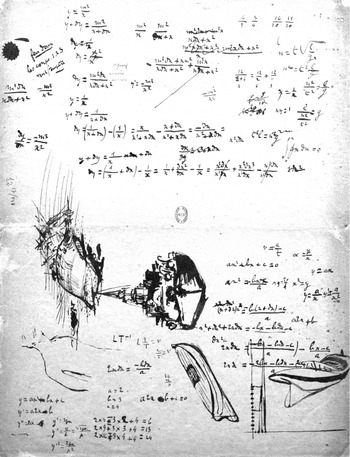
Sheet with drawings and equations from Paul Valéry (18.5 cm x 23 cm): Pré-cahier, 1894–1896, manuscript. Bibliothèque nationale de France, Paris (NAF 19117). © BnF and Madame Boivin-Champeaux

III. Bricolage, Recursion
If one looks at the genesis of the first Cahiers, then Valéry finds his writing scene not through intention or convention, but through bricolage: he gathers together and tentatively assembles. In 1894 this is literally true of the notebooks themselves when he cuts paper to the format 32.5 cm x 25 cm, folds these sheets once, uses them for his notes and sketches, and then stores them away. As the Pré-cahier, research has assigned the collection of these loose sheets to the actual corpus of the Cahiers. Also around 1894 Valéry begins several unruled exercise books in the format 23 cm x 18.5 cm, which, in reference to a ship's log, he calls Journal de bord and Livre de Loch. These notebooks, which were kept more or less simultaneously, are followed from 1895 to 1896 by three notebooks, which also overlap temporally but have a different material appearance: Log-book, Self-book, and Docks. While the Log-book has a slightly larger format (20.5 cm x 23 cm) and ruled sheets, the Self-book is unruled and slightly smaller (22.5 cm x 17 cm) than the first notebook, the Journal de bord. Docks, on the other hand, was again cut to shape from heavy paper (25 cm x 16 cm), but this time Valéry sticks the sheets together. After entering the War Ministry in 1897 he assembles the notebooks using Ministry paper. Not until 1900 is the now mostly bought notebook material noticeably consolidated, and the mode of entries also becomes more homogenous.Footnote 11 However, Valéry also carries out a bricolage in the Cahiers, that is, on their pages. This is particularly noticeable on the loose sheets of the Pré-cahier, which partly predate the first two Cahiers but also accompany them. On the sheets of the Pré-cahier the tentativeness of the beginning is evident; Valéry brings together different notation systems on the paper without the connections between them always being evident.
Fig. 1 is a succinct example of Valéry's use of note-taking and sketching. Valéry presumably began the sheet in a horizontal format with the sketches of the ships, then turned the paper to enter different formulas as well as examples of curve tracings. The pendulum formula
 \begin{equation*}
n = t\sqrt {\frac{l}{g}}
\end{equation*}
 \begin{equation*}
v = \frac{l}{t}\end{equation*}
 \begin{equation*}
y = \frac{1}{x}\end{equation*}
 \begin{equation*}
y = \frac{{m^2 }}{x}\end{equation*}
In these entries, Valéry takes up – and this is what is decisive – various mathematical procedures for approaching unknown, variable objects. The author runs through the procedures, rehearses them, but also reduces them, even so far as distorting them, and applies them to objects that are familiar to him, to adapt them to his means. This tentative bringing together represents a form of bricolage on paper with the aim of appropriating existing scientific tools and deploying them for the formulation and pursuit of his own interests.
The author's interests can indeed be found on the sheet, even if it does not appear in a stringent way through all entries (that is, when it is replaced by new objects that arise from the process of writing and drawing): The mathematical experiments and the drawings on the sheet do not illustrate one another, but there is still a theoretical overlap in the focus on the physical phenomena of equilibrium and oscillation as they are formulated in the pendulum formula and sketched with the sailing ship in a storm. If one looks at the sheet in a horizontal format, then one can see that the sailing ship entered at the top is strongly tilted. The horizontal lines visualize the heavy wind coming from the side, which would make the ship tip over if it were not for the keel under water that makes use of the water resistance to establish a counter force. In this respect the ship behaves like a pendulum. By making the ship's keel, which is normally invisible beneath the water, visible in the sketch, Valéry places the focus of his drawing on the physical situation.
Below the sailing ship Valéry has drawn a war frigate, which dominates the left half of the horizontal sheet with its bulky and closed form. In this sketch there is no hint of the surroundings, and the keel is not made visible. Instead, the emphasis is on the dark reinforced contours of the frigate in a frontal view. Slightly to the left and below, Valéry has drawn another boat that is reduced even further to its contours. The ship and boat sketches change their aspect; they begin with the representation of a (physical) situation and then change to the presentation of different boat forms. The result of these forms entered one after another is not a systematic variation, such as a selection of boat types that stand significantly for a given principle; rather, the activity of drawing functions like a metonymic chain: the prior drawing of one boat becomes the basis and incentive to draw another boat. In this sense, the drawing process alone generates the future drawings. The recorded form is seen, and this provokes another drawing that creates a similar but divergent form.
One could also describe what is to be seen on the sheet as an alternation between concentration, association, and digression. However, such an interpretation about intellectual categories neglects the material intervention that the processual recording evokes. Something happens through the act of drawing that cannot be anticipated. The recording generates a form, and then makes this recorded form available for further development – the process of making entries is thereby further stimulated.Footnote 12 The ongoing drawing process thus acts continuously and discontinuously by attaching itself to the existing form and coming back to it, but at the same time diverging from it and randomly varying it.
In the last boat sketch the variation of the sketches unmistakably becomes a bricolage when Valéry designs a fantasy boat. If one turns the sheet vertically again and follows the mathematical entries, then one finds at the lower right a rapidly sketched and unusual construction. To be seen is the partly closed upper part of a boat that is presumably depicted from the front. One sees the edges of the windshield, an unusual fin on the prow, and on the stern the upper part of a rudder. What is striking in the drawing is an ornamental line that forms the boat's right contour, but is repeatedly retraced and broadened without this being necessary for the depiction of the boat. This linear flourish presumably ended the mathematical calculation and became the starting point for the boat sketch in a further act of note-taking. In this case too, something already recorded becomes the starting point for another entry, although Valéry reverts from the mathematical notation back to drawing. At this point, both forms of entry overlap without this being thematically justified; it is merely the result of a spontaneous flourish. This final flourish is entered, seen by the writer and taken up again through the act of retracing the ornamental line. Here, the recursion is a simple repetition of the curve form and nevertheless becomes the beginning of a sketch that acts as a continuation of the sketched boat variants.
On the sheet of the Pré-cahier Valéry's modes of note-taking can be observed in nuce; they are found again throughout the Cahiers and partly developed into procedures. These include the tentative as well as recursive character of note-taking and sketching. At first glance, the bricolage quality is made evident on this sheet through the juxtaposition of mathematical and graphic types of notation that are not, however, formed into a hybrid, and with the help of which Valéry could systematically work through the different aspects of a problem.Footnote 13 The tentative combinatory impulse is also effective within the forms of notation used, to the extent that Valéry uses mathematical procedures for his own purposes, or evokes in his sketches a variation that spontaneously develops one form out of another, to finally work on an object of his fantasy. The key element in this tentative process is recursion, which need not function as identical or rigid repetition but implies manifold modes of returning to what has already been recorded.Footnote 14 The mathematical curve tracing performs this as a rehearsal of mathematical procedures. But the procedure of breaking off and restarting, which punctuates the equations as well as the boat sketches, is a procedure of discontinuous continuity and, in this sense, of recursion. The act of returning-to-something is straightforward and relates to the interests of the writer as well as to the events on the paper, which is to say, the possibilities of development that arise in the process of note-taking.
The recordings on this sheet gather together an additive experimental process that is structured by recursions, and by doing so creates weakly regulated connections. Once they have been noted, such low-threshold connections can also serve as material for further and more deliberate recursions on this sheet or other pages. The process of note-taking and sketching allows Valéry to return to his bricolages and digressions, even if these begin as a spontaneous flourish or as faulty mathematics. Valéry will preserve the sheets of the Pré-cahier and the tentative appropriation and variation of mathematical procedures as well as the theme of ships, and the sea will indeed become an integral part of the Cahiers. The repetitions from sheet to sheet or page to page produce something that productively structures the Cahiers: an arsenal of mathematical and other figures that serve in the notebooks as flexible and transferable material through a process of analogy, or simply through repeated entry.Footnote 15 It is the simple procedures of bricolage and recursion that initiate internal relations and thereby a certain amount of internal coherence between the notebooks. Nevertheless, this says nothing about the fruitfulness of the entries for the development of Valéry's research interests. Bricolage and recursion – this is shown by the sheet discussed – create connections, but do not necessarily lead to a theoretical system. That Valéry strives for such a systematic connection via the graphic entries is shown by another sheet, which will be dealt with in the following.
IV. Variation, Notation
On the above-mentioned sheet from the Pré-cahier, a central characteristic of the mathematical calculations is systematic variation. Although Valéry uses this mathematical procedure in an irregular way, his approach aims at the instrumental deployment of variation in the sciences. With the systematic use of variation, a rule or measure is established in advance that determines the relation of difference and repetition that in each case specifically characterizes the variation.Footnote 16 At the end of the nineteenth century, systematic variation is accorded a significant role in the sciences. As shown by the physicist and theorist of science Ernst Mach, the method of variation characterizes the experiment,Footnote 17 and the physiologist Étienne-Jules Marey uses the graphic recording of the movement of the body to break down complex processes into single recognizable elements, which as a result of minimal changes can be transformed into one another. In Marey's graphic representation the variation secures the relatability of the elements, and should also make them calculable.Footnote 18 Accordingly, the systematic variation not only organizes the experimental praxis, but also establishes procedures of recording and calculation.
The search for systematic variation is found on many of Valéry's sheets. Especially in the early stages of the Cahiers variation stands in relation to “notation,” which in the present paper means a set of rules which, subsequent to the moment of recording or “transcription,” allows the configuration of the, at first, individual findings. The symbolic calculus of algebra represents an example of an established notation with systematic connections (see Krämer Reference Krämer1988), but also Euclidian geometry and the periodic table in chemistry are forms of notation that can claim to be systematic. However, notations can also be developed anew as will become clear in the following.Footnote 19
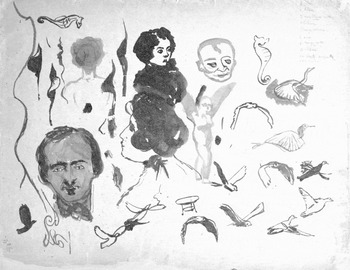
In fig. 2, an example from the Pré-cahier can be seen. Valéry uses the sheet in the vertical as well as the horizontal format, and enters different motifs. In the following I will ignore the two female heads. Also the vignette-like portrait of Edgar Allan Poe will not play a role. Rather, I would like to draw attention to the small sketches of birds in flight that – if one looks at the sheet in the horizontal format – are “scattered” across the right side of the sheet. Here, the variation is not motivated by processual drawing; rather, it represents serial aspects of a single object. The sketches of the birds look like snapshots of the flight movements of different birds. However, despite the fact that Valéry works in a rather rudimentary and cursory way, it is still possible to make out phases of bird flight as well as, in the upper right, a bird taking flight.
Sheet with bird drawings and portraits from Paul Valéry (18.5 cm x 23 cm): Pré-cahier, 1894–1896, manuscript. Bibliothèque nationale de France, Paris (NAF 19117). © BnF and Madame Boivin-Champeaux

There is also another repeatedly varied motif. If one turns the sheet into the vertical format, then one sees, in the lower third, horizontal ornamental forms that – if one looks carefully – can be identified as the outlines of swimming skates. The sketches show details of their fin movements, and in the opposing curvature of the fins the extreme points of the movement can be clearly made out. At this point at the latest it becomes clear that Valéry has not simply sketched his own observations of animals on the sheet; the “motif” serving him here is derived from techniques for recording movement: the chronophotography of Marey, and – I will come back to this later (in “IV. Lists, Dissolution”) – the graphic studies of bird flight by Leonardo da Vinci.
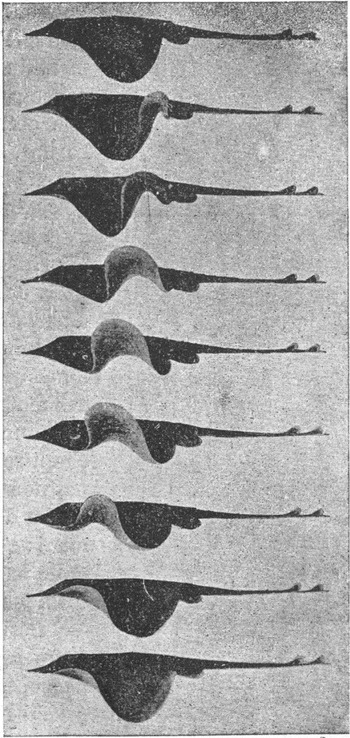
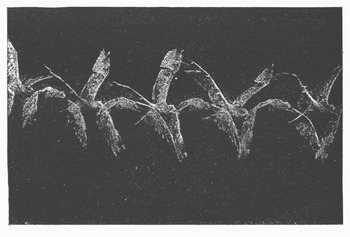
The bird and skate sketches are pictorial citations from Marey's book Le mouvement,Footnote 20 which appeared in 1894. In this book, the doctor, physiologist, and inventor presents a broad panorama of chronophotographic and chronographic studies that range from the movement of people and animals to the movement of waves and the beating of the heart. Valéry's skate sketches are taken from chronophotographs that record, at intervals, the cycle of fin movement (see Marey Reference Marey1894, 216–219). As can be seen in fig. 3, Marey's skate is photographed in profile, and the nine pictures represent from bottom to top the wave-like movement running through its body: the arch-shaped fins initially rise at the front and this rising movement gradually progresses to the back of the fin. From the nine stages of the cycle Valéry has entered the beginning and the end onto his sheet. The upper two (very reduced) black forms relate to the uppermost two photographs in Marey, and the lower two sketches show the beginning of the skate movement and therefore correspond to the two lowermost photographs.
Chronophotography of the fin movement of a skate from Étienne-Jules Marey (5 cm x 10.2 cm): Le Mouvement, Paris 1894, p. 217.

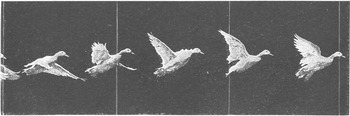
Marey's skate pictures come from the twelfth chapter of his book, “Locomotion dans l'eau,” on the movements of animals in water (see Marey Reference Marey1894, 208–222). This is followed by chapter thirteen on movement in the air (“Locomotion dans l'air”), from which Valéry took the bird motifs (see ibid., 223–236).Footnote 21 On his sheet, Valéry brings together details from several of Marey's studies of bird flight, and it is significant what and how he excerpts from the respective pictures. The three sketches on the lower right on Valéry's sheet (fig. 2, in the horizontal format) show a bird with a slightly larger head. These sketches are an exact quotation of Marey's sequence showing a duck in flight that can be seen in fig. 4 (see ibid., 230). Valéry's representations of the once raised and once lowered wings correspond to the first and third image in Marey's photograph, while the darkly shaded and rather plucked-looking bird that Valéry has drawn above the two others corresponds to the second image in Marey. The sketch of the “plucked” bird shows that Valéry exactly copies the outlines that he perceives in the photograph: the reduced right wing in Valéry's sketch does not correspond to a wing shape that he has knowledge of or has seen with his own eyes, but the one reproduced on the photographic plate as a result of the specific light conditions and the particular sensitivity of the plate.Footnote 22 In this sketch Valéry does not make use of his own perceptual memories or his own knowledge of the bird's form; he directly copies Marey's representation.
Chronophotography of the wing movement of a duck from Étienne-Jules Marey (14.2 cm x 4.7 cm): Le Mouvement, Paris 1894, p. 230.

The bird sketches to the left of the ducks are seen in an angled front view. In this case too the sketches reproduce the extreme points of the beating wings by depicting the bird once with raised and once with lowered wings – he thus adopts the moments that are also decisive for a mathematical representation and tracing of the movement in the form of a curve. Valéry even sketches these two amplitudes of the movement cycle twice on the sheet. The elements from Valéry's sketches are taken from Marey's chronophotograph of a gull that – as can be seen in fig. 5 – is flying in the direction of the camera/viewer (see ibid, 232). This time Marey chose the exposure times in a way that would allow the individual exposures on the photographic plate to overlap slightly, merging the flight movement into a continual abstract formation. The rhythmically repeated basic structure of this formation is formed by the two amplitudes of the beating wing that Valéry “cuts out” in his drawing so that they appear next to one another on the sheet (that is to say, without overlapping).
Chronophotography of the wing movement of a gull from Étienne-Jules Marey (8.4 cm x 5.3 cm): Le Mouvement, Paris 1894, p. 232.

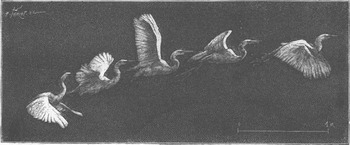
The two sketches at the upper right edge of the sheet (read from top to bottom) also derive from a chronophotographic sequence by Marey showing a heron taking flight (see fig. 6 and ibid., 231). Valéry has only made use of the beginning and end of the engraving (made after a chronophotograph): the bird spreading out its wings, stretching its head and neck almost vertically upward; and the bird entering into an almost horizontal flight movement, head and neck pulled tight to the body and its beating wings now almost stretched in a semi-circle downward.
Engraving after a chronophotography of a heron. From Étienne-Jules Marey (14.6 cm x 6 cm): Le Mouvement, Paris 1894, p. 231.

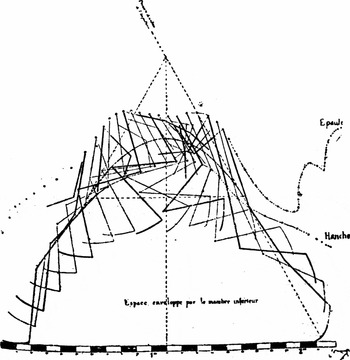
In the bird and skate sketches, Valéry the draftsman does not work according to the memory of something experienced, but excerpts from a book that presents the methods and results of experimental physiology. In doing so, he selects significant details from the chronophotographic movement studies. On the one hand he concentrates on the amplitudes of the movement, and in this way on the extremes that also have a great significance for a mathematical description of the phenomenon (in the form of a curve function). On the other hand Valéry refers to the encyclopedic character of Le mouvement by entering onto his sheet the analogy between swimming movement and flight movement that Marey also proposes (see ibid., 223). This analogy suggests the epistemic claim made by Marey's movement panorama:Footnote 23 the variation of the movement forms should – at least in part – be able to be related back to general laws. Besides comparison and analogy, Marey mainly uses analytical geometry for the generalization of the photographically disclosed movement material. Particularly in “Chronophotographie géométrique” (ibid., 60), Marey not only produces geometric drawings, but also prepares his photographic and filmic studies accordingly (see ibid., 146–151). For the analysis of a leap or a dance movement, for example, he puts a man in a black suit that he has prepared with white marks. Through the serial exposure of the photographic plate, the movement is then reduced to distinct elements such as lines and points. In addition, a scale is occasionally inserted, and the image is processed further by introducing the photographed lines as points and curves on paper that can then be translated into a coordinate system (see fig. 7). The photograph becomes a drawing machine and produces, as Christof Windgätter has already remarked in relation to Marey's chronographic recordings, “countable writing-images” (Windgätter Reference Windgätter and Volmar2009, 97).
Geometric drawing of a leap after a chronophotography. From Étienne-Jules Marey (11 cm x 11 cm): Le Mouvement, Paris 1894, p. 151.

Marey's ambition is fundamentally comprehensive: he wants to dissect the complex movements as a recording into formal components that can be symbolized and combined according to specific laws. The purpose of this is to convert movement into a mathematical calculus that – as Sybille Krämer has shown – through its schematized use of symbol unburdens us from the interpretation of the single concrete phenomenon and thereby establishes new possibilities of combination (see Krämer Reference Krämer1988). Accordingly, mathematical calculus has not only analytical but also productive potential. For Marey the chronophotographic recording of human movement is the first step toward attaining the formal notation of mathematics, and with its help to construct on paper the ideal movement of the athlete or dancer for example.Footnote 24 The movement made visible with the help of the apparatus thus becomes the basis for mathematical symbolizations and curves that should in turn become the basis for the creation of new or ideal movements.
On the sheet of the Pré-cahier not only does Valéry not adopt a single image from Marey, nor does he sum up the latter's methods or results in words, but rather notes Marey's visual systematics as well as his ambition to make available an epistemic form of notation. This corresponds to the prominence that, in 1928, looking both back and forward, Valéry had given to “systems of notation”Footnote 25 (Valéry Reference Valéry, Cowley and Lawler1972c, 152) compared with the instrument of language. The world of curves and diagrams doubles (in the original: “double” Valéry Reference Valéry and Hytier1957c, 1266) the world of experience and constitutes a general ideography:
The graph has a continuity of movement that cannot be rendered in speech, and it is superior to speech in immediacy and precision. . . . Something new is little by little taking shape under our eyes; a sort of ideography of plotted and diagramed relations between qualities and quantities, a language that has for grammar a body of preliminary conventions (scales, coordinates, base lines, etc.), and for logic the relative size of figures or portions of figures and their relative situations on a chart. (Valéry Reference Valéry and Robinson1973c, 153)Footnote 26
This ideography as the basis of knowledge is found again in the sketches on the sheet from the Pré-cahier. Within the radius of the first notebook and with the example of the graphic method of Marey the question of how to write and draw becomes acute for Valéry. Marey provides an answer to this insofar as his procedures of chronography and chronophotography aim to mechanize and formalize the recording process. Marey's pictures are therefore more than documents of a movement; they are also elements of a configuration, and promise the transition to the symbolic notation of mathematics.Footnote 27 It is this promise of configuration and operationality that Valéry enters onto his sheet. He will come back to this noted possibility at a significant place when, on the cover of his first notebook, the Journal de bord, he refers again to a formal and epistemic use of drawing: diagrammatic drawings of electromagnetic force fields become almost an emblem for Valéry's entries.
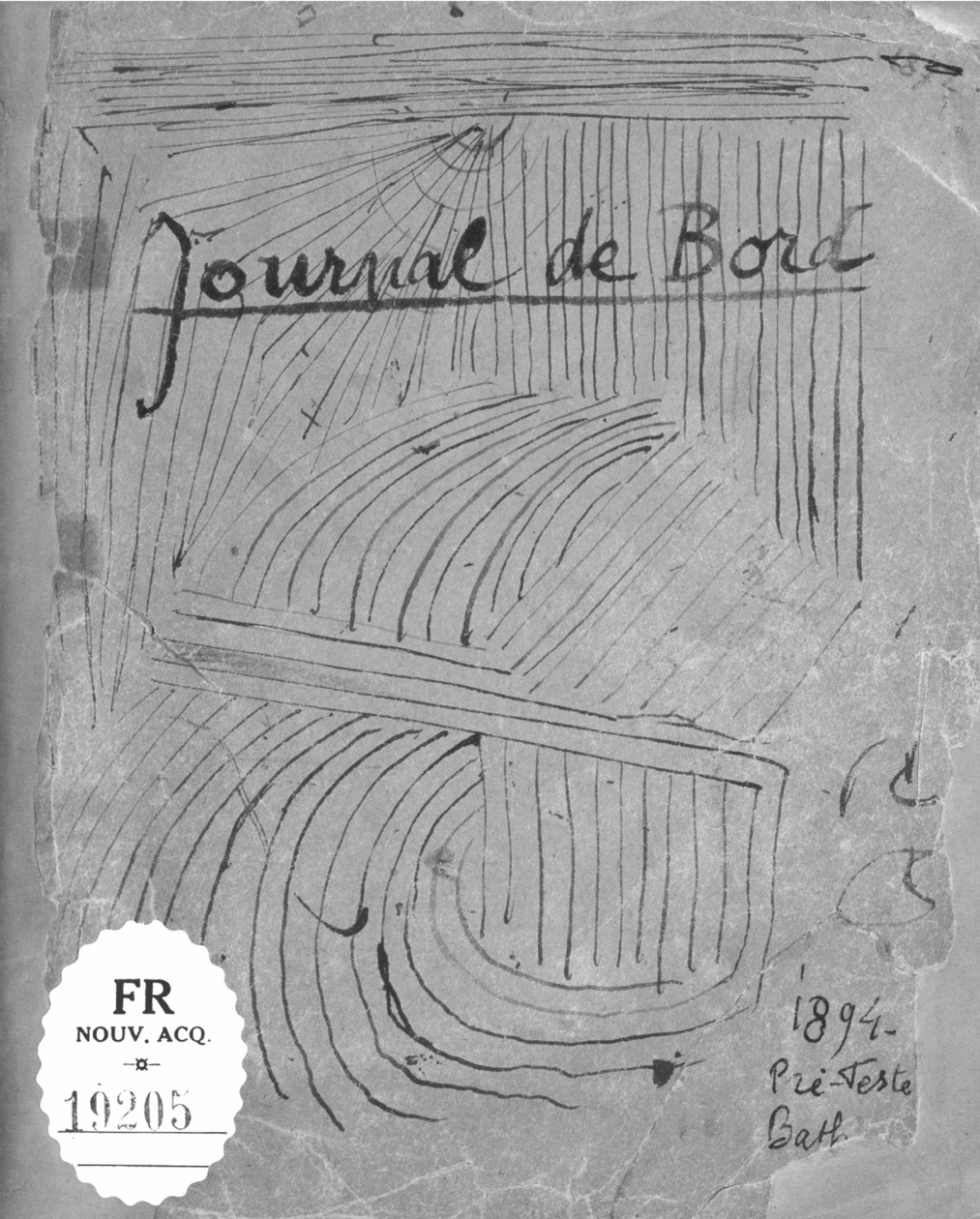
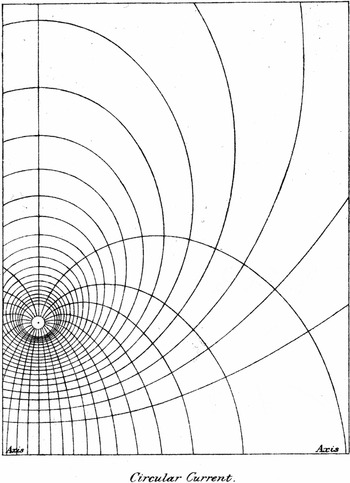
As can be seen in figure 8, the title page of the Journal de bord presents us with a scene that might be identified as an abstract landscape. However, the drawing makes an effort at regularity since the lines follow a parallel curvature that is not organized into the representation of an object, but only into a reciprocal relationship. What is shown here is not the abstract idea of a landscape but a graphic space whose elements are lines and whose laws of combination are called parallelity and curvature. Valéry is referring to the drawings of electromagnetic fields that he had studied in the two volumes of James Clerk Maxwell's A Treatise on Electricity and Magnetism (see fig. 9).Footnote 28
Cover with diagrammatic drawing from Paul Valéry: Journal de bord, ca. 1894, pen and ink on paper (18.5 cm x 23 cm). Bibliothèque nationale de France, Paris (NAF 19205). © BnF and Madame Boivin-Champeaux

Section through the magnetic equipotential surfaces of a current flowing in an orbit (the lines of induction here form closed curves surrounding the path of the current) (11 cm x 14.2 cm). From: James Clerk Maxwell: A Treatise on Electricity and Magnetism, vol. 2, Oxford 1881, Figure XVIII.

The idea that space is pervaded by invisible force fields goes back to the physicist Michael Faraday, who is thereby seen to have replaced Isaac Newton's concept of action at a distance (see Faraday Reference Faraday1839–1855). Maxwell adopts Faraday's idea of electromagnetic force fields as well as his metaphor of “lines of force” that Maxwell calls “lines of induction” (French: lignes de force) and proves them by formulating them mathematically. Maxwell's equations and suggestions for calculation provide the tools with which physicists can continue to work both theoretically and practically, for example, in the construction of conductors. However, to the extent that electromagnetic phenomena are so complicated that a calculation is still not possible, Maxwell expressly recommends approaching them through drawing:
It appears, therefore, that what we want is a knowledge of the forms of equipotential surfaces and lines of induction in as many different cases as we can collect together and remember. In certain classes of cases, such as those relating to spheres, there are known mathematical methods by which we may proceed. In other cases we cannot afford to despise the humbler method of actually drawing tentative figures on paper, and selecting that which appears least unlike the figure we require.
This latter method I think may be of some use, even in cases in which the exact solution has been obtained, for I find that an eye knowledge of the forms of the equipotential surfaces often leads to a right selection of a mathematical method of solution. (Maxwell Reference Maxwell1881, 1:165)
In chapter seven, §123, Maxwell also offers instructions as to how complex electromagnetic phenomena are to be drawn. On paper the drawn lines of induction concretize – in the same way as mathematical equations – Faraday's metaphor of lines of force, and they do this so convincingly that, by this graphic means, measurements, calculations, and constructions become possible. Their epistemic effect rests, however, on a tentative procedure: the drawings of force fields develop by approximating what is still unknown and cannot be clearly established. They operate projectively in a field of indeterminacy, which is to say that they represent a procedure of a tentative formulation that is not identical to mathematical construction, even if that is what it works toward.Footnote 29 For Maxwell drawing is a scientific tool that serves research – and in this function it becomes valuable for Valéry. In November 1893 Valéry writes about Maxwell's Treatise to his friend André Gide: “A book entirely put together from an original metaphor at the beginning, then only formulas and diagrams – an extraordinary ornamentation.”Footnote 30 Valéry's remark is also illuminating for his own writing, drawing, and calculating practice in the Cahiers. Through the emblem on the cover of the Journal de bord, the book that starts with a metaphor (lines of force) and subsequently consists only of formulas and graphic diagrams also becomes a model for the Cahiers. Valéry develops a program for his own entries in the notebooks: recording should become configuration.
V. Lists, Dissolution
If one considers the written sheets from the Pré-cahier and the cover of the Journal de bord, then it becomes apparent that the question of notation forms an essential horizon for Valéry's entries around 1894. In this process, drawing and calculus appear on Valéry's sheets above all as partially formalized modes of formulation, drafting, and construction. This poietic and constructive dimension is true of course for Maxwell's drawing methods, but it is also constantly maintained as possibility in Marey's chronophotographic and chronographic studies. The mathematical curves and calculi acquired through the mechanical processing of the phenomena of natural movement serve as the basis for the creation of new forms and realities. The writing and drawing procedures become poietic tools. This becomes explicit in chapter six, “Applications de la chronophotographie à la mécanique” (Marey Reference Marey1894, 83–101). Here one also finds among other things suggestions on how to make use of chronophotographs of waves and rudder movements for hydrodynamic studies and ship building.
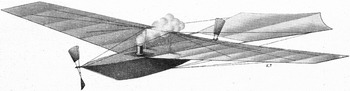
Marey is particularly interested in the problem of aviation, and proposes chronophotography as a tool for the study of air movements and resistances as well as bird flight. Moreover, he puts his Station Physiologique in Paris at the service of the inventor Victor Tatin, who had already constructed a large number of artificial “birds,” and in 1879 on the grounds of Marey's laboratory finally demonstrated a much-discussed flying model (wingspan: 1.90 m) with a compressed-air engine.Footnote 31 In 1890 Tatin designs and builds with Marey's co-worker, the physiologist Charles Richet, a large unmanned flying machine (wingspan: 6.60 m, length: 2.50 m), which – as can be seen in fig. 10 – combined ship-building methods with a wing construction and a steam-powered engine (see Tatin Reference Tatin1910, 228). This hybrid of water and air technology not only realizes Marey's analogy between swimming and flight movements, but also alternates between a construction imitating nature (oriented to bird wings and bird flight) and an original construction with a propulsion engine. In the 1890s, however, Tatin's engine-driven flying machines flew without people. When in 1891 Otto Lilienthal began a series of successful manned flights in Germany, he drew again on the principle of gliding and his studies of bird flight (see Lilienthal Reference Lilienthal1889).
Drawing of a steam airplane by Charles Richet and Victor Tatin with which they experimented in 1890. From Victor Tatin: Théorie et pratique de l'aviation, Paris (H. Dunod et E. Pinat) 1910, p. 228, figure 55.

Valéry's sheet with the recordings on bird flight from the Pré-cahier (fig. 2) draws on this flight research from the latter third of the nineteenth century and also refers to a graphic approach that is linked with a much older vision of a flying construction: Leonardo da Vinci's graphic investigations of bird flight and his projected flying machine.Footnote 32 Valéry's translation of Marey's chronophotographs into drawings and his reduction of them to contours is already evidence of this interest – they take up in a rudimentary way a form of graphic notation that Leonardo da Vinci developed for flight phenomena. While Marey invents graphic and photographic apparatuses and combines them with geometric drawing techniques which enable symbolic operations, the epistemic achievement of Leonardo da Vinci's drawings is rooted in artistic techniques, which, besides drawing, also include (graphically) trained visual perception and imagination.
Valéry, in the years of the first Cahiers, as he himself remarked, was entirely in the thrall of Leonardo da Vinci, about whose notebooks he writes: “His drawings and manuscripts . . . filled me with a sort of awe”Footnote 33 (Valéry Reference Valéry, Cowley and Lawler1972b, 68). In 1881 a large part of the Renaissance artist's Quaderni was made available to the public in a facsimile and transcribed edition, which led to a rediscovery of the painter as researcher, engineer, and inventor (see Ravaisson-Mollien 1881–1891 and Séailles Reference Séailles1892). A veritable revelation for Valéry seems to have been a small notebook by Leonardo da Vinci on the flying techniques of birds. After being split up into single sheets and dispersed, it was bought by Teodoro Sabachnikoff, re-assembled as far as possible, and published in 1893 in collaboration with Charles Ravaisson-Mollien (see Sabachnikoff 1893). In this edition the notebook was not only reproduced and transcribed, it was also included as a supplement in the form of a deceptively real-looking facsimile. Valéry refers to this Codice sul volo degli uccelli e varie altre materie on a number of occasions in his essay Introduction à la méthode de Léonard de Vinci published in 1895 and praises the graphic-constructive precision as well as the visionary poietic ambition of the artist-engineer (Valéry Reference Valéry, Cowley and Lawler1972a, and Valéry Reference Valéry and Hytier1957a, 1178, 1198f.). When one becomes aware of the concentrated use of drawing and writing in the Codice, this small notebook can also be considered as an inspiration for Valéry's Cahiers.
Leonardo da Vinci assembled the notebook himself from paper cut to the size of 21.3 cm x 15.3 cm and worked on it intensely during a stay in Florence in 1505 or 1506.Footnote 34 The temporal concentration corresponds to the thematic concentration since the earlier cursory red chalk drawings are overwritten and overdrawn in this period with reflections on flight navigation and the construction of flying machines. The Codice is thus based on the decade-long practice of Leonardo da Vinci's notebooks in which he repeatedly noted and sketched observations on the anatomy of birds, their flight movements, the mechanics of the wing beat and the action of the winds, as well as considerations on artificial “birds” or veritable flying machines (from “helicopter” to “parachute”). These extensive analytical and projective studies form the background of the small notebook that Leonardo da Vinci begins with an ambitious vision. If one looks at the beginning of the notebook in which the artist, as was his habit, has written and drawn from back to front and in mirror reversal, that is to say from right to left as well as probably with his left hand, then one finds on the inside of the cover a prophecy that is repeated again on the first page (folio 18 verso): “For the first time the great bird will rise up from the back of the giant swan filling the whole world with amazement and all writings with its glorious deeds for the eternal glory of the nest in which it was born” (see Leonardo da Vinci Reference Schneider2000, 94 and 92).
The “great bird” is an artificial bird with which mankind will set off on his first flight from a mountain near Florence, the Monte Ceceri (Mount Swan). Only a few pages later Leonardo da Vinci once again soberly names the program of his notebookFootnote 35 and on folio 16 recto he formulates a “persuasion” (persuasione) for his project of human flight (Leonardo da Vinci Reference Schneider2000, 83). The heading announces the subject of the following entry, which at the beginning proposes a hypothetical objection to human flight in order to subsequently “prove” the possibility of such a flight with arguments, examples, and analogies.
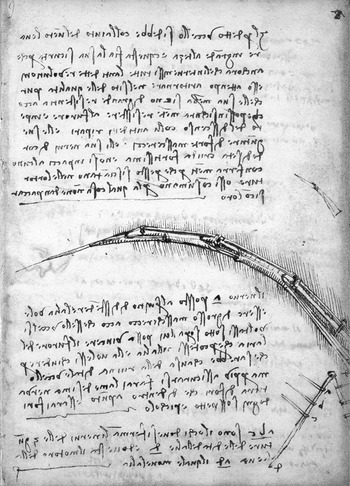
In 1893 the self-confidence with which Leonardo da Vinci, in the early sixteenth century, imagines and defends his project meets with readers who, besides the fantastical aspect, also appreciate the prospective quality, since the flight experiments of the Lilienthal brothers had apparently brought human gliding within reach. The Renaissance artist's explanations concerning bird navigation have an analytic coherence and precision that as late as 1914 led Hans Donalies to the assessment that the Codice sets out a veritable theory of flight (Donalies Reference Donalies1912, 8). In his essay Donalies arranges the sketches and notes of the notebook under the headings: flapping-wing flight; hovering and gliding flight; standing in the wind; navigation and equilibrium. In doing so, he not only highlights the systematics of Leonardo da Vinci's theory of flight, he also shows that the many small abstract sketches that illustrate or accompany Leonardo da Vinci's notes have a largely diagrammatic character. The small sketches bring together analyses and considerations on bird navigation, but also on equipment to test equilibrium behavior as well as on safety measures in case of a crash landing, on the positions of people in a flying machine and much more.Footnote 36 This additive variation of themes and modes of recording is continuously supplemented in the notebook with elaborated entries that summarize and demonstrate. Such pages present results and are aimed at a reader or an audience who is meant to develop these results further. These include the construction drawings for artificial wings, of which an example can be seen in fig. 11 (folio 7 recto). Here, the form is articulated through the clearly drawn lines and the distinct outline and also spelt out through the exact relationship of the parts and the attention to detail. This distinguishes the drawing from the open variation of the small sketches in the notebook and the endless chain of notebooks. Here, based on what has been developed in the notebooks, a concrete relation of materials and proportions is determined. Such drawings propose and fix a construction plan; hence they do not experimentally sound out the unknown, but claim a reality in the future, as Bernhard Siegert has remarked for the disegno-techniques of the Renaissance: “To link the drawing with the draft, preparatory study, or the plan meant making the drawing open to the future, to simultaneously acknowledge and plan, through the drawing, the possibility of its completion in the future” (see Siegert Reference Siegert, Gethmann and Hauser2009, 43).
Leonardo da Vinci: I manoscritti di Leonardo da Vinci. Codice sul volo degli uccelli e varie altre materie, ed. by Theodoro Sabachnikoff, Paris 1883, facsimile (Folio 7 recto) (15.2 cm x 21 cm). © Staatsbibliothek Berlin

This paper technique for visualizing a possible future is also found in another of Leonardo da Vinci's modes of visualization in which he brings together drawing and writing in a hybrid format of presentation. In fig. 12 a double page can be seen (folio 8 recto and 7 verso) that gathers together essential arguments concerning flight navigation.
Leonardo da Vinci: I manoscritti di Leonardo da Vinci. Codice sul volo degli uccelli e varie altre materie, ed. by Theodoro Sabachnikoff, Paris 1883, facsimile (Folio 8 recto and 7 verso) (double page, hence 30.4 cm x 21 cm). © Staatsbibliothek Berlin

If one follows the direction of Leonardo da Vinci's writing from right to left, then the entries begin mostly with the sketches in the margin. These reduced but naturalistic drawings visualize a certain constellation of form (bird body), wind power (symbolized by lines) and operation (the wing position of the bird). The notes on the left provide explanations for the circumstances and consequences of the respective constellation by describing in words the movement and acceleration of movement that follows from a particular operation. On this page Leonardo da Vinci schematizes the mode of entry: the sketches form a vertical column, as does the text, whereby this division is superimposed by a horizontal order of paragraphs in which image and text correlate and the last line of each argument is closed off by a line extending to the margin. The serial structure of this image-text arrangement finds its echo in the grammatical uniformity of the written if-then constructions. Thus already the first entry on the page states: “If a wing and the tail are too far above the wind, lower half of the other wing and let the wind beat against it, and the bird will straighten up” (see Leonardo da Vinci Reference Schneider2000, 50).
The page does not bring its material together at random; rather, the entries establish a systematics of navigation. But while the drawings present exemplary situations of bird flight, the corresponding written explanations go beyond the realm of the animalistic. The repetition of the imperatives make it unmistakably clear that on this page Leonardo da Vinci is giving flight instructions as if the instrument (strumento) or the flying device (volatijl), as he calls the “great bird,”Footnote 37 were waiting just outside the door ready for takeoff. Here the artist-engineer sets out a flying “manual” that simulates flight: the flight situation is presented as if it were happening right now, and the reader spoken to as a pilot. In this way Leonardo superimposes on this page the analysis of bird flight movement with the idea that, in the moment of reading, one is really and truly flying oneself. In the drawn and written entries on this page the “persuasion” (persuasione) from folio 16 recto is indeed put into practice to the extent that a future horizon is entered onto the paper. However, there is a difference between the construction drawing and the flying manual insofar as the flying instructions do not, via the paper techniques and apparatuses, make a reality in the future addressable, but evoke flying as an immediate experience, with the result that the paper reality is completely forgotten.
Whether as construction plan of a flying apparatus or as flying manual, Leonardo da Vinci's projects in the form of writing and drawing make a claim for note-taking and sketching that also prompts and formats Valéry's work in the Cahiers as an ideal. However, for Valéry's notebooks there is no teleological resolution but a number of epistemic concerns. Among other things, Valéry is dedicated to the questions of how the “Self-Variance” (see Valéry Reference Valéry and Robinson1973, 1037) of the mind, that is, the autonomous associative activity of the imagination, can be described in mathematical-formal terms. In Valéry, such theoretical questions are also translated into projects of construction, for instance when in the Pré-cahier he plans a mechanical model of the brain:
“Mechanical model of a brain, of an individual (for Lionardo).
MODEL OF X”Footnote 38
Valéry takes up this project again in Journal de bord, but this time as a plan for an artistic construction: “Portrait of Mr So-and-So.”Footnote 39 The page from this notebook can be seen in fig. 13. Here, divided into different points, as if taking stock, Valéry lists his program for a portrait. In doing so, he takes up one of the most famous genres of fine art and literature in order to develop instructions for the fabrication of such works. He begins with an enumeration of the components of a portrait. Already the specification that it is not a matter of a specific person indicates that for Valéry the portrait should not depict the individuality of the person portrayed. A short remark further down (it is written in the geometric study made up of spherical triangles) provides the literary counterpoint to what Valéry outlines on this page: “In literature the portrait should be made of a given moment, as is the case with painters with a particular pose. This is absolutely different to the schema described above.”Footnote 40
Page on the portrait from Paul Valéry: Journal de bord, ca. 1894, pen and ink on paper (18.5 cm x 23 cm). Bibliothèque nationale de France, Paris (NAF 19205). © BnF and Madame Boivin-Champeaux

The literary or painterly portrait focuses on the characteristic moment in which the individual shows himself in his particularity. Valéry distinguishes this from the “schema” that he produces. According to this schema the portrait is based on the person's quantification: “his whole appearance,” “What did he think about? What did he think about the most?” “Frequency in use of words, of gestures,” “His budget.”Footnote 41
Valéry summarizes a person's outer appearance in a cursory way as “walk, traits, colors” (marche, traits, couleurs). Also the person's character can be counted through “variations,” that is, the variations in his character. And his identity corresponds to the “quantitative order of the immeasurable number of his distinctions” (Ordre de quantité du nombre immesurable de ses distinctions). Valéry's language in this passage, his attitude as well as the range of terms used, define the portrayed as an accumulation of formal regularities. For Valéry the portrait is based on the representation of generalizable structures; it functions as a diagram. The traditional genre of the portrait is reformulated as a construction and production of models based on schematizable operations. If one reads Valéry's instructions for the portrait as a poetological program, then it can be noted that Valéry concentrates on the artistic process of fabrication, but reformulates this as a regulated procedure. However, in Valéry this construction remains a draft, a proposal, as one can also see on this page when one looks at the other entries.Footnote 42
After the entry “Maximum divergences” (Écarts maximums) Valéry turns to the geometric drawing on the sheet, or more precisely, he turns to spherical segments, and in this way to objects of spherical geometry. This shift does not necessarily mean a break with his remarks on the portrait. In the above schema Valéry added something in the margin of point b) on identity: “maximum length and mobility of the radius ρ of the Sphere of Knowledge” (longueur maxima et motilité du rayon ρ de la Sphère de Connaisance).
The concept of the “Sphere of Knowledge” can be understood as the starting point for the geometric sketches. The quoted written addition to the instructions for a portrait is a metaphor insofar as it describes the space of knowledge of a person as a sphere. However, what is a metaphor in an anthropological logic is not one in the logic of the Cahiers for which geometry is the analytical and descriptive mode par excellence. In the logic of the Cahiers the metaphor is a “model” with which one can carry out further operations. The sketches of the spherical segments in the lower third of the page do not digress; they refer back to an aspect from the considerations on the portrait, and vary this on a mathematical-graphic level.
Valéry writes that radius of the Sphere of Knowledge is mobile. The sphere is thus generated by a radius that moves, and possibly with changing velocity. This means that this sphere is not stable but dynamic. And also the length of the radius can vary – it has maxima and minima, Valéry writes. One might ask whether this radius within the sphere also describes a mode of projection of the mind. The question is: what can this radius do? Can it draw?
If the radius can draw, then the scattered spherical segments on the paper draw not only the geometric model of the mind, but also the model of a drawing apparatus, that is, they outline the model of the mind as a drawing apparatus. This is not unimportant in the context of the Cahiers, which repeatedly evoke a drawing oriented toward writing (and vice versa). Thus, if Valéry continues his entry on the portrait via the drawing of a drawing apparatus, then he also refers to his own drawing and writing apparatus in the Cahiers, to his own writing and drawing praxis.
In the sketches of the spherical segments, however, a characteristic moment of note-taking and sketching in the Cahiers can be observed: the sketches become less focused and are eventually abandoned. The writer does not continue further with the connection already entered. In the Cahiers the process of breaking off and beginning anew establishes a mode of writing and outlining that is characteristic of the notebooks. Although the “Penelope notebooks” focus on the paper techniques of construction, they also develop de facto procedures of dissolution: the plan for the portraits remains a draft in the Cahiers.Footnote 43 In the notebooks the breaking off is a precondition for beginning.Footnote 44
In Valéry a good example of the draft status of the construction is the list. With the example of Ernst Mach's notebooks, Christoph Hoffmann has described how lists make possible a procedure of bringing together in which the writer does not at first need to know precisely what this is ultimately intended for since: “Lists in their simplest form . . . bring entries together without these entries necessarily having to have an order; and as a rule they have no other order than that they stand in a temporal, thematic or operative context, and sometimes all of these at the same time” (Hoffmann Reference Hoffmann and Giesecke2008b, 52). In this way the list can be placed at the threshold between simple note-taking and draft or proposal, for instance when it is used to approach an area for which the writer has still not gained a full overview. In Valéry it can be observed in this form on countless sheets and pages. In fig. 1 an indeterminate list (and one that was never expanded) has been entered: “weak fire | the beats 1.2.3 | wind/storm” (feu doux | les coups 1.2.3 | vent/tempête). On other sheets the list functions as a reminder of sources for the writing in the Cahiers: for instance in Journal de bord, where already on the inside of the cover under the heading “to quote” (“à citer”) the entries “Faraday, Maxwell, Edison, 18e siècle, Wronski” appear (Valéry Reference Valéry, Celeyrette-Pietri and Robinson-Valéry1987, 47). Significant for the draft status of the construction is the repeated listing of texts and themes that Valéry wants to work on – due to their length, these lists frequently lead ad absurdum, and in this respect have the tendency to undermine any intention through the ongoing process of listing (see ibid., 78f.). In the case of the subdivided and elaborated list of the portrait program on the other hand, the dissolution is carried out by breaking off.
If one recalls the procedures described in the present paper, then the early Cahiers show clearly that Valéry's efforts are directed toward the appropriation of epistemic tools. Bricolage and recursion are the typical acts of an author who does not simply record what passes through his head, but notes what he is occupied with in the framework of his research interests. Forming the epistemic framework of the Cahiers is the search for a regulated and compatible notation and for techniques of drafting, but also the lists with planned treatises. Procedures such as bricolage and recursion as well as listing are thus well suited to developing innovative processes so that these can lead to new and systematic constructions. Nevertheless, by heightening the aspect of openness, which is necessarily inherent to these operations if they are intended to lead to still unknown results, Valéry gives this procedure a specific form. The Cahiers constitute a space of possibilities that the author, in continuing to write and draw, constantly produces anew. Valéry's format of the list is a characteristic example of this. Whereas the list is normally a tool that provides an overview and thereby helps to structure the work and to bring it to an end, in Valéry's early Cahiers the various lists often recall Penelope's maneuver of unweaving. Valéry's particular form of innovative procedures leads to the Cahiers institutionalizing the draft aspect and establishing – not by chance, but by arrangement – a format of eternal beginning.
When breaking off and beginning anew become the characteristic mode of entry and furthermore the procedure of an endless draft, then this has consequences also for the interpretation: the Cahiers are impossible to read as a “text.”Footnote 45 The continuous discontinuous writing (and drawing and calculating) leads to a rejection of the “whole.” If one wants to read Valéry's notebooks as a text then this leads to a series of interferences, to an overlapping to the point of unrecognizability. The Cahiers become only visible in the particularity of their entries, but not as a whole. In this way they constantly also refer back to the procedures from which they arose.
Acknowledgment
I would like to thank Ben Carter for translating the article from the German.