The north-eastern region of India is considered one of the hot spots of rice genetic resources with extremely diverse rice-growing conditions when compared with other parts of the country. This region is also the secondary centre of origin of rice. Nagaland is one of the eight states in north-eastern India and has a long tradition of rice cultivation. Rice is the main staple food of this state. In this region, traditional jhum (shifting cultivation) and wet terrace rice cultivation (TRC) methods are in practice. The diversity of rice can be seen from the various landraces grown by different tribes according to the preferences with respect to colour, taste, aroma and cooking quality. The indigenous rice cultivars of this region could be broadly classified into three distinct classes – glutinous rice, brown rice and aromatic rice – which are cultivated according to the preference of each tribe. Glutinous rice landraces are quite popularly used during festive occasions in preparing food items such as Naga roti, steamed sticky rice, rice beer, puffed rice and flattened rice. Grain colour of these landraces varies from reddish brown to blackish red and pearly white to creamy green. Brown rice landraces are consumed by many farming families and generally have a coarse texture. Aromatic rice landraces served as special rice items during festive occasions and marriage ceremonies (Government of Nagaland, 2007).
The current diversity of rice displays a variety of architectures that encompass tillering patterns, plant height, arrangement and size of leaves, and grain morphology. In general, these varieties are tall, photosensitive, medium to long duration, poor yielding, susceptible to lodging and tolerant and/or resistant to biotic and abiotic stress. Earlier collection of rice diversity from Nagaland was carried out under PL-480 (Assam Rice Collection) during 1968–1971, and at least 849 rice accessions were collected. The NBPGR, Regional Station, Umiam (Meghalaya) has collected around 700 rice accessions to date. Other institutes also have their own collection of rice accessions. The current collection of rice germplasm contains genotypic and phenotypic variations accumulated over years of domestication and selection under very diverse environments. Even though a large number of rice landraces have been collected and maintained, there are limited reports on precise information about important traits in the rice germplasm of this region (Hore and Sharma, Reference Hore and Sharma1993; Hore, Reference Hore2005). In the present study, we report the variations in agronomic and quality traits in the rice germplasm collected throughout the state of Nagaland to facilitate rice improvement programmes.
Materials and methods
Collection of rice landraces
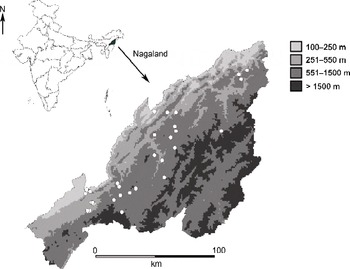
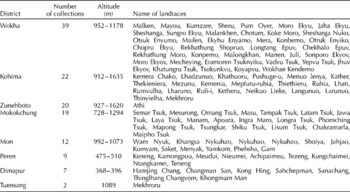
A total of 130 indigenous rice landraces were collected from eight districts of Nagaland (Fig. 1) during September to October, 2010 by B. P. Bhatt and colleagues, Indian Council of Agricultural Research (ICAR) Research Complex for North-eastern Hill Region, Nagaland. A fine grid survey was conducted in the eight districts (Wokha, Kohima, Zunehboto, Mokokchung, Mon, Peren, Dimapur and Tuensang) for the collection of rice landraces (Table 1). The majority of rice landraces were grown under jhum and TRC. Fresh seed stocks for each landrace were collected from fields and farmers' store. The collected landraces have been conserved at medium-term storage of the NBPGR, Regional Station, Umiam, Meghalaya and long-term storage of the NBPGR, New Delhi, India.
(colour online) Collection sites of 130 rice landraces from the state of Nagaland, India. Altitude ranges are indicated by different grey shadings.

List of the rice landraces collected and included in the study by district

Characterization of germplasm for agronomic, grain morphological and grain quality traits
The collected rice landraces were characterized for agronomic, grain morphological and grain quality traits. These landraces were grown at the lowland experimental field of the NBPGR, Regional Station, Umiam, Meghalaya (25.6°N latitude, 91.9°E longitude and 1000 m altitude) for agronomic evaluation during the kharif seasons (June–October) in 2011 and 2012. The soil of the field is an acid alfisol with a pH of 5.3, organic C 1.13%, available N 211.6 kg/ha and cation exchange capacity 14.1 mequiv/100 g. Seeds were sown in nursery plots during the third week of June, and 35-d-old seedlings were transplanted in well-puddled plots (4 × 5 m2). Plant spacing was 0.20 × 0.20 m2 with single seedling per hill. P (30 kg P2O5/ha in the form of di-ammonium phosphate) and K (15 kg K2O/ha in the form of muriate of potash) were applied and incorporated in the plots 1 d before transplanting. Plants were top-dressed with 60 kg/ha of total N (in the form of urea) equally distributed between the tillering and panicle initiation stages. After transplanting, the plots were allowed to remain flooded with a water depth of 5–10 cm throughout the growing season until the week before maturity. No pest control measures were employed. Regular manual weeding was done to keep the crop weed free.
Days required from sowing to 50% flowering was recorded on a plot basis. The tiller and panicle number per plant, plant height and grain yield per plant were measured as the average of five plants randomly selected from the middle portion of a plot. The panicle length and the number of grains per panicle were determined based on five individual measurements of the main stem. The length, breadth and length-to-breadth (l/b) ratio for the whole grain and brown rice were determined from randomly sampled (twice) ten grains. The 1000-grain weight was calculated by taking the weight of 100 grains from the bulk and multiplying it with ten.
The plant, leaf and grain morphology of rice landraces such as plant height group, panicle type, panicle axis, spikelet fertility, basal leaf sheath colour, culm angle, leaf angle, flag leaf angle, leaf blade colour, senescence, awning, awn colour, lemma and palea colour and chalkiness was recorded following the standard evaluation system for rice from the International Rice Research Institute (IRRI, 1996). Brown rice quality was determined using dehusked grains. Grains were classified on the basis of length (size) and for l/b ratio (shape) the classification described by Dela Cruz and Khush (Reference Cruz, Khush, Singh, Singh and Khush2000) was followed. Aroma was detected by sniffing and was scored as mild, medium and strong following the KOH-based method (Nagaraju et al., Reference Nagaraju, Mohanty, Chaudhary and Gangadharan1991).
Data analysis
The 2-year data on various traits were subjected to the analysis of variance, and mean values, standard deviation (SD), coefficient of variation (CV), minimum and maximum values, and skewness were determined. The mean data were standardized by deriving Z scores for further analyses. The principal component analysis (PCA) of the standardized data was performed and the factor scores for the extracted principal components (PCs) were used in the cluster analysis. Ward's hierarchical clustering was used to assess the phenotypic diversity in rice landraces. Pearson's correlation coefficients (r) for the agronomic, grain morphological and grain quality traits were calculated. All analyses were performed in SPSS version 16.0 for Windows (SPSS Inc., Chicago, IL, USA; SPSS, Inc., 2007). A heat map showing Pearson's correlation coefficients was constructed using Microsoft Excel 2007.
Results
Variability in traits
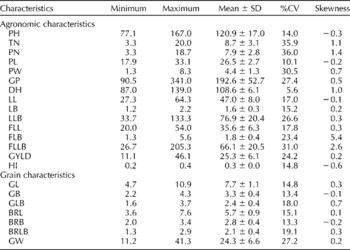
Descriptive statistics for different agromorphological characteristics are given in Table 2. The shortest landrace was ‘Tezeng’ (77.1 cm) and ‘Larunuo’ (167.0 cm) was the tallest. The negative skewness of plant height indicated that most of the landraces were tall in stature. There was a considerable variation in panicle number (%CV = 36.0), ranging from 3.3 to 18.7 with a mean value of 7.9. The variation in panicle length was low (%CV = 10.1). There was a greater degree of variation in panicle weight (%CV = 30.5), ranging from 1.3 g (‘Manam’) to 8.3 g (‘Thiethieru’) with a mean value of 4.4 g. There was a considerable variation in grains per panicle (%CV = 27.4), ranging from 90.5 (‘Changman San’) to 341.0 (‘Tampak Tsuk’). Other landraces such as ‘Rekhathung Shopruo’ (318.0), ‘Phehsha’ (311.5), ‘Lharuno’ (300.0), ‘Gam’ (287.5) and ‘Lisum Tsuk’ (285.5) also had a higher number of grains per panicle. Days to heading recorded the lowest variation (%CV = 5.6) among the traits studied and most of the landraces were of medium to long duration. Days to 85% maturity showed a variation from 127 d (‘Chotum’) to 176 d (‘Jawa Tsuk’ and ‘Mailen’). A large variation was also noted for grain yield per plant (%CV = 24.2) in the collected germplasm. Both leaf length × breadth (%CV = 26.6) and flag leaf length × breadth (%CV = 31.0) showed a considerable variation. Leaf length varied from 27.3 cm (‘Kamongpon’) to 64.3 cm (‘Tampak Tsuk’), while flag leaf length varied from 20.0 cm (‘Khatungru Tsuk’) to 54.0 cm (‘Tsokunkvu’). The characterization of the rice landraces according to agromorphology is given in Supplementary Table S1 (available online).
Agromorphological characteristics of the rice accessions

SD, standard deviation; CV, coefficient of variation; PH, plant height (cm); TN, tiller number; PN, panicle number; PL, panicle length (cm); PW, panicle weight (g); GP, grains per panicle; DH, days to heading; LL, leaf length (cm); LB, leaf breadth (cm); LLB, leaf length × breadth; FLL, flag leaf length (cm); FLB, flag leaf breadth (cm); FLLB, flag leaf length × breadth; GYLD, grain yield per plant (g); HI, harvest index; GL, grain length (mm); GB, grain breadth (mm); GLB, grain length-to-breadth ratio; BRL, brown rice length (mm); BRB, brown rice breadth (mm); BRLB, brown rice length-to-breadth ratio; GW, 1000-grain weight (g).
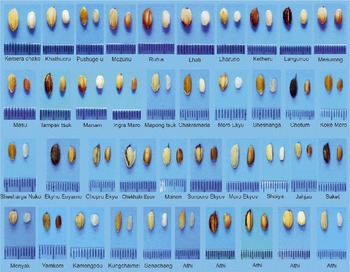
The grain morphology varied considerably in the collected rice germplasm (Fig. 2), and the values for different grain morphological traits are depicted in Table 2. The categorization of the rice landraces based on grain qualitative traits is shown in Supplementary Table S2 (available online). Grain and brown rice length varied from 4.7 mm (‘Lisum Tsuk’) to 10.9 mm (‘Athi’) and from 3.6 mm (‘Saket’) to 7.6 mm (‘Mekhroru’), respectively. Bold grains of ‘Lisum Tsuk’ and ‘Rekhathung Moro’ recorded the lowest (1.6) l/b ratio value, while slender grains of ‘Kamongpou’ recorded the highest l/b ratio value (3.7). The brown rice l/b ratio varied from 1.3 (‘Saket’) to 2.9 (‘Chotum’). Overall, both rough rice and brown rice length and breadth recorded a narrow variation. A considerable variation was observed for 1000-grain weight (%CV = 27.2), ranging between 11.2 g (‘Manam’) and 41.3 g (‘Athi’) with a mean value of 24.3 g. About 30% of the collected germplasm was aromatic, and based on the aroma score, rice landraces were grouped into non-aromatic (88), mild aromatic (12) and highly aromatic (24). Chalkiness of the endosperm was observed in 67% of the rice landraces with varying intensities.
(colour online) Variations in grain and kernel morphology of some rice landraces. The distance between two bars in the scale is 1 mm.

PCA and cluster analysis
The PCA variable loadings, percentage of variance explained and cumulative variance for the extracted PCs are given in Supplementary Table S3 (available online). PCA using 38 quantitative and qualitative traits indicated that 75.4% of the variation was accounted for by 12 PCs with eigenvalues >1. The first PC explained 19.9% of the total variance. The variables leaf length and breadth, plant height, panicle weight, grain breadth, leaf length and grain chalkiness had largest positive loadings. In contrast, many of the variables such as tiller number, grain and brown rice l/b ratio had negative loadings. The second PC explained an additional 11.9% of the total variance. The variables such as grain length, brown rice length, grain weight, awn colour and grain breadth had high positive loadings. However, the variables leaf length, flag leaf length and flag leaf length × breadth had high negative loadings. The variation in brown rice l/b ratio, panicle length and grain l/b ratio was explained by PC 3, while the variation in awning and seed coat colour was explained by PC 4. Both PC3 and PC4 contributed around 8.3% and 4.9% of the total variance, respectively. The variation explained by the other eight PCs varied from 2.8 to 4.3%.
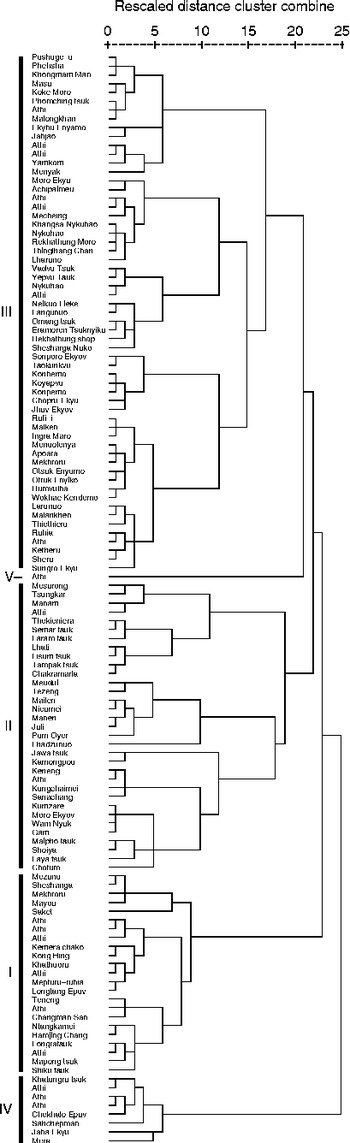
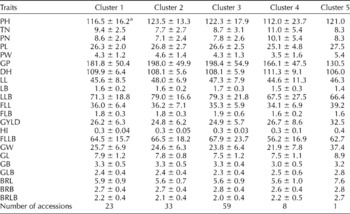
Hierarchical clustering, using Ward's method, grouped 124 rice landraces into five clusters based on 12 extracted PCs (Fig. 3). The mean values of the accessions in each cluster are given in Table 3. Cluster 3 was the largest cluster, which included 59 landraces mostly having extra-long medium to long bold grains and long medium to short bold kernels. The members of the cluster had higher values for plant height, highest grains per panicle, leaf breadth, leaf length × breadth, flag leaf breadth and flag leaf length × breadth. The second largest cluster was cluster 2, which grouped 33 landraces having greater panicle length, panicle weight, grains per panicle and leaf length × breadth. The landraces of this cluster had extra-long slender to short bold grains and long medium to short bold kernels. Cluster 1 comprised 23 landraces that had extra-long medium and long bold grains. The members of this cluster also had higher values for days to heading and 1000-grain weight. Cluster 4 grouped eight landraces that had extra-long medium grains, the highest productive tiller number and days to heading. Cluster 5 consisted of a single landrace ‘Athi’ (collected from the Zunehboto district). This accession had high mean values for panicle length, grain yield per plant, 1000-grain weight and had long medium grains.
Grouping of 124 rice landraces on the basis of the standardized squared Euclidean distance using Ward's hierarchical clustering method.

Comparison of agromorphological traits in five clusters derived from Ward's hierarchical clustering

PH, plant height (cm); TN, tiller number; PN, panicle number; PL, panicle length (cm); PW, panicle weight (g); GP, grains per panicle; DH, days to heading; LL, leaf length (cm); LB, leaf breadth (cm); LLB, leaf length × breadth; FLL, flag leaf length (cm); FLB, flag leaf breadth (cm); GYLD, grain yield per plant (g); HI, harvest index; FLLB, flag leaf length × breadth; GW, 1000-grain weight (g); GL, grain length (mm); GB, grain breadth (mm); GLB, grain length-to-breadth ratio; BRL, brown rice length (mm); BRB, brown rice breadth (mm); BRLB, brown rice length-to-breadth ratio.
a Values represent mean ± SD.
Correlation among the traits
Pearson's correlations among the traits are shown in Supplementary Fig. S1 (available online). There was a strong positive association among the traits such as grain yield per plant and plant height, grains per panicle and leaf length. Positive associations were found between panicle number, panicle length, leaf length × breadth and flag leaf length; between plant height and panicle length, panicle weight, panicle type, panicle axis, grains per panicle, leaf traits, 1000-grain weight and grain breadth; between panicle number and culm angle, leaf angle, grain l/b ratio and grain yield per plant; and between panicle length and panicle weight and all leaf traits. Similar to panicle length, panicle weight had similar associations. Negative correlations were found between plant height with panicle number, days to heading, grain l/b ratio and spikelet fertility; between panicle number with grain breadth, panicle length, panicle weight, grains per panicle, leaf breadth, leaf length × breadth and 1000-grain weight.
Discussion
Rice landraces maintained by farmers harbour wide genetic variability valuable for rice improvement (Fukuoka et al., Reference Fukuoka, Suu, Ebana, Trinh, Nagamine and Okuno2006; Ram et al., Reference Ram, Venkatesan and Vinod2007; Rana et al., Reference Rana, Garforth, Sthapit and Jarvis2007). The broad genetic base of traditional varieties is suitable for subsistence farming practised by tribal communities. It has been observed during different exploration trips that the tribal farming communities of Nagaland have selected and maintained numbers of landraces in response to varying ecological, social and cultural conditions to satisfy their needs. Characterization of these valuable landraces for important agronomic and quality traits is important for breeding programmes and for improving the landraces (Sharma et al., Reference Sharma, Chaudhary, Ojha, Yadav, Pandey and Shrestha2007; Thomson et al., Reference Thomson, Polato, Prasetiyono, Trijatmiko, Silitonga and McCouch2009; Sanni et al., Reference Sanni, Fawole, Ogunbayo, Tia, Somado, Futakuchi, Sié, Nwilene and Guei2012). The north-eastern region of India is considered the secondary centre of origin of rice. Many indigenous cultivars of rice are still cultivated by resource-poor farmers. The farming communities of this region have significantly contributed to the evolution, enrichment and conservation of landrace diversity on-farm. This is also evident at the global scale (Brush, Reference Brush1995; FAO, 2010).
Very limited efforts have been made to understand the existing landrace diversity as well as to improve these landraces. Few recent studies have evaluated the genetic diversity in rice germplasm from different parts of north-eastern India (Bhuyan et al., Reference Bhuyan, Bora and Sarma2007; Rathi and Sarma, Reference Rathi and Sarma2012; Choudhury et al., Reference Choudhury, Khan and Dayanandan2013). Reports on the characterization of rice landraces of Nagaland are lacking. Recently, Mathure et al. (Reference Mathure, Shaikh, Renuka, Wakte, Jawali, Thengane and Nadaf2011) and Tripathi et al. (Reference Tripathi, Sthapit, Subedi, Sah and Gyawali2013) characterized the diversity of aromatic rice landraces in Maharashtra (India) and Nepal, respectively, based on agronomic and grain quality traits. In the present study, the assessment of indigenous rice cultivars was based on various agronomic, grain morphological and grain quality traits. Many important agronomic traits such as panicle number, panicle weight, grains per panicle and grain yield per plant showed a large amount of variation. This signifies that selection for these traits could be possible. Likewise, there is scope for exploitation of the existing variation for improving grain characteristics and aroma. Based on multivariate analyses performed in the present study, it was revealed that the PCA and cluster analysis provide useful information about the variability present in rice germplasm of Nagaland. Both these analyses can reveal the complex relationships among the genotypes with equal effectiveness (Sukla et al., Reference Sukla, Bhargava, Chatterjee, Pandey and Mishra2010; Roy et al., Reference Roy, Verma, Hore, Misra, Rathi and Singh2011, Tripathi et al., Reference Tripathi, Sthapit, Subedi, Sah and Gyawali2013). Reports on variability assessment for rice based on cluster analysis are plenty (Gahalain, Reference Gahalain2006; Naik et al., Reference Naik, Sao, Sarawgi and Singh2006; Hien et al., Reference Hien, Sarhadi, Hirata and Oikawa2007; Sarawgi and Bhisne, Reference Sarawgi and Bhisne2007; Mathure et al., Reference Mathure, Shaikh, Renuka, Wakte, Jawali, Thengane and Nadaf2011; Roy et al., Reference Roy, Banerjee, Senapati and Sarkar2012). In the present study, clustering patterns of rice landraces did not follow the geographical origin of a genotype. A similar trend has also been reported in other studies (Ratho, Reference Ratho1984; Mathure et al., Reference Mathure, Shaikh, Renuka, Wakte, Jawali, Thengane and Nadaf2011). Moreover, it has also been observed that there are inconsistencies in naming rice varieties by farmers. Similar discrepancies in naming rice varieties have also been reported for rice landraces in Nepal (Sharma et al., Reference Sharma, Chaudhary, Ojha, Yadav, Pandey and Shrestha2007) and Vietnam (Fukuoka et al., Reference Fukuoka, Suu, Ebana, Trinh, Nagamine and Okuno2006). In the present study, grouping of ‘Athi’ and ‘Tsuk’ landraces into different clusters indicates that the traditional system of naming rice landraces is not sufficient to give proper information about the agromorphology or growing conditions, and further attention needs to be given in characterizing them. For high variability breeding, parent selection based on wider inter-cluster distances has been suggested (Mishra et al., Reference Mishra, Sarawgi and Mishra2003; Chaturvedi and Mourya, Reference Chaturvedi and Mourya2005). Information on associations between grain yield and its components is vital for improving grain yield through traditional plant breeding methods, as it aids in choosing effective selection criteria. It has also been reported that grains per panicle exerts a negative influence on grain size and shape (Roy et al., Reference Roy, Banerjee, Senapati and Sarkar2012), indicating that genes controlling grain size also regulate grain number in a panicle (Chandraratna, Reference Chandraratna1964). In the present study, we observed a positive correlation between grain length and breadth, which is not consistent with other studies reporting a negative correlation (Roy et al., Reference Roy, Banerjee and Senapati2009, Reference Roy, Banerjee, Senapati and Sarkar2012; Mathure et al., Reference Mathure, Shaikh, Renuka, Wakte, Jawali, Thengane and Nadaf2011) due to the probable linkage between grain length and breadth influenced by genes or pleiotropy (McKenzie and Rutger, Reference McKenzie and Rutger1983).
The average rice productivity of Nagaland is very low (~1.9 tonnes/ha). This low productivity of rice in this state is attributed to various abiotic and biotic factors such as soil acidity, low temperature during the reproductive phase, low sunshine hours, high rainfall patterns, diseases (mainly in the plains) and limited adoption of high-yielding varieties. The present study provides the guidelines for selection of parents based on agromorphological traits for further improvement in grain yield and quality. About 850 rice accessions were collected during 1968 to 1971 under PL-480 (Assam Rice Collection; Hore, Reference Hore2005). Subsequently, the NBPGR, Regional Station has collected around 700 rice accessions from this state. The state's agriculture department has documented the rice landraces available in the state (Government of Nagaland, 2007). The present collection of 130 rice accessions can effectively contribute to the gene pool of indigenous cultivars of this state.
Supplementary material
To view supplementary material for this article, please visit http://dx.doi.org/10.1017/S1479262113000282