

1. Introduction
Maternal mortality in Mali was estimated at 373 deaths per 100,000 births in 2018 [INSTAT (2019)]. While urban rates are about half those observed at the national level, they remain extremely high [Cissé and Sall (Reference Cissé and Sall2012, p. 37)]. Most direct causes of maternal death can now be avoided, partly through prenatal follow-up, but maternal healthcare take-up remains low. In 2018, less than half (43%) of pregnant women in Mali had the four recommended prenatal visits, and in urban areas the proportion was still only two-thirds (67%). Moreover, in only a third of cases (36%) at the national level, and half of cases (54%) in urban areas, did the first prenatal visit take place during the first trimester of pregnancy, as recommended [INSTAT (2019)].
Household poverty is one of the main obstacles to maternal health care in low-income settings today [Ahmed et al. (Reference Ahmed, Creanga, Gillespie and Tsui2010)].Footnote 1 Studies in sub-Saharan Africa—as elsewhere in poor countries—have repeatedly shown that belonging to a disadvantaged social group [Van Eijk et al. (Reference Van Eijk, Bles, Odhiambo, Ayisi, Blokland, Rosen and Lindblade2006)], being in a poor household [Gabrysch et al. (Reference Gabrysch, Cousens, Cox and Campbell2011)], or having a husband or partner who cannot afford to pay for healthcare during pregnancy [Gross et al. (Reference Gross, Alba, Glass, Schellenberg and Obrist2012)] are key factors preventing women from attending a health center for prenatal care or giving birth there with the help of skilled personnel. In Mali, for example, only 69% of women in the poorest quintile access to (some) prenatal care, versus 97% in the richest quintile (DHS, 2018). For lack of other options, the poorest Malian women resort to traditional medicines and self-medication [Diakité et al. (Reference Diakité, Diarra and Traore1993); Diarra (Reference Diarra1993); Berthe et al. (Reference Berthe, Maguiraga, Traoré, Mugisho, Drabo, Traoré and Huygens2009)].
In Bamako, average daily expenditure is still only US$2.80, of which 42% is spent on food [INSTAT (2019)], leaving little for other needs such as healthcare; health insurance and social security schemes are almost entirely non-existent. To combat economic barriers to maternal health care, the Malian government has introduced policies to provide free Caesarean sections (2005) and free access to malaria prevention and treatment for pregnant women (2010). However, while improving the situation, these measures are far from covering the full range of maternal healthcare costs in Mali [Olivier de Sardan and Ridde (Reference Olivier de Sardan and Ridde2014)]. These costs include not only formal and informal fees and the purchase of products (such as gloves for the consultation), but also transportation-related expenses and the opportunity costs of losing an entire morning or even several days of work due to long queues and erratic opening hours.
In addition to household poverty, the literature also highlights the role of women's empowerment in access to maternal healthcare. Empowerment refers to the process whereby people who have been denied the ability to make choices in the past gain access to decision making [Kabeer (Reference Kabeer2005)]. Women become more empowered when they are more educated and have access to monetary or state-provided resources. Moreover, through more favorable gender representations, they are better informed about their rights to healthcare, and more capable of exercising choice in this regard. In many African societies, maternal healthcare has a low priority in the allocation of household funds, reflecting women's subordinate status, especially when they are young and uneducated [Jennings et al. (Reference Jennings, Na, Cherewick, Hindin, Mullany and Ahmed2014)]. Even in urban centers where traditional and globalized values co-exist side by side, girls' access to education and women's say in household decisions are limited. In such contexts, a high level of education can enable women not only to avoid early marriage but also to adopt more egalitarian gender representations and to participate more actively in household decisions that concern them, such as allocation of funds for prenatal healthcare [Bloom et al. (Reference Bloom, Wypij and Gupta2001); Furuta and Salway (Reference Furuta and Salway2006); Ahmed et al. (Reference Ahmed, Creanga, Gillespie and Tsui2010)].
While there is general consensus on the key role of economic resources and gender ideology in empowering women to access maternal health, one aspect remains unexplored. Income and gender representations are only considered within the household, ignoring any material support or normative influence originating in women's social circles. Yet, in these contexts of endemic poverty, alternative systems of solidarity are often developed by individuals via personal networks that serve to increase their economic resilience, including with respect to healthcare, networks which in turn contribute to shape their visions.
Historically, African societies were characterized by the pre-eminence of the group over the individual and the couple, and by solidarity between family group members [Locoh and Mouvagha-Sow (Reference Locoh and Mouvagha-Sow2005)]. Mutual support within large family networks was anchored in a framework of obligations and exchanges of resources, and the unequal balance of flows—primarily toward elders and males—was underpinned by influential representations of the social roles of elders and young people, men, and women [Pilon and Vimard (Reference Pilon and Vimard1998)]. Families have witnessed transformations in recent decades, in urban settings especially, with economic growth providing new job opportunities, the increasing diversity of cultural references, and individuals and nuclear families gaining greater autonomy from their larger family groups. Mutual (though unequal) support and interaction with the extended family still exist, however [Calvès and Marcoux (Reference Calvès and Marcoux2007)], and wealthy households continue to look after their extended family members, notably by giving them a place to live [Sauvain-Dugerdil and Cissé (Reference Sauvain-Dugerdil and Cisséin press); Nouhou et al. (Reference Nouhou, Cissé, Fané, Doumbia and Sauvain-Dugerdil2016)]. At the same time, other types of non-household solidarity appear to be developing in cities, notably via religious, professional, or neighborhood networks who provide support [Nouhou (Reference Nouhou2016); Rossier et al. (Reference Rossier, Soura and Duthé2019)]. In this increasingly diverse social world, women in open (non-family) networks, as well as those in better educated ones are more willing to adopt certain reproductive practices which challenge the patriarchal order, such as condom use with husbands to prevent HIV transmission, or modern family planning methods [Hellenringer and Kohler (Reference Helleringer and Kohler2005); Stephenson et al. (Reference Stephenson, Baschieri, Clements, Hennink and Madise2007); Okigbo et al. (Reference Okigbo, Speizer, Domino, Curtis, Halpern and Fotso2018)].
The role of non-household support and social influence in relation to access to maternal healthcare has never been studied, however. Public health and social science research on the topic has focused primarily on spouses, children, and other individuals belonging to the household. This type of approach is not well suited for studying daily family realities, as scholars working on western societies have increasingly pointed out [Le Bourdais et al. (Reference Le Bourdais, Desrosiers and Gaulin1991); Bonvalet and Lelièvre (Reference Bonvalet and Leliévre1995); Lefranc (Reference Lefranc1997); Widmer (Reference Widmer2006); Brown and Manning (Reference Brown and Manning2009); Lapierre-Adamcyk et al. (Reference Lapierre-Adamcyk, Le Bourdais and Martin2009)]. Recent research in Africa has shown that economic interdependencies are highly complex [Kriel et al. (Reference Kriel, Randall, Coast and de Clercq2014)], and that resources available to individuals may come from more than one household [Rabe (Reference Rabe2008); Randall and Coast (Reference Randall and Coast2015)].
In this research, we interviewed a representative sample of women aged 25–40 in Bamako who recently gave birth and applied the Name Generator tool to gather information on their personal network and their composition (type of relationship). We also asked who in their network would provide them with material support (money or practical help) when needed. To capture the structural properties of women's networks, we asked them to report material support which is exchanged among all network members. Thanks to these data, we assess the exchanges and influences within and beyond the household which could help women in Bamako access maternal health care.
2. Theories and hypotheses
To frame how interpersonal networks help or hinder women in their access to maternal health care in Bamako, we use the concept of social capital, a notion which meanings have varied over the years and can therefore be difficult to operationalize [Portes (Reference Portes1998); Rostila (Reference Rostila2011)]. A first stream of researchers (mainly political scientists) used social capital in the sense of “social cohesion”: a property of communities, measured at the aggregate level, typically with survey questions on trust or participation in local organizations [Putnam (Reference Putnam1993)]. For them, social capital refers to the intensity of interpersonal relations in a community, to the norms of reciprocity underlying this social fabric, and to the outcomes arising from the mobilization of ties (collective action). Other researchers (sociologists), starting with Bourdieu (Reference Bourdieu1980), have defined social capital at the network level, as the resources individuals can potentially obtain from people with whom they maintain a personal relationship. While individuals’ capacity to create and maintain ties is largely structured by their economic and cultural capital, as well as by rules of reciprocity, social capital refers more narrowly to the social resources exchanged within personal ties. This approach has often been operationalized as the social support people receive and give in their network [House (Reference House1981)]. Another sociological stream of research—which lies somewhere between the cohesion and the social network approaches—stresses that tightly knit communities also produce social control (Coleman, Reference Coleman1988). This line of investigation has crossed over into demography, where researchers are interested in “social interaction” and “social influence” effects on reproductive behaviors [Montgomery and Casterline (Reference Montgomery and Casterline1996); Rossier and Bernardi (Reference Rossier and Bernardi2009)].
These different interpretations thus tend to focus either on the “wires” (networks and trust, the collective actions they foster) or on the “electricity” (what the ties exchange: social resources and social influence), to use Putnam's image. In the late 1990s, the distinction between bridging versus bonding social capital [Szreter and Woolcock (Reference Szreter and Woolcock2004)] was an important step forward in the field and helped to connect the two perspectives. Building on studies of the structures of networks and earlier (now outdated) distinctions between “strong” and “weak” ties [Granovetter (Reference Granovetter1973); Burt (Reference Burt2002, Reference Burt2004)], Putnam, and then Szreter and Woolcock, argued that ties that are structured differently carry distinct resources and facilitate different processes. In particular, individuals who belong to small, dense, reciprocal, and centralized networks (i.e., groups with a common social identity: a family, a village, etc.) have strong bonding social capital. Support for “getting by” (care, economic dependence) and normative influences are strong in such networks. But many individuals also build relationships on the basis of common goals or interests (e.g., through a church, a professional organization) with people belonging to different groups. Bridging social capital is exchanged in these less dense and less centralized networks. This type of social capital is especially crucial for obtaining “getting ahead” support, such as information when looking for a job. Bridging social capital is also linked to greater normative diversity and greater individual autonomy.Footnote 2 Last, bridging social capital in a community also promotes collective action, as it brings together people from different groups. This seminal distinction is gaining ground in the social capital literature; today the idea of a bonding–bridging continuum is preferred over a simple dichotomy, with individuals’ networks comprising both bonding and bridging social capital in various proportions [Claridge (Reference Claridge2018)].
The social capital literature in the health domain [Ehsan et al. (Reference Ehsan, Klaas, Bastianen and Spini2019)] has tended to rely first on the “social cohesion” definition of social capital, as in the classic study explaining social inequalities in mortality across countries by differences in social participation and trust [Kawachi et al. (Reference Kawachi, Kennedy, Lochner and Prothrow-Stith1997)]. While social network approaches have also been introduced to study the effect of social capital on health [Carpiano (Reference Carpiano2007)], contemporary work tends to merge the two perspectives, for example, by using the bonding/bridging distinction [Moore and Kawachi (Reference Moore and Kawachi2017)]. The current literature underlines the positive aspects of both bonding and bridging social capital, while stressing also negative ones. For example, elderly relying on a small and dense network can be in worse health, when conflicts are present or respondents resent the loss of control [Girardin and Widmer (Reference Girardin and Widmer2015)]. Homogenous networks can promote unhealthy norms; for example, one reason why people who want to lose weight fail to do so is that they tend to exclude thin people from their interactions [Andersson and Christakis (Reference Andersson and Christakis2016)]. Bridging capital can expose individuals to health risks, see for example Takakura (Reference Takakura2015) on youth participation in social activities and risks of smoking and drinking.
Existing studies on the influence of social capital or networks on maternal health in sub-Saharan Africa have largely focused on the normative aspects of networks, and more precisely on the liberating effects of diverse networks. In Niger, for example, Nouhou (Reference Nouhou2016) shows that women's opinions on birth control are largely shaped by their perception of how other women in the community view the question. This confirms the findings of Sauvain-Dugerdil (Reference Sauvain-Dugerdil2014) on the role of family and social pressure in inhibiting intended or actual use of contraception in Mali and Ghana. Another study in rural Mali found that women are more influenced by the conservative preferences and opinions of their mother-in-law toward maternal health than by those of their husband, whose role is non-significant [White et al. (Reference White, Dynes, Rubardt, Sissoko and Stephenson2013)]. Networks dominated by members of the family-in-law also seem to be associated with more conservative reproductive health practices in Mali and Malawi [Helleringer and Kohler (Reference Helleringer and Kohler2005); White et al. (Reference White, Dynes, Rubardt, Sissoko and Stephenson2013)]. Recent studies focus on new adopters of contraception, and show that the switch to more progressive gender attitudes within the network plays a key role in the transition to greater contraceptive use [Okigbo et al. (Reference Okigbo, Speizer, Domino, Curtis, Halpern and Fotso2018)].
These different studies look at conservative normative influences within the social network and the broader community, a useful angle of approach when examining poorly accepted but largely subsidized practices, such as modern contraception. However, prenatal care generates many direct and indirect costs difficult to support in a context of widespread poverty. In the Malian context of chronic poverty, extended family support has historically been essential for coping with the difficulties of everyday life, health problems included. For example, a study in Mali showed that a large family network improved child survival [Adams et al. (Reference Adams, Madhavan and Simon2002)]. Personal networks might provide opportunities for women to borrow money or receive practical support outside their household to cover maternal healthcare-related expenses and to access care. Therefore, in our study in Bamako, attention will also focus on the material exchanges within social networks and their role in improving maternal healthcare access.
2.1 Hypotheses
As shown in the literature, women's recourse to prenatal health care is enhanced both by the material support that they receive and by their (normatively shaped) ability to make their own decisions in this respect. This leads us to test two somewhat competing hypotheses.
In Bamako, where access to health services implies a wide range of direct and indirect costs that women, especially the poorest ones, cannot afford, prenatal care is expected to be greater for women in networks that are likely to generate more material support. Financial support as well as practical help (for transportation or to replace women at work or at home) could make a difference. As shown in the literature, stronger material support is provided in networks that generate bonding social capital. Therefore, our first hypothesis is that access to prenatal care is higher among smaller, denser, more reciprocal networks.
However, effective recourse to prenatal care depends not only on the availability and accessibility of health services but also on women's capacity to decide freely to use them and, therefore, on their degree of empowerment. In this context where young couples often live with the husband's family, keeping close relations with their own family will help women mitigate their subordinate position in the household. Moreover, having ties with persons of their age and not just older ones, as well as links with persons outside the family, could help women challenge unequal gender and generation relationships. This would enhance their decision-making power and also give them access to better information about the importance of maternal care. Therefore, our second hypothesis is that recourse to prenatal care is higher in networks rich in bridging social capital, that is comprising non-kin, and especially persons from outside the in-laws nucleus.
We shall test the first hypotheses through the association between the structure of the network and recourse to prenatal care, but also the interacting effect of material support. We will test the second hypothesis through the effect of the composition of the network on prenatal care.
3. Data, measures, and methods
This study is based on a field survey conducted in July 2017 on a sample of 516 women aged 25–40 who had given birth to their last child in the previous 12 months.Footnote 3 The sample is representative of Bamako and includes 245 women from formal (zoned) and central neighborhoods selected in equal numbers from the different municipalities of the Bamako district (I, II, III, IV, and V), and a further 271 women from the informal (un-zoned) Sénou and Ngomi neighborhoods, located respectively in municipalities II and VI. The latter were chosen to extend coverage to Bamako's informal peri-urban areas, located on the edge of the city. Their inhabitants are distinctly poorer, less educated, and more often born in rural areas than those living in zoned, central, older parts of Bamako, because plots and rents are cheaper and more easily available. These informal districts are settlements comprising small, densely-spaced dwellings, built from non-durable materials; they have no public roads, electricity, piped water, garbage, or sewage systems, and there are no public schools in their vicinity. However, they are not significantly different from the rest of Bamako in terms of public healthcare provision, because many public health centers are located at the edge of the formal city [such as in Ouagadougou, Rossier et al. (Reference Rossier, Soura and Duthé2019)]. In fact, none of the surveyed women, in the formal or informal neighborhoods, lived more than two kilometers away from the nearest public primary healthcare center and slightly more than two-thirds lived within one kilometer.
A random route sampling method was used. Interviewers followed a predetermined route from a selected starting point (generally a public square, or the start/end of a main street) and selected potential respondents in the houses or compounds along the way, on the basis of eligibility criteria (having given birth in the last year). The interviewers were instructed to administer the questionnaire systematically to all eligible women in every third house or compound in the periurban areas, and every fifth one in the formal areas. Data were recorded using the Computer Assisted Personal Interviewing (CAPI) method. The survey was conducted by five interviewers with proven experience in field operations, who were registered in the directory of the Institut National de la Statistique (INSTAT).
3.1 Measuring maternal healthcare
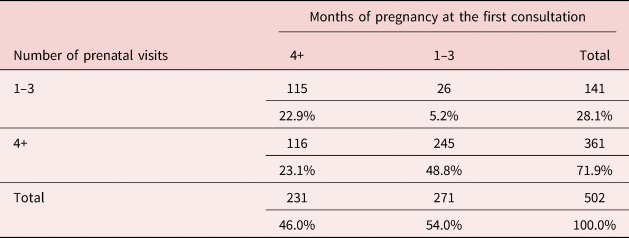
Maternal health-seeking behavior is often measured by the number of prenatal visits. In Africa, however, a high number of prenatal visits may also be the consequence of pregnancy complications [Soura (Reference Soura2009)], since women with difficult pregnancies may be more inclined to make frequent visits. Hence, the fact of attending at least one consultation cannot be considered as a good measure: as one visit is required for a hospital delivery, some women, because of financial, cultural, or geographical obstacles, may not return until they give birth. Our data suggest that this is indeed the case in Bamako: only 2% of the women had no pregnancy follow-up, but as many as 27% had 1–3 visits.
Consequently, in order to fully capture women's healthcare-seeking behavior, the timing of the visits must also be taken into account. We therefore used a composite indicator combining the number of visits and the timing of the first one. We consider that women who made at least four prenatal visits and whose first consultation took place before the fourth month of pregnancy received adequate prenatal healthcare (blue cell in Table 1 below). This is the case for nearly half of the 502 women who had access to health care (49%).
Indicators of maternal healthcare seeking

3.2 Composition of the personal network
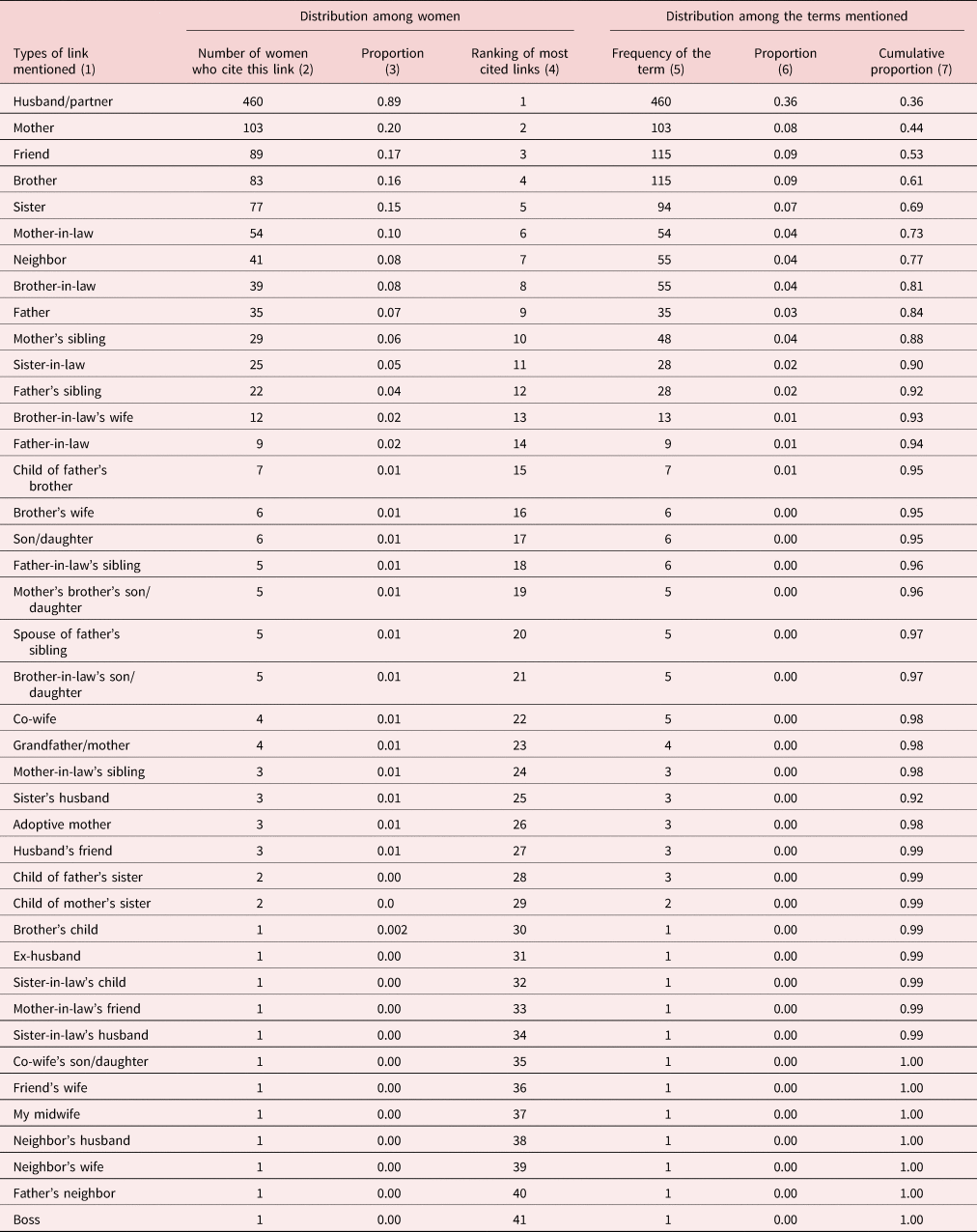
The respondents' personal networks and their relational exchanges were defined using the Name Generator tool. Women were asked to answer the following question “Who are the people you consider to be significant or important for you?” More specifically, they were asked to list the persons who had been important for them (15 at most) during the previous 12 months. The network, such as defined, was thus not necessarily limited to family or household members. The respondents were further asked to describe their link to each person mentioned: “What is your relationship to (name)?” The types of links mentioned by respondents are listed in Table 2 below (column 1). Apart from the husband, who is mentioned by practically all respondents (89%, column 3), a very diverse range of people are considered as important. For example, neighbors are cited by 8% of respondents, and are thus the seventh most cited link (column 4). We used this diversity to define the profile of the personal network. We kept the first 22 types (accounting for 97% of all the terms cited, column 7) to run a Principal Components Analysis (PCA), using the FactoMineR package in R. As in similar network analyses [e.g., Widmer (Reference Widmer2006)], and other analyses of quantitative data, PCA is used to extract the initial factors. We retained the first five factors, with eigenvalues >1, and we performed a varimax rotation. These first five components, explaining 53% of the variability between respondents, were further used to apply an ascending hierarchical classification and we thus obtained five personal network configurations (see Table 3, in the results section below).
Types of persons cited as important

Description of the types of personal network

3.3 Material support received and network structure
The following questions were asked to each woman: “Who, among the persons mentioned, including yourself, would provide material support/small favors to (name: each person listed as important) if he/she were in need (money problems, childcare, daily expenses, family ceremonies, parties, etc.)?” We thus recorded not only the support given and received by the respondents, but all the exchanges within their network. Note that we measured not support actually given and received, but potential support, as common in the literature. Actual support depends strongly on the occurrence of adverse events; thus, support available for routine health care may be better captured through potential support. Material support is measured through the number of persons that would potentially provide help to the respondent (in-degree).
Based on the literature [e.g., Widmer (Reference Widmer2006)], the network structure has been delineated through its size and the exchanges of support among all network members described by their density, reciprocity, and the centrality of the respondent. The size of the network is the number of significant relations reported. Density is measured by the number of exchanges between the network members relative to the total number of possible dyadic exchanges. Density informs about the degree of connectedness of the network: a high density suggests a strong connectedness. Reciprocity is measured by the ratio of relations with reciprocal support to all support exchanges. Strong reciprocity is thought to express a certain stability in the exchanges. A measure of the respondent's centrality (betweenness centrality) captures the proportion of connections within the network for which the respondent is in a position of intermediary: the respondent is said to be highly central if she lies between all or almost all her network members' connections [Widmer et al. (Reference Widmer, Aeby and Sapin2013)].
4. Results
4.1 Composition of personal networks
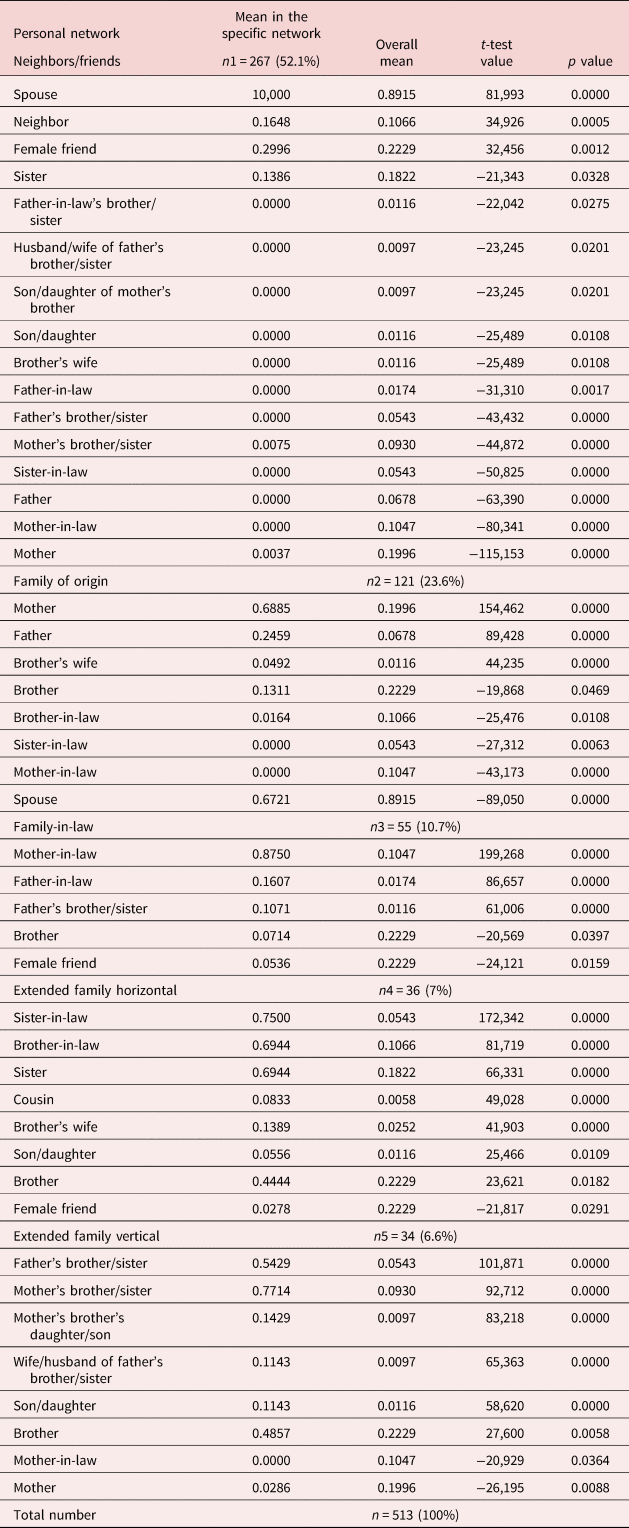
The composition of the five network types is described through the relative number of times a link is cited, i.e., the average proportion of respondents who cite this link in a given network (see Table 3). This average (shown in column 1) represents the weight of each cited link, that is to say the frequency of citation of this link by women in a given configuration compared with the total average (among all surveyed women regardless of the group to which they belong, column 2). The higher the difference between the average frequency of citations of the link in each configuration and the total frequency of citations concerning the same link, the better this link characterizes the network in question. We compute thus the distance between the overall mean and the mean in the specific network type, expressed as the number of standard deviations of a normal distribution (i.e., the t-test value) and keep for each network the links that differ significatively from the global average (those with a p-value smaller than 5%, see column 4). We can thus compare the respective role that each type of link plays in the different personal network types.
The results show that slightly more than half (52.1%) of respondents belong to a neighbours/friends network centered on the husband and non-relatives such as neighbours and friends, in which relatives by blood and by marriage are less present (except siblings). The family of origin network comes in second position, accounting for almost a quarter of the women (23.6%); these women are still quite strongly attached to their parents and siblings (brothers especially). In the family-in-law network, women are mainly connected to their husband's parents and, to a lesser extent, their brothers-in-law; this type of network is much less frequent, however (10.7%). The last two types concern only 7% and 6.6% of respondents. Women in an extended horizontal family network (7%) mention their siblings and sometimes their cousins, both biological and by marriage, but not their ascendant relatives. Women in the last type of network (extended vertical family) have a personal network centered around their husband and blood family, also including the siblings of their biological parents.
4.2 Sociodemographic determinants of the composition of personal networks
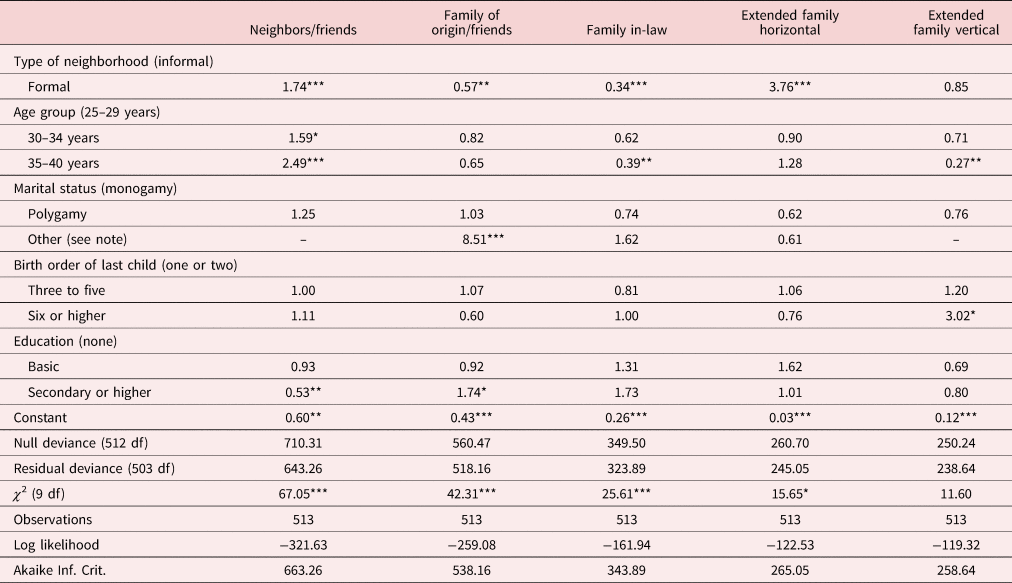
We used binary logistic regressions to examine the sociodemographic characteristics of the different networks (Table 4). The neighbors/friends network is more common among women living in the wealthier central parts of the city, as well as among the oldest ones [women aged 35–40 are twice as likely (OR = 2.5) to belong to this network] and among women who did not reach secondary school. The family of origin/friends network is prevalent among women who are single (a woman who has no husband—i.e., a lone mother—is eight times more likely to belong to such a network), and among women who are living in a poor informal peripheral neighborhood. The family-in-law configuration also mainly concerns women living in the informal areas of the city, as well as younger women. The extended vertical network, with older relatives on the woman's side, is less frequent among women over 35 years old.
Odds ratios of belonging to a given type of personal network by various personal characteristics

Note: The “other” category mainly comprises single women (77%, representing 3.3% of the total sample). The remainder are widows (18%, representing 0.8% of the total sample) and one divorcee.
* p < 0.05; **p < 0.01; ***p < 0.001.
Altogether, age or marital status appears to be the most structuring dimensions of women's networks. Younger women and single mothers interact frequently with older relatives of their family of origin, and younger brides with their family-in-law. Mothers in their late 30s, on the other hand, interact more often with neighbors and friends. Number of children is not significatively linked to network type, except for women in extended vertical family networks, who more often have large families of six children or more.
Place of residence is another structuring dimension of networks. Whatever their age or marital status, women in the richer and more formal areas of the city interact more frequently with neighbors and friends, and with horizontal family members. On the other hand, women in the newer informal settlements, whatever their age or stage in the life cycle, tend to be confined to networks comprised mainly of older relatives, whether in their family of origin or their family-in-law. Interestingly, level of education (having reached secondary school) is not strongly associated with any type of network, except that more educated women (who are relatively rare) are somewhat less likely to be members of the popular neighbors/friends networks; this may result from their tendency to hold white collar jobs that take them away from home.
4.3 Effect of personal networks on the propensity to use prenatal healthcare
We next examine the respective effects on prenatal health care behavior of the composition of the networks, the material support they generate, and their structural properties. More specifically, taking into account age, neighborhood of residence (formal, informal), and education level, the aim is first to identify whether personal network composition is linked to better access to prenatal care. A more diverse network (i.e., not only older kin or family in law) is thought to contain more bridging social capital, and presumably to promote more empowering gender norms (H2). Second, and controlling for sociodemographic characteristics and network composition, we check whether prenatal care is associated with stronger material support and network structures denoting strong bonding social capital—i.e., smaller, denser, more reciprocal, and less central networks (H1).
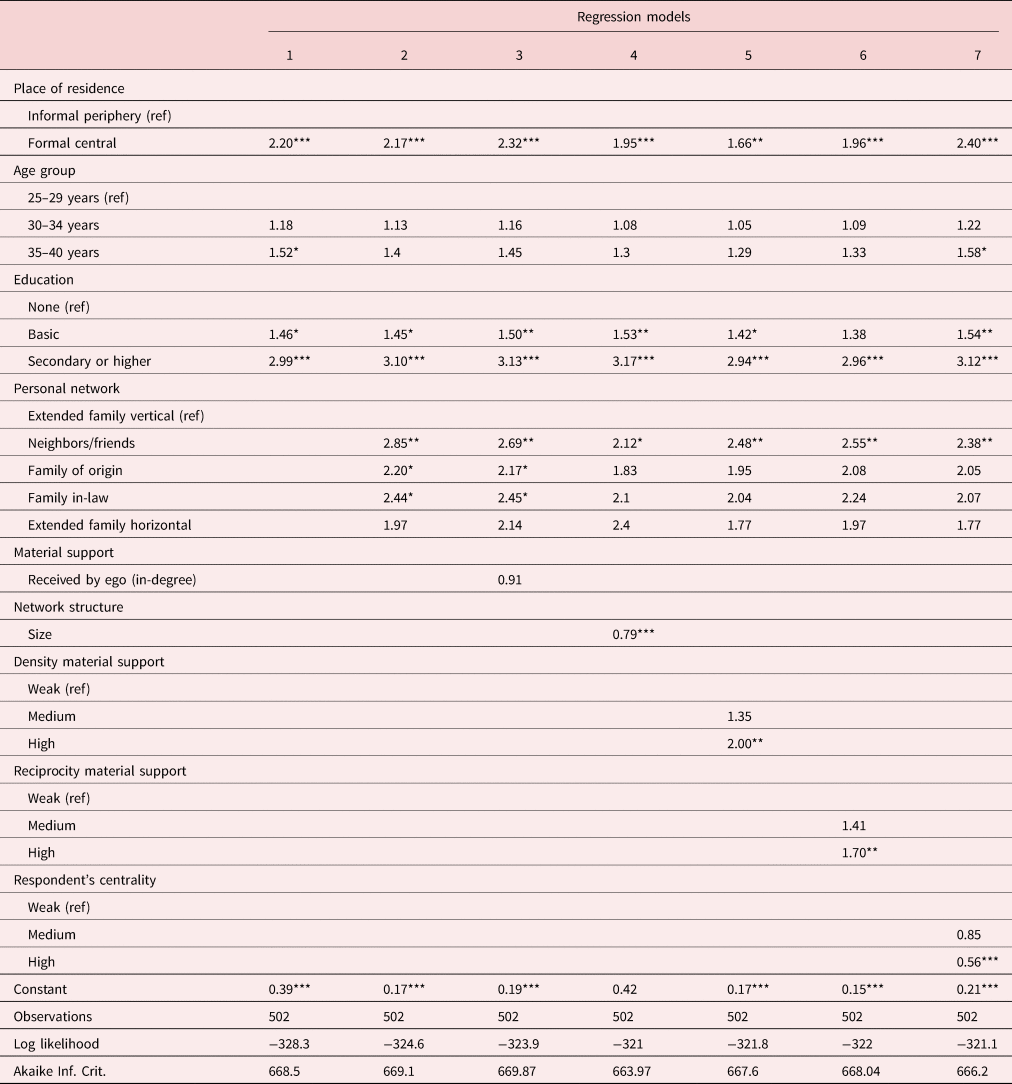
We examined these questions via a series of binary logistic regression analyses on women's propensity to recourse to adequate prenatal care (Table 5). The first model considers the characteristics of the women (type of neighborhood, age, and educational level) only. All other models keep these characteristics and add other variables and control for them. The second model adds the network configuration. The five next models append, one by one the material support received (model 3) and the various dimensions of network structure: size (model 4), density (model 5), reciprocity (model 6), and respondent's centrality (model 7).
Effect of personal network composition, material support, and network structure, controlling for individual characteristics, on the propensity to seek adequate prenatal healthcare (odds ratios)

Note: **p < 0.01; *p < 0.05 (no effect was significant at p < 0.001).
In all models, the results reveal a strong effect on the place of residence on the propensity to seek adequate healthcare: pregnant women from wealthier central neighborhoods receive better prenatal follow-up. As health services are quite widely available for women in both the formal center and the informal suburbs, we attribute this finding to the greater relative poverty of households in the peripheral informal settlements of Bamako. In all models, highly educated pregnant women are more likely to receive adequate prenatal healthcare, illustrating the well-documented role of education in promoting women's empowerment. We also observe that women in the older age group (35–40 years) have better access to prenatal healthcare, but the effect is not significant at the 5% level. Our diverse measures of network specificities do not modify the effect of these indicators of the household socioeconomic level and of the respondent's human resources.
Model 2 shows a net effect of the composition of the network after controlling for individual characteristics. Women whose network is centered on her husband and blood family including parents' siblings (extended vertical) have the worst situation in terms of prenatal healthcare, while the configuration around the husband, neighbors, and friends is the only one showing a significant advantage (at 5%) compared to this reference configuration. In model 3, we see that material support makes no difference, which is surprising. In models 4–7, results show that networks generating bonding social capital lead to more effective prenatal care seeking: women with smaller (model 4), more dense networks (model 5) with higher reciprocity (model 6), and lower respondent's centrality (model 7) have an advantage. These effects are not influenced by the network composition: they are only slightly higher in analyses without control for the network configuration (not shown here). Reciprocally, the effect of network composition is not significatively modified by the size and structure of the network. One exception is that when controlling for network size, the advantage of the “friends/neighbors” configuration decreases slightly, as they are smaller. Thus, network size is more strongly linked to network configuration than does network structure, an argument for using network size as a compositional indicator in future studies.
In short, the “neighbors and friends” configuration (and to a lesser—non-significative—extent the other non-extended family forms), thought to be high in bridging social capital, favorably influences recourse to prenatal care, whatever the material support received and the structure of exchanges. Moreover, small, dense, reciprocal, non-centralized networks (generating bonding social capital) are conducive to more adequate prenatal care, whatever their composition. Adding the effect of a potential material support did not change either the effect of the configuration or that of the structure of the networks (results not shown).
5. Discussion and conclusion
The aim of this study was to assess the dimensions of personal networks that are conducive to better prenatal follow-up in Bamako, the capital of Mali. By focusing on the urban environment, we could rule out factors linked to healthcare availability, as the Bamako urban and peri-urban districts are well covered by services. The personal network is a configuration of significant ties where socioeconomic resources and practical help are exchanged; typically, these exchanges are more intense in dense groups producing bonding social capital. Social ties also convey norms and values which can enhance women's autonomy. In the context of Africa, networks including ties beyond the in-law family, producing bridging social capital, have been shown to promote reproductive practices that challenge patriarchal norms. We thus postulated first that pregnant women's capacity to recourse to adequate prenatal healthcare will increase if they belong to networks that produce bonding social capital and receive more material support. Our second hypothesis was that networks including persons from outside the family, especially from the in-laws, and producing more bridging social capital would promote a more flexible normative environment for women, and thus also improve their access to prenatal healthcare.
In line with literature in other contexts, our research shows that smaller, denser, more reciprocal, and less centralized personal networks improve prenatal care, in family and non-family configurations. Our results thus confirm the pertinence of the bonding social capital approach [Widmer (Reference Widmer2016)] in this urban African context for prenatal care seeking. As found elsewhere, the positive effects of bonding social capital could be due to more effective support. However, as these tight networks often include here friends (and not family), their positive effect may arise also because they convey a more progressive gender ideology conducive to prenatal care seeking.
These results reveal specificities of our study context which deserve to be explored more fully. The fact that in Bamako bonding social capital is more common in elective non-family networks contrasts with findings in the Western context which show that bonding social capital is mainly found in family networks [Widmer (Reference Widmer2006, Reference Widmer2016)]. More precisely, in Bamako, bonding social capital seems to be concentrated in a nuclear family configuration, i.e., centered on the husband only (and non-family members). One point to verify in this regard is whether extended family solidarity may play a greater role for meeting other types of health needs, in other periods of the life course, and for other family members (men, children). For example, extended family relations may be mobilized primarily for health emergencies (not routine care) or concentrated on dependents (children and elders). On the other hand, as we suggest here, gender inequalities may also remain strong in extended family exchanges, with less importance given to women's needs. Another issue to explore is whether intense sociability in urban neighborhoods, as observed, for example, in Ouagadougou [Rossier et al. (Reference Rossier, Soura and Duthé2019)], is filling the void left by the weakening of (extended) family support.
Our results indicate that women living in wealthier neighborhoods (central zoned areas of the city) receive a better prenatal follow-up; this result aligns with the literature showing that costs remain one of the main obstacles to maternal care in poor countries [Ahmed et al. (Reference Ahmed, Creanga, Gillespie and Tsui2010)]. Moreover, the networks made up of husband and friends, associated with denser exchanges, are concentrated in these central parts of the city; the density of exchanges may thus simply reflect their higher socioeconomic status (they have more to give). However, the area of residence gives only a rough indication of the household's socioeconomic conditions and fails to capture heterogeneity within areas. An important limitation of this study is therefore the absence of a measure of household wealth. Moreover, as rural migrants more often live in the informal periphery of the city, it would be necessary to consider also the duration of residence and its specific effect on women's social network composition and structure of exchanges.
Unexpectedly, our findings indicate that a better prenatal follow-up is not associated with the material support received. This may be due to the fact that, in this study, we measured material support quite broadly, without specifying what kind of support is provided (financial, practical help for transports or child care and domestic tasks, etc.). More precise measures may thus be needed to evaluate the role of support for accessing maternal health care. Yet this result may also mean that normative aspects are stronger than material support in enhancing recourse to prenatal care in Bamako.
Finally, future research will have to investigate further the role of gender representations and their differences among networks. More precisely, studies are needed to examine whether networks generating bridging capital, less influenced by the family nucleus, are less gender-conservative and therefore let women more freedom to use prenatal care.
In conclusion, our results indicate that women of reproductive age enjoy little decision power in the game of family solidarity and activate non-family personal relationships. We find indications that social relations beyond the family strengthen their empowerment and enhance their entitlement to prenatal care. These extra-family ties may also provide alternative means to mobilize support. However, because such relational resources are not available equally to all, as our findings indicate, efforts to promote female education should continue and the provision of free maternal healthcare should become an urgent priority. To address the problem of childbearing risks, the policy of free Caesarean sections should be extended to include prenatal consultations and normal deliveries. More information is also needed about the obstacles to prenatal care seeking linked to the quality of services, as shown in a rural setting close to Bamako [Diarra (Reference Diarrain process)].