Cryonics has been used since the late 1960s to cryopreserve humans immediately after death of old age, fatal injuries, accidents, or terminal diseases. The intention of the freezing process is to prevent biological decay—the cessation of all bodily functions and the beginning of cell death. Because the aim is to heal and then revive—“resurrect”—the dead in a possible future in which medical technologies are sufficiently advanced. The blood of a recently deceased body is replaced with antifreeze. Greatest damage is to be expected in the human tissue due to the crystallization of water. During a 2-week process, the body is eventually cooled down to −196°C in liquid nitrogen (Reference Krüger, Gross, Tag and Schweikardt1). Currently, the process of cryopreservation is irreversible (Reference Perry2). A successful awakening is still pending, which is why cryonics is sometimes referred to as an alternative funeral practice (Reference Bestattungen3;4). However, this study is explicitly about the ideological resp. ideal cryonics in the sense of postmortal survival and re-awakening.
Two facilities—the Alcor Life Extension Foundation and the Cryonics Institute—in the United States of America as well as KrioRus in Russia provide cryopreservation and/or storage services. It is possible to choose between “whole body preservation” and “neuropreservation” (suspended animation of the head) (Reference Krüger, Gross, Tag and Schweikardt1;Reference Ettinger5–Reference Sames, Gross, Tag and Schweikardt7). Nearly 270 patients are currently in this state of “cold sleep” (8). Actual applications for cryonics can already be found, for example, in evolutionary biology or reproductive medicine.
In the following study, the term cryonicists denotes persons who are organized in a cryonics society and/or have entered into a contract with a cryonics institute or have declared themselves to be sympathetic to the cryonics movement. They support the idea of prolonging life and negating death, an idea begun by Robert Ettinger among others with the publication of his book “The Prospect of Immortality,” and they are confident that cryopreservation will function in the future.
Although cryonics is often dismissed as mere science fiction, cryopreservation is a widespread and familiar subject in popular culture. The media attention given to cryonics is likewise considerable. Resuming life in the future can be a tempting prospect, especially in an increasingly secularized society in which religion and the associated option of life in the hereafter play a diminishing role. Unlike for example plastination, which gives body donors the opportunity to be corporeally retained and to continue to exist physically (Reference Gross, Tag and Schweikardt9), cryonics concerns itself with the potential immortality of the living body. The slowing down or even cessation of the aging process is, therefore, the ambitious goal. Death will theoretically be completely negated.
Detailed studies of attitudes toward technology acceptance, life and death, associated with cryonics, are rare in the present empirical work. The only quantitative survey to date was carried out by Rievman in 1976 and examined “the origins, development, and membership parameters of the Cryonics Society” (10:viii) in the United States by means of a membership survey. Rievman collected comprehensive data (observation, document sources, and mail questionnaires) on 93 U.S. cryonicists of a total of 155 reported members worldwide. Her analysis showed that the average American cryonicist was white, male, highly educated, nonreligious, had a mean age of 39.2 and was politically unorthodox; he had a higher income but also a stronger (subjectively felt) fear of death than the average U.S. citizen. Although Rievman's study is more than 35 years old, it has continued to shape the image of cryonicists to the present day throughout the scientific literature. It is still widely assumed today that cryonicists are immortalists whose aim is to “heal” or reverse death to attain an unlimited life span (Reference Rievman10;Reference Krüger, Macho and Marek11).
Up to now, scientific work on cryonics has been largely carried out in the English-speaking world and refers mostly to the United States. This is due to the concentration of organized cryonicists in this region as well as the fact that it is the location of almost all providers of cryonics.
OBJECTIVES
We have investigated the extent of the public's awareness of cryonics and the level of social acceptance of cryopreservation in contemporary society. As studies on the Central European region are still lacking completely, the present study explores these questions using the example of Germany. Considerable media attention is given to the subject of cryonics in German media, which leads us to ask what the public perception is. However, it should be noted that the debate about cryonics in the German media depends for the most part on a few individuals (e.g., 12–14).
Investigations were focused on four main issues beside the socio-demographic data: (i) familiarity with and conceivability of cryonics, (ii) attitudes toward (medico-)technological progress, (iii) attitudes toward death, and (iiii) toward life.
METHODS
Despite initial methodological concerns regarding its representativeness, an online survey was favored over a telephone survey (CATI). Of decisive importance for this decision was the desire to use answer categories displayed on a screen to make it easier for respondents to give answers on a technology which has not been the subject of much public discussion to date.
Participants and Representativeness
The methodological basis of the present study was a representative web-based population survey of 1,000 persons aged between 16 and 69 years and resident in the Federal Republic of Germany. The ratio of male and female respondents is approximately fifty–fifty, in accordance with the proportions within the German population. The average age was 42.8 years with no difference between men and women. It was decided not to include the over-70s age group for methodological reasons. The feasibility of realizing the survey (Internet access) and its representativeness (age distribution) were factors speaking in favor of this step.
The market research institute Harris Interactive, which has an online access panel with over 60,000 voluntary respondents at its disposal, was commissioned to carry out the survey. An age- and sex-stratified random sample was used to reflect the distributions within the population correctly. Two weights were used to make a representative statement: (i) Propensity weighting was performed concerning the respondents’ different attitudes and behaviors. (ii) As the variable “highest educational qualification” nevertheless exhibited a considerable distortion of the ratios regarding levels of education, a weighting variable was created on the basis of data from the Federal Statistical Office (15). The original sample size of 1,000 persons was inflated to 1,298 cases as a result of this weighting. This circumstance had to be accepted for the purposes of generalizing the results for the Federal German population. It holds true that the respondents of an online survey have a higher affinity for technology. This effect was compensated by the propensity weighting. All results given in the presentation were established on the basis of this weighting.
MATERIALS AND PROCEDURES
A pretest (n = 25) with what was originally a more extensive version of the questionnaire was conducted. As the pretest showed that a homogenous state of knowledge existed among the respondents regarding this essentially medical concept could not be assumed, the following short definition preceded the block of questions on cryonics: “The concept ‘cryonics’ describes a method of ‘freezing’ people who have just died with the aim of ‘reviving’ these persons in the future - with the help of more advanced medicine. Cryonics is provided in several states by companies that specialize in this area.” The definition was intentionally brief to ensure that as little information as possible was anticipated. The survey was carried out in spring 2012.
Valence and Arousal Ratings
Two different settings were selected: (i) Exhaustive dichotomous answer categories were adopted for the closed-ended questions, (ii) valence and arousal were judged on 5-point scales (1 = strongly disagree and 5 = strongly agree). Five-point scales give respondents the option of choosing the middle category and hence not having to give a concrete answer when less familiar or less common topics are involved. In the case of the present study, this option did not pose a methodological problem but rather resulted in extra information being gained, because “both. . .and” and “don't know” are of considerable significance when it comes to a rather singular topic such as cryonics.
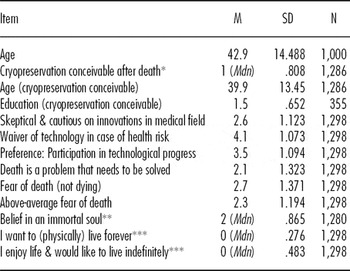
At first we started exploratively, which is why we mainly used descriptive methods (see Table 1 for descriptives). One reason is that Rievman did not secure her results with inferential statistics, even though they were frequently and nonreflective adopted among experts. All analyses were calculated by means of PASW Statistics 18.
Descriptives

Note. The variable age is unweighted. All other factors are weighted to compensate the effects of an online survey.
* 1 = no.
** 2 = don't know.
*** 0 = don't know.
RESULTS
Awareness of Cryonics
Following a short definition of cryonics, the questionnaire enquired whether the respondents were aware of this practice (“Have you ever heard about this procedure?”). Of a total of 1,295 respondents approximately 47 percent (n = 610) have heard of this practice, another 48 percent stated that they were not aware of the process of cryonics (n = 618). Five percent (n = 67) answered with “don't know.” No effect existed between sexes.
The 610 persons who had already heard of cryonics were subsequently asked to state where they had become aware of this. The majority of respondents had heard about cryonics through TV and film (49 percent). Approximately one-fifth had been informed through print media and one-fifth through the Internet. An effect between the unexpectedly high level of awareness of cryonics and the online survey was statistically ruled out. It seems reasonable to suppose that interest in technical developments manifest itself in Internet usage and its relatively high level of information about cryonics. Social contacts such as friends, relatives, and colleagues accounted for just 6 percent of responses as a source of information about cryonics.
Cryonics as a Conceivable Application
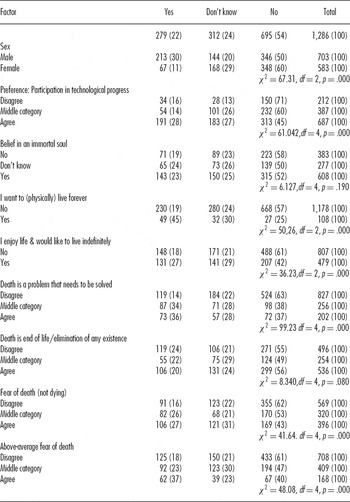
Twenty-two percent of respondents answered the question “Could you imagine having your body ‘cryonized’ immediately after your death?” with “yes” whereas 24 percent saw their own cryopreservation as inconceivable and a majority of 54 percent had no opinion (“don't know”).
It was not possible to establish a statistical relationship between the group of persons who had already heard of cryonics and those who would consider this process for themselves, r(1,293) = −.055, p = .049. On the contrary, a surprising finding was that, of the 279 persons who could imagine cryopreservation following their deaths, only 52 percent had heard about it before taking the survey. This result could be interpreted as an indication of the attractiveness of a process for overcoming biological death or as representing the lack of knowledge of the procedure itself.
Only 11 percent of the women as against a much higher 30 percent of the men could conceive cryopreservation for themselves, χ2(2, N = 1,286) = 67.31, p = .000. The average age of these persons was 39.9 years what indicated a dispersed distribution of age. A further accumulation of cryonics endorsers appeared in the age group between 55 and 58 years. In contrast to Rievman's findings that academics represent the highest proportion (35 percent had a master's degree or higher) among cryonicists, in our study the lowest approval toward cryopreservation (17 percent) within the feature education was found amongst persons with an academic qualification, χ2(4, N = 1,250) = 9.39, p = .052. We identified persons with formal education to have the highest approval rate toward cryopreservation.
Persons who could conceive cryopreservation following their deaths had on average an annual household net income of between EUR 20,000 and 30,0000 at their disposal and were thus in the category of average earners, χ2(6, N = 927) = 23.80, p = .001. This is a clear deviation to Rievman's study which recognized that it was precisely better-educated citizens who were cryonicists.
Attitudes Toward (Medical) Technology
A further block of questions focused on the respondents’ relationship to health, technology and aspects of its use. At the time of the survey, 74 percent of the respondents (n = 789) stated that they were without any health problems or had a minor illness at that particular time.
On a 5-point scale, 50 percent of respondents were not “skeptical and cautious about innovations in the medical field,” only 20 percent were concerned. A large amount of 73 percent stated that they “would not use certain modern technologies if it were established that their use could risk [their] health.” A high value was placed on participation in the latest technological developments (“It is important for me to make use of new technological developments“) by 53 percent of respondents on a 5-point scale. Only this factor did correlate with the target variable “cryopreservation conceivable” (r(1,336) = .214, p = .000). The other two statements had no statistical correlation.
Views on Death and Their Impact on Cryonics
Concerning the topic area “death” only three variables of eight revealed a harmonious image, however, according to our calculations it did not refer to cryonics: (i) death as a solvable problem, (ii) fear of death—not of dying, (iii) an above-average fear of death.
Sixteen percent of respondents regarded death as “a problem that needs to be solved,” 31 percent of participants were “frightened of death—not of dying,” and another 13 percent believed that they had an above-average fear of death. These statements on death are subsumed in Tables 2 and 3.
Degree of Cryopreservation Conceivable after Death
Note. Numbers: quantity of answers (percentages are given in parentheses).
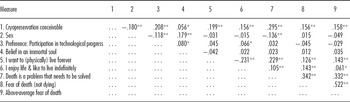
Correlations: Attitudes toward Death and Life

* Correlation significant significance level 0.05 (two-tailed).
** Correlation significant on significance level 0.01 (two-tailed).
This impression of a relatively high acceptance of death as part of the human condition was reaffirmed by the concrete question of how often persons thought about death. Overall, the large majority of 81 percent of participants in the study thought at least rarely or occasionally about death. For none of these variables, a statistical relationship with the idea of having oneself cryonized could be established, which is displayed in table 3. Even so it is worth mentioning that the assessment of “death as a problem that needs to be solved” and the statement “death (not dying) frightens me” are slightly significant with each other, fear of death: r(1,296) = .342, p = .000; above-average fear of death: r(1,296) = .332, p = .000.
Attitude toward Life
A further initial hypothesis was that persons with certain attitudes to life and death would be more willing to consider cryopreservation for themselves. Among these attitudes were, for example, a belief in an immortal soul, fear of death, or the idea that death is the ultimate end of any kind of existence.
Forty-eight percent of the respondents believed in the existence of an immortal soul and another 22 percent did not reject this notion altogether. As expected, it was not possible to detect a statistical relationship with the idea of their own cryopreservation here, r(1,265) = .056, p = .046. The fact that 69 percent of respondents were not afraid of death shows a relatively high acceptance of death as a biological finality inseparably linked to life.
The statement “Imagine you were free of medical complaints. Please indicate which of the following statements best expresses your attitude toward life under these circumstances” was answered by 8 percent of respondents with the option “I want to live forever,” referring to physical life and not an eventual afterlife. Another 37 percent responded that they enjoyed life and would like to live indefinitely. Between these attitudes toward life and the willingness for cryopreservation there was no verifiable statistical correlation. Table 3 presents these findings.
DISCUSSION
The representative population survey illustrates that nearly half of the respondents (47 percent) are aware of the rare practice of cryonics and that this knowledge is sourced particularly from the traditional mass media. Remarkably, around one quarter (22 percent) of all the German citizens interviewed could imagine having their bodies cryonized after death. The “typical” German who favors cryonics and cryopreservation is male, has an average age of 39.9 years, is an average earner, and accepts new technological developments. Moreover, the fear of death is relatively high (37 percent) but actual physical immortality was rejected by a large majority of the respondents (92 percent).
The level of knowledge ascertained and the positive attitude toward cryonics found in some cases are surprising in light of the fact that no significant cryonics movement exists or has existed in Germany. There are only approximately 40 organized cryonicists in Germany (Reference Koch16;Reference Venn17). Given that cryonics is viewed positively, a greater number of supporters and members in Germany might have been expected.
Cryonics is frequently featured in modern popular culture which may have had an affirming influence on the agreement rate for cryopreservation—a situation which may disguise the fact that, even optimistically interpreted, cryonics is at best at the experimental stage. It was not possible to eliminate this conceivable effect even with a brief definition placed at the beginning of the questionnaire. The same holds true for the fact that, while the description states that cryonics is “provided,” it does not discuss the quality, availability and extent of what is provided. Neither was it possible to state that there still is a legal obligation to bury or cremate dead bodies in Germany (18), a circumstance that prohibits the storage of dead bodies and therefore prevents cryonics from being introduced into Germany.
Contextually, it must be stressed that although the method of cryopreservation has existed for four decades, only few people opt for it. The 250 cryonized people in storages in the United States represent a vanishingly small number compared with a total of 2.5 million deaths per year in this country (effective: 2011 (Reference Hoyer and Xu19)).
In contrast, 54 percent rejected cryopreservation completely, 24 percent are indecisive. The attitude considering cryopreservation might be explained by the fact that Germans still tend to favor a more “traditional” handling of dead bodies despite the increasing plurality of types of funeral (Reference Gernig, Gross, Tag and Schweikardt20).
To interpret the 22 percent agreement rate with cryopreservation, it must first be noted that those respondents who did not know of cryonics beforehand also answered these questions only with the knowledge which had been given in the brief definition. The question as to whether the participants in the study could “imagine” the cryopreservation of their own bodies also leaves room for interpretation. On the one hand, the question can include an implication as to whether the respondents consider the technology to be feasible at all and, on the other hand, whether they could consider deciding in favor of it. Nevertheless this agreement ties in well with the result whereby over half of the respondents were open to medical innovations and want to participate in technological developments—a point which is of particular interest in light of the fact that, according to Rievman, cryonicists are to be viewed as a group which is primarily “a temporal and technological phenomenon” (Reference Rievman10:Reference Krüger, Gross, Tag and Schweikardt1). Furthermore, nearly half of the respondents (39 percent) who could imagine cryopreservation had heard of cryonics for the first time through our study. This could be an indication of the attractiveness of a process which offers a chance to overcome biological death. Another possible reason for the surprisingly high approval of this technology might be that the purposely short definition lacked detailed information on physical interventions which are necessary for the procedure (such as beheading, blood replacement, etc.). Also, the costs of a “cold sleep” are considerable, which could explain why Rievman identified cryonicists as “higher earners” in her study; in Germany, middle-income earners were able to envisage cryopreservation more readily. The financial aspect could not be assumed to be known to the respondents in any way. The safe-keeping of the bodies ranges from US$ 10,000 to US$ 200,000 in the case of some providers, with additional annual fees of up to US$ 620 (8). Whether the lack of information given on these circumstances and the fact that their problematic nature was not explained had an influence on the respondents’ openness to cryonics is a question that must remain unanswered.
As cryopreservation aims to overcome human illnesses, and, ultimately, death as an irreversible event, giving people control over the length of their lives, scientific investigation of cryonics inevitably raises questions regarding views of death and attitudes to life, dying, and death among the respondents. The fact that 69 percent of respondents are not afraid of death shows a relatively high acceptance of death as a biological finality inseparably linked to life. Actual physical immortality was rejected by 92 percent. One reason for this could be the close relationship between death and the central belief in eternal life after death and resurrection which is influenced by religion: Forty-eight percent believed in the immortality of the soul and another 22 percent did not reject this notion altogether. This expressed a religiously or spiritually-influenced interpretation of death—irrespective of all tendencies toward secularization. For the majority of the respondents, the technology of cryonics is not a realistically available and acceptable way of prolonging life resp. avoiding death. If thoughts go beyond death, they do not for the most part refer to the earthly body, but to the belief in a spiritual post-mortal continued existence. In this way the absoluteness of death as an existential event is denied.
CONCLUSIONS
The present study shows that, irrespective of its disputed scientific status, cryonics is not perceived as an oddity or mere marginal phenomenon by the German population and that this holds true across all social strata. Half of the respondents in Germany are familiar with the process of cryonics and more than one fifth can imagine having their own dead bodies cryonized—an amount which is significantly higher than previous publications on the subject would have led us to expect. Nevertheless this result is to be treated with caution due to the low-detail definition. A further study that addresses the physical and financial aspects as well as the success rate of this technology more profoundly is advised. Notwithstanding this, a large number of the respondents regarded a technological overcoming of death as unattainable or fundamentally rejected post-mortal continued existence as an option.
SUPPLEMENTARY MATERIALS
Supplementary Appendix: http://dx.doi.org/10.1017/S0266462313000718
CONTACT INFORMATION
Stephanie Kaiser, MA (skaiser@ukaachen.de), Institute of History, Theory and Ethics in Medicine, Medical School, RWTH Aachen University, Aachen, Germany
Dominik Gross, MD, DMD, PhD, Head of the Institute of History, Theory and Ethics in Medicine, Medical School, RWTH Aachen University, Aachen, Germany
Jens Lohmeier, MA, Institute of History, Theory and Ethics in Medicine, Medical School, RWTH Aachen University, Aachen, Germany
Jürgen Raschke, Harris Interactive AG, Hamburg, Germany
Michael Rosentreter, MA, Institute of History, Theory and Ethics in Medicine, Medical School, RWTH Aachen University, Aachen, Germany
CONFLICT OF INTEREST
Jürgen Raschke has received fees for participation in review activities from Harris Interactive AG. Raschke is an employee at Harris Interactive. He was responsible for the execution of the survey. The other authors report they have no potential conflicts of interest.