Introduction
Tympanosclerosis is a disease affecting the middle ear and the tympanic membrane. Histologically, it is characterised by decreased vascularisation and cell proliferation, along with progressive fibroblast infiltration into connective tissue and associated cartilage, and formation of a bone-like substance secondary to increased collagen fibrils and calcium deposition.Reference Sorensen and True1 Although tympanosclerosis can generally be easily differentiated from other middle-ear pathologies, its clinical course, histology and pathological outcome are not yet clearly understood.Reference Teufert and de la Cruz2 However, there is consensus that tympanosclerosis is an irreversible, non-specific pathology which results in chronic inflammation and infection of the middle ear.Reference Teufert and de la Cruz2, Reference Ozcan, Selcuk, Ozcan, Akdogan, Giray and Dere3
Nevertheless, as the cause of the disease is not clear, methods of prevention and surgical treatment are topics of debate.
Helicobacter pylori is a microaerophilic, Gram-negative, spiral bacterium which often infects humans.Reference de Carvalho Leal, Ferreira Bento, da Silva Caldas Neto, Caldas, Alves Peixoto and Delgado Lessa4 It normally lives on the gastric mucosal surface. The presence of this micro-organism is frequently related to chronic gastritis, gastric and duodenal ulceration, and gastric carcinoma.Reference Koc and Uneri5 The human stomach was previously considered the only reservoir for this bacterial species, until it was discovered in human dental plaque, oral lesions, saliva and faeces.Reference de Carvalho Leal, Ferreira Bento, da Silva Caldas Neto, Caldas, Alves Peixoto and Delgado Lessa4 Normally, the bacterium is carried to the upper respiratory tract via gastroesophageal reflux.
The relationship between H pylori, gastroesophageal reflux disease and chronic otitis media has not yet been clearly identified.Reference Kutluhan, Yurttas, Akarca, Aydin, Tuncer and Uğraş6, Reference Dagli, Eryilmaz, Uzun, Kayhan and Karabulut7 The present study is the first to investigate the relationship between H pylori and tympanosclerosis.
Materials and methods
The present study included 40 patients who presented to our clinic with hearing loss and ear discharge, and for whom surgery was planned. During medical history-taking, all patients were questioned about the symptoms of classic gastroesophageal reflux disease (e.g. reflux, heartburn and regurgitation). Patients were also questioned about ear symptoms, including the presence and frequency of ear discharge. A complete physical examination was also performed.
Following this, patients underwent either myringoplasty, tympanoplasty or radical mastoidectomy, under general anaesthesia, depending on their ear pathology. During surgery, the condition of the middle-ear mucosa was recorded, categorised as either normal, sclerotic and hyalinised, polypoid or cholesteatoma. Biopsies (2 mm in diameter) were then taken from the middle-ear mucosa and any tympanosclerotic plaque. Following the operation, biopsy material was transported in a sterile sponge and washed with saline. It was then placed in CLO test material (Bollard Medical Products, Draper, Utah, USA).
The CLO test material was kept at room temperature, and read at 1, 3 and 24 hours. After 24 hours, yellow colouration of test material was recorded as negative, while red or orange colouration was recorded as positive.
Statistical analysis
Data were analysed using the Statistical Package for the Social Sciences version 13.0 for Windows software program. The chi-square test and Mann–Whitney U test were used for evaluations. A p value of less than 0.05 was considered statistically significant.
Results
A total of 40 patients (23 women and 17 men) were included in the study. The mean patient age, ± standard deviation, was 36 ± 1.16 years. Only three patients had a medical history of gastroesophageal reflux. Eleven patients had no ear discharge, while 16 (40 per cent) complained of intermittent discharge (i.e. three to four times a year) and 13 (32.5 per cent) complained of continuous discharge.
On physical examination, 33 patients (82.5 per cent) had a perforated tympanic membrane. The remaining seven patients had advanced tympanic membrane retraction.
Myringoplasty was performed on three patients (7.5 per cent), tympanoplasty on 29 (72.5 per cent) and radical mastoidectomy on eight (20 per cent).
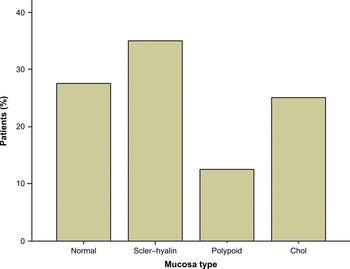
Figure 1 shows the peri-operative condition of the patients' middle-ear mucosa.
Distribution of patients according to their middle-ear mucosa type. Scler–hyalin = sclerotic and hyalinised; chol = cholesteatoma

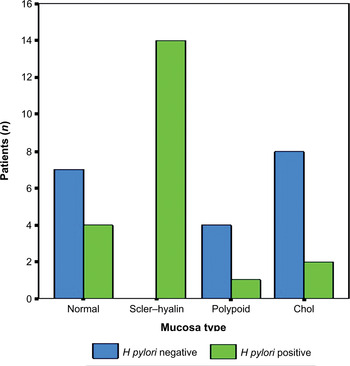
CLO testing for H pylori was positive in all 14 patients (100 per cent) with tympanosclerosis, but in only seven (26.9 per cent) of the 26 patients with other types of chronic otitis media; this difference was strongly significant (p ≤ 0.001) (Figure 2). The latter 26 patients' middle-ear mucosa was either normal, oedematous-polypoid or cholesteatomatous.
Helicobacter pylori positivity in patients with different types of middle-ear mucosa. Scler–hyalin = sclerotic and hyalinised; chol = cholesteatoma

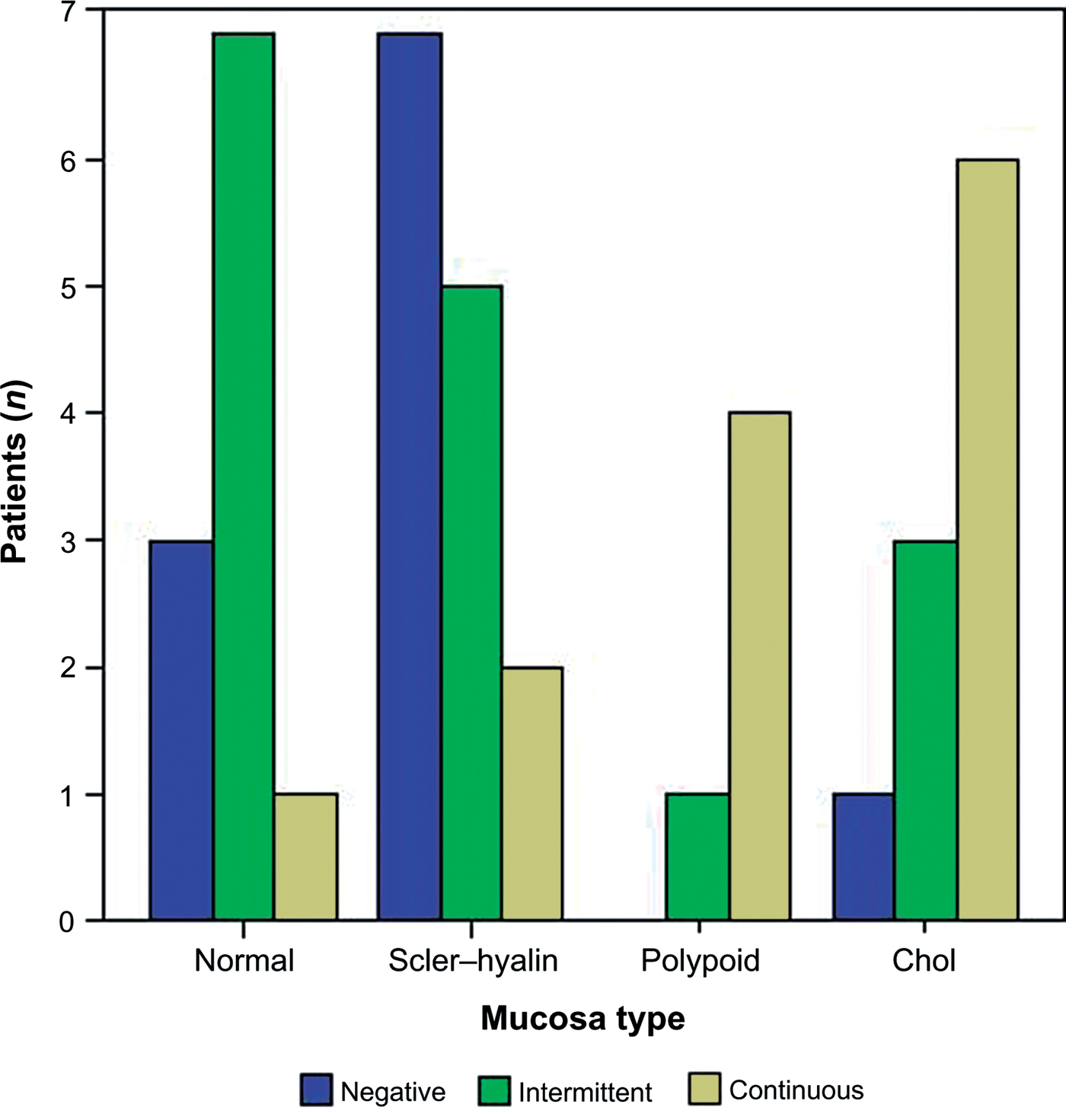
The presence of H pylori was not significantly related to the frequency of ear discharge, the condition of the tympanic membrane or the patient's gender (p ≥ 0.05). Likewise, there was no statistically significant relationship between the frequency of ear discharge and the condition of the middle-ear mucosa (Figure 3).
The relationship between ear discharge frequency and middle-ear mucosa type. Scler–hyalin = sclerotic and hyalinised; chol = cholesteatoma
Discussion
Tympanosclerosis is characterised histologically by hyaline degeneration in the middle ear and mastoid mucosa. Its aetiology has not yet been clarified.Reference Koc and Uneri5 Various factors have been suggested as the cause of this mucosal reaction, including myringoplasty incisions, ventilation tube practices, infection, physical trauma, various chemical agents, autoimmunity and local metabolic changes.Reference Ozcan, Selcuk, Ozcan, Akdogan, Giray and Dere3, Reference Koc and Uneri5, Reference Gibb and Pang8, Reference Mattsson, Magnuson and Hellström9
Although tympanosclerosis and atherosclerosis are recognised as distinct pathological entities, they share similar physiopathological and histopathological elements. A genetic aetiology has been suggested for both conditions.Reference Koc and Uneri5 Previous studies have investigated the role of H pylori in the aetiology of atherosclerosis; however, the present study is the first to investigate its role in the aetiology of tympanosclerosis.
Some authors believe that tympanosclerosis represents the last phase of chronic and recurrent middle-ear infections.Reference de Carvalho Leal, Ferreira Bento, da Silva Caldas Neto, Caldas, Alves Peixoto and Delgado Lessa4, Reference Koc and Uneri10 The incidence of tympanosclerosis following otitis media is 20–43 per cent.Reference Forséni, Bagger-Sjöbäck and Hultcrantz11–Reference Tasker, Dettmar, Panetti, Koufman, Birchall and Pearson13 Bhaya et al. have suggested that tympanosclerosis develops following chronic otitis media, serous otitis media and acute otitis media, with an incidence of 24, 16 and 5 per cent, respectively.Reference Bhaya, Scharchern, Morizono and Paperella14 However, it is not known why the condition develops following some chronic otitis media cases but not others. Because of this question, we used patients with chronic otitis media but no tympanosclerosis as the control group of our study.
The consensus in the literature is that tympanosclerosis is an irreversible and non-specific condition which develops as a result of chronic infection or inflammation of the middle ear.Reference Teufert and de la Cruz2, Reference Forséni, Eriksson, Bagger-Sjöbäck, Nilsson and Hultcrantz15 A study of 203 cases of tympanosclerosis found that it involved the tympanic membrane, middle ear and ossicular chain in 45, 8 and 66 per cent of cases, respectively.Reference Teufert and de la Cruz2 Hearing changes have been reported, in accordance with ossicular chain involvement.Reference Teufert and de la Cruz2, Reference Forséni, Bagger-Sjöbäck and Hultcrantz11, Reference Forséni, Eriksson, Bagger-Sjöbäck, Nilsson and Hultcrantz15 Tympanosclerosis can also involve the otic capsule, with advanced hearing loss. Surgery is not always successful, and recurrence is common.Reference Teufert and de la Cruz2, Reference Forséni, Bagger-Sjöbäck and Hultcrantz11
• This study investigated the relationship between Helicobacter pylori and tympanosclerosis
• The association between chronic H pylori infection and various types of pathology has recently been much discussed
• Helicobacter pylori could play a role in the aetiopathogenesis of tympanosclerosis
Helicobacter pylori has been the most commonly discussed chronic human bacterial infection of recent years.Reference Thomas, Gibson, Darboe, Dale and Weaver16 Initially, the human stomach was thought to be the only H pylori reservoir, until the bacterium was discovered in human dental plaque, oral lesions, saliva and faeces.Reference de Carvalho Leal, Ferreira Bento, da Silva Caldas Neto, Caldas, Alves Peixoto and Delgado Lessa4, Reference Kutluhan, Yurttas, Akarca, Aydin, Tuncer and Uğraş6
In the literature, gastroesophageal reflux has been suggested as an inflammatory cofactor and a possible cause for most adult and paediatric upper respiratory tract disorders.Reference Tasker, Dettmar, Panetti, Koufman, Birchall and Pearson13, Reference White, Heavner, Hardy and Prazma17 Some studies have suggested gastroesophageal reflux as an aetiological factor in otitis media with effusion.Reference Tasker, Dettmar, Panetti, Koufman, Birchall and Pearson13 Furthermore, CLO testing has found significant H pylori positivity in adenotonsillar tissue.Reference Teufert and de la Cruz2, Reference Unver, Kubilay, Sezen and Coskuner18 CLO testing has also shown significant H pylori positivity in the effusion fluid and adenotonsillar tissue of children with otitis media with effusion.Reference Yilmaz, Aktepe, Cetinkol and Altuntas19 Ozdek et al. detected H pylori in the sinonasal discharge of patients with chronic rhinosinusitis, and suggested that anti-reflux treatment should be added to the treatment of rhinosinusitis.Reference Ozdek, Cirak, Samim, Bayiz, Safak and Turet20
There are also studies suggesting H pylori in the aetiology of chronic otitis media.Reference Kutluhan, Yurttas, Akarca, Aydin, Tuncer and Uğraş6, Reference Dagli, Eryilmaz, Uzun, Kayhan and Karabulut7
The CLO test is supplied as a kit, and detects the urease enzyme of H pylori. The test has a high sensitivity and specificity for H pylori detection; one study found a specificity of 97 per cent and a sensitivity of 98 per cent. This same study found a sensitivity of 100 per cent and sensitivity of 70 per cent for histological diagnosis and culture combined.Reference Dye, Marshall, Frierson, Barrett, Guerrant and McCallum21
Conclusion
Our study findings suggest that H pylori could play a role in the aetiology of tympanosclerosis, a condition of uncertain aetiology.
We compared the condition of the eardrum and the type of discharge with the presence of H pylori, but found no significant association. However, we also investigated the presence of H pylori in the middle-ear mucosa, using the CLO test, and found a significantly higher level of H pylori positivity in ears with tympanosclerosis, compared with ears with other forms of chronic otitis media (which showed normal, oedematous, polypoid or cholesteatomatous mucosa) (p ≤ 0.01).
This study represents a preliminary investigation, with a limited number of cases. Future studies performed on large patient series will further elucidate the role of H pylori in the aetiopathogenesis of tympanosclerosis.