Introduction
Several studies have assessed the extent to which the provision of daily personal care to frail older parents conflicts with paid work in mid-life. Daily personal care refers to help with the activities of daily living (ADL) such as bathing, dressing, toileting and feeding. Despite contradictory findings (Dautzenberg et al. Reference Dautzenberg, Diederiks, Philipsen, Stevens, Tan and Vernooij-Dassen2000; Moen, Robinson and Fields Reference Moen, Robinson and Fields1994; Wolf and Soldo Reference Wolf and Soldo1994), there is convincing evidence that women's provision of parent-care is a barrier to their labour market involvement (Ettner Reference Ettner1995; Henz Reference Henz2004; Pavalko and Artis Reference Pavalko and Artis1997; Spiess and Schneider Reference Spiess and Schneider2003). Moreover, aggregate European data also suggest that working women are less likely to take up daily care-giving than non-working women (Ogg and Renaut Reference Ogg and Renaut2006), which has not been found in the United States of America (USA) and Canada (Barnes, Given and Given Reference Barnes, Given and Given1995; Moen, Robinson and Fields Reference Moen, Robinson and Fields1994; Pavalko and Artis Reference Pavalko and Artis1997).
There have been many studies of the trade-off between parent-care and paid-work in the USA, a country with limited public provision of care and assistance for frail older people (cf. Spiess and Schneider Reference Spiess and Schneider2003), and where the majority of older people with care needs rely primarily on informal carers, not publicly-provided services (Tennstedt Reference Tennstedt1999). A comparative study among European countries suggested that in those with limited public elder-care provision, such as Spain and Italy, middle-aged adults provide more daily personal care but less practical help with household tasks and paperwork than their equivalents in countries with more extensive public elder-care, such as Sweden, Denmark and The Netherlands (Ogg and Renaut Reference Ogg and Renaut2006). Furthermore, the percentage of middle-aged adults that provide any help to their elderly parents tends to be higher in European countries with relatively extensive welfare-state provision (Ogg and Renaut Reference Ogg and Renaut2006). These findings align with the growing consensus that state-provided care for dependent older people supplements rather than ‘crowds out’ family help, because it enables family members to focus on instrumental support, such as housework, transport, paperwork and accompanying the relative on visits to doctors and clinics, instead of providing daily personal care (Albertini, Kohli and Vogel Reference Albertini, Kohli and Vogel2007; Attias-Donfut, Ogg and Wolff Reference Attias-Donfut, Ogg and Wolff2005; Bettio and Plantenga Reference Bettio and Plantenga2004; Künemund and Rein Reference Künemund and Rein1999; Motel-Klingebiel, Tesch-Roemer and von Kondratowitz Reference Motel-Klingebiel, Tesch-Roemer and von Kondratowitz2005; Ogg and Renaut Reference Ogg and Renaut2006).
Against this background, this article examines the factors that influence the provision of instrumental support to parents by middle-aged women and men in the relatively generous welfare state of The Netherlands. We define instrumental support as help with the instrumental activities of daily living (IADL), such as routine housework, maintenance and yard work, errands, transport and paperwork. We focus on instrumental support rather than personal care because previous research suggests that in relatively generous welfare states, middle-aged adults provide this kind of support most often. Another reason is that older people are likely to need instrumental support from an earlier age than personal care, and therefore for a longer period. Most older people do not suffer from severe functional limitations, as these tend to be concentrated among those aged 85 or more years (Lafortune and Balestat Reference Lafortune and Balestat2007; Nusselder et al. Reference Nusselder, Looman, Franco, Peeters, Slingerland and Mackenbach2008; Perenboom Reference Perenboom2005). In The Netherlands, men spend more than 95 per cent of their life after reaching 65 years of age without moderate to severe health problems, and among women the equivalent percentage is 93 (Perenboom Reference Perenboom2005).
More specifically, the article examines the interdependence between the work hours of midlife men and women and their provision of instrumental support to older parents. Our aim is to make three contributions to the literature. Firstly, we focus on the relationship between work hours and the provision of parent-support in the context of extensive publicly-provided elder care. Secondly, we estimate a simultaneous model that takes into account the inter-dependency between work hours and the provision of parent-support. Neoclassical micro-economic reasoning suggests that the amount of time spent on paid work influences and is influenced by the time spent on parent-support, rather than the causation being in one direction (Ettner Reference Ettner1995; Johnson and Lo Sasso Reference Johnson and Lo Sasso2000). Thirdly, we explore the interdependencies between the activities of individuals, partners and co-resident children. The predominant household arrangement in mid-life is to live with a partner and one or more children, followed by living with a partner (Agree, Bissett and Rendall Reference Agree, Bissett and Rendall2003; Fields Reference Fields2003; Fokkema and Liefbroer Reference Fokkema and Liefbroer2008; Statistics Netherlands 2008; US Census Bureau 2006, 2008). In The Netherlands, 34 per cent of men and women between the ages of 40 and 60 years live with a partner, and 44 per cent live with a partner and children (Statistics Netherlands 2008, authors' calculation). Help provided to parents is best conceived as an integral part of the intra-household division of labour (Hook Reference Hook2004; Szinovacz and Davey Reference Szinovacz and Davey2008), rather than assuming that individuals reconcile paid work and parent-support independently or in isolation from other household members. On the one hand, the presence of partners and co-resident children can free middle-aged men and women from household obligations and the need to earn an income, but on the other hand, partners and children make demands on their time and energy.
Two research questions are addressed: ‘to what extent are midlife adults’ work hours and provision of parent-support inter-related?' and ‘to what extent do work hours and the provision of parent-support depend on the partner's involvement in paid work, housework, support to partner's parents and relative income, and on the presence and age of children and co-resident children's help with housework?’ We analyse data from the first wave of the Netherlands Kinship Panel Study collected during 2002–2004 (Dykstra et al. Reference Dykstra, Kalmijn, Knijn, Komter, Liefbroer and Mulder2005) for 779 women and men aged 40–64 years that were in dual-worker couples and who had at least one living biological parent.
Literature review
Time-budget constraints and conflicts
According to the precepts of the micro-economic theory commonly referred to as the ‘new home economics’ (NHE) (Becker Reference Becker1965; Gronau Reference Gronau1980; Kooreman and Wunderink Reference Kooreman and Wunderink1996), individual time expenditures on paid labour, unpaid labour and leisure are inter-related. Because a day has only 24 hours, people have to prioritise their activities, so when deciding how to use their time, people as rational economic actors devote most time to those activities that yield the highest utility. They weigh and balance the rewards gained from paid labour, unpaid labour and leisure, as well as the costs of forgoing these activities. With regard to unpaid labour, NHE theory focuses on housework and child-care, forms of unpaid labour that are referred to as home production. Several studies of time-use in families with young children have generated empirical evidence of the interdependencies among individuals' time expenditures on different activities. It has been shown that full-time employment conflicts with housework and child-care, and that because mothers with young children invest substantially more time in unpaid labour than fathers, housework and child-care are particular barriers to women's labour market involvement (Adema Reference Adema2002; Gjerdingen and Center Reference Gjerdingen and Center2005; Gupta Reference Gupta2006; Maume Reference Maume2006; Powers Reference Powers2003; Sanchez and Thomson Reference Sanchez and Thomson1997; Shelton and John Reference Shelton and John1996).
From this perspective, the provision of parent-support in mid-life is likely to be inter-related with being engaged in paid work and parenting children (Johnson and Lo Sasso Reference Johnson and Lo Sasso2000; Spiess and Schneider Reference Spiess and Schneider2003). A qualitative study in The Netherlands suggested that the provision of parent-support can reduce or stop the providers' paid work (Van Doorne-Huiskes et al. Reference Van Doorne-Huiskes, Dykstra, Nievers, Oppelaar and Schippers2002). An example of how supporting parents can interfere with paid work is when support-providers need to accompany a parent to and from a doctor's visit during office hours. It has also been found that providing parent-support increases stress and fatigue, especially when support-providers monitor and co-ordinate the help provided by others, including professional care-givers. Such adverse consequences for the wellbeing of support-providers are likely to influence their performance at work and may result in a decision to reduce work hours. Drawing on the micro-economic understanding of time-budget trade-offs, the following hypothesis was formulated:
H1: The more hours that men and women work, the less likely they are to provide parent-support, and those that provide parent-support are likely to work fewer hours.
Interdependencies between household members
Extending the propositions of NHE theory, one can also argue that partners' individual time budgets are inter-related. For example, time spent on paid labour by one partner provides household income that benefits the entire household, just as household production such as house cleaning or preparing a meal benefits all. To understand the time expenditures of individuals in partner-relationships, we need to take into account not only the individual's activities but also those of the partner. Because the extension of the NHE approach to analyses of the help provided to parents in mid-life is relatively new, however, there is little empirical material on the role of the partner's activities in the individual's reconciliation of paid work and parent-support. A recent US study has suggested that the division of paid work between partners influences their division of parent-care (Szinovacz and Davey Reference Szinovacz and Davey2008), and found that, the more hours their spouses worked, men contributed more time to parent-care, and their spouses less. The same was found when spouses were employed and the men were not. Although the authors did not interpret this finding, it seems to suggest that when women are less available as care-givers, men are more likely to engage in care-giving. Moreover, studies of the division of labour among couples with young children have provided ample evidence of the interdependencies among partners' contributions to paid work, housework and child-care. In couples where women work (near) full-time or on weekend and night shifts, men tend to do more housework and spend more time with their children (Coltrane and Ishii-Kuntz Reference Coltrane and Ishii-Kuntz1992; Presser Reference Presser1994). Men also contribute more to housework the more hours that their partners work (Cunningham Reference Cunningham2007).
Yet it has also been reported that in couples where both members work full-time, women adapt their work efforts to their spouse's characteristics and the needs of their children, whereas men do not (Maume Reference Maume2006). Women more often than men worked fewer hours per week, rearranged their work schedule, refused overtime or extra hours, refused to travel, and turned down promotion and interesting work assignments when they had more and younger children, and had husbands with higher educational attainment and work hours or who were professionals or managers. This suggests that the interdependencies within couples are gendered (cf. Brines Reference Brines1994). Based on the NHE notion of interdependence among the activities of household members because of time constraints, and based on the reviewed literature on the division of labour in couples with young children, a second hypothesis about the impact of the partner's activities on individuals' work hours and provision of parent-support was formulated:
H2: Individuals are likely to work more hours and to provide parent-support the more they are freed from household obligations by their partner's contributions to housework, whereas the more they have household obligations because of their partner's involvement in paid work and support-provision to the partner's parent(s), the fewer hours they will work and the lower the likelihood that they provide parent-support.
Co-resident children can be brought into a household's time-budget interdependencies. Given that the co-resident children of midlife adults tend to be in their teens, most are capable of domestic tasks. Several studies have suggested that co-resident children help with housework (Antill et al. Reference Antill, Goodnow, Russell and Cotton1996; Bianchi and Robinson Reference Bianchi and Robinson1997; Cogle and Tasker Reference Cogle and Tasker1982; Gager, Cooney and Call Reference Gager, Cooney and Call1999; White and Brinkerhoff Reference White and Brinkerhoff1981). Daughters generally take on more routine housework such as cooking and cleaning, and sons perform more occasional housework such as maintenance and yard work (Blair Reference Blair1992; Denuwelaere Reference Denuwelaere2003; Evertsson Reference Evertsson2006; Manke et al. Reference Manke, Seery, Crouter and McHale1994). There is little research on the relationship between children's help with housework and parents' allocation of time. One empirical study in the United Kingdom (UK) suggested that adult children help out with housework in ways that support their mothers' reconciliation of work and care (Henz Reference Henz2004). It found that women with co-resident adult children were more likely to report that care-giving did not affect their work arrangement. In the USA, Szinovacz and Davey (Reference Szinovacz and Davey2008) found that men contributed more to parent-care when they had a co-resident or nearby living daughter, and suggested that daughters in effect ‘pull’ their fathers into the care of grandparents but sons do not. An alternative perspective would be that daughters provide fathers with more time to support grandparents, as they free fathers from domestic tasks more than sons (cf. Henz Reference Henz2004). Although co-resident children may provide help with housework, their presence also involves time expenditures, given that housework and parenting duties (including shared leisure activities) increase with each additional child (Kurz Reference Kurz2002; Solomon et al. Reference Solomon, Warin, Lewis and Langford2002; Wang, Bianchi and Raley Reference Wang, Bianchi and Raley2005). Taking all this into account, a third hypothesis was formulated:
H3: Individuals are likely to work more hours and are more likely to provide parent-support when they are freed from household obligations by co-resident children's contributions to housework, and the more they are encumbered by housework, child-care and parenting (the load being related to the number of children and inversely to their age), the fewer hours they are likely to work and the less likely they are to provide parent-support.
We emphasise that the household help provided by co-resident children is unlikely to cause middle-aged men and women to engage in parent-support or to work more hours, but receiving such housework help from co-resident children may enable providers to continue to provide parent-support and to continue to work a certain number of hours rather than scale back.
Part-time work in The Netherlands and across Europe
According to Eurostat (2008), 75 per cent of employed women in The Netherlands work part-time and the number of hours worked varies considerably. Men's over-all part-time employment rate (24%) is also relatively high. This means that the Dutch population lends itself particularly well to a study of the relationships between the work hours of middle-aged women and their provision of parent-support. Scaling back work hours is likely to be a viable response to elder-support obligations in other European countries too. The overall part-time employment rate of 18 per cent in the 27 European Union countries is substantial, and female part-time employment rates in Switzerland, Germany, Sweden, Norway, Denmark, the UK, Austria, Belgium and Luxembourg range between 36 and 59 per cent (Eurostat 2008).
The sample
The analysis uses data from the first wave of the Netherlands Kinship Panel Study (NKPS public release file), a national survey on family relationships carried out between October 2002 and December 2004 (Dykstra et al. Reference Dykstra, Kalmijn, Knijn, Komter, Liefbroer and Mulder2005). The primary sample was of individuals living in private households in The Netherlands, and data were also collected from their partners. The overall response rate among the primary respondents was 45 per cent, which corresponds with the response rate for other large family surveys in The Netherlands such as the Family Survey of the Dutch Population and the Netherlands Family Survey (De Graaf et al. Reference De Graaf, De Graaf, Kraaykamp and Ultee1998, Reference De Graaf, De Graaf, Kraaykamp and Ultee2000, Reference De Graaf, De Graaf, Kraaykamp and Ultee2003; Ultee and Ganzeboom Reference Ultee and Ganzeboom1992). These relatively low response rates suggest that the Dutch are particularly sensitive about privacy issues (De Leeuw and De Heer Reference De Leeuw, De Heer, Groves, Dillman, Eltinge and Little2001).
The primary respondent data were collected through computer-assisted personal interviews (CAPI) and drop-off self-completion questionnaires (overall response rate 92%). All the variables in the presented multivariate analyses are CAPI-collected items except the partner's contribution to housework and the primary respondent's attitude scores for gender roles, work ethic and filial obligation, which were derived from the primary respondent's self-completion questionnaire (and defined later). We used the partners' responses to their self-completion questionnaires for measures of the partner's provision of instrumental support to partner's parents. Of the primary respondents eligible for our analyses, 79 per cent of the partners of female respondents and 86 per cent of the partners of male respondents provided valid responses on their provision of support to their own parents. Given that most of the missing responses arose from missing partners' questionnaires, we did not replace these missing values. The analysis sample comprised 779 respondents aged 40–64 years (357 men and 422 women) who lived with a working partner, had at least one living non-co-resident parent, were in paid work, and had valid observations on the partner's provision of support to his/her parents. Unlike most studies of parent-care and employment, we were able to include men in the analyses because of the relatively high percentage of male part-time workers (overall 24%).
We focused on the respondents in dual-worker couples for two reasons: the group is extraordinarily apposite for the study of time-budget constraints, given that they need to reconcile not just one person's paid work with other demands but the paid work of two partners; and to prevent biased estimates in the simultaneous regressions. If non-workers had been included, the distribution of work hours would be heavily left-skewed because of the many zeros for paid-work hours, especially among women, which would bias the estimates. Although estimating a tobit equation could solve this problem, we currently cannot simultaneously estimate a tobit model of work hours and a probit or logit model of support provision.Footnote 1 Alternatively, estimating a tobit and a probit or logit model separately would yield biased estimates because of endogeneity. Finally, we excluded one woman and three men from the analysis sample because they had outlier values that would have exercised a disproportional influence on the estimates.
Analytical design and methods
The adopted procedure was two-stage probit least-squares estimation for a continuous and a dichotomous dependent variable that simultaneously estimated work hours and parent-support while controlling for household context factors (cf. Amemiya Reference Amemiya1978; Keshk Reference Keshk2003; Maddala Reference Maddala1983). Such a simultaneous model is suitable for modelling the inter-relatedness or inter-dependency of paid work and the provision of parent-support because it allows the time spent on each activity to be both cause and consequence of the time spent on the other activity, instead of assuming that one causes the other (Ettner Reference Ettner1995; Johnson and Lo Sasso Reference Johnson and Lo Sasso2000). Given the gendered divisions in society regarding participation in paid work, housework and parent-support, we estimated separate models for men and women.
The measure of parent-support was a dichotomy, so a probit equation was used to estimate its provision and a least-squares regression equation to estimate work hours. This simultaneous model was estimated in two stages (cf. Amemiya Reference Amemiya1978; Keshk Reference Keshk2003; Maddala Reference Maddala1983). Both equations were estimated as reduced form models using only exogenous variables. At the second stage, structural form equations were estimated using the predicted values from the first-stage equations as independent variables. Finally, the standard errors of the final estimations were corrected for being based on the predicted values of the endogenous variables rather than observed values.Footnote 2 The estimated coefficients in the work-hours equation can be interpreted as unstandardised ordinary least-squares regression coefficients. Given the difficulties in deriving substantive conclusions from probit coefficients, following Long and Freese (Reference Long and Freese2006), where relevant we also present the changes in the predicted probabilities of providing parent-support.
The dependent variables
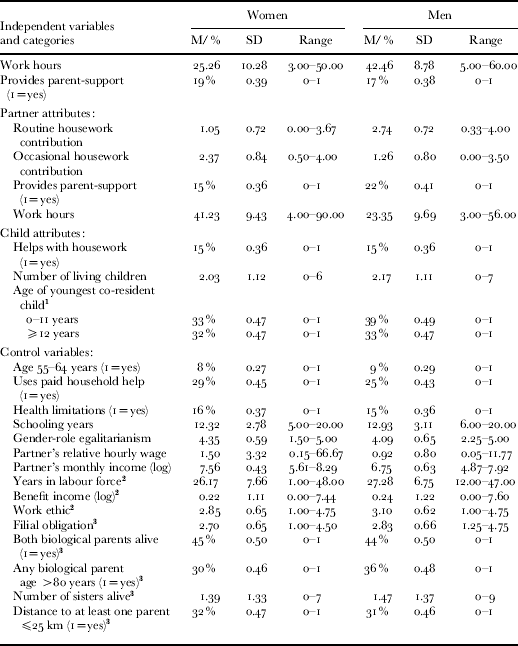
Table 1 presents the means, percentages, standard deviations and extreme values of all the variables used in the simultaneous model. The two dependent variables are work hours and parent-support. The number of work hours was based on two questions, namely: ‘Do you have paid work?’ and ‘How many hours do you actually work per week?’ We included the work hours of all respondents who had any paid work. To reduce the disproportional influence of six women and 24 men who worked between 60 and 80 hours, we constrained women's work hours to 50 and men's to 60. Given that previous studies have shown that men provide different kinds of parent-support than women (Horowitz Reference Horowitz1985; Stone, Cafferata and Sangl Reference Stone, Cafferata and Sangl1987), we included both help with routine types of parent-support, which can be regarded as stereotypically ‘female’, and help with occasional types of parent-support, which can be regarded as stereotypically ‘male’. Parent-support was based on the questions, ‘In the last three months, did you give help (name) with housework, such as with preparing meals, cleaning, fetching groceries, doing the laundry?’ and ‘In the last three months, did you give help (name) with such practical matters as repair work in and around the house, lending things, transport and moving things?’ The two questions were put separately to the mother and the father of the respondent, provided each parent was alive and not co-resident. The response categories were: ‘none’, ‘once or twice’ and ‘several times’. Parent-support (‘1’ yes) was indicated by the answer ‘several times’ to both questions with reference to at least one parent.
Characteristics of the sample of women and men aged 40–65 years, The Netherlands, 2002–04

Notes: All sample members were in paid work, lived with a working partner and had at least one living parent. Sample sizes: women 422, men 357. M/%: unweighted mean or percentage. SD: standard deviation. 1. Reference case, childless or without co-resident children. 2. Specific to the work hours equation. 3. Specific to the support equation.
Source of data: Netherlands Kinship Panel Study 2002–04; for details, see text.
The explanatory variables
The partner's contribution to housework was based on the responses to a question in the primary respondent's self-completion questionnaire, ‘How would you describe the division of household tasks between you and your partner? Please indicate for each of these tasks who usually does the following: preparing meals, fetching groceries, tidying and cleaning; paperwork, bills, accounts and finances; and odd jobs in and around the house’. Responses were organised by a five-category Likert scale that ranged from ‘always me’ to ‘always my partner’. The partner's contribution to routine housework reflected the mean sum-score for the partner's contributions to preparing meals, groceries and cleaning. The partner's contribution to occasional housework reflected the mean sum-score for the partner's contribution to paperwork and odd jobs in and around the house. The higher the scores on these two indicators, the larger the partner's contribution, with ‘0’ indicating that the respondent did all the housework and ‘4’ that the partner did everything. We replaced missing observations on these housework variables with the mean score for one of 18 groups differentiated by sex, age and level of education among 35 women and 24 men. Partners' work hours reflected the partner's actual (not contracted) work hours in paid jobs. This information was derived from the partner if (s)he was present during the primary respondent CAPI, otherwise from the primary respondent. Partner provided parent-support (‘1’ yes) was recorded when he or she reported in their self-completion questionnaire that they had helped at least one parent ‘several times’ during the past three months with housework and/or practical matters. The questions on which this information is based were phrased identically to those posed to the primary respondents. Child helps with housework (‘1’ yes) was an affirmative response to each of the three items of the question, ‘Has your oldest co-resident child helped you with the following household chores in the past week: washing the dishes, fetching the groceries, tidying up and cleaning?’ This question was directed only to respondents whose oldest child was aged six or more years. Respondents without children, without co-resident children or with younger co-resident children were assigned ‘0’ on this dummy variable. We also included the total number of biological, step- and adopted children, and two dummy indicators for the youngest co-resident child being less than 12 years old (‘1’ yes), or aged 12 or more years (‘1’ yes), with respondents without (co-resident) children as the reference category.
The control variables
In both equations we included one set of control variables that we expected to influence both work hours and support-provision. This set included older than 55 years (‘1’ yes), effective years of schooling, based on the respondent's highest-level diploma, employs domestic help (‘1’ yes) based on the question, ‘Do you pay someone to help you with certain household duties?’, health limitations (‘1’ yes), based on the question, ‘Are you restricted in your daily activities because of health deficiencies?’, and gender-role egalitarianism (women: Cronbach's α=0.75, men: α=0.71), based on four (reverse-coded) items about gender roles, such as ‘A woman should quit her job when she gives birth to children’, with a five-point Likert response scale. The higher the score on this scale, the more egalitarian were the respondent's attitudes towards gender roles. Missing observations for 12 women and nine men were replaced with stratified mean scores based on the respondent's sex, age and level of education. Furthermore, as indicators of the financial interdependencies within couples, we included the partner's relative wage, namely the partner's hourly wage divided by the respondent's hourly wage, and the partner's income, namely the partner's total net monthly income from paid work and social benefits, which was log-transformed to correct for a non-normal distribution. We replaced invalid ‘0’ values on the respondent's hourly wage among 11 female respondents and eight male respondents with a stratified group mean, depending on the respondent's affinity with 18 groups based on sex, age and level of education. We replaced missing and invalid ‘0’ values with a stratified group mean on the partner's hourly wage and total income among 53 female respondents and 40 male respondents in a similar fashion.
The work hours equation included as equation-specific controls: the number of years in the labour force as an indicator of labour-market attachment, the respondent's income from benefits, log-transformed to correct for non-normality, as a disincentive to work for pay, and work ethic, based on four Likert scale responses about work and duty (women: Cronbach's α=0.69, men: α=0.65), such as, ‘Work should always take first place, even if that means less leisure time’. The higher the score, the stronger was the respondent's work ethic. We replaced two missing observations on the benefit-income variable for female respondents and one for male respondents with stratified mean scores based on the respondent's sex, age and level of education. In a similar fashion, missing observations on the work-ethic variable were replaced for 12 female and nine male respondents.
In the parent-support equation we included as equation-specific controls: (a) two indicators of the presence of alternative support-providers: having two living biological parents (‘1’ yes) rather than one, and the number of living biological sisters; (b) a proxy for the help needed by parents, having at least one parent aged older than 80 years (‘1’ yes); and (c) a measure of sense of filial obligation (women: Cronbach's α=0.67, men: α=0.68), based on four Likert scaled items such as, ‘Children should take unpaid leave to take care of their ill parents’. The higher the score, the stronger was the respondent's sense of filial obligation. Missing observations for 11 women and eight men were replaced with stratified mean scores based on the respondent's sex, age and level of education. Finally, we controlled for living within 25 kilometres of at least one biological parent.
The descriptive results
Substantial minorities of both the men (17%) and the women (19%) in the dual-worker couples provided support to one or both biological parents (Table 1). Although a slightly higher percentage of women provided such support, the gender difference was small (it should be remembered that we consider only men and women with paid jobs). The gender difference in the prevalence of support provision among the respondents' partners was greater, with 22 per cent of the female partners of male respondents providing support to their own parents compared to 15 per cent of the male partners of female respondents. Women worked fewer hours on average than men, and more women than men had a full-time working partner. These gender differences are in line with recent figures for the Dutch labour market (Cuijpers, Hermans and Portegijs Reference Cuijpers, Hermans, Portegijs, Portegijs, Hermans and Lalta2006). Women and men reported receiving substantial help from their oldest co-resident child with equal frequency (15%). Both male and female support-providers worked fewer hours than their counterparts who did not provide support, but the differences were small and not statistically significant.Footnote 3
The multivariate results
Hypothesis 1: Interdependency between work hours and parent-support
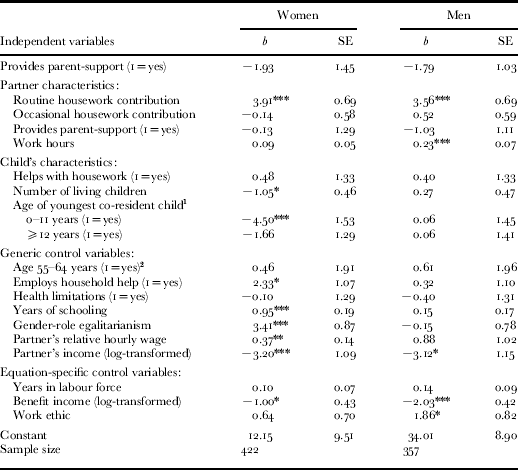
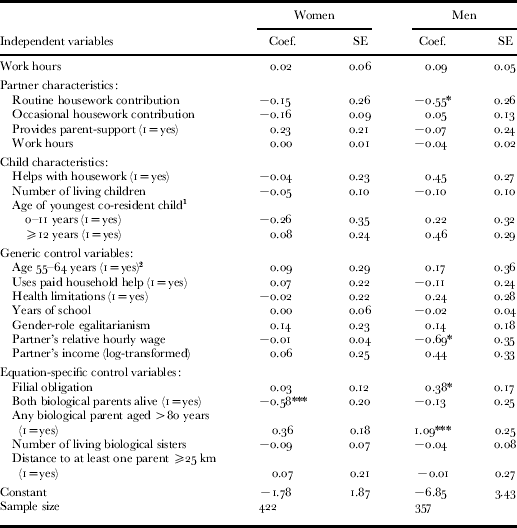
Contrary to the first hypothesis, the simultaneous model found no relationship between work hours and parent-support among either women or men (Tables 2 and 3). It indicates that parent-support had no impact on work hours, and that work hours had no impact on parent-support. This also applied to the baseline models without the household members' characteristics (results not shown).
Least-squares regression estimates of the work hours of men and women aged 40–65 years by whether or not they provided support to parents and selected characteristics of the partner, children and self, The Netherlands, 2002–04

Notes: The dependent variable is work hours per week. All sample members were in paid work, living with a working partner, and had at least one living parent. b: unstandardised regression coefficient from simultaneous two-stage probit least-squares model, to be interpreted as ordinary least-squares regression coefficient. SE: standard error. 1. Reference case: childless or without co-resident children. 2. Reference case: 40–54 years.
Source of data: Netherlands Kinship Panel Study 2002–04; for details, see text.
Significance levels: * p⩽0.05, ** p⩽0.01, *** p⩽0.001.
Probit coefficients for men and women aged 40–65 years of whether or not they provided support to parent(s) by paid work hours and selected characteristics of partner, children and self, The Netherlands, 2002–04

Notes: The dependent variable is provides parent support. All sample members were in paid work, living with a working partner, and had at least one living parent. Coef: probit coefficient from simultaneous two-stage probit least-squares model, to be interpreted as unstandardised probit coefficient. SE: standard error of equation. 1. Reference case: childless or without co-resident children. 2. Reference case: 40–54 years.
Source of data: Netherlands Kinship Panel Study 2002–04; for details, see text.
Significance levels: * p⩽0.05, *** p⩽0.001.
Hypothesis 2: Time constraints by activities of partner
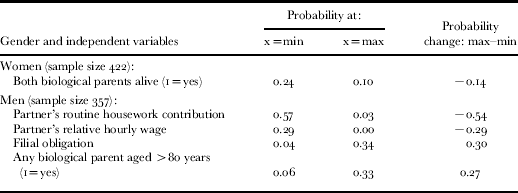
The results provide limited support for the second hypothesis. In line with the time-budget constraint principle, both women and men worked more hours the more their partners contributed to routine housework (Table 2). This suggests that the division of routine housework between household members played an important role in individual men's and women's allocation of time to paid work. Contrary to the time constraints principle of NHE, however, men worked more hours, rather than less, the more hours that their partners worked (Table 2). Moreover, men were less rather than more likely to provide support to parents, the more their partners contributed to routine housework (Table 3). Men whose partners did not contribute to routine housework had a 57 per cent probability of providing parent-support, compared to only 3 per cent of men whose partners did all routine housework (Table 4), and it is striking that none of the partner's activities had an impact on women's provision of parent-support (Table 3).
Probabilities of providing support to parent(s) among women and men aged 40–65 years by selected characteristics of parents, partners, and self, The Netherlands, 2002–04

Notes: The predicted probabilities are derived from the probit coefficients that were significant (p<0.05) in the probit equation of the simultaneous model presented in Table 3. x refers to the probit coefficient. All independent variables were held constant at their means.
Source of data: Netherlands Kinship Panel Study 2002–04; for details, see text.
Hypothesis 3: Time constraints by co-resident children
There was partial confirmation of the third hypothesis about children's influence on the time spent on paid work and parent-support. The oldest child's help with housework did not have an impact on women's and men's work hours or provision of parent-support, but for each additional child that a women had, she worked one hour less, and when she had children aged less than 11 years, she worked four-and-a-half hours less.
Impact of the conventional control variables
Most of the estimated relationships between the usual control variables and respectively work hours and the provision of parent-support are consistent with previous findings on the determinants of work hours and support-provision. Both women and men worked fewer hours the higher their benefit income, and the higher their partner's total gross income (Table 2). Women worked more hours when they used paid household help, had more years of schooling, and had more egalitarian gender-role attitudes. Men worked more hours the stronger their work ethic. Furthermore, women were about two-and-a-half times less likely to provide support when both of their parents were alive, compared to when they had only one surviving parent (Tables 3 and 4). Men were almost nine times more likely to provide support when they had a high as compared to a low filial obligation score, and they were about five times more likely to provide support when they had a parent older than 80 years compared to younger parents (Tables 3 and 4). Contrary to NHE propositions, women worked slightly more hours the higher their partner's relative hourly wage (Table 2), and men's likelihood of providing parent-support decreased the higher their partner's relative hourly wage (Table 3).
Discussion
This article has developed two central arguments. Drawing from the notion of time constraints in micro-economic theories concerning ‘household production’, the first is that the provision of parent-support and work hours are interdependent activities in people's time budgets. We have modelled this interdependency using a simultaneous estimation technique. The second central argument is that both men's and women's participation in paid work and in parent-support depend not only on their own activities but also on those of other household members, particularly partners and co-resident children. We have taken the household context into account by controlling for the impact of partners' and children's activities, and for the number of children and their ages.
The absence of conflict between work hours and parent-support
Although time pressures in mid-life may not be as great as at earlier phases of family formation, many middle-aged people have to reconcile competing demands on their time, given that they are at the peak of their careers and have to combine paid work with a partner-relationship and raising dependent children. This especially applies to middle-aged men and women in dual-earner/worker households, given that both partners have to balance paid work with unpaid labour and leisure. Given the constraint of limited time, we expected that providing parent-support would lead middle-aged men and women to cut back on work hours, and that those who worked many hours would be less able to engage in parent-support than those who worked fewer hours. These expectations were in accordance with the findings of two earlier studies in The Netherlands, one a local area study and the other a qualitative investigation (Dautzenberg et al. Reference Dautzenberg, Diederiks, Philipsen, Stevens, Tan and Vernooij-Dassen2000; Van Doorne-Huiskes et al. Reference Van Doorne-Huiskes, Dykstra, Nievers, Oppelaar and Schippers2002). In addition to the influence of time constraints, we expected that the emotional strain associated with providing parent-support, and the fact that those aged 55 or more years face retirement, might also contribute to a conflict between parent-support and paid work in middle age.
As it turned out, the results from the simultaneous model provided no empirical support for such a conflict among middle-aged men and women in dual-worker couples in The Netherlands. Indeed, no relationship was found between work hours and providing parent-support in either equation of the simultaneous model. The findings suggest that the often expressed fear of declining support for frail older people as a result of high female labour-force participation has little empirical ground, at least among dual-earner couples in The Netherlands in 2002–04. The finding that men's work hours are irresponsive to their provision of parent-support is in line with the consensus in the literature that men's work hours are rather inelastic in relation to the care and housework demands they face (Coltrane Reference Coltrane2000; Kooreman and Wunderink Reference Kooreman and Wunderink1996; Maume Reference Maume2006; Sanchez and Thomson Reference Sanchez and Thomson1997).
We suggest several explanations for the apparent lack of a work-support conflict. Firstly, given the high prevalence of part-time work, paid work in middle age might not pose a sufficiently substantial time demand to prevent providing support to parents, especially for middle-aged women. In accordance with national statistics, the majority (81%) of the female respondents in the sample worked part-time (20% worked fewer than 16 hours, and 61% worked 16–34 hours per week). Dutch midlife women's part-time work provides them with more opportunities to combine their jobs with other responsibilities than have women in countries where full-time work is more usual, such as the USA or France. Having at least one weekday off from work might be sufficient to accommodate parent-support. If this is the case, the fact that the majority of Dutch women work part-time and that all part-timers have at least one weekday off, regardless of the hours of work, may explain why the likelihood of providing parent-support did not vary by women's work hours. In turn, the lack of variation in the likelihood of providing parent-support among different groups of part-time workers may overshadow any contrast between part-timers and full-timers. The 66 per cent prevalence of part-time work among the partners of men in the sample might also help to explain why no conflict was found between work hours and providing parent-support among the men. Their partners might take over other tasks, such as housework and parenting, thus easing the men's time expenditures on both paid work and parent-support.
A second possible explanation is that we have under-estimated the conflict between paid work and providing parent-support because the sample did not include non-working middle-aged men and women, who might be more likely to provide parent-support than their working peers. Some who were not working at the time of the survey may have quit paid jobs earlier because of the time demands of providing support to parents, possibly in combination with other unpaid tasks such as housework, parenting and the provision of support and care for other family members, friends or neighbours. Such under-estimation of the work-support conflict is most likely to apply to women, given that about one-third of the respondents otherwise eligible for inclusion in the analysis sample had no paid work (most were homemakers), but for men the percentage was only about 10 (most of them were retired). Previous studies have given mixed reports of whether working women are less likely to take up daily care-giving than non-working women. On the one hand, aggregate European data have suggested that this is the case (Ogg and Renaut Reference Ogg and Renaut2006), and the authors of a local study in The Netherlands suggested that middle-aged children, especially daughters, without jobs or with part-time jobs were more engaged in care-giving than their (full-time) employed siblings because they were more available (Dautzenberg et al. Reference Dautzenberg, Diederiks, Philipsen, Stevens, Tan and Vernooij-Dassen2000). On the other hand, studies in the USA and Canada have suggested that working and non-working women are equally likely to take up daily care-giving (Barnes, Given and Given Reference Barnes, Given and Given1995; Moen, Robinson and Fields Reference Moen, Robinson and Fields1994; Pavalko and Artis Reference Pavalko and Artis1997), which indicates that the provision of help to parents is a response to a demand or need for such help and that middle-aged women's responses are indifferent to whether or not they have paid work. An alternative estimation to the simultaneous model would be a tobit model of work hours and a probit model of providing support. Such models could include non-working respondents, but the disadvantage would be that they cannot simultaneously estimate work hours and the probability of providing parent-support, and consequently they have an endogeneity bias.
A third possible explanation for the null finding is that our measure of support-provision to parents captured too wide a range of time expenditures on support-provision, from minutes to tens-of-hours per week. The measure distinguished those who provided parent-support ‘several times’ from those who did this ‘once or twice’ or ‘never’ during the past three months. This differentiates the least supportive from those who provided support with some regularity, but in the absence of more detailed information, the categories may still group very different frequencies and time expenditures on support-provision. Future research should examine finer gradations of parent-support. A fourth possible explanation is that middle-aged workers accommodated the provision of parent-support by decreasing the time spent on activities other than paid work, such as housework, child-care, parenting, leisure and sleep. Although our analyses included the partners' relative time expenditures on housework, the number of children, and the presence of co-resident children of different ages, we had no measures of the time spent on the associated activities. A final possible explanation is that middle-aged workers alleviated the conflict between the time required for paid work and providing support by using (paid or unpaid) help, but we had no measure of, for example: siblings', partner's, children's or professionals' help with providing support to the respondent's parents; or of (payments for) help with maintenance, laundry service and ready-made dinners.
Recent research in France and Israel suggests that most family-members who provide informal elder-care are supported by professional or formal help (Litwin and Attias-Donfut Reference Litwin and Attias-Donfut2009), and this may also apply to middle-aged men and women who provide instrumental support to their elderly parents. Data sets with more complete information about, for example, the use of professional services, siblings' parent-support, and the extent to which men and women assist their partners with the provision of parent-support, will shed more light on these issues. Research in the United States has suggested that although men are involved in parent-care to both their own and their spouses' parents, women more often than men provide care to parents-in-law (Szinovacz and Davey Reference Szinovacz and Davey2008).
Impact of household members on work hours and parent-support
The findings provide partial support for the applicability of the micro-economic perspective on intra-household dependencies to the allocation of time as between paid work and parent-support. They suggest that midlife men and women spend more time in the labour force when their partners free them from routine housework, that women spend more time in the labour force the fewer children they have and the older their children, and that the oldest co-resident child's help with housework is not related to women's or men's work hours or whether or not they provide parent-support. Furthermore, the household division of labour between partners is influenced by other factors as well as time-budget constraints, because we found that men worked slightly more hours the more hours their partners worked, which contradicts NHE theory. An alternative explanation for this finding is that the relationship is primarily propelled by dual-worker couples in which both partners work full-time. Previous research using data collected by Statistics Netherlands has suggested that women in dual-worker couples are more likely to work full-time when their partner works full-time (Verbakel Reference Verbakel2008). This association may derive from level-of-education homogamy – it is the case that in the majority of dual full-time worker couples in The Netherlands, both partners have university degrees (Van Gils Reference Van Gils2007). The highly educated tend to select highly-educated partners who share their social and human capital and have similar career perspectives and ambitions (Bernasco Reference Bernasco1994; Verbakel Reference Verbakel2008). Level-of-education homogamy therefore increases the likelihood that the partners of full-time workers also have full-time jobs.
Gendered patterns
The findings suggest that Dutch women's provision of parent-support is virtually independent of their work hours, socio-demographic and socio-economic attributes, and their household members' activities and characteristics, whereas men's support-provision is a function of several contextual factors. This underscores the stereotypical gendered pattern, by which ‘family helper’ is a normative role for women but not for men. We found that women's provision of parent-support depended on only one characteristic, namely that women are less likely to provide support when they have two living parents as compared to one. This finding resonates with previous evidence that daughters become primary care-givers to parents once the most preferred primary care-giver, the other parent or spouse, is not available (Spitze and Logan Reference Spitze and Logan1990).
In contrast to women's provision of parent-support, men's provision was influenced by multiple contextual and individual characteristics. It depended firstly on whether their partner freed them from household obligations, and secondly on their partner's relative hourly wage, which resonates with the ‘gender display’ proposition, that when a woman earns more than her male partner and so the couple do not conform to the stereotypical gendered roles, they compensate by adhering to the stereotypical gendered household division of labour (Bittman et al. Reference Bittman, England, Folbre, Sayer and Matheson2003; Brines Reference Brines1993, Reference Brines1994; Tichenor Reference Tichenor2005). The findings suggest that men might also use such ‘gender display’ in the realm of parent-support to compensate for their wives' higher earnings. When the female partner earns more, a man may be emphasising his masculine identity by abstaining from providing parent-support. Thirdly, we found that the stronger men's sense of filial obligation, the more likely they were to provide parent-support. This finding resonates with American evidence that felt obligation particularly stimulates sons' support of parents (Silverstein, Parrott and Bengtson Reference Silverstein, Parrott and Bengtson1995). Finally, men were more likely to provide parent-support when at least one parent had reached old age (beyond 80 years), which is when the need for help is likely to increase through health problems and functional limitations (Lafortune and Balestat Reference Lafortune and Balestat2007; Nusselder et al. Reference Nusselder, Looman, Franco, Peeters, Slingerland and Mackenbach2008; Perenboom Reference Perenboom2005).
Declaration
The opinions expressed in this paper are those of the authors, not necessarily those of The Netherlands Ministry of Social Affairs and Employment.
Acknowledgements
We gratefully acknowledge the Netherlands Organisation for Scientific Research (NWO) for funding this research with grant 457-03-006, as part of the research programme The Ties That Bind (BKF). The Netherlands Kinship Panel Study is funded by grant 480-10-009 from the Major Investments Fund of the NWO, and the Netherlands Interdisciplinary Demographic Institute (NIDI), Utrecht University, the University of Amsterdam and Tilburg University. We gratefully acknowledge the important methodological advice given by Niels Schenk at Erasmus University Rotterdam. An earlier version of this paper was presented at the Methodology Seminar of the Center for the Demography of Health and Aging, University of Wisconsin, Madison (29 November 2006), and at the Intergenerational Relations Among Older People session at the European Sociological Association Conference, in Glasgow (5 September 2007). We thank the anonymous reviewers, the editor Tony Warnes, and the participants at the NIDI Feedback Forum for their helpful suggestions for improving the article.