


Introduction
Hoarding disorder (HD) is recognised as a distinct diagnosis in the DSM-5 and is classified amongst the obsessive-compulsive and related disorders (American Psychiatric Association, 2013). Diagnostic criteria include a perceived need to save possessions and a persistent difficulty and associated distress when discarding possessions. This results in an accumulation of possessions preventing the use of living spaces for their intended purpose, often compromising safety and resulting in significant impairment in social and occupational functioning. Recent epidemiological research indicates a prevalence rate of 1.5% in adults of working age (Postlethwaite et al., Reference Postlethwaite, Kellett and Mataix-Cols2019).
The cognitive behavioural model of HD (Frost and Hartl, Reference Frost and Hartl1996) proposes that beliefs about the meaning and utility of possessions lead to individuals having significant difficulties in making decisions about the acquisition and discarding of possessions. Furthermore, behavioural avoidance is thought to contribute to HD, with decisions being avoided to prevent negative and undesirable emotional states often associated with loss (Steketee and Frost, Reference Steketee and Frost2003). It has been suggested that multiple emotional vulnerability factors may underlie avoidance behaviours, including intolerance of uncertainty (IU; Mathes et al., Reference Mathes, Oglesby, Short, Portero, Raines and Schmidt2017), anxiety sensitivity (AS; Timpano et al., Reference Timpano, Buckner, Richey, Murphy and Schmidt2009) and distress tolerance (DT; Norberg et al., Reference Norberg, Keyan and Grisham2015). Whilst sharing similarities, there are conceptual distinctions between them (Schmidt et al., Reference Schmidt, Richey, Cromer and Buckner2007). IU is defined as a negative cognitive bias that affects how a person perceives, interprets and responds to uncertain situations on cognitive, emotional and behavioural levels (Dugas et al., Reference Dugas, Schwartz and Francis2004; Freeston et al., Reference Freeston, Rhéaume, Letarte, Dugas and Ladouceur1994). Those high in IU experience uncertainty about the future as stressful and upsetting, which results in impairments in functioning and subsequent avoidance (Buhr and Dugas, Reference Buhr and Dugas2002). AS is defined as a distinct fear of anxiety related to bodily sensations and associated harmful consequences (Timpano et al., Reference Timpano, Buckner, Richey, Murphy and Schmidt2009), with low DT (an aspect of emotional dysregulation) being defined as the inability to withstand any negative emotional state and feelings of distress being interpreted as uncontrollable, unbearable and unacceptable (Simons and Gaher, Reference Simons and Gaher2005). Although these constructs have not been explicitly included in Frost and Hartl’s model, their relationship with HD has been investigated in preliminary research.
There is emerging evidence from cross-sectional studies using student samples for the relationship between HD and emotional vulnerability factors. IU has been shown to predict HD symptoms, with replication using a clinical HD sample in the same study providing comparable results (Wheaton et al., Reference Wheaton, Abramowitz, Jacoby, Zwerling and Rodriguez2016). Furthermore, the HD sample had higher levels of IU compared with healthy controls (HCs) and other anxiety disorders, as well as comparable levels to those with OCD (Wheaton et al., Reference Wheaton, Abramowitz, Jacoby, Zwerling and Rodriguez2016). IU has also been found to be a significant predictor of HD symptom severity after controlling for general levels of worry, depression and non-hoarding obsessive-compulsive symptoms (Oglesby et al., Reference Oglesby, Medley, Norr, Capron, Korte and Schmidt2013). More recently, IU has been found to be significantly positively associated with the HD components of acquisition and difficulties discarding, independent of anxiety and depression (Castriotta et al., Reference Castriotta, Dozier, Taylor, Mayes and Ayers2019). Similarly, AS has also been shown to have a strong relationship with hoarding symptoms (Medley et al., Reference Medley, Capron, Korte and Schmidt2013). In both student and mixed anxiety clinical samples, AS was significantly associated with HD behaviours. In addition, through a hypothetical behavioural HD paradigm, DT was found to predict saving behaviours in HD (Shaw and Timpano, Reference Shaw and Timpano2016).
Evidence suggests that people with HD may experience multiple emotional vulnerabilities. Both IU and DT have been shown to be significantly associated with HD, with these factors independently predicting HD symptoms in a clinical out-patient and community sample (Mathes et al., Reference Mathes, Oglesby, Short, Portero, Raines and Schmidt2017). IU was the only significant predictor of HD, with DT not predicting symptoms of HD. This contrasts with previous research using non-clinical samples in which HD was associated with DT, as well as being robustly associated with AS (Timpano et al., Reference Timpano, Buckner, Richey, Murphy and Schmidt2009). Furthermore, an interaction between AS and DT suggested that DT may play a less important role among individuals with low AS. Conversely, DT appeared to increase vulnerability to symptoms of hoarding among individuals with higher levels of AS. The role of AS, DT and IU as predictors of hoarding symptoms have only been investigated together in one cross-sectional study using a treatment-seeking clinical HD sample, which found that only DT predicted HD symptoms (Grisham et al., Reference Grisham, Roberts, Cerea, Isemann, Svehla and Norberg2018). Whilst having important theoretical and clinical implications, this study lacked a clinical comparison or a HC group.
The next logical step is to ascertain the specificity of emotional vulnerability constructs to HD. This is important because although the trial outcome data indicates positive decreases in HD symptoms following psychological treatment, most people remain closer to the HD range than the non-clinical range at the end of treatment (see Tolin et al., Reference Tolin, Frost, Steketee and Muroff2015). Research into disorder-specific psychological constructs has led to the significant advancement of treatments outcomes (see Clark, Reference Clark1986; Clark and Wells, Reference Clark, Wells, Heimberg, Liebowitz, Hope and Scheier1995; Ehlers and Clark, Reference Ehlers and Clark2000). Given that the current trial data for HD symptoms following psychological treatment indicates modest outcomes at best, it is important to identify the psychological constructs that are specific HD to identify treatment targets.
The aim of the present study was therefore to further understand the roles and relative importance of emotional psychological vulnerability factors within HD, and how this compares with their occurrence in OCD and HCs. It was hypothesised that there would be differences in AS, DT and IU across the three groups of HD, OCD and HC. Based on the evidence discussed above, it was expected that there would be increased AS and IU, and lower DT, in the clinical groups compared with the non-clinical group. Furthermore, if these psychological constructs have greater specificity to HD, it was expected that IU and AS would be significantly higher, and DT significantly lower, in the HD group relative to the OCD group.
Method
Participants
A total of 188 participants (HD n=66; OCD n=59; HC n=63) were recruited and participated in the study. Thirty-four respondents did not meet group criteria and were excluded at the screening stage. Participants were recruited through advertisements on relevant charity and recruitment websites and databases of participants from previous research studies.
Participants were excluded if they were <18 years of age, disclosed a mental health diagnosis (aside from HD or OCD) or a brain injury or neurological disorder. For inclusion in the HD group, participants were required to score 14 or above on the Hoarding Rating Scale Self-Report (HRS-SR; Tolin et al., Reference Tolin, Frost and Steketee2010) or to score above 41 on the Saving Inventory Revised (SI-R; Frost et al., Reference Frost, Steketee and Grisham2004). For inclusion in the OCD group, participants were required to score above the clinical cut-off of 21 on the OCI-R (Foa et al., Reference Foa, Huppert, Leiberg, Langner, Kichic, Hajcak and Salkovskis2002). If participants scored above clinical thresholds on the HD and OCD measures, participants were asked to self-report on which difficulty was primary. Inclusion criteria for HC participants was scoring 10 or below on the Generalised Anxiety Disorder measure (GAD-7; Spitzer et al., Reference Spitzer, Kroenke, Williams and Löwe2006) or the Patient Health Questionnaire measure of depression (PHQ-9; Kroenke et al., Reference Kroenke, Spitzer and Williams2001), scoring below clinical cut-offs on the HD and OCD measures and not self-reporting a current mental health problem.
Diagnostic measures
Hoarding Disorder Rating Scale-Self Report (HRS-SR; Tolin et al., Reference Tolin, Frost and Steketee2010)
The HRS-SR is a 5-item questionnaire. Participants rate their experience of excessive acquisition, difficulty discarding, clutter, impairment and distress on a 0 (no problem) to 8 (extreme) scale. Scores of 14 and above indicate clinically significant symptoms. The scale has excellent test–re-test reliability and internal consistency (α=0.96; Tolin et al., Reference Tolin, Frost and Steketee2010). There was excellent internal consistency in the present study (α=0.95).
Saving Inventory-Revised (SI-R; Frost et al., Reference Frost, Steketee and Grisham2004)
The SI-R is a self-report questionnaire containing 23 items assessing the severity of acquisition, difficulty discarding, and clutter based on scores ranging from 0 (no problem) to 4 (very severe). Scores of 41 and above indicates clinically significant symptoms. The scale has been shown to have high test–re-test reliability (0.86; Frost et al., Reference Frost, Steketee and Grisham2004) and internal consistency (α=0.94). There was excellent internal consistency in the present study (α=0.97).
Obsessive Compulsive Inventory-Revised (OCI-R; Foa et al., Reference Foa, Huppert, Leiberg, Langner, Kichic, Hajcak and Salkovskis2002)
The OCI-R is an 18-item measure of obsessive-compulsive symptoms with a clinical cut-off score of 21 and over. Research indicates that the OCI-R has good test–re-test reliability (0.82) and internal consistency (α=0.72). There was excellent internal consistency in the present study (α=0.95).
Patient Health Questionnaire (PHQ-9; Kroenke et al., Reference Kroenke, Spitzer and Williams2001)
The PHQ-9 is a 9-item measure of depression symptoms, with scores ranging from 0 (not at all) to 3 (nearly every day). Scores below 10 indicates mild depression not requiring intervention. The PHQ-9 has good test–re-test reliability, criterion and construct validity (Kroenke et al., Reference Kroenke, Spitzer and Williams2001) and internal consistency (α=0.89). There was excellent internal consistency in the present study (α=0.92).
Generalised Anxiety Disorder (GAD-7; Spitzer et al., Reference Spitzer, Kroenke, Williams and Löwe2006)
The GAD-7 is a 7-item questionnaire measuring anxiety symptoms. Scores range from 0 (not at all) to 3 (nearly every day). Scores below 10 indicates mild levels of anxiety. The GAD-7 has good test–re-test reliability (0.83), criterion, construct, factorial, and procedural validity (0.83; Spitzer et al., Reference Spitzer, Kroenke, Williams and Löwe2006) and excellent internal consistency (α=0.92). There was excellent internal consistency in the present study (α=0.92).
Emotional vulnerability factors
Anxiety Sensitivity Index-3 (ASI-3; Taylor et al., Reference Taylor, Zvolensky, Cox, Deacon, Heimberg, Ledley and Cardenas2007)
The ASI-3 is an 18-item self-report measure of fear of arousal-related sensations. Scores range from 0 (very little) to 4 (very much). The ASI-3 has good test–re-test and internal reliability (α=0.73–0.91), as well as discriminant, convergent and criterion validity (Taylor et al., Reference Taylor, Zvolensky, Cox, Deacon, Heimberg, Ledley and Cardenas2007). The ASI-3 demonstrated excellent internal consistency in the present study (α=0.96).
Distress Tolerance Scale (DTS; Simons and Gaher, Reference Simons and Gaher2005)
The DTS is a 15-item self-report measure of ability to tolerate psychological distress. It contains four subscales: tolerance, absorption, appraisal and regulation, as well as an overall measure of DT. Items are scored from 1 (strongly agree) to 5 (strongly disagree), with lower scores reflecting low distress tolerance. The scale showed good internal consistency (α=0.95) in the present study and has previously demonstrated both good internal consistency (α=0.89) and test–re-test reliability (0.61; Simons and Gaher, Reference Simons and Gaher2005).
Intolerance of Uncertainty Scale (IUS; Freeston et al., Reference Freeston, Rhéaume, Letarte, Dugas and Ladouceur1994)
The IUS is a 27-item self-report measure of ability to tolerate the uncertainty of ambiguous situations, behavioural and cognitive responses to uncertainty, along with attempts to control the future. Scales range from 1 (not at all characteristic of me) to 5 (entirely characteristic of me). The measure has been shown to have good test–re-test reliability (0.78) and internal consistency (α=0.94; Buhr and Dugas, Reference Buhr and Dugas2002). There was excellent internal consistency in the present study (α=0.97).
Procedure
Participants received a secure, single-use link to access the study materials online. After providing informed consent, participants completed the diagnostic questionnaires. Eligible participants then completed the remaining questionnaires, which were presented in a random order to prevent a response order effect. All participants received a £5 voucher.
Data analytic plan
The study was powered to detect a medium effect size (β=.95, α=.05). Approximately 45 participants were needed for each of the three groups (total=134). GPower was used for this calculation.
Preliminary assumption testing was conducted to check for normality, linearity, univariate and multivariate outliers, homogeneity of variance-covariance matrices and multicollinearity. Four univariate outliers from the HD group on DTS were imputed using the mean (Tabachnick and Fidell, Reference Tabachnick and Fidell2007). Homogeneity of variance-covariance matrices were violated. Consequently, two extreme multivariate outliers were removed from the data, one from the HD and one from the OCD group (see Pallant, Reference Pallant2010). No other serious violations were observed.
To test the study hypotheses, a one-way between-groups multivariate analysis of variance (MANOVA) was performed with group (HD, OCD and HC) as the independent variable and IU, AS and DT as the dependent variables. Follow-up Tukey’s honestly significant difference (HSD) post-hoc tests were used to investigate group differences.
Results
Descriptive statistics
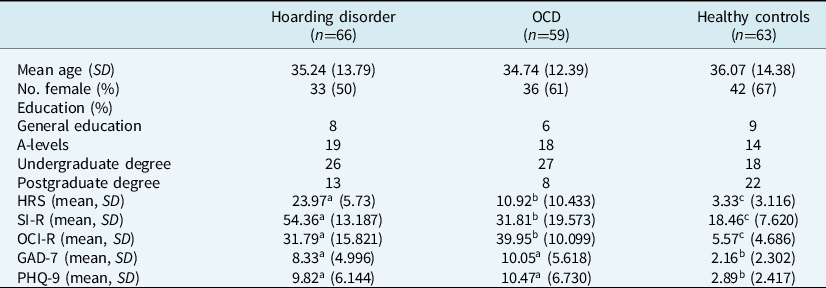
Demographic and sample description details are presented in Table 1. There were no significant group differences in respect of age (F 2,185=0.15, p=0.86), gender (χ2=3.841, p=.147) or education (χ2=10.280, p=.113). Multiple one-way ANOVAs indicated significant difference for all diagnostic measures. Tukey’s post-hoc tests indicated that the control group was significantly different from the clinical groups for all diagnostic measures. The HD and OCD groups were significantly different on the HRS, SI-R and OCI-R but not on the PHQ-9 or GAD-7.
Group characteristics

Means with different superscripts (a,b,c) differ based on one-way ANOVA (p<0.001); HRS, Hoarding Rating Scale; SI-R, Saving Inventory-Revised; OCI-R, Obsessive Compulsive Scale-Revised; PHQ-9, Patient Health Questionnaire; GAD-7, Generalised Anxiety Disorder questionnaire.
Main analysis
The means and standard deviations for the dependent variables are shown in Table 2. A MANOVA revealed a significant multivariate effect of group on the dependent variables, F 6,368=24.16, p<.01; Pillai’s trace=0.565, partial η2=.28. Univariate between-subjects ANOVAs showed that group had a statistically significant effect on IU (F 2,185=88.96; p<.001, partial η2=0.49), AS (F 2,185=52.11; p<.001, partial η2=0.36) and DT (F 2,185=50.78; p<.001, partial η2=.35).
Means and standard deviations for groups involved in 3-, 4- and 5-way ANOVAs

a Groups included in 3-way ANOVA;
b Groups included in 4-way ANOVA;
c Groups included in 5-way ANOVA. Values are means (SD).
Tukey’s HSD post-hoc tests indicated that mean scores for both IU and AS were significantly higher, and DT was statistically significantly lower, in both the HD and OCD groups compared with HCs (Table 3). There was no statistically significant difference between the HD and OCD groups for IU, AS or DT.
Mean differences and 95% confidence intervals from three group comparisons using Tukey’s HSD

* Mean difference is significant at p<0.001.
Group sensitivity analysis
To explore any confounding effect of the presence of OCD in the HD group and vice versa on the findings, a one-way MANOVA was conducted with four groups: pure HD (meeting criteria for HD only), pure OCD (meeting criteria for OCD only), HD/OCD co-morbid (meeting criteria for both HD and OCD) and healthy controls. The MANOVA across groups remained significant: F 9,552=19.04, p<.01; Pillai’s trace=0.711, partial η2=.24. Univariate between-subjects ANOVAs showed that group had a statistically significant effect on IU (F 3,184=65.32; p<.001, partial η2=0.52), AS (F 3,184=60.16 p<.001, partial η2=0.50) and DT (F 3,184=36.76; p<.001, partial η2=0.38).
Tukey’s HSD post-hoc tests (see Table 4) indicated that the clinical groups were significantly different from controls in the same direction as the main analysis for all dependent measures. Similarly, there were no significant differences between the pure HD and pure OCD groups for IU, AS and DT. The HD and co-morbid groups did not differ significantly in respect of either IU or DT, but AS was significantly higher in the co-morbid group. Furthermore, the analysis suggested that IU and AT were significantly higher, and DT significantly lower, in the co-morbid group compared with the pure OCD group.
Mean differences and 95% confidence intervals from four group multi-comparisons using Tukey’s HSD

* Mean difference is significant at p<0.05;
** mean difference is significant at p<0.001.
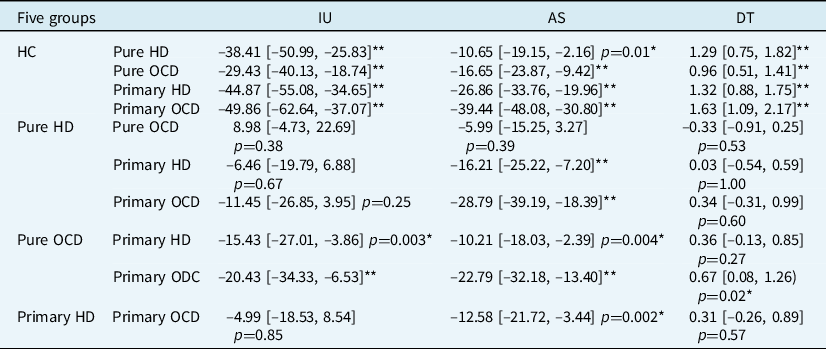
To investigate any unique effects that the primary HD (those meeting criteria for both HD and OCD but self-reporting HD as their primary problem) and primary OCD (those meeting criteria for both HD and OCD but self-reporting OCD as their primary problem) groups might have, an additional 5-group one-way MANOVA (pure HD; pure OCD; primary HD; primary OCD; healthy controls) was run. As with the previous two analyses, the MANOVA across groups remained significant: F 12,549=16.05, p<.01; Pillai’s trace=0.779, partial η2=.26. Univariate between-subjects ANOVAs showed that group had a statistically significant effect on IU (F 4,183=52.92; p<.001, partial η2=0.54), AS (F 4,183=52.86 p<.001, partial η2=0.54) and DT (F 4,183=28.91, p<.001, partial η2=0.39).
Tukey’s HSD post-hoc tests (see Table 5) identified the same pattern of significant differences found in the previous analyses between the clinical groups and the healthy controls for all the dependent measures. There were also no significant differences between the pure HD and pure OCD groups for IU, AS and DT. There was no significant difference between pure HD and both the primary HD and primary OCD groups for IU and DT, but there was a significant difference between pure HD and these two groups for AS. There were significant differences between the pure OCD and the primary HD group for IU and AS, but not DT; whereas there were significant differences between pure OCD and primary OCD for all the dependent measures. Finally, the HD primary and the OCD primary groups did not differ significantly from each other in respect of IU and DT but they did differ significantly for AS.
Mean differences and 95% confidence intervals from five group multi-comparisons using Tukey’s HSD

* Mean difference is significant at p<0.05;
** mean difference is significant at p<0.001.
Discussion
The current study compared IU, AS and DT across HD, OCD and HCs. As hypothesised, there were significant differences between the clinical and non-clinical groups across the three constructs. We investigated whether IU and AS would be significantly higher, and DT significantly lower, in the HD group relative to the OCD group, but no evidence was found to support this hypothesis. Furthermore, these results remained the same when examining the potential confounding effect of co-morbidity. The findings also suggest that emotional vulnerability factors may be more severe when there are multiple diagnoses.
Previous research has produced mixed findings regarding the nature of the relationship of emotional vulnerability factors and HD, with some research suggesting that DT has greater specificity in HD than AS and IU (Grisham et al., Reference Grisham, Roberts, Cerea, Isemann, Svehla and Norberg2018) and other studies finding IU to be a more unique predictor of HD symptomology (Mathes et al., Reference Mathes, Oglesby, Short, Portero, Raines and Schmidt2017; Shaw and Timpano, Reference Shaw and Timpano2016). The present findings indicate that whatever differences there may be in the relationships between the investigated constructs and HD, there was no evidence to indicate that these relationships are unique to HD when compared with OCD, which replicates and extends the findings of Wheaton et al. (Reference Wheaton, Abramowitz, Jacoby, Zwerling and Rodriguez2016), who also found IU to be comparable in HD and OCD.
Our findings are also consistent with the conclusions of previous research that IU, AS and DT are important transdiagnostic constructs that can be identified in a range of anxiety disorders. For example, IU has been found to be comparable across large samples of clinically diagnosed anxiety disorders including OCD, generalised anxiety disorder (GAD), major depressive disorder, social anxiety disorder (SAD) and panic disorder (PD) (Carleton et al., Reference Carleton, Mulvogue, Thibodeau, McCabe, Antony and Asmundson2012). Likewise, comparable levels of DT have been found in OCD, GAD, SAD and PD (Laposa et al., Reference Laposa, Collimore, Hawley and Rector2015; Michel et al., Reference Michel, Rowa, Young and McCabe2016). AS has also been found to play a key role in the development and maintenance of several anxiety disorders including OCD, GAD, SAD, PD and post-traumatic stress disorder (Olatunji and Wolitzky-Taylor, Reference Olatunji and Wolitzky-Taylor2009). The present findings are in line with this literature regarding the transdiagnostic nature of emotional vulnerability factors within various mental health conditions.
Treatments specifically targeting AS, IU and DT have shown positive results in anxiety disorders, including GAD, PD and SAD (Boswell et al., Reference Boswell, Thompson-Hollands, Farchione and Barlow2013; Katz et al., Reference Katz, Rector and Laposa2017; Smits et al., Reference Smits, Berry, Tart and Powers2008). This could indicate that the current treatments for HD may be improved by the introduction of CBT methods focusing on changing AS, DT and IU. However, recent trial findings have indicated little evidence for emotional vulnerability factors as a mechanism of change in HD (Worden et al., Reference Worden, Levy, Das, Katz, Stevens and Tolin2019). This could be attributable to the intervention techniques and their application, rather than demonstrating the irrelevance of the constructs. Nevertheless, it may be that, in line with cognitive behavioural theory, the focus of research should instead be on understanding the specific beliefs and behaviour that influence emotional factors in HD, which is consistent with recent mediational analysis of HD trial data providing evidence for beliefs as a mechanism of change (Levy et al., Reference Levy, Worden, Gilliam, D’Urso, Steketee, Frost and Tolin2017).
Limitations
The present findings would benefit from replication using a community HD sample, where group membership is based upon the gold standard DSM-5 diagnostic interview (SIHD; Nordsletten et al., Reference Nordsletten, Fernández de la Cruz, Pertusa, Reichenberg, Hotopf and Mataix-Cols2013). However, it should be noted that the HRS and SI-R used in the present study are highly correlated with the DSM-5 criteria for HD (Mataix-Cols et al., Reference Mataix-Cols, Fernandez de la Cruz and Nordsletten2012). Furthermore, the HRS and SI-R scores for the HD group were comparable to those found in previous research that also adopted diagnostic interviews (e.g. Grisham et al., Reference Grisham, Roberts, Cerea, Isemann, Svehla and Norberg2018). Similarly, the mean OCI-R scores in the HD, OCD and HC OCD groups were comparable to those found in previous studies (see Blom et al., Reference Blom, Samuels, Grados, Chen, Bienvenu, Riddle, Liang, Brandt and Nestadt2011; Michel et al., Reference Michel, Rowa, Young and McCabe2016). It is not possible to understand the results in relation to ethnicity as this information was not collected in the present study.
Online methodology has been criticised in terms of its potential negative impact on data validity (see Gosling et al., Reference Gosling, Simine, Srivastava and John2004). However, there is growing evidence that anonymity can positively impact upon task engagement (see Barr, Reference Barr2017; Bell, Reference Bell2001); it is possible that the anonymous nature of online data collection may instead improve engagement with research. In addition, equivalency has been demonstrated when comparing psychological information derived from pencil and pen methods versus online methods (Fouladi et al., Reference Fouladi, Mccarthy and Moller2002). Taken together, this suggests that the data produced from the present research are unlikely to experience validity issues attributable to the method of collection.
Conclusion
In conclusion, the findings suggest that IU, AS and DT are present in HD, but there is no evidence to indicate that they are any more important in HD compared with other anxiety disorders such as OCD. Future research is required to extend these findings in comparison with other clinical presentations, as well as to investigate the impact of targeting these factors in HD treatments.
Data availability statement
The data set is unable to be made publicly available due to ethical restrictions.
Acknowledgements
None.
Author contributions
Shemariah Hillman: Conceptualization (lead), Data curation (lead), Formal analysis (lead), Funding acquisition (lead), Investigation (lead), Methodology (lead), Project administration (lead), Resources (lead), Software (equal), Validation (lead), Visualization (lead), Writing – original draft (lead), Writing – review & editing (lead); Claire Lomax: Conceptualization (supporting), Data curation (supporting), Methodology (supporting), Resources (supporting), Supervision (supporting), Writing – original draft (supporting), Writing – review & editing (supporting); Nadeen Khaleel: Data curation (equal), Formal analysis (equal), Methodology (equal), Software (lead), Validation (supporting), Writing – original draft (supporting); Theresa Smith: Data curation (equal), Formal analysis (lead), Investigation (equal), Methodology (lead), Project administration (supporting), Resources (supporting), Software (lead), Supervision (equal), Validation (supporting), Visualization (supporting), Writing – original draft (equal), Writing – review & editing (equal); James Gregory: Conceptualization (lead), Data curation (equal), Formal analysis (lead), Funding acquisition (equal), Investigation (equal), Methodology (lead), Project administration (equal), Resources (equal), Software (equal), Supervision (lead), Validation (equal), Visualization (equal), Writing – original draft (equal), Writing – review & editing (lead).
Financial support
This research received no specific grant from any funding agency, commercial or not-for-profit sector.
Conflicts of interest
None.
Ethics statement
The study was approved by the Psychology Department Ethics Review Board, and the authors abided by the Ethical Principles of Psychologists and Code of Conduct as set out by the BABCP and BPS.






Comments
No Comments have been published for this article.