Milk fat is the most variable component in milk and is highly influenced by dietary nutrient composition. Acetate is a main precursor and source of energy for milk fat synthesis in dairy cows. A recent study has shown that supplementation of sodium acetate to dairy cow rations increases milk fat yield and concentration (Urrutia et al., Reference Urrutia, Bomberger, Matamoros and Harvatine2019). However, studies using cell models to examine the underlying mechanisms are lacking.
Sn-1-acylglycerol-3-phosphate O-acyltransferase 6 (AGPAT6) is a key enzyme involved in lipogenesis. During milk fat synthesis, AGPAT6 acylates lysophosphatidic acid to form phosphatidic acid (PA), which is finally converted to triacylglycerol (TAG) (Donkor et al., Reference Donkor, Sariahmetoglu, Dewald, Brindley and Reue2007). Studies in mice have shown that AGPAT6 is located in the endoplasmic reticulum and that its absence leads to underdeveloped mammary epithelium and the production of milk depleted in TAG (Beigneux et al., Reference Beigneux, Vergnes, Qiao, Quatela, Davis, Watkins, Coleman, Walzem, Philips, Reue and Young2006). The mammalian target of rapamycin complex 1 (mTORC1) is a Ser/Thr kinase complex, which senses and responds to nutrient availability and energy sufficiency to modulate lipogenesis. PA has been implicated in the activation of mTORC1 during lipid synthesis (Toschi et al., Reference Toschi, Lee, Xu, Garcia, Gadir and Foster2009). In HEK293, PA competitively binds to the FRB domain of mTORC1 with FKBP38, thereby disengaging the inhibition of FKBP38 on mTORC1 (Yoon et al., Reference Yoon, Sun, Arauz, Jiang and Chen2011). PA derived from phospholipase D has been demonstrated to be involved in mTORC1 activation (Frohman et al., Reference Frohman, Sung and Morris1999). However, there is no evidence supporting a role of PA generated from AGPAT6 as an activator of mTORC1 signaling. Whether acetate can induce mTORC1 activation and milk fat synthesis via AGPAT6 in mammary gland of dairy cow has not been established.
PPARγ has a role in lipogenic gene regulation. In goats, PPARγ has been detected in mammary gland, where its activation increases the mRNA level of AGPAT6 (Shi et al., Reference Shi, Zhao, Luo, Yao, Sun, Li, Shi and Loor2014). Our preliminary experiment in dairy cow mammary epithelial cells showed that acetate stimulation could increase AGPAT6 mRNA. However, whether PPARγ participates in acetate-induced AGPAT6 expression in dairy cow mammary gland is unknown.
Therefore, we hypothesized that acetate signal governs AGPAT6 expression to subsequently activate mTORC1 signaling in the mammary gland of dairy cows, which in turn promotes milk fat synthesis. To test this hypothesis, we first evaluated the effects of AGPAT6 and its production PA on mTORC1 activation in acetate-incubated cells. Then we examined whether PPARγ participates in the regulation of AGPAT6 transcription in response to acetate stimulation in these cells. This study extended our understanding of short-chain fatty acid regulation on mTORC1 activation in ruminants, which offers support for optimizing milk fat content via altering feed strategies.
Materials and methods
All procedures involving animals were approved by Northeast Agricultural University Animal Care and Use committee (2019-2. Harbin). Mammary tissue samples from 3 lactating cows at 90 DIM were used for mammary epithelial cell isolation. Cells were cultured in DMEM/F12 supplemented with 10% FBS, penicillin (100U/mL), and streptomycin (100μg/mL) as previously described (Lv et al., Reference Lv, Meng, Wang, Duan, Hou and Lin2021).
To detect the effect of AGPAT6 on mTORC1 signaling activation and TAG synthesis, cells were seeded in 6-well plates at 2 × 10⁵ cells/well. After being serum starved overnight, cells were transfected with 1.58 ng of AGPAT6 siRNA (sense = GCAGUAAGGCCCUGGACAATTUUGUCCAGGGCCUUACUGCTT) or scrambled siRNA (sense = UUCUCCGAACGUGUCACGUTT, negative control) using Lipofectamine 2000 (Life Technologies), followed by incubation with 12 mM sodium acetate for 48 h or plus 0.5 h with 100 mM 16:0,18:1 PA (Avanti Polar Lipids, Birmingham, AL). Then the expression of mTORC1 signaling molecules was detected by Western blot and the intracellular TAG content was detected by TAG assay kit.
To detect the effect of PPARγ on AGPAT6 expression, cells (2 × 10⁵ cells/well in 6-well plates) were transfected with 2.5 μg of PPARγ-specific shRNA or nontargeted shRNA (negative control), followed by incubation with 12 mM sodium acetate or plus 1 μM rosiglitazone for 48 h.
To assess the regulation of PPARγ on acetate-induced AGPAT6 transcription, cells were transfected with various AGPAT6 promoter constructs, followed by incubation with 12 mM sodium acetate for 48 h. Luciferase activity was measured using the dual-luciferase reporter assay system. ChIP assay was performed to detect acetate effect on the interaction between PPARγ and AGPAT6. All detailed procedures are available in the online Supplementary File.
Results and discussion
We isolated mammary epithelial cells from lactating cows to investigate the underlying mechanism involved in acetate-induced milk fat synthesis. Our data showed that acetate promoted TAG synthesis via activating mTORC1 signaling in mammary epithelial cells of dairy cows (online Supplementary Fig. S1).
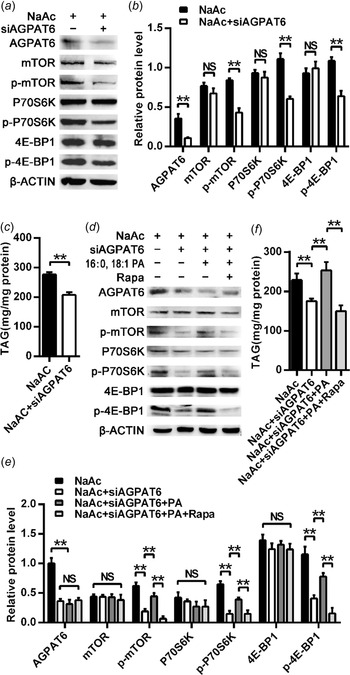
An earlier study in mice showed that AGPAT6 deficiency reduces the TAG content in mammary epithelium (Nagle et al., Reference Nagle, Vergnes, Dejong, Wang, Lewin, Reue and Coleman2008). Our present study indicated that AGPAT6 knockdown markedly decreased acetate-induced phosphorylation of mTOR, P70S6K and 4E-BP1 (Fig. 1a and 1b, P < 0.01), as well as intracellular TAG content in dairy cow mammary epithelial cells (Fig. 1c, P < 0.01). This suggests that AGPAT6 may mediate the activation of acetate on mTORC1 signaling, that in turn induces milk fat production. PA has been identified as a critical component of mTOR signaling activation. Stimulation of HEK293 cells with serum leads to an acute increase in cellular PA content, which is required for activation of mTORC1 downstream effectors (Fang et al., Reference Fang, Vilella-Bach, Bachmann, Flanigan and Chen2001). In this study, we observed that the inhibition effect of AGPAT6 siRNA on mTORC1 signaling activation (Fig. 1d and 1e) and TAG synthesis (Fig. 1f) was recovered by addition of 16:0,18:1 PA, suggesting that AGPAT6 could generate PA in response to acetate simulation via de novo TAG synthesis pathway, which in turn activates mTORC1 signaling and promotes TAG production. However, the recovery of PA-induced TAG production did not occur in cells treated with rapamycin, indicating that the rescue of TAG production was a result of mTORC1 signaling activation and PA substrate for TAG synthesis.
Effect of AGPAT6 on acetate-induced mTORC1 signaling activation. (a, b, c) Effect of AGPAT6 knockdown on mTORC1 signaling activation (a, b) and TAG synthesis (c) in acetate-stimulated mammary epithelial cells. (d, e, f) Effect of 16:0,18:1 PA on mTORC1 signaling activation (d, e) and TAG synthesis (f) in AGPAT6 knockdown mammary epithelial cells. Results are representative of 3 independent experiments, each with n = 3. *P < 0.05; **P < 0.01.

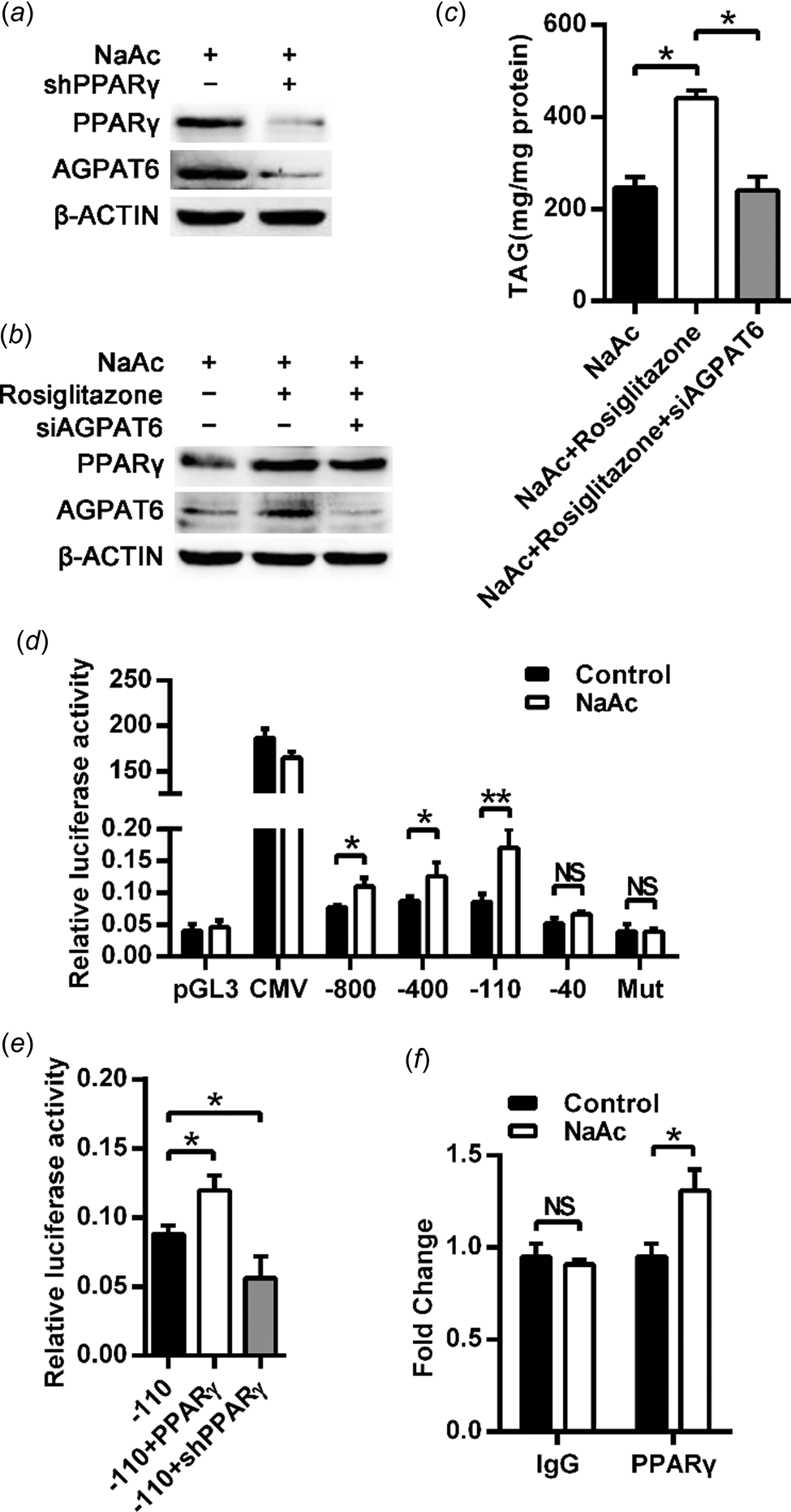
PPARγ has been reported to improve the lipid synthesis rate in goat mammary tissues by upregulating lipogenic gene networks (Shi et al., Reference Shi, Zhao, Luo, Yao, Sun, Li, Shi and Loor2014). As a ligand-activated transcription factor, PPARγ forms a heterodimer with RXRα to play its transcriptional role. In this study, we observed that PPARγ knockdown decreased AGPAT6 expression in dairy cow mammary epithelial cells (Fig. 2a), whereas PPARγ activation had the opposite effect (Fig. 2b). Moreover, when AGPAT6 was knocked down, the induction of TAG synthesis by PPARγ was inhibited (Fig. 2c), suggesting that PPARγ is an upstream regulator of AGPAT6. Using 5′ deletions constructs, we found that the area between −110 to −40 bp mediated the effect of acetate on AGPAT6 promoter (Fig. 2d). Analysis of the bovine AGPAT6 promoter sequence revealed the presence of a consensus binding site for RXRα (GTTGAACTC, position −104 to −96 bp). As expected, mutation of this RXRα binding site abolished the stimulatory effect of acetate on AGPAT6 transcription (Fig. 2d). Meanwhile, we observed that PPARγ could up-regulate AGPAT6 transcription activity via this RXRα binding sequence (Fig. 2e). ChIP assay further demonstrated that acetate treatment significantly increased the interaction between PPARγ and AGPAT6 via RXRα (Fig. 2f).
Acetate regulates AGPAT6 expression by PPARγ-RXRα. (a) PPARγ knockdown decreased AGPAT6 expression in acetate-stimulated mammary epithelial cells. (b, c) Effects of PPARγ activation on AGPAT6 expression (b) and AGPAT6-mediated TAG synthesis (c). (d) Functional analysis of the bovine AGPAT6 promoter mediated acetate effect. Mut represents a construct with mutation in the RXRα consensus binding site located at −96 bp. (e) Effects of PPARγ on AGPAT6 promoter containing fragment −110 bp. (f) ChIP assay showing the interaction between PPARγ and AGPAT6 in cells upon acetate stimulation. Results are representative of 3 independent experiments, each with n = 3. *P < 0.05; **P < 0.01.

In conclusion, our study has demonstrated that acetate can promote TAG synthesis in mammary epithelial cells of dairy cows via mTORC1 signaling pathway, which depends on the activation of PPARγ-AGPAT6 to produce PA.
Supplementary material
The supplementary material for this article can be found at https://doi.org/10.1017/S0022029922000668
Acknowledgments
This work was supported by grants from the National Natural Science Foundation of China (31771453 to Y. L., and 31671285 to X. H.), and Joint Guidance Project of Heilongjiang Natural Science Foundation (LH2019C082, China). The authors declare no competing financial interest.