1. Introduction
More equal economic, social and political rights for women have long been part of civil and political rights movements. Greater rights for women improve the status of women through educational development and increased employment opportunities. They also empower women by leading them to positions of leadership. Women in positions of responsibility and leadership can promote the development of women at grassroots levels. Thus, advancing women's rights is important to promote greater economic prosperity, good governance and social equality. Duflo (Reference Duflo2012) argues that women's empowerment and economic development are closely related (also see Doepke et al., Reference Doepke, Tertilt and Voena2012). Diebolt and Perrin (Reference Diebolt and Perrin2013) suggest that female empowerment is a key ingredient of economic development, as an economy evolves from a Malthusian regime – with slow technological progress, low income and high fertility – to a Modern Growth regime with high living standards and low fertility. Access to media plays an important role in this regard, as the rights of women can be promoted by raising awareness. A free media will permit women to acquire information relating to rights which in turn can lead to inclusive policy making, creating greater equality and participatory policy-making.
Today, governments have to make more information available to the public about their activities as the public demand greater access to such information (David-Barrett and Okamura Reference David-Barrett and Okamura2013). Grigorescu (Reference Grigorescu2003) argues that transparency is higher in countries where there are institutions supporting press freedom (PF). Thus, it can be argued that the media plays an important role in promoting transparency by acting as an intermediary between the government and the masses. A free press is therefore an important precursor, to the access of information, as it enhances transparency, making a government more accountable to the public. This is exemplified by Tocqueville (1840:1990) who states that the press was ‘the chief democratic instrument of freedom’. As documented in the literature, PF can play an important role in the prevention of famines and in improving development outcomes (Djankov et al., Reference Djankov, Montalvo and Reynal-Querol2008; Sen, Reference Sen1982, Reference Sen1999; Stiglitz, Reference Stiglitz and Islam2002), creating an informed electorate (Besley and Prat, Reference Besley and Prat2006), solving principal-agent problems (Besley and Burgess, Reference Besley and Burgess2002), in shaping corporate policy (Dyck and Zingales, Reference Dyck, Zingales and Islam2002), reducing income inequality (Petrova, Reference Petrova2008) and aligning incentives between politicians and voters. Can PF also improve government's respect for women's rights? The present paper aims to answer this question.
An independent media sector is a foundation for good governance and long-term development. In the absence of the media, it is not easy for citizens to raise and debate issues of development that affect them (Kalathil, Reference Kalathil2011). Greater PF can enhance women's rights by increasing positive rights or reducing the infringement of negative rights. Greater PF can be used by women to gain recognition, overcome isolation and raise voices about women's issues. Women can reduce the infringement of negative rights by calling for greater public accountability. Higher freedom also promotes better professionalism and can let women fight against discrimination by firms and government officials. But PF may not work toward enhancement of women's rights, in spite of all capabilities, depending on the gender structure of the public–private sphere of media. The ongoing debate in the literature in this context is that men dominate in the public sphere (the production of media) and women dominate the private sphere (the consumption of media). Thus, media will fail to perform depending on the dominance of each gender in the respective sectors.
In this context, we argue that along with media freedom, other institutions of a country can help promote PF's positive impact on women's rights. We focus, in this context, on the reach of media. Literature has extensively talked about the power of media and how greater reach can improve accountability and transparency and can lead to better governance outcomes. Unless media releases and other information reach the public (access to information), a free press alone will not lead to improvements in women's rights. As reach or access to information improves, a free press will be more effective due to the spread of information. By reach of media, we imply the extent of accessibility of information by the populace that is generated by the media sector. The definition of reach follows Islam (Reference Islam2002). Information generated by the media can be accessed via several sources like television, internet,Footnote 1 cellular phones, newspapers and radio. As iterated in Islam (Reference Islam2002), a media sector in a country should be such that the masses have inexpensive and easy access to various mediums like internet, radio and television and mobile phones. The impact of this increasing penetration by technology has already been felt in the development sector. The UN-INSTRAW/CAWTAR project for example, has organized workshops targeting the active participation of women in politics to improve their skills in communication through SMS campaigns, and the internet (iKNOW Politics, 2014). Information and Communication Technologies (ICTs) allow information to be made available faster and help improve information exchange. Mobile phones and the internet, for example, can help women to exchange ideas on issues of importance such as women's rights.
Thus, we attempt to answer the following questions in the paper – does PF increase women's rights? Is PF more effective in the presence of greater media accessibility? We consider an extensive panel of 187 countries over the period of 1993–2011 and undertake alternate estimation strategies to find answers to these questions. Based on the estimated marginal impacts, we can conclude that the impact of PF on women's rights is enhanced in the presence of greater accessibility via mobile and the internet. Finally, we also check yet another channel via which PF can improve women's rights. Greater democratic capital stock ensuring better checks and balances makes a free press more effective.
There is little evidence in the literature with regard to the effect of media freedom on women's rights. As mentioned, existing studies have focused on the beneficial impact of PF on different development outcomes, such as reducing corruption, increasing government transparency, solving the principal-agent problem, etc. Our paper therefore highlights another dimension of the effect of PF: that is, enhancing women's rights. Our paper adds to the PF literature by exploring this beneficial impact of a free press. Further, it helps us understand what other factors work in conjunction with a free press in shaping better developmental outcomes.
Section 2 presents the theoretical background and Section 3 discusses the data sources and their definitions, and also describes the rationale for the empirical methodology. In Section 4, we present the benchmark results. Section 5 elaborates on the robustness analysis and Section 6 concludes.
2. Literature and theoretical background
PF can increase women's rights by increasing positive rights or reducing the infringement of negative rights. In terms of improving positive rights, the posting of information on the internet, newspapers and radio has drawn increased attention to women's issues. Many women's organizations have gained recognition through web sites. Similarly, the media has enabled women to reduce poverty, overcome isolation and gain a voice which has increased the opportunity for greater equality (Gallegher, Reference Gallagher2002). The media can help increase the representation of women in leadership positions which in turn will provide women with a greater ability to contribute to the development and enactment of legislation and policies that influence them. Snyder and Strömberg (Reference Snyder and Strömberg2010) document the impact of PF on citizen knowledge, politicians' actions and policy. Studying regions in Mozambique in 2009, Aker et al. (Reference Andriantsoa, Andriasendrarivony, Haggblade, Minten and Rakotojaona2011) illustrate how voter education through newspaper reporting and mobile SMS techniques leads to higher voter turnout and electoral participation.Footnote 2 Similarly, Reinikka and Svensson (Reference Reinikka and Svensson2005) and Stromberg (Reference Stromberg2004) document that greater access to information via media leads to increases in government entitlement programs. Therefore, a media literate audience can promote opportunities for the creation of greater gender equality.
Greater PF can also reduce the infringement of negative rights. Increased PF can be used by women's movements to call for greater public accountability. The gang rape of a young girl in Delhi in 2012, for example, was brought to attention by the Delhi Gang Rape hashtag campaign calling for greater government accountability and implementation of stricter laws with regard to rape cases.Footnote 3 It should be noted, however, that this was through social media rather than through the press which we focus on in this study. Yet, greater internet usage or mobile usage (with internet) also increases the use of social media. Thus, theoretically, the explored channels in the paper will also imply greater use of social media. Though our sample period extends till 2011, examples like these lay the theoretical motivation for our hypothesis and show the extent to which the media can encourage a government to be more responsive to the promotion of women's rights. PF can also reduce corruption, thereby increasing political accountability (Andriantsoa et al., Reference Arellano and Bond2005; Stiglitz, Reference Stiglitz and Islam2002). A free press highlights private and public sector corruption and thereby monitors government officials, enabling voters to hold corrupt politicians accountable for their actions and setting higher standards for society. Similarly, PF can, by reducing information asymmetries, encourage government officials to construct more carefully thought out public policy to promote women's rights (Michener, Reference Michener2001). Making the bureaucratic decision making process more open to inspection can improve the efficiency of, and impose greater discipline on official bodies (Banisar, Reference Banisar2006) forcing them to adhere to laws protecting women's rights. Greater access to information by increasing public awareness, can promote greater professionalism and minimize the opportunity for indiscriminate action by firms and government officials. As a result, women will be more aware of conditions relating to equality in hiring and promotion practices, job security and wages. Similarly, press announcements provide greater access to information to women on their rights and increase government accountability to the public. Leeson (Reference Leeson2008) finds where media is government-controlled people have less political knowledge, whereas less regulations and private ownership of media lead to greater political awareness and participation.
A free press however, would only promote women's rights in societies where men support women's rights and take action to promote policy related to gender equality. While media could, as discussed above, increase the rights of women, it could also serve to reinforce women's relative subordination in the field of media (Djerf-Pierre, Reference Djerf-Pierre2007). There has been ongoing debate about the public–private sphere of media. That is, the view that men dominate in the public sphere (the production of media) and women dominate the private sphere (the consumption of media). Even in Sweden, which is advanced in terms of gender equality, women need to struggle against male-defined norms to reach a senior media position (Djerf-Pierre, Reference Djerf-Pierre2007; Gallagher, Reference Gallagher2002). Djerf-Pierre (Reference Djerf-Pierre2007) observes that by 2001, 89% of CEOs in the media industry in Sweden and two out of three heads of departments were men. Media research further suggests that news tends to be biased in favor of male views, while women are portrayed in the press to speak on issues which are an ‘extension of the private sphere in public’ (Pilvre, Reference Pilvre, Pavlíčková and Reifová2012). Thus, economic, political and social power in the media industry remain concentrated in the hands of males (Gallagher, Reference Gallagher2002). If this were the case, then PF will not increase women's’ rights, it could even have a negative effect on women's rights.
Therefore, a free press while necessary, may not be sufficient for enhancing women's rights. A number of factors can generate competition in a society in general, thus enriching media access and quality. Media freedom needs to be accompanied by greater accessibility or it will not have the desired effects. Greater reach or accessibility through modes such as the internet and mobile phone can make the presence of women felt and heard. Women can get empowered to the degree that they can advance collective efforts to improve rights and greater equality. It is also reported that social media has given a voice to the most marginalized groups: mostly women and minorities of various kinds, such as religious minorities, ethnic minorities, and sexual minorities in certain regions (Yamamichi, Reference Yamamichi2011). Media freedom accompanied by increased reach, can increase awareness and women's rights.
Other than media reach, we check another channel through which media freedom can promote women's rights better. This is the channel of democratic capital. Greater democratic capital implies greater transparency and government accountability. As democracies in general have larger civil societies, democracies are more likely to have less patriarchal social norms, NGOs and other international organizations which increase media reach with the aim of promoting progressive women's rights. Similarly, democracies or gender progressive states could lead to greater norm diffusion. Democracies which have progressive women's rights can place greater pressure on a country to introduce more gender tolerant policies (Powell and Schroeder, Reference Powerll and Schroeder2015). Therefore, we expect more democratic societies to have institutions which provide greater individual freedom and less patriarchal policies that do not discriminate by gender. In countries with legitimate governments, legal systems and well-established property rights, target-oriented economic policies yield desired results as opposed to autocracies (e.g., De Haan and Sturm, Reference De Haan and Sturm2003). Aidt (Reference Aker, Collier and Vincente2009) argues that countries which have been democratic for a longer period have had the time to establish the rule of law to effectively control corruption. Democratic capital facilitates gender equality through mobilization of women and electoral accountability (Beer, Reference Beer2009). Women can better organize to express their views and interests, and to obtain and disseminate information. Women may lobby for improving their status through educational development and increased employment opportunities, and also women may in some cases be empowered to positions of leadership.
Based on the theoretical framework and existing literature, our hypothesis can be summarized as follows:
Greater media freedom enhances women's rights. Increased media reach or accessibility increases the impact of media freedom on women's rights. Further, democratic capital also has a similar impact in enhancing the impact of press freedom.
We also use a number of key control variables following the literature. Jayachandran (Reference Jayachandran2014) argues that disparities in health and education are higher, and bargaining power within marriage is lower in countries with low per capita incomes and thus women in developing countries report to having less rights compared to those in developed countries. Economic development can therefore be accompanied by greater PF and media accessibility which promote greater interconnectedness enhancing the impact of PF on women's economic rights. In addition, greater development can lower gender inequality and empower women. As income or level of development increases, women's rights will expand due to greater employment opportunities and/or lower discrimination against women. One would therefore expect a positive relationship between per capita income as an indicator of development and women's rights. Hence, it is important to consider GDP per capita as a key control variable across countries. Similarly, Goldstein and Udry (Reference Goldstein and Udry2008) showed that women have less social and political rights in developing countries, and Galor and Weil (Reference Galor and Weil1996) found that women have less economic rights in low income countries. The expansion of women's economic, social and political rights can therefore be linked to the process of economic development that may lead to institutional reforms including economic reforms such as trade openness which we also control for.
We test our hypothesis using data from 187 countries over the years 1993 to 2011. Since rights of women and men can differ significantly across countries, it is important to consider the entire distribution and assess the effect of key explanatory variables both at their top and bottom segments including their median response on women's rights.
3. Data and methodology
Our dataset covers an extended panel of 187 countries over a period of two decades (1993 to 2011). Our dependent variables capture different components of Women's Rights. These components are economic, social and political rights. The data source is The Cingranelli-Richards (CIRI) Human Rights Database that incorporates standard-based quantitative information on the government with respect to 15 internationally recognized human rights for 195 countries over the period 1981–2007. Women's economic rights range from 0 to 3 with higher values representing the maximum respect toward rights for women by the government. It incorporates factors such as: ‘equal pay for equal work, free choice of profession or employment without the need to obtain a husband or male relative's consent, the right to gainful employment without the need to obtain a husband or male relative's consent, equality in hiring and promotion practices, job security (maternity leave, unemployment benefits, no arbitrary firing or layoffs, etc . . .), non-discrimination by employers, the right to be free from sexual harassment in the workplace, the right to work at night, the right to work in occupations classified as dangerous, the right to work in the military and the police force’ (CIRI, Reference Cingranelli and Richards2014). Political rights incorporate factors for females such as: the right to vote, the right to run for political office and the right to join political office, the right to hold government positions and so on (CIRI, Reference Cingranelli and Richards2014). Finally, social rights include multiple factors such as: ‘the right to equal inheritance, the right to enter into marriage on a basis of equality with men, the right to travel abroad, the right to obtain a passport, the right to confer citizenship to children or a husband, the right to initiate a divorce, the right to own, acquire, manage and retain property brought into marriage, the right to participate in social, cultural and community activities, the right to education, the freedom to choose a residence/domicile, freedom from female genital mutilation of children and of adults without their consent and freedom from forced sterilization, or male relative's consent’ (CIRI, Reference Cingranelli and Richards2014). Both these rights range from 0 to 3 as well.
Our main independent variable of interest is PF or media freedom. Media freedom data is obtained from the popular Freedom House database. The popularity of the media freedom (PF) index from Freedom House is based on the extensiveness of the data in terms of both countries and time period covered. The PF score is assigned based on 23 questions that are divided into three categories: the legal environment, the economic environment and the political environment. These categories encompass different factors – the laws and criteria that influence media contents, the ability of journalists’ to operate freely and the government's use of regulations to curb media operations, the degree of political control over the content of news media, the structure of media ownership, transparency and concentration of ownership and the impact of corruption and economic institutions on media. Based on the Freedom House construction, the PF index ranges from 0 to 100 points, with higher points representing lower levels of PF. For purposes of analysis, the scores have been rescaled so that higher scores denote a freer environment.
Our hypothesis aims to explore how factors such as reach (accessibility) of media affects PF – women's right relationship. As measures of media accessibility (access to information),Footnote 4 we consider internet users per 100 people and mobile users per 100 individuals considered from World Development Indicators (WDI), (2014). The use of these measures can help assess the role of means of connectivity in achieving greater media accessibility. Other independent variables used in the study include a trade openness measure (exports and imports as a share of GDP) and is also taken from WDI, (2014). Increased trade can lead to norm diffusion and place greater pressure on a country to introduce more gender tolerant policies (Powell and Schroeder, Reference Powerll and Schroeder2015). We also control for GDP per capita to account for the level of development of a country. Further, foreign aid inflows and labor force participation rates are used as additional controls. Aid inflows can affect different development outcomes (Rajan and Subramanian, Reference Rajan and Subramanian2007) including that of human rights and women's rights. Similarly, female labor force participation rate can benefit women's rights by generating greater awareness and creating the needed pressure on the government to act rightfully in such areas (Beer, Reference Beer2009). Appendix A provides the summary statistics for the variables. As evident from the minimum and maximum values, we have an entire spectrum of countries in terms of PF or internet or mobile users with relatively high standard deviation. Finally, to measure democratic capital, we consider the measure from Persson and Tabellini (Reference Persson and Tabellini2009).
4. Empirical methodology
Based on our hypothesis, we identify channels through which PF can influence women's rights. We test the following reduced-form specification:
 $$\begin{eqnarray*}
W{R_{it}} &=& {\alpha _0} + {\alpha _1}W{R_{it - 1}} + {\alpha _2}P{F_{it}} + {\alpha _3}{\left( {PF^{\ast}{\rm{Channel}}} \right)_{it}} + {\alpha _4}{\rm{Channe}}{{\rm{l}}_{it}} \\
&&+\, \sum \limits_{i = 1}^k {\gamma _k}{X_{kit}} + {\alpha _5}{\mu _i} + {\alpha _6}{\sigma _t} + {\varepsilon _{it\ }},
\end{eqnarray*}$$
where WRit denotes women's rights (economic, social and political) for country i in period t. WR it − 1 represents women's rights in period t − 1 and captures the persistence of the dependent variable. PFit denotes the PF score for country i in period t. Channel implies the channel of media reach through which PF can influence women's rights. Democratic capital is the other channel considered as part of robustness analysis. Xkit denotes a set of control variables that are used in the empirical analysis. μ i represents country fixed effects, σ t denotes time fixed effects and a set of country dummy variables. t, is a fixed time effect. We are interested in the coefficients,α2, and that of the interaction term,α4. We estimate the marginal impact of PF on women's rights for different levels of media reach, and democratic capital. We estimate the following:
 $$\begin{equation*}
\frac{{\delta W{R_{it}}}}{{\delta P{F_{it}}}} = \ {\beta _1} + {\beta _3}^{\ast}{\rm{Channe}}{{\rm{l}}_{it}}.
\end{equation*}$$
Based on the sign and magnitude of β1,β2 and the magnitude of channel
it
,
 $\frac{{\delta W{R_{it}}}}{{\delta P{F_{it}}}}$
will be >,= or< 0.
The foremost challenge we face in our estimation procedure is that of endogeneity. It is quite likely that as a nation's government shows greater respect toward women's rights, it should also invest greater resources and undertake policies to enhance PF. Thus, in all likelihood, PF is likely to be endogenous. One of the popular ways to deal with endogeneity is to employ Instrumental Variable (IV) estimations or, in other words, employ two stage least squares (2SLS). For IV estimations to be effective, we need instruments that are truly exogenous in nature or, in other words, the instrument should not be correlated with the error term or the dependent variable, but should be correlated with the variable considered to be endogenous. As Murray (Reference Michener2006) points out, invalid instruments exacerbate the problems in the sense that they would result in inconsistent estimates and may lead to greater bias compared to ordinary least squares (OLS) estimates. Murray, further, points out that even if the instruments are weakly correlated with the endogenous variable of interest, then in theory it is not possible to overcome the bias associated with OLS estimators. Additionally, finding time-varying exogenous instruments for multiple endogenous variables in estimations with time fixed effects can be a daunting task (Persson and Tabellini, Reference Persson and Tabellini2006). Other than PF, variables like GDP per capita can be endogenous as well in our regressions.
The other popular method to deal with endogeneity concerns is employing Dynamic Panel Estimators. Such estimators have been frequently used in recent empirical studies with panel data and dealing with endogeneity challenges (Asiedu and Lien, Reference Asiedu and Lien2011; Asiedu et al., Reference Asiedu, Jin and Nandwa2009; Dutta and Williamson, Reference Dutta and Williamson2015; Gehlbach and Malesky, Reference Gehlbach and Malesky2010; Solarin and Sahu, Reference Solarin and Sahu2015; to state a few). By generating instruments via moment conditions, General Method of Moments (GMM) estimation takes into account the endogeneity concerns. Such moment functions depend on observable random variables ‘and unknown parameters, and that have zero expectation in the population when evaluated at the true parameters’ (Söderbom, 2009). Dynamic panel data (DPD) models like fixed effect estimates suffer from inconsistent estimates due to the presence of unobserved panel-level effects that are correlated with the lagged dependent variable. GMM estimators take care of this inconsistency. Other than this, GMM estimators take into account country fixed effects and are constructed to handle the presence of heteroskedasticity and autocorrelation within countries.
The estimator proposed by Arellano and Bond (Reference Arellano and Bond1991) is known as the difference-GMM estimator that uses lagged values of the first difference of the endogenous variables as instruments. Lagged levels can be poor instruments as proposed by Arellano and Bover (Reference Arellano and Bover1995). An improved estimator, the System GMM estimator, suggested by Blundell and Bond (Reference Blundell and Bond1998) uses additional moment conditions to obtain a system of two equations – one in difference and one in level. The additional moment conditions are based on the stationarity conditions of the initial observation (see Blundell and Bond, Reference Blundell and Bond1998; Bun and Windmeijer, Reference Bun and Windmeijer2010). The use of the extra moment conditions result in reduced and greater precision over Difference GMM estimates. We rely on System GMM estimators to be our benchmark estimator. Both Difference and System GMM estimates are rendered inconsistent in the presence of second-order autocorrelation. Thus, for all specifications, we report the p values from the second-order autocorrelation test. Further, to check the validity of the instruments, we report the p values from Sargan test for all our specifications. Additionally, we report r =n/i, the ratio of countries to instruments, for all the regressions. If r is less than one, then estimates can be susceptible to Type-I errors (Asiedu and Lien, Reference Asiedu and Lien2011; Roodman, Reference Roodman2009). Finally, a two-step GMM estimator with Windmeijer correction is employed for all the estimated standard errors so that the downward bias in small samples is corrected (Windmeijer, Reference Windmeijer2005). PF, mobile users, internet users and the corresponding interaction terms are treated endogenous in all our specifications.
We consider a panel of 187 countries over the period 1993 to 2011. The dynamic panel estimators are suited best to handle large N (number of countries) with small T (time period) panels that is very much applicable for our sample of countries. We consider 3 year averages to smooth out business fluctuations. Further, a 3-year time period rather than a continuous panel provides sufficient time for institutional change to happen. Our preliminary estimation is carried out using OLS and fixed effects estimation. We report these as part of baseline results.
5. Empirical results
Baseline results
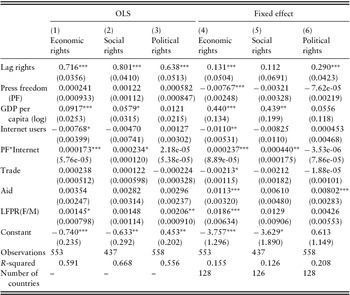
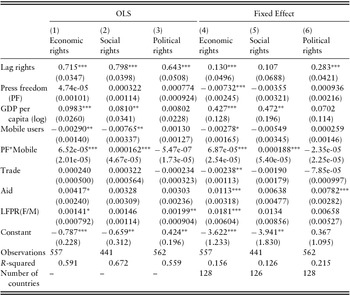
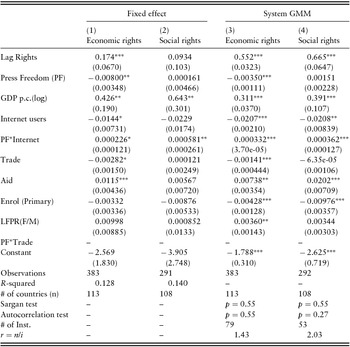
Tables 1 and 2 present the baseline results. In Tables 1 and 2, we present the results for the two measures of reach of media – internet users and mobile users – interacted with PF. For all the tables, columns (1)– (3) present OLS results, and columns (4)–(6) present fixed effects results. Our main variables of interest are PF and PF interacted with internet users and mobile users. For almost all the alternate specifications in the three tables, the coefficients of the interaction term, PF*Internet and, PF*Mobile are positive and significant. Yet, the direct impact of PF is negative in the two tables and in many cases the coefficient is significant. Similar is true for measures of reach – internet or mobile users. Yet, these findings are not conflicting. The foremost thing to be aware of is, in the presence of an interaction term between two variables, say X and Y, the overall impact of X on the dependent variable can only be analyzed based on the values of Y. The direct impact of X on the dependent variable is valid for Y equal to zero or vice versa. Thus, for the regressions in this paper, the impact of PF on women's rights can only be analyzed based on different values of media reach. The meaningful interpretation of a direct impact of PF on women's rights is the impact of the former when media reach is zero. For our sample, as evident from the summary statistics such a value of internet or mobile users is economically meaningful. The results suggest that when media reach is extremely low, the impact of PF on women's rights is negative suggesting that PF may not be beneficial in enhancing women's rights when reach is low. We need marginal estimates to interpret the coefficients of media meaningfully along with the interaction terms. The positive and significant coefficients of the interaction term suggest that as reach of media improves, PF has a beneficial impact on women's rights. The same is true when we look at the coefficients of internet or mobile users. They need to be interpreted based on marginal estimates as well. The negative impact suggests that for 0 values of PF, the impact of internet or mobile users on women's rights is negative. The value ‘0’ is meaningful for our sample and suggest that for very low values of PF, reach will fail to enhance women's rights. Based on equation (2), we estimate the marginal estimates later for the System GMM that allow us to meaningfully interpret the coefficients.
Impact of press freedom on women's rights for different levels of media reach internet users

Note 1: Robust standard errors in parentheses; ***p < 0.01, **p < 0.05, *p < 0.1.
Note 2: Period dummies included.
Impact of press freedom on women's rights for different levels of media reach (mobile users)

Note 1: Robust standard errors in parentheses; ***p < 0.01, **p < 0.05, *p < 0.1.
Note 2: Period dummies included.
Our results are never significant for the specifications with political rights, as in most countries, women occupy only a small fraction of legislative positions and are generally less likely to participate in politics (The World Bank, 2012). The results are qualitatively similar for OLS and fixed effect estimates. Our preliminary findings state that the impact of PF on women's rights can be enhanced in the presence of greater internet users and mobile users. As mentioned earlier, we interpret the coefficients in greater detail in section 5.2 when we talk about the estimated marginal impacts. GDP per capita has a positive and significant impact on women's rights for most of the specifications. In terms of the other controls, labor force participation rate of females to males has a positive and significant impact on women's rights.
Benchmark results
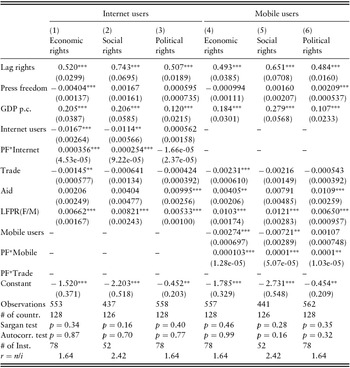
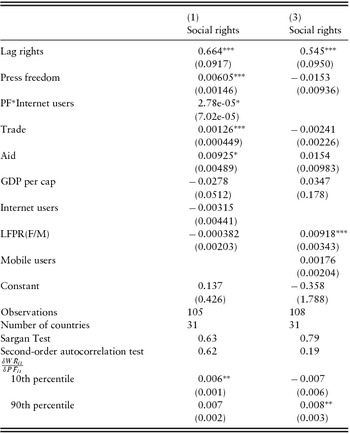
As explained in section 4, OLS and Fixed Effect estimates are not apt for handling several panel data challenges. System GMM estimator is our benchmark estimator. Table 3 presents the results. Columns (1) to (3) present the results for PF interacted with internet users and columns (4) to (6) report the results for PF interacted with mobile users. As mentioned before, PF, reach of media (internet and mobile users) and the corresponding interactions are treated endogenous in all our specifications. Similar to our baseline results, the coefficients of PF are negative and sometimes significant. Yet, the interaction terms are always positive and significant. The interpretation is similar as before – for low levels of reach, PF fails to enhance women's rights. As reach improves, PF is capable of having a beneficial impact on women's rights. Again, the coefficient of GDP per capita is positive and significant for most of the specifications.
System GMM specifications: impact of press freedom on women's rights for different levels of media reach (internet and mobile) and trade openness

Note 1: Standard errors in parentheses; ***p < 0.01, **p < 0.05, *p < 0.1.
Note 2: Period dummies included.
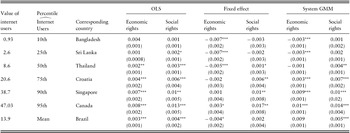
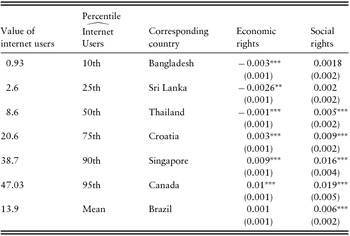
We delve deeper in the analysis by estimating the marginal impacts. In Table 4A, we report the estimated impact of PF on WR for different levels of internet use. Thus, we estimate equation (2) considering internet use as a measure of reach. We report the estimated marginal effects based on OLS, Fixed Effect and System GMM estimates. We do not report the results for political rights since the coefficients are never significant. The means for
 $\widehat{{{\it internet}}}\ {{\it use}}$
are calculated for each country and then the marginal impacts are estimated at the 10th, 25th, 50th, 75th, 90th and 95th percentiles of the means as well as the mean of internet users (see, Asiedu et al., Reference Asiedu, Jin and Nandwa2009; Cooray et al., Reference Cooray, Mallick and Dutta2014; Dutta and Sobel, Reference Dutta and Sobel2016). The country names reported in Table 4A correspond to the particular percentile of internet use and help us better understand where countries lie in terms of internet use and the degree to which female rights are increased or decreased due to changes in PF. For example, countries such as Bangladesh and Sri Lanka with very low internet use do not in general benefit from PF. With the exception of a statistically significant positive effect of PF on social rights under OLS estimation for Sri Lanka, the effect on economic rights is negative and significant. In the presence of very low reach of media (low internet users), the improvement in PF is not beneficial as citizens’ accessibility to information generated by the press is very low. Thus, it might be true that a section of the population benefits from the free flow of information, and a greater majority is deprived. Thus, media fails to be the voice for an improvement in women's rights. The opposite holds for countries with high internet use such as Singapore, and Canada. We find that the marginal impact is positive for all components of women's rights for Canada and for all except in the case of economic rights under OLS estimation for Singapore. The positive marginal impacts suggest that with higher internet usage, citizens are able to get all the information spread by the media and, thus, both traits of the media sector – freedom and reach – successfully enhance women's rights. The joint power of the two traits of the media sector – freedom and reach – in improving governance can be witnessed in the following example – ‘a video of Peru's one-time intelligence chief, Vladimiro Montesinos, paying a bribe to a congressman was leaked to the media in September 2000. The resulting scandal brought down President Alberto Fujimori's ten year of autocratic rule’ (Dutta and Roy, Reference Dutta and Roy2016).
Marginal impact of press freedom on women's rights at different levels of media reach (internet users)
 $\frac{{\delta W{R_{it}}}}{{\delta P{F_{it}}}} = \ {\hat{\beta }_1} + {\hat{\beta }_2}^{\ast}\;{\rm{Internet}}\ {\rm{users,}}$
evaluated at various values of internet users.
 ${\hat{\beta }_1}$
and
 ${\hat{\beta }_2}$
correspond to estimates from Tables 1 and 4

Note1: These marginal impacts have been estimated based on the estimates from Tables 1 and 4.
Note2: Standard errors in parentheses; ***p < 0.01, **p < 0.05, *p < 0.1.
To provide further economic significance of our findings and what the marginal estimates mean, we consider two country examples. We choose two countries with almost similar PF scores to be able to compare how a similar improvement in PF for these two countries would affect their women's rights scenario. The two countries chosen are Tunisia and Yemen. The average PF scores are 25 and 28, respectively. For Yemen, one standard deviation rise in PF will deteriorate economic rights of women by 0.1 percentage points, based on System GMM estimates (column (5)). This is due to its very low internet users per 100 people (2.4). Yet, the same rise in PF for Tunisia will improve its economic rights by 0.02 percentage points since it has higher internet users of almost 10 per 100 people. On a scale of 0 to 3 for economic rights, a 0.2 percentage improvement translates to almost 1% improvement. This reinforces our hypothesis. Even with relatively low PF score, Tunisia could benefit since it has higher internet users compared to Yemen. Compared to Yemen, Tunisia gains by 120% in terms of its improvement in economic rights. For a country like Croatia lying at the 75th percentile, one standard deviation rise in PF will raise its economic rights by 0.1 percentage points, translating to a 2.5%increase.
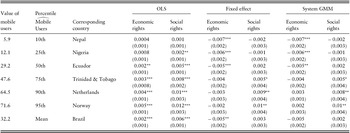
In Table 4B, we report the same for a different measure of access to media. The alternate measure is mobile users. Similar to Table 5A, the means for
 $\widehat {{{Mobile}}\;{{use}}}$
is calculated for each country and then the marginal impacts are estimated at the 10th, 25th, 50th, 75th, 90th and 95th percentiles of the means as well as the mean of mobile use. We find that PF does not help enhance women's economic and social rights for very low levels of reach (accessibility). For example, in the case of Nepal, which lies at the bottom of our sample in terms of mobile users, PF has negative or insignificant impact on women's social and economic rights. But we find that for countries with greater mobile users, the impact of PF on women's rights is positive and significant. The coefficients on economic rights for Nepal suggest that due to low mobile phone use, economic rights do not increase through higher PF. So, in terms of economic significance, one standard deviation rise in PF for Nepal, lying at the 10th percentile, will worsen its social rights (based on System GMM estimates) by 0.1 percentage point although the effect is not significant. Yet, for a country like Trinidad and Tobago, lying at the 50th percentile, the same improvement in PG will raise its social rights by 0.2 percentage points.
Marginal impact of press freedom on women's rights at different levels of media reach (mobile users)
 $\frac{{\delta W{R_{it}}}}{{\delta P{F_{it}}}} = \ {\hat{\beta }_1} + {\hat{\beta }_2}^{\ast}\;{\rm{Mobile}}\ {\rm{users}}$
, evaluated at various values of internet users.
 ${\hat{\beta }_1}$
and
 ${\hat{\beta }_2}$
correspond to estimates from Tables 1 and 4

Note1: These marginal impacts have been estimated based on the estimates from Tables 1 and 4.
Note2: Standard errors in parentheses; ***p<0.01, **p < 0.05, *p < 0.1.
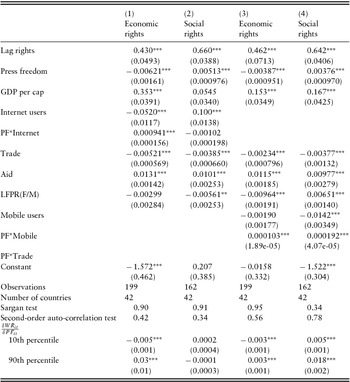
Impact of press freedom on women's rights for different levels of reach and trade openness – inclusion of education

Note 1: Standard errors in parentheses; ***p < 0.01, **p < 0.05, *p < 0.1.
Note 2: Period dummies included.
6. Robustness analysis
We present a series of robustness checks to make sure that our results are neither subject to omitted variable bias nor sensitive to alternate measures of our main variables of interest – like PF or reach of media. Further, we also check our results to another channel through which PF can potentially affect women's rights.
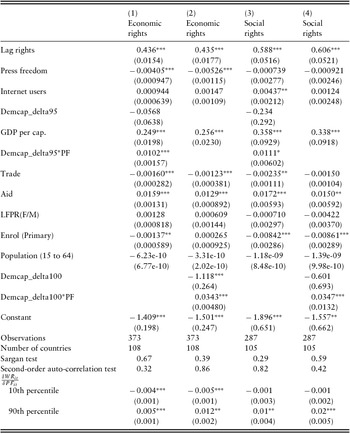
Our first set of robustness tests consist of checking our results to additional controls to minimize omitted variable bias. We include several measures of education but, keeping the space constraint in mind, we report the results only for the measure – net adjustment primary enrolment rates. We choose this measure because of the data availability factor; compared to the other measures of education from World Bank, this measure has decent data availability. The other measures we consider are secondary enrolment of females and the ratio of male to female tertiary enrolments, but these are not reported. Higher human capital stock, in general, has been shown to positively impact economic development outcomes (Mallick and Moore, Reference Mallick and Moore2008) and, thus, should affect women's rights. As we can see from Table 5, our overall conclusions remain robust. Internet users is the considered media reach measure and we do not report the results for mobile users keeping space constraint in mind. While the interaction term is positive and significant, the direct impact of PF and internet users continues to be negative. This reiterates our previous findings – we have to analyze the impact of PF or internet users in terms of the other variables since we have an interaction term in our specification. Overall, the conclusions suggest that for low levels of PF, internet users fail to enhance women's rights. This is also evident from the marginal estimates in Table 6. The same analysis applies to the direct impact of internet users which needs to be analyzed in terms of PF. We find that the impact of PF on women's economic rights is positive in countries such as Croatia, Singapore and Canada which fall into the 75th, 90th and 95th percentiles, respectively of internet use. In terms of economic significance, the results suggest that when media reach (or internet usage) is at the top end of the distribution, the impact of PF on women's rights is positive suggesting that PF is highly beneficial in enhancing women's rights when reach is high.
Marginal impact of press freedom on women's rights at different levels of reach and openness (education included as a control)
 $\frac{{\delta W{R_{it}}}}{{\delta P{F_{it}}}} = \ {\hat{\beta }_1} + {\hat{\beta }_2}^{\ast}\;{\rm{Internet}}\ {\rm{users}}$
, evaluated at various values of internet users.
 ${\hat{\beta }_1}$
and
 ${\hat{\beta }_2}$
correspond to estimates from Table 5

Note1: These marginal impacts have been estimated based on the estimates from Table 5.
Note2: Standard errors in parentheses; ***p < 0.01, **p < 0.05, *p < 0.1.
In terms of education's impact on women's rights, we find that as primary enrolment rises, women's right is hurt. The impact is not significant in the case of OLS and Fixed Effect estimates, but becomes significant for System GMM estimates. One possible explanation is that more educated females are likely to demand more rights that can be perceived as a threat due to the change in power structure. As stated in Folbre (Reference Folbre1994), changing power structureFootnote 5 can be perceived by males as a threat to their position in the society. Thus, they might oppose to improvement in women's rights. Since our measure of primary enrolment does not explicitly state the ratio of males and females, the positive effect of an improvement in women's primary education can be outweighed by the negative impact of male's primary education. Further, as stated by Cooray et al. (Reference Cooray, Dutta and Mallick2016), primary education by females may not effectively lead to positive development outcomes since such basic education may not be sufficient to be aware and act as needed. For the other measures of education, the results remain robust.
Our next set of robustness analysis consists of checking our benchmark findings with alternate sub-samples. While fixed country effects are taken into account in our specifications along with regional differences, we want to check if certain regions of the world benefit more or less from changes in PF with regard to its impact on women's rights. Specifically, we consider the regions of Sub-Saharan Africa (SSA) and Asia. These regions face critical challenges with regard to enforcing and maintaining women's rights and, thus, it is crucial to check the impact of PF and the other factors and if the magnitude differs from our overall findings. Table 7 presents the results for SSA. Apart from specification in column (2), PF*internet users, PF*mobile users or PF*trade are positive and significant for all the other specifications. Keeping space constraint in mind, we report the marginal estimates for the 10th and the 90th percentiles of internet users and mobile users, respectively corresponding to the particular specifications. Reporting the estimates for the two ends of the spectrum of our sample provides us with a detailed perspective of the magnitude of the impact. The magnitude of the marginal estimates is qualitatively similar to our benchmark findings. GDP per capita has a positive and significant impact for most of the specifications. In Table 8, we provide the results for the countries in Asia. For these set of countries, the results are never significant for economic rights. Also, the results are not significant when we interact PF with mobile users. We present the results for internet users considering social rights as the dependent variable. The marginal estimates remain qualitatively similar though they are not significant in all the cases.
System GMM specifications: impact of press freedom on women's rights for different levels of reach (internet and mobile) – SSA

Note 1: Standard errors in parentheses; ***p < 0.01, **p < 0.05, *p < 0.1.
Note 2: Period dummies included.
System GMM specifications: impact of press freedom on women's rights for different levels of reach (internet and mobile) – Asia

Note 1: Standard errors in parentheses; ***p < 0.01, **p < 0.05, *p < 0.1.
Note 2: Period dummies included.
We next check our findings with alternate measures of PF. ‘Reporters with Borders’ publishes a comprehensive measure of PF that includes different vital components including violation of journalistic freedom. The main challenge we face in using the data is the sample period. Reporters without borders database does not start before 2002 and thus, considering 3-year averages, we are able to get only three time points for each country. Our sample shrinks considerably and, thus, our coefficients of interest lose significance. Instead, we use an alternate proxy from World Governance Indicators (WGI) that has better coverage. We use the comprehensive proxy of Voice and Accountability (V&A) – which is a sub-measure of WGI's Governance Index. The V&A measure is defined as ‘capturing perceptions of the extent to which a country's citizens are able to participate in selecting their government, as well as freedom of expression, freedom of association, and a free media’. The variable measures not only PF aspect on the media sector, but also measures how the content is perceived by the populace. Further, it proxies for the system's tolerance and responsiveness to public opinion along with measuring some aspects of media reach. Thus, this measure is very suited for our study as it provides a comprehensive measure of the different essential traits of the media sector.
We check our results with V&A without considering the interaction term PF*Reach, since this measure captures all essential aspects of the media sector. Keeping space constraint in mind, we do not report the results but they are available on request. In the case of economic rights, the coefficient of V&A is not significant. For social rights, the coefficient is positive and significant. In terms of economic significance, one standard deviation rise in V&A raises women's social rights by 0.16 percentage points that translates to almost 3% increase.
Finally, we explore yet another channel via which PF can affect women's rights. We argue based on previous literature that democracies provide the essential checks and balances and ensure transparency of government actions. Thus, the media sector is allowed to produce its desired functions without much interference. Accordingly, higher PF in the presence of greater democratic stability should allow PF to enhance positive rights and reduce the infringement on negative rights. As a measure of democracy and its associated stability, we consider the measure of democratic capital from Persson and Tabellini (Reference Persson and Tabellini2009). As defined by the authors, democratic capital is measured based on a ‘nation's historical experience with democracy and by the incidence of democracy in its neighborhood. Democratic capital captures the historical tradition of a nation's democracy as well as if the nation is surrounded by well-functioning democracies or not. Domestic democratic capital measures the marginal accumulation of democratic capital from the time of a nation's independence. They construct the measure on the idea of depreciation of democracy similar to physical capital and consider two different rates of depreciation. As the authors explain, the measure captures the resilience of democratic institution of a nation and the build-up of formal and informal institutions over time. Foreign democratic capital is based on the incidence of democracy in its neighborhood.
We present the results in Table 9. Democratic capital measures for both rates of depreciation are considered. We construct the interaction terms, PF*domestic democratic capital (depreciation, δ = 0.95), PF*domestic democratic capital (depreciation, δ = 0.1) and PF*foreign democratic capital. We run these for economic and social rights. We find that the interactions are positive and significant for all the specifications. PF*foreign democratic capital is not significant for either social or economic rights. So we do not report those specifications. We estimate the marginal estimates at the 10th and 90th percentiles of democratic capital. Our conclusions remain unchanged. As evident from the negative direct impact of PF, for low levels of democratic capital, PF deteriorates women's rights. As democratic capital improves, we see a significant positive impact of PF.
System GMM specifications: impact of press freedom on women's rights for different levels of democratic capital

Note 1: Standard errors in parentheses; ***p < 0.01, **p < 0.05, *p < 0.1.
Note 2: Period dummies included.
7. Conclusion and policy implications
This paper investigates the impact of media freedom on women's rights. We find that a free media alone does not lead to empowering women's rights. Our estimated marginal impacts suggest that greater media reach (or accessibility as measured by internet and mobile users), and higher democratic capital increase the impact of media freedom on women's rights. Our results indicate that media freedom should be accompanied by increased accessibility or it will not have the desired consequences in increasing women's rights. Greater democratic capital is also an important precursor to the access and reach of information as they enhance transparency, making a government more accountable to its citizens. While higher PF can enhance positive rights and reduce the infringement on negative rights, it works better in conjunction with other necessary institutions.
In addition, we find a significant positive correlation between women's economic and social rights and GDP per capita. But there is little relation, on average, between women's political rights and freedom of the press, which suggests that women's rights are probably still lacking in many poorest countries of the world. Yet, in light of the debate that exists in the literature with regard to public–private sphere of media, countries with greater dominance of men in the public sphere of media and with a strong patriarchal mindset may not benefit much with a free press, or greater reach, unless informal institutions inherently change.
Acknowledgements
The authors are grateful to the editor and the two anonymous reviewers for their constructive comments, which have significantly improved the paper. The usual caveat applies.
Appendix A: summary statistics