



1 Introduction
We start by setting up some basic notation for our paper in Subsection 1.1.
1.1 Notation
Throughout this paper, given a self-map f on some quasiprojective variety X, we denote by
 $f^n$
its n-th compositional power; by convention,
 $f^0$
represents the identity map
 $\mathrm {id}_X$
on X. A preperiodic point
 $x\in X$
for f has the property that
 $f^m(x)=f^n(x)$
for some
 $0\le m<n$
; if
 $m=0$
(i.e.,
 $f^n(x)=x$
), then the point x is called periodic (under the action of f).
1.2 Our results
We prove the following main result.
Theorem 1.1 Let
 $d\ge 2$
be an integer, let L be a field of characteristic
 $p>0$
, and let
 $\alpha ,\beta \in L$
. We let
 ${\overline {L}}$
be a fixed algebraic closure of L, and we let
 ${\overline {\mathbb F}_p}$
be the algebraic closure of
 ${\mathbb F}_p$
inside
 ${\overline {L}}$
. We consider the family of polynomials
 $$ \begin{align*}f_\lambda(x):=x^d+\lambda\text{ parameterized by }\lambda\in {\overline{L}}.\end{align*} $$
Then there exist infinitely many
 $\lambda \in {\overline {L}}$
such that both
 $\alpha $
and
 $\beta $
are preperiodic under the action of
 $f_\lambda $
if and only if at least one of the following statements holds:
-
(1)
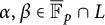
 $\alpha ,\beta \in {\overline {\mathbb F}_p} \cap L$
.
-
(2)
$d=p^\ell $
for some positive integer
$\ell $
and
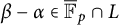
$\beta -\alpha \in {\overline {\mathbb F}_p}\cap L$
. -
(3)
$\alpha ^d=\beta ^d$
.



Moreover, if either one of the conditions (1)–(3) holds, then for each
 $\lambda \in {\overline {L}}$
, we have that
 $\alpha $
is preperiodic under the action of
 $f_\lambda $
if and only if
 $\beta $
is preperiodic under the action of
 $f_\lambda $
.
1.3 The principle of unlikely intersections
Our Theorem 1.1 fits into the general principle of unlikely intersections; for a wonderful introduction to this area stemming from classical arithmetic geometry, we refer the reader to the book [Reference ZannierZan12].
Inspired by the results of Masser and Zannier from [Reference Masser and ZannierMZ10], Baker and DeMarco [Reference Baker and DeMarcoBD11] proved a first outstanding result for unlikely intersections in a purely dynamical context. So, given an integer
 $d\ge 2$
and given complex numbers a and b, Baker-DeMarco [Reference Baker and DeMarcoBD11] prove that if there exist infinitely many
 $\lambda \in {\mathbb C}$
such that both a and b are preperiodic under the action of
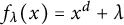 $f_\lambda (x)=x^d+\lambda $
, then
 $a^d=b^d$
. In other words, the infinite occurrence of the unlikely event that both a and b are preperiodic points for the same polynomial
 $f_\lambda $
can only happen if both a and b have the same iterates under the entire family of maps
 $\{f_\lambda \}_{\lambda \in {\mathbb C}}$
; so, a very rigid global condition is derived from the existence of infinitely many discrete unlikely events. The result of [Reference Baker and DeMarcoBD11] was extended for more general families of polynomials and starting points (see [Reference Ghioca, Hsia and TuckerGHT13, Reference Baker and DeMarcoBD13], for example), including families of polynomials parameterized by points in a higher dimensional space (see [Reference Ghioca, Hsia and TuckerGHT15, Reference Ghioca, Hsia and TuckerGHT16]). Also, extensions of [Reference Baker and DeMarcoBD11] were obtained for certain families of rational maps (see [Reference DeMarco, Wang and YeDWY15, Reference Ghioca, Hsia and TuckerGHT15]), and also for arbitrary families of Lattés maps (see [Reference DeMarco and MavrakiDM20]). Each time, the proof of any of the above results had two distinct parts. First, one proves that a certain equidistribution theorem for points of small height holds for the given dynamical system, which leads to knowing that certain canonical heights (suitably normalized) computed for the two starting points with respect to our family of maps are equal. Second, using the equality of the above canonical heights, one derives the precise relation between the two starting points.
Now, the key ingredient for establishing the first part of the above strategy comes from any of the equidistribution theorems of Baker-Rumely [Reference Baker and RumelyBR06], Chambert-Loir [Reference Chambert-LoirCL06], Favre-Rivera-Letelier [Reference Favre and Rivera-LetelierFRL06], or Yuan [Reference YuanYua08]. Verifying the hypotheses of the aforementioned equidistribution theorems is the difficult part and requires a detailed analysis of the arithmetical properties of the given dynamical system. Usually, completing the second step of the above strategy is easier, and it generally relies on two ingredients: a complex dynamics argument (which in turn uses crucially some key features of complex analytic functions, such as the Open Mapping Theorem), along with the refined characterization provided by Medvedev and Scanlon [Reference Medvedev and ScanlonMS14] of the subvarieties of
 ${\mathbb A}^N$
, which are invariant under the coordinatewise action of N one-variable polynomials. All of the above results hold over fields of characteristic
 $0$
, essentially because in positive characteristic, one lacks completely the tools for dealing with the aforementioned second step. In the present paper, we obtain a first complete answer to an unlikely intersection problem for a dynamical system in characteristic p.
1.4 The picture in positive characteristic
Overall, there are only a handful of results for the unlikely intersection principle in characteristic p. These known results are valid for Drinfeld modules (see [Reference Brownawell and MasserBM17, Reference Brownawell and MasserBM22, Reference Ghioca and HsiaGH13, Reference GhiocaGhi24]) since the Drinfeld modules are the natural vehicle in positive characteristic for many of the classical questions in arithmetic geometry, such as the André-Oort conjecture (see [Reference BreuerBre05]), the Bogomolov conjecture (see [Reference BosserBos02]), the Mordell-Lang conjecture (see [Reference GhiocaGhi05, Reference Ghioca and TuckerGT08]), the Manin-Mumford conjecture (see [Reference ScanlonSca02]), and the Siegel’s theorem (see [Reference Ghioca and TuckerGT07]). Generally, if one tries to prove results in characteristic p beyond the world of Drinfeld modules, then one encounters significant difficulties, especially in a purely dynamical setting.
In Theorem 1.1, we establish the counterpart of the main result of [Reference Baker and DeMarcoBD11] in positive characteristic. The three different possibilities (1)–(3) from Theorem 1.1 show the distinct three scenarios one has to deal with when working arithmetic questions in characteristic p. First, we have the case when the starting points
 $\alpha $
and
 $\beta $
live in
 ${\overline {\mathbb F}_p}$
– that is, the so-called isotrivial case, which is always very special. Second, we have the case when
 $d=p^\ell $
is a power of the characteristic; this is special since then each polynomial
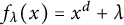 $f_\lambda (x)=x^d+\lambda $
from our family is an affine map on
 $\mathbb {G}_a$
(i.e., it is a composition of an additive polynomial
 $x\mapsto x^{p^\ell }$
with a translate
 $x\mapsto x+\lambda $
). Third, we have the generic case; that is, in the absence of the above two cases, then indeed the only possibility for
 $\alpha $
and
 $\beta $
to admit infinitely many parameters
 $\lambda $
such that both starting points are preperiodic under the action of
 $f_\lambda $
is when
 $\alpha ^d=\beta ^d$
(same as in characteristic
 $0$
).
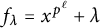
Remark 1.2 The second case above (i.e., case (2) in Theorem 1.1) appears due to the fact that when
 $d=p^\ell $
, our family of polynomials
 $f_\lambda =x^{p^\ell }+\lambda $
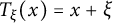
commutes with additional polynomials (besides the identity map). In fact, given any translate
 $T_\xi (x)=x+\xi $
for some
 $\xi \in {\overline {\mathbb F}_p}$
, then
 $T_\xi $
commutes with
 $f^m_\lambda $
, where m is a positive integer so that
 $\xi \in \mathbb {F}_p^{\ell m}$
.
1.5 The strategy for our proof
We also prove (see Theorem 6.1) a generalization of Theorem 1.1 by replacing the hypothesis that there exist infinitely many parameters
 $\lambda $
for which both
 $\alpha $
and
 $\beta $
are preperiodic under the action of
 $f_\lambda $
with the weaker hypothesis that (in a suitable product formula field L) there exist infinitely many parameters
 $\lambda _n$
such that
 $$ \begin{align} \lim_{n\to\infty}\widehat{h}_{f_{\lambda_n}}(\alpha)=\widehat{h}_{f_{\lambda_n}}(\beta)=0; \end{align} $$
for more details regarding the global canonical heights
 $\widehat {h}_{f_\lambda }$
, see Subsection 3.5. The fact that we can reduce in our Theorem 1.1 to the case L is a product formula field is explained in Subsection 6.1 (especially, see Proposition 6.2). Also, as noted in Remark 3.9, once
 $\alpha $
(or
 $\beta $
) is preperiodic under the action of
 $f_\lambda $
, then its global canonical height (with respect to
 $f_\lambda $
) equals
 $0$
; hence, the condition (1.5.1) is weaker than the hypothesis from Theorem 1.1.
Similar to the proof of Baker-DeMarco [Reference Baker and DeMarcoBD11], the first move is proving that the equidistribution theorem from [Reference Baker and RumelyBR10] holds, which allows us to conclude that certain local canonical heights constructed with respect to the two starting points
 $\alpha $
and
 $\beta $
are equal (for more details, see Section 3 and, also, see Theorem 4.1). In order to state the equidistribution theorem that we will employ in our proof (see Theorem 2.2), we need a technical setup both from the theory of Berkovich spaces and also from arithmetic dynamics; this is done in Section 2. We continue by introducing canonical heights (both local and global) associated to our family of polynomials; this is done in Section 3. Our results from Section 3 provide the technical background for obtaining the crucial Theorem 4.1 in Section 4. Theorem 4.1 says that the existence of an infinite sequence of parameters
 $\lambda _n$
satisfying equation (1.5.1) yields that for each parameter
 $\lambda $
and for each nonarchimedean place v of L, we have
 $$ \begin{align} \widehat{h}_{v,\lambda}(\alpha)=\widehat{h}_{v,\lambda}(\beta); \end{align} $$
for the precise definition of the local canonical heights
 $\widehat {h}_{v,\lambda }$
, we refer the reader to Section 3.
In Section 5, we prove Proposition 5.1, which says that assuming equation (1.5.2) holds (for each place v and each parameter
 $\lambda $
), and also assuming that d is a not a power of p and that not both
 $\alpha $
and
 $\beta $
live in
 ${\overline {\mathbb F}_p}$
, then condition (3) from Theorem 1.1 must hold. Its proof requires a refined analysis of the valuations for
 $\alpha ^d-\beta ^d$
, obtained by employing equation (1.5.2) for suitably chosen parameters
 $\lambda $
. Theorem 4.1 coupled with Proposition 5.1 proves the direct implication (which is the much harder part) from the conclusion of Theorem 1.1. Finally, in Section 6, we conclude our proof of Theorem 1.1. We actually state and prove the more general Theorem 6.1 and show first how to deduce Theorem 1.1 as a consequence of Theorem 6.1. The main part of Section 6 is devoted to proving Theorem 6.1; once again, the key ingredient is our Proposition 5.1.
2 Equidistribution for points of small height
As mentioned in Section 1, we will need to apply the arithmetic equidistribution discovered independently by Baker-Rumely [Reference Baker and RumelyBR06], Chambert-Loir [Reference Chambert-LoirCL06], and Favre-Rivera-Letelier [Reference Favre and Rivera-LetelierFRL06]; when the base field is a nonarchimedean field, the equidistribution theorem is best stated over the Berkovich space associated to the underlying variety in question. We will introduce briefly the desired equidistribution theorem for points of small height (see Theorem 2.2); for a comprehensive introduction to Berkovich spaces, we refer the reader to [Reference Baker and RumelyBR10]. In our presentation, we use the approach of Baker-Rumely, which connects the equidistribution theorem to the theory of arithmetic capacities. Hence, the material presented in this Section 2 is mainly from the book [Reference Baker and RumelyBR10] by Baker and Rumely.
So, following [Reference Baker and RumelyBR10, Definition 7.51], we let L be a field of characteristic p endowed with a product formula (i.e., there exists a set
 $\Omega _{L}$
of (pairwise inequivalent) absolute values satisfying the following conditions):
-
(i) for each nonzero
$x\in L$
, we have
$|x|_v=1$
for all but finitely many
$v\in \Omega _L$
; and -
(ii) for each nonzero
$x\in L$
, we have (2.0.1)
$$ \begin{align} \prod_{v\in\Omega_L}|x|_v=1. \end{align} $$


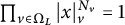
We note that usually, one asks that the product formula (2.0.1) holds in a slighly more general form:
 $\prod _{v\in \Omega _L}|x|_v^{N_v}=1$
for some given positive integers
 $N_v$
; however, since all the absolute values from
 $\Omega _L$
are nonarchimedean, we can absorb the exponents
 $N_v$
in the definition of the respective absolute values
 $|\cdot |_v$
(see also [Reference Ghioca and HsiaGH13, Equation 2.2]). Furthermore, as mentioned in [Reference Baker and RumelyBR10, Chapter 7], one does not require L to be a global (function) field, but rather one needs that L is a general product formula field (see equations (i)–(ii) above). In particular, we can let
 $L_0$
be the perfect closure of the rational function field (in one variable) over
 ${\overline {\mathbb F}_p}$
, that is,
 $$ \begin{align} L_0:={\overline{\mathbb F}_p}\left(t, t^{1/p}, t^{1/p^2},\cdots, t^{1/p^n},\cdots\right), \end{align} $$
and then take L to be any finite extension of
 $L_0$
; then L is a product formula field. Indeed, each place of
 ${\overline {\mathbb F}_p}(t)$
(which geometrically, corresponds to a point of
 $\mathbb {P}^1({\overline {\mathbb F}_p})$
) extends uniquely to a place w of
 $L_0$
, thus making
 $L_0$
a product formula field. Above each given place w of
 $L_0$
, there exist finitely many places v of L; we denote by
 $\Omega :=\Omega _L$
this set of places of L. Then L is a product formula field with respect to
 $\Omega $
. Furthermore, the separable closure
 $L^{\mathrm {sep}}$
of L coincides with its algebraic closure
 ${\overline {L}}$
(see also [Reference Ghioca and ShparlinskiGS22, Remark 1.1]). Finally, we have the following fact: only the points in
 ${\overline {\mathbb F}_p}$
are the points
 $x\in L$
which are integral at each place in
 $\Omega $
; that is,
 $$ \begin{align} \text{if }|x|_v\le 1\text{ for each }v\in\Omega\text{, then }x\in{\overline{\mathbb F}_p}. \end{align} $$
In the rest of this section, we work with an arbitrary product formula field L; however, the relevant case for our results is a finite extension of the field from (2.0.2). Now, for each
 $v\in \Omega _L$
, we let
 ${\mathbb C}_v$
be an algebraically closed field containing L, which is also complete with respect to a fixed extension of
 $|\cdot |_v$
to
 ${\mathbb C}_v$
. Let
 ${\mathbb A}_{\mathrm {Berk},{\mathbb C}_v}^1$
denote the Berkovich affine line over
 ${\mathbb C}_v$
(see [Reference Baker and RumelyBR10] or [Reference Baker and DeMarcoBD11, Section 2] for more details). In order to apply the main equidistribution result from [Reference Baker and RumelyBR10, Theorem 7.52], we recall briefly the potential theory on the affine line over
 ${\mathbb C}_v$
. The right setting for nonarchimedean potential theory is the potential theory on
 ${\mathbb A}_{\mathrm {Berk},{\mathbb C}_v}^1$
developed in [Reference Baker and RumelyBR10]. We quote here part of a nice summary of the theory from [Reference Baker and DeMarcoBD11, Section 2] without going into details (we refer the reader to [Reference Baker and RumelyBR10, Reference Baker and DeMarcoBD11] for all the details and proofs).
So, let E be a compact subset of
 ${\mathbb A}_{\mathrm {Berk},{\mathbb C}_v}^1$
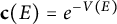
. Then analogous to the complex case, the logarithmic capacity
 ${\mathbf c}(E) = e^{-V(E)}$
, and the Green’s function
 $G_E$
of E relative to
 $\infty $
can be defined where
 $V(E)$
is the infimum of the energy integral with respect to all possible probability measures supported on E. If
 ${\mathbf c}(E)> 0$
, then the exists a unique probability measure
 $\mu _E$
, also called the equilibrum measure on E, attaining the infimum of the energy integral. Furthermore, the support of
 $\mu _E$
is contained in the boundary of the unbounded component of
 ${\mathbb A}_{\mathrm {Berk},{\mathbb C}_v}^1\setminus E$
. The Green’s function
 $G_E(z)$
of E relative to infinity is a well-defined nonnegative real-valued subharmonic function on
 ${\mathbb A}_{\mathrm {Berk},{\mathbb C}_v}^1$
which is harmonic on
 ${\mathbb A}_{\mathrm {Berk},{\mathbb C}_v}^1\setminus E$
(in the sense of [Reference Baker and RumelyBR10, Chapter 8]). The following result (see [Reference Baker and DeMarcoBD11, Lemma 2.5]) summarizes the key features of the Green’s function.
Lemma 2.1 Let E be a compact subset of
 ${\mathbb A}_{\mathrm {Berk},{\mathbb C}_v}^1$
and let U be the unbounded component of
 ${\mathbb A}_{\mathrm {Berk},{\mathbb C}_v}^1\setminus E$
.
-
(1) If
${\mathbf c}(E)>0$
(i.e.,
$V(E)<\infty $
), then
$G_E(z) = V(E) + \log |z|_v $
for all
$z\in {\mathbb A}_{\mathrm {Berk},{\mathbb C}_v}^1$
such that
$|z|_v$
is sufficiently large. -
(2) If
$G_E(z) = 0$
for all
$z\in E,$
then
$G_E$
is continuous on
${\mathbb A}_{\mathrm {Berk},{\mathbb C}_v}^1, \mathrm {Supp}(\mu _E) = \partial U$
and
$G_E(z)> 0$
if and only if
$z\in U.$
-
(3) If
$G :{\mathbb A}_{\mathrm {Berk},{\mathbb C}_v}^1\to {\mathbb R}$
is a continuous subharmonic function which is harmonic on
$U,$
identically zero on E, and such that
$G(z) - \log ^+|z|_v$
is bounded, then
$G = G_E$
. Furthermore, if
$G(z)=\log |z|_v + V + o(1)$
(as
$|z|_v\to \infty $
) for some
$V<\infty $
, then
$V(E)=V$
, and so,
${\mathbf c}(E)=e^{-V}$
.















To state the equidistribution result from [Reference Baker and RumelyBR10], we consider the compact Berkovich adèlic sets, which are of the following form
 $$ \begin{align} {\mathbb E} := \prod_{v\in \Omega_L}\, E_v, \end{align} $$
where
 $E_v$
is a nonempty compact subset of
 ${\mathbb A}_{\mathrm {Berk},{\mathbb C}_v}^1$
for each
 $v\in \Omega _L$
, and furthermore,
 $E_v$
is the closed unit disk
 $\mathcal {D}(0,1)$
in
 ${\mathbb A}_{\mathrm {Berk},{\mathbb C}_v}^1$
for all but finitely many
 $v\in \Omega _L$
. The logarithmic capacity
 ${\mathbf c}({\mathbb E})$
of
 ${\mathbb E}$
is defined as follows:
 $$ \begin{align} {\mathbf c}({\mathbb E}) = \prod_{v\in \Omega_L}\,{\mathbf c}(E_v). \end{align} $$
Note that in (2.0.5), there is a finite product as for all but finitely many
 $v\in \Omega _L$
, we have
 ${\mathbf c}(E_v) = {\mathbf c}(\mathcal {D}(0,1)) = 1$
. Let
 $G_v := G_{E_v}$
be the Green’s function of
 $E_v$
relative to
 $\infty $
for each
 $v\in \Omega _L$
. For every
 $v\in \Omega _L$
, we fix an embedding of the separable closure
 $L^{\mathrm {sep}}$
of L into
 ${\mathbb C}_v$
. Let
 $S\subset L^{\mathrm {sep}}$
be any finite subset that is invariant under the action of the Galois group
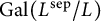 $\mathrm {Gal}(L^{\mathrm {sep}}/L)$
. We define the height
 $h_{{\mathbb E}}(S)$
of S relative to
 ${\mathbb E}$
by
 $$ \begin{align} h_{{\mathbb E}}(S) = \sum_{v\in\Omega_L} \left(\frac{1}{|S|}\sum_{z\in S}G_v(z)\right). \end{align} $$
Note that this definition is independent of the particular embedding
 $L^{\mathrm {sep}}$
into
 ${\mathbb C}_v$
that we choose at each place
 $v\in \Omega _L$
. Finally, for each
 $v\in \Omega _L$
, we let
 $\mu _v$
be the equilibrum measure on
 $E_v$
. The following is a special case of the equidistribution result [Reference Baker and RumelyBR10, Theorem 7.52] that we need for our application.
Theorem 2.2 With the above notation, let
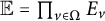 ${\mathbb E} = \prod _{v\in \Omega } E_v$
be a compact Berkovich adèlic set with
 ${\mathbf c}({\mathbb E})=1.$
Suppose that
 $S_n$
is a sequence of
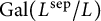 $\mathrm {Gal}(L^{\mathrm {sep}}/L)$
-invariant finite subsets of
 $L^{\mathrm {sep}}$
with
 $|S_n|\to \infty $
and
 $h_{{\mathbb E}}(S_n) \to 0$
as
 $n\to \infty $
. For each
 $v\in \Omega _L$
and for each n, let
 $\delta _n$
be the discrete probability measure supported equally on the elements of
 $S_n$
. Then the sequence of measures
 $\{\delta _n\}$
converges weakly to
 $\mu _v$
the equilibrium measure on
 $E_v$
.
3 Dynamics and heights associated to our family of polynomials
Throughout this section, we let
 $L_0$
be the perfect closure of
 ${\overline {\mathbb F}_p}(t)$
(see its definition from (2.0.2)), and then we let L be a given finite extension of
 $L_0$
. Then each finite extension of L is separable (i.e.,
 $L^{\mathrm {sep}}={\overline {L}}$
); so, from now on, we fix an algebraic closure
 ${\overline {L}}$
of L. Also, for the sake of simplifying our notation, we let
 $\Omega :=\Omega _L$
be the set of inequivalent places of L witnessing the fact that L is a product formula field.
3.1 Preperiodic parameters for a given starting point
We let
 $d\ge 2$
be an integer. We work with a family of polynomials as given in Theorem 1.1 (i.e.,
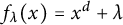 $f_\lambda (x)=x^d+\lambda $
parameterized by
 $\lambda \in {\overline {L}}$
). Given
 $\gamma \in L$
, we define
 $$ \begin{align} P_{n,\gamma}(\lambda):=f^n_\lambda(\gamma)\text{ for each }n\in{\mathbb N}; \end{align} $$
then
 $P_{n,\gamma }(\lambda )$
is a polynomial in
 $\lambda $
. A simple induction on n yields the following result.
Lemma 3.1 With the above hypothesis, for each
 $n\in {\mathbb N}$
, the polynomial
 $P_{n,\gamma }(\lambda )$
is monic and has degree
 $d^{n-1}$
in
 $\lambda $
.
Remark 3.2 We immediately obtain as a corollary of Lemma 3.1 the fact that
 $\gamma $
is not preperiodic for the entire family of polynomials
 $f_\lambda $
. Furthermore, we obtain that if
 $\gamma $
is preperiodic for
 $f_\lambda $
, then
 $\lambda \in {\overline {L}}$
.
3.2 Generalized Mandelbrot sets
From now on, in Section 3, we fix a place
 $v\in \Omega $
.
Following the same approach as in [Reference Baker and DeMarcoBD11], one defines the generalized Mandelbrot set
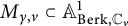 $M_{\gamma ,v}\subset {\mathbb A}_{\mathrm {Berk},{\mathbb C}_v}^1$
associated to
 $\gamma $
; roughly speaking,
 $M_{\gamma ,v}$
is the subset of
 ${\mathbb C}_v$
consisting of all
 $\lambda \in {\mathbb C}_v$
such that
 $P_{n,\gamma }(\lambda )$
is v-adic bounded, as we let
 $n\to \infty $
.
Let
 $\lambda \in {\mathbb C}_v$
and define the local canonical height
 $\widehat {h}_{v,\lambda }(x)$
of
 $x\in {\mathbb C}_v$
with respect to the polynomial
 $f_\lambda $
; more precisely, we have the formula
 $$ \begin{align} \widehat{h}_{v,\lambda}(x) :=\lim_{n\to\infty} \frac{\log^+|f_\lambda^n(x)|_v}{d^{n}}, \end{align} $$
where
 $\log ^+(z)=\log \max \{z,1\}$
for each real number z. Clearly,
 $\widehat {h}_{v,\lambda }(x)$
is a continuous function of both
 $\lambda $
and x on
 ${\mathbb C}_v$
. Also, we will be using the following easy fact:
 $$ \begin{align} \widehat{h}_{v,\lambda}(x)=\frac{\widehat{h}_{v,\lambda}(f_\lambda^m(x))}{d^m}\text{ for each }m\in{\mathbb N}\text{ and for each }x\in{\mathbb C}_v. \end{align} $$
As
 ${\mathbb C}_v$
is a dense subspace of
 ${\mathbb A}_{\mathrm {Berk},{\mathbb C}_v}^1$
, continuity in
 $\lambda $
implies that the canonical local height function
 $\widehat {h}_{v,\lambda }(\gamma )$
has a natural extension on
 ${\mathbb A}_{\mathrm {Berk},{\mathbb C}_v}^1$
(note that the topology on
 ${\mathbb C}_v$
is the restriction of the weak topology on
 ${\mathbb A}_{\mathrm {Berk},{\mathbb C}_v}^1$
, so any continuous function on
 ${\mathbb C}_v$
will automatically have a unique extension to
 ${\mathbb A}_{\mathrm {Berk},{\mathbb C}_v}^1$
). Then
 $\lambda \in M_{\gamma ,v}$
if and only if
 $\widehat {h}_{v,\lambda }(\gamma ) = 0$
. Thus,
 $M_{\gamma ,v}$
is a closed subset of
 ${\mathbb A}_{\mathrm {Berk},{\mathbb C}_v}^1$
; in fact, the following is true (as previously proved in [Reference Baker and DeMarcoBD11]).
Proposition 3.3
 $M_{\gamma ,v}$
is a compact subset of
 ${\mathbb A}_{\mathrm {Berk},{\mathbb C}_v}^1$
.
Proof Since we already know that
 $M_{\gamma ,v}$
is a closed subset of the locally compact space
 ${\mathbb A}_{\mathrm {Berk},{\mathbb C}_v}^1$
, then in order to prove Proposition 3.3, it suffices to show that
 $M_{\gamma ,v}$
is a bounded subset of
 ${\mathbb A}_{\mathrm {Berk},{\mathbb C}_v}^1$
. This last fact follows immediately from Lemma 3.4, part (iii).
The following Lemma 3.4 is not only used in the proof of Proposition 3.3, but it is also repeatedly used throughout Section 5; its proof is easy but its findings are important.
Lemma 3.4 Let
 $\gamma ,\lambda \in {\mathbb C}_v$
.
-
(i) If
$\max \{|\lambda |_v,|\gamma |_v\}\le 1$
, then
$$ \begin{align*}\widehat{h}_{v,\lambda}(\gamma)=0.\end{align*} $$
-
(ii) If
$|\gamma |_v^d>\max \{1,|\lambda |_v\}$
, then (3.2.3)
$$ \begin{align} \widehat{h}_{v,\lambda}(\gamma)= \log|\gamma|_v>0. \end{align} $$
-
(iii) If
$|\lambda |_v>\max \left \{1,|\gamma |_v^{d}\right \}$
, then
$$ \begin{align*}\widehat{h}_{v,\lambda}(\gamma)=\frac{\log|\lambda|_v}{d}>0.\end{align*} $$






Proof of Lemma 3.4.
We first note that conclusion (i) is immediate since knowing that both
 $\lambda $
and
 $\gamma $
are integral at the place v yields that each
 $f_\lambda ^n(\gamma )$
is integral at v, thus showing that
 $\widehat {h}_{v,\lambda }(\gamma )=0$
.
Next, we work under the hypotheses from part (ii). The fact that
 $|\gamma |_v^d>\max \{1, |\lambda |_v\}$
yields that
 $$ \begin{align*}|f_\lambda(\gamma)|_v=|\gamma^d+\lambda|_v=|\gamma|_v^d> |\gamma|_v.\end{align*} $$
An easy induction on n shows that for each
 $n\ge 1$
, we have that
 $$ \begin{align*}\left|f_\lambda^n(\gamma)\right|_v = |\gamma|_v^{d^{n}};\end{align*} $$
then the desired conclusion in part (ii) follows.
Finally, part (iii) is a consequence of part (ii) because the inequality
 $|\lambda |>\max \left \{1,|\gamma |_v^{d}\right \}$
yields
 $$ \begin{align} \left|f_\lambda(\gamma)\right|_v=\left|\gamma^d+\lambda\right|_v=|\lambda|_v>|\lambda|_v^{\frac{1}{d}}. \end{align} $$
Equation (3.2.4) allows us to apply the conclusion from part (ii) to the point
 $f_\lambda (\gamma )$
and the parameter
 $\lambda $
, and thus, we get
 $$ \begin{align*}\widehat{h}_{f_\lambda}(f_\lambda(\gamma))=|f_\lambda(\gamma)|_v=|\lambda|_v.\end{align*} $$
Then equation (3.2.2) yields the desired conclusion in Lemma 3.4, part (iii).
3.3 The logarithmic capacities of the generalized Mandelbrot sets
Next, our goal is to compute the logarithmic capacities of the v-adic generalized Mandelbrot sets
 $M_{\gamma ,v}$
associated to
 $\gamma $
for our given family f polynomials
 $f_\lambda $
.
Theorem 3.5 The logarithmic capacity of
 $M_{\gamma ,v}$
is
 ${\mathbf c}(M_{\gamma ,v}) =1 $
.
The strategy for the proof of Theorem 3.5 is to construct a continuous subharmonic function
 $G_{\lambda ,v} : {\mathbb A}_{\mathrm {Berk},{\mathbb C}_v}^1\to {\mathbb R}$
satisfying Lemma 2.1 (3); the technical steps follow identically as in the proof of the similar result from [Reference Baker and DeMarcoBD11]. So, we let
 $$ \begin{align} G_{\gamma,v}(\lambda):= \lim_{n\to\infty}\frac{\log^+|f^n_\lambda(\gamma)|_v}{d^{n-1}}=d\cdot \widehat{h}_{v,\lambda}(\gamma). \end{align} $$
Note that
 $G_{\gamma ,v}(\lambda ) \ge 0$
for all
 $\lambda \in {\mathbb A}_{\mathrm {Berk},{\mathbb C}_v}^1$
; also,
 $\lambda \in M_{\gamma ,v}$
if and only if
 $G_{\gamma ,v}(\lambda ) = 0$
.
The proof of the next result is essentially the same as the proof of [Reference Baker and DeMarcoBD11, Proposition 3.7].
Lemma 3.6
 $G_{\gamma ,v}$
is the Green’s function for
 $M_{\gamma ,v}$
relative to
 $\infty .$
Now we are ready to prove Theorem 3.5.
Proof of Theorem 3.5.
Lemma 3.4 (iii) yields that
 $$ \begin{align} G_{\gamma,v}(\lambda) = \log|\lambda|_v\text{, for }|\lambda|_v\text{ sufficiently large.} \end{align} $$
Combining Lemma 2.1 (3) and Lemma 3.6, along with equation (3.3.2), we find that
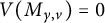 $V(M_{\gamma ,v}) = 0$
. Hence, the logarithmic capacity of
 $M_{\gamma ,v}$
is
 $1$
, as desired.
3.4 The generalized adèlic Mandelbrot set
Let us call
 ${\mathbb M}_{\gamma } = \prod _{v\in \Omega } M_{\gamma ,v}$
the generalized adèlic Mandelbrot set associated to
 $\gamma $
. As a corollary to Theorem 3.5 and Lemma 3.4, we get that
 ${\mathbb M}_{\gamma }$
satisfies the hypothesis of Theorem 2.2; the proof of the next result is identical as its counterpart from [Reference Baker and DeMarcoBD11].
Corollary 3.7 For all but finitely many nonarchimedean places v, we have that
 $M_{\gamma ,v}$
is the closed unit disk
 $\mathcal {D}(0;1)$
in
 ${\mathbb A}_{\mathrm {Berk},{\mathbb C}_v}^1$
; furthermore,
 ${\mathbf c}({\mathbb M}_{\gamma }) = 1$
.
3.5 Global canonical heights
For each
 $\lambda \in {\overline {L}}$
(again note that
 ${\overline {L}}=L^{\mathrm {sep}}$
), we will use the notation
 $$ \begin{align} h_{{\mathbb M}_{\gamma}}(\lambda):=h_{{\mathbb M}_{\gamma}}(S)\text{ where }S\text{ is the }\mathrm{Gal}(L^{\mathrm{sep}}/L)\text{-orbit of }\lambda. \end{align} $$
The notation from (3.5.1) is connected to the global canonical height associated to the polynomials
 $f_\lambda $
.
Definition 3.8 For each
 $x\in {\overline {L}}$
, we define its Weil height as
 $$ \begin{align} h(x):=\frac{1}{[L(x):L]}\cdot \sum_{v\in\Omega}\sum_{y\in \mathrm{Gal}(L^{\mathrm{sep}}/L)\cdot x} \log^+|y|_v. \end{align} $$
For each
 $\lambda \in {\overline {L}}$
, we define the global canonical height of
 $x\in {\overline {L}}$
with respect to the polynomial
 $f_\lambda $
as
 $$ \begin{align} \widehat{h}_{f_\lambda}(x)=\lim_{n\to\infty}\frac{h\left(f^n_\lambda(x)\right)}{d^n}. \end{align} $$
Remark 3.9 If
 $\gamma $
is preperiodic under the action of
 $f_\lambda $
, then it is immediate to see (based on equation (3.5.3)) that
 $\widehat {h}_{f_\lambda }(\gamma )=0$
(since there are finitely many distinct points
 $f^n_\lambda (\gamma )$
).
However, using [Reference BenedettoBen05, Theorem B], one can also establish the converse statement as well (i.e., once
 $\widehat {h}_{f_\lambda }(\gamma )=0$
, then
 $\gamma $
must be preperiodic under the action of
 $f_\lambda $
). Indeed, as long as
 $\lambda \notin {\overline {\mathbb F}_p}$
, then
 $f_\lambda $
is not isotrivial, and therefore, [Reference BenedettoBen05, Theorem B] shows that a point is preperiodic if and only if its canonical height equals
 $0$
. Finally, if
 $\lambda \in {\overline {\mathbb F}_p}$
, then it is immediate to see that
 $\gamma $
is preperiodic if and only if also
 $\gamma \in {\overline {\mathbb F}_p}$
. Similarly, if
 $\widehat {h}_{f_\lambda }(\gamma )=0$
(and
 $\lambda \in {\overline {\mathbb F}_p}$
), then we must have that
 $|\gamma |_v\le 1$
for each place
 $v\in \Omega $
(see Lemma 3.4 (ii)), and therefore, we must also have that
 $\gamma \in {\overline {\mathbb F}_p}$
(see (2.0.3)).
The following fact follows easily from the decomposition of the global canonical height as a sum of local canonical heights; a similar result was obtained in the proof of [Reference Ghioca and HsiaGH13, Theorem 2.6] in the context of Drinfeld modules.
Lemma 3.10 Let
 $\gamma \in L$
. Then for each
 $\lambda \in {\overline {L}}$
, we have
 $h_{{\mathbb M}_\gamma }(\lambda )= d\cdot \widehat {h}_{f_\lambda }(\gamma )$
.
4 Equality of the respective local canonical heights
We continue with the notation as in Section 3. In particular, L is a finite extension of the perfect closure of the rational function field in one variable over
 ${\overline {\mathbb F}_p}$
(see (2.0.2)). Also, for any point
 $\gamma \in L$
, we construct the generalized adèlic Mandelbrot set
 ${\mathbb M}_\gamma $
and then define the associated height
 $h_{{\mathbb M}_\gamma }$
.
The following result is the key technical ingredient which we extract from Theorem 2.2. Its proof is essentially the same as its counterpart from [Reference Baker and DeMarcoBD11] because we are both dealing with the same family of polynomials; the technical ingredients used in the proof of Theorem 4.1 are contained in Theorem 2.2 and Lemma 3.10. We also note that a similar result was proven in [Reference Ghioca and HsiaGH13, Theorem 2.6] for dynamical systems coming from Drinfeld modules.
Theorem 4.1 Let L,
 $f_\lambda $
,
 $\widehat {h}_{f_\lambda }$
,
 $\widehat {h}_{v,\lambda }$
be defined as in Section 3; also, let
 $\alpha ,\beta \in L$
. Assume there exists an infinite sequence
 $\{\lambda _n\}$
in
 ${\overline {L}}$
with the property that
 $$ \begin{align} \lim_{n\to\infty} \widehat{h}_{f_{\lambda_n}}(\alpha)=\lim_{n\to\infty} \widehat{h}_{f_{\lambda_n}}(\beta)=0. \end{align} $$
Then for each
 $\lambda \in {\overline {L}}$
and for each
 $v\in \Omega $
, we have that
 $\widehat {h}_{v,\lambda }(\alpha )=\widehat {h}_{v,\lambda }(\beta )$
.
5 Proof of the precise relation between the starting points.
In this section, we prove the following result.
Proposition 5.1 Let
 $L_0:={\overline {\mathbb F}_p}\left (t,t^{1/p},t^{1/p^2},\cdots , t^{1/p^n},\cdots \right )$
and let L be a finite extension of
 $L_0$
. We denote by
 $\Omega :=\Omega _L$
the set of inequivalent places of L. We let
 $\alpha ,\beta \in L$
, not both of them contained in
 ${\overline {\mathbb F}_p}$
. Let
 $d\ge 2$
be an integer, which is not a power of the prime p. We let
 $$ \begin{align*}f_\lambda(x):=x^d+\lambda\end{align*} $$
be a family of polynomials parameterized by
 $\lambda \in {\overline {L}}$
. As in Section 3, for each
 $\lambda \in {\overline {L}}$
and for each place
 $v\in \Omega $
, we let
 $$ \begin{align*}\widehat{h}_{v,\lambda}(\alpha)=\lim_{n\to\infty} \frac{\log^+\left|f_\lambda^n(\alpha)\right|_v}{d^n}\text{ and } \widehat{h}_{v,\lambda}(\beta)=\lim_{n\to\infty} \frac{\log^+\left|f_\lambda^n(\beta)\right|_v}{d^n}.\end{align*} $$
If for each
 $\lambda \in {\overline {L}}$
and for each place
 $v\in \Omega $
, we have that
 $$ \begin{align} \widehat{h}_{v,\lambda}(\alpha)=\widehat{h}_{v,\lambda}(\beta), \end{align} $$
then we must have that
 $\alpha ^d=\beta ^d$
.
Proposition 5.1 constitutes the bridge in our arguments between Theorem 4.1 and Theorem 1.1 (see also Theorem 6.1).
5.1 The strategy for proving Proposition 5.1
From now on, we work under the hypotheses from Proposition 5.1. We split its proof into Subsections 5.2, 5.3, 5.4, and 5.5.
So, we let S be the (finite) set of places
 $v\in \Omega $
with the property that
 $$ \begin{align} \max\{|\alpha|_v,|\beta|_v\}>1. \end{align} $$
Note that our hypothesis from Proposition 5.1 that not both
 $\alpha $
and
 $\beta $
live in
 ${\overline {\mathbb F}_p}$
yields that S is a nonempty set. Our strategy will be to prove that
 $$ \begin{align} \left|\alpha^d-\beta^d\right|_v\le 1\text{ for each }v\in S. \end{align} $$
Indeed, since S consists of all the places v where
 $\alpha $
or
 $\beta $
is not v-adic integral (see inequality (5.1.1)), then the only places of
 $\Omega $
for which
 $\alpha ^d-\beta ^d$
may not be a v-adic integer are exactly the ones from the set S. So, inequality (5.1.2) would prove that
 $\alpha ^d-\beta ^d$
is integral at each place
 $v\in \Omega $
. Due to the product formula (2.0.1) on L (see also (2.0.3)), this means that
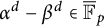 $\alpha ^d-\beta ^d\in {\overline {\mathbb F}_p}$
, which is sufficient to deduce that
 $\alpha ^d=\beta ^d$
if
 $d=2$
(see Lemma 5.12). Now, in the case
 $d>2$
, we can actually prove that the inequality in (5.1.2) is strict; this is sufficient to deduce that
 $\alpha ^d=\beta ^d$
(see Lemma 5.11). We also note (see Remark 5.10) that it is exactly in the last part of our argument (the proof of Lemma 5.9) where we employ the hypothesis from Proposition 5.1 that d is not a power of p.
In order to deduce the inequality (5.1.2), we employ the hypothesis (5.0.1) from Proposition 5.1 for various well-chosen
 $\lambda $
’s in
 ${\overline {L}}$
. Also, we first prove that
 $$ \begin{align} \left|\alpha^d-\beta^d\right|_v\le |\alpha|_v=|\beta|_v\text{ for each }v\in S; \end{align} $$
this is done in Subsection 5.2.
5.2 First step in the proof of Proposition 5.1
In this subsection, we will establish (5.1.3). We first prove the following easy fact which will be used repeatedly in our proof of Proposition 5.1.
Lemma 5.2 For each place
 $v\in S$
, we have
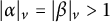 $|\alpha |_v=|\beta |_v>1$
.
Proof of Lemma 5.2.
The desired conclusion is an easy corollary of Lemma 3.4, parts (i)–(ii) using
 $\lambda =0$
and
 $v\in S$
(see (5.1.1)), along with the hypothesis (5.0.1) of Proposition 5.1.
Corollary 5.3 With the hypothesis as in Proposition 5.1, we have that neither
 $\alpha $
nor
 $\beta $
live in
 ${\overline {\mathbb F}_p}$
.
Proof Indeed, Lemma 3.4 shows that both
 $\alpha $
and
 $\beta $
are not integral at the places from S; hence, neither one can live in
 ${\overline {\mathbb F}_p}$
.
In particular, Corollary 5.3 yields that
 $\alpha $
and
 $\beta $
are nonzero. The following Lemma will finish the proof for the assertion from (5.1.3).
Lemma 5.4 For each place v in S, we have that
 $|\beta ^d-\alpha ^d|_v\le |\alpha |_v$
.
Proof of Lemma 5.4.
We argue by contradiction, and so we assume that
 $|\beta ^d-\alpha ^d|_v> |\alpha |_v$
, and we will derive a contradiction.
Indeed, we consider
 $\lambda _0:=-\alpha ^d$
and then apply Lemma 3.4 for
 $\lambda _0$
and
 $\gamma :=f_{\lambda _0}(\beta )=\beta ^d-\alpha ^d$
; since
 $|\beta ^d-\alpha ^d|_v^d>|\lambda _0|_v=|\alpha |_v^d$
(according to our assumption), Lemma 3.4 (ii) yields that
 $$ \begin{align*}\widehat{h}_{v,\lambda_0}(\gamma)=\log\left|\beta^d-\alpha^d\right|_v.\end{align*} $$
But then using the fact that
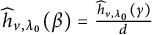 $\widehat {h}_{v,\lambda _0}(\beta )=\frac {\widehat {h}_{v,\lambda _0}(\gamma )}{d}$
(see equation (3.2.2)), we obtain that
 $$ \begin{align} \widehat{h}_{v,\lambda_0}(\beta)=\frac{\log|\beta^d-\alpha^d|_v}{d}. \end{align} $$
However, we compute
 $$ \begin{align*}f_{\lambda_0}(\alpha)=0\text{ and }f^2_{\lambda_0}(\alpha)=-\alpha^d.\end{align*} $$
Then using again Lemma 3.4 (ii), this time for
 $\lambda _0$
and
 $-\alpha ^d$
(note that
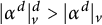 $|\alpha ^d|^d_v>|\alpha ^d|_v$
), we conclude that
 $$ \begin{align*}\widehat{h}_{v,\lambda_0}(-\alpha^d)=\log|\alpha^d|_v.\end{align*} $$
But then again, using equation (3.2.2), we get that
 $$ \begin{align} \widehat{h}_{v,\lambda_0}(\alpha)=\frac{\widehat{h}_{v,\lambda_0}(f^2_{\lambda_0}(\alpha))}{d^2} = \frac{\log|\alpha|_v}{d}. \end{align} $$
However, our assumption that
 $|\alpha ^d-\beta ^d|_v>|\alpha |_v$
coupled with equations (5.2.1) and (5.2.2) contradict the main hypothesis from our Proposition 5.1 that
 $\widehat {h}_{v,\lambda _0}(\alpha )=\widehat {h}_{v,\lambda _0}(\beta )$
. In conclusion, indeed, we must have that
 $$ \begin{align} |\alpha^d-\beta^d|_v\le |\alpha|_v=|\beta|_v, \end{align} $$
for each place v in S.
5.3 Second step in the proof of Proposition 5.1
The inequality from equation (5.1.3) says that
 $|\alpha ^d-\beta ^d|_v$
is much smaller than one would expect it to be; that is, since
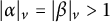 $|\alpha |_v=|\beta |_v>1$
(for
 $v\in S$
), then normally one would expect
 $|\alpha ^d-\beta |_v$
to be larger than
 $|\alpha |_v=|\beta |_v$
. The next Lemma refines further the inequality from (5.1.3) showing that we actually have a strict inequality in (5.1.3).
Lemma 5.5 For each place v in S, we have that
 $|\beta ^d-\alpha ^d|_v<|\alpha |_v$
.
Proof of Lemma 5.5.
We argue by contradiction and therefore assume that
 $|\alpha ^d-\beta ^d|_v\ge |\alpha |_v$
. Then Lemma 5.4 yields that actually
 $|\alpha ^d-\beta ^d|_v=|\alpha |_v$
.
Claim 5.6 There exists some nonzero
 $\gamma _0\in {\overline {\mathbb F}_p}$
such that
 $$ \begin{align} \left|\beta^d-\alpha^d-\gamma_0\cdot\alpha\right|_v<|\alpha|_v.\\[-34pt]\nonumber \end{align} $$
The existence of
 $\gamma _0$
as in the conclusion of Claim 5.6 is essential in the proof of Lemma 5.5. Furthermore, the argument used in the proof of Claim 5.6 will also be useful in our further arguments for proving Lemma 5.5.
Proof of Claim 5.6.
Let
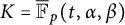 $K={\overline {\mathbb F}_p}(t,\alpha ,\beta )$
; then K is a subfield of L. Moreover, K is a global function field (of transcendence degree
 $1$
) over
 ${\overline {\mathbb F}_p}$
(it is a finite extension of
 ${\overline {\mathbb F}_p}(t)$
). We let
 $\mathcal {O}_{K,v}$
be the ring of v-adic integers in K; then
 $\mathcal {O}_{K,v}$
is a discrete valuation ring. We let
 $\pi _v\in \mathcal {O}_{K,v}\subset L$
be a uniformizer for the restriction of
 $|\cdot |_v$
on K; that is,
 $$ \begin{align*}|\pi_v|_v=\max\left\{|x|_v\colon |x|_v<1\text{ and }x\in K\right\}. \end{align*} $$
So, there exists some positive integer e with the property that both
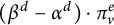 $(\beta ^d-\alpha ^d)\cdot \pi _v^e$
and
 $\alpha \cdot \pi _v^e$
are v-adic units in K (note that
 $e>0$
since
 $|\beta ^d-\alpha ^d|_v=|\alpha |_v>1$
). We let
 $\mathrm {red}_v:\mathcal {O}_{K,v}\longrightarrow {\overline {\mathbb F}_p}$
be the reduction map at the place v; then we simply compute
 $$ \begin{align} \gamma_0:=\frac{\mathrm{red}_v\left(\left(\beta^d-\alpha^d\right)\cdot \pi_v^e\right)}{\mathrm{red}_v\left(\alpha\cdot \pi_v^e\right)}\in{\overline{\mathbb F}_p}^*, \end{align} $$
which satisfies the desired conclusion from Claim 5.6.
So, we let
 $\gamma _0\in {\overline {\mathbb F}_p}$
as in the conclusion of Claim 5.6.
Claim 5.7 With the above notation, there exists some
 $\gamma _1\in {\overline {\mathbb F}_p}$
such that
 $$ \begin{align} (\gamma_1+\gamma_0)^d=1\text{ and }\gamma_1^d\ne 1. \end{align} $$
Proof of Claim 5.7.
We argue by contradiction and therefore we assume that for each
 $u\in {\overline {\mathbb F}_p}$
such that
 $u^d=1$
, we have that also
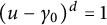 $(u-\gamma _0)^d=1$
. This means that the d-th roots of unity in
 ${\overline {\mathbb F}_p}$
can be grouped in disjoint subsets of p elements (note that
 $\gamma _0\ne 0$
):
 $$ \begin{align*}u,u-\gamma_0,u-2\gamma_0,\cdots,u-(p-1)\gamma_0.\end{align*} $$
However, this would mean that there are
 $p\cdot k$
solutions (for some positive integer k) for the equation
 $x^d=1$
in
 ${\overline {\mathbb F}_p}$
. This is a contradiction because the equation
 $x^d=1$
has s solutions in
 ${\overline {\mathbb F}_p}$
, where d is written as
 $s\cdot p^\ell $
for some integer
 $\ell \ge 0$
and some positive integer s coprime with p. The fact that p does not divide s shows that indeed one can find some
 $\gamma _1$
satisfying conditions (5.3.3).
Then we consider (with
 $\gamma _1$
satisfying the conclusion of Claim 5.7)
 $$ \begin{align*}\lambda_1:=\gamma_1\cdot \alpha - \alpha^d;\end{align*} $$
a simple computation shows that
 $$ \begin{align*}f^2_{\lambda_1}(\alpha)= f_{\lambda_1}(\gamma_1 \alpha)=(\gamma_1^d-1)\alpha^d +\gamma_1\alpha. \end{align*} $$
Since
 $\gamma _1^d\ne 1$
, we conclude that
 $$ \begin{align*}|f^2_{\lambda_1}(\alpha)|_v= |\alpha|_v^d>|\alpha|_v=|\lambda_1|_v^{1/d},\end{align*} $$
and thus, an application of Lemma 3.4 (ii) (coupled with equation (3.2.2)) yields
 $$ \begin{align} \widehat{h}_{v,\lambda_1}(\alpha)= \frac{\widehat{h}_{v,\lambda_1}\left(f^2_{\lambda_1}(\alpha)\right)}{d^2} = \frac{\log|\alpha|_v^d}{d^2}=\frac{\log|\alpha|_v}{d}. \end{align} $$
However, we compute
 $$ \begin{align} f^2_{\lambda_1}(\beta)=f_{\lambda_1}(\beta^d-\alpha^d+\gamma_1\alpha)= (\beta^d-\alpha^d+\gamma_1\alpha)^d +\gamma_1\alpha - \alpha^d. \end{align} $$
Claim 5.8 With our choice for
 $\gamma _0$
as in Claim 5.6 and for
 $\gamma _1$
as in Claim 5.7, we have that
 $$ \begin{align} \left|(\beta^d-\alpha^d+\gamma_1\alpha)^d-\alpha^d\right|_v <|\alpha^d|_v. \end{align} $$
Proof of Claim 5.8.
In order to justify (5.3.6), we argue similarly as in our proof of Claim 5.6. So, letting as before,
 $\pi _v$
be a uniformizer of
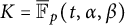 $K={\overline {\mathbb F}_p}(t,\alpha ,\beta )$
at the place v, then for some positive integer e and some v-adic units
 $u_1,u_2$
in K (and therefore in L), we have
 $$ \begin{align} \beta^d-\alpha^d=\pi_v^{-e}\cdot u_1\text{ and }\alpha=\pi_v^{-e}\cdot u_2; \end{align} $$
in particular, (5.3.7) yields
 $|\alpha ^d|_v=\left (|\pi _v|_v^{-e}\right )^d=|\pi _v|_v^{-de}$
. Then we obtain
 $$ \begin{align*}\left|(\beta^d-\alpha^d+\gamma_1\alpha)^d-\alpha^d\right|_v= \left| \pi_v^{-de}\cdot \left(u_1+\gamma_1u_2\right)^d-\pi_v^{-de}\cdot u_2^d\right|_v= |\pi_v|_v^{-de}\cdot \left| (u_1+\gamma_1u_2)^d-u_2^d\right|_v. \end{align*} $$
So, in order to get inequality (5.3.6), it suffices to prove that
 $$ \begin{align} \left| (u_1+\gamma_1u_2)^d-u_2^d\right|_v<1; \end{align} $$
furthermore, using that
 $u_1$
and
 $u_2$
are v-adic units, inequality (5.3.8) is equivalent with asking that
 $$ \begin{align} \left| \left(\frac{u_1}{u_2} + \gamma_1\right)^d-1\right|_v<1. \end{align} $$
We rewrite the left-hand side in (5.3.9) as
 $$ \begin{align} \left|\left(\frac{u_1-\gamma_0u_2}{u_2}+ (\gamma_0+\gamma_1)\right)^d-1\right|_v. \end{align} $$
Equation (5.3.1) (see also (5.3.2)) yields that
 $$ \begin{align} \left|\frac{u_1-\gamma_0u_2}{u_2}\right|_v<1; \end{align} $$
so, coupling equations (5.3.11) and (5.3.10), along with the fact that
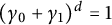 $(\gamma _0+\gamma _1)^d=1$
, we obtain inequality (5.3.9) (which, in turn, delivers the desired inequality (5.3.6)).
This finishes our proof of Claim 5.8.
Now, inequality (5.3.6) yields (see also equation (5.3.5)) that
 $$ \begin{align} \left|f^2_{\lambda_1}(\beta)\right|_v<|\alpha|_v^d. \end{align} $$
We let
 $M:=\max \left \{|\alpha |_v, \left |f^2_{\lambda _1}(\beta )\right |_v\right \}$
; inequality (5.3.12) yields
 $$ \begin{align} M< |\alpha|_v^d. \end{align} $$
Using inequality (5.3.12), we obtain
 $$ \begin{align}\left|f^3_{\lambda_1}(\beta)\right|_v = \left|\left(f^2_{\lambda_1}(\beta)\right)^d + \gamma_1 \alpha - \alpha^d\right|_v\le \max\left\{ \left|f^2_{\lambda_1}(\beta)\right|_v^d, |\alpha|_v^d\right\}=M^d. \end{align} $$
An easy induction (similar to deriving inequality (5.3.14)) shows then that for each
 $n\ge 2$
,
 $$ \begin{align} \left|f^n_{\lambda_1}(\beta)\right|_v\le M^{d^{n-2}}. \end{align} $$
Inequality (5.3.15) yields that
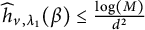 $\widehat {h}_{v,\lambda _1}(\beta )\le \frac {\log (M)}{d^2}$
; then coupling this last inequality with equations (5.3.4) and (5.3.13), we obtain that
 $$ \begin{align*}\widehat{h}_{v,\lambda_1}(\beta)<\widehat{h}_{v,\lambda_1}(\alpha),\end{align*} $$
which contradicts our main hypothesis (5.0.1) from Proposition 5.1. This concludes our proof of Lemma 5.5.
5.4 Third step in the proof of Proposition 5.1
We continue our analysis for
 $|\beta ^d-\alpha ^d|_v$
(for
 $v\in S$
) with the goal of proving the inequality from (5.1.2). This time, we need to split our proof depending whether
 $d=2$
or
 $d>2$
.
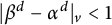
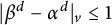
Lemma 5.9 For each
 $v\in S$
, we must have that
-
(i) if
$d>2$
, then
$|\beta ^d-\alpha ^d|_v< 1$
. -
(ii) if
$d=2$
, then
$|\beta ^d-\alpha ^d|_v\le 1$
.


Proof of Lemma 5.9.
We let
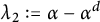 $\lambda _2:=\alpha -\alpha ^d$
. Then clearly,
 $f_{\lambda _2}(\alpha )=\alpha $
, which means that for any place v (not just the ones from the set S), we have that
 $$ \begin{align} \widehat{h}_{v,\lambda_2}(\alpha)=0. \end{align} $$
From now on, we argue by contradiction and assume that for some
 $v\in S$
, we have
-
•
$|\beta ^d-\alpha ^d|_v\ge 1$
if
$d>2$
. -
•
$|\beta ^d-\alpha ^d|_v>1$
if
$d=2$
.
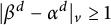

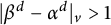

However, we know from Lemma 5.5 that
 $|\beta ^d-\alpha ^d|_v<|\alpha |_v$
.
Next, we write
 $d=p^\ell \cdot s$
for some integer
 $\ell \ge 0$
and some positive integer s coprime with p. Furthermore, due to our hypothesis that
 $d\ne p^\ell $
, then we must have that
 $s\ge 2$
. We compute
 $$ \begin{align*}f^2_{\lambda_2}(\beta)=f_{\lambda_2}(\beta^d-\alpha^d+\alpha) =\left(\beta^d-\alpha^d+\alpha\right)^d+\alpha - \alpha^d.\end{align*} $$
Then we let
 $\epsilon :=\beta ^d-\alpha ^d$
and proceed as follows:
 $$ \begin{align} f^2_{\lambda_2}(\beta)=(\epsilon+\alpha)^d-\alpha^d+\alpha= \left(\epsilon^{p^\ell}+\alpha^{p^\ell}\right)^s - \alpha^{sp^\ell}+\alpha. \end{align} $$
Then we expand
 $$ \begin{align*}\left(\epsilon^{p^\ell}+\alpha^{p^\ell}\right)^s= \alpha^{sp^\ell} + s\alpha^{(s-1)p^\ell}\epsilon^{p^\ell}+ \sum_{i=2}^s \binom{s}{i}\cdot \alpha^{(s-i)p^\ell}\epsilon^{ip^\ell}.\end{align*} $$
From our assumption that
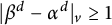 $|\beta ^d-\alpha ^d|_v\ge 1$
(for any
 $d\ge 2$
) along with the conclusion of Lemma 5.5, we have that
 $$ \begin{align} 1\le |\epsilon|_v<|\alpha|_v\text{ (with the left inequality being strict if }d=2). \end{align} $$
Since p does not divide s, inequality (5.4.3) shows that
 $$ \begin{align} \left|s\alpha^{(s-1)p^\ell}\epsilon^{p^\ell}\right|_v = \left|\alpha^{(s-1)p^\ell}\epsilon^{p^\ell}\right|_v> \left|\binom{s}{i}\cdot \alpha^{(s-i)p^\ell}\epsilon^{ip^\ell}\right|_v \end{align} $$
for each
 $i=2,\dots ,s$
. Equation (5.4.4) allows us to conclude that
 $$ \begin{align} \left|\left(\epsilon^{p^\ell}+\alpha^{p^\ell}\right)^s-\alpha^{sp^\ell}\right|_v = \left|\alpha^{(s-1)p^\ell}\epsilon^{p^\ell}\right|_v. \end{align} $$
Clearly, if
 $d>2$
, then
 $(s-1)p^\ell \ge \max \{s-1, p^\ell \}\ge 2$
; hence, using again that
 $|\epsilon |_v\ge 1$
if
 $d>2$
, we derive that
 $$ \begin{align} \left|\alpha^{(s-1)p^\ell}\epsilon^{p^\ell}\right|_v\ge |\alpha|_v^2>|\alpha|_v\text{ if }d>2. \end{align} $$
Furthermore, using our assumption that
 $|\epsilon |_v>1$
if
 $d=2$
, then we also derive that
 $$ \begin{align} \left|\alpha^{(s-1)p^\ell}\epsilon^{p^\ell}\right|_v= |\alpha\cdot \epsilon|_v>|\alpha|_v\text{ if }d=2, \end{align} $$
because then
 $p\ne 2$
and so,
 $\ell =0$
and
 $s=2$
if
 $d=2$
.
Remark 5.10 We note that it is precisely in deriving inequalities (5.4.6) and (5.4.7) that we used the hypothesis that d is not a power of the prime p, since this translates to the inequality
 $s\ge 2$
, which is used in both of the above two inequalities (along with the fact that we cannot have
 $s=p=2$
).
Combining inequalities (5.4.6), (5.4.7), (5.4.5), and (5.4.2) yields that
 $$ \begin{align} \left|f^2_{\lambda_2}(\beta)\right|_v = \left|\alpha^{(s-1)p^\ell}\epsilon^{p^\ell}\right|_v>|\alpha|_v=|\lambda_2|_v^{1/d}. \end{align} $$
Inequality (5.4.8) along with Lemma 3.4 (ii) yields that
 $$ \begin{align} \widehat{h}_{v,\lambda_2}\left(f^2_{\lambda_2}(\beta)\right)= \log\left|\alpha^{(s-1)p^\ell}\epsilon^{p^\ell}\right|_v>0. \end{align} $$
Finally, using equations (5.4.9) and (3.2.2), we conclude that
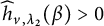 $\widehat {h}_{v,\lambda _2}(\beta )>0$
. Coupled with equation (5.4.1), this contradicts the main hypothesis (5.0.1) that
 $\widehat {h}_{v,\lambda _2}(\alpha )=\widehat {h}_{v,\lambda _2}(\beta )$
. This concludes our proof of Lemma 5.9.
5.5 Final step in the proof of Proposition 5.1
Now we can finish our proof of Proposition 5.1. Once again, we split our analysis into two cases:
 $d>2$
, respectively
 $d=2$
.
Lemma 5.11 If
 $d>2$
, then the conclusion in Proposition 5.1 holds.
Proof of Lemma 5.11.
By definition of the set S (see (5.1.1)), we have that if
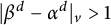 $|\beta ^d-\alpha ^d|_v>1$
, then we must have that
 $v\in S$
. However, Lemma 5.9 yields that
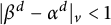 $|\beta ^d-\alpha ^d|_v<1$
if
 $v\in S$
. Hence,
 $\beta ^d-\alpha ^d$
is integral at all places, and furthermore, for the places
 $v\in S$
(note that S is nonempty due to our assumption that not both
 $\alpha $
and
 $\beta $
are in
 ${\overline {\mathbb F}_p}$
), we have that
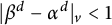 $|\beta ^d-\alpha ^d|_v<1$
; this contradicts the product formula (2.0.1), unless
 $\alpha ^d-\beta ^d=0$
, which is precisely the desired conclusion from Proposition 5.1.
Lemma 5.12 If
 $d=2$
, the conclusion in Proposition 5.1 must hold.
Proof The same argument as in the proof of Lemma 5.11 yields that
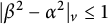 $|\beta ^2-\alpha ^2|_v\le 1$
for each place
 $v\in S$
. Since we already know that
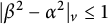 $|\beta ^2-\alpha ^2|_v\le 1$
for
 $v\notin S$
, then (2.0.3) yields that
 $\epsilon =\beta ^2-\alpha ^2\in {\overline {\mathbb F}_p}$
.
Furthermore, we note that
 $p\ne 2$
since we know that
 $d=2$
is not a power of the prime p (according to the hypothesis in Proposition 5.1).
Again, we work with
 $\lambda _2=\alpha -\alpha ^2$
as in Lemma 5.9. We compute (with
 $\epsilon =\beta ^2-\alpha ^2$
)
 $$ \begin{align} f_{\lambda_2}(\beta)=\beta^2+\alpha-\alpha^2=\alpha+\epsilon\text{ and }f^2_{\lambda_2}(\beta)=(2\epsilon+1)\alpha +\epsilon^2 \end{align} $$
and then
 $$ \begin{align} f^3_{\lambda_2}(\beta)=(4\epsilon^2+4\epsilon)\alpha^2+ (4\epsilon^3+2\epsilon^2+1)\alpha+\epsilon^4. \end{align} $$
Now, if
 $4\epsilon ^2+4\epsilon \ne 0$
, then we get (note that
 $\epsilon \in {\overline {\mathbb F}_p}$
)
 $$ \begin{align} \left|f^3_{\lambda_2}(\beta)\right|_v=|\alpha|_v^2\text{ for }v\in S. \end{align} $$
Using inequality (5.5.3) along with Lemma 3.4 (ii) yields that for
 $v\in S$
, we would have that
 $\widehat {h}_{v,\lambda _2}(f^3_{\lambda _2}(\beta ))>0$
, and therefore, we would also have that
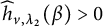 $\widehat {h}_{v,\lambda _2}(\beta )>0$
, which contradicts that
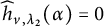 $\widehat {h}_{v,\lambda _2}(\alpha )=0$
because
 $\alpha $
is a fixed point under the action of
 $f_{\lambda _2}$
. So, we must have instead that
 $$ \begin{align} 4\epsilon^2+4\epsilon=0. \end{align} $$
Since
 $p\ne 2$
, then equation (5.5.4) yields either
 $\epsilon =0$
(which provides the desired conclusion
 $\alpha ^2=\beta ^2$
), or we must have
 $\epsilon =-1$
. However, this last possibility would provide a contradiction since then we can run the same argument with
 $\alpha $
and
 $\beta $
reversed, and we would have gotten that
 $$ \begin{align*}\alpha^2-\beta^2=-1,\end{align*} $$
thus contradicting
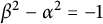 $\beta ^2-\alpha ^2=-1$
. More precisely, we could consider next
 $$ \begin{align*}\lambda_3:=\beta-\beta^2\end{align*} $$
and impose the condition that
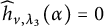 $\widehat {h}_{v,\lambda _3}(\alpha )=0$
for each
 $v\in S$
. Letting
 $\mu :=-\epsilon =\alpha ^2-\beta ^2$
and then arguing along the same lines as in the derivation of equations (5.5.1), (5.5.2), (5.5.3), and (5.5.4), we would obtain that either
 $\mu =0$
(which is the desired conclusion), or that
 $\mu =-1$
. Since we cannot have that
 $$ \begin{align*}\epsilon=-1\text{ and }\mu=-\epsilon=-1\end{align*} $$
because the characteristic p of our field is not
 $2$
(because
 $d=2$
is not a power of the characteristic), we conclude that also when
 $d=2$
, we must have that
 $\alpha ^2=\beta ^2$
.
This concludes our proof of Lemma 5.12.
Combining Lemmas 5.11 and 5.12, we obtain the desired conclusion in Proposition 5.1.
6 Proof of our main results.
In this section, we finish our proof for Theorem 1.1. We actually prove a more general result.
Theorem 6.1 Let
 $L_0={\overline {\mathbb F}_p}\left (t,t^{1/p},t^{1/p^2},\cdots ,t^{1/p^n},\cdots \right )$
and let L be a finite extension of
 $L_0$
. Let
 $d\ge 2$
be an integer and let
 $\alpha ,\beta \in L$
. We consider the family of polynomials
 $$ \begin{align*}f_\lambda(x):=x^d+\lambda\text{ parameterized by }\lambda\in {\overline{L}}.\end{align*} $$
Then there exists an infinite sequence
 $\{\lambda _n\}_{n\ge 1}$
in
 ${\overline {L}}$
with the property that
 $$ \begin{align} \lim_{n\to\infty}\widehat{h}_{f_{\lambda_n}}(\alpha)=\lim_{n\to\infty} \widehat{h}_{f_{\lambda_n}}(\beta)=0, \end{align} $$
if and only if at least one of the following statements holds:
-
(1)
$\alpha ,\beta \in {\overline {\mathbb F}_p} $
. -
(2)
$d=p^\ell $
for some positive integer
$\ell $
and
$\beta -\alpha \in {\overline {\mathbb F}_p}$
. -
(3)
$\alpha ^d=\beta ^d$
.


Moreover, if either one of the conditions (1)–(3) holds, then for each
 $\lambda \in {\overline {L}}$
, we have that
 $\alpha $
is preperiodic under the action of
 $f_\lambda $
if and only if
 $\beta $
is preperiodic under the action of
 $f_\lambda $
.
We start by proving Theorem 1.1 assuming that Theorem 6.1 holds; this is done in Subsection 6.1. Then we will prove Theorem 6.1 by splitting our argument into two steps in Subsections 6.3 and, respectively, 6.4.
6.1 Proof of Theorem 1.1 assuming Theorem 6.1 holds.
The next proposition shows that in Theorem 1.1, we may assume
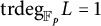 $\mathrm {trdeg}_{{\mathbb F}_p}L=1$
.
Proposition 6.2 Let
 $d\ge 2$
be an integer, let L be a field of characteristic
 $p>0$
, and let
 $\alpha ,\beta \in L$
. If there exists
 $\lambda _1\in {\overline {L}}$
such that both
 $\alpha $
and
 $\beta $
are preperiodic for the polynomial
 $f_{\lambda _1}(x)=x^d+\lambda _1$
, then
 $\mathrm {trdeg}_{{\mathbb F}_p}{\mathbb F}_p(\alpha ,\beta )\le 1$
.
Proof We recall the notation from Subsection 3.1 (see Lemma 3.1) that for each
 $\gamma \in L$
, we have
 $$ \begin{align} P_{n,\gamma}(\lambda):=f^n_\lambda(\gamma), \end{align} $$
which is a monic polynomial of degree
 $d^{n-1}$
(in
 $\lambda $
). Furthermore, the constant term is
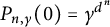 $P_{n,\gamma }(0)=\gamma ^{d^n}$
. An easy induction yields that each coefficient of
 $\lambda ^i$
in
 $P_{n,\gamma }(\lambda )$
for
 $i=1,\dots , d^{n-1}-1$
is itself a polynomial in
 $\gamma $
, that is,
 $$ \begin{align} P_{n,\gamma}(\lambda)=\lambda^{d^{n-1}}+ \sum_{i=1}^{d^{n-1}-1} c_{n,i}(\gamma)\cdot \lambda^i + \gamma^{d^n}, \end{align} $$
with each
 $c_{n,i}\in {\mathbb F}_p[x]$
being a polynomial of degree less than
 $d^n$
. Therefore, imposing the condition that
 $\alpha $
is a preperiodic point under the action of some
 $f_{\lambda _1}$
yields an equation of the form
 $$ \begin{align*}P_{n,\alpha}(\lambda_1)=P_{m,\alpha}(\lambda_1)\text{ for some }0\le m<n.\end{align*} $$
Using equation (6.1.2) (along with the information about the degrees of each corresponding polynomials
 $c_{m,i}$
and
 $c_{n,j}$
), we obtain that
 $\alpha \in \overline {{\mathbb F}_p(\lambda _1)}$
. A similar reasoning, using this time that
 $\beta $
is preperiodic under the action of
 $f_{\lambda _1}$
, yields that also
 $\beta \in \overline {{\mathbb F}_p(\lambda _1)}$
. Hence, we conclude that
 $$ \begin{align*}\mathrm{trdeg}_{{\mathbb F}_p}{\mathbb F}_p(\alpha,\beta)\le \mathrm{trdeg}_{{\mathbb F}_p}\overline{{\mathbb F}_p(\lambda_1)}\le 1,\end{align*} $$
as desired for the conclusion of Proposition 6.2.
Proof of Theorem 1.1 as a consequence of Theorem 6.1.
First, we note that Theorem 1.1 is left unchanged if we replace L by any field extension of
 ${\overline {\mathbb F}_p}(\alpha ,\beta )$
.
Second, Proposition 6.2 allows us to assume that
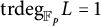 $\mathrm {trdeg}_{{\mathbb F}_p}L=1$
in Theorem 1.1; that is,
 $\alpha $
and
 $\beta $
live in a fixed algebraic closure of
 ${\mathbb F}_p(t)$
.
So, from now on, we take
 $L_0$
be the perfect closure of the rational function field in one variable over
 ${\overline {\mathbb F}_p}$
, that is,
 $$ \begin{align} L_0={\overline{\mathbb F}_p}(t)^{\mathrm{per}}={\overline{\mathbb F}_p}\left(t, t^{\frac{1}{p}}, t^{\frac{1}{p^2}},\cdots, t^{\frac{1}{p^n}},\cdots \right) \end{align} $$
and we let L be a finite extension of
 $L_0$
containing both
 $\alpha $
and
 $\beta $
.
Now, assume that we have infinitely many
 $\lambda _n\in {\overline {L}}$
with the property that both
 $\alpha $
and
 $\beta $
are preperiodic under the action of
 $f_{\lambda _n}$
. Then (according to Remark 3.9), we have that
 $\widehat {h}_{f_{\lambda _n}}(\alpha )= \widehat {h}_{f_{\lambda _n}}(\beta )=0$
for each
 $n\ge 1$
; hence, the direct implication from Theorem 6.1 yields that at least one of the conditions (1)–(3) are met.
Conversely, assuming that at least one of the conditions (1)–(3) are met, then the “moreover” statement from Theorem 6.1 yields that for each
 $\lambda \in {\overline {L}}$
,
 $\alpha $
is preperiodic under the action of
 $f_\lambda $
if and only if
 $\beta $
is preperiodic under the action of
 $f_\lambda $
. So, in order to prove the converse statement in Theorem 1.1, it suffices to establish the following fact.
Proposition 6.3 Let L be an arbitrary field of characteristic p and let
 $\gamma \in L$
. Then there exist infinitely many
 $\lambda \in {\overline {L}}$
such that
 $\gamma $
is preperiodic under the action of
 $f_\lambda $
.
If L were
 $\mathbb {C}$
, then the conclusion from Proposition 6.3 follows from a more general result established in [Reference DeMarcoDeM16]; however, since L is a field of characteristic p, once again we require a different proof.
Proof of Proposition 6.3.
If
 $\gamma \in {\overline {\mathbb F}_p}$
, then the statement is obvious because then
 $\gamma $
is preperiodic under
 $f_\lambda $
for each
 $\lambda \in {\overline {\mathbb F}_p}$
. So, from now on, we assume
 $\gamma \in L\setminus {\overline {\mathbb F}_p}$
. The desired conclusion in Proposition 6.3 follows from the next Lemma, which provides a more refined conclusion.
Lemma 6.4 Assume
 $\gamma \notin {\overline {\mathbb F}_p}$
. Then there exist infinitely many
 $\lambda \in {\overline {L}}$
with the property that there exists some prime number q such that
 $f^q_\lambda (\gamma )=\gamma $
.
Proof of Lemma 6.4.
We argue by contradiction and so assume the set
 $$ \begin{align*}\mathcal{P}:=\left\{\lambda\in{\overline{L}}\colon \text{ there exists a prime }q\text{ such that }f^q_\lambda(\gamma)=\gamma\right\}\end{align*} $$
is finite. In particular, this means that there exists a positive integer M with the property that for each prime
 $q>M$
and for each
 $\lambda \in {\overline {L}}$
such that
 $$ \begin{align} f^q_\lambda(\gamma)=\gamma, \end{align} $$
there exists a prime
 $q_0<M$
(with
 $q_0$
depending on
 $\lambda $
, of course) such that
 $$ \begin{align} f^{q_0}_\lambda(\gamma)=\gamma. \end{align} $$
However, since q and
 $q_0$
are distinct primes, then equations (6.1.4) and (6.1.5) yield that
 $f_\lambda (\gamma )=\gamma $
(i.e.,
 $\lambda =\gamma -\gamma ^d$
). Hence, letting
 $P_{q,\gamma }(\lambda ):=f^q_\lambda (\gamma )$
as before (see equation (6.1.1)), the only solution
 $\lambda \in {\overline {L}}$
to the equation
 $P_{q,\gamma }(\lambda )=\gamma $
is
 $\lambda _0:=\gamma -\gamma ^d$
. Now, using the shape of the polynomial
 $P_{q,\gamma }(\lambda )$
(see equation (6.1.2)), we conclude that
 $$ \begin{align} P_{q,\gamma}(\lambda)=\left(\lambda-\lambda_0\right)^{d^{q-1}}. \end{align} $$
In particular, this means that the constant term in the polynomial
 $P_{q,\gamma }$
must be
 $(\gamma ^d-\gamma )^{d^{q-1}}$
. However, we know that the constant term in the polynomial
 $P_{q,\gamma }$
is
 $\gamma ^{d^q}$
; this leads to the equation
 $$ \begin{align} \left(\gamma^d-\gamma\right)^{d^{q-1}}=\gamma^{d^q}. \end{align} $$
Any solution
 $\gamma $
to equation (6.1.7) must live in
 ${\overline {\mathbb F}_p}$
, thus contradicting the hypotheses of Lemma 6.4. Therefore, indeed, the set
 $\mathcal {P}$
must be infinite, as claimed in the conclusion of Lemma 6.4.
Lemma 6.4 shows that also when
 $\gamma \notin {\overline {\mathbb F}_p}$
, there exist infinitely many
 $\lambda \in {\overline {L}}$
such that
 $\gamma $
is preperiodic under the action of
 $f_\lambda $
. This concludes our proof for Proposition 6.3.
So, Proposition 6.3 shows that there exist infinitely many
 $\lambda \in {\overline {L}}$
such that
 $\alpha $
is preperiodic under the action of
 $f_\lambda $
and therefore (according to the “moreover” claim in Theorem 6.1), also
 $\beta $
is preperiodic under the action of
 $f_\lambda $
. Hence, this establishes the converse statement in Theorem 1.1.
This concludes our proof of Theorem 1.1, assuming that Theorem 6.1 holds.
6.2 Strategy for proving Theorem 6.1
We split our proof of Theorem 6.1 into the remaining two subsections of the current Section 6. In particular, we prove the “moreover” claim from Theorem 6.1 in Subsection 6.3, and then we finish the proof of Theorem 6.1 in Subsection 6.4.
So, from now on, we work with the notation and the assumptions from Theorem 6.1.
6.3 Proof of the “moreover” claim from Theorem 6.1.
In this subsection, we show that if either one of conditions (1)–(3) from the conclusion of Theorem 6.1 holds, then for each
 $\lambda \in {\overline {L}}$
, we have that
 $\alpha $
is preperiodic under the action of
 $f_\lambda $
if and only if
 $\beta $
is preperiodic under the action of
 $f_\lambda $
.
We argue case by case, as follows.
-
(1) For any
$\gamma \in {\overline {\mathbb F}_p}$
, using equations (6.1.1) and (6.1.2), we get that for each
$\lambda \in {\overline {L}}$
, we have that
$\gamma $
is preperiodic under the action of
$f_\lambda $
if and only if
$\lambda \in {\overline {\mathbb F}_p}$
. Therefore, if both
$\alpha $
and
$\beta $
live in
${\overline {\mathbb F}_p}$
, we have that for each
$\lambda \in {\overline {L}}$
,
$\alpha $
is preperiodic under the action of
$f_\lambda $
if and only if
$\beta $
is preperiodic under the action of
$f_\lambda $
. -
(2) Now, assume
$d=p^\ell $
for some positive integer
$\ell $
. Then a simple induction on n shows that for each
$\gamma \in L$
, we have (see equations (6.1.1) and (6.1.2)) that (6.3.1)Now, assume also that
$$ \begin{align} P_{n,\gamma}(\lambda)=f^n_\lambda(\gamma)= \gamma^{p^{n\ell}} + \sum_{i=0}^{n-1} \lambda^{p^{i\ell}}. \end{align} $$
$\alpha -\beta \in {\overline {\mathbb F}_p}$
; more precisely, we assume
$\nu :=\alpha -\beta \in \mathbb {F}_{p^{\ell m}}$
for some positive integer m. Then equation (6.3.1) yields that for each
$n\ge 1$
, we have (6.3.2)moreover, the elements
$$ \begin{align} f^n_\lambda(\alpha)-f^n_\lambda(\beta) =\nu^{p^{n\ell}}; \end{align} $$
$\left \{\nu ^{p^{n\ell }}\right \}_{n\ge 1}$
cycle among the values Therefore,
$$ \begin{align*}\nu,\nu^{p^\ell},\nu^{p^{2\ell}},\cdots, \nu^{p^{(m-1)\ell}}\text{ (since }\nu^{p^{m\ell}}=\nu).\end{align*} $$
$\alpha $
is preperiodic under the action of
$f_\lambda $
if and only if
$\beta $
is preperiodic under the action of
$f_\lambda $
, as desired in the “moreover” claim from the conclusion of Theorem 6.1.
-
(3) Finally, if
$\alpha ^d=\beta ^d$
, we note that for each
$\lambda \in {\overline {L}}$
, we have that
$f_\lambda (\alpha )=f_\lambda (\beta )$
, and therefore,
$\alpha $
is preperiodic under the action of
$f_\lambda $
if and only if
$\beta $
is preperiodic under the action of
$f_\lambda $
.








This concludes our proof that whenever one of the conditions (1)–(3) from the conclusion of Theorem 6.1 holds, then for each
 $\lambda \in {\overline {L}}$
, we have that
 $\alpha $
is preperiodic for
 $f_\lambda $
if and only if
 $\beta $
is preperiodic under the action of
 $f_\lambda $
. Furthermore, according to Proposition 6.3, we know there exist infinitely many
 $\lambda \in {\overline {L}}$
such that
 $\alpha $
(and therefore, also
 $\beta $
) is preperiodic under the action of
 $f_\lambda $
. Therefore, either one of the conditions (1)–(3) from Theorem 6.1 yields the existence of infinitely many
 $\lambda _n\in {\overline {L}}$
such that both
 $\alpha $
and
 $\beta $
are preperiodic under the action of
 $f_{\lambda _n}$
. Clearly (see also Remark 3.9), for each such
 $\lambda _n\in {\overline {L}}$
, we have
 $$ \begin{align} \widehat{h}_{f_{\lambda_n}}(\alpha)=\widehat{h}_{f_{\lambda_n}}(\beta)=0. \end{align} $$
In particular, equation (6.3.3) allows us to establish the converse statement in Theorem 6.1. So, it remains to prove the direct implication from the statement of Theorem 6.1; this is done in Subsection 6.4.
6.4 Conclusion of the proof of Theorem 6.1
In this subsection, we prove the last remaining statement from Theorem 6.1; that is, that if there exist infinitely many
 $\lambda _n\in {\overline {L}}$
such that
 $\lim _{n\to \infty }\widehat {h}_{f_{\lambda _n}}(\alpha ) = \lim _{n\to \infty }\widehat {h}_{f_{\lambda _n}}(\beta )=0$
, then at least one of the conditions (1)–(3) from the conclusion of Theorem 6.1 must hold.
Theorem 4.1 shows that condition (6.0.1) yields that for each
 $\lambda \in {\overline {L}}$
and for each place
 $v\in \Omega =\Omega _L$
, we have that
 $$ \begin{align} \widehat{h}_{v,\lambda}(\alpha)=\widehat{h}_{v,\lambda}(\beta) \end{align} $$
(i.e., hypothesis (5.0.1) from Proposition 5.1 is met). Then Proposition 5.1 yields that
-
(1) either both
$\alpha $
and
$\beta $
live in
${\overline {\mathbb F}_p}$
; -
(2) or
$d=p^\ell $
for some positive integer
$\ell $
; -
(3) or
$\alpha ^d=\beta ^d$
.


So, it remains to prove that when
 $d=p^\ell $
, then we must have that also
 $\alpha -\beta \in {\overline {\mathbb F}_p}$
. Indeed, we will see that the existence of a single
 $\lambda _1\in {\overline {L}}$
such that both
 $\alpha $
and
 $\beta $
are preperiodic under the action of
 $$ \begin{align} f_{\lambda_1}(x)=x^d+\lambda_1=x^{p^\ell}+\lambda_1 \end{align} $$
would give that
 $\alpha -\beta \in {\overline {\mathbb F}_p}$
. Now, the existence of such
 $\lambda _1\in {\overline {L}}$
comes from the fact that once
 $\alpha $
is preperiodic under the action of some
 $f_{\lambda _1}$
(and there are infinitely many such parameters
 $\lambda _1\in {\overline {L}}$
according to Proposition 6.3), then actually
 $\alpha $
is preperiodic under the action of
 $f_{\sigma (\lambda _1)}$
for any
 $\sigma \in \mathrm { Gal}(L^{\mathrm {sep}}/L)$
(since
 $\sigma (f^n_{\lambda _1}(\alpha ))=f^n_{\sigma (\lambda _1)}(\alpha )$
for any n, because
 $\alpha \in L$
is fixed by
 $\sigma $
). But then (see Remark 3.9), we have
 $$ \begin{align} \widehat{h}_{v,\sigma(\lambda_1)}(\alpha)=0\text{ for each }v\in\Omega\text{ and for each }\sigma\in\mathrm{Gal}(L^{\mathrm{sep}}/L). \end{align} $$
Equations (6.4.3) and (6.4.1) yield that
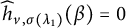 $\widehat {h}_{v,\sigma (\lambda _1)}(\beta )=0$
for each
 $v\in \Omega $
and for each
 $\sigma \in \mathrm {Gal}(L^{\mathrm {sep}}/L)$
. Using equations (2.0.6), (3.3.1), and (3.5.1) along with Lemma 3.10, we conclude that
 $\widehat {h}_{f_{\lambda _1}}(\beta )=0$
. But then, as noted in Remark 3.9, also the converse holds: we must have that
 $\beta $
must be preperiodic under the action of
 $f_{\lambda _1}$
.
So, knowing that both
 $\alpha $
and
 $\beta $
are preperiodic under the action of
 $f_{\lambda _1}$
, we argue as in Subsection 6.3 (see equations (6.3.1), (6.3.2), and (6.4.2)) and writing
 $\nu =\alpha -\beta $
, then we get that the sequence
 $\left \{\nu ^{p^{\ell n}}\right \}_{n\ge 1}$
must consist of finitely many distinct elements (because its elements are the differences of the elements in the orbits of
 $\alpha $
and, respectively, of
 $\beta $
under the action of
 $f_{\lambda _1}$
). This can only happen if
 $\nu \in {\overline {\mathbb F}_p}$
, as desired.
This concludes our proof of Theorem 6.1.


