

The study of elite politics under single-party rule offers insights into the strengths and frailties of a system that is, by design, intended to be non-competitive. Yet, as the contributions to this special issue demonstrate, the interplay between elites and their networks (factions) is anything but non-competitive. In the absence of elections, the contest of ambitions is most clearly visible in the realm of promotions, which, despite significant efforts at meritocratic institutionalization, remains intensely sensitive to internal contests between regime elites. In the case of China, studies of promotion reveal that factional affiliations play an important role in the party's internal balance of power, which, were it not for party norms and rituals, could spill over into visible internal splits.
This article contributes by bringing attention to an omission in the existing discussion of elite authoritarian politics. Most work on elite promotions, including the other contributions to this special issue, sets aside societal connections to focus exclusively on intra-elite conflicts, which given the lack of direct electoral connection, makes some sense. At the same time, we contend that what makes promotion so salient is the fact that internal jockeying could manifest into actual power struggles. This is especially true if contenders wield large public followings, which they can subsequently leverage in gambles for power and survival.
The public connection generates an awkward dynamic for single-party regimes. Popular cadres are assets for a regime's public image and legitimacy. However, when an individual contender's profile vastly outstrips that of their peers, who include both the existing members of the ruling coalition as well as the selectorate charged with electing them, these candidates transform into potent political threats. In short, we posit an inverted U-shaped relationship between the public profile of officials and their likelihood of promotion. That is, officials with very small or very large public profiles are less likely to be promoted than those with moderately sized profiles.
We test our theory using original data on the size of public profiles among contenders for top leadership positions in China and Vietnam. Using this information we demonstrate that a candidate's public profile exhibits the predicted effect on their likelihood for promotion. Candidates whose public profiles are either too large or too small relative to the rest of the cohort are least likely to be promoted, a tendency we substantiate using a number of tests in both countries. The findings suggest that public interest influences promotion even in systems with no elections. However, unlike democratic contexts, the relationship between public profile and electability is not a linear one.
In examining how an elite's connection to the masses influences promotion prospects, we engage a broad literature in comparative politics, including the study of intra-party politics in democracies. Our study highlights an often-overlooked contradiction between those who argue that authoritarian incumbents promote loyal yes-men and those who posit that incumbents advance their most competent performers (Egorov and Sonin Reference Egorov and Sonin2011). Our findings suggest that these two factors are not as incompatible as the literature has suggested. Specifically, by incorporating a candidate's public profile into the equation, we show that it is possible to promote competent candidates without sacrificing loyalty. Instead, competent candidates are only perceived as threatening when they also captivate public interest. Given that competence is likely to influence the size of one's public profile, failing to account for profile could underestimate on the impact of competence on promotion. In this light, our findings offer new insights into the rise of regimes that are clearly authoritarian, but nevertheless are keen on performance and cultivating popular public opinion.
The article proceeds as follows. Section 1 reviews the literature on promotions, presents our theory, and outlines our core hypothesis. Section 2 introduces the cases and reviews our empirical strategy. Section 3 reports quantitative results and robustness tests. Section 4 reinterprets our findings from the perspective of the candidate, highlighting potential explanations for what in many ways comes across as rationally sub-optimal behavior. Section 5 summarizes and concludes.
SECTION 1: PROMOTIONS UNDER AUTHORITARIAN RULE
Scholars and practitioners have used several different approaches to explain the shadowy world of leadership selection in authoritarian countries. State Department officials such as Donald Graves used notecards filled with the biographies of bureaucrats to study the promotion patterns of leading Soviet officials.Footnote 1 In China, experts have long scrutinized the choreography of top leaders, from their position vis-à-vis the camera to the ordering of their names at special events, looking for clues and hints as to who is in or out of favor for promotion.Footnote 2 In Vietnam, experts pore over foreign visits, assembly speeches, and insider sources to predict the outcome of heated political jockeying.Footnote 3
Others provide more rationally motivated interpretations of authoritarian promotions that seek to explain why authoritarian leaders tend to sacrifice competence or even bias against it when promoting subordinates (Egorov and Sonin Reference Egorov and Sonin2011; Mesquita and Smith Reference Mesquita and Smith2011, 58). According to the “perils of meritocracy” argument, dictators prefer pliant and loyal subordinates because more competent nominees, who by virtue of their competence are less dependent on the dictator's patronage, represent an implicit threat. This logic helps explain some otherwise puzzling behavior, such as the reliance on eunuchs by pre-Republican Chinese emperors and Stalin's brutal, and ultimately costly, elimination of top generals just prior to a devastating German invasion in World War II (Rayfield Reference Rayfield1985). Although such accounts generally focus on personalistic incumbents, the logic is perhaps even more appropriate to collective forms of leadership, where both incumbents and peers have incentives not to promote prominent personas.Footnote 4 Indeed, in China, loyalty towards factional patrons within the regime, not competence, is seen as the essential factor for promotion (Shih Reference Shih2008).
The loyalty thesis is not without its limitations, however. If loyalty always trumps competence, it is hard to account for regimes that have coupled autocracy with highly effective economic management. Some so-called East Asian developmental states, for example, are renowned both for their authoritarianism and for their ability to place important policy decisions in the hands of highly competent experts (Greene Reference Greene2009; Woo-Cumings Reference Woo-Cumings1999). In Latin America, bureaucratic autocracies were dependent on highly competent, Western-trained economists, such as Pinochet's “Chicago Boys” (O'Donnell Reference O'Donnell1988). More recently, scholars have pointed to a set of regimes that derive stability not from fervent loyalty within the regime but from popular recognition of their effectiveness in economic management and governance (Nathan Reference Nathan2003; Dimitrov Reference Dimitrov2008). Perhaps the most significant challenge to the loyalty thesis comes from work on China's cadre evaluation system, which is believed to reward officials based on how well they perform in meeting regime-defined targets (Edin Reference Edin2003; Whiting Reference Whiting, Naughton and Yang2004).
From an empirical standpoint, there appears to be evidence for both the loyalty and the competence theses. For example, work on China shows that the Chinese Communist Party (CCP) promotes officials who deliver on economic growth targets, both at the national level (Hongbin Li & Zhou Reference Li and Zhou2005; Su et al. Reference Su, Tao, Xi and Li2012) and in local contests (Landry Reference Landry2008; Xu Reference Xu2011). At the same time, China scholars focusing on elite political networks present compelling evidence that factional ties, not performance, are the primary determinant of promotion (Shih, Adolph, and Liu Reference Shih, Adolph and Liu2012). The most sophisticated attempts to tease apart the two predictions suggest that although factional connections are perhaps more important than GDP growth, competence in revenue collection is greatly rewarded (Bo Reference Bo2004; Lü and Landry Reference Lü and Landry2014; Shih, Adolph, and Liu Reference Shih, Adolph and Liu2012).
Predictions aside, what links the two arguments above is their focus on intra-elite dynamics. The factional argument, for example, clearly privileges connections to top leaders. Similarly, meritocracy is based on the idea that promotions are determined by measures conjured up by elite bureaucrats. We contend that neither of these perspectives is complete without also considering a candidate's connection to the public. Specifically, we propose that competence and loyalty could both be rewarded with promotion, but that each is sacrificed when the candidate possessing these attributes also poses a credible threat to incumbents and peers.
What makes a threat credible? It is impossible to predict regime challengers with certitude, but it is reasonable to expect that only those with the actual capacity to mount such challenges will do so. For example, it may be the person with the most guns, such as a military leader. Alternatively, it may be the person with the most public clout, such as a politician with a large public following that could be mobilized in an election or even in the streets.Footnote 5 Incumbents fear these prominent public personalities most because they represent the most credible risk to their authority and legitimacy.
As such, we highlight the need for an additional dimension to explain authoritarian promotion, namely, the size of a candidate's public profile, which we define as the degree to which a politician captivates public interest. Here it is important to stress that although a candidate's public profile could be affected by competence, the two terms represent distinct concepts. Notoriety owing to a reputation for brutishness, for example, could easily elevate one's name in public discourse. In Iraq, Saddam Hussein's first cousin, nicknamed “Chemical Ali,” was well known at home and abroad for his talents in torture and collective punishment. Similarly, it is possible for a highly competent official to remain obscure, so long as they do not flaunt or claim credit for their achievements. Li Kwoh-ting, for example, remained relatively unknown throughout his tenure as Taiwan's Minister of Economics and later Finance, despite being an integral factor behind Taiwan's economic miracle.Footnote 6 Consequently, where previous work argues that autocracies discount competence in favor of loyalty, our logic suggests that it may in fact be a candidate's public profile that gets them into trouble. If this is correct, then previous work, which does not consider public profile, most likely incorrectly estimates the independent impact of competence on promotion.Footnote 7
A focus on profiles might seem strange if one assumes that authoritarian regimes are monoliths where the incumbents have a monopoly on media coverage. However, candidates can attract large public profiles despite the wishes of top leaders. In some cases, circumstances or past achievements may drive one's public profile more than conscious attempts to mobilize public support. Vietnamese General Vo Nguyen Giap, for example, earned the support of the Vietnamese public based on his military exploits against the French in Dien Bien Phu. For those without such decorated careers, control over provincial propaganda departments and their affiliate media outlets offer a powerful alternative. As Shih (Reference Shih2008) explains, sub-national leaders in authoritarian states can use these state-run mouthpieces to signal loyalty to top leaders. They can also use them to promote local achievements. For example, when Boris Yeltsin was appointed as Mayor of Moscow in 1985, he actively used this new post to cultivate his public image as a brash critic and reformer.Footnote 8
Why are high profile contenders dangerous? We identify to two distinct logics, which point in roughly the same direction. First, just as personalistic candidates can, and often do, undermine party cohesion in democracies (Kitschelt Reference Kitschelt2000; Samuels Reference Samuels1999), high-profile contenders can upset fragile power-sharing arrangements within an authoritarian regime (Svolik Reference Svolik2012). The clearest example of this collective threat is when prominent individuals question internal party positions. Popular war heroes, Peng Dehuai in China and Vo Nguyen Giap in Vietnam, did exactly that when they criticized the policies of their respective party leaders in the 1950s and 1960s.Footnote 9 Given the importance of presenting a united front in single-party regimes (Shirk 2007), such candor undermines the public legitimacy of collective decisions even when it does not lead to party splits. What makes public profile all the more dangerous is that those cultivating large profiles, like Yeltsin, may do so deliberately and precisely for the purpose of “going rogue” and challenging the party.Footnote 10
In addition to a collective threat, a contender with a large public profile poses a private threat to incumbents and peers. In particular, incumbents and members of the selectorate will be concerned that a charismatic rising star will eclipse their own positions and authority.Footnote 11 This may have been why Mahathir sidelined his popular protégé, Anwar Ibrahim, well before the latter began challenging Malaysia's economic policy during the Asian Financial Crisis (Case Reference Case1999). Similarly, some believe that Fidel Castro exiled his closest compatriot Che Guevara for fear of being overshadowed (Geyer Reference Geyer2011, 303). As a consequence of these mutual threats, we expect both incumbents and members of the party selectorate to share a common interest in punishing contenders with prominent personalities. Aware of this tendency, we also expect most contenders to be risk averse, and keep a low profile, or as Deng Xiaoping put it: “hide one's brilliance and embrace modesty in order to achieve greatness.”Footnote 12
There is a risk, however, in extending the anti-charisma logic too far. For one, it would suggest that authoritarian regimes do not value public profiles at all. This is unlikely to be true in all cases, and indeed, if it were, we should not observe any high-profile candidates at all. Instead, we argue that politicians with some profile represent an important asset for an authoritarian regime. Just as a regime is vulnerable without a military or security force, it is politically bankrupt if it fills its ranks with indistinguishable “yes-men.” Indeed, all regimes, including authoritarian ones, have an interest in maintaining some degree of popular legitimacy in order to discourage protests, dissent, and coups (Alagappa Reference Alagappa1995; Thayer Reference Thayer2010). This is partly why autocracies hold elections, convene legislatures, and spend on public goods (Gilley Reference Gilley2013; Rustow Reference Rustow1985). By promoting candidates with large profiles, leaders can capitalize on the popularity of these candidates and ideally generate support for the regime more broadly. The value of a profile explains why political parties in democracies privilege name recognition when nominating candidates and in assigning positions on party lists (Carey and Shugart Reference Carey and Shugart1995; Jacobson and Kernell Reference Jacobson and Kernell1983). We think the same logic plays a role in explaining why authoritarian parties have an incentive to promote personalities with some prominence.
Based on this logic, we argue that while a moderate public profile can be an asset, an exceptionally large profile poses a collective threat to the regime and its leadership. That is, a candidate's public profile must be large enough to generate legitimacy for the regime and compliance with regime-backed policy, but not so large that it threatens to upset existing power balances within the top leadership. This suggests an inverted U-shaped relationship between a candidate's public profile and their prospects for promotion. Specifically, we hypothesize that, a candidate's likelihood for promotion decreases as their public profile becomes conspicuously small or large relative to that of their peers.
Although our theory is couched in terms of single-party regimes, as exemplified by the cases of China and Vietnam, our predictions should hold across a wide range of authoritarian systems, including military, personalist, and even hybrid regimes. However, it should be more visible in single-party systems with regular turnover. Military regimes, for example, tend to opt for civilian handovers, typically through open election, instead of internal jockeying among heavily armed men (Geddes Reference Geddes1999). In personalistic systems turnover is rare, familial, and seldom involving more than one heir-apparent. Hybrid systems, by virtue of their regular but managed elections are in some ways an ideal setting for our predictions. Indeed, previous work has found that winning votes is a strong predictor of promotion in hybrid settings (Reuter and Robertson Reference Reuter and Robertson2012). However, because high profile candidates in a hybrid setting also have the outside option of joining or forming an opposition party, one must also factor in a regime's ability to exclude individual candidates from politics altogether. With that said, while we expect these dynamics to have important effects across a wide range of authoritarian regimes, we leave an exploration of how these dynamics play out in such regimes for future work.
SECTION 2: EMPIRICAL STRATEGY
We test our theory by studying patterns of elite political promotion in China and Vietnam.Footnote 13 As the previous section has highlighted, prominent politicians in China and Vietnam sometimes fail to win top-level promotions despite being favorites in each of their respective cohorts. In China, for example, Wang Yang was seen as the flag-bearer for party's reformist wing while Bo Xilai the vanguard of the left in the lead up the 18th Party Congress.Footnote 14 In Vietnam, NBT was long seen as one of Vietnam's most charismatic local politicians, uniquely skilled in ferreting out corruption and generating economic growth. In the words of one commentator, NBT is the “nearest Vietnam [has] to a Lee Kuan Yew” (Vuving Reference Vuving2013, 334). What makes these cases puzzling is that each of the candidates scored highly on both competence and loyalty.
To understand better why these candidates failed to secure promotion, we compare their bids to those of other provincial party secretaries. Although the range of contenders for promotions in China and Vietnam includes other officials, we restrict the analysis to provincial leaders for three reasons. First, it is important to limit the number of confounding factors that impact either the size of a candidate's public profile, their promotion likelihood, or both. A deputy prime minister, for example, may have a larger profile than a provincial secretary, simply by virtue of their higher profile position rather than their personal charisma. Another reason to look at provincial secretaries is that many of the variables used to measure competence, such as economic performance, necessitate a geographic jurisdiction from which to calculate. It would not make much sense, for example, to compare the growth-enhancing record of a defense minister with that of an assembly chairman.
Most importantly, provincial politicians, by virtue of their control of provincial-run media outlets and propaganda organs have the greatest capacity to influence their public profiles. For example, when, in 2008, a series of taxi strikes impacted most of China's large cities, Bo Xilai took the opportunity to meet personally with protest leaders and negotiate a resolution. National media outlets like Xinhua tuned in, featuring lengthy stories on Bo's princely resolution of the crisis.Footnote 15 There was, however, little mention of the fact that this was the eighth taxi protest in as little as four weeks, or that each of the previous events had also ended with peaceful resolution. The difference, of course, was that Bo Xilai was the only local leader to publicize his meetings on live television. Similarly, in 2012, NBT held an open meeting with 4,000 local officials televised live on a provincial TV station in which he called out several officials. For example, he criticized the chairman of Da Nang's provincial people's committee for not holding press conferences. Such public criticisms of fellow officials are extremely rare in Vietnam.Footnote 16
DEPENDENT VARIABLE—PROMOTION
In principle, promotions in Vietnam and China work similarly. Improving one's rank in the party signifies a promotion. Unfortunately, for both countries party rank is largely an internal secret. Outside observers can only indirectly measure party rank by observing whether or not officials are selected for higher-ranked party institutions such as moving from the central committee to the Politburo or the Politburo to the Politburo standing committee.Footnote 17 As all provincial secretaries in both Vietnam and China, save those leading large cities, are members of the central committees, the only unambiguous promotion is movement from the central committee to the Politburo.
Fortunately, in China the existence of a separate Politburo and Politburo Standing Committee means that such a move occurs with some positive probability, which allows for a clean measure of promotion. Accordingly, in China promotion is determined by party rank. A Politburo position carries a higher rank than a Central Committee position, and a Politburo Standing Committee position is higher still. As such, promotion in China can be captured by a simple dichotomous coding that equals (1) if a rank increases and (0) otherwise.
We also introduce a more nuanced coding. Consistent with previous studies, we consider the move from alternate to full status in China's Central Committee as a partial promotion, even if it does not increase party rank. Likewise, a transfer out of a party leadership position without a drop in party rank, such as transfer to a political advisory body, can be seen as a form of demotion or “early retirement.” By far, however, the worst form of demotion is expulsion from the party. However, since this has been a very rare event, at least until recently, we code it the same as a demotion. Using these criteria we construct a binary and an ordinal coding scheme, ranging from (−1, demotion) to (2, full promotion), for the China portion of the analysis (see Table 2).
In Vietnam, measuring promotions is complicated by two factors. First, measures of party rank are coarser. As Vietnam does not have a separate Politburo and Politburo Standing Committee, the only unambiguous promotion is a move from the Central Committee to the Politburo. Unfortunately, almost all of the provincial secretaries are on the Central Committee and remain so in their subsequent positions. Even when they are promoted to ministerial positions, their observable party rank remains the same as member of the Central Committee. In practice, this means that provincial party secretaries have almost no chance of moving directly to the Politburo.
Therefore, assessing a “promotion” requires more interpretation. The coding of promotion used here rests on the assumption that promotions should be determined by whether or not the official has more access to patronage resources in their new position, and whether the new position affords them a faster path to the Politburo. In terms of access to patronage, party and state positions are likely not equal. State cabinet positions are arguably more attractive, because, even if they do not pave the way for promotion to the Politburo, they afford access to patronage resources in a way that only a few party positions can match. Indeed, promotion to any party position—save possibly the Central Organization Committee—does not represent a source of patronage in the same way a ministerial position does. Unless party positions come with a seat on the Politburo, they are likely not much of a promotion at all because these positions have comparatively less influence over policy than in China.Footnote 18 In fact, this is how NBT's eventual transfer into the Central Internal Affairs Committee in 2013 was interpreted. One commentator went so far as to describe his new position as “toothless” unless it was accompanied by a position on the Politburo, which it was not.Footnote 19
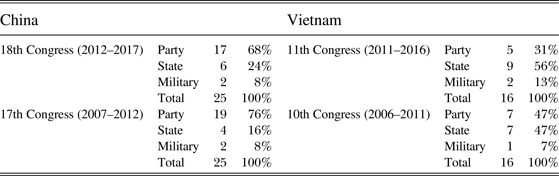
In terms of the paths to the Politburo, in Vietnam it is clear that if one wishes to enter the Politburo, a central party or state position is a necessary step. Therefore, in terms of the prospect of entering the Politburo, a central party or state position is clearly superior to a provincial party position, whatever the differences in access to patronage. In terms of which central positions matter more, Vietnam differs from China in the relative importance of a party versus state central position. In China, for example, the most common trajectory for reaching the Politburo and its standing committee is through the Party. Seventeen out of the current twenty-five Chinese Politburo members worked in a party institution rather than a state institution immediately prior to promotion. In contrast, only six members of Vietnam's 11th Politburo came from party institutions. The rest came from leading positions within state institutions, particularly ministerial posts. As Table 1 reveals, these differences are not unique to the current congresses, suggesting that power in Vietnam is more evenly divided between party and state than in China. This suggests that in terms of future promotion prospects, central party positions and ministerial positions are roughly equal.
Given this discussion, the only unambiguous promotion is from party secretary to either a ministerial position or a central party position that is accompanied by a seat on the Politburo. This suggests a simple dichotomous variable that takes the value of (1) whenever a provincial secretary is awarded a ministerial position or a party position with a corresponding Politburo role. Similar to our China measure, we add to this a disaggregated measure that allows for partial promotions to deputy minister, deputy central party position, and demotion (see Table 2).
Politburo Entry Routes

Note: Based on previous portfolio held by each member prior to joining their respective politburos.
Promotion Coding

Note: In the case of China, partial promotion involves a move from alternate to full member status in the Central Committee. In Vietnam, partial promotion includes promotion to deputy minister, deputy central party chair, or central party chair without a politburo position. Full promotion includes promotion to minister status in the state cabinet or a central party position with a politburo position.
INDEPENDENT VARIABLE—PUBLIC PROFILE
Measuring a politician's public profile in a democracy can be accomplished by simply asking respondents if they are familiar with individual politicians. In single-party regimes like China and Vietnam, however, such questions are too sensitive to include large public surveys. There are two ways to get around this obstacle. The first is to look at media coverage, a measure widely used in the literature as a proxy for name recognition (van Aelst et al. Reference Van Aelst, Maddens, Noppe and Fiers2008; Burden Reference Burden2002; Iyengar and McGrady Reference Iyengar and McGrady2007). Another is to use internet searches, an informative indicator used to predict flu outbreaks (Ginsberg et al. Reference Ginsberg, Mohebbi, Patel, Brammer, Smolinsi and Brilliant2009), consumer behavior (Choi and Varian Reference Choi and Varian2012), and, most importantly, political success (Granka Reference Granka2013; Ripberger Reference Ripberger2011; Weeks and Southwell Reference Weeks and Southwell2010). Granka (Reference Granka2013), for example, uses Google search queries to predict the outcome of US elections within one percent of the actual 2012 outcome, correctly calling forty nine out of fifty states.
For both China and Vietnam, we construct a measure of media coverage using data harvested from national news aggregators. For China, we relied on the Baidu News Index, which compiles daily index statistics on news and magazine coverage from both traditional and digital media. Our measure of media coverage in Vietnam comes from Bao Moi (News), Vietnam's largest news aggregator, which provides a similar service as Baidu, but in count format rather than an index format. In each instance, we use the news aggregators to measure content concerning our provincial party secretaries by inputting their names as keyword searches, either in the title or in the content of the story.
Collecting equivalent internet search data for both cases was more challenging. The massive size of China's internet population – nearly 600 million users in 2011 – combined with the fact that it is serviced almost exclusively by domestic search engines that meticulously track the behavior of Netizens, means search data is well structured and fine-grained. The largest of China's search engines, Baidu, dominates between 60 and 70 percent of the market share and, like Google, provides rich data on the search behavior of its users. We harvested this data on a daily basis, both at the national level and at provincial and prefectural levels, for each provincial secretary in China.Footnote 20 Unfortunately, similar data is difficult to reproduce for Vietnam, due in part to the fact that Vietnam lacks a domestic search engine, and relies instead on Google, which does not have the same level of coverage capacity in Vietnam as it does in the United States and Western Europe. Google Trends, for example, reports blank observations for a majority of Vietnam's provincial party secretaries in 2010. This does not necessarily mean that Google Trends lacks search data on these individuals. NBT, for instance, registers a healthy trend score, but for many of the other candidates search queries were simply too small to report.Footnote 21
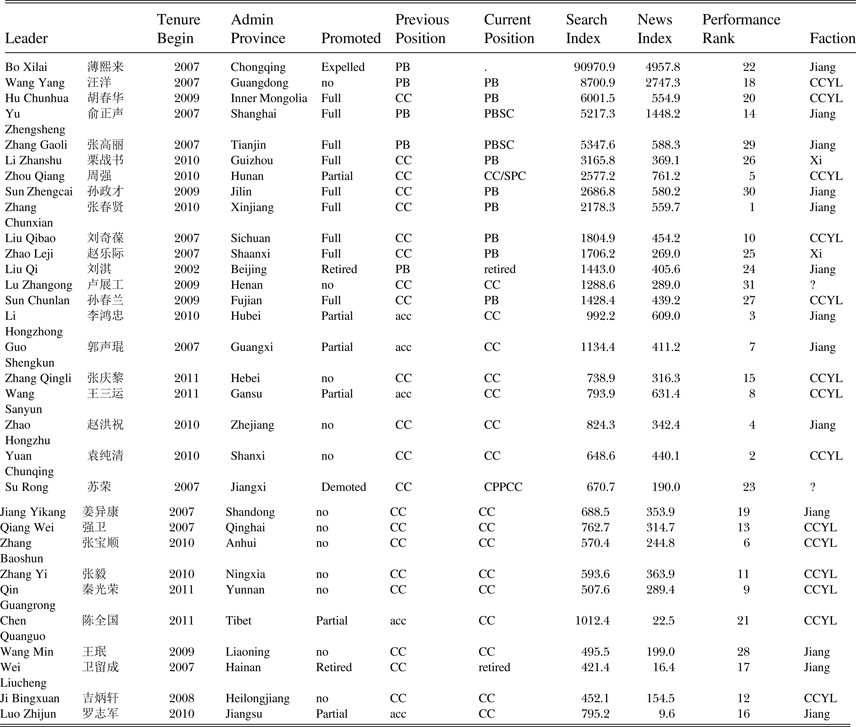
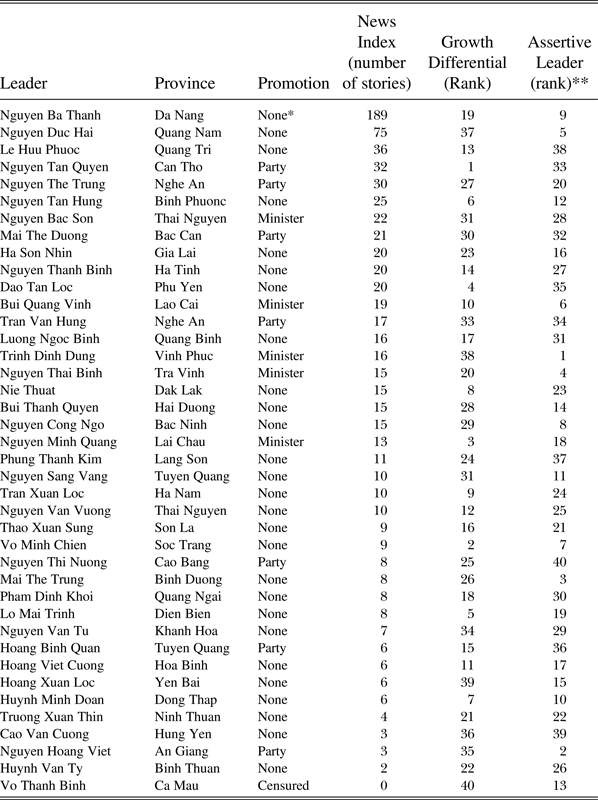
Figure 1 provides a summary of our search index and news index measures for China as well as measure of news stories for Vietnam. For China, we simply average up the daily search scores for each party secretary and assign them an annual average for 2011, the year prior to the congress. In Vietnam, movement by secretaries is a bit more fluid, and some were actually rotated out of their provincial positions before the party congress in 2011. To account for these movements, we normalized all news story counts through a formula that reports the number of stories we would have expect for each secretary had they served their entire term.Footnote 22 What is immediately apparent from Figure 1 is that both China and Vietnam exhibit a great deal of diversity when it comes to public profiles. Interestingly, Bo Xilai and Wang Yang attracted the most public attention. In fact, Bo attracted about seven times the attention of Yu Zhengsheng and Zhang Gaoli, both of whom were eventually promoted into the current Politburo Standing Committee. Similarly, NBT received far more news coverage in Vietnam than any of his counterparts, with more than 180 stories during the period of observation, compared with Nguyen Duc Hai, who had the next highest with seventy five.
Public Profiles in China (2011), News Stories About Provincial Leaders in Vietnam (2007–2010)
Before moving on to control variables, it is worth remembering that media coverage in China and Vietnam is vulnerable to intervention, by both contenders and the regime leadership. As mentioned in the previous section, a provincial contender could try to augment their profile by self-promoting in provincial media outlets. However, as long as self-promotion engenders more public interest, it is consistent with our understanding of public profile. While we do not want to conflate pure advertising with genuine public interest, the nature of the problem is much more apparent when the regime actively censors coverage related to a specific contender. This extreme form of intervention typically only occurs during scandals. The case of Bo Xilai, summarized in Figure 2, provides a clear illustration. Prior to news of a scandal breaking out in February 2012, search queries and media coverage for Bo move almost in tandem. During the scandal, however, there was intense interest on the internet, but little media coverage.Footnote 23 This suggests that, absent a major intervention by the regime, media mentions are highly consistent with the search index. Indeed, media coverage and search queries, at least in China where we have data on both are highly correlated (0.89). We therefore proceed with both measures at our disposal but with a preference for internet searches, when possible.
Bo Xilai in Media and Online
CONTROL VARIABLES—FACTIONS AND PERFORMANCE
In both China and Vietnam we make every effort to account for existing theories of promotion, in particular loyalty and performance theories. Constructing a factions variable involves making several interpretive decisions, such as who the factional leader is and what factors determine allegiance to a particular faction. Fortunately, in the case of China, we were able to consult existing expert accounts of factional affiliations.Footnote 24 As a robustness check, we also confirmed these expert accounts using Shih's (Reference Shih2012) coding rules, which use same home province, same education background, and professional overlap. Based on these methods, Hu Jintao's Communist Youth League faction managed three partial and three full promotions from a pool of 14 contenders. Jiang's Shanghai Clique, on the other hand, achieved three partial and four full promotions, out of 12 contenders.
In Vietnam, a similar measure of factional affiliation could not be constructed. Although some argue Vietnam has factional networks, few have been able to identify them. Even strong adherents to the factional interpretation to Vietnamese politics like Gainsborough (Reference Gainsborough2007) admit that, “We are not yet in a position to put flesh on the bones of this argument in terms of a full rendering of national patronage networks.” While we do not deny the existence of such patronage networks or their role in promotions, due to the fluidity of these networks any attempt to code them would likely obscure more than it would illuminate.
Next we consider the performance thesis, under which promotion is determined by effectiveness at reaching regime-defined targets. Although cadres have many targets, scholars who study the performance thesis generally agree that economic growth, e.g., GPD growth, is the most important (Hongbin Li and Zhou Reference Li and Zhou2005; Whiting Reference Whiting, Naughton and Yang2004; Xu Reference Xu2011). In line with recent work on the subject, we focus not only on GDP growth levels for each contender's respective province but also the change in growth levels across administrations by taking the average growth rate during a secretary's tenure and comparing it to average growth levels attained by their predecessors in the same province (Su et al. Reference Su, Ran, Sun and Liu2011). We then take the difference from this comparison and rank it from 1 to 31, with the top Performance rank going to the provincial secretary overseeing the largest improvement in growth.Footnote 25
One problem with growth-based measures of competence is that prominent party secretaries have unique access to resources that are not equally distributed across all provinces. Critics even raise the possibility that prominent up-and-comers selectively place into high growth regions to bolster their portfolios. In an effort to provide a less contentious measure of competence we also include survey evidence from private industry managers who were asked to report on their local business climate, a scaled assessment increasing from 1 to 3, as well as whether or not the government was an obstacle to business operations, a yes or no binary response.Footnote 26 Assuming competent party secretaries facilitate growth by stimulating business activity, these survey measures actually provide a closer approximation of their competence.
In addition to alternative measures of performance, we also collected several controls to ensure that our measures of a candidate's public profile and performance were not actually measuring something more general about the province they led, such as the number of internet users or the size of the economy. To this end, we collected data on internet penetration from reports published by the China Internet Network Information Center (CCNIC) and extrapolated internet population figures. We also include a basic measure of logged GDP for each province. Both controls are specific to 2011.
In the case of Vietnam, we also used logged provincial GDP figures collected from the Vietnam General Statistics Office and averaged across the leader's tenure to create the GDP variable. To measure competence, we followed the same strategy used to estimate economic competence in China—ranking the differential between the average growth of the leader's tenure and the average growth during the previous period. We also look at other indicators of performance. In particular, we take advantage of survey measures from Vietnamese Provincial Competitiveness Index (PCI) concerning the business and investment environment, similar to the questions used in the China section, described above.Footnote 27 Critically, the survey asks how willing the secretary is to risk punishment from the center in the name of promoting growth.Footnote 28 We used the average score of this question over the leader's tenure to create the assertive leader variable.Footnote 29
SECTION 3: RESULTS
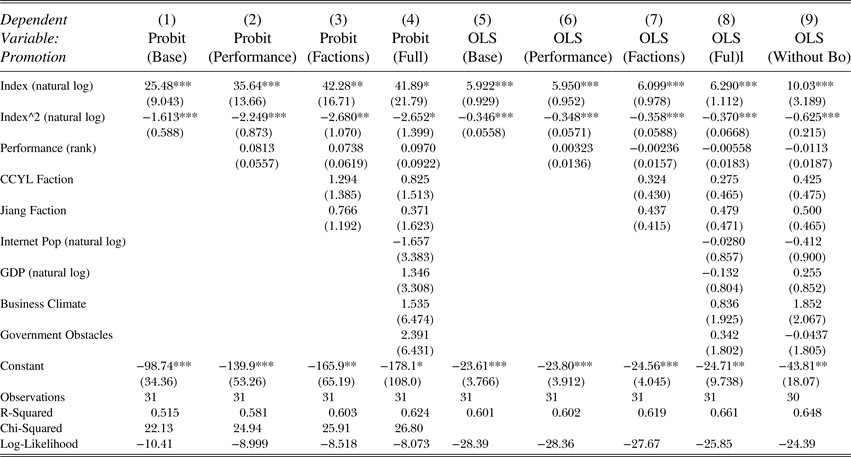
Beginning with China, in Table 3, we conduct two sets of tests. First, we used a probit model to measure the contribution of a candidate's profile on the dichotomous measure of promotion. We then replicated these tests using the four-point promotion scale outlined in the previous section and an ordinary least squares model specification.Footnote 30 Model 1 includes only the search index measure of a candidate's profile as well as the squared value of the index. Model 2 includes a measure of performance, based on GDP growth improvement under the candidate. Model 3 includes a measure of factions, with the reference category including unaffiliated candidates as well as those candidates believed to be loyal to newly appointed regime leader, Xi Jinping. Model 4 includes alternative survey measures of competence, business climate and government obstacles, as well as controls for internet population and GDP size. Models 5–8 replicate the previous specifications but with an ordinal measure of promotion ranging from (−1) representing demotion to (2) representing full promotion and using an ordinary least squares estimator. Model 9 replicates model 8, but with the exclusion of Bo Xilai, who by virtue of his unique criminal circumstances, is a potential outlier.
Main Results (China)
Note: The sample includes all provincial leaders prior to the November 2012 Chinese Communist Party Congress. Model 1 includes only the index measure and the squared value of that index. Model 2 includes a measure of performance based on the GDP growth improvement under the candidate. Model 3 includes a measure of factions, with the reference category including unaffiliated candidates as well as those candidates believed to be loyal newly appointed regime leader Xi Jinping. Model 4 includes additional controls including, Internet population, logged GDP, and alternative measures of competence, climate and business obstacles, derived from survey data. Models 5–8 employ an ordinal measure of promotion ranging from (−1) representing demotion or expulsion to (2) representing full promotion and are estimated using ordinary least squares regression. Model 9 replicates the fully specified Model 8 but without the inclusion of Bo Xilai in the sample. Standard errors in parentheses (*** p < 0.01, ** p < 0.05, * p < 0.1)
Consistent with our expectations, the coefficients on index and its squared term index^2 in each model of Table 3 confirm that popularity is not a liability, except in the extremes. Looking at models 2 and 5 we find that performance does not have any significant effect in either the probit or the ordered logit specification. Including factional affiliations in models 3 and 6 does not change the results greatly either, as both the Jiang connection and the Hu connection are insignificant. Adding in controls to models 4 and 7 has almost no effect on the estimations, other than to increase slightly the R-squared value. In model 9, which tests for robustness by excluding Bo Xilai, there is still no substantive change in the model estimates, other than a slight decrease in the R-Squared value.
Across the board, the impact of public profile is strong, stable, and consistent. Employing the ordinal measure of promotion has no substantive impact on the parameter estimates with the exception of performance, which is slightly negative but still far from significant. This seemingly negative relationship on performance in models 7 through 9 is offset by a small but positive coefficient on business climate in models 8 and 9. Taken together, it seems that performance may have a positive role, but that our measures are not sharp enough to capture it. All in all, the models provide strong and consistent evidence for our predicted inverted U-shaped relationship between a candidate's public profile and their promotion likelihood.
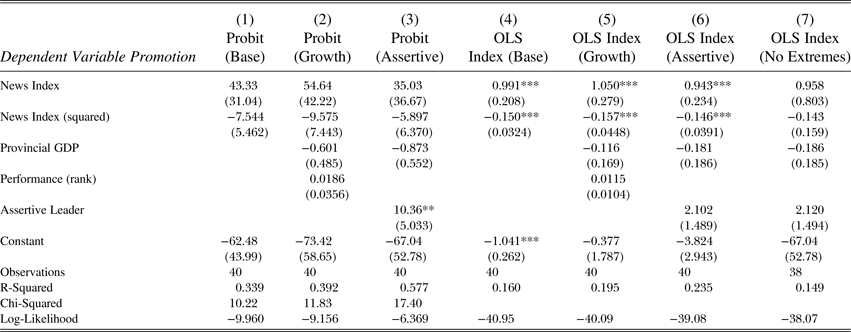
In the case of Vietnam, we replicate the tests of the Chinese case, starting with a probit model on the dichotomous dependent variable and moving to an ordinary least squares estimation for the categorical dependent variable. In each of the probit models 1–3 of Table 4, the quadratic term on the news index variable is consistently negative, indicating a downward facing curve. This is consistent with the predictions. The quadratic term is negative and significant in the OLS models 4–6, using with the four-point categorical variable. To account for the possibility that extreme values are influencing the results, we drop NBT (the largest profile) and Vo Thanh Binh (the smallest profile) from the sample in model 7. Not surprisingly, given the smaller number of observations, the key variables drop from significance. However, the parameter estimates remain relatively unchanged, suggesting that with more observations, a robust relationship would emerge.
Main Results (Vietnam)
Note: Models 1–4 are probit regressions with the dependent variable a dummy variable indicating whether or not the leader was promoted to a ministerial position. Models 4–7 are based on OLS regresions where the dependent variables ranges from −1 (censure); 0 (no change); 1 (promotion to deputy minister, deputy central party position, or central party committee chair without Politburo); 2 (ministerial position or central party committee chair with Politburo). Standard errors in parentheses (*** p < 0.01, ** p < 0.05, * p < 0.1)
For illustration, Figure 3 provides a graphical representation of the predicted promotion likelihood computed using coefficients from the fully specified models 4 and 9 in the case of China, and models 6 and 7 in the case of Vietnam. The left hand panels report estimates from the full sample, while the right hand panels report estimates without the most prominent outliers. In each instance, the findings are consistent with the theory predictions: namely, that profile has an non-linear effect on promotion, characterized by a downward facing U-curve.
Profiles and Predicted Promotion in China and Vietnam
In summary, results based on data from China strongly suggest that a candidate's public profile has a non-linear impact on promotion, with those at the extremes facing a significant disadvantage. In Vietnam, the impact of a candidate's public profile also has a consistent quadratic impact on promotion that is significant in the fully specified models with the fine-grained dependent variable. The strong relationship between a candidate's public profile and promotion in China stands in contrast to the relatively weak contributions of performance or factional affiliation, neither of which produces a significant coefficient. Similarly, in Vietnam the data suggest an indeterminate relationship between competent governance and promotion but a fairly consistent effect of profile. These findings call into question the extant literature's narrow focus on internal manifestations of elite party politics. We cannot fully replicate existing studies of competence and factions, which cover far more history and party congresses than what we have profile data for. However, in rerunning our analyses on the data we do have, we do find that that the effect of competence actually appears weaker when a candidate's public profile is not included.Footnote 31 Indeed, public profile, when unaccounted for, may explain some of the empirical inconsistencies in studies examining the effect of competence on promotion.Footnote 32
ROBUSTNESS TESTS
The findings outlined above are strong but not definitive. First, the limited number of observations means that individual contenders play a large role in driving the estimates. Dropping outliers provides a partial remedy, but reduces the sample size even further. A more pressing concern is the high-stakes politics surrounding provincial party secretary promotion, especially in the case of China, where contenders are either in, or aiming for, Politburo seats. The politically charged environment raises the possibility that expectations of promotion are influencing the size of profiles, thereby reversing causality in our model assumptions. Finally, because the selection process for Politburo positions is highly opaque, it is difficult to assign agency over promotion decisions. That is, it is difficult to tell whether it is incumbents or peers who are penalizing conspicuous low/high profile candidates. To address these limitations, we conduct several additional tests, in both China and Vietnam, aimed at bolstering the generalizability and validity of the findings.
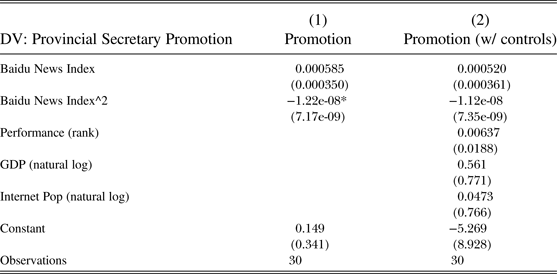
First, we examine the relationship between profile and promotion during the China's 17th Congress, which took place in 2007. Since the internet search data used to examine the 18th Congress is not available prior to 2007 we rely on Baidu's news aggregator, which provides coverage back to 2003. Consistent with our main analysis we operationalize the Baidu news scores using both a normal and a squared term and we determine promotion based on party rank.Footnote 33 We also include the same controls used in the main analysis, with the exception of the same factional alignments, which could not be reproduced for the 17th congress. We report results from this analysis in Table 5. As with our main results, robustness tests in Table 5 show public profile producing a familiar effect, e.g., moderately large profiles are rewarded and conspicuously low/high profiles are penalized. This relationship, however, is not significant when controls are included.
China Robustness (17th Congress)
Note: Model 1 uses Baidu News Index as well as the squared term Baidu News Index^2. Model 2 replicates with controls. In each model, the dependent variable is party rank promotion, which ranges from (−1, demotion) to (2, full promotion). Standard errors in parentheses (*** p < 0.01, ** p < 0.05, * p < 0.1)
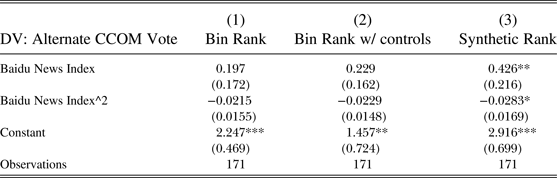
We further complement our analysis of provincial party secretaries by examining the effect of public profile on a relatively less ‘star-studded’ cohort of Central Committee members, who are selected through an internal party vote during each party congress. While the outcome of this vote is secret, the relative vote share for those selected as alternate Central Committee members is partially discernable from the order in which names of selected alternate members are reported.Footnote 34 In particular, by observing the serial placement of names on the list, as well as the stroke count of individual surnames, it is possible to reconstruct a relative bin rank of high and low vote earners. If our theory of public profile is correct, we should expect those with conspicuously low/high profiles to populate lower ranked bins, both because incumbents in the ruling coalition fear their rapid entry into elite leadership positions and because their peers are wary of having to operate under their high-profile shadows.
We test this prediction in Table 6. Estimates in models 1 and 2 are constructed using bootstrap replications that randomly assign different rankings for Central Committee members falling within the same bin.Footnote 35 Based on this methodology, the estimated relationship between news coverage and vote share is consistent with our expectations, but the effects are not significant. To deal with the bin problem, in model 3 we construct a synthetic individual rank, based on covariates that predict relative bin rank. Specifically, we regress bin rank on the age, education, career length, and functional organization of each alternate member. Then we apply the coefficients from this regression to impute a synthetic individual rank for each member. Replicating our bootstrap estimates with this more refined measure of vote rank provides strong support our theory, with both the normal and squared terms on Baidu News, significantly predicting synthetic vote rank.
China Robustness (Alternate Central Committee)
Note: Estimates in models 1 and 2, are constructed using bootstrap replications which randomly assign different rankings for CC members falling within the same bin. In model 3, we predict a synthetic independent rank, based on covariates associated with the relative bin rank.. All models estimated using Poisson specification.
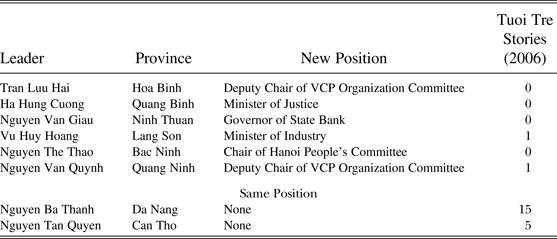
In Vietnam, the Bao Moi aggregator we used in our previous measure does not go back to previous promotion rounds. We were able to scrape news stories from a single newspaper—Tuoi Tre—back to 2006, however. This is useful because it is the year before six provincial party secretaries were given promotions. Table 7 includes a list of these leaders, their positions at the end of the 2006 Party Congress, and their promotions in 2007. To examine our hypothesis, we look at the number of stories about each candidate in 2006—the year before this round of promotions. Of course, this is not as good a measure as one relying on the media aggregator because Tuoi Tre is only one outlet. As such, there is less variation across party secretaries. Indeed, the modal number of stories for provincial secretaries is zero. Another drawback of this data is that we do not have reliable data in 2006 to control for other factors as we did in the previous models.
Vietnam Robustness (Past Congress)
Note: These are the party secretaries that had the two greatest number of stories in Tuoi Tre during 2006.
However, as Table 7 shows, the data suggests a similar dynamic to the one presented in the main analysis. Each of the promoted party secretaries had moderate national profiles. That is, there were few stories covering these leaders until they made their jumps to their new positions. By contrast, two leaders did garner national attention. One was Nguyen Tan Quyen of Can Tho, who was mentioned in five stories during 2006. In two of those stories, he was quoted in an interview with Tuoi Tre, indicating that he actively engaged the media. The other was NBT, who even in 2006 garnered far more national attention than any other party secretary. While this data is certainly not complete and there is not enough variation at the lower levels of public profile to assess the curvilinear relationship, it does suggest that extremely large profiles were nonetheless punished.
SECTION 4: CANDIDATE STRATEGIES
Our findings on China and Vietnam strongly suggest that a candidate's public profile impacts their chances of promotion. Specifically, an exceptionally small or large public profile can hinder one's chances of promotion. But, if these results are correct, why would any candidate risk their prospects by mismanaging their profile? While we do not address this question formally in this article, we offer three propositions that could help guide future work.
One proposition is that a candidate's public profile is intimately linked to charisma, a “supernatural” quality inherent to born leaders (Weber Reference Weber1978, 241). If so, then the size of a candidate's public profile is, to some degree, out of their control. Take, for example, China's former general secretary, Hu Jintao, widely seen as a bland leader who never commanded a personal following despite his efforts to marshal one after winning the top position.Footnote 36
An alternative explanation is that amassing a large public following is strategic. In particular, if a candidate fears they may be under threat, their only remaining poker chip could be their public following. As we argued earlier, the value of a public profile is in its mobilizational capacity. While it is unclear what Bo's ultimate intentions were, it is possible that he calculated his profile was large enough to challenge the incumbent leadership. Indeed, Bo's behavior immediately after his future came into question in February of 2012, strongly suggests he believed his public profile could be his salvation. In particular, he held an unusual press conference at the NPC session in early March 2012, in which he defiantly reached out to his followers as a victim of evil powers determined to suppress him and his movement: “I was mentally prepared that attacking organized crime and expunging evil would affect some people's interests, and there would be different views … These people who form criminal cliques … have power over opinion … and have poured filth on Chongqing, on me, and on my family.”Footnote 37 At that point there were only two possible outcomes for Bo—a successful political coup or prison. He ended up with the latter.
But why did Bo let things go so far? Unless we are willing to accept that inherent charisma means that a candidate's public profile is entirely out of their control, it should have been possible for Bo to trim his profile and avoid the ire of his peers and superiors. Wang Yang is a good example. By 2011, Wang knew that the public considered him a favorite for promotion and a darling of reformist leaning observers, who endearingly dubbed him “father of the Guangdong model.” This is precisely why Wang began to distance himself from unwanted attention: “He knows well to keep within the party's bounds. He rarely talks about the Guangdong Model, which would sound like a slap at others.”Footnote 38 In the end, Wang was not promoted, but he is not in prison either, and he may yet have one more final chance for promotion in 2017.
This suggests that, be it not for hubris, authoritarian contenders can manage their profiles and avoid being singled out as threats, at least until they get the top spot. Today, Xi Jinping provides an excellent example of this third proposition. Most observers agree that Xi is now China's single-most powerful leader since Mao Zedong, not simply because of his institutional strengths but because of his connection to the masses. This, however, was not always the case. Prior to being named as a likely successor to the top leadership in 2007, Xi was a relatively unexceptional elite, whose public profile was only a fraction of that of his wife, a beloved PLA singer. In fact, he was the lowest ranked alternate elected to the 15th Congress in 1997. It was only after Xi acquired the reins of power in 2013 that he unleashed his charisma. Had Bo taken a similar approach, his trajectory may have been quite different.
SECTION 5: CONCLUSION
In this article we propose that an official's public profile is an important but heretofore under-theorized dimension of authoritarian politics. Specifically, we posit that the relationship between public profile and promotion resembles an inverted-U, whereby conspicuously low or high public profiles are harmful for promotion prospects. In testing our theory, we conduct what we believe is the first systematic attempt at measuring the public profile of candidates under single-party rule. Leveraging data on Internet search queries and media coverage, we show that in two prominent single-party regimes, China and Vietnam, the most and least well known candidates are systematically penalized.
Our findings have notable implications for the literature on comparative authoritarianism, which has thus far posited a fundamental dilemma, whereby incumbents penalize competence in subordinates in order to maximize loyalty. By incorporating a candidate's public profile into the equation, we show that it is possible to promote competent candidates without sacrificing loyalty. Put differently, not accounting for elite–mass linkages in the analyses of promotion is likely to bias these estimates. Indeed, our findings suggest that after accounting for the dangers of high public profile, the true effect of competence may actually be more pronounced than previous studies have suggested. In this way, our study helps explain the rise of regimes that are clearly authoritarian but are nevertheless keen on cultivating popular public opinion. As society in these regimes becomes increasingly sophisticated and politically aware, the tension between promoting popular candidates and maintaining party cohesion will only increase. In short, our findings question whether the narrow focus on factional infighting, which has dominated the study of elite authoritarian politics, especially in the case of China, is enough for understanding the complexities of single-party politics in an era where rich media and budding civil society are increasingly bringing the drama of elite politics into the open. As Robert Kuhn explains, “Beijing cannot appoint people that the public won't support.”Footnote 39
Our findings also shine new light on well-established theories concerning the lifespan of single-party regimes. Specifically, the need to prune charismatic contenders may contribute to a phenomenon described in the literature as “authoritarian decay” (Kalyvas Reference Kalyvas1999; Samuel and Huntington Reference Huntington, Huntington and Moore1970). Roeder (Reference Roeder1993), for example, argues that the Soviet Union's rigid institutions ultimately stifled innovation and doomed the regime to failure. For Roeder, these institutions were primarily concerned with policymaking and organization. We would add that the Soviet Union's institutions were especially stifling when it came to personnel management, contributing to an exceptionally aged and ossified Politburo in the decade prior to Gorbachev's reforms in 1985. Put simply, if a regime consistently penalizes those with the greatest capacity to mobilize the masses, its ability to maintain public support will atrophy over time.
Our results also raise several difficult questions. If profile matters, how much is too much and how little is too little? In principle, one could argue that a contender's risk level increases as a function of distance from the mean profile in their cohort. It stands to reason, however, that these parameters are endogenously defined by the nature of the cohort. In a highly uniform cohort, any deviation from the norm could be considered highly conspicuous and risky. In a cohort with a more diverse range of public profiles, these differences may be harder to demarcate. Furthermore, it is important to remember that a politician's profile is multidimensional. In the case of provincial party secretaries, for instance, it may be entirely appropriate to generate large profiles within one's own constituency, while spillover into neighboring constituencies or into the national spectrum is considered highly threatening. Bo Xilai, for instance, was not only nationally prominent, he captivated far more interest than other party secretaries, even in their own respective provinces.Footnote 40
Finally, our analysis raises the question: if there are risks to being anonymous as well as standing above the crowd, why don't all contenders aim for the safety of mediocrity?Footnote 41 In the previous section, we offer several speculative propositions. At the low end, it is possible that some candidates simply do not have the competence, charisma, or leadership skills to generate a public following. At the upper end, we posit that candidates may err because they garnered attention they did not seek, because they simply couldn't help themselves, or because they deliberately sought extra-institutional leverage, in the form of mass public appeals, against their peers. The personal stories of Wang Yang and Bo Xilai in China illustrate the first and third logic, insofar as Wang actively tried to avoid public attention, despite being widely popular, while Bo leveraged his public clout at the same as the party was bearing down on him. We refer these strategic nuances to future work and qualify our conclusions to the point that public profile, a previously overlooked factor, must be considered when analyzing power relations in authoritarian contexts.
China Candidate Summary
Vietnam Candidate Summary