Introduction
Demand for organic grains is on the rise in the northeastern United States, reflecting growing markets for organic livestock feed, local artisan foods, and craft malt products. Weeds, however, remain a challenging production problem in organic grains.
Cereal grains are typically planted in rows spaced 15 to 18 cm apart, and fields are PRE and POST tine harrowed when soil conditions permit. The efficacy of tine harrowing is quite variable (Gallandt et al. Reference Gallandt, Brainard, Brown and Zimdahl2018). Given ideal conditions, tine harrowing can achieve satisfactory weed control of 80% to 90% (Lundkvist Reference Lundkvist2009; Rasmussen Reference Rasmussen2004). Efficacy is reduced, however, as soil moisture increases (Kurstjens and Kropff Reference Kurstjens and Kropff2001) and when weeds surpass the white thread stage (Baerveldt and Ascard Reference Baerveldt and Ascard1999; Kurstjens et al. Reference Kurstjens, Perdok and Goense2000; Lundkvist Reference Lundkvist2009). Tine harrowing is also less effective on taprooted weed species with an erect growth habit (Melander et al. Reference Melander, Cirujeda and Jørgensen2003), such as wild radish (Raphanus raphanistrum L.) (Warwick and Francis Reference Warwick and Francis2005), a particularly problematic weed in cereals (Cheam et al. Reference Cheam, Storrie, Koetz, Holding, Bower and Barker2008). Tine harrows are often referred to as “blind” cultivators, because they uniformly disturb the entire field. POST harrowing ideally results in the uprooting and burial of smaller weeds, with less damage to the grain crop. Thus, a trade-off exists when POST tine harrowing; yield benefits result from reduced weed density, but yield losses result from burial or uprooting of the crop (Kolb and Gallandt Reference Kolb and Gallandt2012; Lundkvist Reference Lundkvist2009; Melander et al. Reference Melander, Rasmussen and Bárberi2005; Rasmussen Reference Rasmussen1991; Rasmussen et al. Reference Rasmussen, Nielsen and Gundersen2009).
Kolb et al. (Reference Kolb, Gallandt and Molloy2010, Reference Kolb, Gallandt and Mallory2012) previously identified two cropping strategies for improving management of weeds in organic cereals: narrow-row planting with a 50% to 150% increase in seeding rate (11-cm rows; PRE and POST tine harrowing) and wide-row planting with interrow hoeing (23-cm rows; PRE and POST tine harrowing and interrow hoeing). The two systems improved weed control by separate mechanisms: enhanced competition with narrow rows and elevated seeding rate, and improved physical weed control with the more aggressive interrow hoeing (Kolb et al. Reference Kolb, Gallandt and Molloy2010, Reference Kolb, Gallandt and Mallory2012). The wide-row system reduced weed biomass by 22% to 54%, and the narrow-row, high-density system reduced weed biomass by 45% to 60% when compared with the region’s standard cropping strategy (18-cm rows; PRE and POST tine harrowing) (Kolb et al. Reference Kolb, Gallandt and Molloy2010, Reference Kolb, Gallandt and Mallory2012).
There are two theoretical advantages of band sowing over wide-row planting, assuming both are hoed: improved interspecific competition and more complete coverage during hoeing. In band sowing, the crop is sown at a precise depth in a broadcast pattern, in bands 5- to 20-cm wide, instead of being sown in a single line or row (Andersson Reference Andersson1986; Heege Reference Heege1993; Huhtapalo Reference Huhtapalo1986; Speelman Reference Speelman1975). Altering the crop’s spatial distribution from the highly rectangular row arrangement to a more uniform broadcast arrangement decreases intraspecific crop competition and increases interspecific competition between individual crop plants and weeds, thus increasing weed suppression (Fischer and Miles Reference Fischer and Miles1973; Regnier and Bakelana Reference Regnier and Bakelana1995; Speelman Reference Speelman1975; Weiner et al. Reference Weiner, Griepentrog and Kristensen2001). Andersson (Reference Andersson1986) found that altering the spatial arrangement from rows to bands provided improved weed control in spring barley (Hordeum vulgare L.), but not in spring or winter wheat (Triticum aestivum L.) crops.
In a band-sowing system, the inter-band zone can be cultivated with sweeps. When compared with tine harrows, sweeps are a more effective physical weed control tool in varying soil conditions and across a wider range of weed species and life stages (Melander et al. Reference Melander, Cirujeda and Jørgensen2003; Pullen and Cowell Reference Pullen and Cowell1997). The novel idea with band sowing is that cultivation sweeps may be sized to fit the entire inter-band zone (L Askling, Gothia Redskap AB, personal communication). When hoeing in a wide-row system, 3 to 6 cm was left uncultivated on either side of the row to reduce the risk of crop mortality due to cultivator misguidance (Kolb et al. Reference Kolb, Gallandt and Molloy2010, Reference Kolb, Gallandt and Mallory2012; Melander et al. Reference Melander, Rasmussen and Rasmussen2001, Reference Melander, Cirujeda and Jørgensen2003).
Band sowing addresses the yield disadvantage of wide-row planting, where interspecific competition occurs due to the increased rectangularity of the crop’s spatial arrangement (Melander et al. Reference Melander, Rasmussen and Rasmussen2001, Reference Melander, Cirujeda and Jørgensen2003; see also Welsh et al. Reference Welsh, Tillett, Home and King2002). There are several studies that support this idea, with band sowing offering an average 4.9% greater cereal yield than that achieved with row planting (Andersson Reference Andersson1986; Heege Reference Heege1993; Huhtapalo Reference Huhtapalo1986; Speelman Reference Speelman1975). Speelman (Reference Speelman1975) simulated the effects of band width, seeding rate, and distribution on grain yield, concluding that band sowing was a superior arrangement to row planting. Speelman also performed field trials in winter wheat that compared band sowing, broadcast sowing, and row planting. Band-sown yields were greatest, but not significantly different from those attained by other crop arrangements. In agreement with Speelman’s models, Huhtaplo (Reference Huhtapalo1986) found that planting in narrow, 7-cm bands with 5.5 cm between crop bands increased barley yields by 1% when compared with a row-planted treatment.
Sowing pattern and crop density may also affect grain quality. Increased row spacing has been shown to increase grain protein and 1,000-kernel weight (Boström et al. Reference Boström, Anderson and Wallenhammar2012; Hiltbrunner et al. Reference Hiltbrunner, Liedgens, Stamp and Streit2005; Kolb et al. Reference Kolb, Gallandt and Mallory2012). Huhtapalo (Reference Huhtapalo1986) also observed improved 1,000-kernel weights when planting in a band-sown arrangement versus row planting. Increasing crop density is, however, associated with a reduction in grain protein, likely due to increased intraspecific competition (Arduini et al. Reference Arduini, Masoni, Ercoli and Mariotti2006; Kolb et al. Reference Kolb, Gallandt and Mallory2012).
Despite the strong theoretical basis for combining band sowing with inter-band hoeing, this practice has not been explicitly tested. Therefore, our research objective was to compare five strategies for managing weeds in organic barley: (1) the region’s standard practice; (2) narrow-row, high-density planting; (3) wide-row planting with interrow hoeing; and (4) band sowing with and (5) without inter-band hoeing. We hypothesized that band sowing with inter-band hoeing would provide superior weed control, increased yields, and improved crop quality when compared with all other treatments tested.
Materials and Methods
Site Characteristics and Field Preparation
Field experiments were located in Old Town, ME (44.93°N, 68.70°W), and Alburgh, VT (45.01°N, 73.31°W), in 2016 and 2017. At the Maine site in 2016, the experiment was conducted on a field with a Nicholville very fine sandy loam (coarse-silty, isotic, frigid Aquic Haplorthods); in 2017, the field was a Pushaw–Boothbay silt loam (fine-silty, mixed, semiactive, nonacid, frigid Aeric Epiaquepts; fine-silty, mixed, semiactive, frigid Aquic Dystric Eutrudepts). In the year preceding the experiment at the Maine site, fields were planted to oat (Avena sativa L.) in 2015 and potato (Solanum tuberosum L.) in 2016. At the Vermont site, the soil was a Covington silty clay loam (very-fine, mixed, active, mesic Mollic Endoaqualfs); fields were planted to corn (Zea mays L.) in 2015 and winter canola (Brassica napus L.) in 2016. All fields were managed organically in the year before establishing experiments, except for the Maine site in 2016, where metribuzin (1.7 g ai L−1, Sencor 75 DF®, Bayer CropScience, Whippany, NJ, USA) and S-metolachlor (3.8 g ai L−1, Charger Max®, WinField United, Arden Hills, MN, USA) were applied for weed control in potatoes.
Soil fertility was amended based on soil test results. In Maine, solid dairy manure was applied at 73 kg ha−1 of plant-available nitrogen. In Vermont, commercial fertilizers were used to amend soil fertility. In 2016, Cheep Cheep 4-3-3 (North Country Organics, Bradford, VT, USA) was applied at 90 kg ha−1 of plant-available nitrogen; and in 2017, Pro-Gro 5-3-4 (North Country Organics) was applied at 112 kg ha−1 of plant-available nitrogen. Fields were fertilized to meet the nutrient requirements of the crop; however, in a scenario in which nutrients are limited, crop–weed competition and treatment outcomes may be affected.
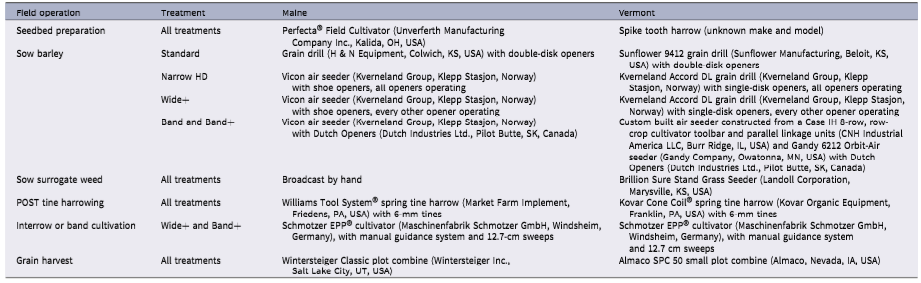
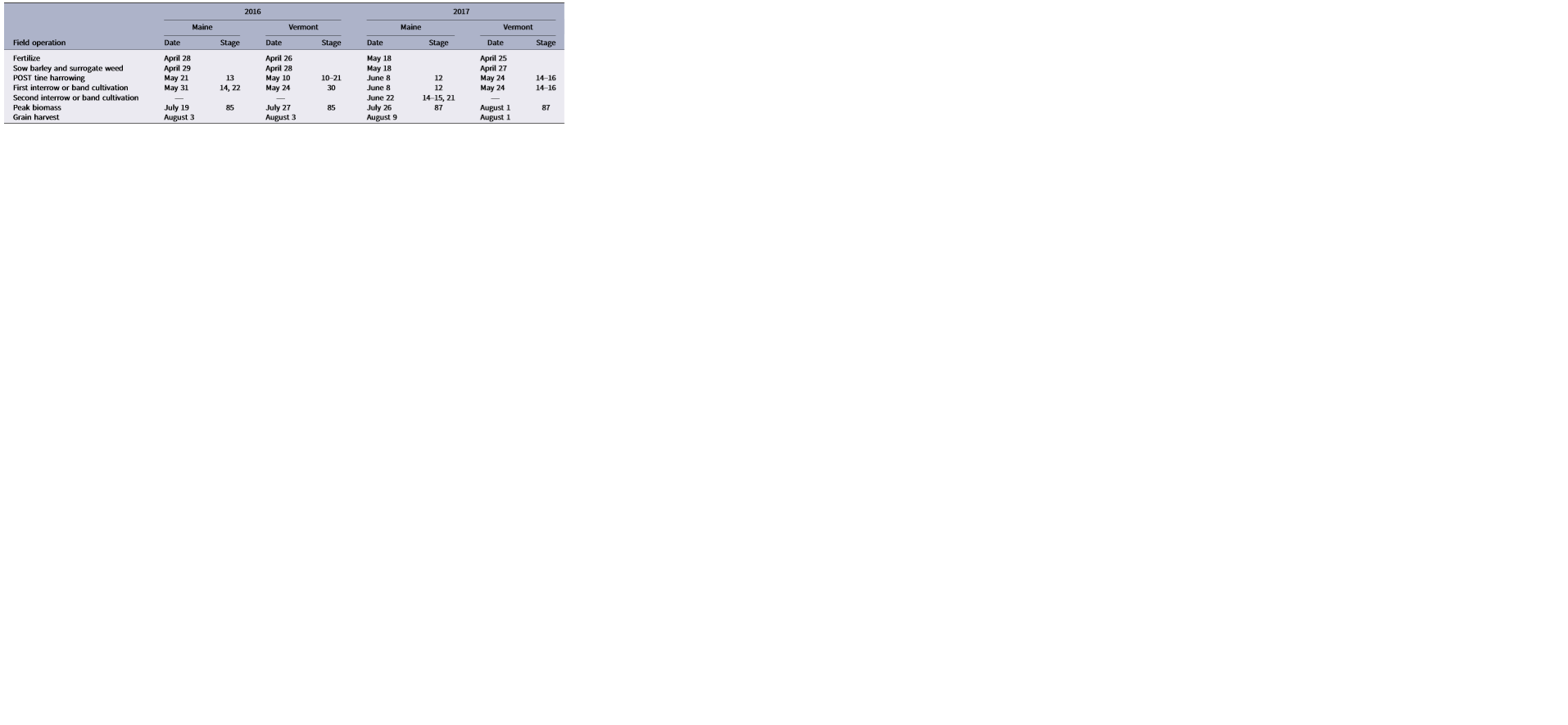
Final seedbed preparations were performed within 12 h of planting at both sites. Equipment used for field preparations and treatment implementation at the Maine and Vermont sites are described in Table 1. A summary of dates and barley growth stages when field operations were performed is presented in Table 2.
Equipment used to perform field preparations and implement treatments at the Maine and Vermont sites in 2016 and 2017.

Summary of field operation dates and barley growth stages at the time of each field operation.a

a Barley growth stages are described using Zadoks et al. (Reference Zadoks, Chang and Konzak1974) decimal code for cereals.
Experimental Design and Treatment Specifications
Treatments were established in a randomized complete block design, with five replications in Maine, and four in Vermont. Two-row spring malting barley (‘Newdale’) was used as the test crop.
The five treatments will be referred to as Standard, Narrow HD, Wide+, Band, and Band+. For all treatments, barley was sown at a depth of 3.5 to 4 cm, and POST tine harrowing was performed when possible. The Standard treatment represents the standard practice for growing cereal crops in northern New England; the crop is sown at a row spacing of 16.5 cm and a target density of 325 plants m−2. Narrow HD consisted of a narrow-row, high-density planting in which row spacing was decreased to 11.4 cm, and the target crop density increased to 500 plants m−2. Wide+ denotes a wide-row planting with 22.8-cm row spacing, plus interrow cultivation performed with 12.7-cm sweeps, and a target crop density of 325 plants m−2. Band and Band+ treatments were sown to a target crop density of 325 plants m−2. Broad-shoe openers capable of sowing the crop in 12.7-cm bands were used to plant the barley; 15.2 cm was left between the planted bands; therefore, band spacing center-to-center was 27.9 cm. The Band treatment did not receive inter-band cultivation, whereas the Band+ treatment was cultivated with 12.7-cm sweeps. Table 3 provides a summary of treatment specifications.
Summary of treatment specifications.a

a A plus sign (+) indicates cultivation event is performed in the designated treatment.
After the barley was planted, condiment mustard (Sinapis alba L. ‘Ida Gold’) was sown in all plots as a surrogate weed at a target density of 65 plants m−2 (Kolb et al. Reference Kolb, Gallandt and Molloy2010) and at a depth of 0 to 3.8 cm.
Data Collection
Three 0.25-m2 permanent quadrat locations were randomly placed within the central area of each plot; these sites were returned to throughout the experiment to measure crop, ambient weed, and surrogate weed density and biomass.
Crop and Surrogate Weed Populations
Initial censuses of the crop and surrogate weeds were taken before POST tine harrowing. Crop censuses were conducted along three permanently marked 0.5-m lengths of row or band in each plot, and weed censuses were taken within the three permanent quadrat locations.
Surrogate Weed Density and Biomass and Ambient Weed Biomass
Before harvest, all aboveground plant biomass within permanent quadrats was cut 13 mm from the soil surface and collected. Crop, surrogate weeds, and ambient weeds were separated, and final censuses were determined for the crop and surrogate weeds. Plant material was dried at 49 C for at least 7 d and weighed.
Barley Yield
Following harvest, grain samples were cleaned using a Clipper Model 400 Office Tester and Cleaner (Seedburo Equipment, Des Plaines, IL, USA) at the Maine site, and a Clipper M2B cleaner (A.T. Ferrell, Bluffton, IN, USA) at the Vermont site. Grain moisture was measured for each sample, and yields were standardized and presented at 13.5% moisture content.
Barley Quality
Barley test weight was obtained using the DICKEY-john GAC 2100 Agri (DICKEY-john, Auburn, IL, USA) at the Maine site, and a Berckes Grain Test Weight Scale (Berckes Manufacturing, Canby, MN, USA) at the Vermont site. The 1,000-kernel weight was measured by counting 1,000 barley kernels and recording their mass. Plump kernels were measured using standard methods (USDA, GIPSA 2006), as was germination energy (ASBC 1958). A ground subsample of barley was used to determine grain protein and deoxynivalenol mycotoxin (DON) levels. In Vermont, crude protein was measured using a Perten Infamatic 8600 Flour Analyzer (Perten Instruments, Springfield, IL, USA). In Maine, nitrogen concentration was measured using the combustion method (Sweeney Reference Sweeney1989), and crude protein were calculated by multiplying % N by 6.25 (ASBC 2011).
Analysis
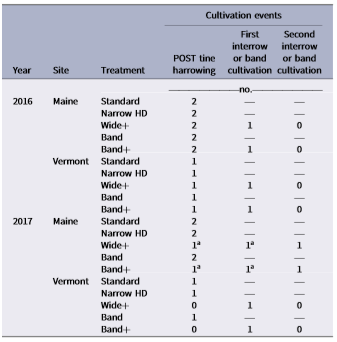
Data were analyzed using JMP® v. 10.0.2 software (SAS Institute, Cary, NC, USA). Each site-year (Maine 2016, Vermont 2016, Maine 2017, and Vermont 2017) was analyzed separately due to significant treatment by site-year interactions as well as differences in the number (Table 4) and timing (Table 2) of cultivation events. An alpha level of 0.05 was used throughout for hypothesis testing.
Cultivation events performed at Maine and Vermont sites in 2016 and 2017.

a In the Maine 2017 site-year, the 1st interrow or band cultivation event and POST harrowing were performed in sequence.
Surrogate weed density, surrogate weed biomass, ambient weed biomass, and barley yield data were analyzed using ANOVA with subsequent preplanned contrasts for hypothesis testing. Variables used in ANOVA analyses included block and treatment. To ensure data met the assumptions of ANOVA, including normal distribution and equality of variance of residuals, Shapiro-Wilk’s and Levene’s tests were performed, respectively. When necessary, square-root, square-root (x + 3), log10, and log10 (x + 1) transformations were performed to meet assumptions.
Grain-quality parameters were analyzed with ANOVA, and Fisher’s protected LSD was used to perform means comparisons. Variables used in ANOVA analyses included block and treatment. When needed, arcsine transformations were performed to meet assumptions. If unable to meet the assumptions of ANOVA with transformations, data were analyzed using the nonparametric Kruskal-Wallis test (Kruskal and Wallis Reference Kruskal and Wallis1952), and the Wilcoxon signed-rank test (Wilcoxon Reference Wilcoxon1945) was used to perform means comparisons.
Results and Discussion
Weather
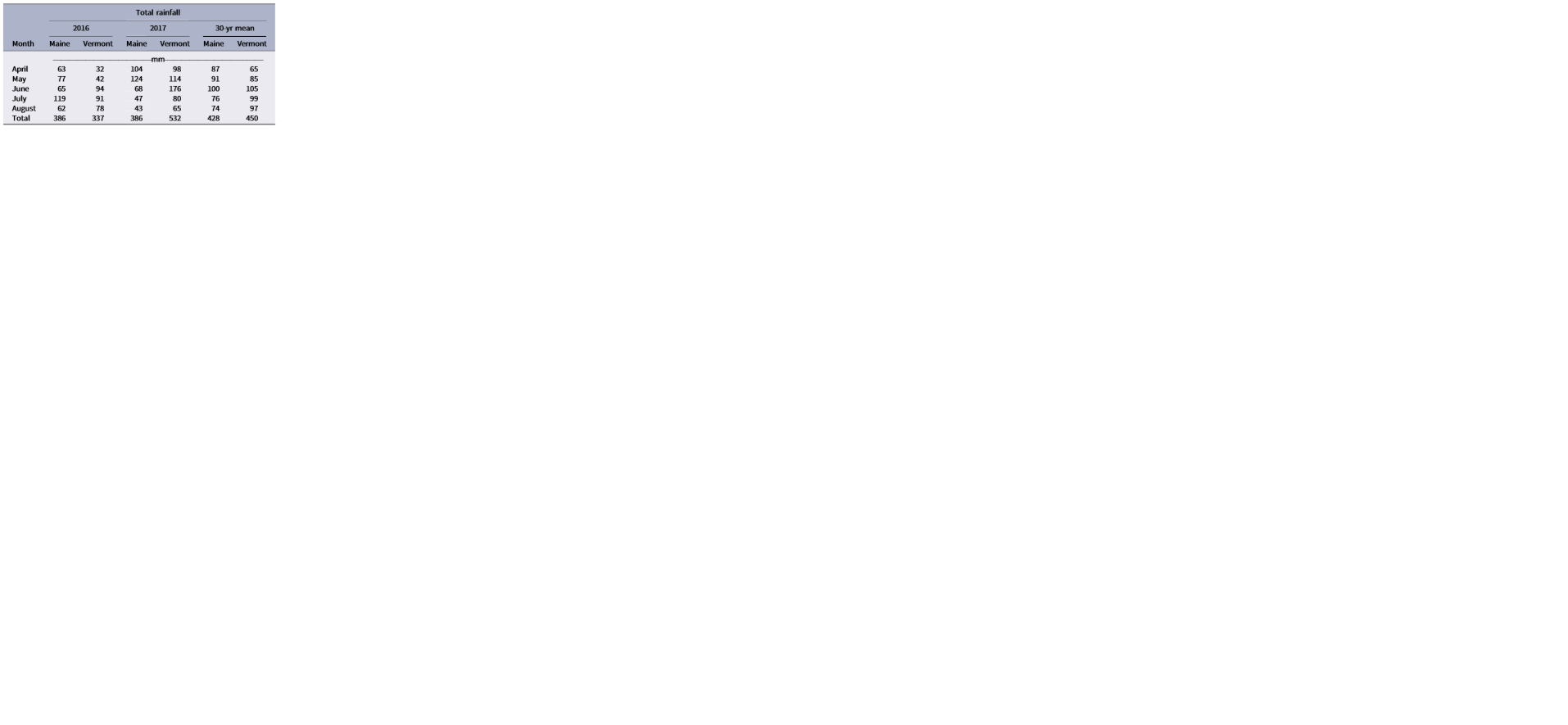
Maine and Vermont sites had below average rainfall during the 2016 growing season, with the exception of July at Maine, when rainfall was 57% greater than the 30-yr average (Table 5). In 2017, April and May had more rainfall than average at both sites; precipitation was 68% greater than normal in June at the Vermont site. Total precipitation during the months of June, July, and August was 37% less than average at Maine; July and August precipitation at the Vermont site was 26% less than average.
Total rainfall during the months of April to August at Maine and Vermont sites in 2016 and 2017 compared with 30-yr means from 1988 to 2017.

Crop Density
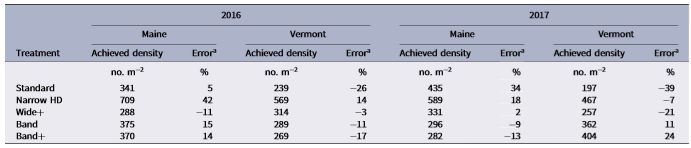
Despite careful drill calibration, crop density in the Narrow HD treatment in Maine 2016 was 42% higher than the target population (Table 6). In Vermont in both years, the standard treatment had a population 26% to 39% lower than planned. This could be a confounding factor affecting weed biomass (Doll Reference Doll1997; Olsen et al. Reference Olsen, Kristensen and Weiner2005a, Reference Olsen, Kristensen, Weiner and Griepentrog2005b). The proportional difference between achieved and target crop density for each plot (Table 6) was therefore used as a continuous variable in an initial series of analysis of covariance analyses. The effect of error (%), however, between achieved and target crop density was nonsignificant (P ≥ 0.05); therefore, this continuous variable was removed from the analyses.
Crop population at Maine and Vermont sites in 2016 and 2017.

a Error = (achieved density − target density)/target density. Target density for barley in the Standard, Wide+, Band, and Band+ treatments was 325 m−2, and for the Narrow HD treatment was 500 m−2.
Surrogate Weed Density
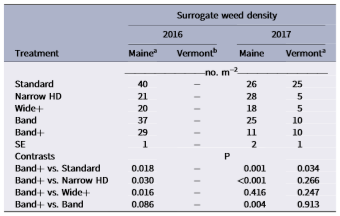
The Band+ treatment reduced surrogate weed density compared with the Standard treatment in all measured site-years (Table 7). This finding supports the overarching hypothesis motivating this work, suggesting that band sowing with hoeing results in fewer end-of-season weeds when compared with the region’s standard practice. Surrogate weed density in the Band+ plots was 45% less than the Standard across the Maine 2016, Maine 2017, and Vermont 2017 site-years.
Effect of crop sowing and weed management treatment (Standard, Narrow HD, Wide+, Band, and Band+) on posttreatment end-of-season surrogate weed density at Maine and Vermont sites in 2016 and 2017.

a Data were square-root transformed before analysis; back-transformed means are presented.
b Data were not collected in the Vermont 2016 site-year.
While the Band+ treatment resulted in fewer weeds, those surrogate weeds surviving in Band+ plots were larger, having 47% greater individual biomass than surrogate weeds in Standard plots (P = 0.018, data not shown). Contrary to our expected outcome, the Band+ treatment only reduced surrogate weed density relative to the Band treatment in the Maine 2017 site-year, when density was 56% less. Results may be due to poor timing of hoeing in Maine 2016 when surrogate weeds were large (BBCH 16) and improved hoeing timing in Maine 2017 when weeds were small (BBCH 12). In the Maine 2016 site-year, the Narrow HD and Wide+ treatments had 28% and 31% fewer surrogate weeds than the Band+ treatment, respectively (Table 7). In the Maine 2016 site-year, the average biomass of individual surrogate weeds from Wide+ and Band+ treatment plots did not differ (P = 0.391); however, surrogate weeds in Narrow HD plots were 58% smaller than those in the Band+ plots (P = <0.001, data not shown). These results concur with previous observations made by Kolb et al. (Reference Kolb, Gallandt and Molloy2010, Reference Kolb, Gallandt and Mallory2012) that weeds surviving interrow hoeing in wide-row systems have greater individual biomass, likely due to greater light resource availability resulting from increased interrow spacing.
In contrast to Maine 2016 results, Band+ performed better than the Narrow HD treatment at the Maine site in 2017, resulting in 61% fewer surrogate weeds (Table 7). Furthermore, the Narrow HD and Wide+ treatments reduced surrogate weed density relative to the Standard in 2 out of 3 and 3 out of 3 site-years, respectively, supporting findings by Kolb et al. (Reference Kolb, Gallandt and Molloy2010, Reference Kolb, Gallandt and Mallory2012). There were no differences in surrogate weed size in Maine or Vermont in 2017 (data not shown).
Surrogate, Ambient, and Total Weed Biomass
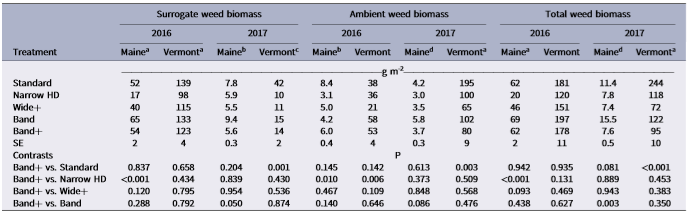
Averaged across treatments, ambient weed biomass accounted for 10% and 37% of total weed biomass (surrogate and ambient weed biomass combined) in the Maine 2016 and 2017 site-years, respectively, and 25% and 85% at the Vermont 2016 and 2017 site-years, respectively (Table 8). Principal ambient weed species in the Maine 2016 site-year were black medic (Medicago lupulina L.), common lambsquarters (Chenopodium album L.), and hairy galinsoga (Galinsoga quadriradiata Cav.). Information on community composition of ambient weed species was not recorded in the Vermont 2016 site-year. In 2017, principal species were redroot pigweed (Amaranthus retroflexus L.), C. album, and G. quadriradiata at the Maine site; and quackgrass [Elymus repens (L.) Gould], common ragweed (Ambrosia artemisiifolia L.), and C. album at the Vermont site.
Effect of crop sowing and weed management treatment (Standard, Narrow HD, Wide+, Band, and Band+) on end-of-season surrogate weed biomass, ambient weed biomass, and total weed biomass (surrogate + ambient) at Maine and Vermont sites in 2016 and 2017.

a Data were square-root transformed before analysis; back-transformed means are presented.
b Data were log10 (x + 1) transformed before analysis; back-transformed means are presented.
c Data were square-root (x + 3) transformed before analysis; back-transformed means are presented.
d Data were log10 transformed before analysis; back-transformed means are presented.
Surrogate weed biomass averaged across treatments and sites in 2016 was approximately 6.6 times greater than in 2017 (Table 8). Lower surrogate weed biomass in 2017 site-years can partially be explained by poor S. alba establishment; densities were 22% less than the target 65 plants m−2 in Maine, and 25% less in Vermont (Table 9). Furthermore, crop and surrogate weed planting was delayed 20 d in Maine 2017 compared with 2016 due to precipitation (Table 2). This delay resulted in stunted crop and surrogate weed growth. The average height of surrogate weeds in the Maine 2016 site-year was 83 cm, compared with 32 cm in 2017 (data not shown).
Pre-treatment starting populations of surrogate weeds at Maine and Vermont sites in 2016 and 2017.

a Error = (achieved density − target density)/target density. Target density for surrogate weed in all treatments was 65 m−2.
Treatment effects on end-of-season surrogate, ambient, and total weed biomass were similar across site-years. The Band+ treatment resulted in less end-of-season surrogate, ambient, and total weed biomass compared with the Standard treatment in only 1 out of 4 site-years (Vermont 2017); biomass was reduced by 59% to 67% (Table 8).
Contrary to our hypothesis, the Band+ treatment did not reduce surrogate, ambient, or total weed biomass when compared with the Narrow HD or Wide+ treatments (Table 8). The Narrow HD treatment had 69%, 48%, and 68% less surrogate, ambient, and total weed biomass, respectively, than the Band+ treatment in Maine 2016; in Vermont 2016, the Narrow HD treatment reduced ambient weed biomass by 32% relative to the Band+ treatment.
In the Maine 2017 site-year, inter-band hoeing (Band+) reduced surrogate weed biomass by 40% and total weed biomass by 51% when compared with band sowing alone (Band) (Table 8). Although differences in total weed biomass were only significant in 1 site-year, averaged across all site-years, the Band+ treatment reduced total weed biomass compared with the Band treatment by 15%, suggesting that hoeing should always be used in the band-sown arrangement.
Narrow-row, high-density planting improves weed control in cereal crops (Kolb et al. Reference Kolb, Gallandt and Molloy2010, Reference Kolb, Gallandt and Mallory2012) and is a superior strategy compared with band sowing plus hoeing. In our research, we compared Band+ and Wide+ treatments to gain insight into the weed-suppressive effects of band sowing versus row sowing under hoed conditions. Band+ did not reduce surrogate, ambient, or total weed biomass or surrogate weed density compared with Wide+, as was expected (Tables 7 and 8). Our results suggest that hoeing is the primary driver of improved weed control in the Band+ treatment, rather than suppression resulting from the band-sown planting arrangement.
Timing of cultivation likely affected weed control. Tine harrowing and hoeing were implemented as separate cultivation events in 2016 at both sites, with 10 and 11 d passed between harrowing and hoeing at the Maine and Vermont sites, respectively (Table 2). In 2016, tine harrowing occurred when weeds were small, resulting in delayed, suboptimal conditions for hoeing (weeds had grown large). The efficacy of both tine harrowing and hoeing are dependent on weed size; smaller weeds are more easily controlled than larger, better-established weeds (Pullen and Cowell Reference Pullen and Cowell1997). It is likely that suboptimal timing of interrow and band hoeing contributed to the reduced performance of the Band+ treatment in 2016 (Table 8). At the Maine site in 2017 interrow hoeing and then tine harrowing were performed on the same date; however, planting was delayed due to wet conditions, likely affecting weed control. Early sowing of spring cereals is an important weed management tactic. Early sowing allows more time for the crop to establish before summer annual weeds emerge, whereas late sowing decreases time between the emergence of crop and weeds (Kolb and Gallandt Reference Kolb and Gallandt2012). Early sowing is also known to increase crop tillering (Juskiw and Helm Reference Juskiw and Helm2003), thereby improving the crop’s competitive advantage.
The use of surrogate weeds in field experiments is common practice (Brown and Gallandt Reference Brown and Gallandt2018; Kurstjens et al. Reference Kurstjens, Perdok and Goense2000; Melander et al. Reference Melander, Cirujeda and Jørgensen2003); however, comparisons of surrogate and wild weed species’ growth rate, competitive ability, and response to control tactics are lacking in the literature. In the present study, the responses of surrogate and ambient weeds were similar within each site-year. If substantial differences are present in the biology and morphology of surrogate and ambient weeds, however, it is logical to expect that treatment response may differ.
Barley Yield
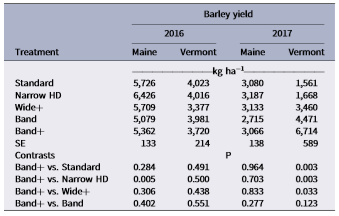
At the Maine site in 2016, band sowing and hoeing did not increase barley yields relative to the Standard, Narrow HD, Wide+, or Band treatments (Table 10). Yield of the Narrow HD treatment was 20% greater than Band+ yield in the Maine 2016 site-year. Increased profits resulting from elevated yields in the Narrow HD treatment may be offset, however, by the increased cost of the higher seeding rate (Kolb et al. Reference Kolb, Gallandt and Mallory2012). In the Vermont 2017 site-year, the Band+ treatment had greater yields than the Standard, Narrow HD, and Wide+ treatments. Barley yields of the Standard, Narrow HD, and Wide+ treatments were 77%, 75%, and 48% less than Band+ yield, respectively, in Vermont 2017. Varying yield responses of the Narrow HD and Band+ treatments are likely associated with differences in the achieved crop density during the Maine 2016 and Vermont 2017 site-years (Table 6). In the Maine 2016 site-year, crop density was 92% greater in the Narrow HD treatment compared with Band+. In the Vermont 2017 site-year, crop density was only 15% greater in the Narrow HD treatment compared with Band+.
Effect of crop sowing and weed management treatment (Standard, Narrow HD, Wide+, Band, and Band+) on barley yield at Maine and Vermont sites in 2016 and 2017.

No differences in yields were detected among the Band+ and Band treatments in Vermont 2017 or among any treatments in Vermont 2016 or Maine 2017 site-years, indicating that hoeing was ineffective. Contrary to expectations, band sowing with hoeing improved yields relative to the Standard, Narrow HD, and Wide+ treatments in only 1 out of 4 site-years. Circumstances surrounding each site-year offer some insight into these results.
Maine 2017 received heavy precipitation in April and May (Table 5), which delayed planting by 20 d (Table 2), followed by low precipitation in June, July, and August, reducing weed biomass and barley yields. In Vermont 2017, hoeing and harrowing were performed on the same date, but Wide+ and Band+ were not harrowed (Table 2). Nevertheless, barley yield was elevated in the Band+ treatment when compared with the Standard, Narrow HD, and Wide+ treatments (Table 10), and surrogate and ambient weed biomass were reduced compared with the Standard treatment. Thus, interrow hoeing alone may provide sufficient weed control in some organic barley fields.
Barley Quality
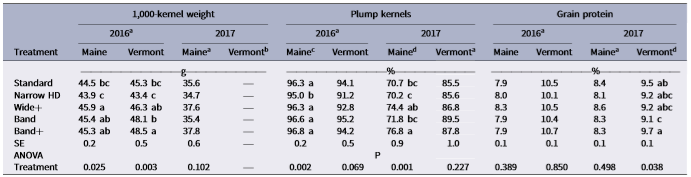
The Band+ treatment had 7% greater 1,000-kernel weight than the Standard treatment in Vermont of 2016, and 3% and 11% 1,000-kernel weight greater than the Narrow HD treatment in Maine and Vermont 2016 site-years, respectively (Table 11). The 1,000-kernel weight was not determined for Vermont 2017 samples. Our results are in agreement with Huhtapalo (Reference Huhtapalo1986), who observed greater 1,000-kernel weights (g) for band-sown versus row-planted cereals.
Effect of crop sowing and weed management treatment (Standard, Narrow HD, Wide+, Band, and Band+) on 1,000-kernel weight, plump kernels, and grain protein at Maine and Vermont sites in 2016 and 2017. If significant differences are present, a Connecting Letters Report is given; values not sharing letters are significantly different (P < 0.05).

a Data were analyzed with ANOVA; Fischer’s protected LSD was used to perform means comparisons.
b Data were not collected in the Vermont 2017 site-year.
c Data were arcsine transformed before analysis; nontransformed means are presented.
d Data were analyzed with the Kruskal-Wallis test; the Wilcoxon signed-rank test was used to perform means comparisons.
The American Malting Barley Association classifies ideal two-row malting barley as having greater than 90% plump kernels (AMBA 2019). All treatments exceeded 90% plump kernels in 2016; at the Maine site, the Narrow HD treatment resulted in fewer plump kernels. In 2017, no treatments exceeded 90% plump kernels; in the Maine 2017 site-year, the Band+ treatment resulted in 9%, 9%, and 7% more plump kernels than the Standard, Narrow HD, and Band treatments, respectively. Results suggest that band sowing with interrow hoeing may improve 1,000-kernel weight and plump kernel grain-quality parameters.
The AMBA also classifies ideal two-row malting barley as having less than or equal to 12.8% protein content (AMBA 2019), and in this experiment, protein never exceeded 12.8% (Table 11). Test weight (kg hL−1), germination energy (%), and DON mycotoxin levels (ppm) were not affected by treatment (data not shown). It is notable, however, that grains possessing DON levels in excess of 1 ppm are considered unfit for human consumption by the U.S. Food and Drug Administration (USFDA 2010). In the Vermont 2017 site-year, the Standard, Narrow HD, and Band treatments had DON levels of 1.0 ppm, and barley from the Band+ treatment had an average DON level of 1.1 ppm (data not shown).
Results from the present study were largely inconclusive. Despite the compelling theoretical basis for band sowing with inter-band hoeing, the practice was not found to be superior to the other weed management strategies tested. In hindsight, multiple factors may have contributed to these results. Both the poor timing of hoeing in 2016 and adverse weather conditions in 2017 likely influenced weed control. In future research, tine harrowing should be evaluated as a separate treatment, given that when conditions are ideal, efficacy can be very high. Finally, it should be noted that a single seeding rate, band width, and inter-band spacing were tested; we suggest that the optimization of these parameters be further studied for improved weed control with the band sowing and hoeing strategy.
Acknowledgments
We thank research technician Erica Cummings and farm managers Joe Cannon and Roger Rainville for their tremendous help in implementing these experiments. We also thank graduate students Sonja Birthisel, Margaret Pickoff, and Bryan Brown and research assistants Geena Wright, Sam Sheppard, Annika Gallandt, Isaac Mazzeo, Garth Douston, Katie O’Brian, Jake Cormier, Grace Smith, and Lucia Helder for their help with data collection. This work was supported by the USDA National Institute of Food and Agriculture, Organic Agriculture Research and Extension Initiative Competitive grant, “Innovative Sowing, Cultivation, and Rotation Strategies to Address Weed, Fertility and Disease Challenges in Organic Food and Feed Grains” (accession no. 1007233; E Mallory, project director). This project was supported by the USDA National Institute of Food Agriculture Hatch Project ME021606. Maine Agricultural and Forest Experiment Publication Number 3724. No conflicts of interest have been declared.