Introduction
“The home is cluttered with rubbish and infested with vermin. Excrement and decomposing food are strewn around the floors and the stench emanating is unbearable to all but the occupant . . .” (Cooney and Hamid, Reference Cooney and Hamid1995).
Some people live in conditions so filthy and unhygienic that almost all observers, in whatever culture, would consider them unacceptable (Snowdon et al., Reference Snowdon, Shah and Halliday2007). The term “severe domestic squalor” has been used when describing very unclean accommodation in which there has been an accumulation of refuse and dirt, commonly with evidence of vermin and with excrement (human or animal) in living areas. In many such cases, a disorderly collection of a variety of articles or possessions of little obvious value limits access within the dwelling. Various researchers have used the term “squalor” when reporting the living conditions in cases of what has been given the misnomer “Diogenes syndrome” (Clark et al., Reference Clark, Mankikar and Gray1975). Wrigley and Cooney (Reference Wrigley and Cooney1992) referred to “gross domestic squalor” when reporting a series of such cases.
It is likely that those who live in severe domestic squalor start doing so because of a complex interplay of triggers and vulnerabilities. There is limited but growing evidence that frontal lobe dysfunction is a major factor accounting for deterioration of living conditions and various associated features in many cases (Snowdon et al., Reference Snowdon, Shah and Halliday2007). However, a body of literature on hoarding (a common finding in cases of severe domestic squalor) suggested that obsessive-compulsive disorder (OCD) is the most common reason for people to hoard possessions excessively and then to live in very unclean conditions (Saxena et al., Reference Saxena2002; Steketee and Frost, Reference Steketee and Frost2003). Subsequently, Saxena (Reference Saxena2007) gathered evidence to justify defining compulsive hoarding as a genetically and neurobiologically discrete entity, to be classified separately from OCD in future diagnostic classification systems. He did not record how commonly the compulsive hoarding resulted in unclean living conditions. Nor did Pertusa et al. (Reference Pertusa, Fullana, Singh, Alonso, Menchon and Mataix-Cols2008), who provided further evidence that most individuals who hoard compulsively manifest a syndrome separate from OCD. Maier (Reference Maier2004) suggested that compulsive hoarding is really an impulse-control deficit rather than a compulsion. However, he pointed out that individuals with neuropsychiatric disorders may collect items ritualistically rather than compulsively or because they lack impulse-control, and others accumulate rubbish and filth because they are not motivated or able to throw it away. The latter types of accumulation of items or rubbish should not be called hoarding (Snowdon et al., Reference Snowdon, Shah and Halliday2007).
A recent review (Snowdon et al., Reference Snowdon, Shah and Halliday2007) pointed out that there are big gaps in our understanding of why some people come to live in squalor, and of what happens to them with or without outside intervention. There is a need for cross-sectional and longitudinal studies, using standardized rating instruments to document living conditions. Assessments of personality (including obsessionality), cognitive function, psychiatric and physical problems, sensory impairment and perceptions of disgust will assist in understanding causative factors, and repeat assessments (particularly in relationship to cleanliness and hoarding) will allow evaluations of the effectiveness of interventions.
In their seminal study, Macmillan and Shaw (Reference Macmillan and Shaw1966) rated each of ten environmental and five personal aspects of cleanliness on a 5-point scale of severity. Snowdon (Reference Snowdon1987) reported data from a catchment area in Sydney, gathered by community staff who provided ratings of domestic cleanliness using a 4-point rating system. For example, floors were rated as clean, a little dirty, dirty or very dirty. Fourteen rooms or features within dwellings were rated: living room, bedroom, kitchen, bathroom and toilet, disposal of excreta, floors, walls and ceilings, windows, curtains, bed, cooker, smell, evidence of hoarding, and adequate disposal of garbage. Seven of these items had been included in Macmillan and Shaw's scale, though with walls and ceilings rated separately. Three of their items (table, coal and dirt) were not included in Snowdon's scale. Samios (Reference Samios1996) used a similar 4-point scoring system but varied some of the items in developing a Living Conditions Rating Scale (LCRS). Items similar to those in Snowdon's scale were kitchen, bathroom and toilet, disposal of excreta, floors, walls, odor, and hoarding. Samios added the following items: accessibility, clutter, lighting, furniture, food, and vermin. Limited evidence of the LCRS's validity was recorded in her unpublished dissertation, and Halliday et al. (Reference Halliday, Banerjee, Philpot and Macdonald2000) used the LCRS in their study of young, middle-aged and older subjects living in squalor in South London (U.K.). Snowdon and Halliday (Reference Snowdon and Halliday2007) included LCRS ratings when documenting the prevalence and outcome of older people living in squalor in Central Sydney.
A scale to rate hoarding (Frost et al., Reference Frost, Steketee and Grisham2004) could also be useful in studies of severe domestic squalor, along with assessments of obsessionality such as the Leyton Obsessional Inventory (Cooper, Reference Cooper1970; Snowdon, Reference Snowdon1980) and the Yale-Brown Obsessive Compulsive Scale (Goodman et al., Reference Goodman1989). Within a framework of assessment questions addressed to people who compulsively hoard, Tolin et al. (Reference Tolin, Frost and Steketee2007) included four items (rotten food, insects, human excreta, animal excreta) to help rate domestic cleanliness.
Those working in agencies that are required to take action in cases of severe domestic squalor, as well as researchers examining cause and outcome, have expressed a need for a readily available, brief, reliable, user-friendly way of documenting the type and degree of uncleanliness and clutter that they observe in such cases. While agreeing that those who live in domestic squalor often neglect personal care as well, they advised that the main need by agencies was for a comprehensive environmental assessment instrument (i.e. a rating of living conditions). Another aim when developing such a scale was to maximize opportunities for linking lines of research that focus on referred cases of squalor (with or without hoarding) with those focusing on referred cases of hoarding (some in the absence of uncleanliness) (Snowdon et al., Reference Snowdon, Shah and Halliday2007).
Methods
The authors initiated the development of a domestic squalor rating scale at a time when they were involved in development of guidelines on intervention in cases of squalor in New South Wales (Australia). They sought views from the Guidelines Reference Group (comprised of representatives of concerned agencies, including community services, housing, environmental health, the Guardianship Tribunal and the RSPCA) regarding aspects of domestic environments that would be relevant in documenting the extent of observed squalor. At that time (2003–2004), staff of these agencies provided narrative descriptions to document cases of squalor. Few used standardized rating questions, though staff of the Central Sydney old age psychiatry service had started using the LCRS routinely in relevant cases in 1999.
The Reference Group proposed that agencies start using an agreed set of questions in order to assess which ones worked best for them in documenting observations of domestic uncleanliness and the need for interventions. Certain items from the LCRS were considered out of place or inadequately worded. Items were suggested by agencies, some being modifications of those used in previously used scales. Attention was given to the difficulties of rating the state of floors and surfaces in cases where they could not be seen because of hoarded possessions. It was agreed that the scale would not be designed to assess occupational health and safety aspects of dwellings (though agencies might want to make ratings of these as well), or to focus on whether owners had adequately maintained the structure and paintwork of the property. The focus was to be on whether occupants had kept their dwellings in an acceptably clean, hygienic and ordered way.
Discussions resulted in a list of 24 domestic environment items, most (21) to be rated on a 4-point scale (0–3). A further question was “Do you think this person is living in squalor? No, mild, moderate or severe?” Raters were asked to endorse “plus lots of clutter” if applicable.
Item reduction and clarification
Comments were received from a number of community services personnel who used the 24-item tool in their routine assessments, to help document their observations in cases of squalor. They considered that the ratings allowed comprehensive assessment of a dwelling but that some of the items could be coalesced. They recommended providing space for comments in order to amplify why particular ratings had been made. Suggestions were offered concerning improved wording of the anchor-points.
It was hoped that the list could be reduced to 10 items or less, and that all could be rated on a 4-point scale. The main aim of the scale was to provide a quantifiable rating of the degree of squalor. It was considered important not to leave items unrated if possible, while realizing that occupants have a right to refuse access to all or part of their accommodation, except if assessors come with an appropriate legal order.
Discussion led to choice of ten items, rating distinct aspects of uncleanliness and clutter, for the final version of the scale (see Appendix). There was hesitation about including ratings of odor, because of recognition that ability to perceive odors and rate their intensity varies between individuals. Nevertheless, the relevance of certain odors as an indicator of squalor was considered so considerable that the item must be retained.
A rating omitted from the final version was of the number of usable rooms in a dwelling. In some homes, one or more rooms are used for storage and commonly appear dirty and cluttered while other areas are clean. Contrastingly, some dwellings consist of only one room with adjoining toilet and shower-room and maybe a kitchenette. The item on usable rooms would not be appropriate. The scale could not take account of size and functions of rooms, but the wording of anchor-points was designed to take these into account (e.g. when assessing accessibility and clutter in living areas). Where a toilet and/or shower-room serve more than one unit of accommodation, it was agreed they should not be rated and must be assumed to be clean when calculating the total rating.
It was intended that agencies be able to use the ratings (including those of clutter and organization of collected articles) as part of a summary overview of living conditions in a dwelling. Supplementary questions (i.e. additional to and separate from the scale) would provide information concerning the availability of utilities, the perceived risks of fire and injury, demographic and housing details, pet ownership, and observations concerning self-care and personal appearance of the occupant(s).
Evaluating the scale
Since late 2004, when the Reference Group submitted its report and recommendations for guidelines on when to intervene in cases of severe domestic squalor (see Snowdon and Halliday, Reference Snowdon and Halliday2009), the scale has been available for use by agencies in New South Wales (NSW). Feedback has vouched for its utility. The NSW Government's Department of Aging, Disability and Home Care arranged to make the scale available on its website. The authors of this paper, together with their community old age psychiatry team, continued to use the scale when assessing cases of domestic squalor in their catchment area, where some 18,000 persons aged 65 years or more reside in their own or rented accommodation. The suburbs range from deprived to well-off. They sought and received approval from Central Sydney Area Health Service's Ethics Committee to develop a database and record ratings concerning all cases of squalor referred to their service, and a first report has been published (Snowdon and Halliday, Reference Snowdon and Halliday2007).
From 2000 to 2009 about 18 such cases per year have been referred to the service (i.e. one per 1000 persons aged 65 years or more). Ratings of living conditions have been possible when the referred occupant(s) (or their designated “responsible person”) gave informed consent for one or more members of the community team to look around the dwelling. For purposes of the present study, where occupants were asked to consent to ratings being made independently by GH and JS, they were informed that the raters would compare observations in order to test the scale. None of the occupants who agreed to their homes being viewed withheld consent.
Testing reliability and validity
After finalizing the wording for the four anchor-points of each item, the scale was used to rate 55 dwellings. The two authors, both being senior specialists in old age psychiatry, visited the homes of a consecutive series of clients who had been referred to their catchment area old age psychiatry service and agreed to the visit, and whose homes had been reported by referrers to be unclean and/or cluttered to some degree. In most cases, the ratings were made soon after referral, and the old age psychiatry team worked with other agencies to ensure appropriate interventions were arranged. In some cases, the assessments were made when attempts had already been made to initiate services. Demographic details were partly available from the referrers, but supplemented (e.g. regarding house and pet ownership) by enquiries during assessment visits.
The authors visited the dwellings either together or within three days of each other, but without discussion or sharing views about what they observed until after they had recorded their ratings. As well as rating the ten items, the authors stated whether their overall impression was that the case was one of no, mild, moderate or severe squalor, plus “lots of clutter” or not. They also rated the dwellings on the LCRS.
The reliability of item ratings and of overall scores was assessed by comparing scores recorded by the two authors. A measure of validity was obtained by comparing each author's overall rating of each home with the other author's opinion of whether he observed no, mild, moderate or severe squalor in the home. The data were analyzed using SPSS (version 14). The κ coefficient was used to examine agreement between raters at the item level. Cronbach's α was used to test for reliability (internal consistency) of survey items. Pearson product moment correlations were used to examine relationships between measures. Principal component analysis with varimax rotation was used to examine latent variables underlying the ECCS. A probability level of 0.05 was used to determine statistically significant differences.
Results
In 45 of the dwellings visited there was only one occupant, but in ten there was a second occupant: spouse (3), child or other relative (5), friend or boarder (2). In each case the referred person was aged 65 years or more, but four of the co-habitees were aged less than 65 years. Thirty-eight (59%) of the occupants were male.
Twenty-three (42%) of the 55 referred subjects had never married. The clinical diagnosis (made by GH and/or JS, based on information from multiple sources, plus examination and prolonged follow-up) was dementia or frontal lobe impairment (8 alcohol-related) in 27 (49%), and schizophrenia or related psychosis in 16 (29%). Six (11%) were not given a psychiatric diagnosis, and other psychiatric diagnoses were made in the other six cases. Twenty-five (44%) of the dwellings were owned by the occupant(s), 28 (51%) were rented from the Department of Housing, and two were leased privately. There were pet animals in 12 (22%) of the homes.
Reliability
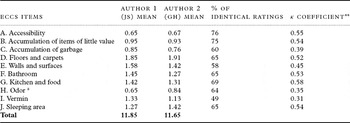
The inter-rater reliability for the ten ECCS items is shown in Table 1. The κ coefficient ranged between 0.31 (vermin) and 0.58 (kitchen and food), all being significant (p < 0.001). On the odor item only one home was rated (and only by one rater) as unbearably malodorous, whereas a zero odor score was recorded for about half the dwellings. The average κ for the 10 items was 0.48, and in 65% of the 550 pairs of ratings the authors recorded identical scores.
The extent of agreement between the two authors in their ratings on individual items of the Environmental Cleanliness and Clutter Scale (ECCS)

a One pair of odor ratings (moderately versus unbearably malodorous) excluded in order to permit calculation of kappa coefficient.
**p < 0.001 for all kappa.
The correlation coefficient between total ECCS scores recorded by the two authors was 0.93; the correlation between the authors’ total scores on 13 domestic environment items of the LCRS was 0.89. Cronbach's α for the ECCS was 0.87 for each author, thereby demonstrating high internal consistency.
Correlations between the total ECCS ratings by one author and the LCRS total domestic items scores of the other were 0.89 and 0.91.
Validity
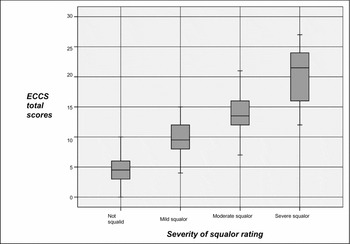
When the two authors’ ratings of whether there was no, mild, moderate or severe squalor were compared, there was complete agreement in 80% of cases and κ = 0.73. When one author's total ECCS scores were compared with the other's categorization of homes as showing no, mild, moderate, or severe squalor, it was found (Figure 1) that an ECCS score of >12 would in most cases indicate that a person lives in moderate or severe squalor as judged by an old age psychiatrist, whereas a score of 12 or lower would most commonly indicate no good evidence of moderate or severe squalor. In relation to the cases seen in this study, the authors believed that intervention would be needed in cases of what they called moderate or severe squalor, whereas in mild cases it might not.
A box-plot showing the relationship between ECCS ratings by one author and the degree of observed domestic squalor in the same cases as judged independently by the other author. There were 110 pairings of ECCS total score versus degree of squalor, a composite of 55 total ECCS ratings by GH versus JS's categorisations of severity, plus 55 total ECCS ratings by JS versus GH's categorisations of severity. Shaded boxes indicate the inter-quartile range, with horizontal lines showing medians, of the ECCS scores.

Types of squalor
Comparison of ECCS ratings showed that those scoring higher on the accessibility item tended also to be rated as showing a high degree of accumulation of items of little value. Among the 55 cases, GH and JS rated 11 and 12, respectively, as showing moderate or severe impairment of access, while 15 and 16, respectively, showed moderately or markedly excessive accumulation of items of little value. The number of cases was smaller than that recommended if conducting a principal component analysis. Nevertheless, an exploratory analysis was deemed appropriate as an indication of whether different types of squalor may be identifiable among referred cases. The accessibility item loaded with accumulation of items of little value. The other eight items loaded together as a second component. GH and JS recorded 22 and 24, respectively, as having moderately or very dirty toilets and bathrooms, but rated accessibility as relatively unimpaired in most of these cases. Broadly, there appears to be two groups: one whose squalor is related to hoarding, and another where the squalor is mainly attributable to failure to dispose of filth.
Discussion
The newly developed scale has been found useful as a descriptive tool. Scores on the accessibility and accumulation of possessions items provide a measure of the degree of “hoarding”, while the other eight items (including the item on accumulation of refuse) allow a measure of uncleanliness. The scale appears to have validity, in that higher scores correspond to independent ratings of moderate or severe domestic squalor. High correlations with LCRS scores are reassuring but unsurprising since items in the two scales have similarity. The ECCS has proved reliable, though ratings of odor and vermin showed less agreement than those on other items. Although it is tempting to drop these items from the scale, both are very relevant to beliefs that a place is squalid. The version of the ECCS shown in the Appendix includes minor amendments to these two items, aiming at even better reliability. Wording of the vermin item now specifies actual numbers of insects or other animals that have to be seen, dead or alive, in order to rate vermin as few, moderate or an infestation.
For some purposes, an expanded potential for rating aspects of hoarding might be useful. At present the ECCS allows ratings of the degree to which floor-space is covered by clutter, and of how high the accumulated articles are piled. Ratings can be amplified in the Supplementary Questions section. It might be helpful to add questions that allow raters to estimate the degree to which observed clutter would interfere with the ability of occupants to carry out tasks. A question included in a handbook for those who compulsively acquire, save and/or hoard (Tolin et al., Reference Tolin, Frost and Steketee2007) is: “To what extent does the clutter in your home prevent you from using parts of your home for their intended purpose? For example, cooking, using furniture, washing dishes . . .” Suggestions for improvement or extension of the ECCS clutter items, and any other recommendations for change, are welcomed by the authors.
In contrast, much of the published research on compulsive hoarding has not recorded measures of uncleanliness, in spite of acknowledgement that hoarding commonly leads to accumulation of filth (Frost et al., Reference Frost, Steketee and Williams2000). It is hoped that the ECCS will prove useful in the assessment and fuller description of such cases.
Although the internal consistency of the ECCS proved to be excellent, there are a number of limitations in the study itself and its findings that need to be acknowledged. The scale was developed as a quantitative descriptive tool, including items that were deemed relevant (by those responsible for care and protection of people and their homes) as indicators of insanitary or unsafe living conditions. The most important consideration is usually whether intervention is required. Evidence in this study that scale scores provide meaningful measures of squalor (i.e. validity) is limited. There is no published validated scale to act as a gold standard. One way of testing validity might be to compare scale scores relating to dwellings where intervention (compulsory cleaning, eviction, etc) is deemed mandatory with those where it is not. However, various factors determine whether local councils, accommodation officers, community staff or others take action, so that subjective judgments about unacceptability of squalid conditions may not prove useful as the comparator.
The scale was tested in the homes of older persons referred to an aged care psychiatry service. Whether reliability would be comparable in dwellings occupied by younger persons, or by people not referred to mental health services, or by people from backgrounds and cultures quite different to those of the sample in Central Sydney, needs further study. Ratings were made by two experienced psychiatrists; reliability and scoring by staff from other health disciplines, and by staff trained in occupations other than health sciences (e.g. housing management), need to be examined. Test-retest reliability has not been reported in this study.
Replication of the findings is desirable, especially exploring the reliability of ratings by community services personnel, housing inspectors and environmental health staff, and among younger as well as older populations. It would be of great interest to assess its utility in places where there is poverty and where cultural attitudes to cleanliness are different to those experienced in Central Sydney.
It is hoped that the ECCS will be useful, not only to facilitate description of cases, but when exploring the triggering and vulnerability factors in relation to differing patterns of uncleanliness. The scale will also be useful in evaluating the effectiveness of interventions and in examining factors associated with changes in living conditions.
Conflict of interest
None.
Description of authors' roles
The two authors designed the study, developed the scale together, were equally involved in carrying out the study, analyzed the data (with help from Dr. G. Hunt), and co-wrote the paper.
Acknowledgments
We thank Dr. Glenn Hunt for valuable advice and help in relation to statistical aspects of this paper. We also thank members of the Reference Group (convened to develop New South Wales guidelines on when and how to intervene when people live in severe domestic squalor) for their ideas and advice about items to include in a squalor rating scale.