The year 2015 saw the endorsement of the Sendai Framework for Disaster Risk Reduction 2015–2030 by 187 United Nations member states. This landmark agreement puts unprecedented emphasis on health, guided by principles including shared responsibility, multi-sectorial engagement, and all-hazards preparedness. It calls for strengthening the resilience of health systems through training and capacity development. 1 It provides further impetus for revisiting health system preparedness amid a rising global trend of climate-related catastrophiesReference Leaning and Guha-Sapir 2 and looming threats from epidemics and man-made disasters.
Health care workers (HCW) remain the focus of health system resilience programs. Over the past 2 decades, numerous studies on various aspects of HCW disaster preparedness, including knowledge, experience, drill participation, awareness of the disaster plan, perceived preparedness, and willingness to respond, etc. have been published.Reference Al-Shaqsi, Gauld, McBride, Al-Kashmiri and Al-Harthy 3 - Reference Chen, Hickner, Fink, Galliher and Burstin 14 Most studies were surveys conducted in North America, Europe, and Australasia and many focused on chemical, biological, radiological, nuclear, and explosive (CBRNE) incidents or on terrorism.Reference Jacobson, Soto Mas, Hsu, Turley, Miller and Kim 9 - Reference Katz, Nekorchuk, Holck, Hendrickson, Imrie and Effler 11 , Reference Alexander and Wynia 13 , Reference Chen, Hickner, Fink, Galliher and Burstin 14 Almost all studies concluded that HCW are not well prepared for disaster, regardless of staff group, clinical setting, and geographical region, and most studies called for more training. However, there is a lack of information about which components or competencies of all-hazards preparedness are really lacking, especially from the perspective of HCW. Also, there is a lack of assessment of all-hazards preparedness of HCW in densely-populated metropolitans in Asia, which is regarded as the world’s most disaster-prone region.
Though generally regarded as a safe city, 15 Hong Kong faces a significant risk for natural disasters.Reference Sundermann, Schelske and Hausmann 16 The 2003 severe acute respiratory system (SARS) crisis was a wake-up call for our stressed health system.Reference Cameron and Rainer 17 Over the past decade, our health system has been strengthened by the establishment of emergency command structures in public hospitals, investment in health and information technology infrastructures, multi-agency contingency planning, professional training, and regular large-scale interagency disaster drills. 18 , Reference Chan, Yeung and Tang 19 It has also been put to the test in several mass casualty incidents, such as the Lamma IV Ferry Disaster in 2012. However, little is known about our HCW all-hazards preparedness from their perspectives. A few local surveys presented us with a grim portrayal: a lack of confidence of doctors in emergency departments (ED) in managing specific CBRNE incidents despite previous trainingReference Hung, Lam, Wong, Wong, Chan and Graham 20 ; reluctance of nurses to report for duty during a disasterReference Fung and Loke 21 ; and a low nurse self-rating of disaster preparedness.Reference Fung, Loke and Lai 22 Nonetheless, these studies were limited by a narrow focus on specific disasters or convenience sampling of nurses not directly involved in disaster response.
ED doctors and nurses are essential to any health system disaster response, as they provide life-saving services. Their perspectives are important in identifying gaps in and needs for improvement. Pursuant to the call for strengthening health system resilience, we undertook a study to examine the all-hazards disaster preparedness of ED doctors and nurses in Hong Kong. The objectives of this study were (1) to gauge their overall level of preparedness, (2) assess training needs from their perspective, and (3) identify factors associated with high perceived personal preparedness.
This study was part of a larger study undertaken to examine Hong Kong’s disaster preparedness among various constituencies—government officials, response agencies, and the community. The same survey had also been administered to non-ED doctors and nurses through their colleges or societies, but the survey response rate was extremely low (<1%). In this paper, we report the responses from ED doctors and nurses only.
Methods
The authors conducted a cross-sectional territory-wide online survey of all-hazards disaster preparedness of ED doctors and nurses in Hong Kong. Ethical approval was obtained from the Institutional Review Board of the University of Hong Kong/ Hospital Authority, Hong Kong West Cluster.
Study Population
According to the government’s emergency response system, hospital care of disaster casualties is mainly provided by public hospitals under the Hospital Authority. 23 In Hong Kong, there are 17 public EDs, 4 of which are trauma centers, and 1 ED run by a private hospital. We recruited ED doctors and nurses in both the public and private sectors because, in the event of a major disaster, ED staff in both sectors are likely to be involved in emergency response. For instance, during the SARS epidemic, private hospitals were involved in treating SARS patients.
Survey Instrument
The survey instrument was based on review of existing instruments and expert input. All-hazards disaster preparedness of health workers is a comprehensive concept. According to the United Nations International Strategy for Disaster Reduction (UNISDR), it entails knowledge and capacities, “…based on a sound analysis of disaster risks and good linkages with early-warning systems, and includes such activities as contingency planning, stockpiling of equipment and supplies, the development of arrangements for coordination, evacuation and public information, and associated training and field exercises.” 24 Measuring the preparedness of health workers therefore requires a multi-faceted assessment. In our study, we assessed the following components of all-hazards preparedness:
1. Disaster risk perception.
2. Disaster response experience.
3. Disaster training, which was characterized by a set of competencies considered important across different disciplines of HCW for all-hazards preparedness published in the literature.Reference Subbarao, Lyznicki and Hsu 25 - Reference Markenson, DiMaggio and Redlener 28 We sought to identify the training gaps from the respondents’ perspective by comparing the proportion of respondents indicating a preference for more training and the proportion with previous training for each competency. We also assessed their preferred training format.
4. Disaster and evacuation plans in their workplace.
5. Disaster drills, including the degree of personal and interagency involvement.
6. Willingness to respond in different difficult scenarios.
7. Information source and alternative communication methods.
8. Under-stress help-seeking behavior.
9. Perceived personal, workplace, and city disaster preparedness.
In this study, we adopted the UNISDR definition of disaster, which defines a disaster “as a serious disruption of the functioning of a community or a society involving widespread human, material, economic or environmental losses and impacts, which exceeds the ability of the affected community or society to cope using its own resources.” 24 Other technical terms were defined clearly in the questionnaire to minimize variations in interpretation.
The questionnaire consisted of 25 questions and could be completed in 10 to 15 minutes. An ordinal 5-point Likert scale was used to capture most responses. Before the wide distribution of the survey instrument, the questionnaire was piloted among 25 doctors and nurses at a university-affiliated ED to assess face validity, comprehensibility, and reliability. Cronbach’s α was 0.702. Minor amendments to the questionnaire were made after collecting feedback in the pretest.
Data Collection
The Hong Kong College of Emergency Medicine (HKCEM) under the Hong Kong Academy of Medicine (HKAM) and the Hong Kong College of Emergency Nursing under the Hong Kong Academy of Nursing (HKAN) Limited were invited to participate in the survey. They were requested to distribute a link to the survey (via the tool’s uniform resource locator or by scanning a quick response code) through their internal communication channels to 381 ED doctors and 192 ED nurses.
The survey was administered online using secure and mobile device-based data collection tools including KoBo Toolbox and SurveyMonkey. Participation was by consent, and was entirely voluntary and anonymous. Respondents could decline to answer any question or could choose to withdraw from the study at any point.
The survey was accessible for a period of 3 weeks after announcement. A reminder e-mail was sent 2 weeks after commencement. The survey was conducted from 9 September to 26 October, 2015, with staggered start dates across the participating colleges as determined by their internal schedules.
Statistical Analysis
The distribution of responses to various questions were described in percentages. The overall disaster response experience of a respondent was determined by summing the response (had experience=1; no experience=0) to each hazard. Likewise, the overall training experience was derived by summing the response to each core competency (had training=1; no training=0). The overall willingness to respond was determined by summing the response to each of the 4 relevant questions (scores ranged from 5 to 20; a higher score indicated greater willingness to respond). The 5-point Likert scales of perceived personal and workplace preparedness were dichotomized into high (“very adequate” and “adequate”) and low (“neutral,” “inadequate,” and “very inadequate”). Backward logistic regression was used to identify factors associated with high perceived personal preparedness. The Statistical Package for the Social Sciences (SPSS) for Windows version 23.0 was used for data analysis. A 2-tailed P value <0.05 was considered statistically significant.
Results
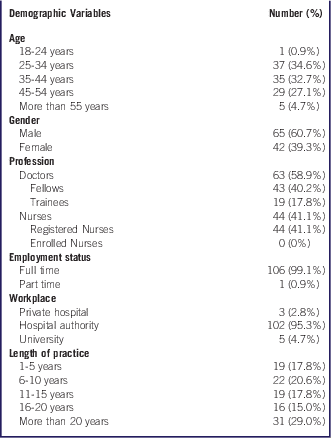
The survey was sent to all target participants. A total of 107 respondents, including 63 ED doctors (response rate 16.5%) and 44 ED nurses (response rate 22.9%), participated in the study. Male participants represented 60.7% of the sample. Most respondents (95.3%) were full-time staff working in public hospitals, 40.2% were specialists, and 17.8% were trainees in emergency medicine. Overall, 38.4% had practiced in the ED for less than 10 years, and 29% had practiced for more than 20 years. The demographics of the respondents are summarized in Table 1.
Demographics of the Respondents

Disaster Risk Perception
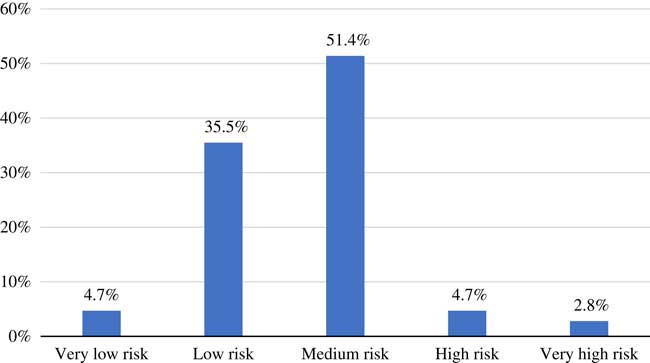
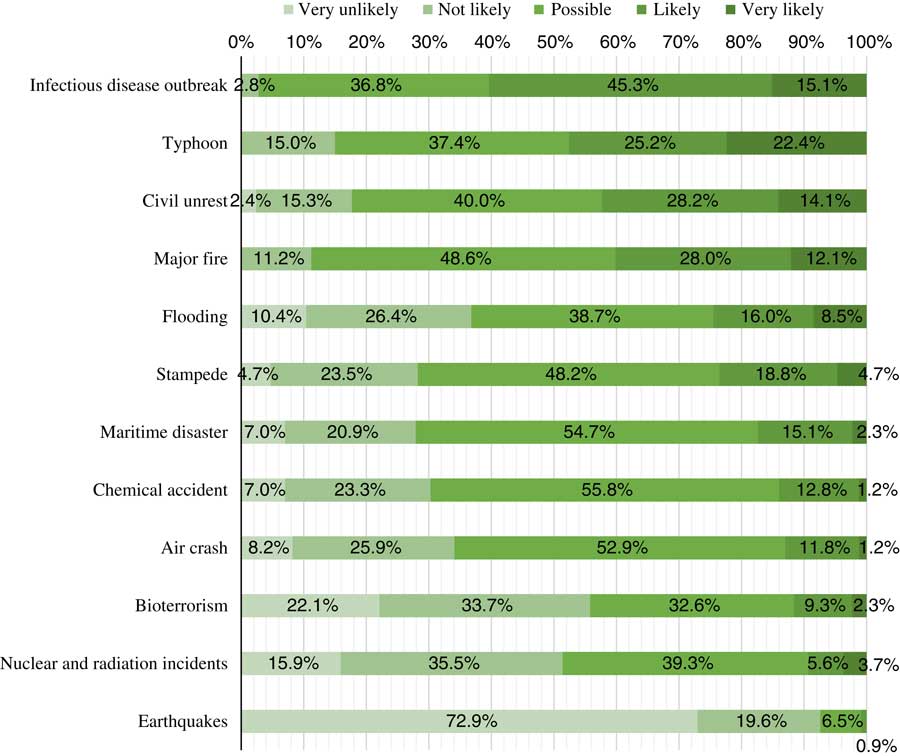
Most respondents rated the risk for a major disaster in Hong Kong over the next 5 years as medium (51.4%) or low (35.5%). Only 8% believed the risk was high or very high (Figure 1). Among different hazards, infectious disease outbreaks were considered to be the most likely, followed by typhoon and civil unrest. The majority stated that the risk for earthquakes was remote, and nearly half believed that nuclear and radiation accidents and bioterrorism were unlikely (Figure 2).
Perceived Risk for a Major Disaster in Hong Kong Over the Next 5 Years.

Perceived Risk for Different Hazards in Hong Kong Over the Next 5 Years.

Previous Disaster Response Experience
More than half (57.0%) of the respondents had previously responded to an infectious disease outbreak and 39.3% to major fires. Few respondents had any experience in responding to stampedes (7.5%), earthquakes (2.8%), air crashes (2.8%), or nuclear and radiation incidents (1.9%). None had responded to bioterrorism.
Disaster Training
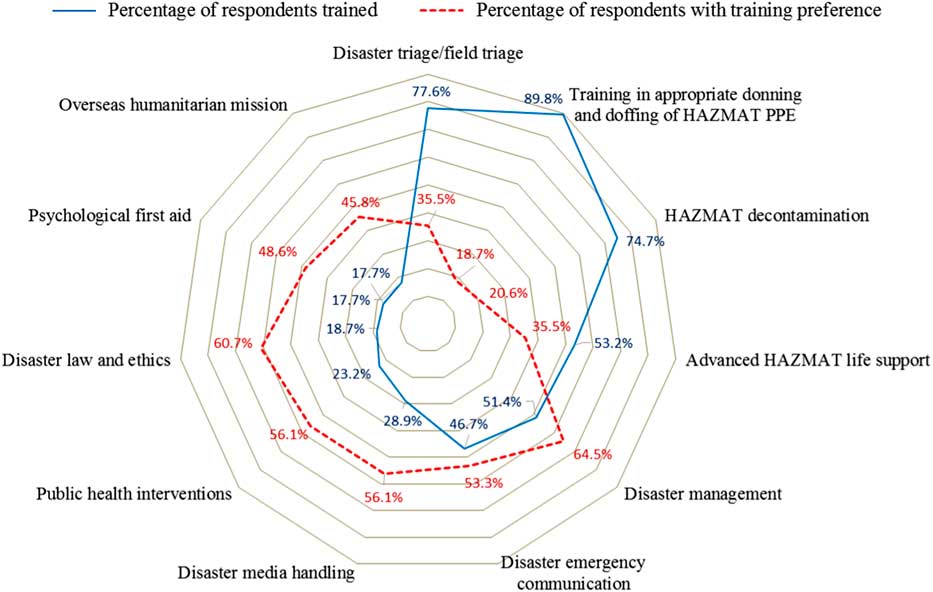
Most respondents had received training in appropriate donning and doffing of personal protective equipment for hazardous materials (HAZMAT) (89.7%), HAZMAT decontamination (74.8%), and disaster field triage (77.6%). About half of the respondents had received training in advanced HAZMAT life support. However, 34.6% had never received any training in disaster management and 41.1% in emergency communication. The majority had no training in psychological first aid, public health interventions, disaster law and ethics, media handling, and humanitarian response in an overseas setting. Over 40% of the respondents wanted more training in these under-trained areas. The gap between the proportion of respondents indicating preference for further training and the proportion with previous training for each competency of all-hazards preparedness is shown in Figure 3. Regarding the preference of training format, hands-on skills training workshop was the most popular, followed by simulation-based training and disaster drills.
The Training Status and Preferences of the Respondents.

Disaster Plan and Drills
Most (92.5%) respondents reported knowledge of a workplace disaster plan, whereas 6.5% of respondents were uncertain and 1 respondent was unaware of such a plan. Fewer respondents (74.8%) were aware of an evacuation plan at their workplace, 15.0% were unsure, and 9.3% had no knowledge at all. Most respondents (83.2%) reported disaster drills at their workplace, 65.4% had directly participated in a drill, and 30.8% and 25.2% did so in the preceding 2 years and 2–5 years, respectively. Only 31.8% had participated in drills involving multiple response agencies. More often, drills were conducted within their departments (26.2%), and some involved multiple departments within a hospital (22.4%).
Willingness to Respond
In the event of a disaster, 66.3% stated that they would voluntarily report for duty even if they were off-duty, 69.2% were willing to work overtime without pay, and 70.1% were willing to be deployed to other departments if necessary. However, only 38.3% were willing to take uncertain health risks in taking care of victims of bioterrorism involving unidentified agents.
Information Source and Communication
Television was regarded as the most important information source during disasters. It is noteworthy that social media had a similar rating to other official information sources such as radio and government websites (57.0%, 55.1%, and 55.2% rated social media, radio, and government websites as “extremely important” or “very important”, respectively). In the case of mobile phone network disruption during a disaster, most respondents would turn to television to look for announcements calling them back to work. The Internet and social media were considered to be more effective than radio announcements.
Help-Seeking Behavior
Peer colleagues, supervisors, and family members were 3 groups of people respondents would likely turn to when facing heightened stress in handling disasters. Only 20.6% of the respondents indicated they would likely seek help from clinical psychologists.
Perceived Disaster Preparedness and Associated Factors
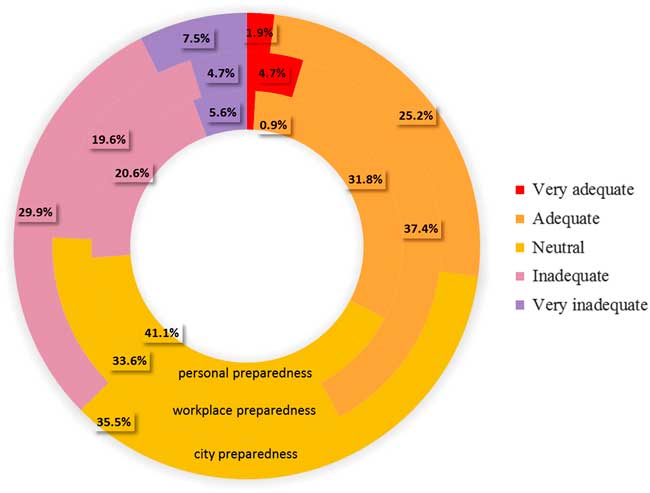
The proportion of respondents who perceived their personal, workplace, and city preparedness as adequate were 32.7%, 42.1%, and 27.4%, respectively (Figure 4). High perceived workplace preparedness (OR: 8.05, 95% CI: 2.69–24.12, P<0.001), length of practice (OR: 2.28, 95% CI 1.50–3.44, P<0.001), and overall willingness to responds (OR: 1.24, 95% CI: 1.05–1.47, P=0.012) were associated with high personal preparedness.
Perceived Preparedness of the Respondents.

Discussion
This study revealed how ED doctors and nurses in Hong Kong view their disaster preparedness. Overall, the perceived risk for a major disaster is low, which is not surprising in a society with a low disaster risk awareness.Reference Chan, Hung, Yue, Kim, Lee and Cheung 29 Risk perception appears to be influenced by personal experience,Reference Wachinger, Renn, Begg and Kuhlicke 30 as demonstrated by health workers’ persistent concern about another infectious disease outbreak across different local studies.Reference Fung, Lai and Loke 31 A local study on nurses showed that SARS recall was associated with a higher perceived risk for an avian influenza outbreak.Reference Tam, Lee and Lee 32 The recent memory of Typhoon Hagupit, which brought storm surge and floods in 2008, 33 and the Occupy Central Movement, which incurred many casualties in 2014, might heighten the perceived risk for typhoons and civil unrest in our study.
ED doctors and nurses in Hong Kong have become better prepared for infectious disease outbreaks after the SARS epidemic,Reference Lai and Yu 34 yet most respondents lacked experience in responding to a number of low-probability, high-impact disasters, such as nuclear and radiation accidents and bioterrorism. Our study revealed several gaps in training: emergency communications, disaster management, psychological first aid, public health interventions of disasters, disaster law and ethics, media handling, and humanitarian response in an overseas setting. Most respondents expressed their desire to fill these gaps by increasing disaster medicine training through hands-on skills training workshops, simulation training, and drills. Experience from other countries has shown that universal training in core competencies and specialized training in task-specific competencies can optimize training resources and maximize preparedness.Reference Schultz, Koenig, Whiteside and Murray 26 , Reference Burkle 35 - Reference Walsh, Subbarao and Gebbie 37 Training resources should be channeled to the under-trained areas.
Our study showed that ED doctors and nurses were keen on participating in disaster response, but that they were less willing to take uncertain personal health risks in responding to bioterrorism. This finding was consistent with that reported in a study by Alexander and Wynia,Reference Alexander and Wynia 13 in which only 40% of US physicians were willing to put themselves at risk for contracting a deadly illness to save the lives of others. Health workers are, in general, less willing to respond to CBRN incidents.Reference Arbon, Ranse and Cusack 6 , Reference Qureshi, Gershon and Sherman 12 , Reference Masterson, Steffen, Brin, Kordick and Christos 38 This finding should be factored in when planning for bioterrorism response. Other frequently cited barriers to willingness include fear and concern for family and personal ill-health and safety,Reference Qureshi, Gershon and Sherman 12 , Reference Masterson, Steffen, Brin, Kordick and Christos 38 distance from home to the facility,Reference Qureshi, Gershon and Sherman 12 lack of transportation,Reference Qureshi, Merrill, Gershon and Calero-Breckheimer 39 and caring for children, the elderly, or for pets.Reference Arbon, Ranse and Cusack 6 , Reference Snipes, Miramonti, Chisholm and Chisholm 7 , Reference Qureshi, Merrill, Gershon and Calero-Breckheimer 39 - Reference Ogedegbe, Nyirenda, Delmoro, Yamin and Feldman 41 Studies have shown that a sense of duty is an influential factor in staff willingness to respond.Reference Snipes, Miramonti, Chisholm and Chisholm 7 , Reference Kaiser, Barnett, Hsu, Kirsch, James and Subbarao 42
Two important characteristics of the respondents are noteworthy in our study. First, many respondents turned to social media for information and communication during a disaster. The multiple advantages of social media in facilitating real-time communications, improving situational awareness, and coordinating relief effort have generated much interest in research.Reference Keim and Noji 43 - Reference Kryvasheyeu, Chen and Obradovich 47 Yet, it has a Janus face and can be misused to disseminate inaccurate information and rumors, undermine authority, and promote terrorist acts.Reference Alexander 48 Its integration into health system emergency commanding structures requires careful planning and warrants further research.Reference Rubin, Bouri, Jolani and Minton 49 Second, only a minority of the respondents choose to seek help from clinical psychologists when they are under stress. Psychological support provided through trained supervisors and work colleagues might be more effective in reaching ED staff involved in disaster response.
Our study found that only one-third of the respondents believed they were prepared for disaster, They were more confident with preparation of their workplace, but less confident with that of Hong Kong as a whole. A survey in a Singapore hospital showed similar findings, in which 75.3% of hospital workers felt that their workplace was disaster-ready, but only 36.4% believed they as individuals were prepared.Reference Lim, Lim and Vasu 5 In our study, high perceived personal preparedness was associated with high perceived workplace preparedness, length of practice, and willingness to respond. These highlight the importance of improving ED staff confidence and sense of security with their workplaces, and removing barriers to staff willingness to respond.
Despite a low perceived preparedness among the respondents in this survey, the authors cannot predict their performance during a disaster. Currently, there is no validated method for assessing hospital disaster preparedness, and no single method adequately characterizes overall preparedness.Reference Kaji, Langford and Lewis 50 A study in New Zealand showed that despite a low self-reported preparedness among acute care providers, the health-care service was found to have “responded well to extraordinary circumstances” in Canterbury earthquakes in 2010 and 2011.Reference Al-Shaqsi, Gauld, McBride, Al-Kashmiri and Al-Harthy 3 Further studies are warranted to study the relationship between providers’ perceived preparedness and their actual performance in disaster response.
Limitations
There were several limitations in this study. First, the survey response rate was low (16.5% for ED doctors and 22.9% for ED nurses), which affected the validity of the study. A low survey response rate is a common problem faced by many researchers in the field. Even with attractive incentives, the response rate of a US national poll of physicians on emergency preparedness was just 28% (USD $50-70 incentives were offered in that study). In our study, we did not have resources to offer any incentives but relied on bulk e-mail to promulgate the survey. This strategy was not successful in our setting and alternative ways in engaging HCW should be used in future surveys. Second, we could not assess the non-responder bias because of the anonymity of the survey. The current results may only reflect the opinions of ED doctors and nurses who are more interested in disaster preparedness. Third, the majority of respondents were from the public sector. Nonetheless, we think it reflects the current situation in Hong Kong that disaster response is mainly offered by public hospitals. Fourth, the network of HKAN does not cover all ED nurses in Hong Kong. The results may not be generalized to all local ED nurses. Fifth, given the broad scope of our study and the limited time most ED staff are likely to volunteer for a survey, a comprehensive and objective knowledge assessment was not feasible. Disaster response and training experiences were used as surrogates of disaster knowledge. Sixth, as in other cross-sectional surveys, this study was subject to information bias, such as recall bias, and social desirability bias. Finally, although definitions were provided for various technical terms, different respondents might still have different interpretations, owing to their varied experiences and training backgrounds.
Despite these limitations, the current study provided essential information on the current state of all-hazards preparedness of ED doctors and nurses in Hong Kong, covering broad areas of interest. By taking reference to the recommended set of cross-disciplinary core competences for all-hazards preparedness and looking at the gaps from their perspective, we were able to better characterize the current training needs of ED doctors and nurses in Hong Kong.
Conclusion
This study was limited by a low response rate, but revealed several important problems of our ED health workforce in disaster preparedness: a low perceived risk for disasters; a lack of experience in a number of low-probability, high-impact disasters; and training gaps in several important areas in disaster response. Although many ED doctors and nurses feel they are not adequately prepared for disaster, they are willing to respond to a call for duty in various difficult situations and are interested in receiving more training. Competency-based training targeting the under-trained areas may help fill the training gaps. Improving staff confidence in their workplace, and removal of barriers to staff willingness to respond may improve their personal preparedness. It is important to revisit health system disaster preparedness from health workers’ perspectives, as they are central to any health system disaster response. Alternative survey methodologies should be considered in future research to increase the response rate.
Acknowledgments
The authors wish to thank Prof Wallace Chak Sing Lau for his guidance and help in the study; Dr Shao-haei Liao, Dr Wendy Lam, and Dr Tai Wai Wong for their inputs on the questionnaire; and Ms Agatha Lin for her time and effort in liaison. The authors also wish to acknowledge the following institutions for their help in distributing the study materials: the Hong Kong College of Emergency Medicine and other colleges of the Hong Kong Academy of Medicine, the Hong Kong College of Emergency Nursing and other nursing colleges of the Hong Kong Academy of Nursing Limited, and the Hong Kong Society of Critical Care Medicine.