The Shi Jun sarcophagus (580 CE), a house-shaped stone coffin of a Sogdian immigrant couple, is one of the most important Silk Road discoveries ever made (figure 1).Footnote 1 Excavated in Xi'an (Shaanxi Province, China) in 2003, it belongs to a group of sarcophagi created for Sogdian community leaders in sixth-century China that have been uncovered over the course of the past century, primarily in the last two decades. The Shi Jun sarcophagus sets itself apart from the others with an epitaph inscribed in both Chinese and Sogdian. The epitaph recounts the migration of a Sogdian couple from Central Asia to the Chinese heartland. Even more unusual than this inscription is the exterior of the sarcophagus, which is carved with a continuous sequence of narrative reliefs. These represent the deceased's multifaceted journey on the Silk Road.Footnote 2
Shi Jun sarcophagus.

The epitaph of the deceased couple provides crucial information about their life together.Footnote 3 Shi Jun (494–579 CE), or Wirkak in Sogdian, was born in the state of Shi (Kesh in present-day Uzbekistan). After he migrated to northwest China, he became a government official responsible for local immigrant communities in Liangzhou (Wuwei, Gansu Province) and thereby assumed the title sabao. Shi Jun's wife Kang Shi (d. 580 CE), or Wiyusi, came from a family originating in the state of Kang (Samarkand, Uzbekistan). She was born in Xiping (Xi'ning, Qinghai Province), where she and Shi Jun got married. Later, the couple relocated to and died around the same year in Chang'an (Xi'an), the capital of the Western Wei and Northern Zhou dynasties (535–81 CE). They were buried in the eastern suburb of Chang'an in 580 CE.
The imagery on the sarcophagus further illustrates the life of the deceased. The exterior of the sarcophagus shows eleven vertical panels, which begin on the west wall, continue on the north wall, and conclude on the east wall of the sarcophagus (hereafter denoted W, N, and E) (figure 2). Based on their subjects, these panels can be broken into two groups: those concerning spiritual activities and those about everyday life.Footnote 4 The spiritual group (W1, N5, and E1–3) is characterized by motifs of evident religious significance, including divine figures, scenes of worship, fabulous creatures, and miraculous happenings. The everyday-life group (W2–3 and N1–4), in contrast, features worldly activities. The panels within this group alternate between “feast,” “reception,” and “travel” scenes. In both groups, the traveling figures consistently move clockwise, and so it seems that together these panels depict the deceased couple's “life and spiritual journey” involving the aforementioned activities and occurrences.Footnote 5
Line drawing of the narrative imagery on the Shi Jun sarcophagus.

The Shi Jun sarcophagus shed critical light on the migration of people in the premodern Eurasian world. The Sogdians were an Eastern Iranian people originating in present-day Uzbekistan and Tajikistan, and they dominated the luxury trade between the East and West for the better part of the first millennium CE. During this period, Sogdian traders, along with their families and associates, were the principal travelers and migrants on the Silk Road.Footnote 6 Before being conquered by the Arabs in the seventh century CE, most Sogdians lived in a host of semi-independent city-states in Central Asia, where they maintained an international trade network and practiced Zoroastrianism/Mazdaism as well as other religions. Yet from the third to the eighth centuries CE, waves of Sogdians left their homeland and settled in major cities along the routes leading to the Chinese heartland.Footnote 7
Both textual and visual evidence for the Sogdian migration is abundant. The body of textual evidence includes historical records, tombstones, letters, commercial documents, and votive inscriptions; visual evidence for the Sogdian migration consists of numerous representations of Sogdian figures and their activities in a variety of media, most notably those carved on Sogdian sarcophagi.Footnote 8 Such textual and visual evidence has given rise to extensive scholarship on Sogdian immigrants and their lives along the Silk Road. Scholars have examined Sogdian immigrant history and culture from many angles, creating literature on the location of Sogdian settlements, business patterns, trade items, involvement in international and domestic politics, religious beliefs and burials, marriages and families, modes of acculturation and identification, and art and crafts.Footnote 9
Most extant scholarship, however, falls short of answering an essential question about the migration of the Sogdians: how did the Sogdians remember their migrant experiences and make sense of their journey on the Silk Road? This is likely due to the fact that there is little visual or textual evidence on which one could base an answer to this question, with the crucial exception of the Shi Jun sarcophagus. There are textual accounts of Sogdians’ migration, but these pale in comparison with the travelogues written by Buddhist pilgrims such as Faxian and Xuanzang. Furthermore, few Sogdian immigrants, especially in the first generations, appear in Chinese dynastic histories; even in the epitaphs of Sogdian immigrants, mentions of migrations are spotty and obscure. Visual materials also provide little help. In both Chinese and Sino-Sogdian art, depictions of the Sogdians tend to be stereotypical, formulaic, and non-narrative. As a result, the Shi Jun sarcophagus has become a focal point for the study of the Sogdians’ own perceptions of their migration.
While most studies center either on the illustrations of Shi Jun's biography or on the religious iconographies found on the Shi Jun sarcophagus, this article interprets the sarcophagus's imagery from a rarely explored perspective: its mediation between the deceased couple's migration on the Silk Road and their metaphorical journey envisioned in light of the life of the Buddha. Although scholars agree that the everyday-life panels on the sarcophagus correspond to the biography of Shi Jun and Kang Shi that is offered by their epitaph, few have considered the spiritual panels as an integral part of the narrative sequence about the couple's life. Drawing attention to the close parallels between the imagery on the sarcophagus and pictorial biographies of the historical Buddha, this article demonstrates that the artists responsible for the sarcophagus cast Shi Jun as a Siddhartha-like figure; in so doing, they created a cohesive narrative about the deceased couple's life, one that interweaves the factual with the fictitious. Moreover, the illustrations of the life of Siddhartha helped the artists incorporate Shi Jun and Kang Shi's migration on the Silk Road into a broader narrative about their spiritual journey from the previous life to the next, a journey that crossed many realms in both this world and beyond.
Reconciling the Spiritual with Everyday Life
The narrative imagery on the Shi Jun sarcophagus is rooted in the vibrant visual culture of the Silk Road. Most scenes feature stock motifs derived from contemporary repertories of funerary and religious art.Footnote 10 The everyday-life panels, for example, contain recurring “banquet” and “travel” scenes commonly found on Sogdian sarcophagi—these were made with similar compositions and styles. The spiritual motifs on display on the Shi Jun sarcophagus, which include flying celestial beings and fire-tending priests, would have been frequently deployed by Buddhist and Zoroastrian projects of the time. The only anomalous aspect of the Shi Jun sarcophagus has to do with the fact that many of the motifs it uses did not appear in tombs, as far as we know. Dislodged from their original narrative or ritual contexts, the intended meaning of these motifs becomes obscure, and this opens the possibility for multiple interpretations, as reflected in the current literature.
Despite the generic nature of the discrete motifs and scenes on the sarcophagus, the imagery as a whole seems to have been designed as a sequential narrative about the deceased's particular life. First of all, the main character(s) on most panels are consistent in appearance; they always include a man or a couple set off from other figures by their scale, dress, gestures, and/or their place in the panel's composition. These primary figures most likely represent the deceased couple—this reflects a long-lasting tradition in Chinese funerary art since the Warring States period (475–221 BCE). What is unprecedented here is the way these leading figures are depicted at different ages. They are shown at several varying points between infancy and senility; this lends a strong sense of chronology to what might have otherwise appeared to be an atemporal assemblage of images.
Second, the regular alternation between “banquet,” “reception,” and “travel” scenes on the sarcophagus serves to give a sense of the rhythms of the constant migration that characterized the couple's life. Since traveling is featured on four of the eleven panels on the sarcophagus, one can identify “journey” as one of the most notable themes in the pictorial narrative without even making reference to the couple's epitaph. Moreover, all the traveling figures in these panels seem to proceed in a clockwise direction. This invokes an uninterrupted flow of movement that is not seen on any other sarcophagi. Because the epitaph mentions four places (Central Asia, Liangzhou, Xi'ping, and Chang'an) that the couple inhabited and points to two major relocations in their life, the four “banquet” or “reception” panels in the everyday-life group (W2, N1–2, N4) may refer to the places where the couple settled. The two “travel” panels (W3, N3) may refer to their actual journeys of migration. A further indicator of the couple's cross-regional migration comes from the dresses of the female figures, which shift drastically from Central Asian–looking styles (W2–N2) to a Chinese style (N3 and N4).Footnote 11
The biographical nature of the imagery notwithstanding, scholars are still grappling with the relationship between the spiritual and everyday-life scenes. The main reason for this is that the epitaph does not give any specifics about the couple's spiritual experiences. Aside from praising the couple's moral virtues in formulaic terms, the Chinese and Sogdian inscriptions consist largely of basic personal information. We are given dates and places related to birth, marriage, death, and burial; names of the deceased and their family members; and the official title Shi Jun held.Footnote 12 The only textual moment with significant spiritual connotations appears in a sentence at the end of the Sogdian inscription, which announces that the couple “would have life together . . . in paradise.”Footnote 13 Nevertheless, this laconic statement barely explains the dazzlingly rich images that illustrate the couple's ascent to heaven on the east wall of the sarcophagus.
Given the lack of spiritual content in the epitaph, most scholars choose to treat the spiritual panels separately when studying the deceased's pictorial biography. For example, Zsuzsanna Gulácsi and Jason Beduhn argue that the spiritual panels present “a comprehensible and substantial Zoroastrian iconographic program,” providing “documentary evidence for a popular version of Zoroastrian eschatology,” while the everyday-life panels merely add a personal tone to this popular take on Zoroastrianism.Footnote 14
Considering the peculiar arrangement of the panels on the sarcophagus, I find it difficult to exclude the spiritual group from the pictorial biography of the deceased in this manner. Above all, the spiritual panels are not grouped all together but are divided into two sets (W1 and N5–E3) that frame the everyday-life panels on both sides. This unusual layout suggests that the spiritual imagery was not intended as an independent unit but was aligned with the beginning and end of the biographical sequence. In fact, the journey to paradise depicted on the east wall (E1–3) extends the clockwise movement of the couple on earth. The interpretive difficulty, therefore, lies in the question of how W1 and N5—namely, the remaining two spiritual panels—fit into this continuous narrative flow.
The difficulty manifested in Shi Jun scholarship around reconciling the spiritual panels, W1 and N5 in particular, with the everyday-life ones may have resulted from scholars’ prioritization of textual over visual sources. Scholars have almost unanimously considered the imagery on the sarcophagus as illustration for some sort of text, whether this be the epitaph or religious literature.Footnote 15 But why would we assume that the artists had to draw on such texts in the first place? The sarcophagus, after all, was not a religious construct. The epitaph is not necessarily more authoritative than the pictorial biography. Both the writer and artists would have received guidance and information directly from the deceased's family members. The artists might have known the content of the epitaph or even understood some religious teachings, but they had no reason to base their project solely on texts. In fact, once we turn our attention from texts to images, a type of pictures that enjoyed ubiquitous popularity in Shi Jun's time stands out: illustrations of the life of Prince Siddhartha, a nobleman who would later become the Buddha.
Illustrations of the Life of the Buddha
In early medieval China, illustrations of the Buddha's life circulated widely in different materials, media, and formats.Footnote 16 They depicted the Buddha's previous incarnations, his earthly experiences as Prince Siddhartha, and his spiritual activities as the Buddha. In terms of composition, two dominant modes can be distinguished: emblematic and episodic. In the emblematic mode, the overall composition focuses on one or two epitomizing scenes, usually related to the turning points in the Buddha's life.
Episodic illustrations, in contrast, utilize more than two scenes—dozens of scenes might be deployed together by the episodic illustrator.Footnote 17 The primary goal of this compositional mode is to convey the narrative of the Buddha's life, either in part or in its entirety. When space allowed, artists working in this mode would depict as many scenes as possible—the ceiling of Cave 290 at Dunhuang, a sixth-century Buddhist chapel, shows eighty-seven episodes of the life of the Buddha, including moments from his conception to his death in a linear sequence.Footnote 18 In general, episodic artists would focus on the most representative episodes from the Buddha's life.Footnote 19
This tradition of episodic illustrations of the Buddha's life offers a holistic framework for understanding the imagery on the Shi Jun sarcophagus. In both cases, the pictorial narrative incorporates multiple scenes that represent a chronological sequence, encompasses a mixture of worldly and miraculous events, and, above all, covers the full course of a life from birth to death. Insofar as pictorial biography is concerned, the illustrated life of the Buddha would be the foremost, if not the only, model available in Shi Jun's time. To further reveal the connections and analogies between Buddhist illustration and the Shi Jun imagery, we need to closely compare the panels on the sarcophagus with representations of different stages of the Buddha's life.
Devotion in the Former Life (W1)
The illustrated life of the Buddha usually begins with an episode that has to do with his former incarnation, known as jataka in Sanskrit. The jataka story appearing in most extant texts about the Buddha's life features three figures: the past Buddha Dipankara (dingguang fo 定光佛 or randeng fo 燃灯佛 in Chinese); the Brahman Sumati or Megha, a former incarnation of Prince Siddhartha; and a flower-selling girl, the future wife of the prince.Footnote 20 In early illustrations of the story, such as the second-century relief from the region of Gandhara (modern Pakistan), the Brahman is often portrayed three times before the past Buddha: prostrating with his hair spread out to cover the mud beneath the Buddha's feet, standing and offering a lotus flower, and rising up to the sky in a gesture of prayer.Footnote 21 In response, the past Buddha raises his hand, delivering a prediction that the Brahman will attain the Buddhahood in the future. Occasionally, the flower-selling girl is also depicted standing behind the Brahman in this episode (figure 3, left). As the story goes, she is willing to sell the flowers to the Brahman only because he promises to marry her in their future life.
Left: The Dipankara jataka, Gandhara, ca. second century CE, Metropolitan Museum. Right: Former incarnations of Shi Jun and Kang Shi before an ascetic Buddha, W1 on the Shi Jun sarcophagus.

The Dipankara jataka might have inspired the creation of the first panel (W1) on the sarcophagus, which introduces the former incarnations of Shi Jun and Kang Shi. The focal scene of W1 shows a man and a young girl kneeling before an oversized divine figure (figure 3, right). The man is looking up to the divinity and extending forth his arms, with a tiny but distinct flower in his hands; his fervent gesture recalls the devout Brahman in the illustration of the Dipankara jataka.Footnote 22 The female figure, holding up a lotus flower, resembles the flower-selling girl. Her smaller scale and twin-bun hairstyle indicate a young age; this strengthens her tie with the female protagonist in the jataka story. Therefore, it seems likely that Shi Jun and Kang Shi were cast as two Buddhist devotees in their previous life in this panel.
In the jataka story, the Brahman and the flower-selling girl are not a married couple, but on W1, the artists seem to have attempted to give the female figure the appearance of Shi Jun's future wife. Most scholars have identified the female figure as the praying man's wife, despite her young age, because of a telling detail: the girl seems to be depicted as kneeling together with the man. However, this detail might have actually been added as an afterthought, and this reveals something of the innovative artistic process. The female figure's apparent act of kneeling is made legible as such by the manner in which the lower part of her skirt is treated—it lies on the ground like a train (figure 4). However, upon close scrutiny, this portion of the skirt looks rather cumbersome and incongruent with the rest of the girl's dress. Without it, the girl would represent a typical standing figure like those we see on other panels of the sarcophagus. The awkward addition to the figure's dress seems to have been made at the last stage of the panel's creation; the revision was likely intended to reveal the otherwise implicit role of this girl as the future wife of Shi Jun.
Former incarnation of Kang Shi, W1 on the Shi Jun sarcophagus.

Regarding the divine figure on W1, there is abundant visual evidence to identify him as a Buddha. Seated on a lotus pedestal, he gestures widely as if in the act of preaching (figure 5, left). In his attentive audience are men and animals divided into small groups. Scholars agree that both the divine figure and the composition surrounding him seem inspired by Buddhist iconography.Footnote 23 Nonetheless, no one has confidently identified the divinity as a Buddha, primarily because the heavy beard of the sacred figure is atypical for a Buddha.Footnote 24 This reasoning, however, neglects the real diversity of Buddha images that circulated on the Silk Road. Though not a regular feature of the Buddha, a thick beard is one of the most common attributes of ascetic figures in Buddhist art, including the emaciated Buddha and the Buddha's previous incarnations (figure 5, middle). A big beard indicates long time spent in the wilderness, as do the kinds of animals and beasts that we see on W1. In fact, except for some variations in dress, the sacred figure on W1 mirrors precisely the starving Brahman in the illustration of the Hare-king jataka from Cave 14 at Kizil: they share not only hair and beard style but also rhyme in hand gesture and sitting posture (figure 5, right). It is no coincidence that in the Hare-king jataka, the Brahman is said to be an incarnation of the Dipankara Buddha.Footnote 25
Left: Acetic Buddha, W1 on the Shi Jun sarcophagus. Middle: Fasting Buddha, Gandhara, ca. first–third century CE, Lahore Museum. Photo by Thomas Laird. Right: Incarnation of Dipankara Buddha as a Brahman in the Hare-king jataka, Cave 14 at Kizil, sixth century CE.

The prototypes of W1, in other words, are jataka illustrations. Referring to Prince Siddhartha's previous incarnation, the artists created an opening episode for Shi Jun and Kang Shi's pictorial biography, one that is indispensable according to the Buddhist vision of life. Although in the epitaph there is no mention of the couple's Buddhist beliefs, it was not uncommon for Sogdians to convert to Buddhism in early medieval China.Footnote 26 This did not necessarily lead to a rejection of their native faith, since the existence of multireligious families, communities, and even individuals is widely documented in textual and visual records of the time.Footnote 27 Still, it is worth remembering that the imitation of jataka paintings on W1 is less about expounding the Buddhist doctrine of rebirth or expressing the deceased couple's religious identity than about initiating the pictorial narrative of their life. After all, it is Shi Jun and Kang Shi that occupy the central place on the following panels.
If W1 represents the former life of Shi Jun and Kang Shi, where could it have taken place? While Buddhist legend has it that the Brahman met the Dipankara Buddha in a city called Rammavati (North India), it is difficult to pin down the exact location of W1. As Grenet noted, the audience of the preaching Buddha on W1 seems to encompass people of multiple ethnic origins; they look like Turks, Sogdians, and Chinese.Footnote 28 Further, these humans are worshiping the Buddha along with a mixed group of animals, including predators (lions and tigers) as well as their preys (stag, ram, gazelle, boar, and ducks). Instead of a specific place on earth, W1 probably presents an idealized world where the Buddha's teaching brings all sentient beings together peacefully. As we see next, this cosmopolitan overtone persists in the illustrations of this life and the afterlife of Shi Jun and Kang Shi.
Road to Awakening in This Life (W2–N5)
Panels W2–N4 show no supernatural or miraculous motifs; they correspond to the biography of the deceased couple inscribed in the epitaph. As some scholars have pointed out, the two panels with “travel” scenes (W3, N3) might depict Shi Jun's migration from Central Asia to northwest China and the couple's further move to Chang'an.Footnote 29 The “banquet” and “reception” panels (W2, N1–2, N4), on the other hand, may allude to the couple's life as it unfolded in the different places that they settled.
The Shi Jun sarcophagus's representation of the full span of a person's life is unique and can be found nowhere else in Chinese art; it is an invention that cannot be properly accounted for without consideration of the pictorial biography of the Buddha. Admittedly, images on Sogdian sarcophagi are all biographical, insofar as they reflect the deceased's life experiences as leaders of immigrant communities.Footnote 30 Yet only the Shi Jun sarcophagus depicts a continuous journey that explicitly captures processes of birth, growth, aging, and death. Such an unusual narrative structure can only be explained through reference to the illustrated life of the Buddha. Thus, the questions before us seem to be: how exactly was the deceased couple's life superimposed on events from the pictorial biography of the Buddha? How did the artists responsible for the Shi Jun sarcophagus approach the task of bringing together spiritual and everyday-life subjects?
To answer these questions, we must first understand that the illustrated life of the Buddha, particularly when he is depicted as Prince Siddhartha, contains a considerable number of everyday-life scenes. Cave 290 at Dunhuang yields one of the most comprehensive illustrations of the Buddha's life. Of the total eighty-seven scenes, nearly half are about Siddhartha's worldly episodes, including activities we see on the Shi Jun sarcophagus, such as receptions, banquets, feasts, and processions.Footnote 31 These everyday-life scenes, framed by the miraculous conception of Siddhartha and his embarking on the pursuit of Buddhahood, function as an interlude between the Buddha's devout past life and his eventual awakening. Upon closer examination, we will see that the shared life of Shi Jun and Kang Shi, as illustrated on the sarcophagus, implies a comparable spiritual trajectory.
W2: Birth
The focus of W2 is a baby in the arms of a regally dressed man who is sitting with his wife inside an ornate architectural setting (figure 6, left). If we can say that W1 is about Shi Jun and Kang Shi's previous incarnations, W2 probably represents the birth of Shi Jun; this is how the narrative goes in the Buddha's biography.Footnote 32 In Buddhist art, a jataka episode is often displayed with scenes concerning the birth of the Buddha. For example, on the Buddhist stele at Maijishan, the Dipankara jataka is put side by side with a scene representing the baby Siddhartha born from the armpit of his mother, Queen Maya. The ceiling in Cave 290 at Dunhuang does not show the Dipankara jataka, but it includes several scenes featuring the infant Buddha held by his parent (figure 6, right). As the motif of a couple with their baby cannot be found on any other Sogdian sarcophagi, its inclusion in the narrative about Shi Jun can be best attributed to these conventional representations of the Buddha's infant episodes.
Left: Birth of Shi Jun, W2 on the Shi Jun sarcophagus. Right: Queen Maya returning to Kapilavastu with the infant Siddhartha, Cave 290 at Dunhuang.

Notably, Shi Jun's parents on W2 are dressed like royalty, a treatment that makes Shi Jun look more like a prince. The headdress of the father on W2, as Frantz Grenet and Pénélope Riboud note, mimics the crown of Sasanian or Central Asian monarchs.Footnote 33 Although the Sogdian homeland was subjected to the rule of a succession of empires from the second to the seventh century, the Sogdians managed to maintain a couple of semi-independent city states. The epitaph claims that Shi Jun was born into an illustrious family and his grandfather was a sabao official of the Shi kingdom. While it is unclear whether Shi Jun's parents had any connections with Sogdian ruling houses, there is little doubt that their regal headdress had to do with the high standing of the Shi Jun family. Given the Buddha's royal origin, it is also probable that the couple on W2 is rendered like a king and a queen to reinforce the resemblance between Shi Jun and Siddhartha.
W3–N1: Coming of Age
W3 features a young man bowhunting on horseback; this martial feat recalls illustrations of Siddhartha's physical achievements as he came of age (figure 7, left). This young man may represent grown-up Shi Jun.Footnote 34 Like his father on W2, he wears a regal headdress; his act of hunting shown here might also be intended to recall the manner in which Sasanian kings were depicted on precious metal wares.Footnote 35 It is noteworthy that hunting contradicts Buddhist teachings, which are unequivocally against killing. In the illustrated life of the Buddha, Siddhartha is never shown in the act of hunting. Nevertheless, Siddhartha is represented practicing archery, along with other physical activities, around the time of his adolescence (figure 7, right). Thus, the motif of bowhunting on W3 might have been adapted to indicate Shi Jun's maturity as a competent leader, given that the archery scene can be interpreted as demonstrating Siddhartha's readiness to rule. Similarly, the reception scene on N1, which seems to involve some political or commercial dealings, adds another episode to the progress of Shi Jun's leadership on the Silk Road.Footnote 36
Left: Shi Jun hunting, W3 on the Shi Jun sarcophagus. Right: Prince Siddhartha in archery contest, Cave 290 at Dunhuang.

N2: Wedding
In their pictorial biographies, Siddhartha and Shi Jun's wives do not appear until they make their debut in scenes celebrating their marriages. On N2, a couple can be seen seated inside a magnificent building, accompanied by a host of attendants, musicians, and dancers (figure 8, left). Rong Xinjiang has convincingly identified the scene as the wedding or marriage of Shi Jun and Kang Shi, which, according to the epitaph, took place in northwest China.Footnote 37 As Rong notes, Shi Jun and Kang Shi are portrayed together on every panel starting from N2, suggesting that N2 marks the beginning of their married life. Like the infant image of Shi Jun on W2, such a representation of the wedding of a deceased couple has no precedent except that of the pictorial biography of the Buddha; the illustrations of the marriage of Siddhartha and his wife, Yasodhara, was likely the source of inspiration for N2. In Cave 290, Siddhartha's wedding is also represented with musicians in an architectural setting, though in a simplified way (figure 8, right).Footnote 38
Left: Wedding of Shi Jun and Kang Shi, N2 on the Shi Jun sarcophagus. Right: Wedding of Prince Siddhartha, Cave 290 at Dunhuang.

N3: Traveling
N3 boasts a grand “travel” scene; its associations with Siddhartha's pictorial biography are implicit but no less profound. Here, Shi Jun and Kang Shi can be seen embarking on a journey on horseback with a large entourage of attendants (figure 9, left). Though it is smaller in size compared with adjacent panels (N2 and N4), N3 occupies the absolute center of the back wall. The images on this panel, therefore, seem to represent a moment of the highest importance in the couple's life. Historically, it might refer to their relocation from northwest China to Chang'an, a journey connecting the two distant regions in which the couple spent most of their life.Footnote 39 On the sarcophagus, N3 serves as a visual transition between N2 and N4. While the husband turns around, waving farewell to those who are seeing them off, the wife is leaning forward, her mind apparently set on the destination ahead.
Left: Shi Jun and Kang Shi departing for Chang'an, N3 on the Shi Jun sarcophagus. Right: Prince Siddhartha encountering a sick man, Cave 6 at Yungang, Northern Wei dynasty.

The distinction accorded the “travel” scene on N3 recalls equally prominent episodes about Siddhartha's travels in Buddhist art. It is true that travel and outings are recurring motifs on Sogdian and Chinese sarcophagi in the sixth century.Footnote 40 Yet N3 is exceptional because the travel scene appears pointedly set in the center of the composition, instead of on a side, as it conventionally does. The illustrated life of the Buddha might again have informed this unique arrangement. For one thing, traveling plays a central part in Siddhartha's spiritual awakening; it is after traveling outside his palace that the prince began to ponder the truth of life seriously. Passing through the four gates of the capital, he encounters an old man, a sick person, a dead body, and an ascetic in succession.Footnote 41 These events, widely illustrated as the Four Great Encounters or Four Sights, prompt Siddhartha to leave behind his worldly obligations and take up a spiritual path. The encounters also divide Siddhartha's life into two contrasting sections – one princely, and the other saintly. As a transitional point in the larger narrative structure, N3 resonates deeply with illustrations of Siddhartha's traveling. It comes as no surprise then that the equestrian image of Shi Jun in this panel evokes the equestrian image of Siddhartha in the Great Encounters, as can be seen in Cave 6 at Yungang and Cave 290 at Dunhuang (figure 9, right).
N4–5: Spiritual Practices
Like Siddhartha's travels, Shi Jun and Kang Shi's journey also marks a turning point of their life, a shift from a mundane path to a spiritual path. The shift is first made manifest on the sarcophagus through a marked change of dress and settings. On panels before N3, Shi Jun is consistently portrayed in a noble fashion, wearing an ornate crown of royal origin and involved in wondrous worldly activities. On N3 and N4, in contrast, Shi Jun takes on a humbler costume typical of Sogdian merchants; he can barely be differentiated from his guests by appearance. A more pronounced contrast is created through the settings of N2 and N4, the two largest pictorial panels on the sarcophagus. While the wedding on N2 takes place against a magnificent building, the feast on N4 is set in the open air, under the shade of fruitful grape vines (figure 10). Despite being classified as an everyday-life panel, N4 is not merely showing a convivial gathering. As Grenet and Riboud point out, the feast prominently features the act of wine drinking, which was associated with Zoroastrian rituals, including the celebration of Iranian New Year (Nowruz).Footnote 42
Shi Jun and Kang Shi in a feast with guests, N4 on the Shi Jun sarcophagus.

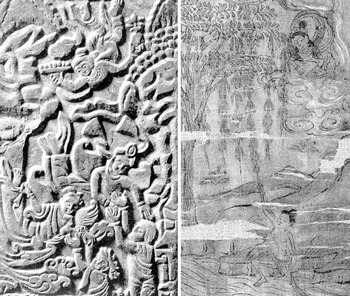
The spiritual engagements of the couple become more explicit on N5. This panel presents the last episode of the deceased's earthly life before they are shown ascending to heaven on the east wall. As Étienne Vaissière notes, both scenes on N5 are derived from illustrations of Siddhartha's ascetic practices after his renunciation of the princely life.Footnote 43 These are exemplified by a painting from the Library Cave at Dunhuang (figure 11, right, and figure 12, right). In the top scene of N5, an old ascetic figure, probably the elderly Shi Jun, sits in a cave and gestures toward a monkey prostrating before him (figure 11, left).Footnote 44 His haggard appearance calls to mind the emaciated Siddhartha meditating in a cave in the Dunhuang painting (figure 11, right). Like the two reclining deer accompanying Siddhartha, the monkey before Shi Jun performs the role of an animal devotee, a widespread motif in Buddhist iconography and here derived from a story about a monkey said to have once offered honey to the preaching Buddha.Footnote 45 Shi Jun died at the age of eighty-six, and most scholars agree that the ascetic practice on N5 indicates his spiritual pursuits, or even achievements, at the end of his life.Footnote 46 This explains why Shi Jun's pose on N5 mirrors that of the ascetic Buddha on W1: he is shown following in the footsteps of the Buddha, and thus progresses from a mundane devotee to a saintly figure himself (figure 5, left).
Left: Shi Jun as an ascetic, N5 on the Shi Jun sarcophagus. Right: Prince Siddhartha practicing asceticism, banner painting on silk, from Cave 17 (“Library Cave”) at Dunhuang, Tang dynasty, British Museum.

Left: Salvation of Shi Jun and Kang Shi, N5 on the Shi Jun sarcophagus. Right: Prince Siddhartha rising from a river, banner painting on silk, from Cave 17 (“Library Cave”) at Dunhuang, Tang dynasty, British Museum.

The meaning of the lower scene on N5 is less obvious, but its resemblance to illustrations related to the ascetic Siddhartha is equally striking. In the Buddhist painting cited by Vaissière, the prince is portrayed twice. Below his ascetic image, Siddhartha is shown trying to rise from a river after a bath (figure 12, right). Too exhausted to stand, he extends his arm upward to grab a hanging tree branch; a heavenly being, meanwhile, comes down from the sky to provide help. On N5, the same composition is adapted to portray the deceased couple (figure 12, left). Instead of one, three heavenly beings are shown flying down toward the couple, who are clearly attempting to rise from a body of water. One of the beings holds vessels which seem to be filled with food and drink; the other two are stretching their arms to catch the raised hands of the couple. Despite its reference to Buddhist painting, this scene cannot be easily interpreted. It might allude to some spiritual transformation of the couple toward the end of their life, thus corresponding to Shi Jun's ascetic image on the same panel.Footnote 47 Yet it may also imply their blessed death in the same year and anticipate their ascent to heaven on the east wall.Footnote 48 In any case, there is little doubt that the final episode of the couple's life is envisioned through the lens of Siddhartha's spiritual practices.
As N3–5 show, Shi Jun and Kang Shi came to their spiritual awakening as they relocated from northwest China to Chang'an. The reason why this happened at the final stage of their life can only be speculated on. The epitaph indicates that the highest title Shi Jun held is the sabao of Liangzhou and he did not assume any positions at other places. Thus, it is possible that, as Dien suggests, the couple moved to Chang'an after Shi Jun's retirement from his official post.Footnote 49 Withdrawing from public service, Shi Jun would have more time to engage in various spiritual pursuits; his retirement, in Tian Xiaofei's words, became a “defining point separating a ‘before’ and an ‘after’,” a typical feature of conversion narrative.Footnote 50 It is noteworthy, however, that Shi Jun's transformation did not bring a decline of his political fame. Rather, he was probably summoned to live in Chang'an by the Chinese emperor, which was considered a special honor at the time. In fact, throughout the sixth century, sarcophagi served as privileged mortuary objects reserved for noble or high-ranking officials. The very fact that the Shi Jun's family was allowed to adopt a sarcophagus signals the imperial favor and political prestige enjoyed by the Sogdian immigrant in his final days.Footnote 51
Journey to Heaven in the Afterlife (E1–E3)
Shi Jun and Kang Shi's journey to heaven unfolds in three consecutive episodes on the east wall of the sarcophagus. While the first two episodes can be neatly explained through the identification of Sogdian and Zoroastrian iconography, the third episode concludes the couple's pictorial biography in an emphatically Buddhist tone. Unlike the rest of the panels, E1 and E2 are united into a single composition by a continuous landscape setting (figure 13). The lower part of the composition shows the deceased couple crossing the Chinvat Bridge, a structure that separates this world from the next in the Zoroastrian cosmology.Footnote 52 Under the gaze of two Zoroastrian priests and two sacred dogs waiting at the right side of the bridge, the couple brave their way to the left side. In the upper part of E1 and E2, the couple, having crossed the bridge successfully, arrives at a celestial realm presided over by what scholars identify as Wesparkar, or “God of Wind,” the supreme deity in the Sogdian pantheon; they are shown receiving drinks from three winged goddesses.Footnote 53 The imagery in this scene is reminiscent of the Zoroastrian feast depicted on N4, which seems to imply that ritual observance (N4) leads to heavenly bliss (E2).
Crossing the Chinvat Bridge and ascent to Heaven, E1–2 on the Shi Jun sarcophagus.

At first sight, the self-contained composition of E1 and E2 renders the last episode on E3 somewhat redundant. After all, in the second episode, the couple appear to be already in paradise. Their mounts, now two winged horses, move counterclockwise for the first time, which would effectively end the couple's clockwise journey in the previous episodes. Most importantly, the unified landscape backdrop of E1 and E2 does not expand into E3, which heightens the impression of the last episode as a surplus. Therefore, we have reason to ask why the artists did not finish the couple's journey on E1 and E2.
The obvious answer to this question is that the narrative about the deceased would have looked incomplete without coming to a close in a Buddha-like way, since most of the panels preceding E3 are derived from the pictorial biography of Siddhartha. The significance of E3 lies precisely in its analogy to illustrations of Siddhartha's life. The focal scene on E3 represents the couple continuing their ascent to heaven (figure 14, left). Riding on winged horses, they are encircled by a swarm of heavenly musicians. The composition has no parallels except in illustrations of the Great Departure, or Siddhartha's miraculous escape from the palace after he decided to seek the way of enlightenment. In Buddhist art from early medieval China, the Great Departure features the prince riding on a flying horse, escorted by a horde of celestial beings (asparas) and heavenly musicians (gandharva) (figure 14, right). Despite variations in details, the visual linkage between the couple's ascent to heaven and Siddhartha's great departure is easily perceptible.
Left: Ascent to Heaven, E3 on the Shi Jun sarcophagus. Right: The Great Departure of Prince Siddhartha, Cave 329 at Dunhuang, early Tang dynasty.

Alluding to the Great Departure, the scene on E3 not only constitutes a culmination of the narrative derived from Siddhartha's life, it also furthers the ascent to heaven introduced on E1 and E2. Insofar as the sequential order of the Buddha's biography is concerned, the Great Departure takes place before rather than after Siddhartha's ascetic practices, referenced by N5. Visually speaking, however, illustrations of this episode in medieval China synthesize the Buddhist narrative with indigenous iconography concerning heaven or paradise. In contrast to its earthbound prototype in India and Central Asia, the Great Departure in Chinese art is set firmly against a celestial background, embellished by rolling clouds and heavenly entourage. Thanks to its paradisiacal associations, the episode is more frequently represented in an emblematic mode than as part of a sequential narrative. To create a finale for the entire narrative on the Shi Jun sarcophagus, there is indeed no more spectacular way than to model it on Chinese illustrations of the Great Departure.
Conclusion
The Shi Jun sarcophagus presents a unique and unprecedented visual narrative about the migration on the Silk Road during the sixth century; the journey from Central Asia to China has never been illustrated on such a personal level, and in such a comprehensive way. In contrast with the terse epitaph, the pictorial panels of the sarcophagus bring to life the couple's immigrant experiences in their full range, from spiritual pursuits to everyday life. Moreover, the sarcophagus reveals to us how the Sogdian immigrants used images to make sense of their journey on the Silk Road, which crosses many geographic and cultural boundaries. While the epitaph, written in two contrasting languages, represents a seemingly impassable barrier between Sogdian and Chinese cultures, images and motifs of disparate origins interact in a rather free and fluid way on the sarcophagus. Most importantly, drawing on the pictorial biography of the Buddha, the designers of the sarcophagus turned all these heterogeneous images and motifs into a cohesive whole, which reflects a harmonious vision of life and world espoused by the Sogdian immigrants, and by many Chinese in the century to come.
Acknowledgments
I am grateful to Xiaofei Tian and Wen-Yi Huang for organizing the workshop on “Migration and Border-crossing in Early Medieval China” at Harvard University and inviting me to present this essay. I appreciate the invaluable feedback from them, the other participants, and the anonymous reviewers. My gratitude also goes to Junghee Lee, Angela Sheng, Annette Juliano, Luo Feng, Yang Junkai, and Carmen Merport for their support at different stages of the writing process. Lastly, I dedicate this article to my wife Yang Jie, for her love and support over the past twenty years.