“I'm only a bird in a gilded cage, a beautiful sight to see.”
—Martha Graham, in a taped interview for Blood Memory Footnote 1
Historians and dance critics alike have used phrases from Martha Graham's Blood Memory: An Autobiography (1991) as though it were written in her own hand, despite concerns about the degree of her authorship expressed upon the book's publication and repeated complaints from those who danced with her (Garafola Reference Garafola1993; McDonagh Reference McDonagh1992).Footnote 2 With little else to go on, scholars (including myself) have quoted Blood Memory as evidence to support their arguments. In Creating Minds: An Anatomy of Creativity (1993), Howard Gardner uses the book to unpack the mind of Graham as an innovator. Susan Ware, in her study of twentieth-century women, quotes Blood Memory as part of her analysis of those “who shaped the American century” (1998). Victoria Thoms deploys theories of “ghosting” to investigate Blood Memory (2008). Yet between 1989 and 1991, when Blood Memory was being prepared for publication, Graham's health rapidly deteriorated.Footnote 3 Indeed, these years mark a period in which Graham would have been little able to manage the rigors of crafting an autobiography.
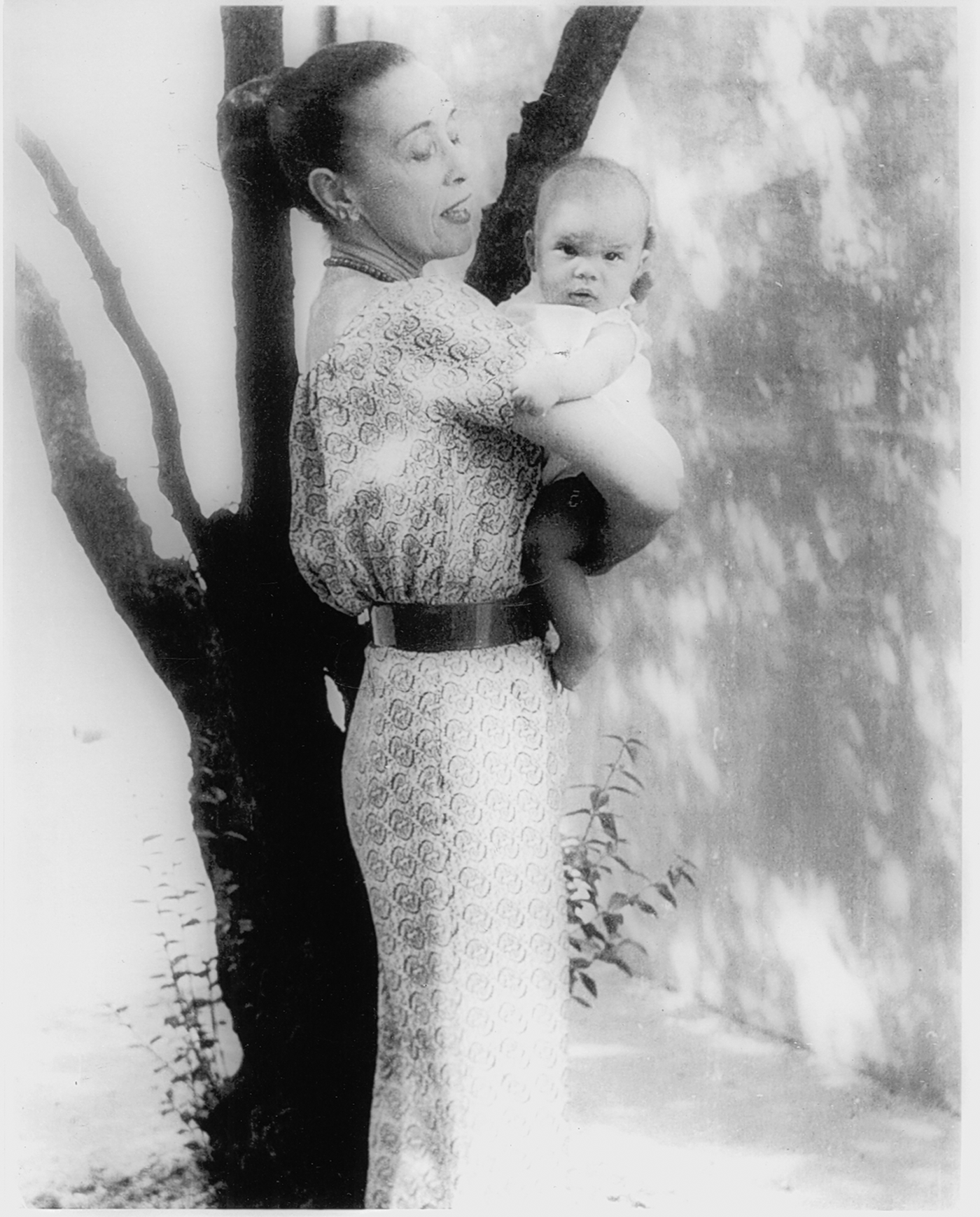
Martha Graham holding Jennifer Hinkson Jackson, 1958. Reproduced with the permission of Mary Hinkson.

Archives, books, and oral histories suggest, in fact, that a group including Ron Protas, Graham's companion and associate, pieced together the narrative with former first lady and editor at Doubleday, Jacqueline Kennedy Onassis. Reporting on a document submitted to Doubleday, Protas wrote to Onassis emphasizing his point in capitalized letters, “JACKIE THIS IS A MIXTURE OF MARTHA AND ME TALKING …”Footnote 4 Upon Graham's death on April 1, 1991, the manuscript lay “incomplete” (Lawrence 2011, 215).Footnote 5 Transmissions to the publisher indicate edits to the galleys as late as June.Footnote 6 Doubleday “rushed to publication,” launching the book posthumously (Feldman Reference Feldman1991, 38; Kuhn Reference Kuhn2010, 180).Footnote 7 As scholars peer into Blood Memory looking for Graham, how do we use the text, which we can prove contains some of her words yet cannot be trusted as evidence?
Arguments about self-editing and theories of authorship remain significant to the study of Blood Memory as autobiography (Barthes Reference Barthes1967; Foucault Reference Foucault and Rabinow1984; Jones Reference Jones2009; Rapaport Reference Rapaport2001). Evidence shows that Graham herself would have suppressed some disclosures. In tapes where Graham speaks about the autobiography, she ruminates, “I am not out to make a preach about my life. Some of it has been wonderful and I've been very, very fortunate. Some of it I regret. The things which are, perhaps, too private to ever reveal—one refuses to reveal.”Footnote 8 The complexity of the autobiographical genre has naturally led to concerns about “authenticity” and Graham's authorship (Campbell Reference Campbell1997; de Man Reference de Man1979; Shapiro Reference Shapiro and McCabe1984; Stillinger Reference Stillinger1991). Regarding the debates about Blood Memory in the 1990s, one feminist literary critic quipped that dance scholars “have little or nothing to say about autobiography” (Heilbrun Reference Heilbrun1991, 16). Indeed, a feminist reading that asks questions about the porous borders of authorship seems apropos because it can unpack the ways in which the body becomes “engaged with the discourses of truth-telling and lying” (Smith and Watson Reference Smith and Watson1998, 22). Graham knowingly engaged in such “discourses” when she wrote in her notebooks: “I am a thief—and I am not ashamed. I steal from the best wherever it happens to me—Plato—Picasso,” adding, “and Bertram Ross,” her longtime dance partner.Footnote 9 Although Graham became mythologized in the mantra “movement never lies,” she knew the power of untruths when it came to producing compelling ballets and creating her public image. In Ross's unpublished biography of Graham, he reported her as declaring, “Truth. What is so wonderful about telling the truth? Anyone can tell the truth. It's boring.”Footnote 10 Regarding her public image, he wrote, “Martha is the great image maker. She makes an image to fit, to suit the particular situation and time. Everything is totally calculated.”Footnote 11 Other dancers also knew that she made her decisions “depending on what effect she wanted to achieve.”Footnote 12
Although these practical and theoretical discussions certainly carry some merit (Landow Reference Landow2006; Said Reference Said1985, 282), Blood Memory becomes destabilized as a text because Graham neither molded the prose nor oversaw the shape of the autobiography. In 1989, Graham could only speak for an hour per day to gather material before she grew weak.Footnote 13 While Graham's choreographic genius relied on her own firm hand to orchestrate artistic elements and designers, with Blood Memory, a coordinated group organized a convenient account of her life.Footnote 14 In addition, phrases and sections marked in notes to the Doubleday editors as “extra material from Martha to be inserted in book” do not appear in Blood Memory.Footnote 15 The recovery of the book's history demonstrates that self-interested parties—perhaps not always with her intentions in mind—sanitized her elliptical poetic descriptions, excluded people (and even her desired insertions), and embellished others.Footnote 16
A Narrative Re-Construction
By the late 1950s, Graham had reached star status among both the intelligentsia and the public. In 1932, the John Simon Guggenheim Foundation had awarded Graham an unprecedented fellowship in dance.Footnote 17 In 1937, Graham became the first “modern” dancer to perform at the White House (Soares Reference Soares1992, 129).Footnote 18 In 1944, Appalachian Spring premiered at the Library of Congress, while the score by Aaron Copland (originally titled “Ballet for Martha”) won the Pulitzer Prize the following year. In 1947, Graham became the clue in an episode of the radio show “Miss Hush,” which was covered by both Life and Time magazines. The call-in winner garnered “the biggest heap of prizes in radio history.”Footnote 19 In 1955, Graham represented the United States in a Department of State international tour of the “Far East” and Iran (Prevots Reference Prevots1998, 45–51), finishing in Israel with private funding.Footnote 20 Events surrounding performances included embassy dinners and Voice of America broadcasts. In the domestic market, critics published lengthy reviews of her performances on Broadway and her American tours. Because of her renown, publishers grew interested in the prospect of a Graham autobiography.
During the 1950s, Graham's agent, Lucy Kroll, undertook the book project. The publishing industry knew Kroll as the “red-haired, brown-eyed Lucy of the subdued dramatic flair” and a fierce contract negotiator (Haydn Reference Haydn1974, 293). Kroll began her search for an editorial partner for Graham. Many agreed that “Graham was too vain to use a ghostwriter.”Footnote 21 Kroll solicited Hiram Haydn, a longtime friend. Haydn's reputation in the publishing industry made him a logical editorial match for Graham. He had worked closely with William Styron on Lie Down in Darkness, and he had become known for the collaborative grace and the “unique cooperation” he fostered between himself and authors (Epstein Reference Epstein2007, 395). In addition, with Lie Down in Darkness, Haydn had demonstrated an ability to retain the sexuality of Styron's novel while softening explicit passages (Calder Reference Calder1996; Casciato Reference Casciato1980; Homberger Reference Homberger2009). Graham's sex life included adultery with Louis Horst and a divorce from Erick Hawkins, among other liaisons. Publishers surely knew that these affairs would shock most readers, so Haydn's editorial deftness would be needed. Finally, Haydn's temperament kept pace with Graham's. Haydn was known as a “high roller, a sport.” Like Graham, he took pride in his involvement with psychotherapy as a “psychoanalysand” (Epstein Reference Epstein2007, 397). In 1956, Kroll contacted Haydn to become the editor of Graham's autobiography.Footnote 22 The following year, Graham signed a contract at Random House to work with Haydn. Although Kroll believed she had secured a tidy advance of $3,000, she and the publisher finally settled on $1,000. Haydn left the timing of draft submissions to Graham.Footnote 23
Graham spoke elegantly on radio and television and in public about the United States and its dance, but her speech did not translate easily into the written word. Despite the monetary sum involved, Graham procrastinated until May of that year, unsure of her ability to produce a book.Footnote 24 Even after meetings with Haydn, Graham did not generate a manuscript. Haydn pressed her about the timing of submissions with a letter that opened, “I must say that I am perplexed but undaunted—literally determined to force some kind of answer out of you.”Footnote 25 Kroll warned Haydn not to push Graham, and Haydn relented. As time elapsed, Graham began to feel that she should return the advance. Haydn refused.Footnote 26 In early 1959, he informed Graham that he would be leaving Random House to start a company with two other partners, and that he would like to bring Graham along with him to complete the autobiography despite the fact that “she hadn't written a word of it.”Footnote 27 They thus renewed their agreement at the newly formed Atheneum Books in May of 1960. Despite the change, and the fact that Haydn showed his faith in Graham by bringing her project with him, Graham continued to procrastinate.Footnote 28
At the same time as Graham remained unable to write her memoir, her hold on the public imagination increased. Her book remained in demand both domestically and internationally, as publishers abroad showed interest. Kroll, caught between Graham's immobility and accelerating public enthusiasm, confessed to Haydn that “[t]he book is nowhere near completion.”Footnote 29 By 1961, Graham alluded to her deep fear of writing and asked for a tape recorder to dictate her thoughts.Footnote 30 Graham's recordings and their transcripts became a central part of the creative process for fleshing out her autobiography. Kroll relayed to Haydn: “I honestly believe that Martha is closer to the writing of her book than all of us suspect.”Footnote 31 According to Kroll, with the tape recorder Graham experienced “for the first time in her life a feeling of her ability and degree of enthusiasm to do her book.”Footnote 32 While the taping process became productive as an initial phase, the publishers understood that the material would have to be molded into text for a final product written by Graham herself, but with Haydn on hand.
Haydn and Graham found promise and trust in their relationship, despite persisting problems. Haydn wrote of Graham, “She is perhaps the most electric person of my acquaintance. Her lithe movements, the force of those eloquent eyes, her habit of dropping her voice almost to a murmur when she has something especially incisive to say—all compel acute and sometimes dazzled attention” (Haydn Reference Haydn1974, 294). In 1961, Kroll urged Graham to use everything at her disposal: “I have a feeling that with your lectures you are saying to audiences what belongs in your book and belongs as a document for the whole world to read forever.”Footnote 33 Yet after a summer retreat with a new tape recorder, her personal note reads, “Shape of book—nothing to see—just do it—machine nice.”Footnote 34 In 1964, Haydn left Atheneum Books and took Graham with him to Harcourt, Brace & World. He asked them to buy out the contract for $1,000.Footnote 35 Kroll reported that Graham had said, “Wherever Haydn goes, I'll go.”Footnote 36 Haydn brought only a select few authors with him to the new publisher (1974, 293).
The Harcourt, Brace & World agreement with Graham included two books: the autobiography and a book on her dance technique. In order to propel the work, Graham offered Haydn access to her personal notebooks, which he then had typed. Haydn, reflecting on his first experience reading them, wrote, “It was a long and rapt evening. I stopped only twice—once to turn to Leonardo's notebooks, once to those of Dostoevsky. Despite the differences of their subjects, I saw an obvious analogy: the artist at work, the creative process intimately revealed” (1974, 295). Inspired by the “cryptic notations that fascinate as they bewilder,” he took the text to the publishing house (1974, 295).The additional book published by Harcourt would become The Notebooks of Martha Graham.
In 1965, Graham's representatives announced that “Martha's fame has practically gotten out of hand.”Footnote 37 Although the autobiography had not been written, publishers considered selling paperback rights. Yet in 1968, Graham tested the patience of publishers when she told an interviewer at The New York Times that she would never write an autobiography (Barnes Reference Barnes1968). Kroll quickly worked to mend relations and wrote Haydn that what Graham had “really said” was that she would never write about her love affairs.Footnote 38 Despite the new tape recorder, there was no work forthcoming, and Graham again offered to return the $1,000 advance. Testifying to his faith in the project, Haydn said he would wait, concluding, “However flamboyant she may seem at times, there is a final sinewy integrity to her” (1974, 294). On April 20, 1969, Graham reluctantly retired from the stage. In the fall of 1969, Haydn wrote Graham, “I have chosen to play it what I at least think is your way.”Footnote 39 In November, Haydn wrote Kroll, “God knows I don't want Martha ducking out and repaying.”Footnote 40 After Graham came close to death in a hospital, she spent eleven months convalescing under the care of a longtime friend, Ben Garber. Haydn suspended work on the manuscript. While Graham recovered at Garber's home, Ron Protas (who was eventually to renew the book project) often came to visit them.Footnote 41
By the early 1970s, Graham re-emerged in the public arena with Protas at her side.Footnote 42 Harcourt forced Graham to make a decision about the autobiography. Kroll promised Haydn that Graham would “rededicate” herself to the project.Footnote 43 In 1971, Graham returned to the taping process that she had begun in the 1960s and recorded her memories and thoughts on ten reels of double-sided tapes for Haydn (Haydn Reference Haydn1974, 294).Footnote 44 Transcripts were made for Haydn, who, in turn, sent a numbered list of topics that needed to be fleshed out, including information about Graham's family, personal friendships, modern dance, and the use of Greek myths in her choreography. Indeed, point thirteen in one memo simply stated, “Tell, tell, tell.”Footnote 45 Despite the ongoing process, Graham resisted the interview format. In response, Kroll wrote, “Martha said she would like to find her own inspiration to tape her autobiography.”Footnote 46
Harcourt Brace became H.B. Jovanovich (HBJ), and William Jovanovich began to shepherd the project. He used his finest secretaries to make the transcripts, yet because of the lack of results, his office labeled the project “Mickey Mouse.”Footnote 47 Transcribers blamed Graham for not speaking into the microphone. One asserted that Graham had said, “I want to talk about drugs.” Those representing Graham claimed that she had said, “I want to talk about glass.”Footnote 48 In May 1972, Graham agreed to work directly with a copyeditor to create initial drafts.Footnote 49 In 1973, Kroll arranged for Graham to get a new Sony tape recorder to inspire her work.Footnote 50 Haydn wrote in his memoir, “As I write, we have transcripts of many of these [conversations], and the editorial work will soon begin” (Haydn Reference Haydn1974, 294). Working with Haydn, Graham likely completed “Chapter One” and a less polished “Chapter Two.”Footnote 51 At the end of his life, Haydn reflected on his work with Graham: “Her variety seems to me that of the Bacchae: it has a fierce ecstatic quality” (1974, 297). He died in 1973, just after Harcourt published Graham's Notebooks in time for the fall publishing shows.
The Notebooks came critically heralded, but with Protas at Graham's side, the 1973 reviews of the entire Graham enterprise grew mixed. The New York Post reported, “A New Boss—and Dance Company—Is Out of Step,” and Graham became celebrated as an icon of American dance rather than a cutting-edge innovator.Footnote 52 Regarding the Notebooks, Kroll and Haydn's role in the publication remained largely unrecognized. Protas escorted Graham to an author luncheon at the Waldorf, but Kroll had to request a ticket from H.B. Jovanovich.Footnote 53 The book became dedicated to Lila Acheson Wallace, the co-founder of Reader's Digest, philanthropist, and patron of Martha Graham, whereas Haydn remained unmentioned as a critical force that had inspired the work. Although in later years Graham asked the publisher to change the dedication to recognize Haydn, it was not revised in subsequent printings.Footnote 54
Interest in the autobiography remained pressing. Kroll worked with HBJ to search for solutions, and Graham remained dedicated to the memory of Haydn and what he had tried to accomplish with her.Footnote 55 Yet in 1975 Jovanovich wrote to Kroll, “I see no way to rescue the Martha Graham autobiography (which at this point consists of no more than 20 pages of text from the 1971 tapes) without Ron Protas's help.”Footnote 56 Evidence indicates that the material collected by Kroll included earlier transcripts, the “1971 tapes,” and the the “20 pages of text,” as well as the pages marked “Chapter One” and “Chapter Two.” The publishers forged a new plan: Protas would conduct a new round of interviews, and a writer would be hired to weave this testimony into existing text. In 1979, during an interview with the Jordan Times while the company toured under the auspices of the State Department (May 1979), Graham expressed her desire to write an autobiography as a corrective to unauthorized biographies. She did not indicate that the project had begun, or that a publisher had been hired. The project had clearly lapsed. In 1983, Protas resorted to legal counsel to reclaim all materials from Graham's agent and defender, Lucy Kroll.Footnote 57
Despite the sporadic near failures of the Martha Graham Dance Company, Graham's currency as an icon gained potency under Protas's watch. Although no longer a cutting-edge innovator, Graham re-emerged as an American legend. Andy Warhol made a series of lithographs to raise funds for the company. Her image papered art collectors' walls alongside those of Marilyn Monroe and Jackie Kennedy. Photographers took candid shots of Graham with Bianca Jagger and other luminaries; she was spotted, for instance, at the famed Studio 54 nightclub. Couture designer Halston constructed her company's costumes, which included luminous gold leotards. Under Protas, Graham forged alliances with Soviet defectors Rudolf Nureyev and Mikhail Baryshnikov. In a revival of Appalachian Spring, Nureyev played the Revivalist, while Baryshnikov premiered with the company as the Husbandman on the American frontier. Graham choreographed new works for both Russians as well as the legendary English ballerina Margot Fonteyn. Graham appeared in a Blackglama mink advertisement alongside Nureyev and Fonteyn under the fur company's slogan, “What becomes a legend most?”Footnote 58
By the 1980s, Graham's renewed public persona revitalized interest in the autobiography, and her supporters sought out publishers again. Critic and writer Francis Mason was a strong supporter of Graham and the Company, and former first lady Jacqueline Kennedy Onassis became interested in publishing Mason's work on George Balanchine at Doubleday (Kuhn Reference Kuhn2010, 167–8). Mason seemed to connect the Graham project to Doubleday, although Onassis had shown interest in Graham independently at galas and other events. At this point, the history of Blood Memory becomes muddied by publicity surrounding the project's publication in 1991. Although taping for the autobiography had begun in 1961, during press interviews in 1991 Protas claimed that he had begun the process in 1979 (Feldman Reference Feldman1991, 38). He and authors credited him with having taken the work to Onassis (Feldman Reference Feldman1991, 38; Kuhn Reference Kuhn2010, 179). Despite the fact that Graham took an advance to write the autobiography in 1957, an unauthorized Onassis biographer claimed that “Jackie's achievement was to persuade Graham to write her autobiography” (Kuhn Reference Kuhn2010, 24). The fact remains that by 1989, two years before Graham's death, the book had re-emerged (with Protas on board) as a project at Doubleday with the former First Lady and her editorial staff.
Archives show that materials forwarded to Onassis eventually became sewn into the patchwork of the text entitled Blood Memory. Initially, pieces sent to Doubleday included the materials from three publishing houses; these were the materials that had once been held by Kroll and were later sent to Protas via his lawyer, i.e., book notes, the 1971 transcripts, “Chapter One,” and “Chapter Two.” Other materials sent to Doubleday seem to have included transcripts with no identifiable questioner and outlines.Footnote 59 In addition, Onassis received letters from Graham to her psychiatrist and transcripts of radio shows.Footnote 60 Correspondence with Aaron Copland appears in the book, and words spoken during made-for-television introductions to dances appear virtually verbatim.Footnote 61 In addition, transcripts were made of interviews conducted by Protas and Bianca Jagger.Footnote 62
With these documents in hand, the team went to work. “Chapter One” appears nearly word-for-word as the opening pages of Blood Memory, although “Chapter Two” seems to have been chopped into sections that are scattered throughout the book. In 1989, a Doubleday representative identified as “Howard” spoke to Graham about “Chapter One.” A cross-reading of two biographies of Onassis's career at Doubleday reveals that “Howard” must have been Howard Kaplan. He wrote entries for The Encyclopedia of Dance and may have been a contributor to Francis Mason's well-regarded Ballet Review (Kuhn Reference Kuhn2010, 180).Footnote 63 Protas opened the discussion between Graham and Kaplan: “So I thought we'd start with the preface you wrote,” he noted, referring to the phrase that opened both Blood Memory and her own Chapter One—“I am a dancer.”Footnote 64
As the project continued at Doubleday, Onassis actively intervened to finish the book, yet Protas seemed (to some) to remain an overseer of the materials and the project. Protas wrote to Onassis, “I remember when you tried to keep Martha on a particular topic when you visited her home (I wasn't there) and she went merrily on her own way.”Footnote 65 No transcript shows Onassis interviewing Graham or discussing material for the book with Graham in letters. Rather, in written correspondence, Onassis relayed questions to Graham through Protas. Protas wrote to Onassis, “Now to your questions,” and promised that he would have Graham speak about her Zen master.Footnote 66 Later transcripts identified this person as “Ramiel McGehee,” whom Graham had known in the early 1930s. Blood Memory cites the Zen master's influence, although it does not offer his name or the details of his relationship with her.Footnote 67 While his name is not specifically mentioned, many stars, including Madonna, get their due.
Kaplan shared drafts and became the conduit between Protas and Onassis.Footnote 68 No letters can be found between Kaplan and Graham. Regarding Graham's elliptical writing and “Chapter One,” Kaplan reported back to Protas: “Jackie said that the preface was wonderful but it's a very difficult tone that's used.”Footnote 69 Later notes comment on Graham's use of language in tapes: “bad grammar,” “awkward,” “(???),” and even “CLICHÉ. CLICHÉR.”Footnote 70 Kaplan explained to Graham, “But sometimes I, too, make such a mess by overspilling, and then the whole idea is to clean up at the end and make [it] nice.”Footnote 71 Yet “making it nice” also included producing the hand of Graham as author. The pages written by Graham, marked “Chapter One,” nearly match the beginning of the printed autobiography. Yet an extra sentence in this portion of Blood Memory begins, “Even as I write. . .” (Blood Memory 1991, 4).Footnote 72 The added tag seems to establish the remaining pages as Graham's text. Ironically, it was one of the few phrases that she did not write herself in “Chapter One.” As the book progressed, editors inserted materials, mimicked, toned down, and spliced Graham's voice to manage the book for publication.
After Graham's death in April 1991, Doubleday rushed to meet fall publishing book fairs. The New York Times reported, “The completed manuscript was delivered to Mrs. Onassis at Doubleday in January” (Anderson Reference Anderson1991, B5). Archives show otherwise.Footnote 73 Protas's lawyer had sued Kroll for papers related to the book project dating from 1957, yet Protas told an interviewer, “A lot of people in publishing had asked her to write her memoirs over the years, but she always refused” (Feldman Reference Feldman1991, 38; Kuhn Reference Kuhn2010, 24). Protas described the book as a dialogue between Onassis and Graham—“these two friends.” However when a reporter for trade publications attempted to interview Onassis about the project after its publication, she was mute regarding the specifics. Onassis was described as “in awe of the project,” yet her only response to questions was to display a piece of jade given to her by Graham (Feldman Reference Feldman1991, 38).
Although the efforts of Protas and Doubleday to construct Graham's autobiography can certainly be understood as motivated by an altruistic desire to perpetuate her legacy, financial gains may also have been a motivating force. Press releases advertised the book as a “celebrity tell-all.”Footnote 74The New York Times noted that the work was “chock-full of anecdotes about her better known students, including BETTY FORD, WOODY ALLEN, GREGORY PECK, and MADONNA” (Anderson Reference Anderson1991). Onassis's biographers have noted that she certainly appreciated dance, yet also looked for titles that would sell (Kuhn Reference Kuhn2010, 55–6). Upon publication of Blood Memory, the press for the trade announced, “[Doubleday] always felt it had a bestseller on its hands.” According to the press, the publishing house cited foreign interest, claiming that “the serial situation is very heated” (Feldman Reference Feldman1991, 38). The promise of Blood Memory, and the swelling future profits from royalties and the sale of the book to producers, would have seemed significant to both Doubleday and any heirs to Graham's estate.
All in all, reviews were mixed. The Atlantic Monthly called it “refreshing” and observed, “Like all good autobiographies it contains crystals of cultural history” (Jacobs Reference Jacobs1991, 41). Publishers Weekly initially printed a long, largely positive article outlining Protas's history of the book. The publication later criticized the work's promotional tone: “Given to name-dropping in her account of her last years, Graham all but loses sight of the roots and nature of her enormous gifts.”Footnote 75 In The New Republic, Mindy Aloff (Reference Aloff1991, 29) pondered the exclusion of mythic stories in what she called “Graham's Graham.” She advised readers looking for “the lowdown on tough subjects Graham glosses over—her love affairs, her alcoholism” to buy Agnes de Mille's biography of Graham (Aloff Reference Aloff1991, 29). After initial sales fell flat, Publishers Weekly lamented the opportunity lost when Blood Memory “passed over” her sexual life “with regrettable speed and discretion.”Footnote 76 Dashed hopes of bestseller status foiled plans to sell the book to Hollywood or Broadway, for shows such as “Martha, the Musical.”Footnote 77
Dancers and the academy remained skeptical, albeit polite. While Stuart Hodes graciously retraced Graham's genius with his review, he regretted the exclusion of anecdotal stories, including a moment when Graham, in a fit of rage, threw her dachshund at her mentor Louis Horst, then gave the dog to actress and longtime supporter Katharine Cornell.Footnote 78 Historian Ann Daly politely noted that the book added to scholarship (Reference Daly1992, 1228). Don McDonagh called it “lightweight” and added that it contrasted sharply with the power of Graham's work and career (1992, 350). Alice Helpern summed up the problem when she wrote that the celebrity run-down constituted “objectionable material” (1992, 39). In a prescient analysis, Lynn Garafola wrote that the work “seems cobbled together by hands other than the author's” (1993, 167). Historians and reviewers understood that the book was thin at best.
Despite uncertain literary or scholarly integrity, Blood Memory has become a must-read, but the text remains a quagmire. While insiders and senior scholars tend to exclaim, “Well of course Martha didn't write Blood Memory,” other historians and those outside the field take the words, the construction, and the narrative shape as the artist's own. Indeed, assertions about Blood Memory have recently been perpetuated in two published volumes on Onassis's career, one of which was published by Doubleday itself. However, evidence suggests that Blood Memory must be understood as a creation with questionable scholarly traction.
Scratching the Surface
Cross-readings of archives reveal myriad questions and opportunities for future work. Here I argue three points. First, the individuals who constructed the narrative sanitized Graham's oral testimony.Footnote 79 The process robbed her voice of texture and nuance. Indeed, the marginalization of Graham began with the oversimplification of her ruminations on “blood memory,” the idea that frames the book with its title. Second, the simplification of Graham's recovery from alcoholism and her childlessness undermines her distinctive and complex personality, which had fueled her artistry. Finally, men who had been instrumental in Graham's career were written out of the narrative; these included, but were not limited to, Francis Mason, Ben Garber, and Bertram Ross.Footnote 80
First, Protas and editors at Doubleday wiped Graham's oral testimony clean in order to manage Graham's “very difficult tone.”Footnote 81 Even the title of the book betrays the sanitizing of her words. The phrase “blood memory” had deep meaning for Graham. Unlike the relatively clear, two-paragraph-long articulation of its meaning in the book—along with some additional, scattered, and somewhat trite references—Graham was never simple, straightforward, or concise in her definition of the concept in the tapes made for the autobiography with Protas. The printed page reads, “Each of us from our mother and father have received their blood,” and concludes, “We carry thousands of years of that blood and its memory” (Blood Memory, 9–10).Footnote 82 As the narrative unfolds, the text even shows Graham equating herself as an artist with a dog, “a strong golden retriever” that “retrieves things from our blood memory” (16). The two other references to the concept cite writer Joseph Campbell and Isamu Noguchi who “directed our blood memory” (163, 223). In the 1971 tapes for Haydn, the subject did not come up. In the later interviews with Protas, Graham could indeed become testy regarding the subject. When Protas remarked to Graham, “I've never gotten you to record what your belief is about blood memory,” Graham replied, “I don't think that I could describe it because it is just something that just is.” When Graham was prodded with the question, “How do you describe blood memory to your class?” Graham retorted with a single sentence, “I say blood memory.”Footnote 83
Graham's unwillingness to discuss the subject dissipated after prodding questions. Indeed, her elucidations of blood memory occupy pages upon pages of later taped testimony; however, some of this material contradicts Blood Memory. When asked whether Blood Memory was a product of her parents, she said, “Just your mother and your father? Oh no, by no means.” In addition, Blood Memory sanitized—or did not include—her poetic verbal phrases and sequences: “It has left on me[,] for gesture[,] for movement[,] for the seeking of strange[,] of unvoiced truths [—] and I call it ‘blood memory’ because it goes beyond the mind[.] [A]s it exists in one individual it exists in time.”Footnote 84 Graham dancers remember her miming the slitting of her wrists and bleeding onto the planks of Studio One's wood floor.Footnote 85 For Graham, blood memory was messy and complex. However, the publisher did not have these paradoxes in mind.Footnote 86 Graham's oral testimony appeared chaotic; her phrasing would not promote a Madison Avenue construction of the woman as icon. Graham's description on the printed page could not package her in Warholian terms.
Graham's delicate and poetic ellipses were deleted even when recorded text reinforced well-known stories, thus leaving the text predictable, disinfected, and sterile. Blood Memory recounts Graham's often-repeated story of the Art Institute of Chicago in the 1920s. She is said to have written, “I nearly fainted because at that moment I knew I was not mad, that others saw the world, saw art, the way I did. It was by Wassily Kandinsky, and had a streak of red going from one end to the other. I said, ‘I will do that someday. I will make a dance like that’” (98). This story has become lore. Yet when Graham recalled the Chicago museum in the 1971 taped interviews, she included Vincent Van Gogh and Pablo Picasso and did not speak about Kandinsky, whose work she may have seen later. Indeed, art historians do not believe a Kandinsky hung in the Institute at the time that Graham claims she visited the collections.Footnote 87Blood Memory does not include any reference to Picasso or Van Gogh. Although dance historians have noted parallels between Graham and Picasso—particularly with their Spanish Civil War pieces—the coalescence of artistic vision has been attributed to an assumed Zeitgeist.
In some cases, entire portions of Graham's relationship to the theater and the mechanics of performance were deleted in order to preserve her stature as a genius with inexplicable powers. Although the autobiography remains true to Graham's self-effacing approach, Blood Memory shows Graham ruminating about “genius” on stage: “[A] person on stage who has this oneness with himself—it is so glorious it has the power to stop you. It is a common gift to us all …” (16). In the 1971 tapes, however, Graham gave the listener more specific images and a more practical approach to her art. She revealed the step-by-step process that takes the performer from the mundane to the sublime. First, she noted how she entered the theater: “Every performance that we do now is in a new place. I go in the front and check the sight lines completely for every dance,” adding, “I do this every time.” She rearranged the stage “so that the audience can participate, because what you're doing in the theatre, you're not doing a monologue.” Graham then launched into the specifics of performance, “You're doing a dialogue. You're conversing, you're talking to somebody. And they're talking back to you,” and concluded, “and that is why the ritual of beauty, and I use that term very deliberately is, for me, a sacred act of communication.”Footnote 88
In addition to removing aspects of Graham's work, Blood Memory masks Graham's long-term battle with alcohol. It constructs Graham's drinking as a reaction to the loss of her performing career: “I stayed home alone, ate very little, and drank too much and brooded” (237). Yet the Doubleday transcripts date the beginning of the problem to events more than two decades earlier and the destruction of her marriage to Hawkins. They read, “Final break with Eric[k],” followed by, “Drinks more and more.”Footnote 89 In correspondence not included in Blood Memory, Graham described herself six years after their marriage ended: “I find myself still arranging my house, my clothes, my face, my figure, my state of heart and mind to meet Erick.” Alcohol entered her writings as a metaphor. Writing about her early relationship with Hawkins, she concluded, “The world knows that there is some such wine of celebration which at times makes me warm and a little drunk.”Footnote 90 Regarding her loss, she wrote, “Sometimes tears run d[o]wn inside your face but that is for you to drink… .”Footnote 91
In addition, outlines for the book (and perhaps a movie based on Graham's life) include a chronology of Graham's father's increasing use of alcohol as she was growing up.Footnote 92 Although the phrase generally credited to him—“movement never lies”—never appears in Blood Memory, he remained the character who taught her that the body tells psychological “truths.” In the transcripts, she recalled that her father told her, “Just remember this all your life, you must tell the truth.” She reflected, “I have never forgotten the vividness of that moment.”Footnote 93 His influence remained seminal. Their shared desire for alcohol (and the physical expression of its effects) certainly would have been an important exploration of a “blood memory.” In plans for an autobiographical work, Graham seemed to become willing to speak about her problem, and even a lineage of alcohol abuse. Yet when Protas wrote Doubleday, he noted, “I think the questions about drinking are terribly exaggerated.” In another instance he wrote, again in capital letters, “MARTHA NEVER DISCUSSED HER DRINKING. AND ACTUALLY IT NEVER GOT IN HER WAY OF PERFORMING. BUT SHE TURNED TO IT MORE AND MORE.”Footnote 94
Here, evidence allows us to understand the “woman as artist” (Leatherman Reference Leatherman1966). Blood Memory's claim that the loss of her performing career led to Graham's substance abuse obscures a reading of the choreographer who had used personal turmoil and uncontrollable excesses to inspire her work well before 1970. Indeed, Clytemnestra (1958) serves as an unmistakable example of how Graham used alcohol to inspire her work. In 1971, she recalled her use of alcohol as inspiration. Speaking into the recorder for Haydn and describing her creative process, she warned, “Do not drink too deeply because then you forget everything. If you drink too deeply then you just go to sleep. You don't do anything.” Then, regarding her inspiration, she said, “If you don't drink too deeply, then at some particular moment something creeps through and animates you.”Footnote 95 During the making of Clytemnestra, dancers remember Graham drinking more heavily, which may have inspired her to confront the effects of alcohol head-on in her choreography.
In Graham's rendering, Aegisthus, Clytemnestra's lover, introduces a chalice filled with wine in Act II. After they murder Clytemnestra's husband, the act closes with “the drunk scene.”Footnote 96Aegisthus enters staggering, and Clytemnestra's torso contracts and twists as she stumbles on stage. They perform a duet filled with gestures that mimic their sober characters; Clytemnestra falters and then falls onto an angled, flat platform—the symbol of their bed. After Aegisthus exits, Clytemnestra wraps herself in a gilded sheath; she defiantly staggers back to her throne, followed, in the shadows, by the power of the muscled, seething character of Death. Act III opens as Clytemnestra writhes in a series of contractions, eyes closed, tangled in the red cloth that reveals only her head. After her solo, the chorus enters, telling of impending doom as she sleeps through the remains of drunkenness.
Graham's performance of Clytemnestra and the choreography of the “drunk scene” reflected reality during the 1962 State Department tour; one dancer wrote home, “Martha was so drunk in Clytemnestra in Munich that she fell into the wings, completely disappeared & then fell back on the stage—She was still drunk the next day.”Footnote 97 Bertram Ross also mentioned the event in his writings.Footnote 98 The United States Information Service dispatches back to the State Department refer to her “exhaustion.”Footnote 99 Yet after her recovery in the 1970s (when government agencies vetted her for awards), Graham's FBI file reports that interviewees consistently repeated the phrase, “Martha Graham does not abuse alcohol.”Footnote 100 The FBI witnesses used the present tense. When Blood Memory drew close to completion, alcohol remained in Graham's past only. Despite her ruminations on tape, and in clearly written outlines that noted the influence of alcohol on her life, those managing the project would not tackle the subject. Now, with access to the taped interviews, historians can use the complexities of her long-term struggle with alcohol to unpack her choreography.
Blood Memory also simplifies Graham's decision to remain childless, which has inspired mythic lore rather than insights into her artistry. Historians cite Stark Young: “I'm afraid she's going to give birth to a cube on stage” (Foulkes Reference Foulkes2002, 40). Blood Memory mirrors this straightforward—even comic—depiction of Graham as a non-mother. In the book, she is depicted as assured, straightforward, and unreflective: “I knew I had to choose between a child and dance, and I chose dance (160). However, Graham's in-depth taped testimony for the autobiography in 1971, as well as the interviews with Protas and Bianca Jagger, document the complexity of her relationship to motherhood. Thus her choice can be recognized as complicated and painful but can also be seen as a fuse for her creativity.
In the 1971 Harcourt interviews, Graham spoke of her childlessness during a section in which she attempted to define the very core of her technique—the contraction and release. The interviewer asked her whether the technique of contraction and release came from Denishawn. She replied that the technique “comes from the time the first baby was born out of a mother's womb.” During the interview, she slipped and said, “When I did it,” and then corrected herself, “when I recognized it.” Graham continued, “I've never had an experience of birth.” She concluded with a description of the physical experience of birthing, and how it molded her technique of contraction and release. She said, “This is fundamental.”Footnote 101
On tape in 1990, Graham was asked, “Did you ever wish you had a child?” She reflected, “I had known I would not be a good mother.”Footnote 102 Rather than choosing a life of dance over motherhood, Graham saw a flaw in herself. Although silent about feeling a mother's passion or regret in Blood Memory, Graham wrote to the mother of her godchild, Martha Graham Weisman: “It was your great privilege and terror to bring THE CHILD into the world. I am certain you may have been afraid. I have never known that experience and have missed a great part of life. But I can imagine that there is desire and terror and finally exhaustion and finally fulfillment of the heart.”Footnote 103 Despite the pithy statements regarding mothering attributed to Graham in Blood Memory, there can be no doubt that the complexity of these issues and physical realities influenced her oeuvre.
In the early tapes, Graham also connected her childless marriage to her failed relationship with her younger husband Hawkins. Through the 1971 and later tapes, critics can glean insight into Graham and Night Journey (1947), the story of Oedipus that she choreographed in her 50s while she and Hawkins shared intimacies. In 1971, she discussed the potent imagery of the child and the husband as a choreographic inspiration. When speaking about Night Journey for Haydn, she recalled, “Every woman's husband is her child at some time,” and said of the work, “I hear a cry and the cry is the cry of a child, my child, who is now my husband.”Footnote 104 In the later tapes she mirrored these ideas: “I do know I have never had a child, but I did have a husband. In a way every woman … her husband is her child.”Footnote 105 Although she was certainly past childbearing age by the time she met Hawkins, we must question how the dynamic of the lost child (Oedipus) and the illicit reunion of the mother with this younger lover inspired her choreography. Of her character, Jocasta, Blood Memory reads, “She turns to the back, pulls the cord around her neck” (Blood Memory, 216). Yet the passage is cut short. Graham described the lovemaking scene in her testimony: “There's another moment of privacy. It is when her young husband, he seems to lay across her knee as though she were rocking him, and she hears in her imagination a baby cry.”Footnote 106 The transcripts demonstrate that she described herself as Jocasta and mother: “Frantic with this umbilical cord in her hands.” Graham concluded, “It is from that moment that I have taken the dance.”Footnote 107 Conflict, not simple resolution about motherhood, became embedded in Graham's Night Journey. The book, however, wipes away this evidence. The complex issues of motherhood in Graham's life and work challenge the simple answers provided within Blood Memory.
Finally, Blood Memory removes the resonance of the career-building influence of Francis Mason, Ben Garber, and Bertram Ross. Although the opening of the book thanks Mason as one “who helped us start up again,” the consistent professional and financial support that he offered is never mentioned in the body of the text. Since Mason provided the link between Graham and Doubleday via Onassis, the omission becomes particularly poignant. In addition, he had worked tangentially with Kroll to support Graham with the early book project.Footnote 108 Graham's interviews with Mason during his highly celebrated series on dance did not make it into Blood Memory, although Blood Memory's editors used transcripts of radio interviews from shows such as This I Believe.Footnote 109 Commenting on the book, Mason revealed that “Protas was in the middle between Jackie and Martha.” He stated that Protas had “manipulated” Graham (Lawrence Reference Lawrence2011, 214–5). The ever-genteel Mason even referred to Protas as a “jackass” (Lawrence Reference Lawrence2011, 214).Footnote 110 As much as Mason appreciated Protas's revival of Graham as an American icon, he spoke his mind in revealing the pitfalls of Graham's reliance on others regarding the publication of Blood Memory.
Mason's career helped pave the way for Graham. After World War II, he had worked for Voice of America and later as a cultural attaché for the State Department. His influence over government projects certainly helped Graham as she recorded Voice of America programs and garnered international touring work for the company. Graham's State Department tours included stops in posts Mason had occupied such as Belgrade (1962) and London (1967). By 1972, when Graham emerged from the hospital, she had lost credibility with “Washington.” Consequently, lucrative State Department tours (such as those that, in the past, had created international recognition and domestic exposure) could not be booked.Footnote 111 Yet Mason, as a well-regarded and long-time member of the Foreign Service, encouraged the State Department to send the Graham Company on its lucrative tour of Asia in 1974.Footnote 112 More importantly, Graham's company could not have survived financially without Mason. He became chair of the Graham board and steered the company through numerous near catastrophes that would have forced it to disband had it not been for his personal loans of millions of dollars. The debt remained in the Graham accounting books for decades. Mason was never repaid in cash.
Mason called Graham “a treasure, a joy in my life.” In addition to providing credibility and financial stability for the company, he generated domestic publicity through WQXR broadcasts. When Mason asked questions, Graham spoke eloquently. He elicited responses from her in which her complex ideas (including those about music) became solidified through dialogue. Indeed, the matter of Graham's use of music remains a weak point in Blood Memory, which trivializes her treatment of composition, sound, and rhythm. For Graham, in the text, Edgard Varèse “opened up new areas of musical strength in the way he used percussion” for Graham, but the book does not discuss Graham's use of percussion in her choreography (Blood Memory, 15). In other passages, thoughts become diffuse: “I don't know how I reacted beat by beat to the music, but I moved” (61). Regarding the complexity of her compositions: “I think it's important to state that the dance does not interpret the music; the music is a setting for the dance” (224). Quotes from Graham's correspondence with Aaron Copland unpack the subject in the greatest detail. The most complicated tidbit offered to the reader is this: “I don't work from counts. I have a very physical memory. I work from body phrase” (231).
Yet if Mason had been included in the text beyond the epigraph, Graham's responses to his questions would have enriched the book. Mason prompted the following response from Graham on WQXR:
And it's only by doing a counterpoint to the music that you really bring out the complexity either of the dance or of the music. Because if you are too slavish to the music, then you are lost. That is, if you reach high when there is a high note or low when there is a low note, and so on. I do know the rhythmic thing in dance is not as obvious as it [is] sometimes made. And I know the rhythmic thing is a very subtle, delicate, and complex thing, and sometimes one should not be aware of it at all any more than one is aware of one's breath.Footnote 113
In Blood Memory, the text credits Protas as being the man who would best understand her dance legacy (10). The elegant responses elicited by Mason challenge this position.
In addition to the minimization of Mason's work with Graham, Blood Memory does not mention the influence of Graham's professional supporter and friend, Ben Garber, whose inclusion would have offered a more nuanced picture of her. Garber arrived at the Graham School after World War II. Once, in class, she sternly warned him to find his passion, which she did not believe was dance. After working with other choreographers including Merce Cunningham, Garber soon realized that he should not be a dancer. Yet his devotion to Graham endured after he became an interior decorator to the financial elite. Garber introduced Graham to numerous benefactors in the 1950s and 1960s, for which he was not credited. In the 1971 tapes, Graham recalled Garber's influence on her company several times, yet he is never mentioned in the book.Footnote 114
Garber's annotated copy of Blood Memory offers insight into the book. Garber detailed Graham's encounters with Lila Atcheson Wallace (who was responsible for giving Graham the building at 316 East 63rd Street). In a description of a formal dinner in Blood Memory, Wallace drinks from “a beautiful gold cup, given to her by the Egyptian government,” as her husband asks Graham, who is wearing a Dior gown, to kick her leg over his head. Garber, who was present at this dinner, noted, “This is all wrong. NEVER.”Footnote 115 Garber made similar comments about Graham's reported encounters with his other clients, including Doris Duke and Diana Vreeland.Footnote 116 Garber became a close friend of Isamu Noguchi, the sculptor and longtime Graham collaborator, yet this tie goes unmentioned in Blood Memory. Garber's annotations regarding Graham's relationship with Georgia O'Keeffe challenge the text, while supporting the assertions of other authors and narrators. While Blood Memory recounts that Graham and O'Keeffe were not “close friends,” Garber maintained that they were never friends at all.Footnote 117 Indeed O'Keeffe's open hostility towards Graham has been documented in oral histories.Footnote 118 Regarding Graham's “collaboration” with George Balanchine on Episodes (1959), Blood Memory reads, “Mr. Balanchine was so wonderful to work with, considerate and concerned—a joy to be with” (235). According to Agnes de Mille (however questionable as a biographer), as well as numerous other historians, the Lincoln Kirstein–managed arrangement between Graham and Balanchine is known to have been a collaboration in name only. Following conventional beliefs, Garber wrote of Blood Memory's presentation of the Graham–Balanchine collaboration: “All of this is hooey.”Footnote 119 Garber concluded his annotated copy of the book with the words: “This is not Martha telling in writing.”Footnote 120
Most importantly, Garber's papers complicate Blood Memory's story of Graham's straightforward recovery from alcoholism. Blood Memory reads, “The easiest part of recuperating was following the doctor's orders,” adding, “Dancers are trained to be disciplined, to follow a regimen.” The book triumphantly concludes, “To stop drinking was not a problem” (237). Like the Minotaur in Errand into the Maze, Garber shows that the woman's battle and conquest did not require merely shooing off a demon. In his annotated Blood Memory, beneath the line “To stop drinking was not a problem,” Garber wrote, “Oh my God.” Footnote 121 His larger archival offerings demonstrate Graham's humanity, her fear, and her power to conquer the disease of alcoholism not because of the ease of discipline, but because of its rigors. In the late 1960s, Garber recognized that “she was drinking so heavily that it was killing her.”Footnote 122 After Graham left the hospital, Graham convalesced at Cross Rivers, Ben Garber's home. Pictures of her recovering in Garber's house show a frail and wounded woman, covered with blankets on an antique daybed.Footnote 123 After Garber found “a little bit of wine, a little bit of sherry” hidden by Graham in his potted plants, he called in doctors.Footnote 124 Graham finally agreed to stop drinking completely. Garber's companion recalled, “They had a routine. She loved to read and wherever they were, they'd go to bookstores. In the mornings, he'd bring her just the right kind of healthy breakfast. And then, later in the day, she would move to the long couch, and read and doze all day.”Footnote 125 Ironically, Garber entertained Protas at Cross Rivers. Indeed, Protas may have taken a photograph that shows Garber walking with Graham in his gardens, his arm tenderly draped around her waist.Footnote 126
While Blood Memory excludes Garber, it includes Protas. Of her recovery, the book reads, “The visitors trailed off [in the hospital] after a while.” The text continues, “A few friends remained, a very few. And even they began to trail off. Ron Protas would come to sit with me.” The book continues, “Then, one morning, I felt something welling up within me” (237). In the Protas tapes, Graham said, simply, “I felt something welling up inside me.”Footnote 127 Much like in the tapes, Graham herself wrote Garber that he had provoked in her a “new stirring of life.” She continued, “I feel you as a special kind of host and its vivid simplicity remains in my deepest heart—I feel this working in me.” She confessed, “Perhaps you bring me nearer to my real soul which I had probably wanted to destroy.” When Graham departed from Cross Rivers (where Protas had only visited), she ended her note to Garber: “Thank you—I love you. Martha.”Footnote 128
Graham's longtime dance partner, Bertram Ross, was another casualty of Blood Memory. The relationship between Graham and Ross, which resulted in innovative dance, heralded performances, a potent technique—and thus her legacy—can be found nowhere in the book. Ross began his performing career with Graham in 1949. His choreographic signature can be found in characters he originated, such as St. Michael in Seraphic Dialogue (1955) and both Agamemnon and Orestes in Clytemnestra. After he took over the role of Oedipus from Graham's husband and leading man Hawkins, he earned consistent critical accolades. Although Ross's claim that he choreographed large segments of Clytemnestra may seem heavy-handed to some, he noted that he had been forced to adopt the role of creator when Graham returned home distraught after her 1957 performance in Berlin; newspapers document her failure in Germany.Footnote 129 Indeed, Graham never denied the collaborative relationship she had with her dancers, particularly Ross. Of her creative thefts she noted, “The members of my company never show me anything—except [to] expect me to steal it” (Graham Reference Graham and Wilson Ross1973, xi). While historians unravel the impact of Yuriko, a Graham Company star, and Merce Cunningham's movement on Graham's choreography, Graham, in her own hand, particularly distinguished Ross alongside Picasso and other artists as “the best” (Graham Reference Graham and Wilson Ross1973, xi). Yet Blood Memory states, “Ron has been with me for twenty-five years and I have trained him in my technique” (11). The 1971 tapes challenge this singular rendition. In the testimony for Haydn, the interviewer asked Graham if she planned the curriculum for her classes. Graham responded that Mary Hinkson and Bertram Ross oversaw the technique.Footnote 130Blood Memory states that Protas best understood Graham's work, yet Graham's 1971 testimony challenges this assertion.
In the 1971 tapes, Graham mentioned Ross not only as a partner, but also a companion and friend.Footnote 131 In addition, Ross's manuscript chronicling Graham's life demonstrates his intimate knowledge of the woman as choreographer. Ross recalls her creative genius and her anger, yet he also acted as a protector. He notes that when Graham fell into the wings during a performance of Clytemnestra, he was relieved that she was merely drunk. At the time, he feared she was losing her performing abilities.Footnote 132 When she needed support on stage, he physically moved her from place to place, whispering instructions. Blood Memory purges him as a dance partner, collaborator, and confidante. His name appears in the book only once, in a caption for a picture of Clytemnestra in which her body cradles his.
Martha Graham has become a national icon. The United States government put her on a postage stamp. The Martha Graham Dance Company continues to tour both nationally and internationally. Its founder has become the subject of numerous books, book chapters, and articles. Thus, the irksome history of Blood Memory demands that scholars reconsider quotation marks as evidence, and return to the archives to find the woman and the artist. Here, the surface has merely been scratched. Indeed, with pressure from the academy, other materials and tapes might become available from the Martha Graham Dance Company and from Protas himself.Footnote 133Blood Memory contains quotable phrases that Graham wrote in early drafts or appear in oral testimony. Yet as a complete text, the book remains a fossilized patchwork of Graham. A study of documents complicates the recovery of the artist and the individual, who remains uncontrollable and astonishingly inexplicable.