Introduction
The balance between nutrients, microflora and mucosa is essential to secure the health of the digestive tract in the young monogastric animals (Montagne et al., Reference Montagne, Pluske and Hampson2003). For instance, ileal flow of nutrients through the ileo-caecal junction will subsequently influence the caecal microbial activity, and it would be related to the incidence of digestive disorders in the young rabbit (Gidenne et al., Reference Gidenne, Jehl, Lapanouse and Segura2004). Although, amylase and disaccharidases activities are low until 35 days of age (Corring et al., Reference Corring, Lebas and Courtot1972; Dojană et al., Reference Dojaña, Costache and Dinischiotu1998), it has recently been shown that a high ileal flow of starch did not disturb either the caecal fermentation (Gidenne et al., Reference Gidenne, Segura and Lapanouse2005a) or the digestive health (Gidenne et al., Reference Gidenne, Jehl, Perez, Arveux, Bourdillon, Mousset, Duperray, Stephan and Lamboley2005b) in growing rabbits. However, the digestive response of the young rabbit to sharp changes in the feed intake (quantity and quality) was never studied at the ileal and faecal levels. Methodological aspects are mainly responsible for this lack of information, since methods available for adult rabbits are not adapted to the young rabbits (Debray et al., Reference Debray, Le Huérou-Luron, Gidenne and Fortun-Lamothe2003). Moreover, no study offers a comprehensive approach of the digestive processes in the young rabbit, including enzymatic response of the small intestine as well as caecal microbial activity (see the first part of this study) and analysis of the consequences on digestive efficiency in the small intestine and in the whole digestive tract.
Thus, we aimed to improve the determination of the ability of young rabbits to digest a solid diet. We also analysed more precisely the digestive adaptation to changes in the nutrient intake of young rabbits weaned at either 21 or 35 days of age, at ileal and at faecal levels.
Material and methods
Animals and experimental design
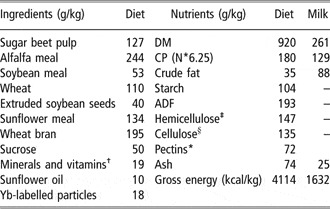
Animals were handled according to the care of animals in experimentation, in agreement with French national legislation (decree 2001-486, 06/06/2001). This experiment was carried out with INRA 1067 × PS Hyplus 39 (Grimaud group) rabbits. Kits from 24 litters were weaned either at 21 (W21 group, 12 litters) or at 35 (W35 group, 12 litters) days of age. From 14 days onwards, the young rabbits were fed ad libitum a special pelleted solid diet (Table 1), whereas does had free access to a commercial feed. To avoid the access of pups to mother’s feed and vice versa, does were placed in a separate cage from 14 days onwards, and a controlled suckling was done every morning. The rabbits had free access to water. Temperature was maintained at 19 ± 3°C. Light was on between 0700 and 2300 h. Litters were equalised at nine kits on day 21 by either withdrawal or adoption. Does were inseminated 25 days after parturition in order to avoid interactions between gestation and milk production. On day 28, three rabbits in seven litters per group were slaughtered for ileal digesta sampling, and were chosen according to their bodyweight within the litter (the lightest, the medium weight and the heaviest). On day 35, the five remaining litters per weaning group were separated according to the weight of rabbit (ranks 1-3-5-7 separated from 2-4-6-8, and exclusion of the lightest rabbit). Four kits stayed in the same cage, whereas four rabbits were moved to another cage. On day 42, the lightest and the heaviest rabbits of each cage were sacrificed for ileal digesta sampling.
Composition of experimental diet and maternal milk (as-fed basis)

*Water-insoluble pectins, calculated according to Gidenne Reference Gidenne(2003).
†Contained: 6 g/kg of salt, 5 g/kg of calcium carbonate, 1 g/kg of dl-methionine, 5 g/kg of vitamin premix (retinol 1.5 × 10⁶ IU/kg, cholecalciferol 2 × 10⁵ IU/kg, tocopherol 3000 mg/kg, thiamin 200 mg/kg), 5 g/kg of AL132® (containing 13.2 g/kg of robenidine).
‡Hemicellulose = NDF − ADF.
§Cellulose = ADF − ADL.
Diets and control of feed intake
Young rabbits were fed the diet described in the first part of this study (Gallois et al., Reference Gallois, Le Huérou-Luron, Fortun-Lamothe, Lallès and Gidenne2007), except between 21 to 28 and 35 to 42 days of age where the feed contained a marker of digesta flow (ytterbium) (Table 1). Indeed, the use of ytterbium is more adapted for digestibility measurements in the rabbit than the Cr2O3 (Blas et al., Reference Blas, Falcão e Cunha, Gidenne, Pinheiro, García and Carabaño2000) or the chromium mordant (Gidenne, Reference Gidenne1988). Labelled fibre particles were prepared according to the procedure described by Ellis and Beever (Reference Ellis and Beever1984). Briefly, a sample of the unlabelled feed was treated with a commercial detergent (at 100°C) and a heat-stable amylase (Termamyl, Novozymes, Bagsvaerd, Denmark) to remove lipids and starch, respectively. Labelling of the subsequent fibre particles (sieving of 0.1 mm) was then done by immersion in a solution of Yb2O3 at pH 3.75. Labelled fibres were then immersed in a citric solution at pH 2.5 to remove the marker fixed on sites with low affinity. After rinsing and drying at 50°C, labelled fibre particles were incorporated in the diet at 18 g/kg (Table 1).
Between 21 and 28 days of age, litter milk consumption was recorded in the morning by weighing does before and after the daily suckling. The solid feed intake was measured daily per cage between 21 and 28 days, and between 35 and 42 days of age.
Ileal digestibility measurements
A slaughter method was used to determine ileal digestibility. The rabbits were sacrificed by cervical dislocation (according to the Report of the AVMA Panel on Euthanasia, 2001). Slaughter was carried out between 1900 and 2100 h to maximise the ileal content and minimise the influence of caecotrophy occurring in the morning. Ileal contents were removed and pooled by litter on day 28 (distal 25 cm of the small intestine, three rabbits in seven litters per weaning group) or by cage on day 42 (distal 40 cm of the small intestine, two rabbits in ten cages per weaning group). Ileal contents were frozen, freeze-dried and then ground. The ileal digestibility of some feed components was determined: organic matter (OM), starch and crude protein (CP). The apparent ileal digestibility (ID, in %) was calculated according to the following equation:

On day 28, milk was considered as completely digested before the ileum. Thus, it was not taken into account in the calculation procedure.
Faecal digestibility measurements
For faecal digestibility trial, we recorded the solid feed intake daily from 23 to 28 days, and from 37 to 42 days of age. Faecal output was also recorded and dry matter (DM) determined (24 h at 103°C) daily between 24 to 28 and 38 to 42 days of age. The daily apparent faecal digestibility of DM was then determined to further improve the calculation procedure of digestibility. Caecotrophy was not prevented, and again milk was considered as completely digested. Then, a balance of ingested and digested diet components (milk and solid feed) was calculated assuming a complete milk digestibility.
The faecal output collected over the 4-day period was pooled by cage for the whole period, and the faecal concentration of OM, CP, crude fat, starch, NDF and energy was determined (EGRAN, 2001). Two calculation procedures were applied to determine the faecal apparent digestibility coefficients (FD). First, we used the classical formula for each nutrient described in the European method (Perez et al., Reference Perez, Lebas, Gidenne, Maertens, Xiccato, Parigi-Bini, Dalle Zotte, Cossu, Carazzolo, Villamide, Carabaño, Fraga, Ramos, Cervera, Blas, Fernández, Falcão e Cunha and Bengala Freire1995)

Secondly, we chose to move back the 24-h ingestion period regardless of the excretion period in order to consider the transit time of digesta along the digestive tract. Equations used for the new calculation procedure, called the 24-h lag method, were as follows:

Moreover, the ytterbium concentration of faeces was measured as for ileal digestibility, and the calculation procedure detailed in the previous section was used for an additional estimation of the apparent faecal digestibility (ytterbium method). This method allowed calculation without any assumptions with respect to intake level or faecal output, according to the following calculation:

Chemical analysis
The following chemical analyses were carried out on feed and faeces: DM, ash, gross energy, fibres, crude fat, starch and CP according to the published methods (EGRAN, 2001). The ytterbium concentration was determined by atomic absorption spectrometry (Solaar M S4; Thermo Electron, Waltham, MA, USA), after ashing (550°C) and boiling with a solution of HNO3 (1.5N) and KCl (2%). Only the analyses of ytterbium, DM and ash, starch and CP were carried out in ileal contents, because of the small amounts of available digesta at this site.
Milk composition was determined on a representative sample pooled from seven does of the same rabbitry at their 25th day of lactation. Milk was collected using a vacuum pump connected to a milker tube on does separated from their litters since the day before. DM, ash and CP were determined on the freeze-dried sample using procedures previously described for the solid diet. Crude fat concentration in the milk was measured according to the method of Folch et al. (Reference Folch, Lees and Stanley1957).
Statistical analysis
Data were analysed according to the GLM procedure of Statistical Analysis System (SAS online®; SAS Inc., Cary, NC, USA). For most parameters, the weaning age was the main effect tested in the model. For apparent faecal digestibility, the model included as main effects the weaning age, the method used and their interaction. The effect of the litter (28 days) or the cage (42 days) within each weaning group was also included in the model, and the effect of weaning age was tested according to the residual variability between litters or cages (split-plot model). Multiple means comparisons were then carried out using the Scheffe test. Finally, the effect of weaning age was tested independently for each method. P values were considered to be significant if P < 0.05. Tendencies were assigned at 0.05 < P < 0.10.
Results
Performances and intake behaviour of the young
No rabbit died during this experiment in both weaning groups. The daily weight gain of W21 rabbits was lower between 21 and 28 days of age as compared with the W35 rabbits (24.9 v. 29.5 g/day per rabbit, respectively, P < 0.01). Their growth rate was then similar to that of the W35 rabbits (36.7 g/day per rabbit between 28 and 35 days of age, 49.3 g/day per rabbit between 35 and 42 days of age, P > 0.10).
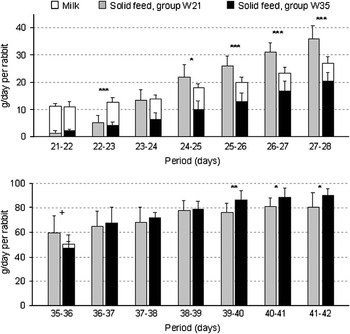
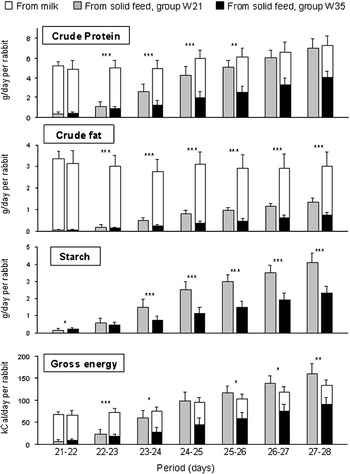
The W21 rabbits had not increased their solid feed intake 1 day after weaning (4.9 g/day per rabbit, Figure 1). The amount of solid feed ingested by the W21 rabbits increased considerably by day 2, leading to a twice-higher intake of starch and NDF (P < 0.001; Figure 2). The intake of starch or NDF remained almost twice higher in the W21 rabbits compared with the W35 rabbits until 28 days of age (P < 0.001). One day after weaning, the OM intake was 2.4-fold lower, then became similar and finally was 22% to 33% higher from 24 till 28 days of age in the W21 rabbits compared with the W35 rabbits (P < 0.05). During a 4-day period following weaning, the W21 rabbits ate more CP than still-suckling rabbits (−80% from 22 to 23 days, P < 0.001, to −16% between 25 and 26 days, P < 0.01). From 26 till 28 days, no differences in CP intake were observed between the two groups. Crude fat intake remained lower for the W21 than for the W35 rabbits from 22 till 28 days of age (from 15- to 2-fold less, P < 0.001). The gross energy intake was 68% and 21% lower for periods between 22 to 23 and 23 to 24 days, respectively, in the W21 group compared with the W35 group (P < 0.05). From 24 to 25 days of age, the level of gross energy intake was similar between the two weaning groups. Then, it was 14% to 21% higher in the W21 group compared with the W35 group (P < 0.05).
Dry matter intake from milk and solid feed, according to the weaning age of rabbits. Values are mean ± s.d.; n = 12 per weaning age. Significant effect of weaning age (*P < 0.05, **P < 0.01, ***P < 0.001, †P < 0.10). W21: rabbits weaned at 21 days of age; W35: rabbits weaned at 35 days of age.

Nutrient intake between 21 and 28 days of age according to the weaning age of rabbits. Values are mean ± s.d.; n = 10 per weaning age. Significant effect of weaning age (*P < 0.05, **P < 0.01). W21: rabbits weaned at 21 days of age; W35: rabbits weaned at 35 days of age.

The rabbits weaned at 35 days of age increased their solid feed intake immediately after weaning (Figure 1), and reached the intake level of the W21 group within 24 h following weaning. Feed consumption remained unaffected by the weaning age for 2 days, then it was 9% to 13% higher in the W35 rabbits compared with the W21 rabbits until 42 days of age (P < 0.05).
Pre-caecal digestion
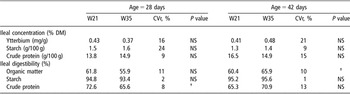
The weaning age did not significantly affect the ileal concentration of starch or CP at 28 and 42 days of age (Table 2). The ileal digestibility of starch was not affected by the weaning age, either at 28 days of age or at 42 days of age. The ileal digestibility of CP tended to be higher in the W21 group compared with the W35 group at 28 days of age (+7 points, P = 0.09), whereas digestibility of OM tended to be lower in the W21 group with respect to the W35 group at 42 days of age (−5.5 points, P = 0.10).
Composition of ileal digesta and ileal digestibility of the solid diet at 28 and 42 days of age, and according to the weaning age of rabbits

DM = dry matter; W21 = weaning at 21 days; W35 = weaning at 35 days.
Values are means; n = 4 to 10 per weaning age. CVr = coefficient of residual variation.
Effect of weaning age = NS P > 0.10, †P < 0.10.
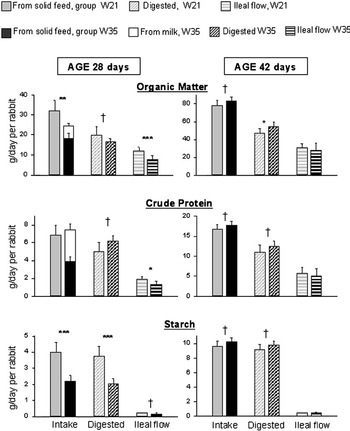
At 28 days of age, the W21 rabbits digested 84% more starch than suckling rabbits (P < 0.001, Figure 3), whereas the amount of digested OM only tended to be higher in the W21 rabbits than in the W35 rabbits at the ileal level (+20%, P = 0.09). Conversely, the amount of digestible proteins at the ileal level tended to be 19% lower in the W21 rabbits than in the W35 rabbits (P = 0.06). Thus, at 28 days of age, the quantity of OM and CP flowing towards the caecum was 56% (P < 0.001) and 42% (P < 0.05) higher, respectively, in the W21 group than in the W35 group. The ileal flow of starch was very low and only tended to be higher in the W21 group compared with the W35 group at 28 days of age (0.20 v. 0.15 g/day, P = 0.10).
Nutrient intake, digested and ileal flow at 28 and 42 days of age according to the weaning age of rabbits. Values are mean ± s.d.; n = 4 to 10 per weaning age. Milk components are assumed to be completely digested. Significant effect of weaning age (*P < 0.05, **P < 0.01, ***P < 0.001, †P < 0.10). W21: rabbits weaned at 21 days of age; W35: rabbits weaned at 35 days of age.

At 42 days of age, the amount of digested nutrients in the W21 rabbits tended to be or was lower compared with the W35 group (−13% for CP, P = 0.05; −6% for starch, P = 0.07; −13% for OM, P < 0.05). However, the amount of OM, CP and starch crossing the ileo-caecal junction was unaffected by the weaning age.
Whole-tract digestion
Faecal digestibility
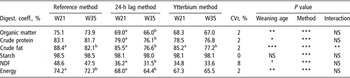
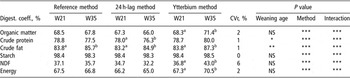
During the 23- to 28-day period, no interaction between the method used and the weaning age was highlighted, except for lipids (Table 3) for which the reference method differed from others. The reference method gave higher values for faecal digestibility than ytterbium or 24-h lag methods (P < 0.001). For lipids, the same differences among methods than those previously described were underlined. However, differences between the two weaning groups were emphasised or minimised according to the retained method, a phenomenon that explains the interaction (P < 0.01) between the weaning age and the method used. The faecal recovery rate of ytterbium, theoretically of 100% (excreted ytterbium × 100/ytterbium intake), amounted to 79·3% and 80·5% with the reference method, respectively, for the W21 and the W35 groups. They were of 98·3% (W21 rabbits) and 104.9% (W35 rabbits) with the 24-h lag method. Before 28 days of age, the three methods were in agreement regarding the impact of weaning age on the ability of rabbits to digest the solid feed. Most of digestibility coefficients (OM, CP, NDF, energy) were higher in the W21 group compared with the W35 group (from +1 to +6 points according to the nutrient considered). The three methods did not differ statistically for only two nutrients: starch and lipids. The digestibility of starch was about 98% irrespective of the weaning age, while the digestibility of crude fat was higher for the W21 than for the W35 rabbits (+6.3, +8.9 and +8.0 points, P < 0.05, respectively, for the reference, 24-h lag and ytterbium methods). For the 38- to 42-day period and for all the nutrients, significant interactions were detected between weaning age and method (Table 4). Faecal digestibility was unaffected by the method used in the W21 rabbits, whereas values varied among methods in the W35 rabbits. Coefficients calculated with the reference and 24-h lag methods were similar, but lower than those provided by the ytterbium method in the W35 group (P < 0.05). Thus, according to the reference method, the faecal recovery rates of ytterbium were 99.9% and 113.1% in the W21 and the W35 rabbits, respectively. The 24-h lag method gave values of 103.7% for the W21 rabbits and 119.2% for the W35 rabbits. As a result, conclusions about the weaning age effect on the digestibility of different nutrients differed among methods. The three methods were in agreement only for lipids and starch. The digestibility of lipids was lower in the W21 group compared to the W35 group (from −1.7 points to −3.5 points, P < 0.05), whereas the digestibility of starch was unaffected by the weaning age. Regarding the other components, digestibility values were either similar between the two weaning ages or higher in the W35 group than in the W21 group.
Whole tract digestibility between 23 and 28 days of age, according to the method and the weaning age of rabbits

W21 = weaning at 21 days; W35 = weaning at 35 days.
Values are means; n = 9 to 12 per weaning age.
CVr = coefficient of residual variation.
P values for the general model: NS P > 0.0,*P < 0.05, **P < 0.01, ***P < 0.001, †P < 0.10.
a,bWithin a method, means having different superscript letters differ between weaning ages (P < 0.05).
Whole tract digestibility between 37 and 42 days of age, according to the method and the weaning age of rabbits

W21 = weaning at 21 days; W35 = weaning at 35 days.
Values are means; n = 9 to 10 per weaning age.
CVr = coefficient of residual variation.
a,bWithin a method, mean values having different superscript letters differ between weaning ages (P < 0.05).
P values for the general model: NS P > 0.10, *P < 0.05, **P < 0.01, ***P < 0.001.
Digestive balance
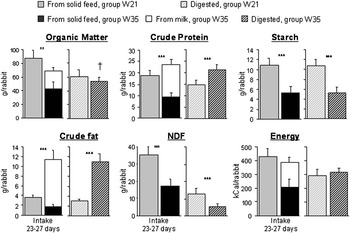
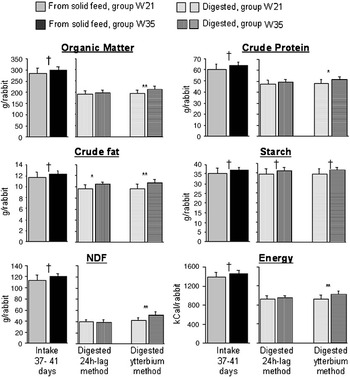
The total digestive balance was established for the first period studied, assuming that maternal milk was completely digested by the W35 rabbits (Figure 4), and by applying the digestibility coefficients obtained from the 24-h lag method. The quantity of digested OM only tended to be higher in the W21 rabbits compared with the W35 rabbits (+12%, P = 0.08), despite a higher intake of the former (+27%, P < 0.001). The amount of digested proteins and lipids were, respectively, 30% and 72% lower in the W21 group than in the W35 group (P < 0.001). But the amounts of digested starch and NDF by the W21 rabbits were 2.0- and 2.4-fold higher than those of the W35 rabbits (P < 0.001). Finally, the digestible energy intake was unaffected by the weaning age. Between 37 and 41 days of age, only few differences in the amount of digested nutrients were observed between the two groups of rabbits when using the 24-h lag method (Figure 5). Only the amount of starch digested by the W21 rabbits tended to be lower (−5%, P = 0.08), while the amount of digested fat was lower in the W21 group compared with the W35 group (9.6 v. 10.4 g/rabbit for the whole period, P < 0.05). Using the ytterbium method, all the quantities of digested nutrients were lower in the W21 group than in the W35 group from 37 to 41 days of age (from −7% to −19%, P < 0.05), except for starch whose level only tended to be 5% lower in the W21 rabbits compared with the W35 rabbits (P = 0.07).
Digestive balance between 23 and 28 days of age according to the weaning age of rabbits. Values are mean ± s.d.; n = 9 to 12 per weaning age. Milk components are considered as completely digested; Values for nutrients digested were obtained with the coefficients calculated with the 24-h lag method. Significant effect of weaning age (***P < 0.001, †P < 0.10). W21: rabbits weaned at 21 days of age; W35: rabbits weaned at 35 days of age.

Digestive balance between 37 and 42 days of age according to the weaning age of rabbits and to the method of measurement. Values are mean ± s.d.; n = 9 to 10 per weaning age. Significant effect of weaning age (*P < 0.05, **P < 0.01, †P < 0.10). W21: rabbits weaned at 21 days of age; W35: rabbits weaned at 35 days of age.

Discussion
Feed intake behaviour of the young rabbit around weaning
The milk availability influences the level of solid feed intake in the young rabbits, when modified either by the litter size (Fortun-Lamothe and Gidenne, Reference Fortun-Lamothe and Gidenne2000), by the weaning age (Piattoni et al., Reference Piattoni, Maertens and Mazzoni1999) or by a daily double suckling (Gyarmati et al., Reference Gyarmati, Szendrõ, Maertens, Biró-Németh, Radnai, Milisits and Matics2000). However, the digestive response to feed intake level is poorly documented in the literature. Our results showed that for young rabbits weaned at 3 weeks of age, the solid feed intake increased sharply after a delay of only 24 h. Two days after an early weaning, the level of solid feed intake was twice higher than for still-suckling rabbits. Thus, compared with suckling rabbits, early-weaned rabbits ate twice as much starch and fibres 2 days after weaning, whereas their level of protein intake was lower for 4 days after weaning. Consumption of lipids, essentially provided by milk, remained lower in weaned than in suckling rabbits. The rabbits weaned at 35 days of age increased their level of solid feed intake without any delay, thus reaching the same level of intake than rabbits weaned 2 weeks before.
Pre-caecal digestive capability of the young rabbit
Methodological aspects
The literature on ileal digestibility of milk components in young rabbits is lacking. To our knowledge, only one study assessed the faecal digestibility of milk in young rabbits. Digestibility values for OM, CP, lipids and energy from milk were 98.6%, 97.3%, 101.3% and 99.7%, respectively (Parigi Bini et al., Reference Parigi Bini, Xiccato, Cinetto and Zotte1991). In pre-ruminant calves fed with a spray-dried skim-milk powder enriched with tallow, starch and lactose, the faecal digestibility of nutrients varied between 92% and 96%, and over 94% of them were digested before the distal ileum (Guilloteau et al., Reference Guilloteau, Toullec, Grongnet, Patureau-Mirand, Prugnaud and Sauvant1986). Thus, the evaluation of ileal digestibility of solid feed may be underestimated for still-suckling rabbits, since some milk components may be still present in ileal contents. Another parameter that may have negatively affected the digestibility coefficients was the length of the small intestine sampled to collect ileal contents: 25 and 40 cm at 28 and 42 days of age, respectively, which represented approximately 18% of the total length of the small intestine. A compromise was done to obtain enough contents for essential chemical analysis (marker, crude protein, starch). However, values obtained in the present study with 28- and 42-day-old rabbits were very high when compared with results reported in the literature for growing or adult rabbits. For instance, ileal digestibility of OM comprised between 56% and 66% in our study, whereas some authors reported values extending from 28% to 61% in older rabbits (Gidenne, Reference Gidenne1992; Merino and Carabaño, Reference Merino and Carabaño1992; Gidenne et al., Reference Gidenne, Pinheiro and Falcão e Cunha2000). However, the variability of this measurement is often very high, and may explain part of these discrepancies (Blas et al., Reference Blas, Falcão e Cunha, Gidenne, Scapinello, Pinheiro, García and Carabaño2003).
Early adaptability to nutritional environment
At 28 days of age, the amount of digested starch by weaned rabbits was almost doubled, whereas the indigestible fraction reaching the caecum in 24 h was very low and only slightly higher than for suckling rabbits. This phenomenon was only a result of a higher amount of OM flow at the ileal level (+4.4 g/day per rabbit), as ileal starch concentrations were unaffected by the weaning age. Finally, intestinal digestive efficiency for starch was high (94%) in the young. Gutiérrez et al. (Reference Gutiérrez, Espinosa, García, Carabaño and De Blas2002) also observed a high capability of 35-day-old early-weaned rabbits (25 days of age) to digest starch in the small intestine (ileal digestibility close to 90%), even with high dietary starch levels (17% to 23% of DM). Thus, starch digestion seemed to be efficient very precociously and rapidly in young rabbits. This phenomenon would partly be explained by a quick adaptation of the enzyme potential of the rabbit. Indeed, higher maltase activities were underlined in weaned compared with still-suckling rabbits of the same age (Gallois et al., Reference Gallois, Le Huérou-Luron, Fortun-Lamothe, Lallès and Gidenne2007). Accordingly, an overload of starch being responsible for an imbalance of caecal microflora, as suggested by Cheeke and Patton (Reference Cheeke and Patton1980), due to a low capability of the endogenous digestive potential seems unlikely. Young rabbits classically weaned between 28 and 35 days of age would have the ability to digest starch, even if its level in does’ diet is relatively high (about 20%, De Blas and Mateos, Reference De Blas and Mateos1998), which is in agreement with Gutiérrez et al. (Reference Gutiérrez, Espinosa, García, Carabaño and De Blas2002) who recommended high levels of starch in feed for young. One limit to such an assertion is the botanical origin of starch. Maize starch is less digested in the small intestine than wheat or barley starch in both young (Blas et al., Reference Blas, Cervera and Fernandez-Carmona1994; Pinheiro and Gidenne, Reference Pinheiro and Gidenne2000) and older rabbits (Gidenne and Perez, Reference Gidenne and Perez1993). However, recent works have shown that an increased starch flow through the ileo-caecal junction, modulated by the origin of cereals incorporated in diet, would not have any negative impact on post-weaning caecal fermentation and mortality (Gidenne et al., Reference Gidenne, Segura and Lapanouse2005a and Reference Gidenne, Jehl, Perez, Arveux, Bourdillon, Mousset, Duperray, Stephan and Lamboley2005b). The higher flow of proteins reaching the caecum in early-weaned rabbits resulted from a higher digesta flow, as the composition of the ileal content was not affected by weaning age. However, the protein quality could be influenced by the nutritional status of the young, since suckling rabbits still ate proteins from milk origin at 28 days of age. This phenomenon may contribute to the differences observed in the caecal fermentative pattern between suckling and weaned rabbits, the last one presenting a lower ammonia concentration in their caecal content at 4 weeks of age (first part of this study, Gallois et al., Reference Gallois, Le Huérou-Luron, Fortun-Lamothe, Lallès and Gidenne2007).
Mid-term consequences of early nutritional changes
At 42 days of age, the flow of ileal digesta was not affected by the weaning age. However, the amounts of starch and protein digested at the ileal level tended to be lower when rabbits were early weaned, essentially resulting from a 5% lower solid feed intake. This observation could be related to the slightly lower enzyme activities observed in the small intestinal mucosa of 42-day-old early-weaned rabbits compared with classically weaned rabbits (first part of this study, Gallois et al., Reference Gallois, Le Huérou-Luron, Fortun-Lamothe, Lallès and Gidenne2007). These lower activities were especially a consequence of lower mucosa densities in early-weaned rabbits. But in this previous study, subclinical infections may have been responsible for this decrease in duodenal and jejunal mucosa densities, as early-weaned rabbits were more sensitive to disease. However, in the present study, no rabbit died in the experiment, suggesting that other phenomenon may be implicated to explain those mid-term negative consequences of an early withdrawal of milk and/or stimulation of solid feed intake. A large number of factors that can affect the structure and the function of the small intestine have been described and reviewed in the pig (Pluske et al., Reference Pluske, Hampson and Williams1997). In our case, premature withdrawal of milk could have been responsible for an abrupt removing of bioactive compounds implicated in the development of the small intestine, like epidermal growth factor or insulin-like growth factors. A hypersensitivity to food components that have not been modulated by milk in early stages in the case of early-weaned rabbits may have also influenced the further structure and function of the intestinal mucosa.
Whole digestive capability of the young rabbit
Methodological aspects
A European reference method for the in vivo determination of diet digestibility in growing rabbits (Perez et al., Reference Perez, Lebas, Gidenne, Maertens, Xiccato, Parigi-Bini, Dalle Zotte, Cossu, Carazzolo, Villamide, Carabaño, Fraga, Ramos, Cervera, Blas, Fernández, Falcão e Cunha and Bengala Freire1995) has been proposed by the European Group on Rabbit Nutrition (EGRAN, http://www.dcam.upv.es/egran/Default.htm). Based on a 4-day balance period, this method assumes that animals have constant feed intake and faecal output during the considered period. Thus, this method was recommended for rabbits aged 49 days at least. When applied to younger rabbits, it leads to overestimation of digestibility coefficients, notably due to a delay between the increase in feed intake and the corresponding faecal output (Debray et al., Reference Debray, Le Huérou-Luron, Gidenne and Fortun-Lamothe2003). Although no data of mean retention time are available for rabbits of this age, we hypothesised that the indigestible fraction of the diet will be found in the faeces about 24 h after intake. Between 23 and 28 days of age, the European reference method (Perez et al., Reference Perez, Lebas, Gidenne, Maertens, Xiccato, Parigi-Bini, Dalle Zotte, Cossu, Carazzolo, Villamide, Carabaño, Fraga, Ramos, Cervera, Blas, Fernández, Falcão e Cunha and Bengala Freire1995) led to high faecal digestibility values, and thus seemed not adapted for young rabbits since nutrient intake and faecal output remained unstable at this age. At 4 weeks of age, the 24-h lag method gave satisfactory results, similar to those obtained with internal dietary marker (Yb). Thus its use should be preferred. We encountered some methodological difficulties in measuring faecal digestibility between 37 and 42 days of age. Indeed, for rabbits weaned more than 2 weeks ago, the three methods we used gave similar values for faecal digestibility, since they already had a stable intake and faecal output. Conversely, for rabbits recently weaned (W35 group), the ‘Yb’ method gave values quite different from the other two, and the faecal recovery of ytterbium exceeded 100%. In our study, one main hypothesis should be considered: the quantity of excreta measured for the collection period was inappropriate regardless of the feed ingestion period considered. Thus, the quantity of fæces measured would be overestimated comparatively to the solid feed intake, and the 24-h lag method exacerbated these effects. As a result, we must consider the age of animal and its physiological status (steady state or not) to choose an adequate method.
Early adaptability to nutritional changes
Irrespective of the nutritional status of young rabbits, weaned or suckling, they were able to digest from 56% to 62% of dietary OM before the end of the small intestine. We estimated by difference with faecal digestibility that only 7% to 8% of ingested OM would be digested in the large intestine. Values reported in the literature are included in growing or adult rabbits between 12% and 27% according to the fibre percentage in the diets (Gidenne, Reference Gidenne1992; Merino and Carabaño, Reference Merino and Carabaño1992; Gidenne et al., Reference Gidenne, Pinheiro and Falcão e Cunha2000). A higher proportion of nutrient digested in the caeco-rectal compartment of older rabbits is relevant to the digestive maturation and the development of the microflora. This low level of digestion in the caecum could in part explain the absence of major differences in bacterial fibrolytic activities in the caecum of weaned compared with suckling 28-day-old rabbits (part I of this study, Gallois et al., Reference Gallois, Le Huérou-Luron, Fortun-Lamothe, Lallès and Gidenne2007). From 24 days of age onwards, the increased solid feed intake of weaned rabbits, and particularly their great ability to digest starch, allowed them to reach a similar digestible energy intake than digestible energy provided by the mixed milk and pelleted feed ration of suckling rabbits. This suggests that young rabbits could adjust their solid feed intake to its digestible energy concentration, comparably to rabbits older than 5 weeks of age (Lebas et al., Reference Lebas, Laplace and Droumenq1982). Literature dealing with intake regulation in the young rabbit is scarce, and often in disagreement. Thus, works of Pascual et al. (Reference Pascual, Cervera, Blas and Fernández-Carmona1998 and Reference Pascual, Tolosa, Cervera, Blas and Fernández-Carmona1999) led to similar conclusions as ours. Increasing the energy concentration of diet using starch (Pascual et al., Reference Pascual, Tolosa, Cervera, Blas and Fernández-Carmona1999) or lipids (Pascual et al., Reference Pascual, Cervera, Blas and Fernández-Carmona1998) led to a lower consumption of solid diet by young rabbits between 22 and 35 days of age. On the contrary, other studies suggested that the regulation of the solid feed intake in young rabbits would implicate other mechanisms than the level of the digestible energy. Thus, young rabbits fed a ‘high energy/high starch’ diet ingested more solid feed, with an equivalent amount of milk ingestion (Fortun-Lamothe et al., 2001) or furthermore with a higher milk intake (Debray et al., Reference Debray, Fortun-Lamothe and Gidenne2002; Gidenne et al., 2007). In our study, weaned rabbits ate 20% less digestible protein than suckling rabbits between 23 and 27 days of age. This deficit could be responsible for their lower growth observed in this study and in the first part of this study (Gallois et al., Reference Gallois, Le Huérou-Luron, Fortun-Lamothe, Lallès and Gidenne2007). This result highlighted that understanding the mechanisms underlying the feed intake regulation is essential to adapt the nutritional composition of the solid diet to the needs of young.
Mid-term consequences of early nutritional changes
As described in the Methodological aspects section, conclusions regarding the impact of weaning age on the efficacy of the whole-tract digestion markedly differed among methods between 37 and 42 days of age. The three methods were however in agreement for faecal digestibility of starch and lipids. Starch was almost completely digested (over 98%) irrespective of the weaning age, whereas dietary lipids were less valourised by rabbits weaned for more than 2 weeks. Debray et al. (Reference Debray, Le Huérou-Luron, Gidenne and Fortun-Lamothe2003) showed a decrease in the ability of the rabbits to digest dietary lipids after weaning. In our study, rabbits weaned at 35 days of age, namely for only 3 days at the beginning of the faeces collection period, should still be able to digest quite large amounts of lipids. The digestion of other nutrients could be slightly impaired in the early-weaned rabbits and could be linked to the lower enzyme activities measured in the first part of this study (Gallois et al., Reference Gallois, Le Huérou-Luron, Fortun-Lamothe, Lallès and Gidenne2007). To our knowledge, no data dealt with a potentially detrimental mid- or long-term effect of an early weaning on the digestive capacities of rabbits. These potential harmful consequences could be linked to the absence of compensatory growth of early-weaned rabbits before 49 days of age (Gallois et al, Reference Gallois, Le Huérou-Luron, Fortun-Lamothe, Lallès and Gidenne2007).
Conclusions
Early-weaned rabbits are able to adapt quickly to digest large amounts of new dietary components like starch and fibres. Thus, weaning itself does not seem to greatly impair the digestive maturation in the young rabbit. However, early-weaned rabbits need a short delay after weaning to increase their solid feed intake, which led to insufficient nutrient supplies and lower growth rate. Thereafter, young rabbits would regulate their solid feed intake according to the dietary digestible energy level, which could lead to insufficient protein intake for optimal growth. Our results highlighted that the analysis of mechanisms underlying the appetite regulation is essential in the future to provide adapted nutritional strategies for the young rabbits before weaning.
Acknowledgements
The authors thank Jean Paul Lallès (INRA Rennes, SENAH) for his assistance in manuscript writing, the staff of the UMR1289 ‘TANDEM ’ (INRA Toulouse) for its technical assistance: Patrick Aymard, Carole Bannelier, Jacques De Dapper, Jean De Dapper, André Lapanouse, Muriel Segura, Véronique Tartié. Cybelia (Glon group, France) is also thanked for its financial support.